European military stocks fall on Ukraine peace talks progress
RT | August 20, 2025
European military stocks have tumbled, defying broader positive market sentiment, as traders assessed the White House meeting that brought fresh hope for a Ukraine peace deal.
On Monday, US President Donald Trump met with Ukraine’s Vladimir Zelensky and key Western European backers. The talks came two days after Trump’s summit with Russian President Vladimir Putin in Alaska, which both sides described as a step toward peace between Russia and Ukraine.
The STOXX Europe Total Market Aerospace & Defense Index fell 2.6% on Tuesday, as traders viewed the ongoing negotiations as a chance to take profits following a strong rally in the sector. Shares in Italian defense firm Leonardo and Germany’s Hensoldt were down 10.1% and 9.5%, respectively. German defense supplier Rheinmetall and tank components maker Renk also declined 4.9% and 8.2%, respectively.
“Any de-escalation of tensions between Russia and Europe, and talk of spending more on US equipment, is negative for these companies,” Craig Cameron, head of European equities at Franklin Templeton, told the FT.
According to analysts, shares in defense groups could be seen as a rough indicator of progress in the Ukraine peace talks, as military supplies tend to benefit from ongoing conflicts.
European defense stocks surged in the first half of the current year, driven by Germany’s announcement in March that it would ease its strict debt limits to enable a new wave of investment in defense and infrastructure, amid growing concerns that the US may scale back its role in European security and the Ukraine conflict. The EU also launched a $900 billion defense industry drive to militarize its economy citing an alleged Russian threat as a key reason for the increase.
The latest US-brokered talks reportedly ended with an agreement in principle to arrange a face-to-face meeting between Putin and Zelensky, although the Kremlin has yet to confirm the plan.
AFP reported on Tuesday that Putin has offered to host the talks in Moscow, but Zelensky rejected the proposal, insisting on a neutral location.
Kiev’s backers fail to sway Trump on Russia – analyst
RT | August 19, 2025
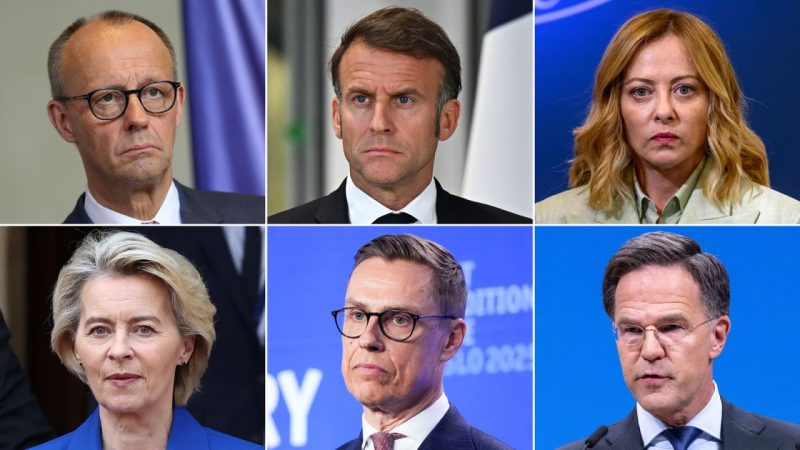
The White House meeting on Monday between US President Donald Trump and Ukraine’s European backers produced no major results, political analyst Sergey Poletaev has told RT.
Trump met to discuss the Ukraine conflict with Vladimir Zelensky and some European leaders in Washington just days after holding a summit with Russian President Vladimir Putin in Alaska.
“Just like in Anchorage, no decisions were announced afterward. And that, in itself, is a sign that something important is happening,” Poletaev said, noting that the talks are part of a larger diplomatic struggle, the ultimate goal of which is to win over the US president.
He suggested that Moscow is seeking to draw Washington out of the conflict, while Europe and Ukraine are pushing to keep the US firmly entangled. Following what Poletaev called Putin’s “gambit” in Anchorage, the European delegation hurried to Washington to persuade Trump to toughen sanctions against Moscow and maintain weapons deliveries to Kiev.
So far, it looks like they came up empty.
Poletaev pointed out that, unusually for the US president, he did not repeat European talking points after the meeting. Instead, Trump reminded the European leaders at the start of the summit that “they had no real power,” the analyst said.
While the immediate effort may have failed, “most likely, Europe will soon try again,” Poletaev stressed.
According to the analyst, the key issue at Monday’s summit was security guarantees for Ukraine. Russia has insisted “from day one” that any such commitments must be tied to “neutrality and disarmament,” he said.
Europe and Kiev, meanwhile, are desperately trying – by hook or by crook – to preserve Ukraine’s armed forces, and even to push for a NATO presence on Ukrainian soil.
According to Poletaev, the attempts are “naive and desperate,” but whatever form security guarantees take in any eventual peace deal will ultimately determine “the fate of the Kiev regime.”
“For now, there’s no compromise in sight,” Poletaev concluded. “And as Ukraine continues to lose ground on the battlefield, the room for maneuver – for both Kiev and its European backers – is shrinking fast.”
Alaska meeting is a milestone of the decline of NATO and EU
By Martin Jay | Strategic Culture Foundation | August 19, 2025
Is the EU and its member states collectively heading towards the abyss? For so many years analysts have thundered headlines of the flavour “end of the EU” – even myself I must admit – but in recent days the EU itself has never been placed so low on the world map as it was in the so-called Alaska meeting. A few weeks earlier, many supporters of the EU were stunned at just how pusillanimous the EU commission boss was facing Donald Trump, as she accepted 15% tariffs across the board on all EU goods entering the U.S. – absolutely amazing given there was no announcement of trade talks where officials on both sides would negotiate a more appropriate rate. This move alone revealed so much. The EU is, if nothing else, a pseudo superpower administration owned wholesale by the world’s largest corporations – like Pfizer, the U.S. drag maker who Ursula von der Leyen made part of a 600bn euro EU vaccine fund – and so it would have been absurd for her to have resisted.
And now it is the EU’s time to take another body blow as it plays a secondary role in the negotiations for a peaceful settlement for the Ukraine war. Yet few are betting on a peace deal. Even Trump himself doesn’t seem to hold out much hope as Putin has made it clear that he wants the Russian-speaking regions of eastern Ukraine to be handed over as part of the deal, plus guarantees that Ukraine can never be a NATO member.
Whether NATO will even be around in the coming months is another matter as it is worth noting that this transatlantic organization, which the U.S. runs, is currently going through its lowest point of its history, like the EU. What idiotic U.S. journalists who shout out to Putin in the press conference “are you going to stop killing civilians” don’t ask is more telling. Of course, they don’t shout out such stupid questions to Netanyahu when he visits, who is the architect of the most horrific genocide of the 21st century, where women and children who manage to miss the bombs which reign down on their tents are now starved to death – all supported by the U.S. But to Putin, U.S. journalists don’t ask “how’s the war going in Ukraine, sir?” or even “what do you think will happen to NATO if your army forces Zelensky to surrender?”.
The meeting was never going to be a deal breaker for a peace deal in Ukraine as the journalists’ temporary accommodation was a clue to that. What the Alaska meeting set out to do was for both leaders to show reverence for one another so that bigger deals can be worked out – perhaps energy and infrastructure deals in Alaska itself or even more rare earth and minerals in Russia – and if you listen carefully to Trump’s responses to questions from U.S. media, you will note the hints.
But with U.S.-Russia relations moving in a soberer, grown up direction, rather than the silly Biden stance, there are many possibilities on the table. Ukraine may well be resolved at some point if some of these super deals can see the light of day.
For the Europeans and the EU, they will have to dance to the beat of the Putin-Trump drum which makes them look even more ineffective and congruent to the bigger picture geopolitics which they crave. Same goes for NATO. Both of these institutions have poured oil on the fire in recent years by only seeing the war option – or more specifically the ‘escalate to de-escalate’ option which backfired spectacularly every single time that now to justify the huge amounts of money shovelled into a war project which cannot benefit the West, its leaders only have one narrative to repeat over and over again now, so that they can save their own jobs and credibility. War talk. More war. War, war and even more war.
It’s incredible. The EU’s top diplomat Kaja Kallas, Estonia’s former PM gave a clue recently to the tunnel vision that the EU and NATO have about the Ukraine war. They see it as the EU’s first test at hard-core foreign policy action, despite it being bank rolled by “Daddy” Trump. Probably the most delusional and idiotic quote of the month has to go to Kallas who told journalists “If Europe cannot defeat Russia how can it defeat China?”. The entire thinking is really all based on conflict rather than conflict prevention which is also about saving both NATO and the EU from its worst ever credibility crash when Russia finally defeats the Ukrainian army. These EU buffoons have created, since 2014 and even before, a war which was inevitable, which they don’t have the means, military capacity or even the leadership to win and yet their priorities now are making a massive cover-up of the failure and protecting their own dynasties. Europe is not preparing itself for war. This is the huge bluff. It is preparing itself for a huge fall which is unprecedented and may well be a catalyst for both the demise of the EU and NATO as we know them.
Trump Holds Firm Peace Deal with Putin Despite European Pushback
Sputnik – 19.08.2025
European leaders and Zelensky didn’t succeed in changing Trump’s peace proposal, which the US president had reached with Putin, former defense politician and chief of staff with the Sweden Democrats Mikael Valtersson told Sputnik.
“The ball is now clearly in Ukrainian and, to a lesser degree, European hands. A strong and clear ‘no’ from the European side might result in broken relations between the US and Europe/Ukraine. Therefore we can expect a ‘maybe’ from the European/Ukrainian side,” he said.
However, Valtersson also notes that playing for time may be part of Zelensky’s strategy, hoping that eventually, a shift in the geopolitical landscape might restore the hardline anti-Russian alliance. This strategy, though, is likely a “lost cause,” according to the former Swedish defense expert. By dragging out the negotiations, Zelensky and his allies risk further territorial losses to Russia and an increase in war casualties.
“If the European leaders really cared for Ukraine, they would pressure Zelensky to accept a peace deal that includes swapping of territories. This would minimize Ukrainian territorial and human losses,” Valtersson argues.
Yet, the expert predicts that European obstruction of a peace deal will continue, driven by the hope that a miraculous turn of events will “rescue” Ukraine. This approach could extend negotiations for weeks, but ultimately, he believes Trump’s patience will wear thin, forcing a clear decision.
In the meantime, the peace process is largely aligning with Russia’s expectations, with Trump holding firm to the terms agreed with Putin in Alaska.
Ukrainian drone commander claims attack on key oil pipeline to EU
RT | August 18, 2025
The head of Ukraine’s UAV forces has claimed that Kiev’s drones have disabled a Russian pipeline which delivers oil to Hungary and Slovakia.
Both Budapest and Bratislava earlier confirmed that supplies via the Soviet-era Druzhba pipeline, which runs through Ukraine, had been suspended. Russia has not confirmed the attack.
“The Druzhba pipeline is out of service. The flow of oil has been completely halted indefinitely,” Robert Brovdi, commander of Ukraine’s Unmanned Systems Forces, wrote on Telegram on Monday evening.
He said Ukrainian drones had struck the Nikolskoye pumping station in Russia’s Tambov Region, southwest of Moscow.
Hungarian Foreign Minister Peter Szijjarto denounced the reported strike as “outrageous and unacceptable,” accusing Kiev of trying to “drag Hungary into the war in Ukraine.”
Ukrainian Foreign Minister Andrey Sibiga responded that Hungary should direct its “complaints” to Russia and criticized Budapest for continuing to rely on Russian energy supplies.
Szijjarto, however, maintained that importing oil from Russia is in Hungary’s national interest. “As Hungary’s foreign minister, my mandate is clear: Hungary’s interest comes first. Period,” he wrote on X.
Ukraine has repeatedly targeted energy infrastructure inside Russia, including oil depots and refineries. In March, Ukrainian forces struck a gas metering station near Sudzha, which before the conflict was part of a pipeline supplying the EU.
Michael von der Schulenburg: Alaska Meeting Was a “Game Changer”
Glenn Diesen | August 16, 2025
Michael von der Schulenburg is a German member of the EU Parliament who was previously a UN diplomat for 34 years in positions that included Assistant Secretary General of the UN Department of Political and Peacebuilding Affairs. Schulenburg explains why he thinks the Alaska meeting was a game changer.
Ridiculous Europe
By Ted Snider | The Libertarian Institute | August 18, 2025
By President Donald Trump’s transactional criterion, NATO has been a costly failure that needs fixing or needs to be cut lose. Europe has failed to pay the price and has left the United States with the financial and military burden of defending Europe. The war in Ukraine has proven the point.
But that was never the point of NATO. The point of NATO was never economic nor transactional. The point of NATO was, in large part, to keep Europe militarily coordinated with, dependent on and subordinate to the United States. The point wasn’t to extricate the U.S. from Europe, it was, as Lord Ismay, the first Secretary General of NATO explained, precisely “to keep the Americans in Europe,” while keeping the Russians out.” By that criterion, NATO has been a massive success. The Ukraine war has proven that point too.
While it continues, with a loud voice, to make demands regarding the defense of Ukraine and the terms for ending the war, Europe has revealed to the world that it is unable to mount that defense without the U.S. and that it has been sidelined in the negotiations, leaving decisions about Europe to the Americans.
Europe is unable to supply Ukraine with the weapons it requires and that Europe insists Ukraine must receive. The United States has reiterated that it will no longer be the font from which Ukraine’s weapons flow. On August 10, Vice President J.D. Vance said clearly again that the U.S. is “done with the funding of the Ukraine war business.” Europe does not have the stockpile to spare nor the capacity to manufacture a fraction of the weapons Ukraine needs. And though Europe has, by necessity, accepted the American plan that Europe can send U.S. weapons to Ukraine if they pay for them, that will not provide Ukraine with even close to the amount of weapons the U.S. was supplying. And even that was not enough.
Not only can Europe not supply the weapons, they cannot supply the troops. Europe has, to its embarrassment, publicly conceded that it cannot mount the number of troops needed to send to Ukraine as peacekeepers after a ceasefire.
The war in Ukraine has exposed Europe’s dependence on the United States. Europe can neither provide the weapons nor the troops to defend itself. Europe has been revealed as dependent on, and subordinate to, the United States.
Ukraine is now facing a crisis on the battlefield. Russia’s military efforts were long dismissed as not rapidly gaining ground. But keeping the media focus on that criterion kept the public in the dark about the real criterion. Russia’s war of attrition was devouring and exhausting Ukraine’s weapons and, more importantly, manpower. The shrinking Ukrainian armed forces is running out of weapons to defend itself against the massive and still growing Russian army. There are not enough soldiers to fill the front line. That leaves gaps in the line. As Ukraine moves troops from other places to fill those gaps, it leaves even bigger gaps in those places. Russia’s war of attrition was setting up this moment. And now, Russian troops are breaking through those gaps in the lines.
For the first time in the war, the Russian armed forces have broken through key defensive lines and their rapid move west is now measured in miles and not inches. Logistical hubs critical for the Ukrainian armed forces to supply their troops in the east have been partially infiltrated and surrounded. Russian positions are being consolidated and roads that are lifelines to Ukrainian soldiers have been partially cut. There is also reliable reporting from both Russian and Ukrainian sources that the rapid advance has brought the Russian army all the way to the heavily fortified second Donbas fortification line, which they have now breached. Beyond that defensive line is largely open fields with no organized line of defense. The Russian armed forces may then be free to rapidly advance, making the Russian goal of control of the entire Donbas a real possibility. For the first time in the war, the Ukrainian armed forces face the very real possibility of collapse.
Geoffrey Robers, professor emeritus of history at University College Cork, told me, “All the signs point to a significant Russian breakthrough north of Pokrovsk. The Ukrainians may be able to stem the Russian advance but I doubt they will be able to throw it back, at least not without fatally weakening their already crumbling defensive lines in other sectors of the front.” Alexander Hill, professor of military history at the University of Calgary, told me that “regardless of how one might categorise this most recent Russian breakthrough, the reality is quite clearly that the rate of Russian advance has sped up recently and Ukrainian forces are having increasing difficulty in plugging gaps in their line.” Roberts says that “if Putin doesn’t obtain the rest of the Donbass through a deal with Trump, he will certainly secure it by military means, in months, if not weeks.”
But, despite this threatening reality, Europe is pleading for the war to go on. While Trump pushes for a diplomatic end to the war, Europe continues to push for an unreachable dream of a military solution. They insist on supporting Ukraine in its aspiration of goals that were already unrealistic over a decade ago. They continue to push for an open door to Ukrainian NATO membership even though Russian President Vladimir Putin went to war to prevent that—and will not stop the war without preventing that—Trump has vetoed it and even Europe has been reluctant to grant it. Putin made it clear on the threshold of the war, that that is what he went to war to prevent. Even NATO has acknowledged that. That goal was unrealist before the war, and it is even more out of reach with Russia winning the war.
The goal of reincorporating Crimea has been unaligned with reality, since 2014, when a referendum and the reincorporating of Crimea into Russia was already a reality. The idea of a Donbas that is at least semiautonomous has been unrealistic since the conception of the Minsk Accords. That idea became more unrealistic with the mounting assaults on Donbas prior to the war and the attacks on the rights of ethnic Russians in Donbas that began in 2014 and have grown worse since the start of the war.
As the Ukrainian armed forces face collapse and defeat, Europe continues to push for a continuation of the war that they cannot help. The War in Ukraine has exposed, not only Europe’s helplessness and dependence, it has revealed its ridiculousness.
Trump’s make or break moment after the Alaska summit
By Salman Rafi Sheikh – New Eastern Outlook – August 18, 2025
While Western media fixated on optics and diplomatic jabs, the Alaska summit quietly marked a turning point that shifted the conversation from temporary ceasefires to the possibility of lasting peace.
This moment demands clarity from Donald Trump: will he commit to a peace-first strategy or allow his European allies to drag the US deeper into costly, unwinnable conflicts?
The Summit
In the lead-up to the Alaska summit, Washington’s playbook was predictable: press Moscow for a ceasefire. President Donald Trump echoed what had become NATO’s default position. In a videoconference just 48 hours before the summit, European leaders and Ukrainian President Volodymyr Zelensky aligned on ceasefire being the top priority.
But ceasefires are rarely solutions. They’re political sedatives—short-term fixes that freeze conflicts without resolving them. Therefore, at the Alaska summit, Russia’s Vladimir Putin flipped the script. Rather than another temporary pause, he proposed a permanent peace framework that could involve a security pact involving mutual guarantees from the US and Russia, limits on NATO expansion, and a demilitarized buffer that includes Ukraine. It was the clearest signal yet that Moscow wasn’t angling for a breather; it wanted a structural reset.
Most importantly, the US President was able to see merit in this framework. In social media post, Trump said,
“A great and very successful day in Alaska! The meeting with President Vladimir Putin of Russia went very well, as did a late-night phone call with [Ukrainian] President Zelensky of Ukraine, and various European Leaders, including the highly respected Secretary General of NATO. It was determined by all that the best way [was] to go directly to a peace agreement … and not a mere ceasefire agreement, which often does not hold up.”
For the Europeans, this is not only a shocking development but also a glaring indication that they do not and cannot control the peace process in the sense that they can unilaterally dictate its terms. Therefore, they are already raising so-called “questions” about whether even the peace agreement will hold or not, or whether Russia can be trusted or not, or whether they can normalize their ties with Russia or not, or whether it is serious about peace. These questions are little more than attempts to throw wrenches into what probably is the best opportunity to bring peace to Europe.
Donald Trump faces a choice
Though he publicly aligned with Vladimir Putin on the need for a permanent peace agreement, President Donald Trump now faces intense resistance from a familiar front: hawkish European leaders who would rather prolong the war—and pull Washington deeper into it—than confront the core issue driving the conflict.
The choice before Trump is stark. He can either listen to Europe’s war camp or to Moscow’s push for a comprehensive peace deal. If he sticks with the narrow, short-term goal of a ceasefire while ignoring Russia’s central demand—ending NATO’s eastward expansion—he risks dragging the US into a grinding geopolitical entanglement. Worse, he’ll be walking away from one of his signature campaign promises: to end America’s endless wars and ‘Make America Great Again’.
Rejecting Russia’s terms outright won’t come without consequences. It would require doubling down on the existing strategy: ramping up sanctions, sending more weapons to Ukraine, and locking the US into a long-term conflict with no clear off-ramp. Such a move would not only escalate tensions with Moscow but also push Russia and its allies, such as China, to further reinforce the politics of creating a new, alternative global order. The idea of a parallel world order—already gathering momentum—would gain new political urgency and legitimacy. Trump has already clashed with BRICS members like India through trade wars and punitive rhetoric. A wider conflict could force him into even more confrontations on multiple fronts.
But there is another path—one that reverses the pressure. Instead of bowing to European hawks, Trump could put the heat on them. If Europe refuses to address the root causes of the war, the US could begin scaling back military support for NATO and Ukraine. Let Brussels handle the fallout. Such a move would send a clear message: if Europe wants perpetual conflict, it can fight it alone. (In fact, Donald Trump did give such statements during his election campaign.) And European leaders would know the likely outcome, that is, without US backing, Ukraine risks losing even more territory to Russia, with little chance of recovery.
As such, this is Trump’s moment of reckoning. He can choose to steer the US toward a long-overdue peace, or sleepwalk into another forever war, one that reshapes the global order and leaves America footing the bill.
Salman Rafi Sheikh is a research analyst of International Relations and Pakistan’s foreign and domestic affairs.
Ukraine Ramps Up Provocations To Sabotage Peace Efforts
Sputnik – 18.08.2025
US President Donald Trump will receive Ukraine’s Volodymyr Zelensky at the White House for the first time on Monday since the spat between them in February.
As Zelensky prepares to meet Trump at the White House, Ukraine is desperately attempting to jeopardize the peace process, which gained momentum after the historic meeting in Alaska.
Crimean Bridge Bombing Thwarted
A Ukrainian terrorist attack on the Crimean Bridge has been prevented, according to Russia’s Federal Security Service (FSB).
Ukrainian authorities planned to target the strategic transport link with an explosive-laden vehicle, the second such plot in the past four months, the FSB pointed out.
“Despite all the trickery by the Ukrainian terrorists, the FSB officers managed to defuse the explosive device and also detain all those involved in its delivery to Russian territory,” the security agency said.
Nuclear Plant Drone Attack Disrupted
Russian anti-drone systems have intercepted an attempted drone attack by the Ukrainian Armed Forces on a nuclear power plant in Russia’s Smolensk region.
Ukraine tried to use ‘Spis’ strike drones to conduct the attack.
Pipeline Drone Strike Provocation
Russian oil supplies to Hungary via the Druzhba pipeline have been suspended following the Ukrainian military’s attacks on the pipe’s key distribution station “Unecha” in Russia’s Bryansk region.
Hungary sees the strikes as an attempt on the country’s sovereignty and energy security, FM Peter Szijjarto underscored.
Pascal Lottaz: US-Russia Relations Decoupling From Europe?
Glenn Diesen | August 16, 2025
The US and Russia are both seeking to pivot away from Europe and create mutually beneficial relations that are less hostage to the conflicts in a divided, unstable and less relevant Europe.
The Delicate Exit
By William Schryver – imetatronink – August 16, 2025
My coalescing sense of the underwhelming Alaska Chats is that Russia has not materially varied from its longstanding terms.
Trump rolled into town with his “stealth” flyover, imagining he was the one giving an audience to Putin.
From start to finish it was perfectly evident to any discerning observer that it was just the opposite, and that Putin was there to repeat and to emphasize Russia’s apparently inviolable terms.
As I understand it, the Russians have said they will implement a conditional temporary ceasefire in the south while NATO/AFU forces withdraw from Donetsk.
No one has said anything about ending the Special Military Operation, nor of the disposition of territories.
In essence, the Russians are saying:
“We’ll temporarily stop destroying you on the southern part of the line of contact while you retreat from the northern part, and then we’ll demand you also withdraw from the southern part, and lay down your arms.”
I cannot understand how so many people seem to doubt the resolve of the Russians to continue fighting western forces for years to come pursuant to their clearly enunciated objectives.
In each successive year of this war, Russian strength has augmented across the spectrum. Russia is not only outproducing the combined west by several multiples, but their military hardware is now indisputably superior in most key categories.
The only exit route for the US/NATO is capitulation, which in this instance entails withdrawing NATO military presence to the 1997 borders, as stipulated in the NATO-Russia Founding Act of 1997.
How they opt to frame that capitulation is up to them.
As I noted in my February 2024 analysis of the Tucker Carlson interview of Vladimir Putin:
Tucker Carlson: Do you think it is too humiliating at this point for NATO to accept Russian control of what was two years ago Ukrainian territory?
Vladimir Putin: I said let them think how to do it with dignity. There are options if there is a will.
Up until now there has been the uproar and screaming about inflicting a strategic defeat on Russia on the battlefield. Now they are apparently coming to realize that it is difficult to achieve, if possible at all. In my opinion, it is impossible by definition. It is never going to happen.
It seems to me that now those who are in power in the West have come to realize this as well. If so, if the realization has set in, they have to think what to do next. We are ready for this dialogue.
That both Tucker Carlson and others have failed to correctly interpret Putin’s words is incomprehensible to me. So permit me to paraphrase them in language that is perhaps more understandable to the dimwitted and disingenuous people in the west who continue to misrepresent them:
“We offered them an early out, and they rejected it in favor of an appeal to arms in order to inflict what they imagined would be a severe strategic defeat against Russia on the field of battle. But their reach greatly exceeded their grasp. They cannot defeat us. Now let them seek a delicate exit from the mess they’ve gotten themselves into — but we will achieve our objectives.”
No matter how the would-be masters of empire try to spin defeat into victory, most everyone around the world will still know the score. And it is this disabused illusion of imperial military supremacy that will rapidly accelerate its inexorable decline.
Ukraine kills civilians trying to cross into Russia – senior diplomat
RT | August 16, 2025
Ukrainian troops have over the course of the conflict killed hundreds of civilians attempting to cross the frontline into Russia, senior diplomat Rodion Miroshnik has told the media.
Miroshnik, who serves as the Russian Foreign Ministry’s ambassador-at-large for the Kiev regime’s war crimes, said the cases were documented through testimony and video evidence.
“There are hundreds of cases. There are instances where people were shot while trying to cross the [front] line, bombarded with drones, attacked,” the diplomat told the TASS news agency on Friday.
Miroshnik went on to claim that Kiev’s forces deliberately murder civilians in the new Russian region of Donetsk.
“There were cases where Ukrainian forces went through the basements of houses and threw grenades at people ‘as a preventive measure,’ he said. Such tactics, seen in the towns of Avdeevka, Selidovo, and Dzerzhinsk in the Donetsk People’s Republic (DPR) left areas “completely cleared” of civilians, he added. The same happened in Chasov Yar, a key Ukrainian stronghold liberated by Russian forces two weeks ago.
According to the diplomat, evidence suggests that Kiev’s forces kill those whom Ukraine no longer sees as its own citizens, but rather as “separatists” waiting to be liberated by Russia.
In June, the Russian Foreign Ministry accused Kiev of deliberately exterminating civilians in Donbass, including mass killings of the elderly and drone strikes on residential buildings.
Russia will not overlook any crimes committed against the civilian population in violation of international humanitarian law, Miroshnik stressed.
The diplomat argued that under international conventions Ukraine is obligated to investigate alleged war crimes and hold perpetrators accountable but claimed that Kiev is unlikely to do so and that its Western backers will not apply pressure.
Miroshnik added that Russia will push for the extradition of Ukrainian war criminals, noting that around 108,000 criminal cases have already been opened and roughly 500 individuals have been convicted, including some in absentia.
Featured Video
BRITAIN’S WARNING: PREPARE FOR WAR
or go to
Aletho News Archives – Video-Images
From the Archive
How Ukraine Tortured and Slaughtered Donbass
By Kit Klarenberg | Al Mayadeen | July 11, 2024
Almost immediately after the proxy war erupted, ISIS-tier footage of the torture and murder of Russians in Ukrainian custody emerged.
On July 6th, the New York Times published an astonishing investigation: In Ukraine, Killings of Surrendering Russians Divide an American-Led Unit. The article documents in grim detail how Chosen Company, an international volunteer battalion for Kiev, routinely executes Russian prisoners of war. It is the very first mainstream admission that this practice – a brazen breach of the Geneva Conventions, and a grave war crime – is widespread among Ukraine’s fighters, both foreign and homegrown. … continue
Blog Roll
 Aletho News
- Pentagon designates Chinese cultural centers national security threat
- Israel Demolishes Home Of Lebanese Journalist Whose Viral Film Exposed Pager Attack
- Record Oil, Empty Tanks: The UAE’s Miracle Recovery
- Burnham tackles Britain’s poverty with aggression in Yemen
- Peace in Ukraine: the easy way – or the hard way
- Trump & the Rrrrussians
- US taxpayer money laundered back through Ukraine – Musk
- Before COVID, an NIH lab chief proposed making a SARS-like bat virus more infectious
- Gates, Bourla on Trial in Netherlands Accused of ‘Great Reset’ Scheme at Vaccine Injury Hearing
- BRITAIN’S WARNING: PREPARE FOR WAR
- If Americans Knew
- An error has occurred; the feed is probably down. Try again later.
- No Tricks Zone
- Two New Studies Find Thwaites Glacier Melt Cannot Be Driven By Human Activity Or A Warming Ocean
- E-Cars Reduce CO2 Emissions By Only 41% Compared To Internal Combustion Engine Vehicles
- Predictions Made By Renowned Climate Professor Over Past Decades Have Been Proven To Be Poor
- New Study Suggests Large Regions Of The Pacific Ocean Have Been Cooling For The Last 80 Years
- Germany’s Green Energy Debacle: High Energy Costs Force Kahla Porzellan to Close After 182 Years!
- New Study: 50 Years Of The Most Aggressive ‘Net Zero’ Policies Can Only Affect The Global Climate By 0.03°C
- US September “Heat” Was No Record…Many Records Set Decades Ago
- Latest European Green Energy Debacle; Portugal’s Largest Flagship Solar Park Insolvent!
- Green Energy Debacle: German Expert Professor Fritz Vahrenholt Warns Of Severe Economic And Social Consequences
- Two More Paleo Reconstructions Affirm Meters-Higher Sea Levels Across Ireland, Brazil 7000-6000 Years Ago

