Russian diplomat accuses Kiev of genocide
RT | January 20, 2025
The Ukrainian military is conducting “language-based genocide,” senior Russian diplomat Rodion Miroshnik claimed on Sunday.
Captured Ukrainian soldiers “have reported they were given orders to kill Russian speakers,” the official tasked by the Russian Foreign Ministry to record alleged Ukrainian atrocities in the conflict with Russia told Izvestia.
Miroshnik was commenting on the discovery of civilian bodies in a recently-liberated village in Russia’s Kursk Region. He asserted that the alleged Ukrainian policy amounts to “elimination of all civilians” in the area, which Kiev recognizes as Russian.
Russian authorities are investigating Ukrainian troops for suspected terrorism, after the bodies of civilians, who were apparently bound, beaten, and murdered by Kiev’s forces, were discovered in the settlement of Russkoye Porechnoye.
The village remained under Ukrainian control since late August, when it was captured during a Western-supported incursion into the Russian region. The Russian Defense Ministry listed it last Friday as freshly-retaken from Ukrainian forces.
On Sunday, the Foreign Ministry described the discovery as evidence of a “massacre” and the latest confirmation of the “terrorist and neo-Nazi essence of the Kiev regime,” as spokeswoman Maria Zakharova put it. She accused Western supporters of the Ukrainian government of turning a blind eye to Kiev’s crimes, and charged that foreign officials secretly condone such behavior.
The Russian Investigative Committee is probing the Ukrainian military for alleged terrorism, based on the reports from Russkoye Porechnoye. A person convicted of such a crime can be sentenced to life imprisonment in Russia.
A Telegram channel associated with the forces responsible for repelling the Ukrainian incursion in Kursk Region released footage on Saturday of Russian troops inspecting the village and finding seven heavily-decomposed bodies in two separate cellars. In both cases, people were reportedly bound and beaten, before being killed.
At one of the locations, a body was too damaged to tell whether it belonged to a man or a woman, with evidence suggesting the use of explosives. Most of the victims were described as elderly people, who presumably had failed to flee from advancing Ukrainian troops.
Officials have vowed to hold the perpetrators accountable, with Zakharova stating that, in the absence of action by relevant international bodies, Russia will pursue justice on its own.
Local police have received statements concerning over 1,100 people missing since the start of the Ukrainian incursion, acting Governor Aleksand Khinshtein reported earlier this month. Of those, 240 have been located, he added.
Blinken overruled America’s top general on Ukraine peace talks – NYT
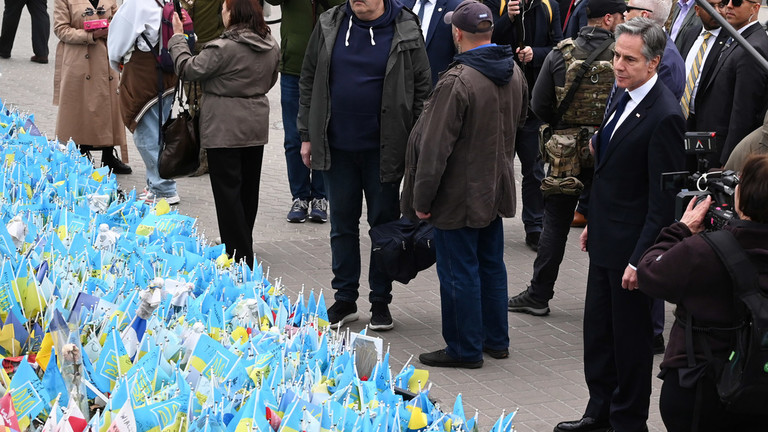
US Secretary of State Antony Blinken in front of a memorial for fallen Ukrainian soldiers, Kiev, Ukraine, May 14, 2024. © Getty Images / STR/NurPhoto
RT | January 20, 2025
Outgoing US State Secretary Antony Blinken urged Ukraine to continue its military efforts against Russia rather than pursue peace negotiations in 2022, the New York Times reported on Saturday.
In late 2022, Chairman of the Joint Chiefs of Staff Mark Milley advised Kiev to capitalize on its battlefield successes by seeking peace talks with Moscow. However, Blinken insisted that Ukraine should press on with its military campaign, the newspaper wrote.
“Less a peacemaker than a war strategist,” the US diplomat frequently argued against more “risk-averse Pentagon officials,” lobbying for advanced American weaponry to be sent to Ukraine, NYT wrote.
Washington has spent “approximately $100 billion” on Ukraine since the conflict escalated in February 2022, while allies and partners have contributed an additional $150 billion, Blinken said during a January appearance at the Council on Foreign Relations.
The outgoing Biden administration has expedited arms deliveries to Kiev ahead of the inauguration of US President-elect Donald Trump, who has indicated that he might reduce military aid to Ukraine in favor of addressing domestic priorities.
The Biden administration had been covertly arming Ukraine months before the conflict intensified, Blinken admitted in a January interview with the NYT. “Starting in September and then again in December, we quietly got a lot of weapons to Ukraine to make sure that they had in hand what they needed to defend themselves – things like Stingers, Javelins that they could use,” he said.
Russia and Ukraine initially engaged in peace negotiations in early 2022 in Istanbul. Both sides provisionally agreed to a truce under which Kiev would renounce its NATO membership ambitions, adopt neutrality, and limit its military size in exchange for international security guarantees. However, Ukraine later withdrew from the talks at the urging of then-UK Prime Minister Boris Johnson, according to David Arakhamia, a Zelensky-allied MP and chief negotiator for Kiev.
Last month, Swiss diplomat Jean-Daniel Ruch similarly accused the US and UK of derailing peace talks between Kiev and Moscow. Speaking to the French-language media outlet Anti-Thèse, Ruch claimed that Johnson acted “on duty for the Americans.”
Moscow has reiterated its willingness to resume peace negotiations, provided they are based on the Istanbul draft agreements and reflect the “new territorial realities,” including the accession of four former Ukrainian regions to Russia and recent battlefield developments.
Russian Victory or Political Settlement in Ukraine?
Ambassador Chas Freeman, Alexander Mercouris & Glenn Diesen
Glenn Diesen | January 15, 2025
I had a conversation with Alexander Mercouris and Ambassador Chas Freeman, a former Assistant Secretary of Defense for International Security Affairs. Besides being a former ambassador to Saudi Arabia, Freeman’s career included opening China with Henry Kissinger and Richard Nixon in the 1970s and developing the post-Cold War security architecture in Europe.
We discussed the messy world that the Biden Administration is handing over to Trump. There is seemingly a genuine desire to end the proxy war in Ukraine, and Trump may also achieve a ceasefire in Palestine. However, NATO’s escalations in Ukraine to sabotage possible negotiations and the reckless support for HTS in Syria have reduced the possibilities available to Trump. Will the Ukraine War be resolved by a Russian victory or a political settlement?
300 Million Cubic Meters a Day? Russia-Iran Pipeline Promises Major Energy Boost
By Svetlana Ekimenko – Sputnik – 18.01.2025
The Comprehensive Strategic Partnership treaty signed between Moscow and Tehran on January 17 shed light on a new project to deliver Russian gas to Iran.
The gas pipeline’s route has been agreed on, it will pass through Azerbaijan, Russian Energy Minister Sergei Tsivilev confirmed.
Negotiations are in the final stages, volumes have already been agreed, and the sides are developing an approach to pricing, Tsivilev added. Russia will cover the infrastructure costs.
Volumes
The project is expected to start with deliveries of up to two billion cubic meters annually, with the prospect of increasing to 55 billion cubic meters.
When Gazprom and the National Iranian Gas Company (NIGC) signed a strategic memorandum on Russian gas supplies in June 2024, the Iranian side noted that about 300 million cubic meters of gas per day will be supplied daily (109 billion m3/year) via the Caspian Sea for domestic consumption and supplies to neighboring countries.
The declared volume of 55 billion cubic meters annually is comparable to the capacity of the Nord Stream twin undersea pipeline system to Europe, sabotaged in 2022.
The 30-year deal will supply Russian gas to Iran both for domestic consumption and for neighboring countries.
Why Does Iran Need Russian Gas?
Despite holding the world’s second-largest natural gas reserves (34 trillion cubic meters, after Russia), Iran is facing a fuel shortage as demand for natural gas exceeds production. Most of these reserves are untapped due to US-led sanctions that stall investment and technology improvement.
Iran’s main gas fields are concentrated in the south, and large consumers are in the north, in a region with a fairly harsh climate. In winter, Iran faces a daily shortfall of at least 260 million cubic meters of gas, straining the electricity supply.
Russian oil product exports shoot up – Bloomberg
RT | January 17, 2025
Russia’s refined fuel exports have surged to their highest level in nearly a year, even as the US imposed new sanctions on the country’s energy sector last week, Bloomberg reported on Thursday.
Seaborne shipments of Russian petroleum products hit an 11-month high, averaging 2.5 million barrels per day (bpd) in the first ten days of January, the outlet said, citing data from analytics firm Vortexa. The surge marks a 12% increase compared to December’s daily average and represents the highest level since February 2024, according to the report.
The US slapped a new round of sanctions on Russia last week in coordination with the UK. The measures targeted major Russian oil companies such as Gazprom Neft and Surgutneftegas, as well as dozens of vessels allegedly used to transport Russian oil in defiance of Western restrictions, which the US has described as a ‘shadow fleet’.
Moscow has condemned the sanctions, calling them “illegal,” with Kremlin spokesman Dmitry Peskov warning that they could destabilize global energy markets.
The latest round of sanctions targets more than 180 tankers allegedly involved in Russian trade, primarily focusing on crude oil shipments. However, only about 4% of petroleum products exported between January 1 and 10 were transported on sanctioned tankers, data from Vortexa, showed. Additionally, there has been no deviation observed in the voyages of these vessels.
The recent surge in Russia’s petroleum products exports is primarily driven by surging shipments of diesel and fuel oil, the outlet said. Revenue gains from fuel exports in December exceeded the decline in crude oil earnings, supported by soaring gasoil flows and higher prices, Bloomberg said citing the International Energy Agency (IEA).
Diesel and gasoil exports, which make up about 40% of Russia’s refined-fuel shipments, jumped 17% from December levels to 1.08 million bpd, the highest since last February. Shipments from Baltic ports rose by over 50%, contributing to the growth, data showed.
Fuel oil flows also increased, reaching 792,000 bpd which represented a 19% increase and the highest level since July 2023. Volumes to Africa saw the most significant rise.
Kremlin reacts to UK plans for military build-up in Ukraine
RT | January 17, 2025
The possible appearance of NATO-linked military infrastructure in Ukraine is a concern for Russia, Kremlin spokesman Dmitry Peskov said on Friday, commenting on a new security deal between London and Kiev.
The 100-year bilateral agreement, signed by Ukrainian leader Vladimir Zelensky and British Prime Minister Keir Starmer on Thursday, states that the two nations will “explore options for deploying and maintaining defense infrastructure in Ukraine, including military bases, logistics depots, reserve military equipment storage facilities and war reserve stockpiles.”
While the establishment of such facilities would in itself not amount to Ukraine joining NATO, a scenario that Moscow strongly opposes, the British plans are “certainly worrisome”, Peskov told a media briefing.
He also relayed the Russian government’s negative attitude toward British statements that its defense cooperation with Ukraine would include enhanced “collaboration on maritime security” near Russian borders, including in the Azov Sea. Peskov emphasized that the Azov Sea is a Russian inner body of water, so that “interactions between Ukraine and Britain can hardly happen there.”
Moscow views NATO as a hostile entity and has accused its members of waging a proxy war against Russia, using Ukrainian soldiers as ‘cannon fodder’.
The UK has been one of the most vocal supporters of Kiev’s war effort. In the 100-year agreement, it has committed to no less than £3 billion ($3.66 billion) in annual military assistance to Ukraine until financial year 2030/31.
NATO’s eastward expansion since the 1990s – conducted in violation of assurances given to Moscow to secure its acceptance of Germany’s reunification – is one of the primary causes of the current hostilities, according to Russian officials.
Accepting the Truth About Ukrainian Casualties is the Only Real Path to Peace
Will the Truth About Ukraine’s Staggering Death Toll Finally Bring an End to the War?
By Michael Vlahos | Landmarks: A Journal of International Dialogue | January 10, 2025
They say “all wars must end.” Yet how does this actually happen? First, all parties must agree — to go down that path together. Next, they must enter into formal negotiation, which almost always means horse trading, compromise, and accommodation. Finally, and most important, all belligerents must want the war to end.
Russia almost certainly wants this. Its minimum territorial objectives are within reach. Moreover, the destruction of Ukrainian military potential — equipment, infrastructure, and stockpiles — is almost complete. Furthermore, the General Staff’s strategy of attrition is approaching its endpoint. The Ukrainian Army is breaking, and Ukrainian national society is literally on the eve of destruction.
Within the “collective West,” the new “Decider” and the majority of Americans also want this war to end. Yet powerful constituencies in EU and American politics are emotionally invested in keeping war going. Red Hawks and most of the Blue Establishment are committed to defanging Russia and demonstrating Alliance strength and cohesion. A settlement that reeks of defeat, they say, will only embolden predatory “autocracies” and further fissiparous “extreme right wing” populism in Europe.
The Trans-Atlantic War Party Establishment, therefore, is determined to deny the Decider a free hand. If Mr. Trump gives away too much to Mr. Putin, he will be derided as an “appeaser.” Red Hawks — including barons in his new administration — will pressure him to bargain from “a position of strength,” creating an instant fissure in his authority if he shows weakness, and an instant, exploitable opening for Blue. Their bitter establishment, still licking its electoral wounds, will leap at the opportunity to tar Trump as a Paper Tiger, abdicating America’s predestined world leadership while also abdicating the sovereignty of the American Century: They will declare, “Even his advisers say so.”
However, if the new president gives in, and “shows strength” by up-arming Ukraine, and offering only a suspension of hostilities, the war will likely go on. Putin has declared that Russia will not accept a truce, armistice, or ceasefire in lieu of a permanent settlement. A long-term compact can be achieved, he insists, only by accommodating Russia’s inviolable strategic needs. Absent this, negotiation will fail, and failure would surely lead to much buyer’s remorse and dismay among those millions who voted for Trump’s promise to bring the fighting to an end.
For “45/47” it would represent a personal failure as well. After all, he vowed to end the war with speed and éclat: Éclat in the sense of “acclamation” as well as “brilliant success.” This is no trivial matter for him: Success could only elevate and enhance his now-mythic persona. In contrast, failure would be a body blow to his stature.
Thus, failure now beckons from two directions. If Trump “appeases,” then Blue will launch him into the meme trajectory of “weak king, enemy comprador.” However, if his Peace Ship fails, and the war goes on, he will be fatefully captured by the War Party, and the conflict will become “Trump’s War.” He will then be well and truly stuck tight in their hand-crafted Tar Baby and its tender snare.
So how then can a new president thread a course between the Scylla and Charybdis of antagonists, foreign and domestic? Perhaps, like Odysseus, the best course might be to “choose the lesser of two evils.”
Here, the lesser evil is a settlement that both accommodates Russia and saves Ukraine. The greater evil is a continuation of the war, leading to the destruction of Ukraine and the breakup of NATO — and just possibly, another world war.
All this means taking on, and overthrowing, the grip of the War Party (Red and Blue) on this nation’s affairs. There is only one way, moreover, to do this: He must break the iron narrative of “Appeasement” — where the only strategic choice is between war and surrender. Thankfully, the hammer and chisel that will break it is at hand.
It means, simply, that the president must tell the whole truth, at long last, about this war.
The Ukraine proxy war against Russia was sold through the greatest Black-and-White story ever told: Of naked aggression unleashed by a maniacal dictator, the latest threat in a long lineage of Evil, from Kaiser to Hitler to Stalin to Mao, and now, the tyrant Putin.
The truth is that the United States, after 2009 (and especially 2014), relentlessly curated conflict between Russia and Ukraine, with the ultimate intent of expanding NATO and breaking Russia. This is the real story. Highly authoritative expert commentary on how it happened is easily accessed: For example, the lectures and videos of John Mearsheimer, and the almost biblical epic volume of Scott Horton, Provoked. There are many, many sources, both scholarly books and an Internet library of unimpeachable analysis.
Yet official “truth” — from the US and NATO governments — has never veered from the iron narrative that is the Manichaean testament of Putin perfidy, Russian savagery, and a “long, twilight struggle” of good vs. evil, of democracy vs. tyranny, of light against the darkness. Moreover, the “commanding heights” of “the collective West” — its entire ruling establishment — sold its credulous electorates this story, supplemented daily by full injections of Ukrainian propaganda. This “Information Op” was itself fully funded by the US and NATO, and orchestrated by a contractual alliance between intelligence agencies and hundreds of PR firms.
This united front presented by Government, Mainstream Media, Intelligence and the propaganda industry effectively marginalized the voice of actual reality. Those advocating for “foreign policy restraint” were labelled “isolationists.” Those who presented the actual backstory to the war were dismissed as Putinists or Orc lovers or Vatniks.
Over three long years of war, however, actual reality began to sink in. More and more Americans became disenchanted with the war and increasingly suspicious of the official story, and of a Biden administration that, on so many fronts, and with so many issues, had simply, brazenly, lied to the American people. Moreover, by the autumn of 2023, the Ukrainian war effort was visibly failing, a reality that propaganda could no longer conceal.
Today, Ukraine stands at the precipice of national existence.
Ukraine in 1994 was 52 million strong. Then the draining began. The best and the brightest sought opportunity in the EU and Russia. Ukraine was a nation of perhaps 33 million in 2022. Today, a quarter of that already-diminished country’s population has fled to the European Union, and another quarter is in the now Russian oblasts, or residing as new migrants in the Russian Federation. The nation itself has shrunk by half.
Yet this is only one edge of the cliff. Ukraine’s fertility has collapsed. Prewar, it was already one of the lowest in Europe. The years of war have pushed it down below 1.0, perhaps even to 0.7. In the war, Ukraine has sustained shockingly massive casualties. Combined with the sheer number of able-bodied men who are fleeing the country, both draft-dodgers and deserters, or those who were migrants loath to come home, Ukraine — sans settlement — is poised to keep shrinking. Within a generation it may wither to the size of Belgium, perhaps even that of Belarus.
Then there is the matter of casualties. Kiev and Washington — and the entire Media and Official Propaganda industrial complex — has been silent on the subject of battlefield losses until recent months, when the yawning catastrophe could no longer be denied. Yet all along there have been signs and signals and harrowing data points. Stitched together, this is the story they tell.
In the first 18 months of the war — simply counting military obituaries and dead SIM cards — comes to ~330,000 Ukrainian soldiers KIA. Moreover, more than 50,000 lost one or more limbs. Moreover, in the last 18 months, monthly losses intensified. Kiev itself has declared that the army needs 30,000 replacements a month just to maintain the current force. Does this mean that, from September 2023 to date, another ~540,000 soldiers were lost?
Here, it is necessary to be mindful of what Soviet historians call “irrecoverable” losses. Hence, a soldier who will never return to the fight is “irrecoverable.” Killed, crippled, missing: This is the true sum of an army’s losses in war. For Ukraine, arithmetic says that number is not less than ~920,000 men.
Yet not all of these are dead or crippled. Deserters also represent, in a very real sense, irrecoverable casualties, as these are the able-bodied who have fled the country, or who have gone to ground inside Ukraine. Eurostat reports that 650,000 men of fighting age have fled Ukraine. Furthermore, reeling under Russian hammer-blows across the Donbass Front, desertions are reportedly over 200,000 in 2024. Thus, Kiev has been forced to raise its monthly mobilization target from 30,000 to 40,000.
Ukrainian journalists cite a desertion rate of 160 per day in early 2024, rising to 200 by summer, and then jumping to 380 by autumn. This suggests that desertion, over the past year at least, has accounted for a thick slice of irrecoverable losses, perhaps 4500-5000 per month. The sudden surge in desertion after September 2024 has been driven by crushing exhaustion and defeat. This in turn has pushed the state to desperate measures. All “conscription” in Ukraine today takes the form of violent kidnapping, even of the sick, aged, and infirm. Yet in spite of the utmost brutality, that 40K per month target is now short about 20,000 each month.
Moreover, actual irrecoverable losses, across the board, are almost certainly understated. For example, many platoon and company commanders simply do not report desertions, for fear of punishment by their field grade superiors. Likewise, the number of missing KIA is massive, given the sheer number of Ukrainian corpses left on the battlefields. A recent composite of casualty estimates puts the KIA total at 780,000. Adding in the severely wounded, total irrecoverable Ukrainian battle losses could be as high as 1.2 million, after 1000 days of war.
To put all this in perspective: Today’s shrunken Ukraine is half the size of the French Republic in 1914. In World War I, France lost 3.6 percent of its population: A monstrous and unnecessary national bloodletting, and a stain on the very idea of “Civilization.”
America’s proxy war against Russia — goading and pitting Ukraine against a nation nearly 8 times its size — has led to yet another unnecessary bloodletting. Ukraine has lost 3.9 percent of its population. Hidden from us for years, in plain sight.
What hath America wrought? Biden’s narrative narcissism would have us believe the United States has been heroically defending democracy against tyranny and pure evil. How he boasted, loudly, that America was bleeding Russia white — all for the price of not one American soldier. What a bargain! However, in sharper focus, an American emperor and his court, in their lust to bring Russia to its knees, destroyed another nation (and this time, not a “primitive,” but rather a “European” nation) to no purpose but to fulfill its own vanity.
Unwittingly perhaps, the real effect of Biden’s fulmination was to fulfill the enemy’s existential need. Curating and handcrafting this naked American proxy war, ironically, gave Russia the signal opportunity to halt NATO expansion, and buy itself strategic breathing room. Biden’s assault served to mobilize and renew Russian national identity. Eager and blind, an addled Emperor thus became Russia’s strategic helpmate.
Now try out this counterpoint. Imagine an alternative reality where Mr. Putin actually agrees to a ceasefire in-place. This is the last fallback wet dream of the US/NATO War Party. An armistice — with NATO “peacekeepers” — would surely let the collective West rejuvenate and rearm Ukraine. A new army, drafted from the 18-25 age cohort, including even women, might then be harnessed by the War Party to have another go at Russia, and give us yet another vicarious national bleed.
In this fantasy, a nation of 20 million (or less) would be trumpeted as the return of Ulysses, i.e., the million fighting men who fled, and their families, would return to their homeland to “fight the good fight” yet again. In the next war, a righteous Ukraine, eager and steel-annealed to exact revenge, would unleash “Fire and Sword” on the Russian serpent: A summoning of NeoCon Nirvana.
Yet think: An armistice premeditating another war could lead only to the further, final hollowing-out of Ukraine. Any male person in that cursed country — given the terrors they know — will surely flee: “Get out now before it’s too late!” The irreversible downhill slope in fertility keeps singing, ominously, of an irreversible path toward national extinction. Ukrainians will never, ever embrace yet more blood after the sheer terror of 2022-2025.
The Ukraine Question must be permanently settled.
Only this argument can silence Red Hawks and the Blue War Party alike. All the peoples American Empire has ravaged and wrecked this century — Afghanistan, Iraq, Libya, Syria, Yemen — stand as mute witness to the dark descent of a once stainless and world-redemptive American Mission. The new president could make use of this American myth about itself to proclaim to the world that “The Fall” stops here.
Bringing peace to Ukraine is the very smallest mercy this nation might ever offer to those millions of innocents betrayed by America’s supremely venal, exiting emperor. Adding further to the argument that this all must end: Russia too has suffered in this war. Their KIA is about twice what America suffered in Vietnam, from a population slightly smaller than the US in 1960. Russia will seek no more wars, whatever ever-ardent keyboard War Hawks declare.
Surely, President Trump can end the madness of another “Forever War” — cold or hot — with Russia. This, without hesitation or reservation, is the greater evil we face.
Surely, a permanent settlement in Ukraine is the lesser of two evils.
Michael Vlahos is author of the book Fighting Identity: Sacred War and World Change. He taught strategy at Johns Hopkins University and the Naval War College and joins John Batchelor weekly on CBS Eye on the World. Follow him on @Michalis_Vlahos
Trump unable to end Ukrainian conflict – media
By Lucas Leiroz | January 16, 2025
Western media apparently does not believe in Donald Trump’s ability to end the war in Ukraine. After months of desperate campaigning against the US president-elect, accusing him of being “pro-Russian” and neglecting the Ukraine issue, Western mainstream outlets are now claiming he never had such ability or intention, and that his campaign promise was simply “bluster.”
Reuters published an article on January 15 claiming that Trump’s promise to end the conflict between Ukraine and Russia “in 24 hours” was a bluff with no basis in reality. According to the news agency, people close to the president-elect said that any negotiations or agreements are still long away, and that an end to hostilities is not possible in the near future.
“Advisers to President-elect Donald Trump now concede that the Ukraine war will take months or even longer to resolve, a sharp reality check on his biggest foreign policy promise – to strike a peace deal on his first day in the White House. Two Trump associates, who have discussed the war in Ukraine with the president-elect, told Reuters they were looking at a timeline of months to resolve the conflict, describing the Day One promises as a combination of campaign bluster and a lack of appreciation of the intractability of the conflict and the time it takes to staff up a new administration,” Reuters’ article reads.
The assessment coincides with some recent statements in which Trump has expressed frustration at not being able to advance his diplomatic plans before his inauguration. He repeatedly said he plans to meet with Russian President Vladimir Putin “long before” six months of his presidency, but at the same time has expressed some skepticism about the future of the conflict. For example, Trump recently said that it would be easier to achieve a ceasefire in Gaza than in Ukraine – which proved true, given the end of hostilities between Israel and Hamas announced on January 15.
“I think, actually, more difficult is going to be the Russia-Ukraine situation [than Gaza] (…) I see that as more difficult. (…) I don’t think it’s appropriate that I meet (Putin) until after the 20th, which I hate because every day people are being – many, many young people are being killed,” Trump said.
Reuters’ journalists, citing their sources, claim that despite the apparent impossibility of achieving a quick peace, there is a consensus among members of Trump’s team on the need to take some emergency measures, such as canceling Ukraine’s accession process to NATO, as well as trying to “freeze the battle lines”. In addition, Trump’s advisers warn the president to demand “security guarantees” for Ukraine, which they consider to be an important and necessary step to create the conditions for a peace agreement.
“While the exact contours of a Trump peace plan are still being mulled, Trump’s advisers generally support taking the possibility of NATO membership for Ukraine off the table, at least for the foreseeable future, and freezing the current battle lines. Most high-ranking Trump advisers also support giving Ukraine a material security guarantee, such as the creation of a demilitarized zone patrolled by European troops. So far, the Trump team’s attempts to end the war have proceeded in fits and starts, underlining the degree to which campaign promises can run into the reality of complex diplomatic negotiations,” the article adds.
In fact, this all seems like a real waste of time on the part of Trump’s advisers. Whether Ukraine’s NATO membership process continues or ends does not change anything in the conflict, since it is already certain that Kiev will not be allowed to join. It is a consensus among Republicans and Democrats that NATO should not admit Ukraine as a member, but rather use it as a proxy in the war. Although Biden and the Democrats show a supposed “support” for such membership, this seems to be a mere rhetorical tool, without any practical meaning.
In the same sense, it is pointless to talk about “freezing the lines” or “giving guarantees to Ukraine”, since only the Russians can decide on these matters. Moscow will not freeze the front lines at least until all of its reintegrated territories are liberated and fully protected by demilitarized border zones.
Moreover, it is not Kiev that is in a position to demand “guarantees”, since Russia is the aggressed side in this war, with the special military operation having begun in 2022 precisely as a response both to NATO expansion and to the massacre of Russians that Kiev has been carrying out since 2014. The position to demand security guarantees belongs to the Russians, not to Ukrainians or Westerners.
In the end, it seems that the Western media is beginning to admit what analysts have been saying since the elections: Trump’s promise to end the war was never feasible. It is not the US that is in a position to demand an end to hostilities, since only the winning side can end a conflict. In fact, the war will end only when Moscow assesses that its strategic objectives have been achieved.
Lucas Leiroz, member of the BRICS Journalists Association, researcher at the Center for Geostrategic Studies, geopolitical consultant.
You can follow Lucas on X (formerly Twitter) and Telegram.
‘NATO Lost’: Ukraine War Backfires, Brings Russia and China Closer Together
Prof. Glenn Diesen on BreakthroughNews
Glenn Diesen | January 14, 2025
I discussed on BreakthroughNews how NATO lost the Ukraine War. NATO has also discredited itself as a security provider by provoking the war, rejecting what were initially reasonable Russian security concerns, and then boycotting all diplomacy and negotiations for three years.
In 2014, NATO based the coup in Kiev despite knowing that pulling Ukraine into NATO’s orbit would likely trigger a war and only 20% of Ukrainians even wanted NATO membership. From the Minsk peace agreement to the Istanbul negotiations, every path to peace since was rejected and sabotaged by NATO due to maximalist objectives. After Russia invaded Ukraine in 2022, NATO could not defeat Russia on the battleground, it could not collapse the Russian economy, and it could not isolate Russia in the international system. Russia has now aligned itself closer with China and a just peace in Ukraine is likely not achievable.
For the next decades, Russia’s economic connectivity will be directed to the East and its increasingly powerful military will be primarily tasked to deter the West. While the Ukrainians suffered the most in this war, Europe also suffered a great defeat as its security, economy, political stability, and geopolitical relevance will continue to decline.
Türkiye confirms attempt to attack key gas pipeline
RT | January 15, 2025
Turkish Energy and Natural Resources Minister Alparslan Bayraktar has confirmed that an attempted attack took place on the TurkStream natural gas pipeline last weekend.
The Russian Defense Ministry had earlier reported that Ukraine targeted the compressor station in Russia’s Krasnodar Region, which supplies gas to TurkStream. The attempted sabotage took place on Saturday and involved nine kamikaze drones launched by Ukrainian forces. According to the ministry, the attack was largely thwarted. One fixed-wing drone crashed close to a gas meter and caused minor damage, which was swiftly addressed by the facility’s personnel, it said.
Speaking to journalists at the Turkish parliament on Wednesday, Bayraktar confirmed that an attack had taken place and provided assurance that the pipeline’s operations had not been affected.
“There was no interruption in gas flow after the attack. The pipeline continues to deliver gas at the same capacity,” he said.
TurkStream is a critical energy corridor, transporting natural gas from Russia to Türkiye under the Black Sea. It also remains the sole route supplying Russian natural gas to southern and southeastern Europe after Ukraine refused to extend a gas transit agreement with Moscow this year.
In 2024, gas shipments via the pipeline increased by 23%, reaching 16.7 billion cubic meters (bcm). The pipeline comprises two sections: one serving Türkiye’s domestic needs, while the other transits gas to Bulgaria through the Strandzha station. This Balkan route extends through Bulgaria and Serbia to Hungary, with connections facilitating the distribution of Russian gas to other EU states. With a total capacity of 31.5 bcm annually, TurkStream plays a vital role in regional energy security.
Russian officials have accused Kiev of attempting to sabotage the energy link on multiple occasions in recent years. In response to the latest attack, Kremlin spokesman Dmitry Peskov accused Ukraine of continuing with its policy of “energy terrorism.”
READ MORE: Lavrov blames US for TurkStream attack
During a press conference on Tuesday, Russian Foreign Minister Sergey Lavrov suggested that the US may have been involved in an attempt to sabotage the gas facility.
“I have a firm belief that the US needs no competitor in any fields, starting with energy,” Lavrov stated.
The State of Western Warcraft
Deep Dive with Lee Slusher | January 12, 2025
In early 2023, the head of the US European Command and Supreme Allied Commander of NATO, General Christopher Cavoli, remarked, “precision can beat mass.”1 This is true; precision can beat mass. But some countries now have the capability to render Western precision much less precise, both by “hard kill” (kinetic) and by “soft kill” (electronic). More to the point, these countries now possess both precision and mass, whereas the West is left to rely on a degraded version of the former and has long since abandoned the latter.
Power Projection versus National Defense
The “unipolar moment” of the post-Cold War period has led to thoroughly misguided notions about the nature of military power. Here it is important to understand the difference between power projection and national defense. Most militaries exist to provide the latter, i.e., the means by which to protect their nations from threats in their respective regions. Very few ever hold the ability to project power far from home.
But the US military primacy of recent decades, specifically the ability to wage and sustain war in far-flung locations, has become to many the hallmark of military power writ large. In this view, any nation unable to project power globally—essentially everyone except the US—is therefore inferior on the whole. This view is incorrect. What matters ultimately in war is the force that can be brought to bear, both the attacker’s and the defender’s, at the specific time and place it is needed.
Consider the conclusion many drew about Russia in the wake of the Assad regime’s collapse. “Russia is a paper tiger with nukes!” According to such thinking, Russia’s inability to continue propping up Assad, or its decision not to do so, somehow translated into weakness elsewhere, most notably in Ukraine. This, too, is incorrect.
When Russia intervened in Syria in 2015, it was entirely uncontroversial to conclude that this operation was likely the limit of Russia’s power projection capabilities. Yes, the country has formidable strategic air, naval, and rocket forces, but these serve mainly as a deterrent. The primary focus of all other Russian forces is to defend Russia, especially on its Western and Southern borders opposite NATO. Here Russia remains incredibly strong. Similar logic applies to China. For instance, those who mock the country’s lack of a true “blue water” naval capability overlook the potency of that force in the waters that line China’s shores.
Operation Desert Storm was the watershed moment for the brief period of US military primacy. It occurred shortly after the fall of the Berlin Wall and shortly before the collapse of the Soviet Union. There is an ongoing debate in military circles over the significance of Desert Storm. Both critics and supporters continue to misunderstand several key takeaways.
Critics point out that the US-led coalition had many months to amass a force in Saudi Arabia, did so uncontested (save the Scud missile attacks), and then smashed an inferior enemy. These things are all true. What critics fail to realize is that the ability to do all of this—diplomatically, economically, logistically, militarily, etc.—was itself an expression of extraordinary power. Moreover, they downplay the fact that this coalition really did possess operational technologies that others, including Russia and China, did not have at the time, as well as the innovations these asymmetries would prompt in weapons development in the years to follow. This was especially the case in Moscow and Beijing.
The primary failure of the war’s admirers, including many current rank and file in the US defense establishment, is to think such an operation is replicable today. They brush aside the fact that most members of the coalition still maintained their enormous Cold War-era forces, but have long since abandoned them. They exaggerate the current reach Western diplomatic influence and industrial capacity. Lastly, they cling unflinchingly to the notion of superior Western military technology. Such people are frozen in the amber of 1991.
The Fluid Nature of Capability Gaps
For decades, the US effectively had monopolies on many decisive capabilities, particularly in terms of deploying them at scale and with broad geographic reach. These included precision-guided munitions, night-vision, global strike, and others. The absence of high-intensity conflict between the US and other nations underscored this reality.
But the list of nations with advanced capabilities continues to grow, and capability gaps continue to narrow. In some cases, these gaps have closed, particularly in missile technology (including hypersonics), air defense, electronic warfare, and, more recently, unmanned systems. More importantly, and to the persistent disbelief of naysayers, some countries now have an edge over the US and its allies in some areas.
Push back hard enough on the arguments of NATO evangelists and one will find, eventually, the sole pillar on which their belief system rests. Such an exchange might begin with their boasting about Tomahawk cruise missiles. By the time these projectiles lazily make their way to their intended targets, and assuming most are not shot down or defeated electronically, Russian missiles—superior in speed, range, and payload—will have already been launched. Some will have already struck, and the others will trail behind them.
Consider the Oreshnik, for which there are no publicly known countermeasures. The prevailing theory is that the Oreshnik is a redesigned intermediate-range ballistic missile that carries six multiple independently targetable reentry vehicles, each of which carries six projectiles. It is capable of striking targets across Europe, and elsewhere, within minutes. Although the Oreshnik is nuclear capable, such warheads would be unnecessary—short of Armageddon—given the missile’s range, speed, and destructive power. This is a key point. Russia is trying to achieve strategic overmatch while removing the need for nuclear weapons. Perhaps it already has. This would be checkmate, at least in terms of a conventional war.
Of what use is the Oreshnik? There are the obvious answers, like striking NATO’s missile systems, bases, and factories, but there is a much more significant target set. Central to NATO’s plan for a defense of Europe is the expectation that American and Canadian troops and materiel would reinforce the continent, and the US was always the long pole in this tent by far. But how would they get there? Airlift would be insufficient; it simply lacks the necessary throughput. Such a conflict would require mass, and mass moves by sea. One could assume Russia keeps European ports under persistence surveillance, including on the ground. With the Oreshnik and other missiles, Russia could destroy the ports within a half hour, supplying follow-on strikes as necessary. The continent would be left with whatever it had on hand. The weakest link would become the primary one, and everything in Europe would remain vulnerable to continued strikes from Russia’s over-the-horizon systems.
Here NATO’s defenders play their perceived trump card, airpower. However, many of these aircraft are outdated while many of Russia’s have grown more advanced. Furthermore, along its periphery with NATO, Russia has the most advanced air defense network and electronic warfare complex in existence. The latter has already proven effective against many of the very technologies on which NATO’s entire way of war depends, particularly GPS-guided bombs.
All of their hopes appear to be pinned on the F-35. It all comes down to this plane, an aircraft dubbed Lightning even though it has demonstrated difficulty flying in that very weather. Could the F-35 defeat all these many threats? No one knows and that is the most honest answer anyone could provide. Neither the US nor anyone else has flown against such formidable threats—ever. Doing so would be an extraordinary gamble and ought to be understood explicitly as such. Here many suffer from a potentially terminal case of “F-35 brain” for which catastrophic defeat might be the only remedy.
Anyone who thinks China lacks similar capabilities, perhaps with the exception of an Oreshnik analogue, is a fool. Consider the possibility of a US-led defense, or even a resupply, of Taiwan in the event of a war with China, a wildly popular fantasy within the US foreign policy establishment. China has built a robust sensor-to-shooter capability that links spaced-based and terrestrial surveillance with many thousands of missiles capable of striking targets well into the adjacent skies and seas. Even if the US had sufficient armaments to support such a war (it does not), the country lacks the sealift and the ability to penetrate Chinese defenses. The entire notion of such an operation is militarily and logistically illiterate. It belongs mostly to the polished history obsessives with no real-world operational experience who populate the thinktank ecosystem.
Contrary to Western talking points, Iran possesses at least some of these capabilities. Yes, much of Iran’s war machine is rickety, but these lackluster elements coexist alongside advanced capabilities. Western governments and media celebrated the “defense” of Israel in April and October of 2024. They derided Iran’s missiles as “crude” despite the fact that the projectiles penetrated Israel’s air defense en masse and struck sensitive targets. That Iran did not execute a wide-ranging, catastrophic assault was wrongly interpreted as a lack of ability instead of as a sign of restraint. Iran responded to Israel’s provocations by messaging that it did not want a wider war and, critically, by previewing some of its high-end offensive capabilities. Regarding Israel, one should also consider the Houthi’s ability to send missiles to Tel Aviv even in the presence of the US’s premier air defense systems, known as THAAD.
Forces and Sustainment
It is common in the West, particularly among NATO member nations, to point to charts that display collective strengths in men and materiel. These graphics depict total personnel, including reservists, and tallies of a range of vehicles, artillery pieces, aircraft, and other tools of war. Such things display nicely on a PowerPoint slide. The assumption here is that synergy would occur in a conflict, that together these disparate factors would form a whole greater than the sum of its parts. While the thirty-thousand-foot view can be instructive in some instances, this is not one of them.
Individually, most Western militaries possess combat power similar to or only marginally greater than that of gendarmeries (militarized police forces capable of dealing with extensive, internal civil disturbances). As such, their suitability for foreign deployment is limited to peacekeeping operations and the provision of humanitarian aid—and, even then, only under conditions in which the warring parties are sufficiently weak or disinclined to engage them in combat. The ability of such militaries to defend their own countries from foreign threats faces similar limitations. Even the once-mighty British Army could field, at most, three brigades.
To be clear, a handful of Western militaries are larger and more capable than their anemic brothers, though none possesses its former mass. What then of their collective ability, the large and the small? Such a thing is difficult to establish, much less to maintain, without frequent, large-scale exercises in which participants stress-test every step of the “road to war” and do so as a collective. This would include: the mobilization, training, and equipping of reservists; the deployment of forces from garrisons to staging areas to front lines; fire and maneuver across wide geographic areas; and many other things. This last happened during Exercise Campaign Reforger (Return of Forces to Germany) in 1993. NATO has since opted for small, infrequent exercises, often involving only command elements or limited operational forces. Even then, the exercises revealed further deficiencies. Yes, these countries have since gained many years of experience in peacekeeping in the Balkans and in low-intensity combat in Afghanistan, but such experiences occurred under ideal conditions, most notably air superiority and uncontested supply lines.
A far more pressing problem is the current state of defense industrial production throughout the West. Though some of us have made this point for years, reality has finally begun to make its way into the mainstream discourse beyond the confines of the defense and foreign policy commentariat. In December 2024, The Atlantic published an article titled, “The Crumbling Foundation of America’s Military.”2 The piece noted, correctly, that the US is incapable of supplying Ukraine with sufficient weapons and ammunition to sustain high-intensity combat against Russia. This would be true even if Ukraine had the necessary manpower (it does not). It went on to question, again correctly, whether the US could manufacture enough materiel to fight a high-intensity war of its own. The US could not do this at present or at any point in the immediate years to come, and its allies are in an even more perilous position.
Like with the charts that show aggregate strengths in Western manpower, vehicles, etc., many derive the wrong conclusions from total Western economic might. Think of this as “collective delusion over collective GDP.” The years of fighting in Ukraine have revealed shortfalls in both production and stockpiles throughout the West. Yet, many persist in the belief that the sum of Western economic power means victory against Russia—whether in the proxy war in Ukraine or a potential direct war with NATO—is assured. “Russia is an economic dwarf!,” they shout.
GDP is but one measure of economic mass, and often a misleading one. For instance, except in extreme comparisons between the richest and poorest nations, GDP says little about the economic wellbeing and day-to-day quality of life of a regular person. It says even less about a country’s capacity to make war. Again, what matters in combat is the force that can be brought to bear and at the specific time and place it is needed. A similar logic applies to the production and distribution of armaments. In Western nations, GDP consists largely of things like professional services, real estate, and non-military government spending. In other words, collective GDP cannot be loaded into a howitzer and fired at the enemy.
The relationship between GDP and military power exists only to the extent a nation can turn wealth into weapons. The height of America’s ability to do this was during World War II, a conflict from which incorrectly-derived lessons continue to plague us. The US turned Detroit into a massive armaments factory, and did much the same throughout the rest of the country. Not only did the US have the factories at the time to do this, it also had the know-how. With the loss of domestic manufacturing came the disappearance of many of its necessary skill-sets. Then there are the supply-chain realities, which are just as stark. Those who claim the US could fight a war against China need to explain how the country could produce sufficient weapons and ammunition while also relying on its enemy for so many of the necessary material inputs. Then, of course, there is the question of how to pay for all of this.
Reckoning with Reality
A common criticism of arguments such as mine is the supposed implication that the West’s adversaries are somehow omnipotent or invincible. This is a misunderstanding at best and a strawman at worst. Again, one must consider the intended purpose of a military and its associated design. The US’s post-World War II military was sufficient to contest Soviet influence. The post-Cold War era enabled the growth of the “rules-based international order,” particularly as former foes struggled through the stages of domestic strife and economic reorientation. But the game has changed.
In more recent years, the US’s most powerful competitors built formidable national defenses capable of contesting Western power projection. These nations correctly identified and adapted to the asymmetries between their own forces and those of the hegemon. They did not dismantle and outsource the industrial machinery necessary to sustain the defense of their respective homelands. Thus, their rise occurred in tandem with imperial decline. But throughout the West, so strong was the perception of perpetual US military primacy that America’s allies willingly accepted their own decades-long slide into military impotence.
The current balance of military power between the US and its adversaries reveals a symbiosis. The US is incapable of projecting power sufficient to subjugate its adversaries, but these adversaries are even less capable of projecting power against the US homeland—at least for n
This piece belongs to the thematic series, “Flipping the Board.”
(1) https://www.businessinsider.com/ukraine-war-scale-out-of-proportion-with-nato-planning-cavoli-2023-2
(2) https://www.theatlantic.com/politics/archive/2024/12/weapons-production-munitions-shortfall-ukraine-democracy/680867/
Featured Video

Elijah Magnier: Yemen’s strikes are shattering Saudi Arabia’s long-term strategy
or go to
Aletho News Archives – Video-Images
From the Archives
British weapons and personnel doing much of the killing in Yemen
Press TV – June 18, 2019
A detailed report published by the Guardian newspaper has shown how Britain is massively contributing to Saudi Arabia’s devastating war on Yemen as it suggests that London is not only supplying the bombs that fall on Yemenis, but it provides the personnel and expertise that keep the war going.
The comprehensive report by Arron Merat published on Tuesday showed that Britain was doing much of the killing in Yemen as the country continues to provide Saudi Arabia with everything it needs to turn its southern impoverished neighbor into a graveyard.
“Every day Yemen is hit by British bombs – dropped by British planes that are flown by British-trained pilots and maintained and prepared inside Saudi Arabia by thousands of British contractors,” said Merat in the report. … continue
Blog Roll
 Aletho News
- Netizens condemn Japanese drama for projecting Japan’s wartime atrocities onto Chinese characters
- Racist Seinfeld Dances for Joy as Bibi Unveils His New Map
- A West Bank War for Netanyahu’s Election Campaign, Could It Backfire?
- Yemen denounces European Parliament’s ‘hypocritical’ push to blacklist Ansarullah
- Qalibaf: UAE’s UN bid aims to ‘clear the runway’ for ‘Greater Israel’, whitewash genocide
- Pakistan reopens Iran border after boosting security: Report
- Why are so many Brazilians voting for Flávio Bolsonaro?
- Democrats Put Anti-Russia Agenda Ahead of American Workers
- Elijah Magnier: Yemen’s Strikes Are Shattering Saudi Arabia’s Long-Term Strategy
- Pentagon designates Chinese cultural centers national security threat
- If Americans Knew
- An error has occurred; the feed is probably down. Try again later.
- No Tricks Zone
- Sudden Stratospheric Warming, Powerful El Niño Combination May Lead To Extreme Europe Cold, Energy Crisis!
- Two New Studies Find Thwaites Glacier Melt Cannot Be Driven By Human Activity Or A Warming Ocean
- E-Cars Reduce CO2 Emissions By Only 41% Compared To Internal Combustion Engine Vehicles
- Predictions Made By Renowned Climate Professor Over Past Decades Have Been Proven To Be Poor
- New Study Suggests Large Regions Of The Pacific Ocean Have Been Cooling For The Last 80 Years
- Germany’s Green Energy Debacle: High Energy Costs Force Kahla Porzellan to Close After 182 Years!
- New Study: 50 Years Of The Most Aggressive ‘Net Zero’ Policies Can Only Affect The Global Climate By 0.03°C
- US September “Heat” Was No Record…Many Records Set Decades Ago
- Latest European Green Energy Debacle; Portugal’s Largest Flagship Solar Park Insolvent!
- Green Energy Debacle: German Expert Professor Fritz Vahrenholt Warns Of Severe Economic And Social Consequences