ICC ignores the Kiev regime’s kidnapping of at least 1000 civilians in Kursk region
By Drago Bosnic | October 16, 2024
It’s been over two months since the Kiev regime launched its incursion into the Kursk oblast (region). The area was previously limited only to cross-border skirmishes, artillery duels and occasional sabotage operations, which was why the Russian military deployed Rosgvardiya, particularly the “Akhmat” special forces mostly composed of personnel from Chechnya. These units were not equipped to handle army-sized invading forces and it took some time for the regular military to move in and prevent further advances by the Neo-Nazi junta troops. Expectedly, as PR “victories” are the most important segment of the latter’s strategy, this was heavily (ab)used to sow discord within Russia, with the Kiev regime trying to present Chechens as “TikTok soldiers”. However, war propaganda was the least of the Neo-Nazi junta’s crimes in the occupied parts of this Russian region.
Namely, the invading force committed gruesome atrocities against Russian civilians, while Nazi-style treatment of the local population is a common practice. This is yet another proof that “nomen est omen” is not just a simple saying. While militarily unjustified, the Kiev regime still went ahead with the incursion. Generals were against it, thinking it was a waste of the Neo-Nazi junta’s increasingly scarce resources. Other high-ranking officials also strongly opposed the move, seeing it as nothing more than Zelensky’s risky (geo)political gambit. This includes former top commander General Valery Zaluzhny, currently holding the largely ceremonial role of ambassador to the UK. The mainstream propaganda machine’s reaction was mixed, with some reporting it as risky, while others continued the usual “Ukraine is winning” narrative, insisting that the incursion “embarrassed” Russia.
CNN ran stories about Moscow’s supposed “inability” to push back the Neo-Nazi junta forces, quoting the latter’s field commanders who claimed that “Russian advances are mostly happening on the flanks of our foothold” and that “they’re only making incremental gains, but lose them to counterattacks”. However, even the mainstream propaganda machine was forced to admit this wasn’t the case, as the Russian military made fast and steady advances in recent weeks, leading to serious breakthroughs. There’s even a strong possibility that the Kiev regime forces in the area could soon be encircled. The Russian advance has been so fast in some areas that not even NATO personnel were able to flee, with Moscow’s forces neutralizing some Americans fighting for the Neo-Nazi junta. The Russian military also has foreign fighters (particularly Serbs), although they’re volunteers.
However, as Moscow’s forces keep advancing, they’re finding evidence of war crimes by the Kiev regime. Perhaps the most concerning is the disappearance of around 1000 locals. The Kremlin has issued a formal accusation that the Neo-Nazi junta forces kidnapped 1,000 residents of the Kursk region. Russian authorities confirmed this after the relatives of the missing locals pleaded with the government to help find them.
“I’ve received messages regarding more than 1,000 such people from relatives trying to find them. We know nothing about their fate. This is a gross violation of their rights and international norms of treatment of civilians,” presidential human rights commissioner Tatyana Moskalkova said on October 14, adding: “I think it would be useful to remind you that the forced removal of civilians from their places of permanent residence is a gross violation of the Geneva Convention. And the world community should probably give this a proper assessment.”
However, the so-called “international community” (a rather pathetic euphemism for a NATO-occupied fraction of the actual world) is busy with prosecuting (or persecuting, to be precise) President Vladimir Putin for evacuating kids from an active warzone. In fact, enemy combatants who waged war on the people of Donbass for years (including as part of Neo-Nazi units) were actually allowed to go to Russia and take their kids (although this too was used for anti-Russian propaganda).
So far, Moscow had to evacuate over 112,000 residents displaced by the Kiev regime forces. However, based on footage posted on social media, some civilians remained, mostly elderly people. The Neo-Nazi junta keeps insisting that the locals in occupied areas are treated “humanely”. Still, evidence on the ground suggests otherwise. There were instances where civilians were shot in cars by the Neo-Nazi junta forces, while first reports about kidnappings appeared just days after the Kursk oblast incursion was launched. What’s probably even more disturbing is the direct involvement of the US-led political West, which not only supported the PR attack, but also took part in its planning. Namely, leaked documents show that several high-ranking American officials and at least one Washington DC-based think tank directly contributed to drawing up plans for the Kiev regime’s attack.
This includes former US Ambassador to Russia Michael McFaul, whose email was hacked, revealing “peculiar” papers on the Kursk oblast incursion. Along with former US ambassador to Uzbekistan and Ukraine John Herbst, McFaul was invited to take part in a wargame organized by the Atlantic Council, a rabidly warmongering think tank with close ties to the Pentagon and the plutocratic oligarchy in Washington DC. This highly controversial gathering took place back in February, while the wargaming itself focused precisely on an incursion such as the one launched in Russia’s Kursk oblast. This makes the US and NATO directly responsible for the gruesome atrocities and war crimes committed by the Neo-Nazi junta. It’s only a matter of time before this fact is confirmed legally, obviously by a Russian court, as actual justice cannot be expected from glorified NGOs posing as courts, such as the infamous ICC.
Drago Bosnic is an independent geopolitical and military analyst.
Druzhba: Oil Mega-Pipeline That Evaded US Sabotage to Power Eastern Europe’s Economic Boom
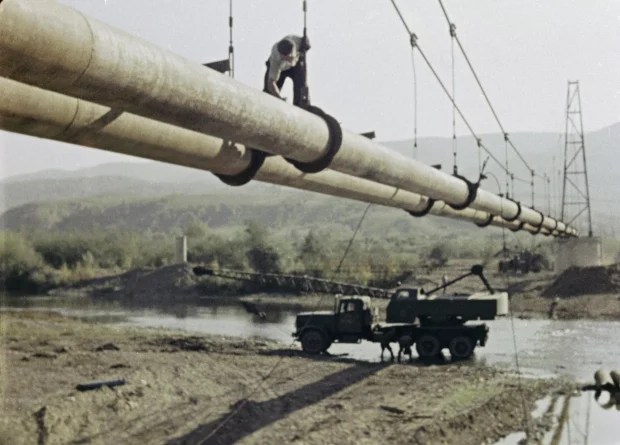
A section of the Druzhba pipeline being erected in Carpathia over a local waterway. September 1962. © Sputnik / I. Arons
By Ilya Tsukanov – Sputnik – 15.10.2024
Tuesday is the anniversary of the creation of Druzbha – the world’s longest oil pipeline, and one of the most technically sophisticated pieces of man-made engineering every created. Here’s what’s important to know about the project, why it was conceived, and why the US and its allies tried, but failed, to stop it.
October 15 marks the 60th anniversary of the inauguration of the Druzhba (‘Friendship’) oil pipeline. Conceived in 1958 at a meeting of the Council for Mutual Economic Assistance – the Soviet-led analogue to Western European integration, Druzhba helped forge closer economic links between the USSR and its Eastern European allies, and eventually, between Russia and the whole of Europe.
Drawn up to aid an economic boom being experienced by Eastern Europe, Druzhba was built to replace more costly and infrastructure-intensive rail-based oil deliveries.
Sourcing oil from the Volga-Ural oil and gas basin and starting off in Almetyevsk, modern-day Tatarstan, Druzhba runs west to Mozyr in Belarus, where it splits into two routes – one to eastern Germany via Poland, and another through Ukraine toward Bratislava in Slovakia, Prague in the Czech Republic and Budapest in Hungary.
Members of the Soviet-led economic alliance, namely Albania, Hungary, Poland, and Czechoslovakia, contributed equipment and know-how, with the USSR and Poland delivering 730,000 tons of 420-1,220 mm pipes, East Germany pumps for pumping stations, Hungary automation equipment and communications gear, and Czechoslovakia valves and fittings.
The US sought to sanction the project into submission, slapping restrictions on Western European sales of large-diameter pipes to the Eastern Bloc after the Cuban Missile Crisis of October 1962. Russian Chelyabinsk’s industrialists saved the day, creating pipes of the necessary diameter.
The success of the project led to the construction of a second line – known as Druzhba-2 and running along the same route, in 1974.
With Moscow selling oil to allies via long-term contracts, Eastern Europe was largely insulated from the oil shocks suffered by the West in the 1970s and early 1980s. Between 1971 and 1980, Hungary’s material national income rose by 62%, East Germany’s by 59%, Poland’s by 73%, Czechoslovakia’s by 57%, and capital construction in these countries grew 1.9, 1.7, 2.2, and 1.8 times, respectively.
This allowed the region to build tens of millions of new apartments, industrial goods and finished products ranging from cars and electronics to household goods.
After the USSR’s collapse, Germany’s reunification and the European Union’s expansion, Druzhba became a key source of fuel for Europe’s economic prosperity, helping Eastern Europe with its difficult transition to the market, and Germany in its effort to build on its status as an industrial powerhouse.
Accounting for expansions (including extensions to deliver oil to southern Germany and Austria), Druzhba holds the record as the longest oil pipeline network in the world, consisting of a whopping 8,900 km of pipe, 46 pumping stations, 38 intermediate pumping stations, and reservoirs that can hold up to 1.5 million cubic meters of oil.
Druzhba is also one of the most technically-sophisticated manmade engineering projects in history, crossing the Volga, Oka, Don, Dnepr, Dniestr, Vistula and Dunabe rivers and hundreds of smaller waterways, thousands of roads and railways, the Pinsk Marshes and the mountains of Carpathia.
The pipeline has an estimated capacity to pump up to 2 million barrels per day, or nearly a fifth of Russia’s total oil output. Until recently, it accounted for up to half of all Russian oil exports.
Killing Druzhba?
The US, the Eu and Ukraine have taken a series of steps to try and effectively kill the Druzhba-based energy partnership between Russia and Europe, with the EU banning deliveries of Russian oil through the northern portion of the pipeline in the summer of 2024, and Ukraine raising transit costs by more than 75%, and in July 2024 prohibiting supplies of Lukoil oil through the pipeline’s southern line to Hungary and Slovakia.
While Russia has proven able to replace its dependence on Druzhba by forging new energy ties with countries in the Global South, including India and China, Europe has been trapped by its own restrictions into buying more expensive and less dependable energy sourced in the US, leaving economic growth stagnant and industrial competitiveness in jeopardy.
Between Russia and Iran all is well that ends well
By M. K. BHADRAKUMAR | Indian Punchline | October 14, 2024
The mystery about the hastily-arranged ‘working meeting’ between Russian President Vladimir Putin and his Iranian counterpart Masoud Pezeshkian at Ashgabat, Turkmenistan, on Friday has only deepened after the event. This was their first-ever meeting. Putin didn’t even have the post-event presser.
Why such a meeting was considered necessary becomes an intriguing thought, as the two leaders are to meet in Kazan within days on the sidelines of the BRICS Summit on October 22-24.
Russia and Iran have had a difficult relationship through centuries. It still remains complicated, as the protracted negotiations over their strategic partnership treaty show. They have serious conflict of interests, as the controversial idea of Zangezur Corridor makes plain.
The two countries are potential competitors in Europe’s energy market. Both are tough practitioners of strategic autonomy. And their partnership in a future multipolar post-American century will have too many imponderables for an overall prediction.
At Ashgabat, Pezeshkian pointedly suggested to Putin that the signing of their proposed strategic treaty should be speeded up. Putin is known to have approved the draft agreement as far back as September 18. What is holding back the signing ceremony begs an explanation. Pezeshkian proposed that the ceremony could take place in Kazan. But the Russian side is dragging its feet.
Such ambivalence is reminiscent of the inordinate delay some years ago in Russia’s transfer of S-300 mobile surface-to-air missile system to Iran even after Tehran had made payment for the system. In sheer exasperation, Iran filed a $4 billion lawsuit against Russia’s defence export agency and embarked on the manufacture of its own long-range, mobile air defence system, the Bavar-373.
Russia was known to have come under US-Israeli pressure. Geopolitical considerations continue to prevail in Russia’s arms transfers with Iran. Pezeshkian, after his return to Tehran disclosed to the media that he had told Putin that Russia should “act more effectively in relation to the crimes committed by the Zionist regime in Gaza and Lebanon.”
Apparently, the tense exchange at Ashgabat provoked a frank remark later by Russian Deputy Foreign Minister Sergey Ryabkov to Tass, the state news agency. Ryabkov said: “We are closely and anxiously following the events [in the Israel-Iran standoff], the risk of a large-scale conflict is indeed high. The tendency to escalate into a full-scale conflict is a real danger. We call on all parties to exercise restraint. We are in intensive dialogue with the countries of the region. And once again — a major war can be avoided, but everyone must show restraint.” [Emphasis added.]
Indeed, Moscow is pragmatically continuing with its ‘neutrality,’ which of course does not help Tehran. At the same time, Putin reportedly did not take a call recently from Israeli Prime Minister Benjamin Netanyahu! Presumably, Russian-Israeli cogitations have gone underground.
That is understandable, as Russia keenly monitors the trajectory of the US-Israeli relationship. The paradox is, while powerful strikes on Iran’s infrastructure is impossible without US help and any Israeli plan to attack Iran would require preliminary discussions with the Pentagon, the Biden Administration is hoping with bated breath that Netanyahu keeps it in the loop about planned military actions.
On the other hand, the US’ willingness to assist in planning an offensive against Iran is also iffy. Nezavisimaya Gazeta newspaper quoted a Russian analyst Vladimir Frolov last week who used to be an employee of the Russian Embassy in the US: “I think Biden and company do not want an escalation [with Iran.] Israel’s relations with Biden are irreparably damaged. Netanyahu is just lying to him… Netanyahu is waiting for Donald Trump.”
That makes it twosome. Like the duo in the Samuel Beckett existential play Waiting for Godot, Putin and Netanyahu are waiting for Trump who may not even come at the end of the day. Committing one hundred percent to Iran, therefore, becomes problematic for the Kremlin. Then, there is the angst in Moscow about the intentions of the Pezeshkian government, which has prioritised the resumption of negotiations with the West.
Tehran noted carefully last week that the US officials went out of the way to affirm that despite tensions with Israel, Tehran is not ‘upgrading’ its nuclear doctrine. A spokesperson for the Office of the Director of National Intelligence (ODNI) in Washington added to the public remarks earlier in the week by CIA Director William Burns, who said the US had not seen any evidence of Iran’s Supreme Leader reversing his 2003 decision to suspend the [alleged] weaponisation programme.
Interestingly, Nournews, which is identified with the establishment, commented that the US intelligence assessment “could help explain the US opposition to any Israeli strike on Iran’s nuclear program in retaliation” — put differently, the US could still be keeping an eye on future nuclear negotiations with Iran.
At the Ashgabat meeting, Pezeshkian told Putin that Iran and Russia have good mutual and complementary potentials and can help each other. Pezeshkian stressed that Iran’s ties with Russia are “sincere and strategic.” He added, “Our positions on global matters are much closer to each other than to those of many other countries.”
According to the Kremlin transcript, Putin told Pezeshkian, “Our relationship with Iran is a priority for us, and it is developing very successfully… We are actively cooperating on the international arena, and often share close or even converging assessments of the ongoing developments.”
However, on his part, Pezeshkian remarked that “we must ensure that our relations improve and become stronger moving forward. We have many opportunities to achieve this objective, and it is our duty to assist one another in these efforts. We share similar visions, and there are many similarities in terms of our respective international standing.”
When it comes to the Ukraine conflict, Tehran’s stance is similar to India’s approach. Interestingly, in a post on X in the weekend, Iranian foreign minister Abbas Araghchi wrote that in his recent interactions in New York with top EU officials, he categorically told them “Iran-Russia military cooperation is not new; it has a history, long before the Ukrainian crisis began… I clearly said, and reiterate once again: we’ve NOT provided ballistic missiles to Russia. If Europe needs a case to appease Israel’s blackmail, better find another story.”
At the Ashgabat meeting, neither Putin nor Pezeshkian claimed a strategic convergence in their respective foreign policies. Pezeshkian, nonetheless, assured Putin that he looks forward to attending the upcoming BRICS summit and “we will do everything needed to approve and sign the documents on its agenda.”
Russia aligns with Iran, war clouds scatter
By M. K. BHADRAKUMAR | Indian Punchline | October 9, 2024
Israel has apparently shelved its planned attack on Iran. A combination of circumstances can be attributed to this retreat, which rubbishes Israel’s own high-pitched rhetoric that it was raring to go.
Despite Israel’s brilliant media management, reports have surfaced that the Iranian missile attack on October 1 was a spectacular success. It was a display of Iran’s deterrence capability to crush Israel, if need arises. The failure of the US to intercept Iranian hypersonic missiles carried its own message. Iran claims that 90 percent of its missiles penetrated Israel’s air defence system.
Will Schryver, a technical engineer and security commentator, wrote on X: “I don’t understand how anyone who has seen the many video clips of the Iranian missile strikes on Israel cannot recognise and acknowledge that it was a stunning demonstration of Iranian capabilities. Iran’s ballistic missiles smashed through US/Israeli air defences and delivered several large-warhead strikes to Israeli military targets.”
Evidently, in the ensuing panic situation in Israel, as the US president Joe Biden put it, as of October 4, there had been no decision yet on what type of response Israel should mount against Iran. “If I were in their [Israeli] shoes, I’d be thinking about other alternatives than striking oil fields,” Biden said in a rare appearance in the White House briefing room a day after Israeli officials were saying that a “significant retaliation” was imminent.
Biden added that Israelis “have not concluded how they’re — what they’re going to do” in retaliation. Biden also told reporters that Israeli Prime Minister Benjamin Netanyahu should remember US support for Israel when deciding on next steps. He claimed that he was trying to rally the world to avoid all-out war in West Asia.
In this pantomime, it is safer to believe Biden, as the honest truth is that without US inputs and practical help, and money — and direct intervention — Israel simply lacks the stamina to take on Iran. Israel’s regional dominance narrows down to executing assassination plots and attacking unarmed civilians.
But here too, it is debatable how self-sufficient Israel is vis-a-vis Iran. Reports have appeared that the US’ new technological intel pinpointed Hezbollah leader Sayyed Nasrallah’s whereabouts, which were passed on to Israel, leading to his assassination.
Interestingly, CIA Director William Burns stepped in to refute the rumours that Iran conducted a nuclear test on Saturday. Speaking at a security conference on Monday, Burns stated that the US has closely monitored Iran’s nuclear activity for any sign of rushing toward a nuclear bomb.
“We don’t see evidence today that such a decision has been made. We watch it very carefully,” he said. Burns gently erased another alibi to attack Iran.
One critical factor that has compelled Israel / US to defer any attack on Iran is the stern warning by Tehran that any attack on its infrastructure by Israel will be met with an even harsher response. “In responding, we neither hesitate nor rush,” to quote Foreign Minister, Abbas Araghchi, who, by the way, made a trip to Lebanon and Syria over the weekend by way of giving Israel a defiant “message” — as he put it — that “Iran has strongly backed the resistance and will always support it.”
Earlier on October 4, Supreme Leader Ayatollah Ali Khamenei had used a rare public sermon to defend Iran’s missile attack against Israel, saying it was “legitimate and legal” and that “if needed,” Tehran will do it again. Speaking in both Persian and Arabic during Friday Prayers in Tehran, Khamenei said Iran and the Axis of Resistance won’t back down from Israel. Iran will not “procrastinate nor act hastily to carry out its duty” in confronting Israel, Khamenei declared.
However, what deters the Israelis and causes uneasiness in the American mind is something else — Russia’s lengthening shadows on the West Asian tapestry.
American military analysts have disclosed that certain highly advanced Russian weaponry have been transferred to Iran in the recent weeks backed up by the deployment of Russian military personnel to operate these systems, including S-400 missiles. There is speculation that the secretary of Russia’s Security Council (former Defence Minister) Sergei Shoigu paid two secret visits to Iran in the recent period.
Apparently, Moscow also responded to the Iranian request for satellite data on Israeli targets for its missile strike on October 1. Russia also supplied Iran with the long-range electronic warfare system “Murmansk-BN”.
The “Murmansk-BN” system is a powerful EW system, which can jam and intercept enemy radio signals, GPS, communications, satellites, and other electronic systems up to 5,000 kms away and neutralise “smart” munitions and drone systems — and is capable of disrupting high-frequency satellite communication systems owned by the US and NATO.
To be sure, the Russian involvement in Iran’s standoff with Israel is potentially a game changer. From the US perspective, it raises the worrisome spectre of a direct confrontation with Russia, which it doesn’t want.
It is in this scenario that official Russian news agencies have quoted presidential aide Yury Ushakov on Sunday that Putin plans to meet with his Iranian counterpart, Masud Pezeshkian in the Turkmen capital, Ashgabat, on October 11.
Ushakov did not elaborate on the meeting. Indeed, this comes as a surprise since the two leaders are scheduled to meet again at the BRICS summit in the Russian city of Kazan that runs on October 22-24.
Of course, Iranians are also playing coy. Both Moscow and Tehran announced that their presidents were visiting Ashgabat on October 11 to attend a ceremony marking the 300th birth anniversary of the Turkmen poet and thinker Magtymguly Pyragy. Smoke and mirrors! (here and here)
It is entirely conceivable that amidst the cascading regional tensions, Moscow and Tehran may have thought of bringing forward the formal signing of the Russian-Iranian defence pact, which was originally scheduled to take place in Kazan.
If so, the event on Thursday will be reminiscent of the unscheduled visit by the then Soviet Foreign Minister Andrei Gromyko to New Delhi for the signing of the historic Treaty of Peace, Friendship and Cooperation Between India and the USSR on 9th August 1971.
Interestingly, Ushakov added that Putin has no plans to meet Netanyahu. Putin is yet to respond to a request by Netanyahu for a phone conversation, made five days ago. A legend that Netanyahu created, typically, in the recent years to impress his domestic audience (and confuse the Arab street) — that he had a special relationship with Putin — is falling apart.
On the other hand, by chalking up an urgent meeting in Ashgabat — in fact, Turkmen president Serdar Berdimuhamedov was in Moscow only on Monday/Tuesday on a working visit — Kremlin is making it clear to Washington and Tel Aviv that Moscow is irrevocably aligned with Tehran and will help the latter no matter what it takes. (See my blog West Asian crisis prompts Biden to break ice with Putin, Indian Punchline, October 5, 2024)
Isn’t history repeating? The 1971 Indo-Soviet Treaty was the most consequential international treaty entered into by India since Independence. It was not a military alliance. But the Soviet Union boosted India’s military capability for an upcoming war and created space for India to strengthen the basis for its strategic autonomy, and its capacity for independent action.
Paris prepares for World War III
Thousands of French soldiers ready to arrive in Romania for simulated conflict with Russia
Remix News | October 8, 2024
The next year will be crucial for the French army, which has undergone a major transformation in recent years to prepare for a possible conflict with Russia, reports Politico.
Next May, thousands of French soldiers will take part in a large-scale military exercise in Romania. The purpose of the exercise is to assess how quickly they can reach NATO’s eastern flank if necessary, which is crucial if Russian President Vladimir Putin were to attack an allied NATO country.
Hungarian news outlet Magyar Nemzet points out that the moves from France show “Paris is preparing for a world war. The pro-war French president has already come up with alarming plans in recent months, which could clearly lead to a war between NATO and Russia. As reported earlier, Emmanuel Macron did not rule out sending troops to Ukraine either.”
Regardless of the potential threats of an open conflict with Russia, NATO seems to be preparing for that possibility.
“We used to play war. Now, there’s a designated enemy, and we train with people with whom we’d actually go to war,” said General Bertrand Toujouse.
Such military exercises “are a strategic signal,” he added
In recent years, French ground forces have undergone a “profound transformation” to prepare for a conflict as intense as the war in Ukraine.
The main challenge is for French forces to reach Romania in such a short time.
“There is still no military Schengen, and we need to decisively improve military mobility in Europe,” said General Pierre-Éric Guillot.
The first troop deployment in Romania in 2022 has been hampered by bureaucratic hurdles, border control procedures and inadequate trains for transporting military equipment. The affected countries have since worked to eliminate these problems.
“We may still be hampered by a few customs measures, but we’ve made a lot of progress in diversifying our routes,” Guillot told reporters.
Sanctions have made Russian economy stronger – top academic
RT | October 8, 2024
Western sanctions imposed on Russia amid the Ukraine conflict have made the country’s economy stronger, Nikita Anisimov, rector of the HSE University in Moscow, has said.
Speaking on behalf of HSE economists at a parliamentary hearing on the draft of the 2025-2027 federal budget on Monday, Anisimov said sanctions have effectively propelled the restructuring of the country’s economy. According to the expert, this has led to Russia “essentially ceasing” its dependence on the export of raw materials such as oil and gas for income – a task the government has been grappling with for years.
“As a result, today, largely due to the situation of external shocks and the rapid restructuring of our economy, we have been able to significantly reduce our dependence on raw materials exports. Thus, we can say that the sanctions have only made our economy stronger and more resilient,” Anisimov stated.
The subject of Russia’s successes in cutting reliance on oil and gas revenues was raised by President Vladimir Putin at the St. Petersburg International Economic Forum (SPIEF) in June. He noted that Russian GDP expanded by 3.6% last year, bouncing back from a 1.2% downturn in 2022, when the country was first targeted by the West’s wide-ranging economic restrictions. Most of that growth stemmed from non-resource-based industries such as manufacturing, construction, and agriculture, as well as trade, hospitality, and financial services, Putin said.
Last month, Finance Minister Anton Siluanov announced that the Russian economy had continued to expand in 2024, with GDP growth in the first half of the year hitting 4.7%. Siluanov said he expected GDP growth at the end of the year to be 3.9%, exceeding the figure for 2023.
Many analysts, both Russian and international, have noted that sanctions have failed to destabilize the country’s economy. Most have attributed this resilience to Russia’s swift pivot to the East for trade, as well as economic policies implemented to offset the effect of the restrictions.
The World Bank and the International Monetary Fund both raised their growth forecasts for the Russian economy earlier this year. The former predicted it to grow by 2.9% in 2024, and in July upgraded Russia to a “high-income country.”
The IMF in April said it expected the country’s GDP to expand by 3.2%, faster than all advanced economies, including the US, the UK, Germany, and France.
West Asian crisis prompts Biden to break ice with Putin
By M. K. BHADRAKUMAR | Indian Punchline | October 5, 2024
The US president Joe Biden sprang a surprise during a press gaggle with reporters outside the White House on Thursday when he essentially didn’t rule out a potential meeting with his Russian counterpart Vladimir Putin at the upcoming summits of the Group of 20 or the Asia-Pacific Economic Cooperation. Biden sort of signalled, ‘Barkis is willing.’ As he put it, “I doubt that Putin will show up.”
As these White House gaggles generally go, Biden deliberately chose to respond to the TASS correspondent who asked the question, who of course knew that Biden knew that a trip by Putin to the Western Hemisphere to attend the G20 summit in Rio de Janeiro, Brazil, on November 18-19 is under active consideration in the Kremlin.
Biden and Putin have a lot to talk about but what adds up is that Biden signalled his interest in a conversation just a day after the massive Iranian missile strike against Israel, which came as a bolt from the blue and dramatically upended the legacy of his presidency.
Don’t be surprised if the Middle East crisis dominates a Biden-Putin summit in Rio de Janeiro — that is, if such a meeting takes place. The Ukraine war is coasting inexorably toward a Russian victory. Biden’s interest lies in making sure somehow that Ukraine’s capitulation — and NATO’s humiliation — get carried over to January 20. But Putin must cooperate. This is one thing.
Meanwhile, what causes sleepless nights for Biden is the situation in the Middle East, which may cascade uncontrollably toward a regional war. Here, Putin is not the problem but can be the solution. This needs some explaining.
To be sure, policy differences have arisen between Biden and Netanyahu which is only to be expected given their sense of priorities respectively as politicians. It may seem the current crisis in the US-Israeli relationship is rather severe but how much of it is for the optics or, how little of it is for real is the moot point. Certainly, even a transition from war to a new diplomatic order is currently not in the cards.
However, the US and Israel are also joined at the hips. There is no question that Biden is allowing seamless assistance to flow to Israel in its war effort and for keeping its economy afloat. And the US is blocking all moves in the UN Security Council calling for a ceasefire, which means that peacemaking efforts cannot even begin.
Iran’s missile attack on Israel, in this context, needs to be put in perspective. Rather than an act of belligerence, it can be seen as a coercive measure to force Israel to abandon its ground operation in Lebanon. President Masoud Pezeshkian has disclosed that Iran exercised utmost restraint so far to stop Israeli atrocities only because of pleas by Western leaders that negotiations leading to a potential ceasefire in Gaza were at a crucial stage. But the West didn’t keep its promise leaving Iran no option but to act.
Passivity or inaction in the face of Israel’s relentless rampage against the Palestinian population aimed at ethnic cleansing created a distressing situation for Iran as the saviour of oppressed Muslims. Besides, Iran’s entire strategy of deterrence came under challenge too.
Biden is today like a cat on a hot tin roof. A Middle Eastern war is the last thing he wants. But he has no control over Netanyahu who is already plotting the next move on the escalation ladder. As for Iran, its sense of exasperation over western perfidy and moral bankruptcy is palpable. The US’ credibility has suffered a severe beating all across the West Asian region.
Enter Putin. On the Middle Eastern chessboard, Russia’s role assumes great importance. Russia-Iran relations touch an unprecedented level today. Russian statements have become highly critical of Israel in recent years. Russia has openly kept contacts with the groups constituting the Axis of Resistance.
Russian diplomacy is moving with a ‘big picture’ in mind to bring the Israeli-Palestinian conflict to the centre stage of international politics. In the past year, security consultations between Moscow and Tehran notably intensified. Some reports have appeared about Russia transferring advanced military equipment to strengthen Iran’s air defence capabilities.
Significantly, Russia was the only country that Iran informed in advance about its missile strike against Israel. According to the well-known US podcast Judge Napolitano: Judging Freedom (below), the Russian naval fleet in the East Mediterranean downed 13 Israeli missiles last week near Lebanon.
Apparently, a frantic Netanyahu has been trying to reach Putin on phone for the past few days but the call is yet to materialise. On the diplomatic track too, Russia has underscored the highest importance it attaches to the relations with Iran.
Clearly, the US senses the imperative to engage with Russia. What may be acceptable can be proportional strikes by the two West Asian protagonists, couched in carefully calibrated media campaigns. For example, targeted attacks on individual military installations, which would save face for Israel and avoid a major war — it’s a preferable scenario for Iran too, because it avoids unnecessary risks and preserves the trump cards for a game that promises to be long drawn out.
In the final analysis, what matters is the US-Israeli intentions. The Financial Times cited Israeli sources to the effect that the game plan is to inflict maximum damage to Iran’s economy so as to trigger the latent ‘protest potential’ of Iranian society. The Israeli hope is apparently that a credible regime change agenda will find resonance in Washington and attract US intervention.
Anyway, Biden’s move to engage with Putin suggests that a US military intervention is to be ruled out. On the other hand, the historic Russian—Iranian security pact, which is expected to be signed during the forthcoming BRICS summit in Kazan, Russia, on October 20-22, gives Iran vastly more strategic depth to negotiate with the West.
Russia’s own interest lies in boosting Iran’s defence capability and pressing ahead with broad-based bilateral cooperation anchored on the economic agenda in the conditions under sanctions while on a parallel track advancing Iran’s integration into Moscow’s Greater Eurasia project. In short, Russia is uniquely placed today as a stakeholder in a stable and predictable Iran at peace with itself and the region.
Russian Foreign Minister Sergey Ryabkov told reporters in Moscow Thursday, “We are in the closest contact with Iran on the current situation. We share a wonderful experience of cooperation in various fields. I think this is the moment when our relations are particularly important.” By the way, President Pezeshkian received the visiting Prime Minister of Russia Mikhail Mishustin on Monday, September 30 in Tehran just hours ahead of the launch of the Iranian ballistic missiles against Israel.
At a meeting of the UN Security Council dedicated to West Asian developments, Russia’s Permanent Representative to the UN Vasily Nebenzya stated on Wednesday, “As part of its mandate to maintain international peace and security, the UN Security Council must compel Israel to immediately cease hostilities. You and I also should make every effort to create conditions for a political and diplomatic settlement. In this context, we take note of Tehran’s signal that it is not willing to whip up confrontation any further.”
Interestingly, the Kremlin spokesman Dmitry Peskov lost no time to pick up the threads of Biden’s remark on a meeting with Putin. He said on Friday, “There have been no talks on this issue and as of today, at this moment, there are no prerequisites for it. However, the president has repeatedly stated that he remained open for all contacts.”
Ukraine hails car bomb that killed Russian nuclear plant worker
RT | October 4, 2024
A senior security staff member of the Zaporozhye Nuclear Power Plant – the biggest facility of its kind in Europe – was killed in a car explosion on Friday morning, the Investigative Committee of Russia has said. Ukraine’s military intelligence hailed the incident on Telegram, while stopping short of openly claiming responsibility for it.
According to Russian investigators, an improvised explosive planted under the personal vehicle of Andrey Korotky, a senior security official at the plant, exploded. Korotky succumbed to his injuries at a nearby clinic.
Ukraine’s military intelligence agency (HUR) immediately commented on the incident on Telegram, branding Korotky a “war criminal” and a “collaborationist” for his decision to “voluntarily” cooperate with Russia. It also accused him of organizing “events in support of the Russian… army,” and of joining the United Russia party.
The agency also published a video showing the moment of the explosion and vowed “vengeance” against anyone it deems to be a “war criminal.”
The Zaporozhye station confirmed its staff member’s death and informed the International Atomic Energy Agency (IAEA) about the incident, the plant’s communications director, Evgenia Yashina, told TASS. Station director Yury Chernichuk condemned the incident as a “horrifying, inhumane terrorist act,” and demanded those behind it be brought to justice.
“Attacking the staff members responsible for the security of a nuclear facility is a reckless step beyond any bounds,” Chernichuk stated. The UN nuclear energy watchdog has not yet commented on the incident.
The Investigative Committee said it has opened a criminal case for murder. It did not name any suspects.
The Zaporozhye Nuclear Power Plant has been under Russian control since March 2022. Throughout the conflict, Moscow and Kiev have repeatedly accused each other of shelling the facility, and the Russian Defense Ministry has said that several attempts by Ukrainian assault units to retake it have been repelled.
Zaporozhye Region officially joined Russia, along with three other former Ukrainian territories, in the autumn of 2022. The IAEA has a permanent monitoring mission at the nuclear facility.
In late August, senior Russian diplomat Rodion Miroshnik said staff members at the plant had been facing blackmail. People working at the facility had allegedly been coerced into cooperating with Kiev and passing sensitive data or even committing terrorist acts under the threat of their relatives in Ukraine being killed.
Croatian president blocks troops for Ukraine mission
RT | October 4, 2024
Croatian President Zoran Milanovic has refused to contribute any troops to the NATO command for providing military aid to Kiev, arguing that this would draw Zagreb into direct conflict with Moscow.
The former Yugoslav republic has been a member of the US-led bloc since 2009. Its right-wing government has sent weapons and helicopters to Ukraine, over the objections of the president, who is a Social Democrat.
”While I am president and the commander in chief, Croatian soldiers, officers and NCOs will not take part in activities that would draw Croatia into a war,” Milanovic said on Thursday.
Milanovic has refused to contribute any personnel to the NATO Security Assistance and Training for Ukraine (NSATU) command, which the bloc established for the purpose of coordinating military aid to Kiev. Zagreb was supposed to send a handful of officers to the 700-strong NSATU staff in Wiesbaden, Germany.
Croatian Prime Minister Andrej Plenkovic has accused the president of “further isolating Croatia on the international scene and destroying its credibility as a NATO member.”
Meanwhile, NATO has reminded Milanovic that the command was agreed at the July summit in Washington and that it would not involve sending any troops to Ukraine. The US-led bloc has argued that spending hundreds of billions of dollars to arm, train and supply Kiev’s war effort doesn’t actually make it a party to the conflict with Russia.
“Whether it’s one soldier or a hundred, wherever they are, this would be a direct command support to a warring party that is not a NATO member, which is out of bounds for Croatian national interests,” Milanovic replied on Thursday that “Croatia has an obligation to help allies, which is what we’ve been doing. Everything else is getting involved in a war, which I will not allow.”
He reminded the bloc that Zagreb has demonstrated its commitment by nearly doubling the number of Croatian troops in the NATO border force, from 300 to 520.
“I answer solely to the people of Croatia, not Washington and Brussels,” Milanovic said.
Under the Croatian constitution, Milanovic has the right to bar the deployment of troops abroad. The cabinet could override the president with a two-thirds vote in the parliament, but the ruling coalition is backed by only 78 out of 151 lawmakers.
Milanovic has long criticized the NATO policy of arming Ukraine to fight against Russia. He has also slammed the EU’s treatment of member states like Poland and Hungary, and accused Brussels of treating Croatia like a “retarded” child.
Russia urges its citizens to leave Israel
RT | October 3, 2024
Moscow’s ambassador to Israel has urged Russian citizens to leave the country, after Iran fired nearly 200 missiles at the Jewish state in response to Israeli strikes on Lebanon.
Speaking to TASS news agency on Thursday, Anatoly Viktorov expressed alarm over the “heightened escalation” in the Middle East.
“We are advising those who are currently in Israel to think about leaving while there are still regular flights” operated by airlines including Israeli national carrier El Al, the diplomat told TASS.
Viktorov urged Russian nationals to consider “risks to their lives and health” before making decisions about traveling to Israel. “The situation in Israel and the neighboring countries is highly intense,” he stressed.
Multiple Russian airlines canceled flights over Israel, Iran and Iraq earlier this week in line with recommendations from Russia’s civil aviation agency. Iran’s missile barrage prompted a Doha-bound plane carrying a Russian deputy prime minister to turn around mid-flight and return to Russia on Wednesday.
Moscow advised its citizens to avoid traveling to Israel shortly after the war with Hamas broke out in October 2023.
Featured Video

America Racing to Strategic Defeat in Iran
or go to
Aletho News Archives – Video-Images
From the Archives
Should Europeans ‘Thank’ the Americans for Destroying Nord Stream?
By Robert Bridge | Strategic Culture Foundation | September 29, 2022
With an investigation continuing into the destruction of the Nord Stream gas pipeline that provided energy supplies to Europe from Russia, there appears to be just one prime suspect, and that should surprise nobody.
Following the sabotage of the Nord Stream 1 and 2 gas pipelines, former Polish Foreign Minister Radoslaw Sikorski already seemed to know the identity of the perpetrator when he tweeted out: “Thank you, USA.”
At first glance, it seemed that Sikorski was speaking sarcastically, berating Washington for carrying out an attack that will have severe repercussions for the people of Europe. After all, how could anyone see any good coming from the termination of Europe’s primary source of gas reserves with winter just around the corner? It was Sikorski’s homeland of Poland, after all, that urged its citizens to collect firewood in the face of dwindling gas reserves.
In fact, the Polish diplomat was speaking one-hundred percent literally… continue
Blog Roll
 Aletho News
- Growing insecurity, soaring prices fuel protests in north as regime bans evacuation: Sources
- Iran denies responsibility for ‘depraved’ attack on Kuwait desalination plant
- Bring The Troops Back. End This War Now!
- Can we please stop calling Israel the ‘only democracy in the Middle East’ now?
- US should start removing its troops for Germany, proposes AfD co-leader Chrupalla
- Iran Red Crescent: 600 educational centers attacked in US-Israeli ‘war crimes’
- Russian Oil Tanker Arrives in Cuba Amid U.S. Blockade
- America Racing to Strategic Defeat in Iran: Lt Col Daniel Davis
- FTC Warns Visa, Mastercard, PayPal, Stripe Over Political Debanking
- Russian tanker approaches Cuba despite US oil blockade
- If Americans Knew
- Israeli police block Catholic cardinal from entering Church of the Holy Sepulchre on Palm Sunday
- Israel is assassinating journalists again, more than any other nation, anywhere, ever – Not a ceasefire Day 170
- Over 300 US service members wounded, majority have brain injuries – Not a ceasefire Day 169
- Researchers at Human Rights Watch Resign Over Blocked Report on Palestinian Refugee Return
- Jewish Groups Are Backing a War Americans Don’t Want
- Eric Fingerhut Thinks He’s the President of the Jews
- Top Jewish Philanthropists, Rabbis Urge Israeli President to Take Action Against ‘Jewish Extremists’
- Don’t Be Fooled. Zionist Leaders Have Always Wanted to Control Southern Lebanon
- Israel’s widespread use of torture is a core element of its genocide against the Palestinian people
- In Israel’s War on Iran, Many Middle East US Bases Rendered “All But Uninhabitable”
- No Tricks Zone
- New Study Finds Warming Saves Lives…Cold Temperatures 12 Times More Deadly Than Excess Heat
- German Science Blog Accuses PIK Climate Institute Of Hallucinating Climate Tipping Points
- Devastating Assessment Of Comirnaty Vaccine By Former Senior Pfizer Europe Toxicologist
- New Study: CO2 Is ‘Effectively Negligible’ As An Explanatory Climate Change Factor Since 2000
- Former Pfizer Toxicologist Dr. Helmut Sterz Tells Bundestag Hearing Pfizer Vaccine Should Have Never Been Approved
- Energy Expert: Germany’s Nuclear Phaseout Was A “500 Billion Euro Mistake”
- New Research: South Australia’s Mid-Holocene Sea Surface Temperatures Were 4°C Warmer Than Today
- Storing Green Energy To Last Germany 10 Days Would Require A 60-Million Tonne Battery
- New Studies: UK Sea Levels Were 4 Meters Higher Than Today During The Mid-Holocene
- Destructive Green New Deal: German Energy And Metal Group Warns Of Drastic Crisis
 Aletho News