Lavrov warns Israel against ‘sowing a storm’ in Syria

RT | December 26, 2024
Israel should refrain from solving its geopolitical problems at the expense of war-torn Syria, Russian Foreign Minister Sergey Lavrov has cautioned. Reckless actions by the Jewish state could erode the security framework in the Middle East, he warned, during an online press conference on Thursday.
Lavrov stressed that Russia insists on Syria remaining an independent country following the demise of former President Bashar Assad, reiterating that Moscow maintains contact both with Damascus and other regional partners. “The disintegration of Syria must not be allowed,” he said.
In light of this, the minister urged Israel, which has established a so-called ‘buffer zone’ in internationally recognized Syrian territory, “to understand its responsibility in these collective [stabilization] efforts and refrain from ensuring its security at the expense of others.”
“One cannot expect to destroy all military facilities in a neighboring country and then live in peace and harmony forever. This is like sowing a storm that will inevitably come back to haunt those who engage in such actions.”
After Assad’s removal and subsequent asylum in Russia, Israel has launched multiple airstrikes across the border, targeting Syrian airbases, weapons depots, and other military facilities to prevent arms from reaching “the wrong hands.” West Jerusalem claimed to have destroyed 70-80% of its neighbor’s strategic military capabilities, with the Syrian navy essentially being eliminated as an operational force.
According to Lavrov, another facet of Syria’s well-being hinges on the situation in the oil-rich eastern part of the country. The US, the minister charged, has “illegally occupied a significant part of the territory, including areas with major oil fields and fertile lands,” adding that revenues from the export of these resources is being funneled to “separatist structures” that the Americans have created in the country.
He also addressed remarks by Turkish President Recep Tayyip Erdogan, who recently vowed to “bury” Kurdish militants – whom Ankara considers terrorists – in Syria if they fail to lay down their arms. “We understand the legitimate concerns of the Turkish leadership… regarding security along the border,” Lavrov said, adding that Türkiye’s “legitimate security interests must be ensured in a way that preserves Syria’s sovereignty, territorial integrity, and unity.”
Earlier media reports claimed that Türkiye and the new leadership in Damascus were considering a joint military operation to expel Kurds from border areas if they failed to integrate with the Syrian military. Russian President Vladimir Putin did not rule out that Ankara could proceed with such an action, while urging both sides to resolve their differences peacefully.
Russia shot down Ukrainian F-16 – official
RT | December 26, 2024
One of the F-16 jets donated to Ukraine by NATO has reportedly been downed while attempting to launch missiles at Russia’s Zaporozhye Region.
Preliminary information from the front line was reported on Thursday by Vladimir Rogov, the co-chair of Russia’s Coordinating Council for the Integration of New Regions.
“The F-16 aircraft was in position to launch a missile strike on the region, and it was shot down,” Rogov wrote on Telegram.
Several European NATO members delivered a “small number” of the US-made fighters to Ukraine in July. Advertised by Kiev as a game-changer in challenging Russian air superiority, the planes ended up never being used in air-to-air combat.
A number of F-16s were reportedly used to defend against incoming Russian missiles in August, but one of the jets was lost. A Ukrainian lawmaker later revealed that it had been shot down by a Patriot air defense battery, which was also donated by NATO.
Private Russian company Fores has offered a reward of 15 million rubles ($170,000) to whoever shoots down the first Ukrainian F-16.
Zaporozhye is one of the four former regions of Ukraine that joined Russia after a referendum in September 2022. Around 70% of the region is under Russian control and was the target of Kiev’s 2023 “summer counteroffensive.”
McCarthyism, European style: The elite crackdown on Ukraine dissent
Experts lambasted as Kremlin mouthpieces turned out to be right
By Eldar Mamedov | Responsible Statecraft | December 12, 2024
As the war between Russia and Ukraine is framed by the ruling politicians and commentators in Europe and America as part of a purported global struggle between democracies and autocracies, the quality of democracy in the West itself has taken a hit.
The dominant voices advocating for Ukraine’s victory and Russia’s defeat, both defined in maximalist and increasingly unattainable terms, are intent on snuffing out more thoughtful and nuanced perspectives, thus depriving the public of a democratic debate on the existential questions of war and peace.
In a familiar pattern throughout the West, respected academics who correctly predicted the quagmire Ukraine and the West now find themselves in have been smeared and delegitimized as Kremlin mouthpieces, subjected to harassment, marginalization and ostracism.
The situation is particularly alarming in Europe. While the Ukraine debate in the U.S. is, to a worrying extent, shaped by pro-militarist think tanks, such as the Atlantic Council, hawkish politicians and neoconservative pundits, a countervailing movement consisting of pro-restraint voices has been growing. They include Defense Priorities, the CATO Institute, publications like The Nation on the left, and The American Conservative on the right, and academics like Stephen Walt, John Mearsheimer, and Jeffrey Sachs, among others. There is more space for alternative voices in American discourse.
In Europe, by contrast, foreign policy debates tend to simply echo the most hawkish voices inside Washington’s Beltway.
Sweden is a particularly telling illustration of that trend. After Russia’s invasion of Ukraine, the Swedish government and political class swiftly moved to join NATO. Yet, as one of the leading Swedish international relations scholars Frida Stranne told me in an interview, “No proper debate was held on the key questions, like whether Russia’s aggression against Ukraine indeed was such an immediate security threat for Sweden that it had to ditch the neutral status it enjoyed even during the Cold War?” (I can testify myself, from my work as a senior foreign policy adviser in the European Parliament in early 2022, that even some members of the then-ruling Swedish social-democratic party were aghast at the government running roughshod over alternative views on NATO).
Further, in a conversation with me, Stranne, while acknowledging that Russia’s invasion of Ukraine was “an egregious breach of international law,” pointed to U.S. policies since 2001, such as the invasion of Iraq, noting that they “have helped to undermine international legal principles and set the precedent for other countries acting ‘preemptively’ against perceived threats.”
In the same interview, she also warned that “a refusal to countenance a negotiated settlement to the war in Ukraine is leading the world perilously close to the brink of a major military conflict between NATO and Russia.”
While such points are routinely made by fairly mainstream scholars in the U.S., in Sweden they triggered a vicious campaign against Stranne and made her nearly untouchable by the media and in foreign policy circles. Leading media outlets vilified her as a U.S. hater and a “Putinist.”
Germany is another example of how enforced groupthink led to a marginalization of dissenting perspectives in political debates. What is particularly noteworthy is the speed and radicalism with which the hawks in think tanks, media, and political parties managed to redefine the debate in a country previously known for its now-defunct Ostpolitik, a policy of pragmatic engagement with the Soviet Union and later Russia.
One of Germany’s most prominent foreign policy experts, Johannes Varwick of the University Halle-Wittenberg, has long defied the trend and advocated for diplomacy. In December 2021, together with a number of high-ranking former military officers, diplomats and academics, he warned that a massive deterioration in relations with Russia could lead to war — due, in part, to the West’s refusal to take seriously Russia’s security concerns, chiefly related to the prospects of NATO’s eastward expansion.
Yet such views earned Varwick accusations of “serving Russian interests.” As a result, as he told me in an interview, his “ties with the political parties and ministries responsible for conducting Germany’s foreign and security policy were severed.”
Experts in neutral countries were not spared marginalization as well. Austrian Prof. Gerhard Mangott, one of the most eminent experts on Russia in the German-speaking world, pointed to a “shared responsibility” of Russia, Ukraine, and Western countries for the failure to resolve the post-2014 Ukrainian conflict peacefully. Such analysis, as Mangott told me, led to his “prompt excommunication by the German-speaking scientific community which turned quickly to political activism and became party to the war.”
The tragic irony, of course, is that these ostracized voices have proved to be correct in most respects about this war.
When, despite his warnings, the Russian invasion of Ukraine did occur, Varwick, who condemned it as illegal and unacceptable, called for further efforts to find a realistic negotiated solution to the conflict. As he told me, this should “firstly include a neutral status for Ukraine with strong security guarantees for the country. Secondly, there would be territorial changes in Ukraine that would not be recognized under international law but must be accepted as a temporary modus vivendi, and thirdly, the prospect of suspension of some sanctions in the event of a change in Russia’s behavior must be on offer.”
In March 2022, both Ukraine and Russia were close to a deal broadly along these same parameters. It did not work, because, among other reasons, the West encouraged Ukraine to believe that a military “victory” was possible. The role of then-British Prime Minister Boris Johnson in undermining the talks is now generally acknowledged. What is, however, particularly striking is that Johnson recently himself admitted that he saw the war in Ukraine as a proxy war against Russia — a claim made by Stranne and the Quincy Institute’s Trita Parsi in their 2023 book, in Swedish, “The Illusion of American Peace,” for which they were lambasted for purportedly pushing Russian narratives.
Fast forward to late 2024, and, faced with growing difficulties on the battlefield, Ukraine’s President Volodymyr Zelensky is now signaling that he could go along with some of the elements outlined by Varwick; namely, accepting some de facto territorial losses to prevent even bigger ones should the war continue.
Today, Ukraine is farther away from achieving anything remotely resembling a military victory than at any point since February 2022. Contrary to the expectations in the U.S. and EU, sanctions neither tanked Russia’s economy nor changed its policies in the ways the West sought.
In the West itself, political forces that urge negotiations to end the war are ascendant, as evidenced by the election of Donald Trump as president in the United States and the rise of anti-war parties in Germany, France and other EU countries. Public opinion surveys consistently show a preference of the majority of Europeans for a negotiated end to the war.
The reality is, irrespective of the outcome of the war in Ukraine, a modus vivendi between the West and Russia will have to be reestablished to ensure, in Varwick’s words, “their coexistence in a Cold War 2.0 without a permanent escalation.” Restoring an open democratic debate about this vital issue is long overdue.
Listening to the experts who have a proven track record of correct analysis would be a necessary first step.
Eldar Mamedov is a Brussels-based foreign policy expert.
Russia to launch new gas pipeline to China – deputy PM
RT | December 25, 2024
Russia has begun developing a new gas pipeline to China via Kazakhstan that will have a planned annual capacity of 45 billion cubic meters (bcm), Deputy Prime Minister Aleksandr Novak told the broadcaster Russia 24 on Wednesday.
China will receive 35 bcm of gas per year via the conduit, while the remainder will go to Kazakhstan.
The official highlighted the project’s strategic importance during discussions on bilateral energy cooperation.
“The process has been launched,” Novak said, adding that it includes technical and economic feasibility studies and negotiations to finalize the framework of the agreement.
As part of the deal, Kazakhstan, which will host part of the pipeline’s infrastructure, is set to receive up to 10 bcm of gas annually.
Kazakh Energy Minister Almasadam Satkaliyev confirmed the country’s interest in the project, emphasizing its benefits for the country’s energy supply. “Kazakhstan fully supports this project [that] will [supply] our northern regions,” he told journalists on Tuesday.
China is Russia’s biggest trade partner and the economic cooperation between the two nations has been steadily increasing despite unprecedented Western sanctions on Moscow. Bilateral turnover is expected to surpass $200 billion by the end of the year, Russian Ambassador to China Igor Morgulov said back in October.
Russian energy major Gazprom reported a new daily record for gas deliveries to China via the Power of Siberia pipeline earlier this month. Under a bilateral agreement, Russia will supply 38 bcm of gas annually to the Asian country via the pipeline starting in 2025.
‘Act of terrorism’ sank Russian cargo ship – owner
RT | December 25, 2024
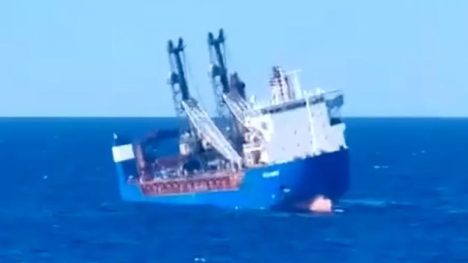
A “terrorist attack” is to blame for the sinking of the Russian cargo ship Ursa Major in the Mediterranean Sea, Russian state shipping company Oboronlogistics announced on Wednesday.
The freighter went down in waters between Spain and Algeria on Monday. Initial reports spoke of an explosion in the engine room that caused the vessel to list sharply to the starboard. Spanish rescue ships recovered 14 crew members, but two are still missing.
“Oboronlogistics believes that on December 23, 2024, a targeted terrorist attack was carried out on the Ursa Major vessel,” the company said in a statement.
According to the surviving crew members, “three successive explosions” happened on board the ship, which then began to take on water.
Built in 2009, the 142-meter-long Ursa Major was one of the largest Russian cargo vessels, and was headed from St. Petersburg to Vladivostok with several specialized pieces of port and ship construction equipment.
Ursa Major set sail on December 11 and was scheduled to arrive by January 22. It had undergone scheduled maintenance this past summer. According to Oboronlogistics, it was carrying many empty containers and was not overloaded at the time of the sinking.
Oboronlogistics is a shipping company that is part of the Russian Defense Ministry. The Ursa Major was operated by its subsidiary SK-Yug.
The company did not name a culprit in the alleged act of terrorism. Ukraine has previously taken responsibility for multiple attacks on Russian ships in the Black Sea.
According to Spanish media, the Ursa Major sent a distress signal as it transited the Strait of Gibraltar. After the vessel deviated from its course and began to list, fishing vessels came to the crew’s rescue. They were later joined by Spanish Navy and the coast guard vessels Clara Campoamor and Serviola. The 14 surviving crew members were taken to the port of Cartagena.
Four Killed, 5 Injured in Ukraine’s Shelling of Lgov Town in Kursk Region
Sputnik – 25.12.2024
As a result of Ukraine’s shelling of the town Lgov in Russia’s Kursk Region four people have been killed and five have been injured, Governor Alexander Khinshtein said on Wednesday.
“According to preliminary information, three people were killed as a result of the barbaric shelling by the armed forces of Ukraine of the town of Lgov, and another person died later in hospital. Five victims were hospitalized, including one woman in serious condition. They are currently receiving all the necessary medical and psychological assistance,” Khinshtein said on Telegram.
Three residential buildings were seriously damaged, Khinshtein added.
“A five-storey residential building, two one-storey residential buildings, as well as a detached one-storey beauty salon were seriously damaged. Windows were blasted in neighboring private residential buildings, and at least 12 vehicles were damaged. Also, an insignificant section of the gas pipeline was destroyed due to the blast,” Khinstein said.
The operational headquarters of the government of the Kursk Region has been deployed in Lgov after the shelling, the governor added.
According to preliminary data, the attack was carried out using a HIMARS multiple launch rocket system (MLRS), a spokesperson for the military investigative authorities told Sputnik at the scene of the incident.
“During the inspection, fragments and shrapnel of a shell were discovered, presumably from a HIMARS MLRS. All of them will be seized and subsequently sent for examination to determine the specific type and kind of the shell,” the spokesperson said.
Hungary to Maintain Energy Ties With Russia As No ‘Better Offer’ Exists
Sputnik – 23.12.2024
Hungary does not intend to abandon its energy cooperation with Russia in the absence of a cheaper and more reliable alternative, Hungarian Foreign Minister Peter Szijjarto told RIA Novosti.
“Russia has been a reliable partner for us when it comes to energy supplies, that’s a fact, and in such serious issues like energy security, you only change your reliable source in case you have a better offer. But we don’t have a better offer, we don’t have an offer for more reliable or cheaper neither more reliable nor cheaper source to utilize. So why would we walk away from our energy cooperation with Russia?” Szijjarto said.
The minister emphasized that the issue of energy belongs to the realm of physical infrastructure and not politics.
“Not to speak about the fact that the energy supply is a matter of physical nature, so it’s very conservative thing to say, if there’s a pipeline, you can buy gas or oil. If there’s no pipeline, it’s just dream. So once you cut the Russian energy sources from Hungary, when it comes to natural gas or oil, simply the remaining infrastructure cannot supply the country, and it’s not a political question, if a pipeline has a certain capacity, you can make whatever statements it will not change,” he noted.
Paks II Nuclear Plant
The construction of the Russian-built Paks II Nuclear Power Plant in Hungary is moving fast, and changes to the budget will be negotiated, the foreign minister also told RIA Novosti.
“What is good news is that we are moving forward with the construction pretty quickly,” Szijjarto said.
The minister added that budget changes were nothing out of the ordinary when it came to the construction of a nuclear plant.
“Since the contract has been signed in 2014, so almost 11 years now, it is not too complicated to understand that during such a long period of time, prices of technologies, especially such complicated technologies and equipment, might have changed,” he pointed out.
The two sides will negotiate about that, the minister said.
Trump should leverage Arctic for Ukraine peace – analyst
RT | December 23, 2024
US President-elect Donald Trump would succeed in talks with Russia to end the Ukraine conflict by offering to lift sanctions on the Northern Sea Route and invite Western carriers to utilize Moscow’s project in the Arctic, an opinion piece in Responsible Statecraft magazine has suggested.
Trump’s campaign promise to swiftly stop the fighting between Moscow and Kiev “seemed increasingly out of reach,” Lyle J. Goldstein, a research professor at the China Maritime Studies Institute (CMSI) at the US Naval War College wrote in his article on Friday.
As the Russian military “continues its slow but steady advance,” Putin could have decided “to push for a more complete Russian military victory and defy any near-term Western peace overtures,” he said.
“It is hard to imagine that dispatching more arms to Ukraine and slapping more sanctions on Russia will be successful at achieving peace,” Goldstein stressed.
However, Trump still has a chance “to break from the status quo and entice Russia to end the war” by making the situation in the Arctic – where a struggle for dominance between world powers has been intensifying in recent years – part of the negotiations, he wrote.
According to the analyst, the issue is “guaranteed to capture… Putin’s attention” because Moscow is interested in the effective functioning of the Northern Sea Route (NSR), which runs from the Barents Sea near Russia’s border with Norway to the Bering Strait between Chukotka and Alaska, and “holds the key to unlocking major development in the country’s vast, resource-rich interior and more broadly for Siberia.”
In order to see Russia making concessions, “the US would need to lift sanctions that have been applied against NSR projects… [and] facilitate major European shipping companies like Hapag Lloyd and Maersk to green light the route.” Another step to “sweeten the pot” for Moscow could be “the encouragement and even incentives for Western investment along the NSR” by Washington and Brussels, Goldstein stressed.
“By appending peace proposals with a carrot guaranteed to catch Putin’s attention, negotiations having a substantial Arctic component could gain Trump’s favor and find success,” he insisted.
Trump said on Sunday that he wants to resolve the Ukraine conflict through direct talks with Putin. “We must end that war,” he stressed.
During his end-of-year press conference last week, the Russian leader said that he is “ready to talk [to Trump] anytime; I will be ready to meet with him if he wishes.”
At the same event, Putin reiterated that Moscow is open to negotiating with Kiev without any preconditions, except for those previously agreed upon in Istanbul in 2022. These agreements include a neutral, non-aligned status for Ukraine and certain restrictions on the deployment of foreign weaponry. He also emphasized that any negotiations must take into account the current situation on the ground.
Syrian ‘end-game’ will change the Middle East
By Salman Rafi Sheikh – New Eastern Outlook – December 20, 2024
The fall of the Assad regime in Syria may have been a geopolitical loss for Iran (and Russia), but the fact that Islamists have overthrown the regime threatens both Iran and Arab states, creating prospects for their cooperation in the near future and minimising whatever gains the ‘winners’ of this ‘end-game’ may have made.
The ‘Winners’ and the ‘losers’
There are clear ‘winners’ and ‘losers’ in the fall of the Assad regime in Syria. But geopolitics is a very dynamic field in which gains and losses are hardly one-sided. In some ways, the fall of the Assad regime – and the inability of Iran to rescue its key ally in the region – may have been an outcome of Israel’s war on Palestine and Hezbollah, but it does not necessarily mean a permanent weakness of Iran and a permanent gain for Israel. For now, Israel is consolidating this gain by a) seizing Syrian territory, and b) bombarding the Syrian military positions to decimate its ability to launch any counter-offensive at all.
In other words, Israel’s steps show a clear direction. First, it weakened Hezbollah by engaging it in a brutal war. Second, it is now supporting the Islamist takeover of Syria. The Islamists have declared that they have no problem with Israel as their neighbour. Israel’s Netanyahu, on the other hand, has already claimed the credit for “reshaping” the Middle East.
Another clear ‘winner’ is Turkey, which had long wanted Assad to go. For years, the Turkish military had been maintaining a direct presence in Syria’s Idlib province, which also happened to be the main province under (partial) control of the so-called “rebel” Islamists. For years, Turkish forces shielded these groups from the Syrian (and Iranian and Russian) strikes and offensives. In addition, the fact that Turkey allowed these groups to conduct trade across the Turkish border provided these groups with economic support too. Now that Assad is gone, Turkey finds itself in a much better position than it was earlier to counter Kurdish groups.
But there are no ‘losers’
All of this apparently translates into crucial geopolitical gains for Israel (Washington) and Ankara, except there are no permanent ‘losers’ here. The fall of the Assad regime has brought to power a well-known Islamist group globally designated as terrorist. It is said to be only previously allied with al-Qaeda, but the way it controlled Idlib for years provides a sufficiently sound snapshot of where the group stands as an ultra-orthodox network, with serious questions remaining about whether the group was ever able to shun its ideological past.
Still, there is little denying that the ability of armed Islamists to overthrow Assad and capture power has upset not only Tehran but also Riyadh, Doha, Abu Dhabi, Kuwait, and even Cairo. All of these states previously faced actual, or prospects, of popular discontent during the so-called ‘Arab Spring’. All of these states are Muslim-majority states, which makes them vulnerable to groups operating both regionally and domestically to overthrow monarchies and/or existing regimes. Can any of them face similar prospects as Syrians did? Let’s not forget that the “rebels” first emerged in Syria in the wake of the so-called ‘Arab Spring’. If the end of the Asad regime is the continuation of the same ‘movement’, there is no denying that it can reach other states too. A clear logic for these states to cooperate with each other against this Islamist threat, backed as it is by Turkey and Israel, exists.
Therefore, while Iran may have become ‘isolated’ and the fall of the Assad regime may have blocked its ability to support Hezbollah via Syria, Iran’s prospects of developing new – and deeper – relations with the Arab world have also increased manifold. Therefore, while Netanyahu might be right in claiming that he is “reshaping” the Middle East, the new shape might not be exactly to his liking. The coming together of Iran and Arab states would directly undermine Israeli ability to defeat Iran in the short and long run.
Iran and the Arab world
They are already cooperating. Iran, Saudia, Qatar, and Iraq were all quick to oppose Israeli incursions into Syrian territory. A Saudi official statement called the Golan Heights “occupied” territory. This is not an isolated development triggered by Israeli actions. It is an outcome of an ongoing policy convergence between Riyadh and Tehran vis-à-vis Israel. On Nov. 11 at a summit of Islamic nations in Riyadh, the Saudi crown prince called on the international community, i.e., the US mainly, to compel Israel to “respect the sovereignty of the sisterly Islamic Republic of Iran and not to violate its lands.” At the same gathering, he described the Israeli war on Palestine as “collective genocide.”
In Egypt, the fall of the Assad regime has brought back echoes of the fall of the Mubarak regime more than a decade ago. When the present Egyptian ruler overthrew the government of Mohammad Morsi, a Turkish ally, Erdoğan said he would never talk to Sisi. Yet, he met Sisi twice in 2024. The fact that Turkey is now backing Islamists – and it has always supported the Egypt-based Muslim Brotherhood – there is yet again every reason for Egypt to align its policies in ways that might help keep the Islamists at bay. This way includes closer ties with the rest of the Arab world, plus Tehran.
Quoting senior Western diplomats, a recent report in Middle East Eye described the situation as particularly unravelling for the UAE, which has “been unnerved by the US’s manoeuvring to open backchannels of communication to HTS via Turkey”. The report also mentions the UAE’s efforts to “broker talks between the government of Bashar al-Assad and the US. The UAE wanted to strike a grand bargain to keep the Assad family in power”. The only reason why the UAE wanted Assad to stay in power was that the alternative to Assad would cause more damage to Emirati interests than any potential benefits. The Islamists are that alternative now that no one, except the Turks and the Israelis, wants.
Therefore, a logical response of these states (Arab and Iran) is to develop coordinated action to thwart any prospects of an Islamist revival, including the revival of the Islamist State, which has a sizable presence in Afghanistan. This is probably the only way that the Arab states can collectively outmanoeuvre Turkey and Israel. There is also little denying that any effort to deepen Gulf-Iran cooperation will be squarely seen as a welcome development in Moscow and Beijing, both of which have vital interests in the region.
Salman Rafi Sheikh is a research analyst of International Relations and Pakistan’s foreign and domestic affairs.
Ukrainians welcome in Russia – Putin
RT | December 19, 2024
The number of ethnic Ukrainians living in Russia is at least the same as that in Ukraine itself, Russian President Vladimir Putin said on Thursday, discussing Moscow’s repatriation programs.
”We welcome them,” Putin said of the Ukrainian diaspora during his marathon year-end Q&A session. “Those are people of our culture, part of our people in essence.”
Millions of Ukrainians chose Russia when they fled their home country amid the conflict between the two nations or voted in referendums to break away from Kiev and ask Moscow to accept their regions under its sovereignty, Putin explained.
Five former Ukrainian regions have done so since the Western-backed armed coup in Kiev in 2014. Crimea joined Russia the same year and now constitutes two federal subjects: the city of Sevastopol and the Republic of Crimea. The Donetsk and Lugansk People’s Republics, Kherson Region, and Zaporozhye Region became parts of Russia in late 2022. Kiev has refused to acknowledge their new status, which serves as one of the focal points of the current hostilities.
Putin previously stated that Ukrainians and Russians are brotherly peoples and that Moscow considers only the government in Kiev, which it calls an illegitimate regime, as an enemy. On Thursday, Putin used the Russian idiom “folk without kin or tribe” to describe those currently in charge in Ukraine.
The president mentioned Ukrainians when discussing the policy which offers preferential treatment to certain groups of foreign nationals who want to become Russian citizens. Ukrainians are one of the categories that enjoy such privileges.
Featured Video
Elijah Magnier: Yemen’s strikes are shattering Saudi Arabia’s long-term strategy
or go to
Aletho News Archives – Video-Images
From the Archives
British weapons and personnel doing much of the killing in Yemen
Press TV – June 18, 2019
A detailed report published by the Guardian newspaper has shown how Britain is massively contributing to Saudi Arabia’s devastating war on Yemen as it suggests that London is not only supplying the bombs that fall on Yemenis, but it provides the personnel and expertise that keep the war going.
The comprehensive report by Arron Merat published on Tuesday showed that Britain was doing much of the killing in Yemen as the country continues to provide Saudi Arabia with everything it needs to turn its southern impoverished neighbor into a graveyard.
“Every day Yemen is hit by British bombs – dropped by British planes that are flown by British-trained pilots and maintained and prepared inside Saudi Arabia by thousands of British contractors,” said Merat in the report. … continue
Blog Roll
 Aletho News
- Netizens condemn Japanese drama for projecting Japan’s wartime atrocities onto Chinese characters
- Racist Seinfeld Dances for Joy as Bibi Unveils His New Map
- A West Bank War for Netanyahu’s Election Campaign, Could It Backfire?
- Yemen denounces European Parliament’s ‘hypocritical’ push to blacklist Ansarullah
- Qalibaf: UAE’s UN bid aims to ‘clear the runway’ for ‘Greater Israel’, whitewash genocide
- Pakistan reopens Iran border after boosting security: Report
- Why are so many Brazilians voting for Flávio Bolsonaro?
- Democrats Put Anti-Russia Agenda Ahead of American Workers
- Elijah Magnier: Yemen’s Strikes Are Shattering Saudi Arabia’s Long-Term Strategy
- Pentagon designates Chinese cultural centers national security threat
- If Americans Knew
- An error has occurred; the feed is probably down. Try again later.
- No Tricks Zone
- Sudden Stratospheric Warming, Powerful El Niño Combination May Lead To Extreme Europe Cold, Energy Crisis!
- Two New Studies Find Thwaites Glacier Melt Cannot Be Driven By Human Activity Or A Warming Ocean
- E-Cars Reduce CO2 Emissions By Only 41% Compared To Internal Combustion Engine Vehicles
- Predictions Made By Renowned Climate Professor Over Past Decades Have Been Proven To Be Poor
- New Study Suggests Large Regions Of The Pacific Ocean Have Been Cooling For The Last 80 Years
- Germany’s Green Energy Debacle: High Energy Costs Force Kahla Porzellan to Close After 182 Years!
- New Study: 50 Years Of The Most Aggressive ‘Net Zero’ Policies Can Only Affect The Global Climate By 0.03°C
- US September “Heat” Was No Record…Many Records Set Decades Ago
- Latest European Green Energy Debacle; Portugal’s Largest Flagship Solar Park Insolvent!
- Green Energy Debacle: German Expert Professor Fritz Vahrenholt Warns Of Severe Economic And Social Consequences

