Iran rejects latest E3 allegations about its peaceful nuclear program
Press TV – December 11, 2024
Iran has rejected the latest allegations about its peaceful nuclear program by three European countries, saying it will give an appropriate response to any confrontational move.
Iranian Foreign Ministry spokesman Esmaeil Baghaei made the remarks on Tuesday while responding to a joint statement by France, Germany, and the UK that accused Iran of failing to honor its commitments under the 2015 nuclear deal and UNSC Resolution 2231, urging Iran to halt what they termed as “nuclear escalation.”
The European statement came after a report by the UN nuclear watchdog indicating that Tehran had stepped up uranium enrichment activity, fulfilling its pledge to respond to a Western-sponsored censure resolution criticizing the country for what was described as a lack of cooperation with the International Atomic Energy Agency (IAEA).
Iran has reduced its commitments under the JCPOA over the past years following the re-imposition of sanctions lifted under the accord and the failure of European parties to compensate for the losses incurred by Iran.
Baghaei said the recent decision of the Iranian government was to activate more advanced centrifuges, within the framework of specific rights given under the Non-Proliferation Treaty (NPT) and with due notification and under the supervision of the IAEA.
“As a responsible member of the IAEA, the Islamic Republic of Iran has proven its commitment to cooperation with this institution, and the understandings reached during the visit of the Director General of the International Atomic Energy Agency to Tehran on 14-15 November,” he said.
The spokesman added that “it is regrettable that the three European countries, regardless of the achievements of the Director General’s visit, which could have been a basis for strengthening cooperation in the future, insisted on their unconstructive approach and proceeded to pass a resolution against Iran.”
Referring to a November 29 meeting with representatives of the three European countries in Geneva, Baghaei stated that the Islamic Republic of Iran continues to believe in constructive interaction based on mutual respect.
“At the same time, the Islamic Republic of Iran will respond to any confrontational and illegal behavior within the framework of its legal rights and in an appropriate manner,” he stated.
Baghaei noted that the root cause of the situation stems from the US withdrawal from the deal and the failure of the E3 to fulfill their commitments.
He emphasized the importance of mutual adherence to the path of constructive interaction and advised the three European countries to address the root cause and reason for the current situation, which is a combination of continuous breach of commitment and the illegal policy of pressure and sanctions against the Iranian nation.
Earlier, Iran’s UN envoy, Amir-Saeid Iravani rejected Western allegations of non-compliance with its JCPOA commitments as “disingenuous and hypocritical.”
He called on the European parties to the 2015 nuclear accord to abandon their campaign of pressure against Iran and make real efforts to revive the deal.
He made the call in a letter addressed to the UN Security Council and UN chief Antonio Guterres.
Return Funding for Reliable Energy to the World’s Poorest
By Brenda Shaffer | Real Clear Energy | November 25, 2024
A centerpiece of President Biden’s agenda was a government led effort to greatly reduce production and consumption of fossil fuels. One of the key policies Biden enacted to pursue this goal was ending of public finance for fossil fuel projects. This policy attracted little public attention or scrutiny, since it had little impact on Americans. The policy mainly impacted the global poor, especially in Africa, which lost access to funding to develop electricity capacity. While ending public finance for fossil fuels provided a feel good moment for the Biden administration and governing elites in other wealthy countries, it hurt the world’s poorest, did not impact climate change and created an opportunity for China to increase its geopolitical influence in Africa and beyond. Cancellation of these restrictions on public finance for fossil fuels should be on the day one list of the incoming Trump administration.
States in the developing world have difficulty attracting commercial investments in their domestic energy sectors, especially for electricity provision. While rich countries that pay high prices for electricity can rely on the private market to develop power capacity, developing countries rely on loans and grants from public finance institutions, like the World Bank and regional development banks, and foreign aid to develop electricity for their populations.
In 2021, the United States together with the G-7, ended finance and loans for fossil fuel based energy projects, leaving the developing world with few finance options for electricity development, which is key to economic growth and poverty reduction. As part of Washington’s climate policies, in August 2021, the U.S. Department of the Treasury announced guidelines to Multilateral Development Banks stating that the “United States will promote ending international financing of carbon-intensive fossil fuel-based energy.” The U.S. has top influence at the multilateral banks, as the main donor thus frequently the World Bank adopts U.S. led policies. In 2019, the World Bank had already stopped funding for fossil fuel production. In December 2021, the G-7 member countries formally ended public finance for fossil fuel projects, including natural gas. At the UK sponsored COP26 in Glasgow, the signatories declared: “we will end new direct public support for the international unabated fossil fuel energy sector within one year of signing this statement.
Through cutting finance to fossil fuels, the Biden administration and the G-7 states believed they could force the developing world to establish renewable projects instead of fossil fuel based electricity. However, most countries rejected this offer. Their energy professionals understood better than the bureaucrats sitting in Washington or Brussels, that today’s renewable energy cannot provide the stable and affordable power that will allow their publics to move up out of poverty. Moreover, wind and solar require baseload power from fossil fuels to provide constant power. Thus, even renewable projects require funding for fossil fuels.
Reducing access to fossil fuels does not mean that pollution and emissions will decrease. In fact, lack of access to stable and affordable electricity produced from fossil fuels, will likely lead to an increase in pollution, emissions and threats to public health. Humans need energy for basic functions, such as heating, cooking and purifying water. If energy is not available, humans will burn dung, lump coal, wood and other biomass. This generates greater pollution, carbon emissions and health threats, than production of electricity from fossil fuels, especially natural gas.
There are several geopolitical implications of the West’s halting of public finance. One, China can reap geopolitical influence through its role as the main funder for energy projects in the developing world. Second, the West’s retreat from finance for fossil fuel projects can generate antagonism in the developing world against the West, as indifferent to the suffering caused by energy poverty. Third, lack of reliable power in the developing world contributes to increased instability in many affected parts of the globe. Fourth, the cessation of public finance for fossil fuels can lead to a slowdown in expanding electricity access in the developing world. For the first time in close to a century, global electricity access declined in 2022 and in 2023 it remained close to flat. Today, one in ten people on the globe do not have access to regular electricity.
The new administration should overturn this prohibition and encourage the G-7 to do the same. The new administration should clarify to the World Bank its support for funding for natural gas and other fossil fuel projects that would benefit the world’s poor. Luckily, Trump’s nominee for Secretary of Energy, Chris Wright is passionate about extending energy access to the world’s poor and has been involved in philanthropy that enables clean cooking for many years.
Reversing this policy and many other Biden era energy policies will not be simple. While some energy policies can be eliminated through Congressional legislation and executive orders, the ban on public finance for fossil fuels was adopted by multi-lateral frameworks, including the G-7, and international agencies, such as the World Bank. The Trump administration will encounter headwinds in attempting to change the policies. It is important to clarify widely that these policies have hurt the world’s poor and need to be reversed. Washington should consider withholding funding to agencies it funds that deny the world’s poor access to funding for electricity.
Trump’s ‘new’ policy on Iran
By Viktor Mikhin – New Eastern Outlook – November 26, 2024
According to a report published by the Financial Times, Trump’s new team intends to ‘bankrupt’ Iran during his second presidential term. The report, citing a national security expert close to the new team, states that executive orders targeting Iran, mainly its oil exports, could be signed on the first day Trump takes office.
The so-called ‘maximum pressure campaign’ is a set of measures imposed against Iran in 2018 after Trump brazenly and illegally withdrew Washington from the Joint Comprehensive Plan of Action (JCPOA). The agreement, signed in 2015, limited Iran’s nuclear programme in exchange for an easing of economic and financial sanctions. Trump called the agreement a ‘disaster’ only because it was signed by Democratic President Barack Obama. He allegedly stated that he was going to make sure that Iran would never receive nuclear weapons, while promising to limit Iran’s regional influence.
In other words, the world has a very dangerous precedent in the Middle East: on the one hand, Israel has completely illegally developed and put into service nuclear weapons and their means of delivery and, on the other hand, Trump is trying to limit – and, moreover, prohibit – Iran from developing peaceful nuclear energy and oppose Tehran’s relations with its neighbours. What kind of democracy is this and what exactly does Trump mean by the word ‘democracy’? This is no longer democracy, rather a medieval-type dictatorship: if I want to, I will allow it, but it is better not to allow it at all.
What was Trump’s goal previously?
Since 1979, Iran has constantly faced US sanctions. The Trump administration’s ‘maximum pressure’ campaign was not so much about inventing new limitations as about dramatically expanding the scope and viciously tightening compliance with previous or existing limitations.
Following the unabashed withdrawal of the United States from the JCPOA (an international document), Trump immediately reinstated sanctions against Iran’s energy, shipping, shipbuilding, automotive and oil sectors in accordance with a decree issued on August 6, 2018. The key difference was the aggressive implementation of so-called ‘secondary sanctions’, which punished foreign organisations for doing business with Iran, regardless of whether these transactions violated their own domestic laws. The aim was to put significant pressure on international players to comply with US sanctions. Apparently, Trump considered himself a liege lord and all others to be his vassals, the purpose of whom was to fulfill Trump’s will.
In May, 2019, the Trump administration dealt a blow to Iran’s metallurgical industry (the second largest source of export revenue) by tightening sanctions on the production of iron, steel, aluminum and copper. This included well-designed sanctions against any foreign financial institutions facilitating large transactions related to these industries. At the same time, Washington was completely uninterested in the opinions and interests of other parties involved in peaceful trade with Iran.
The third major decree issued by Trump was directed against the Islamic Revolutionary Guard Corps (IRGC) and any organisations or individuals conducting financial transactions with it. The stated goal was to limit Iran’s production of ballistic missiles, a weapon that, according to then-US Special Representative for Iran Brian Hook, existed only in Photoshop. Nevertheless, Trump hastened to impose severe sanctions on the IRGC.
The new Biden administration that came to power, contrary to expectations, did not put an end to Trump’s policy. According to Secretary of State Anthony Blinken, all sanctions were to remain in force and hundreds more new ones were added to them. It is incomprehensible how one strong and arrogant country is trying to rule the whole world and establish its own rules of life and trade that are only beneficial to it.
Did Trump’s policy bear fruit?
“The efficacy of US sanctions against a foreign government is measured by the economic damage not caused”, said Amir Ali Abolfat, an expert on North American affairs, “and the extent to which sanctions achieve their political goals and change the behaviour of the target government”. An analysis of statistics before the start of the ‘maximum pressure’ campaign shows that, although Trump made it more difficult for Iran to earn money from exporting oil and metals, he failed to reduce them so much that a brave and persistent Iran had to change its policy.
“Iran produces strategically important goods”, Abolfat explained. “As long as there is demand, these products will find their market. Although Iran no longer sells oil to Europe, it has begun supplying it to China, as evidenced by increased sales to that country, which is resisting pressure and US hegemony. The same principle applies to the export of Iranian metals”.
There is no doubt that Trump and Biden have created great difficulties for Iran, but did they manage to achieve their goals? Absolutely not. Iran’s uranium enrichment rate has increased from 3% to 60% and its military potential has expanded significantly over the past seven years. Moreover, Tehran is successfully developing friendly ties with its neighbours and has managed to create a so-called Axis of Resistance, which successfully opposes the United States and Israel in the region.
As for domestic needs, Iran has successfully reduced its dependence on European partners and former allies (such as Korea and Japan) by finding alternative suppliers. The departure of European automakers has led to a sharp increase in Chinese car imports, making Iran a major market. In addition, Iranian engineers and experts have independently completed projects to develop gas and oil fields that previously depended on Western cooperation. This self-confidence eventually spread to other industries previously dependent on imports, such as the food industry and medicine.
Sanctions and nothing else?
Central to Trump’s policy in the Middle East from 2017 to 2021 was an unsuccessful attempt to drive a wedge between Arab countries and Iran, while simultaneously positioning Israel as a key regional security partner.
Now this approach is much less viable. Iran’s improved relations with countries, such as Saudi Arabia, and ongoing efforts to normalise ties with others, such as Egypt, undermine this strategy. In addition, the successful Hamas operation on October 7 completely dispelled all notions of Israel’s invincibility and the actions of the Israeli regime to destroy the Palestinians made the continuation of the normalisation agreements concluded within the scope of Trump’s ‘Abraham Accords’ unlikely.
Experts believe that the only other untested option – the military option – to which hotheads in the United States and Israel are inclined, is fraught with enormous risk. Such actions could lead to devastating consequences for the West, potentially widespread disruption of oil supplies, attacks on Western bases in the Middle East and fundamental changes to Iran’s nuclear policy. Ultimately, Washington must recognise that enormous pressure alone will not help it achieve its goals with regard to Iran. To solve the US’ problems, Iran’s problems must also be acknowledged. It is only through returning to the JCPOA and sitting at the negotiating table that the most difficult tasks in the region can be solved. Iran is ready for this and has expressed this more than once. Is the ‘peacemaker’ Trump ready for this or is he only thinking of using force?
EU announces sanctions on Iran’s shipping lines
Press TV – November 18, 2024
The European Union has announced sanctions on Iran’s shipping lines over claims it has been involved in the supply of weapons to Russia amid the ongoing war in Ukraine.
The European Commission, the EU’s executive arm, said on Monday that it had imposed sanctions on the Islamic Republic of Iran Shipping Lines (IRISL), its director Mohammad Reza Khiabani, and several other entities and individuals.
It said vessels, ports, and locks owned, operated, or controlled by those individuals and entities will be targeted by the sanctions, thereby prohibiting any transaction with them.
The EU claimed the individuals and entities have been involved in transporting Iranian-made Unmanned Aerial Vehicles (UAVs), missiles, and related technologies and components to Russia to use in the war in Ukraine.
The sanctions come more than a month after the bloc imposed sanctions on Iran’s national airline Iran Air over the same claims.
Iran has repeatedly rejected accusations it has been supplying weapons to Russia for use in the ongoing war in Ukraine.
Foreign Minister Abbas Araghchi said in a post on the X on Sunday that sanctions on the IRISL would backfire, adding that they would be against freedom of navigation as a basic principle of the law of the sea.
Araghchi said the EU’s targeting of Iran’s transport systems and travelers showed its behavior toward Iran has no legal, logical, or moral basis.
He said that even the Ukrainian President Volodymyr Zelenskyy himself had confirmed that no Iranian ballistic missiles have been delivered to Russia.
Experts say the EU’s imposition of sanctions on Iran under the pretexts of its involvement in the war in Ukraine is in line with the US government’s policy to pressure Tehran into new concessions amid reports that there could be a new round of negotiations to revive a 2015 nuclear deal between Iran and world powers.
Why Trump’s return is of little consequence to Iran
Press TV – November 10, 2024
Rolling sanctions imposed on Iran for years have generated a degree of endurance and resourcefulness which enables the country to deal with any possible fallout of Donald Trump’s return to the White House.
The mainstream Western media is already conjuring the things that will come out, citing what they call people briefed on his early plans saying he will drastically increase sanctions on Iran and throttle its oil sales as part of an aggressive strategy to undercut Tehran’s abilities.
Trump took a dim view of Iran during his first term, aborting a six-nation agreement with Tehran—known as the Joint Comprehensive Plan of Action. He also imposed what was described as a “maximum pressure” strategy in hopes Iran would abandon its anti-US and anti-Israeli policies.
However, he sounded contrite at an event for the New York Economic Club in September, where he fielded questions about his future plans, saying he would use sanctions as little as possible and singling out Russia and Iran.
“The problem with what we have with sanctions, and I was using the sanctions, but I put them on and take them off as quickly as possible, because ultimately it kills your dollar and it kills everything the dollar represents. And we have to continue to have that be the world currency. I think it’s important. I think we’d be losing a war.
“If we lost and we lost the dollar as much as the world currency, I think that would be the equivalent of losing a war. That would make us a third-world country. We can’t let it happen.
“So I use sanctions very powerfully against countries that deserve it. And then I take them off because, look, you’re losing Iran. You’re losing Russia. China is out there trying to get their currency to be the dominant currency, as you know better than anybody.
“All of these things are happening. You’re losing so many countries because there’s so much conflict with all of these countries that you’re going to lose that, and we can’t lose that.
“So I want to use sanctions as little as possible,” Trump said.
Analysts say a Trump administration return to a maximum-pressure campaign on Iran would mean tougher enforcement of US oil sanctions, but it could struggle to get China as Iran’s top crude customer to cooperate.
China, they say, could retaliate by strengthening work in the BRICS club of emerging economies, consisting of Iran, Brazil, Russia, India, China, South Africa and others, including by reducing reliance on the dollar in deals in oil and other goods.
Iranian officials have played down the significance of the US election result, with the government saying it will not affect the livelihoods of the Iranians.
“The US elections are not really our business. Our policies are steady and don’t change based on individuals. We made the necessary predictions before and there will not be change in people’s livelihoods,” Government spokesperson Fatemeh Mohajerani said Wednesday after Trump claimed victory.
Iranian economists think Trump’s return to power is unlikely to lead to any turbulence in the country’s economy.
Nevertheless, much depends on measures taken by state planners to deal with the situation. The history of sanctions has shown every threat entails an opportunity that can be used to stabilize the situation and improve.
Trump’s sanctions in 2018 initially led to a steep drop in Iran’s oil exports, but they forced the country to find alternative export channels and return the Iranian oil to the market.
Iran has also been able to tamp down the effect of American sanctions by expanding its trade with third countries through a proactive economic policy.
One should not forget the wise leadership of the country’s top authority to the accompaniment and support of the people which have greatly reduced and sometimes neutralized the effects of the sanctions.
Moreover, the hegemonic power of the United States is waning, and its last tactic of using economic sanctions as a weapon against countries is losing effectiveness in the face of rising multilateralism.
As reflected in Trump’s remarks, further resort of such coercive measures has grave consequences for the country.
China, Russia and Iran have built a trading system that uses mostly national currencies in trade, avoiding the dollar and exposure to US regulators, making sanctions enforcement tough.
When Trump imposed sanctions during his first term, Iran was an observer member of BRICS. Now, it is a full member of the expanding strategic and economic coalition, which has given it diverse means of trade and ways to effectively fend off any hostile measure.
Mossad behind Italian ‘blackmail’ spying scandal
The Cradle | November 1, 2024
An Italian private intelligence firm that allegedly hacked government databases to collect information on thousands of prominent people, including politicians, entrepreneurs, and celebrities, is accused of working for Israeli intelligence and the Vatican, media reported on 30 October.
Police wiretaps leaked to Italian media show that Equalize, which employs former members of Italian intelligence, is accused of breaching the servers of government ministries and the police between 2019 and 2024 to collect information.
Yedioth Ahronoth reported that Equalize allegedly collected numerous classified files that contain sensitive information about prominent Italians to sell to clients – including major companies and law firms seeking information to gain an advantage over competitors, win court cases, or for blackmail and extortion.
Prime Minister Meloni described the alleged scheme as “unacceptable” and “a threat to democracy.”
At least four people are currently under arrest, while dozens more are under investigation. Fearing that Equalize may have obtained state secrets, Italian Defense Minister Guido Crosetto ordered an urgent parliamentary investigation.
Corsetto added that the stolen personal information was just the “tip of the iceberg.”
Politico reported that according to the leaked wiretaps, members of the hacking network met with two Israeli agents at the firm’s office in Milan in February 2023 to discuss a deal worth €1 million.
“The job was a cyber operation against Russian targets, including President Vladimir Putin’s unidentified ‘right-hand man,’ and unearthing the financial trail leading from the bank accounts of wealthy figures to the Russian mercenary group Wagner. The information was then supposed to be passed on to the Vatican,” Politico wrote.
In 2022, Wagner – founded by Yevgeny Prigozhin – mobilized mercenaries to fight on behalf of Russia against Ukraine. Prigozhin was assassinated shortly after carrying out a mutiny where forces were sent to Moscow.
According to the leaked wiretaps, the Israelis had offered to provide original documents from the “Qatargate” scandal, in which European Parliament officials, lobbyists, and their families were bribed to act on behalf of the gas-rich Gulf state in Brussels, Politico added.
The Israelis also allegedly offered Equalize information on the “illicit trafficking of Iranian gas with Italian companies,” potentially benefiting one of its major clients, national energy company Eni.
According to a report released on Wednesday by Italian newspaper Corriere Della Sera, two unidentified Israeli intelligence agents were intercepted while visiting the firm.
The Israelis’ visit was coordinated by Lorezo De Marcio, a senior member of the police who worked for Italian intelligence.
Joe Biden Allowed His Friend Bibi to Destroy His Presidency and Legacy
By Kyle Anzalone | The Libertarian Institute | October 22, 2024
In 2020, amid lockdowns, Joe Biden prevailed in the election, running his campaign from his home. Biden was clearly experiencing significant cognitive decline, so the American people were presented with a carefully choreographed message that a vote for Biden was a return to normalcy.
Since Donald Trump descended the golden escalator, Americans have been subject to a non-stop barrage from establishment media and politicians wailing that we are in an existential battle for our country’s soul. We were told Russia hacked the election, Trump was Hitler, Democracy was on the ballot, and the sitting president was bowing to dictators around the world.
But Biden would save us: no more inflammatory rhetoric, no more prosecutions of the political opposition, and a more stable world.
While Biden was never going to return the US to a normal country in a normal time, he had the potential to significantly de-escalate America’s foreign entanglements. However, during his time in the Oval Office, 46 has done the opposite, starting wars and undermining international norms.
Upon taking office, Biden had two easy foreign policy victories he could have secured. Firstly, the current White House could have followed Trump’s deal with the Taliban and exited Afghanistan in a coordinated manner during May 2021.
Rather, the White House mishandled the situation, first by pushing back the exit from Afghanistan until September, the height of the Afghan fighting season. By then, the US-built government in Kabul had collapsed. This chaos culminated in an ISIS-K bombing at the Kabul airport that killed hundreds of desperate Afghans and 13 US soldiers.
Botching Iran Talks
The other easy win for the new president was returning to the Iran Nuclear Deal. Negotiated during the Barack Obama administration, the deal implemented additional safeguards on Iran’s civilian nuclear program in exchange for sanctions relief.
Tehran was entirely in compliance with the deal in May of 2018 when Trump unilaterally pulled out of the agreement at Tel Aviv’s behest. Washington then placed crippling sanctions on Iran aimed at cutting the Islamic Republic’s oil output to a minimum.
Upon taking office, Biden could have easily negotiated with the moderate Iranian President Hassan Rouhani to return to the deal and lift the sanctions. But, the Biden team was determined to demand Tehran agree to a “longer and stronger” agreement, and at the same time, looked the other way as Israel began attacking Iranian shipping and nuclear facilities.
Over the following two years, US and Iranian officials would engage in several rounds of indirect talks while Israel continued to attack Iranian shipping and conducted assassinations and other sabotage inside Iran. Under those conditions, a deal was never reached, and talks were abandoned last year.
Pushing Tehran from the table and the crippling economic sanctions on Iran had an important impact on Biden’s Ukraine policy.
After Russia invaded Ukraine in February 2022, Washington and its NATO partners engaged in a two-front strategy to use Ukrainian soldiers to bleed and “weaken” Russian invaders. The first was providing billions in weapons, training, and intelligence. The second was launching an economic war to cripple and isolate the Russian economy and bring the Kremlin’s war machine to a halt.
However, as the Iran Nuclear Deal is what ostensibly tied Tehran to Western economies, once the war broke out, the Islamic Republic saw no downside in strengthening its ties with Moscow. Additionally, as is the case with Iran, Russia’s main export is energy. The law of supply and demand says it would have been easier to push the Russian supply off the market if the US was not attempting to simultaneously remove the Iranian oil supply.
Genocide, War, Annexation
After a few years out of power, Netanyahu returned to his post as Prime Minister of Israel, leading a far-right-wing government in late 2022. That government included two extremist settlers in key positions who made clear a top priority was the annexation of the West Bank.
That government ushered in a brutal regime for the Palestinians, with 2023 killings in the West Bank before October 7 reaching a multi-year high.
Still, when Hamas broke the Israeli siege of Gaza on October 7, the White House pretended that Israel had been a normal democracy, not a declared Jewish state with apartheid oppression directed at the native Arab population.
The White House was a key amplifier of the atrocity propaganda put out by Tel Aviv following the Hamas attack. This gave Israel an unlimited blank check for killing in Gaza.
Netanyahu has cashed in that check for $23 billion in military aid from the US, Washington’s protection from UN resolutions at the Security Council, and the killings of tens of thousands of Palestinians in Gaza, thousands of Lebanese civilians, and hundreds of Palestinians in the West Bank.
The killing has intentionally targeted civilians and civilian targets such as hospitals, schools, shelters, and aid convoys. After each Israeli war crime, the US State Department acts as an Israeli PR firm and insists the world must blame Hamas, not Israel.
What Happened to International Law?
So now President Biden has spent the final year of his presidency providing arms to Netanyahu so his government can commit war crimes every day. This is the same president who has insisted to every American that we must send nearly $200 billion to Ukraine to defend international law.
If Russia was wrong to invade Ukraine, why can Israel invade Lebanon?
If Russia is violating international law to extend its border, why is Israel allowed to continue settlement expansion in the West Bank?
If Russia was wrong to detain American journalists in Russia, why has Israel been allowed to kill at least 170 Palestinian journalists, including Shireen Abu Akleh, an American citizen?
If Russia is wrong to attack civilian targets in Ukraine, why has Israel been allowed to destroy nearly every hospital, school, and shelter in Gaza?
One could go on at some length citing the myriad hypocrisies intrinsic to Biden’s murderous foreign policy. When it comes to starving the people of Gaza, assassinations in Iran, bombing diplomatic facilities in Syria, and attacking UN Peacekeepers in Lebanon, it’s clear that Netanyahu wipes his ass with the international “rules-based order” that Joe Biden claims to love so much on a daily basis.
Currently, Americans care more about domestic issues, but history will evaluate Biden by his elective and catastrophic wars. The x-rays of Israeli bullets lodged into the brains of Palestine’s pre-teen children will define the legacy of Biden and his good pal Bibi during the coming decades.
Kamala Harris Isn’t Listening to U.S. Intelligence on Iran

By Ted Snider | The Libertarian Institute | October 10, 2024
Who is “America’s greatest adversary?”
That is the question 60 Minutes asked Vice President Kamala Harris. “I think there’s an obvious one in mind, which is Iran,” was her answer. She gave two reasons for her verdict: “Iran has American blood on their hands” and “what we need to do to ensure that Iran never achieves the ability to be a nuclear power, that is one of my highest priorities.” All three claims are strange.
That Iran is America’s greatest adversary comes as a surprise after the United States has spent the past two and a half years comparing Russian President Vladimir Putin to Adolf Hitler and painting him as bent on the conquest of Europe. The U.S. has spent in the neighborhood of $175 billion helping Ukraine fight Russia.
As early as 2018, the U.S. National Defense Strategy ranked China as the “primary concern in US national strategy.” Throughout the Biden-Harris administration, the focus has been on “growing rivalry with China [and] Russia,” as the Interim National Security Guidance of 2021 put it. It was China, and not Iran, that was considered “the only competitor potentially capable of combining its economic, military, and technological power to mount a sustained challenge” to the American-led system. In 2021, it was Russia and China that the National Intelligence Council flagged as “rising revisionist powers,” while the 2022 National Defense Strategy named China “the most comprehensive and serious challenge to U.S. national security” and called Russia an “acute threat.”
Up until the moment Harris answered the question, the United States had seen Russia and China as America’s greatest adversaries.
Harris did not specify the American blood Iran had on its hands. But her quick description erases the historical record of the second partner in the bloody dance. The history of Iranian blood on American hands traces from the 1953 coup in Iran, which the CIA has formally acknowledged it helped plan and execute, to cyber attacks on Iran’s civilian Natanz nuclear enrichment site, and the 2020 assassination of Iranian general Qasem Soleimani.
Harris’ third, and strangest, claim is that one of her highest priorities is to “ensure that Iran never achieves the ability to be a nuclear power.” But Harris knows that Iran is not pursuing the ability to be a nuclear power. At the same time the vice president was prioritizing blocking Iran from building a nuclear bomb, CIA Director William Burns was telling a security conference, “No, we do not see evidence today that the supreme leader has reversed the decision that he took at the end of 2003 to suspend the weaponization program.”
Burns added, “We don’t see evidence today that such a decision [to build a bomb] has been made. We watch it very carefully.” He said that, if Iran were to make such a decision, “I think we are reasonably confident that–working with our friends and allies–we will be able to see it relatively early on.”
This is not the first time Burns has made this intelligence assessment clear. In February 2023, Burns said, “To the best of our knowledge, we don’t believe that the supreme leader in Iran has yet made a decision to resume the weaponization program that we judge they suspended or stopped at the end of 2003.”
And, as Harris knows, it is not Burns or the CIA alone that assesses that Iran is not in pursuit of a nuclear bomb. The 2022 U.S. Department of Defense’s Nuclear Posture Review concludes that “Iran does not today possess a nuclear weapon and we currently believe it is not pursuing one.”
Iran never was pursuing one. The founder of the Islamic Republic of Iran, Ayatollah Ruhollah Khomeini, consistently ruled that nuclear weapons go against Islamic morality. The current supreme leader of Iran, Ayatollah Ali Khamenei, has consistently reiterated that ruling. Khamenei has insisted that “from an ideological and fiqhi [Islamic jurisprudence] perspective, we consider developing nuclear weapons as unlawful. We consider using such weapons as a big sin.” In 2003, Ayatollah Khamenei issued a fatwa that declared nuclear weapons to be forbidden by Islam.
And Khamenei was neither going rogue nor the exception. “There is complete consensus on this issue,” Grand Ayatollah Yusef Saanei, one of the highest-ranking clerics in Iran, has said. “It is self- evident in Islam that it is prohibited to have nuclear bombs. It is eternal law, because the basic function of these weapons is to kill innocent people. This cannot be reversed.”
In 2015, Iran agreed to the JCPOA nuclear agreement. Eleven consecutive International Atomic Energy Agency reports verified that Iran was completely and consistently in compliance with their commitments under the agreement prior to the United States illegally and unilaterally pulling out of the agreement in 2018. Despite promises by the Biden-Harris administration to return to diplomacy with Iran, they never have. Instead, despite Iran’s expressions of willingness to return to diplomatic negotiations, the State Department has said that negotiations with Iran are “not our focus right now” and that “It is not on our agenda… we are not going to waste our time on it.”
In July 2024, Masoud Pezeshkian was elected president of Iran. Pezeshkian is a reformist who has called for direct negotiations with the United States on improving relations and returning to the JCPOA nuclear agreement. But, in a July 8 press briefing, when National Security Communications Advisor John Kirby was asked if “the U.S. is now ready to resume nuclear talks, other talks, or make any diplomatic moves with Iran in light of this new president,” he answered, “No, we’re—we’re not in a position where we’re willing to get back to the negotiating table with Iran just based on the fact that they’ve elected a new president.”
Unphased, in his September 24 speech to the United Nations General Assembly, Pezeshkian said that “we have the opportunity…to enter a new era” and declared that Iran is “ready to engage with JCPOA participants” and that “[i]f JCPOA commitments are implemented fully and in good faith, dialogue on other issues can follow.”
Contrary to the vice president’s assertion that “ensur[ing] that Iran never achieves the ability to be a nuclear power… is one of [her] highest priorities,” the Biden-Harris administration has stubbornly refused to take the easiest and surest road to that end by honoring its promise to “offer Tehran a credible path back to diplomacy.”
It is strange and concerning that after encouraging and supporting two and a half years of war with Russia in Ukraine, that Harris considers, not Russia, but Iran to be America’s “greatest adversary.” It is also disturbing that Harris deletes America’s role in coups, sabotage, and assassinations in Iran from history. And it is alarming that Harris wants to stop Iran from acquiring a nuclear bomb, seemingly unaware that her military-intelligence community is telling her that they are not attempting to acquire a bomb, while showing no inclination for returning to the nuclear diplomacy with Iran that was already working.
Iran’s oil production nears pre-sanctions levels: Report
The Cradle | October 4, 2024
Iran’s oil production is running at almost full capacity despite US sanctions, amid Israeli threats to target Tehran’s oil infrastructure in an expanded regional war, Bloomberg reported on 4 October.
The Islamic Republic’s oil output has reached 3.4 million barrels per day, just a few hundred thousand barrels below a previous high of 3.9 million.
After US President Donald Trump withdrew the US from the JCPOA nuclear deal in 2018 and reimposed sanctions on Iran, Tehran’s production dropped as low as two million barrels per day.
Iran now sells much of its oil to China at reduced prices, as Beijing has been willing to ignore US sanctions seeking to block the sales.
“Iran is having success exporting thanks to a willing customer in China, the increased sophistication of illicit transportation channels, and the relatively low interest in the US to take action,” said Henning Gloystein and Greg Brew, analysts at Eurasia Group. “There’s a risk that Israel strikes Iranian oil facilities.”
According to Bloomberg, Tehran’s increased sales to China have taken place with the “tacit approval” of the White House, as US President Joe Biden and his advisors have eased sanctions enforcement to keep gasoline prices low.
In August 2023, before the wars in Gaza and Lebanon began, Bloomberg reported that “months of secretive diplomacy” between the US and Iran “have yielded progress on prisoner exchanges, the unblocking of frozen assets, and possibly even Iran’s enrichment of uranium. They also seem to have produced an informal arrangement on oil flows.”
Israel reportedly threatened to bomb Iran’s nuclear or oil facilities following Tehran’s large-scale missile attack on Israel.
Iran fired as many as 400 ballistic missiles at Israel on 1 October in retaliation for its killing of Hamas leader Ismail Haniyeh in Tehran in July and Hezbollah leader Hassan Nasrallah in Beirut on 27 September.
In an off-the-cuff remark to a reporter, Biden said that his administration has been “discussing” possible Israeli plans to attack Iran’s oil industry in retaliation for the Iranian attack.
Bloomberg added that world oil prices jumped five percent on Thursday after Biden’s comment.
Leaked documents reveal US intel cutout’s Iranian counter-revolution plans
By Kit Klarenberg and Max Blumenthal · The Grayzone · September 19, 2024
Leaks expose a secret effort by retired National Endowment for Democracy leader Carl Gershman to consolidate war-hungry neoconservative control over Iran’s opposition, while channeling US government funds into his own pet regime change initiatives.
Leaked documents and emails obtained by The Grayzone reveal a seemingly covert effort by American regime change operatives to impose radical leadership on the remnants of Iran’s protest movement against the mandatory hijab, in order to topple the government of Iran.
The initiative was spearheaded by Carl Gershman, the longtime director of the National Endowment for Democracy (NED), a US government-funded non-profit which advances regime change operations across the globe. Originally conceived by the Reagan administration’s CIA, the NED has meddled in elections and sponsored coup leaders from Nicaragua to Venezuela to Hong Kong, and beyond.
The leaks reveal how Gershman privately plotted to channel US State Department resources into the construction of an “Iran Freedom Coalition” composed of pro-Western Iranian activists and US neoconservative operatives who clamor for an American military assault on Iran.
While aiming to “mobilize international support” for the Women, Life, Freedom Movement, “and to do what is possible to aid [their] struggle,” the Freedom Coalition represents a clear attempt to impose an exiled leadership over the grassroots Iranian opposition which is directed and sponsored by the most belligerent elements in Washington.
Attempts by The Grayzone to reach several members of the Coalition for comment were unsuccessful. We were therefore unable to determine if those listed by Gershman had explicitly committed to participating, or had been named by the NED veteran as prospective leaders.
Regardless of the listed members’ level of participation, the composition of Gershman’s proposed Iran Freedom Coalition demonstrates how Iran’s self-proclaimed pro-democracy movement has become a plaything for the Bomb Iran lobby. Among those handpicked by Gershman to lead the initiative was William Kristol, the neocon impresario who has led a decades-long lobbying campaign for a US military invasion of Iran. Also selected was Joshua Muravchik, a flamboyant supporter of Israel’s Likud Party who insists that “war with Iran is probably our best option”
The Freedom Coalition’s Iranian members consist heavily of US government-sponsored cultural figures and staffers at interventionist Western think tanks like the Tony Blair Institute. While these figures are quoted in Western media as the leaders of Iran’s “freedom” struggle, their involvement in US government-backed campaigns like the one conceived by Gershman reveals them as little more than Persian front people for Washington warmongers.
Protests erupted in Iranian cities in September 2022 after the death of a young Iranian woman named Mahsa Amini, who was briefly taken into police custody in Tehran after violating moral codes mandating that women wear a hijab. The movement attracted the zealous support of Western governments, celebrities and feminist NGOs, which cheered it on even after it fizzled out in the streets.
As Gershman’s leaked proposal illustrates, these elements quickly hijacked the protests, inserting US government-sponsored exiles as the movement’s international face and voice, thus ensuring that their ultimate effect would be a deepening of US sanctions on average Iranians.
In an investigation published this August, The Grayzone revealed that after retiring from his longtime post as leader of the NED in 2021, Gershman became locked in a vicious power struggle with his younger, more socially progressive successors. The Iran leaks we have obtained show how even in retirement, Gershman has attempted a bureaucratic end-around, marshaling his connections in US foreign policy networks to channel government resources into his own pet regime change projects.
Seeking a cut of “illegitimate” $55 million State Dept fund
When Gershman sought to kickstart his latest Iran regime change plot, he reached out to a longtime ally who recorded a three-minute-long “retirement tribute” honoring his tenure at the NED. It was Rep. Mario Díaz-Balart, a Republican powerbroker of the South Florida-based Cuban American lobby. As Chairman of the Subcommittee on the Department of State in the House Committee on Foreign Relations, Diaz Balart had substantial influence over the pursestrings of US foreign operations.
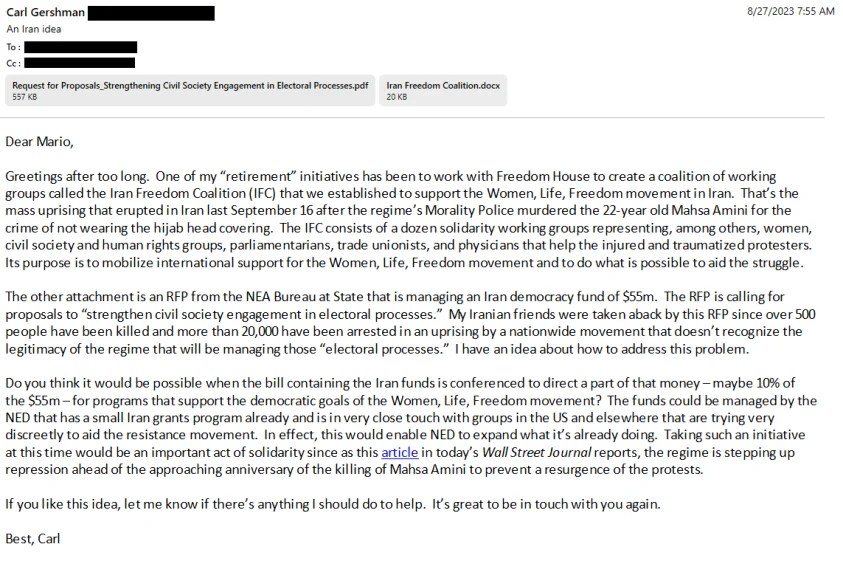
On August 27 2023, Gershman fired off an email to Díaz-Balart and the lawmaker’s “legislative assistant,” Austin Morley, stating that one of his “retirement initiatives” was “to work with Freedom House to create a coalition of working groups.” Calling it the Iran Freedom Coalition (IFC), Gershman claimed the Coalition was already “established.” However, no trace of its existence can be found online.
Gershman explained to Díaz-Balart that his “Iranian friends were taken aback” by the guidelines of the State Department’s 2023 Iran Democracy Fund, which earmarked $55 million for proposals to “strengthen civil society engagement in electoral processes.” According to Gershman, because the Women, Life, Freedom movement driving national protests “doesn’t recognize the legitimacy of the regime that will be managing those ‘electoral processes,” some of the money should be funneled to a more hardline initiative.
The Coalition was to consist “of a dozen solidarity working groups representing…women, civil society and human rights groups, parliamentarians, trade unionists, and physicians that help the injured and traumatized protesters.” Bizarrely, though the protests had been extinguished in Iran, Gershman pitched his IFC to “support…the mass uprising” in Iran, as if it were contemporary.
He suggested Díaz-Balart use his influence within Congress to “direct…maybe 10%” of the $55 million annual budget for the State Department’s controversial Iran Democracy Fund to his own NED.
“The funds could be managed by the NED,” Gershman wrote, “that has a small Iran grants program already and is in very close touch with groups in the US and elsewhere that are trying very discreetly to aid the resistance movement. In effect, this would enable NED to expand what it’s already doing. Taking such an initiative at this time would be an important act of solidarity.”
US-backed interventionists marketed as Iranian “freedom” leaders
Initially led and organized by Iranian citizens, the Women, Life, Freedom Movement quickly became a cause celebre for notorious, high-profile anti-Islamic Republic exiles. They included Reza Pahlavi, the Shah of Iran’s eldest son and pretender to the country’s now non-existent throne, and Masih Alinejad, a prominent veteran of Western-funded propaganda efforts targeting Tehran, who has reaped hundreds of thousands of dollars from the US government for her anti-Iran agitation – which includes calls for Israeli attacks on the country of her birth. In a September 2022 New Yorker interview, she claimed to be “leading this movement.” Alinejad has also called for Israel to assassinate Iranian leaders.
The Women, Life, Freedom movement’s co-optation by Western interventionists was so flagrant, activists on the ground in Iran complained their efforts had been “hijacked” by foreign forces. Protests in Tehran tapered off after a few weeks, and were forgotten inside Iran.
Yet, Pahlavi and Alinejad continued to hype the movement, earning an invite to the February 2023 Munich Security Conference, where they were presented as prospective leaders of a future “democratic” Iran. Three months later, the US government-funded NGO Freedom House presented the defunct Women, Life, Freedom movement with its annual Freedom Award.
With the introduction of his Iran Freedom Coalition, Gershman aimed to consolidate control of any future protests in the hands of the most belligerent elements in Washington, who advocate crushing sanctions, assassinations of Iranian leaders, and US airstrikes, while claiming concern for the human rights of average Iranians.
Gershman seeks US funds for defunct protest movement
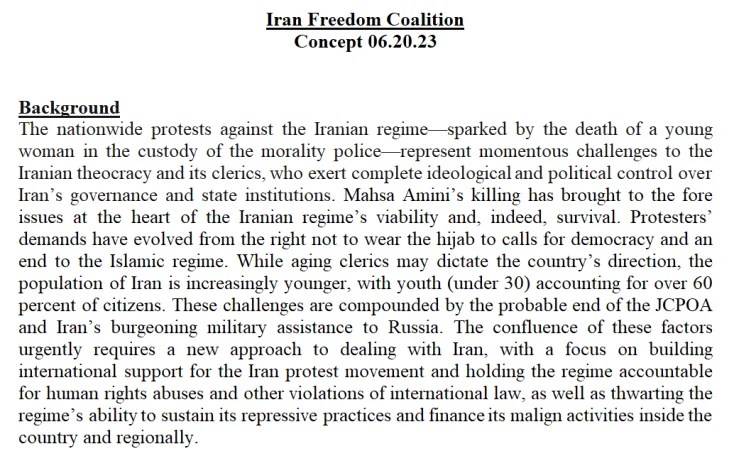
Attached to Gershman’s email to Díaz-Balart was a document setting out his vision for the Iran Freedom Coalition. Touting the defunct Movement as somehow continuing to “represent momentous challenges to the Iranian theocracy and its clerics,” the file called for a “new approach to dealing with Iran.” This was considered particularly urgent in light of the coming termination of the Iran nuclear deal, and what he believed was the Islamic Republic’s “burgeoning military assistance to Russia”:
“The confluence of these factors urgently requires… a focus on building international support for the Iran protest movement and holding the regime accountable for human rights abuses and other violations of international law, as well as thwarting the regime’s ability to sustain its repressive practices and finance its malign activities inside the country and regionally… Through actions outside Iran, the Coalition will also help connect, strengthen, and mobilize constituencies within Iran, namely women, youth, trade unions, civil society, and others.”
The IFC would thus seek to “[shape] international political discourse” on Iran, “[helping] support national discussions about power and democracy.” This work might include “[coordinating] boycotts or divestment campaigns to bring economic pressure to bear” on Tehran, “denying them resources to sustain their repressive activities.” In turn, the Coalition would “bring increased visibility to the efforts of Iranians and empower them to advance change.”
Gershman wrote that Freedom House was committed to “[nurturing] the formation” of IFC, “a coalition of like-minded and influential groups and individuals working on Iran.” It would seek to “inform public opinion in the US and abroad” about “Iran’s freedom struggle,” while focusing “public and diplomatic pressure…on isolating the regime and stopping the flow of funds to the regime.”

A rogue’s gallery of regime change operatives
Gershman’s proposal also provided an accompanying list of “individuals involved or to be involved” in the IFC. Those assembled as the leaders of the longtime NED leader’s coalition represent a veritable rogue’s gallery of neoconservative chickenhawks, pro-war think tankers, and Western-backed Iranian regime change activists.
A full proposed membership list appears at the end of this article.
Mahnaz Afkhami – Afkhami was Minister of Women’s Affairs under the Shah from 1976 to 1978, at a time when the Shah’s brutal Savak security forces were disappearing, torturing and killing thousands of protesters.
William “Bill” Kristol – Kristol is perhaps the leading neoconservative demagogue in Washington, and known for his extensive history of lobbying for war with Iran. In 2010, he declared that Washington’s calamitous, bloody “interventions” in Muslim countries, of which he was invariably a top cheerleader, should be considered “liberations,” and not invasions at all.
Joshua Muravchik – One of the most virulent advocates for a US war on Iran, Muravchik declared “WE MUST bomb Iran” in a 2006 LA Times editorial. Again in 2015, Muravchik declared in a Washington Post editorial, “War with Iran is probably our only answer.” A neoconservative admirer of Israel’s right-wing Likud Party, Muravchik has insisted with his usual knack for subtlety, “Israel keeps saving the world” by carrying out assassinations inside Iran.
Leopoldo Lopez – The de facto leader of Venezuela’s putschist, US and EU government-sponsored opposition, Lopez participated in a failed military coup to remove the democratically elected President Hugo Chavez in 2002, then assisted the Trump administration’s plot to oust President Nicolas Maduro which appointed a phony president, Juan Guaido, to steal Venezuela’s foreign assets, and initiated another failed military coup. Lopez is the aristocratic son of a right-wing Spanish legislator, Leopoldo Lopez Sr., and currently resides in Spain.
Kasra Aarabi and Saeid Golkar – Aarabi and Golkar both work at the Tony Blair Institute, the think tank and influence peddling operation of the pro-war former British Prime Minister. The outfit is known to have received £9 million for advising the government of Saudi Arabia. In November 2022, the Blair Institute published an extraordinary report on the Women, Life, Freedom Movement, excitedly cheering how “removal of the hijab became a symbol of regime change” in Iran. The report made a number of frenzied claims, including that the overwhelming majority of the Islamic Republic’s population are secularists, if not atheists, wholeheartedly supporting their government’s overthrow.
It went on to boast that the Blair Institute had “developed on-the-ground intelligence in Iran through a network of contacts on the streets,” which it has exploited to forecast” protest trends in Iran for the past five years, including the ongoing nationwide uprising.” While the Institute’s claim is unsubstantiated, it raises questions about whether the former UK PM’s outfit played a clandestine role in instigating the Women, Life, Freedom Movement protests.
Roya Hakakian – An Iranian-Jewish author and darling of the Israel lobby, Hakakian has denigrated protests against Israel’s genocidal assault on Gaza as proof that “Iran [has] arrive[d] on US campuses,” and fervently defended Israel as a robust democracy striving for peace.
Maziar Bahari – A Canadian-Iranian journalist, Bahari was the subject of Jon Stewart’s 2014 film, Rosewater, about his detention in Iran’s Evin prison. Today, Bahari serves alongside former State Department and USAID officials, and Western interventionist NGO leaders, as director of the board of Journalism For Change. As the independent outlet Noir reported, Journalism For Change receives at least 95% of its budget from the US State Department, which also funds IranWire, an anti-Tehran partner outlet that publishes Bahari’s articles.
Mariam Memarsadeghi – A self-proclaimed “Iran democracy activist” who features both the Ukrainian and Israeli flags on her Twitter/X bio, Memarsadeghi directs the Israel lobby-adjacent Cyrus Forum, which is dedicated to promoting regime change in Iran.
Despite her own flamboyant advocacy for toppling Iran’s government, Memarsadeghi conceded that Reza Pahlavi’s own campaign to dismantle the Islamic Republic floundered because “his most visible associates” were deranged far-right ultranationalists who alienated average Iranians. “[Spending] most of their time peddling distrust and attacking other opposition leaders on social media,” they also “publicly [called] for retributive violence, summary executions, the purging of leftists, vilification of human rights defenders, and antagonism towards free media outlets.”
In her criticism of Pahlavi, Memarsadeghi could have also been describing the neocon-controlled Iran Freedom Coalition to which she apparently lent her name and reputation.


US agency plotted to channel government funds into anti-Iran campaign after 2022 riots: Report
Press TV – September 20, 2024
A new report has revealed that the US National Endowment for Democracy (NED) privately plotted to direct government resources into an anti-Iran campaign established after 2022 foreign-backed riots.
Citing leaked documents and emails, The Grayzone news website reported Thursday that the NED had tried to channel US State Department resources into the so-called Iran Freedom Coalition.
The coalition, that is composed of pro-Western Iranian figures and warmongering US neoconservative operatives, represents a clear attempt to impose an “exiled leadership” over anti-Iran opposition, the report added.
It further said that the initiative against the Islamic Republic was spearheaded by Carl Gershman, the longtime director of the NED, which is considered Washington’s regime-change arm or the CIA spy agency in disguise.
“Regardless of the listed members’ level of participation, the composition of Gershman’s proposed Iran Freedom Coalition demonstrates how Iran’s self-proclaimed pro-democracy movement has become a plaything for the Bomb Iran lobby,” it said.
“Among those handpicked by Gershman to lead the initiative was William Kristol, the neocon impresario who has led a decades-long lobbying campaign for a US military invasion of Iran. Also selected was Joshua Muravchik, a flamboyant supporter of Israel’s Likud Party who insists that ‘war with Iran is probably our best option.’”
The report also said that the anti-Iran campaign’s Iranian members consist heavily of US government-sponsored cultural figures and staffers at interventionist Western think tanks like the Tony Blair Institute.
“As Gershman’s leaked proposal illustrates, these elements quickly hijacked the protests, inserting US government-sponsored exiles as the movement’s international face and voice, thus ensuring that their ultimate effect would be a deepening of US sanctions on average Iranians,” adds the report.
The Foreign-sponsored riots broke out in Iran in September 2022, when 22-year-old woman Mahsa Amini died in a hospital in the capital Tehran, three days after she collapsed at a police station.
The findings of an investigation into her death later attributed the tragic incident to Amini’s pre-existing medical condition, debunking claims that she was beaten by the police.
Rioters, nonetheless, went on rampage across the country, causing massive material damage to public property and, in some cases, lynching security forces as well as civilians whom they regarded as supporters of the Islamic establishment.
Iran’s intelligence community said several countries, including the United States and the United Kingdom, used their spy and propaganda apparatuses to provoke unrest in the country.
What Is Joe Biden’s Legacy?

By Oleg Burunov – Sputnik – 22.07.2024
Biden announced he is dropping out of the 2024 presidential race on July 21. It came amid calls by prominent Democrats and donors to withdraw following his performance in last month’s debate against former President Donald Trump.
In a statement on his decision to withdraw from the 2024 presidential race, President Joe Biden also reflected on the results of his four years in office, claiming that the US has built the “strongest economy in the world.”
He touted efforts to expand what he described as “affordable healthcare to a record number of Americans,” also arguing that his administration allegedly provided “critically needed care to a million veterans exposed to toxic substances.”
Is It So, Joe?
First and foremost, the US economic meltdown shows no signs of abating, with 36% of Americans recently surveyed by Pew Research rating the national economy as “poor”. Add to this the fact that America’s state debt, which now stands at nearly $34.4 trillion, is rising by $1 trillion about every 100 days.
Also, the US migration crisis persists as new data by the Customs and Border Protection (CBP) reveals a significant surge in illegal border crossings, with more than 205,000 apprehensions in June alone, pushing the total for fiscal year 2024 to 2.5 million.
Drug overdose, meanwhile, remains one of the leading causes of injury death in adults in the US and has risen over the past several years. Overdoses specifically pertain to synthetic opioids (fentanyl) and stimulants (cocaine and methamphetamine), according to Centers for Disease Control and Prevention data.
Biden’s Foreign Policy Track Record
The Ukraine crisis is in full swing, as the Biden administration continues to add fuel to the fire by providing the Kiev regime with military supplies despite Russia’s repeated warnings that such assistance would only prolong the standoff.
Separately, the Gaza war is still in place despite Biden’s much-hyped plan to help clinch a ceasefire between Israel and Hamas. The US president last month said that the Gaza war must end now and Israel must not occupy the Palestinian enclave after the end of hostilities – another statement that apparently fell on the Jewish state’s deaf ears.
As a cherry on the top, Biden failed to deliver on his promise to restore the 2015 Iran nuclear deal, with the Vienna talks on the matter finally coming to a standstill.
Featured Video
or go to
Aletho News Archives – Video-Images
From the Archives
Israel Would Have No Qualms About USS Liberty-Style FALSE FLAG If Iran Campaign Falters – Analysts
By Ilya Tsukanov – Sputnik – 18.06.2025
Donald Trump is mulling whether or not to join Israel’s aggression against Iran as Tel Aviv faces problems sustaining its defenses against growing counterstrikes, and apparently lacks a realistic game plan for an end to hostilities after failing to achieve its goals. Analysts told Sputnik how the US could be ‘nudged’ into the conflict.
“The US is already assisting Israel with supplies, intel, refueling support, etc. One of the many US posts in the region could be attacked for a casus belli,” former Pentagon analyst Karen Kwiatkowski explained.
“If Trump doesn’t comply with Israel’s demand” and join its aggression voluntarily, “a false flag may be needed” to drag the US in, Kwiatkowski, retired US Air Force Lt. Col.-turned Iraq War whistleblower, fears.
Netanyahu has a diverse array of options at his disposal, according to the observer, including:
- a false flag against US assets abroad blamed on Iran or one of its Axis of Resistance allies, like the Houthis
- a US domestic attack or assassination blamed on Iran
- Iranian air defenses ‘accidentally’ hitting a civilian jetliner carrying Americans
- use of a dirty bomb or nuclear contamination somewhere in the region blamed on Iran
- even blackmailing by threatening to use nukes against Iran if the US doesn’t join the fight
Kwiatkowski estimates that Israel probably has “enough blackmail power” against President Trump and Congress to avoid the necessity of a false flag operation, but a “USS Liberty-style” attack, targeting the soon-to-be-retired USS Nimitz supercarrier that’s heading to the Middle East, for example, nevertheless cannot be ruled out entirely, she says. … continue
Blog Roll
 Aletho News
- Embarrassing Pivot: U.S. considers dropping Iran oil sanctions amid war
- US has 2 months of rare earths left to replenish weapons amid Iran war: Report
- Strait Of Hormuz closure brings Empire to brink
- Iran controls Strait of Hormuz, dictates terms of war and peace as US excursion backfires
- Outlasting the Superpower: The Reasons Why Iran is Beating uhe US and Israel
- Top PMU commander, over a dozen fighters killed in new US strikes on Iraq
- Is Netanyahu’s war gamble threatening the future of ‘Israel’?: FT
- Smotrich calls for annexation of South Lebanon to Litani River
- Echos of Gallipoli? Hormuz and the Geography of Hubris
- Pakistan PM backs Iran’s right to self-defense amid tensions
- If Americans Knew
- UN’s special rapporteur on human rights says Israel is systematically torturing Palestinians
- Trump White House plagiarized Iran war manifesto from Israel-aligned think tank
- Gaza says 6–10 patients die daily waiting for treatment abroad as Israel blocks medical evacuations
- ‘Substantial evidence’ of double-tap strike in killing of Gaza’s Hind Rajab
- ‘Do Not Want To Die For Israel’: Doubts About Trump’s Iran Strategy Spread Among Troops
- Instead of taking Joe Kent’s claims seriously, the media is disregarding him as an antisemite
- Joe Kent’s Explosive Interviews about his Resignation over the Iran War
- Israel poised to take over southern Lebanon; settlers wreak havoc in West Bank – Not a ceasefire Day 165
- From Sde Teiman, the truth about Israel’s military justice system has been set free
- Child denied life-saving bone marrow transplant by Israel ‘because he is from Gaza’
- No Tricks Zone
- Devastating Assessment Of Comirnaty Vaccine By Former Senior Pfizer Europe Toxicologist
- New Study: CO2 Is ‘Effectively Negligible’ As An Explanatory Climate Change Factor Since 2000
- Former Pfizer Toxicologist Dr. Helmut Sterz Tells Bundestag Hearing Pfizer Vaccine Should Have Never Been Approved
- Energy Expert: Germany’s Nuclear Phaseout Was A “500 Billion Euro Mistake”
- New Research: South Australia’s Mid-Holocene Sea Surface Temperatures Were 4°C Warmer Than Today
- Storing Green Energy To Last Germany 10 Days Would Require A 60-Million Tonne Battery
- New Studies: UK Sea Levels Were 4 Meters Higher Than Today During The Mid-Holocene
- Destructive Green New Deal: German Energy And Metal Group Warns Of Drastic Crisis
- New Study Documents A 20-Year Pause In Arctic Sea Ice Decline – Driven By Internal Variability
- Wake-up Call: Survey Shows Majority Of Germans Now Favor Postponing Climate Targets!
 Aletho News