‘YOU’RE FIRED!’ Trump Dismisses Brian Hook in Truth Social Post
By Kyle Anzalone | The Libertarian Institute | January 22, 2025
President Donald Trump fired four presidential appointees that he said did not share his vision for America. Among those dismissed were Brian Hook, who served on the Trump transition team.
“My Presidential Personnel Office is actively in the process of identifying and removing over a thousand Presidential Appointees from the previous Administration, who are not aligned with our vision to Make America Great Again,” Trump wrote on Truth Social Monday.
“Let this serve as Official Notice of Dismissal for these 4 individuals, with many more, coming soon.” He continued, “Jose Andres from the President’s Council on Sports, Fitness and Nutrition, Mark Milley from the National Infrastructure Advisory Council, Brian Hook from the Wilson Center for Scholars, and Keisha Lance Bottoms from the President’s Export Council—YOU’RE FIRED!”
In 2018, Hook joined the administration shortly before Trump withdrew from the Iran nuclear deal. Hook was tasked with implementing a “maximum pressure” sanctions campaign against Tehran and overthrowing the Iranian government.
In 2020, Hook resigned from his post, after he was unable to achieve either objective.
Hook was a key official in helping to staff the incoming State Department on the transition team following Trump’s second election victory. In November, Hook said the second Trump administration “would isolate Iran diplomatically and weaken them economically.”
Hook also attacked the Biden administration’s “policy of appeasement and accommodation with Iran,” leading to a “failure of deterrence,” because “no one believes you have a credible threat of military force.”
However, Biden increased sanctions on Iran, refused to enter into serious negotiations with Tehran, and aided Israel in tit-for-tat strikes between Tel Aviv and Tehran.
Along with Hook, chef Jose Andres was fired from the President’s Council. Andres heads the World Food Kitchen (WFK), an international aid organization that often works with Washington.
Last year, seven WFK workers were killed by a series of Israeli strikes on their aid convoy in Gaza. While the White House did not punish or hold Tel Aviv to account for the murders, Andres accepted the Presidential Medal of Freedom from Biden earlier this year.
Trump One, Biden Nothing
By Ted Snider | The Libertarian Institute | January 21, 2025
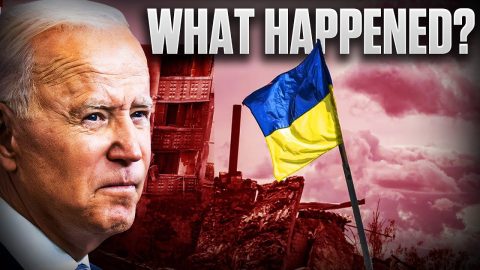
Before the first day of Donald Trump’s second term in office, he already had more diplomatic achievements than Joe Biden did on the last day of his. The entrance of the Trump team into the negotiations was the difference in Gaza. Biden opened his administration with the promise of “a new era of relentless diplomacy.” But after four years of wasted opportunity, the Biden administration would struggle to name a single diplomatic accomplishment.
Secretary of State Antony Blinken’s inclusion in his January 2 exit interview with The New York Times of the Biden administration’s “core goal” of making “sure that the war [in Gaza] wouldn’t spread, the conflict wouldn’t spread to other fronts, to other countries” and that they have “been working” on that “every day since,” is risible because it spread to Lebanon, Syria, Yemen, and Iran.
Blinken was asked how he looks back on the decision “to support Ukraine’s military offensive without a parallel diplomatic track to try and end the conflict.” His answer, as America’s chief diplomat, is no less humiliating. He defined bringing fifty countries together, who waged war on Russia militarily and economically, as “extraordinary diplomacy,” while conceding that, since the war began, there was not one “opportunity to engage diplomatically in a way that could end the war on just and durable terms.”
Biden opened his presidency with the promise to “offer Tehran a credible path back to diplomacy,” to “promptly reverse the failed Trump policies that have inflicted harm on the Cuban people and done nothing to advance democracy and human rights,” to correct the course on Trump’s “abject failure” in Venezuela, and to bring in a new approach to North Korea that “is open to and will explore diplomacy.”
Biden failed on all four. Instead, he ushered in an era in which the State Department has been reduced to the hawkish arm of the Defense Department.
At the end of his term, far from reversing Trump’s policies, Biden’s Cuba policy looks more like Trump’s than like Barack Obama’s. Biden maintained, and even increased, sanctions. The United States continued to support dissident activists and to fund regime change. Most importantly, and most devastatingly, the Biden administration continued to uphold the illegal embargo of Cuba in every single vote at the United Nations. In October 2024, only one other country in the world joined the U.S. in support of its embargo with one other abstaining.
On January 14, with less than a week in his term, Biden announced that he would, at last, remove Cuba from the State Sponsors of Terrorism list. Four years ago, that would have counted as a diplomatic accomplishment. Now, it is an ineffectual gesture that will simply be erased. William LeoGrande, professor of Government at American University and a specialist in U.S. foreign policy toward Latin America, told me that “with just days left in his presidency, [Biden] relaxed sanctions he should have relaxed four years ago—sanctions that will almost certainly be reimposed by Donald Trump.” Mike Waltz, Trump’s pick for national security advisor, told Fox News that “anything they [the Biden Administration] are doing right now we can do back, and no one should be under any illusion in terms of a change in Cuba policy.”
LeoGrande summarized Biden’s diplomatic legacy in Cuba by telling me that “Joe Biden’s Cuba policy accomplished nothing—actually, worse than nothing, because it left both Cubans and the United States worse off. He reneged on his campaign promise to return to Obama’s policy of engagement, a policy that was enormously popular in Latin America, Europe, and in the United States—everywhere except south Florida. In a vain quest for votes in Miami, Biden left most of Donald Trump’s extreme sanctions in place, immiserating the Cuban people in the midst of the pandemic.”
Biden’s diplomatic legacy in Iran is no less disappointing. Biden promised a quick return to the JCPOA nuclear agreement. Instead, he refused to end sanctions—the flesh of the agreement—and refused to promise that the U.S. would not break the deal again even for the duration of Biden’s term—the soul of any agreement. Though it was the United States that illegally pulled out of the deal, Biden demanded additional concessions from Iran.
Instead of following Obama’s diplomacy with Iran, Biden followed Trump’s maximum pressure on Iran. In order “never to allow Iran to acquire a nuclear weapon,” Biden said the U.S. “is prepared to use all elements of its national power to ensure that outcome.”
But the United States does not believe Iran is trying to acquire a nuclear weapon. The 2022 U.S. Department of Defense’s Nuclear Posture Review concludes that “Iran does not today possess a nuclear weapon and we currently believe it is not pursuing one.” CIA Director William Burns has repeatedly said that there is no evidence Iran has decided to build a nuclear bomb. Most recently, Burns reiterated in a January 10 interview, “We do not see any sign today that any such decision has been made.”
The election of Dr. Masoud Pezeshkian brought a reformist back to the presidency of Iran. Pezeshkian has emphasized the need to mend relations with the U.S. and the West. He has called for bypassing intermediaries in favor of direct negotiations. But that did not influence the Biden administration in its stubbornness not to negotiate. When asked at a July 8 press briefing if “the U.S. now ready to resume nuclear talks, other talks, or make any diplomatic moves with Iran in light of this new president,” National Security Communications Advisor John Kirby responded, “No, we’re—we’re not in a position where we’re willing to get back to the negotiating table with Iran just based on the fact that they’ve elected a new president.” Another missed diplomatic opportunity.
Lack of willingness to engage with Iran diplomatically has, instead of the strategically important goal of mending relations between Iran and the West, pushed Iran closer to China and Russia. During the Biden years, Iran joined the Shanghai Cooperation Organization and BRICS, two China-Russia led international organizations. On January 17, 2025, Iran signed a comprehensive strategic partnership with Russia. The details are not yet public, but Russian President Vladimir Putin says it includes bilateral cooperation in “politics and security” and collaboration on “the development of nuclear power plants.”
During Biden’s presidency, diplomacy with China has been set aside in favor of increased confrontation. Biden has sullied the One China policy, declared Taiwan a critical strategic location for U.S. defense, said that the U.S. would send troops to Taiwan if China attacked and weaponized and militarized the conflict.
Perhaps most dangerously of all, Biden pursued the opposite of diplomacy in the Russia-Ukraine war. When diplomacy offered a real chance to avoid the war before it began and to end the war in the weeks after it did, the U.S. refused to negotiate with Russia in the first instance and discouraged and blocked Ukraine from negotiating with Russia in the second. Since then, Biden and Blinken have abdicated diplomacy. Secretary of State Antony Blinken has barely, if ever, officially spoken to Russia foreign minister Sergei Lavrov since the war began, and President Biden has not met with President Putin once. By the summer of 2024, Biden was still maintaining that “I have no good reason to talk to Putin right now.”
Relations with Russia and China are more dangerous as Biden leaves office. Relations have not improved in Cuba and Iran, despite Obama setting the platter to which Biden could have easily returned. Biden’s promise of “relentless diplomacy” devolved into the abdication of diplomacy and a tragically wasted opportunity.
Iran plans $120bn worth of investment in petroleum projects
Press TV – January 11, 2025
Iran is planning to invest up to $120 billion in petroleum projects as the country seeks to increase its oil and gas production to respond to a rising demand for energy.
Oil Minister Mohsen Paknejad said on Saturday that Iran will invest some $50 billion to increase its oil production to 4.6 million barrels per day (bpd) by 2028, from a current output of 3.3 million bpd.
Paknejad said that Iran’s natural gas production should also increase from 1 billion cubic meters (bcm) per day to 1.35 bcm per day in the next four years, adding that the country will need to invest more than $70 billion to hit the target.
He said investment in gas fields will also cover projects to boost pressure at South Pars, the world’s largest gas field which straddles the maritime border between Iran and Qatar in the Persian Gulf.
The minister said seven pressure-boosting projects with a total investment of $18 billion will be executed in South Pars to help stabilize the output from the giant reserve.
Paknejad said Iran also seeks to increase its refining capacity by 0.5 million bpd per day until 2028 while trying to raise the output capacity of its petrochemical sector.
He said the development projects will be funded partly through finances provided by Iran’s sovereign wealth fund and partly through investment from foreign companies.
Iran’s plans to expand its petroleum sector come as the country is still subject to an extensive regime of US sanctions that bans the provision of technology and investment from abroad.
Since the sanctions were imposed in 2018, the Iranian Oil Ministry has mostly relied on domestic resources to develop the oil and gas fields in the country.
Neocon Sanctions Architect Beats Drums of War With Iran Amid Trump’s Looming Return
By Ilya Tsukanov – Sputnik – 02.01.2025
Donald Trump will be back in the White House in less than three weeks. While he’s expressed opposition to regime change in Iran, and pride in being the first president in decades not to start any new wars during his first term, his adamant support for Israel, and the tapping of hawks for his new administration have sparked fears of US aggression.
The United States “should give diplomacy a final shot – while preparing to use military force” against Iran to destroy its nuclear program, prominent Iran sanctions cheerleader and former State Department deputy special envoy Richard Nephew has suggested.
In a new piece for Foreign Affairs magazine, Nephew argues that while there are plenty of “good reasons not to bomb Iran,” like engulfing the Middle East in even greater turmoil and “undermin[ing] US credibility if the attacks don’t succeed,” the “case against military action is not so neat,” given Washington’s paranoia about ‘Iranian nuclear weapons’, and the limited prospects for sanctioning Tehran into submission given its newfound economic and security partnerships with BRICS allies.
Unless the Trump administration is “prepared to live in the world that Iranian nuclear weapons would create, it may have little choice but to attack Iran – and soon,” Nephew claims, even while admitting that “Iranian nuclear weapons would not present a near-term existential threat” to the US as much as it would its regional “partners” (i.e. Israel).
Nephew isn’t the first to float an attack on Iran following Trump’s reelection in November, with DC Beltway media running opinion pieces like “Israel should strike Iran now, paving way for Trump 2.0,” and sources telling the Wall Street Journal that Trump’s transition team is weighing an attack on Iran’s nuclear program. In November, former CIA chief Leon Panetta warned that Trump could give Israel a “blank check” on Iran and ultimately spark a war between the regional powers.
The brainstorming about a direct attack on Iran comes in the wake of the abject failure of the US’s 40+ year strategy of crushing the Islamic Republic through sanctions, saber-rattling and attempts at regime change, which have pushed the country to strive for economic and military self-sufficiency, and to expand its strategic footprint regionally.
Will Trump Attack Iran?
Trump is a well-known Iran hawk, pulling the US out of the Joint Comprehensive Plan of Action nuclear deal in 2018 at Israel’s behest, and expressing full-throated support for Tel Aviv amid its conflict with the Iran-led Axis of Resistance over the past 15 months. He’s also staffed his new administration with a number of avowedly pro-Israel Iran hawks, including Marco Rubio and Mike Waltz.
At the same time, Trump’s past frustrations with Benjamin Netanyahu, who rushed to congratulate Joe Biden after the highly contentious 2020 election, combined with resistance to advice from aides to escalate militarily against Iran, and support for initiatives to scale back the US military footprint in the Middle East during his first term, make the future of US policy vis-a-vis Iran and the Middle East region uncertain.
US judge awards pro-regime change journo Shane Bauer $113 million seized from Iran
By Alexander Rubinstein and Max Blumenthal · The Grayzone · January 1, 2025
UPDATE: U.S. District Senior Judge Richard J. Leon has awarded pro-regime change journalist Shane Bauer a whopping $113 million in money seized from Iran by the US sanctions regime.
Together with his ex-wife, Sarah Shourd, and their friend, Joshua Fattal, Bauer sued the Iranian government for millions in damages they claim to have incurred during their two year-long imprisonment in Tehran. The three Americans were arrested by Iranian soldiers near the border of the Kurdistan region of Iraq in 2009. At the time, Bauer was studying in Damascus, Syria on a US Department of Defense-sponsored fellowship. Judge Leon ruled that “Iran is liable for false imprisonment,” and “for intentional infliction of severe emotional distress as to all plaintiffs.”
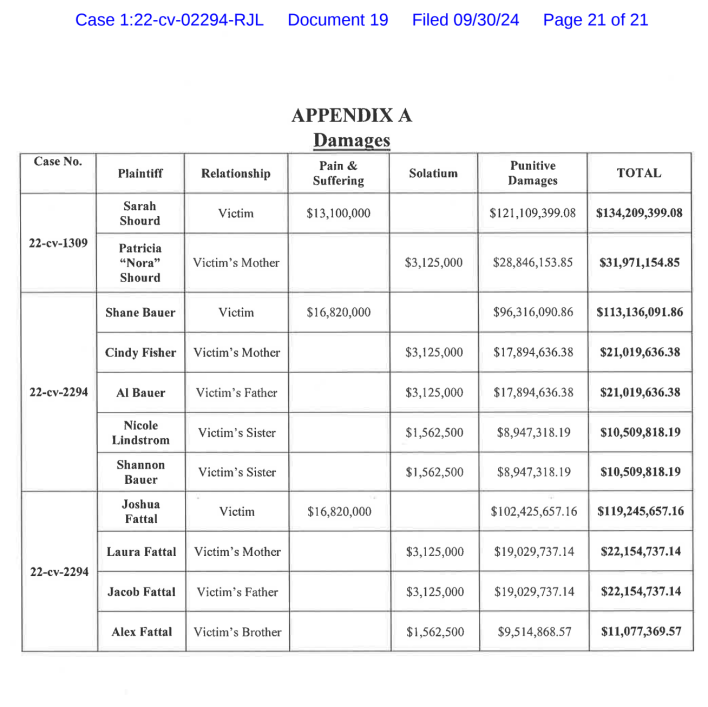
Leon has awarded Bauer, Fattal, Shourd and their families more than $500 million in seized Iranian state funds which could have been used to purchase medicine, sanitation equipment and food for citizens of the heavily sanctioned nation. As The Grayzone reported below, “Bauer and his ex-wife, Shourd, posed as staunch opponents of US sanctions against Iran and other nations. In 2016, for example, Bauer characterized Hillary Clinton’s call for Iran sanctions as ‘totally irresponsible.’ Shourd, for her part, condemned sanctions against Iran for ‘hitting the poorest of Iranians the hardest.’”
Bauer is currently reporting from Damascus, where the former Al Qaeda affiliate Hayat Tahrir al-Sham (HTS) has toppled the Syrian government and assumed power – a development he appeared to support. He and his fellow plaintiffs have not commented on the judgment they received against Iran.
Judge Leon’s full decision can be viewed here.
Below, in their initial August 30, 2022 report on Bauer’s lawsuit against Iran, Alexander Rubinstein and Max Blumenthal detail his history of agitation for Western-sponsored regime change operations across the globe, and his record of sordid attacks on The Grayzone, including his promotion of a failed frivolous lawsuit that aimed to destroy this publication.
Over a decade since he rose to prominence as a protagonist in an international drama of espionage and imprisonment, American journalist Shane Bauer and his family filed suit against Iran’s government in a Washington DC-based US District Court, seeking compensation for $10 million in damages resulting from his two year detention in Tehran.
Bauer’s ex-wife Sarah Shourd and their friend, Joshua Fattal, filed simultaneous lawsuits, seeking $10,000 and $10 million respectively.
The trio’s cases were filed in a Washington DC federal court with Judge Richard J. Leon – the same justice who ordered the Iranian government to pay the Washington Post’s Jason Rezaian $180 million in damages for his 18-month detention in the country.
In 2011, an Iranian court sentenced Bauer and Fattal to a total of eight years in prison each after they were convicted of illegally crossing the country’s border and spying for the United States. The two each served a total of two years, while Shourd was granted a compassionate release from Iranian prison after 13 months of detention.
Before his imprisonment, Bauer trekked throughout Africa and the Middle East while working as an English teacher and roaming reporter, racking up an impressive collection of passport stamps. Following his 2011 release, he established himself as a journalist specializing in undercover investigations, working a stint as a senior reporter for Mother Jones magazine in between various freelance gigs.
Bauer simultaneously emerged as a prolific apologist for US-backed regime change operations from Syria to Nicaragua, while justifying the US assassination of Iranian Maj. Gen. Qasem Soleimani. A relentless antagonist of anti-interventionist public figures, he has pushed for big tech platforms to censor media personalities that challenged Washington’s regime change agenda.
Bauer has even promoted a failed legal action against The Grayzone by a fellow journalist who had received a large sum of assets seized by the US government from Iran.
In 2018, Bauer’s book of undercover reporting, “American Prison,” which saw him take a job as a prison guard to gain inside access to a private prison, wound up on former President Barack Obama’s “Favorite Books of 2018.”
By the following year, as Bauer’s journalistic output declined, his attacks on anti-war media figures only escalated. Today, many of his most malicious tweets have been scrubbed, he is no longer employed by Mother Jones, and he says he is “working on a book about Americans in the Syrian war.” If Bauer scores a lucrative payout in US federal court, however, he may never need to worry about a freelance fee again.
And if successful, he and his former cellmates will ultimately be paid out with Iranian government assets seized by the United States through its international sanctions regime. In other words, the trio plans to benefit from looted public funds which Tehran could have otherwise used to purchase medicine, food, or fund social programs for its people.
Studies have found that the “Iranian economy and households are affected enormously” by sanctions targeting the country’s oil exports. In one particularly egregious instance of theft, the US government seized an Iranian oil tanker in 2021 and hauled it to Texas, where it sold the stolen crude for $110 million.
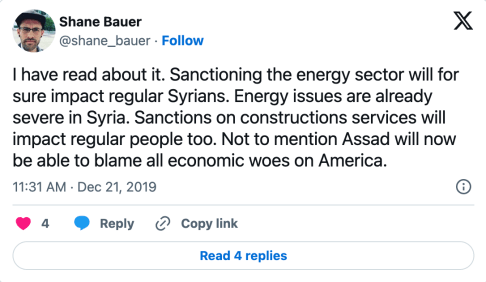
Before launching their lawsuits, Bauer and his ex-wife, Shourd, posed as staunch opponents of US sanctions against Iran and other nations. In 2016, for example, Bauer characterized Hillary Clinton’s call for Iran sanctions as “totally irresponsible.” Shourd, for her part, condemned sanctions against Iran for “hitting the poorest of Iranians the hardest.”
Bauer’s sudden bid for millions of dollars seized from the Iranian people by the US government raises new questions about a character whose journalistic career was shrouded in suspicion.
Long before his arrest in Iran, Bauer’s moves throughout Africa and the Middle East tracked closely with US foreign policy initiatives, and were sponsored by a US Department of Defense fellowship for several years.
To top it off, the lawyer Bauer enlisted to secure millions from Iran’s government counts one of Washington’s most infamous spies among her previous clients.
“the lack of coordination on the part of these hikers… indicates an intent to agitate”
The background to Bauer’s lawsuit originates in a July 2009 expedition he, his then-girlfriend Sarah Shourd, and their friend Joshua Fattal took to the Iranian border, where they were subsequently arrested.
The three Bay Area natives and self-described social justice activists insisted that their incursion into Iran was the result of an honest mistake. They claimed to have crossed the border unknowingly during a hiking trip near the Ahmad Awa waterfall in Iraq’s Sulaymaniyah Province, a region which fell under control of US-backed Kurdish militias following the US invasion of 2003.
According to Bauer’s legal complaint, when Iranian border guards arrested him and his companions, “Shane and Mr. Fattal instead became limp, as they would often do when protesting.”
While in Iranian custody, Bauer’s captors discovered photographs on Shourd’s camera showing they had visited Tel Aviv, Israel. The two said they traveled to Israel to visit an American friend, Tristan Anderson, who had been badly wounded and hospitalized by an Israeli teargas canister during a protest against Israel’s apartheid wall.
During Bauer’s trial, an Iranian judge listed each of the entry stamps on his second passport. They included Syria, Yemen, Iraq, Lebanon, Sudan and Israel.
Iran’s government was not the only party that rejected the trio’s excuses for their presence on the border. An Iraqi police officer claimed to the Iranian TV station Al-Alam the hikers were “working with the CIA.”
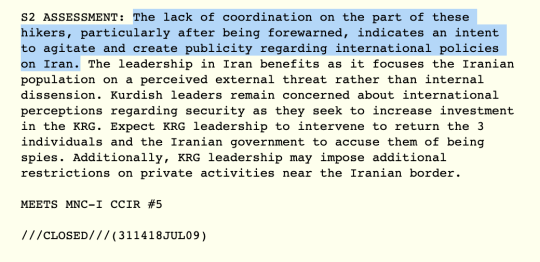
Meanwhile, a classified 2010 US military report stated that “the lack of coordination on the part of these hikers, particularly after being forewarned [of their proximity to the Iranian border], indicates an intent to agitate and create publicity regarding international policies on Iran.”
While Shourd denounced the US military assessment as “ridiculous,” her and her friends’ visit to the Iranian border came at a precarious time for the country’s government.
Indeed, their arrest occurred just weeks after President Mahmoud Ahmadinejad, a firebrand personality considered hostile to the West, secured reelection by a nearly 30 percent margin. The result sparked massive demonstrations in Tehran and gave way to the so-called “Green Movement,” a sustained protest campaign against Ahmadinejad’s mandate that eventually aided the 2014 electoral victory of Iran’s reformist bloc.
Throughout the summer of 2009, Western media granted the “Green Movement” wall to wall coverage, crediting it with drawing the largest protest crowds since Iran’s 1979 Islamic Revolution. In her memoir of captivity, Shourd recounted that during a trip to Sweden, “Stockholm’s sizable expatriate Iranian community protested in solidarity with the uprising in their home country.”
“My brother, Alex, and I documented the anti-Iran rally in Sweden,” she recalled.
Shourd later wrote that while imprisoned in Iran, the Green Movement “made me want to participate in undermining the regime that was causing me and my family so much pain.”
When the story of “Three American Hikers Held Hostage in Iran” emerged in July 2009, their tale was presented as further proof of the embattled government in Tehran’s anti-American sentiment and lack of regard for human rights. Shourd later expressed gratitude to the Iranian government “for using us to further deepen your own crisis of legitimacy around the world and with your own people.”
Their detention also corresponded with the launch of President Barack Obama’s economic assault on Tehran, a strategy which saw Washington levy hefty financial sanctions against Iran’s government in a bid to force it to negotiate limits on its domestic nuclear program.
Bauer’s lawyer represented top US spy jailed in Cuba
Bauer’s lawsuit accused the Iranian government of a slew of crimes against both himself and his family. Notably, it claims Bauer was subjected to torture, assault, and battery while in Iranian custody.
Bauer’s 2014 memoir, “A Sliver of Light,” which he co-authored with Shroud and Fattal, offers a strikingly different narrative, however. In the book, Bauer recalled taunting a prison guard to assault him and acknowledged that Iranian authorities were reluctant to do so.
“If he can’t frighten me, all he can do is hit me, and if he does that, he will be hurting himself,” Bauer explained.
“We are hostages, and hostages are currency, and currency is not to be damaged. Making him beat me is my only way to fight back,” he continued, after saying he repeatedly screamed at the guard: “Hit me!”
While Bauer’s lawsuit appeared to contradict the account offered in his memoir, it is far from an amateurish legal complaint. He and his family are represented by Emily P. Grim, a partner at the elite Gilbert, LLP law firm, which is located just blocks from the US Capitol.
Grim’s biography on Gilbert’s website boasts: “Her clients include Alan Gross, an American jailed in Cuba from 2009 to 2014 for his work on a U.S. Government project to increase Internet access in Cuba’s Jewish community, and Amir Hekmati, a former U.S. Marine imprisoned in Iran from 2011 to 2016 on false charges of espionage.”
Before he became Grim’s most famous client, Alan Gross was arrested by Cuban security officers in 2009. At the time, Gross was working for the United States Agency for International Development, or USAID, a soft power arm of American foreign policy that has overseen countless destabilization plots around the globe. The USAID program that sponsored Gross’ work in Cuba was funded through the 1996 Helms-Burton Act, a US law that explicitly called for regime change in Cuba.
When Cuban authorities apprehended Gross during his fifth trip to the country, they discovered his phone was linked to a SIM card that was distributed exclusively by the Pentagon and the CIA. The USAID employee had previously smuggled large amounts of illicit technology into Cuba, apparently as part of an effort to establish a network of covert internet access points throughout the country.
Amir Hekmati is the second-most notable client of Bauer’s lawyer, Emily Grim. A former marine, Hekmati helped develop a translation system financed by the Pentagon’s Defense Advanced Research Project Agency, or DARPA. Iran jailed Hekmati and sentenced him to death after convicting him on espionage charges. Following the diplomatic breakthrough of the Iran-US nuclear deal, he was released in 2016 as part of a prisoner swap.
Though Hekmati was initially rewarded a $20 million payout of seized Iranian assets, the Department of Justice eventually cut him off when the FBI became suspicious that the American had traveled to Iran to sell classified information about US operations in Afghanistan to the government, and not to visit his grandmother as he claimed.
Despite angry protestations, Grim’s firm has been unsuccessful in persuading the courts to complete her client’s payout.
Gilbert LLP has not responded to multiple emailed requests from The Grayzone regarding Bauer’s lawsuit. Bauer and Shourd have also ignored requests for comment delivered by Twitter and email.
Bauer sponsored by Pentagon grant that mandates “contributing to the national security of the United States”
Shane Bauer has lashed out at anyone who has accused him of having worked with the US government. However, his memoir raised more questions about his relationship with Washington than it has answered.
In one particularly revealing section, Bauer recalled an interrogation he experienced at the hands of an English-speaking Iranian he nicknamed “Weasel.”
“In our other sessions, you listed twenty-four countries that you have been to. Who funded those trips?” Weasel asked Bauer, who was 29 at the time.
“I know what he is getting at,” Bauer recalled, “and it is a legitimate question. If I can’t account for my funds, how can I prove that I am not being funded by the CIA? The problem is, I don’t think my honest answer is that believable.”
Bauer ultimately told Weasel that he saved money while “working as a welder” until he was 19 before traveling “through Europe and the Middle East.”
“Does this asshole believe a word I’m saying?” Bauer recalled wondering.
The line of questioning proceeded with Weasel asking whether the US government paid for any of Bauer’s trips.
“Shit! He knows about the grant…” wrote Bauer. ‘No,’ I say.”
Bauer was referring to the Boren Award, a Department of Defense sponsored grant that covered his Arabic studies in Yemen and Syria. When “Weasel” asked who funded the program, Bauer once again admitted to lying, telling him it was the State Department.
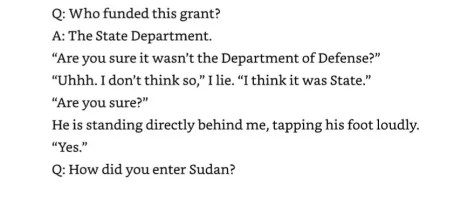
From Bauer’s co-authored account of captivity in Iran, “Sliver of Light”
Boren fellowship recipients are required to pay back their award through governmental service by “contributing to the national security of the United States in the Department of Defense, any element of the intelligence community, the Department of Homeland Security, or the Department of State.”

From the Boren Awards website
In less common instances, Boren recipients are allowed to fulfill their obligations to the US government in other departments. However, the overwhelming majority of grantees do so with the aforementioned agencies. Bauer never specified whether or not he fulfilled his obligation to the fellowship – or how he did it. He did claim, however, that the professor who encouraged him to apply for the grant stated none of their students actually went into government.
Yet when journalist David Ravicher inquired with a Boren representative about the program, he was informed “that 98 percent of its recipients fulfill this requirement and the rest receive deferments. Otherwise, the Treasury Department hunts them down.”
Before stepping into Iran, Bauer winds strange trail through the region
Shane Bauer entered journalism while enrolled at the University of California-Berkeley’s Peace and Conflict Studies program, which he graduated in 2007. It was at UC-Berkley where he met Shourd.
Bauer’s first dabbled in undercover journalism while in Yemen in 2005. At the time, the Houthi movement had just launched its insurgency against the Yemeni government. The civil conflict eventually triggered a brutal and ongoing military intervention by the US, Saudi Arabia, and the UAE to crush the Houthi advance.
According to the UC-Berkeley Alumni Association’s newsletter, Bauer was employed in Yemen by “a pro-government, English-language paper.” While the Alumni Association did not say which paper that was, Bauer earned a byline in 2005 from the Yemen Observer, a paper founded by the longtime press secretary to then-President Ali Abdullah Saleh.
Bauer eventually “decided to sneak into a city occupied by Houthi rebels which no Western journalist had visited,” the newsletter wrote. While disguised in local garb, Bauer and a British pal were detained by local authorities in the city of Saada and released a day later.
Bauer also spent two summers in the Darfur region of Sudan while enrolled at UC-Berkeley. At the time, between 2006-07, Darfur-based rebel groups from the Sudanese Liberation Army, or SLA, were facing international pressure to enact a peace deal with Sudanese President Omar Bashir, who was labeled a state sponsor of terror by the US.
In 2007, Bauer managed to score an interview with the vice intelligence director for SLA General Secretary Minni Minnawi, who had signed the deal. According to the Institute for International and Strategic Relations, a French think tank, Minnawi had been backed by the CIA as the only rebel faction leader to ink the agreement with Khartoum. He was later flown to Washington to meet with President George W. Bush. Today, he serves as the governor of Darfur while his forces fight in Libya under the command of Khalifa Haftar, another former CIA asset.
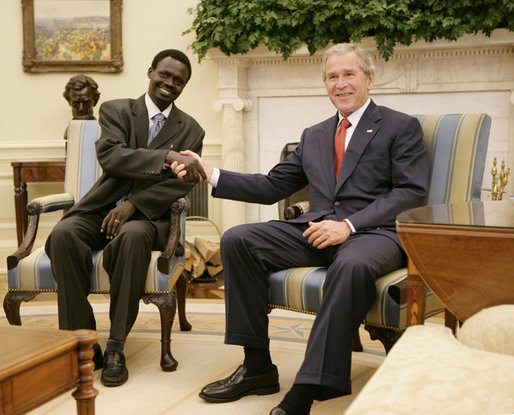
SLA General Secretary Minni Arko Minnawi and President George W. Bush
In his memoir of captivity in Iran, Bauer wrote that his interrogator demanded to know how he entered Sudan in 2007. The inquiry caused Bauer to worry that Iran may have been aware of his “history of government funding and my history of illegally crossing borders,” he recalled. Bauer told his interrogator that he “entered [Sudan] as a guest of the Sudanese Liberation Army.”
Not long after his jaunt into Darfur, Bauer arrived in Damascus, Syria with his then-girlfriend, Shourd, for several months. At the time, Washington was cultivating opposition to the government of President Bashar al-Assad through civil society networks around the country.
Bauer and Shourd said they studied Arabic at Damascus University, taught English to Iraqi refugees, and used the country as a base for reporting around the region. (On her personal webpage, Shourd says, “In 2007, I moved to Damascus, Syria…” In an interview with the Pulitzer Center, however, she states, “In 2008, I moved to Damascus, Syria…”)
A confidential November 2008 cable by Maura Connelly, then the Charges D’Affaires for the US Embassy in Damascus, identified English teachers and visiting Fulbright scholars in Syria as important cogs in US “public diplomacy” efforts against the government of President Bashar al-Assad.
The US embassy’s “English Language Fellow (ELF) for 2008-2009 remains in country and is using her numerous contacts among Syrian English teachers to conduct training in Damascus and country-wide,” Connelly noted.
Bauer and Shourd’s teacher in Damascus, Majid Rafizadeh, happened to have been on a Fulbright scholarship at the time. A Syrian-Iranian academic, Rafidzadeh has since emerged as a fervent supporter of Iranian regime change who has supplied testimony to Congress advancing the interventionist goals of hardline neoconservatives.
Bauer later reflected “how, back in 2009, my Syrian friends would fantasize about being rid of the dictator and his secret police, but no one could have imagined that the Arab Spring would come two years later.”
Bauer escalates online attacks, enters Syria under US occupation
Years after the so-called Arab Spring swept through the region like a hurricane, leaving unimaginable ruin in its wake, Bauer was still pumping out online attacks against prominent critics of US meddling.
By 2019, his attacks on opponents of the US-backed dirty war on Syria had grown so unhinged, his detractors began to taunt him with the refrain: “Take a hike.”
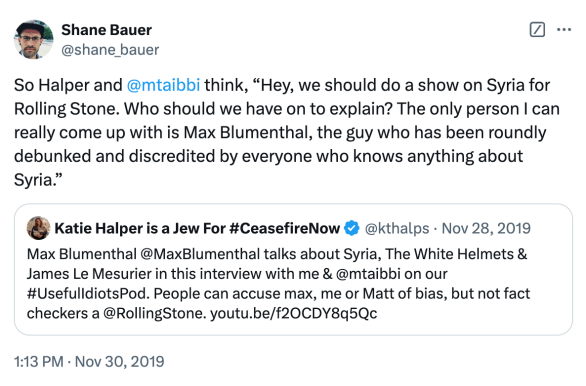
Bauer also took aim at former US Rep. Tulsi Gabbard for daring to criticize the US military occupation of northeastern Syria, insisting it was a noble anti-terrorist mission. In fact, Dana Stroul, a senior Biden Department of Defense official, has openly stated that the US military “owns” the “resource rich” region of Syria in order to exploit its wealth and starve Damascus into capitulating to the West’s agenda.
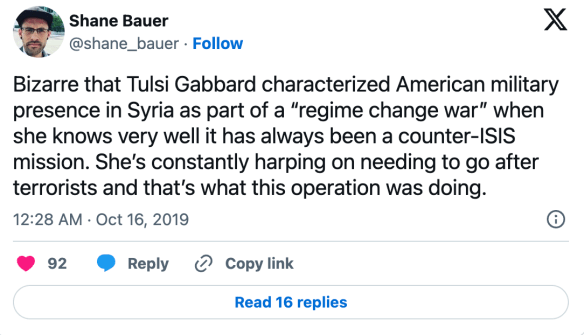
At the time, Bauer had recently returned from a visit to the US-occupied northeastern region of Syria for a series of field reports lamenting Washington’s refusal to remove Assad by force. Published in the May/June 2019 issue of Mother Jones, the series opened with a quote by a Kurdish border guard practically begging the US to plunder Syria’s natural wealth: “We have oil, so much oil. Let them stay and take the oil.”
Careful readers may be wondering whether Bauer entered the country legally or not. In fact, Syria’s government denied Bauer’s visa, prompting him to “sneak in” through the border controlled by the US military and its Kurdish allies.
Since Bauer’s reports from US-occupied Syria in 2019, he has produced only one article: a profile of a rogue local US police force for The New Yorker. That was nearly two years ago.
With no known sources of income apart from his two published books and the one apparently on the way, Bauer turned to the US government and the funds it seized from the Iranian people for a massive payday.
View the initial legal complaint, Shane Bauer v. the Government of the Islamic Republic of Iran, here.
US imposes sanctions on IRGC entity over alleged election interference
Press TV – December 31, 2024
The United States has announced sanctions on an entity it says is affiliated with the Islamic Revolution Guard Corps (IRGC) over its alleged interference in the 2024 US presidential elections.
The designation was announced by the US Treasury’s Office of Foreign Assets Control (OFAC) on Tuesday and targeted the IRGC subsidiary, which it identified as the Cognitive Design Production Center (CDPC).
A statement on the Treasury’s website claimed the CDPC had planned influence operations since at least 2023 to incite tensions among the US electorate on behalf of the IRGC.
Iran has repeatedly rejected accusations it has interfered in elections in other countries, including in the US.
Iran’s Permanent Mission to the United Nations issued a statement in late August to reject such allegations.
“Such allegations are unsubstantiated and devoid of any standing,” said the Mission after the US Federal Bureau of Investigation and several other American intelligence agencies claimed that Iran had been involved in the hacking of the campaigns of Trump and his Democratic rival Kamala Harris.
“As we have previously announced, the Islamic Republic of Iran harbors neither the intention nor the motive to interfere with the US presidential election,” said the statement.
Iranian authorities say that Washington’s policy of imposing numerous sanctions on the country is solely aimed at forcing the country into accepting political and military concessions.
Global Majority nations are de-dollarizing trade with Panda Bonds and African banks
Inside China Business | December 13, 2024
Top African banks are key in the BRICS push to do more trade outside the US Dollar, and especially outside Western systems. By setting up branches inside China, African banks are able to borrow and lend in renminbi, the Chinese currency. This allows for cross-border trades to be settled in local currencies and RMB, instead of through USD-denominated letters of credit or debt markets. Panda Bonds are another tool, rapidly gaining in popularity and usage. Pandas are RMB bonds, sold to investors in Mainland China who want to diversify their fixed income investments to global borrowers. To borrowers, Panda Bonds offer lower interest costs than USD- or Euro-denominated debt, while also allowing for repatriation and currency swaps that are common in USD loans. Africa’s biggest banks, including those owned by African governments themselves, have set up in Mainland China and are increasingly integrated into China’s financial and industrial sectors. And large Chinese banks are heading the other way, investing heavily in Africa’s raw materials industries, and providing liquidity for Africa’s rising consumer class.
Resources and links:
Substack, for video transcript and direct links https://open.substack.com/pub/kdwalms…
South China Morning Post, African banks set up shop in China as Beijing pushes for yuan to eclipse US dollar https://www.scmp.com/news/china/diplo…
Statista, China’s African Trade Takeover https://www.statista.com/chart/26668/…
Africa’s Top 100 Banks 2024: Going global https://african.business/2024/09/fina…
S&P Global, Three Minutes In Panda Bonds: Why Issuance Is Surging https://www.spglobal.com/ratings/en/r…
Iran rejects latest E3 allegations about its peaceful nuclear program
Press TV – December 11, 2024
Iran has rejected the latest allegations about its peaceful nuclear program by three European countries, saying it will give an appropriate response to any confrontational move.
Iranian Foreign Ministry spokesman Esmaeil Baghaei made the remarks on Tuesday while responding to a joint statement by France, Germany, and the UK that accused Iran of failing to honor its commitments under the 2015 nuclear deal and UNSC Resolution 2231, urging Iran to halt what they termed as “nuclear escalation.”
The European statement came after a report by the UN nuclear watchdog indicating that Tehran had stepped up uranium enrichment activity, fulfilling its pledge to respond to a Western-sponsored censure resolution criticizing the country for what was described as a lack of cooperation with the International Atomic Energy Agency (IAEA).
Iran has reduced its commitments under the JCPOA over the past years following the re-imposition of sanctions lifted under the accord and the failure of European parties to compensate for the losses incurred by Iran.
Baghaei said the recent decision of the Iranian government was to activate more advanced centrifuges, within the framework of specific rights given under the Non-Proliferation Treaty (NPT) and with due notification and under the supervision of the IAEA.
“As a responsible member of the IAEA, the Islamic Republic of Iran has proven its commitment to cooperation with this institution, and the understandings reached during the visit of the Director General of the International Atomic Energy Agency to Tehran on 14-15 November,” he said.
The spokesman added that “it is regrettable that the three European countries, regardless of the achievements of the Director General’s visit, which could have been a basis for strengthening cooperation in the future, insisted on their unconstructive approach and proceeded to pass a resolution against Iran.”
Referring to a November 29 meeting with representatives of the three European countries in Geneva, Baghaei stated that the Islamic Republic of Iran continues to believe in constructive interaction based on mutual respect.
“At the same time, the Islamic Republic of Iran will respond to any confrontational and illegal behavior within the framework of its legal rights and in an appropriate manner,” he stated.
Baghaei noted that the root cause of the situation stems from the US withdrawal from the deal and the failure of the E3 to fulfill their commitments.
He emphasized the importance of mutual adherence to the path of constructive interaction and advised the three European countries to address the root cause and reason for the current situation, which is a combination of continuous breach of commitment and the illegal policy of pressure and sanctions against the Iranian nation.
Earlier, Iran’s UN envoy, Amir-Saeid Iravani rejected Western allegations of non-compliance with its JCPOA commitments as “disingenuous and hypocritical.”
He called on the European parties to the 2015 nuclear accord to abandon their campaign of pressure against Iran and make real efforts to revive the deal.
He made the call in a letter addressed to the UN Security Council and UN chief Antonio Guterres.
Return Funding for Reliable Energy to the World’s Poorest
By Brenda Shaffer | Real Clear Energy | November 25, 2024
A centerpiece of President Biden’s agenda was a government led effort to greatly reduce production and consumption of fossil fuels. One of the key policies Biden enacted to pursue this goal was ending of public finance for fossil fuel projects. This policy attracted little public attention or scrutiny, since it had little impact on Americans. The policy mainly impacted the global poor, especially in Africa, which lost access to funding to develop electricity capacity. While ending public finance for fossil fuels provided a feel good moment for the Biden administration and governing elites in other wealthy countries, it hurt the world’s poorest, did not impact climate change and created an opportunity for China to increase its geopolitical influence in Africa and beyond. Cancellation of these restrictions on public finance for fossil fuels should be on the day one list of the incoming Trump administration.
States in the developing world have difficulty attracting commercial investments in their domestic energy sectors, especially for electricity provision. While rich countries that pay high prices for electricity can rely on the private market to develop power capacity, developing countries rely on loans and grants from public finance institutions, like the World Bank and regional development banks, and foreign aid to develop electricity for their populations.
In 2021, the United States together with the G-7, ended finance and loans for fossil fuel based energy projects, leaving the developing world with few finance options for electricity development, which is key to economic growth and poverty reduction. As part of Washington’s climate policies, in August 2021, the U.S. Department of the Treasury announced guidelines to Multilateral Development Banks stating that the “United States will promote ending international financing of carbon-intensive fossil fuel-based energy.” The U.S. has top influence at the multilateral banks, as the main donor thus frequently the World Bank adopts U.S. led policies. In 2019, the World Bank had already stopped funding for fossil fuel production. In December 2021, the G-7 member countries formally ended public finance for fossil fuel projects, including natural gas. At the UK sponsored COP26 in Glasgow, the signatories declared: “we will end new direct public support for the international unabated fossil fuel energy sector within one year of signing this statement.
Through cutting finance to fossil fuels, the Biden administration and the G-7 states believed they could force the developing world to establish renewable projects instead of fossil fuel based electricity. However, most countries rejected this offer. Their energy professionals understood better than the bureaucrats sitting in Washington or Brussels, that today’s renewable energy cannot provide the stable and affordable power that will allow their publics to move up out of poverty. Moreover, wind and solar require baseload power from fossil fuels to provide constant power. Thus, even renewable projects require funding for fossil fuels.
Reducing access to fossil fuels does not mean that pollution and emissions will decrease. In fact, lack of access to stable and affordable electricity produced from fossil fuels, will likely lead to an increase in pollution, emissions and threats to public health. Humans need energy for basic functions, such as heating, cooking and purifying water. If energy is not available, humans will burn dung, lump coal, wood and other biomass. This generates greater pollution, carbon emissions and health threats, than production of electricity from fossil fuels, especially natural gas.
There are several geopolitical implications of the West’s halting of public finance. One, China can reap geopolitical influence through its role as the main funder for energy projects in the developing world. Second, the West’s retreat from finance for fossil fuel projects can generate antagonism in the developing world against the West, as indifferent to the suffering caused by energy poverty. Third, lack of reliable power in the developing world contributes to increased instability in many affected parts of the globe. Fourth, the cessation of public finance for fossil fuels can lead to a slowdown in expanding electricity access in the developing world. For the first time in close to a century, global electricity access declined in 2022 and in 2023 it remained close to flat. Today, one in ten people on the globe do not have access to regular electricity.
The new administration should overturn this prohibition and encourage the G-7 to do the same. The new administration should clarify to the World Bank its support for funding for natural gas and other fossil fuel projects that would benefit the world’s poor. Luckily, Trump’s nominee for Secretary of Energy, Chris Wright is passionate about extending energy access to the world’s poor and has been involved in philanthropy that enables clean cooking for many years.
Reversing this policy and many other Biden era energy policies will not be simple. While some energy policies can be eliminated through Congressional legislation and executive orders, the ban on public finance for fossil fuels was adopted by multi-lateral frameworks, including the G-7, and international agencies, such as the World Bank. The Trump administration will encounter headwinds in attempting to change the policies. It is important to clarify widely that these policies have hurt the world’s poor and need to be reversed. Washington should consider withholding funding to agencies it funds that deny the world’s poor access to funding for electricity.
Trump’s ‘new’ policy on Iran
By Viktor Mikhin – New Eastern Outlook – November 26, 2024
According to a report published by the Financial Times, Trump’s new team intends to ‘bankrupt’ Iran during his second presidential term. The report, citing a national security expert close to the new team, states that executive orders targeting Iran, mainly its oil exports, could be signed on the first day Trump takes office.
The so-called ‘maximum pressure campaign’ is a set of measures imposed against Iran in 2018 after Trump brazenly and illegally withdrew Washington from the Joint Comprehensive Plan of Action (JCPOA). The agreement, signed in 2015, limited Iran’s nuclear programme in exchange for an easing of economic and financial sanctions. Trump called the agreement a ‘disaster’ only because it was signed by Democratic President Barack Obama. He allegedly stated that he was going to make sure that Iran would never receive nuclear weapons, while promising to limit Iran’s regional influence.
In other words, the world has a very dangerous precedent in the Middle East: on the one hand, Israel has completely illegally developed and put into service nuclear weapons and their means of delivery and, on the other hand, Trump is trying to limit – and, moreover, prohibit – Iran from developing peaceful nuclear energy and oppose Tehran’s relations with its neighbours. What kind of democracy is this and what exactly does Trump mean by the word ‘democracy’? This is no longer democracy, rather a medieval-type dictatorship: if I want to, I will allow it, but it is better not to allow it at all.
What was Trump’s goal previously?
Since 1979, Iran has constantly faced US sanctions. The Trump administration’s ‘maximum pressure’ campaign was not so much about inventing new limitations as about dramatically expanding the scope and viciously tightening compliance with previous or existing limitations.
Following the unabashed withdrawal of the United States from the JCPOA (an international document), Trump immediately reinstated sanctions against Iran’s energy, shipping, shipbuilding, automotive and oil sectors in accordance with a decree issued on August 6, 2018. The key difference was the aggressive implementation of so-called ‘secondary sanctions’, which punished foreign organisations for doing business with Iran, regardless of whether these transactions violated their own domestic laws. The aim was to put significant pressure on international players to comply with US sanctions. Apparently, Trump considered himself a liege lord and all others to be his vassals, the purpose of whom was to fulfill Trump’s will.
In May, 2019, the Trump administration dealt a blow to Iran’s metallurgical industry (the second largest source of export revenue) by tightening sanctions on the production of iron, steel, aluminum and copper. This included well-designed sanctions against any foreign financial institutions facilitating large transactions related to these industries. At the same time, Washington was completely uninterested in the opinions and interests of other parties involved in peaceful trade with Iran.
The third major decree issued by Trump was directed against the Islamic Revolutionary Guard Corps (IRGC) and any organisations or individuals conducting financial transactions with it. The stated goal was to limit Iran’s production of ballistic missiles, a weapon that, according to then-US Special Representative for Iran Brian Hook, existed only in Photoshop. Nevertheless, Trump hastened to impose severe sanctions on the IRGC.
The new Biden administration that came to power, contrary to expectations, did not put an end to Trump’s policy. According to Secretary of State Anthony Blinken, all sanctions were to remain in force and hundreds more new ones were added to them. It is incomprehensible how one strong and arrogant country is trying to rule the whole world and establish its own rules of life and trade that are only beneficial to it.
Did Trump’s policy bear fruit?
“The efficacy of US sanctions against a foreign government is measured by the economic damage not caused”, said Amir Ali Abolfat, an expert on North American affairs, “and the extent to which sanctions achieve their political goals and change the behaviour of the target government”. An analysis of statistics before the start of the ‘maximum pressure’ campaign shows that, although Trump made it more difficult for Iran to earn money from exporting oil and metals, he failed to reduce them so much that a brave and persistent Iran had to change its policy.
“Iran produces strategically important goods”, Abolfat explained. “As long as there is demand, these products will find their market. Although Iran no longer sells oil to Europe, it has begun supplying it to China, as evidenced by increased sales to that country, which is resisting pressure and US hegemony. The same principle applies to the export of Iranian metals”.
There is no doubt that Trump and Biden have created great difficulties for Iran, but did they manage to achieve their goals? Absolutely not. Iran’s uranium enrichment rate has increased from 3% to 60% and its military potential has expanded significantly over the past seven years. Moreover, Tehran is successfully developing friendly ties with its neighbours and has managed to create a so-called Axis of Resistance, which successfully opposes the United States and Israel in the region.
As for domestic needs, Iran has successfully reduced its dependence on European partners and former allies (such as Korea and Japan) by finding alternative suppliers. The departure of European automakers has led to a sharp increase in Chinese car imports, making Iran a major market. In addition, Iranian engineers and experts have independently completed projects to develop gas and oil fields that previously depended on Western cooperation. This self-confidence eventually spread to other industries previously dependent on imports, such as the food industry and medicine.
Sanctions and nothing else?
Central to Trump’s policy in the Middle East from 2017 to 2021 was an unsuccessful attempt to drive a wedge between Arab countries and Iran, while simultaneously positioning Israel as a key regional security partner.
Now this approach is much less viable. Iran’s improved relations with countries, such as Saudi Arabia, and ongoing efforts to normalise ties with others, such as Egypt, undermine this strategy. In addition, the successful Hamas operation on October 7 completely dispelled all notions of Israel’s invincibility and the actions of the Israeli regime to destroy the Palestinians made the continuation of the normalisation agreements concluded within the scope of Trump’s ‘Abraham Accords’ unlikely.
Experts believe that the only other untested option – the military option – to which hotheads in the United States and Israel are inclined, is fraught with enormous risk. Such actions could lead to devastating consequences for the West, potentially widespread disruption of oil supplies, attacks on Western bases in the Middle East and fundamental changes to Iran’s nuclear policy. Ultimately, Washington must recognise that enormous pressure alone will not help it achieve its goals with regard to Iran. To solve the US’ problems, Iran’s problems must also be acknowledged. It is only through returning to the JCPOA and sitting at the negotiating table that the most difficult tasks in the region can be solved. Iran is ready for this and has expressed this more than once. Is the ‘peacemaker’ Trump ready for this or is he only thinking of using force?
EU announces sanctions on Iran’s shipping lines
Press TV – November 18, 2024
The European Union has announced sanctions on Iran’s shipping lines over claims it has been involved in the supply of weapons to Russia amid the ongoing war in Ukraine.
The European Commission, the EU’s executive arm, said on Monday that it had imposed sanctions on the Islamic Republic of Iran Shipping Lines (IRISL), its director Mohammad Reza Khiabani, and several other entities and individuals.
It said vessels, ports, and locks owned, operated, or controlled by those individuals and entities will be targeted by the sanctions, thereby prohibiting any transaction with them.
The EU claimed the individuals and entities have been involved in transporting Iranian-made Unmanned Aerial Vehicles (UAVs), missiles, and related technologies and components to Russia to use in the war in Ukraine.
The sanctions come more than a month after the bloc imposed sanctions on Iran’s national airline Iran Air over the same claims.
Iran has repeatedly rejected accusations it has been supplying weapons to Russia for use in the ongoing war in Ukraine.
Foreign Minister Abbas Araghchi said in a post on the X on Sunday that sanctions on the IRISL would backfire, adding that they would be against freedom of navigation as a basic principle of the law of the sea.
Araghchi said the EU’s targeting of Iran’s transport systems and travelers showed its behavior toward Iran has no legal, logical, or moral basis.
He said that even the Ukrainian President Volodymyr Zelenskyy himself had confirmed that no Iranian ballistic missiles have been delivered to Russia.
Experts say the EU’s imposition of sanctions on Iran under the pretexts of its involvement in the war in Ukraine is in line with the US government’s policy to pressure Tehran into new concessions amid reports that there could be a new round of negotiations to revive a 2015 nuclear deal between Iran and world powers.
Why Trump’s return is of little consequence to Iran
Press TV – November 10, 2024
Rolling sanctions imposed on Iran for years have generated a degree of endurance and resourcefulness which enables the country to deal with any possible fallout of Donald Trump’s return to the White House.
The mainstream Western media is already conjuring the things that will come out, citing what they call people briefed on his early plans saying he will drastically increase sanctions on Iran and throttle its oil sales as part of an aggressive strategy to undercut Tehran’s abilities.
Trump took a dim view of Iran during his first term, aborting a six-nation agreement with Tehran—known as the Joint Comprehensive Plan of Action. He also imposed what was described as a “maximum pressure” strategy in hopes Iran would abandon its anti-US and anti-Israeli policies.
However, he sounded contrite at an event for the New York Economic Club in September, where he fielded questions about his future plans, saying he would use sanctions as little as possible and singling out Russia and Iran.
“The problem with what we have with sanctions, and I was using the sanctions, but I put them on and take them off as quickly as possible, because ultimately it kills your dollar and it kills everything the dollar represents. And we have to continue to have that be the world currency. I think it’s important. I think we’d be losing a war.
“If we lost and we lost the dollar as much as the world currency, I think that would be the equivalent of losing a war. That would make us a third-world country. We can’t let it happen.
“So I use sanctions very powerfully against countries that deserve it. And then I take them off because, look, you’re losing Iran. You’re losing Russia. China is out there trying to get their currency to be the dominant currency, as you know better than anybody.
“All of these things are happening. You’re losing so many countries because there’s so much conflict with all of these countries that you’re going to lose that, and we can’t lose that.
“So I want to use sanctions as little as possible,” Trump said.
Analysts say a Trump administration return to a maximum-pressure campaign on Iran would mean tougher enforcement of US oil sanctions, but it could struggle to get China as Iran’s top crude customer to cooperate.
China, they say, could retaliate by strengthening work in the BRICS club of emerging economies, consisting of Iran, Brazil, Russia, India, China, South Africa and others, including by reducing reliance on the dollar in deals in oil and other goods.
Iranian officials have played down the significance of the US election result, with the government saying it will not affect the livelihoods of the Iranians.
“The US elections are not really our business. Our policies are steady and don’t change based on individuals. We made the necessary predictions before and there will not be change in people’s livelihoods,” Government spokesperson Fatemeh Mohajerani said Wednesday after Trump claimed victory.
Iranian economists think Trump’s return to power is unlikely to lead to any turbulence in the country’s economy.
Nevertheless, much depends on measures taken by state planners to deal with the situation. The history of sanctions has shown every threat entails an opportunity that can be used to stabilize the situation and improve.
Trump’s sanctions in 2018 initially led to a steep drop in Iran’s oil exports, but they forced the country to find alternative export channels and return the Iranian oil to the market.
Iran has also been able to tamp down the effect of American sanctions by expanding its trade with third countries through a proactive economic policy.
One should not forget the wise leadership of the country’s top authority to the accompaniment and support of the people which have greatly reduced and sometimes neutralized the effects of the sanctions.
Moreover, the hegemonic power of the United States is waning, and its last tactic of using economic sanctions as a weapon against countries is losing effectiveness in the face of rising multilateralism.
As reflected in Trump’s remarks, further resort of such coercive measures has grave consequences for the country.
China, Russia and Iran have built a trading system that uses mostly national currencies in trade, avoiding the dollar and exposure to US regulators, making sanctions enforcement tough.
When Trump imposed sanctions during his first term, Iran was an observer member of BRICS. Now, it is a full member of the expanding strategic and economic coalition, which has given it diverse means of trade and ways to effectively fend off any hostile measure.
Featured Video

Racist Seinfeld Dances for Joy as Bibi Unveils His New Map
or go to
Aletho News Archives – Video-Images
TV Drama Review
Japanese drama projects Japan’s wartime atrocities onto Chinese characters

Global Times | October 25, 2026
By portraying Chinese characters as perpetrators of ruthless violence while casting Japanese Self-Defense Forces (SDF) intelligence operatives as defenders, the season 2 of the Japanese drama Vivant has recently drawn criticism from Chinese netizens, who argue that its depiction turns historical reality on its head while ignoring Japan’s wartime atrocities.
The TBS drama series – a spy suspense story in which an alleged unofficial intelligence unit of the SDF operates across the globe — has attracted a passionate fanbase. Its currently airing season 2 opened with a household rating of 18.8 percent, the highest for a TV drama this year, according toa commentary article by Japanese media Toyo Keizai.
What draws attention is the portrayal of the enemies in the series, the article noted. Scenes in which the Chinese organization subjects kidnapped members of the SDF unit to brutal torture are repeated with unrelenting intensity.
It is rare for Japanese TV dramas to explicitly portray a real-life country as the enemy, the article noted.
Japanese Prime Minister Sanae Takaichi also made a reference to the drama, saying that she has been recording Vivant and hopes to binge-watch it over the year-end and New Year holidays, according to Japanese media outlets.
China’s CCTV News report on Sunday revealed that the drama features scenes in which Chinese personnel cut off the fingers of and stab Japanese intelligence operatives in the abdomen. Such acts bear striking similarities to the torture inflicted on Chinese nationals by invading Japanese troops during the World War II.
The drama distorts the truth by attributing these atrocities to modern Chinese characters. Beneath the surface, it subtly glorifies Japan’s cross-border overseas operations, blurs the functional boundaries of the SDF and implicitly promotes an expansionist narrative, per CCTV News. … continue
Blog Roll
 Aletho News
- EU facing trillion-euro debt hole while seeking more cash for Kiev
- How US, Europe, Persian Gulf states exhausted missile stockpiles, splurged billions to defend Israel
- Up in arms… Koreans reject U.S. empire’s plan to make South Korea the next Ukraine
- Iran, Turkey, Pakistan, Saudi Arabia could advance region-led security framework in Tehran: FM spox
- Netizens condemn Japanese drama for projecting Japan’s wartime atrocities onto Chinese characters
- Racist Seinfeld Dances for Joy as Bibi Unveils His New Map
- A West Bank War for Netanyahu’s Election Campaign, Could It Backfire?
- Yemen denounces European Parliament’s ‘hypocritical’ push to blacklist Ansarullah
- Qalibaf: UAE’s UN bid aims to ‘clear the runway’ for ‘Greater Israel’, whitewash genocide
- Pakistan reopens Iran border after boosting security: Report
- If Americans Knew
- An error has occurred; the feed is probably down. Try again later.
- No Tricks Zone
- Sudden Stratospheric Warming, Powerful El Niño Combination May Lead To Extreme Europe Cold, Energy Crisis!
- Two New Studies Find Thwaites Glacier Melt Cannot Be Driven By Human Activity Or A Warming Ocean
- E-Cars Reduce CO2 Emissions By Only 41% Compared To Internal Combustion Engine Vehicles
- Predictions Made By Renowned Climate Professor Over Past Decades Have Been Proven To Be Poor
- New Study Suggests Large Regions Of The Pacific Ocean Have Been Cooling For The Last 80 Years
- Germany’s Green Energy Debacle: High Energy Costs Force Kahla Porzellan to Close After 182 Years!
- New Study: 50 Years Of The Most Aggressive ‘Net Zero’ Policies Can Only Affect The Global Climate By 0.03°C
- US September “Heat” Was No Record…Many Records Set Decades Ago
- Latest European Green Energy Debacle; Portugal’s Largest Flagship Solar Park Insolvent!
- Green Energy Debacle: German Expert Professor Fritz Vahrenholt Warns Of Severe Economic And Social Consequences


