US renews waiver for gas field shared by Iran and UK
Press TV – January 24, 2023
The US government has renewed a sanctions waiver for the Rhum gas field in the UK North Sea in which Iran has a 50% stake.
Iran is heavily sanctioned by the United States, but Britain’s Serica Energy which owns another 50% of the field has repeatedly secured waivers to maintain production from the field.
In a statement, Serica said it had secured another waiver extension that ensures that all companies linked to the field can provide services and goods without fear of US penalties.
“We are grateful to the UK government and regulatory authorities who have supported us in this process,” Serica Chief Executive Mitch Flegg was quoted as saying.
Serica Energy is responsible for 5% of the gas produced in the UK which is currently in turmoil over runaway prices of energy in the wake of the Ukraine war.
The UK firm expects its net production to increase by between 50 and 80 percent this year and that level of production to continue into 2025.
This would mean that the company would be producing up to 40,000 barrels of oil equivalent per day, reports said.
Rhum, a gas filed located 240 miles (390 km) northeast of Aberdeen in Scotland, is one of the largest on the UK Continental Shelf.
Iran owns half of the stakes at the gas field based on a deal signed before the Islamic Revolution of 1979. The field is believed to be capable of producing more than five million cubic meters of natural gas.
Washington has imposed a series of harsh sanctions on Iran’s energy sector since 2018 when it pulled out of an international nuclear deal.
Pressure hardening
The Biden administration, however, is hardening its position. The Iraqi government is reportedly under immense pressure from Washington to stem the alleged flow of dollars into Iran.
In recent weeks, Iraq’s currency market has been wracked by turmoil after the US introduced tighter controls on international dollar transactions by commercial Iraqi banks in November.
Reports said the move was designed to curb the alleged siphoning of dollars to Iran and apply more pressure along with US sanctions imposed on the Islamic Republic.
Iraqi MP Aqeel al-Fatlawi, however, said Washington was deliberately using the new regulations as a political weapon.
“Americans are using the dollar transfer rigid restrictions as warning messages to Prime Minister Sudani to stay tuned with the American interests. ‘Working against us could lead to bringing down your government’ – this is the American message,” the lawmaker said.
The price of consumer goods has increased and the Iraqi currency has taken a beating in the wake of the US restrictions.
And it has deepened anti-American sentiment among politicians in Iraq, which remains unstable nearly 20 years after a US-led invasion toppled Saddam Hussein.
The US is also targeting Iran’s other major trade partners. On Monday, the Biden administration’s top Iran envoy said it will increase pressure on China to cease imports of Iranian oil.
China is the main destination of exports by Iran, and talks to dissuade Beijing from the purchases are “going to be intensified,” US Special Envoy for Iran Robert Malley told Bloomberg Television.
The US reimposed sanctions on the Islamic Republic and its petroleum exports in 2018 after pulling out of the nuclear agreement, with then president Donald Trump pledging that Washington was set to bring Iran’s oil exports down to zero.
That goal never realized, with Iranian sales continuing to reach the market despite the US “maximum pressure” to curb them.
“We have not lessened any of our sanctions against Iran and in particular regards to Iran’s sale of oil,” Malley said.
Iranian crude shipments have surged in recent months, including to China, the world’s biggest importer.
Malley said the US will “take steps that we need to take in order to stop the export of Iranian oil and deter countries from buying it”.
FM: Iran to Possibly Quit NPT if Europe Not Stop Hostile Stances
Al-Manar | January 22, 2023
If the Europeans do not change their anti-Iran positions, Iran will possibly withdraw from the NPT as a countermeasure, the Iranian Foreign Minister said on Sunday.
Reacting to a recent move by the European Union to designate the IRGC as a “terrorist” entity, Hossein Amir-Abdollahian told reporters on Sunday, “Parliament’s Sunday measure that binds the government to designate the armies of the European countries as terrorist is a countermeasure.”
Referring to his conversations with EU Foreign Policy Chief Josep Borrell, Amir-Abdollahian said that the resolution is not binding and it’s just an expression of the feelings of a part of the European Parliament representatives.
Answering a question about whether withdrawal from the NPT would be one of Iran’s countermeasures, Amir-Abdollahian said, “A small number of European political leaders, including the German Foreign Minister, have no experience in the field of diplomacy.”
Therefore, if they do not move in the direction of rationality and do not correct their positions, any measure is possible, he noted.
Violating international law, European Parliament urges EU to add IRGC to terror list
Press TV – January 18, 2023
In violation of international law, the European Parliament has voted to call on the European Union and its member states to place Iran’s Islamic Revolution Guard Corps (IRGC) on the bloc’s terror list.
On Wednesday, the parliament members backed an amendment added to an annual foreign policy report, calling for “the EU and its member states to include the IRGC in the EU’s terror list.”
The hostile move passed by a vote of 598 in favor and nine against, with 31 abstentions.
The amendment will urge Brussels to blacklist the IRGC military force, the voluntary Basij force as well as the Quds Force.
And it would hit “any economic and financial activity involving businesses and commercial activities related to, owned, wholly or in part, by, or fronting for, the IRGC or IRGC-affiliated individuals, regardless of their country of operation.”
The vote does not oblige the European Union to act, but it comes as foreign ministers are already due to discuss tightening sanctions on Tehran at a meeting in Brussels next week.
“The EU Parliament has today voted to call for the EU and its Member States to include the IRGC on the EU’s terrorist list. The amendment… was passed with an overwhelming majority,” European Parliament member Charlie Weimers of Sweden tweeted on Wednesday.
He added, “Tomorrow, I hope members will take the next step & call to suspend the JCPOA.”
The JCPOA stands for the Joint Comprehensive Plan of Action, which is the official name of the 2015 Iran nuclear deal.
The marathon talks in the Austrian capital of Vienna aimed at the removal of anti-Iran sanctions and revival of the nuclear deal, underway since April last year, have remained stalled since August over foot-dragging by the United States and refusal to provide necessary guarantees to Iran.
The “politically manipulated” actions of the UN nuclear agency and the probe into so-called “uranium traces” found at “three undeclared sites” have also emerged as a key obstacle.
Iran maintains that the measures taken by the International Atomic Energy Agency (IAEA) have been at the behest of the Israeli regime and the Western states to seek leverage in ongoing nuclear talks.
Israeli foreign minister Eli Cohen welcomed the European Parliament’s decision to blacklist the IRGC.
Earlier on Wednesday, Iranian Interior Minister Ahmad Vahidi censured “some Europeans” for their attempts to designate IRGC as a foreign terrorist organization, stating that the move clearly attests to the mental and political weakness of its architects.
“There is no room for concern about the plan, and Iran’s Islamic Revolution Guards Corps (IRGC) will strongly press ahead with its path,” Vahidi told reporters after weekly cabinet meeting in the capital Tehran.
He underlined that the decision by a number of Western governments to blacklist the elite force as a terrorist organization contravenes the international regulations, and is a testimony to the mental, moral and political weakness of its engineers.
Gross distortion of facts on Mahsa Amini’s death in Western media
By Damian Lenard | Press TV | December 30, 2022
In his recent article Seven people with British links arrested in Iran over protests, freelance journalist for The Guardian, Nadeem Badshah, relates to the audience an interesting and all-too-familiar Western media version of the death of Mahsa Amini in Iran.
It is educational to dissect the article because it is representative of the propagandistic way in which foreign media have covered the tragic event for the past few months:
The 22-year-old Kurdish Iranian had been arrested for wearing “inappropriate attire” under Iran’s Islamic dress code for women.
Witnesses said Amini was beaten while inside a police van when she was picked up in Tehran. Police have denied the allegations, saying she “suddenly suffered a heart problem”.
I would refer to these short paragraphs as contextual snippets, repeated ad nauseam in media reports to drill propaganda points into the unprepared minds of the audience (yes, and we claim to abhor the widely misquoted “If you tell a lie big enough and keep repeating it, people will eventually come to believe it,” as if our own media was not an active part of that very machinery).
Let’s dig into this illustrative contextual snippet used by Badshah. I am by no means attempting to shame him, as it probably is a snippet offered by his employer/editor to make his job easier and — more importantly in this specific case — to make sure that key state propaganda is duly reinforced:
- Iran’s Islamic dress code for women
Iran’s Islamic dress code, like Western and Eastern secularist dress codes, exists not only for women but for all people in society.
Such dress codes are indeed applied differently for men and women not just in Iran, but everywhere around the world. The exception being the one or two countries on the face of the planet where public nudity or female toplessness is indiscriminately allowed in the majority of the territory.
This first part of the Guardian’s contextual snippet used by Badshah aims to brainwash readers by repetition with the notion that Iran is the only country in the globe with a dress code or the only one which enforces it. Worse, it is exclusively so for women in Iran. And that this “abhorrence” is the result of religion (and even worse, Islam) applied to politics.
The well is poisoned for the acceptance of the central part which follows:
- Witnesses said
Since no evidence whatsoever exists to support the hypothesis of Mahsa Amini having been brutally beaten to death, Western media is forced to rely exclusively on “witnesses/family said” assertions as their top proof to attempt to causally link Amini’s brief detention with her death.
The reader might already be willing to accept such a weak hearsay kind of proof (which would be disregarded or even mocked as poor journalism should it apply to an event in their own countries) because, after all, Iran is exceptionally evil as “proven” in point 1.
- Police have denied the allegations
This segment is typically dedicated to the antithesis of the previous premises, supposedly for balance and to pretend journalistic honesty. What does the other side have to defend itself? In this case, what does it have? Claims by the police. Pretty weak, isn’t it? Is that all you’ve got Iran? So it’s the word of noble witnesses (do we care how it was established that they even exist?) against that of the evil Iranian police.
The claim that “police have denied the allegations” implies the denial of the hypothesis (brutally beaten to death) is only supported by a police statement (the directly involved party and, we must remember, any authority in Iran is evil). Combined with them saying she “suddenly suffered a heart problem,” (note the cherry-picking of a quote with an inaccurate medical description to further undermine the credibility of the party) while totally omitting:
(a) The existence of a clear CCTV camera video recording at the police station in which Amini collapses on her own without the aid of any external agent and,
(b) The “leaked” hospital photographs of Amini showing no sign of trauma or blood consistent with a fatal beating (or debatable signs if one possesses a powerful imagination), expose the utter disregard for journalistic integrity, and full commitment to pedaling state propaganda regardless of the damage it causes.
The reason why I find this rather fascinating is because of the vicious circle that is built around these structures of reporting about a country like Iran:
The premises of point 1. (the exceptional evilness of religion applied in politics, the exceptional evilness of Iran’s dress code, the exceptional oppression Iran crushes women with) bias the evaluation of the following points, and at the same time tend to be “proven” with non-facts analogous — in terms of objective weakness — to those of points 2. and 3.
Thanks to meticulously-crafted reality distortion of this sort, the Western public, which believes itself to be professionally informed and impervious to manipulation, unsuspectingly swallows dogma after dogma of misrepresented reality.
The result is the installation of moral shock and the reaffirmation of solid prejudices useful to rally sufficient public support for the foreign policy of the day: usually the collective punishment of entire nations by war or economic sanctions.
Iraq has weapons of mass destruction, so getting half a million Iraqi children killed by sanctions and millions more by war can be deemed “worth it” or at least as just an honest mistake, as opposed to punishable war crimes and crimes against humanity.
If only there was a way to poll the staunch defenders of freedom and democracy (a noble utopia that could only separate itself from tyranny with a perfectly well-informed public), asking how many of them were offered to watch the CCTV footage and “leaked” hospital photos of Mahsa Amini (as opposed to handed only hearsay rumors) that would have otherwise allowed them to decide for themselves.
Goethe was certainly on to something big when he wrote in his Elective Affinities: None are more hopelessly enslaved than those who falsely believe they are free.
Damian Lenard, Ph.D., is a political commentator with focus on Eurasian politics. He speaks fluent Persian and occasionally writes for Iranian publications.
Ukraine presidential aide calls for destruction of Iranian weapon factories
The Cradle | December 24, 2022
A presidential aide for Ukrainian leader Volodymyr Zelensky on 24 December called for the “liquidation” of Iranian weapons and drone manufacturing facilities and the arrest of those supplying the Islamic Republic with raw materials.
“Important to abandon nonworking sanctions, invalid UN resolutions concept, [and] move to more destructive tools,” Mykhailo Podolyak tweeted early Saturday.
Since September, Kiev has accused Tehran of supplying the Kremlin with hundreds of kamikaze drones allegedly used to hit Ukrainian infrastructure.
On Friday, the head of Ukraine’s spy agency claimed Russia had already launched around 540 drones at military and energy targets. For its part, Iran denies supplying Russia with drones since the start of the war.
The call for military action against Iran by Zelensky’s aide comes just days after officials in the Islamic Republic warned that its “strategic patience” towards Ukraine was running out.
“Iran’s patience will not be limitless,” Foreign Ministry spokesperson Nasser Kanaani said in a statement published by the state-run IRNA news agency on 22 December, where he also reiterated Tehran’s official position of “never supplying military equipment to any side to be used in the Ukraine war.”
“Mr. Zelenskyy should better learn a lesson from the fate of other world leaders who have invested hope on America’s support,” Kanaani concluded.
This statement was released hours after President Zelensky delivered an address at the US Capitol building, where he rebuked Iran for being an ally in Russia’s “genocidal policy” before describing Tehran as a “terrorist” state.
“Russia found an ally in this genocidal policy — Iran … Iranian deadly drones sent to Russia in the hundreds became a threat to our critical infrastructure. That is how one terrorist has found the other,” the Ukrainian leader told an exuberant gathering of US lawmakers before demanding Washington deliver more financial aid to fuel the war against Russia.
Since the start of the war, the White House has approved approximately $113 billion in economic and military assistance to Kiev. According to government spending data, over the last 12 months, Ukraine has been awarded more US taxpayer dollars than 40 US states.
Western sanctions prevent dozens of food shipments from reaching Iran
The Cradle | December 21, 2022
At least 40 merchant ships carrying grains and sugar are stranded off the coast of Iran due to delays in payments that have been ongoing for weeks, according to shipping data reviewed by Reuters.
Ship tracking data shows that the carrier ships are currently stuck outside the major Iranian ports of Bandar Imam Khomeini and Bandar Abbas.
The Iranian Ports and Maritime Organization said in late November that 37 ships loaded with 2.2 million tons of goods had not been able to unload their cargo due to “documentation and hard currency payment issues.”
One western trade source quoted by Reuters estimated that the cargoes stuck outside Iran are worth more than $1 billion, with charterers facing delay costs known as demurrage.
While western sanctions on Iran allegedly exempt food and medicine purchases, the weight of the punitive measures on the country’s financial system greatly restricts payment methods, forcing authorities to rely on complex and erratic arrangements with international companies.
Iran counts among the driest countries in the world, with an average rainfall of only 250mm a year. Despite its nearly 165 million hectares of land, only about 50 million is arable, with just 18 million hectares used for farming.
According to data compiled by the US Department of Agriculture, due to severe droughts, Iran is expected to import 5.5 million tons of wheat during the 2022/23 season, down from 8.0 million during the previous season, but still well above normal levels.
Iranian authorities have, in recent years, prioritized boosting food security in the country to confront western sanctions.
In September, Venezuela offered millions of hectares of agricultural land to Iranian producers. Other reports indicated that Russia had also offered 100,000 hectares of land – an attestation to how Tehran has been pursuing its plans of trans-territorial farming in various countries.
The idea of trans-territorial farming surfaced in Iran over two decades ago. However, it was not until 2016 that officials started implementing measures to achieve this as part of their strategy to secure food supplies for the country.
Tehran, which between 2004 and 2017 celebrated its self-sufficiency in strategic products like wheat, and even exported part of its wheat surplus in 2017, now needs to import grains to make up for shortfalls in production.
Russia categorically rejects UK foreign secretary’s claim of military deal with Iran
Press TV – December 12, 2022
The Russian embassy in London has roundly dismissed the “inappropriate statements” of British Foreign Secretary James Cleverly, who spuriously claimed Iran was sending armament and munitions to Russia for its military campaign in neighboring Ukraine.
“We categorically reject recent comments by Cleverly, who followed in the footsteps of US authorities and accused the Russian Federation and Iran of some ‘sordid’ deals concerning the Ukraine crisis. The United Kingdom is well aware of the fact that the allegations about Iran’s military supplies to Russia lack any factual basis,” the diplomatic mission said in a statement released on Monday.
“Russia, unlike certain Western governments, is invariably committed to compliance with national legislations as well as international principles as regards its cooperation with third countries,” it added.
The Russian embassy also emphasized that the top British diplomat should be reminded of London’s and its Western allies’ massive military, technical, financial and propaganda assistance to Ukraine when talking about “sordid” transactions between Moscow and Tehran.
The embassy underlined that supplying Ukraine with Western weapons, which is taking place in clear breach of fundamental norms of export control, only led to prolongation of hostilities and an increase in civilian casualties as Ukrainian army forces used the military equipment to launch “de-facto terrorist strikes against civilian targets” on Russian territory.
“We are carefully recording all cases of London’s and its Western allies’ financial and military supplies to the Kiev regime, as well as planned military operations against Russian facilities and military personnel. Such criminal acts will naturally have specific legal consequences for all those involved,” the statement said.
The embassy also drew attention to Cleverly’s “utterly unfounded speculations” that Tehran violated UN Security Council Resolution 2231, which endorses the 2015 Iran nuclear deal – officially known as the Joint Comprehensive Plan of Action (JCPOA).
“If London is really concerned about implementation of the resolution, British authorities should pay meticulous attention to its true violator, the United States, whose unilateral withdrawal from the nuclear deal [in May 2018] has created serious challenges for global security,” the statement added.
Earlier this month, Iranian Foreign Minister Hossein Amir-Abdollahian rejected claims about the Islamic Republic’s arms sales to Russia to be used in the ongoing war against Ukraine, saying such allegations are aimed at legitimizing the West’s military assistance to Kiev.
In a phone conversation with Secretary General of the United Nations Antonio Guterres on December 2, Amir-Abdollahian said the ongoing conflict between Russia and Ukraine is rooted in the wrong policies of the North Atlantic Treaty Organization (NATO), namely its expansion toward the east.
The top diplomat reiterated Iran’s opposition to the dispatch of weapons to the parties involved in the war which he said would only increase human losses and financial costs for both sides.
He said Tehran would continue its efforts to stop the war and promote lasting peace in Europe.
Both Iran and Russia have repeatedly denied claims that Tehran has provided Moscow with drones to be used in the war in Ukraine.
The anti-Iran claims first emerged in July, with US National Security Advisor Jake Sullivan alleging that Washington had received “information” indicating that the Islamic Republic was preparing to provide Russia with “up to several hundred drones, including weapons-capable UAVs on an expedited timeline” for use in the war.
Can Hungary act as a bridge between Iran and Europe?
By Mohammad Salami | The Cradle | December 7, 2022
Upon signing the protocol of the third session of the joint commission for economic cooperation between Iran and Hungary on 16 November, Hungarian Foreign Minister Péter Szijjártó expressed support for Iran’s right to the peaceful use of nuclear energy.
He also wrote on his Facebook page that the Hungarian government intends to integrate Iran into the international cooperation system and that Budapest plans to expand economic cooperation with sanctioned Iran with the aim of “normalizing the situation.”
After regaining power in 2010 and forming a government, Hungary’s ruling Fidesz Party defined its main priority as improving the nation’s economy, creating jobs, and attracting foreign direct investment (FDI). Budapest gradually moved to provide the necessary legal platforms through which foreign companies could make investments, especially in the industrial sector.
Arguably, Hungary’s foreign policy is therefore heavily focused on the development of economic relations with foreign partners to maintain and continue economic growth and attract more FDI.
Between 1989 and 2019, Hungary received approximately $97.8 billion in FDI, mainly in the banking, automotive, software development, and life sciences sectors. The EU accounts for 89 percent of all in-bound FDI.
Hungary’s “Eastern Opening” policy
However, the presence of eastern countries and the increase in the volume of trade and investment in Hungary is particularly noteworthy. This presence is due to Hungary’s “Eastern Opening” policy, which has become one of the principles of the country’s foreign policy and economy since 2012.
The global financial and economic crisis of 2007-2009 and its impact on the European economy was one of the catalysts for the Hungarian government in launching this initiative. As a result of this policy, China has become Hungary’s fifth most important trade partner with bilateral trade volume in 2020, having increased by more than 25 percent year-on-year.
Regardless of the debatable success of this policy, there are two points which make Hungary willing to continue this policy resolutely:
First, Hungary’s location as the gateway to Western Europe positions Budapest as an important access point to those markets, even potentially a logistics and transportation hub between the EU and Asia.
Second, is Budapest’s assumption that a genuine representation of Hungarian national interests is only possible once the country attains more global visibility and is able to parlay that into support from relevant international and regional players.
Iran and Hungary
Iran-Hungary relations cannot be separated from Budapest’s key “Look to the East” policy. Hungary has a special view of the east, including West Asia, and considers Iran to be an important strategic player in the region.
“The Hungarian government has always supported Iran’s balanced approach in international forums and the further development of bilateral ties,” Péter Szijjártó said in July.
The cooperation between Budapest and Tehran has been prioritized in several fields: energy, trade, migration, student exchanges, and support for Iran’s nuclear negotiations.
In the economic sector, Iran and Hungary have signed three economic cooperation protocols to date. Most of the cooperation is in the field of agriculture, animal husbandry, and healthcare. Moreover, the volume of economic trade between the 2nd and the 3rd Joint Economic Cooperation Commission has increased by 55 percent.
Following a recent meeting in Budapest, Iran’s Finance and Economic Affairs Minister Ehsan Khandouzi announced the two countries’ plans for boosting their annual bilateral trade to €100 million. In addition, Iran and Hungary signed a memorandum of understanding in late 2021 to expand economic cooperation in the fields of water treatment, seeds, power plants, animal feed and building materials, and joint investment opportunities.
“We would like Iran to return to the system of peaceful collaboration within the international community as soon as possible. We believe that economic cooperation may be the first step in this return,” Szijjártó said on his last visit to Iran.
In addition to economic cooperation, there are 2000 Iranian students in Hungary, and the government plans to grant scholarships to 100 Iranian students. Budapest also appreciated Iran’s role in preventing the flow of migrants to Hungary, especially Afghans, and politically supports Iran’s acquisition of peaceful nuclear technology.
Capitalizing on Budapest’s strained EU ties
From Iran’s point of view, Hungary can help it to bypass sanctions, enter global markets, and act as a mediator in easing belligerent European policies against Iran. Budapest’s tension with the EU in adopting policies that, in some cases, violate the EU’s own procedures and regulations, also incentivizes Iran to deepen its strategic partnership with Hungary to help further Tehran’s interests in Europe.
Hungary and the EU have been clashing for years on issues ranging from judicial independence to media freedoms and refugee rights. In September, several EU lawmakers declared that Hungary had become “a hybrid regime of electoral autocracy.”
In turn, Budapest has repeatedly accused Brussels of undermining its national interests and meddling in its internal politics. In 2018, Hungary passed a law in that criminalized helping illegal asylum seekers, which punishes violators with up to a year in prison. The EU strongly condemned the new legislation, but Hungary stood firm.
An eastward outlook
The opposition of the EU to Hungary and the adoption of its closer alignment with the east has prompted Budapest to take a positive, more proactive view toward countries like China, Russia, Iran, and to some extent, Turkey.
Currently, Hungary enjoys strong economic and energy relations with Russia. By opposing a visit by the special rapporteur on human rights to Russia, Budapest became the only European capital to take this stance.
While Hungary voted in favor of two 2014 resolutions against Russia over Ukraine, it has also opposed an €18 billion EU aid package to the embattled state.
Budapest is highly dependent on Moscow for energy supplies with 85 percent of the country’s gas and 65 percent of its oil supplied by Russia. Unlike the other energy dependent EU members, Hungarian authorities are strongly and openly opposed to sanctions against Russia, particularly in the energy sector.
In regard to 2022 energy shortages, Hungary’s foreign minister has even encouraged Europe to look to Tehran: “Iran’s stronger entry to the global energy market is in line with the interests of the world’s entire countries and nations.”
On the issue of Sweden and Finland joining NATO, Hungary – like Turkey – has declared its opposition to the plan, which is essentially opposition to the expansion of NATO in Europe or to the east.
Hungary’s common positions with Russia and the eastern bloc inevitably overlaps with some of Iran’s policies. By coordinating with both Europe and West Asia, deepening strategic relations between Budapest and Tehran can become a means to advance their mutual goals and interests.
At the same time, Hungary will be wary of potential western sanctions if it is viewed as growing too close to Iran.
Iran, India recalibrating ties amid geopolitical shifts
‘Not a choice, but necessity’
By Zafar Mehdi | The Cradle | December 1, 2022
“Not a choice, but a necessity.” That’s how Iran’s Deputy Foreign Minister Ali Bagheri Kani stressed the importance of closer strategic and economic ties between Tehran and New Delhi during his visit to India in November.
Kani had a message for Prime Minister Narendra Modi from Tehran – strategic synergy is a win-win proposition for the two sides amid the shifting geopolitical and geo-economic landscape in the wake of the Ukraine war and the new world order.
Before the Trump administration reinstated sanctions on Iran in 2018, Iranian oil comprised nearly 11 percent of India’s total oil basket. However, New Delhi buckled under US pressure and stopped importing oil from Tehran in a move that hampered their cooperation in other strategic areas.
Three years down the line, amid rapidly changing geopolitical power dynamics and the end of “the era of the unipolar world,” as announced by Russian President Vladimir Putin in June, India has become keen on recalibrating its ties with Iran, a traditional ally, in the midst of an energy crisis gripping the world.
It is worth noting that Russia became the biggest oil supplier to India in October, supplying 935,556 barrels of crude oil per day, according to energy cargo tracker Vortexa, making up for 22 percent of the energy-dependent country’s total crude imports, ahead of Iraq’s 20.5 percent and Saudi Arabia’s 16 percent.
Iran as an alternative energy supplier
Faced with a burgeoning demand for oil and gas amid the global energy crisis and recent oil cuts by the OPEC+, India now looks poised to resume oil imports from Iran, defying US sanctions, The Cradle learned from sources in Tehran and New Delhi.
Interestingly, India’s petroleum minister Hardeep Puri hinted at it during his visit to Washington in October, saying New Delhi will buy oil from wherever it has to. Russia, as we know, is already shipping oil to India, despite strong US pressures.
Talks are currently underway between India and Venezuela, especially with the US easing oil-related sanctions against Caracas. This, by extension, has opened a window of opportunity for India and Iran to revive their energy trade. The good news is that both sides look interested.
Iran has already expressed its readiness to resume energy trade with India. Last month, newly-appointed Iranian ambassador to New Delhi, Iraj Elahi, announced that Iran is willing to provide low-cost crude oil to India to ensure the country’s energy security, something top Indian officials have in recent months cited as the government’s priority.
A win-win proposition
In 2018-2019, India purchased $12.11 billion worth of crude oil from Iran, which plummeted to zero in May 2019 after the significant reduction exemption (SRE) period ended.
Likewise, trade between the two countries dropped from $17.3 billion in 2018-2019 to $4.77 billion in 2019-2020. Although it has ultimately failed to achieve its objectives, Washington’s “maximum pressure” campaign had a negative impact on India-Iran relations.
However, ties have since markedly improved, as evidenced by Bagheri Kani telling the Indian press that the Islamic Republic is ready to meet the country’s growing energy needs, while India can in turn contribute to Iran’s food security as a major food producer.
This, he asserted, would help in boosting the process of multilateralism in the international system, which essentially means the death of US unilateralism more than three decades after the end of the Cold War and the collapse of the former Soviet Union that paved the way for the era of the unipolar world.
Suhasini Haidar, diplomatic affairs editor at The Hindu and a leading Indian analyst, termed Bagheri Kani’s visit to India as “significant,” saying it “shows a commitment to India-Iran ties by both governments despite geopolitical divides in the world on issues like the Ukraine war.”
Penalized by US sanctions
Haidar described Iranian crude as “sweeter, lighter, cheaper, and easier to transport to India than other options,” calling the Indian government’s decision to cut Iranian imports “irrational.”
“It was irrational of the Modi government to have canceled India’s imports of Iranian oil under threat from the Trump administration, and it would make sense if they decided to restore the oil trade between the two countries,” she told The Cradle.
Haidar said it remains to be seen if the Modi government will be willing to resume oil imports from Iran, “despite several signals that both sides are exploring their options,” especially after the latest sanctions on an Indian company transporting Iranian oil.
Mumbai-based Tibalaji Petrochem Private Limited was sanctioned in late September for shipping Iranian petrochemical products to China. It was the first time an Indian company was sanctioned by the US for dealing with Iran.
In his meeting with his Indian counterpart Vinay Mohan Kwatra, Bagheri Kani pointed to the “necessity” of regional cooperation between the two countries, which he said would “take away the opportunity from foreigners to exploit the lack of cooperation.”
The sentiments were mutual as India’s foreign ministry spokesman, in a statement following Bagger Kani’s meeting with Kwatra, said the two officials “discussed bilateral relations, including the development of Chabahar Port” and “regional and international issues of mutual interest.”
Time to shore up ties
According to observers, the time is now ripe for the two sides to shore up bilateral ties and multilateral cooperation, with Tehran set to become a full member of the Shanghai Cooperation Organization (SCO) as well as the BRICS group, given its close ties with Russia and China.
Notwithstanding existing challenges, Iran and India share mutual interests in trade and connectivity. Iran’s full SCO membership could prompt the two sides to focus more on connectivity projects like the Chabahar Port, which links with the International North-South Transport Corridor (INSTC), the multi-mode network of ships, rail and roads for moving freight between India and Iran, among other countries.
“India and Iran have important trade needs, including in wheat, pulses and commodities, as well as oil reserves. And the connectivity engagement is very important for India through Chabahar and through the INSTC,” Haidar explained.
Importantly, in recent years, Chabahar Port in Iran’s southeastern Sistan-Baluchestan province has emerged as a key area of cooperation between Tehran and New Delhi, which will provide India access to Afghanistan and Central Asia through Iran, ending its reliance on arch-rival Pakistan.
Rezaul Hasan Laskar, the foreign affairs editor at Hindustan Times, says the strategic port has “become more important following its growing use” but that “it needs to be connected to Iran’s railway network.”
While the first section of the Zahedan-Chabahar railway line is nearing completion, official sources in Tehran said the agreement between the two sides to construct the 628-kilometer (390 miles) railway line had faced “serious impediments” due to New Delhi’s reluctance to start work fearing US sanctions.
“Despite India’s close ties with the US and Israel, its decision to build strategic ties with Iran, and Iran’s according special projects to India like Chabahar Port despite its ties with China are a constant reminder of this special relationship,” Haidar told The Cradle.
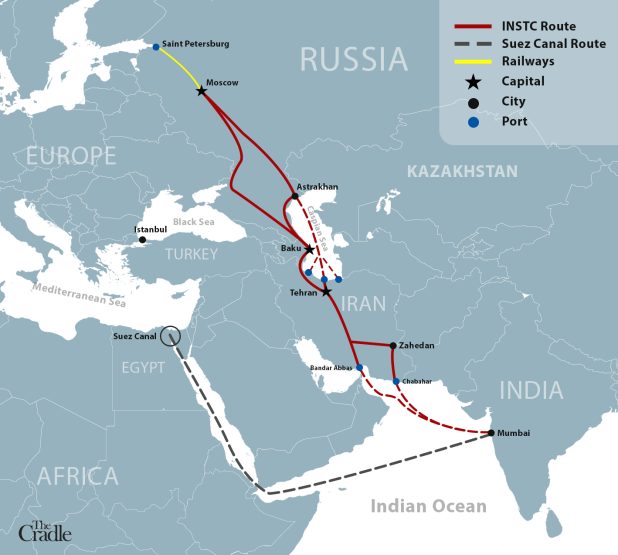
Map of the International North-South Transport Corridor (INSTC)
Joint cooperation with Beijing and Moscow
Sources in Tehran and New Delhi said the use of rupee-rial trade was also “seriously considered” during Bagheri Kani’s New Delhi visit, with both sides agreeing that a banking mechanism that is not tied to the west is key to strengthening the process of multilateralism, and paving the way for the resumption of trade.
Laskar of Hindustan Times confirmed that the senior Iranian diplomat “reiterated Iran’s offer to resume oil supplies and raised the issue of trade in national currencies.”
The changing geopolitical landscape in the wake of growing anti-western mechanisms, including SCO and BRICS, led by China and Russia, is also likely to propel increased cooperation between Tehran and New Delhi.
Laskar, however, believes that the SCO has not been a particularly crucial grouping for India in recent years, “largely because of the tensions with China,” adding that India’s biggest concern about the expansion of BRICS is that “it shouldn’t become a China-centric grouping,” underlying Sino-India tensions.
Meanwhile, Russia remains a common ally of India and Iran, which is evident in Moscow and New Delhi looking to ramp up trade via Tehran along the INSTC – the strategic route that has assumed tremendous significance since the start of the Ukraine war.
The decision to boost INSTC trade, according to reports in Indian media, was high on the agenda during Bagheri Kani’s India visit, as Russia now looks set to invest in the Chabahar Port. According to sources, the war in Ukraine also figured prominently in Bagheri Kani’s talks with Indian officials. Both sides agreed on maintaining a “neutral stance” on the war and increased engagement with Moscow.
“Russia is the new game-changer in the region, especially after the realignment of power centers, and that is good news for India-Iran ties,” an Iranian diplomat stationed in South Asia told The Cradle.
Russian Foreign Ministry: No Evidence That Tehran Wants to Develop Nuclear Weapons
Samizdat – 30.11.2022
MOSCOW – There is no evidence that Tehran intends to develop nuclear weapons, reviewing its participation in the Nuclear Non-Proliferation Treaty (NPT), Vladimir Yermakov, director of the Russian Foreign Ministry’s Non-Proliferation and Arms Control Department, said in an interview with Sputnik.
“Iran has been and remains a conscientious participant in the Treaty on the Non-Proliferation of Nuclear Weapons. The conclusion of the JCPOA in 2015 helped to finally and irrevocably remove all the questions that the [International Atomic Energy Agency] had to Tehran at that time.”
“After that, for several years Iran remained the most verified state among agency members. No deviations from its obligations were identified,” Yermakov said. “There is no evidence that would indicate Tehran’s intention to ever reconsider its participation in the NPT and start developing a nuclear explosive device.”
Yermakov’s remarks come as the US undertakes joint military drills with Israel, complete with fighter jet simulations on strikes against Iran’s nuclear program infrastructure. Earlier announcements detailed the drills would be held in the Mediterranean Sea starting November 29, and lasting through December 1.
At the time, Israeli Defense Minister Benny Gantz stressed that the drills were needed in order for Israel to “prepare” its service members for any “possibility.”
Days before the drills kicked off, US media reported that Tehran was inching toward achieving a weapons-grade enrichment, paving the way for Iran to acquire the technology to assemble nuclear weapons.
However, it’s worth noting that Iran has repeatedly indicated it has no intention to create nuclear arms; in fact, Iranian leadership imposed a fatwa in 2003 on the production or usage of any form of nuclear weapons.
Tension between Iran, Israel and the US has remained high for years. Under the Trump administration, however, escalations were at near-boiling after the US withdrew from the 2015 Joint Comprehensive Plan of Action, reimposed past sanctions and continued on a “maximum pressure” campaign against Tehran.
Talks to restore the agreement under the Biden White House have remained stalled for months. Iran earlier dispatched a “constructive” response to Washington’s proposals but was ultimately shut down by administration officials who deemed the messages “not constructive.”
European parliament severs ties with Iran over sanctions against EU

The Cradle | November 22, 2022
The EU parliament announced on 21 November its decision to sever ties with Iran. The announcement comes in response to the Islamic Republic’s recent decision to place sanctions on the European governing body, which has been slapping its own sanctions against Tehran throughout the ongoing unrest in the country.
“We will not look away from those who look to us from the streets of Iran. Iran must stop its oppression of legitimate protests. In response to Iran’s [sanctions] on members of the European Parliament, [it] will no longer engage with Iranian authorities,” President of the EU parliament, Roberta Metsola, said in a statement via Twitter with the popular Iranian protest slogan “Women, life, freedom” written in Persian at the end of the tweet.
At the opening of its November plenary session on the same day, Metsola said that there would be “no direct contact” between the parliament and Iranian officials “until further notice.”
As Iran continues to face large waves of violent riots – which have resulted in the deaths of several members of the security forces and the destruction of public property – western media has framed the response by authorities as nothing more than a brutal crackdown on peaceful protestors.
In addition to the propagation of misinformation by mainstream, western European media, the EU has repeatedly placed several rounds of sanctions against Iran.
Accusing European states of interventionist policies and “supporting terrorism and violence” on Iranian soil, Tehran on 26 October announced the implementation of its own sanctions against several individuals and institutions associated with the EU.
Earlier that month, the Islamic Republic had sent several letters to European diplomats warning them that the aggressive EU sanction policy against Tehran could result in a “rupture” of relations between them.
As European, Saudi, British, and US media outlets lead the misinformation campaign against Tehran, violent attacks against the country’s security personnel are on the rise, and internationally-backed armed separatists continue to push for the illegal overthrow of the Islamic Republic.
Iran retaliates against UN nuclear resolution – media
RT | November 22, 2022
Tehran has for the first time started enriching uranium to 60% fissile purity at the Fordow facility, Iranian media reported on Tuesday. Such a move would be seen as a response to a critical resolution adopted by the UN’s nuclear watchdog last week.
Iran is already enriching uranium at Natanz, its other major production site, to below weapons-grade 90% enrichment, but well above the 3.67% limit specified in the 2015 Iran Nuclear Deal, or JCPOA. The US abandoned the deal with Tehran during the administration of Donald Trump, leading to its erosion and effective collapse.
Other reported moves by Iran include upgrading cascade lines with more advanced gas centrifuges to boost production capacity at Fordow, as well as firing up additional chains at Natanz.
Tehran’s action was described as retaliation for a resolution passed last Thursday by the Board of Directors of the International Atomic Energy Agency (IAEA). The document, which was drafted by the US, Britain, France and Germany, decried “insufficient substantive cooperation by Iran” on the issue of uranium traces found in 2019 by inspectors at three undeclared sites. It demanded “credible explanations” and full cooperation from Tehran.
The four sponsoring nations are also signatories of the JCPOA. China and Russia, two other participants of the landmark deal, reportedly voted against the draft document during the closed-door session last week.
The Iranian Foreign Ministry rejected the resolution, calling it a form of political pressure by the US and its allies. Spokesman Nasser Kanaani said on Monday that the country had taken “initial measures” in response to it on Sunday night.
“The implementation of these measures was realized today in the presence of IAEA inspectors in the Natanz and Fordo enrichment complexes,” the diplomat added, without specifying what had happened.
The JCPOA was meant to exchange an Iranian commitment to limit its nuclear program for relief of economic sanctions imposed on the country. The goal was to prolong the time Tehran would need to create a nuclear weapon, an ambition that Iran officially denies fostering in the first place.
The Trump administration unilaterally pulled out of the Iran Nuclear Deal as part of its “maximum pressure” campaign against Tehran. President Joe Biden has been negotiating a possible revival of the JCPOA, but no breakthrough has been achieved so far.
or go to
Aletho News Archives – Video-Images
From the Archives
Israel Would Have No Qualms About USS Liberty-Style FALSE FLAG If Iran Campaign Falters – Analysts
By Ilya Tsukanov – Sputnik – 18.06.2025
Donald Trump is mulling whether or not to join Israel’s aggression against Iran as Tel Aviv faces problems sustaining its defenses against growing counterstrikes, and apparently lacks a realistic game plan for an end to hostilities after failing to achieve its goals. Analysts told Sputnik how the US could be ‘nudged’ into the conflict.
“The US is already assisting Israel with supplies, intel, refueling support, etc. One of the many US posts in the region could be attacked for a casus belli,” former Pentagon analyst Karen Kwiatkowski explained.
“If Trump doesn’t comply with Israel’s demand” and join its aggression voluntarily, “a false flag may be needed” to drag the US in, Kwiatkowski, retired US Air Force Lt. Col.-turned Iraq War whistleblower, fears.
Netanyahu has a diverse array of options at his disposal, according to the observer, including:
- a false flag against US assets abroad blamed on Iran or one of its Axis of Resistance allies, like the Houthis
- a US domestic attack or assassination blamed on Iran
- Iranian air defenses ‘accidentally’ hitting a civilian jetliner carrying Americans
- use of a dirty bomb or nuclear contamination somewhere in the region blamed on Iran
- even blackmailing by threatening to use nukes against Iran if the US doesn’t join the fight
Kwiatkowski estimates that Israel probably has “enough blackmail power” against President Trump and Congress to avoid the necessity of a false flag operation, but a “USS Liberty-style” attack, targeting the soon-to-be-retired USS Nimitz supercarrier that’s heading to the Middle East, for example, nevertheless cannot be ruled out entirely, she says. … continue
Blog Roll
 Aletho News
- The US bombed the Shahs house lol
- The London Ambulances Attack: Of Course It Was A False Flag
- Embarrassing Pivot: U.S. considers dropping Iran oil sanctions amid war
- US has 2 months of rare earths left to replenish weapons amid Iran war: Report
- Strait Of Hormuz closure brings Empire to brink
- Iran controls Strait of Hormuz, dictates terms of war and peace as US excursion backfires
- Outlasting the Superpower: The Reasons Why Iran is Beating uhe US and Israel
- Top PMU commander, over a dozen fighters killed in new US strikes on Iraq
- Is Netanyahu’s war gamble threatening the future of ‘Israel’?: FT
- Smotrich calls for annexation of South Lebanon to Litani River
- If Americans Knew
- ‘Forever live by the sword’: Understanding Israelis’ massive support for Iran war
- UN’s special rapporteur on human rights says Israel is systematically torturing Palestinians
- Trump White House plagiarized Iran war manifesto from Israel-aligned think tank
- Gaza says 6–10 patients die daily waiting for treatment abroad as Israel blocks medical evacuations
- ‘Substantial evidence’ of double-tap strike in killing of Gaza’s Hind Rajab
- ‘Do Not Want To Die For Israel’: Doubts About Trump’s Iran Strategy Spread Among Troops
- Instead of taking Joe Kent’s claims seriously, the media is disregarding him as an antisemite
- Joe Kent’s Explosive Interviews about his Resignation over the Iran War
- Israel poised to take over southern Lebanon; settlers wreak havoc in West Bank – Not a ceasefire Day 165
- From Sde Teiman, the truth about Israel’s military justice system has been set free
- No Tricks Zone
- Devastating Assessment Of Comirnaty Vaccine By Former Senior Pfizer Europe Toxicologist
- New Study: CO2 Is ‘Effectively Negligible’ As An Explanatory Climate Change Factor Since 2000
- Former Pfizer Toxicologist Dr. Helmut Sterz Tells Bundestag Hearing Pfizer Vaccine Should Have Never Been Approved
- Energy Expert: Germany’s Nuclear Phaseout Was A “500 Billion Euro Mistake”
- New Research: South Australia’s Mid-Holocene Sea Surface Temperatures Were 4°C Warmer Than Today
- Storing Green Energy To Last Germany 10 Days Would Require A 60-Million Tonne Battery
- New Studies: UK Sea Levels Were 4 Meters Higher Than Today During The Mid-Holocene
- Destructive Green New Deal: German Energy And Metal Group Warns Of Drastic Crisis
- New Study Documents A 20-Year Pause In Arctic Sea Ice Decline – Driven By Internal Variability
- Wake-up Call: Survey Shows Majority Of Germans Now Favor Postponing Climate Targets!
 Aletho News