IAEA primary instrument of pre-aggression, sets scene for US, Israeli unilateral actions: Analyst
Press TV – November 22, 2022
works before a news conference attended by IAEA Director Rafael Grossi during an IAEA Board of Governors meeting in Vienna, Austria, September 13, 2021. (Photo by Reuters)
A political analyst has described the International Atomic Energy Agency (IAEA) as a primary “instrument of pre-aggression” which paves the way for Israel and the US to take unilateral actions against Iran.
“The IAEA has become a primary instrument of pre-aggression. In other words, they create a scenario, they make the false charges, they do not prove the charges, and then they use the false unproven charges, to stoke the fires of aggression against you,” John Bosnitch told Press TV on Monday while commenting on recent tensions between Iran and the IAEA following a resolution passed by the UN nuclear body’s Board of Governors.
The politically motivated draft resolution, ratified on Thursday, has criticized Iran for what it called a lack of cooperation with the agency. It was put forward by the United States, Britain, France, and Germany, in continuation of their political pressures on Iran.
Bosnitch added that the “trend” that has been going on for years against Iran is rooted in the Israeli lobby and its influence on the US government and American personnel inside the IAEA.
“It looks like yet another provocation to create false grounds for aggressive action against Iran,” he said.
The political analyst further pointed to the “invented” excuses and provocations against Iran, saying that the US uses the IAEA as a tool “to make it a little bit more believable to those naive people around the world who still hold trust in such institutions.”
Once the fires of aggression are lit, Bosnitch said, Israel and the US can act unilaterally and illegally based on the so-called reports by the IAEA.
“And that is the formula for aggression. And I have to say that Iran, as I’ve said, through all discussions on this topic, must be ready for the worst,” he cautioned.
‘IAEA a spying organization’
Bosnitch also called the IAEA a “spying organization” that only spies on enemies of the United States and Israel.
In order to ease concerns about its nuclear program, Iran has agreed to install surveillance cameras in its nuclear facilities and has provided the IAEA with physical monitoring and satellite images. According to Bosnitch, however, “nothing works because the lies perpetrated by the lying mainstream media are bigger to the common person’s eye than the truth.”
Head of the Atomic Energy Organization of Iran Mohammad Eslami said on Sunday that the Islamic Republic will give a “firm response” to the IAEA Board of Governors’ anti-Iran resolution.
“The nuclear programs of the Islamic Republic of Iran are moving forward according to the strategic action plan of the parliament, and the issuance of multiple resolutions against Iran will not cause any disruption in the progress of these programs,” the AEOI chief added.
According to a report published on Tuesday, Iran has started enriching uranium to the purity level of 60% at its Fordow nuclear facility. The country has also installed two new IR2M and IR4 cascades at the Natanz and Fordow facilities.
The report added that Iran has fitted and launched new centrifuges at two empty halls in Fordow and Natanz nuclear sites and replaced IR1 centrifuges at Fordow with IR6 which will increase enrichment at the site by 10 times.
Tehran informed the IAEA of that decision via a letter. It described the move as a strong message to the recent anti-Iran resolution passed by the IAEA’s Board of Governors.
‘US provoking protests in Iran’
Elsewhere in his remarks, Bosnitch mentioned the recent violent riots across Iran, warning that US agents are working inside Iran “right now” to provoke protests.
“Whatever grievance there might have been, it has been amplified by the US State Department and by the CIA inside your country already.”
He added that the US is not only attacking Iran on the IAEA side but also organizing protest expansion inside the country.
“They definitely try new tactics, and the only protection against American militarism and unilateralism is to tie up with other countries that are threatened by the same thing,” he concluded.
Riots have broken out in Iran since 22-year-old woman Mahsa Amini died in hospital on September 16, three days after she collapsed in a police station. An investigation has attributed Amini’s death to her medical condition, dismissing allegations that she was beaten by police forces.
In the last two months, using the protests as a cover, rioters, and thugs — many of whom were later found to have links with foreign parties — went on a rampage, engaging in savage attacks on security officers, vandalism, desecration of sanctities, and false-flag killings of civilians to incriminate the Iranian police.
Iran bans imports of French cars unless damage redressed
Press TV – November 21, 2022
Iran has banned the imports of French cars until France’s automobile manufacturers, namely Renault, Peugeot and Citroen, compensate the damage caused by leaving the Islamic Republic.
The withdrawal imposed a lot of costs on Iran’s automobile and parts manufacturing industry and left many investments in ruins after the US imposed new sanctions in August 2018, targeting the Islamic Republic’s car industry, trade in gold and other precious metals, and purchases of US dollars.
Although the withdrawal forced Iranian manufacturers to pool their resources and produce locally-made cars, compensation for the damage caused by the pullout is a central demand.
The ban announced by Ministry of Industry, Mining and Trade spokesman Omid Qalibaf comes as Iran is reintroducing foreign car imports in order to both improve the pool of quality automobiles and meet consumer demand.
Iran prohibited the import of Western cars in 2017 to counter the impending reimposition of US sanctions. The idea was part of Tehran’s efforts to develop a “resistance economy” that could both serve Iranians’ demands for cars, lessen dependence on foreign technology, and potentially boost export revenue.
“Those in the process of importing cars are dealing with the related issues and are concluding their contracts one by one, with the first cars expected to enter the country with the conditions that have been announced to the importers.
“However, what is certain is that French cars will not find a way to our market for now, because French companies such as Renault and Peugeot do not have a good history during the time of sanctions, when they easily left our country despite having committed to joint ventures and investments,” Qalibaf said.
Before the sanctions, French carmaker PSA Group had signed a framework deal with Iranian counterpart SAIPA to produce and sell vehicles for its Citroen brand in the country.
Under the agreement, Citroen and its Iranian partner would invest 300 million euros ($330 million) over five years in manufacturing, research and development, with the first of three planned new Citroen models due to be launched in Iran in 2018.
PSA Group, the maker of Peugeot and Citroen cars, had finalized a similar production deal with major Iranian automaker Iran Khodro under a 50-50 joint venture to invest up to 400 million euros ($451 million).
Renault had signed a new joint venture deal that included an engineering and purchasing center to support the development of local suppliers as well as a plant with an initial production capacity of 150,000 vehicles a year.
“In the middle of the road, however, they left the Iranian automakers alone and caused a lot of damage to our country’s automobile industry,” Qalibaf said.
“As long as the French car manufacturers do not compensate for these damages, they will not have any share in the large car market of our country, and the import of any car from France will be prohibited,” he added.
The ban, however, will not include South Korea, Japan and other countries, because they were not involved in any joint projects with Iranian industrialists when the new sanctions were imposed, Qalibaf stated.
The auto industry forms the second biggest sub-sector of the economy behind oil, accounting for some 10 percent of the gross domestic product and 4 percent of employment.
When the former Trump administration reimposed sanctions on Iran in August 2018, it reserved Washington’s first hammer blow for the car industry to hurt as many Iranians as possible.
However, the US pressures forced domestic manufacturers to mobilize their resources to fulfill some of the tasks which were an exclusive competence of foreign companies.
Last week, Venezuelan Minister of Transport Ramón announced the shipment of 1,000 cars built in Iran to Venezuela, stating that they were among 80,000 requests registered for the products of an Iranian car manufacturer in his country.
“We have a very high demand for Iranian car products, where we were able to register about 80,000 requests in the first stage,” he said in Tehran where he was at the head of a large delegation.
With the exports, Iran is staking out a niche in South America’s automotive marketplace which has a lot of space for growth and expansion, given the uneasy relationship of some of the countries of the region with the United States.
It followed the Iran-Venezuela 2022 Expo Fair held on Sept. 14-18 in Caracas where President Maduro announced the assembly of four Iranian models at Venirauto car manufacturing plant, a joint venture between the Venezuelan government and Iran Khodro.
Iran confirms it released Greek tankers after Athens did same
Press TV – November 16, 2022
Iran has confirmed reports it released two Greek-flagged tankers that had been confiscated in the country’s waters in the Persian Gulf in May after an Iranian-flagged tanker was allowed to leave Greece.
In a statement issued on Wednesday, the Iranian Foreign Ministry said the Greek tankers had left Iranian waters earlier in the day based on an understanding reached between maritime authorities of Iran and Greece.
The statement indicated that Iranian-flagged tanker Lana had set sail from Greece hours earlier and seven months after it was seized in the country because of US pressure.
Tanker tracking services said on Wednesday that Lana was underway from Greece and Istanbul was listed as its destination.
Data from those services showed Greek tankers Delta Poseidon and Prudent Warrior were underway from Iran and were sailing to ports in the United Arab Emirates for inspections before returning to Greece.
The Iranian Foreign Ministry said in its statement that Iranian and Greek maritime authorities had signed a memorandum of understanding to increase their cooperation in order to improve maritime security.
It said the agreement came following months of intensive negotiations between the two countries and allowed the confiscated vessels to leave on the same day.
The statement highlighted the fact that the United States had sought to confiscate an oil cargo on Lana under false accusations that it violated the unilateral American sanctions on Iran.
It described the move as a piracy and said it was in line with previous US attempts to confiscate Iranian oil in international or territorial waters.
The West bullies Iran, again
BY M. K. BHADRAKUMAR | INDIAN PUNCHLINE | NOVEMBER 7, 2022
The manner in which Tehran handled its drone deal with Russia has been somewhat clumsy. The fact that the first ‘leak’ on this topic originated from none other than President Biden’s National Security Advisor Jake Sullivan should have alerted Tehran that something sinister was afoot.
Instead, for whatever reasons, Tehran went into a flat denial mode. And now in a turnaround, we are given to understand that Iran’s denial was factually correct, albeit not wholly true in content. Foreign Minister Hossein Amirabdollahian has acknowledged that the “drone part is true, and we provided Russia with a small number of drones months before the Ukraine war.”
The minister added the caveat that “This fuss made by some Western countries, that Iran has provided missiles and drones to Russia to help the war in Ukraine — the missile part is completely wrong.”
Howsoever good Iran’s drone technology might be, it has not been a game changer for Russia in the war in Ukraine. Russia’s own missile capability is surprising even the western experts who had predicted months ago that it was “running out” of its inventory. In fact, the missile strikes may continue until Ukraine collapses and the West has no meaningful interlocutor left in Kiev’s rubble.
Russia and Iran seem to have got mired in a controversy unnecessarily. What seems to have happened is that just as Iran did reverse engineering on US’ drone technology, Russians also did a good job to remake the Iranian kamikaze drones that were in its inventory prior to the special military operation in Ukraine. Kiev now says, after examining the debris of the Russian drones that it shot down, that they had Ukrainian parts, too!
It stand to reason that the Russian defence industry picked something from Iran’s technology, something else from Ukraine’s, and came up with a startling “Russian model”. That probably explains the sophistry in Moscow’ consistent stance that it didn’t use Iranian drones.
Amirabdollahian revealed that Iran offered to explain the situation to Ukrainian authorities and a meeting was even set up in Poland to clear the misunderstanding and restore Iran’s diplomatic ties with Kiev, but the Americans got it scuttled. Evidently, the US is not interested in a normalisation of Ukraine-Iran relations. Israel too would have an interest in keeping Iran at arm’s length from Kiev. The US and Israel would apprehend that a strong Iranian diplomatic presence in Kiev might work to Russia’s advantage.
Be that as it may, Amirabdollahian’s candid admission will have consequences. Iran possibly got carried away by the exhilarating feeling that a superpower stooped to source its military technology, and furthermore, relished the high publicity its drones received — not to mention the embarrassment caused to Ukraine’s western patrons who watched helplessly when the Russian drones created panic on such a scale.
However, belatedly, Iran realised the potential political and diplomatic fallout. In reality, all this “fuss,” as Amirabdollahian put it, stems from Tehran’s refusal to sign the EU draft nuclear agreement at Vienna, which infuriated Brussels and Washington, dashing their hopes that Iranian oil would come to the rescue of Europe by replacing the Russian oil imports that are being terminated w.e.f December 5.
Again, Iran’s increased oil production was what the US was counting on to introduce tensions within the OPEC and split the cartel.
According to a Spiegel report, Germany and eight other EU states have put together a new package of sanctions against Iran in Brussels on Wednesday, which contains 31 proposals targeting officials and entities in Iran connected with security affairs as well as companies, for their alleged “violence and repressions” in Iran. The alibi is human rights violations.
Evidently, the West has reverted to its bullying tactic. President Biden has pledged to “free Iran” from its present political system — although the Americans know from past experience that public protests are nothing unusual for Iran but regime change remains a pipe dream.
Why is the West resuscitating the “Iran question” at this point? There are two underlying reasons — perhaps, three. One is, Benjamin Netanyahu’s victory in the Israeli election last Sunday virtually guarantees that Israel’s existential rivalry with Iran is once again in the centre stage of West Asian politics. Without that happening, Netanyahu will come under pressure to address the core issue in West Asia, namely, the Palestinian problem.
As things stand, the “Iran question” will return to the centre stage of West Asian politics. There is a congruence of interests between Tel Aviv and Washington on that score at a time when there is going to be some friction inevitably in US-Israel relations, as the racist anti-Arab Religious Zionism alliance, Netanyahu’s latest coalition parters, contains elements that the US once regarded as terrorists. Whipping up a frenzy over Iran comes in handy for both Israel and the US.
But on the other hand, Netanyahu is realistic enough to know that it will be suicidal for Israel to attack Iran militarily without American support and second, that the Biden Administration has not yet entirely given up hope on a nuclear deal with Iran.
Therefore, in the event of the midterms radically changing the profile of Congress to the detriment of the Biden Administration, trust Netanyahu to insert the Iran nuclear issue as a key template of US domestic politics and the US-Israel relations.
A second factor is the trajectory of the war in Ukraine. Although the proxy war is in the home stretch and the US and NATO are staring at the defeat and destruction of Ukraine, the Biden Administration cannot simply walk away in humiliation, since this is Europe and not the Hindu Kush, and the fate of the western alliance system is at a crossroads.
Most certainly, US troops have appeared on Ukrainian soil and they can only be regarded as an “advance party.” Will Ukraine turn out to be another Syria, with the regions to the west of the Dnieper River — “the Rump” denuded of natural resources — coming under US occupation so that its NATO allies in the periphery do not jump into the fray of dormant ethnic tensions inherited from history to carve out their pieces out of the carcass? Or, will a US-led “coalition of the willing” be preparing to actually fight the Russian forces in eastern and southern Ukraine?
Either way, the point is, the strategic ties developing between Iran and Russia will remain a focal point for the West, Amirabdollahian’s “clarification” notwithstanding. It is only natural that in the conditions under sanctions, Russia’s external relations are in the cross-hairs of the US. Iran has a stellar record of rubbishing the “maximum pressure” strategy.
Put differently, having Iran as an ally will be a strategic asset for Russia in a multipolar setting. Iran and the Eurasian Economic Union have decided to negotiate a Free Trade Agreement while Tehran is also working out swap deals involving Russian oil. Simply put, Europeans can keep their SWIFT for whatever it is worth and that is not going to make any difference to Russia or Iran — and the rest of the world is watching this happening in real time, especially in Iran’s neighbourhood where oil is traded in dollars.
By now it is also clear to the US and its allies that JCPOA or no JCPOA, the overarching tilt toward Russia and China is Tehran’s version of the Israeli Iron Dome, in diplomacy. The bottom line is that Iran is becoming a role model for the Persian Gulf region, as is evident from the queue lengthening for membership of the Shanghai Cooperation Organisation, even as the parallel track of the Abraham Accords has disappeared in the endorheic basin of the Arabian Peninsula.
The EU’s energy security now rests in Turkey’s hands
Europe has sought to bypass Russian gas with disastrous results. Turkey is set to reap the benefits.
By Karin Kneissl | The Cradle | October 24 2022
“Geography is the constant of history,” is a quote attributed to the German statesman Otto von Bismarck. Today, those words ring true as we witness geography altering global politics, finance, and alliances.
The geostrategic importance of Turkey has rarely been as clear to European politicians as it has been in recent months, as the continent grapples with a burgeoning energy crisis this coming winter.
Whether it is grain exports from the Black Sea region or the flow of energy supplies from the eastern producing countries, the Bosphorus and the links to Eurasia are once again playing a decisive geopolitical role, as they so often have throughout history. The fact is, Turkey is now crucial for the security of Europe.
Pipeline politics
On the occasion of Turkish President Recep Tayyip Erdogan’s meeting with his Russian counterpart Vladimir Putin in Sochi at the beginning of August 2022, the focus was mainly on bilateral cooperation in energy matters.
Putin told journalists after the tete-a-tete that Europeans should be grateful to Ankara for its gas supplies due to the reliability of the TurkStream pipeline.
Last year, Russian natural gas accounted for around 45 percent of European gas imports. But that share has fallen to less than 10 percent after supplies were halted via the eastbound Yamal-Europe pipeline and suspected US-backed operatives blew up Nord Stream, which also curtailed exports via Ukraine.
The Russian-Turkish TurkStream gas pipeline project was announced in December 2014 after Moscow realized that the long-planned SouthStream project – meant to deliver Russian natural gas via the Black Sea directly to European Union (EU) member state Bulgaria – was not feasible.
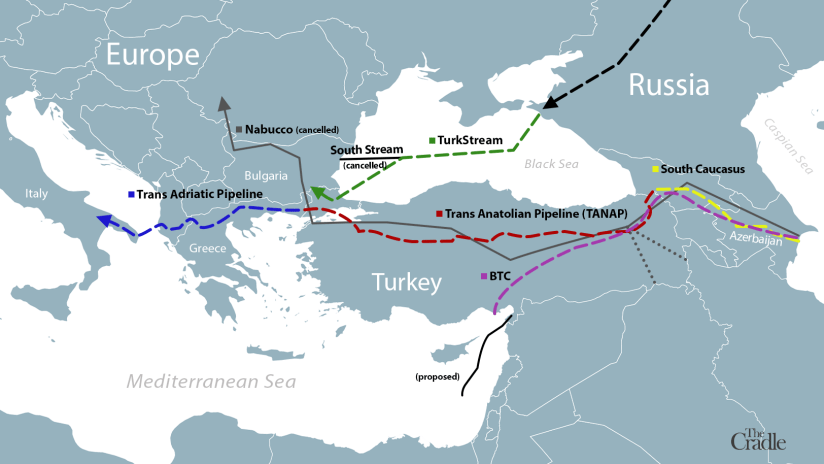
Russian energy giant Gazprom and the Italian energy company ENI were the main partners in the consortium. However, following the Crimean crisis in March 2014, the EU Commission blocked this major infrastructure project, citing competition rules.
As far as Moscow was concerned, this arrangement had already been completed in the form of terminals and pipeline routes. Thousands of work contracts had been issued between Bulgaria and Hungary at the time.
Construction was scheduled to begin in June 2014, but Brussels alluded to apparent violations of competition rules in the awarding of contracts by the Bulgarian authorities and brought everything to a halt.
Turkey as a Russian energy hub
Nine months later, during a joint press conference with Erdogan in Ankara, Putin remarked that “If Europe does not want to carry it out, then it will not be carried out.” Putin then announced the TurkStream project, which was formally launched in early 2020.
One pandemic and a war later, the world has experienced and continues to experience rising natural gas prices, while Russian-Turkish energy cooperation is intensifying. On 19 October, Erdogan said he had agreed with Putin to set up a comprehensive hub for Russian natural gas built in Turkey from where Europe could meet its energy needs.
“If Turkey and our potential buyers are interested, we could consider building another gas pipeline and creating a gas hub in Turkey for sale to third countries, especially in Europe,” Putin proposed. In addition, a gas exchange could also be created in Turkey to determine prices, he added.
Neither the EU nor the US have welcomed these developments or, in some cases, faits accomplis. Turkey makes no secret of the fact that it wants to expand its status in the China-led Shanghai Cooperation Organisation (SCO) and will probably soon become the tenth member of this important regional organization.
It should be noted that the SCO’s statutes stipulate energy and security – especially the fight against terrorism – as its essential agenda. The EU, it must be said, is only just discovering the importance of these issues.
Attempts to bypass Russian gas
In the recent past, governments and energy companies have looked to Turkey as an alternative to the existing transit routes for oil and gas between the east and west. In 2005, the 1750 km long Baku-Tbilisi-Ceyhan (BTC) pipeline was opened, transporting Caspian oil across the Caucasus to the Turkish Mediterranean port.
Crucially, this route had the backing of Washington, reinforcing the close connection between politics and the oil business. As per an apt saying from the early 20th century US oil industry: “The oil business is too important to leave it to the oil people.”
The Nabucco pipeline project, intended to reduce Europe’s reliance on Russia’s gas, consisted of a consortium of six corporations based on the initiative of the Austrian partly state-owned OMV. The project was supported politically and financially by the European Commission, with the premise being that natural gas would be supplied from the Caspian region via Turkey to Central Europe to the Baumgarten hub in Austria.
Billions were spent on marketing this project between 2002 and 2014. However contractual agreements surrounding the deal never materialized. Though inconceivable now, Iran was also initially planned as an alternative supplier, yet these efforts failed from 2005 onwards due to UN Security Council sanctions on Iran from 2008 until the present.
Additionally, supply contracts with Iraq and Turkmenistan were targeted in vain, although these arguably had a lot to do with complete mismanagement. In the case of Turkmenistan, countless advisory opinions were commissioned on the status of the Caspian Sea under international law, sea, or lake, and the possible transit pipelines for landlocked Turkmenistan.
A failed strategy
After many years of mere marketing and a lot of hot air between Brussels and Vienna around the Nabucco project, OMV’s partners finally backed out in 2014. It was clear that there was no natural gas available.
In my book “Der Energiepoker” (The Energy Poker) I wrote in 2006: “If the managers had not gone to the State Opera to see Verdi’s Nabucco, but had seen the operetta by Johann Strauss “Wiener Blut” (Viennese Blood), then this natural gas pipeline would have been given a more appropriate name.
Now, in view of the Nord Stream 2 pipeline boycotted by the EU, OMV is facing further setbacks, as the contracts with take-or-pay clauses were drafted in such a way that payment would have to be made for the Russian natural gas, even if there was no physical delivery. These conditions apparently apply until 2040.
EU will buy Russian energy indirectly
While the EU wants to bypass Russian energy sources for political reasons, Turkey, India, and China, among others, will gladly fill in the consumer void. As described, Turkey already benefited in 2014 from the SouthStream project, which became TurkStream. The EU ultimately lost out, while Ankara stood to gain, with the EU presently buying Russian natural gas via Turkey.
This energy route is set to expand even further once the Russian natural gas hub in Turkey is established. Turkey thus becomes the safeguard of the EU’s energy security. While this was the case a few years ago with non-Russian natural gas and oil, it now looks as if Russia is merely adapting its role for the European market on a regional basis.
For some years, Ankara aligned its prospective role as a hub for BTC and the Nabucco project with its EU accession ambitions. Now it seems that Turkey will become a member of the SCO much faster, and despite its NATO membership, part of the security cooperation with Russia and China.
The EU is more dependent than ever on the goodwill of those it once created obstacles for, and Turkey and Russia are no exception. The coming months will show with all their force just how irresponsibly the EU governments handled the continent’s energy security needs.
Iran envoy dismisses Ukraine’s accusations Tehran violated UN resolution
Press TV – October 21, 2022
Iran’s permanent representative to the United Nations refutes Ukraine’s allegation that the Islamic Republic violated a UN resolution by, what Kiev calls, providing Russia with drones.
Amir-Saeid Iravani made the remarks in a letter to the UN Secretary-General Antonio Guterres and the world body’s Security Council (UNSC) on Thursday.
The envoy submitted the letter after Ukraine’s UN Ambassador Sergiy Kyslytsya wrote to Guterres and Security Council members, alleging that the Islamic Republic had “violated” the UNSC Resolution 2231 by allegedly transferring unmanned aerial vehicles to Russia, which is conducting a military operation in the ex-Soviet republic.
The letter obtained by the Associated Press alleges that Iran had violated the resolution by breaching the Paragraph 6 of its Annex B that used to ban Tehran from selling “uncrewed aerial vehicle (UAV) systems having a range equal to or greater than 300 kilometers (186 miles).” Kyslytsya also invited UN experts to visit his country to ascertain, what he called, Iran-built drones being used by Russia in the military operation.
Responding to Kiev’s allegations, Iravani noted that the restrictions mentioned in the Annex B of the UNSC resolution had “ended in October 2020.” “Since then, none of Iran’s actions towards provision, selling or transfer of weapons or related materials to other countries has been subject to the resolution,” he added.
The Ukrainian official also accused Iran of breaching the Paragraph 4 of Annex B, which bans development of nuclear-capable missile systems.
Iravani also condemned the Ukrainian official’s latter claim as “wrongful and arbitrary interpretation” of the resolution and Paragraph 4’s “spirit.”
The Islamic Republic “has neither provided, nor intends to provide [any foreign party] with items, materials, equipment, commodities, and technology that contribute to development of nuclear weapons.”
Ukraine’s invitation of UN experts towards examination of Iran’s so-called violation of Resolution 2231 is, therefore, “lacking in all legal foundation within Resolution 2231’s framework,” the Iranian official asserted.
The official called on the UN secretary-general to prevent any “misuse” of the resolution in relation to the war in Ukraine.
He finally called on the world body to confront such unfounded anti-Iranian allegations.
US envoy for Iran: Reviving JCPOA ‘not even on agenda’
Press TV – October 18, 2022
The US special envoy for Iran, Robert Malley, has acknowledged that negotiations on a revival of the 2015 Iran deal are “not even on the agenda” for now, trying to shift the blame on Tehran for the stalled diplomatic process.
Malley, in an interview with CNN on Monday, accused the Islamic Republic of not being interested in restoring the deal and claimed that the administration of US President Joe Biden believed diplomacy was the best way to prevent Iran from what he called “acquiring a nuclear weapon.”
“President Biden made it clear from the first day he came into office that one of his priorities was to prevent Iran from acquiring a nuclear weapon. And he believes and we continue to believe that diplomacy is the best way to achieve that goal,” Malley told CNN.
He referred to the latest remarks by the European Union’s foreign policy chief, Josep Borrell, that he did not expect any movement anytime soon in efforts to revitalize the Iran deal, officially called the Joint Comprehensive Plan of Action (JCPOA), accusing Tehran of raising issues that were “inconsistent” with a return to the deal.
Iran has demanded that the United States provide assurances that it would not leave the JCPOA again before it could reenter the agreement. Washington has refused to give a legally enforceable guarantee, leaving Iranian negotiators suspicious of the Biden administration’s seriousness in the talks.
“The reason the talks are at a standstill and at an impasse and why they’re not so far moving at all and why they’re not the focus is because Iran has taken a position in those talks for the past two months which is simply inconsistent with a return to the deal; they’re making demands that have nothing to do with the JCPOA and as long as that’s the case, the talks will be stopped,” Malley claimed.
Asked about the fate of negotiations on the JCPOA’s revival, Malley said, “It’s not even on the agenda. It’s not the focus because there’s no movement… We will see whether this is a government that is interested in reaching that deal. But at this point, the focus is on what’s happening around because the talks are stalled.”
Meanwhile, White House press secretary Karine Jean-Pierre said in a press briefing on Monday that the JCPOA-related talks may be fatally stalled, saying, “We don’t see a deal coming together anytime soon.”
Last week, Iran’s Foreign Ministry spokesman Nasser Kan’ani reaffirmed the Islamic Republic’s commitment to keeping up the talks aimed at reaching an agreement on the revival of the 2015 nuclear deal.
“The Islamic Republic of Iran’s approach is to remain in the course of negotiations so as to reach a lasting and sustainable agreement that would simultaneously guarantee the fundamental interests of the government as well as those of the Iranian nation,” Kan’ani told reporters.
Kan’ani said the three EU parties to the deal – France, Britain and Germany – and the United States have linked the talks to the latest violent riots in Iran, asserting that Tehran will not allow other states to interfere in its domestic affairs.
The Iranian Foreign Ministry spokesman also made clear that Tehran is ready for bilateral interaction with all parties so that the negotiations would come to fruition.
The current crisis over Iran’s nuclear program was created in May 2018, when former US president Donald Trump pulled Washington out of the 2015 nuclear deal and imposed tough economic sanctions against the Islamic Republic under what he called the “maximum pressure” policy.
The talks to salvage the agreement kicked off in the Austrian capital of Vienna in April last year, months after Biden succeeded Trump, with the intention of examining Washington’s seriousness in rejoining the deal and removing anti-Iran sanctions.
Despite notable progress, the US indecisiveness and procrastination have caused multiple interruptions in the marathon talks.
Tehran breaching nuclear deal with drone supplies to Russia – US
Samizdat | October 18, 2022
The US on Monday accused Iran of breaching the conditions of the 2015 nuclear deal with the West by selling ‘kamikaze’ drones to Russia. Moscow stated that it is only using “Russian hardware.”
Russia has used autonomous loitering munitions to devastating effect in its attacks on Ukrainian military and energy infrastructure in recent weeks. Flying at low altitude, these unmanned aircraft can evade traditional air defense systems before dive bombing their targets, and are rumored to cost a fraction of the price of the missiles Kiev’s forces fire to intercept them.
The distinctive delta-wing design of the drones has led Ukrainian and Western officials to claim that they are Iranian Shahed-136 UAVs.
“Earlier today our French and British allies publicly offered the assessment that Iran’s supply of these UAVs [to] Russia is a violation of UN Security Council resolution 2231,” US State Department spokesman Vedant Patel told reporters on Monday. “This is something that we agree with.”
Adopted in 2015, Security Council resolution 2231 sets out the terms of Iran’s nuclear deal with the US, UK, China, France, Germany and Russia, in which it agreed to restrict its nuclear program in exchange for limited sanctions relief. The resolution includes embargoes on Iranian arms exports, and although the US unilaterally pulled out of the deal in 2018, Washington argues that an embargo on missile parts covers drone exports, and is valid until 2023.
Tehran has denied providing arms to either side of the conflict in Ukraine. Kremlin spokesman Dmitry Peskov told reporters on Monday that he had received “no information” concerning the alleged use of Iranian drones in Ukraine.
“Russian hardware is being used,” he said, adding: “you know it well. It has Russian designations.”
Photographs of wreckage from blast sites in Ukraine show the drones bearing the Russian designation ‘Geran-2’, allegedly a localized version of the Shahed-136.
Russia’s use of the so-called ‘kamikaze’ drones has sparked panic in Ukraine, with video footage showing troops desperately firing at them with small arms. Ukrainian President Vladimir Zelensky has argued that Ukraine needs newer and more advanced air defense weapons from the West to counter the threat, although the Pentagon has no effective method of defending against these drones at present.
Europe’s Biggest Enemy Isn’t Russia Nor Islamic Terrorism, but Israel
By Martin Jay | Strategic Culture Foundation | September 25, 2022
When Joe Biden took office, many pundits said that at least relations between the U.S. and EU would be restored. But the Iran deal is the ultimate test of just how much he loves the old continent.
Just how far will Israel go to scupper the so-called Iran deal from being signed by both Iran and the West? And will it play a fair game or use underhand and covert tactics to achieve its goal of the deal never being signed? Recently, we have seen the talks in Vienna progress as even the Americans say that certain key negotiating points have been taken out of the deal from the Iranians which has made the negotiations move closer to an agreement; we have also seen though Israel pulling out all the stops, from a PR and lobbying perspective at least.
And then there is the murky subject of skullduggery to destroy the talks. If you’re one of these people who believes in fairies at the bottom of the garden or that certain toothpastes can make your teeth whiter, then you might not buy into Israel using Mossad to derail the deal. Attacks on U.S. forces for example in Iraq, supposedly carried out by Iran-backed militias would normally have most people pointing the finger at Iran, proclaiming that Tehran is not at all serious about the deal but just playing along for time so that it can roll out a nuclear bomb. Then there is the curious case of the Salman Rushdie attack, which, again, many would point out could be attributed to the Iranians who still have a very much ‘alive’ fatwa against the British writer. Indeed, even the Supreme Leader is reported to have made a comment against Rushdie when he heard of the knife attack.
Given even the Israeli media have speculated that Mossad did it, it would be easy to conclude an open and shut case right?
Yet the author believes, like the 9/11 attacks in New York, which was the dirty work of Mossad, that these previous attacks can also be attributed to the Israelis who may well be plotting a bigger attack in the U.S. which Iran can be framed for; in fact, Americans are so ignorant of Islam or anything to do with the Arab world, that such an attack doesn’t even need to be linked to Iran but simply “Islamic terrorists” which might have tenuous links with Tehran.
There is no limit for Israel in terms of how far it can go to block the deal as the elite there believes that the Iran deal would exponentially boost Tehran’s power given the impact of sanctions relief on the economy. But the emergence of Iran as a regional player, economically, will always be a threat to Israel especially as it throws the spotlight on the once pariah state and many will see the fraud of hatred between Israel and Iran for what it is. Just as for decades the West goaded the Gulf States about Iran, installing fear to such a point that it was America and the UK who cleaned up on weapons sales, Israel needs to keep this yarn alive that Iran is the threat both for internal politics with their own people and also to justify the obscene amount of military aid which is sent to Israel each year. But any hack in Lebanon who has connections with Hezbollah will tell you that this threat is phoney and that both sides have enormous respect for one another; in reality both sides are fooling their own people into buying into the threat of an attack as it’s good for political support. The recent claims by Matthew Levitt in the Israeli media for example that Hezbollah wants to start some skirmishes with Israel can’t be taken seriously from those who are close to the Shiite group in Lebanon who say simply that Hezbollah is too scared to do such a thing off its own bat; being directed by the Supreme Leader in Iran though is another matter.
Hezbollah and Indeed Israel’s game of smoke and mirrors in Lebanon makes some pundits question whether Iran is really serious about reaching out for a deal with the west to lift its sanctions, or just playing us all along to win time? Surely Israel can’t have it both ways as its desperate antics of late tend to contradict themselves.
Hezbollah serves Israel well as the latter can focus more of defence spending and other such border initiatives in preference for being held more accountable for its governance. For Hezbollah it’s exactly the same. The threat of Israel launching an attack, once again, is the very bedrock of Hezbollah support in Lebanon. Without that threat, the Shia group may well lose half of its support overnight. This is one of the reasons why Israel continues to bomb Syria, targeting Iranian and Hezbollah activities: to keep the dream alive. It’s another reason why Hezbollah has a despondent enthusiasm towards Lebanon securing gas drilling rights close to Israel’s maritime border.
Yet in this time of Europe’s economies diving into recessions, we should ask ourselves what is the bigger picture? If Israel fails to derail the Iran talks and once again the Iranians get a deal which appeases the Americans, then certainly their economy in Iran will return to the billion dollars a month trade with the EU. One minor detail though which is overlooked and carefully airbrushed out of mainstream media’s narrative is the impact on Europe if the deal goes ahead. Cheap Iranian oil being sent to most EU countries which are really suffering from the shortages of oil and gas and its present market price could be a godsend and would enrage the Israelis even further. Europeans and even the British would look at Iran through a more favourable prism. Many would argue that Iran should be brought back in from the cold, in preference to the loathing of Putin and the hatred generally towards Russia. At least we can talk to the Iranians, many will argue. This notion cannot have escaped the attention of the EU dogs of war in Brussels who seem to be detached from all realities about the Ukrainian war and their sanctions towards Russia. Is it that they are banking on cheap oil from Iran saving EU economies? Biden too must have been advised of how things will pan out. But cheap oil for EU countries doesn’t favour the U.S. directly whereas letting the Europeans sink in their own demise will actually boost the U.S. economy according to the Washington Post, So much for the special relationship with Europe. For both Israel and Washington.
Iran: What is the Future of the Nuclear Deal?
By Viktor Mikhin – New Eastern Outlook – 22.09.2022
While many around the world hoped for a positive reaction from the United States to Iran’s latest response, the European trio at the talks in Vienna (E3 – the UK, Germany, France) have separately issued a statement that could undo all the positive results of a year of painstaking negotiations. After Tehran responded to an American text submitted through the European Union’s coordinator for the Vienna talks, Josep Borrell, the latter passed it on to Washington. The Biden administration called the latest Iranian response “unconstructive” but refrained from responding formally, prompting speculation about the impact of the US midterm elections on negotiations in Vienna over the resumption of the 2015 Iran nuclear deal, officially called the Joint Comprehensive Plan of Action (JCPOA).
Still, after days of guesswork and speculation, a response was given, but not from the American side, which had intended to do so. E3 released a joint statement that seems only to have delighted opponents of the JCPOA and caused bewilderment around the world. “As we move closer to an agreement, Iran has reopened separate issues, related to its legally binding international obligations under the Treaty on the Non-Proliferation of Nuclear Weapons (NPT) and its safeguards agreement under the NPT concluded with the International Atomic Energy Agency (IAEA). This latest demand raises serious doubts as to Iran’s intentions and commitment to a successful outcome on the JCPOA. Iran’s position contradicts its legally binding obligations and jeopardizes prospects of restoring the JCPOA,” the E3 statement said demagogically and with no good reason.
This is despite the fact that Iran has long claimed that the IAEA has lost all credibility by making unfounded accusations that are politically motivated and emanate from the anti-JCPOA camp. In other words, and this fact has now become clear, the IAEA is simply a tool in the hands of the West, not an independent UN body. The E3 countries also seemed keen to make a poorly veiled threat against Iran, stating, “Given Iran’s failure to conclude the deal on the table, we will consult, alongside international partners, on how best to address Iran’s continued nuclear escalation and lack of cooperation with the IAEA regarding its NPT (non-proliferation treaty) safeguards agreement.”
The E3 joint statement was seen by experts around the world as an irresponsible move and a servile, obsequious submission to its master, the US. Reading this statement, one gets the impression that it is the E3 that is the aggrieved party that has lost over 300 billion dollars and 1,000 lives in the last 3 years because Iran withdrew from the JCPOA. Apparently, Brussels wants everyone to believe that Iran, not the US, has blatantly violated and completely reneged on all its obligations, subsequently violating all 11 commitments it had made to rectify the situation. After all, it is both well known and not disputed by anyone in the world that it was the US that unreasonably withdrew from the JCPOA and imposed further brutal sanctions on Iran, causing the Iranian people to suffer.
In addition to the separatist actions disregarding the views of Russia and China and the utter irresponsibility, the statement also undermined the ongoing and subsequent negotiations, deepening the atmosphere of distrust. Moreover, and quite obviously, the E3 countries have only strengthened the position of the opponents of the JCPOA, which is apparently what they were aiming for. “It is regrettable that by [issuing] such an ill-considered statement, the three European countries have followed in the footsteps of the Zionist regime down a path that will lead to the failure of negotiations. It is obvious that if such an approach continues, the E3 should also accept responsibility for its consequences,” Iranian Foreign Ministry Spokesman Nasser Kanaani said bluntly.
German Chancellor Olaf Scholz, trying to justify his loyalist position to the US, demagogically signaled a lack of expectation on his part that an agreement with Iran would in the near future restore Tehran’s shattered nuclear deal with world powers. Then, realizing that the best defense is a good offense, he unceremoniously declared that Iran had no reason not to sign and that European countries would remain “patient.” And what else could the 9th Federal Chancellor say after meeting in Berlin with Israeli Prime Minister Yair Lapid, who insisted that restoring the 2015 agreement would be a “critical mistake”? Incidentally, Germany still pays reparations to those Jews who were forced by Nazi Germany to leave as evacuees.
It appears that provocative pressure from Israel as well as other factors have managed to halt or delay Washington’s progress towards a return to a nuclear deal with Iran. This is clear from statements by senior Israeli officials, analysis by Israeli research centers and the media. There was a real celebration in Israel, as officials could not hide their joy at the E3 statement. “Following the Americans, yesterday the E3 countries announced that a nuclear agreement with Iran will not be signed in the near future, that the IAEA’s files opened on Iran will not be closed,” Israeli Prime Minister Yair Lapid cheerfully told a cabinet meeting. He thanked the leaders of France, Britain and Germany for their “strong position” on the issue. Then a wave of boasting and bravado swept over the Prime Minister and he took all credit for the collapse of the nuclear deal, saying, “In recent months, we held a discreet and intensive dialogue with them, and presented them with up-to-date intelligence information about Iranian activity at nuclear sites.” And further: “Israel is conducting a successful diplomatic campaign to stop the nuclear agreement and prevent the lifting of sanctions on Iran.”
It may be recalled that as the negotiations approached a crucial milestone, Israel began to take active steps to counter this, including visits to Washington by Mossad director David Barney, Israeli National Security Advisor Eyal Hulata and Minister of Defense Benny Gantz. Israel said the diplomatic onslaught was aimed at preventing the renewal of the nuclear agreement, which Tel Aviv sees as a threat to its security. Israeli Prime Minister Yair Lapid said he would visit the US this month to meet US President Joe Biden ahead of the UN General Assembly meetings to discuss the Iranian issue. “Israel is conducting a successful diplomatic campaign to stop the nuclear agreement and prevent the lifting of sanctions on Iran,” World Israel News stressed. Apparently, Israel and its leadership have decided that they are above the UN, and only they should solve the world’s problems and only in their own interests. That is why now more than ever, the challenge of transforming our world from a unipolar to a multipolar one, where all countries have equal rights and resolve issues in the common interest, is relevant.
Lapid, who visited Germany to discuss his country’s concerns about the agreement, said that “it is not over yet – there is still a long way to go, but there are encouraging signs.” He was referring to Israel’s success in dissuading the US administration from returning to the agreement. The Times of Israel quoted an unnamed senior Israeli official as saying that during recent talks with Biden, the Israeli Prime Minister was told that the nuclear deal was not being discussed and would not be signed anytime soon. According to the website, Lapid has recently become increasingly convinced that Washington’s return to the nuclear deal is unlikely. Iran’s 2015 nuclear deal with world powers is “in the ER room” and unlikely to be extended any time soon, if at all, Israeli Minister of Defense Benny Gantz said after European leaders expressed doubts about Tehran’s willingness to revive the pact.
“We cannot predict when the deal will be signed by major world powers and Iran,” Aleef Sabbagh, a political analyst, told Al-Ahram Weekly. “Right now, it’s not even close.” He noted that pressure from Tel Aviv appears to have delayed the signing of the agreement, and Israel’s diplomatic war against the deal has so far achieved some of its goals. However, several Israeli analysts point out that the delay in finalizing the agreement is linked to some of its details, in particular the IAEA’s investigation into traces of uranium at three sites that Tehran has not previously disclosed. Iran at the same time is demanding the cessation of this investigation as a precondition for a deal, and is apparently not about to back down. Israel, for its part, will continue to apply pressure until the last minute to prevent the signing of the agreement, focusing its attention on organizing a tough international stance in support of the IAEA investigations. This would require the establishment of a mechanism to control the funds Iran gains access to in order to ensure that they do not fall to Tehran’s allies in the region.
The Israeli opposition, led by former Prime Minister Benjamin Netanyahu, claims that the US administration has decided to return to the agreement, but insists on more favorable terms. He also accuses the incumbent Lapid government of failing to convince Washington of Tel Aviv’s security demands, which would be harmed by the agreement. However, the current Prime Minister argues that his cabinet is working quietly and diligently and has so far succeeded in blocking the agreement. Israel often repeats that it will not be bound by the agreement if it is signed, and reserves the right not to allow Iran to become a nuclear power. Tel Aviv has also frequently threatened to resort to the military option to achieve this goal if “Israel’s security needs” demand it, despite all the peace treaty efforts of many countries around the world.
US ‘Trampled Upon’ Iran Nuclear Deal, Can’t Tolerate Independent States, Raisi Tells UNGA
Samizdat – 21.09.2022
The United States “trampled upon” the Iran nuclear deal, Iranian President Ebrahim Raisi said during his Wednesday address to the United Nations General Assembly. The Iranian president stressed that the Islamic Republic is not striving to obtain nuclear weapons.
“The American government [has] trampled upon the JCPOA [Joint Comprehensive Plan of Action a.k.a. Iran nuclear deal]. Some time ago, the former US president announced that Daesh was created by the US. To us, it makes no difference who created [it]. What matters is that a government outside this region decided to bring havoc to the region,” Raisi said.
He further condemned Washington’s meddling in the region’s affairs and refusal to take the interests of other countries into account. Raisi noted that the US can’t tolerate countries that act independently and puts its own priorities over those of other states.
Raisi also declared that the existing world order, where international organizations had become “instruments of repression” and economic sanctions are used as leverage to pressure other countries, no longer enjoys widespread support. He stated that a new world order is starting to take shape in its place and stressed the necessity to create a more “fair” world.
The Iranian president said that late IRGC General Qasem Soleimani, who was killed in the US strike in January 2020, “fought against oppression” of the current world order. Raisi condemned his killing by the US as a crime and said that Iran will insist on holding a fair trial for those responsible.
“The government on the other side of the planet decides to create chaos in our region through the bloodshed of women and children. But the Islamic Republic opposed this destructive dynamic, and Qassem Soleimani became the leader who opposed terrorism,” Raisi said.
Raisi’s speech to the UNGA came amid a pause in negotiations on reviving the 2015 Iran nuclear deal, which effectively collapsed following the unilateral US withdrawal from it in 2018. The sides have since exchanged a new draft agreements, but there has been no suggestion of an imminent signing. Western parties to the accord accused Iran, which demands guaranties the deal won’t collapse again, of unreasonable demands, while Tehran slammed the unconstructive approach of certain countries.
or go to
Aletho News Archives – Video-Images
From the Archives
Israel Would Have No Qualms About USS Liberty-Style FALSE FLAG If Iran Campaign Falters – Analysts
By Ilya Tsukanov – Sputnik – 18.06.2025
Donald Trump is mulling whether or not to join Israel’s aggression against Iran as Tel Aviv faces problems sustaining its defenses against growing counterstrikes, and apparently lacks a realistic game plan for an end to hostilities after failing to achieve its goals. Analysts told Sputnik how the US could be ‘nudged’ into the conflict.
“The US is already assisting Israel with supplies, intel, refueling support, etc. One of the many US posts in the region could be attacked for a casus belli,” former Pentagon analyst Karen Kwiatkowski explained.
“If Trump doesn’t comply with Israel’s demand” and join its aggression voluntarily, “a false flag may be needed” to drag the US in, Kwiatkowski, retired US Air Force Lt. Col.-turned Iraq War whistleblower, fears.
Netanyahu has a diverse array of options at his disposal, according to the observer, including:
- a false flag against US assets abroad blamed on Iran or one of its Axis of Resistance allies, like the Houthis
- a US domestic attack or assassination blamed on Iran
- Iranian air defenses ‘accidentally’ hitting a civilian jetliner carrying Americans
- use of a dirty bomb or nuclear contamination somewhere in the region blamed on Iran
- even blackmailing by threatening to use nukes against Iran if the US doesn’t join the fight
Kwiatkowski estimates that Israel probably has “enough blackmail power” against President Trump and Congress to avoid the necessity of a false flag operation, but a “USS Liberty-style” attack, targeting the soon-to-be-retired USS Nimitz supercarrier that’s heading to the Middle East, for example, nevertheless cannot be ruled out entirely, she says. … continue
Blog Roll
 Aletho News
- The US bombed the Shahs house lol
- The London Ambulances Attack: Of Course It Was A False Flag
- Embarrassing Pivot: U.S. considers dropping Iran oil sanctions amid war
- US has 2 months of rare earths left to replenish weapons amid Iran war: Report
- Strait Of Hormuz closure brings Empire to brink
- Iran controls Strait of Hormuz, dictates terms of war and peace as US excursion backfires
- Outlasting the Superpower: The Reasons Why Iran is Beating uhe US and Israel
- Top PMU commander, over a dozen fighters killed in new US strikes on Iraq
- Is Netanyahu’s war gamble threatening the future of ‘Israel’?: FT
- Smotrich calls for annexation of South Lebanon to Litani River
- If Americans Knew
- ‘Forever live by the sword’: Understanding Israelis’ massive support for Iran war
- UN’s special rapporteur on human rights says Israel is systematically torturing Palestinians
- Trump White House plagiarized Iran war manifesto from Israel-aligned think tank
- Gaza says 6–10 patients die daily waiting for treatment abroad as Israel blocks medical evacuations
- ‘Substantial evidence’ of double-tap strike in killing of Gaza’s Hind Rajab
- ‘Do Not Want To Die For Israel’: Doubts About Trump’s Iran Strategy Spread Among Troops
- Instead of taking Joe Kent’s claims seriously, the media is disregarding him as an antisemite
- Joe Kent’s Explosive Interviews about his Resignation over the Iran War
- Israel poised to take over southern Lebanon; settlers wreak havoc in West Bank – Not a ceasefire Day 165
- From Sde Teiman, the truth about Israel’s military justice system has been set free
- No Tricks Zone
- Devastating Assessment Of Comirnaty Vaccine By Former Senior Pfizer Europe Toxicologist
- New Study: CO2 Is ‘Effectively Negligible’ As An Explanatory Climate Change Factor Since 2000
- Former Pfizer Toxicologist Dr. Helmut Sterz Tells Bundestag Hearing Pfizer Vaccine Should Have Never Been Approved
- Energy Expert: Germany’s Nuclear Phaseout Was A “500 Billion Euro Mistake”
- New Research: South Australia’s Mid-Holocene Sea Surface Temperatures Were 4°C Warmer Than Today
- Storing Green Energy To Last Germany 10 Days Would Require A 60-Million Tonne Battery
- New Studies: UK Sea Levels Were 4 Meters Higher Than Today During The Mid-Holocene
- Destructive Green New Deal: German Energy And Metal Group Warns Of Drastic Crisis
- New Study Documents A 20-Year Pause In Arctic Sea Ice Decline – Driven By Internal Variability
- Wake-up Call: Survey Shows Majority Of Germans Now Favor Postponing Climate Targets!
 Aletho News