Always Another War
America and Israel together against Iran
BY PHILIP GIRALDI • UNZ REVIEW • AUGUST 31, 2021
Afghanistan is not exactly history quite yet as there still will be a lot final adjustments on the ground as well as the usual Vietnam-syndrome war of words that inevitably follows on yet another American-engineered foreign catastrophe. But the recriminations will go nowhere as there is certainly enough mud to stick on both major political parties that make Washington their home, and neither wants to be embarrassed to such an extent that anyone will actually demand change.
Regarding Afghanistan itself, I often recall hearing from a CIA friend of mine who served as the last Chief of Station in Kabul in the 1970s before the start of the Mujaheddin insurgency against the Marxist-Leninist government that was then in place eventually forced the US Embassy to close. He remarked how liberated the city was, full of smartly dressed attractive women and well-turned-out men going about their business. Though there was considerable repression in rural areas, education was highly prized by the people in the cities while many aspects of fundamental Islam were made illegal.
All of that came to a crashing halt when the United States and Saudi Arabia supported the Mujaheddin and eventually created al-Qaeda in a bid to damage the Soviets, who had intervened in the country and were backers of the Kabul regime headed by Babrak Karmal. Zbigniew Brzezinski was the “brain” behind the plan, in part to do payback for the Soviet role in Vietnam and in part because Zbig apparently had difficultly in separating his attachment for Poland, at the time part of the Soviet empire, from his role as national security adviser for Jimmy Carter, President of the United States of America.
To be sure, wars that are unsuccessful, like Vietnam and Afghanistan, do generate a certain blowback. It was regularly observed that the 1990-1 US-led Desert Storm operation followed by a victory parade down Fifth Avenue in New York City helped the United States recover from Vietnam fatigue. That meant that it would not hesitate to again use armed force to enforce its often touted “rules based international order,” best translated as US global hegemony.
Some might suggest that the best thing to do about Afghanistan is to learn from it. Hold senior officials and officers responsible for the egregious errors in judgement that led to disaster. But that will never happen as the top levels of the US government operate like a large social club where everyone protects everyone else. A Marine Lieutenant Colonel Stuart Scheller who has called for accountability at senior levels has already been relieved of his command and is leaving the service, a warning from above to others who might be similarly inclined to be outspoken.
So, with all that in mind, the best was to make Afghanistan go away is to begin preparations for the next war. Since that is so, how lucky is President Joe Biden to have a visit at this very critical moment from Israel’s new Prime Minister Naftali Bennett, who presented the president with a “new strategic vision” for the Middle East. In preparation for the visit, White House press secretary Jen Psaki told reporters that the prime minister’s visit “will strengthen the enduring partnership between the United States and Israel, reflect the deep ties between our governments and our people, and underscore the United States’ unwavering commitment to Israel’s security.” Psaki, who conflates the deep ties between the Democratic Party and its Jewish donors with a “partnership,” predictably said everything demanded of her, only stopping short of turning in her application to join the Israel Defense Force (IDF).
Bennett met on the day before the White House meeting with Defense Secretary Lloyd Austin, Chairman of the Joint Chiefs of Staff General Mark Milley and also separately with Secretary of State Antony Blinken. It is not known how many standing ovations were given to Bennett by the simpering US officials, but it is presumed that they were necessary as filler for the event because Austin and Milley in particular are notably inarticulate and poorly informed. The lumpish Austin did, however, echo Psaki in coming out with the usual message, telling Bennett that the Pentagon is absolutely “committed” to ensuring Israel can “defend itself” against the Iranians, that “The administration remains committed to Israel’s security and right to self-defense. That is unwavering, it is steadfast and it is ironclad.”
Bennett was engaged in delivering his timely message that the fall of Afghanistan has actually made everything in that part of Asia more dangerous, meaning that the US and Israel should prepare to fight Iran when it seeks to take advantage of the situation. More to the point, Bennett also made time to meet with the omnipotent Israel Lobby as represented by the head of its most powerful component, Executive Director Howard Kohr of the American Israel Public Affairs Committee (AIPAC).
The actual discussion with Biden and who-knows-who else in the room was also predictable, minus only that Biden did not feel compelled to go down on his knees as he did with visiting outgoing Israeli President Reuven Rivlin and his chief of staff Rivka Ravitz in early July. Perpetual victim Israel was presented by Bennett as facing hostilities coming from its southern border where Hamas controls the Gaza Strip. Neither Bennett nor Biden mentioned the enormous advantage in military power that Israel already possesses, as was evident in the conflict that took place three months ago, an 11-day war that left 265 dead in Gaza, including many targeted children in apartment blocks, while only 13 died in Israel.
Bennett had two principal objectives. First, he was looking for a commitment from Biden not to re-engage with Iran in the nuclear proliferation treaty Joint Comprehensive Plan of Action (JCPOA) unless it is greatly “improved” to include peripheral regional issues as well as eliminating any uranium enrichment. As Iran is prepared to accept the status quo ante and nothing more, Bennett knew perfectly well that his insistence on a broader agreement would be a game-breaker. And second, as a consequence of that expected commitment, he wanted assurances that the US will not withdraw its remaining forces from Iraq and Syria and would support Israel fully if it should choose to attack Iran.
Israel’s Ambassador to the US Gilad Erdan has also been pushing the White House to admit Israel to the so-called Visa Waiver Program, which would allow Israelis to travel freely to the United States without having to obtain a visa. The program usually requires reciprocity which would mean that Israel would in turn have to admit all American travelers, but the Jewish state insists on reserving the right to block Arab and Muslim Americans for no reason whatsoever. It is presumed that Bennett discussed the issue with Blinken.
On the other more important issues, Biden appears to have bought into at least some of what Bennett was selling. In comments made after their meeting, with the Israeli standing beside him, the US President said that “We’re putting diplomacy first and see where that takes us. But if diplomacy fails, we’re ready to turn to other options.” Bennett was pleased by what he was hearing, elaborating on it, “I was happy to hear your clear words that Iran will never be able to acquire a nuclear weapon and that you emphasize that you will try the diplomatic route, but there’s other options if that doesn’t work out.” The other “options” include, of course, intensified covert action intelligence operations, assassinations and a hoped-for bombing attack on Iranian nuclear facilities and weapons sites. Attacking Iran will also have the benefit of demonstrating that Biden is a “tough” leader, surely a consideration at this point when his approval ratings are sinking.
The prime minister also surfaced another proposal for all his interlocutors, including Biden. He wants to upgrade his fleet of F-15 fighter bombers to give his military planners more options if there should be a war with Iran. The US produced F-35 is the primary fighter for IDF, but the older F-15 can carry significantly more weaponry and bomb load.
Bennett has asked Washington to provide an advance on its annual $3.8 billion military assistance package to pay for the improvements. In other words, Israel wants to start a war and have the United States pay for it, possibly in addition to actually doing much of the fighting.
Israel has, in fact, been warning that a war is coming for quite some time, a message that was delivered yet again in a timely fashion as Bennett winged his way to Washington for his meetings. As the prime minister was landing in the US, IDF Chief of Staff Aviv Kohavi held a press conference in which he advised that the Israeli military advancing its “operational plans” against Iran. He observed that the country’s new military budget had funds earmarked specifically to improve IDF capabilities against Iran. Israeli Defense Minister Benny Gantz also warned on the same day that “The State of Israel has the means to act and will not hesitate to do so. I do not rule out the possibility that Israel will have to take action in the future in order to prevent a nuclear Iran.”
So, the new Israeli premier has laid down the gauntlet and, for the moment, Joe Biden has only tentatively moved to pick it up even if he has in a sense pledged total support for Israel no matter what the Jewish state decides to do. The Israel Lobby meanwhile will be working hard to bring Joe totally into line. And to be sure Biden will have to reckon with the fact that there is a new player in town in the form of a bunch of progressive Democrats who are not in love with Israel, backed up by shrinking public support for Israeli actions resulting from the recent slaughter in Gaza. Nevertheless, a weakened and disoriented Biden will have only limited ability to stand up to an increasingly assertive Israel and its powerful lobby.
Philip M. Giraldi, Ph.D., is Executive Director of the Council for the National Interest, a 501(c)3 tax deductible educational foundation (Federal ID Number #52-1739023) that seeks a more interests-based U.S. foreign policy in the Middle East. Website is https://councilforthenationalinterest.org address is P.O. Box 2157, Purcellville VA 20134 and its email is inform@cnionline.org
Hezbollah grows stronger in Lebanon amid energy crisis, arranging oil shipments from Iran
By Uriel Araujo | August 28, 2021
Hassan Nasrallah, the leader of the Lebanese Shia Islamist organization Hezbollah has announced more Iranian ships are bringing fuel to Lebanon. The country is under an unprecedented political and economic crisis and is facing massive gasoline shortages – even after the first vessel arrived on August 19. Some worry Iran-funded Hezbollah could thus take the place of the almost collapsing Lebanese state or companies. Others worry the US could impose sanctions on Lebanon due to its relation with the Islamic Republic of Iran. The US Ambassador to Lebanon in fact stated, hours after Hezbollah’s statement, that Washington was in talks with Jordan and Egypt to find solutions to Lebanon’s fuel crisis, which has affected businesses, hospitals, and homes.
Riad Toufic Salameh, the Governor of Lebanon’s central bank claimed two weeks ago that Beirut simply lacks the foreign reserves needed to release dollars to import fuel. On August 12, Salamesh announced Lebanon decided to change the exchange rate used as a base for importing fuel, thus sharply increasing retail prices. Gasoline prices may rise up to 66% as subsidies were cut in an attempt to ease shortages. This central bank measure clashed with outgoing Prime Minister Hassand Diab’s government, which pledged to keep the subsidies in an ongoing dispute. Diab described Salamesh’s decision as illegal and irresponsible. Several roads were closed by protesters the same day and the demonstrations are still going on. It is in this context that Hezbollah and its network of Shia businessmen arranged for the shipments of oil. This move was criticised by former Prime Minister Saad Hariri and other political figures as an infringement on the Lebanese state’s sovereignty.
According to the Iranian semi-official Nour News agency, the first fuel shipment was bought by a group of Lebanese Shiite merchants. The same agency reported that the shipment should be considered Lebanese property “from the moment it is loaded”, and described the fuel dispatch as a “strong action taken by Iran and Hezbollah to break the economic siege of the Lebanese people by a western-Arab-Israeli axis”.
According to Laury Haytayan, a Middle East gas and oil expert and a Natural Resource Charter Senior Officer, Hezbollah’s announcement in itself could place Lebanon in danger of being sanctioned for the ships bringing fuel from Iran are carrying a product that is under US sanctions and thus anyone engaging with such product could also be sanctioned under the current regime that targets third parties buying Iranian oil or merely interacting with the Iranian financial sector.
The Lebanese government could of course ask for a waiver of these sanctions (such as the ones that were granted to Iraq pertaining to Iranian gas imports) but the hard truth is that Lebanon today barely has a government. Any political void always invites political entrepreneurship and Hezbollah seems to be showing itself capable of doing what the government can’t.
Furthermore, there have been Israeli attacks on shipments of Iranian fuel to Syria, which neighbors Lebanon. If such were to happen with a shipment heading to Lebanon, this would obviously further increase anti-Israeli sentiment in a country where tensions are already escalating. Some see Hezbollah’s move as a part of a kind of a deterrence equation, that is, the Shia organization would retaliate in case Israel attacks any ship bringing fuel during a major energy crisis.
Nasrallah also said Hezbollah could help bring an Iranian company to drill, if necessary. These remarks were made during his televised speech for Ashura, an Islamic holiday of particular significance for Shias. With the current crisis, Hezbollah is showing itself to be the only faction that can organize the country. This means Iran’s influence on the Levant is to increase which will worry many actors, particularly Saudi Arabia.
Earlier this year Iran and Saudi Arabia started a series of talks, urged by Qatar, but they have been suspended. The new Iranian President Ebrahim Raisi has claimed his foreign policy priority now is to improve relations with the Persian Gulf Arab countries, which are led by Saudi Arabia. The current war in Yemen is a point of contention, though, for Tehran supports the Houthi insurgency in Yemen. Riad leads a major military intervention in the country against the Houthi rebels (in a coalition that includes Bahrain, and the United Arab Emirates, as well as Egypt, Jordan, and Sudan). This makes the conflict in Yemen a proxy war between Iran and Saudi Arabia. If Tehran and Riad could put such differences aside they could help bring peace and stability to the region. But this is not an easy task, as the two rivals still seem to compete in Iraq and Lebanon and might further compete in Afghanistan after the US withdrawal.
Washington and the European powers are losing their influence in the Lebanese political game. Solving the energy crisis in Lebanon is first and foremost a humanitarian issue and if the US chooses to act in terms of sanctioning Lebanon this would greatly harm US President Joe Biden’s narrative of the United States as a champion of human rights worldwide. The current crisis after all is also about Iran – whose economy has been hit hard by sanctions and today has a 45% inflation rate and has reached the highest price for food products.
If the US does not sanction Lebanon, such will serve Hezbollah as a kind of a show of force. If Washington does sanction the country, Hezbollah also wins somehow for it would corroborate its narrative of Lebanon under siege. Under such a scenario Lebanon should further enhance its relations with Iran. Thus, no scenario is good for the US.
A Tonkin Gulf Incident in the Gulf of Oman?
BY PAT BUCHANAN • UNZ REVIEW • AUGUST 6, 2021
A week ago, the MT Mercer Street, a Japanese-owned tanker managed by a U.K.-based company owned by Israeli billionaire Eyal Ofer, sailing in the Arabian Sea off the coast of Oman, was struck by drones.
A British security guard and Romanian crew member were killed.
Britain and the U.S. immediately blamed Iran, and the Israelis began to beat the war drums.
Monday, Israeli Defense Minister Benny Gantz said action against Iran should be taken “right now.”
Tuesday, Prime Minister Naftali Bennett warned Israel could “act alone.” “They can’t sit calmly in Tehran while igniting the entire Middle East — that’s over,” said Bennett. “We are working to enlist the whole world, but when the time comes, we know how to act alone.”
Wednesday, Gantz ratcheted it up, “Now is the time for deeds — words are not enough. … It is time for diplomatic, economic and even military deeds. Otherwise the attacks will continue.”
Thursday, Gantz went further: “Israel is ready to attack Iran, yes. … We are at a point where we need to take military action against Iran. The world needs to take action against Iran now.”
And what do the Americans say?
“We are confident that Iran conducted this attack,” said Secretary of State Antony Blinken. “We are working with our partners to consider our next steps and consulting with governments inside the region and beyond on an appropriate response, which will be forthcoming.”
Iran, however, has repeatedly denied that it ordered the attack.
What makes the attack puzzling is its timing, as it occurred just days before the inauguration of the newly elected president of Iran, the ultraconservative hardliner Ebrahim Raisi.
Query: Would Raisi have ordered a provocative attack on an Israeli-owned vessel, just days before taking office, when his highest priority is a lifting of the “maximum pressure” sanctions imposed on his country by former President Donald Trump? Why?
Would Raisi put at risk his principal diplomatic goal, just to get even with Israel for some earlier pinprick strike in the tit-for-tat war in which Iran and Israel have been engaged for years? Again, why?
If not Raisi, would the outgoing president, the moderate Hassan Rouhani, have ordered such an attack on his last hours in office and risk igniting a war with Israel and the U.S. that his country could not win?
Could the attack have been the work of rogue elements in the Iranian Republican Guard Corps? Gantz and Foreign Minister Yair Lapid claim that Saeed Ara Jani, head of the drones section of the IRGC, “is the man personally responsible for the terror attacks in the Gulf of Oman.”
Or was this simply a reflexive Iranian reprisal for Israeli attacks?
For years, Israel and Iran have been in a shadow war, with Iran backing Hamas in Gaza, Hezbollah in Lebanon, the Houthi rebels in Yemen, and the Shia militia in Syria and Iraq.
Israel has both initiated and responded to attacks with strikes on Iranian-backed militia in Lebanon, Syria and Iraq, and by sabotaging Iran’s nuclear program and assassinating its nuclear scientists.
But whoever was behind the attack in the Gulf of Oman, and whatever the political motive, the U.S. was not the target, and the U.S. should not respond militarily to a drone strike that was not aimed at us.
No one has deputized us to police the Middle East, and we have not prospered these last two decades by having deputized ourselves.
With America leaving Afghanistan and U.S. troops in Iraq transiting out of any “combat” role, now is not the time to get us ensnared in a new war with Iran.
Lest we forget. It was in an August, 57 years ago, that the Tonkin Gulf incident occurred, which led America to plunge into an eight-year war in Vietnam.
President Joe Biden’s diplomatic goal with Iran, since taking office, has been the resurrection of the 2015 nuclear deal from which former President Donald Trump walked away. In return for Iran’s reacceptance of strict conditions on its nuclear program, the U.S. has offered a lifting of Trump’s sanctions.
Whoever launched the drone strike sought to ensure that no new U.S.-Iran deal is consummated, that U.S. sanctions remain in place, and that a U.S. war with Iran remain a possibility.
But, again, why would Tehran carry out such a drone attack and kill crewmen on an Israeli-owned vessel — then loudly deny it?
Since he took office, Biden has revealed his intent to extricate the U.S. from the “forever wars” of the Middle East and to pivot to the Far East and China. By this month’s end, all U.S. forces are to be out of Afghanistan, and the 2,500 U.S. troops still in Iraq are to be repurposed, no longer to be designated as combat troops.
Those behind this attack on the Israeli-owned vessel do not want to reduce the possibility of war between the United States and Iran.
They want to make it a reality. We ought not accommodate them.
Zarif defends Iran’s voting rights as Guterres set to get reelected as UN chief
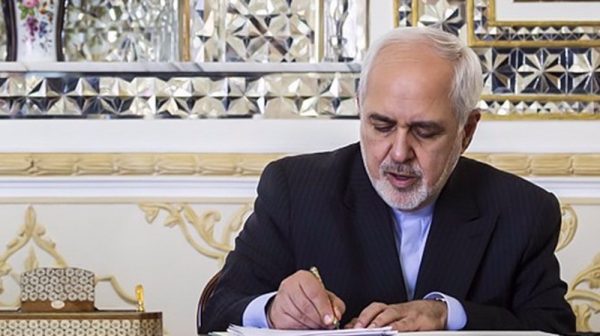
Iranian Foreign Minister Mohammad Javad Zarif
Press TV – June 9, 2021
Iran’s Foreign Minister Mohammad Javad Zarif wrote a letter to UN Secretary General Antonio Guterres earlier this month, criticizing the United Nations’ decision to deprive Iran of its voting rights.
As the UN Security Council backed Guterres for a second term on Tuesday, it is worthwhile to read highlights of Zarif’s letter to the UN chief, in which the Iranian foreign minister slammed the UN decision as “fundamentally flawed, entirely unacceptable and completely unjustified.”
“Iran’s inability to fulfill its financial obligation toward the United Nations is directly caused by ‘unlawful unilateral sanctions’ imposed by the United States to punish those who comply with a Security Council resolution,” Zarif wrote.
He was making a reference to the sanctions that the US slapped on Iran after former president Donald Trump withdrew from the 2015 Iran nuclear deal and violated UN Security Council Resolution 2231 that endorsed the historic pact.
The sanctions have blocked Iran’s access to global financial systems, and its money in foreign banks, including in South Korean, Japanese and Iraqi banks.
Zarif said the world is well aware that the people of Iran have been under unprecedented economic warfare and terrorism since the US withdrawal from the nuclear deal, also called the JCPOA, in material breach of preemptory norms of international law, the Charter of the United Nations and Resolution 2231.
“It is astonishingly absurd that Iranian people, who have been forcibly blocked from transferring their own money and resources to buy food and medicine – let alone pay UN contributions arrears – by a permanent member of the United Nations’ Security Council, are now being punished for not being allowed to pay budget arrears by the secretariat of the same organization, which has unjustifiably chosen for the past 3 years to remain indifferent in the face of attempted mass starvation – a crime against humanity – by the United States,” he noted.
The letter came after the UN said it had suspended the voting rights of Iran and four other countries over dues under Article 19 of the UN Charter, which states that any member owing the previous two years of assessments may not vote in the General Assembly.
However, Zarif pointed out that the UN Charter gives the General Assembly the authority to decide “that the failure to pay is due to conditions beyond the control of the member,” and in that case a country can continue to vote.
“By what definition are Iran’s arrears not ‘due to conditions beyond control’?” the chief Iranian diplomat asked.
“The Islamic Republic of Iran is fully committed to fulfilling its financial obligations to the United Nations and will continue to make every effort to settle the arrears in the payment of its financial contribution to the UN and other international organizations as soon as the underlying imposed conditions, i.e. the US unlawful unilateral coercive measures, is removed,” Zarif added.
The UN decision came while Iran and the other parties to the JCPOA are engaged in multilateral talks to bring the US back into compliance with the deal and remove the anti-Iran sanctions in exchange for the reversal of Iran’s nuclear activities that go beyond the JCPOA limits.
The talks, which began in early April, have not led to a tangible outcome yet.
Zarif said on Monday that it remains unclear whether US President Joe Biden and State Secretary Antony Blinken are ready to bury the failed “maximum pressure” policy of Trump and his State Secretary Mike Pompeo.
“Iran is in compliance with the #JCPOA. Just read paragraph 36,” Zarif wrote in a tweet. “Time to change course.”
Iran to leave Vienna by end of month if Biden doesn’t lift all sanctions
By Elijah J Magnier | Press TV | May 4, 2021
Iranian and Western delegations returned to their capitals after the third Vienna round, with optimism emanating from the statements of the gathered officials. Iran’s Deputy Foreign Minister Abbas Araqchi issued positive information about the US lifting sanctions on energy, economic sectors, shipping, freedom of transportation, banks, and on many Iranian personalities. The negotiations have reached a stage where the elaboration of complex texts is on the table. Also, there were talks about the US releasing more than 90 billion dollars withheld from Iranian funds and another 20 billion frozen in Iraq, South Korea and China from oil revenues. No details have been discussed so far about the interest on these funds held for many years due to US sanctions.
There was also talk of the possibility of exchanging Iranian prisoners held in America, who number 18, including 7 in critical health condition, and others of Iranian–Western double nationality holders (American and British) detained in Iran on charges of espionage. This is an old Iranian demand that Iran insists on ending everything in one single exchange.
However, after lifting sanctions against individuals and accepting all demands, the biggest problem lies in Iran’s request to ensure that the lifting of sanctions will be applied in a specific time frame. According to a particular pre-agreed timetable, Iran wants to ensure that all frozen funds will return to the Central Bank. Countries around the world will be allowed to deal with Iran in all sectors without intimidation.
Iran has never requested the return of diplomatic relations with the US, but rather the lifting of the sanctions that were imposed on it since 2015 and that President Barack Obama agreed to cancel. Moreover, Iran wants to lift all additional sanctions added by Donald Trump when the nuclear deal was torn apart in 2018.
Negotiations have reached a reasonable level, although Iran still refuses to communicate with the US directly because the US is no longer a partner in the JCPOA and that talks could blow up any time. The US flag was removed from the negotiating room at the request of Iran. The Iranian delegation stressed the need for the US delegates not to be present at the same hotel where the negotiations are taking place until the White House announces the end of all sanctions. This is when the US will become a JCPOA partner again.
An Iranian decision-maker in Iran said that “the Leader of the [Islamic] Revolution, [Ayatollah] Seyyed Ali Khamenei, will not give an unlimited time-space to negotiate in Vienna. This is the last month before the announcement of the clinical death of the JCPOA agreement if all Iranian conditions are not met.” The source asserts that “Iran will not accept the American evasiveness that called for easing the sanctions by lifting those related to the nuclear file and placing other sanctions related to Iran’s missile capability, the Revolutionary Guards (Islamic Revolution Guards Corps) and other sectors until a future negotiation to be established later. Either all sanctions are lifted, or no deal is reached because mid-solutions are not accepted.”
Many indications lead to the US intention to conclude the deal with Iran and honor its previous commitment signed in 2015. Israel is prepared for this move following Mossad director Yossi Cohen, National security advisor Meir Ben-Shabbat and other military and security high-ranking officers meeting with US officials. The Israelis failed to persuade the US to abandon the agreement with Iran.
The Biden administration considers the nuclear deal necessary to protect Israel by preventing Iran from reaching enrichment uranium to 90-percent purity level, which makes possessing an atomic bomb easy. Israel wishes to keep the harsh sanctions on Iran and strike its nuclear reactor.
Iran possesses the ballistic and precision missiles that enable it to strike back with a decisive blow to the US bases deployed in the Middle East in case of war. Furthermore, Iran can count on the strength of its allies deployed in Gaza, Lebanon, Syria, Iraq and Yemen, who can join the battlefield if needed. Therefore, waging war on Iran is not feasibly possible. That leaves the US with slim options: the best could be to honor its deal, lift the sanctions and make sure that Iran does not obtain military nuclear grade capability. This is Biden’s logic and approach to assure the security of Israel and the interests of the US. Iran has shown that it imposes its conditions on the US and treats it as an equal from strength because it has strong cards to play.
However, Israel cannot go to war with Iran alone and wants to drag in the US. Iran has shown that its strategic patience has been replaced by strategic deterrence. Multiple strikes manifested that, and missile messages exchanged in the Strait of Hormuz and the Red Sea. There were powerful indications that Iran will not be silent on any Israeli transgression. Furthermore, when Israeli Prime Minister Benjamin Netanyahu presented himself as an alternative power to the US in the Middle East and became a superpower, a missile landed close to the Dimona nuclear reactor. Therefore, there is no doubt that Israel can harass Iran in Syria by cyber warfare and assassinations. It is also accurate to say that Iran has the power to direct similar annoyance to Israel.
It is a crucial month to indicate in which direction the ship of negotiations between Iran and America will sail. It is in the interest of both parties to reach an agreement, but all indications indicate that Iran will not budge from its place and will hold its ground firmly before accepting the US back as a partner in the nuclear agreement. The ball is in Biden’s court now, and time is not on his side.
Elijah J Magnier is a veteran war correspondent and a Senior Political Risk Analyst with decades of experience covering the West Asian region.
Continuing the Story of the Hijacked Tanker and Frozen Funds
By Konstantin Asmolov – New Eastern Outlook – 04.05.2021
In early 2021, we wrote about the Iranian seizure of a South Korean tanker and how this precedent actually demonstrates a number of unresolved problems, most notably the problem of Iranian assets in South Korean banks intended to pay for Iranian crude oil imports and frozen because of US sanctions.
Recall: Iran has repeatedly urged Seoul to address the $7 billion frozen in two South Korean banks as part of US sanctions after the Donald Trump administration pulled out of the landmark nuclear deal with Iran in 2018 and tightened sanctions against the Islamic Republic. On January 4, 2021, the Iranian Islamic Revolutionary Guard Corps seized the South Korean-flagged tanker MT Hankuk Chemi under the pretext of environmental pollution.
On January 10, 2021, a government delegation led by First Deputy Foreign Minister Choi Jong-gon arrived in Tehran. However, the parties were unable to reach any agreements. In fact, Choi called for the release of the tanker and demanded evidence of oil pollution in the waters of the Persian Gulf, which formally caused the tanker to be seized. In response, his interlocutor Abbas Araghchi said that the tanker was in the hands of an Iranian court, and that the development of bilateral relations can make sense only when the issue of frozen funds is resolved.
Araghchi openly stated that “the freezing of Iran’s foreign currency resources in Korea is more due to a lack of political will on the part of the Korean government than to US sanctions,” and called on Choi to work out a mechanism to resolve the issue. However, the Iranian side noted that the crew members were safe and in good shape.
Choi’s talks with Iran’s Central Bank Governor Abdel Nasser Hemmati and Foreign Minister Javad Zarif also proved fruitless. The minister reiterated the thesis that the executive branch does not interfere in matters that fall within the jurisdiction of the judiciary; and the bank recalled that the South Korean government had promised to resolve the issue a year and a half ago, but had done nothing.
Kamal Kharrazi, head of Iran’s Strategic Council on Foreign Relations, was even more blunt: “The two countries had good relations, but now, unfortunately, because the Korean government yielded to US pressure, Iranian assets worth $7 billion have been frozen in Korean banks, and it cannot even withdraw money to buy medicine“.
On January 12, during a briefing, Saeed Khatibzadeh of the Iranian Foreign Ministry expressed dissatisfaction with the measures taken by the ROK to solve the problem: the solution is delayed and Tehran is not satisfied. The Iranian side has indicated its position that the problem of frozen funds should be solved first, and the issue of the arrested tanker will be resolved in accordance with legal procedures.
As a result of Choi’s visit, the parties agreed on nothing but further negotiations, and Choi went to Qatar, where he appealed for assistance in freeing the South Korean tanker and its crew.
In mid-January it emerged that in order to “create a positive mood before negotiations with Iran,” South Korea withdrew its anti-piracy naval unit Cheonghae from the Strait of Hormuz. Iranian Ambassador Saeed Badamchi Shabestari allegedly once expressed displeasure to Seoul over the presence of South Korean troops in the Straits because they were actually part of an international contingent assembled by the United States to contain Iran, even though formally the unit is meant to fight regional piracy. It is a typical trick of South Korean foreign policy when US orders are de facto carried out, but de jure these actions are anything but the direct order. However, the Foreign Ministry of the ROK refused to confirm this movement of troops.
At the same time, there was a rumor that the Iranian party offered to use part of the frozen funds to pay off its outstanding UN membership dues. Although the amount is only $16,200,000, experts decided that the only the first step would be particularly difficult, and on January 19, the head of the Central Bank of Iran, in an interview with Bloomberg agency again noted that this is not the first time the authorities of the Republic of Korea promise to do everything possible, but in fact they continue to follow the US policy and rules.
The Korean party, on the other hand, has made certain hints that a change of power in the US could unblock the problem.
On January 21, Hemmati reported that some of the funds belonging to Iran, which are in foreign banks, have been unfrozen and are being used by the government.
On February 2, 2021, Iran agreed to release the entire crew of the hijacked tanker except for the captain. Seoul welcomed this decision, and “the parties agreed to continue mutual communication”. By this time everyone finally remembered that at the time of the seizure the ship was carrying not petroleum products, but ethyl alcohol, so it is unclear how the fact of pollution that became the reason for the arrest of the ship occurred at that time.
The next day, the ROK media reported that South Korea was finalizing negotiations with the US to use some of the frozen money to pay Iran’s outstanding US dues. Otherwise, South Korean experts believed that the decision was still related to the change of power in the US, because, first, Biden was going to deal with the restoration of alliances in general, and second, the Iranian issue, according to Southerners, will be solved differently than under Trump. Iran has been called upon to return to the Joint Comprehensive Plan of Action in order to restore the 2015 nuclear agreement.
In addition, it was reported that South Korea increased the export of medicine to Iran for two months, which also contributed to the release of detainees.
On February 11, the first Korean sailor returned home, but some of the crew remained on the ship to provide management.
On February 23, in a statement issued by South Korean Foreign Ministry in response to the Iranian Foreign Ministry’s statement on reaching an agreement with the South, it was stated that Iranian assets could be unblocked after consultations with the United States. According to a report posted on the Iranian government’s website, the agreement was reached during the February 22 meeting between Hemmati, Governor of the Central Bank of Iran, and Yoo Jong-hyun, the ROK ambassador to Iran. The parties agreed on directions for the transfer of money, and the Central Bank of Iran has informed Seoul of the amount it wants to receive. Then, according to Bloomberg, Iranian government spokesman Ali Rabiei told a news conference that South Korea would release $1 billion in frozen money as a first step toward resolving the issue, without giving further details on how it would be used.
However, on the same day, Feb. 23, State Department spokesman Ned Price noted that the US and the ROK could discuss the supposed release of Iranian funds, but the money had not yet been transferred. The ROK Foreign Ministry also stressed that American pressure was needed to unfreeze Iranian assets. Thus, Tehran’s claim of an agreement has been refuted.
On February 24, the foreign ministers of the ROK and Islamic Republic of Iran discussed the situation, and Jong Eui-young said that South Korea “is making sincere efforts to release frozen assets,” but recalled that the issue must be resolved in close cooperation with the United States. In response, the Governor of the Central Bank of Iran said that South Korea must pay Iran $1 billion, otherwise Tehran will initiate proceedings in international courts.
On February 25, a US Treasury Department official said that Washington agreed in principle to a partial transfer of Iranian assets to Switzerland, from where they can be sent to Iran under the so-called Swiss Agreement on Humanitarian Trade, the essence of which is that Swiss food, pharmaceutical and medical companies must have a reliable channel of payment to ensure payment for their exports to Iran. Actually, the aforementioned billion was going to be transferred to the purchase of drugs against coronavirus
The conservative media in the ROK accused Iran of diplomatic impoliteness and wishful thinking. However, the commonplace conclusion was that it was all Moon’s fault for failing everything: the government is only engaged in improving relations with the DPRK and cannot conduct skillful diplomacy with other countries.
On March 2, Ned Price said that the US would be willing to discuss with Iran the unblocking of its money in the ROK “to achieve the main goal of Iran’s denuclearization.” He was silent about where, when, and how this issue would be discussed.
On March 10, US Secretary of State Antony Blinken took an even tougher stance: until Iran meets its obligations under the nuclear deal, the US will not ease any sanctions, including the release of Iranian funds in South Korean banks. When asked whether it was true that some of the funds could be transferred, however, Blinken replied that “the report you referred to is simply wrong“. Korean conservative media and experts immediately noted that “Secretary Blinken’s principled approach to frozen Iranian funds is good news for Korean national interests. This allows Seoul to resist extortion, even while making every reasonable effort to cooperate with Tehran. It also sends a signal to North Korea that international sanctions will be strictly enforced, but may be eased if denuclearization agreements are respected.”
On March 16, the ROK and Iran held a video conference that formally focused on expanding bilateral humanitarian trade, and on March 17, Deputy Prime Minister and Treasury Secretary Hong Nam-gi spoke by phone with new US Treasury Secretary Janet Yellen, where the parties agreed to cooperate closely, including on the Iranian issue.
On April 2, 2021, a diplomatic source reported that the tanker would soon be released, and on April 5, Said Khatibzadeh of the Iranian Foreign Ministry added that the case was ending and the court decision would most likely be in favor of the South Korean side.
According to experts, this was related both to the upcoming visit to Iran of Prime Minister Jong Se-kyung and to the fact that 700,000 doses of AstraZeneca vaccine produced in Kazakhstan were delivered to Iran.
On the morning of April 9, Iran released the tanker and it left the port. On board were the captain and 12 crew members who had been released earlier but remained on the ship for maintenance purposes.
On April 11, Jeong Se-kyung left for Iran on a three-day visit. This visit was the first trip of a South Korean prime minister to Iran in 44 years, but it should be remembered that by this time it was already known that at the end of the visit Chong was resigning due to a set of domestic political problems. Therefore, despite the high status of the visit, its real significance was somewhat less than expected, and the visit did not end with anything serious. The sides agreed to expand humanitarian exchanges, including medical cooperation, and to create a special consultative body responsible for preparing economic cooperation projects after the possible resumption of the nuclear deal. The Iranian side again urged Seoul to unblock the money as soon as possible, which was responded to with further assurances that everything possible was being done and a call to prevent Iran from detaining foreign vessels in the future: “The freedom of navigation must be guaranteed.”
In general, during his stay in Iran, Jeong Se-kyung himself was particularly active trying to please Iran and even talked about the importance and profound spiritual significance of Ramadan. It turns out that he has said before that “this money is Iranian money and should be returned to the rightful owner. We have to find a way to return it quickly.” However, the author’s attempt to search for statements by the South Korean prime minister on this topic was unsuccessful. Jeong met with a number of dignitaries, including the speaker of parliament, but was unable to meet with President Rouhani “for various reasons, including the situation with Covid-19.”
And Iran’s First Vice President Jahangiri openly said, “We call on the Korean government to release Iran’s financial resources as soon as possible and solve the problems of recent years through practical compensatory measures.” The vice president regretted that the $1 billion transfer to Swiss banks for the purchase of a coronavirus vaccine did not materialize despite promises by Korean officials: the Korean banks’ actions severely damaged bilateral relations, as it deprived Iran of major foreign exchange resources to purchase medicines and medical equipment in a pandemic. As a result, the image of the ROK has been seriously damaged. There is hope that the situation will improve after Jeong Se-kyung’s visit.
Nevertheless, on April 12, a US State Department official, speaking on condition of anonymity, repeated in an interview with the Ryonhap news agency that the US position on sanctions against Iran remains unchanged. Until Iran goes back on the JCPOA, it won’t get its money back.
Thus, on the one hand, the story of the tanker hijack ended well enough, and the notion that the action had not an environmental but a political purpose was safely confirmed. On the other, Iran’s attempt to push for the return of the blocked funds in this way did not end with anything. Iran received some vaccines and other medical resources, but it was more of a handout than a victory. Finally, this situation shows well the level of independence of South Korean foreign policy on certain issues. Despite the fact that the South Korean leadership did not seem to mind solving the problem, at the first shout from the US in Seoul they stood at attention, not even trying to show displeasure about it. For the author, this is a rather important story that explains both why some countries periodically claim a “lack of sovereignty” in South Korea and the difference in South Korean foreign policy between the populist statements of Moon Jae-in and Co. and Seoul’s actual actions.
Konstantin Asmolov, PhD in History, is a leading research fellow at the Center for Korean Studies of the Institute of the Far East at the Russian Academy of Sciences.
US agency in charge of nukes approves plutonium project as Washington urges Iran to curtail its own nuclear program
RT | April 29, 2021
The US has approved a multibillion-dollar project to beef up its plutonium production at the same time Washington is calling on Iran to return to an international agreement designed to prevent Tehran from developing nuclear bombs.
The National Nuclear Security Administration (NNSA), the federal agency responsible for nuclear research and weapons manufacturing in the US, has approved the first design phase for the new project.
At least 30 plutonium pits per year will be built to “meet national security needs,” the NNSA said in a statement on Wednesday.
The project at the Los Alamos National Laboratory, New Mexico, will cost an estimated $2.7–$3.9 billion and could be finished between 2027 and 2028, the agency said.
Plutonium pits are bowling-ball-sized plutonium shells, and a crucial component in nuclear warheads.
The move to expand plutonium production is a bid by US President Joe Biden’s administration to make up for the country’s near-three-decade shortfall in the quantity of material the NNSA says is required for America’s nuclear arsenal.
At the same time as it hatches plans to bolster America’s own stockpile, the Biden administration has repeatedly called on Iran to restrict its nuclear program and return to the terms of the 2015 nuclear deal.
Indirect US-Iranian talks to revive the accord – officially known as the Joint Comprehensive Plan of Action (JCPOA) – have been taking place in Vienna over the last three weeks.
Under the deal, Iran originally agreed to curbs on its nuclear program in exchange for sanctions relief.But in 2018 Biden’s predecessor Donald Trump pulled the US out of the agreement and reverted to imposing crippling sanctions on Iran.
Tehran then began breaching its commitments under the deal.
Biden has said he wants the US to re-join the JCPOA – but first wants Iran to make concessions by cutting back on the amount, and purity, of uranium it produces and stores.
Tehran has said it will not alter its approach until Washington lifts sanctions.
On Thursday Mikhail Ulyanov, the Russian ambassador to the International Atomic Energy Agency, who is one of the mediators at the negotiations, briefed the US Special Envoy for Iran Robert Malley on the talks.
“We had a detailed and very useful discussion on major topics which are under consideration in the course of on-going talks in Vienna on full restoration of the #JCPOA,” Ulyanov said in a statement on Twitter.
The Iranian Nuclear Program and the Current International Agenda
By Viktor Mikhin – New Eastern Outlook – 22.04.2021
Iran began enriching 60 percent uranium at its plant in Natanz a few days after the explosion that occurred at the facility – something for which Tehran legitimately laid the blame on Israel. “Our response to the anger of our enemies,” stressed President Hassan Rouhani, “is to replace the damaged centrifuges with more advanced ones, thereby activating 1,000 cutting-edge centrifuges, and there will be an increase in the level of enrichment of up to 60% at the Natanz Nuclear Power Plant”.
The International Atomic Energy Agency stated that it had been informed of the decision by the Iranian authorities. For its part, Washington pedantically called Iran’s statement “provocative”, and said that the US administration was allegedly concerned, adding that this casts doubt on Tehran’s seriousness in its negotiations on the nuclear program.
At the same time, US President Joe Biden has repeatedly stated that he wants to return to the deal, but Iran apparently “must terminate its violations”. This caused the European Union to call for negotiations to hopefully accomplish precisely this. Although the American delegation has a presence in Vienna, it does not meet directly with the Iranian one, but rather with diplomats from other countries that shuttle between them. Entering the negotiations – which have just begun – Iran said that it is ready to return to fully complying with the agreement, but that the United States will first have to repeal all the sanctions that it imposed under Donald Trump. However, this is fairly difficult, since the previous administration added sanctions on Iran that went beyond the boundaries of those related to its nuclear program, including those imposed due to accusations of terrorism, human rights violations, and the country’s ballistic missile program.
But there still are glimmers of hope. According to Aniseh Bassiri Tabrizi, an Iranian scholar at the Britain’s Royal United Services Institute, the negotiations quickly passed by the “Who makes the first move?” debate, and began to address specific issues. “It’s a very good development that these work groups exist that really do talk about and examine the nitty-gritty,” she told the Associated Press. For Iran to return to the deal, among other things it must return to enriching uranium to no more than a 3.67% level of purity, stop using advanced centrifuges, and drastically reduce the quantity of its enriched uranium. Despite the challenges, Tabrizi said that “the challenge ahead is not as difficult as the one the group faced in 2015, since there is already a deal in place”.
Although negotiations have just begun, the question has arisen as to how long they will last. There is no specific time frame. The diplomats involved in the talks say these issues cannot be resolved overnight, but several reasons exist why they hope that they will be resolved in a matter of weeks, not months. The initial deal was agreed upon after Iranian President Hassan Rouhani, widely known as a moderate politician, first took office. Rouhani is unable to run again in the upcoming June elections due to term limit restrictions, and he hopes to be able to step down during a time when Iran can again sell oil abroad and gain access to international financial markets.
Meanwhile, the US could face much more difficult negotiations if it doesn’t strike a deal before Rouhani leaves. Hardliners in Iran reject the nuclear deal, saying it hasn’t brought enough economic assistance, and is a slippery slope leading to increasing pressure on the country. This does not necessarily mean they will stop the negotiations if they are elected, although that will complicate matters, said Sanam Vakil, deputy director of the Chatham House Policy Institute’s Middle East North Africa Program.
There is another reason to take action quickly: In February, Iran began curtailing International Atomic Energy Agency inspections at its nuclear facilities. Instead, it was announced that surveillance footage of the facilities would be retained for three months, and then transferred over to the IAEA if the Iranians gain some relief from the sanctions. Otherwise, Iranian scientists will erase all records and, quite possibly, the IAEA will face new obstacles to visiting Iran and monitoring its nuclear program.
Although it must be acknowledged that there are many other difficulties and obstacles. The Natanz nuclear facility has just been targeted with subversive activity, which the Iranian authorities have called sabotage. Many with good reason suspect that the attack was carried out by Israel, which opposes the nuclear deal, although the Israeli authorities are somehow trying to avoid the question of commenting on that. The lion’s share of Iran’s work at the Natanz plant has gone to waste, with many Israeli media reporting gloatingly. According to their assessments, the Iranian regime is now being dealt one blow after another, which indicates its inability to protect even its important nuclear facilities, but it will definitely seek to exact revenge when it can. Lieutenant Colonel Michael Segall, a strategic affairs expert specializing in Iran, terrorism, and the Middle East who is a senior analyst at the Jerusalem Center for Public Affairs, noted that talks between the United States and Iran on bringing the Islamic Republic back to a nuclear deal “triggered many recent events, and the latest actions taken by Israel”. This is not the first time that the centrifuges in Natanz have suffered some kind of destruction. “I’m not sure how many of the cascades that keep the uranium enrichment centrifuges in place have been destroyed, and it’s unclear what happened, but when a cascade breaks down that spells years of work going down the drain,” Segall said.
Prior to that, Iranian President Hassan Rouhani announced that Iran had begun testing new IR-9 centrifuges, which enrich uranium 50 times faster than first-generation IR-1 centrifuges. That same day, Iran reported that 164 IR-6 centrifuges were started up at Natanz that enrich uranium 10 times faster than the IR-1 centrifuges. Incidentally, the 2015 nuclear deal restricts Iran to using only IR-1 centrifuges. After that, Natanz suffered a mysterious power outage that followed reports of an explosion. The well-informed (from what source?!) New York Times newspaper immediately reported that the incident would halt production at the plant for at least nine months. The IR-9 centrifuges have really cut down on the time frames needed for enrichment, and this decreases what used to take days down to a few hours. A power outage without backup power could lead to serious damage if the cascades are thrown out of position, said Israeli specialist Segall.
Iran strongly believes that Israel clearly hopes to disrupt negotiations by using sabotage. Rouhani stated he still hopes the talks will work, but the latest attack has made matters more complex. First, Iran responded by announcing that it would increase its uranium enrichment activities to reach a 60% purity level – one much higher than ever before, and install more advanced centrifuges at the Natanz plant. And following how these events unfolded, both sides ratcheted up their rhetoric and propaganda. In particular, the Supreme Leader of Iran, Ayatollah Ali Khamenei, who has the final say on all state matters in the country, rejected all proposals that have been considered so far in Vienna as “not worthy of attention”. At the same time, US Secretary of State Antony Blinken stated that Washington has demonstrated its commitment by participating in indirect talks in Vienna, but with Tehran’s recent statements “it remains to be seen whether Iran shares the seriousness of this objective”. The US is very serious about its “provocative” announcement on intending to start enriching uranium up to 60 percent, Blinken said at a press conference held at NATO headquarters in Brussels, referring to Iran. European countries participating in the 2015 Iranian nuclear deal – and unquestioningly fulfilling the will of their overlord – also told Tehran that this step allegedly contradicts their efforts to revive the agreement, one from which, it is worth reiterating, the United States withdrew.
Meanwhile, at the nuclear talks in Vienna, as evidenced by the facts, Washington has so far demonstrated a rather decisive, uncompromising, and crass position. The American delegation was headed by the US Special Envoy for Iran Robert Malley – a man, as American media outlets note, who is little inclined toward negotiations or flexibility in his thinking. But Iran, for its part, “very strongly” insists that all sanctions be lifted before it reverses its moves in the nuclear power industry. Incidentally, there is a well-organized division of labor in the Iranian government, with the Ministry of Foreign Affairs reflecting the firm position taken by Ayatollah Ali Khamenei, and President Hassan Rouhani sometimes adopting a more optimistic tone about the possible outcome of the negotiations.
It is quite apparent that the Iranians’ idea is that all sanctions should be lifted, even those related to non-nuclear issues like accusations of supporting terrorism. Verification is very important from the Iranian perspective – first of all, Iran wants to make sure that the sanctions are lifted, and only then will it reverse its latest measures, including in installing the advanced IR-9 centrifuges. It should not be forgotten that Iran is supposed to stop sharing video footage of its nuclear facilities with the IAEA in six weeks, a move that followed Tehran terminating its live video feeds as part of its ever-escalating series of moves in the nuclear power industry to exert pressure on the negotiations. But the reality is that everything will basically depend only on the reasonable measures taken by the Joe Biden administration – if any of those will originate from the White House.
Report: Iran’s verification of US reversal to take 3 months at least
Press TV – April 11, 2021
A detailed report by the Iranian parliament’s Research Center says the verification of any US removal of sanctions on Tehran would require at least three months, emphasizing that the process would not be possible within hours or days.
“It is obvious that the real test of sanctions removal and fulfillment of measurable indices put forward by Iran is not possible in a matter of few hours or days, and would take at least 3 to 6 months. It is also necessary to verify within specified intervals (for example every six months) that the Iranian economy benefits from the removal of the sanctions,” the parliament’s Research Center (IPRC) said in its report.
The report said Article 6 of the Strategic Action Plan to Counter Sanctions, a law passed in December by Iranian legislators, stipulates several general criteria concerning the removal of the anti-Iran sanctions.
They include normalization of banking transactions, total removal of export barriers, unhindered sale of Iranian petroleum and oil derivatives, in addition to complete and rapid return of revenues from Iranian oil sales.
Last December, Iranian lawmakers overwhelmingly voted in favor of the action plan, which tasked the administration with suspending extra commitments under the 2015 nuclear deal, officially known as the Joint Comprehensive Plan of Action (JCPOA).
The Iranian parliament’s report went on to say that Article 7 of the Strategic Action Plan to Counter Sanctions obliges the government to report to the parliament on measures taken to counteract the US sanctions. Parliamentary commissions have been assigned to assess those measures.
The report noted that Washington has a number of economic, political and legal means which it could employ despite its possible removal of the sanctions in order to prevent the Iranian economy from benefiting from the dividends of the nuclear deal.
The United States, the report said, may prevent Iran from benefiting economically from the removal of the sanctions by trying to maintain the status quo, including limiting other countries’ cooperation with the Islamic Republic.
Research conducted by the IPRC has significant impact on the legislation passed by Iranian lawmakers.
On April 8, Leader of the Islamic Revolution Ayatollah Seyyed Ali Khamenei said verification means Iran should be able to sell its oil under normal conditions and receive its money.
The Biden administration has conceded that its predecessor’s so-called maximum pressure campaign has failed, but it has so far failed to take any practical steps to undo the wrongs.
Iran will in no way enter negotiations beyond JCPOA: Security chief
Press TV – April 6, 2021
Secretary of Iran’s Supreme National Security Council (SNSC) Ali Shamkhani says the Islamic Republic will under no circumstances enter negotiations beyond the nuclear agreement it clinched with six major world states in 2015.
“Regardless of whether Europe has the will or ability to persuade #USA to lift all sanctions at once & Washington’s return to its commitments, there will be no possibility for Iran entering the talks in the new fields, more than JCPOA, under any circumstances,” he said.
The security chief posted the tweet with the hashtag #activeresistance in his tweet.
Shamkhani’s tweet followed remarks by the US administration’s special envoy for Iran, Rob Malley, who is based in a hotel near the venue of talks in the Austrian capital of Vienna between representatives of Iran and the remaining signatories to the JCPOA.
In an interview with the American National Public Radio, Malley was asked about a “follow-up” agreement in case the JCPOA gets back on track.
“What we would pursue is, first of all, a longer agreement. Even though this one lasts quite some time and some of its provisions last forever, of course, it would be better, as in any arms control agreement, to see whether we could get a follow-on deal that extends the timelines,” he replied.
Earlier in the day, representatives of Iran and the P4+1 group of countries — Britain, France, Germany, Russia and China — began a new round of talks in Vienna over a possible return of the United States to the JCPOA, which abandoned by the US under former president Donald Trump some three years ago.
The Vienna negotiations took place within the “in-person” and expert-level formats.
Ahead of the talks, Iran’s Foreign Ministry reaffirmed in a statement that no representatives from the US are to attend the nuclear talks in Vienna, and that the Iranian delegation’s agenda does not feature any direct or indirect negotiations with Americans either.
Iran will have no direct, indirect talks with US in Vienna: Official
Press TV – April 4, 2021
Deputy Foreign Minister Abbas Araqchi says Iran and the US will have no direct or indirect talks in Vienna, where the remaining parties to a 2015 nuclear deal will meet Tuesday to discuss the lifting of sanctions on Tehran.
He made the remarks on Sunday, two days after participants at the virtual meeting of the Joint Comprehensive Plan of Action (JCPOA) Joint Commission agreed to resume in-person talks in the Austrian capital.
Araqchi said Iran’s negotiations with Germany, France, Britain, China and Russia in Vienna are purely technical about the lifting of sanctions and Iran’s remedial measures as well as the sequence of the US lifting of sanctions which should be verified.
“What we are pursuing in Vienna at the Joint Commission is precisely based on the firm positions of the establishment that have repeatedly been stated by Leader of the Islamic Revolution [Ayatollah Seyyed Ali Khamenei] and the country’s officials,” he said.
“We will have no talks, whether direct or indirect, with the Americans in Vienna. We will negotiate with the Joint Commission and the P4 + 1 and pronounce our condition for the [US] return to the JCPOA. Our demand is that the US must first fulfill all its obligations and remove all the sanctions it has imposed, then we will verify and return” to the point before the remedial measures Iran has taken, he added.
The Europeans are trying to resurrect the 2015 nuclear deal, which the administration of former US president Donald Trump almost wrecked after abandoning it in May 2018 and imposing the “toughest ever” anti-Iran sanctions.
After the withdrawal, Iran waited for a year for the Europeans to take remedial measures and thwart the unilateral American sanctions as per their obligations under the JCPOA, but to no avail.
That prompted the Islamic Republic to suspend some of its obligations in line with its legal rights stipulated under Article 36 of the JCPOA.
The new US administration, under President Joe Biden, has spoken of a willingness to return to the nuclear agreement, but in practice, it has been sticking to Trump’s “maximum pressure” campaign.
Last month, Ayatollah Khamenei said Washington must first remove all the sanctions it has imposed on Tehran in a verifiable manner before Iran reverses its nuclear countermeasures.
Iran has drawn a line in the sand before going to the Vienna talks: it will not accept any step-by-step lifting of the sanctions as suggested by the Americans.
“We do not have any step-by-step plan or proposal and do not accept it,” Araqchi reiterated Sunday.
“In our opinion, there is only one step: All the sanctions that were reimposed after Trump’s withdrawal or imposed newly under different headings should be identified and the United States must lift them. Then we will verify and return to our commitments.”
Featured Video
The US bombed the Shahs house lol
or go to
Aletho News Archives – Video-Images
From the Archives
How a War with Iran Would Diminish American Power
By Greg Scoblete | The Compass | August 13, 2010
Jennifer Rubin wants a war with Iran:
But the emphasis on the existential threat to Israel ignores a more basic issue for Americans to ponder: a nuclear-armed Iran represents a dagger at the heart of America and an existential threat to our status as a superpower and guarantor of the West’s security. As to the former, Iran is pressing ahead with its long-range ballistic missile program. First the Middle East and Eastern Europe, then all of Europe and, within a matter of years, the U.S. will be within range of Iranian missiles. If those are nuclear and not conventional, what then? We’re not talking about whether Iran is going to be “merely” a destabilizing factor in the Middle East or whether it will set off an arms race with its neighbors or imperil Israel’s existence. We’re talking about whether America will then be at risk (and lacking sufficient missile-defense capabilities if we continue to hack away at our defense budget). The argument about whether mutual assured destruction can really work against Islamic fundamentalists who have an apocalyptic vision becomes not about Israel’s ability to deter an attack but about ours. Those who oppose American military action have an obligation to explain why America should place itself in that predicament.
I would argue that any obligation to present an explanation lies with those whose disastrous policy prescriptions with respect to Iraq lead America into the worst strategic blunder in the country’s recent history. That aside, note the blind faith in the power of the military to actually achieve its ends. … continue
Blog Roll
 Aletho News
- Neighbors first – Moscow signals shift in energy strategy
- Almost 400 Ukrainian drones downed over Russia in single night – MOD
- Battle for Hungary: How the Russiagate blueprint has been unleashed against Orban
- Brussels warns Slovakia over ‘discriminatory’ dual fuel pricing targeting foreign drivers
- Hungary to halt gas deliveries to Ukraine – Orban
- The US bombed the Shahs house lol
- The London Ambulances Attack: Of Course It Was A False Flag
- Embarrassing Pivot: U.S. considers dropping Iran oil sanctions amid war
- US has 2 months of rare earths left to replenish weapons amid Iran war: Report
- Strait Of Hormuz closure brings Empire to brink
- If Americans Knew
- ‘Forever live by the sword’: Understanding Israelis’ massive support for Iran war
- UN’s special rapporteur on human rights says Israel is systematically torturing Palestinians
- Trump White House plagiarized Iran war manifesto from Israel-aligned think tank
- Gaza says 6–10 patients die daily waiting for treatment abroad as Israel blocks medical evacuations
- ‘Substantial evidence’ of double-tap strike in killing of Gaza’s Hind Rajab
- ‘Do Not Want To Die For Israel’: Doubts About Trump’s Iran Strategy Spread Among Troops
- Instead of taking Joe Kent’s claims seriously, the media is disregarding him as an antisemite
- Joe Kent’s Explosive Interviews about his Resignation over the Iran War
- Israel poised to take over southern Lebanon; settlers wreak havoc in West Bank – Not a ceasefire Day 165
- From Sde Teiman, the truth about Israel’s military justice system has been set free
- No Tricks Zone
- Devastating Assessment Of Comirnaty Vaccine By Former Senior Pfizer Europe Toxicologist
- New Study: CO2 Is ‘Effectively Negligible’ As An Explanatory Climate Change Factor Since 2000
- Former Pfizer Toxicologist Dr. Helmut Sterz Tells Bundestag Hearing Pfizer Vaccine Should Have Never Been Approved
- Energy Expert: Germany’s Nuclear Phaseout Was A “500 Billion Euro Mistake”
- New Research: South Australia’s Mid-Holocene Sea Surface Temperatures Were 4°C Warmer Than Today
- Storing Green Energy To Last Germany 10 Days Would Require A 60-Million Tonne Battery
- New Studies: UK Sea Levels Were 4 Meters Higher Than Today During The Mid-Holocene
- Destructive Green New Deal: German Energy And Metal Group Warns Of Drastic Crisis
- New Study Documents A 20-Year Pause In Arctic Sea Ice Decline – Driven By Internal Variability
- Wake-up Call: Survey Shows Majority Of Germans Now Favor Postponing Climate Targets!
 Aletho News