Israel to Attack Iran? Washington Gives the Green Light to the ‘Military Option’
By Philip Giraldi | Strategic Culture Foundation | October 28, 2021
Some might recall candidate Joe Biden’s pledge to work to rejoin the Joint Comprehensive Plan of Action (JCPOA) which was a multilateral agreement intended to limit Iran’s ability to develop a nuclear weapon. The JCPOA was signed by President Barack Obama in 2015, when Biden was Vice President, and was considered one of the only foreign policy successes of his eight years in office. Other signatories to it were Britain, China, Germany, France, and Russia and it was endorsed by the United Nations. The agreement included unannounced inspections of Iranian nuclear facilities by the IAEA and, by all accounts, it was working and was a non-proliferation success story. In return for its cooperation Iran was to receive its considerable assets frozen in banks in the United States and was also to be relieved of the sanctions that had been placed on it by Washington and other governments.
The JCPOA crashed and burned in 2018 when President Donald Trump ordered U.S. withdrawal from the agreement, claiming that Iran was cheating and would surely move to develop a nuclear weapon as soon as the first phase of the agreement was completed. Trump, whose ignorance on Iran and other international issues was profound, had surrounded himself with a totally Zionist foreign policy team, including members of his own family, and had bought fully into the arguments being made by Israel as well as by Israel Lobby predominantly Jewish groups to include the Foundation for Defense of Democracies (FDD) and the American Israel Public Affairs Committee (AIPAC). Trump’s time in office was spent pandering to Israel in every conceivable way, to include recognizing Jerusalem as the country’s capital, granting Israel the green light for creating and expanding illegal settlements on the West Bank and recognizing the occupied Syrian Golan Heights as part of Israel.
Given Trump’s record, most particularly the senseless and against-American-interests abandonment of JCPOA, it almost seemed a breath of fresh air to hear Biden’s fractured English as he committed his administration to doing what he could to rejoin the other countries who were still trying to make the agreement work. After Biden was actually elected, more or less, he and his Secretary of State Tony Blinken clarified what the U.S. would seek to do to “fix” the agreement by making it stronger in some key areas that had not been part of the original document.
Iran for its part insisted that the agreement did not need any additional caveats and should be a return to the status quo ante, particularly when Blinken and his team made clear that they were thinking of a ban on Iranian ballistic missile development as well as negotiations to end Tehran’s alleged “interference” in the politics of the region. The interference presumably referred to Iranian support of the Palestinians as well as its role in Syria and Yemen, all of which had earned the hostility of American “friends” Israel and Saudi Arabia.
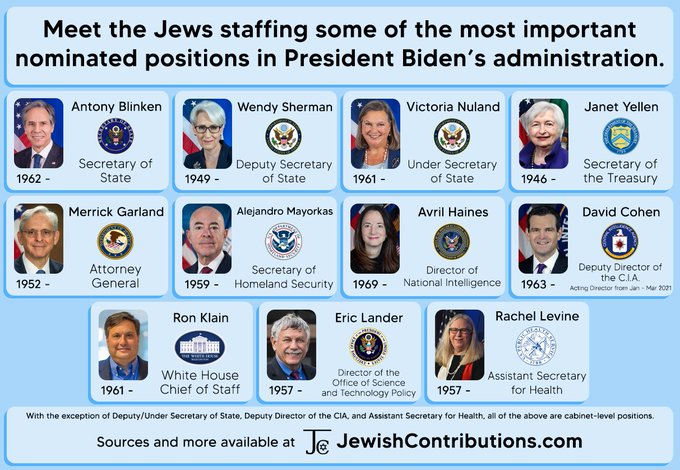 Israel inevitably stirred the pot by sending a stream of senior officials, to include Foreign Minister Yair Lapid, Defense Minister Benny Gantz and Prime Minister Naftali Bennett to discuss “the Iranian threat” with Biden and his top officials. Lapid made clear that Israel “reserves the right to act at any given moment, in any way… We know there are moments when nations must use force to protect the world from evil.” And to be sure, Biden, like Trump, has also made his true sentiments clear by surrounding himself with Zionists. Blinken, Wendy Sherman and Victoria Nuland have filled the three top slots at State Department, all are Jewish and all strong on Israel. Nuland is a leading neocon. And pending is the appointment of Barbara Leaf, who has been nominated Assistant Secretary to head the State Department’s Near East region. She is currently the Ruth and Sid Lapidus Fellow at the Washington Institute for Near East Policy (WINEP), which is an AIPAC spin off and a major component in the Israel Lobby. That means that a member in good standing of the Israel Lobby would serve as the State Department official overseeing American policy in the Middle East.
At the Pentagon one finds a malleable General Mark Milley, always happy to meet his Israeli counterparts, and Secretary of Defense Lloyd Austin, an affirmative action promotion who likewise has become adept at parroting the line “Israel has a right to defend itself.” And need one mention ardent self-declared Zionists at the top level of the Democratic Party, to include Biden himself, Speaker of the House Nancy Pelosi, House Majority Leader Steny Hoyer and, of course, Senate Majority Leader Chuck Schumer?
So rejoining the JCPOA over Israel objections was a non-starter from the beginning and was probably only mooted to make Trump look bad. Indirect talks including both Iran and the U.S. technically have continued in Vienna, though they have been stalled since the end of June. Trita Parsi has recently learned that Iran sought to make a breakthrough for an agreement by seeking a White House commitment to stick with the plan as long as Biden remains in office. Biden and Blinken refused and Blinken has recently confirmed that a new deal is unlikely, saying “time is running out.”
And there have been some other new developments. Israeli officials have been warning for over twenty years that Iran is only one year away from having its own nukes and needs to be stopped, a claim that has begun to sound like a religious mantra repeated over and over, but now they are actually funding the armaments that will be needed to do the job. Israel Defense Force Chief of Staff Aviv Kohavi has repeatedly said the IDF is “accelerating” plans to strike Iran, and Israeli politicians to include former Prime Minister Benjamin Netanyahu have regularly been threatening to do whatever must be done to deal with the threat from the Islamic Republic. Israeli media is reporting that $1.5 billion has been allocated in the current and upcoming budget to buy the American bunker buster bombs that will be needed to destroy the Iranian reactor at Bushehr and its underground research facilities at Natanz.
In the wake of the news about the war funding, there have also been reports that the Israeli Air Force is engaging in what is being described as “intense” drills to simulate attacking Iranian nuclear facilities. After Israel obtains the 5000 pound bunker buster bombs, it will also need to procure bombers to drop the ordnance, and one suspects that the U.S. Congress will somehow come up with the necessary “military aid” to make that happen. Tony Blinken has also made clear that the Administration knows what Israel is planning and approves. He met with Israeli Foreign Minister Yair Lapid on October 13th and said if diplomacy with Iran fails, the U.S. will turn to “other options.” And yes, he followed that up with the venerable line that “Israel has the right to defend itself and we strongly support that proposition.”
Lapid confirmed that one of Blinken’s “options” was military action. “I would like to start by repeating what the Secretary of State just said. Yes, other options are going to be on the table if diplomacy fails. And by saying other options, I think everybody understands here … what is it that we mean.” It must be observed that in their discussion of Iran’s nuclear program, Lapid and Blinnken were endorsing an illegal and unprovoked attack to prevent Iran from acquiring a nuclear weapon that it is apparently not seeking, but which it will surely turn to as a consequence if only to defend itself in the future.
In short, U.S. foreign policy is yet again being held hostage by Israel. The White House position is clearly and absurdly that an Israeli attack on Iran, considered a war crime by most, is an act of self-defense. However it turns out, the U.S. will be seen as endorsing the crime and will inevitably be implicated in it, undoubtedly resulting in yet another foreign policy disaster in the Middle East with nothing but grief for the American people. The simple truth is that Iran has neither threatened nor attacked Israel. Given that, there is nothing defensive about the actions Israel has already taken in sabotaging Iranian facilities and assassinating scientists, and there would be nothing defensive about direct military attacks either with or without U.S. assistance on Iranian soil. If Israel chooses to play the fool it is on them and their leaders. The United States does not have a horse in this race and should butt out, but one doubts if a White House and Congress, firmly controlled by Zionist forces, have either the wisdom or the courage to cut the tie that binds with the Jewish state.
EU energy crisis hitting poorest citizens hardest
By Jerome Hughes | Press TV | October 21, 2021
Brussels – European Commission President, Ursula von der Leyen, warns the EU’s energy crisis is hitting the poorest hardest and businesses are at risk of closing. EU officials say the 27-nation bloc could benefit from Iran’s vast energy reserves if US sanctions against the Islamic Republic are removed.
The weather is becoming more inclement in the EU and while temperatures are dropping, energy costs are soaring. The crisis has just been discussed in the European Parliament.
The main factors driving prices upwards are consumer demand after COVID-19 lockdown restrictions were eased and gas stockpiles were depleted last winter as it was particularly cold. Then we used a lot of electricity during a warmer than usual summer. Half of the gas used in the EU is imported from Russia. We raised the issue of alternative suppliers with the European Commission.
Question: “Is it the case that the EU would like to be getting more energy from Iran?”
The commission says US sanctions are impeding Iranian energy sales but that won’t be a problem if the JCPOA Iran nuclear deal can be brought back on track.
The EU could import liquefied natural gas from various places, such as the United States, but experts say it would not make sense.
Von der Leyen confirmed to the European Parliament on Wednesday that Russia has fully honored its energy contracts with the EU. She says Moscow has so far not increased supply. Energy consultants say the bloc will still need Russia’s gas for at least another 20 years.
While this dependency exists they suggest it would be prudent of the bloc to improve relations with Moscow.
The Iran Nuclear Saga: US-Israel Hammer Out a “Plan B”
By Salman Rafi Sheikh – New Eastern Outlook – 18.10.2021
Even though the presidential candidate Joe Biden had vowed to “move quickly” to re-join the Iran nuclear deal, this has not happened. The Biden administration’s deliberate strategy to kill the previous deal by following the framework of talks it inherited from the Trump administration has contributed massively to the present deadlock, leading the US and Israel to devise a “Plan B” to force Iran into submission. While Iran has been insisting – and its demands are not illegitimate – that the US must lift its sanctions first to create the path for reviving the JCPOA, Washington’s (and Israel’s) insistence on including Iran’s ballistic missile programme into the deal has become an additional source of tensions and the ensuing deadlock. Including a new agenda in the deal does not mean reviving the deal; in fact, it is actually involves a bid to push Tehran for an altogether new deal – a goal that the US and Israel have been pursuing ever since the Trump administration withdrew from the deal and Israel started sabotaging Iran’s legitimate nuclear production though cyber attacks and by murdering its top nuclear scientist.
While a simple revival of the deal is increasingly looking impossible, the talk of the town is the ‘military option’ if the ‘diplomatic option’ fails to produce the desired outcome, that is a one-dimensional result that favours the US and Israel only.
While it is already hard to argue against the fact that Israel, by engaging in active sabotage, has been using proper military options to coerce Iran into submission, there is still no gainsaying that the US and Israel are actively contemplating the military option to actually upgrade the military resources they have used so far. In doing so, both the US and Israel will be relying on the precedent set by the Trump administration when it killed Iran’s top military official, General Suleimani, last year in a drone air-strike in Iraq.
While the Biden administration may not itself want to start a new fully fledged war against Iran when it has just ended the US’ “endless war” in Afghanistan, there is no gainsaying that the US defense establishment may provide all the support, both diplomatic and military, Israel needs to carry out a military strike on Iran’s nuclear production capabilities. At the same time, it remains that the US may not be fully opposed to actually coordinating with Israel a military strike on Iran. During his latest meeting with Biden, the Israeli prime minister, Naftali Bennett, was a happy man when he received Biden’s reassurance that “all options” were on the table, should the on-goings talks fail. Now that the prospects of JCPOA’s revival through US participation look extremely bleak, other options, including a military/air strike, could become a possibility.
For Israel, resorting to military actions has an added political – electoral advantage. According to a recent survey conducted by Israel’s Democracy Institute, more than 50 per cent of Israeli Jewish population believes that Israel should have launched a military strike against Iran’s nuclear facilities in the very early phase of its development. Launching a military strike, therefore, does not have political consequence for Naftali who sits on a multi-party coalition government.
Accordingly, Israel is building the momentum for its “Plan B” at both regional and international levels. The Israeli activity to build this momentum flows from its previous attempts at derailing the whole process to revive the JCPOA. Last week, in a joint press conference with his US and Emirati counterparts, Israel’s foreign minister, Yari Lapid, said that they “reserve” the right to act in self-defence. In Israeli geo-strategic parlance, the ‘right to self-defence’ has always meant a pre-emptive military operation. Lapid himself operationalized the definition of the so-called ‘right to self defence’ when he said that “If a terror regime is going to acquire a nuclear weapon, we must act. We must make clear the civilized world won’t allow it.” Antony Blinken reciprocated, saying that “we are prepared to turn to other options if Iran doesn’t change course.”
In his meeting with Biden’s National Security Advisor, Jake Sullivan, Lapid shared, without himself publicly revealing, with him details of Israel’s “alternative plan” against Iran. But some of the details of this plan have already been revealed by Israel’s military chief, when he said that Israel and its intelligence community “is working against Iranian regional entrenchment throughout the Middle East.” “Operations to destroy Iranian capabilities will continue — in various arenas and at any time”, he added.
Echoing Israel’s discourse, US Special Envoy for Iran Robert Malley said last week that
“We will be prepared to adjust to a different reality in which we have to deal with all options to address Iran’s nuclear program if it’s not prepared to come back into the constraints of 2016.”
While the US officials continue to project that Iran is refusing to return to JCPOA, the fact remains that the deadlock is not an outcome of Iran’s refusal to revive the JCPOA, but its insistence on reviving the same agreement that was agreed in 2015 and lifting all sanctions the US has imposed, or failed to lift right after the deal. In refusing to lift sanctions, the Biden administration is essentially following in the footsteps of the Obama administration, which, while it did make the deal, continued to delay the lifting of all financial sanctions and unfreezing of the Iranian assets as well.
Therefore, the roots of the “Plan B” are impossible to find in the Iranian intransigence. It must be found in the US withdrawal from the treaty and its illegitimate insistence on negotiating a new deal, a demand that the other signatories of the deal – especially, China and Russia – do not support. A military action against Iran will thus be an avid example of how both the US and Israel have been staging wars to consolidate their regional and international dominance, respectively.
There’s a wide range of factors causing massively increased gas prices in Europe, but Russia is not one of them: Kremlin
By Jonny Tickle | RT | October 6, 2021
Russia has nothing to do with the rapidly rising gas prices in Europe, and the country is providing as much as it possibly can to the rest of the continent, the Kremlin said on Wednesday, amid accusations that Moscow is to blame.
Speaking to journalists on Wednesday, spokesman Dmitry Peskov rejected the idea that Russia is playing any part in the rising prices. Earlier that day, the price of gas in Europe once again reached a historical record of $1,900 per 1,000 cubic meters.
“The first and most important thing is that we not only believe, but we insist that Russia is playing no role in what is happening on the gas market in Europe,” Peskov said, noting that Gazprom is pumping as much gas as it can “within the framework of the existing contracts.”
According to the Kremlin spokesman, Russia has avoided huge gas prices due to a well-thought-out strategy, while Europe has made mistakes.
“It’s all very simple. If you bet on the development of wind energy, you create the appropriate infrastructure,” Peskov explained. “But different climate processes happen and suddenly there is less wind. This is what is happening this year in Europe. There is less wind and generation is down.”
Some have accused Moscow of intentionally limiting gas supplies to Europe as a means to speed up the launch of the controversial pipeline Nord Stream 2, which was recently completed.
On Tuesday, the European Commission announced it would look into suggestions that Moscow is trying to boost gas prices. However, according to European Energy Commissioner Kadri Simson, Russia is “fulfilling its long-term contracts.”
Lift Iran sanctions if you seek end to global energy crisis: Minister
Press TV – October 4, 2021
Iranian Oil Minister Javad Owji says removing sanctions from Iran’s hydrocarbon sector would be key to resolving a global energy crisis that has affected supplies in many Western countries.
Owji said on Monday that people in the United States and some European countries have been paying the price for the unwise policies of their leaders who have banned crude exports from Iran as one of the leading energy suppliers of the world.
The minister made the remarks while speaking after a meeting of OPEC+ alliance of oil exporting nations.
He was referring to fuel, natural gas and electricity problems reported on both sides of the Atlantic amid rising prices and increasing demand caused by the global recovery from the coroanvirus pandemic.
“My recommendation to the decision-makers in these countries is that they should take a lesson from the current circumstances and lift sanctions from Iran so that people in all regions can benefit from cheap and accessible energy,” said Owji.
Iran has seen its oil exports slashed to levels much lower than those reported in mid-2018 when a former US administration pulled out of an international agreement on Iran’s nuclear program and imposed sanctions on the country.
A new US government has been pressing for a revival of the 2015 nuclear deal that would lift sanctions from Iran’s energy exports.
Beside its huge crude production capacities, Iran is also a leading supplier of natural gas with a current production of over 1 million cubic meters per day.
Owji said Iran has repeatedly declared that it would be able to swiftly increase its crude production to help alleviate the global shortage of fuel.
He said the current shortages could have larger implications on the livelihoods of people in the West in future if policymakers do not properly tackle supply issues.
Iran And Venezuela Strike Oil Swap Deal
By Irina Slav | Oilprice.com | September 27, 2021
Iran and Venezuela have struck a deal to swap heavy Venezuelan crude for Iranian condensate, Reuters has reported, citing unnamed sources familiar with the deal.
According to these sources, the swaps are set to begin this week and last for six months, although they could be extended. The imports of Iranian superlight crude will help Venezuela revive its falling oil exports amid U.S. sanctions that, among other problems, have cut off the country’s access to the light oil that is used to blend with its superheavy to make it exportable.
For Iran, the deal will bring in heavy crude it could sell in Asia, the Reuters sources also said. The diluted Venezuela crude will also likely go to Asian buyers.
Reuters also reported that, according to the U.S. Treasury Department, the deal could constitute a breach of sanctions, to which both Venezuela and Iran are subjects.
“Transactions with NIOC by non-U.S. persons are generally subject to secondary sanctions,” the Treasury Department said in response to a Reuters request for comments on the deal. It added that it “retains authority to impose sanctions on any person that is determined to operate in the oil sector of the Venezuelan economy.”
Despite the sanction noose, Venezuela has been ramping up its oil exports, generating vital revenue. According to a recent Reuters report, the country, which is home to the world’s largest oil reserves, exported more than 700,000 bpd of crude in July—the highest daily export rate since February.
Most of the oil went to China and Malaysia, although the latter is usually only a stop along Venezuelan oil’s trip to China. The same report noted that three of the five crude oil blending facilities in the Orinoco Belt were operational, and another crude upgrader was preparing to restart operations after a year’s pause.
Iran, meanwhile, recently revealed plans to attract some $145 billion in oil and gas investments from both local and foreign sources.
“We plan to invest $145 billion in the development of the upstream and downstream oil industry over the next four to eight years, hence I welcome the presence of domestic and foreign investors in the industry,” Javad Owji, Iran’s new oil minister, said during a meeting with executives from China’s oil giant Sinopec.
Door Is Closing on an Iran Nuclear Deal
BY PHILIP GIRALDI • UNZ REVIEW • SEPTEMBER 14, 2021
Critics of the foreign and national security policies of the Joe Biden regime were quick to note that the American soldiers being pulled out of Afghanistan were no doubt a resource that will be committed to a new adventure somewhere else. There was considerable speculation that the new model army, fully vaccinated, glorious in all its gender and racial diversity and purged of extremists in the ranks, might be destined to put down potentially rebellious supremacists in unenlightened parts of the United States. But even given an increasingly totalitarian White House, that civil war type option must have seemed a bridge too far for an administration plagued by plummeting approval ratings, so the old hands in Washington apparently turned to what has always been a winner: pick a suitable foreign enemy and stick it to him.
It is of course generally known that when Joe Biden was running for president, he committed himself to making an attempt to reenter the Joint Comprehensive Plan of Action (JCPOA) of 2015 which placed limits on the Iranian nuclear program and also established an intrusive inspection routine. In turn, the Iranians were to receive relief from sanctions related to the program. In 2018 President Donald Trump withdrew the United States from the agreement based on the false argument that Iran was cheating on the arrangement and was secretly engaged in developing a weapon. Trump’s neocon supporters on the issue also argued without any evidence that Iran was intending to use the agreement as cover for its efforts to accumulate enriched uranium, guaranteeing that they would be able develop a weapon quickly when the inspection regime expires in 2025.
The Trump move was, of course, backed by the Israel Lobby and it was widely seen as deferring to Israeli interests at a time when the agreement was actually good for the United States as it blocked an unfriendly country’s possible nuclear proliferation. Unfortunately, a US government’s bowing to Israel is not exactly unusual and the withdrawal was subject to only limited criticism in the mainstream media.
Joe Biden, who has described himself as a Zionist, is no less prone to pandering to Israel than is Trump. When he raised the issue of JCPOA during his campaign in a bid to appeal to his party’s progressives, he also caveated the move by indicating that the agreement would have to be updated and improved. The talks in Vienna, which Iran and the US are indirectly engaged in, have been stalled for several months due to Iranian elections and over Washington’s insistence that Iran include in the agreement restrictions on the country’s ballistic missile program while also ceasing its alleged interference in the political turmoil in the region. The interference charge relates to Iranian support of the completely legitimate Syrian and Lebanese governments as well as of the Houthi rebels in Yemen who have been on the receiving end of Saudi Arabian aggression supported by Washington.
As Iran insists that any return to status quo ante be based on the existing agreement without any additions, to include relief from sanctions which Washington has rebuffed, it has been clear from the beginning that there is nowhere to go. Recently it has been argued in neocon and media circles (essentially the same thing) that the new conservative president of Iran Ebrahim Raisi means that no arrangement with Iran can be trusted and they point to International Atomic Energy Agency (IAEA) reports that suggest that Iran has started to enrich admittedly small amounts of uranium. To add to the confusion, there have been some reports suggesting that Israel deliberately targeted and destroyed IAEA monitoring equipment in a June raid to make clear assessments of nuclear developments more difficult to obtain.
To finish the charade, which was not expected to result in anything, Secretary of State Tony Blinken, traveling Germany to mend fences over the Afghanistan debacle, has now warned that the US is getting “closer” to giving up on renegotiating the Iran nuclear deal. Blinken declared to reporters that “I’m not going to put a date on it but we are getting closer to the point at which a strict return to compliance with the JCPOA does not reproduce the benefits that that agreement achieved.”
When Blinken refers to benefits he is now of course meaning the full package of demands being made by Washington, which, as noted above, go far beyond the original intention of the agreement. As Iran has repeatedly insisted that it is only willing to discuss the original formulation which would provide for them some sanctions relief, something that Blinken certainly knows, he evades the issue of Washington being the spoiler in the Vienna talks.
Now that Afghanistan has fallen with considerable blowback to the fortunes of the Biden Administration, the situation with Iran becomes potentially more important, even while recognizing that Iran does not threaten the United States or its actual interests in any way. Biden-Blinken are clearly interested in sustaining a purported vital interest in the Middle East so troop levels throughout the region can be maintained. There is a commitment with Baghdad to remove all US “combat troops,” however that will be defined, by year’s end, but there are also American soldiers in Syria fighting a war and large military bases in Kuwait, Doha, and Bahrain. The US also maintains a skeleton presence of air force personnel in Israel as well as large arms supply depots.
To justify all that an enemy is essential and Iran fits the bill. And it should surprise no one that steps are now being taken to confront the evil Persians in their home waters. The United States Navy’s Bahrain-based 5th Fleet announced last week that it will create a special new task force that will incorporate airborne, sailing and underwater drones to confront Iran. In the announcement the spokesmen revealed that in coming months drone capabilities would be expanded to cover a number of chokepoints critical to the movement both of global energy supplies and worldwide shipping, to include the crucial Strait of Hormuz, through which 20% of all oil passes. It also will presumably include the Red Sea approaches to the Suez Canal as well as the Bab el-Mandeb Strait off Yemen.
The systems being deployed by what has been dubbed the 5th Fleet Task Force 59 will include some recently developed innovative technologies, to include underwater, long range, and special surveillance drones. Armed drones will use the same platforms and some of the drones will be small enough to be fired from submarines, which will confuse points of origin and permit plausible denial by Washington if they should be used to deter or intimidate the Iranians.
So, the fall of Afghanistan might be seen as welcome after all these years of mayhem, but it may have opened the door to heightened tension in the nearby Persian Gulf. Washington-Biden-Blinken are intent on proving to the world that in spite of Afghanistan the United States is nobody’s patsy. Unfortunately, putting the screws to Iran yet again is no solution to Washington’s inability to perceive its proper role in the world. The lesson that might have been learned in Afghanistan and also Iraq apparently has already been forgotten.
Philip M. Giraldi, Ph.D., is Executive Director of the Council for the National Interest, a 501(c)3 tax deductible educational foundation (Federal ID Number #52-1739023) that seeks a more interests-based U.S. foreign policy in the Middle East. Website is https://councilforthenationalinterest.org address is P.O. Box 2157, Purcellville VA 20134 and its email is inform@cnionline.org
Always Another War
America and Israel together against Iran
BY PHILIP GIRALDI • UNZ REVIEW • AUGUST 31, 2021
Afghanistan is not exactly history quite yet as there still will be a lot final adjustments on the ground as well as the usual Vietnam-syndrome war of words that inevitably follows on yet another American-engineered foreign catastrophe. But the recriminations will go nowhere as there is certainly enough mud to stick on both major political parties that make Washington their home, and neither wants to be embarrassed to such an extent that anyone will actually demand change.
Regarding Afghanistan itself, I often recall hearing from a CIA friend of mine who served as the last Chief of Station in Kabul in the 1970s before the start of the Mujaheddin insurgency against the Marxist-Leninist government that was then in place eventually forced the US Embassy to close. He remarked how liberated the city was, full of smartly dressed attractive women and well-turned-out men going about their business. Though there was considerable repression in rural areas, education was highly prized by the people in the cities while many aspects of fundamental Islam were made illegal.
All of that came to a crashing halt when the United States and Saudi Arabia supported the Mujaheddin and eventually created al-Qaeda in a bid to damage the Soviets, who had intervened in the country and were backers of the Kabul regime headed by Babrak Karmal. Zbigniew Brzezinski was the “brain” behind the plan, in part to do payback for the Soviet role in Vietnam and in part because Zbig apparently had difficultly in separating his attachment for Poland, at the time part of the Soviet empire, from his role as national security adviser for Jimmy Carter, President of the United States of America.
To be sure, wars that are unsuccessful, like Vietnam and Afghanistan, do generate a certain blowback. It was regularly observed that the 1990-1 US-led Desert Storm operation followed by a victory parade down Fifth Avenue in New York City helped the United States recover from Vietnam fatigue. That meant that it would not hesitate to again use armed force to enforce its often touted “rules based international order,” best translated as US global hegemony.
Some might suggest that the best thing to do about Afghanistan is to learn from it. Hold senior officials and officers responsible for the egregious errors in judgement that led to disaster. But that will never happen as the top levels of the US government operate like a large social club where everyone protects everyone else. A Marine Lieutenant Colonel Stuart Scheller who has called for accountability at senior levels has already been relieved of his command and is leaving the service, a warning from above to others who might be similarly inclined to be outspoken.
So, with all that in mind, the best was to make Afghanistan go away is to begin preparations for the next war. Since that is so, how lucky is President Joe Biden to have a visit at this very critical moment from Israel’s new Prime Minister Naftali Bennett, who presented the president with a “new strategic vision” for the Middle East. In preparation for the visit, White House press secretary Jen Psaki told reporters that the prime minister’s visit “will strengthen the enduring partnership between the United States and Israel, reflect the deep ties between our governments and our people, and underscore the United States’ unwavering commitment to Israel’s security.” Psaki, who conflates the deep ties between the Democratic Party and its Jewish donors with a “partnership,” predictably said everything demanded of her, only stopping short of turning in her application to join the Israel Defense Force (IDF).
Bennett met on the day before the White House meeting with Defense Secretary Lloyd Austin, Chairman of the Joint Chiefs of Staff General Mark Milley and also separately with Secretary of State Antony Blinken. It is not known how many standing ovations were given to Bennett by the simpering US officials, but it is presumed that they were necessary as filler for the event because Austin and Milley in particular are notably inarticulate and poorly informed. The lumpish Austin did, however, echo Psaki in coming out with the usual message, telling Bennett that the Pentagon is absolutely “committed” to ensuring Israel can “defend itself” against the Iranians, that “The administration remains committed to Israel’s security and right to self-defense. That is unwavering, it is steadfast and it is ironclad.”
Bennett was engaged in delivering his timely message that the fall of Afghanistan has actually made everything in that part of Asia more dangerous, meaning that the US and Israel should prepare to fight Iran when it seeks to take advantage of the situation. More to the point, Bennett also made time to meet with the omnipotent Israel Lobby as represented by the head of its most powerful component, Executive Director Howard Kohr of the American Israel Public Affairs Committee (AIPAC).
The actual discussion with Biden and who-knows-who else in the room was also predictable, minus only that Biden did not feel compelled to go down on his knees as he did with visiting outgoing Israeli President Reuven Rivlin and his chief of staff Rivka Ravitz in early July. Perpetual victim Israel was presented by Bennett as facing hostilities coming from its southern border where Hamas controls the Gaza Strip. Neither Bennett nor Biden mentioned the enormous advantage in military power that Israel already possesses, as was evident in the conflict that took place three months ago, an 11-day war that left 265 dead in Gaza, including many targeted children in apartment blocks, while only 13 died in Israel.
Bennett had two principal objectives. First, he was looking for a commitment from Biden not to re-engage with Iran in the nuclear proliferation treaty Joint Comprehensive Plan of Action (JCPOA) unless it is greatly “improved” to include peripheral regional issues as well as eliminating any uranium enrichment. As Iran is prepared to accept the status quo ante and nothing more, Bennett knew perfectly well that his insistence on a broader agreement would be a game-breaker. And second, as a consequence of that expected commitment, he wanted assurances that the US will not withdraw its remaining forces from Iraq and Syria and would support Israel fully if it should choose to attack Iran.
Israel’s Ambassador to the US Gilad Erdan has also been pushing the White House to admit Israel to the so-called Visa Waiver Program, which would allow Israelis to travel freely to the United States without having to obtain a visa. The program usually requires reciprocity which would mean that Israel would in turn have to admit all American travelers, but the Jewish state insists on reserving the right to block Arab and Muslim Americans for no reason whatsoever. It is presumed that Bennett discussed the issue with Blinken.
On the other more important issues, Biden appears to have bought into at least some of what Bennett was selling. In comments made after their meeting, with the Israeli standing beside him, the US President said that “We’re putting diplomacy first and see where that takes us. But if diplomacy fails, we’re ready to turn to other options.” Bennett was pleased by what he was hearing, elaborating on it, “I was happy to hear your clear words that Iran will never be able to acquire a nuclear weapon and that you emphasize that you will try the diplomatic route, but there’s other options if that doesn’t work out.” The other “options” include, of course, intensified covert action intelligence operations, assassinations and a hoped-for bombing attack on Iranian nuclear facilities and weapons sites. Attacking Iran will also have the benefit of demonstrating that Biden is a “tough” leader, surely a consideration at this point when his approval ratings are sinking.
The prime minister also surfaced another proposal for all his interlocutors, including Biden. He wants to upgrade his fleet of F-15 fighter bombers to give his military planners more options if there should be a war with Iran. The US produced F-35 is the primary fighter for IDF, but the older F-15 can carry significantly more weaponry and bomb load.
Bennett has asked Washington to provide an advance on its annual $3.8 billion military assistance package to pay for the improvements. In other words, Israel wants to start a war and have the United States pay for it, possibly in addition to actually doing much of the fighting.
Israel has, in fact, been warning that a war is coming for quite some time, a message that was delivered yet again in a timely fashion as Bennett winged his way to Washington for his meetings. As the prime minister was landing in the US, IDF Chief of Staff Aviv Kohavi held a press conference in which he advised that the Israeli military advancing its “operational plans” against Iran. He observed that the country’s new military budget had funds earmarked specifically to improve IDF capabilities against Iran. Israeli Defense Minister Benny Gantz also warned on the same day that “The State of Israel has the means to act and will not hesitate to do so. I do not rule out the possibility that Israel will have to take action in the future in order to prevent a nuclear Iran.”
So, the new Israeli premier has laid down the gauntlet and, for the moment, Joe Biden has only tentatively moved to pick it up even if he has in a sense pledged total support for Israel no matter what the Jewish state decides to do. The Israel Lobby meanwhile will be working hard to bring Joe totally into line. And to be sure Biden will have to reckon with the fact that there is a new player in town in the form of a bunch of progressive Democrats who are not in love with Israel, backed up by shrinking public support for Israeli actions resulting from the recent slaughter in Gaza. Nevertheless, a weakened and disoriented Biden will have only limited ability to stand up to an increasingly assertive Israel and its powerful lobby.
Philip M. Giraldi, Ph.D., is Executive Director of the Council for the National Interest, a 501(c)3 tax deductible educational foundation (Federal ID Number #52-1739023) that seeks a more interests-based U.S. foreign policy in the Middle East. Website is https://councilforthenationalinterest.org address is P.O. Box 2157, Purcellville VA 20134 and its email is inform@cnionline.org
Hezbollah grows stronger in Lebanon amid energy crisis, arranging oil shipments from Iran
By Uriel Araujo | August 28, 2021
Hassan Nasrallah, the leader of the Lebanese Shia Islamist organization Hezbollah has announced more Iranian ships are bringing fuel to Lebanon. The country is under an unprecedented political and economic crisis and is facing massive gasoline shortages – even after the first vessel arrived on August 19. Some worry Iran-funded Hezbollah could thus take the place of the almost collapsing Lebanese state or companies. Others worry the US could impose sanctions on Lebanon due to its relation with the Islamic Republic of Iran. The US Ambassador to Lebanon in fact stated, hours after Hezbollah’s statement, that Washington was in talks with Jordan and Egypt to find solutions to Lebanon’s fuel crisis, which has affected businesses, hospitals, and homes.
Riad Toufic Salameh, the Governor of Lebanon’s central bank claimed two weeks ago that Beirut simply lacks the foreign reserves needed to release dollars to import fuel. On August 12, Salamesh announced Lebanon decided to change the exchange rate used as a base for importing fuel, thus sharply increasing retail prices. Gasoline prices may rise up to 66% as subsidies were cut in an attempt to ease shortages. This central bank measure clashed with outgoing Prime Minister Hassand Diab’s government, which pledged to keep the subsidies in an ongoing dispute. Diab described Salamesh’s decision as illegal and irresponsible. Several roads were closed by protesters the same day and the demonstrations are still going on. It is in this context that Hezbollah and its network of Shia businessmen arranged for the shipments of oil. This move was criticised by former Prime Minister Saad Hariri and other political figures as an infringement on the Lebanese state’s sovereignty.
According to the Iranian semi-official Nour News agency, the first fuel shipment was bought by a group of Lebanese Shiite merchants. The same agency reported that the shipment should be considered Lebanese property “from the moment it is loaded”, and described the fuel dispatch as a “strong action taken by Iran and Hezbollah to break the economic siege of the Lebanese people by a western-Arab-Israeli axis”.
According to Laury Haytayan, a Middle East gas and oil expert and a Natural Resource Charter Senior Officer, Hezbollah’s announcement in itself could place Lebanon in danger of being sanctioned for the ships bringing fuel from Iran are carrying a product that is under US sanctions and thus anyone engaging with such product could also be sanctioned under the current regime that targets third parties buying Iranian oil or merely interacting with the Iranian financial sector.
The Lebanese government could of course ask for a waiver of these sanctions (such as the ones that were granted to Iraq pertaining to Iranian gas imports) but the hard truth is that Lebanon today barely has a government. Any political void always invites political entrepreneurship and Hezbollah seems to be showing itself capable of doing what the government can’t.
Furthermore, there have been Israeli attacks on shipments of Iranian fuel to Syria, which neighbors Lebanon. If such were to happen with a shipment heading to Lebanon, this would obviously further increase anti-Israeli sentiment in a country where tensions are already escalating. Some see Hezbollah’s move as a part of a kind of a deterrence equation, that is, the Shia organization would retaliate in case Israel attacks any ship bringing fuel during a major energy crisis.
Nasrallah also said Hezbollah could help bring an Iranian company to drill, if necessary. These remarks were made during his televised speech for Ashura, an Islamic holiday of particular significance for Shias. With the current crisis, Hezbollah is showing itself to be the only faction that can organize the country. This means Iran’s influence on the Levant is to increase which will worry many actors, particularly Saudi Arabia.
Earlier this year Iran and Saudi Arabia started a series of talks, urged by Qatar, but they have been suspended. The new Iranian President Ebrahim Raisi has claimed his foreign policy priority now is to improve relations with the Persian Gulf Arab countries, which are led by Saudi Arabia. The current war in Yemen is a point of contention, though, for Tehran supports the Houthi insurgency in Yemen. Riad leads a major military intervention in the country against the Houthi rebels (in a coalition that includes Bahrain, and the United Arab Emirates, as well as Egypt, Jordan, and Sudan). This makes the conflict in Yemen a proxy war between Iran and Saudi Arabia. If Tehran and Riad could put such differences aside they could help bring peace and stability to the region. But this is not an easy task, as the two rivals still seem to compete in Iraq and Lebanon and might further compete in Afghanistan after the US withdrawal.
Washington and the European powers are losing their influence in the Lebanese political game. Solving the energy crisis in Lebanon is first and foremost a humanitarian issue and if the US chooses to act in terms of sanctioning Lebanon this would greatly harm US President Joe Biden’s narrative of the United States as a champion of human rights worldwide. The current crisis after all is also about Iran – whose economy has been hit hard by sanctions and today has a 45% inflation rate and has reached the highest price for food products.
If the US does not sanction Lebanon, such will serve Hezbollah as a kind of a show of force. If Washington does sanction the country, Hezbollah also wins somehow for it would corroborate its narrative of Lebanon under siege. Under such a scenario Lebanon should further enhance its relations with Iran. Thus, no scenario is good for the US.
A Tonkin Gulf Incident in the Gulf of Oman?
BY PAT BUCHANAN • UNZ REVIEW • AUGUST 6, 2021
A week ago, the MT Mercer Street, a Japanese-owned tanker managed by a U.K.-based company owned by Israeli billionaire Eyal Ofer, sailing in the Arabian Sea off the coast of Oman, was struck by drones.
A British security guard and Romanian crew member were killed.
Britain and the U.S. immediately blamed Iran, and the Israelis began to beat the war drums.
Monday, Israeli Defense Minister Benny Gantz said action against Iran should be taken “right now.”
Tuesday, Prime Minister Naftali Bennett warned Israel could “act alone.” “They can’t sit calmly in Tehran while igniting the entire Middle East — that’s over,” said Bennett. “We are working to enlist the whole world, but when the time comes, we know how to act alone.”
Wednesday, Gantz ratcheted it up, “Now is the time for deeds — words are not enough. … It is time for diplomatic, economic and even military deeds. Otherwise the attacks will continue.”
Thursday, Gantz went further: “Israel is ready to attack Iran, yes. … We are at a point where we need to take military action against Iran. The world needs to take action against Iran now.”
And what do the Americans say?
“We are confident that Iran conducted this attack,” said Secretary of State Antony Blinken. “We are working with our partners to consider our next steps and consulting with governments inside the region and beyond on an appropriate response, which will be forthcoming.”
Iran, however, has repeatedly denied that it ordered the attack.
What makes the attack puzzling is its timing, as it occurred just days before the inauguration of the newly elected president of Iran, the ultraconservative hardliner Ebrahim Raisi.
Query: Would Raisi have ordered a provocative attack on an Israeli-owned vessel, just days before taking office, when his highest priority is a lifting of the “maximum pressure” sanctions imposed on his country by former President Donald Trump? Why?
Would Raisi put at risk his principal diplomatic goal, just to get even with Israel for some earlier pinprick strike in the tit-for-tat war in which Iran and Israel have been engaged for years? Again, why?
If not Raisi, would the outgoing president, the moderate Hassan Rouhani, have ordered such an attack on his last hours in office and risk igniting a war with Israel and the U.S. that his country could not win?
Could the attack have been the work of rogue elements in the Iranian Republican Guard Corps? Gantz and Foreign Minister Yair Lapid claim that Saeed Ara Jani, head of the drones section of the IRGC, “is the man personally responsible for the terror attacks in the Gulf of Oman.”
Or was this simply a reflexive Iranian reprisal for Israeli attacks?
For years, Israel and Iran have been in a shadow war, with Iran backing Hamas in Gaza, Hezbollah in Lebanon, the Houthi rebels in Yemen, and the Shia militia in Syria and Iraq.
Israel has both initiated and responded to attacks with strikes on Iranian-backed militia in Lebanon, Syria and Iraq, and by sabotaging Iran’s nuclear program and assassinating its nuclear scientists.
But whoever was behind the attack in the Gulf of Oman, and whatever the political motive, the U.S. was not the target, and the U.S. should not respond militarily to a drone strike that was not aimed at us.
No one has deputized us to police the Middle East, and we have not prospered these last two decades by having deputized ourselves.
With America leaving Afghanistan and U.S. troops in Iraq transiting out of any “combat” role, now is not the time to get us ensnared in a new war with Iran.
Lest we forget. It was in an August, 57 years ago, that the Tonkin Gulf incident occurred, which led America to plunge into an eight-year war in Vietnam.
President Joe Biden’s diplomatic goal with Iran, since taking office, has been the resurrection of the 2015 nuclear deal from which former President Donald Trump walked away. In return for Iran’s reacceptance of strict conditions on its nuclear program, the U.S. has offered a lifting of Trump’s sanctions.
Whoever launched the drone strike sought to ensure that no new U.S.-Iran deal is consummated, that U.S. sanctions remain in place, and that a U.S. war with Iran remain a possibility.
But, again, why would Tehran carry out such a drone attack and kill crewmen on an Israeli-owned vessel — then loudly deny it?
Since he took office, Biden has revealed his intent to extricate the U.S. from the “forever wars” of the Middle East and to pivot to the Far East and China. By this month’s end, all U.S. forces are to be out of Afghanistan, and the 2,500 U.S. troops still in Iraq are to be repurposed, no longer to be designated as combat troops.
Those behind this attack on the Israeli-owned vessel do not want to reduce the possibility of war between the United States and Iran.
They want to make it a reality. We ought not accommodate them.
Zarif defends Iran’s voting rights as Guterres set to get reelected as UN chief
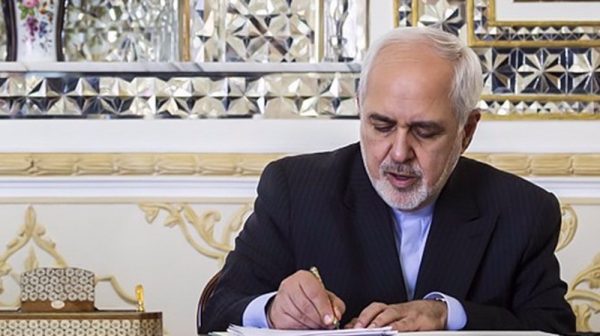
Iranian Foreign Minister Mohammad Javad Zarif
Press TV – June 9, 2021
Iran’s Foreign Minister Mohammad Javad Zarif wrote a letter to UN Secretary General Antonio Guterres earlier this month, criticizing the United Nations’ decision to deprive Iran of its voting rights.
As the UN Security Council backed Guterres for a second term on Tuesday, it is worthwhile to read highlights of Zarif’s letter to the UN chief, in which the Iranian foreign minister slammed the UN decision as “fundamentally flawed, entirely unacceptable and completely unjustified.”
“Iran’s inability to fulfill its financial obligation toward the United Nations is directly caused by ‘unlawful unilateral sanctions’ imposed by the United States to punish those who comply with a Security Council resolution,” Zarif wrote.
He was making a reference to the sanctions that the US slapped on Iran after former president Donald Trump withdrew from the 2015 Iran nuclear deal and violated UN Security Council Resolution 2231 that endorsed the historic pact.
The sanctions have blocked Iran’s access to global financial systems, and its money in foreign banks, including in South Korean, Japanese and Iraqi banks.
Zarif said the world is well aware that the people of Iran have been under unprecedented economic warfare and terrorism since the US withdrawal from the nuclear deal, also called the JCPOA, in material breach of preemptory norms of international law, the Charter of the United Nations and Resolution 2231.
“It is astonishingly absurd that Iranian people, who have been forcibly blocked from transferring their own money and resources to buy food and medicine – let alone pay UN contributions arrears – by a permanent member of the United Nations’ Security Council, are now being punished for not being allowed to pay budget arrears by the secretariat of the same organization, which has unjustifiably chosen for the past 3 years to remain indifferent in the face of attempted mass starvation – a crime against humanity – by the United States,” he noted.
The letter came after the UN said it had suspended the voting rights of Iran and four other countries over dues under Article 19 of the UN Charter, which states that any member owing the previous two years of assessments may not vote in the General Assembly.
However, Zarif pointed out that the UN Charter gives the General Assembly the authority to decide “that the failure to pay is due to conditions beyond the control of the member,” and in that case a country can continue to vote.
“By what definition are Iran’s arrears not ‘due to conditions beyond control’?” the chief Iranian diplomat asked.
“The Islamic Republic of Iran is fully committed to fulfilling its financial obligations to the United Nations and will continue to make every effort to settle the arrears in the payment of its financial contribution to the UN and other international organizations as soon as the underlying imposed conditions, i.e. the US unlawful unilateral coercive measures, is removed,” Zarif added.
The UN decision came while Iran and the other parties to the JCPOA are engaged in multilateral talks to bring the US back into compliance with the deal and remove the anti-Iran sanctions in exchange for the reversal of Iran’s nuclear activities that go beyond the JCPOA limits.
The talks, which began in early April, have not led to a tangible outcome yet.
Zarif said on Monday that it remains unclear whether US President Joe Biden and State Secretary Antony Blinken are ready to bury the failed “maximum pressure” policy of Trump and his State Secretary Mike Pompeo.
“Iran is in compliance with the #JCPOA. Just read paragraph 36,” Zarif wrote in a tweet. “Time to change course.”
Iran to leave Vienna by end of month if Biden doesn’t lift all sanctions
By Elijah J Magnier | Press TV | May 4, 2021
Iranian and Western delegations returned to their capitals after the third Vienna round, with optimism emanating from the statements of the gathered officials. Iran’s Deputy Foreign Minister Abbas Araqchi issued positive information about the US lifting sanctions on energy, economic sectors, shipping, freedom of transportation, banks, and on many Iranian personalities. The negotiations have reached a stage where the elaboration of complex texts is on the table. Also, there were talks about the US releasing more than 90 billion dollars withheld from Iranian funds and another 20 billion frozen in Iraq, South Korea and China from oil revenues. No details have been discussed so far about the interest on these funds held for many years due to US sanctions.
There was also talk of the possibility of exchanging Iranian prisoners held in America, who number 18, including 7 in critical health condition, and others of Iranian–Western double nationality holders (American and British) detained in Iran on charges of espionage. This is an old Iranian demand that Iran insists on ending everything in one single exchange.
However, after lifting sanctions against individuals and accepting all demands, the biggest problem lies in Iran’s request to ensure that the lifting of sanctions will be applied in a specific time frame. According to a particular pre-agreed timetable, Iran wants to ensure that all frozen funds will return to the Central Bank. Countries around the world will be allowed to deal with Iran in all sectors without intimidation.
Iran has never requested the return of diplomatic relations with the US, but rather the lifting of the sanctions that were imposed on it since 2015 and that President Barack Obama agreed to cancel. Moreover, Iran wants to lift all additional sanctions added by Donald Trump when the nuclear deal was torn apart in 2018.
Negotiations have reached a reasonable level, although Iran still refuses to communicate with the US directly because the US is no longer a partner in the JCPOA and that talks could blow up any time. The US flag was removed from the negotiating room at the request of Iran. The Iranian delegation stressed the need for the US delegates not to be present at the same hotel where the negotiations are taking place until the White House announces the end of all sanctions. This is when the US will become a JCPOA partner again.
An Iranian decision-maker in Iran said that “the Leader of the [Islamic] Revolution, [Ayatollah] Seyyed Ali Khamenei, will not give an unlimited time-space to negotiate in Vienna. This is the last month before the announcement of the clinical death of the JCPOA agreement if all Iranian conditions are not met.” The source asserts that “Iran will not accept the American evasiveness that called for easing the sanctions by lifting those related to the nuclear file and placing other sanctions related to Iran’s missile capability, the Revolutionary Guards (Islamic Revolution Guards Corps) and other sectors until a future negotiation to be established later. Either all sanctions are lifted, or no deal is reached because mid-solutions are not accepted.”
Many indications lead to the US intention to conclude the deal with Iran and honor its previous commitment signed in 2015. Israel is prepared for this move following Mossad director Yossi Cohen, National security advisor Meir Ben-Shabbat and other military and security high-ranking officers meeting with US officials. The Israelis failed to persuade the US to abandon the agreement with Iran.
The Biden administration considers the nuclear deal necessary to protect Israel by preventing Iran from reaching enrichment uranium to 90-percent purity level, which makes possessing an atomic bomb easy. Israel wishes to keep the harsh sanctions on Iran and strike its nuclear reactor.
Iran possesses the ballistic and precision missiles that enable it to strike back with a decisive blow to the US bases deployed in the Middle East in case of war. Furthermore, Iran can count on the strength of its allies deployed in Gaza, Lebanon, Syria, Iraq and Yemen, who can join the battlefield if needed. Therefore, waging war on Iran is not feasibly possible. That leaves the US with slim options: the best could be to honor its deal, lift the sanctions and make sure that Iran does not obtain military nuclear grade capability. This is Biden’s logic and approach to assure the security of Israel and the interests of the US. Iran has shown that it imposes its conditions on the US and treats it as an equal from strength because it has strong cards to play.
However, Israel cannot go to war with Iran alone and wants to drag in the US. Iran has shown that its strategic patience has been replaced by strategic deterrence. Multiple strikes manifested that, and missile messages exchanged in the Strait of Hormuz and the Red Sea. There were powerful indications that Iran will not be silent on any Israeli transgression. Furthermore, when Israeli Prime Minister Benjamin Netanyahu presented himself as an alternative power to the US in the Middle East and became a superpower, a missile landed close to the Dimona nuclear reactor. Therefore, there is no doubt that Israel can harass Iran in Syria by cyber warfare and assassinations. It is also accurate to say that Iran has the power to direct similar annoyance to Israel.
It is a crucial month to indicate in which direction the ship of negotiations between Iran and America will sail. It is in the interest of both parties to reach an agreement, but all indications indicate that Iran will not budge from its place and will hold its ground firmly before accepting the US back as a partner in the nuclear agreement. The ball is in Biden’s court now, and time is not on his side.
Elijah J Magnier is a veteran war correspondent and a Senior Political Risk Analyst with decades of experience covering the West Asian region.
Featured Video

Racist Seinfeld Dances for Joy as Bibi Unveils His New Map
or go to
Aletho News Archives – Video-Images
TV Drama Review
Japanese drama projects Japan’s wartime atrocities onto Chinese characters

Global Times | October 25, 2026
By portraying Chinese characters as perpetrators of ruthless violence while casting Japanese Self-Defense Forces (SDF) intelligence operatives as defenders, the season 2 of the Japanese drama Vivant has recently drawn criticism from Chinese netizens, who argue that its depiction turns historical reality on its head while ignoring Japan’s wartime atrocities.
The TBS drama series – a spy suspense story in which an alleged unofficial intelligence unit of the SDF operates across the globe — has attracted a passionate fanbase. Its currently airing season 2 opened with a household rating of 18.8 percent, the highest for a TV drama this year, according toa commentary article by Japanese media Toyo Keizai.
What draws attention is the portrayal of the enemies in the series, the article noted. Scenes in which the Chinese organization subjects kidnapped members of the SDF unit to brutal torture are repeated with unrelenting intensity.
It is rare for Japanese TV dramas to explicitly portray a real-life country as the enemy, the article noted.
Japanese Prime Minister Sanae Takaichi also made a reference to the drama, saying that she has been recording Vivant and hopes to binge-watch it over the year-end and New Year holidays, according to Japanese media outlets.
China’s CCTV News report on Sunday revealed that the drama features scenes in which Chinese personnel cut off the fingers of and stab Japanese intelligence operatives in the abdomen. Such acts bear striking similarities to the torture inflicted on Chinese nationals by invading Japanese troops during the World War II.
The drama distorts the truth by attributing these atrocities to modern Chinese characters. Beneath the surface, it subtly glorifies Japan’s cross-border overseas operations, blurs the functional boundaries of the SDF and implicitly promotes an expansionist narrative, per CCTV News. … continue
Blog Roll
 Aletho News
- Iran FM Araghchi: “Hormuz Will No Longer Be the Same”
- EU facing trillion-euro debt hole while seeking more cash for Kiev
- How US, Europe, Persian Gulf states exhausted missile stockpiles, splurged billions to defend Israel
- Up in arms… Koreans reject U.S. empire’s plan to make South Korea the next Ukraine
- Iran, Turkey, Pakistan, Saudi Arabia could advance region-led security framework in Tehran: FM spox
- Netizens condemn Japanese drama for projecting Japan’s wartime atrocities onto Chinese characters
- Racist Seinfeld Dances for Joy as Bibi Unveils His New Map
- A West Bank War for Netanyahu’s Election Campaign, Could It Backfire?
- Yemen denounces European Parliament’s ‘hypocritical’ push to blacklist Ansarullah
- Qalibaf: UAE’s UN bid aims to ‘clear the runway’ for ‘Greater Israel’, whitewash genocide
- If Americans Knew
- An error has occurred; the feed is probably down. Try again later.
- No Tricks Zone
- Sudden Stratospheric Warming, Powerful El Niño Combination May Lead To Extreme Europe Cold, Energy Crisis!
- Two New Studies Find Thwaites Glacier Melt Cannot Be Driven By Human Activity Or A Warming Ocean
- E-Cars Reduce CO2 Emissions By Only 41% Compared To Internal Combustion Engine Vehicles
- Predictions Made By Renowned Climate Professor Over Past Decades Have Been Proven To Be Poor
- New Study Suggests Large Regions Of The Pacific Ocean Have Been Cooling For The Last 80 Years
- Germany’s Green Energy Debacle: High Energy Costs Force Kahla Porzellan to Close After 182 Years!
- New Study: 50 Years Of The Most Aggressive ‘Net Zero’ Policies Can Only Affect The Global Climate By 0.03°C
- US September “Heat” Was No Record…Many Records Set Decades Ago
- Latest European Green Energy Debacle; Portugal’s Largest Flagship Solar Park Insolvent!
- Green Energy Debacle: German Expert Professor Fritz Vahrenholt Warns Of Severe Economic And Social Consequences

