US may lift ban on Iranian oil – Vitol
Samizdat | June 6, 2022
The Biden administration might let more sanctioned Iranian oil flow into the global markets in an attempt to rein in fuel prices at home amid the run-up to the midterm elections in the US, according to a major independent crude trader.
“If the midterms are dominated by the need to get gas prices lower in America, turning a somewhat greater blind eye to the sanctioned barrels flowing out is probably something you might expect to see,” Mike Muller, the head of Asia at Vitol Group, told Dubai-based Gulf Intelligence on Sunday.
Gasoline prices have doubled in the US since President Joe Biden was inaugurated in January last year, according to last week’s data from the non-profit American Automobile Association (AAA). Global crude prices have been rallying in recent months, fueled by restrictions on Russian exports. On Monday, crude hit $120 a barrel as Saudi Arabia hiked prices for Asia.
The Trump administration reimposed sanctions on Iran’s oil, petrochemicals, shipping and other sectors in 2018 due to concerns over the country’s nuclear program. Talks between Tehran and world powers stalled in March and, according to Muller, the window of opportunity for the Biden administration to reach an agreement with Tehran has almost closed, but it could allow the transportation of Iranian crude anyway. In April, the US seized Iranian oil carried by a Russian tanker. Iran currently exports most of its oil to China.
Iranian nuclear chief: IAEA’s Grossi lacks serious will to find Tehran’s ‘accurate’ answers convincing
Press TV | June 6, 2022
The head of the Atomic Energy Organization of Iran (AEOI) says Tehran has given accurate answers to questions posed by the International Atomic Energy Agency (IAEA), but the Agency bases its reports on the information provided to it by the enemies of Iran.
In an interview with Al Jazeera network on Monday, Mohammad Eslami said the director general of the IAEA, Rafael Grossi, lacks serious will to describe Iran’s answers to the Agency’s queries as convincing.
“The International Atomic Energy Agency relies on the intelligence reports [provided by] our enemies, topped by Israel,” Iran’s nuclear chief said.
Eslami made the remarks after the IAEA chief, in his introductory statement to the Board of Governors’ meeting on Monday, once again repeated his anti-Iran rhetoric, alleging that since February 23, 2021, the Agency’s “activities have been seriously affected by Iran’s decision to stop the implementation of its nuclear-related commitments under the JCPOA, including the Additional Protocol.”
Grossi claimed, “Iran has not provided explanations that are technically credible in relation to the Agency’s findings at three undeclared locations in Iran.” Grossi’s allegation, however, came after his meeting with Eslami and the adoption of the two sides’ joint statement on March 5, 2022.
The AEOI and the IAEA agreed, in continuation of their cooperation as stated in the Joint Statement of August 26, 2020, to accelerate and strengthen their cooperation and dialogue aimed at the resolution of the issues, read part of the joint statement.
Grossi’s remarks came despite frequent warnings by Iran that in case the Agency drifts away from its technical nature and makes a politicized decision related to Iran’s peaceful nuclear program, the country will respond in kind.
Elsewhere in his interview, Eslami pointed to the possible adoption of an anti-Iran resolution during the ongoing meeting of IAEA’s Board of Governors and said even if adopted, such a resolution would not create a new situation.
Advising the UN nuclear watchdog to block political influence on its decisions and abide by its own regulations, the AEOI’s head said, “The IAEA has not condemned attacks on our [nuclear] facilities and this is a big question mark.”
Over the past years and amid lack of sensitivity and proper attention on the part of the IAEA towards performing a responsible role in the area of protection of various countries’ peaceful nuclear activities, some malign activities, for which the Zionist regime has implicitly accepted responsibility, have afflicted some damage to our country’s nuclear facilities.
Although these activities have never had a decisive effect on the progress of Iran’s peaceful nuclear program, given the sensitivity that is inherent to the nature of nuclear work, adoption of new strategies in the structural, hardware, and software aspects have found a place on the AEOI authorities’ agenda so the nuclear facilities’ security can be completely ensured.
Eslami also rejected allegations that Iran is planning to build nuclear weapons, saying, “Nuclear weapons have no place in our strategies” and that all such allegations are nothing but spiteful accusations.
Asked about the IAEA’s access to information recorded by monitoring cameras it has installed in Iran’s nuclear facilities, Eslami said this issue depends on the fate of the ongoing talks in the Austrian capital on the revival of the 2015 Iran deal, officially known as the Joint Comprehensive Plan of Action (JCPOA).
“If other parties commit to all articles of that agreement, we are ready for full compliance with the accord,” Iran’s nuclear chief said.
Under the JCPOA, Iran accepted certain caps on its nuclear program in exchange for the removal of international sanctions.
The US, however, unilaterally abandoned the deal in 2018 and re-imposed crippling sanctions despite Tehran’s full compliance with its share of obligations.
Israel-IAEA collusion: Grossi lands in Tel Aviv ahead of UN nuclear agency meet
Press TV – June 3, 2022
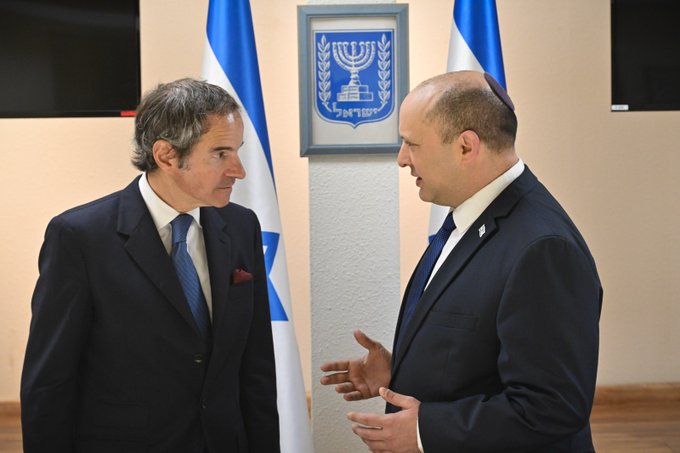
The chief of the UN nuclear agency has traveled to Israel and met the regime’s extremist premier Naftali Bennett, ahead of the body’s Board of Governors meeting on Monday.
The high-profile visit by Rafael Grossi also comes in the wake of the latest report by the International Atomic Energy Agency (IAEA) on Iran’s nuclear program amid a stalemate in Vienna talks to salvage the 2015 nuclear deal, called the Joint Comprehensive Plan of Action (JCPOA).
Iran has on many previous occasions cautioned the UN nuclear agency against allowing the Israeli regime to influence its independent mandate and decision-making.
On Thursday, during a phone call with his Singaporean counterpart Vivian Balakrishnan, Iran’s Foreign Minister Hossein Amir-Abdollahian described any political interference in the technical affairs of the IAEA as “unconstructive”.
He said during Grossi’s recent visit to Iran, the two sides had reached a mutually satisfactory agreement through a positive process.
However, the IAEA’s latest report last week drew Iran’s criticism, rejecting it as “unfair and unbalanced” that had deviated from the technical path under Israel’s pressure.
Earlier this week, Bennett accused Iran of stealing classified documents from the IAEA and using them to deceive international inspectors nearly two decades ago. Iran rejected the allegations as outright lies.
Iran’s Foreign Ministry spokesman Saeed Khatibzadeh on Wednesday called the Israeli regime “the world’s #1 JCPOA hater” which he said also “happens to be NPT-denier and the only nuke-possessor” of the region.
“We know this. The world knows this. Time for E3/US to stop pretending to be asleep. They can pursue diplomacy—or pursue the opposite. We’re ready for both,” the spokesman said.
Israel is the Middle East’s sole, though undeclared, nuclear-armed entity, but it has never allowed the IAEA to inspect its nuclear sites. It has also refused to sign the Non-Proliferation Treaty (NPT).
On the other hand, Iran’s nuclear energy program has been subject to the most intensive inspections. The Islamic Republic is a signatory of the NPT, but it continues to reel under harsh sanctions for working to benefit from the peaceful use of nuclear energy, like other countries.
On Friday, Bennett told Grossi that Israel would prefer a diplomatic resolution but could take unilateral action against Iran’s nuclear energy program.
Bennett “stressed (to Grossi) the importance of the IAEA Board of Governors delivering a clear and unequivocal message to Iran in its upcoming decision”, a
statement from the Israeli premier’s office said.
Warning to IAEA
The IAEA board of governors is slated to hold a meeting on Monday for which Britain, France, Germany, and the US have reportedly prepared a draft resolution to mount pressure on Iran.
The United States on Thursday confirmed that it will join Europeans in backing the resolution against Iran.
Iran has pledged a “firm and appropriate” response to any “unconstructive” move. “We will respond firmly and appropriately to any unconstructive action at the board of governors,” Khatibzadeh said on Wednesday.
China also warned that any confrontational moves at the upcoming meeting will only undermine cooperation between Iran and the IAEA, and disrupt the process to revive the 2015 nuclear deal.
Chinese Foreign Ministry spokesman Zhao Lijian said exerting pressure on Iran and the UN nuclear agency will escalate tensions and complicate the situation.
He called on Washington to make a political decision as soon as possible on the revival of the nuclear agreement and actively respond to what Iran’s legitimate concerns.
Iran has repeatedly stated that it is waiting for a response from the US on its proposals to revive the deal, but Washington has been dragging its feet on it.
Greek Opposition Demands Legal Clarification for Confiscation of Iranian Oil at US Behest
Samizdat | May 31, 2022
ATHENS – Greek largest opposition party, Coalition of the Radical Left – Progressive Alliance (SYRIZA), on Tuesday asked the Greek government to clarify the legal grounds for the confiscation of Iranian oil from a former Russian-flagged tanker at the request of the United States.
“What was the legal basis for the US request for legal assistance in confiscating oil from the tanker? Was the proposal of the [Greek] anti-money laundering authority to continue the detention of the Russian ship contrary [to the US request]? On what legal basis did the ship remain detained during the time between the cancellation of the original decision about its arrest by the anti-money laundering authority and the decision of the one-judge trial court of Chalcis to grant the US request?” the party said in a statement.
The party added that initially, the anti-money laundering authority decided not to confiscate Iranian oil or detain the tanker. US sanctions against Iran are not considered legal by the EU and Greece, the party noted.
The party also asked what actions had been taken for the immediate release of the crew, and why Greece did not receive significant support from the US, which initiated the process of confiscation.
Last Friday, Iran’s armed forces captured two Greek-flagged oil tankers — the Delta Poseidon and the Prudent Warrior — in Persian Gulf waters, reportedly in response to the seizure of the Iranian-flagged tanker Lana in Greek waters in mid-April on suspicion that it was avoiding EU sanctions. The US claimed that the vessel was carrying Iranian crude, subject to US sanctions, and requested that the cargo be handed over to it, despite later reports that it was a Russian-flagged tanker Pegas that had changed its ownership before entering Greek waters.
Iran says US foreign policy ‘taken hostage’ by Israel
MEMO | May 26, 2022
Iranian Foreign Minister, Hossein Amir-Abdollahian said, Thursday, Tehran is committed to reaching a deal during the Vienna nuclear talks, adding that US interests and foreign policy have been “taken hostage” by Israel, Anadolu News Agency reports.
Speaking at the World Economic Forum in Davos, Switzerland, he accused the Biden administration of being “indecisive” in talks to salvage the landmark 2015 nuclear deal following the previous administration’s maximum pressure policy against Iran.
The annual event brings together over 2,000 representatives of governments, business organisations, civil society and media leaders to discuss global challenges.
In a session moderated by CNN’s Fareed Zakaria, Iran’s top diplomat said Tehran has put forward a number of initiatives to Washington to salvage the nuclear deal, but the Biden administration has been dragging its feet over them.
The marathon talks in Vienna to revive the 2015 nuclear deal, also known as Joint Comprehensive Plan of Action (JCPOA), are currently stalled due to key disagreements between Tehran and Washington.
Amir-Abdollahian said the pause in the talks has been due to “lack of economic guarantees” from the US, and due to the fact that the new administration has followed the Donald Trump administration’s policy against Iran.
He said Iran must enjoy “full economic benefits” of the deal, and the agreement must facilitate the country’s economic and trade activity with the world.
The top diplomat, referring to one of the key sticking points in the talks — de-listing of the Islamic Revolutionary Guard Corps (IRGC) from foreign terrorist organisations (FTO) — said the issue has been magnified by Israel.
He said the “main factor” is the full economic benefits of the deal for Iran and its people, while adding that the Biden administration must “show goodwill” in de-listing IRGC.
Amir-Abdollahian added that Iran has endured sanctions for 40 years and has “other different options” on the table if the talks in Vienna do not lead to a “good and lasting agreement”.
He also spoke about tension-easing talks with regional arch-foe, Saudi Arabia, saying the two sides have made small but significant progress and have agreed to hold talks at the level of foreign ministers in the near future.
The talks between Tehran and Riyadh have been under way since April last year, brokered by the Iraqi government. Despite pauses and tensions, both sides have noted progress.
Amir-Abdollahian said Iran has “always kept its door open” for Saudi Arabia and is ready for normalisation of ties with the Gulf neighbour, adding that it will contribute to stability in the region.
His remarks came a day after Saudi Foreign Minister, Faisal bin Farhan, told the Davos forum that progress had been made in talks with Iran, adding that “hands remain stretched” to Tehran.
Commenting on Russia’s war in Ukraine, Amir-Abdollahian said Iran condemns the war, as well as conflicts in Iraq and Afghanistan, without mentioning or condemning close ally, Moscow. He said Tehran is willing to mediate between the two warring countries.
On Yemen, the top Iranian diplomat said all Yemeni parties “should play a role” in determining the future of their country. He also denounced what he called “US support for terrorists” in the war-ravaged Arab country.
Iran and China agree to counter ‘unilateralism’
Samizdat | April 27, 2022
Iran sees its relations with China as part of an effort by like-minded powers to confront US unilateralism and create stability and order, Iranian President Ebrahim Raisi told the visiting Chinese Defense Minister Wei Fenghe on Wednesday.
Raisi said that the successful implementation of the 25-year strategic cooperation agreement between China and Iran, signed in 2021, was a priority for Tehran, according to the state media.
“Confronting unilateralism and creating stability and order is possible through the cooperation of independent and like-minded powers,” Raisi was quoted as saying by the IRNA news agency. He added that the current “regional and global developments show more than ever the value of Iran-China strategic cooperation.”
Wei said his visit was aimed at “improving the strategic defense cooperation” between Tehran and Beijing, which would have a “remarkable” impact on fighting terrorism and defusing unilateralism, “particularly in the current critical and tense situation.”
Wei also met with Iranian Defense Minister General Mohammad Reza Ashtiani and reportedly invited him to visit China. In their meeting, Ashtiani stressed “the need to counter American hegemony in the world by strengthening multilateralism,” according to a statement by the Iranian Defense Ministry.
Ashtiani also criticized the US military presence in the Middle East and elsewhere, saying that “wherever the US has had military presence, it has created waves of insecurity, instability, rifts, pessimism, war, destruction and displacement,” according to IRNA.
Major General Mohammad Bagheri, the chief of staff of Iran’s armed forces, also met with the Chinese visitor, and offered some details on the shape of their cooperation going forward.
“We agreed to expand bilateral cooperation in joint military drills, exchange of strategies, training issues and other common fields between the two countries’ armed forces so that we can provide better security for the two countries,” Bagheri told reporters in Tehran on Wednesday.
The 2021 strategic cooperation treaty has paved the way to military cooperation between Iran and China, but also a variety of economic activities ranging from oil trade to transportation and agriculture.
Iran has been under unilateral US sanctions since 2018, when the Trump administration reneged on the 2015 nuclear deal. China is one of the signatories of the original pact, along with the UK, France, Germany, and Russia. The current US government has said it wants to restore the agreement, but the talks have gone nowhere due to Washington’s refusal to lift the sanctions against Tehran.
US Diplomacy Continues to be Invisible
BY PHILIP GIRALDI • UNZ REVIEW • APRIL 26, 2022
Remember the Beatles’ song that went like this: “I read the news today, oh boy!”? To be sure there has not been much good news to savor recently, though notably, under the cover provided by the war in Ukraine’s domination of the news cycle, the Israel Lobby in the United States has been working harder than ever to promote the interests of the country that is most dear to its heart. It’s associated media arm has been ignoring the regular killing of Palestinians by Israeli security forces while also dismissing the ultra-violent incursion by the Jewish state’s police at one of Islam’s holiest sites, the al-Aqsa Mosque complex, during Ramadan prayers.
Recently, the Zionist focus has been most intense on one area: to kill the stalled negotiations over the renewal of US participation in the currently ineffective multiparty Joint Comprehensive Plan of Action (JCPOA) agreement with Iran to monitor its nuclear program and prevent its development of a weapon. Ironically, Israel, unlike Iran, already has an undeclared nuclear weapons arsenal that is even protected from exposure by US officials, who are not allowed to mention it in spite of the fact that its existence is widely acknowledged. Recently, Sam Husseini, a critic of the US pandering to Israeli interests, tweeted how “I recently contacted the offices of @IlhanMN, @AOC, @CoriBush, @RashidaTlaib, @SenSanders and 10 others asking if they would acknowledge that Israel has nuclear weapons. None would do so.” Not one of the fifteen, mostly describable as progressives, would even confirm that the Israelis possess such weapons, so terrified were they of even mentioning what the entire world knows to be true.
To be sure, the issue of what to do about Iran is certainly the number one foreign policy problem for Israel as it is the only regional opponent of the Jewish state that could reasonably be described as militarily formidable. For something like thirty years successive Israeli governments have been seeking to convince a number of gullible American presidents to treat the Islamic Republic as a serious international threat, which is ridiculous as Iran has neither the necessary resources nor a history of seeking to dominate even its own region. This Israeli persuasion has included manipulation of a bought and paid for Congress and media which support a steady flow of propaganda seeking to depict Iran in the most negative terms, intended to appeal to the American desire to frame its foreign policy in terms of “good versus evil” with the US/Israel always being good no matter what wartime atrocities they might commit.
One might reasonably observe that the pattern of “good versus evil” is also playing out with regard to Russia in Ukraine. Given such a faux ethically based worldview, the US rarely acts in terms of genuine national interests, witness the relationship with Jerusalem more generally speaking. Israel’s security service Mossad has as its motto “By Way of Deception Thou Shalt Do War.” With that in mind it has been hard at work fabricating “intelligence” that the Iranian leadership has initiated a secret nuclear proliferation program. A laptop that surfaced in 2004 through the dissident Iranian group MEK allegedly contained information regarding covert plans for an Iranian nuclear bomb. It was, however, revealed to be a clever Mossad forgery.
Israel has never quite convinced the White House to take the final step and make war directly against the Iranians, though it came close when a gullible Donald Trump ordered the assassination of senior Iranian general Qasem Soleimani, who was in Baghdad for peace talks in January 2020. But Israel has nevertheless managed to obtain what is apparently considerable covert CIA collaboration in its own semi-secret program to kill scientists and technicians that might be involved in nuclear research, while also hacking into and sabotaging Iranian computer systems and other infrastructure. Under Trump, CIA Director Mike Pompeo focused particularly on Iran, setting up a “special action group” to counter its presence and claimed “malign activities” in the Middle East. That task force presumably still exists under the current Director William Burns appointed by Joe Biden.
The Joe Biden Administration has long been dancing around re-joining the JCPOA, which was entered into under President Barack Obama in 2015. President Donald Trump withdrew from the agreement in 2018, convinced by his neocon and hardline advisers that it would only provide Iran cover to ramp up its secret program and produce a nuclear weapon. Trump’s associates argued that JCPOA would actually make eventual Iranian acquisition of a nuke inevitable.
As of right now, the discussions on JCPOA in Vienna are at a standstill and appear about to break down completely, though some reports alternatively claim that a new agreement is within reach. The Iranians believe that the US is not negotiating in good faith and is failing to take even relatively minor steps that could lead to a reasonable understanding without compromising the vital interests of any of the parties involved. Those steps could include removing the Iranian Revolutionary Guard Force from the US terrorist list and releasing some frozen Iranian assets, while also cutting back on sanctions. It appears that Biden would actually like to renew the agreement, but his own associates at the State Department, whose top three officials are Zionists, as well as the powerful Israel Lobby are pushing against such a course of action.
In reality the JCPOA is in the interest of the United States, pledged as it is to stop nuclear proliferation, since it permits unannounced inspection of virtually all Iranian research facilities by UN officials. It would make attempted proliferation by Iran extremely difficult, even if an elaborate deception operation were attempted. Nevertheless, a number of the usual journalists and self-proclaimed “experts” continue to push the Trumpean neocon derived argument that the agreement would actually accelerate an Iranian nuclear weapons program. Think tanks like the Foundation of Defense of Democracies (FDD) and the American Israel Public Affairs Committee (AIPAC) have been lobbying Congress and the White House assiduously, as have some conventionally conservative groups like the Heritage Foundation, which argues that reviving JCPOA would be a “dangerous mistake.” In a recent paper it maintains that “Reviving the deeply flawed Iran nuclear deal would reward and empower a hostile dictatorship by lifting sanctions and squandering US bargaining leverage. Iran never fully complied with the JCPOA and is currently in violation of it on several accounts. A much more restrictive agreement is necessary. A new agreement should include Iran’s ballistic missile program, disclosure of its past nuclear weapons efforts, and better protection for Israel and Arab allies.”
The Heritage paper is, of course, more speculative than fact-based and false in several respects, particularly the claim that Iran never fully complied with the agreement. Iran opened up to UN inspectors and it was the United States that continued with sanctions contrary to the intent of the original deal. If Iran were to abandon its missile program and provide “better protection” for Israel and select Arab states it would be basically surrendering its sovereignty in the area of national defense.
Another recent effort to attack JCPOA comes from an article written by two Israelis featured in The Atlantic magazine entitled “A Case Against the Iran Deal: Reviving the JCPOA will ensure either the emergence of a nuclear Iran or a desperate war to stop it.” One of the two authors is Michael Oren, until recently the Israeli Ambassador to the United States. The article’s title is self-explanatory and the argument it makes, largely based on what passes for Israeli “intelligence,” is that Iran has a secret weapons program and already has enough of enriched uranium to begin construction of a weapon within a few months. If its clandestine activities are in a sense shielded by a revived JCPOA, they will no doubt do just that, according to the authors.
Against the Israeli argument which, by implication, calls for war to disarm the Iranians, a sustainable inspection routine run by the UN would seem to be a preferable option but a number of Democratic Party Congressmen apparently do not agree and are pressuring President Biden to rethink his acceptance of the desirability of something like a rapprochement with Iran. Eighteen Democratic Congressmen, led by Josh Gottheimer and Elaine Luria, both of whom are Jewish, are pushing back against the Biden efforts, arguing that the agreement is flawed. Gottheimer added that “We need a longer and stronger deal, not one that is shorter and weaker. It’s time to stand strong against terrorists, protect American values and our allies.” Note the emphasis on protecting “our allies,” though one need not point out that there is only one ally in the region that matters to Washington politicians, particularly to folks like Gottheimer.
Republicans are also on board. They are expressing particular concerned because Russia is a signatory to the agreement and would be a guarantor of it, or at least that is what they are arguing to block any Biden effort to reengage. Pennsylvania Representative Brian Fitzpatrick, who is on the House Foreign Affairs Committee, remarked that he was very concerned about a new deal because “Russia should not be at any table with us right now. They’re committing egregious acts of terrorism and murder in a free democracy in Ukraine, in Europe right now.” That Fitzpatrick, on the Foreign Affairs Committee, should be so ignorant of actual US interests as well as regarding the nuances of the Russia-Ukraine conflict illustrates better than anything the abysmal level of ignorance that prevails in the federal government, leading to a collapse of what used to be called Diplomacy 101.
Finally, nothing better illustrates the disarray in US foreign and national security policy than a brief exchange that took place more than three weeks ago in Israel, where US Secretary of State Tony Blinken was trying in part to sell the possibility that the Biden Administration might actually re-enter the JCPOA. Israel of, course, strongly opposes that option, particularly if it involves any concessions to Iran, while Blinken’s State Department persists in repeating the Israeli line that Iran is the “world’s leading state sponsor of terrorism” while also asserting that “this administration’s commitment to Israel’s security is sacrosanct.” So, what did an obviously between a rock and a hard place Blinken do? He asked Israeli Prime Minister Naftali Bennett for suggestions of what might be arranged in lieu of an actual agreement. Naftali reportedly suggested harsher sanctions on Iran. When the US senior-most representative involved in crafting foreign policy feels compelled to ask the agenda-driven head of a rogue foreign government to tell him what to do, there is something very wrong in Washington.
Philip M. Giraldi, Ph.D., is Executive Director of the Council for the National Interest, a 501(c)3 tax deductible educational foundation (Federal ID Number #52-1739023) that seeks a more interests-based U.S. foreign policy in the Middle East. Website is councilforthenationalinterest.org, address is P.O. Box 2157, Purcellville VA 20134 and its email is inform@cnionline.org.
US resets the containment of Iran
BY M. K. BHADRAKUMAR | INDIAN PUNCHLINE | MARCH 28, 2022
The summit of Arab diplomats on March 27-28 hosted by Israeli Foreign Minister Yair Lapid in the southern Negev Desert is doubtless a landmark event. The UAE’s Abdullah bin Zayed Al Nahyan, Bahrain’s Abdullatif bin Rashid Al-Zayani, Morocco’s Nasser Bourita, and Egypt’s Sameh Shoukry are the Arab participants, while the visiting US Secretary of State Antony Blinken becomes the sole “extra-regional” participant.
The expectation that more West Asian countries would join the Abraham Accords failed to materialise, but the security and military ties between Israel, UAE, Bahrain — and Saudi Arabia behind the curtain — have deepened. Egypt also joins the nascent partnership.
There is much symbolism surrounding the venue of the Arab-Israeli summit: Israel’s first prime minister, David Ben-Gurion, lived at Sde Boker and he is buried there, overlooking the Zin wilderness. Lapid hopes to take his guests to visit the gravesite.
To be sure, wherever Blinken goes, the agenda would include Ukraine conflict and he is sure to make a pitch for isolating Russia and urge his Arab interlocutors to join Western efforts in support of Ukraine, but it has had limited success even with his Israeli hosts, much less so with the US’ Arab allies.
For a variety of reasons, Israel is wary of antagonising Russia (although under US pressure it set up a field hospital inside Ukrainian territory to treat those injured by Russian forces and has also sent several shipments of humanitarian supplies to the war zone.) Israel has refused repeated requests from Kiev for weapons.
Israel also opted out of imposing sanctions against Russian oligarchs. This rankles the Biden administration. The acerbic tongue of US Under Secretary of State for Political Affairs Victoria Nuland lashed out during a Channel 12 interview, “You (Israel) don’t want to become the last haven for dirty money that’s fuelling Putin’s wars.”
Israel ignored her barb. Israel sought a mediatory role in the conflict initially but lately stepped back, and, at any rate , Russia does not really need mediators to bring this conflict to an end once its special operation is successfully concluded. On the whole, Israel tries to walk a tightrope to maintain good relations with both Ukraine and Russia.
As for Gulf states, they do not even pretend to take a neutral stance. None of them has rallied to the western call to impose sanctions against Russia. The foreign ministers of Qatar and the UAE visited Moscow recently to discuss expansion of bilateral relations.
The crux of the matter is that the major oil producing countries of the Gulf would have congruence of interests with Russia to preserve OPEC+ not only to maintain their present income level, but also are in anticipation of the lifting of US sanctions against Iran leading to full flow of Iranian crude back into the global oil markets.
The point is, Iran remains a great oil power, with an estimated 157 billion barrels of proven crude oil reserves, nearly 10 percent of the world’s total and 13 percent of those held by the OPEC. Its habitation within the OPEC+ is an absolute must for all oil producing countries. Now, Russia has a major role to play to leverage both short-term and longer-term bearish effects of Iran’s entry on global oil prices.
Experts estimate that Iran could see an 80 percent recovery of full oil production within six months and a 100 percent recovery within 12 months, and in the immediate terms, once sanctions are lifted, its overnight impact may already manifest as a 5-10 percent fall in the oil prices.
Nonetheless, Ukraine conflict aside, the real significance of the Israel-Arab diplomatic summit in the Negev Desert should be sought somewhere else. Prima facie, it is a diplomatic coup for Israel, as its efforts to integrate into the Arab family are making progress. What lends enchantment to the view is that this bucks the overall trend of the US’ regional influence in West Asia.
Prime Minister Naftali Bennett’s accent on diplomacy to win friends and influence neighbours is proving productive and Israel is no longer depending on the US to cut new paths for it to navigate as a regional state. This is a paradigm shift.
Principally, Israel taps into the angst in the Arab world that Iran is poised to surge as a regional power very shortly and the future trajectory of Iranian policies remain unclear. In fact, this is the leitmotif of the diplomatic event in the Negev Desert.
In immediate terms, Israel and the Arab states believe that the intensifying drone attacks by the Houthis lately is only possible with the help and even participation by Iran’s Islamic Revolutionary Guard Corps, which provides missiles, rockets, drones, intelligence equipment and training. They apprehend that Iran’s resistance politics are signalling a new cutting edge, as the recent missile strike on alleged Israeli assets in Erbil in northern Iraq showed.
Saudi Arabia, Bahrain and the UAE have been depending on US-made anti-missile defences, mainly the Patriot systems, but their performance so far has been less than satisfactory. Thus, a stunning idea has taken shape lately in the nature of building an architecture of “joint air defences” between Israel, the UAE, Bahrain and Saudi Arabia.
After all, Israel has the expertise in developing a multi-layered air defence system devolving upon the famous Iron Dome, David’s Sling systems (which can intercept missiles up to 200km away) and Arrow batteries, which are capable of intercepting and destroying long-range missiles at ranges of up to 2,000km, including ballistic missiles. The three layers of Israeli systems are integrated and assisted by advanced radars and other early warnings equipment.
Interestingly, coincidence or not, the Israeli air defences are also linked to a powerful American radar, stationed in the Negev Desert which is where the Arab diplomats from Egypt, Bahrain and the UAE have gathered for the 2-day event.
Blinken’s mission at the summit is principally to get the regional allies accustomed to the imminent conclusion of the negotiations at Vienna leading to the removal of US sanctions against Iran. The Biden administration is yet to take the plunge on lifting the designation of the IRGC as a “Foreign Terrorist Organisation”. The US’s regional allies, especially Israel, have opposed such a move tooth and nail.
But the US has a sense of urgency about Iran’s increased oil output entering the world market. That said, however, Washington’s containment policy against Iran is not going to be mothballed. Rather, it will continue in a newer form. In fact, the lifting of sanctions without any reciprocal assurances from Tehran as regards its regional policies necessitates that the containment strategy will have to remain as the US’ geopolitical tool for the foreseeable future.
The Arab-Israeli summit with Blinken’s participation underscores that the US-Iran entanglement is being reset. There is no question that the JCPOA is of vital importance to check Iran’s nuclear programme. Israel also tends to go along with that thinking lately. The Abraham Accords is providing the foundation for a new US-backed security architecture in West Asia to counter Iran.
Russian FM: We never betray friends, Iran very close to us
Press TV – March 20, 2022
Russian Foreign Minister Sergei Lavrov says his country, unlike the US, is not seeking “selfish interests” by the restoration of the 2015 Iran nuclear deal.
Lavrov made the remarks on Saturday when he was asked whether the revival of the Joint Comprehensive Plan of Action (JCPOA) was advantageous to Moscow, given that it could lead to the resumption of Iran’s oil supply to the global market.
“We never betray our friends in politics. Venezuela is our friend, and Iran is a state that is very close to us. Secondly, we do not pursue selfish interests, unlike the Americans,” he told reporters.
“You can see what they [the Americans] are actually doing, trying to spite Russia and teach it a lesson. Ah, well, let the regime in Caracas be. Let Iran be, let us reinstate the program as soon as we can just to punish Russians.”
Earlier this month, US President Joe Biden announced a ban on all Russian oil, gas and energy imports over the military operation in Ukraine.
The measure sent the already skyrocketing oil and gasoline prices ever higher, with reports saying that Washington is potentially looking at Iran and Venezuela for oil talks
Biden also tried to contact Persian Gulf Arab countries to seek help amid rising energy prices.
“So, the Americans have been contacting Saudi Arabia, the Emirates and Qatar regarding oil and gas. All of those countries, just like Venezuela and Iran, clearly said: when we discuss issues pertaining to the appearance of new actors in the oil market, all of us are committed to the OPEC+ format, where quotas for every actor are discussed and agreed upon by consensus,” Lavrov said.
“For now, I see no reason to believe that this mechanism may somehow be dismantled. No one is interested in that.”
Ireland says JCPOA revival can ease oil prices
In another development on Saturday, Irish foreign minister Simon Coveney said a revival of the JCPOA could help ease global oil prices by bringing a major producer back into the market.
“Certainly having a big new player in the market, if you like, Iranian crude oil coming back into the market with the removal of sanctions, would be a very attractive prospect in terms of reducing pressure on oil prices, because of sanctions on Russia, which are likely, I think, to remain for quite some time,” he said.
“I think that is an added incentive to try to get a deal done now.”
Earlier this month, the talks in Vienna, aimed at resurrecting the JCPOA, were paused for an undetermined period of time despite reports suggesting that they were in final stages.
Iranian officials have repeatedly said the United States should remove all illegal sanctions against the Islamic Republic in a verifiable manner and guarantee that a new US administration would not breach the JCPOA once again.
Former US president Donald Trump unilaterally left the JCPOA in May 2018 and re-imposed the anti-Iran sanctions that the deal had lifted. He also placed additional sanctions on Iran under other pretexts not related to the nuclear case as part of his “maximum pressure” campaign.
In May 2019, following a year of strategic patience, Iran decided to let go of some of the restrictions on its nuclear energy program, resorting to its legal rights under the JCPOA, which grants a party the right to suspend its contractual commitments in case of non-compliance by the other side.
The Biden administration says it is willing to compensate for Trump’s mistake and rejoin the deal, but it has retained the sanctions as leverage.
US to remove IRGC from terror blacklist
BY M. K. BHADRAKUMAR | INDIAN PUNCHLINE | MARCH 19, 2022
Axios reported earlier this week citing Israeli officials and US sources that the Biden administration is considering the removal of Iran’s Islamic Revolutionary Guard Corps [IRGC] from its terror blacklist, in return for a ‘public commitment from Tehran to de-escalation in the region.’
It is improbable that Tehran will give any such ‘public commitment’. But, a ‘private commitment’? Well, that may be possible. Indeed, the Axios report acknowledged that ‘The IRGC designation is not directly related to the nuclear deal, and any decision would take the form of a separate bilateral understanding between the US and Iran.’
No doubt, the lifting of the US sanctions is incompatible with the ban on the IRGC. The IRGC is deeply incorporated into the country’s economy and business. According to some estimates, up to 60% of Iran’s economy — including both state and private companies — is controlled by individuals and entities linked to the IRGC.
And the IRGC is well represented in the organs of the state. Executing a nuclear deal at Vienna while excluding the IRGC elites from plucking its low-hanging fruits is simply unrealistic. Arguably, even Americans wouldn’t want that to happen.
It is entirely conceivable that they too are eagerly looking forward to doing business with the IRGC top brass. After all, it’s best to do business with those who matter most in Tehran.
On balance, therefore, the Biden administration will concede Iran’s demand to drop the designation of the IRGC as a terrorist organisation. The crux of the matter is that the US is desperate to normalise with Iran since they also see potential to erode Iran’s friendly ties with Russia. The immediate goal of the Biden administration is to release Iran’s oil reserves. The amount of Iranian oil that may enter the market once sanctions are lifted is estimated at over two million barrels a day!
That said, even a US-Iran ‘bilateral understanding’ over the activities of the IRGC is not easy to achieve. The IRGC functions directly under the Supreme Leader’s supervision. Clearly, while from the American side, it is rather a formality requiring an executive order by the state department to legitimise IRGC, from the Iranian part, there is an ‘operational angle’ to it — namely, a commitment to end Iran’s expansion in the so-called Shiite Crescent of Syria, Lebanon and Iraq.
That involves the jettisoning of Quds Force’s ‘resistance’ and settling for peaceful co-existence with Israel. Does that look simple?
But then, when it comes to Iran, nothing is simple, because nothing is iron-cast. Didn’t Iran help in the US invasion of Afghanistan and the creation of a puppet government in Kabul? Resistance politics too was the child of difficult times when the country was besieged. With the lifting of sanctions, Iran is unbound for the first time after the 1979 revolution.
To be sure, there is a growing uneasiness among regional states — and, possibly, even in Moscow — about Iran’s future trajectory. The Raisi government now proclaims a ‘balanced foreign policy’ — ‘neither with the West nor the East.’ The framing of the paradigm in this suggests that Tehran anticipates the world community to queue up on the road to Tehran.
Iran’s few steadfast friends in the region may begin to wonder what lies in the womb of time. Syrian President Assad’s visit to the UAE on Friday hints at realignments. Assad hopes to create more space for himself by rejoining the Arab family. Now, he has never been an acolyte of ‘resistance’ and is well aware that the UAE is Israel’s closest regional ally in West Asia.
The bottom line is that Iran will certainly seek integration with the industrial world, which will help it get the best that money can buy in technology or goods and services. But Iran also harbours ambitions that it will not be a junior partner of the West.
This is going to be a trapeze act. Integration into the world economy will require the freeing of market forces, which, in turn, carries attendant risks, as the pent-up social and economic discontent within the country seeks political expression and the genie gets out of the bottle. Colour revolution can take many forms, as current history shows. When George Soros and company move in, nothing is impossible!
Iran, of course, will be in doubts about the US’ intentions, too. Presently, Washington needs an accommodation with Iran devolving upon its capacity to pump more oil. But the US’ male-fide intentions are yet to be exorcised. And the crimes it has committed to the Iranian nation are no secret, either.
Above all, there is never any consistency in the US policies. Its self-interests come first and last. Iran doesn’t have to look far to see in the next-door Gulf region the debris of the US’ discarded Arab alliances once their purpose was served.
Moscow reveals whether US sanctions would harm Iran deal
RT | March 15, 2022
Russian Foreign Minister Sergey Lavrov said on Tuesday that Moscow has received written assurances from the US that Ukraine-related sanctions won’t hinder its ability to trade with Iran under the terms of a new nuclear agreement. “We received written guarantees. They are included in the text of the agreement itself on the resumption of the Joint Comprehensive Plan of Action on the Iranian nuclear program,” Lavrov told reporters in Moscow.
The ‘Joint Comprehensive Plan of Action’, or JCPOA, is the official title of the 2015 Iran nuclear deal. Signed by Iran and the US, UK, Russia, France, Germany, China and the EU the deal promised Iran sanctions relief in exchange for a halt to its nuclear program. Former US President Donald Trump unilaterally withdrew from the deal in 2018, claiming that Iran was breaching its obligations, and negotiators have been meeting in Vienna, Austria and attempting to hammer out a new deal for nearly a year now.
An unnamed US official told the Wall Street Journal on Sunday that the US was not prepared to ease any Ukraine-related sanctions to save the deal, and would be open to negotiating a “replica of the JCPOA” without Russian involvement if Moscow insisted on exemptions being made.
Commenting on the reports, Lavrov suggested that Washington itself is still not ready to support the deal, and pointed out that, according to his Iranian counterpart, the problem with the agreement is in the US’ “exorbitant demands.”
Appearing beside Lavrov on Tuesday, Iranian Foreign Minister Hossein Amir-Abdollahian said that there is no link between the conflict in Ukraine and the talks in Vienna.
The Iranians have repeatedly insisted that Russia remain a part of any deal.
The Vienna negotiations have been paused since last week, but an Iranian Foreign Ministry spokesman said on Monday that they should resume shortly, when they will enter their “final, crucial steps.” Lavrov told reporters on Tuesday that he believes these talks are on the home stretch, and called on the US to “return to the legal framework of this nuclear deal” and lift “the illegal sanctions the US has imposed to hurt not only Iran and its people, but a number of other countries.”
‘US will scrap Iran deal before agreeing with Russia on sanctions’
RT | March 13, 2022
The US will not negotiate the easing of any Ukraine-related sanctions on Russia to ensure that Moscow can trade with Tehran under a new iteration of the Iran nuclear deal, a US official told the Wall Street Journal on Sunday. Despite a deal being reportedly close at hand, the official said that Washington would pursue an alternate agreement before granting Russia any exemptions.
“I don’t see the scope for going beyond what is within the confines of the JCPOA,” the official said, referring to the 2015 Joint Comprehensive Plan of Action, which guaranteed Iran limited sanctions relief in exchange for a halt to its nuclear program. “I think it’s pretty safe to say that there is no room for making exemptions beyond those.”
Russian Foreign Minister Sergey Lavrov has demanded written assurances that sanctions imposed on Russia since the start of its military offensive in Ukraine won’t impact any trade between Russia and Iran under a successor deal to the JCPOA, which is currently being negotiated.
Despite US Secretary of State Tony Blinken describing the Ukraine-related sanctions as “irrelevant” to the deal last week, the Iranians are apparently siding with Russia. Iranian Foreign Ministry spokesman Saeed Khatibzadeh stated last week that “Iran’s peaceful nuclear cooperation should not be affected or restricted by any sanctions, including Iran’s peaceful nuclear cooperation with Russia.”
According to the Wall Street Journal, Russian negotiators are likely to specify their precise demands in writing in the coming days, and the Americans will “know within a week whether or not Russia is prepared to back down,” the US official added.
Should Russia remain firm on its demands, the US would be open to negotiating a “replica of the JCPOA” without Russian involvement, the official said, noting that “we…at this point wouldn’t rule anything out.”
However, it is far from clear whether the other parties to the 2015 deal would agree to a new accord without Russia. The original agreement was signed by Iran and the US, UK, Russia, France, Germany, China and the EU. While the Wall Street Journal claimed that European diplomats are exploring “options for pursuing a deal without Russia,” China is a major nuclear power and generally a diplomatic ally of Russia, and may balk at any deal that excludes Moscow.
Negotiators have been attempting to hammer out a replacement for the JCPOA for nearly a year, meeting regularly in Austria’s capital Vienna for negotiations. The French Foreign Ministry said last week that the parties are “very close to a deal,” but admitted that disagreements between the US and Russia could scupper any potential accord. The anonymous US official echoed these concerns on Sunday, describing Russia’s demands as “the most serious stumbling block and obstacle to reaching a deal.”
Featured Video
Racist Seinfeld Dances for Joy as Bibi Unveils His New Map
or go to
Aletho News Archives – Video-Images
TV Drama Review
Japanese drama projects Japan’s wartime atrocities onto Chinese characters

Global Times | October 25, 2026
By portraying Chinese characters as perpetrators of ruthless violence while casting Japanese Self-Defense Forces (SDF) intelligence operatives as defenders, the season 2 of the Japanese drama Vivant has recently drawn criticism from Chinese netizens, who argue that its depiction turns historical reality on its head while ignoring Japan’s wartime atrocities.
The TBS drama series – a spy suspense story in which an alleged unofficial intelligence unit of the SDF operates across the globe — has attracted a passionate fanbase. Its currently airing season 2 opened with a household rating of 18.8 percent, the highest for a TV drama this year, according toa commentary article by Japanese media Toyo Keizai.
What draws attention is the portrayal of the enemies in the series, the article noted. Scenes in which the Chinese organization subjects kidnapped members of the SDF unit to brutal torture are repeated with unrelenting intensity.
It is rare for Japanese TV dramas to explicitly portray a real-life country as the enemy, the article noted.
Japanese Prime Minister Sanae Takaichi also made a reference to the drama, saying that she has been recording Vivant and hopes to binge-watch it over the year-end and New Year holidays, according to Japanese media outlets.
China’s CCTV News report on Sunday revealed that the drama features scenes in which Chinese personnel cut off the fingers of and stab Japanese intelligence operatives in the abdomen. Such acts bear striking similarities to the torture inflicted on Chinese nationals by invading Japanese troops during the World War II.
The drama distorts the truth by attributing these atrocities to modern Chinese characters. Beneath the surface, it subtly glorifies Japan’s cross-border overseas operations, blurs the functional boundaries of the SDF and implicitly promotes an expansionist narrative, per CCTV News. … continue
Blog Roll
 Aletho News
- Iran FM Araghchi: “Hormuz Will No Longer Be the Same”
- EU facing trillion-euro debt hole while seeking more cash for Kiev
- How US, Europe, Persian Gulf states exhausted missile stockpiles, splurged billions to defend Israel
- Up in arms… Koreans reject U.S. empire’s plan to make South Korea the next Ukraine
- Iran, Turkey, Pakistan, Saudi Arabia could advance region-led security framework in Tehran: FM spox
- Netizens condemn Japanese drama for projecting Japan’s wartime atrocities onto Chinese characters
- Racist Seinfeld Dances for Joy as Bibi Unveils His New Map
- A West Bank War for Netanyahu’s Election Campaign, Could It Backfire?
- Yemen denounces European Parliament’s ‘hypocritical’ push to blacklist Ansarullah
- Qalibaf: UAE’s UN bid aims to ‘clear the runway’ for ‘Greater Israel’, whitewash genocide
- If Americans Knew
- An error has occurred; the feed is probably down. Try again later.
- No Tricks Zone
- Sudden Stratospheric Warming, Powerful El Niño Combination May Lead To Extreme Europe Cold, Energy Crisis!
- Two New Studies Find Thwaites Glacier Melt Cannot Be Driven By Human Activity Or A Warming Ocean
- E-Cars Reduce CO2 Emissions By Only 41% Compared To Internal Combustion Engine Vehicles
- Predictions Made By Renowned Climate Professor Over Past Decades Have Been Proven To Be Poor
- New Study Suggests Large Regions Of The Pacific Ocean Have Been Cooling For The Last 80 Years
- Germany’s Green Energy Debacle: High Energy Costs Force Kahla Porzellan to Close After 182 Years!
- New Study: 50 Years Of The Most Aggressive ‘Net Zero’ Policies Can Only Affect The Global Climate By 0.03°C
- US September “Heat” Was No Record…Many Records Set Decades Ago
- Latest European Green Energy Debacle; Portugal’s Largest Flagship Solar Park Insolvent!
- Green Energy Debacle: German Expert Professor Fritz Vahrenholt Warns Of Severe Economic And Social Consequences

