Iran: E3 unconstructive draft resolution at IAEA meeting mockery of international rules
Press TV – June 16, 2020
Iran has condemned as “unconstructive” a resolution reportedly drafted by the three European signatories to a 2015 nuclear deal for a vote at the International Atomic Energy Agency (IAEA)’s governing board meeting, saying such a resolution makes a mockery of international rules.
Speaking to reporters on Tuesday, Kazem Gharibabadi, Iran’s permanent representative to Vienna-based international organizations, urged France, Germany and the UK — also known as E3 — not to complicate the situation surrounding the Iran deal if they cannot fulfill their end of the bargain and help salvage the accord.
The comments came as IAEA Board of Governors started a four-day meeting on Monday, with Iran on the agenda.
According to a Bloomberg report, the resolution prepared by the European trio urges Tehran to “fully cooperate” with the IAEA investigation of its nuclear facilities. It came after the nuclear watchdog’s inspectors claimed they had not been given access to two locations that may have hosted atomic activities two decades ago.
The resolution will have to be presented during the meeting and is expected to win Washington’s backing.
During the Monday session, the IAEA Director General Rafael Mariano Grossi claimed that for over four months, “Iran has denied us access to two locations and that, for almost a year, it has not engaged in substantive discussions to clarify our questions related to possible undeclared nuclear material and nuclear-related activities.”
Gharibabadi dismissed the claims in the reported resolution and said, “While Iran is cooperating extensively and constructively with the agency, submitting a resolution with the purpose of asking Iran to cooperate and fulfill the two demands of the IAEA is regrettable and a totally unconstructive move.”
He criticized the European trio’s double standards on Tehran’s nuclear program and said such a resolution is being put forth by the countries that “either possess nuclear weapons or play host to such destructive and deadly weapons.”
Such a move, Gharibabadi said is “a mockery of international norms and rules governing disarmament and non-proliferation regimes.”
Gharibabadi also called on all members of the IAEA Board of Governors to exercise vigilance and avoid taking any “political and hasty” measures in order for Iran to continue cooperation with the Vienna-based agency.
“Naturally if such a resolution, which clearly serves American goals, is approved, the Islamic Republic of Iran will have to take the necessary measures accordingly,” he noted.
The Iranian envoy further stressed that the new IAEA request is founded on the claims raised by the Israeli regime, which is an enemy of Iran.
Tehran’s transparent cooperation with the agency “does not mean that we should agree to every request from the IAEA on the basis of delusional claims of our enemies,” he emphasized.
Iran signed the Joint Comprehensive Plan of Action (JCPOA) with six world states — namely the US, Germany, France, Britain, Russia and China — in 2015.
However, Washington’s unilateral withdrawal in May 2018 and the subsequent re-imposition of sanctions against Tehran left the future of the historic agreement in limbo.
Iran remained fully compliant with the JCPOA for an entire year, waiting for the co-signatories to honor their commitments.
As the European parties failed to do so, the Islamic Republic moved in May 2019 to suspend its JCPOA commitments under Articles 26 and 36 of the deal covering Tehran’s legal rights.
Iran warns IAEA against taking Israeli intelligence report about Tehran violating nuke deal at face value
RT | June 15, 2020
Tehran called on the international nuclear watchdog to maintain neutrality and refrain from “unconstructive” decisions based on a biased Israeli intelligence report that claims Iran may be violating its international nuclear deal.
The International Atomic Energy Agency (IAEA) met on Monday to discuss a report alleging that Tehran is violating the Joint Comprehensive Plan of Action by continuing to enrich uranium beyond the agreed level. Iran claims that the data was supplied by Mossad.
Should the IAEA Board of Governors be taken in by “Israeli fabrications” underlying a recent report that claimed Iran was violating the terms of the 2015 nuclear deal, it would “complicate Iran’s cooperation with the agency,” Foreign Ministry spokesman Abbas Mousavi said during a press briefing on Monday as reported by Tasnim, hinting at a “proportionate reaction.”
“They can probably guess what Iran’s reaction will be.”
Mousavi called on the IAEA to maintain neutrality instead of acting on “allegations made by the Zionist regime,” citing Israel’s long history of producing unsubstantiated claims about Iran’s nuclear activities and warning the agency against issuing any resolution against Iran in reaction to the report.
The report claimed Iran has “for months blocked inspections at two sites where nuclear activity may have occurred in the past,” continued to build up its uranium stockpile, and upped enrichment levels past the limits set out by the JCPOA nuclear deal. Israel demanded “paralyzing sanctions” be levied on the country in response.
However, Iran only began exceeding the terms of the JCPOA a year after the US unilaterally pulled out and reimposed crippling sanctions in 2018 despite what was at the time full compliance from Iran, and the other signatories have refused to cross the US in order to hold up their ends of the deal.
Iran has rejected all allegations of non-compliance with the IAEA, and Mousavi on Monday called on the agency to base its actions on legal facts rather than the claims of obviously-biased international actors.
Also on rt.com Iran slams Washington’s ‘unlawful’ nuclear moves in letter to IAEA officials
Mousavi pointed out that caving in to US and Israeli “pressure” and punishing Iran based on the report’s claims amounts to reopening a probe into “possible military dimensions” of Iran’s nuclear program that was resolved in the country’s favor in 2015. The IAEA at the time concluded Iran had never diverted its peaceful nuclear activities, despite spurious allegations to the contrary.
The spokesman also slammed US threats to extend an arms embargo due to expire in October, pointing out that Washington was no longer a signatory to the JCPOA nuclear deal and thus has no legal standing to extend the prohibition. An extension of the embargo would be a “red line,” he warned.
Iran to react if US prevents lifting arms embargo as per nuclear deal: President Rouhani
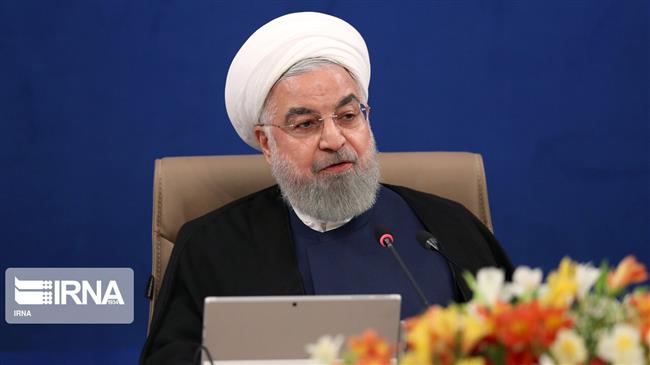
Iran’s President Hassan Rouhani addresses a cabinet session in Tehran on June 14, 2020. (Photo by IRNA )
Press TV | June 14, 2020
Iran’s President Hassan Rouhani says the country will not remain indifferent and will show suitable reaction if the US tries to prevent lifting of arms embargo against the Islamic Republic, which will end this year in accordance with the landmark nuclear deal that Tehran clinched with six world powers back in 2015.
During past months, Washington has stepped up calls for the extension of a UN arms embargo on Iran, which will expire in October under UN Security Council Resolution 2231, which endorses Iran nuclear deal, officially known as the Joint Comprehensive Plan of Action (JCPOA).
The administration of US President Donald Trump has threatened that it may seek to trigger a snapback of all sanctions on Iran if its attempts to extend the arms embargo fail.
The landmark nuclear deal was reached between Iran and the P5+1 group of countries — the US, Britain, France, Russia and China plus Germany — in 2015. However, in May 2018, US President Trump unilaterally pulled his country out of the JCPOA and re-imposed the sanctions that had been lifted against Tehran and began unleashing the “toughest ever” fresh sanctions.
While the US is no longer a party to the JCPOA, it has launched a campaign to renew the Iran arms ban — in place since 2006/2007 — through a resolution at the Security Council, but Russia and China are most likely to veto it.
Addressing a cabinet session on Sunday, Rouhani said, “The termination of the arms ban [on Iran] … is one of the important achievements of the JCPOA and if Americans want to question this achievement, other big countries know what our reaction will be.”
The Iranian president also expressed hope that “all countries who are members of the United Nations Security Council and the Board of Governors” of the International Atomic Energy Agency (IAEA), would be aware of “the US planning with regard to these plots.”
“We, for our part, will be successful in this regard and will weather these plans that the United States has made for Iran,” he noted.
Posting a tweet in early June, Iran’s UN ambassador said the US’ call for an extension of the UN Security Council’s arms embargo on Tehran lacked legal standing in international law.
Majid Takht-e Ravanchi said the US ambassador to the UN “wrongly” believes the US retains the right to initiate snapback of sanctions under the UN Security Council Resolution 2231.
“WRONG: US cannot be a JCPOA ‘Participant’, since Donald Trump ceased US participation,” the Iranian ambassador noted, referring to Trump’s 2018 decision to withdraw his country from the Iran nuclear deal in violation of the Resolution 2231.
In the middle of May, China and Russia also rejected US plans to extend a UN arms embargo on Iran along with a probable push to trigger a return of all sanctions on Tehran at the UN Security Council.
The “US has no right to extend an arms embargo on Iran, let alone to trigger snapback,” China’s UN mission wrote in a tweet.
“Maintaining the Joint Comprehensive Plan of Action is the only right way moving forward,” he added.
Russian Deputy Foreign Minister Sergei Ryabkov vehemently rejected the plan as a “cynical” measure plunging the UN Security Council into crisis.
“The conclusion is that the next crisis in the UN Security Council and the UN as a whole is imminent, taking into account this US stubbornness,” he said, adding, “Washington will not have an easy road here in any case.”
European Union foreign policy chief Josep Borrell said on Tuesday that the US has already pulled out of the international nuclear agreement and cannot currently use its former membership of the deal to seek a permanent arms embargo on Tehran.
“The United States has withdrawn from the JCPOA, and now they cannot claim that they are still part of the JCPOA in order to deal with this issue from the JCPOA agreement. They withdraw. It’s clear. They withdraw,” Borrell said.
The EU believes that the JCPOA plays a key role in maintaining regional and international security and has made efforts to keep the pact alive despite US pressure.
Borrell is tasked with supervising the circumstances surrounding the implementation of the nuclear deal so he can help resolve disputes between its signatories.
Iran dismisses UN report on missiles ‘of Iranian origin,’ says body under US, Saudi pressure
Press TV – June 12, 2020
Iran has dismissed a recent claim by the United Nations that missiles used to attack Saudi Arabia have been “of Iranian origin,” saying the organization has spoken out under political pressure from the US and the Saudi regime.
In a statement on Friday, the Iranian Ministry of Foreign Affairs said it was deeply concerned about the use of the UN Secretariat as a means to achieve political objectives.
“Preparing reports with political motivation will not change the facts and it is clear to all that the current circumstances in the region have directly resulted from the wrong policies of the United States and the child-killing Saudi regime,” the statement said.
UN Secretary General Antonio Guterres told the Security Council in a report seen by Reuters on Thursday that cruise missiles used in several attacks on oil facilities and an international airport in Saudi Arabia in November 2019 and February 2020 had been of “Iranian origin.”
He also said the “items may have been transferred in a manner inconsistent” with Security Council Resolution 2231, which enshrines the international nuclear deal – officially known as the Joint Comprehensive Plan of Action (JCPOA) – signed between Iran and world powers in 2015.
Guterres pointed out in his report that the United Nations had examined the debris of weapons used in the attacks on an oil facility in Afif in May, the Abha international airport in June and August, and the Aramco oil facilities in Khurais and Abqaiq in September.
Referring to the “examination of the weapons debris,” the Iranian Foreign Ministry censured the inattention to the sales of lethal weapons to Saudi Arabia that are used against the defenseless people of Yemen while “Saudi garbage is being checked for proof.”
“Undoubtedly, such reports will not only fail to help [promote] peace and security in the region and implement [UN] Security Council resolutions, but also completely destroy the validity and reputation of the United Nations,” the ministry warned.
It said the UN report came at a time that the United States is drafting a “dangerous” resolution to “illegally” extend an arms embargo against Iran, adding this would strengthen the likelihood of it being prepared on Washington’s order to be used at the Security Council against Iran.
The Iranian Foreign Ministry highly recommended that the UN Secretariat not play into the hands of the US in its “pre-planned scenario to annul the cancellation of Iran’s arms embargo.” It also warned the UN against contributing to such a dangerous trend by preparing illegal reports.
In May 2018, President Donald Trump unilaterally pulled the United States out of the JCPOA and later re-imposed the sanctions that had been lifted against Tehran and began unleashing the “toughest ever” bans.
Although the US is not a party to the JCPOA any longer, it recently launched a campaign to renew the Iran arms ban — in place since 2006/2007 – through a resolution at the Security Council. Russia and China are against the push, and most likely to veto it.
To circumvent the veto, the US says it will argue that it legally remains a “participant state” in the nuclear pact only to trigger the snapback that would restore the UN sanctions, which had been in place against Iran prior to the JCPOA inking.
Tehran says Washington, through its unilateral withdrawal from the deal, has forfeited all rights to have a say in the agreement.
European Union foreign policy chief Josep Borrell said on Tuesday that the US has already pulled out of the JCPOA and cannot currently use its former membership of the deal to seek a permanent arms embargo on Tehran.
“The United States has withdrawn from the JCPOA, and now they cannot claim that they are still part of the JCPOA in order to deal with this issue from the JCPOA agreement. They withdraw. It’s clear. They withdraw,” Borrell said.
Netanyahu Calls on World to Impose ‘Paralyzing’ Sanctions on Iran Over Nuclear Deal ‘Violations’
Sputnik – 07.06.2020
On Friday, a confidential International Atomic Energy Agency report indicated that Iran is continuing to build up enriched uranium stockpiles beyond limits set out in the 2015 nuclear deal. Tehran has vowed to continue reducing commitments to the treaty until other signatories find a way to bypass crippling US sanctions.
Israeli Prime Minister has called on the international community to join the US in applying “paralyzing” sanctions on Iran over the alleged violation of its obligations under the Joint Comprehensive Plan of Action (JCPOA) nuclear deal.
“Over the weekend, the IAEA determined that Iran had refused to allow IAEA inspectors access to clandestine sites at which Iran had carried out secret military nuclear activity. Iran has systematically violated its commitments by hiding sites and enriching fissionable material, and has committed other violations,” Netanyahu said, speaking at a cabinet meeting on Sunday.
“I believe that the time has come, and I think that the time has passed, but reality certainly requires it in the light of these revelations, for the international community to join the US and reimpose paralyzing sanctions on Iran,” the prime minister said.
Netanyahu stressed that Israel “will not allow” Tehran to achieve nuclear weapons capability, and would “continue to act methodically against Iran’s attempts to militarily entrench on our borders.”
Netanyahu’s comments follow the release of a confidential report Friday indicating that Iran has continued to grow its stockpile of enriched uranium, registering 1,571.6 kg of the nuclear fuel as of May 20, up from 1,020.9 kg on February 19. According to the report, Tehran has also refused to allow inspectors to access two shuttered nuclear facilities. Enrichment levels, meanwhile, are said to have increased to 4.5 percent, up from the 3.67 percent limit outlined in the JCPOA.
Iran maintains that it has no intention to produce nuclear weapons, or weapons of mass destruction of any kind, and that its atomic program is aimed strictly at producing nuclear energy.
For the moment, the country’s uranium enrichment levels as reported by the IAEA remain far below the purity levels required to build a nuclear bomb. The nuclear bomb the US dropped on Hiroshima in August 1945, for instance, had an enrichment level of about 80 percent.
Iran’s uranium stockpiles are also far below the estimated 7,000 kg that the country had in 2013, before the signing of the JCPOA. At that time, enrichment levels reached up to 20 percent purity.
Tehran began reducing its commitments under the nuclear deal in May 2019, a year after the US unilaterally withdrew from the agreement and slapped the country with tough energy and banking sanctions. The nation’s leaders promised to continue to abandon certain of the deal’s components until the JCPOA’s European signatories found a way to bypass the crushing economic impact of Washington’s sanctions, which include secondary sanctions against foreign companies doing business with the Islamic Republic.
Officials in Tel Aviv and Tehran have been engaged in a years-long debate on one another’s nuclear intentions, with Israeli officials accusing Iran of seeking to build a nuclear weapon to target Israel, while Iranian officials have pointed out that Israel is the only nation in the Middle East with an actual nuclear arsenal.
Rep. Ilhan Omar Surrenders to Israel Lobby

By Philip Giraldi | American Free Press | June 1, 2020
The nearly complete corruption of the U.S. republican form of government has largely come about due to the Citizens United decision by the Supreme Court in January 2010 that basically permitted unlimited donor-spending on political campaigns based on the principle that providing money, normally through a political action committee (PAC), is a form of free speech. The decision paved the way for agenda-driven plutocrats and corporations to largely seize control of the formulation process for certain policies being promoted by the two national parties.
No one has benefited from the new rules more than the state of Israel, whose hundreds of support organizations and principal billionaire funders euphemized as the “Israel Lobby” have entrenched pro-Israel donors as the principal financial resources of both major political parties. Las Vegas casino magnate Sheldon Adelson has become relatively well known as the major funder of the Republican Party, having contributed an estimated $100 million to the 2018 midterm election, while Haim Saban, a billionaire Israeli/ American movie producer has filled a similar role for the Democrats. Adelson, who once upon a time served as a draftee in the U.S. Army, has described how he wishes it had been the Israel Defense Force instead. He has also stated that he would be proud to have a son who is an Israeli Army sniper. Haim Saban in a somewhat similar vein has said that he is a one-issue guy, and his issue is Israel.
No one should be surprised that the Jewish donor and activist base is paying particular attention to certain congressional races in 2020, most particularly of the three of the four women comprising the so-called “squad,” namely Rashida Tlaib, Ilhan Omar, and Alexandria Ocasio- Cortez, who have been most critical of the U.S.- Israeli connection. Tlaib, a congresswoman representing Detroit who is of Palestinian descent, is already being targeted by fellow Democrat Brenda Jones, who is currently the Detroit City Council president.
Jones almost certainly has made her positive views of Israel known to Anti-Defamation League (ADL) inquisitors, and she will be showered with money and favorable press in a possibly successful bid to overthrow Tlaib. Prospective candidates for Congress and even state level offices are approached by supporters of Israel and are routinely asked to fill out a form explicitly detailing their view of Israel. It is frequently fatal in political terms to respond incorrectly. Play the game and one has money and press support. Do otherwise, and all that vanishes.
The highly controversial Alexandria Ocasio-Cortez, also no friend of the Israel Lobby, is likewise being challenged by her own party in the Bronx. She is being confronted by no fewer than five Democratic Party challengers but is well placed to prevail due to her popularity in her district.
The red lines established around the issue of Israel are something that every American politician understands. But perhaps the biggest surprise, and an indication of the reach of Jewish power in the United States, is the flip-flop recently performed by Ilhan Omar, the ethnic Somali congresswoman who represents Minneapolis.
Omar clearly would like to remain in Congress but, not surprisingly, a strong and well-funded Democratic primary candidate named Antone Melton-Meaux, an African-American lawyer, has surfaced. He has raised $500,000 for his campaign chest, much of it coming from outside sources. He has publicly stated that Omar is not connected to her district, has done nothing for Minnesota, and, perhaps the biggest sin of all, she “… has repeatedly made divisive statements that have been hurtful to members of our Jewish community. She creates distraction and drama, not results. Rep. Omar believes that sanctions are economic warfare and is a vocal advocate for abolishing them, particularly for Iran. Yet she supports sanctions on Israel. She has repeatedly refused to explain this inconsistency. That doesn’t work for us.”
Not surprisingly, Melton-Meaux has been described by the Jewish Insider as having the endorsement of “pro-Israel America.” Decisively progressive Muslim-American Omar is indeed a magnet for controversy. She is certainly not everyone’s cup of tea on specific issues, but she has up until now been one of the most powerful voices criticizing the lopsided relationship of the United States with the Jewish state. She was the one who coined the phrase “It’s the Benjamins” when linking Israel’s grip over Congress to hundred-dollar bills, implying very clearly that it is Jewish money that has bought America’s legislators as well as the White House. Omar also dared to condemn her fellow congressmen as having “dual loyalty” when they supported legislation abridging freedom of speech for anyone who criticizes Israel. For her pains, she was accused of being an anti-Semite by both President Trump and Nancy Pelosi as well as by numerous Republicans and other members of her own party in Congress. Under intense pressure, she apologized to Pelosi and expressed appreciation to her “Jewish allies and colleagues who are educating me on the painful history of anti-Semitic tropes.”
To her discredit, Omar has recently surrendered to force majeure, joining 389 of her colleagues in signing on to a House of Representatives letter supported by the American Israel Public Affairs Committee (AIPAC) that demands the continuation of the United Nations sanctions regime against Iran, a policy that essentially treats the Persians as if they were a country having no rights beyond what Washington will allow them. Secretary of State Mike Pompeo has called the overall policy one of “maximum pressure,” punishment of the Iranian people to compel them to rise up against their rulers.
Ironically, the continuation of the embargo on arms sales, which is what the letter deals with, would seem to be superfluous currently, as Iran has been suffering for some time due to U.S. pressure, a process that has been exacerbated by the arrival of the COVID virus. The U.S. has already effectively blocked Iranian oil sales, the country’s only major source of income, and the medical system is broken, with no money for medical equipment and pharmaceuticals as the virus continues to rage.
Omar’s reversal, for such it is, is particularly remarkable as she denounced on humanitarian grounds the U.S. use of sanctions to pressure other governments as recently as late April. After the story of the letter broke, Omar tried to justify her action by stating that she “has consistently, for a long time, supported arms embargoes against human rights abusers. . . . It was just a narrow ask that we couldn’t find anything wrong with.”
What is wrong with the narrow ask is that it is aimed at allowing the U.S. to intercede to block the sunset provision of the Joint Comprehensive Plan of Action (JCPOA) that kicks in this fall, which will again allow Iran to buy weapons. Ironically, of course, the U.S. withdrew from the agreement in 2017 but Secretary of State Mike Pompeo is now claiming that it is still part of the arrangement, allowing it to press a case against Iran for non-compliance. Even if the U.S. fails in its gambit to interfere directly, the JCPOA will likely come apart, leaving the sanctions in place. Either way AIPAC and Israel win.
Omar’s signature on the AIPAC letter was in reality little more than a surrender to the Israel Lobby by a congresswoman who is under siege and wants to get re-elected. She has undoubtedly done so against her better judgement, as do many of the congressmen who blindly support Israel, because she doesn’t want any problems. In this case, she is aiding the hawks in Congress and the administration who want unrelenting extreme pressure on the Iranian people until the government falls. Or alternatively, an Iran driven against the wall to the point where it does something foolish, enabling the United States and Israel to attack and destroy it. Either way, Ilhan Omar will almost certainly regret placing her signature on the AIPAC letter.
Iran Can Supply Itself With Nuclear Fuel Without Russia’s Help – Atomic Energy Body
Sputnik – 28.05.2020
TEHRAN – Iran is capable of supplying itself with nuclear fuel even without Russia’s assistance, Iran’s Atomic Energy Organization (AEOI) spokesman, Behruz Kamalvandi, said on Thursday.
“Fuel is delivered from Russia each time we need it, without any problems. If we run out of fuel, we will be capable of producing it, without resting on any other country,” Kamalvandi told the ISNA news agency.
His comment came soon after the United States announced ending sanction waivers covering Iran’s nuclear projects.
In late April, Russia delivered a fresh batch of nuclear fuel to Iran’s Bushehr Nuclear Power Plant, necessary for efficient functioning of the reactor.
Iran surges in Venezuela in defiance of US sanctions
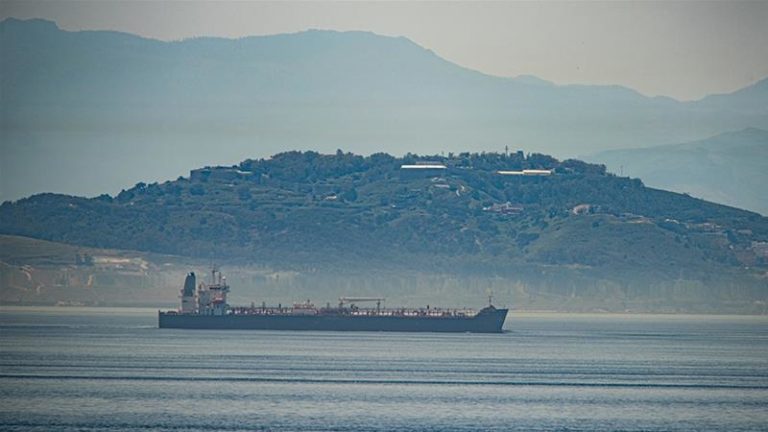
Iranian oil tanker Clavel crossing the Gibraltar stretch heading for Venezuela, May 20, 2020
By M. K. BHADRAKUMAR | Indian Punchline | May 25, 2020
Escorted by the Venezuelan navy and air force, an Iranian oil tanker named Fortune has entered that country’s waters on Sunday, amidst intense speculation whether the US would interfere with the delivery. The US has imposed oil sanctions against Venezuela and Iran and had said it is monitoring the Iranian tanker.
In fact, five Iranian tankers carrying about 1.5m barrels of fuel passed through the Suez Canal earlier this month, according to shipping data on Refinitiv Eikon, and were heading for Venezuela. The other four Iranian tankers — Forest, Petunia, Faxon and Clavel — are approaching the Caribbean en route to Venezuela.
A flotilla of US Navy and Coast Guard vessels is patrolling the Caribbean Sea on a mission to counter illicit drug trafficking. But the Pentagon has stated that there are no plans to stop the Iranian tankers.
At the same time, a Pentagon spokesman, Jonathan Hoffman, while saying on Thursday he was not aware of any operations related to the Iranian cargoes, also added, “We have continued to say that Iran and Venezuela – both two outliers in the international order – [are] clearly violating international sanctions on both nations with this transaction.”
The US sanctions on Venezuela are aimed at increasing pressure on President Maduro to step down. Thus, arguably, Iran is frontally challenging the Trump administration’s stated policy of ‘regime change’ in Venezuela. The Iranian move comes just three weeks after the abortive coup attempt masterminded by the White House on May 1 with the participation of two former US Green Berets aimed at capturing Maduro and transport him to the US in American helicopters to be put on trial on fake drug trafficking charges.
The coup attempt showed the extent of desperation in Washington to overthrow the Maduro government before the US presidential election in November, which President Trump hopes would help him garner Hispanic votes. Iran has now offered a lifeline to Venezuela.
In an historical context, this becomes a frontal assault by Iran on the Monroe Doctrine dating back to the 19th century, which in US foreign policy calculus regarded the Western Hemisphere as its sphere of influence. According to a Reuters report, the Trump administration said earlier this month it was “considering measures” it could take in response to the Iranian shipments, without providing specifics.
No doubt, this is a deliberate sanctions-busting enterprise by Iran. Venezuela desperately needs fuel for up to 1,800 gasoline stations that have been partially closed for weeks due to insufficient supply from state-run refineries.
Venezuela’s gasoline output is now limited to a single facility, the Amuay refinery, but most fuel produced is low octane as most of the country’s alkylation units are out of service. Imported alkylate could improve the quality of domestic gasoline. Venezuela’s refineries are in poor condition. Shipments of equipment in flights by Iran’s Mahan Air have arrived in Venezuela in recent weeks to start repair work.
It will be interesting to see whether the US Navy would interdict any of the other four Iranian tankers before they enter Venezuelan waters. Tehran has sternly warned the US that it would retaliate if any such attempt is made. On Saturday, Tehran raised the ante with President Hassan Rouhani explicitly warning, “If our oil tankers in the Caribbean Sea or anywhere else in the world get into trouble caused by the Americans, they (US) will run into trouble reciprocally.”
Washington is well aware of Iran’s capability to create big problems for the US Navy deployed in the Persian Gulf, especially the Strait of Hormuz. Last week, in a precautionary step, US Navy, via the Maritime Safety Office run by the National Geospatial-Intelligence Agency, alerted all international maritime traffic to maintain a safe distance of at least 100 meters from US naval vessels in international waters and straits. Pentagon officials separately confirmed that the stay-away warning to marine traffic in the Persian Gulf, the Arabian Sea and the Gulf of Oman was actually intended for Iran.
In geopolitical terms, Iran’s strategic defiance of the US in the Western Hemisphere makes an interesting case study not only of the decline in American influence in its backyard to the south but the entire efficacy of the “sphere of influence” concept in contemporary world politics. This is one thing.
More importantly, in the backdrop of the Iranian tanker reaching Venezuela, Caracas has described Iran as a “revolutionary partner” in the struggle against US imperialism. From the Iranian viewpoint, Venezuela becomes a part of the “axis of resistance” against the US. To be sure, the audacity of the two countries will irritate Washington to no end.
How far the Iran-Venezuela axis will deepen and expand will bear watch. Importantly, the UN Security Council embargo against Iran exporting arms to other countries is expiring in October. The US move to extend the timeline of the embargo is unlikely to succeed, given the strong negative reaction by Russia and China. It is entirely conceivable that a matrix of military cooperation may commence in a near future involving Iran and Venezuela.
Iran’s indigenously developed missile capability acts as a deterrent against US aggression. Iran has transferred missile technology to Hezbollah, which is estimated to have the capability today to inflict significant damage to Israel in the event of any aggression by the latter on Lebanon. Significantly, the deterrence is working and Israel no longer stages attacks on Lebanon.
A similar shift in the strategic balance with Iran’s help can create more space for Venezuela to push back at the US. All in all, Iran appears to be working on a strategy to help Venezuela to maintain its strategic autonomy. There is enormous potential for cooperation and coordination between Iran and Venezuela. If Venezuela has the largest known oil reserves in the world, Iran too has massive reserves of oil and gas.
The despatch of oil to lubricate the beleaguered Venezuelan economy may prove to be the harbinger of an assertive Iranian power projection elsewhere in Latin America too. Surely, in the near term, it is a rebuff to the Trump administration’s maximum pressure strategy against Iran. In a longer-term perspective, a concerted regional strategy in Latin America by Russia, China and Iran can seriously erode the US influence in the continent.
Will Trump Really Start Two Wars Instead of “Just” One?
The Saker | Unz Review | May 20, 2020
Amidst the worldwide pandemic induced scare most of us have probably lost track of all the other potential dangers which still threaten international peace and stability. Allow me to list just a few headlines which, I strongly believe, deserve much more attention than what they got so far. Here we go:
- Military Times : “5 Iran tankers sailing to Venezuela amid US pressure tactics“
- Time : “5 Iranian Tankers Head to Venezuela Amid Heightened Tensions Between U.S. and Tehran“
- FoxNews: “Iran tankers sailing to Venezuela in effort to undermine US sanctions“
Notice that Military Times speaks of “US pressure tactics”, Time of “tensions” and FoxNews of “efforts to undermine US sanctions”?
I don’t think that this is a coincidence. Folks in the US military are much more in touch with reality than the flag-waving prostitutes which some people call “reporters” or “journalists”.
Furthermore, the US has embarked on a new policy to justify its acts of piracy on the high seas with something called Visit, Board, Search and Seizure (VBSS) all under the pretext of the war on drugs. To get a better understanding of the context of these developments I asked a specialist of Maritime issues of our community, NatSouth, who replied the following: (stress added)
If a ship does not comply with the request to be boarded, it is usual that the pursuing authorities must gain the permission of the ‘flag’ state prior to boarding, on the high seas and the pursuit has to have started in the coastal state’s jurisdictional waters. The caveat here is that in the Caribbean – Caribbean Regional Maritime Agreement (CRA) – (long name: Agreement Concerning Co-operation in Suppressing Illicit Maritime and Air Trafficking in Narcotic Drugs and Psychotropic Substances in the Caribbean Area). So, there is an agreement with participating coastal states on boardings and pursuits in EEZs and the like. You can find more on the legal aspects of boardings at sea here: and more info on so-called “consensual boardings” here.
The anti-drug/ counterterrorism angle allows the U.S. Navy and the USCG to carry out interdictions on the high seas. Important point to note whether this approach will be taken to interdict the tankers, given that Venezuela is a declared narco-State. The absurdity is that Venezuela isn’t the primary transit point in the region, Colombia holds that honour.
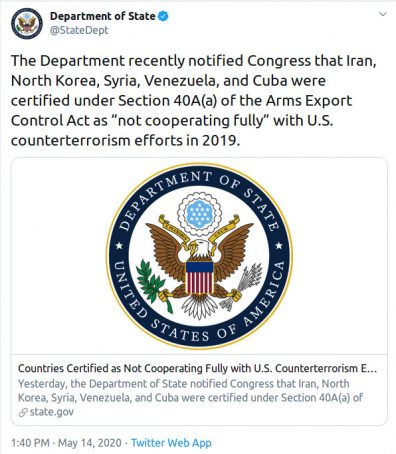
If I could add at this point, the origins are that Venezuela didn’t wish to play ball with Washington anymore, specifically with the DEA back in 2005, squaring the circle of sorts, (or should that be a vicious circle cunningly used by Washington, because who is going to argue with that narrative, aka the war on terror). March: SOUTHCOM’s Adm. Faller: “There will be an increase in US military presence in the hemisphere later this year. This will include an enhanced presence of ships, aircraft, & security forces to reassure our partners… & counter a range of threats to include illicit narco-terrorism.” At the same time, the State dept released this tweet, so the US could effectively carry out boardings under the guise of counterterrorism as well.
While the Iranian tankers were in the Mediterranean, Washington released a (delayed) “Global Maritime Sanctions Advisory”, to the maritime industry, setting out guidelines to shipowners and insurers to enable them to avoid the risks of sanctions penalties related to North Korea, Syria and Iran. This also concerns oil exports from Iran, (but doesn’t apply to Iranian flagged ships). This came after the State Dept gave warning notice to oil companies to stop operations, including Rosneft (Russia), Reliance (India) and Repsol (Spain).
Then NatSouth concluded the following:
Under international law, every merchant ship must be registered with a flag state, which has jurisdiction over the vessel. Hence, this time, the use of Iranian-flagged tankers, as a direct response from Washington’s latest version of restating “maximum pressure” campaign on enforcement of Iran and Venezuela sanctions, (back in Feb, literally the same language as in Aug 2019). There was talk back then of a naval embargo, which would a serious notch up in tensions. There was mention of the 4 U.S. warships in the Caribbean, the U.S. Navy tweeted about, but one the Preble went through the Panama Canal into the Pacific).
Pretty clear, isn’t it?
What the US is doing is substituting itself for the United Nations and it is now openly claiming the right to board any vessel under whatever kind of pious pretext like, say, narco-trafficing, nuclear proliferation, sanctions against so-called “rogue states”, etc. Clearly, the AngloZionists expect everybody to roll over and take it.
How likely is that?
Let’s look at a few Iranian headlines, all from PressTV:
- PressTV, May 16th: “Iran’s fuel shipment to Venezuela guaranteed by its missile power“
- PressTV, May 17th: “US aware Iran will respond ‘very strongly’ if Venezuela-bound ships attacked: Analyst“
- PressTV, May 18th: “Iran: US bears responsibility for any foolish act against tankers heading to Venezuela“
Three days in a row. I think that it is fair to assume that the Iranians are trying very hard to convince Uncle Shmuel not to mess with these tankers. Does anybody seriously believe that the Iranians are bluffing?
Before we look at some of the aspects of this potential crisis, let’s just mention a few things here.
First, the US is acting in total and official illegality. Just like the bombing of Syria, the threats to Iran, or the US murderous sanctions Uncle Shmuel imposes left and right – the blockade of Venezuela is a) totally illegal and b) an act of war under international law.
Second, if USN commanders think they can operate with impunity only because the Caribbean is far away from Iran, they are kidding themselves. Yes, Iranian forces cannot defend these tankers so far away from home, nor can they take any action against the USN in the Atlantic-Caribbean theater of naval operations. But what they can and will do is retaliate against any AngloZionist target in the Middle-East, including any oil/gas tanker.
Third, while Venezuela’s military is tiny and weak compared to the immensely expensive and bloated US military, being immensely expensive and bloated is no guarantee of success. In fact, and depending on how the Venezuelan leadership perceives its options, there could be some very real risk for the USA in any attempt to interfere with the free passage of these ships.
What do I mean by that?
Did you know that Venezuela had four squadrons of Su-30MKV for a total of 22 aircraft? Did you know that Venezuela also had an unknown number of Kh-31A supersonic anti-shipping missiles? And did you know that Venezuela had a number of S-300VM and 9K317M2 Buk-M2E long range and medium range SAMs?
True, that is nowhere near the amount of weapons systems Venezuela would need to withstand a determined US attack, but it is more than enough to create some real headaches for US planners. Do you remember what the Argentinian Air Force did to the British Navy during the Malvinas war? Not only did the Argentinians sink two Type 42 guided missile destroyers (the HMS Sheffield and the HMS Coventry) which were providing long-range radar and medium-high altitude missile picket for the British carriers, they also destroyed 2 frigates, 1 landing ship, 1 landing craft, 1 container ship. Frankly, considering how poorly defended the British carriers were, it is only luck which saved them from destruction (that, and the lack of sufficient number of Super Étendard strike aircraft and Exocet missiles). I would add here that the British military, having been defeated on many occasions, has learned the painful lessons of their past defeats and does not suffer from the cocky-sure attitude of the US military. As a result, they were very careful during the war against Argentina and that caution was one of the factors which gave a Britain well-deserved the victory (I mean that in military terms only; in moral terms this was just another imperialist war with all the evil that entails). Had the Argentinians had a modern air force and enough anti-shipping missiles, the war could have taken a very different turn.
Returning to the topic of Venezuela, war is a much more complex phenomenon than just a struggle of military forces. In fact, I strongly believe that political factors will remain the single most important determinant factor of most wars, even in the 21st century. And chances are that the Venezuelans, being the militarily weaker side, will look to political factors to prevail. Here is one possible scenario among many other possible ones:
Caracas decides that the US seizing/attacking the Iranian tankers constitutes an existential threat to Venezuela because if that action goes unchallenged, then the US will totally “strangle” Venezuela. Of course, the Venezuelan military cannot take on the immense US military, but what they could do is force a US intervention, say by attacking one/several USN vessel(s). Such an attack, if even only partially successful, would force the US to retaliate, bringing US forces closer not only to Venezuelan air defenses, but also closer to the Venezuelan people which will see any US retaliation as an illegitimate counter-counter-attack following the fully legitimate Venezuelan counter-attack.
Then there is the problem of defining victory. In the US political “culture” winning is usually defined as pressing a few buttons to fire off some standoff weapons, kill lots of civilians, and then declare that the “indispensable nation” has “kicked the other guy’s ass”. The problem with that is the following one: if they other guy is very visibly weaker and has no chance for a military victory of his own, then the best option for him is to declare that “surviving is winning” – meaning that if Maduro stays in power, then Venezuela as won. How would the USA cope with that kind of narrative? Keep in mind that Caracas is a city of over two million people which even in peacetime is rather dangerous (courtesy of both regular crime and potential guerilla activities). Yet, for Maduro to “win” all he has to show is that he controls Caracas. Keep in mind that even if the US forces succeed in creating some kind of “zone of real democracy” somewhere near the Colombian border, that will mean nothing to Maduro, especially considering the terrain between the border and the capital city (please check out this very high resolution map of Venezuela or this medium resolution one). As for the notion of a USN landing on the shores of Venezuela, all we need to do is to remember how the immense Hodgepodge of units which were tasked with invading Grenada (including 2 Ranger Battalions, Navy Seals, most of an Airborne Division, etc. for a total of over 7,000 soldiers(!) against a tiny nation which never expected to be invaded (for details, and a good laugh, see here for a full list of participating US forces!) was defeated by the waves of the Caribbean and the few Cuban military engineers who resisted with small-arms fire (eventually, most of the 82AB was calling in to fix this mess).
In other words, if Maduro remains in power in Caracas then, in political terms, Venezuela wins even though it would loose in purely military terms.
This phenomenon is hardly something new, as shown by the following famous quote by Ho Chi Minh: “You can kill ten of my men for every one I kill of yours. But even at those odds, you will lose and I will win.”
By the way, this is exactly the same problem the Empire faces with Iran: as long as the Islamic Republic remains an Islamic Republic it “wins” in any exchange of strikes with the USA and/or Israel.
Still, it is pretty obvious that the US can turn much of Venezuela into a smoking heap of ruins. That is true (just like what the USA did to Korea, Vietnam, Iraq or Serbia and Israel what did to Lebanon in 2006). But that would hardly constitute a “victory” in any imaginable sense of the word. Again, in theory, the US might be able to secure a number of landing locations and then send in an intervention force which could try to take key locations in Caracas. But what would happen after that? Not only would the hardcore Chavistas trigger a guerilla insurrection which would be impossible to crush (when is the last time the USA prevailed in a counter-insurgency war?), but many Venezuelans would expect the US to pay for reconstruction (and they would be right, according to the rules of international law, “once you take it, you own it” meaning that the USA would become responsible for the socio-economic situation of the country). Finally, there is always the option of an anti-leadership “decapitating” strike of some kind. I believe that in purely military terms, the US has the know-how and resources to accomplish this. I do not believe that this option would secure anything for the USA, instead – it would further destabilize the situation and would trigger some kind of reaction by the Venezuelan military both outside and inside Venezuela. If anything, the repeated failures of the various coup attempts against Chavez and Maduro prove that the the bulk of the military remains firmly behind the Chavistas (and the failed coup only served to unmask the traitors and replace them anyway!).
The bottom line is this: if Uncle Shmuel decides to seize/attack the Iranian tankers, there is not only a quasi certitude of a war between the US and Iran (or, at the very least, an exchange of strikes), but there is also a non-trivial possibility that Maduro and his government might actually decide to provoke the USA into a war they really can’t win.
Is Trump capable of starting a process which will result in not one, but two wars?
You betcha he is! A guy who thinks in categories like “my button is bigger than yours” or “super-dooper weapons” obviously understands exactly *nothing* about warfare, while the climate of messianic narcissism prevailing among the US ruling classes gives them a sense of total impunity.
Let’s hope that cooler heads, possibly in the military, will prevail. The last thing the world needs today is another needless war of choice, never mind two more.
Iran’s fuel shipment to Venezuela guaranteed by its missile power
Press TV – May 16, 2020
Iran is shipping tons of gasoline to Venezuela in defiance of US sanctions on both countries in a symbolic move guaranteed by Tehran’s missile prowess.
Unconfirmed reports and tanker monitoring groups suggest that at least five Iranian-flagged tankers are transporting fuel to Venezuela through the Atlantic Ocean despite the US sanctions on both Tehran and Caracas.
Iran has intentionally hoisted its own flag over the huge tankers which are navigating through the Atlantic before the eyes of the US Navy.
Iran is shipping large consignments of gasoline to Venezuela even though the US would try to intercept the shipments and seize the tankers.
There are unconfirmed reports that the US Navy has deployed its USS Detroit (LCS-7), USS Lassen (DDG-82), USS Preble (DDG-88), and USS Farragut (DDG-99) to the Caribbean along with its patrol aircraft Boeing P8-Poseidon for possible encounter with the Iranian vessels.
However, analysts say it is very unlikely that the US makes such a mistake, as it would have serious repercussions for the Trump administration ahead of the November elections.
The US would not dare to seize the Iranian vessels especially after Iran’s reaction to a similar move by the United Kingdom, a close ally of Washington.
Iran also has the upper hand thanks to its missile power, which was shown to the US in the IRGC’s retaliatory missile attacks on the Ain al-Assad Airbase in Iraq, which accommodated American troops.
The US was also reminded of the Islamic Republic’s missile prowess following the recent successful launch of Nour-1 military satellite, which reached its orbit using the Qased satellite carrier. Some Western analysts claim the satellite achievements are a prelude to Iran’s program to develop intercontinental ballistic missiles (ICBMs).
Confident about its missile capabilities, Iran is going on with the gasoline shipment to its ally in Latin America, mocking the US sanctions on the oil sectors of both countries.
The US seems to be between the rock and hard place. While it is unlikely for Washington to dare to intercept the tankers, if they reach their destination safe and sound, it may tarnish the “superpower” forever.
The fuel shipment also shows Iran’s success in turning into an exporter of gasoline after years of importing the fuel.
A senior official in US President Donald Trump’s administration told Reuters on Thursday that the United States was considering measures against Iran in response to the fuel shipment.
The official said Washington has a “high degree of certainty” that the Venezuelan government is paying Iran in gold for the fuel.
If these claims are confirmed, the “fuel for gold” exchange is also a great achievement for the Islamic Republic amid the US’ maximum pressure policy, which deprives the country’s economy of billions of dollars’ worth of oil revenues.
There are reports that Iran is receiving nine tons of gold in exchange for the fuel its ships transport to Venezuela. Under the cruel sanctions imposed by the US after its withdrawal from the 2015 nuclear deal in 2018, nine tons of gold can be a very precious asset for the Iranian economy.
However, we must still wait and see whether the US administration would let the Iranian tankers go and strip Washington of its “superpower” title, or it would dare to intercept the vessels and endanger Donald Trump’s campaign ahead of the November elections.
Earlier in the day, Iranian government spokesman Ali Rabiei said Venezuela and Iran are both independent states that have had and will continue to have trade relations with each other.
“We sell goods and buy goods in return. This trade has nothing to do with anyone else. We have to sell our oil and we have ways to do it,” Rabiei said in reaction to reports of the fuel shipment to the Latin American country.
See also:
US interception of Iran vessel to Venezuela would be ‘completely illegal
Swiss humanitarian channel yet to process a single deal for Iran: Report
Press TV – May 8, 2020
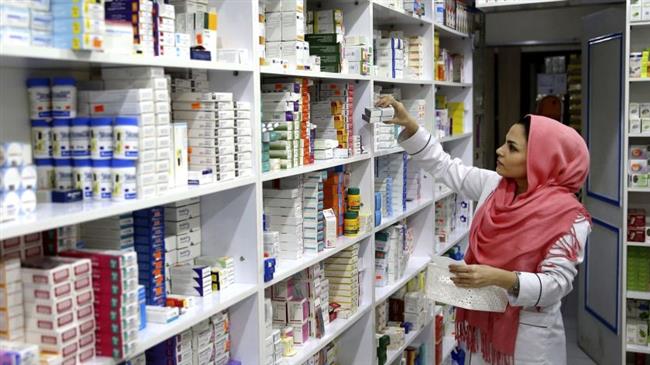
A new report published in the American media shows a Swiss trade channel much publicized by Washington as a secure way of delivering humanitarian assistance to Iran at a time of sanctions has failed to process any single deal on Iranian medicine imports.
The Daily Beast reported that Iranians have got almost nothing from the Swiss Humanitarian Trade Agreement (SHTA) since it was launched in January with the support and consent of the US.
The channel was meant to find a way around the US sanctions to use Iranian funds deposited abroad to buy food and medicine for the country via the Swiss bank BCP.
However, companies seeking to participate in the scheme have found it very difficult to comply with the criteria set by the US government to avoid violating the general rules governing the sanctions, said the report.
Fabian Maienfisch, a spokesman for Switzerland’s State Secretariat for Economic Affairs (SECO), which oversees the channel, admitted in comments made to the Daily Beast that the initiative had effectively failed to meet its objectives.
“No transactions have yet been carried out. Unfortunately, this whole process has been slower than expected…,” said Maienfisch.
The comments prove statements by the Iranian government saying that US officials have been disingenuous in claiming that Iran’s humanitarian needs are exempt from the harsh regime of sanctions imposed on the country.
Iran has made it clear that the sanctions have not affected its robust response to a new coronavirus pandemic that has infected more than 100,000 people and led to over 6,000 deaths in the country.
However, governments and rights organizations have criticized the US for its refusal to lift the sanctions at the time the Iranian health system is under pressure, saying the bans violate the most basic principles of human rights.
Featured Video
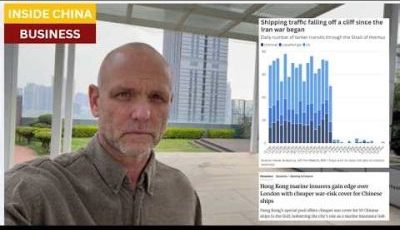
More Iran War fallout: Maritime insurance industry shifts from London to China
or go to
Aletho News Archives – Video-Images
From the Archives
The Biggest Threat to Peace in Middle East
By Dr. Elias Akleh* | Sabbah Report | May 24, 2010
A build up of heightened tension in the Middle East is escalating in the last few weeks. American and Israeli postures towards Lebanon, Syria, and Iran have become more threatening. Listening to speeches of political leaders one hears talks only about war not peace. Iranians and Israelis are continuously training hard for a possible showdown. Both sides are conducting extensive war games every month. This led Syrians to claim that Israel is preparing for a soon-to-come another war. The Jordanians also are warning that current stalemate of the peace process is an indication of a war breaking out this summer. The Russian President and his army chief hinted, a few months ago, that the US and Israel were planning for an attack on Iran.
Indeed Iran is, as it has been for last few years, the target of most of the threats and accusations of supporting terrorism. Escalating incitement against Iran the American Defense Department sent last month (April) to Congress a report on Iran’s military claiming Iran could develop intercontinental ballistic missiles capable of reaching the US by 2015.
Ignoring the fact that N. Korea, India, Pakistan, and Israel are proven to have nuclear weapons while Iran does not, the US Secretary of State Hillary Clinton chose in her speech, to the nuclear Non-Proliferation Treaty review conference at the UN, to focus on Iran’s alleged nuclear ambitions putting the whole world at risk as she put it. According to Clinton Iran’s acquisition of nuclear weapons, rather than Israel’s more than 200 nuclear bombs, is destabilizing the Middle East. She called on the world’s nations to rally around US efforts to hold Iran, not other nuclear countries, to account.
The accusation that Usama Bin Laden is living comfortably in Iran had received a boost after the broadcast of a documentary called “Feathered Cocaine”. This echoed the June 2003 claims of the Italian newspaper Corre de la Sierra that Bin Laden was in Iran according to some intelligence report, and according to Richard Miniter’s book “Shadow War”. … continue
Blog Roll
 Aletho News
- Japan Clings to US Vassalage Despite Energy Crunch Caused By Iran War
- US Seeks Control Over Global Energy Infrastructure – Kremlin
- US senators target Orban government for standing up to Zelensky
- The deep-rooted culture of corruption in Ukraine
- Iran mobilizing one million soldiers to ‘create hell’ for any US ground assault: Report
- The coming military and psychological unravelling?
- Iran has the last laugh
- More Iran War fallout: Maritime insurance industry shifts from London to China
- US-Israeli aggression on Iran triggers review of GCC countries’ investment pledges to Washington
- Russia slams UK plan to seize tankers suspected of carrying its oil
- If Americans Knew
- Reports: Iran mobilizing 1M fighters, Israel-US run low on ammo, Israeli army faces shortage – Not a ceasefire Day 168
- ‘No Innocent Children’: Far-right Israeli Lawmaker Defends Killing of Palestinian Family
- Mossad’s promises helped Netanyahu convince Trump that Iran could be toppled
- US Arms Control Official Refuses To Comment When Asked If Israel Has Nuclear Weapons
- Veterans warn US landing could be ‘more Gallipoli than Vietnam’
- Israel may be committing war crimes in Lebanon – Not a ceasefire Day 167
- In the West Bank, life is a constant battle – 3 articles
- Jacob Reses, one of the most powerful pro-Israel operatives in Trump’s Washington
- Israeli-US assaults kill or injure 87 children a day – Not a ceasefire Day 166
- ‘Forever live by the sword’: Understanding Israelis’ massive support for Iran war
- No Tricks Zone
- Devastating Assessment Of Comirnaty Vaccine By Former Senior Pfizer Europe Toxicologist
- New Study: CO2 Is ‘Effectively Negligible’ As An Explanatory Climate Change Factor Since 2000
- Former Pfizer Toxicologist Dr. Helmut Sterz Tells Bundestag Hearing Pfizer Vaccine Should Have Never Been Approved
- Energy Expert: Germany’s Nuclear Phaseout Was A “500 Billion Euro Mistake”
- New Research: South Australia’s Mid-Holocene Sea Surface Temperatures Were 4°C Warmer Than Today
- Storing Green Energy To Last Germany 10 Days Would Require A 60-Million Tonne Battery
- New Studies: UK Sea Levels Were 4 Meters Higher Than Today During The Mid-Holocene
- Destructive Green New Deal: German Energy And Metal Group Warns Of Drastic Crisis
- New Study Documents A 20-Year Pause In Arctic Sea Ice Decline – Driven By Internal Variability
- Wake-up Call: Survey Shows Majority Of Germans Now Favor Postponing Climate Targets!
 Aletho News