As the United States sinks deeper into a multi-faceted global crisis that no politician seems able or even willing to address, one hears more and more often demands for radical change in who runs the country and to what end. Of course, Donald J. Trump offered such a dramatic shift in priorities four years ago, but he has been unable to deliver due to his own inability to execute and the ill-conceived machinations of those whom he has chosen as advisers. The Democrats for their part are offering little beyond a repeat of their 2016 pander to grievance groups in an effort to cobble together an unassailable majority based on buying off the party’s various constituencies.
But there is one area where change could come dramatically if either party were actually motivated to do something that would truly benefit the American people, and that is in the area of foreign and national security policy where the president has considerable power to set priorities and redirect both the State and Defense Departments. Unfortunately, foreign and national security policy is almost never discussed during the presidential campaigns and this time would already appear to be no exception. That means that the one thing that is a constant amidst all the smoke and mirrors is the continued bellicosity of both parties on the world stage.
The Republicans are apparently eager to “democratize” Latin America while the Democrats in particular are wedded to the “foreign interference” angle to explain their loss in 2016, with Hillary Clinton predictably advising in her Democratic National Convention speech that the public should “Vote to make sure we — not a foreign adversary — choose our president.” Indeed, the tendency to create and then demonize “foreign conspiracies” is generally supported by the establishment and its parasitical media, since it enables the billionaire oligarchs who really run the country to grow fatter while also avoiding any blame for the declining fortunes of most of the American people.
The Democrats are currently taking pains to recall the so-called “Russian interference” in 2016, and are expecting or possibly even hoping for more of the same this year. Tying Trump to Russian President Vladimir Putin is obviously perceived as a game winner, even though the just-completed investigations into the events of 2016 are at best ambiguous. Early prognostications by journalist-pundits in the foreign interference sweepstakes indicate that both China and Iran will be supporting Joe Biden while Russia wants to continue with Trump. No one bothers to explain how those countries will express their preferences or what kind of impact they could possibly have.
One thing that is certain is that both parties will continue their deference to Israel which in turn means hostility towards Iran and its few friends worldwide. The U.S. media has not reported the almost daily bombings of Syria and Gaza by Israel and even largely failed to cover how two weeks ago the United States Navy seized four Greek flagged oil tankers transporting more than a million gallons of fuel to economic basket case Venezuela, a country which is in its sad condition due to sanctions and other “maximum pressure” at the hands of Washington. The fuel was seized based on unilaterally imposed U.S. sanctions on Iranian sale or export of its own petroleum products, a move intended to strangle the Iranian economy and bring about an uprising of the Iranian people. Such a move used to be called piracy.
To be sure, the Democrats have indicated that they will rejoin the Joint Comprehensive Plan of Action (JCPOA), which Trump withdrew from under orders from top donor Sheldon Adelson in 2017, one of his first acts in office. The JCPOA is intended to monitor and restrain any possible efforts by Iran to enrich uranium to develop a nuclear weapon, which one might assume is in the U.S. interest, but one should make no mistake in thinking that re-entering the agreement signifies any softening towards Iran. Joe Biden and Kamala Harris are owned lock, stock and barrel by the Israel Lobby, which is pretty much true of most politicians from both major parties in Washington. Iran is Israel’s target and even lacking any threat to the U.S. so it will remain the American enemy of choice.
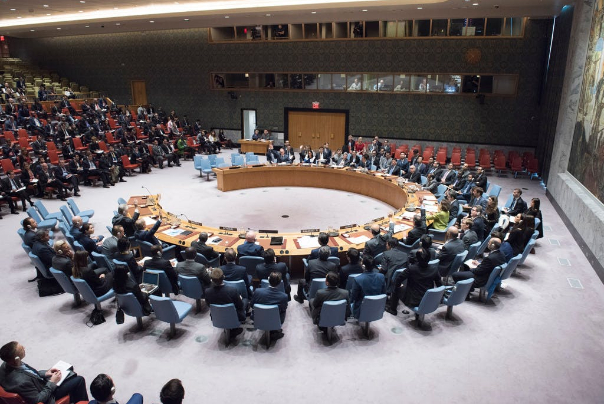
America’s efforts to demonize and punish Iran, ineptly stage managed by Secretary of State Mike Pompeo, frequently lead into the Twilight Zone. On August 17th, the United States suffered what has to be described as a humiliating defeat in the United Nations Security Council. As the Washington Post reported it, “The United States asked the council to approve an extension of the 13-year-old embargo on arms trade with Iran — something that matters greatly to Israel and U.S. Arab allies, and which most of the democratic world favors. Yet only one member of the 15-member council, the Dominican Republic, sided with Washington. Russia and China opposed the motion, while 11 countries — including Britain, France and Germany — abstained. The vote could open the way for Iran to obtain Chinese and Russian arms — for example, missiles it could employ against Israel, the UAE or U.S. ships in the Persian Gulf.”
Note particularly the reliably Zionist Post’s “newspeak” version in describing both the issue and the vote. It states that “most of the democratic world favors” an embargo on selling arms to Iran but then describes how “11 countries – including Britain, France and Germany – abstained.” And, of course, the potential threat to Israel is front and center as the reason for the embargo, an apartheid state that has nuclear weapons developed in secret after stealing both the uranium and triggers from the United States. One might also note that Iran is a signatory to the Nuclear Non-Proliferation Treaty (NPT), which Israel is not, and its nuclear related research facilities are fully open to inspection by the International Atomic Energy Agency (IAEA).
After the rebuff, Trump subsequently moved on to phase two in its attack on Iran by invoking a so-called “snap-back” provision of the JCPOA that empowers any of the signatories to the agreement to unilaterally call for renewal of the international sanctions that isolated Iran prior to 2015, when the plan of action was signed by the U.S., Britain, China, France, Germany and Russia, along with the European Union. The U.S. claimed that Iran has been cheating on its enrichment program and also that the accord’s authority is rooted in an accompanying Security Council resolution, which means that Washington can at will address the issue before that body.
Bear in mind that the U.S., though an original signatory, withdrew from the agreement, and any attempt to restore U.N. sanctions through an admittedly sleazy maneuver would be resisted by nearly all the other members of the Security Council, which is precisely what did take place last Thursday, with the Europeans producing a joint letter emphasizing that Washington has no standing on the issue as it is no longer party to the arrangement. Pompeo responded by saying that the Europeans “chose to side with the ayatollahs.”
Secretary of State Mike Pompeo, presumably supported by the president, has been angered by the Security Council’s failure to support him on either extending the arms embargo or re-imposing general sanctions, though he is probably eternally grateful for the fortitude demonstrated by the plucky little Dominican Republic. On both meetings with the Security Council Pompeo complained, using his standard line, saying that “We can’t allow the world’s biggest state sponsor of terrorism to buy and sell weapons. I mean, that’s just nuts.”
The next step by the White House was a unilateral proposal submitted in writing by the U.S. to reimpose a full range of economic sanctions on Iran in thirty days. That can only be blocked by a Security Council resolution which Washington can veto, meaning that America will again be going it alone in its not-so-secret war against Iran, further isolating the U.S. in world fora and again demonstrating that the Trump Administration has few friends anywhere in this fight but Israel and its newfound Arab associates in the Gulf. It also means that the re-imposed sanctions are unlikely to be actively enforced by anyone that matters, further suggesting that the U.S. might resort to secondary sanctions, as it has done in the past, on those who do not comply, a formula for chaos.
Well, it should seem obvious that we Americans can’t afford a foreign and national security policy that pits the United States against the rest of the world in situations where the U.S. is not actually directly threatened and does not even have a vital interest. Over the next two months, perhaps we will see some serious discussion of America’s place in the world or perhaps not. If 2016 is anything to go by, we are more likely to see a number of bromides tossed out without any real meaning behind them. We are still waiting for troops reductions and the ending of useless wars promised by Trump. We are still waiting for Hillary to concede that Russia didn’t defeat her. She did it all by herself.
The alliance between Venezuela and Iran seems to be taking new directions. The ties between the two countries began to strengthen in an economic sphere when, in the first half of 2020, Tehran started sending oil ships to Venezuela, circumventing the international trade rules imposed by Washington with the aim of blocking Caracas economically. Earlier this year, Tehran sent several cargoes of gasoline to Venezuela to help the South American country overcome fuel shortages, as well as equipment to help state oil company PDVSA overcome production and export difficulties during the crisis.
The presence of Iranian ships on the Venezuelan coast has been a real affront to the United States, which has always played a role of naval hegemony in the Caribbean. Recently, the United States claimed to have seized four ships carrying Iranian gasoline en route to Venezuela, prompting Washington to tighten sanctions on both countries. But the US was unable to contain the Iranian advance and now the alliance between Caracas and Tehran has advanced into a military step.
Recently, Venezuelan President Nicolás Maduro thanked Iran for helping the South American country overcome US sanctions on its oil industry. At the time, he said that Iran is helping to maintain all Venezuelan national governance but did not elaborate on how this cooperation was taking place. He said it was important to maintain secrecy on the topic because of the economic boycott imposed by the US – which he called a “brutal war”. However, Colombian President Iván Duque said last week that Maduro was interested in buying missiles from Iran, which Venezuelan officials denied, but later Maduro responded that Duke’s statement was a “good idea” and that he had not yet considered it .
Shortly thereafter, Maduro confirmed his interest in buying Iranian weapons. According to the Venezuelan president, Iran, possessing advanced military technology, can be a great partner of the South American country in case of possible attacks by the US. According to Maduro, buying Iranian missiles was not in his plans until the moment that Iván Duque gave him this idea by accusing him in a condemning tone of being acquiring such equipment.
“With Iran having tremendous military technology, buying short, medium and long-range rockets and missiles from Iran to defend against imperialist threats seemed like a good idea, [so] I gave the order to Defense Minister Vladimir Padrino to evaluate all potentialities and possibilities, and if it is possible and convenient, we will buy these missiles at the right time”, said Maduro in an interview with the state television channel” Venezolana de Televisión”. According to the Venezuelan president, the Duke’s pronouncement was intended to attack Venezuela to take international attention away from Colombia’s national problems, such as the massacres and murders perpetrated by drug trafficking militias and the great social crisis generated by the new coronavirus, however, it ended up arousing the Venezuelan government’s interest in buying such Iranian missiles.
Now, it seems that the possibility of buying Iranian missiles is being evaluated by Vladimir Padrino, leader of the Venezuelan Defense, and there is a great likelihood for the negotiations to be concluded, considering that there is a willingness on both sides for international cooperation since they have a common enemy. Looking at the case from a realistic point of view, it is very unlikely that negotiations between Iran and Venezuela started due to Iván Duque’s pronouncement. Both countries were probably already discreetly maintaining this dialogue and the accusatory and condemnatory pronouncement served only as an opportunity to make the news public. In fact, it seems that Duque’s words were a flawed blow: Venezuela was expected to deny the accusations and thus create a scenario of tensions and uncertainties, but, contrary to what was predicted by the Colombia-US coalition, Venezuela has made public its intention to acquire the missiles and now the alliance is almost official.
If the missiles are bought by Caracas, this will be a major blow to the American presence in South America and, at the same time, a major milestone for Iranian international projections. The most important thing to note is that this agreement has a much deeper dimension than mere military trade: everything indicates that it will only be the first step in a major military alliance. Venezuela will have its defense system strengthened and will guarantee greater security against possible attacks by both Americans and Colombians. Likewise, in a possible war against Washington, Iran will have the definitive support of Venezuela – a strategically well located ally, with its coastline pointing to the Caribbean Sea, an important area of American influence.
Lucas Leiroz is a research fellow in international law at the Federal University of Rio de Janeiro.
More than two years ago, in May 2018, the Trump administration unilaterally walked away from the international nuclear accord with Iran signed by the five permanent members of the UN Security Council plus Germany. President Trump derided the deal as the “worst ever” and proceeded to re-impose crippling U.S. sanctions on Iran.
This week the United States announced it intends broadening sanctions to those previously imposed by the United Nations. Those UN sanctions were lifted after the nuclear deal was signed in July 2015 and subsequently endorsed by the UN Security Council under Resolution 2231. Washington wants to reimpose the UN sanctions by claiming that Iran is in “non-compliance” of the nuclear accord, formally known as the Joint Comprehensive Plan of Action (JCPOA). Washington’s claims of Iran’s “non-compliance” are baseless.
The U.S. is asserting that it is entitled to trigger the reimposition of UN sanctions by invoking a “snapback” mechanism incorporated into the JCPOA, which permits signatories to lodge a complaint if they register credible, non-compliance by another party.
Washington’s double-think is astounding. It unilaterally repudiated an international accord, and by doing so was in breach of a UNSC resolution, yet Washington now wants to use this same accord to enforce multilateral sanctions against Iran. The American position is preposterous, yet it is proposing to proceed in absurd mental gymnastics with an apparently straight face. The seeming lack of awareness of its own glaring illogicality is an illustration of the consummate conceit that defines Washington’s policy.
To accuse Iran of “non-compliance” in a treaty that Washington has trashed is the height of hubris. Furthermore, the wielding of extra-territorial sanctions against any nation that defies U.S. sanctions against Iran is tantamount to aggression. Nations that are trying to uphold the JCPOA are threatened with American sanctions under the diktat from Washington to abandon an international treaty.
The Trump administration’s policy of “maximum pressure” against Iran is really a policy of “maximum aggression”. The callousness of Washington’s criminality is testified by its refusal to shelve its sanctions against Iran at a time of global pandemic. Appeals from the UN chief Antonio Guterres have been coldly rebuffed.
Washington’s conduct is that of a rogue state which has no shame nor legal semblance. And yet as its maximum aggression policy fails in its objectives to destroy the JCPOA and incite regime change in Iran, Washington is now turning to the multilateral forum of the UN in order to pursue its felonious aims. That’s a measure of the moral torpor that characterizes the regime in Washington.
Nevertheless, one consolation is that the U.S. is finding itself more and more isolated from its irrational and insatiable tyranny.
Last week, a U.S. draft resolution to extend an arms embargo on Iran was dealt a humiliating defeat at the UN Security Council. That embargo is due to expire as a result of the JCPOA which Iran has been in full compliance with, as verified by multiple UN inspections of its nuclear program for solely civilian purposes. Infuriated by the embarrassing snub to its presumed global power, the Trump administration doubled down this week by demanding the re-imposition of UN sanctions as part of a snapback mechanism, a mechanism that the Americans forfeited when their president crashed out of the deal in 2018.
U.S. Secretary of State Mike Pompeo – whose brain size seems to have an inverse relationship to his expanding waist measurement – this week served notice of 30 days on the international community for the reimposition of UN sanctions on Iran. It is unfathomable how the U.S. intends to proceed with such a process given its void of legal competence from no longer being a participant in the JCPOA. In double-think wonderland fashion, the U.S. somehow maintains that it still is a participant.
In any case, the American posturing this week was roundly rejected by all signatories to the JCPOA, including significantly Washington’s allies among the so-called E3 of Britain, France and Germany.
Russia and China denounced the U.S. proposal as “illegitimate”. Moscow lambasted Washington’s “reckless actions” and noted that the U.S. side has been “blatantly violating UNSC Resolution 2231 since May 2018” with “its policy course aimed at destroying the JCPOA.”
Unabashed, the intemperate and pugnacious Pompeo lashed out at European allies for “siding with the ayatollahs” and warned Russia and China of more sanctions, accusing them of “disinformation”.
The fiasco over the nuclear deal and Washington’s arrant delinquency is but one facet of a much bigger picture. Namely, the flagrant disregard for international laws and norms by the United States which views itself as “exceptional” and above the law, unlike all other nations. There has always been a distinctive element of double-think and hypocrisy in the historic conduct of the United States, especially when it comes to its presumed right to wage genocidal wars and subversions against other nations with impunity.
However, what the fiasco over U.S. demands for sanctions on Iran shows is the extreme culmination of its arrogance and increasingly the isolation that inevitably goes with such deviancy. Washington’s rampant and deranged arrogance is now rightly seen as a global danger to peace and security.
In a world where American exceptionalism and unilateralism has become common currency, the brazenness of Secretary of State Pompeo’s bid to impose “snap back” inspections of Iran takes the cake. Moreover, it’s doomed to fail.
When it comes to Iran and the Iran nuclear deal (formally known as the Joint Comprehensive Plan of Action, or JCPOA), President Trump has been singularly focused on one outcome–to bring the Islamic Republic back to the negotiation table for the purpose of producing a “better deal” than the one done by his predecessor, Barack Obama, in July 2015. For the former New York realtor and reality television star-turned Chief Executive, it does not get any simpler than that–he is, after all, the consummate (if self-proclaimed) “deal maker.” How the deal is made, and even what constitutes the deal, is less important than the deal itself. This goal dominated his thinking about Iran as a candidate and continues to do so as President.
The precipitous decision to withdraw from the JCPOA in May 2018 was driven more by the perceived need to begin shaping the diplomatic battlefield in support of a new negotiation than any legitimate national security concerns. Trump’s goal all along has been to compel Iran, through the implementation of economic sanctions combined with political isolation, to scrap the Obama-era JCPOA and sit down with the new American “deal maker” to craft a “big deal” that would make everyone happy.
America versus the world
The problem from the start, however, was that the United States was alone with its displeasure over how the deal was being implemented. Among the other parties to the JCPOA (France, Great Britain, Germany, the EU, Russia, China and Iran), the agreement was proving its viability by preventing Iran from engaging in any “breakout” actions that could result in Iran obtaining enough fissile material from its centrifuge-based uranium enrichment program to build a nuclear device. Trump, however, had latched on to the so-called “sunset clauses” of the JCPOA, which lifted restrictions on Iran’s use of centrifuges after a period of several years, allowing Iran to blow-past the hypothetical calculations regarding nuclear “breakout,” and thereby mooting the fundamental purpose of the JCPOA to begin with.
The US decision to unilaterally withdraw from the JCPOA has proven to be an unmitigated policy disaster, one that has empowered Iran, Russia and China as the “aggrieved parties,” and driven a wedge between the US and its European allies. Rather than admit defeat and help restore the status quo by re-entering the JCPOA, the Trump administration has instead opted to double down, threatening to reimpose UN sanctions which had been suspended upon Iran’s entry into the JCPOA via procedural mechanisms contained in the body of that agreement calling for the “snap back” of sanctions if any party is dissatisfied with the compliance of another. The real purpose of the US gambit to reimpose “snap back” inspections wasn’t any malfeasance on the part of Iran’s nuclear program, but rather a desire to prevent the automatic lifting of an arms embargo that had been spelled out in the body of the JCPOA. This embargo was scheduled to automatically terminate come October 2020.
The US sought to pressure the Security Council into passing a resolution which would permanently extend this embargo. Both Russia and China had promised to veto, so the resolution’s defeat was inevitable. The goal in pushing for it, however, was to persuade at least nine other members of the 15-member body to vote in favor, thereby providing the US with the moral high ground when approaching the Security Council about re-imposing “snap back” sanctions. Most of the other members of the Security Council, recognizing that if they intervened to reverse a clause mandated by the JCPOA, they would put Iran’s continued participation in the agreement at risk, instead abstained from voting on the resolution. Only the Dominican Republic sided with the US; Russia and China, as expected, cast their vetoes.
Trump’s deal or no deal
Having failed to secure the moral high ground, the US could have admitted defeat and regrouped, trying to find another, less controversial way forward. But the US policy of “maximum pressure” brooks no such weakness, especially when Donald Trump has bragged that he will secure a new deal with Iran within four weeks of his being re-elected. To even have a shot at this, the US would need to not only maintain the existing unilateral sanctions regime it is enforcing on Iran, but also increase the pressure, something that could only be done by re-imposing UN sanctions via the “snap back” mechanism of the JCPOA.
If the US were to succeed in “snapping back” UN sanctions, the JCPOA would be dead in the water, as there would be no way Iran would continue to comply with an agreement which no longer delivers on its promises. The other parties to the JCPOA understand this and indicated their unwillingness to go along with the US scheme. Moreover, these nations believe that by having withdrawn from the JCPOA, the US was no longer a “participant” to that agreement, and as such, had no jurisdictional or legal authority to initiate the “snap back” provisions.
On August 20, Secretary of State Mike Pompeo, ignoring the warnings from the other JCPOA parties, met with the President of the Security Council for the purpose of delivering a letter announcing that the US was activating the “snap back” procedures, and that in 30 days it would be calling for a vote on the matter by the Security Council. Almost immediately the US actions were condemned by the other parties of the JCPOA, with France, Great Britain and Germany calling the US move “incompatible with our current efforts to support the JCPOA”, and both Russia and China terming the effort “illegal.”
Tearing down UNSC is an acceptable outcome for the US
The Trump administration, faced with this united opposition, has shown no indication it is willing to back down. The UN Security Council is navigating uncharted waters, having never been confronted with a challenge of this nature in its entire 75-year history. There is every reason to believe that the US will submit a resolution for consideration following the expiration of the 30-day notification period, and then veto it itself, thereby triggering the automatic “snap back” of UN sanctions. There is also every reason to believe that the Security Council will seek to block the US through various procedural formalities designed not to formally recognize the US demands, and thereby preventing the submission of any resolution.
A likely outcome will be that the Security Council fails to recognize the US submission of a resolution, followed by the US refusing to recognize the Security Council’s ability to prevent such a resolution from being submitted. The US will seek to submit the resolution, then immediately veto it, and claim that the “snap back” has been accomplished. The rest of the Security Council will reject this action, and deem the JCPOA to be in play, free of UN sanctions. The US will then sanction any party which fails to comply with the UN sanctions.
If this were in fact to occur, it would mean the functional death of the UN Security Council, an outcome many in the Trump administration appear willing to live with. Faced with the inevitability of this outcome, some members–especially the French, Germans and Brits–may be compelled to reexamine their position on the lifting of the arms embargo, seeking a compromise solution that salvages the JCPOA while denying Iran access to Russian and Chinese armaments. This may be the goal of the US all along. If so, it is an extremely dangerous one that is based on a false predicate, namely that there is a combination of economic and diplomatic pressure that can be placed on Iran to compel it to renegotiate the JCPOA. Simply put, there is not, and for the Trump administration to proceed as if there is only endangers regional and international peace and security.
Scott Ritter is a former US Marine Corps intelligence officer and author of ‘SCORPION KING: America’s Suicidal Embrace of Nuclear Weapons from FDR to Trump.’ He served in the Soviet Union as an inspector implementing the INF Treaty, in General Schwarzkopf’s staff during the Gulf War, and from 1991-1998 as a UN weapons inspector. Follow him on Twitter @RealScottRitter
As expected, the Trump Administration delivered letters on Thursday to both the UN Secretary-General Antonio Guterres and to the president of the Security Council Dian Triansyah Djani notifying them that the United States is initiating the restoration of virtually all UN sanctions on Iran lifted under UN Security Council Resolution 2231.
This process, if successful, could lead to those sanctions coming back into effect 30 days from August 20. Explaining the move, US Secretary of State Mike Pompeo stated at the UN Headquarters in New York at a press conference that the US “will never allow (Iran) to freely buy and sell planes, tanks, missiles, and other kinds of conventional weapons. These UN sanctions will continue the arms embargo… also reimpose accountability for other forms of Iranian malign activity…
“Iran will be again prohibited from ballistic missile testing. Iran will be back under sanctions for ongoing nuclear activities – such as the enrichment of nuclear material – that could be applied to a nuclear weapons program,” Pompeo added.
In essence, the US has triggered the “snapback” process notifying the security council that Iran is breaching the JCPOA (2015 Iran nuclear deal), whereupon, the council’s members or its president must introduce a resolution to continue the suspension of the UN embargoes under 2231.
The battle lines are drawn. An overwhelming majority of UN SC members are opposed to the US move. A US resolution last week seeking extension of the UN arms embargo on Iran met with crushing defeat with only the Dominican Republic supporting it. In a scathing criticism, New York Times wrote that the US has “largely isolated itself from the world order.”
On Thursday, UK, France and Germany issued a joint statement questioning the US’ credentials to make such a move, saying, inter alia, “The U.S. ceased to be a participant to the JCPOA following their withdrawal from the deal on 8 May, 2018… We cannot therefore support this action which is incompatible with our current efforts to support the JCPOA.”
Politico in a dispatch from Berlin wrote that the US move has left European allies in “an awkward position … For now, the European strategy is to play for time. If Pompeo triggers the snapback, they’re likely to look for ways to delay a final decision until after the November 3 presidential election in the hope Joe Biden would reverse Trump’s course.” Russia and China have explicitly rejected the US move, too. On Thursday, Russia sought an “open debate” at the Security Council, but the US promptly shot it down.
Of course, the UN SC’s rotating presidency — held by Indonesia through August — could simply ignore the US notification of Iran’s noncompliance with the JCPOA. (But Pompeo said he’s “confident” the notification won’t be ignored.) If the US pushes ahead and imposes its will, Russia and China may proceed to defy the “snapback” sanctions.
Tehran has warned that it will strongly react to “snapback” sanctions. A range of options remain open to Iran, including exit from Nuclear Non-Proliferation Treaty. Tehran remains defiant: on Thursday, it unveiled a new ballistic missile (named after Gen. Qassem Soleimani) and another cruise missile.
Indeed, a confrontation that irreparably damages the standing of the UN SC is in no one’s interest. President Trump himself did some kite-flying recently that he could get a deal with Iran within four weeks if re-elected. On Tuesday, Trump’s son-in-law and senior advisor Jared Kushner appealed through Voice of America to Iranian President Hassan Rouhani to engage with Washington. “For President Rouhani, I would say it’s time for the region to move forward. Let’s stop being stuck in conflicts of the past. It’s time for people to get together and to make peace.”
Trump seems open to shifting course after November. Despite the failure of his “maximum pressure” approach, Trump wants a deal with Iran that outdoes Obama. Which means that after the election, freed from Jewish donors and conservative Evangelicals, a shift could be more likely on his part than a continuation of the status quo.
This is where President Vladimir Putin’s proposal of August 14 on the holding of an online summit of the five permanent members of the UN Security Council, Germany and Iran soon to focus on the JCPOA implementation issues — to “set out steps to avoid confrontation and tensions in the UN Security Council” — comes into play.
Trump has rejected Putin’s proposal “for the time being” with a hint he may revisit it after November. On Wednesday, Kremlin spokesman Dmitry Peskov also hinted that all is not lost. Peskov said: “Indeed, the US rejection does not allow us to gather in this format as it was proposed from the start.
“However, it does not mean that the dialogue with the other states is halted on the Iranian issue. This dialogue for the sake of viability of the JCPOA and for the sake of settlement will definitely be continued.”
Indeed, much is happening elsewhere on the template of Russian-American relations. The NBC News disclosed on August 16 quoting “four people familiar with the subject” that Trump has told aides he’d like to hold an in-person meeting with Putin before the November election.
The Administration officials have since “explored various times and locations” for a summit, including potentially next month in New York.
The report added, “The goal of a summit would be for the two leaders to announce progress towards a new nuclear arms control agreement … One option under consideration is for the two leaders to sign a blueprint for a way forward in negotiations on extending New START.” This was almost exactly what I had predicted. (See US snapback sanctions on Iran not easily done, Asia Times)
A Russian-American confrontation over Iran — with all its ramifications for international security — is not on Trump or Putin’s calculus. Trump lost a great deal of time through his first term to improve relations with Russia but being a consummate deal maker, he hasn’t given up hope.
Nor has Putin. An agreement to renew START is one offer from Trump that Putin cannot afford to spurn, something he’s been keenly seeking, as it could open pathway for a resumption of arms control talks that would not only strengthen strategic balance and make US-Russia relations more predictable but enhance Russia’s global standing.
Furthermore, Trump at this point in time also hopes to win over Russia and isolate China. Putin, being a realist, would know the contradictions in US domestic politics that might stymie Trump’s belated effects to cap and rollback the slide in US-Russian relations. Equally, Putin believes in the raison d’être of Sino-Russian entente, which is a strategic choice and necessity for Moscow — as unfolding events in Minsk only underscore.
Suffice to say, Putin will stick to his pragmatic foreign-policy trajectory that prioritises Russia’s national interests. He’ll accept Trump’s invitation to a summit.
In such a complex backdrop of shifting moods in big-power politics, it is neither in American nor Russian interest to get entangled just now in acrimonious confrontation at the horseshoe table in the UN Hqs in New York while preparations have begun for a likely Trump-Putin summit.
The moment is at hand for Putin to step in as mediator to navigate the US-Iran standoff to calmer waters — perhaps, even bring the two implacable adversaries to the negotiating table. In the current US election cycle, this can only work to Trump’s advantage.
The US exited the Iran nuclear deal and therefore has no right to demand a ‘snapback’ of UN sanctions on Tehran, the foreign ministers of three European powers involved in the JCPOA said in response to Washington’s latest push.
“France, Germany and the United Kingdom, the so-called E3, note that the United States has not been a member of the JCPOA since their withdrawal from the agreement on May 8, 2018,” their respective foreign ministers Jean-Yves Le Drian,Heiko Maas and Dominic Raab said in a statement on Thursday.
Therefore, the E3 “cannot support” the US demand for UN sanctions against Iran to be reimposed, as it is “inconsistent” with their current efforts to implement the deal, the trio added.
JCPOA stands for the Joint Comprehensive Plan of Action, the name given to the 2015 nuclear agreement negotiated by the Obama administration, endorsed by all five permanent members of the UN Security Council and Germany.
Citing UNSC Resolution 2231, which codified the deal, US envoy to the UN Kelly Craft officially requested the “snapback” of sanctions on Thursday, accusing Iran of “significant non-compliance” with the deal. However, China has previously pointed out that the US is not eligible to make that request, having exited the treaty unilaterally. The E3 statement indicates the Europeans share Beijing’s stance on the issue.
The E3 statement came during the press conference US Secretary of State Mike Pompeo was giving at the UN, declaring confidently that the rules of the Security Council are “straightforward” and will lead to the sanctions being restored.
MOSCOW – The proposal by Russian President Vladimir Putin to hold an online conference of leaders of the UNSC states, Germany, and Iran to discuss the Persian Gulf and Iran remains on the table after US President Donald Trump’s refusal to support it, Russian Deputy Foreign Minister Sergey Ryabkov affirmed on Sunday.
“Of course, yes”, Ryabkov said when asked whether the initiative is still on the table after Trump’s statement.
Trump said on Saturday that he would unlikely support Putin’s initiative to hold the online summit on Iran adding that he would wait until [after] the election.
On Friday, Putin suggested holding a remote videoconference around tensions in the Persian Gulf with the participation of the leaders of the UN Security Council members, Germany and Iran.
He urged Washington to assess the advantages of the implementation of this initiative in order to avoid further escalation of the situation in the Persian Gulf.
The UN Security Council resoundingly defeated a US resolution to indefinitely extend UN arms embargo on Iran, with only Dominican Republic endorsing the American move, New York, August 14, 2020
The Iran nuclear issue moves to centerstage of international security with US President Donald Trump’s remarks Saturday that Washington “will be doing a snapback” against Iran — announcing Washington’s intention to push for restoration of all pre-2015 UN sanctions against Iran. Trump added, “You will be watching it next week.”
Also, Trump apparently poured cold water on Russian President Vladimir Putin’s proposal Friday for a video summit of the veto-holding permanent members of the UN Security Council plus Germany and Iran (that were the original signatories of the JCPOA) to discuss the 2015 Iran nuclear deal and Persian Gulf security issues. He saw no urgency. Trump vaguely hinted that he would revisit the subject “after November”.
Clearly, the optics of the “snapback” sanctions is that Washington is hanging tough and the “maximum pressure” approach is further tightening.
But having said that, Trump ultimately considers himself to be the consummate deal maker — and is strategising an approach of calibrated brinkmanship.
For a start, he hopes to extract out of Russia and China some sort of self-restraint that at least until the US elections are over in November, they wouldn’t provide Iran with military technology. On the other hand, by side-stepping Putin’s proposal — which effectively resuscitates the dispute resolution mechanism of the “6+1” format of the original signatories of the JCPOA — Trump avoids any controversies in the US domestic politics in the run-up to the November election where his “maximum pressure” approach embellishes his strongman image.
Of course, Moscow has a dubious history of heeding such US expectations in the past — when it delayed the delivery of S-300 missiles to Iran for several years due to US and Israeli pressure, forcing Tehran to sue Moscow for compensation. But circumstances have changed. US-Russia relations are tense, while Russia and Iran are partners in regional security.
Equally, Russia and China have worked in tandem on the diplomatic plane and over the JCPOA, Beijing has adopted a line which upfront rejects the Trump administration’s locus standii to invoke snapback sanctions. Again, China-Iran relations have matured and the two countries are expected to conclude in a conceivable future a 25-year $400 billion comprehensive strategic partnership agreement.
Significantly, Putin’s statement on Friday underscored Moscow’s convergence with Tehran and reiterated Moscow’s rejection of Washington’s “maximum pressure” approach against Iran. The following elements of Putin’s statement are to be noted:
“Iran faces groundless accusations.”
“Resolutions are being drafted (by Washington) with a view to dismantling decisions that had been unanimously adopted by the Security Council.”
“Russia maintains its unwavering commitment to the JCPOA.”
Russia’s Collective Security Concept for the Persian Gulf Region (which Iran welcomed and US ignored) “outlines concrete and effective paths to unravelling the tangle of concerns” in Persian Gulf region.
“There is no place for blackmail or dictate in this (Gulf) region, no matter the source. Unilateral approaches will not help bring about solutions.”
There is imperative need to build an inclusive security architecture in the Persian Gulf.
Indeed, Trump is playing his cards close to his chest. The US move on “snapback” sanctions will come up for a decision before the rotating presidency of the UN Security Council, which will be called upon to take a view on the admissibility of the American contention that although Trump publicly repudiated the JCPOA, since it did not formally intimate the same to the UN SC, it still enjoys the prerogative to act under the security council’s Resolution 2231 that provided an international legal basis for the “snapback” clause.
Indonesia chairs the presidency through August and Jakarta and Tehran enjoy friendly relations. The next in line for September is Niger, which may be susceptible to US pressure. By October, Russia’s turn comes to chair the presidency. How far Washington will push the envelope through the August-September period remains to be seen.
Without doubt, a UN sanctions snapback could have predictable consequences for any form of trade with Iran, as it demands from member states to exercise caution when transacting with Iranian financial institutions, and permits countries to inspect vessels or aircraft suspected of carrying cargo in violation of UN sanctions provisions on Iran in national or international waters. Russia and China may decide to take advantage of the new Iranian market for their weapons exports. China’s stance has been exceptionally strong. Of course, all bets are off if Iran carries through its threats of a withdrawal from the Nuclear Non-Proliferation Treaty in the case of UN sanctions reimposition.
In sum, instead of focusing on sanctions snapback, the issue of critical importance in the coming weeks will be the ability of the E3 (France, UK and Germany) — and potentially Russia and China — to take advantage of the time available to engage with the US on the sidelines.
The key to unlocking the current dispute lies largely in Washington, which is insistingon a resolution of the current impasse and on limiting Iranian nuclear activities. Washington in turn will have to offer some incentives to Iran. And those incentives need to be worked out through creative negotiation, as they devolve upon the existing unilateral US sanctions regime on Iran. The good part is that none of the JCPOA protagonists stands to gain out of the snapback sanctions.
Arguably, Trump is applying “maximum pressure” on other JCPOA countries by threatening snapback sanctions, while keeping an open mind on Putin’s proposal to discuss all issues in a “6+1” format once the November election is out of the way. It is a fair assumption that Moscow anticipated Trump’s response on the above lines.
After all, Iran figured in the last phone conversation in late July between Trump and Putin a fortnight ago and Putin’s latest proposal followed up that discussion. Iran was kept in the loop, too. (Interestingly, following the visit by Iran’s FM Javad Zarif to Moscow in late July, Tehran Times newspaper had commented that a “possible revival of diplomatic initiatives between Iran and the US” under Putin’s mediation was to be expected.)
Moscow is yet to react to Trump’s “Probably-not” remark of Saturday apropos the Putin proposal. But the Tass report took note that “Washington will probably want to wait until presidential elections in the country end.” Beijing and Paris have so far voiced support for Putin’s proposal, while London and Berlin are watching from the sidelines.
As for Tehran, it is still savouring the sweet taste of the defeat of the US resolution at the UN Security Council on Friday to extend an arms embargo on Iran that is due to expire in October. (here and here ) In the final analysis, however, Tehran’s choice will be to directly negotiate with Washington.
Debates around the Iranian issue within the UN Security Council are becoming increasingly strained. Tensions are running high. Iran faces groundless accusations. Resolutions are being drafted with a view to dismantling decisions that had been unanimously adopted by the Security Council.
Russia maintains its unwavering commitment to the Joint Comprehensive Plan of Action (JCPOA) on Iran’s nuclear programme. Its approval in 2015 was a landmark political and diplomatic achievement that helped fend off the threat of an armed conflict and reinforced nuclear non-proliferation.
In 2019, Russia presented an updated version of its Collective Security Concept for the Persian Gulf Region, outlining concrete and effective paths to unravelling the tangle of concerns in this region. We strongly believe that these problems can be overcome if we treat each other’s positions with due attention and responsibility, while acting respectfully and in a collective spirit.
Like anywhere else in the world, there is no place for blackmail or dictate in this region, no matter the source. Unilateral approaches will not help bring about solutions.
It is essential that the positive experience gained earlier through intensive effort is maintained when building an inclusive security architecture in the Persian Gulf.
Accordingly, we propose convening an online meeting of the heads of state of the permanent members of the UN Security Council, with the participation of the heads of Germany and Iran, as soon as possible, in order to outline steps that can prevent confrontation or a spike in tensions within the UN Security Council. It is important to secure collective support for the implementation of UN Security Council Resolution 2231 that sets forth an international legal framework for the execution of the JCPOA.
During this leaders’ meeting, we propose agreeing on parameters for joint efforts to facilitate the emergence of reliable mechanisms in the Persian Gulf region for ensuring security and confidence building. This can be achieved if our countries and the regional states combine their political will and creative energy.
We call on our partners to carefully consider this proposal. Otherwise, we could see the further escalation of tension and an increased risk of conflict. This must be avoided. Russia is open to working constructively with anyone interested in taking the situation back from the dangerous brink.
This is an urgent matter. Should the leaders agree in principle to have this conversation, we propose that the foreign ministries of the seven countries agree on a meeting agenda, make the necessary arrangements and schedule a video summit.
The proposed 25-year deal between the Islamic Republic of Iran and the People’s Republic of China, titled “Comprehensive Strategic Partnership between I.R. Iran and P.R. China” has been heavily discussed recently. While not all details in the deal are clear, it has been described by Iranian and Chinese officials as specifying the roadmap of developing and deepening Tehran-Beijing ties in “Political”, “Executive Cooperation”, “Human and Cultural”, “Judiciary, Security and Defence”, and “Regional and International” domains.
It remains unclear when such a deal will be formally clinched. But Iran’s government says the two sides have so far finalized at least 75 percent of the draft version of the pact. Once concluded, the text of the deal will be discussed for final approval in Iran’s Parliament. However, many lawmakers are already critical of the government for not consulting the deal before entering into negotiations with China.
What has so far been made public is that the 25-year cooperation roadmap will cover economy, security and military areas. Iran will reportedly supply the PRC (People’s Republic of China) with oil for 25 years. In return, China will invest heavily in Iran’s infrastructure as well as banking and telecommunications sectors, amounting to some 400 billion dollars. Reactions, both inside and outside Iran have been mixed. Some inside Iran have criticized the deal since they believe that the Islamic Republic has negotiated it from a position of weakness, in order to escape the failing JCPOA deal and its aftermath – Washington’s maximum pressure campaign. Supporters of the deal argue that the deal is a political victory against what Beijing and Tehran have identified as a common opponent.
Naturally, the US State Department and anti-Iran Farsi media outlets based outside Iran have denounced the possible deal without even knowing all the details. The US State Department went on to issue tweets in Farsi, comparing the potential Iran-China accord to the 1828 Treaty of Turkmenchay which was a peace treaty between Qajar Iran and the Russian Empire. By the treaty, Iran had to cede to Russia control of most of its areas in the South Caucasus.
As per usual, social media is the main tool they use for their propaganda. Certain think tanks led by Western governments, particularly the United States spread rumours and lies. For instance, they have created various hashtags like “No to Iran Sellout!” This has been picked up by Iranian analysts too:
“Based on our monitoring of social media, we spotted the first analyses on the Iran-China cooperation plan in US media. What the mainly US media claim is reproduced in social media, particularly Twitter. Those who are active in cyberspace and social media include users affiliated with the Zionist regime, users affiliated with the Mujahideen Khalq Organization as they are supposed to insinuate wrong interpretations into public minds in Persian language. MKO agents based in Albania and benefiting from Western funding are involved. The Zionist regime and Saudi Arabia are also cooperating by spending money and offering human resources. From as early on as 1995, Iran has been aware of the importance of the Beijing- Tehran axis as a counterweight to the U.S.-led global order. Iran and China share a desire to engage in revisionist regional moves without wanting to start a large-scale war; to put an end to US imperialism and military supremacy in the Persian Gulf region. It is a valid question however, whether this will not lead to a Chinese show of military might in the region.
Our ties with some nations may be focused on a single aspect like agriculture, culture and energy. But with China, we have reached the conclusion that we can cooperate in academic, cultural and IT and economic sectors. And regarding the strategic aspects, our ties with some countries may be periodic. But the Islamic Republic of Iran and the People’s Republic of China eye long-term cooperation.“ – Hamed Vafai, China Affairs Analyst
The Iranians outside of Iran who oppose the deal are often pro-Western and echo the same lies spewed by Washington – for example when they claim that Iran has sold its soil to China, offering Beijing Iran’s Kish Island as a military base and so on. The sheer hypocrisy by Pro-US Iranians is mind-boggling. The things they accuse the Islamic Republic of doing for China are the same things their beloved “King” did for the US, if not even more. I don’t need to go into detail over how subservient the Iranian monarchy was to Washington.
Tehran has made it clear that this deal is to protect the Iranian economy from US sanctions, and that it will not cede any part of its soil to China. Tehran rejected the criticism saying is it aimed at appeasing the enemies of the Islamic Republic. “Unfortunately, a destructive line of propaganda has been initiated and directed from outside Iran against the expansion of Iran’s relations with neighbors and especially (with) China and Russia,” Iranian president’s chief of staff, Mahmoud Vaezi, said last week.
The Iranian foreign ministry spokesman, Seyed Abbas Mousavi dismissed unfounded claims of Iranian islands in the Persian Gulf being leased out to China, oil sold at exclusively low prices, or the deployment of Chinese armed forces in the Gulf, an invading force in Iranian waters that is. He said such claims were too ridiculous to even merit a denial. Apparently the Chinese response to the allegations was not so different.
So what’s in it for the parties involved?
There is no doubt that Washington’s withdrawal from the JCPOA and the subsequent sanctions imposed by Washington has left the Iranian economy in a very difficult position, especially since the EU has betrayed the deal as well. Part of the blame has been placed on the Rouhani government, which I believe to be wrong. It is counterproductive to assume that the Islamic Republic’s commitment to the JCPOA triggered the crisis since the pressure on Iran’s economy was no less severe before the JCPOA.
The trade deal itself is one of necessity as the West has failed to live up to their promises and proven once and for all that they can never be trusted. Not only have they reneged on their commitments, but they also continue to wage psychological warfare on Iran through propaganda and lies. Bearing in mind that Washington has forbidden many countries from doing deals with Tehran, I see no reason to be critical of this potential deal with the PRC as of yet. This is about the Islamic Republic’s very survival, something that the IRGC and the top leadership in Tehran have also recognized – which explains why they have remained so silent about it.
The potential partnership offers Iran a way out of the harsh US sanctions. For Iran this would translate into an injection of approximately 280 billion dollars for its energy sector and 120 billion dollars for manufacturing and transport infrastructure. In return for a discounted oil-flow to China and preferential Chinese access to various sectors of the Iranian economy, Iran would have its infrastructure given a much needed boost. The deal includes 100 projects which defy US unilateral sanctions against Iran.
China is the only remaining official buyer of Iranian oil and has strongly opposed Washington’s sanctions. It defies the US also economically together with Russia and Iran, as the three have attempted to replace the US dollar in their dealings, an act that inspired Pakistan and may have other regional states follow. Why wouldn’t the Islamic Republic with its free-falling rial want China as a potential shield against US sanctions and even motions at the UN Security Council? What other options does Iran have? To negotiate a new JCPOA with Washington, one which the US would at any time once more renege on? Besides, it should be known to all by now that the nuclear issue is not really why Washington is sanctioning the Islamic Republic.
The PRC is viewed in the West as a threat both because of its rising economic power, and more recently because of its potential political power, poised to challenge Washington’s hegemony. Crude accusations of Chinese imperialism and false expressions of “worry” for poor Asian and African countries aside, the West is worried because China’s entry into the Middle East would enhance Beijing’s position not only in West Asia, but in Central Asia and the Caucasus as well. For China, Iran could very well be a gateway into the Middle East, as it has historically also been. Iran has connections in Syria, Iraq and Lebanon where China has up until recently been absent, and their partnership could flourish as Iraq and Syria will rebuild their countries after decades of US imposed wars. The Islamic Republic can introduce lucrative projects to the Chinese who may not know the region quite well.
All this gives Washington clear reason to be annoyed since it would make the US sanctions rather useless. But Washington also knows that the implications of this potential deal are far greater than just helping Iran.
Washington knows that its position in the Middle East as the sole dominant power alongside Israel is being challenged by Russia, Iran and now China as well. The Zionist axis has lost the struggle for Syria and is desperately clinging onto the oil fields in the eastern parts of the country, they have lost in Iraq as Baghdad wants them out, and they will lose elsewhere too. Even Turkey – a NATO ally – is a loose cannon that Washington cannot trust, especially since Ankara has repeatedly refused to follow Washington’s orders. This leaves Washington with the vassal reactionary monarchies in the Persian Gulf and Israel as the only reliable “friends” of Washington’s. The birth of an alliance/united front with a common cause against the Zionist empire could potentially lead to an East-West divide situation not so different from the Cold War in Europe.
Personally, I welcome it. A bipolar balance in the region would deter Washington further from regime change attempts. The only reason for Washington’s audacity to start the Syrian and Iraqi wars were because of the power vacuum left after the dissolution of the Soviet Union – without a counter-weight against it, Washington has been free to do as it pleases in the region for the past 3 decades.
Necessity will drive China and Iran to deepen relations. Both share grievances against the US and its vassals, both are being threatened in their own regions by Washington and together with the Russian Federation, they can finally bring back a balance of power in the world. When it is all said and done, let’s see what these two ancient Asian cultures can achieve together.
The US is putting Iran on regime-change notice, appointing Iran-Contra convict Elliott Abrams as Special Representative for Iran in addition to his duties as Special Representative for Venezuela, a State Department release shows.
Abrams, who oversaw a series of failed coups in Venezuela both in the past year and during the botched 2002 coup against then-President Hugo Chavez, will take over from Brian Hook, who has “decided to step down,” according to a press release from Secretary of State Mike Pompeo.
Pompeo lauded Hook’s efforts in the statement, declaring he had “achieved historic results countering the Iranian regime.” The outgoing official oversaw the Trump administration’s “maximum pressure” campaign against Tehran, leveling sanction upon sanction against the Islamic Republic after withdrawing the US from the JCPOA nuclear deal in 2018. Hook praised his own record to the New York Times on Thursday, declaring that “by almost every metric, the regime and its terrorist proxies are weaker than three and a half years ago.”
“We have been very successful,” he said.
Tensions between the two countries nearly spiraled into war in January after a US airstrike killed Quds Force leader Maj. Gen. Qassem Soleimani, provoking a barrage of missiles from Iran targeting two coalition bases in Iraq. The US has also flooded the Persian Gulf with military assets and placed bounties on Iranian ships and other military assets.
Abrams has been a ubiquitous presence in the US’ regime-change efforts in Latin America, helping to replace left-leaning governments with right-wing dictatorships in El Salvador and Guatemala and attempting similar makeovers in Nicaragua and Venezuela. In 1991, he pleaded guilty to two minor criminal counts regarding the Iran-Contra scandal, in which the CIA illegally funneled weapons to the Nicaraguan Contras. However, he was subsequently pardoned by then-President George HW Bush and went on to continue undermining democratically-elected governments under George W. Bush and Donald Trump.
The promotion comes ahead of a hotly-anticipated UN Security Council vote on extending the arms embargo on Iran. If the measure does not pass, the US has threatened to trigger “snapback” sanctions agreed upon as part of the 2015 nuclear deal – despite having pulled out of the deal years ago and therefore lacking an ability to enforce its provisions as a “participating nation.”
Iran’s Oil Minister Bijan Namdar Zanganeh says the country will reach almost a full natural gas penetration rate next summer.
Zanganeh said on Monday that more than 95 percent of all households in Iran would have access to natural gas once the current administrative government leaves office in August 2021.
Zanganeh said that the figure, which he described as unique in the world, would be above a target set in 2013.
“We do not have such a level of extensive gas penetration in the world, this is an important infrastructure which people have a good grasp of it,” he said.
Iran is the second largest holder of natural gas reserves in the world. It has significantly boosted production in recent years despite sanctions imposed by the United States on the country’s energy sector.
Growing production has become possible thanks to massive development plans in the sprawling South Pares gas field, the world’s largest gas reserve which is shared between Iran and Qatar in the Persian Gulf.
Zanganeh, who was speaking at a video conference session to inaugurate new gas projects, said building out South Pars had allowed Iran to expand the coverage of its national gas network to thousands of villages across the country.
Elaborating on gas export figures, he said that Iran is currently pumping some 75 million cubic meters (mcm) of gas through pipelines to neighboring countries.
He said production at South Pars would reach 750 mcm by March 2021, adding that the figure would almost be a three-fold increase compared to 2012.
Iran’s total gas production is set to break through one billion cubic meters per day by next year. Total consumption by households normally hits record highs of 600 mcm a day during cold winter months.
Slava Zilber: Sam, three years ago, you appeared on Talk Nation Radio with David Swanson and spoke about the case of the GCHQ whistleblower Katharine Gun. You pointed out that the people involved in the spying on the UN and the people authorizing the Iraq War were not held accountable:
“Virtually everybody who went along with the war, whether it is Kerry or Clinton, of course, the Bush administration themselves has falsified their own records in terms of why, what they did, when they did, why they did it, to the extent that they’ve been scrutinised at all.”
You also address it in a recent article. And recently, Joe Biden has been lying about his position on the Iraq War. How can such an important issue escape meaningful scrutiny? … continue
This site is provided as a research and reference tool. Although we make every reasonable effort to ensure that the information and data provided at this site are useful, accurate, and current, we cannot guarantee that the information and data provided here will be error-free. By using this site, you assume all responsibility for and risk arising from your use of and reliance upon the contents of this site.
This site and the information available through it do not, and are not intended to constitute legal advice. Should you require legal advice, you should consult your own attorney.
Nothing within this site or linked to by this site constitutes investment advice or medical advice.
Materials accessible from or added to this site by third parties, such as comments posted, are strictly the responsibility of the third party who added such materials or made them accessible and we neither endorse nor undertake to control, monitor, edit or assume responsibility for any such third-party material.
The posting of stories, commentaries, reports, documents and links (embedded or otherwise) on this site does not in any way, shape or form, implied or otherwise, necessarily express or suggest endorsement or support of any of such posted material or parts therein.
The word “alleged” is deemed to occur before the word “fraud.” Since the rule of law still applies. To peasants, at least.
Fair Use
This site contains copyrighted material the use of which has not always been specifically authorized by the copyright owner. We are making such material available in our efforts to advance understanding of environmental, political, human rights, economic, democracy, scientific, and social justice issues, etc. We believe this constitutes a ‘fair use’ of any such copyrighted material as provided for in section 107 of the US Copyright Law. In accordance with Title 17 U.S.C. Section 107, the material on this site is distributed without profit to those who have expressed a prior interest in receiving the included information for research and educational purposes. For more info go to: http://www.law.cornell.edu/uscode/17/107.shtml. If you wish to use copyrighted material from this site for purposes of your own that go beyond ‘fair use’, you must obtain permission from the copyright owner.
DMCA Contact
This is information for anyone that wishes to challenge our “fair use” of copyrighted material.
If you are a legal copyright holder or a designated agent for such and you believe that content residing on or accessible through our website infringes a copyright and falls outside the boundaries of “Fair Use”, please send a notice of infringement by contacting atheonews@gmail.com.
We will respond and take necessary action immediately.
If notice is given of an alleged copyright violation we will act expeditiously to remove or disable access to the material(s) in question.
All 3rd party material posted on this website is copyright the respective owners / authors. Aletho News makes no claim of copyright on such material.