Code-Panic: A Controlled Opposition Spectacle
By Gilad Atzmon | January 12, 2020
Ariel Gold is the national co-director of CODEPINK, an American female “grassroots peace and social justice movement” that claims to work “to end U.S.-funded wars and occupations.” Ariel claims to support the Palestinians and oppose Israel. She has published articles in Jewish progressive outlets such as the Forward, Tikkun Magazine and Mondoweiss.
On January 3rd, just a few hours after the world became aware of the assassination of Iranian General Qasem Soleimani by an American drone attack, Ariel, the so called ‘Jewish dissenter’ rushed to post the following tweet:
“Loving reminder to folks rightfully horrified the US attack on Iran: please don’t frame this as being as being done to please Israel. This is Donald Trump and his band of US war hawks, period. To suggest Jews are pulling the strings is nothing short of antisemitism.”
The Jewish progressive activist basically insisted that any such criticism of Israel was ‘antisemitism.’ She was also naive to prematurely vindicate the Jewish State of involvement in the unlawful assassination: a crime that may lead to unpredictable and lethal consequences in the near future.
Today’s news reports that Israel was deeply involved in the targeted assassination of the Iranian general. The Times of Israel’s headline this morning reads:
“Israeli intel helped US carry out strike that killed Iran’s Soleimani.” The article states that “Information provided by Jewish state confirmed that Quds Force leader was at Baghdad airport before missile strike, NBC News reports.”
Amongst my sins is the argument I have made for almost two decades: for the solidarity and peace movements to be genuine, functional and effective they must be emancipated from the grip of the so called Jewish progressives. As things stand at the moment, solidarity with the oppressed is restricted by the sensitivities of the oppressor.
Facebook ‘thought police’ censors pro-Iran posts ‘to comply with US sanctions’… as Trump warns Tehran against censorship
RT | January 12, 2020
Facebook has admitted to selectively censoring pro-Iranian government Instagram posts about the murdered General Soleimani, as US President Donald Trump hypocritically championed free speech and warned Tehran against censorship.
Instagram has confirmed that they have been removing posts that voice support for Qassem Soleimani, with a Facebook spokesperson claiming that censorship is fully justified in order to comply with US sanctions. Instagram is one of the few social media platforms that is not blocked in Iran, and it is where many within the country went to fuel outrage over the US assassination strike in Iraq last week.
The International Federation of Journalists condemned the censorship effort as “unprecedented in the history of social networks and in conflict with the very innate actuality of media.” In its letter to Instagram, the AoIJ Teheran noted that numerous Iranian state media accounts had been removed and 15 journalists had been censored recently, which goes against freedom of speech principles.
“These massive Big Tech corporations are Thought Police for the US government: Facebook and Instagram are removing posts expressing support for Iran’s top general Soleimani,” tweeted journalist Ben Norton. “They say it’s to comply with US sanctions, but how do posts violate sanctions?”
The US government designated the Islamic Revolutionary Guard Corps (IRGC) a foreign terrorist organization last year, in an unprecedented move against a sovereign nation’s military. The IRGC’s elite Quds Force, led by Soleimani, was among those forces that turned the tide against the Islamic State terrorist ‘caliphate’ in Syria. But technically, since Washington considers him a terrorist, Facebook has a convenient excuse to sensor any posts critical of the US extrajudicial assassination strike.
While Facebook was acting as ‘thought police’ on behalf of the US government, Washington has been championing free speech and warning the Tehran government against restricting the Iranian people’s internet access. US President Donald Trump personally addressed anti-government protesters in the streets of Iran – in Farsi mind you – reassuring them of unwavering support.
Iran’s fifth step in suspending nuclear commitments will not mean end to JCPOA: Araqchi

Iranian Deputy Foreign Minister for Political Affairs Abbas Araqchi
Press TV – January 7, 2020
A senior Iranian official says the country’s decision to take the fifth and final step in reducing its commitments under a landmark nuclear deal it clinched with major world powers in 2015 does not mean an end to the accord or Tehran’s withdrawal from it.
Speaking to reporters in Tehran on Tuesday, Iranian Deputy Foreign Minister for Political Affairs Abbas Araqchi said the last step means that “we have reached a reasonable balance” in the nuclear deal, officially known as the Joint Comprehensive Plan of Action (JCPOA).
“The US withdrawal from the JCPOA disrupted the balance of this international accord and now we think that we have reached a reasonable balance in the JCPOA after scaling back the nuclear commitments,” he added.
The Iranian government announced in a statement on Sunday that from now on, the country will observe no operational limitations on its nuclear industry, including with regard to the capacity and level of uranium enrichment, the amount of enriched materials as well as research and development.
“By taking the fifth step in reducing its commitment, the Islamic Republic of Iran eliminates the last key operational restriction it faced under the JCPOA, which is the limitation imposed on the number of centrifuges,” it said.
Araqchi, who is also a senior nuclear negotiator, further said the amount of enrichment would depend on the agenda of the Atomic Energy Organization of Iran (AEOI) and the country’s requirements.
He reiterated that the Islamic Republic would continue to cooperate with the International Atomic Energy Agency (IAEA) and said, “We are ready to come back to the previous process whenever the opposite sides [of the nuclear deal] will be able to meet our demands and fulfill their commitments under the JCPOA.”
“It is possible to save the JCPOA if the opposite sides want,” the Iranian diplomat added.
In response to a question about the possibility of Europe triggering the JCPOA’s “dispute resolution mechanism,” also known as the trigger mechanism, whose activation can lead to the return of the UN sanctions on Iran, Araqchi said it only would accelerate the termination of the deal.
“As Iran acted wisely after the US withdrawal from the JCPOA, the other sides are also expected to behave prudently and refrain from escalating tensions,” he added.
US President Donald Trump, a stern critic of the historic deal, unilaterally pulled Washington out of the JCPOA in May 2018, and unleashed the “toughest ever” sanctions against the Islamic Republic in defiance of global criticism in an attempt to strangle the Iranian oil trade.
In response to the US unilateral move, Tehran has so far rowed back on its nuclear commitments four times in compliance with Articles 26 and 36 of the JCPOA, but stressed that its retaliatory measures will be reversible as soon as Europe finds practical ways to shield the mutual trade from the US sanctions.
Iran’s latest nuclear announcement coincided with a major escalation of tensions with Washington after the US assassination of Lieutenant General Qassem Soleimani, the commander of the Quds Force of the Islamic Revolution Guards Corps (IRGC), in a drone strike in the Iraqi capital of Baghdad early on Friday.
Iran has criticized the three European signatories to the JCPOA — Britain, France and Germany — for failing to salvage the pact by shielding Tehran’s economy from US sanctions.
Enrichment based on technical needs: Iran rolls back on 2015 nuclear deal
RT | January 5, 2020
Tehran has removed the last constraints it agreed to impose on its nuclear program under the 2015 deal but said it is ready to return to fulfilling its obligations under the agreement if the US lifts sanctions.
Iran’s nuclear program “no longer faces any operating restrictions,” a government statement cited by Iranian media said, adding that parameters of enrichment capacity, enrichment level and the amount of enriched material would from now on be determined only by the program’s “technical needs.”
Tehran still vowed to continue its cooperation with the International Atomic Energy Agency (IAEA) and said that it could potentially return to fulfilling its obligations under the nuclear deal if sanctions imposed by Washington are lifted and Tehran’s interests are respected.
Russia says extension of UN arms embargo on Iran out of question
Press TV – December 27, 2019
Russian Deputy Foreign Minister Sergei Ryabkov has ruled out the possibility of renewing a UN arms embargo against Iran which is to expire in October 2020 in line with the 2015 nuclear deal between Tehran and world powers.
Speaking to the Russian news agency Interfax, Ryabkov said restrictions on Iran’s import and export of arms will expire next year as per the Joint Comprehensive Plan of Action (JCPOA) and it is not possible to renew them.
The US officials’ calls for extension of the embargo are considered as a foreign policy move that has no basis and principle, Ryabkov noted, highlighting that the removal of the embargo is based on the JCPOA, signed by several parties including the US and endorsed by the UN Security Council Resolution 2231.
The Russian official said Moscow is not going to bow to the US demands whenever they want. “They may come up with something else next time.”
Under the nuclear deal, from which the US unilaterally withdrew last year, a UN ban on weapons sales to Tehran will end in October 2020.
Last month, President Hassan Rouhani said Iran intends to stay in the nuclear deal despite the US violations, arguing that the accord will be put to good use next year when a long-running arms embargo against Tehran comes to an end.
“By continuing the JCPOA, we will fulfill a major objective in terms of politics, security and defense,” he said.
Noting that for years Iran has been banned by the United Nations from buying and selling any kinds of weapons, Rouhani said the arms embargo will end next year according to the deal and the UN Security Council Resolution 2231, which endorses it.
“This is one of the important effects of this deal. Otherwise, we could leave the deal today but the kind of benefit we stand to reap next year will no longer exist,” he said.
As the expiration date gets closer, the White House is getting more nervous and American authorities are doing their utmost to make the restrictions permanent.
Last October, US special envoy to Iran Brian Hook told a congressional hearing on US-Iran policy that Washington wanted the UN Security Council to renew the Iranian arms embargo.
One of the issues used by the United States to withdraw from the nuclear deal between Iran and the P5+1 countries was the time span of the UN arms embargo on Iran. The measure covers all weapons sales and “related material” to Iran.
Earlier in August, US Secretary of State Mike Pompeo expressed concern that the resolution restricting weapons sales to Iran is due to end in October 2020.
Iran’s Ambassador to the UN Majid Takht Ravanchi responded to Pompeo’s comments and slammed the United States for causing insecurity and instability with its military presence and “unbridled flow of American weaponry into this region, which has turned it into a powder keg.”
Japan to send helicopter-carrying destroyer & spy planes to ensure ‘safe passage’ of oil from increasingly crowded Middle East
RT | December 27, 2019
Japan’s cabinet has approved a plan to send its warship and surveillance planes to the Middle East, framing the controversial mission as “study and research activities” totally separate from the US initiative to contain Iran.
Tokyo is expected to send a destroyer with 200 crew and carrying up to two patrol helicopters alongside two P-3C anti-submarine patrol airplanes to the Gulf of Oman sometime in February, for a year-long mission.
The deployment is styled as a “study and research” mission to ensure “safe passage” for Japanese vessels through the region from which Tokyo receives some 90% of its oil imports. Yet in case of “unexpected developments,” local media report, a special order might be issued by the Japanese defence minister to allow the ‘Self-Defense Force’ to use weapons.
The possibility of Japanese deployment to the region was first voiced soon after a Japanese oil tanker came under a totally not suspicious attack back in June that by pure coincidence occurred just as Prime Minister Shinzo Abe was meeting with Iran’s supreme leader, Ayatollah Seyed Ali Khamenei.
Washington blamed Tehran for that and other attacks, pitching the idea of a maritime ‘policing’ mission but finding little enthusiasm among its allies. Besides Bahrain and the UAE, only the UK agreed to send a couple of destroyers after an embarrassing incident when it tried to seize an Iranian tanker under a bogus pretext only to get its own vessel impounded in a tit-for-tat response. Saudi Arabia joined the naval alliance after a drone attack – that was also pinned on Iran – targeted a major oil facility in the country. In addition, Australia promised to join sometime next year and the US says it’s only a “matter of time” until Qatar and Kuwait also join.
France in the meantime is spearheading a European-led mission independent of the US-led maritime initiative, as the US failed to convince European allies that its gunboat diplomacy was indeed only aimed at ‘protecting’ crucial waterways rather than enforcing Washington’s unilateral sanctions on Iran.
Impeachment Is a Distraction: Heavily Scripted Vote Demonstrates That Democracy Really Is Dead
By Philip Giraldi | Strategic Culture Foundation | December 26, 2019
Watching the impeachment “vote” was hard work. With only a few exceptions, each Congressman rose for roughly 90 seconds and provided a prearranged, almost completely scripted-along-party-lines explanation of how he or she was casting one’s ballot. After four grueling hours of hearing self-serving lies like “no one is above the law,” I was hoping that one of them would either fall off the podium and fracture a leg or actually go mad and break out into a song and dance routine. The entire performance was the strongest possible argument for term limits that is possible to make.
However, one of the more truly interesting aspects of the proceedings was the Democratic Party view of Russia, which was cited constantly. According to most of the Democrats, Russian meddling was the decisive element in getting Donald Trump elected, and many of them also believe that there was collusion between the GOP candidate and President Vladimir Putin. It is a viewpoint that is totally at odds with the facts, even if one actually believes that there was a meeting in the Kremlin at which a malevolent Putin instructed his myrmidons to “get Hillary.” Slippery Adam Schiff, he of the intelligence committee, carefully referred to Russia as an adversary but many other Democrats kept using the word “enemy.”
Regarding Ukraine, it was also interesting to note bipartisan support for supplying lethal weapons to the puppet regime in Kiev so they can kill Russian soldiers. No one, as far as I could discern, made the point that the United States had no real interest in regime change in Ukraine in the first place as it was a dangerous move that was responsive to no actual American interest. After that, funding and arming the locals to confront Moscow also would not seem to be in the US interest. That so many congress critters seem to be hard wired in their Russo-phobia would seem to suggest that they are willfully ignorant on the subject and inclined to take the path of least resistance, which is to blame the Kremlin rather than the horrific US policy that preceded and brought about Moscow’s intervention.
One also has to conclude that while the Republicans continue to mostly quietly support an aggressive foreign policy, the real war party in Congress is now the Democrats. They have incorporated Russia as the enemy so completely into their sense of identity that it has become the fallback position whenever they feel compelled to say something to distance themselves from the GOP. For them Russia and Vladimir Putin are together the real enemy that is out to destroy what remains of American democracy. To put it bluntly, such an argument is ridiculous, but it is clearly believed by many in the House of Representatives and Senate.
While all of that was going on in high definition, there were other things taking place. A week before the “trial” in the House of Representatives, the White House ordered a new round of sanctions directed against Iran. The sanctions in part target the country’s largest private airline Mahan Air, which was accused of “weapons of mass destruction proliferation” and transportation of lethal aid to Yemen. Secretary of the Treasury Steven Mnuchin issued a statement claiming that “The Iranian regime uses its aviation and shipping industries to supply its regional terrorist and militant groups with weapons, directly contributing to the devastating humanitarian crises in Syria and Yemen.”
Mahan Air has been targeted by the Treasury Department since 2011, when it was claimed that the planes were being used by the Iranian Revolutionary Guards Corps (IRGC) to move troops and military hardware around the Middle East region. The airline has 55 planes and flies to 40 international and domestic destinations.
The airline is now sanctioned under the Executive Order 13382 as a “proliferator of weapons of mass destruction and their supporters.” Apart from the appalling English usage, one might well question the designation itself as Iran is not the party responsible for the humanitarian crisis in Yemen. That honor goes to America’s good friend Saudi Arabia. And blaming the situation in Syria on Iran is also a bit of a misdirection as it is the United States that has prolonged the carnage in that country. And what weapons of mass destruction are involved in both cases is by no means clear. Iran has no nukes and there have been no credible reports of the use of chemical or biological weapons in Yemen, while the stories about Syrian government employment of such weapons have turned out to be fabrications.
The Treasury Department sanctions targeted three general ticket sales agents of Mahan Air, as well as dozens of aircraft belonging to or operated by it. The new sanctions might be viewed as the latest step in the US government campaign to apply “maximum pressure” against Iran. The move will mean that other countries in Europe and the Middle East will stop permitting Mahan Air flights from landing or otherwise using their facilities. The Treasury is clearly willing to use what are referred to as “secondary sanctions” on other countries if the ban on Mahan Air is not supported. It is economic warfare pure and simple and the intent might well be to shut down the airline.
The timing and targeting of the White House move suggest that pressure is being directed against Iran’s transportation links with the rest of the world, thereby isolating it and bringing it that much closer to economic collapse. How Iran will react to the new sanctions is not known, but if it is pushed hard enough it might choose to strike back.
There is also some concern over a bill before Congress that was originally introduced three years ago but which now appears to have sufficient support to pass into law. It would authorize additional sanctions by the US Treasury Department directed against “the Syrian regime, Russia and Iran for past and ongoing war crimes” that it has been claimed took place during the Syrian war. As many of the alleged atrocities in the Syrian war have been exposed as fabrications by groups like the White Helmets, it is by no means clear how Washington will verify its list of “war crimes.” At least one report suggests that the White House now supports the bill and is likely to enforce any sanctions that are put in place.
And, of course, it just might be Israel that will pull the trigger and start a war. Israeli Prime Minister Benjamin Netanyahu, struggling for his political survival, continuously claims that Iran is planning to attack, requiring his continued strong leadership. Last month, Israel carried out a “very intense” attack on Iranian and Syrian targets in Syria, killing 23 soldiers and civilians. Earlier, the Israeli Air Force claimed that it had destroyed an Iranian weapons depot in Iraq and also used drones to hit alleged Hezbollah targets in Lebanon. Some believe that the Israeli actions are intended to provoke an Iranian response that will bring the US into the fight.
So, Congress continues to whine pointlessly about Russiagate while the pot is boiling over in the Middle East. It will be interesting to see if it will be possible to make it through the year without something very unpleasant happening.
UN reiterates that it can’t verify US allegations against Iran in Aramco attacks
Press TV – December 20, 2019
The UN Under-Secretary-General for Political Affairs Rosemary DiCarlo has reiterated earlier remarks by the UN General Secretary that the body cannot verify US claims blaming Iran for attacks on Saudi Arabia’s Aramco oil facilities.
DiCarlo made remarks during a UN Security Council briefing on the eighth report of the Secretary General on the implementation of resolution 2231 which endorsed the Iran nuclear deal in 2015.
“At this time, we are unable to independently corroborate that the cruise missiles, or the recovered components we inspected, are of Iranian origin,” she said speaking of alleged missile debris related to the September 14 attack on the oil facilities.
“We have recently received confirmation that some of the cruise missile components were, in fact, not made by the identified manufacturers but could have been copies,” she added.
DiCarlo also said the Secretariat is “unable to independently corroborate” whether drones used in the operation were of “Iranian origin”.
The attacks, which successfully halved the Saudi kingdom’s oil production, were claimed by Yemen’s Houthi Ansarullah movement and were in response to Riyadh’s nearly five-year onslaught against the country.
The operation displayed a significant advancement in Yemeni military capabilities, successfully striking one of Riyadh’s most important and also most heavily protected assets.
Washington, however, which has provided the bulk of Saudi Arabia’s air defense systems, was quick to blame Iran following the attack without providing any conclusive evidence to back up its claims.
Washington’s allegations against Tehran came at a time when Saudi officials had said that they lacked enough information to identify the perpetrator of the attack.
Washington’s jump to blame Tehran for the attack came as the operation, conducted by Yemen’s ragtag military forces, was widely seen to be undermining the efficiency of Washington’s much-prized Patriot surface-to-air missile systems deployed in Saudi Arabia.
Two days following the attack, Russian President Vladimir Putin pointed to the utter failure of the US defense systems, mockingly suggesting that Saudis may be better off buying Russian-made missile defense systems.
Washington insists on blaming Iran
On Thursday, Washington claimed that it had obtained new evidence blaming Iran for the attack.
A US report, cited by Reuters, said Washington “assessed that before hitting its targets, one of the drones traversed a location approximately 200 km to the northwest of the attack site”.
“This, in combination with the assessed 900 kilometer maximum range of the Unmanned Aerial Vehicle (UAV), indicates with high likelihood that the attack originated north of Abqaiq,” the report said, referring to the location of one of the oil facilities.
Speaking with Reuters, US Special Representative for Iran Brian Hook said the newly-declassified information proved that Iran was behind the operation.
“As many nations have concluded, there are no plausible alternatives to Iranian responsibility,” he said.
Hook’s comments come despite the fact that Washington’s own report stopped short of claiming that Iran was the origin of the attack.
“At this time, the US Intelligence Community has not identified any information from the recovered weapon systems used in the 14 September attacks on Saudi Arabia that definitively reveals an attack origin,” Reuters quoted the report as saying.
Addressing the Security Council on Thursday, Iran’s Ambassador to the United Nations Majid Takht-Ravanchi vehemently rejected Washington’s accusations regarding the Aramco operation.
He also described US sanctions on Iran as being “economic terrorism” targeting ordinary people as well as different sectors of the Iranian economy.
UN slams US JCPOA withdrawal
Speaking on Thursday, DiCarlo also urged for the full and effective implementation of the Joint Comprehensive Plan of Action (JCPOA) to “secure tangible economic benefit to the Iranian people”.
“We therefore regret the withdrawal of the United States from the JCPOA in May 2018,” she added.
Washington reimposed economic sanctions which had been lifted under the deal after withdrawing from the deal last year.
“Certain actions taken by the United States, since its withdrawal from the Plan, are contrary to the goals of the Plan,” she said.
“The reimposition of its national sanctions lifted under the Plan, as well as its decision not to extend waivers for the trade in oil with Iran and certain non-proliferation projects, may also impede the ability of Iran and other Member States to implement the Plan and 2231,” she added.
The UN official said Iran has stated that the suspension of its JCPOA commitments in response to the failure of signatories of the JCPOA to uphold the agreement, “are reversible and that it intends to remain in the Plan”.
“In this regard, the recent decisions by Belgium, Denmark, Finland, the Netherlands, Sweden and Norway to also join the Instrument in Support of Trade Exchanges (INSTEX) are positive developments,” she added.
US Treasury’s Steve Mnuchin Virtue Signals Economic Terrorism
By Finian Cunningham | Strategic Culture Foundation | December 19, 2019
US Treasury Secretary Steve Mnuchin seems to think that nations under the hammer of American sanctions should be thanking Washington for not attacking them militarily instead. How generous, how virtuous of Uncle Sam!
Speaking at the Doha Forum in Qatar last week, Mnuchin made a virtue of the US imposing economic sanctions on countries it dislikes because such measures, he claimed, were a way to avoid the worse alternative of war.
“The reason why we’re using sanctions is because they are an important alternative for world military conflicts,” said the US Treasury Secretary.
The sleight of hand here is to portray Washington as somehow being more responsible and principled in its foreign policy by using coercion against other nations supposedly without harming civilians, damaging infrastructure or spilling blood.
Billionaire Mnuchin is living in a bubble of American propaganda if he thinks that economic sanctions are some kind of sterile lever which do not have any impact on human suffering. Sanctions are acts of war, conducted as other means to troop invasions, air strikes and naval blockades.
International lawyer and former UN diplomat Alfred de Zayas calls the sanctions imposed by the US on Venezuela “economic terrorism”. Tens of thousands of Venezuelans are estimated to have died as a result of Washington’s tightening embargo on the South American country since 2017.
Iran’s government has also condemned US sanctions on its nation as “economic terrorism”. So too has Syria, North Korea and Cuba – the latter having been embargoed by the US for nearly six decades without relent.
Typically, sanctioned countries cannot import vital medicines and medical equipment due to US restrictions on banking systems and trade. That leads to premature deaths from terminal illnesses that go untreated, and to worsening health of vulnerable sections of the population, the young and elderly. Less perceptibly, but no less real, is increased mortality from general deprivation caused by sanctions-hit economies.
Remember how former US Secretary of State Madeleine Albright infamously admitted on national TV that American sanctions killed 500,000 children in Iraq during the 1990s, and with monstrous callousness added, “it was worth it”.
Steve Mnuchin claims with barefaced lies that US sanctions do not impinge on humanitarian supplies to targeted countries. That is contradicted by independent international observers who have visited Syria, Iraq, Iran, Venezuela and North Korea where US sanctions have decimated public health services. See this article by independent journalist Eva Bartlett who visited several of the aforementioned countries.
Indeed, the whole purpose of sanctions is to deliberately ravage populations in order to provoke widespread social instability and ultimately regime change.
The practice of unilateral sanctions by the US should be banned under international law as a form of aggression against nations. It is an act of war and, without just cause of self-defense, is therefore a war crime.
Mnuchin’s cynicism pretends that sanctions are a valid legal instrument of foreign policy which are qualitatively different from military warfare. His nauseating attempt to claim that the US is acting with restraint by using sanctions “instead of war” is absurd.
Sanctions are part of the US arsenal to harass and subjugate other nations which Washington deems to be recalcitrant to achieving its geopolitical objectives.
Historically it is seen that economic assault on countries is often the prelude to all-out war. The good “alternative” that Mnuchin talks of is delusional.
Recall how US sanctions against Japan in the 1930s aimed at cutting off the latter’s oil imports led to Japan precipitating the Pacific War with the attacks on Pearl Harbor on December 7, 1941. Arguably, the war’s inception was not at Pearl Harbor, but rather found in the prior US policy of strangulating Japan economically.
That’s what makes the current sanctions on Iran by the Trump administration a matter of grave concern. The US economic blockade seems aimed at forcing Iran to make a retaliatory move which would then be cited by Washington as “justifying” American military action. But let’s put those sanctions in proper context. They were imposed unilaterally by the Trump administration when it tore up its signature in May 2018 to the treaty-binding international nuclear accord. Bad faith has been followed by economic aggression, which may, in turn, lead to open military aggression. Thus, sanctions are part of a sliding scale of war, not some abstract benign alternative to war, as the US Treasury Secretary likes to pretend.
What is more disturbing is the increasing use of sanctions as a normal foreign policy by the Trump administration.
The list of nations under US sanctions continues to grow. In addition to countries mentioned above are several others, primarily Russia and China. Countless layers of sanctions originated by the Obama administration have been added on to Moscow by the Trump presidency. The vague and unverified nature of US claims invoked to implement these sanctions against Russia are in themselves provocative.
The threat of American sanctions against Russia’s Nord Stream-2 mega project for increasing gas exports to Europe is perhaps the most egregious example of using economic instruments gratuitously to pursue geopolitical interests. Not only Russia but also European “allies” of the US are being threatened with sanctions over Nord Stream-2.
Nord Stream-2 clearly illustrates how US sanctions are another instrument of unlawful aggression and coercion for achieving American interests.
The complacency of Mnuchin’s virtue-signaling belies a brutal truth. Far from avoiding war, Washington is more and more at war with the rest of the planet by using economic aggression, terrorism and bullying.
The would-be US hegemon is increasingly out of control, no longer restrained by the superficial need for appearance of legal niceties. The international tensions it is stoking by its wanton tyranny are creating a dangerous threshold. US economic warfare through sanctions has ensured that catastrophic military war is but one fatal slip away.
Rouhani: US sanctions unsustainable, world wants ties with Iran
Press TV – December 17, 2019
President Hassan Rouhani says the United States’ “cruel and unlawful” sanctions against Iran will not be sustainable, and that all countries are want to foster close and friendly relations with the Islamic Republic.
“The conditions caused by the cruel pressure and illegal US sanctions will not be sustainable. All countries want to have close relations with Iran, especially the ones with whom we have traditionally enjoyed good relations,” Rouhani said on Tuesday.
The Iranian president made the remarks before departing Tehran for the Malaysian capital to attend the Kuala Lumpur Summit, which is set to take place from December 18 to 21.
The event, themed “The Role of Development in Achieving National Security,” will gather around 450 leaders, scholars, clerics, and thinkers from 52 countries including Iran, Indonesia, Pakistan, Qatar, and Turkey.
Fifty-two countries have confirmed their participation in the event, which will seek solutions to problems afflicting the Muslim world.
“The Muslim world has vast potential when it comes to geography, energy, population, industry and culture, but it is unfortunately grappling with problems such as armed conflicts and terrorism” in addition to foreign intervention, Rouhani said.
He said Iran and Malaysia share “common views” regarding the developments in the region and the Muslim world, describing diplomacy as the sole way to resolve the issues.
Rouhani said he would highlight Iran’s peace initiative for the Persian Gulf region at the Kuala Lumpur meeting.
He initially introduced the Hormuz Peace Endeavor (HOPE) in September at a meeting of the UN General Assembly.
President Rouhani also said he would hold multilateral meetings with senior Malaysian officials as well as leaders from different participating countries on the sidelines of the event.
Wrapping up his three-day stay in Malaysia, Rouhani will then head to Tokyo for a visit upon an official invitation by Japanese Prime Minister Shinzo Abe.
On visit to Japan
Regarding his upcoming visit to Japan, Rouhani said he would discuss mutual Tehran-Tokyo ties as well issues related to regional security, particularly for shipping lines, during his meeting with Abe.
Hailing economic ties between Iran and Japan, Rouhani said Japanese companies made sizeable economic investment in Iran following the 1979 Islamic Revolution and “currently, we are in close talks on environmental issues.”
He said the current decline in Iran-Japan relations is temporary and a by-product of Washington’s “illegal and cruel” sanctions.
Rouhani will be the first Iranian president to visit the Asian country since 2000. The visit comes amid heightened tensions between Iran and the US.
Back in June, Abe traveled to Iran on a first visit by a Japanese premier in more than 40 years.
Abe said in his meetings with Iranian officials that Japan sought to play a maximum role in preventing tensions.
Western leaders, screw your ‘Sanctions Target the Regime’ blather: Sanctions KILL PEOPLE
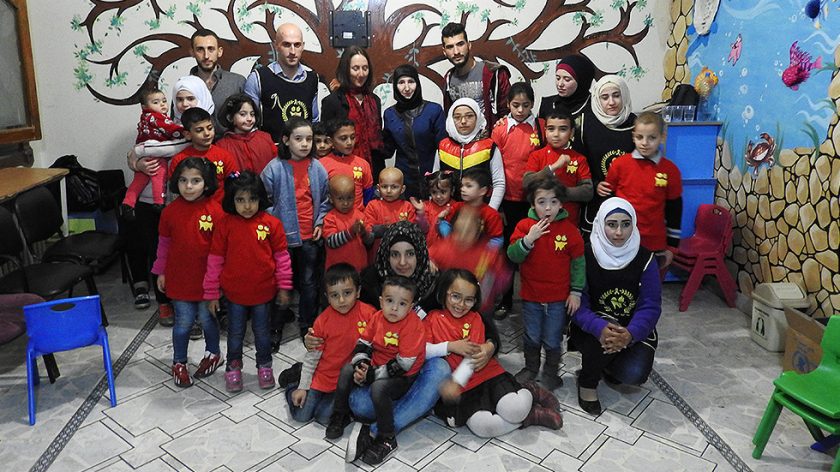
Children with cancer couldn’t get adequate treatment due to sanctions (photo Aleppo 2016)
By Eva Bartlett | RT | December 16, 2019
The US has a favourite tool for bullying non-compliant nations: sanctions. Sanctions inflict considerable suffering, even death, on ordinary people in targeted nations. Yet those defiant nations persist and resist.
A recent opinion piece in the Washington Post proposing a new oil-for-food scheme, this time in Venezuela, surprisingly acknowledges that sanctions “can also end up harming the people that they intend to protect.”
Okay, first off, we know there is no intention of “protecting” civilians in any of the countless countries targeted by Western sanctions. Do Western talking heads really think we’ve forgotten the half-a-million dead Iraqi children, thanks to US sanctions?
Yet, ask a Western leader about crippling sanctions placed on nations which don’t bow to Imperial demands and you’ll be met with some nonsensical explanation that sanctions only target ‘regimes’ and ‘terrorists,’ not the people.
I’ve lived in, spent considerable time in, or visited areas under sanctions and siege, and I’ve seen first hand how sanctions are a form of terrorism, choking civilians, depriving them of basic and urgent medical care, food, employment, and travel entitlements that many of us in Western nations take for granted.
When I was in Syria last October, a man told me his wife had been diagnosed with breast cancer, but because of the sanctions he couldn’t get her the conventional treatments most in the West would avail of.
In 2016, in Aleppo, before it was liberated of al-Qaeda and co, Dr. Nabil Antaki told me how –because of the sanctions– it had taken him well over a year to get a simple part for his gastroenterology practise.
In 2015, visiting Damascus’ University Hospital, where bed after bed was occupied by a child maimed by terrorists’ shelling (from Ghouta), a nurse told me:
“We have so many difficulties to ensure that we have antibiotics, specialized medicines, maintenance of the equipment… Because of the sanctions, many parts are not available, we have difficulties obtaining them.”
Visiting a prosthetic limbs factory in Damascus in 2016, I was told that, due to the sanctions, smart technology and 3D scanners –used to determine the exact location where a limb should be fixed– were not available. Considering the over eight years of war and terrorism in Syria, there are untold numbers of civilians and soldiers in need of this technology to simply get a prosthetic limb fixed so they can get on with their lives. But no, America’s concern for the Syrian people means that this, too, is near impossible.
In 2018, Syria’s minister of health told me Syria had formerly been dubbed by the World Health Organization a “pioneer state” in providing health care.
“Syria had 60 pharmaceutical factories and was exporting medicine to 58 countries. Now, 16 of these factories are out of service. Terrorists partially or fully destroyed 46 hospitals and 620 medical centres.”
I asked the minister about the complex in Barzeh, targeted with missile strikes by the US and allies in April 2018. Turns out it was part of the Ministry of Health, and manufactured cancer treatment medications, as well as antidotes for snake or scorpion bites/stings, the antidote also serving as a basic material in the manufacture of many medicines.
Last year, Syrian-American doctor Hussam al-Samman told me about his efforts to send to Syria chemotherapy medications for cancer patients in remission. He jumped through various hoops of America’s unforgiving bureaucracy, to no avail. It was never possible in the first place.
“We managed to get a meeting in the White House. We met Rob Malley, a top-notch assistant or adviser of Obama at that time. I asked them: ‘How in the world could your heart let you block chemotherapy from going to people with cancer in Syria?’
They said: ‘We will not allow Bashar al-Assad to have anything that will make people love him. We will not support anything that will help Bashar al-Assad look good’.”
Fast forward to the present: in spite of the sanctions, or precisely because of the sanctions, Syria recently opened its first anti-cancer drugs factory. President Assad is, again, looking rather good to Syrians.
UN expert: Sanctions on Venezuela “a form of terrorism”
Alfred de Zayas, the human rights lawyer and former UN official, aptly calls sanctions a form of terrorism, “because they invariably impact, directly or indirectly, the poor and vulnerable.”
Earlier this year, The Center for Economic and Policy Research estimated 40,000 deaths had occurred due to sanctions in 2017-2018.
While in Venezuela in March this year, I spoke with people from poor communities about the effects of sanctions. Most I met were very well aware of the US economic war against their country, and rallied alongside their government.
One woman told me:
“If you don’t have water, don’t have electricity, the basics, how would you feel, as a mother? This makes some of the population, that doesn’t understand about the sanctions, blame the government.”
Venezuela’s Foreign Minister, Jorge Arreaza, said during that visit:
“We told [American diplomat and Trump envoy] Mr Elliott Abrams, ‘the coup has failed, so now what are you going to do?’ He kind-of nodded and said, ‘Well, this is going to be a long-term action, then, and we are looking forward to the collapse of your economy.’”
Indeed, that collapse would come about precisely due to the immoral US sanctions against the Venezuelan people.
North Korean Youth: Sanction the USA
After visiting Korea’s north in August 2017, in a photo essay I noted: “The criminal sanctions against the North, enforced since 1950, making even more difficult the efforts to rebuild following decimation. The sanctions are against the people, affecting all sectors of life.”
And although most I met there were proud of their country’s achievements in spite of the sanctions, they were also vocal about the injustice of being bombed to near decimation and then sanctioned.
In a Pyongyang Middle School, to my questions about the sanctions, a girl replied:
“The sanctions are not fair, our people have done nothing wrong to the USA.”
Another boy spoke of the silence around America’s use of nuclear bombs on civilians: “Why do people all over the world give us sanctions? Why can’t we put sanctions on the US?”
At the Okryu Children’s Hospital, Doctor Kim Un-Song said: “As a mother, I feel extremely angry at the sanctions against the DPRK, even blocking medicine and instruments for children. This is inhumane and against human rights.”
As with Syria, sanctions on the DPRK prevent further entry to Korea of hospital machinery, as well as replacement parts.
Defying the sanctions
In spite of draconian sanctions, Syria, the DPRK and Venezuela continue to resist. After fighting international terrorism since 2011, Syria is rebuilding in liberated areas. That process could proceed more quickly were sanctions lifted, making it easier for companies outside of Syria to invest.
But Syria is managing, with its allies’ support, including that of North Korea, and due to the steadfastness of the heroic Syrian people, and its leadership.
Likewise, Venezuela and North Korea, facing America’s economic war and endless propagandistic rhetoric, continue to resist.
In each of these countries, I’ve met well-informed people who are fighting the sadism of the sanctions, and who are determined to remain free of US tyranny.
Eva Bartlett is a Canadian independent journalist and activist. She has spent years on the ground covering conflict zones in the Middle East, especially in Syria and Palestine (where she lived for nearly four years).
Featured Video
More Iran War fallout: Maritime insurance industry shifts from London to China
or go to
Aletho News Archives – Video-Images
From the Archives
The Biggest Threat to Peace in Middle East
By Dr. Elias Akleh* | Sabbah Report | May 24, 2010
A build up of heightened tension in the Middle East is escalating in the last few weeks. American and Israeli postures towards Lebanon, Syria, and Iran have become more threatening. Listening to speeches of political leaders one hears talks only about war not peace. Iranians and Israelis are continuously training hard for a possible showdown. Both sides are conducting extensive war games every month. This led Syrians to claim that Israel is preparing for a soon-to-come another war. The Jordanians also are warning that current stalemate of the peace process is an indication of a war breaking out this summer. The Russian President and his army chief hinted, a few months ago, that the US and Israel were planning for an attack on Iran.
Indeed Iran is, as it has been for last few years, the target of most of the threats and accusations of supporting terrorism. Escalating incitement against Iran the American Defense Department sent last month (April) to Congress a report on Iran’s military claiming Iran could develop intercontinental ballistic missiles capable of reaching the US by 2015.
Ignoring the fact that N. Korea, India, Pakistan, and Israel are proven to have nuclear weapons while Iran does not, the US Secretary of State Hillary Clinton chose in her speech, to the nuclear Non-Proliferation Treaty review conference at the UN, to focus on Iran’s alleged nuclear ambitions putting the whole world at risk as she put it. According to Clinton Iran’s acquisition of nuclear weapons, rather than Israel’s more than 200 nuclear bombs, is destabilizing the Middle East. She called on the world’s nations to rally around US efforts to hold Iran, not other nuclear countries, to account.
The accusation that Usama Bin Laden is living comfortably in Iran had received a boost after the broadcast of a documentary called “Feathered Cocaine”. This echoed the June 2003 claims of the Italian newspaper Corre de la Sierra that Bin Laden was in Iran according to some intelligence report, and according to Richard Miniter’s book “Shadow War”. … continue
Blog Roll
 Aletho News
- US Tells Allies That Ukraine-Bound Arms Could be Sent to Middle East
- Organized terrorism: Iran condemns killing of its diplomats in Lebanon
- Why could Gaza enter the regional war?
- Hamas official rejects Mladenov Plan linking disarmament to Gaza reconstruction
- Two Primary Elections for the Soul of ‘America First’
- Japan Clings to US Vassalage Despite Energy Crunch Caused By Iran War
- US Seeks Control Over Global Energy Infrastructure – Kremlin
- US senators target Orban government for standing up to Zelensky
- The deep-rooted culture of corruption in Ukraine
- Iran mobilizing one million soldiers to ‘create hell’ for any US ground assault: Report
- If Americans Knew
- Researchers at Human Rights Watch Resign Over Blocked Report on Palestinian Refugee Return
- Jewish Groups Are Backing a War Americans Don’t Want
- Eric Fingerhut Thinks He’s the President of the Jews
- Top Jewish Philanthropists, Rabbis Urge Israeli President to Take Action Against ‘Jewish Extremists’
- Don’t Be Fooled. Zionist Leaders Have Always Wanted to Control Southern Lebanon
- Israel’s widespread use of torture is a core element of its genocide against the Palestinian people
- In Israel’s War on Iran, Many Middle East US Bases Rendered “All But Uninhabitable”
- ‘Burn the lawn’: Israel pursues ‘Rafah model’ in southern Lebanon
- A genocide here, an amputation there
- Reports: Iran mobilizing 1M fighters, Israel-US run low on ammo, Israeli army faces shortage – Not a ceasefire Day 168
- No Tricks Zone
- Devastating Assessment Of Comirnaty Vaccine By Former Senior Pfizer Europe Toxicologist
- New Study: CO2 Is ‘Effectively Negligible’ As An Explanatory Climate Change Factor Since 2000
- Former Pfizer Toxicologist Dr. Helmut Sterz Tells Bundestag Hearing Pfizer Vaccine Should Have Never Been Approved
- Energy Expert: Germany’s Nuclear Phaseout Was A “500 Billion Euro Mistake”
- New Research: South Australia’s Mid-Holocene Sea Surface Temperatures Were 4°C Warmer Than Today
- Storing Green Energy To Last Germany 10 Days Would Require A 60-Million Tonne Battery
- New Studies: UK Sea Levels Were 4 Meters Higher Than Today During The Mid-Holocene
- Destructive Green New Deal: German Energy And Metal Group Warns Of Drastic Crisis
- New Study Documents A 20-Year Pause In Arctic Sea Ice Decline – Driven By Internal Variability
- Wake-up Call: Survey Shows Majority Of Germans Now Favor Postponing Climate Targets!
 Aletho News