UK tanker seizure violation of nuclear deal: Iran deputy FM
Press TV – July 28, 2019
Iran’s deputy foreign minister for political affairs says recent seizure of a supertanker carrying Iranian oil off Gibraltar was a violation of the nuclear deal signed between Iran and the world powers in 2015, officially known as the Joint Comprehensive Plan of Action (JCPOA).
Abbas Araqchi made the remarks while speaking to reporters in Vienna, where he is attending another session of the JCPOA joint commission with the European parties to the deal.
“We have witnessed detention of a tanker carrying Iranian oil in Gibraltar, which in our opinion, is a violation of the JCPOA, because member states to the JCPOA should not create any obstacle on the way of Iran’s oil exports,” the Iranian top diplomat said.
Araqchi added, “During this period, there have been other developments, which amount to violation of the JCPOA and this is why we requested this meeting to be held.”
On Thursday, July 4, the British overseas territory Gibraltar said it had seized a supertanker on suspicion of carrying crude oil to Syria in violation of European Union (EU) sanctions against the Arab country.
Gibraltar Chief Minister Fabian Picardo said the territory’s police and customs agencies, aided by a detachment of British Royal Marines, had seized the Grace 1 vessel.
Iran’s Foreign Ministry summoned Britain’s ambassador to the country the same day, with Foreign Ministry spokesman Abbas Moussavi saying, “We declared to the ambassador that this move amounts to strange unconventionality, because the sanctions that they have announced are not based on the Security Council [resolutions] and the Islamic Republic of Iran does not accept this measure (seizure of the tanker).”
Elsewhere in his remarks, Araqchi said many developments took place during the past month, which made holding an extraordinary meeting of the JCPOA Joint Commission urgent.
“During the previous meeting of the Joint Commission we decided to hold a foreign ministerial meeting as well and this issue is still on the agenda and we hope to prepare a clear and tangible schedule for the ministerial meeting as soon as possible,” Araqchi said.
Before the meeting started in Vienna, Araqchi met and conferred with Helga Schmid, deputy to the European Union’s foreign policy chief Federica Mogherini, as well as representatives of China and Russia.
US President Donald Trump withdrew Washington in May 2018 from the multilateral nuclear accord, officially known as the Joint Comprehensive Plan of Action (JCPOA), which was reached between Iran and six world powers in 2015.
Afterwards, Washington re-imposed unilateral sanctions on Iran that had been lifted under the deal.
On Friday, June 28, the remaining signatories to the nuclear agreement met in the Austrian capital as a last-ditch effort to save the accord after the US withdrew last year.
Following the meeting, Araqchi said progress was made in Vienna talks aimed at saving the JCPOA, but the demands of the Islamic Republic are yet to be met.
“It was a step forward, but it is still not enough and not meeting Iran’s expectations,” Abbas Araqchi told reporters on Friday after almost four hours of talks with senior diplomats from Britain, China, France, Germany and Russia.
‘We’re Aligned With US Policy’: Bolsonaro Refuses to Supply Fuel to Iranian Cargo Ships
teleSUR | July 25, 2019
Since the beginning of June, two Iranian commercial ships have been stranded at the port of Paranagua, in the state of Parana, in Brazil because the state-owned company, Petrobras has so far refused to supply fuel to them, in line with sanctions imposed by U.S. President Donald Trump on Iran, according to comments made by President Jair Bolsonaro to reports earlier this week.
“You know we are aligned with the U.S. policy. That is why we do what we have to do,” replied Brazil’s far-right President Jair Bolsonaro when questioned about this unusual case, which happens despite the fact that the U.S. sanctions on Iran contemplate exceptions for the sale of food and medicine.
The vessels Bavand and Termeh entered Brazilian territory to load corn two months ago. In fact, one of them is already loaded with about 50,000 tons of corn that could be completely spoiled in a short time.
According to the Latin American news outlet Pagina 12, a third of all Brazilian corn exports go to Iran and a good part of the urea used in the Brazilian fertilizer industry comes from Iran. Iran also imports Brazilian soy and meat.
Both ships belong to Sepid Shipping, an Iranian company blacklisted by Washington. However, the fuel for the vessels was acquired by Eleva, a Brazilian urea importer. Throughout this commercial process, therefore, the diesel was not acquired by Iranian money.
However, Petrobras claims that the urea is one of the U.S. banned products, an argument that does not stand given the fact that the Eleva transaction occurred before May and was authorized from Washington.
On July 13, Iran’s ambassador to Brazil Seyed Ali Saghaeyan went to the foreign minister in Brasilia to request information on the situation of the stranded ships. “He left without hearing anything concrete. The issue must reach the Supreme Court,” Pagina 12 reported.
During his visit, the Iranian ambassador told officials that if the federal government refuses to supply diesel to the vessels, his country could easily find new suppliers of corn, soy and meat.
Although this possibility could mean “bad news” for the Brazilian agriculture industry, “there are no signs” that the Iranian ships impasse will affect bilateral trade relations, according to Bolsonaro’s Foreign Trade Secretary Lucas Ferraz.
Meanwhile, on Thursday morning, Brazilian Supreme Court President Dias Toffoli ruled that Petrobras must provide fuel to Iranian ships. The Bolsonaro government has yet to react to the ruling.
Historically Brazil has maintained a favorable trade balance in its relations with Iran. For instance, in the first half of 2019, Iran imported about 2.5 million tons of Brazilian corn, while the South American country exported goods to Iran for US$1.299 million and bought Iranian products for US$27 million, which means Brazil obtained a favorable trade balance of US$1,272 million
UK court rejects Iran claims for £20m interest on old defense deals
Press TV – July 26, 2019
A top court in Britain has dismissed a complaint lodged by Iran seeking at least £20 million in interest for a debt related to a series of defense deals signed before the Iranian revolution of 1979.
Judge Stephen Phillips from the High Court in London ruled on Friday that the UK does not have to pay the sum that Iran believes has accrued on £387 million owed to Tehran over the failed delivery of more than 1,500 Chieftain tanks and armored vehicles based on contracts signed as of 1971.
The judge said the interest was accumulated over a 10-year period when Iran was under sanctions. The ruling also asserted that there was still ambiguity for the UK to decide to which Iranian government body it should pay the main debt so that it could avoid current sanctions.
The ruling deals a fresh blow to efforts meant to reduce tensions between Iran and Britain as the two countries are locked in several disputes, including two recent ship seizure incidents and a high-profile legal case related to the imprisonment of several dual nationals.
Britain has repeatedly refrained from paying the debt it acknowledges it owes to Iran, citing illegal sanctions imposed by the United States on Tehran.
Newly-appointed Prime Minister Boris Johnson once briefed the journalists in February 2018 after a trip to Tehran as foreign minister that the money will be paid back.
However, the payment never took place to the irritation of Tehran which thinks London is trying to use the case to solve other problems, including the much-publicized imprisonment of Nazanin Zaghari Ratcliffe, an Iranian-British national who is in jail in Iran for espionage convictions.
The court ruling also comes amid renewed tensions in the Persian Gulf where Iran has refused to release a British tanker since it was seized last Friday for violation of maritime rules.
The incident came two weeks after British marine forces boarded a supertanker laden with Iranian oil near the UK overseas territory of Gibraltar.
Iran Delenda Est
By Stephen J. Sniegoski • Unz Review • July 25, 2019
After Carthage had been significantly weakened by Rome in the Second Punic War (218 to 201 BC), Cato the Elder, a leading Roman senator, is said to have ended all his speeches with the words: “Carthago delenda est!” (“Carthage must be destroyed!”). This destruction ultimately took place in the Third Punic War (149–146 BC). A somewhat similar situation exists today in the United States, where war hawks demand that Iran–which in no way could effectively attack the United States, or even conquer America’s Middle East so-called allies—be stripped of its ability to protect itself.
Of course, what makes the American situation different from ancient Rome’s is that Rome sought to eliminate Carthage for its own interests whereas the United States is largely acting to advance the military interests of Israel (and to a lesser extent Saudi Arabia) because of the immense power of the Israel lobby in the United States. In short, the destruction of Iranian power would enable Israel to solidify its dominance of the Middle East.
An insightful article by James North notes: “Iran in 2019 is no danger to U.S. interests anywhere. . . . The U.S. is squeezing Iran mainly because Israel wants it to. . . . Iran is the only regional power that is deterring him [Netanyahu] from completely annexing the West Bank. Iran is also a major supporter of Hamas, the resistance movement in Gaza.”
As North points out: “Israel wants the Iranian government destroyed, and Netanyahu has been instigating the United States for years to attack Teheran.” Obviously, Israel does not want any country in the Middle East to be able to contest its hegemonic power, which it maintains by virtue of its influence on the U.S. government and through its possession of top- level military weapons—especially its nuclear arsenal—the threatened use of which would likely cause the United States to intercede on Israel’s behalf to prevent a nuclear holocaust.
Support for Israel does not mean that American presidents have done everything sought by the Israel lobby, especially when it required outright war. Bush the Younger, for example, did not make war on Iran after defeating Saddam’s Iraq in 2003, although that was what Israel and its American supporters sought. And President Obama’s nuclear deal with Iran [Joint Comprehensive Plan of Action (JCPOA)] in 2015 to prevent its development of nuclear weapons was vehemently opposed by Israel and its American myrmidons because they regarded it as far too favorable toward Iran, especially since it would terminate sanctions that had been placed upon it.
While Iran is not allowed to develop nuclear weapons, a 2019 report by Stockholm International Peace Research Institute (SIPRI) described Israel’s nuclear arsenal as consisting of: “30 gravity bombs capable of delivering nuclear weapons by fighter jets; an additional 50 warheads that can be delivered by land-based ballistic missiles; and an unknown number of nuclear-armed, sea-launched cruise missiles that would grant Israel a sea-based second-strike capability.” Considering this completely unbalanced nuclear-arms situation, it would be reasonable to assume that Iran is threatened far more by Israel than Israel is by Iran. But that is not how the Alice-in-Wonderland U.S. media and politicians present the situation.
Israel and its American supporters wanted an overall diminution of Iranian military power—not just a restraint on nuclear power—which they contended would be enhanced by the increased wealth accruing to Iran due to the nuclear deal’s elimination of existing sanctions. Obama, however, held that he had maintained Israel’s military superiority over Iran. As Avi Schlaim, an Israeli historian, wrote: “Obama has given Israel considerably more money and arms than any of his predecessors. He has fully lived up to America’s formal commitment to preserve Israel’s ‘qualitative military edge’ by supplying his ally with ever more sophisticated weapons systems. His parting gift to Israel was a staggering military aid package of $38bn for the next 10 years. This represents an increase from the current $3.1 to $3.8bn per annum. It is also the largest military aid package from one country to another in the annals of human history.”
Donald Trump ran in the 2016 U.S. presidential election as something of a non-interventionist, especially promising to stay out of conflicts in the Middle East. Trump stated that “[w]e will stop racing to topple foreign regimes that we know nothing about, that we shouldn’t be involved with. Instead, our focus must be on defeating terrorism and destroying ISIS, and we will. Almost two year later, Trump would continue to repeat his non-interventionist promise when he stated on December 19, 2018, that “[w]e have defeated ISIS in Syria, my only reason for being there during the Trump Presidency.” However, from the beginning of Trump’s presidential campaign, his expressed non-interventionist position was negated by his staunch support for the interests of Israel.
Trump made the renegotiation of the Iran nuclear deal—a deal he described as disastrous—as one of his main foreign affairs campaign promises. Moreover, hardline supporters of Israel loomed large in his campaign team, such as son-in-law Jared Kushner, David M. Friedman, and Jason D. Greenblatt. And Trump selected Michael Flynn, a strong critic of Iran, who was a senior adviser to Trump during his presidential campaign and also his first national security adviser. Flynn’s pro-Israel credentials loomed large since he had coauthored a book, The Field of Fight: How We Can Win the Global War Against Radical Islam and Its Allies, with staunch neocon Michael Ledeen.
Trump’s advisers would become even more pro-Israel and anti-Iran with the addition of John Bolton, who played a significant role in bringing about the war on Iraq in 2003, as national security adviser in April 2018, and Mike Pompeo who became Secretary of State in April 2018. Both of these key figures have pushed for an attack on Iran.
Like many evangelical Christians, Pompeo is more supportive of Israel than most Jews. He has said that it is “possible” that Trump is meant to save the Jewish people, like Esther in the Old Testament, who used her wiles to prevent a massacre of Persian Jews.
Trump announced the U.S. withdrawal from the nuclear deal with Iran on May 8, 2018. This carried out his campaign promise and was something he could do unilaterally since the nuclear deal was a non-binding political agreement, not a treaty ratified by the U.S. Senate. Trump alleged that Iran was violating the agreement though there was no evidence for this. The International Atomic Energy Agency (IAEA), which was authorized to verify and monitor the nuclear deal, had repeatedly found Iran to be in compliance, and the Trump administration had not officially disputed IAEA’s assessment when the United States was still a member of the JCPOA.
After pulling out of the nuclear agreement, the United States was in the strange position of demanding that Iran still abide by it. Furthermore, the United States levied a series of sanctions which quickly had a devastating impact upon the Iranian economy.
On May 21, 2018 , almost two weeks after the United States exited from the nuclear deal, Secretary of State Pompeo, in a speech to the conservative Heritage Foundation, presented 12 demands (he would shortly add one more, human rights) for inclusion in any new nuclear treaty with Iran, most of which being unrelated to nuclear weapons. These requirements included: terminating support for any alleged terrorist groups—which meant groups hostile to Israel and Saudi Arabia, such as Hamas, Hezbollah, and the Houthis; removal of all forces under Iranian command in Syria, even though Iran played a significant role in defeating the Jihadi rebels there; disarming and demobilizing Shiite militias in Iraq, even though these militias played a major role in defeating ISIS; ending the Islamic Revolutionary Guard Corps’ support for alleged terrorists from the perspective of Israel and Saudi Arabia; ceasing Iran’s threatening behavior against its neighbors such as Israel, Saudi Arabia, and the United Arab Emirates; and ending threats to international shipping and cyberattacks. The totality of these requirements would have left Iran unable to defend itself against its enemies. In short, Pompeo’s demands could only be accepted by a government of a thoroughly defeated country. His demands emulated Rome’s treatment of Carthage after the Second Punic War before it was obliterated following the Third Punic War.
While the neocons and Israel firsters in his administration are pushing for war with the Iran, Trump acts as if he wants to avoid such a conflict. He certainly had the opportunity to launch war with Iran after it downed a U.S. surveillance drone—a massive RQ-4A Global Hawk costing around $130 million–over the Strait of Hormuz, which the United States claimed was in international waters. Whether this was true of not, the U.S. government has had a history of going to war over questionable, or outright false claims, such as the sinking of the U.S.S. Maine that led to the Spanish-American War; the alleged attack on an American ship in Gulf of Tonkin, which caused a much greater involvement in the Vietnam War; and the claim that Iraq had WMD, which ultimately led to the U.S. invasion of that country.
According to reports, Trump’s advisers were divided on how to respond. Bolton, Pompeo, and the CIA director, Gina Haspel, sought a military response, which Pentagon officials opposed. Trump initially called for a military strike on Iran in response but then aborted the mission at the last moment because, he claimed, it would lead to a large number of Iranian casualties, which was disproportionate to what Iran had done.
One interesting explanation for the non-attack put forth by the website Moon of Alabama provides some information that indicates that Trump planned a fake attack and instructed members of his administration to ask the Iranians for permission to bomb an area of their country that would not do any real damage. The Iranians, however, rejected this setup. While Trump’s explanation might seem questionable, given the myriad of leaks that have come out of his administration, it is hard to believe that this aforementioned strategy would be discussed, much less be proposed to Iran.
Trump realizes that war with Iran would not lead to any easy victory for the U.S. and would cause a devastating impact on the world oil market. He not only would want to avoid this situation per se but would grasp the likelihood that a war with Iran would entail a morass that would almost guarantee his defeat in the 2020 election, for it is quite clear that most Americans are opposed to such a war.
But how does this approach affect Israel and its American minions? Philip Weiss, a staunch Jewish critic of Israel, contends: “Trump’s climbdown represents a real defeat for the Israel lobby. Clearly Israel and its rightwing supporters wanted an attack on Iran and they did not get it.” But as I pointed out earlier, the Israel lobby does not get everything it wants especially when its plan might embroil the United States in a large war.
But what about Trump’s need for funds from large pro-Israel donors for the 2020 election? Last-minute funds from multi-billionaire Sheldon Adelson were quite likely the key to Trump’s hairbreadth victory in the 2016 election. Would he get support from Adelson and other pro-Zionist billionaires if he does not make war on Iran as they desire?
As pointed out earlier, if the United States were enmeshed in war with Iran, Trump would almost be guaranteed to lose the 2020 election no matter how much money Adelson and his fellow pro-Israel plutocrats contribute to his campaign. Also, this group will not be as crucial for Trump in the 2020 election because he has already amassed a large war chest, which was lacking in 2016. Moreover, Republican funders who provided monetary support to other Republican candidates in the 2016 primary election would have these funds available for Trump in 2020 since almost all would prefer Trump over any Democrat.
Furthermore, even if Trump does not make war on Iran, he has provided benefits to Israel and the Adelsons that the Democrats are not likely to offer. For example, Trump has moved the U.S. embassy to Jerusalem, recognized Syria’s Golan Heights as part of Israel, and, of course, placed heavy sanctions on Iran.
Moreover, Trump awarded the Presidential Medal of Freedom to Adelson’s wife, Miriam, and she has reciprocated, writing: “Would it be too much to pray for a day when the Bible gets a ‘Book of Trump,’ much like it has a ‘Book of Esther’ celebrating the deliverance of the Jews from ancient Persia?”
Given what Trump has already done for Israel and the Adelsons, it would be quite reasonable that the couple would believe that Trump would take a more militant stance toward Iran, even making war, in his second administration when he would not have to worry about re-election. Also, there is no evidence that any Democratic candidate for the presidency would do as much for Israel.
The fact of the matter is that by pulling out of Obama’s nuclear agreement and threatening sanctions on all countries that attempt to deal with Iran, the United States has already seriously weakened Iran, forcing it to greatly reduce its funding of Syrian groups and even its closest ally Hezbollah.
As an article in the Washington Post of May 18, 2019, points out: “Hezbollah, the best funded and most senior of Tehran’s proxies, has seen a sharp fall in its revenue and is being forced to make draconian cuts to its spending, according to Hezbollah officials, members and supporters.
“Fighters are being furloughed or assigned to the reserves, where they receive lower salaries or no pay at all, said a Hezbollah employee with one of the group’s administrative units. Many of them are being withdrawn from Syria, where the militia has played an instrumental role in fighting on behalf of President Bashar al-Assad and ensuring his survival.”
In addition to this diminution of support, Israel has been bombing Iranian targets in Syria. And Syria is of vital importance to Iran. Leading figures in Iran have referred to Syria as “a golden ring of resistance against Israel” and Iran’s “35th province.” Assad’s Syria has provided a conduit for arms from Iran to reach Hezbollah and, to a lesser extent, Hamas. With Iranian arms those groups play a critical role in Iran’s strategy to deter, and if necessary, retaliate against an Israeli attack on it. However, a weakened Hezbollah would not be able to effectively attack Israel, much less provide substantial help to Iran in combat with the United States.
But how long will the Iranian populace be willing to have their government supply its allies as their own standard of living continues to plummet due to the U.S. sanctions? Iran is not a totalitarian state, such as North Korea where the population is virtually under total control. There is considerable evidence that while the great bulk of the Iranian population is willing to undergo great sacrifice in defense of their own country, they are not willing to do the same in support of Iran’s allies. And a significant number of Iranians are already critical of these ties.
If the United States continues to rely on sanctions but does not attack Iran militarily, it could cause Iran to give up supporting its proxies, who themselves would have become weaker as a result of diminished support from Iran.
Although the current Iranian government could support some type of compromise peace, it certainly would not concede to the harsh demands put forth by Pompeo. Iranian Foreign Minister Mohammad Javad Zarif told NBC News that “room for negotiation is wide open” once the United States removes its stringent sanctions, but another Iranian official, presumably at the behest of Ayatollah Khamenei, who is the actual ruler of Iran, added that negotiations would not include Iran’s missiles.
What has been the result of Trump’s treatment of Iran? There has yet to be a Carthaginian peace that Israel and its American supporters would like. Iran will remain a power that could resist Israel. However, the sanctions have weakened Iran and its allies, which should mean that Iran will not be as aggressive as it has been, and thus Israel’s position in the Middle East has improved for the time being. Nonetheless, it is not apparent how long this will continue. And undoubtedly Israel and its American supporters will continue to believe, or at least pretend to believe, that Israel still faces annihilation unless the United States does more for it.
Israel-born Treasury official is at the center of U.S. policies on Iran
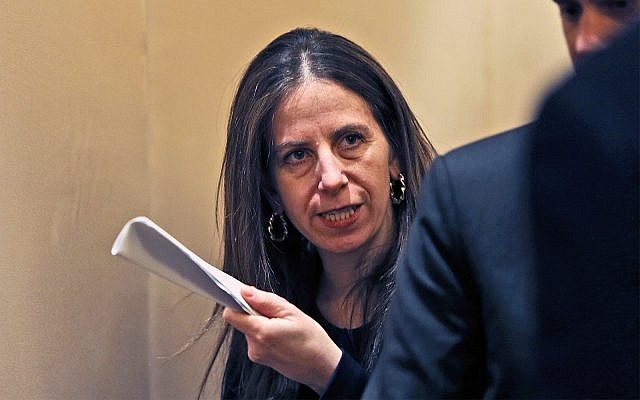
Sigal P. Mandelker, the undersecretary for terrorism and financial intelligence at the US Treasury in Dubai, UAE, July 12, 2018. (AP Photo/Kamran Jebreili, Jewish Insider )
At the Center of U.S. Iran policies is an Israel-born Treasury official named Sigal Mandelker. The Atlantic writes that her ‘hand is on the lever’ of crippling economic sanctions meant to force Iran’s ‘capitulation or demise’… meanwhile the Treasury Department refuses to divulge whether Mandelker is still an Israeli citizen… (Iran has long been in Israeli crosshairs)
By Alison Weir | If Americans Knew | July 23, 2019
According to a just published report in the Atlantic and a previous article by a former CIA officer, an Israeli-born individual is at the center of U.S. policies targeting Iran.
The Atlantic reports that financial sanctions are the “key tool” the United States has been using against Iran during “the past three presidential administrations.” And Treasury official Sigal Mandelker” is the one with her hand on the lever.”
According to the article, “Because Trump is anxious to avoid war with Iran but also eager to push the Iranians, she is one of the most powerful officials designing the strategy Trump’s administration hopes will force Iranian capitulation—or, failing that, perhaps even the government’s collapse.”
Mandelker has been working on governmental policies since 2006 – the year in which U.S. officials “focused on finding ways to cut off Iran from the global financial system.”
According to Mandelker’s Treasury Department bio, from 2006-2009, Mandelker served as Deputy Assistant Attorney General in the Criminal Division of the Department of Justice. Prior to that, she was Counselor to the Secretary of Homeland Security, “where she advised the Secretary and worked extensively on intelligence, national security, counterterrorism, and border security matters.”
In 2017 Mandelker was named Under Secretary of the Treasury for Terrorism and Financial Intelligence. As we will see, this office was created at the behest of Israel partisans. It provides a powerful position from which to direct policies.
In this position she is in charge of “developing and implementing U.S. government strategies to combat terrorist [sic] financing and money laundering… She oversees the operation and coordinates actions of the Office of Foreign Assets Control (OFAC), Financial Crimes Enforcement Network (FinCEN), the Office of Intelligence and Analysis (OIA), and the Office of Terrorist Financing and Financial Crimes (TFFC).”
In the years just before her 2017 Under Secretary appointment, Mandelker was a partner at Proskauer Rose LLP, a powerful, politically connected international law firm with ties to Israel. The pro-Israel website Algemeiner,* reports: “Historically, Proskauer Rose was known as a ‘Jewish’ law firm.” Partner Joseph M. Proskauer was “a Democratic Party stalwart, friend of politicians, state judge, civic and philanthropic personality, and major fund raiser for the state of Israel.”
Born in Israel
It appears that Mandelker is or was an Israeli citizen who was born in Israel. While this is periodically referred to in Israeli and Jewish media, the Treasury Department has refused to answer whether Mandelker is still an Israeli citizen, despite numerous email and phone inquiries requesting this information about a high U.S. official.
The information is particularly relevant since U.S. attacks on Israel’s neighbors are often pushed by Israel partisans concerned with maintaining Israeli hegemony in the region.
Dual citizenship became permissible in the U.S. in 1967 under a decision by the Abe Fortas Supreme Court in a case on behalf of Israel that broke a 200 year American tradition. Today, many Americans feel that such a potential conflict of interest by governmental officials should, at minimum, be divulged to the U.S. public, and perhaps disallowed.
Israel has long targeted Iran for attack.
From Israel’s earliest days, Ben Gurion wrote about the need to neutralize Israeli neighbors who might potentially support Palestinian rights. This strategy has also been enunciated in various strategy documents, including the Yinon Oded Plan and A Clean Break: A New Strategy for Securing the Realm (the realm was Israel).
Israel and pro-Israel groups in the U.S. have frequently promoted anti-Iran policies, despite the fact that U.S. intelligence agencies have found that Iran is not developing nuclear weapons and that accusations claiming this have proven unfounded. (Israel has in the range of 100-300 nuclear weapons and has refused to sign the Non-Proliferation Treaty, the only Middle East state that has not signed the NPT.)
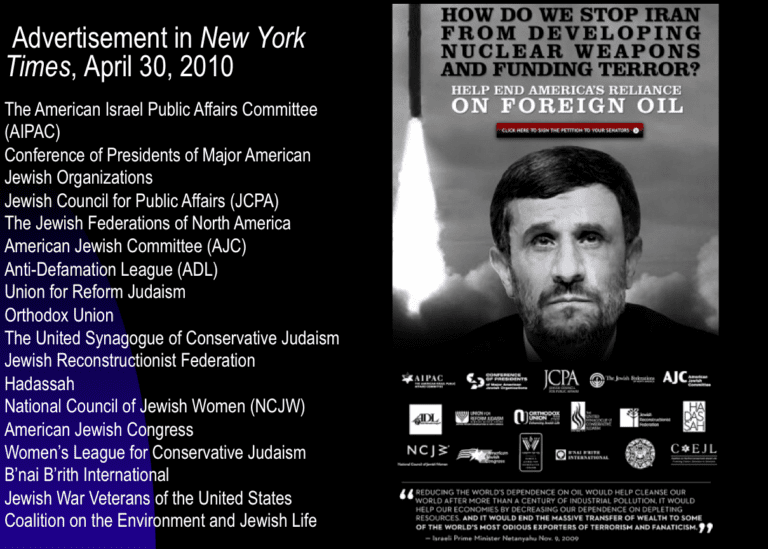
Advertisement placed in New York Times with the names of the sponsoring groups.
Israel partisans & Treasury’s “Office of Terrorism”
The Atlantic reports that Stuart Levey was the founding official in the role Mandelker now holds. Mideast analyst Grant Smith writes: “AIPAC and its associated think tank, the Washington Institute for Near East Policy (WINEP), were instrumental in lobbying the president for the creation of the Office of Terrorism and Financial Intelligence unit early in 2004. The Israel lobby also vetted Stuart Levey who President Bush approved to lead the new unit.”
Israel partisans continued to abound. Levey was then succeeded by David S. Cohen (Israel advocate Alan Dershowitz recommended Cohen for his first job, with Israel partisan Nathan Lewin). The Secretary of the Treasury, Steven Mnuchin, is also an Israel partisan.
Former CIA officer and current executive director of the Council for the National Interest Philip Giraldi investigated this situation and found that Israel partisans have pervaded the office. He writes:
… A key component in the Israeli penetration of the U. S. government has been President George W. Bush’s 2004 signing off on the creation of the Office of Terrorism and Financial Intelligence (OTFI) within the Department of the Treasury. The group’s website proclaims that it is responsible for “safeguarding the financial system against illicit use and combating rogue nations, terrorist facilitators, weapons of mass destruction (WMD) proliferators, money launderers, drug kingpins, and other national security threats,” but it has from its founding been really all about safeguarding Israel’s perceived interests. Grant Smith notes however, how “the secretive office has a special blind spot for major terrorism generators, such as tax-exempt money laundering from the United States into illegal Israeli settlements and proliferation financing and weapons technology smuggling into Israel’s clandestine nuclear weapons complex.”
The first head of the office was Undersecretary of Treasury Stuart Levey, who operated secretly within the Treasury itself while also coordinating regularly both with the Israeli government as well as with pro-Israel organizations like AIPAC, WINEP and the Foundation for the Defense of Democracies (FDD). Levey also traveled regularly to Israel on the taxpayer’s dime, as did his three successors in office.
Levey left OTFI in 2011 and was replaced by David Cohen. It was reported then and subsequently that counterterrorism position at OTFI were all filled by individuals who were both Jewish and Zionist. Cohen continued the Levey tradition of resisting any transparency regarding what the office was up to. Smith reports how, on September 12, 2012, he refused to answer reporter questions “about Israel’s possession of nuclear weapons, and whether sanctioning Iran, a signatory to the Treaty on the Non-Proliferation of Nuclear Weapons, over its internationally-inspected civilian nuclear program was an example of endemic double standards at OTFI.”
Cohen was in turn succeeded in 2015 by Adam Szubin who was then replaced in 2017 by Sigal Pearl Mandelker, a former and possibly current Israeli citizen. All of the heads of OTFI have therefore been Jewish and Zionist. All work closely with the Israeli government, all travel to Israel frequently on “official business” and they all are in close liaison with the Jewish groups most often described as part of the Israel Lobby. And the result has been that many of the victims of OTFI have been generally enemies of Israel, as defined by Israel and America’s Jewish lobbyists. OTFI’s Specially Designated Nationals And Blocked Persons List (SDN), which includes sanctions and enforcement options , features many Middle Eastern Muslim and Christian names and companies but nothing in any way comparable relating to Israel and Israelis, many of whom are well known to law enforcement otherwise as weapons traffickers and money launderers . And once placed on the SDN there is no transparent way to be removed, even if the entry was clearly in error.
Here in the United States, action by OTFI has meant that Islamic charities have been shut down and individuals exercising their right to free speech through criticism of the Jewish state have been imprisoned. If the Israel Anti-Boycott Act succeeds in making its way through congress the OTFI model will presumably become the law of the land when it comes to curtailing free speech whenever Israel is involved…
Mandelker frequently speaks movingly of her parents’ suffering under the Nazis. She seems to equate Iran with Hitler, despite the fact that Germany was defeated almost three-quarters of a century ago, and that today it is her birth country that is based on discrimination against people who are not of the preferred religion or ethnicity.
The economic policies Mandelker and others have engineered against Iran are creating significant humanitarian hardship, which seems to be the plan – just as Israel partisans worked to destabilize and eventually attack Iraq. Today, we are teetering on the brink of escalation that could again cost untold lives and damage the U.S. even more.
Perhaps it’s time for Americans to stop allowing the Treasury Department to be weaponized by partisans working in the perceived interests of a foreign country.
Alison Weir is executive director of If Americans Knew, president of the Council for the National Interest, and author of Against Our Better Judgment: The Hidden History of How the U.S. Was Used to Create Israel.
* According to Wikipedia, “The Algemeiner Journal, known informally as The Algemeiner is a New York-based newspaper, covering American and international Jewish and Israel-related news. Former Senator Joseph Lieberman described the paper and the Jacobson Foundation as “independent truth telling advocates for the Jewish people and Israel”.[2] The Algemeiner‘s Advisory Board was chaired by Nobel laureate, writer and activist Elie Wiesel…. In 1972, Gershon Jacobson founded the Yiddish-language Der Algemeiner Journal, after consulting with the Lubavitcher Rebbe Menachem Mendel Schneerson.[3] He served as editor and publisher from its inception until his death in 2005.[4]
Iran’s seizes UK tanker in counter-escalation
By M. K. BHADRAKUMAR | Indian Punchline | July 21, 2019
The seizure of a British oil tanker by the Islamic Revolutionary Guards Corps on July 20 in the Strait of Hormuz has all the hallmarks of a retaliatory act in the downstream of the seizure of an Iranian tanker by the British Navy exactly two weeks ago on July 4 off Gibralter.
On July 16, Iran’s Supreme Leader Ali Khamenei had warned, “Iran will respond to the vicious Britain’s piracy. Iran’s response will come at the right time and the right place.” Four days alter, IRGC struck. An IRGC statement gave a detailed account of what happened. Footage of the incident has also been released — just as Britain did.
Iran is taunting Britain and making it look foolish. Britain is now left with no option but to negotiate. And the outcome of any negotiations can be easily foretold — Britain will have to unceremoniously set free the Iranian tanker.
Quite obviously, the seizure of the Iranian tanker by Britain was done in tandem with the hardliners in Washington and it is by now clear that the EU distanced itself from it. Britain’s dilemma now will be that all its ships in the Strait of Hormuz are in Iran’s crosshairs.
Yesterday’s incident was a calculated act by the IRGC, enacted right under the nose of a British warship, which was escorting the tanker. When the warship threatened to open fire, IRGC retorted that it would also retaliate with fire. Thereupon, an Iranian helicopter dropped masked men on the British tanker and took control of it. The intention is to make the Brits look impotent and stupid. (See the Press TV commentary The Royal Navy: From Piracy to Impotence.)
In a broader perspective, therefore, it appears that Iran may have underscored that its earlier threat must be taken very seriously — that if its oil exports ever got intercepted or blocked, then no one will be allowed to export oil via the Strait of Hormuz.
****
On July 17, Iran’s semi-official news agency Fars News had carried an interview with me (in Persian) on the seizure of the Iranian oil tanker by Britain and its likely consequences as well as the related issues of the Iran-EU cogitations over the mechanism known as INSTEX, which Brussels has put in place to circumvent US sanctions against Iran.
In the context of yesterday’s incident in the Straits of Hormuz, my interview with the Fars correspondent Mahdi Khodabakhsh may be of interest. The English translation of the interview follows:
‘Indian diplomat: British action against Iran on behalf of the United States.’
QUESTION: As you know, some days ago UK royal navy seized a Tanker containing Iranian crude oil off Gibraltar. UK claimed it was bound to Syria which is under sanctions. Do you think UK’s move was legal? What does the international law say about it?
ANSWER: As far as I can gather from media reports, the legality of the British action is highly questionable. Syria is not under any UN sanctions and under international law, there is no embargo on oil supplies to that country.
QUESTION: How do you see the development and what effect it can have on Iran relations with EU? (also considering recent JCPOA tensions)
ANSWER: This is an act of blatant provocation with a view to inciting an Iranian reaction that could in turn be used as an alibi for some other downstream action by the US. I cannot see how the EU can endorse the British action because the group has no such policy to enforce a naval blockade of Syria. At least, I have not seen any EU country endorsing the British action so far. There are also signs that UK is seeking some sort of a patch-up with Iran, while saving face, because the international opinion did not support the British action.
QUESTION: In your opinion would it be proper for Iran – in this tense situation – to react to the UK’s move and do something retaliatory? If No, why is that; and if Yes what could the response be?
ANSWER: I have no doubt that Iran views the British belligerence with utmost seriousness and there will be consequences. Having said that, in my opinion, it is only proper that Iran has refused to be provoked into any knee-jerk response but is taking its own time. There could be a range of responses that Iran could consider, but importantly, Iran should only give a measured response that does not provide excuses for the US for doing something reckless or aggressive. The US or the so-called B Team, to my mind, has most likely instigated the British action. This is a surcharged atmosphere and Iran has so far acted with restraint and dignity — and rationally.
QUESTION: As we know, Iran started taking a second step in reducing its obligations under JCPOA from yesterday due to Trump’s unilateral withdrawal from the deal and of course because Iran did not benefit from economic relief. So how do you think the EU and other remaining parties in JCPOA will react to these steps by Iran? Are they going to trigger the dispute mechanism and snap-back lifted UN sanctions?
ANSWER: The EU foreign ministers meeting in Brussels on Monday reportedly took the decision that the situation does not warrant any move to trigger the dispute mechanism or to demand snap-back sanctions.
QUESTION: Yesterday EU ministers held a meeting in Brussels with a focus on the Deal however many of the diplomats including French, Britain, German, Dutch, Finnish Foreign Ministers and even Mogherini called on Iran to stay committed unilaterally to the JCPOA but say nothing about US withdrawal. Do you think with this trend,the JCPOA will survive? Considering the European partners’ inaction against US sanctions on Iran and its unilateral withdrawal from the deal, despite the 14 month period Iran given to them for some efforts; do you think that the EU really wants the JCPOA? Are they sincere in what they say about the Iran deal? The UK, Britain and France tried to put together a mechanism to evade US sanctions for trading with Iran called INSTEX. However Tehran says it was not fruitful. How do you elaborate its effectiveness to benefit Iran from JCPOA economic relief? Is the US capable of sanctioning the whole INSTEX?
ANSWER: The EU is walking a fine line. It is unrealistic to expect the US’ European allies — make no mistake, there are still allies — to publicly condemn Washington even if they disagree fundamentally on the Trump administration’s decision to withdraw from the JCPOA. Clearly, the EU is keen that the JCPOA survives and there should be no doubt on that score. One can see that the EU is on the defensive, as it realises that the EU and the E3 have not been able to fulfil their obligations under the JCPOA. What they are trying to do, in my opinion, is to mitigate to some extent Iran’s losses. As of now, there is a visible shortfall. The issue is not about sincerity but about politics, which is the art of the possible.
The INSTEX has just become operational. The EU foreign policy chief Mogherini is on record that the mechanism is fleshing out some business proposals already. She also said that certain non-EU third parties have shown interest in the INSTEX. These are encouraging signs. To my mind, these are early days and it is difficult to pass final judgment. Mogherini claimed that the E3 are also discussing the feasibility of oil trade being included in the INSTEX mechanism.
As things stand, the US may see the INSTEX as contravening its sanctions and the ‘maximum pressure’ policy. But then, on the other hand, the US is also interested that the JCPOA survives (according to Mogherini.) Therefore, a pragmatic US attitude toward INSTEX cannot be ruled out, either. As I said earlier, this is an evolving situation.
‘Trump assigns Rand Paul as Iran liaison’
Press TV – July 17, 2019
US President Donald Trump has reportedly assigned Sen. Rand Paul (R-Ky.) as a liaison to Iran in a stated effort to de-escalate tensions with Tehran.
Trump signed off the proposal this weekend, four US officials told Politico on Wednesday.
The report was released a day after Trump and his state secretary, Mike Pompeo, spoke of “progress” and “deal” with Iran.
According to Politico, assignment of the “dovish” Kentucky Republican could hamper the administration’s so-called “maximum pressure” campaign.
On Saturday, Paul played a round of golf with the president at his club in Sterling, Virginia, along with Sens. Lindsey Graham (R-S.C.) and David Perdue (R-Ga.).
Neither the White House nor Paul’s office has commented about US media questions on a meeting between Paul and Iranian Foreign Minister Mohammad Javad Zarif, who is currently in New York.
The anti-war senator waned Pompeo during an April hearing on Capitol Hill about going to war with Iran through bypassing congressional approval.
“You do not have the permission of Congress to go to war with Iran,” Paul told Pompeo. “Only Congress can declare war.”
The report came as restrictions were imposed on Zarif during his New York visit.
Tehran has said that the restrictions imposed on Zarif, travelling between the United Nations and the Iranian UN mission or the Iranian UN ambassador’s residence, would not affect his “work schedule.”
The US is obliged to allow access to the United Nations, based on a 1947 agreement, involving UN headquarters.
US lawmakers introduce resolution for re-entry into Iran nuclear deal
Press TV – July 16, 2019
Lawmakers in the Democratic-controlled US House of Representatives are introducing a resolution to for Washington’s re-entry into the Iran nuclear deal, which President Donald Trump quit.
Reps. Barbara Lee (D-CA), David Price (D-NC), and Jan Schakowsky (D-IL) introduced the resolution Tuesday, urging the administration to re-enter the Joint Comprehensive Plan of Action (JCPOA).
“Trump’s Iran policy is responsible for this self-inflicted crisis,” said Lee (pictured below). “As someone who played a key role in building Congressional support for the JCPOA, it is disappointing to find ourselves dangerously close to a military confrontation with Iran because of the administration’s disastrous decision to unilaterally withdraw from the Iran deal on May 8, 2018. “

She further called on the administration to avoid military confrontation with Iran.
“We need serious and sustained diplomatic engagement to remove us from the path to war and on to a path of peace and diplomacy, and that’s what this critical resolution calls for,” she asserted.
Price, meanwhile, noted that the US unilateral pressure has failed to bring Iran to the negotiating table, an idea formerly reiterated by Iranian Foreign Minister Mohammad Javad Zarif, calling on Americans to “try respect” rather than anti-Iran threats.
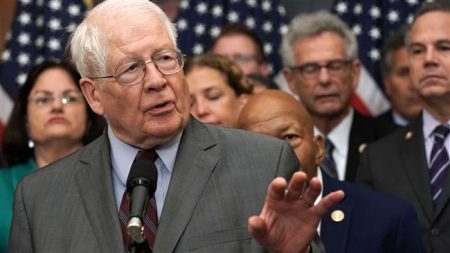
“If we look at current events, we see that President Trump’s rash decision to pull the US out of the Iran nuclear agreement has brought us no closer to bringing Iran to the negotiating table – it’s only emboldened Iranian hardliners, incentivized Iran to return to previously prohibited nuclear activity, and threatened our own credibility and leadership,” said the North Carolina congressman (pictured above).“This resolution sends a strong message from Congress to the administration: we must return to the JCPOA, and we must return to meaningful diplomatic engagement—peace, security, and United States leadership is at stake.”
Schakowsky, on the other hand, asserted that Trump has no Iran strategy or “vision in the Middle East.”
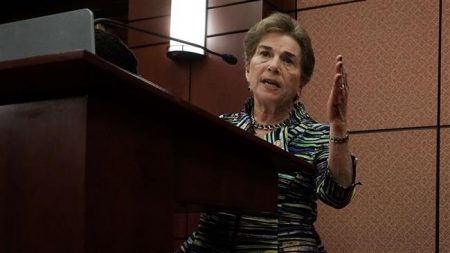
“With no strategy in Iran and no vision in the Middle East, President Trump’s reckless decision to pull out of the JCPOA has increased tensions around the world, pushed the United States closer to armed conflict with Iran, and severely diminished US leadership and leverage,” Schakowsky (pictured above) said. “We have been isolated from allies, have opened the door for Iran to become non-compliant, and have dissuaded other nations from negotiating agreements with the United States. It is time to bring Iran back into compliance, rejoin the JCPOA, and work with allies and partners on a diplomatic track to eliminate the threat of a nuclear Iran.”
The United States has quit the internationally backed nuclear deal and re-imposed illegal sanctions on Iran, which has responded by reducing its commitments under the agreement.
The UK, Germany, Russia, China and France are also signatories to the deal, inked after years of tough negotiations in 2015.
Iran Ready to Hold Talks With US if Sanctions Lifted – Rouhani
Sputnik -July 15, 2019
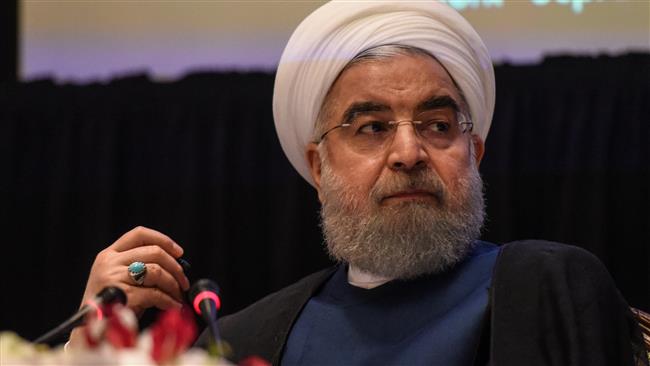
Iran is ready to hold negotiations with the United States if Washington lifts sanctions and gives up “bullying,” Iranian President Hassan Rouhani said on Sunday.
Earlier in the day, Berlin, Paris and London called for a dialogue between all parties of the Joint Comprehensive Plan of Action (JCPOA), saying the deal risks falling apart due to the US sanctions against Iran and Tehran’s decision to partially discontinue its obligations and.
“We are always ready for negotiation. I tell you this hour and this moment to abandon bullying and lift the sanctions and return to logic and wisdom. We are ready,” Rouhani said, as quoted by the Mehr news agency.
Rouhani added that Iran shifted its approach from “strategic patience” to “reciprocal action” and would respond in kind to any of Washington’s steps related to the nuclear deal.
On May 8, 2018, US President Donald Trump unilaterally withdrew his country from the JCPOA and imposed several consecutive rounds of economic sanctions on Iran. A year later, Tehran announced its own decision to partially suspend obligations under the deal and giving the other signatories – France, Germany, the United Kingdom, Russia, China and the European Union – 60 days to save the accord by facilitating oil exports and trade with Iran.
On July 7, as the deadline expired, Iranian Deputy Foreign Minister Seyed Abbas Araghchi announced that his country was ready to begin enriching uranium beyond the 3.67 percent level set in the JCPOA, adding that Tehran would go on gradually abandoning its nuclear commitments every 60 days.
Foreign Ministry: No ongoing negotiations between Iran, US at any level
Press TV – July 14, 2019
The spokesman for Iran’s Foreign Ministry says there are no ongoing talks between the Islamic Republic and the United States at any level, denying certain media reports in this regard.
Speaking to reporters on Sunday, Abbas Mousavi said, “The Islamic Republic of Iran is engaged in no negotiations with the American officials at any level.”
Mousavi was reacting to recent reports by certain social and other media outlets alleging that Iran has been in talks with the US through Russian mediation. They went as far as claiming that the talks were being conducted between the two countries’ foreign ministers.
Rumors about clandestine Iran-US talks come at a time that Iranian officials at various levels have said time and again that there would be no talks with Washington after the United States unilaterally left a nuclear deal with Iran, officially known as the Joint Comprehensive Plan of Action (JCPOA), and re-imposed tough sanctions against the country, which had been lifted under the deal.
On May 29, Leader of the Islamic Revolution Ayatollah Seyyed Ali Khamenei ruled out the possibility of talks between Tehran and Washington, saying such negotiations will be “fruitless,” “harmful,” and “a total loss.”
“The Islamic Republic of Iran will absolutely not sit for talks with America … because first, it bears no fruit and second, it is harmful,” the Leader said in a meeting with a number of university professors, elites and researchers in Tehran.
The Leader referred to negotiation as a tactic used by Americans to complement their strategy of pressure. “This is actually not negotiation; it’s rather a means for picking the fruits of pressure.”
The only way to counter this trick, he said, is to utilize the means of pressure available for use against Americans. “If they are used properly, the Americans will either stop or decrease pressures.”
on May 26, Iranian Deputy Foreign Minister for Political Affairs Abbas Araqchi met with Omani State Minister for Foreign Affairs Yusuf bin Alawi bin Abdullah in Muscat, categorically rejecting recent claims about the beginning of negotiations between the Islamic Republic and the United States with the goal of reducing tensions between the two sides.
Rejecting all reports about any form of direct or indirect talks with the United States, the Iranian diplomat emphasized, “The Islamic Republic of Iran is ready to establish balanced and constructive relations with all countries in the Persian Gulf region based on mutual respect and interests.”
Earlier in April, Iran’s President Hassan Rouhani said Washington’s claims of seeking negotiations with Iran were “mere lies” and that the United States, in fact, intended to force the Iranian nation to its knees.
Contrary to what some are trying to promote, “the US does not possess the willingness for negotiations at all,” the president told a cabinet session in Tehran.
“The actions that it is taking are aimed at defeating the Iranian nation” and “making a return” to Iran, he added, referring to Washington’s ample presence and influence in the country prior to the Islamic Revolution in 1979.
Ending the myth of the ‘Millionaire Mullah’
Part 1

By Ramin Mazaheri | Press TV | July 2, 2019
There are many pieces of nonsense about Iran, which are fervently believed in the West but which have zero credibility inside Iran. “Millionaire Mullahs” is a concept which has captivated the Western imagination, even though it has no basis in reality.
The idea of “Millionaire Mullahs” was conceived in 2003 by the uber-capitalist magazine Forbes. What’s worse, it was created by their longtime Russia editor during the age of Yeltsin, when neoliberal capitalism was shamelessly gutting all the nations of the former Soviet Union and transferring the longtime assets of the people/state to Western high finance.
The idea “sounds right” to Western ears for three likely reasons: they are often ardently secular and suspicious of all religious authority; they assume all Muslim religious authorities are as rabidly capitalist as the Roman Catholic Church has often been; and also because they know nothing about the revolutionary (unique) and inherently anti-capitalist post-1979 changes to the Iranian economy.
Let’s stop with the nonsense: being a mullah in Iran usually places one in the lower middle class. Iranian Shia clergy do not have extravagant lifestyles, and they have certainly chosen the wrong calling if that was their aim. Furthermore, the Iranian press – which casts an open and intensely critical eye on the government, contrary to Western perceptions – would absolutely have a field day were there any mullahs living the lavish lives of millionaires. The entire idea is absurd and – rather crucially – unproven.
The subject has come up again, due to the incredibly foolish sanctions by the US against Leader of Iran’s Islamic Revolution Ayatollah Seyyed Ali Khamenei.
Ayatollah Khamenei, like his predecessor in the Leader post, Ruhollah Khomeini, and his family are known by all Iranians for living simple lifestyles and for possessing absolutely common levels of personal wealth. How does all of Iran know this? Well, doesn’t everyone in the US know the general financial background of Trump?
But first, a bit of background for non-Iranians: Ayatollah Khamenei is from clerical families on both sides of his parents. They were not rich clerics, but lower-middle class, like the majority of Iranian clergy. The 1979 Revolution was decidedly class-based — it was called “the revolution of the barefooted” — and this extended to the clerical class as well, so it should not be surprising that someone from Ayatollah Khamenei’s class background rose so high.
Because clerics are humans, they have a right to have varied personal interests: ex-Iranian President Hashemi Rafsanjani was rather an Iranian Islamic Revolution anomaly – a revolutionary cleric from a rich background (pistachio farmers) – and he had a personal interest in the affairs of business. It is common knowledge that Ayatollah Khamenei has never evinced this interest, and nor have his several brothers, who are also clerics – the family’s interests are clearly religion and politics.
Furthermore, simply check out his speeches on YouTube (and perhaps while you still can do so, as Press TV was banned from YouTube in April): Ayatollah Khamenei is always discussing the example of his namesake, Imam Ali, the personification of personal austerity in Islam. “Shia” means “partisan of Ali,” so non-Muslims should be able to easily imagine that if Ayatollah Khamenei was constantly exhorting everyone to follow “Pope” Ali’s worthy example, yet not following it himself, this would be cause for immediate and widespread comment among the highly-educated, very politically-involved Iranian general public.
So even the whiff of a mere rumor of personal embezzlement would be a major risk to Ayatollah Khamenei’s job status!
Part 2 will fully quote and explain the begrudging exoneration of Ayatollah Khamenei by one of his biggest adversaries – Western mainstream media – that there is “no evidence” that Ayatollah Khamenei has used Iran’s wealth to enrich himself. And, of course, there is no logical reason why he would thus tolerate theft and fraud among his fellow lower-ranking clergy who also work as civil servants.
Ayatollah Khomeini’s and Ayatollah Khamenei’s precedents of clearly living in a manner, which rejects worldly riches will certainly help produce this same type of Leader in the future, but whoever is the Leader at any time in the Islamic Republic of Iran will likely be forced to live lives of transparent piety and to display moral, spiritual and fiscal rectitude, which combined with self-sacrificing patriotism, is the very essence of the job. The Leader’s post is not that of a technocrat, as Western leaders are now often merely supposed to be; he is essentially called to act as the “soul of the nation,” and, I would also add, “of the government.”
Such values are anathema to Western secularism, which is a governmental philosophy that was certainly available in 1979 for Iranians to select. However, even atheistic secularists must concede that Western-style secularism was democratically rejected by Iranians, and this fact cannot be ignored no matter how disagreeable non-Iranians may find this fact.
To put it plainly: Does the West really think that Iranians don’t have a good sense of Ayatollah Khamenei’s personal morality? He has been living in the public eye longer than French President Emmanuel Macron has been alive, and the French all know about Macron’s privileged upbringing, marriage to a chocolate heiress who was his high school teacher, and Rothschild banker-paid lifestyle. An entire nation simply cannot be kept in the dark about the true personal nature of its leaders; people are not stupid, anywhere, and the Iranian press is far from being either non-existent or totally subservient to power.
You can take the average Iranian’s word for it: if Ayatollah Seyyed Ali Khamenei was living lavishly – or, living like every single Western CEO does – and with absolutely zero Western media condemnation, sadly – all of Iran would know it, and there would be serious repercussions.
This all explains why Iranians view the recent US sanctions on their Leader Ayatollah Khamenei as absurd and based on both propaganda and ignorance. The sanctions put The New York Times in a quandary: they had to choose between their iron-law Iranophobia and their equally unobjective anti-Trump editorial policy. Their jeering-but-accurate headline, “Iran Greets Latest US Sanctions with Mockery,” reflects that the anti-Trumpers drowned out the Irano-/Islamophobes on that day in their newsroom.
Beyond Ayatollah Khamenei, I can very briefly explain how and why the West can persist with their “Millionaire Mullah” mythology:
There are many economic principles that guide the Iranian economy, which have no basis in the West – they are, after all, “revolutionary.” Many are based on principles of Islamic charity and of Islamic finance; many are also based on anti-capitalist principles, which were obviously drawn from 20th century socialism. There are almost too many to list, but in Part 2 of this three-part article I will pick a few key ones, which specifically relate to clergy, and which – when added with Iranophobia – create such widespread and ignorant propaganda.
Ramin Mazaheri is the chief correspondent in Paris for PressTV and has lived in France since 2009. He has been a daily newspaper reporter in the US, and has reported from Iran, Cuba, Egypt, Tunisia, South Korea and elsewhere. He is the author of “I’ll Ruin Everything You Are: Ending Western Propaganda on Red China”.
Iran, Russia say US ‘was isolated’ at IAEA’s special meeting
Press TV – July 11, 2019
Tehran says the UN nuclear watchdog’s special meeting held at Washington’s request to win the Board of Governors’ support for its anti-Iran claims turned into another failure for Americans.
“Another failure for the US at the mockery of the IAEA’s Board of Governors,” Iranian Foreign Ministry Spokesman Seyyed Abbas Mousavi tweeted on Wednesday in reference to an emergency meeting of the 35-member Board of Governors of the International Atomic Energy Agency (IAEA) to discuss Iran’s nuclear program, which wrapped up with no conclusion earlier in the day in Vienna.
“The US was once again isolated by its own hands,” Mousavi added.
“The legal strength of the JCPOA [the Iran nuclear deal], the active diplomacy and the fruitful political and ethical record of Iran block all the paths to arrogant deal-breakers,” he added.
The meeting was held a few days after Iran increased the level of its uranium enrichment to 4.5%, which is beyond the limit set by the JCPOA. The move was part of the second phase of the country’s May 8 decision to reduce its commitments under the multilateral 2015 nuclear deal in reaction to the US violations and Europe’s inaction.
The emergency meeting was held at the request of US Ambassador to International Organizations Jackie Wolcott. Iran later criticized the US’ request as a “sad irony” as Washington is the party that has violated the deal first by unilaterally pulling out of it and imposing sanctions on the Islamic Republic.
The US had approached various delegations before requesting to convene the special meeting but in the end had to make the request itself, says Iran’s ambassador to the IAEA Kazem Gharib-Abadi.
“We have been informed that the United States were seeking to have some formal outcome of this meeting, something like a resolution […] but because they haven’t been in a position to convince the others to have their support for their claim, regarding consideration of Iran’s ceasing its implementation of the JCPOA, there has been no conclusion,” he told Press TV following the special session.
“The majority of the members of the Board supported the JCPOA, multilateralism and deplored unilateral actions of the US,” he added.
The Iranian envoy earlier told the IAEA’s special meeting that “the sadistic tendency of the United States to use illegal, unilateral sanctions as an instrument to coerce sovereign states and private entities should come to an end.”
‘US practically isolated’
The Russian Ambassador to the IAEA, Mikhail Ulyanov, also tweeted after the meeting that the US “was practically isolated on this issue”.
Ulyanov told the assembled diplomats it was an “oddity” that the meeting had been called by the US, “the country that declared the JCPOA to be a ‘terrible deal’”.
He said “in practice, it turns out that Washington is aware of the importance of the Plan (JCPOA).”
Also in a statement to the meeting, the UK, France, and Germany said such issues “should be addressed by participants to the JCPOA, including through a meeting of the Joint Commission to be convened urgently.”
The E3 at the same time called on Iran to implement its commitments under the 2015 nuclear deal in full despite the fact that Iran’s decision to reduce its commitments under the deal was made after Europe’s failure to live up to its side of the bargain.
The European parties to the JCPOA were supposed to compensate for the US withdrawal from the deal in May 2018 and the impact of its sanctions on the Iranian economy. Back in January, the E3 officially announced a special payment mechanism, known as the Instrument in Support of Trade Exchanges (INSTEX), which was aimed at facilitating trade with Tehran despite the US bans.
However, it took a long time for the trade channel to become fully operational. The first transaction is set to take place soon, but Iran says without injection of sufficient money into the channel, it cannot help the country reap the benefits of the deal.
“Iran would only accept the European financial mechanism known as INSTEX if it covers all countries rather than just the current ten, if it covers all items in the sanctions, rather than just food stuffs and medicine, and if it is sufficiently funded,” Gharib-Abadi told Press TV on Wednesday.
“We have told them that if they are not ready to put money in the INSTEX, so you have to consider the import of the Iranian oil, so that the money can go to the INSTEX to fund it,” he added.
Featured Video

Bombing Hitler’s Hometown
or go to
Aletho News Archives – Video-Images
From the Archives
The Biggest Threat to Peace in Middle East
By Dr. Elias Akleh* | Sabbah Report | May 24, 2010
A build up of heightened tension in the Middle East is escalating in the last few weeks. American and Israeli postures towards Lebanon, Syria, and Iran have become more threatening. Listening to speeches of political leaders one hears talks only about war not peace. Iranians and Israelis are continuously training hard for a possible showdown. Both sides are conducting extensive war games every month. This led Syrians to claim that Israel is preparing for a soon-to-come another war. The Jordanians also are warning that current stalemate of the peace process is an indication of a war breaking out this summer. The Russian President and his army chief hinted, a few months ago, that the US and Israel were planning for an attack on Iran.
Indeed Iran is, as it has been for last few years, the target of most of the threats and accusations of supporting terrorism. Escalating incitement against Iran the American Defense Department sent last month (April) to Congress a report on Iran’s military claiming Iran could develop intercontinental ballistic missiles capable of reaching the US by 2015.
Ignoring the fact that N. Korea, India, Pakistan, and Israel are proven to have nuclear weapons while Iran does not, the US Secretary of State Hillary Clinton chose in her speech, to the nuclear Non-Proliferation Treaty review conference at the UN, to focus on Iran’s alleged nuclear ambitions putting the whole world at risk as she put it. According to Clinton Iran’s acquisition of nuclear weapons, rather than Israel’s more than 200 nuclear bombs, is destabilizing the Middle East. She called on the world’s nations to rally around US efforts to hold Iran, not other nuclear countries, to account.
The accusation that Usama Bin Laden is living comfortably in Iran had received a boost after the broadcast of a documentary called “Feathered Cocaine”. This echoed the June 2003 claims of the Italian newspaper Corre de la Sierra that Bin Laden was in Iran according to some intelligence report, and according to Richard Miniter’s book “Shadow War”. … continue
Blog Roll
 Aletho News
- Bombing Hitler’s Hometown
- German journalist threatened with homelessness as German court upholds EU sanctions in landmark free speech case
- US Tells Allies That Ukraine-Bound Arms Could be Sent to Middle East
- Organized terrorism: Iran condemns killing of its diplomats in Lebanon
- Why could Gaza enter the regional war?
- Hamas official rejects Mladenov Plan linking disarmament to Gaza reconstruction
- Two Primary Elections for the Soul of ‘America First’
- Japan Clings to US Vassalage Despite Energy Crunch Caused By Iran War
- US Seeks Control Over Global Energy Infrastructure – Kremlin
- US senators target Orban government for standing up to Zelensky
- If Americans Knew
- Researchers at Human Rights Watch Resign Over Blocked Report on Palestinian Refugee Return
- Jewish Groups Are Backing a War Americans Don’t Want
- Eric Fingerhut Thinks He’s the President of the Jews
- Top Jewish Philanthropists, Rabbis Urge Israeli President to Take Action Against ‘Jewish Extremists’
- Don’t Be Fooled. Zionist Leaders Have Always Wanted to Control Southern Lebanon
- Israel’s widespread use of torture is a core element of its genocide against the Palestinian people
- In Israel’s War on Iran, Many Middle East US Bases Rendered “All But Uninhabitable”
- ‘Burn the lawn’: Israel pursues ‘Rafah model’ in southern Lebanon
- A genocide here, an amputation there
- Reports: Iran mobilizing 1M fighters, Israel-US run low on ammo, Israeli army faces shortage – Not a ceasefire Day 168
- No Tricks Zone
- Devastating Assessment Of Comirnaty Vaccine By Former Senior Pfizer Europe Toxicologist
- New Study: CO2 Is ‘Effectively Negligible’ As An Explanatory Climate Change Factor Since 2000
- Former Pfizer Toxicologist Dr. Helmut Sterz Tells Bundestag Hearing Pfizer Vaccine Should Have Never Been Approved
- Energy Expert: Germany’s Nuclear Phaseout Was A “500 Billion Euro Mistake”
- New Research: South Australia’s Mid-Holocene Sea Surface Temperatures Were 4°C Warmer Than Today
- Storing Green Energy To Last Germany 10 Days Would Require A 60-Million Tonne Battery
- New Studies: UK Sea Levels Were 4 Meters Higher Than Today During The Mid-Holocene
- Destructive Green New Deal: German Energy And Metal Group Warns Of Drastic Crisis
- New Study Documents A 20-Year Pause In Arctic Sea Ice Decline – Driven By Internal Variability
- Wake-up Call: Survey Shows Majority Of Germans Now Favor Postponing Climate Targets!
 Aletho News