Trump Has Lost All Leverage With Iran
By Marko Marjanović | Checkpoint Asia | June 20, 2019
I’m not buying Moon of Alabama’s theory that Iran is attacking the tankers — I think it’s plausible and I stand ready to change my mind if we get some evidence, but so far I have not seen more than conjecture so for me Iran is not the first suspect.
That said I agree that by going all in on the “maximum pressure” campaign Trump has in fact backed himself into a very unenviable position where he now has no leverage against Iran left.
Since it is obvious he doesn’t want war, but has already played all his cards short of war, Iran has now actually gained considerable freedom of action. It can shoot down US drones whether above Iran, or just over the Strait of Hormuz and what is Trump going to do about it?* Apply “maximum pressure”??
At most Trump could organize some kind of Syria-style limited strike but such a strike carries much more potential downside for him than for Tehran.
Limited missile and air strikes aren’t going to threaten the ayatollah and the Revolutionary Guards any more than they threatened Assad’s rule in Syria. They may actually boost the Revolutionary Guards who would get to pose as standing up to and defending the country against a super power.
While for Trump they would carry the danger of being seen as weak and inconclusive if Iran managed to mount a partially successful defense or retaliation, and cause him harm for 2020 as he satisfied neither the Iran war crazies nor the America firsters.
Trump should have kept some sanctions gunpowder in the magazine. Instead by firing off all of it he has disarmed himself.
* Albeit the drone that was shot down today may have been in Iranian airspace the US also claimed days earlier that Iranian forces had targeted a drone merely near its airspace.
False Identities Become the New Weapon: War with Iran Promoted by Fake Journalists

By Philip Giraldi | American Herald Tribune | June 17, 2019
One of the claims made about alleged Russian interference in the 2016 U.S. election was that Kremlin-controlled entities were using fake identities to create dissension and confusion on social network sites. This should surprise no one, if it is true, as intelligence operatives have been using false names since Sumerian times.
The concern over fake identities no doubt comes from the deception involved, meaning that if you are dealing with a real person you at least have some handle on making an assessment of what something means and what is likely to occur. A false persona, however, can pretend to be anything and can advocate or do something without any yardstick to measure what is actually taking place. In other words, if Mike Pompeo says something you know that he is a liar and can judge his words accordingly but if it is someone otherwise unknown named Qwert Uiop you have to wonder if he or she just might be telling the truth. You might even give them the benefit of the doubt.
A prime example of a false internet persona has recently surfaced in the form of an alleged “activist” invented by the Iranian terrorist group Mojahedin e Khalq (MEK). MEK is a curious hybrid creature in any event in that it pretends to be an alternative government option for Iran even though it is despised by nearly all Iranians. At the same time, it is greatly loved by the Washington Establishment which would like to see the Mullahs deposed and replaced by something more amenable to western and Israeli worldviews.

MEK is run like a cult by its leader Maryam Rajavi, with a number of rules that restrict and control the behavior of its members. One commentary likens membership in MEK to a modern day equivalent of slavery. The group currently operates out of a secretive, heavily guarded 84 acre compound in Albania that is covertly supported by the United States, as well as through a “political wing” front office in Paris, where it refers to itself as the National Council of Resistance of Iran.
MEK, which is financially supported by Saudi Arabia, stages events in the United States in Europe where it generously pays politicians like John Bolton, Rudy Giuliani and Elaine Chao to make fifteen-minute speeches praising the organization and everything it does. It’s paying of inside the Beltway power brokers proved so successful that it was removed from the State Department terrorist list in 2012 by Hillary Clinton even though it had killed Americans in the 1970s. MEK also finds favor in Washington because it is used by Israel as a resource for anti-Iranian terrorism acts currently, including assassinations carried out in Tehran.
MEK’s fake journalist, who has recently been exposed by The Intercept, is named Heshmat Alavi. He, or if you prefer “it,” has very successfully gained access to a considerable body of generally conservative mainstream western media, including Forbes, The Hill, the Daily Beast and The Federalist. Alavi has placed scores of articles as “an activist with a passion for human rights,” aimed at discrediting Iran and its government while also subtly praising MEK as an alternative to the current regime. His bona fides have never been questioned, even by Forbes, which placed no less than 61 articles under the name between April 2017 and April 2018. The pieces appearing allegedly by Alavi are reportedly composed at a “troll factory” as a so-called “group account” in Albania where MEK members who belong to the organization’s “political wing” toil under tight security.
Alavi’s contribution to the damning of Iran has not been insignificant. An article written by him/it that appeared in Forbes claiming that the Mullahs had been able to increase their military budget due to having money freed up by the Joint Comprehensive Plan of Action (JCPOA) agreement. The article reached the White House and reportedly helped convince the Trump Administration to withdraw from the pact.

*(MEK members working in the ‘Twitter troll factory’ in Manez Camp, Albania)
To supplement the Alavi propaganda effort, MEK’s Albania operation uses banks of computers manned by followers, some of whom are fluent in English, who serve as bots unleashing scores of comments supporting regime change in Iran while also directing waves of criticism against any pro-Iranian pieces that appear on social media, to include Facebook and Twitter. By one account, more than a thousand MEK supporters manage thousands of accounts on social media simultaneously. The objective of all the chatter is to convince the mostly English-speaking audience that there is a large body of Iranians who are hostile to the regime and supportive of MEK as a replacement.
While the Iranian government and MEK might well be regarded by most Americans as a far-away problem, there was considerable shock expressed even by congress and the media when it was learned shortly before The Intercept’s revelations that the United States government had been funding a so-called Iran Disinformation Project that was employing tactics remarkably similar to those of MEK in an attempt to control the discussion over Iran policy.
The project, run by the State Department’s global engagement center, consisted of a trolling campaign which targeted online American citizens critical of the government’s Iran policy, labeling them as disloyal to the United States and tools of the Iranian government. It used, for example, the website IranDisInfo.org and the hashtag #NIACLobbies4Mullahs. Iranian-American activist and long-time State Department contractor Mariam Memarsadeghi headed the program, receiving hundreds of thousands of dollars to “relentlessly attack critics of the Iran policy on social media… accusing them of being paid operatives of the regime in Tehran.” In all, the “Iran Disinfo” operation received over $1.5 million through the Memarsadeghi contract entity the oddly named E-Collaborative for Civic Education.
The investigation of Iran Disinfo also revealed that the neoconservative Foundation for Defense of Democracies (FDD), which has been leading the charge for war with Iran, had at least one employee working with E-Collaborative. FDD, which has been advising the Trump White House on a more aggressive policy towards Iran, has also been actively involved in the State Department effort and cross-posting material from the Disinfo campaign.
FDD has long been targeting Iran. It received $3.63 million in 2017 from Bernard Marcus, co-founder of Home Depot. Marcus is a hard-core Zionist who hates Iran and once referred to that nation as “the devil.” FDD has also received billions from Las Vegas casino mega billionaire Sheldon Adelson, the GOP’s largest individual donor, who has advocated dropping a nuclear bomb on Iran to send a message. The link between major Republican donors supporting FDD and an increase in FDD quasi-overt cooperation with the Trump Administration in demonizing Iran should not surprise anyone.
Even though the State Department operation was relatively insignificant compared to similar initiatives undertaken by Israel, the idea that an ostensibly democratic government should propagate lies to defend its own policies was definitely unsettling. Some might think that disinformation on Iran is of little importance, that it has little impact on actual policy, but they would be wrong. Bad information that is allowed to circulate freely creates its own reality. Most Americans believe that Iran actually threatens the United States, though they would be at a loss to explain exactly how that could be the case. Dubious stories that originated with Reuters about corruption in Iran have been used by Mike Pompeo to justify sanctions against the regime on humanitarian grounds, measures which have ironically hurt average Iranians disproportionately. The same story was also used in at least four books to discredit the Iranian leadership.
To be sure, the mainstream media is itself largely at fault, as it was with Heshmat Alavi, for not vetting their sources more carefully, particularly when a story is clearly providing unique information or representing a point of view that might be considered controversial. In some cases, of course, the news outlet wants the story to be perceived as true even when it knows that it is not, so it becomes an accomplice in the propaganda effort. A recent attempt to create a mechanism to establish standards by determining the reliability of online news content has, in fact, been little more than a neoconservative scheme to discredit sites that do not support the neocon point of view.
Since governments and various non-governmental constituencies now, by their own admission, are heavily into the game of providing false information and discrediting critics, most Americans will completely tune out of the process, meaning that there will be little or no measurable difference between truth and lies. One already hears complaints from all across the political spectrum that most news is fake. When one reaches the point where such skepticism becomes the consensus, both elections and democracy itself will be rendered pretty much meaningless.
Philip M. Giraldi is a former CIA counter-terrorism specialist and military intelligence officer who served nineteen years overseas in Turkey, Italy, Germany, and Spain. He was the CIA Chief of Base for the Barcelona Olympics in 1992 and was one of the first Americans to enter Afghanistan in December 2001. Phil is Executive Director of the Council for the National Interest, a Washington-based advocacy group that seeks to encourage and promote a U.S. foreign policy in the Middle East that is consistent with American values and interests.
Iran can be Trump’s nemesis
By M. K. BHADRAKUMAR | Indian Punchline | June 15, 2019
What a coincidence that a leaked document from the Organization for the Prohibition of Chemical Weapons (OPCW) just exposed that the chemical weapons attack in Douma, Syria in April, 2018 was most likely staged. In security parlance, it was a false flag operation — stage-managed cunningly to create the alibi for a ‘humanitarian intervention’ by the West in Syria.
As it happened, the US and France did stage a missile strike at Syrian government targets in July that year, alleging that Damascus was culpable for what happened in Douma, ignoring the protests by Russia.
False flag operations are not uncommon, but the US holds a PhD on that genre. The most famous one in modern history was the Gulf of Tonkin incident of August 1964 where the US government deliberately misrepresented facts to justify a war against Vietnam.
Prima facie, there is enough circumstantial evidence to estimate that the attack on two tankers in the Gulf of Oman on June 13 has been a false flag operation. The attack on the two tankers with cargo heading for Japan took place just as the Japanese PM Shinzo Abe sat down for the meeting yesterday with Iran’s Supreme Leader Ayatollah Ali Khamenei in Tehran.
The fact of the matter is that Abe was on a delicate mission to try to kickstart talks between the US and Iran. It is one of those delicate moments when a slight push can derail or even undermine the nascent move for dialogue. True, in the first round, Khamenei rejected talks with the US. But, as Abe said later, more efforts are needed for easing tensions between the US and Iran.
Therefore, as regards the incident yesterday in the Gulf of Oman, the question to be asked is: Who stands to gain? Most certainly, it cannot be Iran, which has just laid on the table in plain terms what it takes for negotiations to commence between the US and Iran — President Trump abandoning what Tehran calls the US’ ‘economic terrorism’ against it. Khamenei told Abe with great frankness that it is futile to negotiate with the US, which keeps resiling from international agreements. No doubt, Trump has been highly erratic by making overtures to Iran on the one hand and tightening the screw on the other hand. (See my blog Abe’s mediatory mission to Tehran hangs in the balance.)
Simply put, Iran has no axe to grind by undermining Abe’s mission, especially since Japan is the only western power, which, historically speaking, never ever acted against Iran but on the contrary consistently maintained friendly ties and showed goodwill. (Once in 1953, Japan even ignored the British-American embargo against Iran and went ahead to import Iranian oil.)
However, this much cannot be said about certain regional states — which Iran has called the ‘B Team’ — that are bent on perpetuating the US-Iran standoff and incrementally degrade Iran to a point that a military confrontation ensues at some point in which American power dispatches that country to the “Stone Age”, as the present US National Security Advisor John Bolton once put it.
In this rogues’ gallery, apart from Israel, there is also Saudi Arabia and the UAE. Bolton, of course, is mentored by Israel and it is an established fact that he has received money for services rendered from the Mojahedin-e Khalq, the anti-Iran terrorist group based in France, which espouses the overthrow of the Islamic regime in Tehran.
Iran has sounded warnings in recent weeks, including at the level of Foreign Minister Javad Zarif, that this ‘B Team’ would at some point stage false flag operations to ratchet up tensions and/ or precipitate a crisis situation, that would in turn prompt Trump to order some sort of military action against Iran.
To be sure, the stakes are very high for Israel, Saudi Arabia and the UAE if Abe’s mission advances further and the current tensions begin to ease. An added factor for the ‘B Team’ is that time is the essence of the matter. It increasingly seems that Bolton’s job as NSA is in danger. Trump has hinted more than once that he does not subscribe to Bolton’s warmongering. The well-known ex-CIA officer and commentator John Kiriakou wrote this week that the White House has “very quietly and discreetly begun informal meetings with a list of a half-dozen possible replacements for Bolton.” (See the commentary in Consortium News titled JOHN KIRIAKOU: Bolton’s Long Goodbye.) It is crucial for the ‘B Team’ that Bolton keeps his job in the White House. And there is no better way to hold back Trump from sacking his NSA when a crisis situation looms large in the Middle East.
Be that as it may, the US Secretary of State Mike Pompeo has announced that Iran is responsible for the incident in the Gulf of Oman. He claimed in a statement, “This assessment is based on intelligence, the weapons used, the level of expertise needed to execute the operation, recent similar Iranian attacks on shipping, and the fact that no proxy group operating in the area has the resources and proficiency to act with such a high degree of sophistication.”
Now, doesn’t Israel too have the intelligence capability, weapons and expertise to execute such a false flag operation? Read Pompeo’s statement carefully and its laboured tone gives away that the ex-CIA Director (who recently even bragged openly about the art of lying in diplomacy and politics) was far from convincing.
So, where’s the beef? Pompeo has instructed that the UN Ambassador Jonathan Cohen raise the matter in the UN Security Council. There is an eerie similarity to what once one of Pompeo’s predecessors as state secretary, Colin Powell did — manufacturing evidence of WMD program by Saddam Hussein to pave the way for the US to invade Iraq.
What needs to be factored in is that the US anticipates that in another fortnight, Iran’s 60-day deadline for the European countries to come up with concrete steps to fulfil their commitments under the 2015 Iran nuclear deal will expire. The German Foreign Minister Heiko Maas’s visit to Tehran last week was a calculated attempt to persuade Iran to accept the stark reality that it must unilaterally fulfil its commitments under the nuclear deal while there is little the EU can do in practical terms to defy the US sanctions. Maas tried to persuade Iran to accept the US’ demand that non-nuclear issues (such as Iran’s missile programme, regional policies, etc.) also be negotiated under a new pact. Quite obviously, the European powers, despite their bravado (in words), are falling in line with Trump’s strategy of ‘maximum pressure’ against Iran.
If Iran decides to reject the idea of unilaterally observing the 2015 deal (without any reciprocal acts by the international community), the US and its western allies will want to take the matter to the UNSC to revive the UN’s past (pre-2015) sanctions against Iran. The big question is whether Russia and China would allow such a turn of events. Tehran has categorically denied any involvement in yesterday’s incident. And Iran is playing it cool. President Hassan Rouhani and Foreign Minister Javad Zarif left Tehran for Bishkek on June 13, as scheduled previously, to participate in the Shanghai Cooperation summit.
Meanwhile, the US has made an additional deployment to the region. But then, the US Central Command has also signalled to Tehran in a statement: “We have no interest in engaging in a new conflict in the Middle East. We will defend our interests, but a war with Iran is not in our strategic interest, nor in the best interest of the international community.”
At this point, the logical thing to do will be to insist on an impartial investigation by the UNSC on the incident. But, curiously, no country is willing to bell the cat. Russia, which is usually quick on demanding facts before reaching any definitive opinion on such murky situations, is also not in a hurry to demand investigation. Can it be that everyone understands that this was a false flag operation and could only be Bolton’s last waltz with Netanyahu?
Trump is walking a fine line. He has blamed Iran, but refrained from saying what he proposed to do. The fact remains that a highly dangerous situation is developing in and around the Straits of Hormuz, which is a choke point for oil tankers.
An entanglement with Iran’s Pasdaran is the last thing Trump would want as he plans to announce shortly his candidacy for the 2020 election. The situation is fraught with grave political risks, if one recalls how the Iran crisis spelt doom for Jimmy Carter’s re-election campaign in 1980.
Trump has bitten more than he could chew, as the strong rebuke Iran’s Supreme Leader Ali Khamenei administered to him underscores. Iran may turn out to be Trump’s nemesis.
Read the CNN ‘analysis’ here taunting Trump to walk the talk on Iran.
Convenient “Tanker Attacks” as US Seeks War with Iran
By Tony Cartalucci | New Eastern Outlook | June 13, 2019
… it would be far more preferable if the United States could cite an Iranian provocation as justification for the airstrikes before launching them. Clearly, the more outrageous, the more deadly, and the more unprovoked the Iranian action, the better off the United States would be. Of course, it would be very difficult for the United States to goad Iran into such a provocation without the rest of the world recognizing this game, which would then undermine it. – Brookings Institution, “Which Path to Persia?” 2009
For the second time since the United States unilaterally withdrew from the so-called Iran Nuclear Deal, Western reports of “suspected attacks” on oil tankers near the Stait of Hormuz have attempted to implicate Iran.
The London Guardian in an article titled, “Two oil tankers struck in suspected attacks in Gulf of Oman,” would claim:
Two oil tankers have been hit in suspected attacks in the Gulf of Oman and the crews evacuated, a month after a similar incident in which four tankers in the region were struck.
The article also claimed:
Gulf tensions have been close to boiling point for weeks as the US puts “maximum economic pressure” on Tehran in an attempt to force it to reopen talks about the 2015 nuclear deal, which the US pulled out of last year.
Iran has repeatedly said it has no knowledge of the incidents and did not instruct any surrogate forces to attack Gulf shipping, or Saudi oil installations.
The Guardian would admit that “investigations” into the previous alleged attacks in May carried out by the UAE found “sophisticated mines” were used, but fell short of implicating Iran as a culprit.
The article would note US National Security Advisor John Bolton would – without evidence – claim that Iran “was almost certainly involved.”
This news of “attacked” oil tankers near the Stait of Hormuz blamed by the US on Iran – comes all too conveniently on the heels of additional steps taken by Washington to pressure Iran’s economy and further undermine the Iranian government.
The US just recently ended waivers for nations buying Iranian oil. Nations including Japan, South Korea, Turkey, China, and India will now face US sanctions if they continue importing Iranian oil.
Coincidentally, one of ships “attacked” this week was carrying “Japan-related cargo,” the Guardian would report.
Also convenient was the US’ recent designation of Iran’s Islamic Revolutionary Guard Corps (IRGC) just ahead of this series of provocations attributed to Iran.
AP in a May 2019 article titled, “President Trump Warns Iran Over ‘Sabotaged’ Oil Tankers in Gulf,” would claim:
Four oil tankers anchored in the Mideast were damaged by what Gulf officials described as sabotage, though satellite images obtained by The Associated Press on Tuesday showed no major visible damage to the vessels.
Two ships allegedly were Saudi, one Emirati, and one Norwegian. The article also claimed:
A U.S. official in Washington, without offering any evidence, told the AP that an American military team’s initial assessment indicated Iran or Iranian allies used explosives to blow holes in the ships.
And that:
The U.S. already had warned ships that “Iran or its proxies” could be targeting maritime traffic in the region. America is deploying an aircraft carrier and B-52 bombers to the Persian Gulf to counter alleged, still-unspecified threats from Tehran.
This more recent incident will likely be further exploited by the US to continue building up its military forces in the region, applying pressure on Iran, and moving the entire globe closer toward war with Iran.
The US has already arrayed its forces across the Middle East to aid in ongoing proxy wars against Iran and its allies as well as prepare for conventional war with Tehran itself.
All of this amounts to a renewed push toward a more direct conflict between the United States and Iran after years of proxy war in Syria Washington-backed forces have decisively lost.
It is also a continuation of long-standing US foreign policy regarding Iran put into motion over a decade ago and carried out by each respective presidency since.
Washington’s Long-Standing Plans
Continued sanctions and the elimination of waivers are part of Washington’s unilateral withdrawal from the Joint Comprehensive Plan of Action (JCPOA) or the “Iran Nuclear Deal.” The deal was signed in 2015 with the US withdrawing in 2018.
While the decision is portrayed as political differences between former US President Barack Obama and current US President Donald Trump – in reality – the plan’s proposal, signing, and then withdrawal from by the US was planned in detail as early as 2009 as a means of justifying long sought-after war with Iran.
In their 2009 paper, “Which Path to Persia?: Options for a New American Strategy Toward Iran” (PDF), the corporate-financier funded Brookings Institution would first admit the complications of US-led military aggression against Iran (emphasis added):
… any military operation against Iran will likely be very unpopular around the world and require the proper international context—both to ensure the logistical support the operation would require and to minimize the blowback from it.
The paper then lays out how the US could appear to the world as a peacemaker and depict Iran’s betrayal of a “very good deal” as the pretext for an otherwise reluctant US military response (emphasis added):
The best way to minimize international opprobrium and maximize support (however, grudging or covert) is to strike only when there is a widespread conviction that the Iranians were given but then rejected a superb offer—one so good that only a regime determined to acquire nuclear weapons and acquire them for the wrong reasons would turn it down. Under those circumstances, the United States (or Israel) could portray its operations as taken in sorrow, not anger, and at least some in the international community would conclude that the Iranians “brought it on themselves” by refusing a very good deal.
And from 2009 onward, this is precisely what the United States set out to achieve.
First with President Obama’s signing of the 2015 Iran Nuclear Deal, up to and including President Trump’s attempts to backtrack from it based on fabricated claims Iran failed to honor the agreement.
The 2009 policy paper also discussed “goading” Iran into war, claiming (emphasis added):
With provocation, the international diplomatic and domestic political requirements of an invasion [of Iran] would be mitigated, and the more outrageous the Iranian provocation (and the less that the United States is seen to be goading Iran), the more these challenges would be diminished. In the absence of a sufficiently horrific provocation, meeting these requirements would be daunting.
Unmentioned directly, but also an obvious method for achieving Washington’s goal of provoking war with Iran would be the US simply staging an “Iranian provocation” itself.
As the US had done in Vietnam following the Gulf of Tonkin incident, or US fabrications regarding “weapons of mass destruction” Washington claimed Iraq held in its possession, the US has a clear track record of not just simply provoking provocations, but staging them itself.
The Brookings paper even admits to the unlikelihood of Iran falling into Washington’s trap, lamenting (emphasis added):
… it is certainly the case that if Washington sought such a provocation, it could take actions that might make it more likely that Tehran would do so (although being too obvious about this could nullify the provocation). However, since it would be up to Iran to make the provocative move, which Iran has been wary of doing most times in the past, the United States would never know for sure when it would get the requisite Iranian provocation. In fact, it might never come at all.
The alleged sabotaging of oil tankers off the shore of the UAE in May and now additional “attacks” this month could be the beginning of a series of staged provocations aimed at leveraging the recent listing of the IRGC as a “terrorist organization” coupled with increased economic pressure as a result of US sanctions re-initiated after the US’ own withdrawal from the Iran Deal.
Synergies Toward War
The US has already attempted to leverage allegations in May of “Iranian sabotage” to further build its case against Iran. Washington hopes that either war – or at least the impending threat of war – coupled with crippling economic sanctions, and continued support of political and armed sedition within Iran itself will create the synergies required for dividing and destroying Iran’s political order.
In a wider regional context, the US has seen political losses particularly in Iraq where Iranian influence has been on the rise. Militarily, US-backed proxy forces have been defeated in Syria with Iran and Russia both establishing permanent and significant footholds there.
Despite the setbacks, the success of Washington’s designs against Tehran still depends mainly on America’s ability to offer political and economic incentives coupled with equally effective threats to friend and foe alike – in order to isolate Iran.
How likely this is to succeed remains questionable – decades of US sanctions, covert and overt aggression, as well as proxy wars have left Iran resilient and with more influence across the region now than ever. Still, Washington’s capacity for sowing regional destruction or dividing and destroying Iran should not be underestimated.
The intentional creation of – then withdrawal from the Iran Deal, the US’ persistent military presence in the Middle East, and sanctions aimed at Iran all indicate that US policymakers remain dedicated isolating and undermining Iran. It will continue to do so until its geopolitical goals are met, or until a new international order creates conditions in the Middle East and throughout the global economy making US regime change against Iran impossible.
Munk School of Global Affairs feeds anti-Iran propaganda

By Yves Engler · June 12, 2019
Sometimes, when you pay attention, it is easy to see how foreign policy propaganda works. Take the case of Iran.
Recently the US has choked off Iranian oil exports, listed its military a terrorist organization and dispatched an aircraft carrier and B-52 bombers to its environs to stop Iran’s “aggression”. Going along with Donald Trump’s warlike actions and rhetoric, Justin Trudeau’s government has broken a promise to restart diplomatic relations, failed to withdraw Iran from Canada’s list of state sponsors of terrorism and recently accused Tehran of destabilizing the region.
This is the context in which the Munk School of Global Affairs’ Citizen Lab released a recent report criticizing Iran. According to Citizen Lab, an Iran-aligned group dubbed Endless Mayfly impersonated major media sites, used fake Twitter accounts to spread false articles and targeted journalists with fake stories. Its report noted, “initial reporting on some of the inauthentic articles speculated that Endless Mayfly may have links to Russia; however, based on the evidence gathered from our investigation we conclude with moderate confidence that Endless Mayfly is Iran-aligned and has been operational since at least early 2016.”
The University of Toronto based lab’s accusations were picked up by dozens of media outlets around the world. A New York Times headline read: “Report Shows How a Pro-Iran Group Spread Fake News Online” while the Globe and Mail noted “New Citizen Lab report suggests Iran spreads fake news.”
But, the report’s concluding section titled “Narratives fit Iranian interests, propaganda” isn’t convincing. One reason it claims Iran was responsible for the initiative is that “framing Saudi Arabia as a creator and supporter of global Islamist terrorism is also a very common theme in Endless Mayfly content and is consistent with recent rhetoric from Iran’s top-ranking officials.” But, Iranian officials certainly aren’t the only ones who claim Saudi Arabia contributes significantly to Islamic terror.
While the media mostly covered Citizen Lab’s claims uncritically, its positions on Iran should be viewed with significant skepticism. This ‘lab’ has produced a stream of reports critical of Iran and, in fact, is part of a government funded effort to destabilize that country. In March Citizen Lab Director Ron Deibert co-authored “Censors Get Smart: Evidence from Psiphon in Iran.” Previously, Citizen Lab published “Group 5: Syria and the Iran Connection”, which described a malware operation targeting Syrian opposition figures that purportedly came from Iran. The Lab published After the Green Movement: Internet Controls in Iran, 2009-2012 and in 2015 they detailed hacking of Iranian dissidents. While Citizen Lab carefully avoided naming a culprit, their press release hyped the matter and a number of media reports implied Iranian authorities were responsible.
Deibert is a regular at anti-Iranian events. He spoke at a Toronto International Film Festival screening of a movie about the 2009 Green Revolution in Iran and a 2012 Walrus article described a “network of local Farsi speakers linked to Deibert and Psiphon.”
With early financial support from the Ford Foundation, Donner Canadian Foundation and Open Society Institute, Citizen Lab developed software to bypass government censors. It worked with Voice of America, Radio Free Europe and Radio Farda in Iran to disseminate its Psiphon technology to Iranian dissidents. A 2018 Vice story titled “This App Is Helping Iranians Beat Tehran’s Internet Censorship” described Psiphon’s growth in Iran. It noted, “the lab, and the school, has spent years devising various ways to improve civic engagement in Iran, especially online, with some financial support from the Canadian government.”
The Munk School of Global Affairs joined the Stephen Harper Conservatives’ low-level war against Iran. After severing diplomatic ties and designating Iran a state sponsor of terrorism in 2012, Foreign Affairs ploughed $250,000 into the Munk School’s Global Dialogue on the Future of Iran. The aim of the initiative was to foment opposition to the regime and help connect dissidents inside and outside Iran. Employing cutting-edge Internet strategies, the Iran Dialogue was launched at a two-day conference kicked off by foreign minister John Baird. Some Iranian Canadians criticized the 2013 Global Dialogue on Iran. In a letter to Munk School head Janice Stein, who was awarded an honorary doctorate from Hebrew University “in tribute to her unwavering devotion to Israel”, the president of the Iranian Canadian Community Council Niaz Salimi wrote: “Conspicuously absent from the event were experts, academics, political activists, students, bloggers, journalists and members of the Iranian diaspora (including those of the Iranian-Canadian community) whose views on Iran do not fully concur with the positions of the Harper government.”
The Munk School has been a hub of anti-Iranian activity. A senior research fellow until recently, Mark Dubowitz was dubbed “The Man Who Fights Iran” by Ynet, Israel’s largest English language news site. Alongside his position at the Munk School, Dubowitz was executive director of the extremist pro-Israel Foundation for Defense of Democracies where he led its campaign against the Obama administration’s Iran nuclear deal. In 2011 Dubowitz said, “the best way [to end Iran’s nuclear program] is to work toward changing the regime.”
Expanding the Global Dialogue on the Future of Iran, Foreign Affairs gave the Munk School $9 million in 2015 to establish the Digital Public Square project. The federal support “will enable the Munk School to create our new Digital Public Square, a square designed for citizens who cannot come together physically to exchange ideas about the future of their country,” Munk School head Janice Stein said. The countries cited were Iran, Syria, Iraq and Russia. There was no mention of employing digital technologies to undermine online censorship in equally, or more, repressive allies such as Rwanda, Jordan, Honduras or Saudi Arabia.
This is one-way Canadian propaganda works: Establish who your enemies are — generally defined by big corporations, rich people and whoever is in power in Washington — attempt to destabilize their “regimes”, then accuse their governments of interfering in your affairs.
Citizen Lab’s recent report criticizing Iran is part of a government funded effort to demonize that country, which could be a step towards a military assault.
US Treasury Dept imposes new Iran-related sanctions on 2 individuals and a company in Iraq
RT | June 12, 2019
The US Treasury Department announced sanctions on Wednesday against two Iraq-based persons and one company, for their alleged links to Iran’s Revolutionary Guard.
Makki Kazim and Mohammed Hussein, along with the South Wealth Resources Company have all been hit with secondary sanctions, according to the Treasury Department website.
Secondary sanctions form a major part of US international statecraft, cutting off businesses and individuals from the US financial system and tarnishing their reputations with international businesses and banks. A number of measures can be enforced against targeted individuals, ranging from limiting their ability to do business in the US to prohibiting all US parties from conducting business with them.
Abe’s mediatory mission to Tehran hangs in the balance
By M. K. BHADRAKUMAR | Indian Punchline | June 10, 2019
With two days to go for the arrival of Japanese Prime Minister Shinzo Abe in Tehran on a peace mission to promote US-Iran talks, a great deal of shadow boxing has been going on. Typically, there is much excitement in the media. Thus, western media in general hyped up the remarks of the commander of the US’ Lincoln strike group, Rear Adm. John F. G. Wade to make them sound belligerent and provocative.
However, Tehran has not fallen into that trap. The fact of the matter is that the US and Iranian militaries have deep experience in fathoming each other’s intentions and working out ground rules of co-habitation in the crowded waters of the Persian Gulf. This arrangement has worked fine for past 4 decades and quite obviously, a ‘new normal’ has come to exist lately with the recent deployment of a US nuclear strike group in the region.
The Tehran Times carried a sober report on Adm. Wade’s remarks bringing out vividly what the admiral wished to convey (and Iran’s appreciation of it). The influential establishment daily highlighted Wade’s remark that “Since we’ve been operating in the region, we’ve had several interactions with Iranians. To this point all have been safe and professional — meaning, the Iranians have done nothing to impede our maneuverability or acted in a way which required us to take defensive measures.”
That just about sums up the state of play in the Persian Gulf. The facts are important. The Tehran Times reported: “One month after its arrival in the region, the Lincoln has not entered the Persian Gulf, and it’s not apparent that it will. The USS Gonzalez, a destroyer that is part of the Lincoln strike group, is operating in the Persian Gulf.”
“Last week, the Lincoln was some 320 kilometers (200 miles) off the eastern coast of Oman in the Arabian Sea. It would still need to pass through the Gulf of Oman and the Strait of Hormuz before reaching the Persian Gulf.” Clearly, the ‘new normal’ is not so precarious as made out by some media reports (here , here and here.) Surely, a lot of grandstanding is going on, but, war? Not a chance.
Meanwhile, the US has extended its sanctions on Iran’s oil industry to cover its largest petrochemical group. This appears to have been a decision in the pipeline but the timing of the announcement (on Friday) is intriguing — although it is a by-now familiar pattern of an inchoate Administration pulling in different directions. No doubt, Tehran has questioned the US’ true intentions by making such a move at this point in time when the air is full of talk about negotiations.
The Trump administration has taken a reckless step on the eve of Abe’s mission, which could have been avoided. It is a moot point whether Trump himself was aware of it or not. All the same, Tehran is approaching the talks with Abe calmly and purposely.
Unsurprisingly, Iran plays down the forthcoming talks. A commentary in the Tehran Times in the weekend cited Washington’s move on Friday in extending the sanctions to the petrochemical sector as confirming that the White House has no intentions to “retreat” from its “maximum pressure” strategy. The commentary sees two-fold pressures as working on Trump — aversion to war in the US public opinion and the lack of support from allies apropos his Iran policies.
Interestingly, the commentary weighs on Abe’s mission, assessing that its outcome depends on two factors — “the ‘real will’ and determination of the US and Iran to solve the ongoing problems, especially the US’ ‘real will’ ” and secondly, Japan’s ability to influence US decisions.
Foreign Minister Javad Zarif has welcomed Abe’s visit — “We will carefully listen to Abe’s views, and then will express ours in detail.” But he stressed that the US must stop its ‘economic war’. He disclosed that Tehran has already sensitised Abe in the matter.
Importantly, the Spokesman of Iran’s Supreme National Security Council has noted that the success of Abe’s visit could be guaranteed if only Japan has made efforts to “return the US to the JCOPA (2015 nuclear deal) and compensate (sic) the losses suffered by Iran (due to sanctions)” as well as to remove the US sanctions regime.
Abe’s visit to Tehran is a milestone in Japan-Iran bilateral relations insofar as this is the first such event since the Islamic Revolution in 1979, although the two countries have kept up friendly ties all through. Tehran pins hopes that Abe can win waivers from the US to be able to buy oil from Iran.
Quite obviously, the benchmark for the Iranian negotiators will be the remarks made by Supreme Leader Ayatollah Ali Khamenei on May 29 during an an address to a gathering of Iranian academicians, researchers and elites in Tehran. Khamenei said that the bottom line is, “We will not negotiate on the core issues of the Revolution. Negotiations on this issue imply trading; that is, they mean we give up on our defensive capabilities. We will not negotiate our military capability.”
In general, Khamenei said the US has a history of targeting the assets of a country by pressurising it. In this, negotiation becomes a tactic to compel the interlocutor to trade its national assets. “They (US) pressure until the adversary gets tired, and then propose to negotiate. This negotiation is complementary to the pressure and aims to cash in on the pressures. They impose pressure and then propose to negotiate. This is what negotiation means to them. Their strategy is not negotiation. It is pressure. Negotiation is part of the pressure strategy.”
That is why, Khamenei underscored, Iran has had to resort to resistance as a “countermeasure.” To quote him, “The countermeasure for us (Iran) is to use our own means of pressures to contend their (US) pressure. However, if we are deceived by their call for negotiations and consider our means of pressures unnecessary, we would slip and that equals absolute defeat.” (Excerpts of Khomeini’s speech are here.)
The Geo-Port-Politics of Gwadar and Chabahar
By Salman Rafi Sheikh – New Eastern Outlook – 08.06.2019
In a highly surprising move, Iran’s foreign minister, on an unscheduled and unannounced visit to Pakistan on Thursday (May the 23rd), announced the proposal to link Pakistan’s port of Gwadar with Iran’s Chabahar port. This announcement signals tectonic geo-political shift taking place in the region in the wake of increasing tensions between the US and Iran. The US has already successfully forced India, its chief South Asian ally, to scrap its purchase of oil from Iran, a country India was not long ago claimed to have entered into a strategic alliance with. Although the US has somehow left Chabahar out of its net of sanction, India’s decision to follow the US in its footsteps does signal its participation in the US policy of crippling Iranian economy and take Iran to the verge of massive political disruption and eventual regime change. Iran, obviously, is not unmindful of the implications of this particular decision of India.
Iran’s proposal to link Chabahar with Gawadar, despite the fact that the US sanctions don’t apply on the post, shows the deep sense of Indian betrayal prevailing in Tehran and a counter-manoeuvre to avoid isolation. Iran, obviously, does not expect India to be as robust and committed to building the rest of the port as it would have in a peaceful and sanction-less scenario. Iran, logically enough, is boosting its ties with its immediate neighbour, a country that already is deeply allied with China and aims to expand CPEC to Iran to increase regional connectivity. With Chabahar and Gwadar being linked, Iran will thus have two major regional states on its side i.e., Pakistan and China and will be far better placed in China’s extended regional connectivity programme than it is now. Zarif’s connectivity proposal itself tells everything. To quote him:
“We believe that Chabahar and Gwadar can complement each other. We can connect Chabahar and Gwadar, and then through that, connect Gwadar to our entire railroad system, from Iran to the North Corridor, through Turkmenistan and Kazakhstan, and also through Azerbaijan, Russia, and Turkey.”
As far as the US—Iran tension is concerned, unlike India, Pakistan has already said that it will not take sides in the conflict. Pakistan’s neutrality in the on-going scenario suits Tehran far more than it does for the US, that is if it does at all.
There is also no gainsaying that Tehran’s proposal to connect the two ports couldn’t have come with prior consultation with the Chinese, who are practically running the port in Pakistan. Accordingly, before coming to Pakistan, Zarif was in China where he met his Chinese counterpart and certainly discussed this proposal, leading Chinese foreign minister to “Welcome Iran” to actively take part in the joint building of the Belt and Road Initiative (BRI) through Chabahar.
China also re-affirmed its support for Iran. “China firmly opposes unilateral sanctions and the so-called ‘long-arm jurisdiction’ imposed by the United States on Iran,” Wang said, pledging to maintain the Joint Comprehensive Plan of Action and safeguard the authority of the United Nations and basic norms governing international relations.
Chinese support’s major manifestation came a few days ago when Chinese oil tanker Pacific Bravo left the Persian Gulf with 2 million barrels of Iranian light crude, ignoring the US sanctions and practically challenging the US unilateralism.
Pacific Bravo is owned by Bank of Kunlun, a financial institution that is owned by the Chinese state oil company CNPC. Bank of Kunlun has long been the financial institution at the heart of China-Iran bilateral trade—a role for which the company was sanctioned during the Obama administration. Despite already being designated, Bank of Kunlun ceased its Iran-related activities in early May when the oil waivers were revoked. But Bravo’s current moves point to a change in Chinese policy. Importantly enough, Bravo sailed from the Persian Gulf on the same day that Zarif arrived in Beijing and met Chinese foreign minister to discuss Iranian participation in the BRI (through linking Gwadar and Chabahar).
With Iran now taking this fundamental shift, what is apparent is that a major foreign policy shift in Iran has taken place whereby its leadership has come to an understanding that their relations with the US are unlikely to take a positive turn for a long time and that a necessary adjustment in the foreign policy is absolutely needed. As a matter of fact, it was only a few days ago when Iran’s supreme leader criticised Iran’s foreign policy and dropped a major hint about why changing the course of foreign policy was an utmost necessity.
Of course, its major manifestation is reorienting Iran’s relations with Pakistan via participation in the BRI. Pakistan will be least concerned about any US reaction over linking Gwadar with Chabahar, for the US sanctions do not apply to the Iranian port. But the fact that the geo-political significance of the port will undergo a significant change after a successful linkage between the two ports and that China will become a major player, the US might feel ‘compelled’ to direct its sanctions toward the port eventually.
‘Act of economic terrorism’: Iran says US sanctions prove call for talks was ‘deceitful & untrue’
RT | June 8, 2019
The sanctions imposed by the US against Iranian petrochemical companies prove that Mike Pompeo’s earlier promise of negotiations without preconditions was nothing but a bluff, a senior Iranian diplomat said.
On Friday, the US Treasury announced it has imposed a new wave of sanctions against Iranian energy businesses. The move is meant to stifle the revenues of the elite Islamic Revolutionary Guard Corps (IRGC), which Washington declared a terrorist organization earlier in April. This proves that US Secretary of State Mike Pompeo made an empty promise to Tehran less than a week ago, when he said he was ready to start “a conversation with no preconditions,” a spokesman for the Iranian Foreign Ministry said.
Pompeo’s words were “deceitful, untrue and merely in service of appealing to the public opinion,” Abbas Mousavi said as cited by Iran’s Mehr News Agency. He called the sanctions an act of “economic terrorism” and said Tehran will not yield to Washington’s pressure.
“All countries have a responsibility to react against the flagrant violations of the fundamental principles of international law and not to allow the international community’s achievements in multilateralism to be further ruined by the bullying and unilateral actions of the American governing body,” Mousavi said.
The Trump administration has broken the multinational agreement on Iran’s nuclear industry signed under his predecessor and ramped up economic sanctions against Tehran, re-imposing those lifted under the nuclear deal and issuing more.
In April, the US announced it will not renew waivers it previously extended to the largest buyers of Iranian crude, which previously shielded them from US sanctions against Iranian energy export. The waivers were meant to give the buyers a grace period to switch away from Iranian oil.
Unlike Pompeo’s claim, Iran’s missiles not for developing nukes: FM Zarif
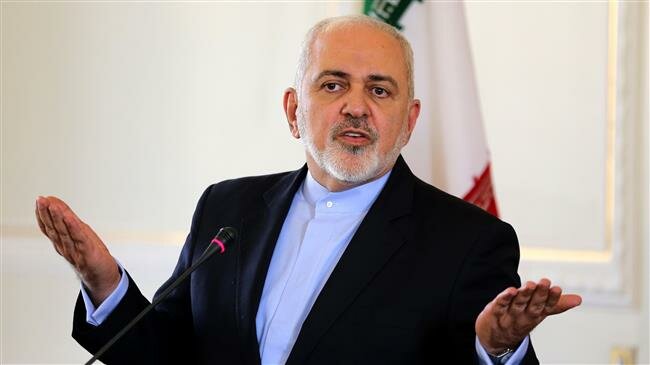
Iranian Foreign Minister Mohammad Javad Zarif
Press TV – June 7, 2019
Iranian Foreign Minister Mohammad Javad Zarif has categorically rejected a claim by US Secretary of State Mike Pompeo about Iran’s missile program, saying Tehran does not seek to develop nuclear weapons.
“Our missiles are not ‘designed’ for nukes, which we’re not developing,” Zarif said in a post on his official Twitter account on Friday.
In an interview with The Washington Times this week, Pompeo once again reaffirmed the US administration’s strategy of applying economic pressure on Iran.
“The objectives are to change the behavior of the Islamic Republic of Iran. … No terror around the world, no expeditionary terror around the world, put your missile program back inside a set of constraints that had been identified in UN Security Council Resolution 2231 and … have a permanent commitment not to develop your nuclear program,” Pompeo said.
Resolution 2231 endorsed the multilateral nuclear accord, officially known as the Joint Comprehensive Plan of Action (JCPOA), which was signed between Iran and the major world powers, including the United States, in 2015.
Under the JCPOA, Iran undertook to put limits on its nuclear program in exchange for the removal of nuclear-related sanctions imposed against Tehran. However, US President Donald Trump pulled his country out of the JCPOA in May 2018 and re-imposed harsh sanctions against the Islamic Republic in defiance of global criticisms.
The US administration claims that Tehran had violated the JCPOA with a series of ballistic missiles tests over the past four years.
In his tweet, Zarif said the US and its allies are in no position to criticize the Islamic Republic’s missile program and lashed out at the West for making arms deals with the countries that are killing the Yemeni people.
“The US—which violated UNSCR 2231 in withdrawing from JCPOA—or its allies (in violation of its provision on normalizing economic relations w/Iran) are in no position to push a conceited interpretation of its missile provision while pouring weapons into hands that kill Yemenis,” the top Iranian diplomat said.
An American think tank said in April that it has found new data showing US arms deals with Saudi Arabia and the UAE are “dramatically understated” and billions more than previously reported.
The data collected by arms trade watchdog Security Assistance Monitor (SAM) shows the US has struck at least $68.2 billion worth of deals with the two countries since they started their war in Yemen.
In another tweet, Zarif said that Resolution 2231 has “called upon” Iran not to undertake any activity aimed at designing ballistic missiles capable of carrying nuclear warheads.
He emphasized that the Security Council resolution does not enforces any prohibition in this regard.
French President Emmanuel Macron also on Thursday accused Tehran of making efforts to achieve nuclear arms and said France and the US both wanted to stop Tehran getting nuclear arms and new talks should focus on curbing its ballistic missiles program and on other issues.
In a Thursday meeting with the US president, Macron listed four common priorities of the US and France in addressing “Iranian behavior”: preventing Iran from getting a nuclear weapon, reducing Iran’s ballistic activity, containing Iran’s regional activity and establishing peace in the region.
However, Iranian Foreign Ministry Spokesman Abbas Moussavi rejected French calls for wider international talks over its nuclear program and said Macron’s comments will be of no help to saving the Iran nuclear deal and will just further deepen distrust among its signatories.
Meanwhile, during a meeting with heads of international news agencies on Thursday, Russian President Vladimir Putin once again stressed the importance of preserving the multilateral nuclear agreement, saying Moscow does not approve of “what is being done against Iran.”
In reaction to Macron’s remarks, the Russian leader drew a line between Iran’s nuclear and missile programs and said, “Yes, someone may be concerned by Iran’s missile programs. But that’s a different problem.”
Bipartisan Support for Trump’s Aggressive Iran Policy Reveals the Hollowness of Russiagate
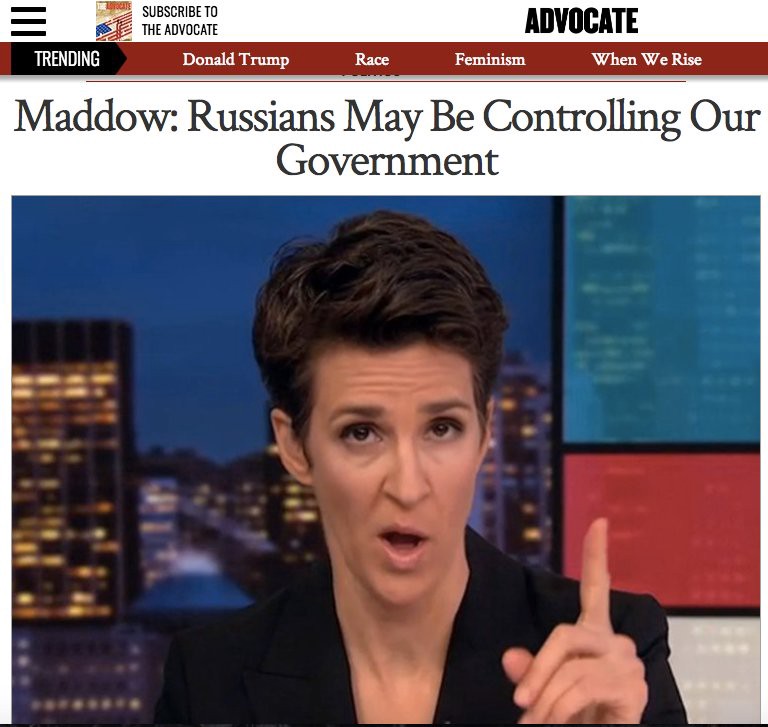
By Whitney Webb | MintPress News | June 3, 2019
In early May, MSNBC news host Rachel Maddow — known as one of the top promoters of the new Cold War and Russiagate in American media — emphatically endorsed regime change in Venezuela after she claimed that President Donald Trump’s hawkishness towards the South American country had changed, all because of a single phone call with his Russian counterpart Vladimir Putin.
Though Maddow’s claims were arguably the most extreme in suggesting that Trump was “taking orders” from Putin on Venezuela, she wasn’t alone in making them. For instance, Cenk Uygur of the Young Turks also made the claim that the Trump-Putin phone call on Venezuela was “direct evidence that he is literally taking orders from Putin.” In addition, several corporate media outlets supported this narrative by suggesting that Trump “echoed” Putin’s Venezuela stance after the phone call and directly contradicted his top staffers and even himself in doing so.
Yet now, strangely, those same corporate media voices remain silent on the Trump administration’s other regime-change project — in Iran — despite the fact that the Putin-led Russian government is set to be the biggest winner as tensions between the U.S. and the Islamic Republic boil over and threaten to send the Middle East into a fresh bout of destruction and chaos.
How Russia wins
As tensions between the U.S. and Iran have grown in recent months, analysts in both corporate and independent media have speculated about what country is set to benefit the most from the U.S.’ campaign of “maximum pressure” and regime change against the Islamic Republic. Of the many analyses, two countries have stood out as likely beneficiaries: Russia and China.
The cases for China and Russia’s benefit are somewhat similar given that the Trump administration’s focus on Iran results in less pressure on both Russia and China. This is despite the fact that, officially, the U.S.’ current National Defense Strategy explicitly calls for focusing attention on preparing for a “long war” against Russia and China to prevent either from superseding the U.S. as a global superpower. Yet, with the U.S. focused on regime change in Iran and Venezuela, Russia and China can avoid bearing the brunt of U.S. military adventurism, either directly or by proxy, while the U.S. wears itself thin by trying to do it all at once.
Several U.S. military analysts have been warning against war with Iran for precisely this reason. Nikolas Gvosdev, a professor of national security affairs at the U.S. Naval War College, recently wrote in The Hill that the U.S. faces a lose-lose scenario by pursuing a militaristic, aggressive Iran policy:
To gear up for a major conflict with Iran, the U.S. would be forced to de-emphasize Europe’s eastern flank, allowing Russia more time and breathing space to consolidate its position. On the other hand, a U.S. campaign that is defined more by bellicose rhetoric and less by action will buttress Russia’s claim, already seemingly validated in Syria and in Venezuela, that the U.S. talks a good game but has no real stomach for projecting its power.”
Both countries also stand to benefit from Iran’s increasing desperation for trading partners unwilling to bow to the U.S. Currently, China represents 30 percent of Iran’s international trade and the current U.S. sanctions on Iran have pushed Tehran to rely more heavily on Russia, especially for weapons purchases, than it had while the Iran nuclear deal (officially the Joint Comprehensive Plan of Action, JCPOA) was in force.
However, upon closer examination, it becomes clear that China, though it benefits to some degree, is not a clear winner amid current tensions, while Russia stands to gain the most. The reason for this is the effect of current and future U.S.-Iran tensions on the oil market. While China trusts Iran to be a key oil supplier even if there is a breach in U.S.-China relations, any shock to the oil market and any jump in oil prices — both of which are likely to occur if U.S.-Iran tensions continue to escalate — will spell disaster for the Chinese economy, given that China is now the world’s largest importer of oil.
Russia, on the other hand, stands to benefit massively from the chaos that U.S.-Iran tensions are set to unleash on the oil market and, by extension, oil prices. With the U.S. seeking to starve Iran of any and all oil export revenue, all countries that had been purchasing Iranian oil must seek new suppliers. Yet, with the prospect of a U.S-Iran conflict still ever-present, it will be those oil producers outside of the Middle East that will come out on top, since oil supply routes that do not pass through the Middle East do not risk supply disruptions that would be caused by a war in the region. Thus, Russia, owing to its location, will emerge as an oil producer of extreme importance. Furthermore, given that such instability in the Middle East will lead to a surge in global oil prices, Russia will be able to export more oil at a higher price and will see its economy and geopolitical clout benefit greatly as a result.
A potential geopolitical killing
In addition to a great boost to its oil sector, Russia also stands to make unique geopolitical gains, particularly in the Middle East and beyond. For instance, in Syria, Russia is increasingly seeking to use its pull with Syria’s government as a major bargaining chip with Israel and the U.S., as made clear by the upcoming trilateral summit on the Middle East between Russia, Israel and the U.S. The main focus of that summit will likely be the fate of the presence of foreign militaries in Syria, particularly Iranian and U.S. forces.
The summit will likely be dominated by Russia and Israel, given Israel’s influence over the U.S., and particularly over National Security Adviser John Bolton, who will represent the U.S. at the summit. Israel’s key interest in Syria at this stage of the conflict is the removal of Iranian forces from Syria. Russia is likely to oblige that request, as doing so would allow Russia to dominate a post-war Syria at Iran’s expense. This seems to be a current Russian objective in Syria, given recent reports of in-fighting among Russian and Iranian forces in Northern Syria.
However, Russia is unlikely to help reduce Iran’s Syria presence if doing so would favor the United States’ occupation of Syrian territory or threaten to upset Russia’s own interests in Syria. Thus, in this case, Russia is counting on Israel’s influence on the Trump administration to ensure that, if Iranian forces vacate Syria, it will be Russia that will dominate the country post-conflict.
Russia also stands to gain geopolitically from the isolationism being forced on Iran by the Trump administration. Indeed, U.S. pressure on Iran has already served Russian interests by pushing Iran further towards Russia, giving Moscow the status of an increasingly important economic partner of Tehran. While benefiting the Russian economy, closer economic ties between Moscow and Iran would also give Russia a leg up in discussions with the U.S., as Washington may then need to make concessions to or coordinate with Russia in future efforts to pressure Iran.
Meanwhile, Russia stands to reap major profits by selling more weapons to Iran, and to gain geopolitical clout by further cementing its role as a mediator of conflict by promoting compliance with the JCPOA and opposing regime change. Iran’s dwindling options for strategic alliances with non-U.S. aligned countries will make it difficult for Tehran to resist Russian demands on key issues, including the Syria conflict.
Another major geopolitical win for Russia that has resulted from the U.S.’ current Iran policy is the tension that that policy has engendered between the U.S. and its European allies. When the U.S. unilaterally withdrew from the JCPOA, it began the development of a rift between the U.S. and its key European allies who are also JCPOA signatories — particularly France, Germany and the United Kingdom. As a signatory, Russia’s stance on Iran has revolved around the JCPOA, with Russia having urged Iran to remain in the deal “no matter what,” advice that Iran does not now seem keen to follow.
Russia’s stance on JCPOA is likely aimed just as much at Europe as it is at Iran, since promoting the agreement amid the U.S. unilateral withdrawal paints Russia as more predictable and stable in terms of its political stances and diplomacy in comparison to the U.S. If nothing else, Putin is known for excelling at taking advantage of the missteps made by his geopolitical adversaries.
This is all part of a careful public image that Russia is seeking to cultivate with European countries as it hopes to attract them to do business with Russian oil and gas companies as the Middle East now seemingly approaches another era of extreme instability. By promoting the JCPOA alongside Europe, Russia makes increased Russo-European cooperation seem more attractive.
As U.S.-Iran tensions mount, particularly if armed conflict breaks out, importing goods from Russia, especially oil and gas, will appear more attractive and safer in comparison to goods that originate from or pass through the Middle East before arriving in Europe. Depending on how the situation plays out, Europe — driven by concerns about stability and reliability — may be willing to risk angering the U.S. to pursue increased economic cooperation with Russia, even though doing so would run counter to current U.S. and NATO objectives.
Putin plays Netanyahu
While it is often difficult to find accurate, honest reporting on Vladimir Putin –reporting that is neither too biased against him nor too much in his favor — it is generally acknowledged that Putin, above all else, is interested in advancing Russia’s national interest and is a cunning strategist who often thinks several steps ahead of both his allies and his adversaries.
In viewing the ratcheting up of tensions between the U.S. and Iran, Putin’s modus operandi remains unchanged and, upon closer examination, it is clear that he is giving the hotheads driving this still-escalating situation just enough rope to hang themselves. Meanwhile, Russia is waiting in the wings to pick up the pieces and further cement its already acknowledged role as the new foreign “peacemaker” in the Middle East while gaining economic and geopolitical clout in the process.
Prior to the Israeli election earlier this year, Israeli media noted on several occasions that Putin was backing the reelection of Israeli Prime Minister Benjamin Netanyahu, including when Putin hosted Netanyahu at a sudden pre-election summit. Israeli newspaper Haaretz described Putin’s decision to host Netanyahu at the time as aimed at helping Netanyahu secure the “crucial Russian vote” among Russian-Israeli Jews in order to “outflank” his competitors. In another instance, Putin was alleged to have further helped Netanyahu’s reelection odds by having Russian special forces find and deliver the remains of Zachary Baumel — an Israeli soldier who had gone missing in Lebanon in 1982 — to Israel just ahead of the election.
Putin’s direct support of Netanyahu may seem odd to observers of geopolitics, given that the two have often been at odds over Syria. However, Putin and Netanyahu have developed an effective working relationship and Russia and Israel enjoy relatively strong bilateral ties and economic agreements.
Yet, beyond the ties that have been forged between the two countries in recent years, Putin likely knows that he can play Netanyahu’s weaknesses to his advantage. For instance, Putin is acutely aware of the benefits to be reaped from increasing tensions between the U.S. and Iran and is also aware of the key role that Netanyahu has played and continues to play in driving the Trump administration’s Iran policy. Netanyahu’s near-obsession with regime change in Iran and the practical likelihood that a U.S.-Iran war would be “unwinnable” for the U.S. and would leave its military weakened and distracted are points that Putin is likely eager to exploit in pursuance of Russian geopolitical goals.
Russia seeks to play the role of mediator but only to a certain extent and has kept its attitude towards Iran intentionally vague when dealing with the Israeli government, so much so that Israeli officials have cited Russia’s unknown stance towards Iran as a major difficulty in negotiating the deconfliction of Russian and Israeli forces in Syria. This is likely because Russia doesn’t seek to aid either side amid escalating tensions, instead waiting for the current tensions to play out, as it stands to make gains in either case.
That Russia stands to gain from current U.S.-Iran tensions hasn’t been lost on all Israeli officials, however. Earlier this month, a former Israeli intelligence official, Yakkov Kedmi, openly stated that not only is a war against Iran “unwinnable” for the U.S. and its regional allies, but further that Russia would be the only major country to benefit from any military conflict pitting the Americans against the Iranians. Appearing on Russian television program Evening with Vladimir Solovyov, Kedmi stated that, if war does break out, the U.S. “won’t remain whole” after the conflict and that “if anyone wins, it’ll be Russia.”
“If the price of oil exceeds $100 per barrel, it hits the Chinese economy. Most of all, it hits the European and American economies,” Kedmi stated. “If you double the price,” he added, “[global] industry will be ruined. First of all, it will happen in the U.S.” To that, the program’s host, Vladimir Solovyov, asserted that “Their [American] industry will be [ruined]. It’ll be the opposite in our country. Our economy will begin to develop. We’ll feel like kings with golden diamond-studded wheels on our cars.”
Why the Russiagaters are silent on Iran
Given Russia — and Putin’s — clear benefit from the continuing U.S. escalation with Iran and a potential military conflict, it is striking that Putin’s fiercest critics in the American media have remained silent about this clear pay-off as the Trump administration continues to pursue an aggressive, hawkish Iran policy that hardly benefits the U.S. and instead benefits its supposed adversary. This is especially notable in light of the fact that these same American critics of Russia and Putin’s leadership were recently accusing Trump of “taking orders” from Putin by altering his Venezuela policy in a way that was perceived to benefit Russian over American interests.
This dichotomy is most easily deconstructed by noting that top promoters of Russiagate and news personalities known for their hyperfocus on Putin rarely call for any policy that would involve a reduction in tensions or less militarism abroad. Indeed, all too often, the “solutions” offered by these journalists involve sending weapons to U.S. proxy forces, shooting missiles at Russian allies, sanctioning Russia and its allies, and other “useful reminders of the military strength of the Western alliance” between the U.S. and NATO.
Without fail, the suggested solutions of how to counter Putin from the U.S. media and political establishment almost always involve “pushing back” with force equal to or greater than the perceived aggression. Rarely do they involve backing down or unwinding tensions, even in the cases where doing so would clearly challenge key geopolitical objectives of the Russian government.
In the case of Russia’s benefit from Trump’s Iran policy, the benefit is so clear that it has been voiced in several mainstream media outlets — including CNN, The Hill, Forbes and Bloomberg — with most of those reports focusing exclusively on the oil angle. However, while Russia’s advantage has been noted, it is also clear that Trump’s current Iran policy has avoided inflaming the Russiagate hysteria that has marked media coverage of other Trump policies and statements that were perceived as being “pro-Putin” for the past few years.
One reason that the media has skipped a prime opportunity for another Russiagate frenzy is the fact that many of the driving forces behind Russiagate are also supportive of regime change in Iran. Indeed, while Russiagate has recently been cast by Trump and prominent Republicans as a “hoax” narrative exclusive to Democrats, prominent neoconservatives have long been pivotal in creating and fomenting Russigate for over five years.
For instance, the origins of the infamous Steele dossier — which was used to assert that Russia’s government had a litany of salacious blackmail on Trump that it would use to manipulate him as president — trace back to top neoconservative Republican donor Paul Singer. That dossier was subsequently circulated within the Obama administration during the 2016 campaign by neoconservatives Victoria Nuland and the late Senator John McCain.
Many of the same neoconservative figures who have helped stoke Russiagate and pounced on the resulting climate of hysteria to promote increased militarism as the solution, also support regime change in Iran. Michael McFaul — U.S. Ambassador to Russia during the Obama administration — is both a strong advocate for aggressive U.S. measures to counter Putin and also a vocal proponent of U.S.-led regime change in Iran. Similarly, on the supposed other side of the political spectrum, Bill Kristol — well-known neoconservative writer, an icon of the establishment “resistance” to Trump, and a promoter of Russiagate — also strongly supports hawkish measures to contain Russia and is a long-time, vocal supporter of regime change in Iran.
While the tense situation between the U.S. and Iran is undeniably troubling, the relative silence among figures in U.S. media and politics who claim to be Putin’s fiercest critics with regard to Trump’s aggressive Iran policy reveals a stark truth about Russiagate. The goal of Russiagate is not actually about “countering” Putin or Russian geopolitical influence; it is about promoting the expansion and widespread adoption of hyper-militarism by both the establishment left and establishment right in the United States.
While Russia often serves as a useful “boogeyman” in service to this agenda of promoting militaristic policies, the odd moments when those same policies actually benefit Russia and do not run into hysterical opposition from the political and media establishment provide a rare glimpse into the real motivations behind Cold War 2.0 and the dubious validity of the media-driven narratives upon which current anti-Russian hysteria is based.
Whitney Webb is a MintPress News journalist based in Chile. She has contributed to several independent media outlets including Global Research, EcoWatch, the Ron Paul Institute and 21st Century Wire, among others. She has made several radio and television appearances and is the 2019 winner of the Serena Shim Award for Uncompromised Integrity in Journalism.
Featured Video
Bombing Hitler’s Hometown
or go to
Aletho News Archives – Video-Images
From the Archives
The Biggest Threat to Peace in Middle East
By Dr. Elias Akleh* | Sabbah Report | May 24, 2010
A build up of heightened tension in the Middle East is escalating in the last few weeks. American and Israeli postures towards Lebanon, Syria, and Iran have become more threatening. Listening to speeches of political leaders one hears talks only about war not peace. Iranians and Israelis are continuously training hard for a possible showdown. Both sides are conducting extensive war games every month. This led Syrians to claim that Israel is preparing for a soon-to-come another war. The Jordanians also are warning that current stalemate of the peace process is an indication of a war breaking out this summer. The Russian President and his army chief hinted, a few months ago, that the US and Israel were planning for an attack on Iran.
Indeed Iran is, as it has been for last few years, the target of most of the threats and accusations of supporting terrorism. Escalating incitement against Iran the American Defense Department sent last month (April) to Congress a report on Iran’s military claiming Iran could develop intercontinental ballistic missiles capable of reaching the US by 2015.
Ignoring the fact that N. Korea, India, Pakistan, and Israel are proven to have nuclear weapons while Iran does not, the US Secretary of State Hillary Clinton chose in her speech, to the nuclear Non-Proliferation Treaty review conference at the UN, to focus on Iran’s alleged nuclear ambitions putting the whole world at risk as she put it. According to Clinton Iran’s acquisition of nuclear weapons, rather than Israel’s more than 200 nuclear bombs, is destabilizing the Middle East. She called on the world’s nations to rally around US efforts to hold Iran, not other nuclear countries, to account.
The accusation that Usama Bin Laden is living comfortably in Iran had received a boost after the broadcast of a documentary called “Feathered Cocaine”. This echoed the June 2003 claims of the Italian newspaper Corre de la Sierra that Bin Laden was in Iran according to some intelligence report, and according to Richard Miniter’s book “Shadow War”. … continue
Blog Roll
 Aletho News
- Bombing Hitler’s Hometown
- German journalist threatened with homelessness as German court upholds EU sanctions in landmark free speech case
- US Tells Allies That Ukraine-Bound Arms Could be Sent to Middle East
- Organized terrorism: Iran condemns killing of its diplomats in Lebanon
- Why could Gaza enter the regional war?
- Hamas official rejects Mladenov Plan linking disarmament to Gaza reconstruction
- Two Primary Elections for the Soul of ‘America First’
- Japan Clings to US Vassalage Despite Energy Crunch Caused By Iran War
- US Seeks Control Over Global Energy Infrastructure – Kremlin
- US senators target Orban government for standing up to Zelensky
- If Americans Knew
- Researchers at Human Rights Watch Resign Over Blocked Report on Palestinian Refugee Return
- Jewish Groups Are Backing a War Americans Don’t Want
- Eric Fingerhut Thinks He’s the President of the Jews
- Top Jewish Philanthropists, Rabbis Urge Israeli President to Take Action Against ‘Jewish Extremists’
- Don’t Be Fooled. Zionist Leaders Have Always Wanted to Control Southern Lebanon
- Israel’s widespread use of torture is a core element of its genocide against the Palestinian people
- In Israel’s War on Iran, Many Middle East US Bases Rendered “All But Uninhabitable”
- ‘Burn the lawn’: Israel pursues ‘Rafah model’ in southern Lebanon
- A genocide here, an amputation there
- Reports: Iran mobilizing 1M fighters, Israel-US run low on ammo, Israeli army faces shortage – Not a ceasefire Day 168
- No Tricks Zone
- Devastating Assessment Of Comirnaty Vaccine By Former Senior Pfizer Europe Toxicologist
- New Study: CO2 Is ‘Effectively Negligible’ As An Explanatory Climate Change Factor Since 2000
- Former Pfizer Toxicologist Dr. Helmut Sterz Tells Bundestag Hearing Pfizer Vaccine Should Have Never Been Approved
- Energy Expert: Germany’s Nuclear Phaseout Was A “500 Billion Euro Mistake”
- New Research: South Australia’s Mid-Holocene Sea Surface Temperatures Were 4°C Warmer Than Today
- Storing Green Energy To Last Germany 10 Days Would Require A 60-Million Tonne Battery
- New Studies: UK Sea Levels Were 4 Meters Higher Than Today During The Mid-Holocene
- Destructive Green New Deal: German Energy And Metal Group Warns Of Drastic Crisis
- New Study Documents A 20-Year Pause In Arctic Sea Ice Decline – Driven By Internal Variability
- Wake-up Call: Survey Shows Majority Of Germans Now Favor Postponing Climate Targets!
 Aletho News