‘Dialogue at gunpoint’: Bolton says Iran’s ‘silence’ is DEAFENING while it’s actually pretty vocal
RT | June 25, 2019
US National Security Advisor John Bolton has said that defiant Iran stays silent over meaningful talks with Washington, when, in fact, Tehran repeatedly argued that a barrage of threats and sanctions has made talks impossible.
Bolton blamed Iran for avoiding dialogue with the US during his visit to Jerusalem on Tuesday.
“As we speak, American diplomatic representatives are surging across the Middle East, seeking a path to peace. In response, Iran’s silence has been deafening.”
The official insisted that Washington “has held the door open for real negotiations,” and all Iran needs to do is to “walk through that open door.” Bolton explained that by doing so Iran must fulfill a laundry list of demands put forward by the US, including the one to “completely and verifiably” eliminate its “nuclear weapons program” and end “malignant behavior worldwide.”
Iran, meanwhile, has been anything but silent about the prospect of negotiating with the US. The country had consistently maintained that it is ready to talk if Washington refrains from issuing threats and slapping new sanctions on Tehran.
Iran stands ready for dialogue, given that it goes on “equal footing and mutual respect,” Foreign Minister Mohammad Javad Zarif said in January. The minister often blamed Bolton and other foreign policy hardliners at the White House for pushing President Donald Trump from peaceful solutions towards a more bellicose stance.
The Islamic Republic also made it clear that meaningful talks cannot go in hand with the Trump administration’s strategy of applying “maximum pressure” on Iran. On Monday, the US announced plans to blacklist Zarif along with Supreme Leader Ali Khamenei in retaliation to Iran downing a US drone it claims violated its airspace last week. Tehran responded by saying that sanctions against the nation’s top leadership effectively close “the path of diplomacy” and do not create the right atmosphere for talks.
Iran’s President Hassan Rouhani put it more bluntly, saying that the new sanctions are a sign of Washington’s “desperation” and “the White House actions show it is mentally retarded.”
“You [the Americans] call for negotiations. If you are telling the truth, why are you simultaneously seeking to sanction our foreign minister, too?”
The promise to enact new sanctions shows that the US is “lying” in the offer of talks with Tehran, Rouhani stressed.
Moscow, whose senior security official Nikolai Patrushev met with Bolton on Tuesday, had also blasted the new round of US sanctions on Iran. The restrictions “negate all of the repeatedly-sent signals that Washington is open and ready to engage in dialogue,” Deputy Foreign Minister Sergey Ryabkov said.
“You can’t have dialogue at gunpoint, literally and figuratively speaking.”
All the recent diplomatic maneuvers by the US have been “aimed at mobilizing an anti-Iranian front,” Ryabkov stated.
The decades-long row between Tehran and Washington escalated dramatically last year when the US unilaterally abandoned the 2015 nuclear deal, known as the JCPOA, while accusing Iran of secretly violating the agreement. Iran denied this, and the nuclear watchdog, the International Atomic Energy Agency (IAEA), in its latest reports had confirmed that the nation was following the deal.
Trump: War President or Anti-Interventionist?
By Patrick J. Buchanan • Unz Review • June 25, 2019
Visualizing 150 Iranian dead from a missile strike that he had ordered, President Donald Trump recoiled and canceled the strike, a brave decision and defining moment for his presidency.
Secretary of State Mike Pompeo, John Bolton and Vice President Mike Pence had signed off on the strike on Iran as the right response to Tehran’s shootdown of a U.S. Global Hawk spy plane over the Gulf of Oman.
The U.S. claims the drone was over international waters. Tehran says it was in Iranian territory. But while the loss of a $100 million drone is no small matter, no American pilot was lost, and retaliating by killing 150 Iranians would appear to be a disproportionate response.
Good for Trump. Yet, all weekend, he was berated for chickening out and imitating President Barack Obama. U.S. credibility, it was said, has taken a big hit and must be restored with military action.
By canceling the strike, the president also sent a message to Iran: We’re ready to negotiate. Yet, given the irreconcilable character of our clashing demands, it is hard to see how the U.S. and Iran get off this road we are on, at the end of which a military collision seems almost certain.
Consider the respective demands.
Monday, the president tweeted: “The U.S. request for Iran is very simple — No Nuclear Weapons and No Further Sponsoring of Terror!”
But Iran has no nuclear weapons, has never had nuclear weapons, and has never even produced bomb-grade uranium.
According to our own intelligence agencies in 2007 and 2011, Tehran did not even have a nuclear weapons program.
Under the 2015 nuclear deal, the JCPOA, the only way Iran could have a nuclear weapons program would be in secret, outside its known nuclear facilities, all of which are under constant U.N. inspection.
Where is the evidence that any such secret program exists?
And if it does, why does America not tell the world where Iran’s secret nuclear facilities are located and demand immediate inspections?
“No further sponsoring of terror,” Trump says.
But what does that mean?
As the major Shiite power in a Middle East divided between Sunni and Shiite, Iran backs the Houthi rebels in Yemen’s civil war, Shiite Hezbollah in Lebanon, Alawite Bashar Assad in Syria, and the Shiite militias in Iraq who helped us stop ISIS’s drive to Baghdad.
In his 12 demands, Pompeo virtually insisted that Iran abandon these allies and capitulate to their Sunni adversaries and rivals.
Not going to happen. Yet, if these demands are nonnegotiable, to be backed up by sanctions severe enough to choke Iran’s economy to death, we will be headed for war.
No more than North Korea is Iran going to yield to U.S. demands that it abandon what Iran sees as vital national interests.
As for the U.S. charge that Iran is “destabilizing” the Middle East, it was not Iran that invaded Afghanistan and Iraq, overthrew the Gadhafi regime in Libya, armed rebels to overthrow Assad in Syria, or aided and abetted the Saudis’ intervention in Yemen’s civil war.
Iran, pushed to the wall, its economy shrinking as inflation and unemployment are rising, is approaching the limits of its tolerance.
And as Iran suffers pain, it is saying, other nations in the Gulf will endure similar pain, as will the USA. At some point, collisions will produce casualties and we will be on the up escalator to war.
Yet, what vital interest of ours does Iran today threaten?
Trump, with his order to stand down on the missile strike on Iran, signaled that he wanted a pause in the confrontation.
Still, it needs to be said: The president himself authorized the steps that have brought us to this peril point.
Trump pulled out of and trashed Obama’s nuclear deal. He imposed the sanctions that are now inflicting something close to unacceptable if not intolerable pain on Iran. He had the Islamic Revolutionary Guard declared a terrorist organization. He sent the Abraham Lincoln carrier task force and B-52s to the Gulf region.
If war is to be avoided, either Iran is going to have to capitulate, or the U.S. is going to have to walk back its maximalist position.
And who would Trump name to negotiate with Tehran for the United States?
The longer the sanctions remain in place and the deeper they bite, the greater the likelihood Iran will respond to our economic warfare with its own asymmetric warfare. Has the president decided to take that risk?
We appear to be at a turning point in the Trump presidency.
Does he want to run in 2020 as the president who led us into war with Iran, or as the anti-interventionist president who began to bring U.S. troops home from that region that has produced so many wars?
Perhaps Congress, the branch of government designated by the Constitution to decide on war, should instruct President Trump as to the conditions under which he is authorized to take us to war with Iran.
Copyright 2019 Creators.com.
Boxed in by Neocons and the Media, Will Trump Launch Iran War?
By Ron Paul | June 24, 2019
President Trump did the smart thing last week by calling off a US airstrike on Iran over the downing of an American spy drone near or within Iranian territorial waters. According to press reports, the president over-ruled virtually all his top advisors – Bolton, Pompeo, and Haspel – who all wanted another undeclared and unauthorized US war in the Middle East.
Is Iran really the aggressive one? When you unilaterally pull out of an agreement that was reducing tensions and boosting trade; when you begin applying sanctions designed to completely destroy another country’s economy; when you position military assets right offshore of that country; when you threaten to destroy that country on a regular basis, calling it a campaign of “maximum pressure,” to me it seems a stretch to play the victim when that country retaliates by shooting a spy plane that is likely looking for the best way to attack.
Even if the US spy plane was not in Iranian airspace – but it increasingly looks like it was – it was just another part of an already-existing US war on Iran. Yes, sanctions are a form of war, not a substitute for war.
The media are also a big part of the problem. The same media that praised Trump as “presidential” when he fired rockets into Syria on what turned out to be false claims that Assad gassed his own people, has been attacking Trump for not bombing Iran. From Left to Right – with one important exception – the major media is all braying for war. Why? They can afford to cheer death and destruction because they will not suffer the agony of war. Networks will benefit by capturing big ratings and big money and new media stars will be born.
President Trump has said he does not want to be the one to start a new war in the Middle East. He seemed to prove that by avoiding the urgings of his closest advisors to attack Iran. It is hard to imagine a president having top advisors who work at cross-purposes to him, planning and plotting their wars – and maybe more – behind his back. Even Trump seems to recognize that his national security advisor is not really serving his administration well. Over the weekend he said in an interview, “John Bolton is absolutely a hawk. If it was up to him he’d take on the whole world at one time, okay?”
I think when you have a national security advisor who wants to fight the whole world at once, you have a problem. Does anyone believe we will be more secure after spending a few trillion more dollars and making a few hundred million more enemies? What does “victory” even look like?
President Trump is in a bind and it is of his own making. Iran has shown that it is not willing to take its marching orders from Washington, which means “maximum pressure” from the US will not work. He has two options remaining in that case: risk it all by launching a war or make a gesture toward peace. A war would ruin his presidency – and a lot more. I would urge the president to issue waivers to China, India, Turkey, and the others who wish to continue buying Iranian oil and invite the Iranian leadership to meet at a neutral location. And fire Bolton and Pompeo.
Trump Has a $259 million Reason to Bomb Iran
By Eli Clifton | LobeLog | June 22, 2019
On Thursday, the United States came perilously close to a military confrontation with Iran after it downed a U.S. drone that may or may not have entered the country’s air space. President Donald Trump reportedly ordered a retaliatory military strike on Iran but called it off, according to Trump’s own tweets on Friday morning, because a general told him that “150 people” might die in the strike.
Much analysis of Trump’s slide toward war with Iran has focused on his hawkish national security adviser, John Bolton, who, reportedly requested options from the Pentagon to deploy as many as 120,000 troops to the Middle East and hit Iran with 500 missiles per day. Bolton is the loudest voice inside the White House pushing for a military escalation to the administration’s “maximum pressure” strategy.
Secretary of State Mike Pompeo, for his part, is staking out the position that the 2001 Authorization for Use of Military Force allows the administration to take military action against Iran without congressional approval, an unusual and broadly criticized interpretation of congressional oversight.
Yet, there’s another omnipresent influence on Trump: $259 million given by some of the GOP’s top supporters to boost his campaign in 2016 and support Republican congressional and senate campaigns in 2016 and 2018.
Those funds came from Sheldon and Miriam Adelson, Paul Singer and Bernard Marcus, donors who have made no secret, both through public statements and funding think tanks that support military action against Iran, of their desire for the United States to destroy the Islamic Republic.
Adelson, who alongside his wife Miriam are the biggest donors to Trump and the GOP, contributed $205 million to Republicans in the past two political cycles and reportedly sent $35 million to the Future 45 Super PAC that supported Trump’s presidential bid. His role as the biggest funder of Republican House and Senate campaigns makes him a vital ally for Trump—who relied on Adelson’s campaign donations to maintain a Republican majority in the Senate and curb Republican losses in the House in the 2018 midterm election—and any Republican seeking national office.
Adelson publicly suggested using nuclear weapons against Iran and pushed for Trump to replace then-national security adviser H.R. McMaster with Bolton, partly due to the former’s perceived unwillingness to take a harder line on Iran. In 2017, the Zionist Organization of America, which receives much of its funding from the Adelsons, led a public campaign against McMaster, accusing him of being “opposed to President Trump’s basic policy positions on Israel, Iran, and Islamist terror.”
In 2015, Trump mocked his primary opponent, Sen. Marco Rubio (R-FL), for seeking Adelson’s financial support, warning that Adelson expects a degree of control over candidates in exchange for campaign contributions. Trump tweeted:
Sheldon Adelson is looking to give big dollars to Rubio because he feels he can mold him into his perfect little puppet. I agree!
And Adelson isn’t alone.
Billionaire Home Depot co-founder Bernard Marcus is the second largest contributor to Trump’s campaign, providing $7 million. He also champions John Bolton, contributing $530,000 to John Bolton’s super PAC over its lifetime. And he’s a major contributor to GOP campaigns, contributing over $13 million to Trump’s presidential campaign and GOP congressional campaigns in 2016 and nearly $8 million to GOP midterm efforts in 2018.
Marcus, like Adelson, makes no qualms about his views on Iran, which he characterized as “the devil” in a 2015 Fox Business interview.
Unlike Adelson and Marcus, hedge fund billionaire Paul Singer was a “never Trump” conservative until Trump won the election. Then he donated $1 million to Trump’s inauguration. Singer is far more careful with his words than Marcus and Adelson, but his money supports some of the most hawkish think tank experts and politicians in Washington.
Singer, alongside Marcus and Adelson, has contributed generously to the hawkish Foundation for Defense of Democracies, whose experts have spent the past decade regularly promoting policies to pressure Iran economically and militarily, including most recently Trump’s “maximum pressure” approach.
According to donor rolls of FDD’s biggest supporters by the end of 2011, a year that saw a sharp rise in tensions and rumors of war by Israel against Iran, Adelson contributed $1.5 million, Paul Singer contributed $3.6 million, and Bernard Marcus, who sits on FDD’s board, contributed $10.7 million.
(FDD says that Adelson is no longer a contributor, but Marcus continues to give generously, contributing $3.63 million in 2017, over a quarter of FDD’s contributions that year.)
Employees of Singer’s firm, Elliott Management, were the second largest source of funds for the 2014 candidacy of the Senate’s most outspoken Iran hawk, Sen. Tom Cotton (R-AR), who urged Trump to conduct a “retaliatory strike” against Iran for purportedly attacking two commercial tankers last week.
Singer donated $26 million to Republicans in the 2016 election and $6.4 million to the GOP’s midterm campaigns.
The billionaire Iran hawks—the Adelsons, Singer, and Marcus—made combined donations of over $259 million to GOP politicians in the past two cycles, making them some of the Republican Party’s most important donors. That quarter-billion-dollars doesn’t include contributions to dark money 501c4 groups and donations to 501c3 nonprofits, such as think tanks like FDD.
News coverage of Trump’s slide toward war frames the discussion as a competition between his better instincts and a national security advisor and secretary of state who, to varying degrees, favor military action.
But the $259 million that helped elect Trump and Trump-friendly Republicans must loom large over the president.
As Trump evaluates his options with Iran and turns his attention to the 2020 election, he knows he’ll need to rely on the Adelsons, Singer, and Marcus to boost his campaign, maintain a narrow majority in the Senate, and attempt a takeback of the House.
These donors have made their policy preferences on Iran plainly known. They surely expect a return on their investment in Trump’s GOP.
Iran ‘Violates’ Nuclear Deal, After US ‘Withdraws’

By Joshua Cho | Fair | June 21, 2019
Quick question: Does the US ever break, breach or violate its international agreements?
Apparently not, according to US coverage of Iran’s recent announcement that it intended to go beyond the limits of the 2015 Iran nuclear deal in enriching uranium for its civilian nuclear program (frequently mischaracterized as a nuclear weapons program in media coverage). Reading corporate media’s inversion of reality, it’s hard to escape the impression that while Iran betrays its international agreements, the US just leaves them behind.
An Associated Press report carried by USA Today (6/17/19) was headlined: “Iran Says It Will Break Uranium Stockpile Limit in 10 Days,” and reported that Iran’s announcement indicated its “determination to break from the landmark 2015 accord,” while noting that “tensions have spiked between Iran and the United States,” partly because the US “unilaterally withdrew” from the landmark agreement. Note that the US rejection of its obligations under the deal is referred to in neutral terms—Washington “withdrew”—while Iran’s response to US nonobservance gets negatively characterized as a “break”—a pattern that persists throughout the coverage.
There was no indication in the AP piece that Iran offered conditions under which it would continue to comply with the Iran Deal (formally known as the Joint Comprehensive Plan of Action), which gives the false impression that Iran’s decision to end compliance with the JCPOA is settled and unconditional.
The Wall Street Journal (6/17/19) offered the same kind of misleading headline: “Iran to Breach Limits of Nuclear Pact, as US to Send More Troops to the Middle East.” Again, Iran’s potential departure from the pact whose terms the US has vitiated is portrayed as a “breach,” while the US’s actual violation of the deal is labeled a “pullout” in the accompanying piece.
The Journal, unlike the AP, did note that Iran offered conditions under which it would continue to comply with the JCPOA’s terms:
The spokesman for Iran’s atomic energy agency, Behrouz Kamalvandi, said that by June 27—10 days from Monday—the country would surpass its enriched-uranium limits. He said Iran would further increase its production in early July, but could reverse both steps if Europe provided relief from [US] sanctions.
CNN (6/17/19) went with “Iran says it will break the uranium stockpile limit agreed under nuclear deal in 10 days,” as their headline. Only people who read past the headline, which most people don’t, would’ve known that that’s not really what Iran is saying:
Iran has reiterated that it could reverse the new measures should the remaining European signatories in the nuclear deal (France, Germany and the United Kingdom) step in and make more of an effort to circumvent US sanctions.
To its credit, CNN added “withdraw” in addition to the usual “violate,” “break” and “breach” in its list of words to describe Iran’s potential departure compared with just “withdrew” to describe the US’s actions.
The New York Post (6/17/19) chose “Iran Will Violate Nuclear Deal, Boost Uranium Stockpile” as the headline to mislead readers, and kept with the pattern of describing the US’s JCPOA breach as “pulling out of the deal.” However, unlike other reports, it didn’t feature any sources skeptical of Iran’s responsibility for the recent Gulf of Oman attacks on Japanese and Norwegian commercial oil tankers, despite crew members aboard the Japanese Kokuka Courageous contradicting US allegations of an Iranian mine attack by claiming to have been hit by a “flying object,” and European officials calling for further investigation and urging “maximum restraint.”
The New York Times’ headline (6/17/19): “Trump Adds Troops After Iran Says It Will Breach Nuclear Deal,” not only continued the above trends by not giving any hint that Iran might not depart from the pact, and characterizing the US’s JCPOA violations as a mere “withdrawal,” it also reported on US sanctions on Iran without mentioning that the sanctions themselves are violations of international law (Guardian, 10/3/18).
The Times uncritically cited Secretary of State Mike Pompeo’s statements that the US is “considering a full range of options”—including military strikes—without mentioning that these would be violations of international law because they go against UN Security Council Resolution 1887, which requires peaceful resolutions to disputes regarding nuclear issues, in accordance with the UN Charter and the Non-Proliferation Treaty, which both the US and Iran are parties to.
In fact, virtually all coverage fails to address the JCPOA in light of the NPT, because none of it challenges the legitimacy of the US’s prerogative to impose limits on Iran’s civilian nuclear program to begin with. Article IV of the NPT supports the “inalienable right of all the Parties to the Treaty to develop research, production and use of nuclear energy for peaceful purposes,” in accordance with Articles I and II forbidding the transfer and receiving of nuclear weapons from nuclear-weapon states.
FAIR (10/17/17) has observed that corporate media frequently attribute malicious intentions to Official US Enemies without going through the bother of presenting evidence. Iran is often accused of sneakily plotting to develop nuclear weapons, the way US ally Israel actually did when it built the only nuclear weapons arsenal in the Middle East (Guardian, 1/15/14).
This is ironic, because Iran has actually been a consistent leader in the nuclear disarmament movement. Foreign Minister Javad Zarif, when Iran was the chair of the Non-Aligned Movement, critiqued the JCPOA because it didn’t go far enough to ensure peace in the Middle East by not establishing a Nuclear Weapons–Free Zone there. Iran was also one of the first countries to propose making the Middle East a NWFZ, bringing up the proposal to the UN General Assembly in 1974 (CounterPunch, 12/13/13).
Journalist Gareth Porter (Foreign Policy, 10/16/14), reporting on Iran’s little-understood theocratic system, noted that Supreme Leader Ayatollah Khomeini’s fatwa against building any kind of WMDs in the 1990s is a formal ruling on Islamic jurisprudence, holding a legal status above mere legislation. He also pointed to Khomeini’s refusal to develop WMDs when up to 20,000 Iranians were killed by chemical weapons by then–US ally Saddam Hussein in the 1980s (Reuters, 9/16/13)—with an additional 100,000 survivors developing chronic diseases. Current US sanctions aiming to bring Iran’s “oil exports to zero” are exacerbating those chronic diseases, in addition to further strangling Iran’s economy, by restricting access to necessary medicine (Guardian, 9/2/13).
Of course, none of this can be mentioned, because it contradicts the corporate media narrative of Iran being an enemy that must be confronted, with US aggression against Iran being portrayed as defensive countermeasures (FAIR, 5/19/19, 6/6/19). For US media, Iran is the only JCPOA party with commitments that can be “breached,” “violated” or “broken,” with the US free to leave them whenever it wants to, without harming its reputation as a trustworthy party to international agreements.
Germany vs. Iran – Has Germany Sold Out to the Devil?
By Peter Koenig – New Eastern Outlook – 22.06.2019
Madame Angela Merkel – the head of Europe’s strongest economy, of the leader of the European Union, said that there was strong evidence that Iran attacked the two tankers in the Gulf of Oman. Ten days ago, German Foreign Minister, Heiko Maas, travelled to Tehran, officially to “save” the Nuclear Deal (Joint Comprehensive Plan of Action – JCPoA), but in reality, to ‘negotiate’ with Tehran ways so Germany and by association other EU members, might still do business with Iran, against some “concessions” by Iran, in order to appease Washington.
Iran’s President Rouhani reacted quickly. FM Maas got the cold shoulder and was dismissed. And rightly so. Maas was not really representing Germany – but the United States. Iran gave the EU an “ultimatum” of 60 days to stick to their commitments on trading with Iran according to the Nuclear Deal – despite the US reneging on it – or else, Iran may bypass some of the conditions under the JCPOA accord. The EU – not being independent and her member countries having lost all sovereignty by submitting to the dictate first from Brussels, second from the tyranny of Washington, didn’t like the ultimatum, and said so in a joint statement. They added a weak and meek phrase, “We call on countries not party to the JCPoA to refrain from taking any actions that impede the remaining parties’ ability to fully perform their commitments;” not even daring calling the country by name, for whom the statement was destined, i.e. the US of A.
Germany’s position is as absurd as it has ever been since Merkel and the entire Bundestag accepted the sanctions imposed by Washington on Russia in 2014 – and replicated them along with the rest of the EU – even to their own detriment and to the detriment of the entire EU. Chancellor Merkel and apparently the entire Bundestag, again, go along with Washington’s equally absurd and false accusation that Iran has attacked the two tankers, one Japanese owned, the other Norwegian. The latter belonging to a close friend of Iran’s, and the Japanese one, hardest hit – exactly at the time when Japan’s PM Shinzō Abe, was visiting the Ayatollah in Tehran to discuss how to maintain the Nuclear Deal – trading – despite the sanctions and threats of Washington, hence, a friendly visit.
—
A blind person can see that these were two false flags – so thinly masked, with badly fabricated US ‘video evidence’ that even according to CIA and US military brass did not deliver conclusive evidence. In fact, none at all. Madame Merkel – why do you not first ask the obvious question “Cui bono?”— Who benefits? Certainly not Iran – but the aggressor, the US which has been planning and preparing for war with Iran for decades, ever since the first Iraq war under Father Bush, in 1991. At the 2003 invasion of Iraq – Bolton openly expressed his dreams to demolish Iran. He and Pompeo are liars and war criminals, who run the White House and pretend to run the Pentagon – and who act in impunity. Their power seems limitless. Trump – seems to be a mere puppet.
Getting Merkel on board of the flagrant US lie that Iran was attacking two tankers in the Gulf of Oman, is a strategic hit, enhancing the lies’ credibility and, thus, making a US attack on Iran more palatable to the rest of the world. Yet, apparently this was not enough. The Pentagon sent an unmanned high-altitude Global Hawk drone into Iranian airspace, a provocation Iran could not resist and shot the drone down, but not before sending warning signals, about which today nobody talks. The world shouldn’t know that Iran had the noblesse to warn the US about the drone being in their airspace. As can be expected the White House gnomes deny that the drone was invading Iranian airspace, but pretend it was in international air space, when it was shot down.
This raised the ante for Washington to launch an attack on Iran. All was planned to be carried from Thursday to Friday (20 to 21 June), and at last minute Trump stopped it. Is it true? – It could be, because somebody a bit ‘higher up’ than Trump and his warrior minions, must have realized the danger that such an attack may pose to the rest of the world – or actually that it could trigger a nuclear conflict. However, that the attack plan was stopped doesn’t mean it was canceled. Maybe it was just postponed.
In the meantime, the US Federal Aviation Administration (FAA) has ordered all US airlines to avoid the Gulf of Oman and the Gulf of Hormuz. And, as could be expected, the airlines of Washington’s “true” puppet allies have followed suit, i.e. Australia’s Qantas Airways Ltd, Singapore Airlines Ltd, Germany’s Lufthansa, British Airways, Air France and its Dutch KLM affiliate, as well as Malaysia Airlines, said they were re-routing flights to avoid the area. Others may follow under direct or tacit pressure of the US. The Japanese airline ANA said they were considering alternative routings. Effectively, the US was able to declare a no-fly zone over a significant area of Iran.
Let’s make no mistake, all the visible key figures at the helm of the White House – are run in the back by Israel, by Netanyahu and the Chosen People he represents, those who also run Wall Street and the western world’s banking and financial system. Israel would like to see Iran in rubbles, or better, in eternal chaos, the goal that was set for Iraq, Afghanistan and that the US was and still is dreaming for Syria. This bunch of evil elite pulls the strings and hopes to soon pull just ONE string for global hegemony, under a ONE World Order.
—
Back to Germany. Instead of jumping off the sinking ship of Washington and its faithful entourage of the willing, as rats would do, and as the vast majority of the German people would prefer, let alone German and European business, Madame Merkel and apparently all her circles, including Berlin’s Parliament, follow the US flagrant lie propaganda. Why? – Well, this is the deal: There are many ways to “buy” top politicians, with threats or with money or by outright inflicting fear through ‘proxy-assassinations’.
Once Germany is on board – the rest of Europe will follow suit. In that case, Washington – Trump and consortia – think they have Iran totally strangled, by blocking all trade and all financial transactions, plus confiscating Iranian assets abroad – on top of imposing stiff tariffs, so that Iran can no longer afford importing vital goods for manufacturing – or for sheer survival from the west. Once a country is weak, it can be taken over easily. So, the western, AngloZionist thinking goes.
Iran – her Fifth-Columnists aside – is strong and has already proven that it is detaching from the west. Even trying to adhere and fight for the Nuclear Deal which the west, i.e. Europe is incapable of respecting for lack of backbone, is a waste of time. To demonstrate that Iran has alternatives, Mr. Rouhani was attending the Shanghai Cooperation Organization (SCO) summit in Bishkek, Kyrgyzstan, on 13 and 14 June 2019, by invitation of China, the leader of the 8-member “club”.
SCO stands for promoting peace, trade and a non-aggressive defense strategy (the antidote to the NATO-type military aggression). As of now, Mr. Rouhani is an observer for his country, Iran which is in an advanced stage in the process of entering the SCO as a full member. This could happen later this year or in 2020. Iran would recover her sovereignty, her economic potential and would – and will – be able to detach from the west, pretty much as did Russia and China, the two super-powers under constant assaults of sanctions, denigration and false accusations.
Turkey – is in a similar situation. If Turkey is admitted by the SCO – also very likely – their NATO exit will be imminent. What that will mean for the rest of NATO, at this point we can only guess and dream of, especially since there is an ever-stronger people’s movement throughout Europe to exit NATO. It is particularly strong in Italy and paradoxically also in Germany. The vast majority of Germans want to exit NATO, but the government doesn’t listen. “So far” doesn’t listen. The German anti-NATO movement has been gaining strength ever since the anti-nuclear energy protests in the early seventies which were followed and intensified in the late 1970’s early 1980s against nuclear arms stockpiled in Germany by the US, particularly those stored at the US Air Force base of Ramstein, near Kaiserslautern.
The “so-far” is a precursor to a break with NATO, as the pressure against the USAF base Ramstein, against NATO, is mounting, and that, when Madame Merkel decides firmly to go with the sinking ship – risking to pull Germany and her people down the drain for sheer senseless and outdated obedience to the succumbing tyrant. How absurd!
While Iran is making smart moves, gradually away from western economics, from trading with the west – and moving eastwards – where the future is – Germany backtracks, literally into the orbit of a dying beast, into what is ever-more detectible – a decaying empire.
When will Germany wake up? When the first bombs fall on her cities – a WWI and WWII redux? Except this time, it may not be just the falling of conventional bombs. It may be nuclear meeting nuclear at Ramstein. Madame Merkel, your obligation to the people who apparently elected you is larger than you think and larger than yourself – and much larger than whatever goes on in your mind to follow a defeated warrior and rogue nation into hell.
Peter Koenig is an economist and geopolitical analyst. After working for over 30 years with the World Bank he penned Implosion, an economic thriller, based on his first-hand experience.
Trump Has Lost All Leverage With Iran
By Marko Marjanović | Checkpoint Asia | June 20, 2019
I’m not buying Moon of Alabama’s theory that Iran is attacking the tankers — I think it’s plausible and I stand ready to change my mind if we get some evidence, but so far I have not seen more than conjecture so for me Iran is not the first suspect.
That said I agree that by going all in on the “maximum pressure” campaign Trump has in fact backed himself into a very unenviable position where he now has no leverage against Iran left.
Since it is obvious he doesn’t want war, but has already played all his cards short of war, Iran has now actually gained considerable freedom of action. It can shoot down US drones whether above Iran, or just over the Strait of Hormuz and what is Trump going to do about it?* Apply “maximum pressure”??
At most Trump could organize some kind of Syria-style limited strike but such a strike carries much more potential downside for him than for Tehran.
Limited missile and air strikes aren’t going to threaten the ayatollah and the Revolutionary Guards any more than they threatened Assad’s rule in Syria. They may actually boost the Revolutionary Guards who would get to pose as standing up to and defending the country against a super power.
While for Trump they would carry the danger of being seen as weak and inconclusive if Iran managed to mount a partially successful defense or retaliation, and cause him harm for 2020 as he satisfied neither the Iran war crazies nor the America firsters.
Trump should have kept some sanctions gunpowder in the magazine. Instead by firing off all of it he has disarmed himself.
* Albeit the drone that was shot down today may have been in Iranian airspace the US also claimed days earlier that Iranian forces had targeted a drone merely near its airspace.
False Identities Become the New Weapon: War with Iran Promoted by Fake Journalists

By Philip Giraldi | American Herald Tribune | June 17, 2019
One of the claims made about alleged Russian interference in the 2016 U.S. election was that Kremlin-controlled entities were using fake identities to create dissension and confusion on social network sites. This should surprise no one, if it is true, as intelligence operatives have been using false names since Sumerian times.
The concern over fake identities no doubt comes from the deception involved, meaning that if you are dealing with a real person you at least have some handle on making an assessment of what something means and what is likely to occur. A false persona, however, can pretend to be anything and can advocate or do something without any yardstick to measure what is actually taking place. In other words, if Mike Pompeo says something you know that he is a liar and can judge his words accordingly but if it is someone otherwise unknown named Qwert Uiop you have to wonder if he or she just might be telling the truth. You might even give them the benefit of the doubt.
A prime example of a false internet persona has recently surfaced in the form of an alleged “activist” invented by the Iranian terrorist group Mojahedin e Khalq (MEK). MEK is a curious hybrid creature in any event in that it pretends to be an alternative government option for Iran even though it is despised by nearly all Iranians. At the same time, it is greatly loved by the Washington Establishment which would like to see the Mullahs deposed and replaced by something more amenable to western and Israeli worldviews.

MEK is run like a cult by its leader Maryam Rajavi, with a number of rules that restrict and control the behavior of its members. One commentary likens membership in MEK to a modern day equivalent of slavery. The group currently operates out of a secretive, heavily guarded 84 acre compound in Albania that is covertly supported by the United States, as well as through a “political wing” front office in Paris, where it refers to itself as the National Council of Resistance of Iran.
MEK, which is financially supported by Saudi Arabia, stages events in the United States in Europe where it generously pays politicians like John Bolton, Rudy Giuliani and Elaine Chao to make fifteen-minute speeches praising the organization and everything it does. It’s paying of inside the Beltway power brokers proved so successful that it was removed from the State Department terrorist list in 2012 by Hillary Clinton even though it had killed Americans in the 1970s. MEK also finds favor in Washington because it is used by Israel as a resource for anti-Iranian terrorism acts currently, including assassinations carried out in Tehran.
MEK’s fake journalist, who has recently been exposed by The Intercept, is named Heshmat Alavi. He, or if you prefer “it,” has very successfully gained access to a considerable body of generally conservative mainstream western media, including Forbes, The Hill, the Daily Beast and The Federalist. Alavi has placed scores of articles as “an activist with a passion for human rights,” aimed at discrediting Iran and its government while also subtly praising MEK as an alternative to the current regime. His bona fides have never been questioned, even by Forbes, which placed no less than 61 articles under the name between April 2017 and April 2018. The pieces appearing allegedly by Alavi are reportedly composed at a “troll factory” as a so-called “group account” in Albania where MEK members who belong to the organization’s “political wing” toil under tight security.
Alavi’s contribution to the damning of Iran has not been insignificant. An article written by him/it that appeared in Forbes claiming that the Mullahs had been able to increase their military budget due to having money freed up by the Joint Comprehensive Plan of Action (JCPOA) agreement. The article reached the White House and reportedly helped convince the Trump Administration to withdraw from the pact.
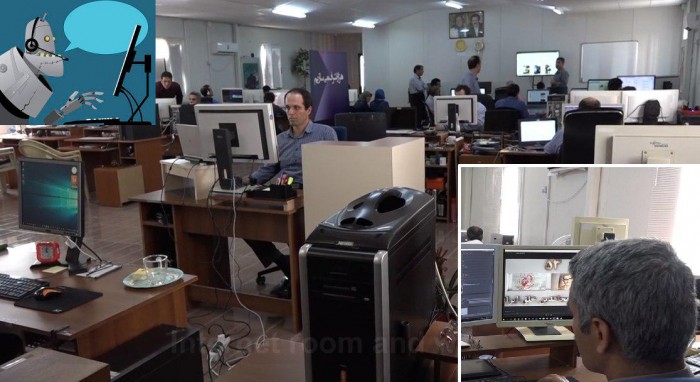
*(MEK members working in the ‘Twitter troll factory’ in Manez Camp, Albania)
To supplement the Alavi propaganda effort, MEK’s Albania operation uses banks of computers manned by followers, some of whom are fluent in English, who serve as bots unleashing scores of comments supporting regime change in Iran while also directing waves of criticism against any pro-Iranian pieces that appear on social media, to include Facebook and Twitter. By one account, more than a thousand MEK supporters manage thousands of accounts on social media simultaneously. The objective of all the chatter is to convince the mostly English-speaking audience that there is a large body of Iranians who are hostile to the regime and supportive of MEK as a replacement.
While the Iranian government and MEK might well be regarded by most Americans as a far-away problem, there was considerable shock expressed even by congress and the media when it was learned shortly before The Intercept’s revelations that the United States government had been funding a so-called Iran Disinformation Project that was employing tactics remarkably similar to those of MEK in an attempt to control the discussion over Iran policy.
The project, run by the State Department’s global engagement center, consisted of a trolling campaign which targeted online American citizens critical of the government’s Iran policy, labeling them as disloyal to the United States and tools of the Iranian government. It used, for example, the website IranDisInfo.org and the hashtag #NIACLobbies4Mullahs. Iranian-American activist and long-time State Department contractor Mariam Memarsadeghi headed the program, receiving hundreds of thousands of dollars to “relentlessly attack critics of the Iran policy on social media… accusing them of being paid operatives of the regime in Tehran.” In all, the “Iran Disinfo” operation received over $1.5 million through the Memarsadeghi contract entity the oddly named E-Collaborative for Civic Education.
The investigation of Iran Disinfo also revealed that the neoconservative Foundation for Defense of Democracies (FDD), which has been leading the charge for war with Iran, had at least one employee working with E-Collaborative. FDD, which has been advising the Trump White House on a more aggressive policy towards Iran, has also been actively involved in the State Department effort and cross-posting material from the Disinfo campaign.
FDD has long been targeting Iran. It received $3.63 million in 2017 from Bernard Marcus, co-founder of Home Depot. Marcus is a hard-core Zionist who hates Iran and once referred to that nation as “the devil.” FDD has also received billions from Las Vegas casino mega billionaire Sheldon Adelson, the GOP’s largest individual donor, who has advocated dropping a nuclear bomb on Iran to send a message. The link between major Republican donors supporting FDD and an increase in FDD quasi-overt cooperation with the Trump Administration in demonizing Iran should not surprise anyone.
Even though the State Department operation was relatively insignificant compared to similar initiatives undertaken by Israel, the idea that an ostensibly democratic government should propagate lies to defend its own policies was definitely unsettling. Some might think that disinformation on Iran is of little importance, that it has little impact on actual policy, but they would be wrong. Bad information that is allowed to circulate freely creates its own reality. Most Americans believe that Iran actually threatens the United States, though they would be at a loss to explain exactly how that could be the case. Dubious stories that originated with Reuters about corruption in Iran have been used by Mike Pompeo to justify sanctions against the regime on humanitarian grounds, measures which have ironically hurt average Iranians disproportionately. The same story was also used in at least four books to discredit the Iranian leadership.
To be sure, the mainstream media is itself largely at fault, as it was with Heshmat Alavi, for not vetting their sources more carefully, particularly when a story is clearly providing unique information or representing a point of view that might be considered controversial. In some cases, of course, the news outlet wants the story to be perceived as true even when it knows that it is not, so it becomes an accomplice in the propaganda effort. A recent attempt to create a mechanism to establish standards by determining the reliability of online news content has, in fact, been little more than a neoconservative scheme to discredit sites that do not support the neocon point of view.
Since governments and various non-governmental constituencies now, by their own admission, are heavily into the game of providing false information and discrediting critics, most Americans will completely tune out of the process, meaning that there will be little or no measurable difference between truth and lies. One already hears complaints from all across the political spectrum that most news is fake. When one reaches the point where such skepticism becomes the consensus, both elections and democracy itself will be rendered pretty much meaningless.
Philip M. Giraldi is a former CIA counter-terrorism specialist and military intelligence officer who served nineteen years overseas in Turkey, Italy, Germany, and Spain. He was the CIA Chief of Base for the Barcelona Olympics in 1992 and was one of the first Americans to enter Afghanistan in December 2001. Phil is Executive Director of the Council for the National Interest, a Washington-based advocacy group that seeks to encourage and promote a U.S. foreign policy in the Middle East that is consistent with American values and interests.
Iran can be Trump’s nemesis
By M. K. BHADRAKUMAR | Indian Punchline | June 15, 2019
What a coincidence that a leaked document from the Organization for the Prohibition of Chemical Weapons (OPCW) just exposed that the chemical weapons attack in Douma, Syria in April, 2018 was most likely staged. In security parlance, it was a false flag operation — stage-managed cunningly to create the alibi for a ‘humanitarian intervention’ by the West in Syria.
As it happened, the US and France did stage a missile strike at Syrian government targets in July that year, alleging that Damascus was culpable for what happened in Douma, ignoring the protests by Russia.
False flag operations are not uncommon, but the US holds a PhD on that genre. The most famous one in modern history was the Gulf of Tonkin incident of August 1964 where the US government deliberately misrepresented facts to justify a war against Vietnam.
Prima facie, there is enough circumstantial evidence to estimate that the attack on two tankers in the Gulf of Oman on June 13 has been a false flag operation. The attack on the two tankers with cargo heading for Japan took place just as the Japanese PM Shinzo Abe sat down for the meeting yesterday with Iran’s Supreme Leader Ayatollah Ali Khamenei in Tehran.
The fact of the matter is that Abe was on a delicate mission to try to kickstart talks between the US and Iran. It is one of those delicate moments when a slight push can derail or even undermine the nascent move for dialogue. True, in the first round, Khamenei rejected talks with the US. But, as Abe said later, more efforts are needed for easing tensions between the US and Iran.
Therefore, as regards the incident yesterday in the Gulf of Oman, the question to be asked is: Who stands to gain? Most certainly, it cannot be Iran, which has just laid on the table in plain terms what it takes for negotiations to commence between the US and Iran — President Trump abandoning what Tehran calls the US’ ‘economic terrorism’ against it. Khamenei told Abe with great frankness that it is futile to negotiate with the US, which keeps resiling from international agreements. No doubt, Trump has been highly erratic by making overtures to Iran on the one hand and tightening the screw on the other hand. (See my blog Abe’s mediatory mission to Tehran hangs in the balance.)
Simply put, Iran has no axe to grind by undermining Abe’s mission, especially since Japan is the only western power, which, historically speaking, never ever acted against Iran but on the contrary consistently maintained friendly ties and showed goodwill. (Once in 1953, Japan even ignored the British-American embargo against Iran and went ahead to import Iranian oil.)
However, this much cannot be said about certain regional states — which Iran has called the ‘B Team’ — that are bent on perpetuating the US-Iran standoff and incrementally degrade Iran to a point that a military confrontation ensues at some point in which American power dispatches that country to the “Stone Age”, as the present US National Security Advisor John Bolton once put it.
In this rogues’ gallery, apart from Israel, there is also Saudi Arabia and the UAE. Bolton, of course, is mentored by Israel and it is an established fact that he has received money for services rendered from the Mojahedin-e Khalq, the anti-Iran terrorist group based in France, which espouses the overthrow of the Islamic regime in Tehran.
Iran has sounded warnings in recent weeks, including at the level of Foreign Minister Javad Zarif, that this ‘B Team’ would at some point stage false flag operations to ratchet up tensions and/ or precipitate a crisis situation, that would in turn prompt Trump to order some sort of military action against Iran.
To be sure, the stakes are very high for Israel, Saudi Arabia and the UAE if Abe’s mission advances further and the current tensions begin to ease. An added factor for the ‘B Team’ is that time is the essence of the matter. It increasingly seems that Bolton’s job as NSA is in danger. Trump has hinted more than once that he does not subscribe to Bolton’s warmongering. The well-known ex-CIA officer and commentator John Kiriakou wrote this week that the White House has “very quietly and discreetly begun informal meetings with a list of a half-dozen possible replacements for Bolton.” (See the commentary in Consortium News titled JOHN KIRIAKOU: Bolton’s Long Goodbye.) It is crucial for the ‘B Team’ that Bolton keeps his job in the White House. And there is no better way to hold back Trump from sacking his NSA when a crisis situation looms large in the Middle East.
Be that as it may, the US Secretary of State Mike Pompeo has announced that Iran is responsible for the incident in the Gulf of Oman. He claimed in a statement, “This assessment is based on intelligence, the weapons used, the level of expertise needed to execute the operation, recent similar Iranian attacks on shipping, and the fact that no proxy group operating in the area has the resources and proficiency to act with such a high degree of sophistication.”
Now, doesn’t Israel too have the intelligence capability, weapons and expertise to execute such a false flag operation? Read Pompeo’s statement carefully and its laboured tone gives away that the ex-CIA Director (who recently even bragged openly about the art of lying in diplomacy and politics) was far from convincing.
So, where’s the beef? Pompeo has instructed that the UN Ambassador Jonathan Cohen raise the matter in the UN Security Council. There is an eerie similarity to what once one of Pompeo’s predecessors as state secretary, Colin Powell did — manufacturing evidence of WMD program by Saddam Hussein to pave the way for the US to invade Iraq.
What needs to be factored in is that the US anticipates that in another fortnight, Iran’s 60-day deadline for the European countries to come up with concrete steps to fulfil their commitments under the 2015 Iran nuclear deal will expire. The German Foreign Minister Heiko Maas’s visit to Tehran last week was a calculated attempt to persuade Iran to accept the stark reality that it must unilaterally fulfil its commitments under the nuclear deal while there is little the EU can do in practical terms to defy the US sanctions. Maas tried to persuade Iran to accept the US’ demand that non-nuclear issues (such as Iran’s missile programme, regional policies, etc.) also be negotiated under a new pact. Quite obviously, the European powers, despite their bravado (in words), are falling in line with Trump’s strategy of ‘maximum pressure’ against Iran.
If Iran decides to reject the idea of unilaterally observing the 2015 deal (without any reciprocal acts by the international community), the US and its western allies will want to take the matter to the UNSC to revive the UN’s past (pre-2015) sanctions against Iran. The big question is whether Russia and China would allow such a turn of events. Tehran has categorically denied any involvement in yesterday’s incident. And Iran is playing it cool. President Hassan Rouhani and Foreign Minister Javad Zarif left Tehran for Bishkek on June 13, as scheduled previously, to participate in the Shanghai Cooperation summit.
Meanwhile, the US has made an additional deployment to the region. But then, the US Central Command has also signalled to Tehran in a statement: “We have no interest in engaging in a new conflict in the Middle East. We will defend our interests, but a war with Iran is not in our strategic interest, nor in the best interest of the international community.”
At this point, the logical thing to do will be to insist on an impartial investigation by the UNSC on the incident. But, curiously, no country is willing to bell the cat. Russia, which is usually quick on demanding facts before reaching any definitive opinion on such murky situations, is also not in a hurry to demand investigation. Can it be that everyone understands that this was a false flag operation and could only be Bolton’s last waltz with Netanyahu?
Trump is walking a fine line. He has blamed Iran, but refrained from saying what he proposed to do. The fact remains that a highly dangerous situation is developing in and around the Straits of Hormuz, which is a choke point for oil tankers.
An entanglement with Iran’s Pasdaran is the last thing Trump would want as he plans to announce shortly his candidacy for the 2020 election. The situation is fraught with grave political risks, if one recalls how the Iran crisis spelt doom for Jimmy Carter’s re-election campaign in 1980.
Trump has bitten more than he could chew, as the strong rebuke Iran’s Supreme Leader Ali Khamenei administered to him underscores. Iran may turn out to be Trump’s nemesis.
Read the CNN ‘analysis’ here taunting Trump to walk the talk on Iran.
Convenient “Tanker Attacks” as US Seeks War with Iran
By Tony Cartalucci | New Eastern Outlook | June 13, 2019
… it would be far more preferable if the United States could cite an Iranian provocation as justification for the airstrikes before launching them. Clearly, the more outrageous, the more deadly, and the more unprovoked the Iranian action, the better off the United States would be. Of course, it would be very difficult for the United States to goad Iran into such a provocation without the rest of the world recognizing this game, which would then undermine it. – Brookings Institution, “Which Path to Persia?” 2009
For the second time since the United States unilaterally withdrew from the so-called Iran Nuclear Deal, Western reports of “suspected attacks” on oil tankers near the Stait of Hormuz have attempted to implicate Iran.
The London Guardian in an article titled, “Two oil tankers struck in suspected attacks in Gulf of Oman,” would claim:
Two oil tankers have been hit in suspected attacks in the Gulf of Oman and the crews evacuated, a month after a similar incident in which four tankers in the region were struck.
The article also claimed:
Gulf tensions have been close to boiling point for weeks as the US puts “maximum economic pressure” on Tehran in an attempt to force it to reopen talks about the 2015 nuclear deal, which the US pulled out of last year.
Iran has repeatedly said it has no knowledge of the incidents and did not instruct any surrogate forces to attack Gulf shipping, or Saudi oil installations.
The Guardian would admit that “investigations” into the previous alleged attacks in May carried out by the UAE found “sophisticated mines” were used, but fell short of implicating Iran as a culprit.
The article would note US National Security Advisor John Bolton would – without evidence – claim that Iran “was almost certainly involved.”
This news of “attacked” oil tankers near the Stait of Hormuz blamed by the US on Iran – comes all too conveniently on the heels of additional steps taken by Washington to pressure Iran’s economy and further undermine the Iranian government.
The US just recently ended waivers for nations buying Iranian oil. Nations including Japan, South Korea, Turkey, China, and India will now face US sanctions if they continue importing Iranian oil.
Coincidentally, one of ships “attacked” this week was carrying “Japan-related cargo,” the Guardian would report.
Also convenient was the US’ recent designation of Iran’s Islamic Revolutionary Guard Corps (IRGC) just ahead of this series of provocations attributed to Iran.
AP in a May 2019 article titled, “President Trump Warns Iran Over ‘Sabotaged’ Oil Tankers in Gulf,” would claim:
Four oil tankers anchored in the Mideast were damaged by what Gulf officials described as sabotage, though satellite images obtained by The Associated Press on Tuesday showed no major visible damage to the vessels.
Two ships allegedly were Saudi, one Emirati, and one Norwegian. The article also claimed:
A U.S. official in Washington, without offering any evidence, told the AP that an American military team’s initial assessment indicated Iran or Iranian allies used explosives to blow holes in the ships.
And that:
The U.S. already had warned ships that “Iran or its proxies” could be targeting maritime traffic in the region. America is deploying an aircraft carrier and B-52 bombers to the Persian Gulf to counter alleged, still-unspecified threats from Tehran.
This more recent incident will likely be further exploited by the US to continue building up its military forces in the region, applying pressure on Iran, and moving the entire globe closer toward war with Iran.
The US has already arrayed its forces across the Middle East to aid in ongoing proxy wars against Iran and its allies as well as prepare for conventional war with Tehran itself.
All of this amounts to a renewed push toward a more direct conflict between the United States and Iran after years of proxy war in Syria Washington-backed forces have decisively lost.
It is also a continuation of long-standing US foreign policy regarding Iran put into motion over a decade ago and carried out by each respective presidency since.
Washington’s Long-Standing Plans
Continued sanctions and the elimination of waivers are part of Washington’s unilateral withdrawal from the Joint Comprehensive Plan of Action (JCPOA) or the “Iran Nuclear Deal.” The deal was signed in 2015 with the US withdrawing in 2018.
While the decision is portrayed as political differences between former US President Barack Obama and current US President Donald Trump – in reality – the plan’s proposal, signing, and then withdrawal from by the US was planned in detail as early as 2009 as a means of justifying long sought-after war with Iran.
In their 2009 paper, “Which Path to Persia?: Options for a New American Strategy Toward Iran” (PDF), the corporate-financier funded Brookings Institution would first admit the complications of US-led military aggression against Iran (emphasis added):
… any military operation against Iran will likely be very unpopular around the world and require the proper international context—both to ensure the logistical support the operation would require and to minimize the blowback from it.
The paper then lays out how the US could appear to the world as a peacemaker and depict Iran’s betrayal of a “very good deal” as the pretext for an otherwise reluctant US military response (emphasis added):
The best way to minimize international opprobrium and maximize support (however, grudging or covert) is to strike only when there is a widespread conviction that the Iranians were given but then rejected a superb offer—one so good that only a regime determined to acquire nuclear weapons and acquire them for the wrong reasons would turn it down. Under those circumstances, the United States (or Israel) could portray its operations as taken in sorrow, not anger, and at least some in the international community would conclude that the Iranians “brought it on themselves” by refusing a very good deal.
And from 2009 onward, this is precisely what the United States set out to achieve.
First with President Obama’s signing of the 2015 Iran Nuclear Deal, up to and including President Trump’s attempts to backtrack from it based on fabricated claims Iran failed to honor the agreement.
The 2009 policy paper also discussed “goading” Iran into war, claiming (emphasis added):
With provocation, the international diplomatic and domestic political requirements of an invasion [of Iran] would be mitigated, and the more outrageous the Iranian provocation (and the less that the United States is seen to be goading Iran), the more these challenges would be diminished. In the absence of a sufficiently horrific provocation, meeting these requirements would be daunting.
Unmentioned directly, but also an obvious method for achieving Washington’s goal of provoking war with Iran would be the US simply staging an “Iranian provocation” itself.
As the US had done in Vietnam following the Gulf of Tonkin incident, or US fabrications regarding “weapons of mass destruction” Washington claimed Iraq held in its possession, the US has a clear track record of not just simply provoking provocations, but staging them itself.
The Brookings paper even admits to the unlikelihood of Iran falling into Washington’s trap, lamenting (emphasis added):
… it is certainly the case that if Washington sought such a provocation, it could take actions that might make it more likely that Tehran would do so (although being too obvious about this could nullify the provocation). However, since it would be up to Iran to make the provocative move, which Iran has been wary of doing most times in the past, the United States would never know for sure when it would get the requisite Iranian provocation. In fact, it might never come at all.
The alleged sabotaging of oil tankers off the shore of the UAE in May and now additional “attacks” this month could be the beginning of a series of staged provocations aimed at leveraging the recent listing of the IRGC as a “terrorist organization” coupled with increased economic pressure as a result of US sanctions re-initiated after the US’ own withdrawal from the Iran Deal.
Synergies Toward War
The US has already attempted to leverage allegations in May of “Iranian sabotage” to further build its case against Iran. Washington hopes that either war – or at least the impending threat of war – coupled with crippling economic sanctions, and continued support of political and armed sedition within Iran itself will create the synergies required for dividing and destroying Iran’s political order.
In a wider regional context, the US has seen political losses particularly in Iraq where Iranian influence has been on the rise. Militarily, US-backed proxy forces have been defeated in Syria with Iran and Russia both establishing permanent and significant footholds there.
Despite the setbacks, the success of Washington’s designs against Tehran still depends mainly on America’s ability to offer political and economic incentives coupled with equally effective threats to friend and foe alike – in order to isolate Iran.
How likely this is to succeed remains questionable – decades of US sanctions, covert and overt aggression, as well as proxy wars have left Iran resilient and with more influence across the region now than ever. Still, Washington’s capacity for sowing regional destruction or dividing and destroying Iran should not be underestimated.
The intentional creation of – then withdrawal from the Iran Deal, the US’ persistent military presence in the Middle East, and sanctions aimed at Iran all indicate that US policymakers remain dedicated isolating and undermining Iran. It will continue to do so until its geopolitical goals are met, or until a new international order creates conditions in the Middle East and throughout the global economy making US regime change against Iran impossible.
Munk School of Global Affairs feeds anti-Iran propaganda

By Yves Engler · June 12, 2019
Sometimes, when you pay attention, it is easy to see how foreign policy propaganda works. Take the case of Iran.
Recently the US has choked off Iranian oil exports, listed its military a terrorist organization and dispatched an aircraft carrier and B-52 bombers to its environs to stop Iran’s “aggression”. Going along with Donald Trump’s warlike actions and rhetoric, Justin Trudeau’s government has broken a promise to restart diplomatic relations, failed to withdraw Iran from Canada’s list of state sponsors of terrorism and recently accused Tehran of destabilizing the region.
This is the context in which the Munk School of Global Affairs’ Citizen Lab released a recent report criticizing Iran. According to Citizen Lab, an Iran-aligned group dubbed Endless Mayfly impersonated major media sites, used fake Twitter accounts to spread false articles and targeted journalists with fake stories. Its report noted, “initial reporting on some of the inauthentic articles speculated that Endless Mayfly may have links to Russia; however, based on the evidence gathered from our investigation we conclude with moderate confidence that Endless Mayfly is Iran-aligned and has been operational since at least early 2016.”
The University of Toronto based lab’s accusations were picked up by dozens of media outlets around the world. A New York Times headline read: “Report Shows How a Pro-Iran Group Spread Fake News Online” while the Globe and Mail noted “New Citizen Lab report suggests Iran spreads fake news.”
But, the report’s concluding section titled “Narratives fit Iranian interests, propaganda” isn’t convincing. One reason it claims Iran was responsible for the initiative is that “framing Saudi Arabia as a creator and supporter of global Islamist terrorism is also a very common theme in Endless Mayfly content and is consistent with recent rhetoric from Iran’s top-ranking officials.” But, Iranian officials certainly aren’t the only ones who claim Saudi Arabia contributes significantly to Islamic terror.
While the media mostly covered Citizen Lab’s claims uncritically, its positions on Iran should be viewed with significant skepticism. This ‘lab’ has produced a stream of reports critical of Iran and, in fact, is part of a government funded effort to destabilize that country. In March Citizen Lab Director Ron Deibert co-authored “Censors Get Smart: Evidence from Psiphon in Iran.” Previously, Citizen Lab published “Group 5: Syria and the Iran Connection”, which described a malware operation targeting Syrian opposition figures that purportedly came from Iran. The Lab published After the Green Movement: Internet Controls in Iran, 2009-2012 and in 2015 they detailed hacking of Iranian dissidents. While Citizen Lab carefully avoided naming a culprit, their press release hyped the matter and a number of media reports implied Iranian authorities were responsible.
Deibert is a regular at anti-Iranian events. He spoke at a Toronto International Film Festival screening of a movie about the 2009 Green Revolution in Iran and a 2012 Walrus article described a “network of local Farsi speakers linked to Deibert and Psiphon.”
With early financial support from the Ford Foundation, Donner Canadian Foundation and Open Society Institute, Citizen Lab developed software to bypass government censors. It worked with Voice of America, Radio Free Europe and Radio Farda in Iran to disseminate its Psiphon technology to Iranian dissidents. A 2018 Vice story titled “This App Is Helping Iranians Beat Tehran’s Internet Censorship” described Psiphon’s growth in Iran. It noted, “the lab, and the school, has spent years devising various ways to improve civic engagement in Iran, especially online, with some financial support from the Canadian government.”
The Munk School of Global Affairs joined the Stephen Harper Conservatives’ low-level war against Iran. After severing diplomatic ties and designating Iran a state sponsor of terrorism in 2012, Foreign Affairs ploughed $250,000 into the Munk School’s Global Dialogue on the Future of Iran. The aim of the initiative was to foment opposition to the regime and help connect dissidents inside and outside Iran. Employing cutting-edge Internet strategies, the Iran Dialogue was launched at a two-day conference kicked off by foreign minister John Baird. Some Iranian Canadians criticized the 2013 Global Dialogue on Iran. In a letter to Munk School head Janice Stein, who was awarded an honorary doctorate from Hebrew University “in tribute to her unwavering devotion to Israel”, the president of the Iranian Canadian Community Council Niaz Salimi wrote: “Conspicuously absent from the event were experts, academics, political activists, students, bloggers, journalists and members of the Iranian diaspora (including those of the Iranian-Canadian community) whose views on Iran do not fully concur with the positions of the Harper government.”
The Munk School has been a hub of anti-Iranian activity. A senior research fellow until recently, Mark Dubowitz was dubbed “The Man Who Fights Iran” by Ynet, Israel’s largest English language news site. Alongside his position at the Munk School, Dubowitz was executive director of the extremist pro-Israel Foundation for Defense of Democracies where he led its campaign against the Obama administration’s Iran nuclear deal. In 2011 Dubowitz said, “the best way [to end Iran’s nuclear program] is to work toward changing the regime.”
Expanding the Global Dialogue on the Future of Iran, Foreign Affairs gave the Munk School $9 million in 2015 to establish the Digital Public Square project. The federal support “will enable the Munk School to create our new Digital Public Square, a square designed for citizens who cannot come together physically to exchange ideas about the future of their country,” Munk School head Janice Stein said. The countries cited were Iran, Syria, Iraq and Russia. There was no mention of employing digital technologies to undermine online censorship in equally, or more, repressive allies such as Rwanda, Jordan, Honduras or Saudi Arabia.
This is one-way Canadian propaganda works: Establish who your enemies are — generally defined by big corporations, rich people and whoever is in power in Washington — attempt to destabilize their “regimes”, then accuse their governments of interfering in your affairs.
Citizen Lab’s recent report criticizing Iran is part of a government funded effort to demonize that country, which could be a step towards a military assault.
Featured Video
Iran FM Araghchi: “Hormuz Will No Longer Be the Same”
or go to
Aletho News Archives – Video-Images
From the Archives
Sam Husseini: The entire US establishment helped lie their way into the Iraq war
By Slava Zilber | American Herald Tribune | October 14, 2019
Sam Husseini is a senior analyst with the Institute for Public Accuracy, independent journalist and contributor to The Nation and FAIR.
Slava Zilber: Sam, three years ago, you appeared on Talk Nation Radio with David Swanson and spoke about the case of the GCHQ whistleblower Katharine Gun. You pointed out that the people involved in the spying on the UN and the people authorizing the Iraq War were not held accountable:
“Virtually everybody who went along with the war, whether it is Kerry or Clinton, of course, the Bush administration themselves has falsified their own records in terms of why, what they did, when they did, why they did it, to the extent that they’ve been scrutinised at all.”
You also address it in a recent article. And recently, Joe Biden has been lying about his position on the Iraq War. How can such an important issue escape meaningful scrutiny? … continue
Blog Roll
 Aletho News
- Barghouti: ‘Netanyahu has fallen,’ era of Smotrich, Ben-Gvir over
- China slams US policy on Iran as Russia rejects legality of nuclear meeting at UN
- The Mecca Pact Courts Iran: Containment Comes Full Circle
- Oman FM: Persian Gulf states, Iran, Iraq should form security pact excluding US
- Trump peddles fresh falsehoods, claims Iran ‘started the war’ as US aggression drags on
- Ukraine quagmire? Yes, but it’s for NATO, not Russia
- US intelligence hypes Chinese, Russian space threats while accelerating its own military buildup in orbit
- Iran FM Araghchi: “Hormuz Will No Longer Be the Same”
- EU facing trillion-euro debt hole while seeking more cash for Kiev
- How US, Europe, Persian Gulf states exhausted missile stockpiles, splurged billions to defend Israel
- If Americans Knew
- An error has occurred; the feed is probably down. Try again later.
- No Tricks Zone
- Sudden Stratospheric Warming, Powerful El Niño Combination May Lead To Extreme Europe Cold, Energy Crisis!
- Two New Studies Find Thwaites Glacier Melt Cannot Be Driven By Human Activity Or A Warming Ocean
- E-Cars Reduce CO2 Emissions By Only 41% Compared To Internal Combustion Engine Vehicles
- Predictions Made By Renowned Climate Professor Over Past Decades Have Been Proven To Be Poor
- New Study Suggests Large Regions Of The Pacific Ocean Have Been Cooling For The Last 80 Years
- Germany’s Green Energy Debacle: High Energy Costs Force Kahla Porzellan to Close After 182 Years!
- New Study: 50 Years Of The Most Aggressive ‘Net Zero’ Policies Can Only Affect The Global Climate By 0.03°C
- US September “Heat” Was No Record…Many Records Set Decades Ago
- Latest European Green Energy Debacle; Portugal’s Largest Flagship Solar Park Insolvent!
- Green Energy Debacle: German Expert Professor Fritz Vahrenholt Warns Of Severe Economic And Social Consequences

