US Treasury Dept imposes new Iran-related sanctions on 2 individuals and a company in Iraq
RT | June 12, 2019
The US Treasury Department announced sanctions on Wednesday against two Iraq-based persons and one company, for their alleged links to Iran’s Revolutionary Guard.
Makki Kazim and Mohammed Hussein, along with the South Wealth Resources Company have all been hit with secondary sanctions, according to the Treasury Department website.
Secondary sanctions form a major part of US international statecraft, cutting off businesses and individuals from the US financial system and tarnishing their reputations with international businesses and banks. A number of measures can be enforced against targeted individuals, ranging from limiting their ability to do business in the US to prohibiting all US parties from conducting business with them.
Abe’s mediatory mission to Tehran hangs in the balance
By M. K. BHADRAKUMAR | Indian Punchline | June 10, 2019
With two days to go for the arrival of Japanese Prime Minister Shinzo Abe in Tehran on a peace mission to promote US-Iran talks, a great deal of shadow boxing has been going on. Typically, there is much excitement in the media. Thus, western media in general hyped up the remarks of the commander of the US’ Lincoln strike group, Rear Adm. John F. G. Wade to make them sound belligerent and provocative.
However, Tehran has not fallen into that trap. The fact of the matter is that the US and Iranian militaries have deep experience in fathoming each other’s intentions and working out ground rules of co-habitation in the crowded waters of the Persian Gulf. This arrangement has worked fine for past 4 decades and quite obviously, a ‘new normal’ has come to exist lately with the recent deployment of a US nuclear strike group in the region.
The Tehran Times carried a sober report on Adm. Wade’s remarks bringing out vividly what the admiral wished to convey (and Iran’s appreciation of it). The influential establishment daily highlighted Wade’s remark that “Since we’ve been operating in the region, we’ve had several interactions with Iranians. To this point all have been safe and professional — meaning, the Iranians have done nothing to impede our maneuverability or acted in a way which required us to take defensive measures.”
That just about sums up the state of play in the Persian Gulf. The facts are important. The Tehran Times reported: “One month after its arrival in the region, the Lincoln has not entered the Persian Gulf, and it’s not apparent that it will. The USS Gonzalez, a destroyer that is part of the Lincoln strike group, is operating in the Persian Gulf.”
“Last week, the Lincoln was some 320 kilometers (200 miles) off the eastern coast of Oman in the Arabian Sea. It would still need to pass through the Gulf of Oman and the Strait of Hormuz before reaching the Persian Gulf.” Clearly, the ‘new normal’ is not so precarious as made out by some media reports (here , here and here.) Surely, a lot of grandstanding is going on, but, war? Not a chance.
Meanwhile, the US has extended its sanctions on Iran’s oil industry to cover its largest petrochemical group. This appears to have been a decision in the pipeline but the timing of the announcement (on Friday) is intriguing — although it is a by-now familiar pattern of an inchoate Administration pulling in different directions. No doubt, Tehran has questioned the US’ true intentions by making such a move at this point in time when the air is full of talk about negotiations.
The Trump administration has taken a reckless step on the eve of Abe’s mission, which could have been avoided. It is a moot point whether Trump himself was aware of it or not. All the same, Tehran is approaching the talks with Abe calmly and purposely.
Unsurprisingly, Iran plays down the forthcoming talks. A commentary in the Tehran Times in the weekend cited Washington’s move on Friday in extending the sanctions to the petrochemical sector as confirming that the White House has no intentions to “retreat” from its “maximum pressure” strategy. The commentary sees two-fold pressures as working on Trump — aversion to war in the US public opinion and the lack of support from allies apropos his Iran policies.
Interestingly, the commentary weighs on Abe’s mission, assessing that its outcome depends on two factors — “the ‘real will’ and determination of the US and Iran to solve the ongoing problems, especially the US’ ‘real will’ ” and secondly, Japan’s ability to influence US decisions.
Foreign Minister Javad Zarif has welcomed Abe’s visit — “We will carefully listen to Abe’s views, and then will express ours in detail.” But he stressed that the US must stop its ‘economic war’. He disclosed that Tehran has already sensitised Abe in the matter.
Importantly, the Spokesman of Iran’s Supreme National Security Council has noted that the success of Abe’s visit could be guaranteed if only Japan has made efforts to “return the US to the JCOPA (2015 nuclear deal) and compensate (sic) the losses suffered by Iran (due to sanctions)” as well as to remove the US sanctions regime.
Abe’s visit to Tehran is a milestone in Japan-Iran bilateral relations insofar as this is the first such event since the Islamic Revolution in 1979, although the two countries have kept up friendly ties all through. Tehran pins hopes that Abe can win waivers from the US to be able to buy oil from Iran.
Quite obviously, the benchmark for the Iranian negotiators will be the remarks made by Supreme Leader Ayatollah Ali Khamenei on May 29 during an an address to a gathering of Iranian academicians, researchers and elites in Tehran. Khamenei said that the bottom line is, “We will not negotiate on the core issues of the Revolution. Negotiations on this issue imply trading; that is, they mean we give up on our defensive capabilities. We will not negotiate our military capability.”
In general, Khamenei said the US has a history of targeting the assets of a country by pressurising it. In this, negotiation becomes a tactic to compel the interlocutor to trade its national assets. “They (US) pressure until the adversary gets tired, and then propose to negotiate. This negotiation is complementary to the pressure and aims to cash in on the pressures. They impose pressure and then propose to negotiate. This is what negotiation means to them. Their strategy is not negotiation. It is pressure. Negotiation is part of the pressure strategy.”
That is why, Khamenei underscored, Iran has had to resort to resistance as a “countermeasure.” To quote him, “The countermeasure for us (Iran) is to use our own means of pressures to contend their (US) pressure. However, if we are deceived by their call for negotiations and consider our means of pressures unnecessary, we would slip and that equals absolute defeat.” (Excerpts of Khomeini’s speech are here.)
The Geo-Port-Politics of Gwadar and Chabahar
By Salman Rafi Sheikh – New Eastern Outlook – 08.06.2019
In a highly surprising move, Iran’s foreign minister, on an unscheduled and unannounced visit to Pakistan on Thursday (May the 23rd), announced the proposal to link Pakistan’s port of Gwadar with Iran’s Chabahar port. This announcement signals tectonic geo-political shift taking place in the region in the wake of increasing tensions between the US and Iran. The US has already successfully forced India, its chief South Asian ally, to scrap its purchase of oil from Iran, a country India was not long ago claimed to have entered into a strategic alliance with. Although the US has somehow left Chabahar out of its net of sanction, India’s decision to follow the US in its footsteps does signal its participation in the US policy of crippling Iranian economy and take Iran to the verge of massive political disruption and eventual regime change. Iran, obviously, is not unmindful of the implications of this particular decision of India.
Iran’s proposal to link Chabahar with Gawadar, despite the fact that the US sanctions don’t apply on the post, shows the deep sense of Indian betrayal prevailing in Tehran and a counter-manoeuvre to avoid isolation. Iran, obviously, does not expect India to be as robust and committed to building the rest of the port as it would have in a peaceful and sanction-less scenario. Iran, logically enough, is boosting its ties with its immediate neighbour, a country that already is deeply allied with China and aims to expand CPEC to Iran to increase regional connectivity. With Chabahar and Gwadar being linked, Iran will thus have two major regional states on its side i.e., Pakistan and China and will be far better placed in China’s extended regional connectivity programme than it is now. Zarif’s connectivity proposal itself tells everything. To quote him:
“We believe that Chabahar and Gwadar can complement each other. We can connect Chabahar and Gwadar, and then through that, connect Gwadar to our entire railroad system, from Iran to the North Corridor, through Turkmenistan and Kazakhstan, and also through Azerbaijan, Russia, and Turkey.”
As far as the US—Iran tension is concerned, unlike India, Pakistan has already said that it will not take sides in the conflict. Pakistan’s neutrality in the on-going scenario suits Tehran far more than it does for the US, that is if it does at all.
There is also no gainsaying that Tehran’s proposal to connect the two ports couldn’t have come with prior consultation with the Chinese, who are practically running the port in Pakistan. Accordingly, before coming to Pakistan, Zarif was in China where he met his Chinese counterpart and certainly discussed this proposal, leading Chinese foreign minister to “Welcome Iran” to actively take part in the joint building of the Belt and Road Initiative (BRI) through Chabahar.
China also re-affirmed its support for Iran. “China firmly opposes unilateral sanctions and the so-called ‘long-arm jurisdiction’ imposed by the United States on Iran,” Wang said, pledging to maintain the Joint Comprehensive Plan of Action and safeguard the authority of the United Nations and basic norms governing international relations.
Chinese support’s major manifestation came a few days ago when Chinese oil tanker Pacific Bravo left the Persian Gulf with 2 million barrels of Iranian light crude, ignoring the US sanctions and practically challenging the US unilateralism.
Pacific Bravo is owned by Bank of Kunlun, a financial institution that is owned by the Chinese state oil company CNPC. Bank of Kunlun has long been the financial institution at the heart of China-Iran bilateral trade—a role for which the company was sanctioned during the Obama administration. Despite already being designated, Bank of Kunlun ceased its Iran-related activities in early May when the oil waivers were revoked. But Bravo’s current moves point to a change in Chinese policy. Importantly enough, Bravo sailed from the Persian Gulf on the same day that Zarif arrived in Beijing and met Chinese foreign minister to discuss Iranian participation in the BRI (through linking Gwadar and Chabahar).
With Iran now taking this fundamental shift, what is apparent is that a major foreign policy shift in Iran has taken place whereby its leadership has come to an understanding that their relations with the US are unlikely to take a positive turn for a long time and that a necessary adjustment in the foreign policy is absolutely needed. As a matter of fact, it was only a few days ago when Iran’s supreme leader criticised Iran’s foreign policy and dropped a major hint about why changing the course of foreign policy was an utmost necessity.
Of course, its major manifestation is reorienting Iran’s relations with Pakistan via participation in the BRI. Pakistan will be least concerned about any US reaction over linking Gwadar with Chabahar, for the US sanctions do not apply to the Iranian port. But the fact that the geo-political significance of the port will undergo a significant change after a successful linkage between the two ports and that China will become a major player, the US might feel ‘compelled’ to direct its sanctions toward the port eventually.
‘Act of economic terrorism’: Iran says US sanctions prove call for talks was ‘deceitful & untrue’
RT | June 8, 2019
The sanctions imposed by the US against Iranian petrochemical companies prove that Mike Pompeo’s earlier promise of negotiations without preconditions was nothing but a bluff, a senior Iranian diplomat said.
On Friday, the US Treasury announced it has imposed a new wave of sanctions against Iranian energy businesses. The move is meant to stifle the revenues of the elite Islamic Revolutionary Guard Corps (IRGC), which Washington declared a terrorist organization earlier in April. This proves that US Secretary of State Mike Pompeo made an empty promise to Tehran less than a week ago, when he said he was ready to start “a conversation with no preconditions,” a spokesman for the Iranian Foreign Ministry said.
Pompeo’s words were “deceitful, untrue and merely in service of appealing to the public opinion,” Abbas Mousavi said as cited by Iran’s Mehr News Agency. He called the sanctions an act of “economic terrorism” and said Tehran will not yield to Washington’s pressure.
“All countries have a responsibility to react against the flagrant violations of the fundamental principles of international law and not to allow the international community’s achievements in multilateralism to be further ruined by the bullying and unilateral actions of the American governing body,” Mousavi said.
The Trump administration has broken the multinational agreement on Iran’s nuclear industry signed under his predecessor and ramped up economic sanctions against Tehran, re-imposing those lifted under the nuclear deal and issuing more.
In April, the US announced it will not renew waivers it previously extended to the largest buyers of Iranian crude, which previously shielded them from US sanctions against Iranian energy export. The waivers were meant to give the buyers a grace period to switch away from Iranian oil.
Unlike Pompeo’s claim, Iran’s missiles not for developing nukes: FM Zarif
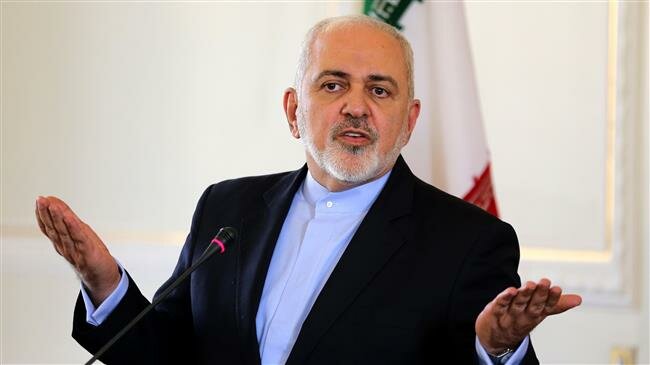
Iranian Foreign Minister Mohammad Javad Zarif
Press TV – June 7, 2019
Iranian Foreign Minister Mohammad Javad Zarif has categorically rejected a claim by US Secretary of State Mike Pompeo about Iran’s missile program, saying Tehran does not seek to develop nuclear weapons.
“Our missiles are not ‘designed’ for nukes, which we’re not developing,” Zarif said in a post on his official Twitter account on Friday.
In an interview with The Washington Times this week, Pompeo once again reaffirmed the US administration’s strategy of applying economic pressure on Iran.
“The objectives are to change the behavior of the Islamic Republic of Iran. … No terror around the world, no expeditionary terror around the world, put your missile program back inside a set of constraints that had been identified in UN Security Council Resolution 2231 and … have a permanent commitment not to develop your nuclear program,” Pompeo said.
Resolution 2231 endorsed the multilateral nuclear accord, officially known as the Joint Comprehensive Plan of Action (JCPOA), which was signed between Iran and the major world powers, including the United States, in 2015.
Under the JCPOA, Iran undertook to put limits on its nuclear program in exchange for the removal of nuclear-related sanctions imposed against Tehran. However, US President Donald Trump pulled his country out of the JCPOA in May 2018 and re-imposed harsh sanctions against the Islamic Republic in defiance of global criticisms.
The US administration claims that Tehran had violated the JCPOA with a series of ballistic missiles tests over the past four years.
In his tweet, Zarif said the US and its allies are in no position to criticize the Islamic Republic’s missile program and lashed out at the West for making arms deals with the countries that are killing the Yemeni people.
“The US—which violated UNSCR 2231 in withdrawing from JCPOA—or its allies (in violation of its provision on normalizing economic relations w/Iran) are in no position to push a conceited interpretation of its missile provision while pouring weapons into hands that kill Yemenis,” the top Iranian diplomat said.
An American think tank said in April that it has found new data showing US arms deals with Saudi Arabia and the UAE are “dramatically understated” and billions more than previously reported.
The data collected by arms trade watchdog Security Assistance Monitor (SAM) shows the US has struck at least $68.2 billion worth of deals with the two countries since they started their war in Yemen.
In another tweet, Zarif said that Resolution 2231 has “called upon” Iran not to undertake any activity aimed at designing ballistic missiles capable of carrying nuclear warheads.
He emphasized that the Security Council resolution does not enforces any prohibition in this regard.
French President Emmanuel Macron also on Thursday accused Tehran of making efforts to achieve nuclear arms and said France and the US both wanted to stop Tehran getting nuclear arms and new talks should focus on curbing its ballistic missiles program and on other issues.
In a Thursday meeting with the US president, Macron listed four common priorities of the US and France in addressing “Iranian behavior”: preventing Iran from getting a nuclear weapon, reducing Iran’s ballistic activity, containing Iran’s regional activity and establishing peace in the region.
However, Iranian Foreign Ministry Spokesman Abbas Moussavi rejected French calls for wider international talks over its nuclear program and said Macron’s comments will be of no help to saving the Iran nuclear deal and will just further deepen distrust among its signatories.
Meanwhile, during a meeting with heads of international news agencies on Thursday, Russian President Vladimir Putin once again stressed the importance of preserving the multilateral nuclear agreement, saying Moscow does not approve of “what is being done against Iran.”
In reaction to Macron’s remarks, the Russian leader drew a line between Iran’s nuclear and missile programs and said, “Yes, someone may be concerned by Iran’s missile programs. But that’s a different problem.”
Bipartisan Support for Trump’s Aggressive Iran Policy Reveals the Hollowness of Russiagate
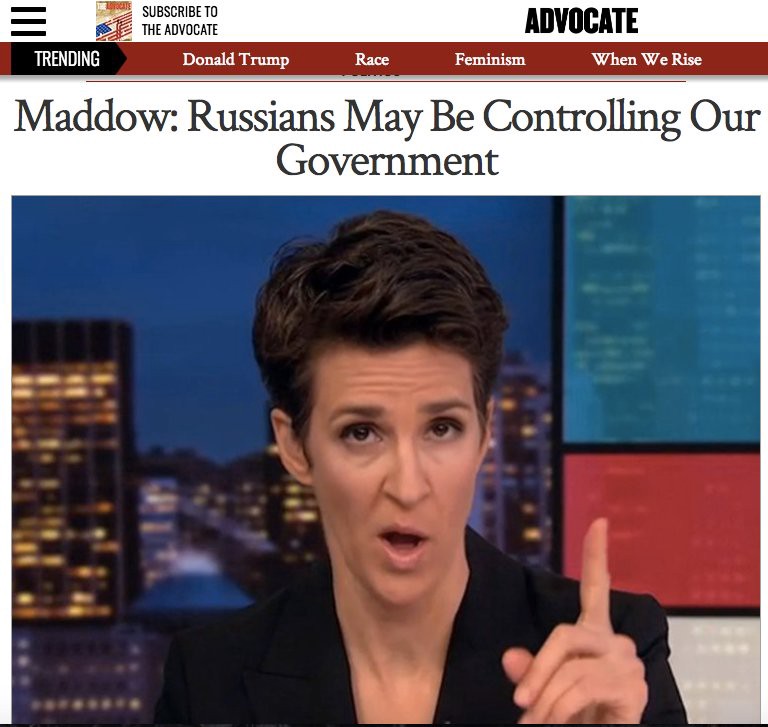
By Whitney Webb | MintPress News | June 3, 2019
In early May, MSNBC news host Rachel Maddow — known as one of the top promoters of the new Cold War and Russiagate in American media — emphatically endorsed regime change in Venezuela after she claimed that President Donald Trump’s hawkishness towards the South American country had changed, all because of a single phone call with his Russian counterpart Vladimir Putin.
Though Maddow’s claims were arguably the most extreme in suggesting that Trump was “taking orders” from Putin on Venezuela, she wasn’t alone in making them. For instance, Cenk Uygur of the Young Turks also made the claim that the Trump-Putin phone call on Venezuela was “direct evidence that he is literally taking orders from Putin.” In addition, several corporate media outlets supported this narrative by suggesting that Trump “echoed” Putin’s Venezuela stance after the phone call and directly contradicted his top staffers and even himself in doing so.
Yet now, strangely, those same corporate media voices remain silent on the Trump administration’s other regime-change project — in Iran — despite the fact that the Putin-led Russian government is set to be the biggest winner as tensions between the U.S. and the Islamic Republic boil over and threaten to send the Middle East into a fresh bout of destruction and chaos.
How Russia wins
As tensions between the U.S. and Iran have grown in recent months, analysts in both corporate and independent media have speculated about what country is set to benefit the most from the U.S.’ campaign of “maximum pressure” and regime change against the Islamic Republic. Of the many analyses, two countries have stood out as likely beneficiaries: Russia and China.
The cases for China and Russia’s benefit are somewhat similar given that the Trump administration’s focus on Iran results in less pressure on both Russia and China. This is despite the fact that, officially, the U.S.’ current National Defense Strategy explicitly calls for focusing attention on preparing for a “long war” against Russia and China to prevent either from superseding the U.S. as a global superpower. Yet, with the U.S. focused on regime change in Iran and Venezuela, Russia and China can avoid bearing the brunt of U.S. military adventurism, either directly or by proxy, while the U.S. wears itself thin by trying to do it all at once.
Several U.S. military analysts have been warning against war with Iran for precisely this reason. Nikolas Gvosdev, a professor of national security affairs at the U.S. Naval War College, recently wrote in The Hill that the U.S. faces a lose-lose scenario by pursuing a militaristic, aggressive Iran policy:
To gear up for a major conflict with Iran, the U.S. would be forced to de-emphasize Europe’s eastern flank, allowing Russia more time and breathing space to consolidate its position. On the other hand, a U.S. campaign that is defined more by bellicose rhetoric and less by action will buttress Russia’s claim, already seemingly validated in Syria and in Venezuela, that the U.S. talks a good game but has no real stomach for projecting its power.”
Both countries also stand to benefit from Iran’s increasing desperation for trading partners unwilling to bow to the U.S. Currently, China represents 30 percent of Iran’s international trade and the current U.S. sanctions on Iran have pushed Tehran to rely more heavily on Russia, especially for weapons purchases, than it had while the Iran nuclear deal (officially the Joint Comprehensive Plan of Action, JCPOA) was in force.
However, upon closer examination, it becomes clear that China, though it benefits to some degree, is not a clear winner amid current tensions, while Russia stands to gain the most. The reason for this is the effect of current and future U.S.-Iran tensions on the oil market. While China trusts Iran to be a key oil supplier even if there is a breach in U.S.-China relations, any shock to the oil market and any jump in oil prices — both of which are likely to occur if U.S.-Iran tensions continue to escalate — will spell disaster for the Chinese economy, given that China is now the world’s largest importer of oil.
Russia, on the other hand, stands to benefit massively from the chaos that U.S.-Iran tensions are set to unleash on the oil market and, by extension, oil prices. With the U.S. seeking to starve Iran of any and all oil export revenue, all countries that had been purchasing Iranian oil must seek new suppliers. Yet, with the prospect of a U.S-Iran conflict still ever-present, it will be those oil producers outside of the Middle East that will come out on top, since oil supply routes that do not pass through the Middle East do not risk supply disruptions that would be caused by a war in the region. Thus, Russia, owing to its location, will emerge as an oil producer of extreme importance. Furthermore, given that such instability in the Middle East will lead to a surge in global oil prices, Russia will be able to export more oil at a higher price and will see its economy and geopolitical clout benefit greatly as a result.
A potential geopolitical killing
In addition to a great boost to its oil sector, Russia also stands to make unique geopolitical gains, particularly in the Middle East and beyond. For instance, in Syria, Russia is increasingly seeking to use its pull with Syria’s government as a major bargaining chip with Israel and the U.S., as made clear by the upcoming trilateral summit on the Middle East between Russia, Israel and the U.S. The main focus of that summit will likely be the fate of the presence of foreign militaries in Syria, particularly Iranian and U.S. forces.
The summit will likely be dominated by Russia and Israel, given Israel’s influence over the U.S., and particularly over National Security Adviser John Bolton, who will represent the U.S. at the summit. Israel’s key interest in Syria at this stage of the conflict is the removal of Iranian forces from Syria. Russia is likely to oblige that request, as doing so would allow Russia to dominate a post-war Syria at Iran’s expense. This seems to be a current Russian objective in Syria, given recent reports of in-fighting among Russian and Iranian forces in Northern Syria.
However, Russia is unlikely to help reduce Iran’s Syria presence if doing so would favor the United States’ occupation of Syrian territory or threaten to upset Russia’s own interests in Syria. Thus, in this case, Russia is counting on Israel’s influence on the Trump administration to ensure that, if Iranian forces vacate Syria, it will be Russia that will dominate the country post-conflict.
Russia also stands to gain geopolitically from the isolationism being forced on Iran by the Trump administration. Indeed, U.S. pressure on Iran has already served Russian interests by pushing Iran further towards Russia, giving Moscow the status of an increasingly important economic partner of Tehran. While benefiting the Russian economy, closer economic ties between Moscow and Iran would also give Russia a leg up in discussions with the U.S., as Washington may then need to make concessions to or coordinate with Russia in future efforts to pressure Iran.
Meanwhile, Russia stands to reap major profits by selling more weapons to Iran, and to gain geopolitical clout by further cementing its role as a mediator of conflict by promoting compliance with the JCPOA and opposing regime change. Iran’s dwindling options for strategic alliances with non-U.S. aligned countries will make it difficult for Tehran to resist Russian demands on key issues, including the Syria conflict.
Another major geopolitical win for Russia that has resulted from the U.S.’ current Iran policy is the tension that that policy has engendered between the U.S. and its European allies. When the U.S. unilaterally withdrew from the JCPOA, it began the development of a rift between the U.S. and its key European allies who are also JCPOA signatories — particularly France, Germany and the United Kingdom. As a signatory, Russia’s stance on Iran has revolved around the JCPOA, with Russia having urged Iran to remain in the deal “no matter what,” advice that Iran does not now seem keen to follow.
Russia’s stance on JCPOA is likely aimed just as much at Europe as it is at Iran, since promoting the agreement amid the U.S. unilateral withdrawal paints Russia as more predictable and stable in terms of its political stances and diplomacy in comparison to the U.S. If nothing else, Putin is known for excelling at taking advantage of the missteps made by his geopolitical adversaries.
This is all part of a careful public image that Russia is seeking to cultivate with European countries as it hopes to attract them to do business with Russian oil and gas companies as the Middle East now seemingly approaches another era of extreme instability. By promoting the JCPOA alongside Europe, Russia makes increased Russo-European cooperation seem more attractive.
As U.S.-Iran tensions mount, particularly if armed conflict breaks out, importing goods from Russia, especially oil and gas, will appear more attractive and safer in comparison to goods that originate from or pass through the Middle East before arriving in Europe. Depending on how the situation plays out, Europe — driven by concerns about stability and reliability — may be willing to risk angering the U.S. to pursue increased economic cooperation with Russia, even though doing so would run counter to current U.S. and NATO objectives.
Putin plays Netanyahu
While it is often difficult to find accurate, honest reporting on Vladimir Putin –reporting that is neither too biased against him nor too much in his favor — it is generally acknowledged that Putin, above all else, is interested in advancing Russia’s national interest and is a cunning strategist who often thinks several steps ahead of both his allies and his adversaries.
In viewing the ratcheting up of tensions between the U.S. and Iran, Putin’s modus operandi remains unchanged and, upon closer examination, it is clear that he is giving the hotheads driving this still-escalating situation just enough rope to hang themselves. Meanwhile, Russia is waiting in the wings to pick up the pieces and further cement its already acknowledged role as the new foreign “peacemaker” in the Middle East while gaining economic and geopolitical clout in the process.
Prior to the Israeli election earlier this year, Israeli media noted on several occasions that Putin was backing the reelection of Israeli Prime Minister Benjamin Netanyahu, including when Putin hosted Netanyahu at a sudden pre-election summit. Israeli newspaper Haaretz described Putin’s decision to host Netanyahu at the time as aimed at helping Netanyahu secure the “crucial Russian vote” among Russian-Israeli Jews in order to “outflank” his competitors. In another instance, Putin was alleged to have further helped Netanyahu’s reelection odds by having Russian special forces find and deliver the remains of Zachary Baumel — an Israeli soldier who had gone missing in Lebanon in 1982 — to Israel just ahead of the election.
Putin’s direct support of Netanyahu may seem odd to observers of geopolitics, given that the two have often been at odds over Syria. However, Putin and Netanyahu have developed an effective working relationship and Russia and Israel enjoy relatively strong bilateral ties and economic agreements.
Yet, beyond the ties that have been forged between the two countries in recent years, Putin likely knows that he can play Netanyahu’s weaknesses to his advantage. For instance, Putin is acutely aware of the benefits to be reaped from increasing tensions between the U.S. and Iran and is also aware of the key role that Netanyahu has played and continues to play in driving the Trump administration’s Iran policy. Netanyahu’s near-obsession with regime change in Iran and the practical likelihood that a U.S.-Iran war would be “unwinnable” for the U.S. and would leave its military weakened and distracted are points that Putin is likely eager to exploit in pursuance of Russian geopolitical goals.
Russia seeks to play the role of mediator but only to a certain extent and has kept its attitude towards Iran intentionally vague when dealing with the Israeli government, so much so that Israeli officials have cited Russia’s unknown stance towards Iran as a major difficulty in negotiating the deconfliction of Russian and Israeli forces in Syria. This is likely because Russia doesn’t seek to aid either side amid escalating tensions, instead waiting for the current tensions to play out, as it stands to make gains in either case.
That Russia stands to gain from current U.S.-Iran tensions hasn’t been lost on all Israeli officials, however. Earlier this month, a former Israeli intelligence official, Yakkov Kedmi, openly stated that not only is a war against Iran “unwinnable” for the U.S. and its regional allies, but further that Russia would be the only major country to benefit from any military conflict pitting the Americans against the Iranians. Appearing on Russian television program Evening with Vladimir Solovyov, Kedmi stated that, if war does break out, the U.S. “won’t remain whole” after the conflict and that “if anyone wins, it’ll be Russia.”
“If the price of oil exceeds $100 per barrel, it hits the Chinese economy. Most of all, it hits the European and American economies,” Kedmi stated. “If you double the price,” he added, “[global] industry will be ruined. First of all, it will happen in the U.S.” To that, the program’s host, Vladimir Solovyov, asserted that “Their [American] industry will be [ruined]. It’ll be the opposite in our country. Our economy will begin to develop. We’ll feel like kings with golden diamond-studded wheels on our cars.”
Why the Russiagaters are silent on Iran
Given Russia — and Putin’s — clear benefit from the continuing U.S. escalation with Iran and a potential military conflict, it is striking that Putin’s fiercest critics in the American media have remained silent about this clear pay-off as the Trump administration continues to pursue an aggressive, hawkish Iran policy that hardly benefits the U.S. and instead benefits its supposed adversary. This is especially notable in light of the fact that these same American critics of Russia and Putin’s leadership were recently accusing Trump of “taking orders” from Putin by altering his Venezuela policy in a way that was perceived to benefit Russian over American interests.
This dichotomy is most easily deconstructed by noting that top promoters of Russiagate and news personalities known for their hyperfocus on Putin rarely call for any policy that would involve a reduction in tensions or less militarism abroad. Indeed, all too often, the “solutions” offered by these journalists involve sending weapons to U.S. proxy forces, shooting missiles at Russian allies, sanctioning Russia and its allies, and other “useful reminders of the military strength of the Western alliance” between the U.S. and NATO.
Without fail, the suggested solutions of how to counter Putin from the U.S. media and political establishment almost always involve “pushing back” with force equal to or greater than the perceived aggression. Rarely do they involve backing down or unwinding tensions, even in the cases where doing so would clearly challenge key geopolitical objectives of the Russian government.
In the case of Russia’s benefit from Trump’s Iran policy, the benefit is so clear that it has been voiced in several mainstream media outlets — including CNN, The Hill, Forbes and Bloomberg — with most of those reports focusing exclusively on the oil angle. However, while Russia’s advantage has been noted, it is also clear that Trump’s current Iran policy has avoided inflaming the Russiagate hysteria that has marked media coverage of other Trump policies and statements that were perceived as being “pro-Putin” for the past few years.
One reason that the media has skipped a prime opportunity for another Russiagate frenzy is the fact that many of the driving forces behind Russiagate are also supportive of regime change in Iran. Indeed, while Russiagate has recently been cast by Trump and prominent Republicans as a “hoax” narrative exclusive to Democrats, prominent neoconservatives have long been pivotal in creating and fomenting Russigate for over five years.
For instance, the origins of the infamous Steele dossier — which was used to assert that Russia’s government had a litany of salacious blackmail on Trump that it would use to manipulate him as president — trace back to top neoconservative Republican donor Paul Singer. That dossier was subsequently circulated within the Obama administration during the 2016 campaign by neoconservatives Victoria Nuland and the late Senator John McCain.
Many of the same neoconservative figures who have helped stoke Russiagate and pounced on the resulting climate of hysteria to promote increased militarism as the solution, also support regime change in Iran. Michael McFaul — U.S. Ambassador to Russia during the Obama administration — is both a strong advocate for aggressive U.S. measures to counter Putin and also a vocal proponent of U.S.-led regime change in Iran. Similarly, on the supposed other side of the political spectrum, Bill Kristol — well-known neoconservative writer, an icon of the establishment “resistance” to Trump, and a promoter of Russiagate — also strongly supports hawkish measures to contain Russia and is a long-time, vocal supporter of regime change in Iran.
While the tense situation between the U.S. and Iran is undeniably troubling, the relative silence among figures in U.S. media and politics who claim to be Putin’s fiercest critics with regard to Trump’s aggressive Iran policy reveals a stark truth about Russiagate. The goal of Russiagate is not actually about “countering” Putin or Russian geopolitical influence; it is about promoting the expansion and widespread adoption of hyper-militarism by both the establishment left and establishment right in the United States.
While Russia often serves as a useful “boogeyman” in service to this agenda of promoting militaristic policies, the odd moments when those same policies actually benefit Russia and do not run into hysterical opposition from the political and media establishment provide a rare glimpse into the real motivations behind Cold War 2.0 and the dubious validity of the media-driven narratives upon which current anti-Russian hysteria is based.
Whitney Webb is a MintPress News journalist based in Chile. She has contributed to several independent media outlets including Global Research, EcoWatch, the Ron Paul Institute and 21st Century Wire, among others. She has made several radio and television appearances and is the 2019 winner of the Serena Shim Award for Uncompromised Integrity in Journalism.
Negotiation with US ‘total loss’: Ayatollah Khamenei
Press TV – May 29, 2019
Leader of the Islamic Revolution Ayatollah Seyyed Ali Khamenei has ruled out the possibility of talks between Tehran and Washington, saying such negotiations will be “fruitless”, “harmful”, and “a total loss”.
“The Islamic Republic of Iran will absolutely not sit for talks with America … because first, it bears no fruit and second, it is harmful,” the Leader said in a meeting with a number of university professors, elites and researchers in Tehran on Wednesday.
The Leader referred to negotiation as a tactic used by Americans to complement their strategy of pressure. “This is actually not negotiation; it’s rather a means for picking the fruits of pressure.”
The only way to counter this trick, he said, is to utilize the means of pressure available for use against Americans. “If they are used properly, the Americans will either stop or decrease pressures.”
However, the Leader warned against being deceived by the US plot, saying that the Islamic Republic must use the leverage at its disposal to counter the US’ pressures; otherwise, being deceived into negotiation would be a “total loss”.
The Leader said Iran’s leverage is not military unlike what the anti-Iran propaganda says, even though that option is not off the table in case of necessity.
He referred to the recent decision by the Supreme National Security Council to reduce some of Iran’s commitments under the 2015 nuclear deal with the world, and described it as one of the means that Iran can use against the US’ pressures.
“The leverage Iran has used for now is the recent SNSC decision, but we won’t remain at this level forever, and in the next phase, if necessary, we’ll use other means of pressure,” the Leader warned.
Back on May 8, 2019, on the anniversary of the US’ withdrawal from the Joint Comprehensive Plan of Action (JCPOA), Iran said that it will halt implementing some terms of the nuclear deal until parties to the deal other than US take action to mitigate the negative impacts of US decision in May 2018 to withdraw from the agreement.
The Islamic Republic says other parties to the JCPOA, particularly the E3 – France, Britain, and Germany – have failed so far to compensate for the US withdrawal and help Iran reap the economic dividends of the 2015 nuclear deal.
Iranian President Hassan Rouhani has set a two-month deadline for the parties to either do the necessary actions to save the JCPOA or face Iran resuming a nuclear enrichment program which had been suspended as part of the deal in return for lifting of international sanctions on Tehran.
Ayatollah Khamenei also noted that the Islamic Republic has no problem with holding negotiation with the Europeans and others, but it won’t sit for talks on “core” issues of the 1979 Revolution, including its defensive capabilities.
‘US will fail to impose deal of century on Palestinians’
Elsewhere in his remarks, Ayatollah Khamenei referred to US President Donald Trump’s so-called peace plan for the Middle East, saying that the US and its cronies will fail to impose the so-called “deal of the century” on Palestinians.
US President Donald Trump has set forth his so-called “deal of the century” to resolve the Israeli-Palestinian conflict. The plan is to be revealed at an undetermined date sometime after the Israeli parliamentary elections.
Since Trump took office a trio composed of his son-in-law Jared Kushner, Jason Greenblatt, long-time confidant and chief legal officer to Trump’s business empire, and US Ambassador to Israel David Friedman have been working on such a plan.
In his Wednesday comments, the Leader said that defending Palestinians was both a humanitarian and a religious duty and thus participation in this year’s International Quds Day rallies was more important than before given the ongoing sensitive developments in the region.
The International Quds Day is an annual event held on the last Friday of the holy month of Ramadan.
It was initiated by the late founder of the Islamic Republic, Imam Khomeini to express support for the Palestinians and oppose the Zionist regime.
Iran Ready for Talks with Regional States, No Such Prospect for US
Al-Manar | May 28, 2019
Noting Iran’s proposal for signing a non-aggression pact with regional countries, FM spokesman Mousavi said there is currently no prospect for talks with US.
“The Persian Gulf littoral states are among the most important neighboring countries for Iran; therefore, what foreign minister Zarif has put forward- i.e. the non-aggression pact- is not a new topic,” Sayyed Abbas Mousavi said in a news conference on Tuesday.
“Iran does not want to be in an insecure and stressful region,” he underlined.
Iran, in the past years, has always reiterated its readiness to sign a non-aggression pact with regional countries in a bid to build trust and confidence, and help eliminate concerns originating from other countries’ fear-inducing tactics. Most recently, Foreign Minister Zarif in a meeting with Iraqi President Barham Salih in Baghdad on Saturday repeated the suggestion to Persian Gulf states to sign a non-aggression pact. The move was praised by Russian FM Sergey Lavrov as the first step to reduce regional tensions.
Addressing Trump’s recent claims that the US is “not looking for regime change” in Iran, rather all pressures are aimed at preventing Iran from achieving nuclear weapons, Mousavi said that “Iran is not interested in empty rhetoric and pays more attention to behaviors and will decide and act upon them.”
“We do not have any talks with the US, and our basis is on respecting international pacts to which the US can return,” Mousavi said.
The US’ illegitimate withdrawal [from the nuclear deal] and some of its illusions have ruined any chance for negotiations, he said, adding that currently there is no prospect for talks with Washington. “We should wait for new developments,” he added.
Elsewhere, he noted Zarif’s recent regional tour to India, Turkmenistan, Syria, Japan, Pakistan and Iraq, saying the visits have been in line with clarifying Iran’s stance. He also voiced hope that a new round of talks would commence with Iran’s northern neighbors at the ministerial and even head of state levels.
Mousavi then criticized European’s flimsy commitment to implementing JCPOA, saying that Iran always gives diplomacy a chance, but that does not mean pinning its hope on Europe.
He added that Iran expects Europeans to act within the set 60-day deadline by Iran and if they do not do so Iran will take the next step regarding its reduction of commitments to the JCPOA.
Addressing the latest situation of EU’s trade mechanism INSTEX, Mousavi said that the first transaction between Iran and Europe has been done. Some Iranian INSTEX-experts have traveled to Europe and have conducted some negotiations. A group of European INSTEX managers will travel to Iran in future to continue talks, he added.
About other countries proposing to mediate between Iran and US amid heightened tensions, Mousavi said that “we are not at that level yet, since having other countries to mediate needs some requirements. It is vital to pay attention to the roots of Iran-US tensions, which are in the reinforcement of sanctions on Iran, US’ illegal withdrawal form JCPOA and its economic terrorism.”
He also noted that Zarif’s meetings with US senators cannot be translated as holding talks with the US since Congress members are not considered as US government officials.
Bolton’s Trap: Iran Cast as a Nuclear Threat, Diverting us from his Occulted Project
By Alastair Crooke | Strategic Culture Foundation | May 27, 2019
President Putin was correct when he foresaw that the US actions which forced Iran towards default on the JCPOA would be quickly forgotten – as they have – and that the US mainstream ‘narrative’ would be turned wholly against Iran (which it has).
John Bolton has activated his ‘trap’, which inevitably will lead to ratchetting tensions between Iran and the US: He has inverted the paradigm from that of the ‘Greater Israel’ (the Deal of the Century) project requiring the blunting of Iranian opposition, to that of the ‘threat’ of potential Iranian nuclear ‘break out capacity’ – as Iran is effectively forced to accumulate enriched uranium (even at 3.67%).
Precisely by withdrawing US ‘waivers’ permitting Iran to stay within the JCPOA strict limits on Iran’s holding of uranium and heavy water (from Arak), by sanctioning the export of any Iranian surplus (a JCPOA obligation), Pompeo and Bolton made a default inevitable – and intentional. And with the prospect of Iranian default (and Iran’s response of threatening to go to higher levels of enrichment), Trump’s team have rewritten ‘the story’ as one of Iran grasping after nuclear weaponisation.
Why does this serve Pompeo and Bolton’s aim to drive Iran into the corner? To understand this, we have to reach back to Rand Corporation’s Albert Wohlstetter’s seminal policy doctrine (in 1958) — that there is, and can be, no material difference between peaceful and weapons enrichment of uranium. Wohlstetter said that the processes for both were identical, and therefore to halt proliferation, (untrustworthy) states such as Iran must not be allowed any enrichment: i.e. no nuclear programme at all.
This Wohlstetter ‘doctrine’ underlay all the heated arguments leading up to the JCPOA. Obama finally came down from the fence on the side of allowing Iran internationally surveilled, low enrichment – in an agreement that ensured that Iran would be at least a year away from breakout capacity (i.e. it would take Iran more than a year to switch toward assembling enriched material sufficient to build a bomb).
Pompeo and Bolton have effectively unilaterally decided that Iran may only have 0% enrichment. And the western press has taken up again the cry of the renewed ‘threat’ of Iranian breakout. Let us be clear — this is where Bolton wants Iran. He has undercut the only compromise that had halted that earlier march toward a military ‘solution’ being imposed by the US, under threats of imminent military action threatened by Israel. And the Wohlstetter thesis, which still has a significant following in the US, offers no ‘off-ramp’ to ratchetting tensions.
Just to be clear: There was no proliferation ‘threat’ at all from Iran, which has been in compliance with the JCPOA, as verified by the IAEA multiple times, until the US made compliance literally impossible by withdrawing the very waivers that made compliance possible. This was President Putin’s point. The origins to the issue will now be drowned out by the clamours about proliferation.
Why are Pompeo and Bolton’s so intent on this project to corner Iran?
Well, who is pushing it? Who stands behind it? One key constituency – for Trump – is his Evangelical base (one in every four Americans say they are Evangelists). It was they who insisted on the move of the US Embassy to Jerusalem; they supported Trump’s assertion of Israeli sovereignty over the Golan; they support the annexation of Israeli settlements; and they were behind the demand that the US scrap the JCPOA. But above all – and they feel truly empowered by their achievements – and now look to Trump, finally, to actuate a (biblical) Greater Israel.
Trump is not Evangelical (he is Presbyterian by upbringing), but has over the years moved closer to the Evangelical wing, and has given signs that he believes that the actuation of a Greater Israel would finally end the conflict in the Middle East, and bring lasting peace to the region. It would be his legacy.
Whilst it is true that Trump keeps repeating (perhaps truthfully) that he does not want war, the act of creating Greater Israel, nonetheless, is no minor real estate re-shuffling of the Palestinians into alternative ‘accommodation’, so that his Israel project can unfold, and expand into a Greater Israel. Laurent Guyénot, an authority on Biblical studies writes that it possesses another, often overlooked, but highly significant dimension:
“Zionism cannot be a nationalist movement like others, because it resonates with the destiny of Israel as outlined in the Bible … It may be true that Theodor Herzl and Max Nordau sincerely wished Israel to be “a nation like others”… [But the assertion] that Zionism is biblical doesn’t mean it is religious; to Zionists, the Bible is both a “national narrative” and a geopolitical program, rather than a religious book (there is actually no word for “religion” in ancient Hebrew).
“Ben-Gurion was not religious; he never went to the synagogue and ate pork for breakfast. Yet he was intensely biblical. Dan Kurzman, [Ben Gurion’s biographer] who calls him “the personification of the Zionist dream”, [nonetheless] was a firm believer in the mission theory, saying explicitly: “I believe in our moral and intellectual superiority, in our capacity to serve as a model for the redemption of the human race”.
“Ten days after declaring Israel’s independence, [Ben Gurion] wrote in his diary: “We will break Transjordan [Jordan], bomb Amman and destroy its army, and then Syria falls, and if Egypt will still continue to fight—we will bombard Port Said, Alexandria and Cairo.” Then he adds: “This will be in revenge for what they (the Egyptians, the Aramis and Assyrians) did to our forefathers during biblical times.”
This is the point from which Bolton and Pompeo are deliberately diverting attention by laying a nuclear breakout false scent. The project to realise Greater Israel – resonating with metaphysical destiny, and redolent of special status, as when “all the nations” will pay tribute “to the mountain of Yahweh, to the house of the god of Jacob,” when “the Law will issue from Zion and the word of Yahweh from Jerusalem” – is music to Christian Zionist ears, since they believe this precisely is what will advance the return of their Messiah and bring Rapture closer.
Of course, any such project – implicit or explicit – could be expected to be opposed by a civilisation-state such as Iran, with its own very powerful, but contrasting metaphysics. For Greater Israel to be actualised, Iranian opposition to the Israeli ‘divine election’ plan must be curbed.
Bolton is no Evangelical, but is closely allied with the Israeli Right. Ben Caspit, a leading Israeli commentator, expands:
“The US has no intention of invading Iran,” [my] Israeli source clarified, “but the Iranians are trying to signal to the Americans that [any escalation] … could cause serious damage to American interests and at a steeper cost than anything Saddam Hussein’s regime was able to achieve. […]
“Netanyahu’s distance from the escalating tension can be understood from [his appearance] before a Congressional committee in the days leading up to the invasion of Iraq to claim that Hussein was attempting to build nuclear weapons and that toppling the regime in Iraq would rein in Iran and create greater stability throughout the entire Middle East. History proved all Netanyahu’s predictions wrong … Now, Netanyahu is attempting to tone it down, so that he will not be thought of as the person pressuring the Americans to launch a military strike against Iran. It is not at all certain that he will succeed.
“Israel is now trying to downplay its support for the stance of US national security adviser John Bolton, who advocates for direct conflict with the Iranians and is therefore considered the most hawkish in the administration. According to someone who has worked with Netanyahu on military matters for years who spoke on condition of anonymity, “It should be obvious that behind closed doors, Netanyahu is praying that Bolton succeeds in convincing the president to launch a military attack on Iran, but this cannot be too obvious. [Netanyahu] cannot be identified with this approach, particularly after he has already come under fire for being the person who pressured the US to invade Iraq.” Jerusalem is watching the conflict between President Donald Trump’s current conciliatory tone, which leads him to avoid unnecessary American military adventurism, and Bolton’s more belligerent approach. The fear is that Trump will blink first in this war of nerves with the Iranians and eventually lose interest and tone down the pressure”.
Iran slams as politically-motivated France’s extradition of Iranian engineer to US
Press TV – May 25, 2019
Iran has denounced as politically-motivated a French court’s verdict to extradite an Iranian engineer to the United States over accusations of importing American technology for military purposes.
The condemnation came on Saturday after the court in Aix-en-Provence, southern France, approved the extradition of Jalal Rouhollahnejad to the US to face charges of “attempting to illegally import US technology for military purposes on behalf of an Iranian company.”
The Iranian non-governmental Center for Civilian Drones along with a number of knowledge-based firms working in the field of aerospace said in a joint statement that the French court’s verdict was politically-motivated and against the principles of the Iran nuclear deal as well as other international rules.
Rouhollahnejad was detained on February 2 at Nice airport as he got off a plane coming from Tehran. The US judicial officials claimed that the Iranian engineer might have been seeking to import high-power industrial microwave systems from the US to be later used for military purposes in Iran.
The Iranian aerospace firms said in the statement that high-power industrial microwave systems are modern non-military technologies used for detecting Unmanned Aerial Vehicles (UAVs) flying in sensitive sites like airports.
“So the technologies have no military use. They are also not under the US sanctions,” the statement said, adding that it is among the basic rights of any country to use such technologies within the regulations of the International Civil Aviation Organization (ICAO) to protect its airspace and provide security for sensitive sites like civilian airports.
“Such a move will have serious repercussions for the French tradesmen and specialists working in Iran,” the statement warned.
Rouhollahnejad’s lawyer also said the US arrest warrant was politically-motivated and stressed that he would continue to refuse extradition from France.
US judges claim that the 41-year-old engineer acted on behalf of a company linked to Iran’s Islamic Revolution Guards Corps (IRGC), which was blacklisted by the US President Donald Trump’s administration last month.
A decree by the French prime minister is still necessary for the extradition to go ahead.
Featured Video
Iran FM Araghchi: “Hormuz Will No Longer Be the Same”
or go to
Aletho News Archives – Video-Images
From the Archives
Sam Husseini: The entire US establishment helped lie their way into the Iraq war
By Slava Zilber | American Herald Tribune | October 14, 2019
Sam Husseini is a senior analyst with the Institute for Public Accuracy, independent journalist and contributor to The Nation and FAIR.
Slava Zilber: Sam, three years ago, you appeared on Talk Nation Radio with David Swanson and spoke about the case of the GCHQ whistleblower Katharine Gun. You pointed out that the people involved in the spying on the UN and the people authorizing the Iraq War were not held accountable:
“Virtually everybody who went along with the war, whether it is Kerry or Clinton, of course, the Bush administration themselves has falsified their own records in terms of why, what they did, when they did, why they did it, to the extent that they’ve been scrutinised at all.”
You also address it in a recent article. And recently, Joe Biden has been lying about his position on the Iraq War. How can such an important issue escape meaningful scrutiny? … continue
Blog Roll
 Aletho News
- Barghouti: ‘Netanyahu has fallen,’ era of Smotrich, Ben-Gvir over
- China slams US policy on Iran as Russia rejects legality of nuclear meeting at UN
- The Mecca Pact Courts Iran: Containment Comes Full Circle
- Oman FM: Persian Gulf states, Iran, Iraq should form security pact excluding US
- Trump peddles fresh falsehoods, claims Iran ‘started the war’ as US aggression drags on
- Ukraine quagmire? Yes, but it’s for NATO, not Russia
- US intelligence hypes Chinese, Russian space threats while accelerating its own military buildup in orbit
- Iran FM Araghchi: “Hormuz Will No Longer Be the Same”
- EU facing trillion-euro debt hole while seeking more cash for Kiev
- How US, Europe, Persian Gulf states exhausted missile stockpiles, splurged billions to defend Israel
- If Americans Knew
- An error has occurred; the feed is probably down. Try again later.
- No Tricks Zone
- Sudden Stratospheric Warming, Powerful El Niño Combination May Lead To Extreme Europe Cold, Energy Crisis!
- Two New Studies Find Thwaites Glacier Melt Cannot Be Driven By Human Activity Or A Warming Ocean
- E-Cars Reduce CO2 Emissions By Only 41% Compared To Internal Combustion Engine Vehicles
- Predictions Made By Renowned Climate Professor Over Past Decades Have Been Proven To Be Poor
- New Study Suggests Large Regions Of The Pacific Ocean Have Been Cooling For The Last 80 Years
- Germany’s Green Energy Debacle: High Energy Costs Force Kahla Porzellan to Close After 182 Years!
- New Study: 50 Years Of The Most Aggressive ‘Net Zero’ Policies Can Only Affect The Global Climate By 0.03°C
- US September “Heat” Was No Record…Many Records Set Decades Ago
- Latest European Green Energy Debacle; Portugal’s Largest Flagship Solar Park Insolvent!
- Green Energy Debacle: German Expert Professor Fritz Vahrenholt Warns Of Severe Economic And Social Consequences

