Netanyahu Threatens to Deploy Israeli Navy to Enforce US Oil Sanctions on Iran
Sputnik – March 7, 2019
Earlier, despite threats to bring Tehran’s crude oil exports down “to zero,” Washington granted ‘temporary waivers’ on Iranian oil to major importers including China, India, Italy, Japan, South Korea, Greece, and Turkey, as well as Taiwan. Unless they are renewed, these waivers may expire in May.
Israeli Prime Minister Benjamin Netanyahu has threatened to deploy the Israeli Navy to help tackle suspected Iranian efforts to smuggle out oil via maritime routes to skirt US sanctions.
“Iran is trying to circumvent the sanctions through covert oil smuggling over maritime routes, and to the extent that these attempts widen, the Navy will have a more important role in blocking these Iranian actions,” Netanyahu said, speaking to graduates of the Israeli Naval Academy in Haifa on Wednesday, according to the Jerusalem Post.
“I call on the entire international community to stop Iran’s attempts to circumvent the sanctions by sea, and of course, by [other] means,” Netanyahu added.
The prime minister did not clarify how the Israeli Navy, whose fleet consists mostly of coastal patrol ships, missile boats, corvettes and support ships, would tackle the suspected Iranian oil smuggling, or whether Israeli efforts would include preparedness for direct armed confrontation at sea. At present, the Israeli Navy operates primarily in the Mediterranean Sea, as well as the Gulf of Aqaba and the Red Sea.
Boarding merchant vessels in international waters without the flag state’s permission is illegal under the Convention on the High Seas, and may be interpreted as an act of aggression.
Tehran has repeatedly warned that it may resort to closing the Strait of Hormuz, a key strategic waterway through which roughly 20 percent of the world’s oil passes, if it is provoked into doing so and its oil exports interfered with. Oil exports are a vital lifeline for Iran’s economy, with the country exporting some $40.1 billion of crude oil in 2017, contributing to nearly 5 percent of total world supplies.
Pompeo, Pence & the Alienation of Europe
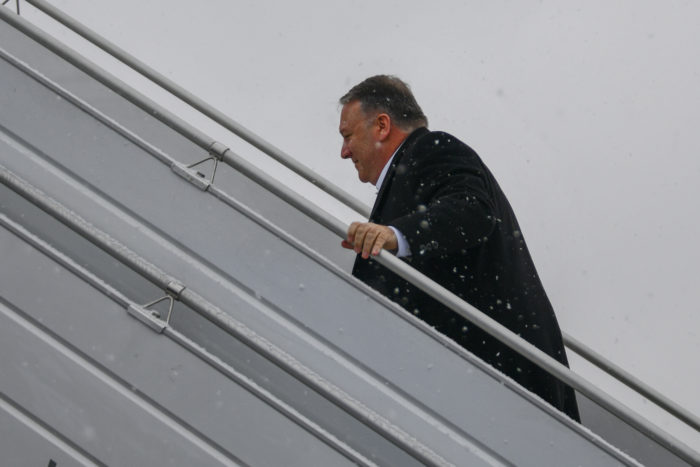
Pompeo leaving Warsaw. (State Department photo by Ron Przysucha)
By Patrick Lawrence | Consortium News | February 19, 2019
What a job Vice President Mike Pence and Secretary of State Mike Pompeo did in Europe last week. If the objective was to worsen an already critical trans–Atlantic rift and further isolate the U.S., they could not have returned to Washington with a better result.
We might have to mark down this foray as among the clumsiest and most abject foreign policy failures since President Donald Trump took office two years ago.
Pence and Pompeo both spoke last Thursday at a U.S.–sponsored gathering in Warsaw supposedly focused on “peace and security in the Middle East.” That turned out to be a euphemism for recruiting the 60–plus nations in attendance into an anti–Iran alliance.
“You can’t achieve peace and stability in the Middle East without confronting Iran,” Pompeo said flatly. The only delegates this idea pleased were Benjamin Netanyahu, the Israeli prime minister, and officials from Gulf Arab nations who share an obsession with subverting the Islamic Republic.
Pence went on to the annual security conference in Munich, where he elaborated further on a few of the Trump administration’s favored themes. Among them: The Europeans should ditch the nuclear accord with Iran, the Europeans should cut off trade with Russia, the Europeans should keep components made by Huawei and other Chinese companies out of their communications networks. The Europeans, in short, should recognize America’s global dominance and do as it does; as if it were still, say, 1954.
It is hard to imagine how an American administration can prove time and again so out of step with 21stcentury realities. How could a vice-president and a secretary of state expect to sell such messages to nations plainly opposed to them?
Pounding the Anti-Iran Theme
Pompeo, who started an “Iran Action Group” after the Trump administration withdrew last year from the 2015 nuclear accord, returned repeatedly to a single theme in his Warsaw presentations. The Iranians, he said, “are a malign influence in Lebanon, in Yemen, and Syria and Iraq. The three H’s—Houthis, Hamas, and Hezbollah—these are real threats.”
Pence ran a mile with this thought. “At the outset of this historic conference,” he said, “leaders from across the region agreed that the greatest threat to peace and security in the Middle East is the Islamic Republic of Iran.” To be noted: all the “leaders from across the region” in attendance were Sunnis, except for Netanyahu. The major European allies, still furious that Washington has withdrawn from the nuclear accord, sent low-level officials and made no speeches.
The European signatories to the Iran accord knew what was coming, surely. While Pence insisted that Britain, France and Germany withdraw from the nuclear pact—“the time has come,” he said—he also criticized the financing mechanism the three set up last month to circumvent the Trump administration’s trade sanctions against Iran. “They call this scheme a ‘special purpose vehicle,’ ” Pence said. “We call it an effort to break American sanctions against Iran’s murderous revolutionary regime.”
There were plenty of European leaders at the security conference last weekend in Munich, where Pence used the occasion to consolidate what is beginning to look like an irreparable escalation of trans–Atlantic alienation. After renewing his attack on the Iran agreement’s European signatories, he shifted criticism to the Nord Stream 2 gas pipeline. Now under construction, this will be the second undersea pipeline connecting Gazprom, the Russian energy company, to Germany and other European markets. Last month the U.S. renewed threats to sanction German companies working on the $11 billion project. “We cannot strengthen the West by becoming dependent on the East,” Pence said at the security conference Saturday.
These and other remarks in Munich were enough to get Angela Merkel out of her chair to deliver an unusually impassioned speech in defense of the nuclear accord, multilateral cooperation and Europe’s extensive economic relations with Russia. “Geo-strategically,” the German chancellor asserted, “Europe can’t have an interest in cutting off all relations with Russia.”
US Primacy V. Europe’s Future
Merkel’s speech goes to the core of what was most fundamentally at issue as Pompeo and Pence blundered through Europe last week. There are three questions to consider.
The most obvious of these is Washington’s continued insistence on U.S. primacy in the face of full-frontal resistance even from longstanding allies. “Since day one, President Trump has restored American leadership on the world stage,” Pence declared in Warsaw. And in Munich: “America is stronger than ever before and America is leading on the world stage once again.” His speeches in both cities are filled with hollow assertions such as these—each one underscoring precisely the opposite point: America is fated to continue isolating itself, a little at a time, so long as its leaders remain lost in such clouds of nostalgia.
The other two questions concern Europe and its future. Depending on how these are resolved, a more distant trans–Atlantic alliance will prove inevitable.
First, Europe must soon come to terms with its position on the western flank of the Euro–Asian landmass. Merkel was right: The European powers cannot realistically pretend that an ever-deepening interdependence with Russia is a choice. There is no choice. China’s Belt and Road Initiative, as it progresses westward, will make this clearer still.
Second, Europe must develop working accommodations with its periphery, meaning the Middle East and North Africa, for the sake of long-term stability in its neighborhood. The mass migrations from Syria, Libya and elsewhere have made this evident in the most tragic fashion possible. It is to Germany’s and France’s credit that they are now negotiating with Turkey and Russia to develop reconstruction plans for Syria that include a comprehensive political settlement.
As they do so, Washington shows no sign of lifting sanctions against Syria that have been in place for more than eight years. It may, indeed, impose new sanctions on companies participating in reconstruction projects. In effect, this could criminalize Syria’s reconstruction—making the nation another case wherein Europe and the U.S. find themselves at cross purposes.
Patrick Lawrence, a correspondent abroad for many years, chiefly for the International Herald Tribune, is a columnist, essayist, author, and lecturer. His most recent book is “Time No Longer: Americans After the American Century” (Yale). Follow him @thefloutist. His web site is http://www.patricklawrence.us.
US-led anti-Iran circus in Warsaw unravels as farce
By Finian Cunningham | RT | February 14, 2019
A conference in Warsaw this week was billed as reinstating the US’ lead role in diplomacy for the Mideast. The absence of Russia and other European leaders only served to expose the ill-conceived summit and Washington’s isolation.
When the forum was initially planned last year by the Trump administration, the purpose was to bring Washington back in from the diplomatic cold which it had opted for by abandoning the international nuclear accord with Iran.
Trump’s tearing up of the Iran deal in May 2018 had isolated the US from other signatories: Russia, China and the Europeans. By holding a high-level conference on Iran, the idea was to burnish Washington’s diplomatic standing in the Middle East.
The trouble was that from the outset most would-be participants saw the real agenda of the meeting as an attempt by Washington to drum up international support for further antagonizing Iran with economic sanctions.
Despite recent official US denials of seeking regime change in Tehran, the long-term pattern of flagrant hostility from President Trump and others in his administration betrayed Washington’s real intentions.
Iranian Foreign Minister Mohammad Javad Zarif has been labeling the Warsaw event “a desperate anti-Iran circus.” Last month, it was evident that European states were going to give the conference a miss on the grounds that the thinly veiled agenda would further undermine EU efforts at preserving the Iran deal.
This week’s conference – although slated as a “ministerial summit” – was conspicuous by the absence of senior delegates. Russia, Turkey, Qatar and Lebanon did not attend. Neither did many European leaders, including EU foreign policy chief Federica Mogherini.
The American side sent a high-profile delegation headed by Vice-President Mike Pence and Secretary of State Mike Pompeo. Also present were Jared Kushner, President Trump’s son-in-law and “special advisor” on Middle East policy.
The void in senior foreign participants – especially Russia which has become the main external player in Middle Eastern affairs following its successful military intervention in Syria – only goes to show how diminished Washington’s role has become.
Realizing its anti-Iran agenda was not going to gain much traction, Washington rebranded the Warsaw conference in an attempt to give it an apparently more general regional remit. The event’s updated title proclaiming the “Future of Peace and Security in the Middle East” was intended to not alienate others over the initial hostile focus on Iran.
Hence the agenda was broadened out to include discussions on Syria, Yemen and the Israeli-Palestinian peace process.
Still, however, Iran was not invited. How can a supposed Middle East peace and security conference be held without the inclusion of Iran, an undoubted regional powerhouse?
How could discussions on Syria be expected to be productive when the Syrian government is not present, nor its main ally Russia?
There were no delegations from the Houthi rebels in Yemen, nor the Palestinian Authority. The Palestinians have boycotted Trump’s much-vaunted peace plan, headed up by Jared Kushner, ever since Washington’s recognition last year of Jerusalem as the capital of Israel, as well as ongoing suspicions of additional transgressions against Palestinian rights, such as return of refugees.
On the eve of the Warsaw conference, Israeli Prime Minister Benjamin Netanyahu pulled back the curtains when he revealed the gathering was intended to solidify the “common interest of war with Iran.” Netanyahu’s tweet was quickly deleted but not before it was widely disseminated by critics.
Iran noted it was “no coincidence” that on the first day of the conference in Warsaw, the country saw the worst terrorist attack in years on its soil when 27 of its Islamic Revolutionary Guard Corps were killed in a suicide bombing claimed by a jihadist group. Tehran asserted that the terrorist group had links to “foreign intelligence services.”
While attending the summit, Trump’s personal lawyer Rudy Giuliani openly called for regime change in Iran. Giuliani also spoke at a rally in Warsaw organized by the Iranian exile group Mujahideen-e Khalq (MEK). The group has been linked to past terrorist attacks in Iran aimed at overthrowing the government in Tehran. It is not clear if the MEK had any involvement in this week’s deadly bombing, but its delegates in Warsaw who had been hosting Giuliani cheered the killing of the Iranian guards, according to Iran’s Foreign Ministry.
Earlier this week, Iran celebrated the 40th anniversary of its Islamic revolution. The anniversary was vilified by Trump as “40 years of terror.” His National Security Advisor John Bolton also directed a message to Iran’s leadership saying its time was up. Israel’s Netanyahu also gloated in a chilling warning that the anniversary could be the last.
Yet, preposterously, American officials tried to pretend that the Warsaw conference was not a “trash Iran” event. Gordon Sondland, the US ambassador to the EU, griped that the non-attendance of European leaders was “an unhelpful act.”
Andrew Miller, a former diplomat in the Obama administration, was quoted as saying it was unprecedented for such a de facto boycott by American allies of a supposedly landmark summit.
But of course, what does Washington expect? The Trump administration has shown such a high-handed contempt for diplomatic norms, even towards its purported European allies.
It has also revealed itself as riven with contradictions and shambles over its Middle East policy. Is the US withdrawing from Syria or not? The mixed signals out of Washington on this one issue alone is symbolic of the general incoherence and faltering leadership in the White House.
President Trump seems to want to have his cake and eat it. He wants “America First” unilateralism and is all too quick to ride roughshod over allies and their interests – the Iran nuclear deal being a classic case.
Then when the Trump administration tries to mitigate the damage of its bruising behavior and to hold a supposed multilateral conference on the Middle East, the upshot is very few give the event any credence or respect.
It’s abundantly clear that Washington has no intention for “peace and security” in the Middle East. Its charade of posing as a diplomatic arbiter is coming apart at the seams. But the farce that is American diplomacy is revealing how irrelevant Washington’s role has become.
Most nations know that Washington’s obsession with confronting Iran is not a viable policy. Indeed, it is a reprehensible pathology which only seems to resonate with the unhinged regimes of Israeli and Saudi warmongering despots, both of whom were prominent in Warsaw this week.
Even the mere choice of venue was telling of America’s declining status. Poland has been sucking up to Washington with its purchase of US missile systems and its request for the Americans to build a new military base in the country, which Warsaw proposes to call ‘Fort Trump.’ A former Polish diplomat even complained that the Warsaw government had no input into the summit agenda, which he said was dominated by Washington, Israel and Saudi Arabia.
The Trump administration knew it had to hold its Mideast summit in Poland this week because it would not be welcome in Western European states. It’s a sign of the times when US diplomacy seems to be only hosted by marginal European states who are too obsequious to snigger at the farce.
Pence says EU must withdraw from Iran deal & stop trying to ‘break up’ sanctions on ‘vile regime’
RT | February 14, 2019
US Vice-President Mike Pence has demanded that Europe withdraw from the Iran nuclear deal and lashed out at the EU’s efforts to evade Washington’s sanctions on Tehran.
Speaking at a security conference in Warsaw, Pence chastized Europe for leading an “effort to create mechanisms to break up our sanctions” against Iran, and complained that European countries had not been “cooperative” since the Trump administration withdrew from the Iran deal last year.
“The time has come for our European partners to withdraw from the Iran nuclear deal” and join with the US to give the Iranian people and the world “peace, security and freedom,” he said.
Pence said the EU’s newly created Special Purpose Vehicle (SPV), conceived as a way to continue facilitating trade between the EU and Iran, was an “ill-advised step” which would only “strengthen Iran, weaken the EU, and create still more distance between Europe and the United States.”
In January, the EU unveiled a new transactions channel aimed at bypassing the SWIFT international payments system to circumvent US sanctions. The system, called INSTEX – or ‘Instrument in Support of Trade Exchanges’ – has limited capacity and only allows “humanitarian” trade by focusing on sectors “most essential” to Iranian people like food, pharmaceutical and medical devices. While the EU hailed the mechanism as a way to preserve the Iran deal, critics say it won’t change much as European countries still worry about US repercussions if they are “caught” evading sanctions and working in Iran.
Pence said that the US had been “a force for good” in the Middle East and claimed that Trump is committed to standing with “the good people of Iran and stand up to their oppressors.”
He cited the US’ withdrawal from the Iran deal as proof that Washington was making good on that promise, despite the fact that American sanctions, which Pence called “the toughest in history,” have had devastating effects on the Iranian people. He said the sanctions would “get tougher still” until Tehran complies with US demands, and said Washington’s efforts to isolate Iran was a “noble cause.”
Pence said that the nuclear deal did not ensure that the “vile regime” of Iran would not obtain nuclear weapons, but instead “delayed the day” that this would happen. This is despite the fact that Europe, the International Atomic Energy Agency (IAEA) and the UN have all said that Iran is complying with the terms of the deal.
Pence called the Warsaw meeting, which was organized by the US and Poland, an “unprecedented gathering” of leaders, but the attendees list probably wasn’t quite what he might have hoped for, since major EU countries chose not to send top officials and Russia declined an invitation altogether. The summit was billed as a way to promote “peace and security in the Middle East” but focused mainly on efforts to isolate Iran. Ironically, Iran was not invited to the gathering.
Earlier at the conference, US Secretary of State Mike Pompeo said that peace and stability in the Middle East was “not possible” without confronting Iran.
The absence of top diplomats from Germany, France and the UK is a sign that Europe is not likely to back down on its continued support of the Iran deal or its efforts to continue trading with Tehran. Iran dismissed the meeting as an anti-Iran “circus” aimed at “demonizing” the country.
U.S. Tells Iran’s Oil Customers Not To Expect New Waivers
By Tsvetana Paraskova | Oilprice.com | February 7, 2019
Iran’s oil customers should not expect new U.S. waivers in May, the U.S. Special Representative for Iran, Brian Hook, said this week, urging buyers to stop importing Iranian oil.
“What we have announced is the policy to get to zero imports of Iranian crude as quickly as possible. We are not looking to grant any future waivers or exceptions to our sanctions regime, whether it is oil or anything else,” Hook told Japanese public broadcaster NHK while on a visit to Japan.
When it re-imposed sanctions on Iran last November, the U.S. granted waivers to eight countries so they could continue purchasing oil from Iran at reduced rates until early May 2019.
Some of those buyers, including the four major Asian buyers of Iranian oil—China, India, Japan, and South Korea—have recently resumed buying limited volumes of Iranian crude oil, after a period of around a month and a half in which they had to clarify how much and under what conditions they would purchase oil from Iran.
Earlier this week, Iran criticized Italy and Greece for not buying Iranian oil despite the fact that they had obtained waivers to do so.
The U.S. Administration has not officially said that no waivers will be issued, but officials have said that the goal is to drive Iranian exports to zero. Analysts, however, believe that there will be a direct correlation between the U.S. Iran waivers policy and the price of oil at the time Washington decides.
Despite the fact that the U.S. is not looking to grant any waivers to Iranian oil customers when the current ones expire in early May, it shouldn’t be taken for granted that no waivers will be issued, Hook and analysts hinted last month.
“We did not want to lift the price of oil, and we were successful doing that. So when the president left the deal it was trading at $74. When our sanctions went back into effect, and we had taken off a million barrels of Iranian crude, oil was at $72,” Hook said at Atlantic Council’s 2019 Global Energy Forum in Abu Dhabi in mid-January.
Hopes Fade for EU to Rescue Iran Via Banking Scheme to Bypass Sanctions – but Was It Ever a Serious Plan?
By Martin JAY | Strategic Culture Foundation | 08.02.2019
At the end of September, the European Union unveiled plans to help Iran bypass sanctions imposed by the US, so that it could sell oil and even trade with EU countries. The move followed Trump finally losing his patience over the so-called Iran Deal – a treaty drafted by Barak Obama which effectively prevented Iran from developing nuclear weapons in return for opening up Iran’s economy to the West and unblocking funds held outside of the country – which he dismisses as a bad deal for American interests in the region.
In reality, Trump’s real problem with the Joint Comprehensive Plan of Action (JCPA), is the same one which vexed America’s two strongest allies in the Middle East, which is that it did nothing to curtail Iran’s real strength against any external threat: its ballistic missiles program.
And so, to appease these two partners, who felt betrayed by Obama, sanctions were imposed against Iran – along with secondary sanctions, imposed via other countries (although this has not been as successful as Trump would have hoped) – and a new ‘war’ against Iran began, aimed at largely toppling its moderate government, while Saudi Arabia gains time to move ahead with its own ballistic missile program.
A key part of spurring a downfall of the present regime in Tehran, was both secondary sanctions wielded against Turkey, China and India, threatening them against buying Iran’s cheap oil, along with forcing the EU to stop trading altogether with Tehran. At one point, Trump’s plan looked like it was working with Europe as all the main investors inside Iran packed their bags and promptly left Iran within weeks of his sanctions plan being announced.
But there was great optimism about Iran finding a clever go-around and still sell its oil to EU governments as well as foster trade with European companies who were not afraid of the threats from the US via its banking system to shut companies off from the US market.
The European Union’s own foreign policy damsel, Federica Mogherini, who stole a lot of the credit for the Iran Deal being signed in the first place (when in reality the Iranians humored her with this idea all along) had a plan. She soon announced that a new banking system to be called INSTEX would be created specifically to allow EU governments and companies to trade with Iran. Although on paper it seemed pretty simple, there were warnings from experts that it might be a difficult task to pull off, given the complexities of international banking, not to mention international laws; moreover, the EU has no real track record of pulling off anything so bold as this before as the so-called ‘foreign policy’ initiatives it has are largely grand ideas on paper – fantasies of what it might be one day rather than the present day European External Action Service which employs over a 100 ‘ambassadors’ who largely live in Djin palaces and keep the dream alive around the world in exotic locations whose governments are happy to give Brussels the cash-for-hegemony deal anytime.
Sadly, it seems that Mogherini’s plan for the banking scheme which was to send a clear signal to Trump as well as keep the Iran Deal alive, is folly and delusional – given that, for Mogherini and her colleagues, the Iran Deal is seen as their great success to exercise EU foreign policy into concrete terms and to create the first ever international treaty drafted by Brussels. It is more or less sacrosanct and considered to be a treaty which now can be used to exert EU hegemony against Trump’s new world order which they consider geopolitical heresy.
Yet the Iran Deal has so much fake news and false prophesies – like Trump’s claims that the Iranians got 150 billion dollars from it, when in reality they only got just over 30 and it was their money in the first place – and the EU’s idea seems just that. Just more fake news.
For the first time, there are growing doubts about both whether it can be pulled off and whether it was a genuine offer in the first place as Brussels appears to be at odds with the giants of the EU, who are cranking up the sanctions to new levels.
Just recently, France’s foreign minister warned Tehran of new sanctions if Tehran would not agree to curbs its ballistic missiles program, regardless of the fact that ballistics were never part of the Iran Deal. France, a founding member of the European Union itself and a country with real clout in Brussels seems to be at odds with the EU’s plans, to say the least. Or was the Brussels plan the real deal in the first place?
Concurrent to this, are also the first real signals from Tehran that it doubts the EU’s sincerity in the draft banking plan. Politicians there, feeling the heat from sanctions and living with daily rumours of a possibility of a military coup engineered by the charismatic, anti-US military figure Qasem Soleimani, are starting to cry foul.
In reality, we shouldn’t get too excited about the scheme, as Tehran clearly isn’t holding out too much hope. In addition to there being many doubts about whether European firms will sign up to it, even if it gets off the ground it will only appeal to smaller companies that are flying under the US radar anyway. Additionally, earlier hopes that it could be used to sell Iran’s oil to Europe, have been dashed.
The EU is living in dangerous times. With its own elections this May expected to give record wins to nationalist, populist parties – in particular in France – it is facing its worst ever credibility crisis, which explains the fear mongering led by President Macron with his latest Brexit speech. But if Brussels can’t deliver on Iran’s rescue package, then it won’t matter if far right parties dominate the European parliament, signaling the demise once and for all, of the EU as we know it. Brussels will never be taken seriously again around the world where it practices its fake hegemony as no one will forget the farce of the EU and the Iran Deal. INSTEX may well be the sword that the EU falls on, certainly on the world’s stage, when the hype dies down and it is dispatched to the press room floor as folly for a wannabee superpower.
US Sanctions Against Syria, Iran is ‘Economic Terrorism’ – Moscow
Sputnik – 07.02.2019
According to Deputy Foreign Minister Sergei Ryabkov, Moscow and Tehran will be advancing ways in which to defend their economies from US sanctions.
“We must — and many have already spoken about this, including our ambassador in Tehran — complete the transition process of economic interaction in the national currency as the best way to protect ourselves from the US abusing the role of the dollar”, Ryabkov told reporters on Thursday.
He also slammed Washington for the sanctions imposed on Damascus.
“There are ways to minimise the consequences of US sanctions, and these ways will be improved. There are alternative partners and formats, they need to be strengthened. I am sure that in the case of Syria, Russian-Syrian relations will only continue to ascend; neither the United States nor anyone else will interfere with this. And I agree that the US sanctions are economic terrorism”, the deputy minister stressed.
The statement by the Russian diplomat comes just a day after the US Senate voted to expand economic sanctions on Syria and to condemn President Donald Trump for announcing a full US troop withdrawal from that country.
Last November, a second package of US sanction against Tehran came into effect following the US withdrawal from the Joint Comprehensive Plan of Action (JCPOA) — the Iran nuclear deal — in May, 2018. The sanctions are aimed at exercising maximum pressure on Iran and forcing it to negotiate a new deal.
Europe shuns Iranian oil despite US sanctions waivers
RT | February 5, 2019
Despite being granted exemptions from US sanctions against Iran to enable them to buy Tehran’s oil, some European countries fully cut off crude imports from the Islamic Republic, according to Iran’s oil minister.
Washington agreed to give temporary waivers to several Iranian oil buyers when it imposed an embargo on oil shipments from the country in November after it pulled out from the landmark nuclear agreement. Those granted waivers included China, India, South Korea, Japan, Italy, Greece, and Turkey, allowing them to continue purchases without penalties.
However, not all countries opted to use the waivers, as the US attempts to push Tehran’s oil export revenues “to zero” and tries to “block any money transfer,” the Iranian Minister of Petroleum Bijan Namdar Zangeneh stated.
“Among the Europeans, except for Turkey, no other nation has purchased oil from Iran. Greece and Italy refuse to buy Iran’s oil despite winning waivers. Nor do they respond to our correspondence,” the minister said on Tuesday.
Iran’s crude exports, which contribute to a significant part of the country’s revenues, have been dropping since the US embargo took effect. In April, the crude and oil condensates exports were estimated to be about 2.8 million barrels per day. Zangeneh declined to announce the current export figures, but earlier reports suggest that the shipments fell by more than half.
Iranian officials have previously said that countries have to be extremely cautious in dealing with Tehran, as they face “financial pressure” from Washington. In January, Iran’s Deputy Minister of Petroleum Amir Hossein Zamaninia said that even those who dare to buy its crude, “would not even buy an additional one barrel.”
The 180-day US waivers expire in May and it is believed that their number will be reduced. However, Iran stressed that it had already found new potential buyers for its oil without revealing who exactly they were.
The last country who decided finally to resume purchases of Iranian oil was Japan. On January 21, a large tanker with two million barrels of crude, destined for Japanese companies, left Iran and is expected to reach buyers on February 9.
Iran Slams EU Accusations of “Assassination Attempts, Terrorist Plots in Europe”
Sputnik – 05.02.2019
Iran regrets the European Union “groundlessly” accusing it of hostile activities, such as alleged assassination plots in several EU states, the Iranian Foreign Ministry said on Tuesday.
“The unsubstantiated accusations, such as with regard to assassination attempts and attempted terrorist attacks in Europe, have been groundless and surprising from the very beginning. We are disappointed with such accusations and concerns of the Europeans, while in Europe itself terrorist and criminal groups are being active,” the Iranian Foreign Ministry wrote.
Tehran went on to express hope that Brussels would realistically approach the issue of terrorism, unlike those who use “double standards.”
Responding to the bloc’ concerns on Iran’s desire to increase the accuracy and range of its missiles, the Foreign Ministry said that Tehran’s activities were exclusively defensive.
On Monday, the European Union sanctioned two individuals and one entity in relation to Iran’s “hostile activities” in some European countries. The Council of the European Union also called on Iran to halt activities aimed at the development and testing of ballistic missiles.
Earlier, the Danish Security and Intelligence Service (PET) accused its Iranian colleagues of plotting an assassination of an Iranian separatist group member in Denmark. Dutch Foreign Minister Stef Blok and Interior Minister Kajsa Ollongren said in January that they had “strong indications” of Tehran being behind assassinations of two Dutch nationals of Iranian origin in 2015 and 2017.
Iran not accepting EU’s humiliating conditions on INSTEX: Judiciary chief
Press TV – February 4, 2019
Iran’s Judiciary Chief Ayatollah Sadeq Amoli Larijani says the Islamic Republic will never give in to humiliating conditions set by Europe for the enforcement of its new non-dollar mechanism aimed at facilitating trade with the Islamic Republic.
Addressing a meeting of high-ranking judicial officials on Monday, Iran’s top judge said, “After nine months of dawdling and negotiations, European countries have come up with a limited-capacity mechanism not for exchange of money with Iran, but to supply food and medicine.”
The European signatories to the 2015 nuclear agreement, officially known as the Joint Comprehensive Plan of Action (JCPOA), issued a joint statement on Thursday, announcing the launch of a long-awaited direct non-dollar payment mechanism meant to safeguard their trade ties with Tehran following Washington’s withdrawal from the nuclear deal and in the face of the “toughest ever” sanctions imposed by the United States against the Islamic Republic.
Following months-long preparations, the foreign ministers of France, Germany and Britain finally unveiled the mechanism, officially called the Instrument in Support of Trade Exchanges (INSTEX), after a summit in Bucharest, Romania.
Iran’s Judiciary chief further said, “European countries, which had promised to remain committed to Iran’s nuclear deal after the US withdrawal from it, have now restricted their efforts to INSTEX and have reportedly set two strange conditions for it to become effective.”
They have asked “Iran to join the FATF (the Financial Action Task Force) and start negotiations over its missile program,” before INSTEX enters into force, he added.
“These [European] countries must know that the Islamic Republic of Iran will by no means accept these humiliating conditions and will not give in to any demand in return for a small opening [in sanctions] like INSTEX,” Amoli Larijani emphasized.
He noted that today, European countries are moving in the same direction that the US had moved before “and we [the Iranian nation] must continue to stand fast as [we have] always [done].”
President Donald Trump withdrew the US in May from the landmark Iran nuclear agreement, reached between the Islamic Republic and the P5+1 group of countries in 2015, and decided to re-impose unilateral sanctions against Tehran.
Under the deal, Iran undertook to put limits on its nuclear program in exchange for the removal of nuclear-related sanctions.
Trump’s administration announced the re-imposition of the “toughest” sanctions ever against Iran’s banking and energy sectors with the aim of cutting off the country’s oil sales and crucial exports.
Iran’s nuclear chief said on Saturday that the establishment of the new mechanism to ease trade with Iran is a promising step, but noted the Europeans must act more swiftly and adopt final measures in this regard.
“The Europeans took a promising step in terms of economy and we hope that they will keep racing ahead on the same path,” the head of the Atomic Energy Organization of Iran (AEOI), Ali Akbar Salehi, told reporters.
Despite Washington’s withdrawal, Iran has not left the deal yet, but stressed that the remaining signatories to the agreement have to work to offset the negative impacts of the US pullout for Iran if they want Tehran to remain in it.
On Friday, China’s Foreign Ministry spokesman, Geng Shuang, appreciated the efforts made by European countries to uphold the JCPOA after the US withdrawal from the agreement.
“It (INSTEX) fully demonstrated the EU’s determination to uphold multilateralism. China firmly supports the continued cooperation between the EU and Iran to put the mechanism into operation as soon as possible and open it to third parties so as to promote normal economic and trade cooperation between the international community and Iran,” he said.
Featured Video

Bombing Hitler’s Hometown
or go to
Aletho News Archives – Video-Images
From the Archives
‘Conspiracy Theory’ Now Fact: Greater Israel Has Arrived
By Kit Klarenberg | Mint Press News | January 28, 2025
Ever since Tel Aviv’s 1948 creation, much has been said and written about ‘Greater Israel’ – the notion Zionism’s ultimate end goal is the forcible annexation and ethnic cleansing of vast swaths of Arab and Muslim lands for Jewish settlement, based on Biblical claims this territory was promised to Jews by God. The mainstream media typically dismisses this concept as antisemitic conspiracy theory, or at most the fringe fantasy of a minuscule handful of extremist Israelis.
In reality … continue
Blog Roll
 Aletho News
- Failing to Defeat Hezbollah, Israel & US Pressure Syria’s Ahmed al-Sharaa to Join War
- US-Israeli war on Iran drives global fertilizer prices up 40%
- Hezbollah’s Surprise Weapons Redefine Ground Battle with Israel
- Yemen joins fight against US, Israel by firing missiles at occupied territories
- Seizing the Kharg: Washington’s path to defeat in the Persian Gulf
- Iran reports 500 US casualties in strikes on covert US military sites
- Pro-Israel terrorist arrested before assassination of pro-Palestinian activist
- Bombing Hitler’s Hometown
- German journalist threatened with homelessness as German court upholds EU sanctions in landmark free speech case
- US Tells Allies That Ukraine-Bound Arms Could be Sent to Middle East
- If Americans Knew
- Researchers at Human Rights Watch Resign Over Blocked Report on Palestinian Refugee Return
- Jewish Groups Are Backing a War Americans Don’t Want
- Eric Fingerhut Thinks He’s the President of the Jews
- Top Jewish Philanthropists, Rabbis Urge Israeli President to Take Action Against ‘Jewish Extremists’
- Don’t Be Fooled. Zionist Leaders Have Always Wanted to Control Southern Lebanon
- Israel’s widespread use of torture is a core element of its genocide against the Palestinian people
- In Israel’s War on Iran, Many Middle East US Bases Rendered “All But Uninhabitable”
- ‘Burn the lawn’: Israel pursues ‘Rafah model’ in southern Lebanon
- A genocide here, an amputation there
- Reports: Iran mobilizing 1M fighters, Israel-US run low on ammo, Israeli army faces shortage – Not a ceasefire Day 168
- No Tricks Zone
- Devastating Assessment Of Comirnaty Vaccine By Former Senior Pfizer Europe Toxicologist
- New Study: CO2 Is ‘Effectively Negligible’ As An Explanatory Climate Change Factor Since 2000
- Former Pfizer Toxicologist Dr. Helmut Sterz Tells Bundestag Hearing Pfizer Vaccine Should Have Never Been Approved
- Energy Expert: Germany’s Nuclear Phaseout Was A “500 Billion Euro Mistake”
- New Research: South Australia’s Mid-Holocene Sea Surface Temperatures Were 4°C Warmer Than Today
- Storing Green Energy To Last Germany 10 Days Would Require A 60-Million Tonne Battery
- New Studies: UK Sea Levels Were 4 Meters Higher Than Today During The Mid-Holocene
- Destructive Green New Deal: German Energy And Metal Group Warns Of Drastic Crisis
- New Study Documents A 20-Year Pause In Arctic Sea Ice Decline – Driven By Internal Variability
- Wake-up Call: Survey Shows Majority Of Germans Now Favor Postponing Climate Targets!
 Aletho News