French bank pays huge US fine for doing business in Cuba, Iran
RT | November 20, 2018
Societe Generale has agreed to pay $1.34 billion to US federal and state authorities to settle a pending legal dispute over violations of US trade sanctions against Iran and other countries.
One of France’s largest banks has also pledged to pay $95 million to resolve another dispute over violations of anti-money laundering regulations.
“We acknowledge and regret the shortcomings that were identified in these settlements, and have cooperated with the US authorities to resolve these matters,” the group CEO Frederic Oudea said in a statement.
“These resolutions, following on the heels of the resolution of other investigations earlier this year, allow the bank to close a chapter on our most important historical disputes.”
The bank, informally known as SocGen, reportedly violated the Trading with the Enemy Act by illegally transferring billions of dollars to partners registered or located in countries targeted by US embargos, including Iran, Sudan, Cuba and Libya.
The banking giant said the settlement wouldn’t have an extra impact on its results for the current financial year. SocGen had previously agreed to $1.3 billion (€1.14 billion) in the US and France to settle investigations over transactions with Libya, and over the suspected rigging of Libor, a benchmark rate tied to finance products and debts. Last year, the bank had paid €963 million ($1.1 billion) over another dispute with the Libyan Investment Authority.
According to the Manhattan US Attorney’s office, the latest fine imposed on SocGen is the second biggest financial penalty issued on a bank for breaching US sanctions. In 2015, French international banking group BNP Paribas agreed to pay $8.9 billion to settle a probe on sanctions violations.
EU Mulls Iran Sanctions in Light of Alleged Plots in France, Denmark – Reports
Sputnik – 20.11.2018
Until now the EU has been unwilling to join the US sanctions on Iran preferring to maintain close trade ties with the Islamic Republic.
In a most recent policy U-turn, European Union foreign ministers hinted on Monday that their countries could be prepared to impose new economic sanctions on Iran, Reuters reported.
The sudden shift of policy came after France and Denmark accused Tehran of being allegedly behind a series of plots to carry out attacks on their soil. During a meeting in Brussels French and Danish foreign ministers filled in their fellow EU counterparts on the details of the alleged Iranian plots, although no details or names were discussed, Reuters quoted diplomats as saying on Tuesday.
France has imposed sanctions on two Iranians and Iran’s intelligence service over what it says was a botched attempt to stage a bomb attack at a rally near Paris organised by an exiled Iranian opposition group.
In October, France said it was certain about the Iranian intelligence ministry’s role in the June plot to attack a demonstration by Iranian exiles near Paris.
Also in October, Denmark said it suspected an Iranian government intelligence service of plotting an assassination on its territory and is also ready to join possible EU-wide sanctions against the Islamic Republic.
Iran has denied any involvement in either alleged plot and warned that it could pull out of the nuclear deal if EU powers do not stand up for its trade and financial benefits.
The readiness to punish Tehran would be the first such move in years by the EU, which has been trying keep in place the 2015 nuclear accord with Iran. Brussels has been unwilling to consider sanctions, instead seeking talks with Tehran.
In March, a joint proposal by Britain, France and Germany to sanction Iran over its development of ballistic missiles and its role in the Syrian war failed to gather sufficient support across the EU, including from Italy which wants to maintain business ties with Iran.
During the meeting on Monday, the EU foreign ministers tried to balance the EU’s policy towards Iran by speeding up the creation of a special mechanism to trade with Tehran that could be under EU, not national, law.
Dubbed the Special Purpose Vehicle (SPV), this mechanism could be used to help match Iranian oil and gas exports against purchases of EU goods as part of a barter arrangement, thus circumventing US sanctions, which are based on global use of the dollar for oil sales.
Despite technical difficulties and delays, the EU hopes this arrangement could protect individual member states from being hit by the sanctions Washington has threatened to use against countries that continue doing business with Iran.
John Bolton Wins “Defender of Israel” Award From Zionist Lobby Group That Helped Appoint Him
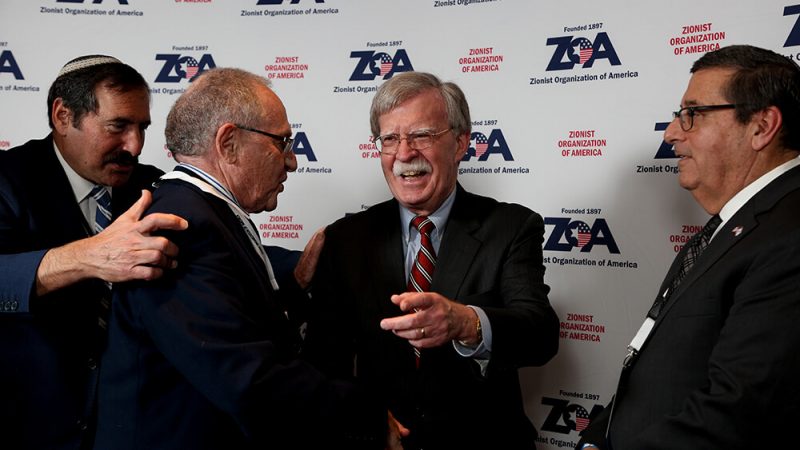
Pictured left to right: Joseph Frager, Alan Dershowitz, and John Bolton at the 2018 Zionist Organization of America awards. Photo | ZOA
By Whitney Webb | MintPress News | November 12, 2018
The ZOA, Bolton’s enthusiastic sponsor, led the campaign to remove former National Security Adviser H.R. McMaster from his post after railing against McMaster’s “anti-Israel” positions, most notably his support for the Joint Comprehensive Plan of Action (JCPOA), better known as the Iran nuclear deal.
The Zionist Organization of America (ZOA) recently awarded U.S. National Security Adviser John Bolton the “Defender of Israel Award” during its annual awards dinner, which took place in New York on Sunday night.
Other awardees included U.S. Ambassador to Germany Richard Grenell as well as Fox News television host Mark Levin. Both Grenell and Levin are close to Bolton, with the former having served as Bolton’s spokesman and the latter having worked closely with Bolton at the Department of Justice in the Reagan administration.
Though Bolton has received several awards from the Israel lobby in the past, due to his fervent promotion of Zionism and Israeli government policy, this more recent award is notable, as the ZOA is largely responsible for Bolton’s appointment as National Security Adviser within the Trump administration.
Indeed, beginning in August 2017, the ZOA – under the leadership of its president, Morton Klein – led the campaign to remove former National Security Adviser H.R. McMaster from his post after railing against McMaster’s “anti-Israel” positions, most notably his support for the Joint Comprehensive Plan of Action (JCPOA), better known as the Iran nuclear deal.
However, McMaster had also earned the ire of American Zionists for allegedly referring to Israel as an “occupying power” and acknowledging the existence of Palestine — as Zionists at ZOA and like-minded organizations support a revisionist history of the creation of the Israeli state that asserts that Palestine as a state never existed prior to Israel’s establishment in 1948.
Leaked emails reported on by MintPress earlier this year revealed that ZOA’s campaign to remove McMaster soon won the support of Trump’s top political donor, Zionist billionaire Sheldon Adelson. It was later revealed that Adelson had been instrumental in placing Bolton in the position McMaster vacated, as Bolton had long been a confidant of the politically influential casino magnate and Adelson had previously lobbied Trump – then president-elect – to include Bolton in his cabinet.
Bolton has not disappointed his sponsors
Since his appointment in April, Bolton has promoted and helped bring to fruition policies long supported by Adelson and the ZOA – which Adelson helps fund – as well as related groups. Under Bolton’s influence, President Trump unilaterally withdrew the U.S. from the JCPOA and imposed harsh sanctions against Iran, which disproportionately affect Iranian civilians. Secretary of State Mike Pompeo recently stated that Iranian leaders would need to fall in line if “they want their people to eat,” underscoring the fact that the Iranian people are by and large the target of the U.S. sanctions targeting Iran.
In addition, Bolton has also used his role as National Security Adviser to advocate for other troubling policies in the Middle East to the benefit of Israel, such as the continuation and expansion of the U.S.’ occupation of around 30 percent of Syrian territory.
Bolton announced in July that the U.S. would maintain its military presence in Syria until the “Iranian menace was wiped off the map.” Bolton’s announcement became administration policy just two months later in September. However, just days before Bolton took over for McMaster, Trump had announced that he wanted to remove U.S. troops from Syria “very quickly.”
Ultimately, Bolton’s recent award from the Adelson-backed ZOA for “defending Israel” is the result of events that ZOA itself helped made possible. Now that Bolton – who they helped install into power – has helped bring about the very policies they had hoped he would manifest, ZOA has granted him a “prestigious” award. Perhaps it is only fitting that he receive such thanks for the service to Zionism he was installed to provide. Indeed, it is a cause and ideology that Bolton has repeatedly supported – often at the expense of U.S. government interests and even U.S. national security.
Whitney Webb is a staff writer for MintPress News and a contributor to Ben Swann’s Truth in Media. Her work has appeared on Global Research, the Ron Paul Institute and 21st Century Wire, among others. She has also made radio and TV appearances on RT and Sputnik. She currently lives with her family in southern Chile.
See also:
Bolton’s Past Advocacy for Israel at US Expense Heralds Dangerous New Era in Geopolitics
Copyright © Whitney Webb, MintPress News, 2018
US Blocks $199Mln in Assets Belonging to Iran, Syria, N Korea in 2017 – Treasury
Sputnik – 07.11.2018
WASHINGTON – The United States blocked nearly $200 million in assets belonging to Syria, Iran, and North Korea in 2017 as a result of the sanctions imposed on the three countries, the Treasury Department said in its annual report to Congress released on Wednesday.
“Approximately $199 million in assets relating to the three designated state sponsors of terrorism in 2017 have been identified by OFAC as blocked pursuant to economic sanctions imposed by the United States,” the report said.
The statement comes days after the US fully reinstated sanctions against Iran, including measures that curb Tehran’s oil industry. At the same time, the United States temporarily exempted eight nations — China, Greece, India, Italy, Japan, South Korea, Taiwan and Turkey — from the sanctions on importing oil from Iran.
In May, US President Donald Trump announced that the United States would withdraw from the Iran nuclear agreement, officially known as the Joint Comprehensive Plan of Action, and reimpose sanctions against Tehran that were previously lifted under the accord, including secondary restrictions.
The first round of the US sanctions was reimposed in August, while the second round, targeting over 700 Iranian individuals, entities, banks, aircraft and vessels, came into force this week.
Lavrov Calls US Sanctions on Iran ‘Illegitimate’, Slams Pressure on SWIFT
Sputnik – 06.11.2018
Washington implemented tough unilateral sanctions against the Islamic Republic on Monday following President Trump’s withdrawal from the Iran nuclear deal in May.
Russian Foreign Minister Sergei Lavrov has condemned Washington’s decision to slap Tehran with sanctions, calling the restrictions “absolutely illegitimate” and deeply disappointing, and saying that it was “unacceptable” to hold dialogue in the language of ultimatums.
“As far as the US measures against Iran are concerned, they are absolutely illegitimate,” Lavrov said on Tuesday in Madrid following a meeting with Spanish officials.
“They are being implemented in flagrant violation of the decisions of the UN Security Council, and the way in which these measures are announced and implemented cannot but cause a deep sense of disappointment. We proceed from the idea that the norms of not only international law, but of international dialogue, have not been repealed,” Lavrov stressed.
“Pursuing a policy based on ultimatums and one-sided demands is hardly permissible in our times,” according to the Russian foreign minister.
Pressure on SWIFT Also Unacceptable
Commenting on suspected US pressure on international financial messaging system SWIFT, which implied Monday that it would comply with US sanctions against Iranian financial institutions, Lavrov said that such pressure was also illegitimate.
“Within the framework of the participants of the Joint Comprehensive Plan of Action (JCPOA) agreement, mechanisms are being developed which will allow for the continued implementation of the provisions of this document, first of all as regards [nations’] economic ties to Iran without US participation, and this is not a simple matter,” the foreign minister explained. “You can see how, using unacceptable methods, pressure has been placed on the operators of the SWIFT system. But experts are actively engaged in these issues, and they have a sufficiently stable understanding that this is possible and that such measures will be found.”
On Monday, Washington followed through with plans to renew sanctions against Iran following President Trump’s exit from the JCPOA Iran nuclear deal. The tough sanctions target Iran’s energy, banking and sea-based transport sectors, and threaten so-called secondary sanctions against foreign companies and countries doing business with the Islamic Republic.
The Belgium-based SWIFT financial messaging service announced that it would be suspending some Iranian banks’ access to the system, making no mention of US sanctions. Calling the move “regrettable,” SWIFT’s statement said it had taken the step “in the interest of the stability and integrity of the wider global financial system.”
All of the JCPOA’s other signatories, including Iran, Russia, China and several European powers, have made an effort to save the landmark nuclear deal and bypass the US sanctions or otherwise limit their impact. This has included the development of a Special Purpose Vehicle (SPV) on trade. China and India, the largest importers of Iranian crude oil, have resisted US secondary sanctions threats, and were granted exemptions along with five other oil-importing countries plus Taiwan.
India should stay the course on Iran oil
By M. K. BHADRAKUMAR | Indian Punchline | November 5, 2018
The new kids on the block are unaware that not a year had passed since the Islamic Revolution in Iran 40 years ago when US sanctions against that country wasn’t a fact of life. Iran has weathered multiple rounds of sanctions before.
As a BBC commentary put it, “Iranians will be forced into finding creative ways to sell oil, relying on their years of experience of life under previous sanctions. And to fill the gap left by lost European investment, Iran will be looking east to forge new links with Russia and China.”
This is also the signal one gets from the Iranian reaction to the Trump administration’s re-imposition of sanctions. At the most authoritative level, Supreme Leader Ali Khamenei has been plainly dismissive. Some excerpts from his remarks on Saturday:
“The enemy made every attempts against us, with a variety of actions; the US engaged in military, economic, and media warfare against us. Via all these actions, the US aspired, in vain, to regain its previous domineering status over Iran — that it enjoyed during the Pahlavi Regime.”
“Today, an overview of the situation of the US shows that the US’s power is declining. The US is today much weaker than it was forty years ago… US’s soft power has degraded… US’s hard power — that is, its economic and military power — is also declining… It suffers from more than $15 trillion dollars public debt and $800 billion budget deficit… The US is declining. Everyone should know this.”
Clearly, for Tehran, talks with the US will be simply out of the question.
On the other hand, there are no knee-jerk reactions, either – such as that Iran is going to dump the 2015 nuclear deal. As the Iranian ambassador to the UK Hamid Baeidinejad (who was a leading member of Iran’s negotiating team with the US during 2013-2015) put it, “The aspiration that we have with the European Union, Britain, France and Germany, China and Russia, is that we keep the Iran Nuclear Deal alive and give time to the U.S. to rethink and revise its position.”
Baeidinejad added, Tehran will not accept any idea of changing or renegotiating the nuclear deal, because if one word is changed other aspects of the deal will either be changed or compromised. “We have a total loss of confidence” in negotiating with the US, but “we are trying very hard with European countries, with China and Russia, to find mechanisms that this deal could (still) be effectively implemented.”
The ambassador said, “There will be pressure against some countries, particularly European countries, and economic and trade institutions from attempting to enter into working with Iran, there will probably be some risks.” However, there is “total determination” by European countries and other world partners to find “practical solutions” so that the deal will be kept alive.
These remarks sum up the Iranian position. Tehran estimates that it has much elbowroom left to force a rethink on the Trump administration.
Curiously, this is also the assessment of some Israeli experts. A commentary in the Jerusalem Post gives the expert opinion that while the US’ oil sanctions will no doubt hurt Iran, “Tehran maintains key support from Asia,” which means that the sanctions are “insufficient to compel Iran to accept a new tougher nuclear deal.” Equally, support for Iran from China, Russia, India and South Korea would be too strong too [sic] sufficiently isolate the Islamic Republic’s economy… the fundamental dynamics protecting Iran from a total collapse if anything are even more solid (today).”
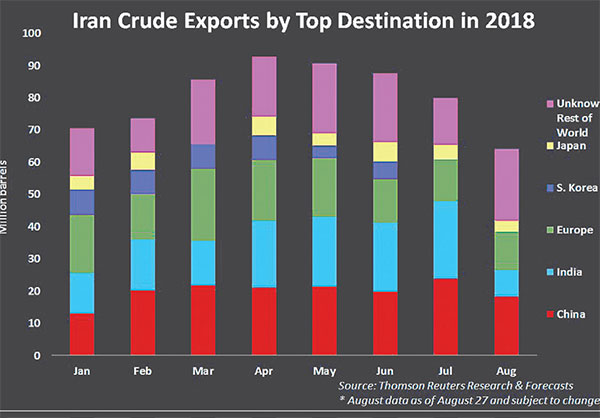
Interestingly, Tehran is not perturbed about the US threat to cut Iran off from the SWIFT. The fact of the matter is that Iran has an alternative to SWIFT – Russia’s SPFS. By the way, SPFS’ clients already include three of the top importers of Iranian oil – China, India and Turkey. (India probably used it recently to make payments for its purchase of the Russian S-400 ABM system!)
Suffice to say, Washington not only needs to accept that SPFS is a viable workaround for countries to import Iranian oil, but also a factor in the long-term implications of the emergence of such a new and parallel monetary system.
Therefore, the Trump administration’s decision to give the ‘waiver’ on import of Iranian oil is understandable. It is only prudent not to jeopardize the US’ relations with countries such as India or Turkey on account of the Iran oil sanctions when these countries are in any case going to find ingenious ways to import Iranian oil.
Then, there are other factors at work. One, as mentioned above, the US realizes that it lacks the ability to bring Iran’s oil exports to anywhere near zero level, as it once boasted. Two, oil sanctions against Iran will impact the world oil prices. Can Trump afford the political cost of oil prices cascading to, say, $100 bpd or more when he gears up for his re-election bid in 2020?
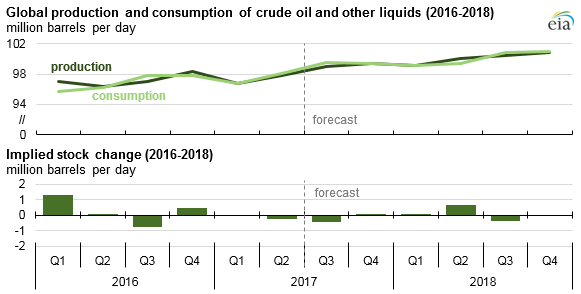
Third, there is great uncertainty about US-Saudi relations in the aftermath of the murder of Jamal Khashoggi. It is turning out to be a high stakes game of rogue operation by intelligence agencies for regime change in Saudi Arabia, which went horribly wrong. The searing experience seriously damages US-Saudi relations. And Saudi Arabia happens to be the only OPEC country that has the means to boost oil production to make up for shortfalls due to US’ oil sanctions against Iran. (Even Saudi surplus capacity is severely restricted.)
The bottom line is that New Delhi must stay the course, no matter what the American lobby in Delhi may say. The point is, the Trump administration is heading toward a cul-de-sac. When this realization dawns on Trump, he’ll, typically, make the course correction. As Ambassador Baeidinejad explained, Iran’s plan is to isolate the US and give it time to rethink. In this wise approach, Iran is getting strong support from the EU and Russia and China. Read the joint statement by the EU + EU-3 foreign ministers here.
Suspect’s Iranian Origin an Excuse for New Sanctions Against Tehran – Scholars
Sputnik | November 4, 2018
Denmark and Iran are in conflict. While leading European countries are trying to preserve the nuclear deal with Iran, Denmark is engaged in a strong confrontation with Iran.
Danish police have announced that they have arrested a Norwegian citizen of Iranian origin linked to an alleged attack on the head of the Danish branch of the “Arab Struggle Movement for the Liberation of Ahvaz.”
According to the Danish Security and Intelligence Service, Iranian intelligence services supported the incident. In addition, the Danish Ministry of Foreign Affairs has recalled its ambassador from Tehran. The country’s foreign minister, Anders Samuelsen, has announced that Copenhagen would advocate for the EU imposing sanctions on Iran.
Commenting on the situation for Sputnik, Sergei Demidenko, an associate professor at the Institute of Social Sciences of the Russian Presidential Academy of National Economy and Public Administration, pointed out that the confrontation between Tehran and Copenhagen is very controversial but minor in terms of the political climate between the EU and Iran.
“There are many ways that the leaders of terrorist and separatist movements could use to get into the country. The primary one is presenting yourself as a member of some illegal political entity. In a country like Denmark, despite commonsense logic, this person will automatically receive the status of a ‘victim of political repression’, as well as the right to political asylum and welfare for a comfortable living.Generally speaking, Denmark doesn’t have a stance on the Iranian issue, unlike the US and the UK. That is why the Iranian case is very controversial. One may assume that these are political speculations and provocations, organized by some third party.”
The expert pointed out that Denmark’s position in the EU is not important enough to induce the union to impose new sanctions.
“Speaking about the EU, its position is not always identical with the US. The union always had an economic interest in Iran, not a political one. It’s hard to believe that the EU really needs to conduct an anti-Iranian campaign. This case is unlikely to affect the dynamics of the relationship between the EU and Iran. In some instances, the European Union may support the US against Iran, but not in all domains and not unanimously.”
Seyed Hadi Afghahi, an Iranian political scientist, leading expert on the Middle East, diplomat and a former official of the Iranian Embassy in Lebanon, shared the Russian expert’s point of view concerning the provocation against Iran possibly being organized by a third party. He added that there is an interested party to this diplomatic conflict. It is the United States.”The accusations against Iran that have been made recently as part of this conflict are not something new, especially since the new American sanctions package against Iran is to take effect soon. The US is actively preparing the ground for rationalizing new sanctions by trying to denigrate Iran in public opinion, pushing a narrative of us being sponsors of terrorism.
For this, Washington uses its allies. As you remember, there was the case of one of our diplomats being arrested in France for alleged support of terrorism against the leader of ‘Mojahedin-e Khalq’. However, the proof of these accusations hasn’t been provided. Now, let’s move on to the Danish case. The authorities of this country are accusing a citizen of Iranian origin of trying to organize a terrorist act against the leader of the local wing of the ‘Arab Struggle Movement for the Liberation of Ahvaz’.
The real question here is: why do the leaders of a separatist group that has conducted numerous terrorist attacks in Iran live in Denmark with political immunity? Don’t the Danish authorities know that just recently, during a military parade in Ahvaz, members of this group, in cooperation with Daesh, conducted a horrible terrorist attack against innocent Iranian civilians? It is a commonly known fact. In the meantime, Denmark, considering itself a civilized state, grants these terrorists political asylum and hides them on its territory, not revealing this fact to the public.
The second amazing fact about the campaign against Iran is the murder case of Jamal Khashoggi. Despite existing evidence, the authorities of Saudi Arabia are not being blamed by the US or the EU for assassinating the journalist.
The statement of the Danish authorities is a part of the anti-Iran plot prepared by the US to justify new sanctions. They found an innocent person connected to Iran, presented him as a murderer at an international level without having any evidence, and now they are threatening us with new sanctions. While the Saudi journalist case remains open, no European country has so far demonstrated a firm stance towards those responsible for his death and has not demanded to introduce sanctions against Saudi Arabia.It’s quite obvious that the Danish case is an attempt to avoid the responsibilities of the nuclear deal. In other words, the EU will justify its passivity in regards to preserving the JCPOA (Joint Comprehensive Plan of Action) and not helping Iran by saying that the Islamic Republic is a sponsor of terrorism and could organize attacks in European capitals.
It could be concluded that this is all an intrigue and conspiracy against Iran. We see no practical steps by the EU to preserve the nuclear deal. It looks like Europe, influenced by the US, is trying to take the anti-Iranian position.”
Israel in the Middle of the Scandal
Denmark doesn’t provide personal information of the “Arab Struggle Movement for the Liberation of Ahvaz” separatist wing leader and doesn’t say how many of the movement’s members are on its territory. Tehran rejects the allegation of involvement of its intelligence services in the case.
When Iranian Foreign Ministry spokesman Bahram Qassemi commented on the accusations made by Denmark, he said: “When Iran-Europe relations are normalizing, some parties are trying to create division between them.” He considered Denmark’s sanctions decision to be “unpredictable” and pointed out: “This action was planned by counter-revolutionaries and terrorists in Europe, in the Middle East and in the US. Its purpose is psychological warfare against Iran.”It should be noted that the Israeli Public Broadcasting company Kan reported that Denmark had received information from Mossad that the Iranian intelligence services were planning to liquidate an opposition politician on its territory.
Seyed Hadi Afghahi thinks that these actions are a part of the anti-Iranian plot. Tel Aviv’s information was falsified and shouldn’t be trusted.
“Israel always gives false information to European leaders and heads of Persian Gulf countries, claiming that Iran is going to establish hegemony, conquer several Arab countries, etc. Iran is represented as a dangerous player, a conqueror and a source of all evil. Arab diplomats told me that during his visit to Oman, Israel’s Prime Minister Benjamin Netanyahu gave Sultan Qaboos bin Said al Said provocative information that Iran was planning to take over Oman in two years.
Israel offered Oman to reinforce cooperation, stop rapprochement with Iran and guaranteed its support in the event of an Iranian invasion; although Iran has been keeping close, friendly ties with Oman for 40 years.
Israel’s statements that Iran is building nuclear bombs were ridiculous. The IAEA didn’t trust it, saying that Israel’s evidence doesn’t have value.
It is simply beneficial for Israel to give falsified information to denigrate Iran’s image. That is why Israel is always in the middle of the US’ attempts to unravel Europe and Iran.”
US Will Walk Out of Nuke Treaty Again if Iran Agrees to New Deal – Scholar
Sputnik – 17.10.2018
Six months after Donald Trump announced the US withdrawal from the 2015 nuclear deal with Iran, Washington is proposing to sign a new agreement with Tehran.
The US is ready to give “a whole lot” to sign a new treaty with Iran that would take into account all of Washington’s concerns, including Tehran’s missile program, the US Special Representative for Iran Brian Hook said.
It is not the first time that Washington has invited Iran to conclude a new treaty since it walked out of the 2015 nuclear deal with Tehran.
Tehran insists that it won’t ink a new agreement with the US after Washington’s mistake of withdrawing from the Joint Comprehensive Plan of Action (JCPOA).
In his address to the 73rd session of the UN General Assembly in September, Iranian President Hassan Rouhani said that Tehran would agree to negotiate with the US but only if Washington changed its attitude towards the Islamic Republic.
In an interview with Sputnik Persian, Iranian political observer Ali Reza Rezakhah and a Tehran University expert in US affairs, Mohammad Marandi, spoke about the terms on which Tehran would be ready to sign a new accord with Washington.
According to Dr. Rezakhah, signing a new a new agreement with the US made no sense as Washington’s departure from the JCPOA showed everyone that it can’t be trusted.
“Statements alone are not enough, because the US has repeatedly declared its intention of concluding a new treaty with Iran. Singing a new treaty with the United States makes no sense. This is logical too because one can conclude a new agreement only with someone who fulfills his obligations. This means that we need to be confident about what the United States is saying,” Reza Rezakhah said.
He added that there weren’t any guarantees that the US would fulfill its obligations under a new treaty.
“It unilaterally withdrew from the JCPOA treaty, violating all its international obligations. Neither Iran nor any other country can agree to sign a treaty with the United States, since they (the United States) do not honor their obligations. When speaking at the UN General Assembly, President Hassan Rouhani stated that Iran is ready to negotiate, provided that the United States takes the first step by adhering to the JCPOA.”
Mohammad Marandi flatly ruled out any new agreement with the US.
“It will not happen. Iran will not sign a new agreement with the United States or re-negotiate with it. With the JCPOA in place, what new agreement can we talk about? If the Americans do not understand this, then they know the Iranians even worse than we could have imagined.”
According to him, by violating the JCPOA the US proved that it can’t live up to its commitments.
“Tomorrow we will conclude an agreement with the United States, and they will walk out of it again. This defies logic,” Dr. Marandi argued.
“Even if Iran agrees to negotiate (a new agreement), the United States will take this as a sign of its pressure having worked and will ramp it up even more,” Marandi continued.
Iran would agree to negotiate with the US only if Washington returns to the JCPOA and negotiates within its framework,” Mohammad Marandi concluded.
In May, President Donald Trump said he was withdrawing the US from the 2015 nuclear agreement with Tehran and promised to impose the “highest level” of sanctions on the country’s energy petrochemical and financial sectors despite objections from Europe as well as Russia and China — the other parties to the deal, known as the Joint Comprehensive Plan of Action (JCPOA).
Washington has also warned countries to stop buying Iranian oil starting from November 4 and threatened to use sanctions against those who do not.
The first wave of US sanctions on Iran took effect on August 6, targeting the country’s automotive sector, trade in gold, and other vital metals.
The remaining sanctions will come into effect on November 4, targeting Tehran’s energy sector, petroleum-based transactions, and transactions with Iran’s Central Bank.
Benjamin Netanyahu Is No Friend to America
By Scott Ritter | TruthDig | October 4, 2018
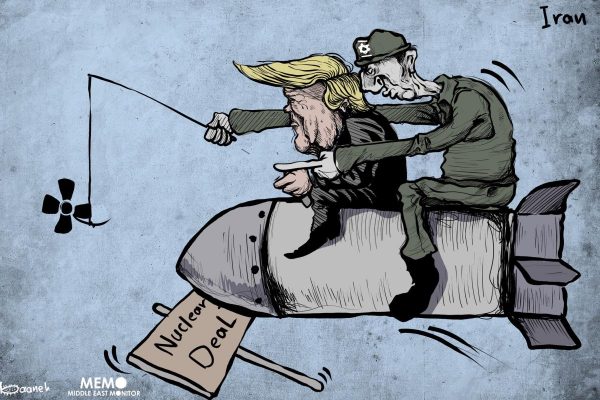
Benjamin Netanyahu is no stranger to the American spotlight. A career Israeli politician who attended school in the United States, he specializes in the kind of rhetoric that his American counterparts revel in—a kind of narcissism that’s more used car salesman than educator.
Netanyahu specializes in selling danger to the American people. This is an art he has practiced on numerous occasions, whether it be at the gatherings of the American Israel Public Affairs Committee (AIPAC), his many appearances before the U.S. Congress, at televised events or during the general debate in the United Nations General Assembly, an annual gathering of global leaders and diplomats where each nation’s representative is provided the opportunity to address counterparts and the world on issues he or she deems to be of particular import.
Bibi (as he is known, affectionately or otherwise) delivered his latest address to the General Assembly on Sept. 27. Like others he had delivered previously, this one was a tour de force of angst, fear and anger with a nearly singular focus on the issue that has seized Netanyahu for more than two decades—Iran and its alleged nuclear weapons program.
In his 1995 campaign autobiography, “Fighting Terrorism,” Netanyahu, preparing to run for the office of prime minister of Israel, asserted that Iran was “three to five years” away from having a nuclear bomb. Bibi repeated this claim several times over the next 20-plus years, apparently unconcerned by the fact that his self-appointed timetable kept coming and going without the Iranian nuclear threat manifesting itself.
In September 2002, when he briefly found himself a private citizen, Netanyahu shifted his aim to Iraq, which he confidently asserted had a nuclear weapons program as he touted the benefits of removing Saddam Hussein from power—this during so-called “expert” testimony before the U.S. Congress. He was wrong on both counts, a fact that seems to slip the minds of those who continue to assign him a semblance of credibility given his proximity to Israel’s vaunted intelligence service.
As someone who spent four years (from 1994 to 1998) working closely with Israel’s intelligence service to uncover the truth about Iraq’s weapons of mass destruction programs, I can attest that Israeli intelligence is better than most at what it does, but far from perfect. For every good lead the Israelis delivered to the United Nations Special Commission (UNSCOM), for which I was working at the time, they provided a dozen or more that did not pan out. Their detailed analysis about the alleged organization and structure of Iraq’s covert nuclear program proved to be far removed from the truth. They got names wrong, affiliations wrong, locations wrong—in short, the Israelis made the exact same mistakes as any other intelligence service.
Iraq was a denied area, made less so by the presence of UNSCOM weapons inspectors like me who had unprecedented access to the most sensitive national security sites in the country. And still the Israelis got it wrong. They did so not because of “bad intelligence,” but because they, like the CIA and other intelligence agencies around the world, were privy to the vast amount of information and data collected by UNSCOM inspectors about the true state of Iraq’s proscribed weapons and related programs. They suffered from the same lack of imagination as did the others that postulated a nuclear-armed Iraq circa 2002, unwilling to consider the possibility that Saddam Hussein might be telling the truth about not having retained any weapons and related capabilities prohibited by the Security Council resolution. This same lack of imagination appears to fuel Netanyahu’s increasingly wild claims about Iran.
It is no secret that Netanyahu has opposed the Iran nuclear deal—officially known as the Joint Comprehensive Program of Action, or JCPOA—since the possibility of a negotiated solution to the stand-off between Iran and the rest of the world was put on the table by the Obama administration in 2012. He lobbied hard against the agreement, interjecting himself in American domestic politics in an unprecedented fashion to undermine the negotiations.
When Donald Trump won the 2016 U.S. presidential election, Netanyahu found a kindred spirit whose intellectual curiosity would not permit any effective challenge to the narrative constructed by the Israeli prime minister. And when Trump faced resistance from his secretary of state, Rex Tillerson, and his national security adviser, H.R. McMaster, he simply replaced them with more compliant persons, Mike Pompeo and John Bolton respectively.
Trump’s decision to withdraw from the JCPOA was facilitated not by any supporting brief from the U.S. intelligence community, which held fast to the assessment that Iran was fully compliant with its obligations under the JCPOA, but rather by intel provided by Israel that featured wild claims of an operation in the heart of Tehran; hundreds of thousands of documents purported to outline a nuclear program that Iran insisted did not exist. In April 2018, Bibi unveiled the existence of what he termed Iran’s “Atomic Archive” as he detailed some of its contents, allegedly recovered during an Israeli operation.
While Netanyahu’s dramatic presentation proved to be enough to help push Trump into withdrawing from the JCPOA the following month, it failed to convince the rest of the world that Iran was operating in bad faith when it came to declaring the totality of its nuclear program. One of the main reasons for this is that the tale put forward by Bibi simply didn’t add up. Documents he presented as being derived from the newly captured archive were recognized by officials from the International Atomic Energy Agency (IAEA)—which, along with supporting governments, is responsible for implementing the JCPOA—as matching those presented to the agency more than a decade ago. That cache of documents was allegedly recovered from a laptop computer sourced to an Iranian opposition group by Israeli intelligence.
At best, there is nothing new in these materials, and all the underlying issues alleged to have been “exposed” had already been discussed and rectified by the IAEA and Iran prior to the rectification of the JCPOA. At worst, Netanyahu was lying about the Israeli intelligence operation, and simply recycling old material—which may have been manufactured by Israel to begin with back in 2004—simply to provide political cover for Donald Trump.
Netanyahu spent much of his Sept. 27 address before the General Assembly detailing an alleged “Atomic Warehouse,” supposedly uncovered by Israeli intelligence in the heart of Tehran. As was the case with the “Atomic Archive” facility, Netanyahu made grand claims about Iranian malfeasance: The site contained “15 ship containers full of nuclear-related equipment and material,” along with “15 kilograms of radioactive material” that Iran allegedly evacuated from the site to evade detection. (Netanyahu seems to have overlooked the fact that the U.S. Department of Energy, prior to the JCPOA and in anticipation of such a scenario, “evacuated” nuclear material from one of its facilities during an exercise, only to have evidence of its existence uncovered by inspectors wielding the same detection capabilities as the IAEA.)
Netanyahu alleged that Iran was maintaining both an “Atomic Archive” and an “Atomic Warehouse” so that it could reconstitute its nuclear weapons program when the “time is right,” ostensibly when the sunset clauses of the JCPOA, which limit the number of centrifuges Iran can operate, expire. As with the “Atomic Archive” story, however, outside of Trump and his inner circle of anti-Iranian acolytes, informed American officials aren’t buying the Israeli leader’s tale, noting that Netanyahu has exaggerated the scope and scale of the warehouse in question. (These officials claim that the “material” being stored there is documentary in nature, a far cry from the “equipment” claimed by Netanyahu.)
Netanyahu bemoaned the fact that the world was promised “anywhere, anytime” inspections in Iran, and yet the IAEA has failed to take any steps to investigate the revelations provided by Israel. The reality is that the JCPOA promised no such thing. “Anywhere, anytime” was an artificial construct cobbled together by opponents of the deal by denigrating the investigatory capabilities of the IAEA. Moreover, the IAEA is intimately familiar with the quality of the intelligence information provided by Israel in the past, having spent months with Iran carefully deconstructing the claims contained within. The agency is hesitant to fall victim to Israeli exaggerations and falsifications again, and rightfully so.
More importantly, the JCPOA has a detailed mechanism in place to investigate claims such as those put forth by Israel. But by precipitously withdrawing from the JCPOA, the Trump administration has removed itself from that process. This means that Israel would need to turn to the Europeans, Russians or Chinese to plead its case. And the fact that neither France nor Germany nor the United Kingdom has picked up the mantle of Israel’s claims points to the inherent weakness of its intelligence. Netanyahu may be able to play siren to Trump’s Ulysses in order to crash America’s ship onto Iranian shoals, but the rest of the world is not following suit.
The American people should not tolerate this continued intrusion into their affairs by an outsider whose previous lies, prevarications and provocations helped get the United States entangled in one war, all the while advocating for our involvement in another. Bibi Netanyahu has a problem with telling the truth, and we give power to his words and deeds by not calling him out for what he truly is—a habitual liar with the blood of thousands of our fellow citizens on his hands. Netanyahu claims he is a friend of the American people. He is, in fact, the furthest thing from it.
Scott Ritter is the author of “Dealbreaker: Donald Trump and the Unmaking of the Iran Nuclear Deal,” published by Clarity Press, October 2018.
Featured Video

Bombing Hitler’s Hometown
or go to
Aletho News Archives – Video-Images
From the Archives
‘Conspiracy Theory’ Now Fact: Greater Israel Has Arrived
By Kit Klarenberg | Mint Press News | January 28, 2025
Ever since Tel Aviv’s 1948 creation, much has been said and written about ‘Greater Israel’ – the notion Zionism’s ultimate end goal is the forcible annexation and ethnic cleansing of vast swaths of Arab and Muslim lands for Jewish settlement, based on Biblical claims this territory was promised to Jews by God. The mainstream media typically dismisses this concept as antisemitic conspiracy theory, or at most the fringe fantasy of a minuscule handful of extremist Israelis.
In reality … continue
Blog Roll
 Aletho News
- Trump admits Iran hit USS Ford carrier: ‘We ran for our lives’
- Battle for Hungary: EU attacks on Orban are a sign of worse things to come
- Iraqi resistance conducts drone strike on US-run base in Syria
- Failing to Defeat Hezbollah, Israel & US Pressure Syria’s Ahmed al-Sharaa to Join War
- US-Israeli war on Iran drives global fertilizer prices up 40%
- Hezbollah’s Surprise Weapons Redefine Ground Battle with Israel
- Yemen joins fight against US, Israel by firing missiles at occupied territories
- Seizing the Kharg: Washington’s path to defeat in the Persian Gulf
- Iran reports 500 US casualties in strikes on covert US military sites
- Pro-Israel terrorist arrested before assassination of pro-Palestinian activist
- If Americans Knew
- Researchers at Human Rights Watch Resign Over Blocked Report on Palestinian Refugee Return
- Jewish Groups Are Backing a War Americans Don’t Want
- Eric Fingerhut Thinks He’s the President of the Jews
- Top Jewish Philanthropists, Rabbis Urge Israeli President to Take Action Against ‘Jewish Extremists’
- Don’t Be Fooled. Zionist Leaders Have Always Wanted to Control Southern Lebanon
- Israel’s widespread use of torture is a core element of its genocide against the Palestinian people
- In Israel’s War on Iran, Many Middle East US Bases Rendered “All But Uninhabitable”
- ‘Burn the lawn’: Israel pursues ‘Rafah model’ in southern Lebanon
- A genocide here, an amputation there
- Reports: Iran mobilizing 1M fighters, Israel-US run low on ammo, Israeli army faces shortage – Not a ceasefire Day 168
- No Tricks Zone
- Devastating Assessment Of Comirnaty Vaccine By Former Senior Pfizer Europe Toxicologist
- New Study: CO2 Is ‘Effectively Negligible’ As An Explanatory Climate Change Factor Since 2000
- Former Pfizer Toxicologist Dr. Helmut Sterz Tells Bundestag Hearing Pfizer Vaccine Should Have Never Been Approved
- Energy Expert: Germany’s Nuclear Phaseout Was A “500 Billion Euro Mistake”
- New Research: South Australia’s Mid-Holocene Sea Surface Temperatures Were 4°C Warmer Than Today
- Storing Green Energy To Last Germany 10 Days Would Require A 60-Million Tonne Battery
- New Studies: UK Sea Levels Were 4 Meters Higher Than Today During The Mid-Holocene
- Destructive Green New Deal: German Energy And Metal Group Warns Of Drastic Crisis
- New Study Documents A 20-Year Pause In Arctic Sea Ice Decline – Driven By Internal Variability
- Wake-up Call: Survey Shows Majority Of Germans Now Favor Postponing Climate Targets!
 Aletho News