What if Trump dumps the Iran deal?
By M K Bhadrakumar | Indian Punchline | April 28, 2018
The last big European effort to dissuade US President Donald Trump from abandoning the 2015 Iran nuclear pact ended without success Friday with the ‘working visit’ by German Chancellor Angela Merkel to the White House. Earlier in the week, French President Emmanuel Macron also tried his hand. Perhaps, all that remains is a phone call from British PM Theresa May to Trump.
Macron and Merkel met with no success. Macron floated an ingenious idea of linking the Syrian conflict, Iran’s ballistic missile program, Iran’s regional policies and the nuclear deal and negotiating a new package deal. But Trump didn’t sound enthusiastic. He’d rather tear up the Iran deal and move on. Macron estimated finally that Trump would act for “domestic reasons.” Mike Pompeo, the newly appointed secretary of state, also said Friday that the US is unlikely to remain in the deal.
At the joint press conference with Merkel at the White House on Friday, Trump was rhetorical and took a hard line. Merkel, while conceding that the 2015 pact might not have been a perfect deal, flagged that it was a “first step” that significantly slowed down Iran’s nuclear program and left scope for improvement – “one piece of the mosaic, one building block, if you like, on which we can build up this structure.”
Indeed, the remarks by Macron and Merkel vaguely hint at their acceptance that the 2015 pact needs to be re-negotiated. If so, they have caved in to Trump’s bullying. On the other hand, what they said does not reflect the common European Union position. The EU has never discussed the idea of a new Iran deal. The vast majority of EU countries seem perfectly pleased with the implementation of the 2015 deal and see no reason to reopen the agreement that was painstakingly negotiated. Any shift in the EU stance will need unanimity of opinion, which is highly unlikely to favor a re-negotiation of the 2015 deal.
The big question is what Iran’s reaction is likely to be to Trump’s decision to leave the nuclear deal. The Iranian Foreign Minister Mohammad Javad Zarif spoke on this in a conversation with Robin Wright at the New Yorker magazine. This is what Wright wrote:
- Tehran has three broad choices if Trump opts out, according to Zarif. In the first, Iran could withdraw from the deal, terminate compliance, and resume—even increase—its uranium enrichment… “America never should have feared Iran producing a nuclear bomb,” Zarif said. “But we will pursue vigorously our nuclear enrichment.”
- Iran’s second option exploits a dispute mechanism in the deal, which allows any party to file a formal complaint with a commission established to adjudicate violations. Iran has filed eleven complaints—to Federica Mogherini, the E.U.’s foreign-policy chief, who heads the commission—citing U.S. violations on three different counts, Zarif said. The process allows forty-five days for resolution. “The objective of the process is to bring the United States into compliance,” Zarif said.
- Iran’s third option is the most drastic: the country could decide to walk away from the Treaty on the Non-Proliferation of Nuclear Weapons, or N.P.T… In Tehran, debate is still intense about which option Iran should choose. “Iran is not a monolith,” Zarif said.
The growing impression is that the 2015 deal cannot be saved. But then, there is a flip side to it. One, Trump has shown that his strident rhetoric need not necessarily be followed by corresponding action. The North Korean example is in front of us. Two, Washington never really implemented the Iran deal. So, what difference does it make if Trump pulls out?
In the downstream, the US options are very limited. More US sanctions? Well, Iran has lived with US sanctions for four decades. Regime change? Just forget it. Military attack? Simply suicidal. Then, there are the ground realities. Iran is well entrenched in the so-called northern tier of the Middle East (Iraq, Syria and Lebanon) where the Shi’ite predominance is a geopolitical reality. Above all, there are other players in that region also who don’t like the US presence.
Importantly, Russia and China will never cooperate with Trump on the Iran file. The only significant variable, if at all, could be Europe’s implementation of the deal, which is of course crucial for Tehran. This was how Wright concluded: “I asked Zarif if there was a prospect, if the deal dies, that Iran would negotiate again with the United States. “Diplomacy never dies,” he told me. “But it doesn’t mean that there is only one avenue for diplomacy, and that is the United States.” Whatever Iran’s final decision, he said, it “won’t be very pleasant to the United States. That I can say. That’s a consensus.” Read Wright’s piece here.
Washington Has Violated Iran Deal ‘Ever Since the Agreement Was Signed’
Sputnik – 25.04.2018
European leaders are clamoring for US President Donald Trump not to rip up the historic 2015 Iran nuclear deal. Whether or not Trump kills the deal, the US hasn’t been living up to its end of the bargain since the agreement was signed, according to Mohammad Marandi, a professor at Iran’s University of Tehran.
French President Emmanuel Macron is in Washington to convince Trump to go against the suggestions of new neoconservative National Security Adviser John Bolton and keep the 2015 Iran nuclear deal intact.
While anything is possible between now and May 12 — when Trump must renew the the Joint Comprehensive Plan of Action (JCPOA) — Bolton’s role in the White House has led to increasing conviction among political observers that Trump will pull the US out of the history agreement struck by his predecessor.
“The Iranians have, for a very long time, been sensing that the deal is coming to an end. Ever since the agreement was signed, the United States has been violating it,” Marandi told Sputnik Radio’s Loud & Clear on Tuesday.
“Under [former] President Barack Obama, they passed the nuclear restriction laws. They also passed — again, despite promises to do otherwise — the Iran Sanctions Act. The Treasury Department has constantly added people and institutions to the sanctions list. But also, more importantly, the United States behind the scenes was putting pressure on banks, financial institutions, insurance companies and shipping companies not to work with Iran. That was in direct violation of the agreement, specifically between Articles 26 and 29,” Marandi, a professor of English Literature and Orientalism at the University of Tehran, said.
Earlier in the day, Trump actually hinted that he may have reached an “understanding” with Macron on the Iran deal. “We could have at least an agreement, among ourselves, fairly quickly… I think our meeting, our one-on-one, went very, very well,” Trump said following the meeting in the Oval Office, shortly before the joint news conference.
And during their joint news conference, Macron introduced the idea of building on top of the Iran nuclear arms deal to accomplish mutual goals instead of tearing up the JCPOA.
“We’re going to have a short little meeting and it turned out to be a long meeting, and it could have gone on for another two hours,” Trump said following extended talks with the French president. “We’ve come a long way — just the two of us — as understanding.”
“We talked about Iran. We talked about Syria… I think we really had some substantive talks on Iran, maybe more than anything else. We’re looking forward to doing something, but it has to be done, and it has to be done strongly,” the New York native said Tuesday.
US, French presidents call for changes to Iran nuclear deal
Press TV – April 24, 2018
The US and French presidents have called for major changes to Iran’s nuclear deal, despite Tehran’s repeated assertions that the agreement is non-negotiable.
“I can say that we have had very frank discussions on that, just the two of us,” French President Emmanuel Macron told a joint press conference with his US counterpart Donald Trump in Washington on Tuesday.
“We, therefore, wish from now on to work on a new deal with Iran,” he added.
When asked to clarify if he meant a new accord or an add-on agreement, Macron said, “I am not saying that we move from one agreement to another.”
Macron noted that a new deal should incorporate three additional elements, including Iran’s ballistic missile program, the Islamic Republic’s regional influence and what happens after 2025 when Tehran will restart part of its nuclear program under the accord.
The French president described the 2015 nuclear deal, known as the Joint Comprehensive Plan of Action (JCPOA), only as the “first pillar” of a wider final agreement.
Macron’s statements came despite the initial speculations that his visit to Washington was aimed at convincing Trump not to pull out of the accord.
Trump, who currently faces a May 12 deadline to announce his final position on the Iran deal, said, “I think we will have a great shot at doing a much bigger, maybe, deal,” claiming that any new deal will be based on “solid foundations.”
“This is a deal with decayed foundations. It is a bad deal, it is a bad structure. It is falling down,” he said, noting that he will announce his decision on May 12.
While Iran has repeatedly warned that it will resume its enrichment activities if the US withdraws from the deal, Trump said, “They are not going to be restarting anything. If they restart it, they are going to have big problems, bigger than they ever had before. And you can mark it down.”
On Tuesday, Iranian President Hassan Rouhani once again warned the US against violating the 2015 nuclear deal, saying any failure to respect the multinational agreement would have “grave consequences.”
Iran has stressed that European signatories to the JCPOA should convince Trump not to pull out of the deal, because there is no alternative to the accord.
Trump has repeatedly threatened to pull out of the historical agreement, which was struck between the Islamic Republic and the P5+1 group of countries, including Washington itself.
The deal removed nuclear-related sanctions against Tehran, which, in turn, changed some aspects of its nuclear energy program. All other signatories have warned the US against quitting the deal.
Trump has said unless the European parties “fix the terrible flaws” of the accord by May 12, Washington would withdraw from the deal.
Amid Trump’s threats, other parties have stepped up diplomatic efforts to save the deal.
German Chancellor Angela Merkel will also visit the White House later this week to discuss the issue.
Russia and China have also issued a draft statement, calling on the UN member states to express their “unwavering support” for Iran’s nuclear agreement amid the US efforts to scrap the deal.
Russian Foreign Minister Sergei Lavrov said on Monday he had agreed with his Chinese counterpart that Moscow and Beijing would try to block any US attempt to sabotage the nuclear deal.
US, EU States Agree on Conditions to Preserve Iranian Nuclear Deal – Reports
Sputnik – 24.04.2018
The United States, Germany, France and the United Kingdom have agreed on the conditions under which Washington will remain committed to the Iran nuclear deal, also known as the Joint Comprehensive Plan of Action (JCPOA), media reported Tuesday.
Under the new agreements, the European and US sides decided that they needed to threaten Iran with new sanctions because of its missile tests and regional policy, but the JCPOA itself would not be altered, according to the Sueddeutsche Zeitung newspaper.
The media also noted citing diplomatic sources that the negotiations had not finished yet.
Trump has repeatedly criticized the JCPOA – negotiated by the previous US President Barack Obama’s administration – as being perhaps the worst deal in US history and threatened to withdraw Washington from the deal if it was not amended.
On July 14, 2015, the European Union, Iran and the P5+1 group of countries — Russia, China, France, the United Kingdom, the United States and Germany — signed the JCPOA to ensure the peaceful nature of Iran’s nuclear program. Under this agreement, Iran pledged to not seek to develop or acquire nuclear weapons in exchange for the lifting of sanctions imposed against Iran.
With eye on Pompeo, Zarif reaches New York
By M K Bhadrakumar | Indian Punchline | April 23, 2018
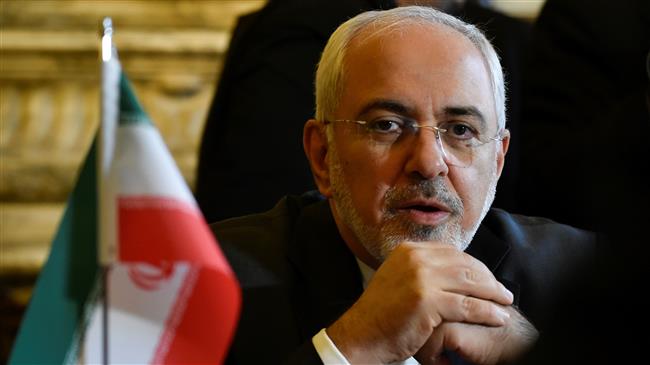
As the May 12 deadline draws close for Trump to waive the sanctions against Iran, as required under the Joint Comprehensive Plan of Action or (JCPOA), Tehran has carried the war of words into the enemy camp. Foreign Minister Mohammad Javad Zarif arrived in New York over the weekend on a six-day visit, ostensibly to attend High-Level Meeting on Peace-building and Sustaining Peace at the United Nations on April 24-25.
But in reality he is on a Track 1.5 mission to reach out to the US audience as well as to be simply available on call on American soil through next week when the leaders of two key allies of the US – French President Emmanuel Macron an German Chancellor – are scheduled to meet Trump in Washington to discuss policy options with regard to the JCPOA, amongst other things.
The big question is whether President Donald Trump would instruct his top officials to establish direct contact with Zarif in New York on the sidelines of the UN meet. Tehran is drawing encouragement from the remarks last Thursday by Mike Pompeo, CIA Director and Secretary of State-designate at his confirmation hearing in the US Senate.
Pompeo told the US senators, “I want to fix this (JCPOA) deal. That’s the objective. I think that’s in the best interests.” Alongside, he acknowledged that Iran was not pursuing a nuclear weapon program even before the nuclear deal; nor will it be in future. Pompeo emphasized that as CIA Director, he didn’t find any evidences that Iran violated the nuclear deal and he believes that Tehran cannot expand its program even shortly after a hypothetical US withdrawal from the JCPOA. Even more intriguing was Pompeo’s remark,
- If there’s no chance that we can fix it (nuclear deal), I will recommend to the president that we do our level best to work with our allies to achieve a better outcome and a better deal. Even after May 12, there’s still much diplomatic work to be done.
Pompeo signaled that Trump may not make a final decision by the May 12 deadline and may instead opt to continue the consultations with European allies with a view to “fixing the flaws of the JCPOA”.
A commentary in the influential Tehran Times noted on Saturday that “the White House hasn’t come to a determined and clear decision on how to deal with the JCPOA yet,” The Iranians never branded Trump as a one-dimensional man. Besides, Tehran is greatly experienced in moving past US rhetoric.
Zarif fired his opening salvo soon after reaching New York when he told CBS’ Face the Nation moderator Margaret Brennan in a fascinating interview that Tehran has kept a number of options ready, “including options that would involve resuming (the nuclear program) at a much greater speed,” but will “make the necessary decision when we see fit.” (Full transcript is here.)
Zarif underscored that Tehran cannot be expected to “unilaterally and one-sidedly implement the deal.” Plainly put, Iran will not accept any unilateral move to scrap the JCPOA. President Hassan Rouhani has also warned from Tehran that the range of Iran’s policy options include “what they (US) cannot imagine.”
Interestingly, Zarif also told the CBS that Tehran is open to a prisoner swap if there is a “change of attitude” on the part of the US. Zarif said, “The United States needs to approach this from a position of dealing with another sovereign government. And if that approach led to change, then the United States would see a difference.”
Pressed by Brennan on whether the Iranians were open to an exchange, Zarif offered an opening: “It is a possibility, certainly from a humanitarian perspective, but it requires a change in attitude.” Zarif just signaled that he’s ready to meet with American counterparts.
Trump has a job cut out for Pompeo. To be sure, Israel must be panicking.
Russia-Iran ties soar high under US pressure
By M K Bhadrakumar | Indian Punchline | April 22, 2018
A commentary entitled Tehran, Moscow boosting strategic relations, appearing last week in the Iran Daily newspaper, which is close to Supreme Leader Ali Khamenei – and subsequently circulated by IRNA – noted as follows:
“Policies adopted by Tehran and Moscow are becoming more harmonious on a daily basis as their bilateral as well as multilateral moves and measures are becoming more consistent with each other.”
The general expectation was that in the downstream of the 2015 Iran nuclear pact opening the door to Iran’s integration with the international community, Russia-Iran ties might get atrophied. But the exact opposite is happening. A senior Iranian official told Alexander Lavrentiev, Russian President Vladimir Putin’s special envoy to Syria, at a meeting in Tehran last week that the two countries are having their relations at the highest level in recent times.
If any single factor is to be held accountable for this, it must be American policies. The US’ containment policies toward Russia pursued under President Barack Obama have continued during the Trump presidency – and, arguably, even intensified. For Iran, on the other hand, the expected scale of integration with the international community has not materialized following the implementation of the 2015 nuclear pact due to the US’ negative attitude. The inertia of the Obama period has given way to hostile US policies under President Trump.
Meanwhile, the conflict in Syria has found Russia and Iran on the same side as staunch supporters of President Bashar Al-Assad. The Russian-Iranian cooperation deepened progressively during the period since the deployment of Russian forces to Syria in September 2015 and proved effective in stemming the tide of the war in favor of the Syrian government.
In the process, the overall Russian-Iranian relations began acquiring a strategic character, which they had lacked previously. Today, the spectre of US sanctions haunts both countries. The quasi-alliance with Iran provides much-needed strategic depth to the Russian policies in the Middle East. Whereas, Russia’s robust support on the vexed nuclear issue is invaluable help to Tehran at the present juncture. If Iran’s relations with the West run into difficulty under US pressure, Tehran’s dependence on Russia will only increase. Suffice to say, the more these countries face hostility from the US, the stronger their quasi-alliance is becoming. Shades of the “new type of relations” between Russia and China!
Two developments this week highlight that Middle Eastern politics has to reckon with a new geopolitical reality in the developing Russian-Iranian quasi-alliance. First, in a major statement two days ago, Russian Foreign Minister Sergey Lavrov hinted that following the recent western missile strike on Syria, Moscow may consider supplying the advanced S-300 missile defence system to Damascus.
If Russia upgrades the Syrian air defence system, the military balance will shift in favor of Damascus and thereby Iran will also be a beneficiary, since Syrian capability to deter any further Israeli adventures in its air space will help the consolidation of long-term Iranian presence in the Levant as well. (Following the killing of several Iranian personnel in a recent Israeli missile attack on a Syrian base near Damascus, the Chief of the Iranian Army Abdolrahim Mousavi said on Saturday that “destroying the Zionist regime is one of the major tasks of the Islamic Revolutionary Guards.”)
In a second development this week, Russian energy minister Alexander Novak was quoted as saying that Russia has received the first shipment of oil under the oil-for-goods deal agreed upon in 2014 (and ratified by the two countries last year) with a view to eschew the use of the US dollar in their bilateral trade transactions. Under the deal, Russia would initially buy 100,000 barrels a day from Iran and sell the country $45 billion worth of goods.
Indeed, the implications are profound when Russia and Iran, two energy superpowers, collaborate on oil trade. The two countries have also signed six provisional agreements to collaborate on “strategic” energy deals worth up to $30 billion. The Russian Presidential aide Yuri Ushakov recently disclosed that Russian investment in developing Iran’s oil and gas fields could total more than $50 billion.
According to Ushakov, Iran’s formal entry into the Russia-led Eurasian Economic Union is now only a matter of months. The free-trade deal between the EEU and Iran will be a game changer for Russian-Iranian economic cooperation on the whole. Meanwhile, with Russia’s support, Iran has also applied for membership of the Shanghai Cooperation Organization.
Trump replaces national security adviser McMaster with John Bolton
Sputnik – March 22, 2018
HR McMaster will exit the role of National Security Adviser to United States President Donald Trump. Former UN Ambassador John Bolton, a prominent war hawk, will replace McMaster, Trump announced on Twitter Thursday evening.
It had been reported for weeks that McMaster and Trump were butting heads and that the US Army lieutenant general was on the brink of being removed. McMaster is the most recent of more than two dozen officials to be fired or resign from the Trump administration since the president took office 14 months ago.
“After thirty-four years of service to our nation, I am requesting retirement from the US Army effective this summer,” McMaster said in a Thursday statement, adding, “I am thankful to President Donald J. Trump for the opportunity to serve him and our nation as National Security Adviser.” McMaster will leave public service after retiring from the military.
Bolton will be Trump’s third national security adviser, following the very brief tenure of Iran hawk Michael Flynn and now McMaster.
Bolton was a major proponent of the US’ 2003 invasion of Iraq and an advocate for the overthrow of leader Saddam Hussein, positions he still defends more than a decade later.
He wrote an op-ed in the Wall Street Journal in late February outlining “the legal case for striking North Korea first.” Historian Gareth Porter told Radio Sputnik’s Loud & Clear last week that Bolton’s nomination would likely lead to a White House that is more eager to pursue a war with Iran. “During the [George W.] Bush administration,” when Bolton was the US ambassador to the UN, “there was a plan for war with Iran,” Porter said.
Like Trump, Bolton opposes the multilateral 2015 Joint Comprehensive Plan of Action, the milestone agreement intended to provide limits to and transparency on Iran’s nuclear program in exchange for sanctions relief. Trump in January recertified the deal for what he said would be the last 120-day period without major changes.
Speaking to reporters at the White House while Saudi Crown Prince Mohammad bin Salman was visiting this week, Trump stated, “The Iran deal is coming up. It’s probably another month or so, and you’re going to see what I do.” Former Secretary of State Rex Tillerson, one of the voices said to have counseled Trump that scrapping the JCPOA was a bad idea, was recently dismissed from his position in favor of former CIA Director Mike Pompeo.
Since his time in the Bush administration, Bolton has worked as a foreign policy fellow at the American Enterprise Institute. He is a Fox News contributor and frequently appears on TV as a conservative pundit.
Iran official warns Europe against playing US-Israeli game
Press TV – March 17, 2018
A senior Iranian official has warned European countries against playing into the hands of the United States and the Israeli regime as European signatories to the 2015 Iran nuclear deal propose fresh sanctions against Tehran under the pressure of Washington.
“Defense capabilities, particularly the missile program, of the Islamic Republic of Iran, which have a deterrent nature, will firmly be continued based on national security necessities,” Secretary of Iran’s Supreme National Security Council (SNSC) Ali Shamkhani said in a meeting with Oman’s Foreign Minister Yusuf bin Alawi in Tehran on Saturday.
“Political and media propaganda will have no impact on their development,” he added.
Britain, France and Germany have proposed new EU sanctions on Iran over its missile program and its regional role, a confidential document said on Friday.
The joint paper was sent to the EU capitals to sound out support for such sanctions as they would need the backing of all 28 member states of the bloc, Reuters quoted two people familiar with the matter as saying.
The proposal is allegedly part of an EU strategy to appease US President Donald Trump and preserve the Iran nuclear deal, officially known as the Joint Comprehensive Plan of Action (JCPOA), signed between Tehran and the P5+1 group of countries in 2015 amid constant US threats to withdraw from it.
Shamkhani said US failure to fulfill its obligations and its illegal approach to the JCPOA as well as Europe’s passivity with regard to Washington’s approaches clearly show that regional countries need to focus on finding a solution to the ongoing issues and crises in the region by themselves.
“The Islamic Republic of Iran will give a proper and due response to the US constant violations of its commitments under the JCPOA and will accept no change, interpretation or new measure that would limit the JCPOA,” the SNSC secretary said.
His comments came a day after Iranian Foreign Minister Mohammad Javad Zarif warned the US against the “painful mistake” of pulling out of the Iran nuclear agreement.
“Considering what has been envisaged in the JCPOA in the field of research and development and the Islamic Republic of Iran’s continued measures to develop its peaceful nuclear capability, if the US makes the mistake of exiting the JCPOA, it will definitely be a painful mistake for the Americans,” Zarif told reporters.
Elsewhere in his comments, Shamkhani said growing deep relations between Iran and Oman had led to consensus on regional issues.
“The development of constructive and all-out relations with neighbors based on common interests is the top priority of the Islamic Republic of Iran’s foreign policy,” he added.
The senior Iranian official lashed out at certain regional countries for adopting “a hasty and arrogant attitude and statements” which have posed serious challenges to the handling of regional crises.
He expressed his concern about the killing of Yemeni women and children in airstrikes by Saudi Arabia and the United Arab Emirates as well as the catastrophic conditions of the oppressed Yemeni people.
“The shared view of Iran and Oman on the Yemeni crisis is based on putting an immediate end to war, establishing ceasefire, lifting the blockade, dispatching humanitarian aid and holding Yemeni-Yemeni dialogue to form new political structures based on the Yemeni people’s demands and vote,” Shamkhani pointed out.
He emphasized that the Yemeni crisis cannot be settled through military approaches and urged a political initiative in this regard.
About 14,000 people have been killed since the onset of Saudi Arabia’s military campaign against Yemen in March 2015. Much of the Arabian Peninsula country’s infrastructure, including hospitals, schools and factories, has been reduced to rubble due to the war.
The United Nations says a record 22.2 million people are in need of food aid, including 8.4 million threatened by severe hunger.
The UN Security Council on March 15 warned about the worsening humanitarian situation in war-battered Yemen, stating the status quo is having a “devastating” impact on the lives of civilians in the impoverished Arab country.
“The Security Council expresses its grave concern at the continued deterioration of the humanitarian situation in Yemen, and the devastating humanitarian impact of the conflict on civilians,” it said in a statement.
Oman urges dialogue instead of military approaches
The Omani foreign minister, for his part, criticized military approaches to regional issues and urged the path of dialogue and understanding instead.
He added that Oman regards Iran as a trustworthy neighboring country and commended the Islamic Republic’s role in establishing stability and security in the region.
Bin Alawi arrived in Tehran Friday night on a two-day visit to hold talks with senior Iranian officials about mutual and regional issues.
Iran rejects speculations about bin Alawi’s visit
Iranian Foreign Ministry Spokesman Bahram Qassemi on Saturday rejected speculation about a link between the Omani minister’s visit to Tehran and US Defense Secretary James Mattis’s recent travel to Muscat and said bin Alawi’s trip was taking place with the purpose of strengthening mutual relations.
“Although Oman has very good relations with many countries in the world, Mr. Yusuf bin Alawi’s trip to Tehran has nothing to do with Mattis’s visit to this country,” Qassemi said.
He strongly rejected any link between bin Alawi’s visit to Tehran and US policies on the JCPOA.
The Iranian spokesperson said, “Iran and Oman are cooperating with each other on a wide range of issues and the two sides seek to use the two countries’ existing capacities to further deepen economic, commercial, banking and financial cooperation.”
Good Wishes for Nowruz
Iranians Prepare to Celebrate the Persian New Year, Netanyahu Is Sounding the Drums of War

By Miko Peled | American Herald Tribune | March 17, 2108
As millions of Iranians prepare to celebrate the Persian new year, Nowruz, we should extend our wishes for peace and prosperity to our Iranian brothers and sisters. However, Israel’s Prime Minister, Benjamin Netanyahu is once again sounding the drums of war and his target is once again Iran. It seems that when the going gets tough Netanyahu goes for Iran. He has done it several times in the past and most recently during his latest visit to Washington, DC. Netanyahu – arguably in an effort to divert attention from his impending indictment – insisted that “Iran, Iran, Iran” is a threat. And although all who visit Iran talk about the richness of its culture, the beauty of its landscapes and the kindness of its people, according to Netanyahu “Darkness is descending on our region,” and that darkness is caused by Iran. “Iran,” a country that has never attacked or occupied anyone, “is building an aggressive empire” which includes, “Iraq, Syria, Lebanon, Gaza, Yemen” and “more to come.”
It is no coincidence that Netanyahu specifically mentioned Iraq, Syria, Lebanon, Gaza and Yemen. The message that he sends is clear: the destruction of Iraq and Syria must go on because of Iran; the destabilization of Lebanon and the demonizing of Hezbollah must go on, the genocide in Gaza too will go on, not because of Zionist genocidal tendencies but because of Iranian influence and finally, in a message of support to Mohammad Bin Salman, Netanyahu gave his blessing to the ongoing Saudi bombing in Yemen. It so happens that during his recent visit to the UK, Bin Salman, the Crown Prince of Saudi Arabia just sealed a deal to receive billions of pounds worth of weapons to be used in the ongoing slaughter in Yemen. Netanyahu explained that these are the arms of the “Iranian empire” and even though the lion’s share of the killing in the Middle East is done by the US, Israel and their cronies, Iran is the problem. “More to come” Netanyahu added presumably as a threat that Israel is keeping open the possibility that still other countries may see destruction.
Though he did not mention it specifically, at the center of Netanyahu’s speech is the new vision for the Middle East- sewn together by Israel, The United States and the Saudi Crown Prince, Mohammad Bin Salman. What has been named “The Deal of the Century” in English and Safkat El Kurn in Arabic (the Arabic name being less ambitious as it means the deal of the decade) is a vision of an “open” and “moderate” Saudi Arabia which like Jordan and Egypt will have diplomatic relations with Israel ignoring the Palestinian people’s struggle against Zionist oppression. In return Saudi Arabia will be permitted to continue its own genocide in Yemen and receive Western support in its ongoing feud with Iran. It will also be spared, like Egypt and Jordan, “Israel’s longtime peace partners,” the lectures on human rights violations. Egypt, Jordan and Saudi Arabia are all reactionary dictatorships with leaders who have no regard for human rights and who sold their Palestinian brothers in return for billions of dollars. The message for Arab regimes is clear – collaborate with Israel and the West and you will be allowed to oppress your people and line your pockets with cash, or stand with the Palestinians and find yourself in ruins like Iraq and Syria or under constant threat like Iran. Clearly, Mohammad Bin Salman made his choice clear.
“The force behind so much of what is bad is this radical tyranny in Tehran. If I have a message for you today, it’s a very simple one: We must stop Iran. We will stop Iran.”
Stop Iran from doing what? Stop Iran from supporting the Palestinian struggle for freedom. Stop Iran from calling to remove the racist Zionist regime from Palestine and to allow for a democracy to emerge. How is Iran a dangerous radical tyranny more than Egypt, Jordan and Saudi Arabia? The difference is that the latter are happy to collaborate with Israel.
Netanyahu is accustomed to receiving political gifts from the U.S. and particularly from Donald Trump. These are gifts that solidify his power at home, and this time he received the following: “The President has also made it clear that if the fatal flaws of the nuclear deal are not fixed, he will walk away from the deal and restore sanctions.” The United States walking away from the Iran agreement will suit Israel fine, and will show Bin Salman that when it comes to the US, Israel can deliver. While other Israeli politicians run around the like children, with few achievements to show Netanyahu is a serious player on national and international issues.
The troubling partnership between Bin Salman, Netanyahu and Trump (through his son-in-law Jared Kushner) will inevitably crash and burn. Both Bin Salman and Netanyahu represent regimes that have no legitimacy and the Kushner-Trump foreign policy is founded on Zionist mythology and grand ambitions that disregard the will of the people of the region. It is an irony that Netanyahu could not resist calling Iran dishonest, “I warned that Iran’s regime had repeatedly lied to the international community, that it could not be trusted,” and then add the biggest lie of them all, “Israel remains committed to achieving peace with all our neighbors, including the Palestinians.”
Hard as it may be to believe, Netanyahu’s obsession with Iran has nothing to do with Iran and it has nothing to do with any real or perceived threat by Iran. Netanyahu discovered that Iran is a perfect target to use each time he needs a smoke screen. As Palestinians die a slow agonizing death due to his policies, thirsty for water, desperate for urgent medical care and fighting for their freedom, killed in the streets and held in Israeli torture chambers, Netanyahu the magician is terrifying the world with a smoke screen intended to turning the world’s attention to a threat that does not exist. Still, one may safely assume some seventy-five million Iranians are concerned for their country and their lives.
As Nowruz approaches, I wish all Iranians inner strength, peace, prosperity and Nowruz Mobarak.
Miko Peled is a writer and human rights activist. He is an international speaker and the author of “The General’s Son, Journey of an Israeli in Palestine”.
How ‘Operation Merlin’ Poisoned U.S. Intelligence on Iran
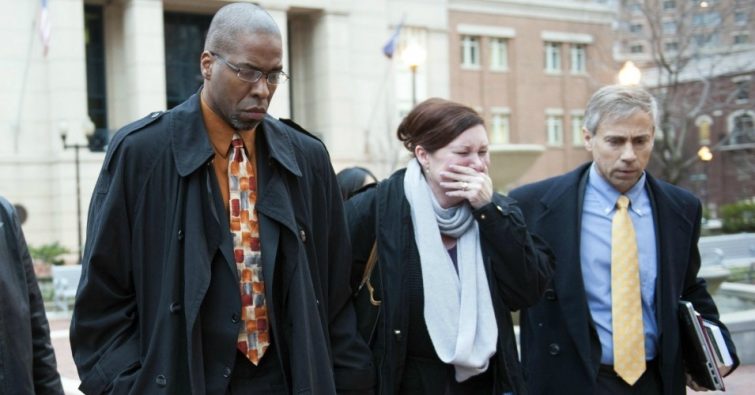
Former CIA officer Jeffrey Sterling, left, leaves the Alexandria Federal Courthouse on Jan. 26, 2016 with his wife Holly, center, and attorney Barry Pollack. Photo: Kevin Wolf/AP
By Gareth Porter | Consortium News | March 3, 2018
Jeffrey Sterling, the case officer for the CIA’s covert “Operation Merlin,” who was convicted in May 2015 for allegedly revealing details of that operation to James Risen of the New York Times, was released from prison in January after serving more than two years of a 42-month sentence. He had been tried and convicted on the premise that the revelation of the operation had harmed U.S. security.
The entire case against him assumed a solid intelligence case that Iran had indeed been working on a nuclear weapon that justified that covert operation.
But the accumulated evidence shows that the intelligence not only did not support the need for Operation Merlin, but that the existence of the CIA’s planned covert operation itself had a profound distorting impact on intelligence assessment of the issue. The very first U.S. national intelligence estimate on the subject in 2001 that Iran had a nuclear weapons program was the result of a heavy-handed intervention by Deputy Director for Operations James L. Pavitt that was arguably more serious than the efforts by Vice-President Dick Cheney to influence the CIA’s 2002 estimate on WMD in Iraq.
The full story of the interaction between the CIA operation and intelligence analysis, shows, moreover, that Pavitt had previously fabricated an alarmist intelligence analysis for the Clinton White House on Iran’s nuclear program in late 1999 in order to get Clinton’s approval for Operation Merlin.
Pavitt Plans Operation Merlin
The story of Operation Merlin and the suppression of crucial intelligence on Iran’s nuclear intentions cannot be understood apart from the close friendship between Pavitt and CIA Director George Tenet. Pavitt’s rise in the Operations Directorate had been so closely linked to his friendship with Tenet that the day after Tenet announced his retirement from the CIA on June 3, 2004, Pavitt announced his own retirement.
Soon after he was assigned to the CIA’s Non-Proliferation Center (NPC) in 1993 Pavitt got the idea of creating a new component within the Directorate of Operations to work solely on proliferation, as former CIA officials recounted for Valerie Plame Wilson’s memoir, Fair Game. Pavitt proposed that the new proliferation division would have the authority not only to collect intelligence but also to carry out covert operations related to proliferation, using its own clandestine case officers working under non-official cover.
Immediately after Tenet was named Deputy Director of the CIA in 1995, Pavitt got the new organization within the operations directorate called the Counter-Proliferation Division, or CPD. Pavitt immediately began the planning for a major operation targeting Iran. According to a CIA cable declassified for the Sterling trial, as early as March 1996 CPD’s “Office of Special Projects” had already devised a scheme to convey to the Iranians a copy of the Russian TBA-486 “fireset” – a system for multiple simultaneous high explosive detonations to set off a nuclear explosion. The trick was that it had built-in flaws that would make it unworkable.
A January 1997 declassified cable described a plan for using a Russian émigré’ former Soviet nuclear weapons engineer recruited in 1996 to gain “operational access” to an Iranian “target.” The cable suggested that it would be for the purpose of intelligence on the Iranian nuclear program, in the light of the fact that the agency had not issued a finding that Iran was working on nuclear weapons.
But in mid-March 1997 the language used by CPD to describe its proposed covert operation suddenly changed. Another declassified CPD cable from May 1997 said the ultimate goal was “to plant this substantial piece of deception information on the Iranian nuclear weapons program.” That shift in language apparently reflected Tenet’s realization that the CIA would need to justify the proposed covert operation to the White House, as required by legislation.
With his ambitious plan for a covert operation against Iran in his pocket, Pavitt was promoted to Associate Deputy Director of Operations in July 1997. On February 2, 1998, CPD announced to other CIA offices, according to the declassified cable, that a technical team from one of the national laboratories had finished building the detonation device that would include “multiple nested flaws,” including a “final fatal flaw” ensuring “that it will not detonate a nuclear weapon.”
An official statement from the national lab certifying that fact was a legal requirement for the CIA to obtain the official Presidential “finding” for any covert operation required by legislation passed in the wake of the Iran-Contra affair.
Pavitt obtained the letter from the national laboratory in mid-1999 a few weeks after it was announced he would be named Deputy Director of the CIA for Operations.
But that left a final political obstacle to a presidential finding: the official position of the CIA’ s Intelligence Directorate remained that Iran did not have a nuclear weapons program. The language of the CIA’s report to Congress for the first half of 1999, which was delivered to Congress in early 2000, contained formulations that showed signs of having been negotiated between those who believed Iran just have a nuclear weapons program and those who did not.
The report referred to nuclear-related projects that “will help Iran augment its nuclear technology infrastructure, which in turn would be useful in supporting nuclear weapons research and development.” The shift from “will” to “would” clearly suggested that nuclear weapons work was not yet an established fact.
A second sentence said, “expertise and technology gained, along with the commercial channels and contacts established-even from cooperation that appears strictly civilian in nature-could be used to advance Iran’s nuclear weapons research and developmental program.” That seemed to hint that maybe Iran already had such a nuclear weapons program.
That was not sufficient for Tenet and Pavitt to justify a covert nuclear weapons program involving handing over a fake nuclear detonation device. So the dynamic duo came up with another way around that obstacle. A new intelligence assessment, reported in a front page article by James Risen and Judith Miller in the New York Times on January 17, 2000, said the CIA could no longer rule out the possibility that Iran now had the capability to build a bomb – or even that it may have actually succeeded in building one.
Risen and Miller reported that Tenet had begun briefings for Clinton administration officials on the new CIA assessment in December 1999 shortly after the document was completed, citing “several U.S. officials” familiar with it. The Tenet briefings made no mention of any evidence of a bomb-making program, according to the sources cited by the Times. It was based instead on the alleged inability of U.S. intelligence to track adequately Iran’s acquisition of nuclear technology and materials from the black market.
But the new assessment had evidently not come from the Intelligence Directorate. John McLaughlin, then Deputy Director for Intelligence, said in e-mail response to a query that he did not recall the assessment. And when this writer asked him whether it was possible that he would not remember or would not have known about an intelligence assessment on such a high profile issue, McLaughlin did not respond. Pavitt and Tenet had obviously gone outside the normal procedure for an intelligence assessment in order to get around the problem of lack of support for their thesis from the analysts.
A declassified CIA cable dated November 18, 1999 instructed the Russian émigré to prepare for a possible trip to Vienna in early 2000, indicating that Tenet hoped to get the finding within a few weeks. Clinton apparently did give the necessary finding in early 2000; in the first days of March 2000 the Russian émigré dropped the falsified fireset plans into the mail chute of the Iranian mission to the United Nations in Vienna.
Pavitt Suppresses Unwelcome Iran Nuclear Intelligence
Pavitt’s CPD was also managing a group of covert operatives who recruited spies to provide information on weapons of mass destruction in Iran and Iraq. CPD not only controlled the targeting of the operatives working on those accounts but the distribution of their reports. CPD’s dual role thus represented a serious conflict of interest, because the CPD had a vested interest in an intelligence estimate that showed Iran had an active nuclear weapons program, and it could prevent intelligence analysts from getting information that conflicted with that interest.
That is exactly what happened in 2001. One especially valuable CPD operative, who was fluent in both Farsi and Arabic, had begun recruiting agents to provide intelligence on both Iran and Iraq since 1995. His talents had been recognized by the CPD and by higher levels of the Operations Directorate: by 2001 he had been promised an intelligence medal and a promotion to GS14 – the second highest grade level in the civil service.
But that same year the operative reported very important intelligence on the Iran nuclear issue that would have caused serious problems for Pavitt and CPD and led ultimately to his being taken out of the field and being fired.
In a November 2005 court filing in a lawsuit against Pavitt, the unnamed head of CPD and then CIA Director Porter Goss, the operative, identified only as “Doe” in court records, said that one of his most highly valued “human assets” – the CIA term for recruited spies – had given him very important intelligence in 2001. That information was the subject of three crucial lines of the key paragraph in the operative’s complaint that were redacted at the demand of the CIA. For years “Doe” sought to declassify the language of that had been redacted, but the CIA had fought it.
It was assumed in press accounts at the time that the redacted lines were related to Iraq. But the lawyer who handled the lawsuit for “Doe,” Roy Krieger, revealed to this writer in interviews that the redacted lines revealed that the CIA “human asset” in question was an Iranian, and that he had told “Doe” that the Iranian government had no intention of “weaponizing” the uranium that it was planning to enrich.
It was the first intelligence from a “highly-valued” U.S. spy – one who was known to be in a position to know he claimed to know – on Iran’s intentions regarding nuclear weapons to become available to the U.S. intelligence community. “Doe” reported what the spy had said to his supervisor at CPD, according to the court filing, and the supervisor immediately met with Pavitt and the head of CPD. After that meeting the CPD supervisor ordered “Doe” not to prepare any written report on the matter and assured him that Pavitt and the head of the CPD would personally brief President Bush on the intelligence.
But “Doe” soon learned from his own contacts at CIA headquarters that no such briefing ever took place. And “Doe” was soon instructed to terminate his relationship with the asset. After another incident involving intelligence he had reported on WMD in Iraq that had also conflicted with the line desired by the Bush administration, CIA management took “Doe” out of the field, put him in a headquarters job and denied him the intelligence medal and promotion to GS-14 that he had been promised, according to his court filing. The CIA fired “Doe” without specifying a reason in 2005.
Pavitt did not respond to requests for an interview for this story both at the Scowcroft Group and, after he retired, at his home in McLean, Virginia.
The intervention by Pavitt to prevent the intelligence from Doe’s Iranian asset from circulating within the U.S. government came as the intelligence community was working on the 2001 National Intelligence Estimate (NIE) on the Iranian nuclear program. That NIE concluded that Iran was working on a nuclear weapon, but the finding was far from being clear-cut. Paul Pillar, the CIA’s National Intelligence Officer for the Middle East and North Africa, who was involved in the 2001 NIE, recalled that the intelligence community had no direct evidence of an Iranian nuclear weapons program. “We’re talking about things that are a matter of inference, not direct evidence,” Pillar said in an interview with this writer.
Furthermore he recalls that there was a deep divide in the intelligence community between the technical analysts, who tended to believe that evidence of uranium enrichment was evidence of a weapons program, and the Iran specialists, including Pillar himself, who believed Iran had adopted a “hedging strategy” and had made no decision in favor or a nuclear weapon. The technical analysts at the CIA’s Weapons Intelligence Non-Proliferation and Arms Control (WINPAC), were given the advantage of writing the first draft not only on Iranian technical capabilities but on Iranian intentions – a subject on which it had no real expertise – as well, according to Pillar.
The introduction of the intelligence from a highly credible Iranian intelligence asset indicating no intention to convert its enriched uranium into nuclear weapons would arguably have changed the dynamic of the estimate dramatically. It would have meant that one side could cite hard intelligence from a valued source in support of its position, while the other side could cite only their own predisposition.
Pillar confirmed that no such intelligence report was made available to the analysts for the 2001 NIE. He noted just how rarely the kind of intelligence that had been obtained by “Doe” was available for an intelligence estimate. “Analysts deal with a range of stuff,” he said, “from a tidbit from technical intelligence to the goldmine well-placed source with an absolutely credible account,“ but the latter kind of intelligence “almost never comes up.”
After reading this account of the intelligence obtained by the CPD operative, Pillar said he is not in a position to judge the value of the intelligence from the Iranian asset, but that the information from the CPD Iranian asset “should have been considered by the NIE team in conjunction with other sources of information.”
That lead to a series of estimates that assumed Iran had a nuclear weapons program.
In 2004, a large cache of purported Iranian documents showing alleged Iranian research related to nuclear weapons was turned over to German intelligence, which the Bush administration claimed came from the laptop of an Iranian scientist or engineer. But former senior German Foreign Official Karsten Voigt later revealed to this writer that the whole story was a fabrication, because the documents had been given those documents by the Mujahedin-E Khalq, the Iranian opposition group that was known to have publicized anti-Iran information fed to it by Israel’s Mossad.
Those documents led directly to another CIA estimate in 2005 asserting the existence of an Iranian nuclear weapons program, which in turn paved the way for all the subsequent estimates – all of which were adopted despite the absence of new evidence of such a program. The CIA swallowed the ruse repeatedly, because it had already been manipulated by Pavitt.
Operation Merlin is the perfect example of powerful bureaucratic interests running amok and creating the intelligence necessary to justify their operations. The net result is that Jeffrey Sterling was unjustly imprisoned and that the United States has gone down a path of Iran policy that poses serious – and unnecessary – threats to American security.
Gareth Porter is an independent journalist and winner of the 2012 Gellhorn Prize for journalism. He is the author of numerous books, including Manufactured Crisis: The Untold Story of the Iran Nuclear Scare (Just World Books, 2014).
Featured Video

Bombing Hitler’s Hometown
or go to
Aletho News Archives – Video-Images
From the Archives
‘Conspiracy Theory’ Now Fact: Greater Israel Has Arrived
By Kit Klarenberg | Mint Press News | January 28, 2025
Ever since Tel Aviv’s 1948 creation, much has been said and written about ‘Greater Israel’ – the notion Zionism’s ultimate end goal is the forcible annexation and ethnic cleansing of vast swaths of Arab and Muslim lands for Jewish settlement, based on Biblical claims this territory was promised to Jews by God. The mainstream media typically dismisses this concept as antisemitic conspiracy theory, or at most the fringe fantasy of a minuscule handful of extremist Israelis.
In reality … continue
Blog Roll
 Aletho News
- IRGC: Israeli, US universities in region legitimate targets after strikes on Iranian university
- Trump admits Iran hit USS Ford carrier: ‘We ran for our lives’
- Battle for Hungary: EU attacks on Orban are a sign of worse things to come
- Iraqi resistance conducts drone strike on US-run base in Syria
- Failing to Defeat Hezbollah, Israel & US Pressure Syria’s Ahmed al-Sharaa to Join War
- US-Israeli war on Iran drives global fertilizer prices up 40%
- Hezbollah’s Surprise Weapons Redefine Ground Battle with Israel
- Yemen joins fight against US, Israel by firing missiles at occupied territories
- Seizing the Kharg: Washington’s path to defeat in the Persian Gulf
- Iran reports 500 US casualties in strikes on covert US military sites
- If Americans Knew
- Over 300 US service members wounded, majority have brain injuries – Not a ceasefire Day 169
- Researchers at Human Rights Watch Resign Over Blocked Report on Palestinian Refugee Return
- Jewish Groups Are Backing a War Americans Don’t Want
- Eric Fingerhut Thinks He’s the President of the Jews
- Top Jewish Philanthropists, Rabbis Urge Israeli President to Take Action Against ‘Jewish Extremists’
- Don’t Be Fooled. Zionist Leaders Have Always Wanted to Control Southern Lebanon
- Israel’s widespread use of torture is a core element of its genocide against the Palestinian people
- In Israel’s War on Iran, Many Middle East US Bases Rendered “All But Uninhabitable”
- ‘Burn the lawn’: Israel pursues ‘Rafah model’ in southern Lebanon
- A genocide here, an amputation there
- No Tricks Zone
- Devastating Assessment Of Comirnaty Vaccine By Former Senior Pfizer Europe Toxicologist
- New Study: CO2 Is ‘Effectively Negligible’ As An Explanatory Climate Change Factor Since 2000
- Former Pfizer Toxicologist Dr. Helmut Sterz Tells Bundestag Hearing Pfizer Vaccine Should Have Never Been Approved
- Energy Expert: Germany’s Nuclear Phaseout Was A “500 Billion Euro Mistake”
- New Research: South Australia’s Mid-Holocene Sea Surface Temperatures Were 4°C Warmer Than Today
- Storing Green Energy To Last Germany 10 Days Would Require A 60-Million Tonne Battery
- New Studies: UK Sea Levels Were 4 Meters Higher Than Today During The Mid-Holocene
- Destructive Green New Deal: German Energy And Metal Group Warns Of Drastic Crisis
- New Study Documents A 20-Year Pause In Arctic Sea Ice Decline – Driven By Internal Variability
- Wake-up Call: Survey Shows Majority Of Germans Now Favor Postponing Climate Targets!
 Aletho News