Boycott Hamas, brand Hezbollah terrorists, don’t trust Iran…
By Stuart Littlewood | Intifada-Palestine | February 10, 2015
Every general election brings with it the irksome task of reading the manifestos of the political parties. Now the Board of Deputies of British Jews have launched their very own “Jewish Manifesto”. The 40-page document is intended to persuade policy-makers and politicians to promote key aspects of Jewish life in Britain and do some big favours for the abhorrent Zionist regime in Tel Aviv
“It will form the centrepiece of the Board’s drive to ensure that all the political parties take the concerns of Britain’s 300,000-strong Jewish community into account when setting out their own proposals for government.”
Favours we are asked to do for the Rogue State
At the heart of the Manifesto is a list of “policy asks”, some of which attempt to demonise Hamas, Hezbollah and Iran and portray them as Britain’s enemies as well as Israel’s.
Others aim to perpetuate Israeli dominance in the Holy Land at the Palestinians’ expense, like this one from the ‘Ten Commitments’:
- “Advocate for a permanent, comprehensive solution to the Israeli-Palestinian conflict, resulting in a secure Israel alongside a viable Palestinian state.”
The Board of Deputies explicitly state that the UK Jewish community is committed to equality for Israel and the Palestinians, yet here they want us to press for a “secure” Israel with Palestine only “viable”. And that has become the mantra among Israel’s stooges in the West. We know what it will mean on the ground, and it’s despicable. Why should the Palestinians, whose land it is, live in permanent fear and subjugation, defenceless among the shredded and disconnected remnants of their territory and not even in control of their borders? Let’s turn it round so we have “a secure Palestine alongside a viable Israeli state”. How do the Board of Deputies like the sound of that?
Here are a few more Manifesto gems…
- They want restitution for private property the Nazis stole during the Holocaust leaving many survivors living in dire poverty and without a legacy for the descendants.
This is a very cruel injustice. But what about all the land, homes, other property, infrastructure and natural resources the Jewish State confiscated from the Palestinians during the Nakba and continued to seize ever since? When will that be returned? According to the UN, last year alone Israel demolished the homes of 1,177 Palestinians in Jerusalem and West Bank (never mind the countless thousands of homes they reduced to rubble in Gaza).
They don’t like to see Israel boycotted.
- “We urge resistance of calls for boycotts of Israel. By their very nature, such measures attribute blame to only one side of the conflict, and through this stigmatisation they perpetuate a one-sided narrative.”
At the same time they want our help in boycotting Palestinians.
- The Manifesto urges the British government “to refuse to engage with Hamas politicians, officials or supporters until the movement agrees to recognise Israel, abide by previous diplomatic agreements, and desists from terrorist attacks”.
Are the Board of Deputies aware that Israel refuses to recognise the Palestinian State, has failed to honour previous agreements and never ceases its terrorist attacks? Are they also aware that the UK does not list Hamas’s political wing as a proscribed organisation, only its military wing – the Izz al-Din al-Qassem brigades.
The boycott of Israel simply calls for non-violent measures that “should be maintained until Israel meets its obligation to recognize the Palestinian people’s inalienable right to self-determination and fully complies with the precepts of international law by:
1. Ending its occupation and colonization of all Arab lands and dismantling the Wall
2. Recognizing the fundamental rights of the Arab-Palestinian citizens of Israel to full equality; and
3. Respecting, protecting and promoting the rights of Palestinian refugees to return to their homes and properties as stipulated in UN resolution 194.”
There’s nothing controversial. The same is required of Israel by international and humanitarian law.
Other bizarre “asks” include these:
- The Manifesto wants us to “promote awareness of the acute threats to Israeli and regional security, and encourage further security cooperation between the UK and Israel”.
Many experts conclude that the main threat to Middle East peace is Israel itself. It would be foolish to be drawn into closer co-operation. Our already slavish support for Israel (and indeed its protector, the US) undermines our own security, puts UK citizens in harm’s way and blackens our reputation. It is hard to see how this is in our national interest.
- The Manifesto says the world must ensure “no backsliding towards an Iranian military nuclear capability… it is vital that Iran knows that there is a credible military option to end its pursuit of nuclear weapons if diplomacy should fail”.
The Zionist regime is reckoned to have up to 400 nuclear warheads. It has signed but not ratified the Comprehensive Nuclear Test Ban Treaty. It has not signed the Biological and Toxin Weapons Convention. It has signed but not ratified the Chemical Weapons Convention. In short, Israel is the neighbour from Hell.
These endless attempts to drive a wedge between Britain and Iran are tiresome. Israel would love to launch a war against Iran if support from the US and its EU lackeys was assured. Iran has no nuclear weapons and poses no threat to the UK. What’s more, our Iranian friends are menaced by an unrestrained nuclear-armed Israeli regime on their doorstep. UN Security Council resolution 487, in 1981, called on Israel “urgently to place its nuclear facilities under IAEA safeguards”. Israel has defied it for 34 years. In 2009, the IAEA called on Israel to join the Non-Proliferation Treaty and open its nuclear facilities to inspection. Israel still refuses while Iran has complied.
- “Years of disingenuity and obfuscation from the Iranian authorities should not be naively forgotten.”
So says the Manifesto, oblivious to the staggering hypocrisy.
The “violent nature” of Hezbollah
For a long time Israel has planned to annex Lebanon’s Litani River. Hezbollah (the ‘party of God’) was formed in response to the Israelis’ 1982 invasion and occupation. An international commission concluded that Israel’s aggression was contrary to international law, the government of Israel had no valid reasons for invading Lebanon and Israel was directly or indirectly responsible for the massacres in Sabra and Shatila refugee camps, declared an act of genocide by the UN General Assembly.
So Hezbollah came into being for very good reasons. Israel began overflying Lebanese territory in 2000 after its troops vacated parts of southern Lebanon they had occupied since 1978. These flights are a constant provocation. In 2006 Israel launched another invasion and received a bloody nose from Hezbollah. The conflict killed over six thousand people and severely damaged Lebanese infrastructure. Much of Southern Lebanon was left uninhabitable due to unexploded Israeli cluster bombs.
The Jewish Manifesto talks of Hezbollah’s “violent nature” but in the circumstances how valid is this next “ask”?
- It wants Hezbollah in its entirety designated as a terrorist organisation, and asks the UK to take the lead in getting the whole EU to proscribe Hezbollah’s political wing.
Lebanon’s Cabinet has confirmed Hezbollah as an armed organisation with the right to “liberate or recover occupied lands”. Israel routinely breaches UN Resolution 1701 by crossing the Blue Line or violating Lebanese airspace and still occupies the Shebaa Farms area. Hezbollah is hardly going to disband with Israel next door always poised to grab what isn’t theirs.
Why should the UK take on another of Israel’s enemies and try to weaken Lebanon’s defence against the Zionist predator?
In case we forget, the US defines terrorism as an activity that
(i) involves a violent act or an act dangerous to human life, property, or infrastructure; and
(ii) appears to be intended
- to intimidate or coerce a civilian population;
- to influence the policy of a government by intimidation or coercion; or
- to affect the conduct of a government by mass destruction, assassination, kidnapping, or hostage-taking.
Anyone spring immediately to mind?
- The Manifesto also asks Britain to maintain an expenditure of 0.7% of GNP on overseas development.
So that so we continue to subsidise the Zionists’ never-ending occupation of Palestine?
- It urges us to “support efforts to remember and understand the Holocaust and strive to prevent any future genocide”.
Most ordinary people in the UK (though not necessarily our politicians) have taken on-board the lessons of the Holocaust and don’t need constant reminding. How about the Israeli regime?
The ‘Israel problem’ a Jewish family matter
Finally, this ‘hot potato’:
- July 2014 was the worst month for anti-semitism on record, presumably on account of another murderous assault on Gaza by the Israeli military. “A robust political and policing response is required when criticism of the policies of a government spills over in to hatred, intimidation or violence against a religious or ethnic group” ..
Prime Minister Cameron’s Holocaust Commission Report says: “The Community Security Trust, an organisation that looks after the safety and security needs of the Jewish community, recorded more than 1,000 incidents last year, making 2014 the worst year on record.”
Do Jewish leaders in the UK need reminding that Muslims and Christians in the Holy Land have suffered a high tide of hatred, intimidation, violence and worse for decades under Israel’s brutal occupation?
We’re told that anti-semitism is often bound up with perceptions of the political and military decisions of the Israeli government, and that Israel represents a fundamental component of Jewish identity. In that case, one would have thought, Israel’s appalling conduct – and damage to reputation – is something the global Jewish family would wish to deal with themselves. Wise heads have warned long enough that Jews worldwide will pay the price for Israel’s crimes. Many Jews, to their great credit, have taken heed and faced up to the moral challenge, and are now fiercely critical of the Israeli regime’s behaviour.
For example, over 400 rabbis from Israel, the USA, Canada, Britain and other countries have just signed a call to Israel’s Prime Minister Netanyahu to stop the practice of home demolitions. “Every year, hundreds of Palestinian homes are demolished due to discriminatory administrative plans created and implemented by the Israel military without significant Palestinian influence. Palestinians are very rarely allowed to build, even on their own land.”
That’s leadership.
Israel lobby: Attendance mandatory at Netanyahu speech
Press TV – February 9, 2015
Several pro-Israel lobby groups in the United States have threatened to “publicly condemn” Democrats who plan to skip the Israeli prime minister’s speech about Iran before Congress next month.
Benjamin Netanyahu’s well-funded Jewish conservative backers say they may use their funds to draw attention in the districts and states of any Democratic lawmaker who is not at the US Capitol to listen to Netanyahu on March 3.
Netanyahu has been invited by House of Representatives Speaker John Boehner to address a joint session of Congress to speak about the “threat” of Iran’s nuclear energy program.
“This is, I think, a critical visit by the prime minister. If these Democrats would rather put partisan politics ahead of principle and walk out on the prime minister of Israel, then we have an obligation to make that known,” said Matt Brooks, the executive director of the Republican Jewish Coalition, a political lobbying group which promotes Jewish Republicans.
“We will commit whatever resources we need to make sure that people are aware of the facts,” Brooks said. He did not specify what methods this campaign would use, but promised that his group would do whatever it can.
Other Zionist organizations are sending similar messages. “We will, of course, be publicly condemning any Democrats who don’t show up for the speech, unless they have a doctor’s note,” said Mort Klein, president of the Zionist Organization of America, a prominent pro-Israel group with 30,000 members.
“It’s really an anti-American, anti-patriotic position to take,” Klein added.
AIPAC, the largest pro-Israel lobby in the US, is encouraging members of Congress to attend the speech, although the group also has reservations because it is turning into a partisan event.
Growing criticism over Netanyahu speech
Democrats are angry over the Boehner’s invitation of the Israeli premier, which was planned without the knowledge of the Obama administration.
The event will take place just two weeks before the Israeli elections, which is seen by the White House and senior Democrats as particularly manipulative. The White House has called the invitation a breach of protocol.
President Barack Obama would not meet with Netanyahu during his trip to Washington, according to the White House. Vice President Joe Biden’s office also confirmed on Friday that he would not be present during Netanyahu’s speech.
It seems Netanyahu plans to go ahead with the trip despite growing criticism both in Israel and the United States. The Israeli prime minister says he will address Congress to lobby against a “bad and dangerous” nuclear deal with Iran.
Iran and the P5+1 group – the US, France, Britain, Russia, China and Germany – are in talks to narrow their differences and pave the way for a final, long-term nuclear accord.
The Republican-controlled Congress, however, is pushing a new round of sanctions on Iran, despite the veto threat from the White House and warnings that additional sanctions at this juncture risked derailing the nuclear talks.
Iran argues that as a committed signatory to the nuclear Non-Proliferation Treaty (NPT) and a member of the International Atomic Energy Agency (IAEA), it has the right to use nuclear technology for peaceful purposes.
Opportunity of nuclear talks may not come again: Zarif
Press TV – February 8, 2015
Iranian Foreign Minister Mohammad Javad Zarif has attached special significance to the ongoing talks on Iran’s nuclear program, saying the negotiations serve as an opportunity that may not be repeated.
“The only way to resolve the issue is through negotiations,” Zarif said on Sunday at a press conference on the sidelines of the Munich Security Conference in Germany.
“We have made quite a bit of success” during the negotiations to resolve remaining issues on Iran’s nuclear program “over the past many months,” Zarif said, adding that the talks are an “opportunity” to resolve the standoff between Iran and the West.
“This is the opportunity to do it and we need to seize this opportunity. It may not be repeated,” the Iranian foreign minister stated.
He said the first objective of the negotiations is to assure the opposite side that Iran’s nuclear program “remains exclusively peaceful,” adding, “It means that Iran should be able to exercise its right to nuclear technology for peaceful purposes because without exercising that right it is impossible to make sure that it is peaceful.”
The second objective, Zarif went on to say, is the removal of all “unacceptable” sanctions imposed on Iran.
“We are prepared to reassure the international community and some of the negotiating partners that Iran’s nuclear energy is peaceful, but at the same time it is important the restrictions that have been imposed on Iranian people be lifted,” he stated.
“It is important for everybody to realize that the only way to deal with Iran is through respect and negotiations and meeting on a non-zero sum game.”
The Iranian foreign minister said those who insisted on imposing sanctions on Iran should now realize that the restrictions “did not achieve their intended result.”
“When the sanctions were imposed on Iran, Iran had less than 200 centrifuges. If the objective was to prevent Iran from developing its nuclear technology, they (sanctions) utterly failed because now we have 20,000 centrifuges.”
Commenting on a possible extension to the nuclear talks, Zarif said, “I do not think another extension is in the interest of anyone, as I do not believe this extension was either necessary or useful.”
Zarif also responded to a question on the possible consequences if the nuclear talks fail, saying, “If we don’t have an agreement, it is not the end of the world.”
Iran and the P5+1 group of countries – Russia, China, France, Britain, the United States and Germany – are seeking to reach a high-level political agreement by the end of March and to confirm the full technical details of the accord by July 1.
Elsewhere in his remarks, the Iranian foreign minister slammed the Tel Aviv regime’s claims that Iran is after a nuclear weapon.
“We do not have a weapons program,” he said, adding that the Israelis cannot hide their acts of aggression against Palestinians and others in the region through their hypothetical allegations.
Saying “No” to Netanyahu
Israel’s demands are not good for Americans
By Philip Giraldi • Unz Report • February 3, 2015
Israeli Prime Minister Benjamin Netanyahu will be visiting Washington during the first week in March. His annual visit coincides with the American Israel Public Affairs Committee (AIPAC) summit in Washington, at which he is expected to speak. He will also be addressing a joint session of Congress on March 3 rd as a guest of the new Republican majority. Per Speaker of the House John Boehner, Netanyahu will be providing additional insights regarding the threats posed by Iran and by Islamic terrorism, which the president had “papered over” in his State of the Union address. Boehner has in mind promotion of policies that would be contrary to those embraced by the White House, most particularly President Barack Obama’s intention to continue negotiations to come to an understanding over Iran’s nuclear program. That would mean Congress’s imposing new and intentionally deal breaking sanctions on Iran just to show it we are serious and a possible demand that any agreement with Tehran be subject to legislative approval.
Netanyahu has frequently warned that Iran’s construction of a nuclear arsenal is just around the corner. He has been making that claim regularly since 1996 and apparently is not particularly bothered that his warning has proven to be inaccurate since the Mullahs have yet to develop the long anticipated weapon of mass destruction. He will no doubt again express his view that there is a secret Iranian weapons program that imminently threatens both Israel and the United States. It is not clear if he will produce a cartoon showing a ticking bomb as he famously did at the United Nations in 2012.
Concerning the terrorist threat, Netanyahu will undoubtedly play the Charlie Hebdo card, insisting that it is the duty of the West united with Israel to oppose Islamic barbarism. It will be convenient dodge as it allows him to avoid answering for what Israel is doing to the Palestinians and it conveniently conflates all believers in a specific religion with political violence. No matter what Netanyahu says he will undoubtedly be cheered both when he speaks to Congress and also by the 1,500 attendees at AIPAC, which will include many Congressmen, journalists, and even Supreme Court justices. He will be treated like visiting royalty even though his message is essentially one of hate.
It is my understanding that a number of groups are organizing to protest both AIPAC and the Netanyahu visit. I hope they will be highly visible and noisy as hell, possibly forcing some of the summit attendees to think about just what they are supporting. I also urge the demonstrators to focus on Netanyahu’s actual message because everything that he has come to Washington to sell is essentially false.
Starting with Iran, the entire narrative of Iran as a nuclear threat is bogus, largely invented in Israel and the United States and in part based on manufactured evidence. I am not suggesting for a moment that Iran is a friend to the American people, but its malignancy has been much overstated by the Israel Lobby and its friends. It does not threaten the United States in any way and it hardly impacts on the security of countries like Israel and Saudi Arabia, both of which should be worrying about their viability based on their own behavior rather than due to an exaggerated Iranian menace. The reality is that the United States government has twice in 2007 and 2011 confirmed that Iran has no nuclear weapons program. Even Israel’s Mossad agrees and both governments admit that Tehran has not made the essentially political decision to proceed with such a program.
Not only has Iran neither developed nor tested a nuclear device, she has never enriched her uranium stocks to anything approaching weapons-grade. Her Fordow “secret” plant and other nuclear sites now have IAEA inspectors in place, the heavy-water reactor at Arak is not operational and many centrifuges are not operating. Most Iranians and many Americans understand that a negotiated settlement over the program as an alternative to a major regional war is highly desirable.
Netanyahu’s second point will be that the world is threatened by Islamic terrorism, requiring democratic nations to stand by Israel. But standing by Israel and adopting the Israeli standards for dealing with terrorism are precisely the problem. The only places in the world where Islamists have the remotest ability to take power are in those countries where the United States adhered to the Israeli model and intervened militarily, leaving chaos in its wake. Today that would include Iraq, Libya, Somalia, Afghanistan and Syria. Highly publicized terrorist attacks in Europe and in the United States have killed relatively few people and produced a predictably panicked response but do not threaten either a national security crisis or the stability of any government. In the U.S. since 9/11 there have been 69 deaths, either terrorist or criminal, that can plausibly be linked to Muslims or Islamic sensibilities, less than five a year. During the same time period 200,000 Americans have been murdered, making terrorism by local Muslims pretty much a statistical anomaly. For what it’s worth, the policies being pursued overseas by Washington during the same time period directly or indirectly contributed to the killing of as many as half a million Muslims while turning at least three million more into refugees, which inevitably fuels terrorism.
A third point that Netanyahu will not be making as he is a beneficiary of it is the astonishing power of the Israel Lobby in the United States. As John Mearsheimer and Stephen Walt demonstrated in their book, the Lobby is in reality a loose aggregation that is bound together to promote what are perceived to be Israeli interests. It includes think tanks, PACS and other lobbying groups, journalists and media outlets, Christian evangelicals, leading figures in academia and it is all backed up by deep pocket donors who both fund political candidates and provide the fuel to keep everything moving. Pat Buchanan once described Congress as “Israeli occupied territory,” but to be sure he was being too kind and Tom Friedman’s observation that it is bought and paid for by the Lobby might actually be closer to the mark. In an actual occupation there would characteristically be at least some resistance but in the United States Congress there is virtually none now that Ron Paul is retired. If any daring congressmen stay home sick when Netanyahu speaks it will be a surprise and the only real question regarding the impending joint session address is how many standing ovations the Israeli leader will receive. Will it exceed the 29 he recorded last time around?
So there are three good reasons for saying “no” to Benjamin Netanyahu, or, even better, telling him to go away and stay away. First, he is striving mightily to involve the United States in a war with Iran for which there is no compelling national interest and which will cost Americans heavily in both lives and treasure. Second, he has poisoned Washington’s relationship with the Muslim world through the largely successful selling of his message that all believers in Islam are essentially terrorists. And third, he and his associates in the Israel Lobby are a cancer in our political system, using money and even coercion to bring about a “special relationship” that is hardly a relationship at all but is instead a mechanism to impel U.S. subordination to Israeli interests.
It is shameful that Netanyahu will be in Washington at all on a mission to tell the U.S. Congress what to do, but one can always hope that both he and Speaker Boehner have finally gone too far. Will this be a wake-up call for the American public, aware at last that it is being led by the nose by a foreign country aided by its own venal and corrupted quislings? One can always hope, and it might just be that Netanyahu will finally pay a price for his hubris with his own voters next month and be turned out of office. Wouldn’t it be nice to be able to say that we have seen the last of Benjamin Netanyahu?
Chutzpah Squared, Bibi and Boehner
By Jim Lobe | LobeLog | January 22, 2015
As Mitchell Plitnick pointed out on Wednesday, House Speaker John Boehner has invited Israeli Prime Minister Benjamin Netanyahu to speak to a joint session of Congress on February 11, although now it appears that Bibi would like to put off the occasion until March 3, when AIPAC will be holding its annual policy conference and unleashing its 12,000-plus attendees on Capitol Hill. The lobby group presumably aims to persuade its members of Congress to do everything they can to sabotage a possible nuclear deal between the P5+1 and Iran—as well as bolster Bibi’s chances of retaining the premiership in the March 17 elections in Israel. Much has happened that is relevant to the visit in the last 24 hours, and a brief round-up, which unfortunately is all that I have time for today, seems in order.
The invitation was clearly arranged without any notification of or coordination with the White House, which, as Mitchell reported, noted that its handling appeared to be “a departure from protocol.” It also appears now that Boehner didn’t even consult Minority Leader Nancy Pelosi who, in addition to complaining about the negative impact Netanyahu’s appearance might have on the negotiations, explained on Thursday that the common practice is for the two leaders from each party to agree before issuing an invitation to a foreign leader:
…[I]t’s out of the ordinary that the Speaker would decide that he would be inviting people to a Joint Session without any bipartisan consultation. And of course, we always—our friendship with Israel is a very strong one. Prime Minister Netanyahu has spoken to the Joint Session two times already. And there are concerns about the fact that this—as I understand it from this morning—that this presentation will take place within two weeks of the election in Israel. I don’t think that’s appropriate for any country—that the head of state would come here within two weeks of his own election in his own country.
Meanwhile, the White House announced that Obama won’t meet Netanyahu for the same reason: “As a matter of long-standing practice and principle, we do not see heads of state or candidates in close proximity to their elections, so as to avoid the appearance of influencing a democratic election in a foreign country,” National Security Council spokeswoman Bernadette Meehan told reporters in an emailed statement. Kerry won’t meet with Bibi either, according to the State Department.
Meanwhile, Obama’s position that Congress should give diplomacy a chance by not enacting new sanctions legislation got a key endorsement from the presumed front-runner in the 2016 Democratic presidential race, Hillary Clinton. Speaking at a conference in Winnipeg, Manitoba, she said:
If we’re the reason—through our Congress—that in effect gives Iran and others the excuse not to continue the negotiations, that would be, in my view, a very serious strategic error… Why do we want to be the catalyst for the collapse of negotiations until we really know whether there’s something we can get out of them that will make the world safer [and] avoid an arms race in the Middle East?… [R]ight now, the status quo that we’re in is in my view in our interests and therefore I don’t want to do anything that disrupts the status quo until we have a better idea as to whether there’s something we can get out of it.
Clinton’s position, of course, should be quite helpful in keeping wavering Democrats in line. And, in the wake of Obama’s veto threat and Boehner’s invitation to Bibi, it seems that even some of the Democratic co-sponsors of the original Kirk-Menendez bill are moving in the White House’s direction. “I’m considering very seriously the very cogent points that he’s made in favor of delaying any congressional action,” Sen. Richard Blumenthal told Politico. “I’m talking to colleagues on both sides of the aisle. And I think they are thinking, and rethinking, their positions in light of the points that the president and his team are making to us.”
The fact that he would mention that some Republicans may also be “rethinking” their positions, while not provable yet, is significant, particularly in light of today’s Washington Post op-ed, “Give Diplomacy a Chance,” by the foreign ministers of France, Britain, and Germany and the high representative of the European Union (EU) for foreign affairs and security policy, Federica Mogherini, with whom Kerry met on Wednesday. The four of them could not have been clearer:
Maintaining pressure on Iran through our existing sanctions is essential. But introducing new hurdles at this critical stage of the negotiations, including through additional nuclear-related sanctions legislation on Iran, would jeopardize our efforts at a critical juncture. While many Iranians know how much they stand to gain by overcoming isolation and engaging with the world, there are also those in Tehran who oppose any nuclear deal. We should not give them new arguments. New sanctions at this moment might also fracture the international coalition that has made sanctions so effective so far. Rather than strengthening our negotiating position, new sanctions legislation at this point would set us back.
It’s worth remembering that the writers of that statement include the foreign ministers of Washington’s three closest European and NATO allies—the countries (at least Britain and France) that Americans normally think of when a politician, including the Republican variety, talks about building closer ties with “our traditional allies.” Asked to choose between Israel and Washington’s western allies that, unlike Israel, have suffered real casualties alongside U.S. servicemen and women in Iraq and Afghanistan, some Republicans may not find it to so easy to follow AIPAC’s lead, despite rich campaign rewards dangled by the billionaire donors in the Republican Jewish Coalition (RJC), notably its chairman, Sheldon Adelson. So, when Boehner told Politico Thursday, “Let’s send a clear message to the White House — and the world — about our commitment to Israel and our allies,” he failed to clarify which “allies” he was referring to.
Of course, Europe is also Israel’s biggest trading partner by far, and European leaders and parliaments have been expressing increasing frustration over the past year with Netanyahu’s positions on Israel-Palestine as well as the general rightward drift of Israeli politics. In his last foreign venture, Netanyahu made himself thoroughly obnoxious in France. By being seen as actively trying to sabotage an agreement with Iran that, if it is indeed concluded, will gain the strong backing of the president of the United States and the leaders of Washington’s closest European allies, Netanyahu will isolate Israel even more from its western supporters.
That may be part of the reason why Israel’s national-security professionals have apparently been willing to go “rogue,” as Josh Rogin and Eli Lake called it in their big story Wednesday on Bloomberg about dissent in the Israeli intelligence community regarding the potentially disastrous impact of new sanctions legislation on the Iran negotiations. The intelligence community did this before when Netanyahu and Ehud Barak were repeatedly threatening to attack Iran earlier this decade.
Although Mossad’s director issued an extremely unusual statement on Thursday denying any opposition to new sanctions, the phrasing indicated a certain lack of conviction.
Meanwhile, it will be very interesting to find out who initiated the idea that Netanyahu should be invited to address Congress at such a critical moment and to do so without any consultation with the State Department, the White House, or the minority leader in Congress. It’s hard to believe that either Boehner or McConnell would have the temperament or imagination to act on their own. One wonders whether Israeli Ambassador Ron Dermer or someone at the RJC or Bill Kristol thought it was a great idea. Or maybe it was Bibi himself. Certainly the Emergency Committee for Israel welcomes the visit and plans to hold a reception for Bibi when he gets to Washington. Still, it’s hard to figure out how Israel’s relations with the United States or Europe are going to be improved by this.
AN ADDITIONAL THOUGHT: I think mainstream Jewish organizations that place a high stock in maintaining their bipartisan identity — including the Conference of Presidents of Major Jewish Organizations, the Anti-Defamation League, and even AIPAC — are going to have a difficult time dealing with this situation due to the fact that Boehner has acted in such a transparently partisan manner. It’s important to remember that both Kristol’s ECI and Adelson’s favorite Zionist group, the Zionist Organization of America, implicitly attacked AIPAC last February for essentially throwing in the towel on the Kirk-Menendez sanctions bill precisely because the powerful lobby group had run into a solid wall of Democratic opposition and didn’t want to risk its bipartisan image. As Kristol said at the time, “[I]t would be terrible if history’s judgment on the pro-Israel community was that it made a fetish of bipartisanship — and got a nuclear Iran.” If Democrats line up strongly against Boehner’s and Bibi’s little coup, that same community is going to have to make some hard decisions.
~
The Fantasy of an Iran-US Partnership
By Seyed Mohammad Marandi | Tehran Times | January 6, 2015
Western pundits who blithely assert that the Islamic Republic of Iran can or will cooperate with the United States in Iraq against ISIL ignore a basic problem; how can the US be a serious partner in fighting a terrorist movement that Washington may have played a critical role in creating?
When US Vice-President Joe Biden told an American university audience in October that Turkey, the UAE and Saudi Arabia are responsible for arming al-Nusra, ISIL, and other al-Qaeda-rooted extremists in Syria and that there is no “moderate middle” in the country, there was (as most non-Americans expected) little coverage of this stunning admission in the US mainstream media.
Indeed, what little coverage there was focused on Biden’s subsequent apologies to Turkish, Emirati, and Saudi leaders for having made such comments in the first place.
Predictably, there was no follow-up reporting in The New York Times reminding Americans that the US is itself complicit in funding and arming extremists in Syria.
CIA producing weapons
In early 2013, the newspaper reported what many in the region already knew; that since the beginning of 2012, the CIA had been deeply involved in procuring weapons for anti-Assad forces, airlifting arms to Jordanian and Turkish airports, and “vetting” rebel commanders – all to help US allies “support the lethal side of the civil war”. Other reports pointed out that these shipments were actually paid for by US allies, at the bidding of the Obama administration.
But, after the Biden revelation, the so-called “newspaper of record” made no reference to how the US, in violation of international law, helped to facilitate the Syrian civil war – and, in the process, to enable the rise of ISIL.
Western-backed extremism is neither a new nor regionally-bound concept. Whether it is the “Contra” rebels in Nicaragua or al-Qaeda-like groups in Afghanistan, the objective has always been to achieve strategic objectives through the infliction of mass suffering – for, in the “free and civilised world” of the US and its allies, the utopian end too often justifies the Mephistophelean means.
More recently, an important footnote to the Libyan civil war was the involvement of Abdul Hakim Belhaj, previously the leader of the Libyan Islamic Fighting Group as well as an al-Qaeda member.
He was one of many Libyan militants influenced by a takfiri (apostate) ideology; the groups with which he was affiliated were designated as terrorist organisations by the US State Department.
Nevertheless, he, along with other like-minded militants, became central components in the efforts of western and Arab-backed anti-Gaddafi forces to capture Tripoli, the Libyan capital.
Western willingness to cooperate with al-Qaeda (or “former” al-Qaeda) militants in Libya was a major turning point. Even the subsequent death of the US ambassador to Libya did not change US policy in this regard. Belhaj became the representative of Libya’s interim president after Gaddafi’s overthrow (before the complete ruin of the country).
More importantly, the willingness of the US and European and “Middle Eastern” allies to embrace al-Qaeda-like militants took US and western foreign policy in the region back to what it had been before the September 11, 2001 attacks – a policy of cooperation with violent extremists to undermine regional actors the West considers problematic.
Monster they created
This policy quickly expanded from Libya to Syria and the repercussions are being felt today in countries like Pakistan, Nigeria, Australia, and China.
After Gaddafi’s overthrow, Turkey – a NATO member – allegedly helped Belhaj to meet with leaders of the so-called “Free Syrian Army” in Istanbul and along the Syrian-Turkish border. In the meetings the former al-Qaeda leader discussed supporting the FSA with money, weapons, and fighters, at a time when the CIA was a major conduit for the transfer of weapons from Libya to Syria.
While Belhaj was just one of many al-Qaeda affiliates involved in violent anti-government campaigns in both Libya and Syria, his openly acknowledged role underscores how the supposedly “moderate” FSA was, from early on in the Syrian civil war, as Iran repeatedly warned, deeply associated with and infiltrated by extremists.
US arms sales hit record levels
Over time, the problem grew so large with ISIL’s rise that it became impossible to hide the monster that the US and its allies had created. And so, Washington launched yet another chapter in its never-ending post-9/11 “war on terror”.
Notwithstanding Washington’s professed determination to degrade and, ultimately, to destroy ISIL, Iran remains profoundly skeptical of US intentions.
Even after dramatic gains by ISIL in Iraq and the formation of a US-led coalition of the guilty to fight it, this coalition has, on average, carried out just nine airstrikes per day in both Iraq and Syria.
In comparison, western reports indicate that, in the same period, the Syrian air force alone has at times carried out up to 200 strikes in 36 hours. Even as these largely inconsequential US-led airstrikes are carried out in Iraq and Syria, some regional players continue to provide extensive logistical support to ISIL; along Syria’s borders with Jordan and the Israeli regime, the Nusra Front continues to collaborate with other extremist militias backed by foreign (including western) powers.
In light of these realities, Iranians – who have been indispensable in preventing the fall of Damascus, Baghdad, Aleppo, and Erbil – simply do not buy the argument that a repentant US is now waging a real war against ISIL, the Nusra Front, and other extremist organisations in Iraq and Syria.
Rather, Iranians see the evidence as pointing to a complex (yet foolish) policy undertaken by Washington and its allies for the purpose of “containing” the Islamic Republic.
What, then, would be the justification – under such circumstances and as Iranian allies are successfully pushing back extremists in Iraq and Syria – for the Islamic Republic to cooperate with the US in Iraq?
No matter how much some may try to tempt it, Iran will not play Faust to America’s Mephistopheles.
Seyed Mohammad Marandi is professor of North American Studies and dean of the Faculty of World Studies at the University of Tehran. He can be reached at mmarandi@ut.ac.ir.
US Senate will vote on Iran sanctions bill in January
Press TV – December 28, 2014
Hawkish Republican Senator Lindsey Graham has announced that the US Senate will vote on Iran sanctions legislation next month despite ongoing nuclear negotiations.
“In January of next year, there will be a vote on the Kirk-Menendez bill, bipartisan sanction legislation,” he said in a press conference with Israeli Prime Minister Benjamin Netanyahu on Saturday.
He was referring to sanctions legislation drafted by Senate Foreign Relations Chairman Bob Menendez and Sen. Mark Kirk.
 The bill that would impose more sanctions against Iran came one month after Tehran and six world powers reached an interim nuclear agreement in Geneva in November 2013.
Several important lobby groups, including the American Israel Public Affairs Committee (AIPAC), are working hard to build support for the measure.
The White House has said President Barack Obama will veto the bill if it is passed.
“We continue to believe that adding on sanctions while negotiations are ongoing would be counterproductive,” White House spokesman Josh Earnest said last month.
The Obama administration is under pressure to put additional sanctions against Iran following the extension of nuclear talks between Tehran and the P5+1 countries — the US, Britain, France, Russia, China and Germany.
Last month, Iran and the six world powers agreed to extend the negotiations.
They also agreed that the interim deal they had signed in Geneva last November remain in place during the remainder of the negotiations until July 1, 2015.
Bad Reporting and Nuclear Alarmism Return to The Guardian
By Nima Shirazi | Wide Asleep in America | December 22, 2014

Tehran Bureau/Digarban/The Guardian article from December 17, 2014
Last week, the Iran-focused blog, Tehran Bureau, housed online by The Guardian, posted an alarming headline: “Senior cleric: Iran has knowledge to build a nuclear bomb.” The accompanying article, co-authored by Tehran Bureau‘s new partner Digarban, was posted below a guaranteed-to-scare image simultaneously containing three beardy clerics, two Supreme Leaders, and an angry looking partridge in a pear tree.
The report announced:
An official site belonging to the Islamic Revolutionary Guard Corps (IRGC) has quoted a senior conservative cleric as saying that Iran has attained the knowledge to build a nuclear bomb but doesn’t want to use it.
The IRGC site of Kurdistan province today quoted Ayatollah Ahmad Khatami, a leading cleric who often leads Friday prayers in Tehran, as telling a group of IRGC commanders in Iran’s Kurdistan province that Iran had the expertise to enrich uranium not just to the 5% and 20% levels required for civilian uses but to higher levels required for a bomb. “[We] can enrich uranium at 5% or 20%, as well as 40% to 50%, and even 90%,” he was quoted as saying. But he said the Islamic republic believed that the building of a bomb is religiously forbidden.
Furthermore, Tehran Bureau boasts, “Khatami’s speech was widely covered by the Iranian press, but the remarks about Iran’s nuclear bomb-making capabilities were not reported.”
What an exclusive! What breaking news!
Except not really.
Before addressing the details of the disingenuous reportage, a larger point looms. Tehran Bureau‘s headline and lede claiming that, according to a senior cleric, Iran now has “the knowledge to build a nuclear bomb” are not only irresponsible and misleading, they are genuinely incorrect.
The reporting wholly conflates uranium enrichment with nuclear bomb-making; this is absurd. Obtaining enriched uranium at weapons-grade levels (90% or more) is but one component of manufacturing a nuclear weapon, but one that pales in relative comparison to mastering the detonation process, requisite missile technology, and making a bomb deliverable. It’s like standing next to a pile of steel, plastic and glass, and claiming an ability to make a Ferrari.
Iran has the technical ability to enrich uranium up to roughly 19.75%; it began enriching to this level in February 2010, under strict IAEA monitoring. By early 2013, Iran had already begun voluntarily converting its stockpile of 19.75% LEU to reactor fuel, a process rendering such material incapable of weaponization. Conversion of all remaining 19.75% stocks was agreed to under the multilateral interim nuclear deal struck between Iran and six world powers in November 2013. Earlier this year, the IAEA confirmed that Iran had completed the conversion process, leaving no 19.75% LEU in the country.
As is often pointed out, the technical capacity to enrich uranium to nearly 20%, “accomplishes much of the technical leap towards 90% – or weapons-grade – uranium.”
Last year, Rob Wile explained in Business Insider:
Uranium enrichment has a kind of momentum curve, where it takes much more effort to go from 0% enriched to 20% enriched than it does 20% enriched to 90% enriched. Here’s the chart: The vertical axis represents “effort” as measured in things called Separate Work Units, which is basically the given quantity of uranium measured in kilograms needed to reach a given level of enrichment. The horizontal axis is enrichment percentage.
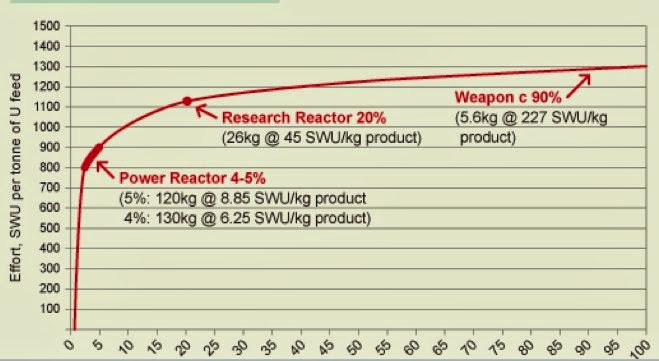
By virtue of having functional uranium enrichment facilities and technical expertise to spin centrifuges, Iran – like any other nation with that technology – can create weapons-grade material if it decided to. But this doesn’t mean it can already “build a nuclear bomb.”
Moreover, Tehran Bureau‘s paraphrased quote from Khatami is itself misleading. The source of the quote can be found here, although Tehran Bureau does not provide a link over to it, a highly unprofessional reporting practice.
Mohammad Ali Shabani, a doctoral researcher at the University of London’s School of Oriental and African Studies (SOAS), notes that the focus of Khatami’s speech before the IRGC gathering was not the nuclear issue, but rather Iran’s Kurdistan province and Syria. While Khatami is by no means an expert on nuclear technology, when he did touch briefly on the subject, this is what he said, according to Shabani’s translation:
[But] even if we could build a bomb, we would not do such a thing as our Guardian Jurist [Ayatollah Khamenei] deems use [of such weapons] impermissible (haraam). The West’s concerns are not about a bomb, but Iran’s capabilities; just as our nuclear scientists enriched uranium from 5% to 20%, undoubtedly they can [do so] to 40%, 50% and finally 90%, which is needed in order to build a bomb, and they [Iran’s scientists] posses this knowledge. Our role model is our Dear Prophet, who even forbade the poisoning of an enemy city, and this is our evidence [basis] for not building a bomb.
This is a political statement, not a technical declaration. Nowhere does Khatami state that Iran can build a nuclear weapon. Tehran Bureau‘s reporting also omits the fact that such statements about such scientific capabilities and the nation’s official, absolute prohibition on nuclear weapons are nothing new for Iranian officials.
For instance, in February 2010, then-Iranian president Mahmoud Ahmadinejad announced that “right now in Natanz, we have the capacity to enrich uranium at high levels.” He added, “We have the capability to enrich uranium more than 20 percent or 80 percent but we don’t enrich (to this level) because we don’t need it.”
A couple years later, in April 2012, The Guardian itself reported on a nearly identical statement made by Gholamreza Mesbahi Moghadam, a minister of the Iranian parliament. The framing in both that piece and the latest report are very similar:
Iran has the technological capability to produce nuclear weapons but will never do so, a prominent politician in the Islamic republic has said.
The statement by Gholamreza Mesbahi Moghadam is the first time an Iranian politician has publicly stated that the country has the knowledge and skills to produce a nuclear weapon.
Moghadam, whose views do not represent the government’s policy, said Iran could easily create the highly enriched uranium that is used to build atomic bombs, but it was not Tehran’s policy to go down that route.
Moghadam told the parliament’s news website, icana.ir: “Iran has the scientific and technological capability to produce [a] nuclear weapon, but will never choose this path.”
The 2012 Guardian report sparked false conclusions and predictable reactions from Israeli officials, who eagerly exploited the non-news for political posturing. The following year, a number of different reports published by The Guardian contained bad analysis, dubious allegations and sloppy journalism.
Unfortunately, The Guardian, now in partnership with Tehran Bureau, is at it again.
MTV Glorifies Venezuela’s Barricade Protests in New Reality TV Show
By Z.C. Dutka | Venezuelanalysis | December 18, 2014
Santa Elena de Uairen – US entertainment channel MTV has signed a contract with a Venezuelan media group to purchase extensive footage of the violent anti-government protests that wracked the South American nation earlier this year, to be featured in the new reality series Rebel Music.
The footage, captured by citizen reporters with GoPro cameras, show masked and shirtless men throwing handmade grenades and wreaking general havoc in a coordinated effort to force president Nicolas Maduro’s resignation that lasted from February to May this year.
43 people were killed during that time, the majority while trying to clear rubbish from or cross the barricades set up by demonstrators. Numerous public institutions including hospitals, universities, and transportation agencies were also burnt down in protest.
Reporte Confidencial became known for editing the GroPro material nightly, adding in a pumping dubstep track befitting a London club scene, and posting the finished videos to YouTube, where they received thousands of views from around the world.
It is this material MTV now seeks to own.
The reality show Rebel Music claims to be inspired by young people who “are raising their voices to demand change for a better future…. often putting their lives on the line,” according to the show’s website.
With this premise, many Venezuelans fear the show’s narrative will grant hero status to those hardcore protestors – whose tactics were so violent they effectively drove away a majority of opposition supporters, according to polls.
Furthermore, as the White House approves sanctions against Venezuelan government officials, others accuse the MTV program of dovetailing too neatly with US foreign policy. […]
The series, which first aired last month, will also feature voices of dissent in Myanmar, Iran, Senegal, Turkey and US Native American communities.
The US media has made no effort to hide its contempt of Venezuela’s socialist government since the Hugo Chavez’s election in 1999, while Chavez, in turn, repeatedly accused Washington of funding subversive movements to remove him from office.
Shepard Fairey and USAID
Venezuelan political analyst Luigino Bracci pointed out the paradoxical use of red stars and other archetypal communist symbols in an op-ed for Caracas newspaper Alba Ciudad last week, which he attributes to the show’s executive producer, Shepard Fairey.
Fairey is the pop art empresario behind the OBEY campaign and the red and blue stencil portrait of Barack Obama, which featured the word HOPE and was used universally throughout the US president’s initial campaign.
Though he calls himself apolitical, Fairey has been criticized for reproducing communist Cuban and Korean poster art with slight twists and selling them as his own. In a 2008 interview with the magazine Mother Jones, reporter Liam O’Donoghue also called the artist out on appropriating images from social movements, usually created by artists of color, and stripping them of their political messages.
In a promotional video, Rebel Music features Venezuelan reggae artist OneChot whose 2010 video for the English-language single “Rotten Town” generated controversy for its depiction of Caracas as an Inferno of crime and murder, replete with images of dead and dying children.
Though the reggae singer also claims to abstain from politics, his music is more popular with Venezuela’s privileged class, the same sector that widely supports the opposition.
“You are not free of violence anywhere. That is why I fight for change in Venezuela,” OneChot says to the MTV cameras.
While many Caracas artists would be eager for such international exposure, some mistrust the pre-determined script many reality shows are known to possess, believing it may spell out further US defamation of Venezuela’s socialist leaders.
After being approached by MTV correspondents to represent the pro-Chavez version of events, underground hip hop artist Arena La Rosa announced her refusal on her Facebook page.
“My dignity and my ideas are worth more than a million [page] views, so I have wisely decided not to participate,” the chavista rapper said.
On the same day La Rosa posted her response, the Associated Press released documents detailing the US government’s failed attempt at infiltrating the Cuban hip hop scene, by way of the developmental organization USAID.
According to the AP, Washington had sought to build a network of young people seeking “social change” to spark a resistance movement against the government of Cuban president Raul Castro.
Incidentally, Maduro has accused numerous opposition leaders of attempting the same kind of subterfuge during February’s unrest. A committee of victims and their families has even assembled to seek justice from those public figures who they believe encouraged such extreme tactics.
Meanwhile, Venezuela will have to wait for the MTV segment to be released to understand how their high-stakes reality will be adapted to meet the lofty demands of broadcast entertainment.
Washington Fines German Bank for its Dealings With Cuba
Prensa Latina | December 16, 2014
Berlin – The second largest German financial institution, Commerzbank AG, was fined by the US government for a billion dollars for conducting business with Cuba.
The Financial Times said this Tuesday that the German company is headquartered in Frankfurt and is the second largest in the country after the Deutsche Bank, which is listed as the fifth most powerful bank in the world.
Commerzbank AG is obliged to disburse a penalty of one billion dollars, according to US provisions establishing penalties for bank agents having made transactions linked to Cuba through US branches.
According to the Financial Times, the German institution agreed last September to pay 650 million dollars after being accused of conducting financial transactions with Cuba, Iran, Sudan and other countries sanctioned by the United States.
The report adds that Washington launched a full-scale investigation against European banks, potential violators of the sanctions regime.
Some of the European banks investigated by the United States are the German Deutsche Bank, the French Crédit Agricole and Société Générale of France, and the Italian UniCredit SpA.
The New York Times published on July 9 that the Treasury Department fined Commerzbank more than 500 million dollars for making transfers through its subsidiaries toward Cuba, Democratic People’s Republic of Korea, Myanmar, Iran and Sudan.
Havana constantly denounces United States’ extraterritorial sanctions against it, with economic entities from almost all over the world joining the Cuban protest.
Iran Nuclear Talks à la Israeli-Palestinian Negotiations
By ISMAEL HOSSEIN-ZADEH | CounterPunch | December 16, 2014
Soon after the Iran nuclear talks were recently extended for another seven months (beyond the November 22, 2014 deadline), President Rouhani spoke with the Iranian people in a televised address in which he sought to portray the inconclusive negotiations as a diplomatic victory for Iran, as an indication that his team of negotiators “stood their ground” in the face of excessive demands by the US and its allies.
In reality, however, the extension meant the failure of the Iranian negotiators to achieve anything of substance (in terms of sanctions relief) in exchange for the significant unilateral concessions they had made a year earlier. To put it differently, it meant that the US and its allies refused to honor what they had promised Iran in return for its suspension and/or downgrading of its nuclear technology.
A year earlier, that is, in the first round of negotiations on 24 November 2013, Iran had agreed to the following significant concessions: limit its enrichment of uranium from the level of 20 percent to below 5 percent purity, render unusable its existing stockpile of 20 percent fuel for further enrichment, not activate its heavy-water reactor in Arak, not use its more advanced IR-M2 centrifuges for enrichment, and consent to extensive IAEA inspections of its nuclear industry/facilities.
This obviously means that Iranian negotiators had agreed to more than freezing Iran’s nuclear technology; more importantly, they had reversed and rolled back significant scientific achievements and technological breakthroughs of recent years.
In return, the US and its allies had agreed that following the “confidence building” implementation of these commitments by Iran, economic sanctions against that country would be lifted.
A year later, and despite the fact that IAEA has consistently confirmed Iran’s compliance with these commitments, major sanctions continue unabated. At a press conference on November 22, 2014, US Secretary of State John Kerry boasted that undiminished sanctions have forced Iran to either reverse or freeze much of its nuclear program. “Today,” Kerry stated, “Iran has no 20 percent enriched uranium. Zero. None. They have diluted and converted every ounce that they have… Today, IAEA inspectors have daily access to Iran’s enrichment activities and a far deeper understanding of Iran’s program.”
Instead of honoring what they had promised during the initial negotiations of year ago, the US and its allies now argue that Iran needs to make more concessions, and that therefore more time is needed for further negotiations—hence the seven-month extension of negotiations, to July 1, 2015.
And what are the new demands that are made of Iran? The new requirements, which the Iranian negotiators have now additionally agreed to, include the following:
* Expanded snap Inspections of Iran’s Centrifuge Production Facilities: under the seven-month extended negotiations, the IAEA will double its unannounced, snap inspections of Iran’s centrifuge production facilities.
* Conversion of more 20% Uranium Oxide to Reactor Fuel: Iran will convert 35 additional kg of its remaining 75 kg of 20% enriched uranium powder from oxide form into reactor fuel for the Tehran Research Reactor, thereby helping prevent the reversibility of a key concession Iran has made.
* Further Limitations on Research and Development (R&D) of Advanced Centrifuges and Enrichment Technology. The most important of these new limits are:
* Iran cannot pursue semi-industrial-scale operation of the IR-2M, a necessary prerequisite toward mass production of the model.
* Iran cannot feed IR-5 model centrifuges with uranium gas.
* Iran cannot pursue gas testing of the IR-6 centrifuge on a cascade level.
* Iran cannot install the IR-8 centrifuge at the Natanz Pilot Plant, preventing it from being tested with uranium gas.
* Iran is prohibited from using other/new forms of enrichment, including laser enrichment [source].
And what would Iran gain in return for these significant additional/new concessions? Not much. Under the extended interim agreement, as in the two previous interim agreements, dating back to November 2013, Iran will be permitted to repatriate only $700 million per month of its nearly $100 billion assets that are frozen overseas under the sanctions regime.
This explains why many critics have pointed out that Iranian negotiators have, once again, made significant one-sided concessions without much reciprocity in the way of sanctions relief. It also explains why President Rouhani’s (and his negotiating team’s) portrayal of the extension of negotiation as a diplomatic victory for Iran is far from warranted—it is, indeed, tantamount to self-deception, or more precisely, deception of the Iranian people.
Off-the-record briefings in Washington indicate that the US is projecting a long period of 15 to 20 years of protracted negotiations before restrictions on Iran’s civilian nuclear program are fully lifted. In light of the fact that the US and its allies have already achieved their goal of downgrading and freezing Iran’s nuclear program, while retaining crippling sanctions on that country, their policy of prolonging negotiations—as a tactic to avoid honoring what they have promised Iran—is understandable. As Keith Jones, a keen observer of the Iran nuclear talks, points out:
“Washington is determined to continue to subject Iran to crippling economic sanctions, with relief doled out incrementally and over a period of years. Moreover, during a lengthy initial period, the Western powers want only piecemeal suspension of the sanctions, not their repeal, so that they can be quickly reinstituted should they determine that Tehran has failed to fulfill its commitments” [source].
This means that President Rouhani’s (and Foreign Minister Javad Zarif’s) wishful thinking that a combination of generous concessions and a diplomatic charm offensive would suffice to have the US lift the economic sanctions against Iran has, effectively, placed his negotiators on a slippery slope, with no end to ever newer demands and additional conditions required of them by the US and its allies.
The perils of prolonged negotiations—increasingly resembling the Israeli-Palestinian negotiations—go beyond downgrading and/or freezing Iran’s nuclear technology. Equally devastating are the crippling effects of the continued sanctions on the Iranian economy/society.
Detrimental effects of sanctions on the Iranian economy have been further exacerbated by the Rouhani administration’s misguided policy of having tied the fate of Iran’s economy to the outcome of nuclear negotiations—effectively, making the future of the economy hostage to the unreliable and unpredictable consequences of the nuclear talks. This policy stems from the administration’s neoliberal economic outlook that seeks solutions to economic stagnation, poverty and under-development in unreserved integration into world capitalist system. The policy tends to hurt Iran in two major ways.
First, by tying the chances of economic recovery in Iran to the removal of the sanctions, that is, to the “successful” conclusion of the nuclear talks, the policy has undermined Iran’s bargaining position in the negotiations. Indeed, it can reasonably be argued that President Rouhani condemned Iran to a losing nuclear negotiation long before he was elected. He did so during his presidential campaign by pinning his chances for election on economic recovery through a nuclear deal. This was a huge mistake, as it automatically weakened Iran’s bargaining position and, by the same token, strengthened that of the United States and its allies. By exaggerating the culpability of his predecessor in the escalation of economic sanctions against Iran, he committed two blunders: (a) downplaying the culpability of the US and its allies, and (b) placing the onus of reaching a nuclear deal largely on Iran.
Second, the policy of linking the chances of an economic recovery to the outcome of nuclear negotiations and/or the lifting of sanctions has created an ominous atmosphere of business/market uncertainty among the Iranian investors and entrepreneurs. Uncertainty is perhaps the worst enemy of a market economy, which explains why long-term, productive investment is drying up in Iran, or why economic stagnation has deteriorated since President Rouhani took office in early 2013.
Iran could minimize the baleful effects of sanctions by trying to delink its economic policies from nuclear negotiations and the threat of further sanctions. This would be possible if the Rouhani administration’s economic outlook somehow tilted away from outward-looking to inward-looking strategies of economic development; that is, the development of a “resistance economy,” as Iran’s Supreme leader, Ayatollah Khamenei has put it. This requires an economic strategy that would view the sanctions as an opportunity to mobilize national resources and chart an industialization course toward import-substitution and economic self-reliance—something akin to a war economy, since Iran has effectively been subjected to a brutal economic war by the United States and its allies.
Such a path of development would be similar to the eight years (1980-88) of war with Iraq, when at the instigation and support of regional and global powers Saddam Hussein launched a surprise military attack against Iran. Not only did the Western powers and their allies in the region support the Iraqi dictator militarily but they also subjected Iran to severe economic sanctions. With its back against the wall, so to speak, Iran embarked on a revolutionary path of a war economy that successfully provided both for the war mobilization to defend its territorial integrity and for respectable living conditions of its population.
By taking control of the commanding heights of the national economy, and effectively utilizing the revolutionary energy and dedication of their people, Iranian policy makers further succeeded in bringing about significant economic developments. These included: extensive electrification of the countryside, expansion of transportation networks, construction of tens of thousands of schools and medical clinics all across the country, provision of foodstuffs and other basic needs for the indigent at affordable prices, and more.
Alas, despite its record of success, this option seems to be altogether alien to President Rouhani and his team of economic advisors who, following the neoliberal/neoclassical school of economic thought, maintain that the solution to Iran’s economic problems lies in an unrestrained integration into world capitalism, in a wholesale (and often fraudulent) privatization of the economy, and in an IMF-style of economic austerity.
Ismael Hossein-zadeh is Professor Emeritus of Economics (Drake University). He is the author of Beyond Mainstream Explanations of the Financial Crisis (Routledge 2014), The Political Economy of U.S. Militarism (Palgrave–Macmillan 2007), and the Soviet Non-capitalist Development: The Case of Nasser’s Egypt (Praeger Publishers 1989).
Featured Video
Yemen joins the war – Red Sea could be blocked next – Saudi regime at risk
or go to
Aletho News Archives – Video-Images
From the Archives
Should Europeans ‘Thank’ the Americans for Destroying Nord Stream?
By Robert Bridge | Strategic Culture Foundation | September 29, 2022
With an investigation continuing into the destruction of the Nord Stream gas pipeline that provided energy supplies to Europe from Russia, there appears to be just one prime suspect, and that should surprise nobody.
Following the sabotage of the Nord Stream 1 and 2 gas pipelines, former Polish Foreign Minister Radoslaw Sikorski already seemed to know the identity of the perpetrator when he tweeted out: “Thank you, USA.”
At first glance, it seemed that Sikorski was speaking sarcastically, berating Washington for carrying out an attack that will have severe repercussions for the people of Europe. After all, how could anyone see any good coming from the termination of Europe’s primary source of gas reserves with winter just around the corner? It was Sikorski’s homeland of Poland, after all, that urged its citizens to collect firewood in the face of dwindling gas reserves.
In fact, the Polish diplomat was speaking one-hundred percent literally… continue
Blog Roll
 Aletho News
- Growing insecurity, soaring prices fuel protests in north as regime bans evacuation: Sources
- Iran denies responsibility for ‘depraved’ attack on Kuwait desalination plant
- Bring The Troops Back. End This War Now!
- Can we please stop calling Israel the ‘only democracy in the Middle East’ now?
- US should start removing its troops for Germany, proposes AfD co-leader Chrupalla
- Iran Red Crescent: 600 educational centers attacked in US-Israeli ‘war crimes’
- Russian Oil Tanker Arrives in Cuba Amid U.S. Blockade
- America Racing to Strategic Defeat in Iran: Lt Col Daniel Davis
- FTC Warns Visa, Mastercard, PayPal, Stripe Over Political Debanking
- Russian tanker approaches Cuba despite US oil blockade
- If Americans Knew
- Israeli police block Catholic cardinal from entering Church of the Holy Sepulchre on Palm Sunday
- Israel is assassinating journalists again, more than any other nation, anywhere, ever – Not a ceasefire Day 170
- Over 300 US service members wounded, majority have brain injuries – Not a ceasefire Day 169
- Researchers at Human Rights Watch Resign Over Blocked Report on Palestinian Refugee Return
- Jewish Groups Are Backing a War Americans Don’t Want
- Eric Fingerhut Thinks He’s the President of the Jews
- Top Jewish Philanthropists, Rabbis Urge Israeli President to Take Action Against ‘Jewish Extremists’
- Don’t Be Fooled. Zionist Leaders Have Always Wanted to Control Southern Lebanon
- Israel’s widespread use of torture is a core element of its genocide against the Palestinian people
- In Israel’s War on Iran, Many Middle East US Bases Rendered “All But Uninhabitable”
- No Tricks Zone
- New Study Finds Warming Saves Lives…Cold Temperatures 12 Times More Deadly Than Excess Heat
- German Science Blog Accuses PIK Climate Institute Of Hallucinating Climate Tipping Points
- Devastating Assessment Of Comirnaty Vaccine By Former Senior Pfizer Europe Toxicologist
- New Study: CO2 Is ‘Effectively Negligible’ As An Explanatory Climate Change Factor Since 2000
- Former Pfizer Toxicologist Dr. Helmut Sterz Tells Bundestag Hearing Pfizer Vaccine Should Have Never Been Approved
- Energy Expert: Germany’s Nuclear Phaseout Was A “500 Billion Euro Mistake”
- New Research: South Australia’s Mid-Holocene Sea Surface Temperatures Were 4°C Warmer Than Today
- Storing Green Energy To Last Germany 10 Days Would Require A 60-Million Tonne Battery
- New Studies: UK Sea Levels Were 4 Meters Higher Than Today During The Mid-Holocene
- Destructive Green New Deal: German Energy And Metal Group Warns Of Drastic Crisis
 Aletho News