Israel’s Prime Minister Benjamin Netanyahu has called for the escalation of international pressure against Iran over the country’s nuclear energy program.
“As long as we don’t see actions instead of words, the international pressure should continue, and even more than that, it should be strengthened,” Netanyahu said on Sunday.
The remarks were Netanyahu’s first comments after the four-day expert-level nuclear talks between the representatives of Iran and six world powers in Vienna last week.
On Thursday, the US Treasury Department announced new sanctions against a number of companies and individuals for “providing support for” Iran’s nuclear energy program.
On Sunday, Iranian Foreign Minister Mohammad Javad Zarif slammed the US action as “unconstructive and inappropriate” and reaffirmed Iran’s resolve to respond prudently to such measures, while seriously pursuing the nuclear negotiations with the six countries.
The new US sanctions came despite the nuclear deal inked between Iran and the five permanent members of the UN Security Council – Russia, China, France, Britain and the US – plus Germany in the Swiss city of Geneva on November 24.
Following the conclusion of the interim agreement, Netanyahu described the nuclear deal as a “historic mistake.”
Israel, known as the sole possessor of nuclear weapons in the Middle East, has repeatedly accused Iran of pursing non-civilian objectives in its nuclear energy program and threatened to take unilateral military action against the country.
The administration of President Barack Obama has told lawmakers in US Congress that they could pass new sanctions against Iran as far as they are not “nuclear-related.”
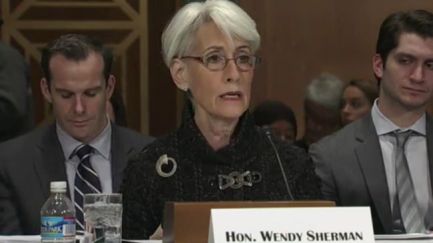
During a public testimony before the Senate Banking Committee on Thursday, State Department official Wendy Sherman, who led the US delegation in nuclear talks with Iran in Geneva, indicated that US lawmakers had the green light from the Obama administration to pass new anti-Iran sanctions as long as the sanctions are not “nuclear-related.”
“Given that there are different kinds of sanctions and the agreement focuses on nuclear-related sanctions,” Sen. Mike Crapo, the top Republican on the Committee, asked Sherman, “assuming we can specify exactly what that is and distinguish between the different sanctions, does that mean that Congress would be free to pass other sanctions measures while we are” negotiating over a final deal over Iran’s nuclear energy program?
“We have said to Iran that we will continue to enforce all of our existing sanctions, and we have said that this agreement pertains only to new nuclear-related sanctions,” Sherman answered.
In a phone interview with Press TV on Thursday, US Congress policy advisor Frederick Peterson said that the problem with some hawkish US lawmakers who are pushing for a new anti-Iran sanctions bill is exacerbated by the way the Obama administration is “misrepresenting” the interim deal between Iran and the P5+1 to the American people and Congress.
Meanwhile, the US Departments of Treasury and State announced new sanctions against a number of companies and individuals for “providing support for” Iran’s nuclear energy program.
Treasury Department official David Cohen, who also testified before the Senate Banking Committee on Thursday, said the new sanctions were “a stark reminder to businesses, banks, and brokers everywhere that we will continue relentlessly to enforce our sanctions.”
Iranian Deputy Foreign Minister Abbas Araqchi has hit out at Washington, saying that the new restrictions are in full contradiction with the recent nuclear deal between Tehran and the P5+1. Araqchi also said that Tehran is now assessing the current situation.
Iran’s Deputy Foreign Minister Abbas Araqchi slams the new US sanctions targeting Iran, saying the bans run counter to the spirit of the recent nuclear deal reached between Tehran and six major world powers.
“This [US] move is against the spirit of the Geneva deal,” Araqchi said on Friday.
“We are assessing the current situation,” the senior member of Iran’s nuclear negotiating team added.
On Thursday, the administration of US President Barack Obama issued new sanctions against more than a dozen companies and individuals for “providing support for” Iran’s nuclear energy program.
The US Treasury Department said it was freezing assets and banning transactions of entities that attempt to evade the sanctions against Iran.
The sanctions came despite the nuclear deal inked between Iran and the five permanent members of the UN Security Council – Russia, China, France, Britain and the US – plus Germany in the Swiss city of Geneva on November 24 in a bid to set the stage for the full resolution of the West’s decade-old dispute with Iran over the country’s nuclear energy program.
Under the Geneva deal, the six countries have undertaken to lift some of the existing sanctions against the Islamic Republic in exchange for Iran agreeing to limit certain aspects of its nuclear activities during six months. It was also agreed that no more sanctions would be imposed on Iran in the same time frame.
Iran and the six powers ended four days of intense expert-level negotiations in Vienna, Austria, on Thursday.
Iranian Foreign Minister Mohammad Javad Zarif had earlier warned that the Geneva nuclear deal will be “dead” if the US imposes further sanctions against the Islamic Republic.
“The entire deal is dead. We do not like to negotiate under duress. And if Congress adopts sanctions, it shows lack of seriousness and lack of a desire to achieve a resolution on the part of the United States,” Zarif said in an exclusive interview with Time magazine in Tehran on Saturday.
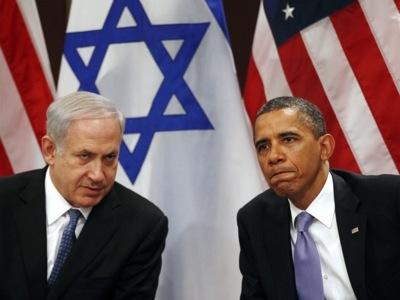
It’s kind of one of those pictures that are “worth a thousand words,” don’t you think? What you’re looking at is Obama onstage with media mogul and Israeli dual national Haim Saban, who has stated previously, “I’m a one issue guy, and my issue is Israel.” The photo was taken last weekend at the Saban Forum, held in Washington. During the event Saban and Obama appeared together for what was billed as a “conversation” on the Middle East, but basically it was a one-on-one press conference—with Saban doing the grilling and Obama doing the answering. Do the facial expressions in the photo, the body language, suggest anything to you—like for instance which of the two figures is dominant and which is submissive?
Saban, of course, has lots of money. In 2002 he provided a $13 million grant which established the Saban Center for Middle East Policy, and which is part of the larger Brookings Institution think tank. Today he is a major funder of political candidates, particularly of the Democratic Party. You can go here and watch a 48-minute video of his “conversation” with Obama, which includes a few questions from the audience towards the end (all of the people selected to ask questions in that closing segment, coincidentally, happen to be Israelis). At one point, Saban jokingly remarks upon how “obedient” Obama is. A little later in the video, Obama states the following:
“The one thing I will say to the people of Israel is that you can be assured, whoever is in the office I currently occupy, Democrat or Republican, that your security will be uppermost on our minds. That will not change.”
Does it not strike you as a curious comment? Why would the security of a foreign nation be “uppermost” in the minds of the leaders of a supposedly sovereign country? But then maybe America is no longer a sovereign nation.
Obama indeed proves his “obedience” by never once bringing up Israel’s nuclear weapons. Much of the conversation is dominated by talk about Iran’s domestic nuclear energy program. The president at one point repeats the standard, stock-in-trade “options-on-the-table” remark—which in essence is nothing more than a threat to attack Iran—yet nowhere, in the entire 48-minute video, does the subject of Israel’s nuclear weapons come up.
A report on the Saban Forum was posted recently at the Mondoweiss blog. While the article mentions the “conversation” between Obama and Saban, much of the piece is devoted to the remarks of John Kerry, who delivered the keynote address for the event. Allison Deger, the author of the report, notes that Kerry expressed the view that Palestinians in the West Bank are deserving of “state institutions” (as opposed to an actual state) of their own, a comment which seems to have prompted Deger to draw the conclusion that “Palestinian statehood is not on the table in the current round of peace talks.” It is a not unreasonable conclusion to draw.
Kerry also referred to Palestinians as a “demographic time bomb” threatening to jeopardize Israel’s “future as a democratic, Jewish state”—apparently the secretary of state’s first public expression of concern over the so-called “demographic threat.” But perhaps most interesting is what Deger reports on comments by Israeli Foreign Minister Avigdor Lieberman, who also attended the event:
Even though Lieberman was amongst a crowd of Washington and Israeli officials familiar with his anti-Arab diatribes, audible gasps could be heard throughout the room when he called to expel Palestinian citizens of Israel. A diplomat from the Russian embassy seated next to me even choked. Another moment of discontent between the plated-dinner audience and Lieberman passed when the foreign minister made a forlorn pun at Sen. Joe Lieberman. Otherwise the foreign minister was amongst allies.
Much has been made of the recent bone of contention between Obama and Netanyahu over the negotiations with Iran, with some suggesting that the US president is beginning to assert himself and to defy the Israeli lobby on some key, important issues. Is it simply wishful thinking on the part of some commentators? I don’t pretend to know the answer to that, but if there was any note of defiance struck at last weekend’s Saban Forum, all I can say is it is extremely difficult to detect.
*
Update-12/11/13: The following information on Saban comes from Wikipedia:
In March 2008, Saban was among a group of major Jewish donors to sign a letter to Democratic Party house leader Nancy Pelosi warning her to “keep out of the Democratic presidential primaries.” The donors, who “were strong supporters of Sen. Hillary Rodham Clinton presidential campaign”, “were incensed by a March 16 interview in which Pelosi said that party ‘superdelegates’ should heed the will of the majority in selecting a candidate.” The letter to Pelosi stated the donors “have been strong supporters of the DCCC” [Democratic Congressional Campaign Committee] and implied, according to The Jewish Telegraphic Agency, that Pelosi could lose their financial support in important upcoming congressional elections.
And also this:
Regarding Jane Harman AIPAC Controversy, in April 2009, New York Times, quoting anonymous sources, said a caller promised her that Saban would withhold campaign contributions to Representative Nancy Pelosi if she did not select Ms. Harman for the intelligence post.”
And additionally this:
Saban says his greatest concern is to protect Israel. At a conference in Israel, Saban described his formula. His three ways to influence American politics were: make donations to political parties, establish think tanks, and control media outlets.
There is no remission to Washington’s belligerence towards Iran and no deal seems to be an antidote to this venom of spite secreted out on the part of the US officials on a daily basis.
In a tone not unfamiliar to Iranian ears, US Defense Secretary Chuck Hagel on board the USS Ponce, just 120 miles off the coast of Iran once again reminded the military men that the “threat of US military force still exists even though the Obama administration is pursuing a six-month long diplomatic process with Iran to freeze its nuclear program.”
There was some hope that the nuclear deal between Iran and the six world powers would considerably alleviate the tensions on Iran, relieve the inhumane sanctions against the Iranian population and offset future internal and external attempts directed at imposing more illegal sanctions against the Islamic Republic.
However, the sanctions are not only still in place but there is also a perceptibly powerful force at work in Washington to intensify the sanctions that have already taken human toll in Iran.
According to reports, the Democratic chairman of the Senate Foreign Relations Committee, Robert Menendez, and Republican Senator Mark Kirk are on the verge of “agreeing on legislation that would target Iran’s remaining oil exports, foreign exchange reserves and strategic industries.”
Widely considered the major engineers of the anti-Iran sanctions, these two senators are at the beck and call of the Zionists and their efforts are certainly aimed at gratifying their Iranophobic desires.
Quite naturally, Iran’s Foreign Minister Javad Zarif has warned Washington of imposing new sanctions as they would definitely kill the nuclear deal.
A top Republican Senate aide has told Reuters that the legislation is “an insurance policy to protect against Iranian deception.”
Time and again, Sen. Robert Menendez has proved to be cravenly submissive to Tel Aviv and has frequently warned Washington of the impending danger Iran poses towards the entity. For instance, in September, he recklessly said that Iran and Hezbollah “could possibly” strike Israel.
“The Iranians and Hezbollah… ultimately could possibly strike against neighbors in the region, including our ally, the state of Israel.”
Apart from playing an extremely effective role in imposing sanctions on Iran, he has resorted to any brute means to instill a sense of threat and phobia about Iran.
Also, in his AIPAC address, he clearly said that he would make every endeavor to safeguard the interests of Israel.
“The committee has helped every American president, from Harry Truman to Barack Obama, protect and defend our fundamental promise to stand with Israel and the Israeli people in a strong and lasting and enduring alliance. And as chairman, I can say without hesitation I will keep that promise as I always have. There will never be any daylight between the United States and Israel on my watch. Never. Not on my watch.”
Prominent among his numerous political hunger games are designing anti-Iran sanctions after sanctions under the aegis of Tel Aviv, authorizing the US President the use of military force in Afghanistan and his refusal to vote against the Iraq Resolution, which terminated in an invasion of Iraq.
In this diabolical league comes in Sen. Mark Kirk, who tries in a similar way to disseminate fear of Iran in the world. During an invitation-only phone briefing for supporters, Kirk said, “It’s the reason why I ran for the Senate, [it] is all wrapped up in this battle. I am totally dedicated to the survival of the state of Israel in the 21st century. This has been very much a one-senator show, unfortunately.”
After all, Sen. Mark Kirk is a darling of the Zionists. In 2002, when he was still home recovering from a stroke that incapacitated him from making an appearance at AIPAC, Israeli Prime Minister Benjamin Netanyahu voiced his “sincere request” during his keynote and said, “I want to send a special message to a great friend of Israel who is not here tonight: Senator Mark Kirk, the co-author of the Kirk-Menendez Iran Sanctions Act. Senator Kirk, I know you’re watching this tonight. Please get well soon. America needs you; Israel needs you. I send you wishes for a speedy recovery. So get well and get back to work.”
Indeed it is not hard to imagine that these well-financed marionette-handlers in Washington are playing in the hands of Tel Aviv to advance their ultimate goals regarding Iran, which is clearly regime change. As time passes and realities come to surface, one acquires conviction that the rift that keeps deepening more and more between Iran and the West has nothing to do with a West concerned about Iran’s intention in trying to build a nuclear bomb; rather, it is an ulterior motive long cherished and shaped by the West and the Zionists: uprooting a tree of truth.
The confrontational attitude of these senators against Iran and the unfortunate and powerful sway they exercise on the powers-that-be in America leave no room for optimism in restructuring a politically correct attitude on the part of Washington towards Iran.
Be that as it may, global awakening is on the horizon. Manipulation of public opinion has run its course. Distorting the realities on the ground is a threadbare ploy. It is now generally acknowledged that the West’s narrative on Iran’s intention to produce nuclear weapons is but a thumping big lie and a fairy tale forcefully woven into the warps and wefts of public opinion. Indeed, it is, in Shakespeare’s words, “a tale told by an idiot full of sound and fury signifying nothing.”
US Congress has threatened giant oil companies with “severe financial penalties” should they resume business with Iran following an interim nuclear agreement.
In interviews with Foreign Policy Magazine, several American officials expressed concerns about the international firms’ interest to enter the Iranian oil market in the next six months.
Chairman of the House Homeland Security Committee Rep. Michael McCaul said that companies examining their options for “resuming business relationships” with Iran are “acting prematurely at best.”
Hawkish anti-Iran Senator Mark Kirk also warned foreign firms that they “must be on notice that sanctions are coming back stronger than ever” if the nuclear deal does not lead to a comprehensive resolution.
“It is far too premature for any international energy company to contemplate re-entering the Iranian market,” said a spokesman for Rep. Eliot Engel, the top Democrat on the House Foreign Affairs Committee.
The warning came after Royal Dutch Shell, Italian company Eni, and Austrian oil and gas company OMV said they were looking for the possibility of renewing their operations in Iran.
Under the six-month accord reached in Geneva last month, Tehran has agreed to limit some aspects of its nuclear energy program in exchange for the easing of economic sanctions against the country. However, oil sanctions are still in place.
Earlier this week, some international oil companies began talks with Iranian counterparts on the sidelines of an OPEC meeting in Vienna in order to restart their cooperation.
Eni Chief Executive Paolo Scaroni confirmed the negotiations, saying the two sides “discussed specific projects that we had been looking at for many years before sanctions were imposed.”
“We plan to continue to be in Iran and possibly increase our activity as long as the sanctions regime is lifted,” Scaroni said. “There are so many opportunities in Iran both in oil and gas that we will certainly find a common area of interest.”
Former US State Department official Suzanne Maloney said the process is not surprising.
“It’s not surprising that we’re seeing this from the companies that have some experience in Iran like Eni and Total,” she said.
US Secretary of State John Kerry says Washington will continue to consult with Tel Aviv about the final nuclear agreement with Iran.
“While we may sometimes favor different tactical choices, the United States and Israel have always shared the same fundamental goal,” Kerry said during a speech at the Brookings Institution’s 10th anniversary Saban Forum on Saturday.
“As we move forward in this negotiation, we will continue to consult very closely with Israel, as with our other friends and allies in the region and around the world whose input is critical to us in the process,” he added.
The top US diplomat once again tried to reassure Israeli Prime Minister Benjamin Netanyahu that the interim nuclear deal that reached between Iran and the six world powers in Geneva last month was beneficial to Israel.
“Let me repeat that. Israel will be safer the day this begins to be implemented than it was the day before,” Kerry said.
“And I say that because with implementation, we will then sit down with our P5+1 united colleagues and partners, and sit down with Iran, for the comprehensive discussion that Prime Minister Netanyahu has always said he favors,” he said.
“We will do so, with all due respect, with one important advantage: we will have ensured that Iran’s program will not advance while we negotiate,” Kerry said.
He also pointed out that Netanyahu’s National Security Advisor Yossi Cohen will travel to the US for “direct conversations with our Iran experts that will help coordinate our positions going forward.”
Earlier at the forum, President Barack Obama reiterated that he was prepared to increase sanctions and even order a military strike if Tehran did not adhere to the terms of the Geneva accord.
“I will say that if we cannot get the kind of comprehensive end state that satisfies us and the world community and the P5+1, then the pressure that we’ve been applying on them and the options that I’ve made clear I can avail myself of, including a military option, is one that we would consider and prepare for,” the US president said.
The (interim) nuclear agreement that was signed on 24 November 2013 by Iran and the so-called P5+1 group in Geneva is questionable on a number of grounds.
The Irony and Absurdity of the Negotiations: When the Guilty Tries the Innocent
The underlying logic for the Iran nuclear negotiations was (and continues to be) altogether preposterous: on one side of the negotiating table sat major nuclear powers who are all in violation of the Nuclear Nonproliferation Treaty (NPT), which requires them to have either dismantled or drastically reduced their nuclear arsenal; on the other side, an NPT–compliant country (Iran) that neither possesses nor pursues nuclear weapons—a fact that is testified to both by the U.S. and Israeli intelligence agencies. Yet, in an ironically perverse way, the culprits have assumed the role of the police, the prosecutor and the judge, shamelessly persecuting and prosecuting the innocent for no other reason than trying to exercise its NPT-granted right to peaceful nuclear technology.
This obviously means that Iran is essentially negotiating under duress. Largely shut out of normal international trade, and constantly threatened by economic strangulation, it is essentially negotiating with a bullet to its head. As an astute observer of the negotiations has pointed out, “Iran voluntarily agreed to the [nuclear] deal the same way that a robbery victim voluntarily agrees to give up valuable possessions” to save his/her life.
The Imbalance between what Iran Gave and what it Took
To reach the interim deal, the Iranian negotiators agreed to a number of concessions with very little reciprocity in terms of relief from sanctions. These included: limiting its enrichment of uranium to only 3-5 percent purity, from the current level of 20 percent purity; rendering unusable its existing stockpile of 20 percent fuel for further enrichment; not using its more advanced IR-M2 centrifuges for enrichment; not activating its heavy-water reactor in Arak; and consenting to highly intrusive inspections.
This means that under the deal, the Iranian negotiators have agreed to more than freezing Iran’s nuclear technology; perhaps more importantly, they have reversed and rolled back significant scientific achievements and technological breakthroughs of recent years. One can imagine the feeling of disappointment (and perhaps betrayal) on the part of the many dedicated scientists, engineers and technicians who worked so hard to bring about such scientific advances; only to see them dishonored or degraded by reversing and freezing them at a much lower level.
In return for these significant concessions, the U.S. and its allies would agree: to unfreeze less-than 7 billion dollars of Iran’s nearly 100 billion dollars of oil revenue frozen in bank accounts overseas; to consider easing sanctions banning trade in precious metals, petrochemicals and auto industry; and to suspend the EU and U.S. sanctions on insurance and transportation services for the drastically reduced sale of Iran’s oil.
The most crippling sanctions on Iran’s oil and banks, which served as the financial facilitators of international trade, would remain intact under the proposed interim deal.
Threat to Iran’s Sovereignty
A careful reading of the interim agreement reveals that the Iranian negotiators gave up more than scaling down and freezing their country’s nuclear technology and/or knowledge. More importantly, if implemented, the deal effectively places Iran’s nuclear program (through IAEA) under total control of the United States and its allies. This is no speculation; it follows from the interim deal’s vastly invasive inspections regime, which is described under the subheading “Enhanced Monitoring”:
– Provision of specified information to the IAEA, including information on Iran’s plans for nuclear facilities, a description of each building on each nuclear site, a description of the scale of operations for each location engaged in specified nuclear activities, information on uranium mines and mills, and information on source material. This information would be provided within three months of the adoption of these measures.
– Steps to agree with the IAEA on conclusion of the Safeguards Approach for the reactor at Arak, designated by the IAEA as the IR-40.
– Daily IAEA inspector access when inspectors are not present for the purpose of Design Information Verification, Interim Inventory Verification, Physical Inventory Verification, and unannounced inspections, for the purpose of access to offline surveillance records, at Fordow and Natanz.
– IAEA inspector managed access to: centrifuge assembly workshops; centrifuge rotor production workshops and storage facilities; and, uranium mines and mills.
The fact that provisions of “enhanced monitoring” tend to infringe upon Iran’s national sovereignty was implicitly acknowledged by the Washington Post when it reported on the morning following the signing of the deal (24 November 2013) that, according to Western officials in Geneva, the Iranian concessions “not only halt Iran’s nuclear advances but also make it virtually impossible for Tehran” to make any changes in its nuclear technology “without being detected.”
Another indication of Iran’s national sovereignty being threatened is the interim deal’s establishment of “a financial channel to facilitate humanitarian trade for Iran’s domestic needs. . . . This channel could also enable: transactions required to pay Iran’s UN obligations; and, direct tuition payments to universities and colleges for Iranian students studying abroad.” Although the financial channel would be using Iran’s own money, currently frozen abroad, it would not be controlled or managed by Iranians—sadly reminiscent of Iraq’s “oil for food” neo-colonial deal under Saddam Hussein.
Did Iran Have to Give up so Much for so Little?
Deprived of more than half of its oil exports/revenue, and largely locked out of the international banking and/or trade system, the Iranian economy and its people are already gravely suffering from the ravages of economic sanctions. Additional sanctions, which are pre-packaged and frequently brandished as a Damocles’ Sword in the background of the nuclear negotiations, are bound to further depress Iran’s economy and the living conditions of its people.
Under these circumstances, Iran basically faced (or faces) two options. One option would be embarking on the path of a war economy, as it has, in effect, been subjected to a brutal economic war by the United States and its allies. This would be similar to the eight years (1980-88) of war with Iraq, when at the instigation and support of regional and global powers Saddam Hussein launched a surprise military attack against Iran. The other option would be compromising its legal and legitimate rights to peaceful nuclear technology in order to appease the global bully (the U.S.) and its minions in the hope that this may prevent a further tightening of the noose of economic sanctions around the neck of the Iranian people.
During the eight-year war with Saddam’s Iraq, not only did the Western powers and their allies in the region support the Iraqi dictator militarily but they also subjected Iran to severe economic sanctions. With its back against the wall, so to speak, Iran embarked on a revolutionary path of a war economy that successfully provided both for the war mobilization to defend its territorial integrity and for respectable living conditions of its population. By taking control of the commanding heights of the national economy, and effectively utilizing the revolutionary energy and dedication of their people, Iranian policy makers further succeeded in bringing about significant economic developments. These included: extensive electrification of the countryside, expansion of transportation networks, construction of tens of thousands of schools and medical clinics all across the country, provision of foodstuffs and other basic needs for the indigent at affordable prices, and more.
Despite its record of success, this option is altogether ruled out by today’s Iranian ruling powers. There are a number of reasons for this aversion to a regimented war economy. A detailed discussion of such reasons is beyond the purview of this essay. Suffice it to say that many of the revolutionary leaders who successfully managed the 1980-88 war economy have now become business entrepreneurs and prosperous capitalists. Having effectively enriched themselves in the shadow of the public sector economy, or by virtue of the political/bureaucratic positions they held (or still hold) in various stations in the government apparatus, these folks have by now lost all appetite they once had for the radical economic measures required by a war economy. Instead, they now seem eager to strike business and investment deals with their counterparts in the West.
More than any other social strata, President Rouhani and his administration represent the interests and aspirations of this ascending capitalist–business class in Iran. Representatives of this class wield economic and political power through the highly influential Iran Chamber of Commerce, Industries, Mines, and Agriculture (ICCIMA). Ideological and/or philosophical affinity between President Rouhani and the power-brokers residing within ICCIMA is reflected in the fact that, immediately upon his election, the president appointed former head of the Chamber of Commerce Mohammad Nahavandian, a U.S.-educated neoliberal economist and an advisor to former president Hashemi Rafsanjani, as his chief of staff.
It was through Nahavandian and the Iran Chamber of Commerce that, in September 2013, an Iranian economic delegation accompanied President Rouhani to the United Nations in New York to negotiate (behind the scenes) potential business/investment deals with their American counterparts. The Iran Chamber of Commerce also organized a number of economic delegations that accompanied Iran’s Foreign Minister Zarif to Geneva in pursuit of similar objectives in Europe.
It is understandable, therefore, why major factions within Iran’s ruling circles, especially the Rouhani administration and their allies and co-thinkers, have no stomach for a regimented, war-like economy; and why, instead, they opted for compromises over Iran’s nuclear program. The question remains, however, why did they make so many concessions in return for so little? Did they have to compromise as much as they did?
Two major reasons can be identified for why they could strike a better nuclear deal in Geneva than they actually did. For one thing, President Rouhani’s and his team of negotiators’ liaison with the P5+1 group got off on the wrong foot: they showed their hand prematurely by approaching the negotiations with a sense of desperation and an attitude of eagerness to reach a deal.
Indeed, it is fair to argue that President Rouhani condemned Iran to an unsound or flawed deal long before he was elected. He did so during his presidential campaign by pinning his chances for election on economic recovery through a nuclear deal. This was a huge mistake, as it automatically weakened Iran’s bargaining position and, by the same token, strengthened that of the United States and its allies. By exaggerating (perhaps opportunistically) the culpability of his predecessor in the escalation of economic sanctions against Iran, he committed two blunders: one downplaying the culpability of the U.S. and its allies; the other (and by the same token) placing the onus of reaching a nuclear deal largely on Iran.
Secondly, whereas the U.S. and its junior partners constantly brandished the so-called “stick” of additional sanctions in the background of the Geneva negotiations to extract more concessions from Iran, the Iranian side does not seem to have effectively used its country’s recent geopolitical successes in the region to resist the one-sided concessions. While the United States and its allies have in recent months experienced a major setback over the Syrian crisis, Iran and its allies (Russia, Syria, Hezbollah and, indirectly and minimally, China) have by the same token experienced success. And while the results of the U.S. military adventures of the past dozen years or so have been chaos and civil war in countries like Afghanistan, Libya, Yemen, Iraq, and Syria, Iran remains a relatively stable and an ascending regional power, indeed, a power-broker—sanctions-induced economic distress notwithstanding.
It is thus altogether reasonable to argue that had the Iranian negotiators (a) not gone to Geneva with such an openly eager attitude to reach a nuclear deal, and (b) taken more effective advantage of their country’s recent geopolitical successes in the region, they could have struck a better nuclear deal than they actually did. For example, while agreeing on the freezing of their nuclear technology was (under the circumstances) unavoidable, they could more strongly argue that there was no reason for them to roll back Iran’s scientific achievements from 20 percent enrichment of uranium to 5 percent—20 percent enrichment is both NPT-sanctioned, or legal, and required for the Tehran Research Reactor, which manufactures medical isotopes.
Likewise, while agreeing to more intrusive inspections of nuclear sites was (again, under the circumstances) inescapable, Iranian negotiators could reasonably resist allowing inspectors access to and monitoring of their country’s centrifuge assembly workshops, or its uranium mines and mills. Furthermore, the Iranian team could, again quite reasonably, insist on making the elements of the “final agreement,” which is supposed to remove all of the sanctions against Iran, more specific. As they now stand, these elements are so vague, fluid and inconsistent that they seem to be crafted in order to be broken.
Regime Change From Within
Ever since the 1979 revolution in Iran, which significantly undermined the U.S. influence in Iran and elsewhere in the region, the United States has been on a “regime change” mission in that country. Its efforts in pursuit of this nefarious goal are rather well established. They range from instigating and supporting Saddam Hussein to invade Iran, to training and supporting destabilizing terrorist organizations to attack Iran, to constant war and military threats, to efforts to sabotage the 2009 presidential election through the so-called “green revolution,” and to systematic escalation of economic sanctions.
Not only have these imperialistic schemes fallen short of their goal of “regime change” in Iran, they have, in fact, driven that country to become a major power in the region, which has further thwarted the geopolitical plans of the United States in the area. While the U.S.–supported mercenary forces in Syria as well as its allies in Ankara, Cairo and Riyadh have experienced serious setbacks in their efforts to overthrow the government in Damascus, the Iran-Russia-Syria-Hezbollah alliance has (by the same token) gained strength and prestige in recent months.
Having thus failed at its plots for “regime change” in Iran from without, the U.S. (or more precisely, a major faction of its ruling powers) now seems to have opted for regime change (or reform) from within; that is, through political and economic rapprochement with Iran. Even some of the U.S. allies such as Turkey, Qatar, Saudi Arabia, and Israel that have always been wary of Iran’s radical influence in the region, and who initially opposed vehemently the Iran–P5+1 nuclear agreement, are beginning to see the “moderating” or “stabilizing” benefits of the success of this tactic.
What has made this option more promising (to the U.S. and its client regimes) is the rise of an ambitious capitalist class in Iran whose chief priority seems to be the ability to do business with their counterparts in the West. These folks literally mean business, so to speak; for them, issues such as nuclear technology or national sovereignty are of secondary importance. As mentioned earlier, they are the staunchest supporters of President Rouhani and the unquestioning supporters of his lopsided concessions in the nuclear deal. Also as mentioned before, it was the representative delegations of this class of Iranian capitalists that accompanied President Rouhani and Foreign Minister Zarif to the United States and Europe in order to negotiate business/investment deals with their counterparts in the West.
To be sure, the jingoistic factions of the U.S. ruling circles, headed by the beneficiaries of war dividends and the Israeli lobby, continue to push for direct military intervention and/or further economic strangulation of Iran. But the leaders and/or beneficiaries of non-military industries such as oil, automobile, airlines, agriculture, and the like are lobbying the Obama administration for economic and political rapprochement with Iran.
Which of these two major factions of the U.S. ruling powers (Proponents of regime change from within or from without) would succeed, depends largely on the process and/or outcome of nuclear negotiations. While making threats of additional sanctions, the hardline or militaristic faction seem to be for now sitting on the fence: if Iran continues to make more one-sided concessions, which would basically mean giving up its right to a level of uranium enrichment that is necessary for its peaceful domestic needs, they would soften their positions and gradually lower their shrill and menacing voices. On the other hand, if Iran does not relent on its legal and legitimate enrichment rights, and insists that the U.S. and its allies need to reciprocate Iran’s interim concessions by lifting the sanctions, they would further harden their positions by calling for additional sanctions and/or military intervention. Under this latter scenario, proponents of rapprochement with Iran, having failed in their tactic of regime change/reform from within, would most probably join the hardliners, thereby embarking, once again, on the long-standing policy of regime change from without—back to square one, so to speak.
So, how would all of these new developments on both the Iranian and the U.S. side affect and/or be affected by the interim nuclear deal toward a “comprehensive final step”?
Problematic and Uncertain Future of the Interim Nuclear Deal
Components of the interim agreement are so vague, inconsistent and even contradictory that it makes them subject to divergent interpretations and, therefore, potential breaches of the deal in the future. This explains why soon after the agreement was signed conflicting understandings of it began to surface. While the Iranian president and his team of negotiators have frequently declared that the agreement acknowledges the country’s right to uranium enrichment, the U.S. side, headed by President Obama and Secretary of State John Kerry, has vigorously denied that right.
Equally vague and (potentially) problematic is the meaning of the “elements of the final step of a comprehensive solution.” According to Iran’s negotiators, the “final step” would “Comprehensively lift UN Security Council, multilateral and national nuclear-related sanctions,” as it is, indeed, stipulated as such in the interim agreement. However, the agreement immediately adds that the final step would “Involve a mutually defined enrichment program with mutually agreed parameters consistent with practical needs, with agreed limits on scope and level of enrichment activities, capacity, where it is carried out, and stocks of enriched uranium, for a period to be agreed upon.” And it is this ambiguous and condition-laden (“mutually defined enrichment…, mutually agreed parameters…, agreed limits on scope…, for a period to be agreed upon”) sentence in the interim deal that is frequently highlighted by the United States as governing the status of the “final step.”
This is an indication, as pointed out by Gareth Porter (among others), “of uncertain U.S. commitment to the ‘end state’ agreement.” U.S. reservations or unfaithfulness toward a clear, comprehensive and sanctions-free final deal, Gareth further points out, “came in a background press briefing by unidentified senior U.S. officials in Geneva via teleconference late Saturday night [23 November 2013]. The officials repeatedly . . . referred to the negotiation of the ‘comprehensive solution’ outlined in the deal . . . as an open-ended question rather than an objective of U.S. policy”. It is this ambiguous, unsure and noncommittal U.S. approach to the nuclear deal that serves as grounds for the pessimistic conclusion that the deal is facing an uncertain future.
Ismael Hossein-zadeh is Professor Emeritus of Economics, Drake University, Des Moines, Iowa. He is the author of The Political Economy of U.S. Militarism (Palgrave–Macmillan 2007) and the Soviet Non-capitalist Development: The Case of Nasser’s Egypt (Praeger Publishers 1989). His latest book, titled Beyond Mainstream Explanations of the Financial Crisis: Parasitic Finance Capital, is forthcoming from Routledge Books.
Can Europe be trusted? Certainly, this is an important question on the mind of many Iranians, in light of the surprise news that a precious few days after signing the Geneva agreement on November 24th, the European Union (EU) imposed new sanctions on Iran, by targeting 17 Iranian shipping companies, decried by Iran’s Foreign Ministry spokesperson as “illegal.”
Per the terms of the Geneva agreement, the “5 + 1” nations have agreed not to impose any new sanctions on Iran for the duration of this “interim agreement” that stipulates a six-months timeline for negotiating a final status agreement, subject to further extension by both sides’ consent.
It therefore comes as a shocking surprise to many people both inside and outside Iran that instead of moving to ease the sanctions, the most immediate European follow-up action has been the intensification of the Iran sanctions. There is no valid justification for this move, which clearly contradicts both the letter and the spirit of the Geneva agreement, reflecting instead a counter-productive and obstructionist tendency on the part of the European officials, who may be addicted to Iran-bashing and find it rather difficult to re-track themselves toward the unknown territory of “Iran detente.”
But, of course, the Geneva agreement is in Europe’s own interest, seeing how over the past 8 years the continent’s once thriving trade with Iran has languished, which can be resurrected as a result of good-faith diplomacy toward Iran in the weeks and months to come. Already, there are reports of various European auto and other companies embracing the positive development in Geneva and preparing themselves to re-engage with Iran, awaiting clear policy guidelines by the EU so that their present concerns regarding the prohibitions on doing business with Iran are fully addressed.
Henceforth, it is vitally important for the EU officials not to drag their feet on implementing the terms of the Geneva agreement; otherwise, some provisions such as those with respect to the easing of the sanctions affecting the European insurance companies would not be implemented in a timely fashion, thus resulting in a partial lack of the fulfillment of sanctions’ relief promised by the West.
Unfortunately, the history of Europe’s nuclear negotiations with Iran during the past decade leaves a lot to be desired, warranting a healthy Iranian skepticism. Case in point, exactly nine years ago, the EU3 (i.e. France, Germany, and England) signed an agreement with Iran, the so-called Paris Agreement in November 2004, that was hailed in the Western media as a “major breakthrough” and raised the expectation for an end to the Iranian nuclear standoff.
One key element of the Paris Agreement was, as this author pointed out in a New York Times report back then, its recognition of “Iran’s rights under the NPT standards… without discrimination.” Naturally, Iran fully expects the same willingness on the part of Western governments to acknowledge and respect Iran’s full nuclear rights including the right to possess a peaceful nuclear fuel cycle (via an indigenous uranium enrichment program), which was expressly mentioned in the Paris Agreement.
Sadly, as this author has fully documented in his book, Iran’s Nuclear Program: Debating Facts versus Fiction (2006), the Europeans ended up reneging on their promises in the Paris Agreement, by failing to provide the promised incentives and, worse, by reversing themselves on Iran’s enrichment rights under pressure by the US, which was opposed to this aspect of the agreement from the outset.
As a result, none of the “objective guarantees” regarding technical, nuclear, and other cooperation with Iran, as well as the promise of regional security cooperation, ever materialized, thus setting the stage for the agreement’s subsequent breakdown, fully blamed on Iran by the hypocritical European officials, who consistently failed to direct their criticisms at their own shortfalls.
This was interpreted as an example of bad-faith negotiation and “broken promises” by, among others, Iran’s envoy to the United Nations at the time, current Iranian Foreign Minister Mohammad Javad Zarif, in a seminal article in Columbia University’s journal of international affairs.
In the light of the above-said, the important question is, of course, whether or not the Geneva agreement is destined to have the same fate as the Paris Agreement? Lest we forget, the West’s failure to accept blame for the breakdown of the Paris Agreement played a crucial role in the dispatching of Iran’s nuclear file to the UN Security Council and the subsequent imposition of several rounds of UN sanctions on Iran, despite the absence of any formal and proper finding of “non-compliance” by the International Atomic Energy Agency (IAEA).
Drawing lessons from the past, the history of incoherent and contradictory European behavior after signing the Paris Agreement mentioned above is a fresh reminder of the potential perils facing the Geneva agreement, which can easily derail it absent the political will on the part of EU officials and lawmakers to withstand the avalanche of anti-Iran pressure, some of which stems from certain governments in the region.
As a result, from Iran’s vantage point, the Western governments’ full compliance with the terms of the Geneva agreement is a must, which, as stated above, requires the issuance of new policy guidelines with respect to the easing of sanctions cited in the agreement.
Following the agreement, a joint commission consisting of officials from Iran and the “5 + 1” nations will be formed shortly to oversee the simultaneous implementation of the pledges made by both sides and to resolve any potential problems in this connection. Only then can full Iranian confidence in Europe’s good-faith negotiation be restored and the troubled Iran-EU relations gradually heal.
For now, however, the news of new EU sanctions in the aftermath of the Geneva agreement is simply a fresh log to the Iranian collective memory of past European behavior (of broken promises and reneged contracts), yet another reminder that the the continent’s policy-makers continue to be infected by the legacy of Euro-centric post-colonialism, requiring a cognitive leap forward, presently held at bay by the lingering distortions of what the late Edward Said aptly labeled as “Orientalism.”
With the EU policy on Iran clearly showing the traces of “Orientalism,” the path forward in Iran-EU relations must be explored on all levels, including at the normative and cognitive level, given the ‘cognitive dissonance’ of contradictory behavior toward Iran mentioned above.
Europe’s failure to resolve this problem will undoubtedly affect their level of commitment to their own pledges reflected in the Geneva agreement and thus set the stage for a policy vicious circle regarding Iran. It is time for Europe to break the spell of this vicious circle and demonstrate a collective evolution, following the norms of international affairs in showing respect and reciprocity to the nation of Iran, a cradle of world civilization.
French automakers PSA Peugeot Citroen and Renault are planning to return to Iran’s market following a recent nuclear deal reached between Tehran and six major world powers in Geneva which will ease sanctions on auto industry.
According to the Geneva deal, the EU and US sanctions on Iran’s petrochemical export, gold and precious metals and auto industry as well as the supply of spare parts for the Iranian airplanes would be suspended.
French auto giants are poised to resume vehicle sales in Iran to reclaim their share of the huge Iranian market they lost after the implementation of sanctions against Tehran over its nuclear energy program in 2011.
Peugeot and Renault are among Western companies sending representatives to a crucial auto conference that was to open in the Iranian capital, Tehran, on Saturday.
Their participation in the conference has been interpreted by the media as a sign to mark their early return to the Iranian market before other competitors.
Renault and Peugeot have been production partners of Iran’s domestic majors – Iran Khodro and SAIPA.
Official data show the sanctions against Iran led to the unemployment of 100,000 workers and undermined the output of the two French giants.
A day after the nuclear deal between Iran and the six countries, Peugeot’s shares soared 4.50 percent to 10.69 euros and Renault rose 1.43 percent to 65.35 euros.
Iran used to be Peugeot’s second-biggest market in car sales volumes before Western sanctions against Tehran were toughened. In 2011, Iran accounted for 13 percent of Peugeot’s annual sales.
Peugeot has experienced an estimated four billion euros in lost sales after cutting ties with Iranian automaker Iran Khodro in February 2012 under pressure from its American partner company General Motors.
On July 26, Renault reported a huge fall in profits for the first half of 2013 after writing off the entire value of its business in Iran due to the US-led sanctions against Tehran.
The firm took a 512-million-euro (680-million-dollar) charge after halting its activities in Iran.
Last year, Renault sold a total of 100,783 vehicles in Iran, and had a 10-percent market share. The Middle Eastern country was Renault’s eighth-biggest global market by sales, above Italy where Renault sold 96,144 units and Spain where it sold 83,366 cars.
On November 24, Iran and the five permanent members of the United Nations Security Council – Russia, China, France, Britain and the US – plus Germany sealed an interim deal in the Swiss city of Geneva to lay the groundwork for the full resolution of the West’s decade-old dispute with Iran over its nuclear energy program.
The US and Israel are planning to conduct a joint military drill in an effort to threaten Iran towards the end of the six-month period when an interim deal between Iran and the five permanent members of the UN Security Council plus Germany expires.
The drill is aimed at sending a threatening message to Iran while US President Barack Obama says “we cannot commit ourselves to an endless cycle of conflict.”
Time magazine broke the story of the planned US-Israeli military exercise on Thursday, citing a top Israeli official who said, “The strategic decision is to continue to make noise.”
“In May there’s going to be a joint training exercise with the Americans,” said the official who spoke on condition of anonymity. “It’s going to be big.”
The planned war game comes after the interim nuclear deal between Iran and the P5+1 intensely angered Israelis.
As part of the interim deal, which was announced on November 24, Iran has agreed to limit certain aspects of its nuclear activities, and the United States and its allies have agreed to lift some of the economic sanctions and offer access to a portion of the revenue that Tehran has been denied through these sanctions. No additional sanctions will be imposed.
The deal infuriated Israeli Prime Minister Benjamin Netanyahu who called it “a historic blunder.”
The American Israel Public Affairs Committee (AIPAC), the most powerful pro-advocacy group in the US, also called on US Congress to impose new sanctions on Iran.
Meanwhile, a recent Reuters/Ipsos poll has shown that the American people support the deal over Iran’s nuclear energy program by a 2-to-1 margin.
Last Saturday, the ink on the historic “interim agreement” signed in Geneva had not dried yet when the early signs of trouble with the deal and its roadmap for a comprehensive final agreement emerged in the form of US Secretary of State’s explicit denial that the deal had recognized Iran’s right to enrich uranium.
Since then, John Kerry has repeated this claim, flatly contradicted by his Iranian counterpart, Mohammad Javad Zarif, on a half dozen occasions, thus raising questions regarding US’s sincerity.
Not only that, within hours of the late night breakthrough in Geneva, the White House published a “fact sheet” about the content of the agreement, which has now been contested by Iran’s Foreign Ministry as inaccurate, misleading and “one-sided interpretation.” As expected, there is absolutely no reference in this “fact-sheet” to Iran’s nuclear rights, including the right to enrich uranium, an important step in manufacturing fuel for the country’s reactors, which is enshrined in the articles of Non-Proliferation Treaty (NPT).
Indeed, one of the main problems with the US’s approach toward the Iran nuclear issue is, and always has been, its complete obliviousness toward and lack of respect for Iran’s inalienable nuclear rights, which are the centerpieces of Iran’s negotiation strategy.
Little wonder, then, that US President Barack Obama in his post-Geneva outreach to the Israeli Prime Minister Benjamin Netanyahu has reportedly emphasized the “shared goals” vis-à-vis Iran’s nuclear program, namely, the dismantling of Iran’s “nuclear weapons capability” that stems from its uranium enrichment program.
Israel has now dispatched a technical team to Washington to coordinate the US’s effort with respect to the final status agreement with Iran. This will probably mean even less of a “tactical difference” between US and Israel in the coming months with respect to Iran.
There is now even a shared US and Israeli linguistic (and policy) emphasis on “dismantling” the Iranian nuclear program. The word “dismantle” has seeped in the public statements of John Kerry, in contrast to his earlier hints at respecting Iran’s right to enrich uranium, e.g. in Financial Times in 2009.
Case in point, in his interview with ABC network on November 24th, Kerry stated, “While we are negotiating for the dismantling, they will not grow their program.” This echoed Kerry’s earlier admission, on November 10, 2013, that the US “is aiming to get Tehran to halt further nuclear development as a first step toward a complete dismantling of the program.”
By all indications, the US is pursuing this objective through a phased “roll back strategy,” whereby the Iranian nuclear energy program would be targeted for a gradual dismantling, in light of the statement by Tony Blinken, the US Deputy National Security Adviser, that “if we could have gotten an entire freeze of their program right away in one fell swoop, we would have done that.” This recalls Kerry’s other interview, with CBS’s Face the Nation on November 24, when he responded to the question of whether the agreement calls for the dismantling of some of Iran’s programs by saying “Not yet. That’s correct. Not yet. But you don’t get everything at first step. You have to go down the process here.”
The interim agreement is thus viewed by the US as a milestone in achieving the initial objectives of this “roll-back” strategy – by destroying Iran’s 20-percent enriched uranium, halting the completion of Arak heavy water reactor and the installation of new centrifuges, freezing the number of centrifuges and imposing a low-ceiling on enrichment – according to Kerry “3.5 percent,” even though the agreement specifically says 5 percent, and subjecting Iran’s program to unprecedented intrusive inspection, including “a number of facilities we have never been in before,” to paraphrase Kerry.
Since collecting information on Iran’s nuclear energy program is a must for the “roll-back” strategy, the US hopes that the implementation of the interim agreement will prove vital, given the American persistence on keeping the “military option on the table.” Equally important is “reversing key aspects of the Iranian program” via this deal, which Kerry has been fond of repeating since co-signing the deal in Geneva.
As for the agreement’s concluding statements that refer to Iran’s enrichment program in a final agreement, Kerry has put the emphasis on the sentence that subjects this to “mutual agreement.” In other words, Iran’s NPT right is now threatened with a contractual atrophy that subjects this right to the prerogatives of a select few governments and thus shrinks and compromises it.
The full text of that important paragraph is as follows: “Involve a mutually defined enrichment program with mutually agreed parameters consistent with practical needs, with agreed limits on scope and level of enrichment activities, capacity, where it is carried out, and stocks of enriched uranium, for a period to be agreed upon.”
In addition, Kerry has repeatedly turned attention to the agreement’s reference to the UN sanctions resolutions on Iran, which call for the suspension of Iran’s enrichment and reprocessing activities. In other words, as far as the US is concerned, the inclusion of the passage on UN resolutions is yet another stab at Iran’s defense of its right to enrich.
Notwithstanding the above-said, there is very little doubt that the US’s intention of the “first step” interim agreement is to downgrade the Iranian nuclear energy program and move steadily along the path of complete dismantling and dispossession of Iran’s nuclear fuel cycle.
Another point: the agreement places some of Iran’s centrifuges in standby, i.e. spinning without enriching, which can be hazardous to the equipment after a while, causing equipment decay and failure. Both the standby and shut down options have clear consequences for the physical condition of the centrifuges, which is why it is important not to extend this agreement beyond the six months. On this account alone, the US will likely drag its feet on a final deal, hoping that Iranian centrifuge program will increasingly suffer as a result of a lengthy state of ‘limbo.’
Consequently, it is important from Iran’s vantage to correctly tabulate what a “win” for the other side entails, and whether or not the “win-win” is balanced and evenly distributed, rather than triggering a process whereby the other side’s “win” would accumulate over time at Iran’s expense. In that case, it would simply culminate in a “lose-win,” to the detriment of Iran’s interests.
Of course, this is not even to mention the “psychological warfare” behind the White House “fact-sheets” hoopla about allowing the release of measly 4.2 billion of Iran’s oil proceeds in the next six months, while keeping the rest in an escrow. Clearly, the US’s intention is to weaken not only Iran’s resolve but also the spirit of resistance and national dignity, as part and parcel of its nuclear “roll-back.”
Yet, despite all the US’s clever “smart power” maneuvers mentioned above, what is rather remarkable about Iran’s counter-strategy, based on deft, skillful negotiation strategy, is how those maneuvers are neutralized and a broader anti-sanctions, pro-Iran momentum has been generated that is bound to grow stronger and introduce greater fissures between US and its Western partners, who happen to have greater vested economic interests with Iran. And this is precisely why Iran’s “win” in this stage of the nuclear game is irrefutable.
By Robert Bridge | Strategic Culture Foundation | September 29, 2022
With an investigation continuing into the destruction of the Nord Stream gas pipeline that provided energy supplies to Europe from Russia, there appears to be just one prime suspect, and that should surprise nobody.
Following the sabotage of the Nord Stream 1 and 2 gas pipelines, former Polish Foreign Minister Radoslaw Sikorski already seemed to know the identity of the perpetrator when he tweeted out: “Thank you, USA.”
At first glance, it seemed that Sikorski was speaking sarcastically, berating Washington for carrying out an attack that will have severe repercussions for the people of Europe. After all, how could anyone see any good coming from the termination of Europe’s primary source of gas reserves with winter just around the corner? It was Sikorski’s homeland of Poland, after all, that urged its citizens to collect firewood in the face of dwindling gas reserves.
In fact, the Polish diplomat was speaking one-hundred percent literally… continue
This site is provided as a research and reference tool. Although we make every reasonable effort to ensure that the information and data provided at this site are useful, accurate, and current, we cannot guarantee that the information and data provided here will be error-free. By using this site, you assume all responsibility for and risk arising from your use of and reliance upon the contents of this site.
This site and the information available through it do not, and are not intended to constitute legal advice. Should you require legal advice, you should consult your own attorney.
Nothing within this site or linked to by this site constitutes investment advice or medical advice.
Materials accessible from or added to this site by third parties, such as comments posted, are strictly the responsibility of the third party who added such materials or made them accessible and we neither endorse nor undertake to control, monitor, edit or assume responsibility for any such third-party material.
The posting of stories, commentaries, reports, documents and links (embedded or otherwise) on this site does not in any way, shape or form, implied or otherwise, necessarily express or suggest endorsement or support of any of such posted material or parts therein.
The word “alleged” is deemed to occur before the word “fraud.” Since the rule of law still applies. To peasants, at least.
Fair Use
This site contains copyrighted material the use of which has not always been specifically authorized by the copyright owner. We are making such material available in our efforts to advance understanding of environmental, political, human rights, economic, democracy, scientific, and social justice issues, etc. We believe this constitutes a ‘fair use’ of any such copyrighted material as provided for in section 107 of the US Copyright Law. In accordance with Title 17 U.S.C. Section 107, the material on this site is distributed without profit to those who have expressed a prior interest in receiving the included information for research and educational purposes. For more info go to: http://www.law.cornell.edu/uscode/17/107.shtml. If you wish to use copyrighted material from this site for purposes of your own that go beyond ‘fair use’, you must obtain permission from the copyright owner.
DMCA Contact
This is information for anyone that wishes to challenge our “fair use” of copyrighted material.
If you are a legal copyright holder or a designated agent for such and you believe that content residing on or accessible through our website infringes a copyright and falls outside the boundaries of “Fair Use”, please send a notice of infringement by contacting atheonews@gmail.com.
We will respond and take necessary action immediately.
If notice is given of an alleged copyright violation we will act expeditiously to remove or disable access to the material(s) in question.
All 3rd party material posted on this website is copyright the respective owners / authors. Aletho News makes no claim of copyright on such material.



 Aletho News
 Aletho News