Iran may spend unfrozen oil money on plane parts: Official
Press TV – January 19, 2014
Iran is likely to spend oil funds, expected to be unfrozen with the implementation of its nuclear deal with world powers, for aircraft and car spare parts, an Iranian deputy oil minister says.
Ali Majedi made the remarks in an interview with The Wall Street Journal as Iran’s nuclear accord with the Sextet of world powers is to take effect on Monday.
He said Iran may spend its oil money, currently stuck in foreign banks, on machinery and spare parts for aircraft and automotive industries.
World powers are set to ease sanctions on Iran under last November’s interim nuclear accord.
The sanctions relief is targeted at Iran’s aircraft, automotive and petrochemical industries. Billions of dollars in oil revenues will be also unfrozen.
Majedi said unfreezing Iran’s petrodollars opens “a new window of cooperation with the Europeans and the US.”
The official said Iran may also consider buying stocks in Asian refineries in a bid to strike long-term oil sale contracts.
“With sanctions, it’s difficult. We are trying to be ready” for the time when sanctions on Iran’s oil are lifted, said Majedi.
On January 12, Iran and the Sextet of world powers finalized an agreement to start implementing the Geneva nuclear deal from January 20. The accord is aimed at setting the stage for the full resolution of the West’s decade-old standoff with Tehran over its nuclear energy program.
Under the nuclear deal, the European Union will suspend 2012 sanctions against insuring and transporting Iranian crude oil.
The EU will also suspend embargoes on gold, precious metals and petrochemical products and raise the ceiling on financial transfers not related to remaining sanctions.
If everything takes place according to the plan, as of Monday, EU companies will be authorized to insure or transport Iranian crude oil to Tehran’s major customers, China, India, Japan, Korea, Turkey and Taiwan.

A New Year Just Like the Old Year
Jennifer Rubin Wants More War
By Philip Giraldi • The Unz Review • January 16, 2014
Israel’s friends frequently claim that critics hold Tel Aviv to a higher standard than they do other countries that have similar or worse records on human rights. Actually the truth is quite the reverse, with Israel frequently able to escape censure for actions that would normally result in the imposition of sanctions by the United Nations Security Council and condemnation by other international bodies. I am of course referring to the continued brutal Israeli occupation of much of what remains of Palestine and the ongoing colonization of land that is being appropriated illegally, activity that is only allowed to continue because of Washington’s willingness to protect Israel no matter what cost to other American interests.
Some of the gyrations that Israel’s supporters engage in would be describable as comic if the consequences of their obfuscation were not so serious. And there is no one better at throwing mud than Jennifer Rubin, the Washington Post’s designated “Right Turn” blogger who is one of those folks who believe that being in love with Israel is a core conservative value. Rubin can hardly write about any current issue without somehow turning the discussion to poor little Israel, or, alternatively, to evil Iran.
On January 5th, Rubin produced what for her might be considered a ruminative piece entitled “What mattered in 2013.” She found “two developments… more significant” than anything else that happened in the past year, namely gay marriage and the continued perfidy of those danged Muslims. Leaving the gay marriage issue aside, Jennifer sees “Iran and its junior partner Syria in ascendancy” while Bashar Al-Assad of Syria “murdered more than 130,000” of his own people and crossed red lines with “near impunity,” a “monstrous event [that] Elliott Abrams tells us, has ramifications far beyond Syria.”
Abrams, a convicted felon and notorious liar but true blue for Israel, believes that inaction in Syria “has been noted in Jerusalem” and will send a signal and encourage Moscow and Beijing to challenge Washington.
Hezbollah meanwhile has “expanded its missile cache” and obtained “a strategic victory” together with Iran and will win in Syria while the US president “thinks up reasons not to act.”
Iran is behind all the instability, benefiting from “advanced centrifuges” and “international acquiescence” it is “on the cusp of obtaining a nuclear arms capability” even as it “pursues terrorism.” Rubin notes that “Sanctions have not dislodged the regime nor caused it to rethink its nuclear arms ambitions” but then goes on to recommend that “Congress can pass sanctions over White House objections and thereby force Iran to capitulate” because “If Congress finds a nuclear-armed Iran horrifying and wants to avoid a Middle East war it will need to pass a final sanctions bill, the last chance to peacefully disarm that mullahs.”
In another blog item posted on the following day, Jennifer is at it again, describing “Middle East bedlam.” She excoriates Secretary of State John Kerry for his eminently sensible suggestion “that Iran might join Syrian peace talks in Geneva” which she describes as “rewarding bad behavior” before stating that Washington has “no will to check Iranian hegemonic ambitions in the region.”
Three hours later, Rubin was at it again explaining how “Iran sanctions opponents [are] desperate,” noting that as of that time 49 senators had signed on to the new Iran bill, which would put an end to talks intended to resolve outstanding issues relating to the Iranian nuclear program. Interestingly, she observes that four “traditionally pro-Israel democrats” had yet to sign, suggesting that she appreciates very well that all the rationalizations about how Iran is a threat to the US are bogus and that it is all about Israel, just as it always is for her.
Rubin observes that the “anti-sanctions crowd remains a gaggle made up of far-left activists, State Department sycophants and reluctant Democratic chairmen dragooned into opposing the measure by the White House.” The lefties, apparently, have been suborned into opposing the measure by a “hit squad and consistently anti-Israel gang” in the progressive media while the “small cadre of ex-State Department and intelligence community hacks” fill out the roster of those who hate American National Security, apparently a subset of American Exceptionalism. Thank God true American heroes like Senators Schumer, Gillibrand, Cardin and Menendez are “showing fortitude on sanctions” and doing what it takes to “dismantle [Iran’s] illegal nuclear weapons program.”
Three days later Rubin again describes how “Obama Iran gambit is unraveling.” She describes the negotiations in Geneva as “a giant stall by Iran to allow it to progress with its nuclear weapons program while getting sanctions relief.” How does she know that? She quotes no less an authority than Mark Dubowitz, a Canadian who claims to be an expert on the Middle East because he lived there but it turns out that he only resided in Israel. He is currently president of the neocon Foundation for Defense of Democracies and heads a staff of 32 dedicated to finding more punishing ways to sanction Iran. Dubowitz claims that “Iran is building an industrial-size nuclear infrastructure that will give it multiple overt and covert pathways to a bomb.” Rubin adds that “either president Obama was snookered or he is snookering us” before quoting Josh Block, a former AIPAC communications director currently heading The Israel Project, who claims that “the ‘interim deal’ is actually just another stalling tactic by Iran… [but] Congress is not fooled. The American people are not fooled. Iran is playing us for the fool.” Block, for what it’s worth, is an Israel Firster who believes that anyone who uses the expression Israel Firster is a “borderline anti-Semite.”
Rubin concludes by warning that “… Congress needs to step forward and exercise leadership. If not, Iran will have gotten the bomb, relief from sanctions, encouragement for its hegemonic ambitions and a nuclear blackmail card. In fact, it’s most of the way there.”
First of all, it is perhaps not surprising that everywhere one turns with Jennifer Rubin Israel comes up, but she lacks the integrity required to appreciate that most of the criticisms she levels against the feckless Arabs and Iranians would apply equally or even more to Israel’s behavior. I sometimes think that it would be a wake-up call for her and her associates if one were able to arrange for all 100 Senators to vote anonymously, without fear of being exposed, on whether or not they really think that Iran threatens the United States. I would bet that an overwhelming number would indicate “no.” But, unfortunately, congress does not vote secretly. A veto proof majority of Senators now appear to be willing to vote for new Iran sanctions, the result of “a massive phone campaign by Concerned Women for America (CWA), a 500,000-member Christian and Zionist conservative group” and by the Emergency Committee for Israel. The White House is correctly warning that voting for new sanctions equates to voting for war.
So the question becomes “Why is the United States inching away from a possible agreement with Iran, a country that has been unfairly designated enemy number one since 1978?” I would suggest that Jennifer Rubin and the hacks (her term) that she assembles to say what she wants to hear have been a major element in pressuring congress and the rest of the media to line up squarely behind Israel, no matter what the issue and no matter what the genuine US interests might be. Rubin proudly reports that former Senator Scott Brown recently e-mailed her “One of the things I miss most [since leaving the Senate] is not being able to fight for Israel.” One has to wonder why any American Senator should be saying anything like that, but the irony apparently eludes Rubin.
And Jennifer is not above repeating over and over again her basic themes: that Iran wants to destroy Israel, that it has a nuclear weapons program, and that its intentions are both aggressive and hegemonic. Unfortunately all of her power points are either flat out false or not demonstrated by available evidence. According to the US intelligence community, Iran abandoned plans for a nuclear weapon in 2003 and does not currently have a program to develop one. Even Israeli intelligence agrees that is so. And Iran has never actually threatened to attack Israel. In fact, it hasn’t attacked anyone since the seventeenth century.
When Rubin launches her diatribes, she assumes that the reader agrees that Iran has a nuclear weapons program and that it is a somehow a threat to the rest of the Middle East as well as to Europe and the United States. She piles surmise upon innuendo while making no real effort to explain how Iran with its miniscule military budget and surrounded by enemies is actually a threat, possibly because it is an impossible case to make. And as for poor beleaguered Israel, with its more than 200 secret nukes and delivery systems, she certainly must know that Iran could be destroyed in a matter of hours if Prime Minister Benjamin Netanyahu should choose to give the order. Given the fact that the breathtakingly belligerent Netanyahu is far nuttier than anyone running around loose in Iran, he is the real threat to peace that comes out of the Middle East, but it is a tale that Jennifer Rubin is unlikely to tell.
Related articles
Panic, Predictions and Propaganda: Endless Empty Estimates on Iran’s Nuclear Program
By Nima Shirazi | Wide Asleep in America | December 31, 2013
“As you know, Iran is just a week away from a nuclear weapon. ‘They have been for the past 20 years…,’ says people who would like to bomb Iran.” – Jon Stewart, The Daily Show, November 12, 2013
It has been three years since I published “The Phantom Menace: Fantasies, Falsehoods, and Fear-Mongering about Iran’s Nuclear Program,” a timeline of constant American, Israeli, and European assertions regarding the supposed inevitability and imminence of a nuclear-armed Iran – hysterical allegations that have been made repeatedly for the past three decades, none of which has ever come true.
So far, through August 2013, 80 updates cataloging new alarmist claims and dire predictions have been added to the original piece (they can all be read here). More extensive follow-up catalogs were posted in November 2011 and October 2012.
Over the past few months, new estimates and predictions have poured in. Below are some of them.
While reading, please remember that any estimate given for a potential Iranian “breakout” scenario in which Iran makes a “dash” for a nuclear weapon (or simply just enriching enough uranium to weapons grade levels for a single bomb) relies on the presumption that Iran:
1. has a nuclear weapons program;
2. wants to build nuclear weapons or acquire sufficient capability to be able to quickly develop a bomb;
3. and has made or will soon make a decision to militarize its fully legal, strictly safeguarded and constantly monitored civilian nuclear energy program.
Not a single one of these assertions is confirmed and there is overwhelming evidence that argues that each assumption is demonstrably false.
The consensus view of all 16 American intelligence agencies has maintained since 2007 that, by 2003, Iran ceased whatever research (if any) into nuclear weaponization it may have conducted up until that point, and has never resumed that work. This determination has been consistently reaffirmed ever since (in 2009, 2010, and again in 2011).
The United States intelligence community and its allies, including Israel, have long assessed that Iran is not and never has been in possession of nuclear weapons, is not building nuclear weapons, and its leadership has not even made the political decision to do so.
In early 2012, James Clapper, Director of National Intelligence, stated in testimony before the Senate Armed Services Committee, “We do not know…if Iran will eventually decide to build nuclear weapons.”
The same day, Defense Intelligence Agency Director Ronald Burgess said that “the agency assesses Iran is unlikely to initiate or intentionally provoke a conflict” and maintained that Iran’s military doctrine is defensive in nature and designed only for deterrence.
Clapper repeated this conclusion verbatim a number of times this past year.
Moreover, the IAEA itself continually confirms that Iran has no active nuclear weapons program and has stated it has “no concrete proof that Iran has or has ever had a nuclear weapons program.”(emphasis added) Beyond this, IAEA inspectors have never found evidence of illegal nuclear activity in Iran, even after Iran voluntarily accepted the intrusive inspections of the IAEA’s Additional Protocol for over two years.
In November 2003, the IAEA affirmed that “to date, there is no evidence that the previously undeclared nuclear material and activities referred to above were related to a nuclear weapons programme.” And the following year, after extensive inspections of Iran’s nuclear facilities were conducted under the auspices of the Additional Protocol, the IAEA again concluded that “all the declared nuclear material in Iran has been accounted for, and therefore such material is not diverted to prohibited activities.”
Even if Iran were to technically acquire the capability to make nuclear bombs and stopped short of militarizing its program, far from being a rogue outlier, it would be joining a nuclear club of dozens of other nations that currently have the materials and knowledge to rapidly produce nuclear weapons.
The alarming time frames dished out constantly are all hypothetical, not actual. The beginning of each worrying countdown to any potential Iranian bomb must start after a decision is made by the Iranian leadership to actually start developing weapons grade fuel, which it is not currently doing.
It is like predicting it would take only a year to learn how to speak French fluently once one actually begins using Rosetta Stone, except without ever making the decision, let alone move, to actually buy the program. The year time frame, in that case, doesn’t make sense. You’ll always be a year away from something that supposedly will take a year if you never actually start the process of accomplishing whatever it is.
As senior Iranian officials have confirmed constantly for decades, that decision will never be made (and if it were, the move to weaponize would be immediately detected by the international community), which means that the timelines are all fantasies based on a starting point that will never occur.
With this in mind, sit back and enjoy:
SEPTEMBER 2013
On September 5, Jasmin Ramsey of Inter Press Service (IPS) reported, “U.S. and Israeli fears that Iran could achieve the capability to dash toward a nuclear weapon by as early as 2014 according to worst-case assessments,” though she added, “To date, the U.S. intelligence community has assessed that Iran has not made the decision to pursue nuclear weapons.”
Ramsey quoted Colin Kahl, Obama’s former senior Middle East advisor at the Pentagon, as saying, “The issue then is not whether Iran will make the decision in 2014 to dash for nuclear weapons. We don’t know whether they will or whether they want to and probably the probability is that they won’t, but they might.”
On September 8, perennial Israeli hysteric Yuval Steinitz – currently Netanyahu’s International Relations, Intelligence and Strategic Affairs Minister – warned against Iranian President Hassan Rouhani’s “offensive of friendliness and moderation toward the West,” which he deemed to be a ruse to charm and deceive world leaders and the media and “calm fears over a nuclear Iran.” Rouhani’s real plan, Steinitz announced at an annual conference held by Israel’s Institute for Counter-Terrorism, is to “laugh all the way to the bomb.”
“The centrifuges continue to spin. The heavy water facility [at Arak] continues to work. Make no mistake; Iran must be judged on its actions, not on its words,” Steinitz declared. If one were to judge Steinitz by his own words, however, one might point out that not a single one of Iran’s centrifuges produces weapons-grade uranium, all are under strict international inspection, and that the operational heavy water production plant at Arak is not a nuclear site. The heavy water nuclear reactor at Arak, however, is still under construction and is not yet up and running.
On September 10, the routinely hilarious Gregory S. Jones published another speculative analysis on Iran’s breakout capacity, again based solely on fantastical notions that Iran would be able to somehow convert its entire stockpile of low enriched uranium to weapons-grade in the blink of an eye and without detection or international intervention.
This time around, Jones uses a fancy calculator and elaborate daydreams to surmise that “Iran can produce enough HEU for a nuclear weapon in just six weeks and its entire stockpile of enriched uranium can be used to produce enough HEU for three weapons in four months.” Moreover, Jones asserts that, were Iran to have some “clandestine enrichment facility specifically designed to enrich uranium from 20% to 90%,” it could then “produce enough HEU for a nuclear weapon in just three weeks.”
Jones writes that, while using a secret enrichment lair has the “disadvantage” of “violating IAEA safeguards,” he points out that “the time needed for Iran to produce HEU by this method is so short as to make it very doubtful that any effective counteraction could be taken before Iran obtained a nuclear weapon.”
The fact that enriching uranium to weapons-grade is not the same thing as producing a deliverable nuclear weapon is irrelevant to Jones, as are over a decade of consistent IAEA inspections and safeguards that have never once detected any move by Iran to militarize its civilian nuclear program.
On September 20, Reuters quoted Yuval Steinitz as saying, “There is no more time to hold negotiations” with Iran over its nuclear program. “If the Iranians continue to run, in another half a year they will have bomb capability,” he told the right-wing, Sheldon Adelson-owned Israel Hayom daily in an interview.
The same day, in an apparent attempt to prove just how dedicated he is to spouting nonsensical propaganda, New York Times reporter David Sanger wrote, “Unless a good deal of the current infrastructure is dismantled, Iran will be able to maintain a threshold nuclear capability — that is, it will be just a few weeks, and a few screwdriver turns, from building a weapon. It is unclear whether Mr. Obama can live with that; the Israelis say they cannot.”
Also on September 20, a post by the Foreign Policy Initiative (FPI), a right-wing, pro-war outfit that is effectively one of the neoconservative successors to the Project for a New American Century, declared that nothing – diplomacy, sanctions, threats – has caused Iran “to halt its drive to nuclear weapons-making capability. Instead, the potential threat posed by Iran’s nuclear program has only grown.”
The post, penned by Robert Zarate, continues, “Even if it is true that Iranian leaders have not made the final decision to assemble a nuclear weapon, Iran not only holds all of the raw ingredients required that for an atomic bomb, but also is making technical advances that could rapidly shorten the amount of time it would need to build a nuclear weapon to a matter of months, if not weeks.”
On September 22, The New York Times reported, “American intelligence experts believe Iran is still many months, if not years, away from having such a [nuclear] weapon.”
An Israeli intelligence assessment, leaked to and published by The Washington Post on September 23, concluded that “[t]he current Iranian charm offensive aims at reaching a deal with the international community… will preserve Iran’s ability to rapidly build a nuclear weapon at a time of its choosing — the so-called breakout option.” It adds that Iran has continued to “move full-steam ahead toward attaining a nuclear weapons capability.”
The same day, Brookings analyst Kenneth Pollack wrote in The New Republic that, were Iran’s “enrichment capability” to be “capped and constrained by intrusive inspections” (which, mind you, it already is) and “its ability to work on weaponization is precluded by those same inspections,” it would then “take Iran at least six months and probably more like a year to assemble a crude nuclear device, once it decided to do so, and it would be highly likely that the inspectors would discover such a gambit long before it came close to fruition.”
In a one minute-long video message, issued on September 24, in response to U.S. President Barack Obama’s speech at the United Nations General Assembly, Israeli Prime Minister Benjamin Netanyahu said, “Iran thinks that soothing words and token actions will enable it to continue on its path to the bomb.” He added, “Israel will welcome a genuine diplomatic solution that truly dismantles Iran’s capacity to develop nuclear weapons, but we will not be fooled by half measures that merely provide a smokescreen for Iran’s continued pursuit of nuclear weapons and the world will not be fooled either.”
On September 27, Maariv reporter Shalom Yerushalmi quoted anonymous Israeli “government security sources up to date on development in Iran” as telling him, “It’s too late for Israel [to prevent an Iranian bomb]. Iran has crossed all the borders and all the constraints, and it has a first nuclear bomb in its possession, and maybe more than that.”
The same day, Ehud Yaari, an analyst for Israel’s popular Channel 2 TV News, said on the air that Iran was no more than “one to two months away” from having a sufficient amount of highly-enriched uranium with which to build its first bomb. He added that, if Iran begins using more advanced centrifuges, that time frame could be cut to merely “two or three weeks.”
On September 28, New York Times Jerusalem Bureau Chief Jodi Rudoren wrote that Israeli and Arab leaders “worry about Iran’s sincerity, and fear that Mr. Obama’s desire for a diplomatic deal will only buy Iran time to continue a march toward building a nuclear weapon.” Yuval Steinitz – who else? – was quoted as saying, “The most critical problem with Iran is its aim of achieving nuclear weapons, but the problem with Iran is wider. Iran is not a peace-seeking country or regime — on the contrary. Iran is maybe the most aggressive country in the world, and it’s not just against Israel.”
Rudoren also gave space to other Israeli analysts who oppose diplomacy. Their “main concern now is that four to six months of negotiations would allow Iran to get to the breakout point for developing a bomb,” she wrote, before quoting Jonathan Spyer of the Interdisciplinary Center in Herzliya as warning, “It’s not just that forever we go on with an Iranian nuclear program that never reaches conclusion, it’s that diplomacy can be a way of helping it get to the finishing line.”
Paper of record, people, paper of record.
On September 29, Britain’s Sunday Times reported that, at their upcoming meeting at the White House, Netanyahu would provide Obama “with an intelligence report asserting that Iran has amassed enough enriched uranium to produce a nuclear weapon,” according to the Times of Israel.
The same day, Iran’s Foreign Minister Mohammad Javad Zarif told ABC News‘ George Stephanopolous, “Mr. Netanyahu and his colleagues have been saying since 1991 — and you can refer to your records — that Iran is six months away from a nuclear weapon. And we are how many years, 22 years after that and they are still saying we’re six months away from nuclear weapons.”
“We’re not seeking nuclear weapons. So, we’re not six months, six years, sixty years away from nuclear weapons. We don’t want nuclear weapons,” he added.
The next day, on September 30, FPI board member Bill Kristol wrote in his Weekly Standard column that “the accommodation of the Islamic Republic of Iran’s quest for nuclear weapons lies ahead as surely as the accommodation of Nazi Germany’s expansionist dreams,” and shamelessly continued, “As Iran moves closer to nuclear weapons, undeterred by the West’s leading power, a 21st-century tragedy threatens to unfold.”
OCTOBER 2013
On October 1, Iran’s Foreign Minister Mohammad Javad Zarif said in an interview on Iranian television, “We have seen nothing from Netanyahu but lies and actions to deceive and scare, and international public opinion will not let these lies go unanswered.”
“For 22 years, the Zionist regime has been lying by repeating endlessly that Iran will have the atomic bomb in six months,” Zarif said, speaking from the United Nations in New York City. “After all these years, the world must understand the reality of these lies and not allow them to be repeated.”
On October 4, Kurt Eichenwald wrote a cover story for the first online issue of Newsweek entitled, “The Phantom Menace” (sound familiar?), in which he called out all the speculation and fear-mongering over Iran as “hysteria,” explaining:
Interviews with military strategists and foreign and domestic intelligence officers, and a review of the 34 years of warnings about the Iranians’ threat to America’s vital interests, all show that the doomsaying is based on suspicion, supposition and precious little hard data. It is, in many ways, a repeat of the supposed threat from Iraq that led to war – except this time, the intelligence world knows there are no weapons of mass destruction.
Eichenwald cites the view of Christopher J. Bolan, a former army intelligence officer who served as a national security advisor to both Al Gore and Dick Cheney and who now teaches military strategy at the prestigious United States Army War College: “Iran is not a threat to American vital interests. They don’t want nuclear weapons. I think it has just been overly alarmist when folks are advocating a more aggressive reaction,” Bolan said “Even if they manage to get sufficient enriched uranium, it is going to be years before they can weaponize it. The timeline is not urgent. We have years, if that is the objective of the government, which, again, I think is a pretty questionable claim.”
In an interview with the Associated Press on October 5, President Barack Obama stated that the current “U.S. intelligence assessment” maintains that Iran “continues to be a year or more away” from being able to produce a nuclear bomb. “And in fact, actually, our estimate is probably more conservative than the estimates of Israeli intelligence services,” he added.
AP itself, in its interview of the American president, inadvertently revealed just how tedious and interchangeable these constant, recycled predictions really are. The question posed to Obama – the one eliciting the above response – was set up with the following statement: “Israeli Prime Minister Benjamin Netanyahu said this week that Iran is about six months away from being able to produce a nuclear weapon.”
This wasn’t true, it was a misinterpreted reiteration of something stupid Netanyahu said a year ago. Note the correction issued by AP in its transcript of the interview:

Last year. Most. Needed to produce. All gibberish, signifying nothing.
On October 6, French Foreign Minister Fabius Laurent said in a radio interview with Europe 1 that nuclear negotiations with Iran must bear fruit quickly lest Iranian facilities be allowed to progress to a point beyond which they can be bombed into oblivion. If the heavy water reactor at Arak, for example, were to become operational, “we wouldn’t be able to destroy it because if you bomb plutonium it will leak. This means it’s a race against time,” he said, continuing that there is “roughly a year” before this becomes a possibility.
The next day, on October 7, Reuters quoted an unnamed “Israeli official” in reaction to Obama’s “year or more” timeframe as saying, “If Iran decides to complete uranium enrichment, it would be able to do so within a few weeks from the moment of decision.”
On October 17, BuzzFeed‘s Sheera Frenkel quoted an anonymous “Israeli diplomat” as telling her that a nuclear-armed Iran “is not a far off possibility but a very near, almost actualized thing.” In an exceptionally alarmist post entitled, “What If Iran Already Has a Nuke?” – which reads more like an Israeli Foreign Ministry press release than an independent news report – Frenkel writes of another recent Maariv article by Shalom Yerushalmi that claimed Israeli officials believe Iran already has a nuclear warhead.
“They made it very clear that Iran already had the uranium for one bomb, and it was very very probable that they had put that one bomb together,” Yerushalmi told Frenkel. “This opinion is growing though many are afraid to say it too loudly because they would then be admitting that Israel, specifically Netanyahu, has failed the central mission of his political life.”
Relaying what an unnamed Israeli official told him, Yerusalmi said, “This is no longer about how to prevent a bomb but about how to prevent its being launched, and what to do if and when.”
Meanwhile, Gary Samore, a former advisor to Obama and longtime pro-Israel hawk, told Frenkel, “We have seen a number of significant changes in the last few weeks that have suggested that Iran is closer, much closer to a bomb than ever before,” adding, “We can’t be precise about the timeline, nobody can because there are too many factors. What we can say is that they are very close and there is nothing standing in their way other than international pressure.”
On October 22, Israeli ambassador to the United Nations Ron Prosor delivered a speech before the UN Security Council during which he declared that “Iran is marching towards a bomb,” and warned, “The clock is ticking and time is running out.”
On October 24, David Albright and his colleagues at the Institute for Science and International Security (ISIS) issued a new report estimating Iranian nuclear “breakout” capacity. They write that Iran could potentially produce one nuclear bomb’s worth of weapons grade uranium (WGU) in about a month or two, depending on the specific stockpile and method used. “It is possible that Iran could use a covert plant to break out in as little as approximately one to two weeks,” the report claims.
The authors also note that “the estimates in this report do not include the additional time that Iran would need to convert WGU into weapons components and manufacture a nuclear weapon.”
This report was publicized in an error-filled USA Today article by Oren Dorell on October 25, headlined, “Iran may be month away from bomb.”
The same day, Ian Bremmer, president of the consulting firm Eurasia Group, wrote a commentary for Reuters in which he stated, “Iran is getting significantly closer to nuclear weapons capability” and cited an International Atomic Energy Agency’s (IAEA) report from August as claiming that Iran “is on pace to become nuclear-weapons capable in 2014 or 2015 — and that window could narrow further.”
Bremmer added, “Iran is approaching nuclear breakout capacity, the point at which it could conceivably race to produce sufficient material for a nuclear weapon and hide it in a secure location before the U.S. or Israel could amass a military response to stop them. A realistic worst-case scenario could see breakout time drop to around 10 days — a span too short to assemble an effective response — by the middle of next year.”
NOVEMBER 2013
A series of infographics provided by the New York Times on November 8 used David Albright’s hypothetical estimates to promote the dire assessments that “Iran has the technology and material to produce fuel for power or a weapon” and “Iran could quickly move to a nuclear ‘breakout.'” The graphics, created by Sergio Peçanha, illustrate potential measures, outlined in the Institute for Science and International Security report, “that could elevate the breakout time to more than six months.”

One of the graphics (seen above) shows Iran having 19,000 centrifuges, but does not note that roughly half of those, while installed, are not operational.
In testimony before the House Foreign Relations Committee on November 13, Mark Dubowitz of the Foundation for Defense of Democracies, a hawkish, Iran-obsessed think tank, said that if Iran is able to continue construction of its heavy water reactor at Arak over the next six months, “Tehran will gain an extra six months to develop the capacity to produce a plutonium bomb.” He added, that “while keeping all existing sanctions in place, Iran should be given an ultimatum” to suspend its enrichment at both the Natanz and Fordow facilities, where, he said, “nuclear experts estimate that Iran is no more than eight months from achieving an undetectable nuclear breakout.”
The chairman of the committee, Congressman Ed Royce of California, declared during the same hearing, “Only when the Iranian regime is forced to decide between economic collapse or compromise on its rush to develop a nuclear weapons capability, do we have a chance to avoid that terrible outcome.”
At the hearing, Colin Kahl, Obama’s former Deputy Assistant Secretary of Defense for the Middle East, made the case for diplomacy, citing ISIS estimates for emphasis. “The Institute for Science and International Security estimates it would currently take Iran as little as 1.3-2.3 months to produce one bomb’s worth of weapons-grade uranium using a combination of its 3.5 percent and 20 percent uranium stockpile,” he said. “However, if Iran stops 20 percent enrichment and neutralizes most of its 20 percent stockpile, this would lengthen the breakout time for weapons-grade uranium to 3.1-3.5 months.”
Later in the hearing, Kahl explained that, if accepted and implemented, the deal proposed to Iran by the P5+1, would thus “double Iran’s breakout time.”
The same day, November 13, top U.S. officials – including Secretary of State John Kerry, Undersecretary Wendy Sherman, Vice President Joe Biden, and others – met with members of the Senate Banking Committee in a closed-door session to convince them of the benefit of working toward a nuclear deal with Iran and dispel rumors about potential sanctions relief floated by the Israeli government and their lobbyists in Washington.
Senator Mark Kirk, a leading Iran hawk who has stated, “It’s okay to take the food out of the mouths of the citizens” of Iran and who, in 2010, received vastly more money from pro-Israel lobbying groups than any other politician, was unhappy with what he heard from Kerry.
The presentation, Kirk told reporters after the meeting, was “very unconvincing” and “fairly anti-Israeli. I was supposed to disbelieve everything the Israelis had just told me, and I think the Israelis probably have a pretty good intelligence service.”
Presumably, he was referring to the same Israelis who have insisted Iran has been on the brink of having a nuclear bomb for over two decades now.
Kirk added that the Israelis had told him that the “total changes proposed set back the program by 24 days.”
On November 14, Adiv Sternman of the Times of Israel wrote, “Responding to an International Atomic Energy Agency report claiming that Iran had substantially cut uranium enrichment since the election of President Hassan Rouhani last June, [Israeli Prime Minister Benjamin] Netanyahu said he was ‘not impressed,’ and that Iran still strives to acquire nuclear weapons.”
Netanyahu continued, “Iran is not expanding its nuclear program because it already has the foundations needed for nuclear weapons. The question is not whether they are expanding the program, but how to stop the Iranian military nuclear program.”
On November 24, New York Times reporter David Sanger – who has a dubious history of writing ignorant and incorrect things about Iran – doubled-down on his complete misunderstanding of Iran’s nuclear program (or any nuclear program or weapons development whatsoever), writing of the “deep suspicion inside Mr. Netanyahu’s government that Mr. Obama will settle for a final agreement that leaves Iran a few screwdriver turns short of a weapon.”
Sanger also wrote that the just-inked interim nuclear deal, “according to American intelligence estimates, would slow Iran’s dash time by only a month to a few months,” and added that “it will take Iran several months to produce weapons-grade fuel from its current stocks, and perhaps a year or more to fashion that fuel into a usable weapon and shrink it to fit atop one of the country’s Shahab missiles.”
In a November 25 op-ed for the Washington Post about the tenets of the interim nuclear deal signed in Geneva between Iran and six world powers and the voluntarily accepted limitations on the Iranian program, ISIS head David Albright wrote, “If Iran used all of its installed centrifuges, the time it would need to produce a weapon would expand to at least 1.9 to 2.2 months, up from at least 1 month to 1.6 months.”
On November 26, Siegfried Hecker, a fellow at Stanford University’s Center for International Security and Cooperation, claimed that Iran was “[v]ery close, possibly weeks away from making sufficient highly enriched uranium bomb fuel, and six months or so away from building a nuclear weapon.” He further suggested that “Iran had likely previously done most of the work necessary to build nuclear weapons once it obtained the capacity to produce bomb fuel. Iran’s extensive missile development and testing program also points to Tehran pursuing the option of missile deliverable nuclear weapons.”
On November 27, a report from the Israeli daily Maariv claimed “that Israeli experts have estimated that Tehran’s schedule for nuclear enrichment has only been delayed for up to two weeks.”
A summary of the report by the Israeli settler-run news outlet Arutz Sheva confused Iran’s hypothetical capacity to enrich one bomb’s worth of uranium to weapons grade levels with Iran’s ability to manufacture a deliverable nuclear warhead, issuing the screaming headline, “Estimate: Iran Could Produce a Nuclear Weapon Within 36 Days.”

DECEMBER 2013
In a grossly misleading and disingenuous December 2 op-ed in the Wall Street Journal, former U.S. secretaries of state Henry Kissinger and George Shultz wrote that the recently-signed “interim agreement leaves Iran, hopefully only temporarily, in the position of a nuclear threshold power—a country that can achieve a military nuclear capability within months of its choosing to do so.”
Speaking at the pro-Israel Saban Center’s annual conference in Washington D.C. on December 7, President Barack Obama said that aspects of Iran’s nuclear infrastructure “cannot justify simply wanting some peaceful nuclear power, but frankly hint at a desire to have breakout capacity and go right to the edge of breakout capacity.” He later stated that, without an interim deal that slows Iran’s nuclear progress, “all the breakout capacity we’re concerned about will accelerate in the next six months… They would be that much closer to breakout capacity six months from now.”
Later that day, John Kerry addressed the same conference and reiterated the White House line. “Iran’s breakout time, the period required to produce enough weapons-grade material intended for nuclear weapons, will have been increased because of our diplomacy,” he said.
On December 10, Fredrik Dahl of Reuters wrote, “Last month’s preliminary accord reached after marathon talks in Geneva is seen as a first step towards resolving a decade-old standoff over suspicions Iran might be covertly pursuing a nuclear weapons ‘breakout’ capability, a perception that has raised the risk of a wider Middle East war.”
On December 11, the Sydney Morning Herald reported that Israeli Economy Minister Naftali Bennett had told Australian Prime Minister Tony Abbott to leverage its temporary membership on the United Nations Security Council to scuttle the nascent diplomacy over the Iranian nuclear program. After absurdly stating that “Iran is on the verge of having to give up its nuclear production because of the economic sanctions,” Bennett said, “Our objective is to dismantle effectively all their centrifuges so the time they need for a nuclear break-out is not six weeks but three years.”
On December 19, French Foreign Minister Fabius Laurent cast doubt on the ability to reach a final deal with Iran over the latter’s nuclear program. “It is unclear if the Iranians will accept to definitively abandon any capacity of getting a weapon or only agree to interrupt the nuclear programme,” he said, “What is at stake is to ensure that there is no breakout capacity.”
In a December 30 interview with the Times of Israel, former Israeli ambassador to the United States Michael Oren said that Iran already has “enough in their 3.5% stockpile for more than four bombs,” and that Iran could “breakout” as a nuclear weapons state in a matter of “weeks.”
On December 30, former Senator Joe Lieberman, now with the right-wing American Enterprise Institute, issued his own rabid predication for the next twelve months. Speaking on FOX News, Lieberman declared, “tougher sanctions will not convince Iran to find a diplomatic way to end their nuclear weapons project and I think there is a better than even chance that before the end of 2014 the U.S. and/or Israel will take military action to disable Iran’s nuclear program.”
A NEW YEAR, A RESOLUTION?
Despite so much incessant nonsense, the year thankfully ended on a high note. Writing for the indispensable LobeLog on December 31, 2013 – New Year’s Eve – François Nicoullaud, a career diplomat and former French ambassador to Iran, addressed the claim that, with its current technical capabilities, Iran “would be able to produce the fissile material necessary for a bomb in just a few weeks.”
“But what is the practical value of such estimates?,” Nicoullaud rhetorically asks, before laying out some important facts:
First, having the material for the bomb does not mean having the bomb. Several months, possibly a good year or more, would still be necessary to manufacture and test a first nuclear explosive device. Second, to maintain a minimal deterrent effect after an initial test, at least two or three bombs should be kept in stock. To obtain such a deterrent, however, would significantly add to the time needed for enrichment to 90%. Some argue that as soon as this highly enriched uranium would be produced, and subsequently diverted, it would escape the safeguards of the IAEA, making it much more difficult for the international community to react. But why? The whole country would still be there, both as a possible target for increased sanctions and more. And if a few weeks are theoretically enough for a successful breakout, a few days should be enough to deploy and deliver an adequate response.
The entire article is worth reading, if only to rinse the awful taste of hysteria with some effervescent and much-needed rationality and honesty.
Just a day earlier, on December 30, Iranian President Hassan Rouhani published an article that was syndicated around the world. In addition to talk of rejuvenating the Iranian economy, improving relations with European and North American nations, and working toward a peaceful end to the bloody civil war in Syria, Rouhani wrote clearly about “Iran’s peaceful nuclear energy programme which has been subject to enormous hype in recent decades.”
Since the early 1990s, one prediction after another regarding how close Iran was to acquiring a nuclear bomb has proved baseless. Throughout this period, alarmists tried to paint Iran as a threat to the Middle East and the world.
We all know who the chief agitator is, and what purposes are to be served by hyping this issue. We know also that this claim fluctuates in proportion to the amount of international pressure to stop settlement construction and end the occupation of Palestinian lands. These false alarms continue, despite US national intelligence estimates according to which Iran has not decided to build a nuclear weapon.
In fact, we are committed not to work toward developing and producing a nuclear bomb. As enunciated in the fatwa issued by supreme leader Ayatollah Ali Khamenei, we strongly believe that the development, production, stockpiling and use of nuclear weapons are contrary to Islamic norms. We never even contemplated the option of acquiring nuclear weapons, because we believe that such weapons could undermine our national security interests; as a result, they have no place in Iran’s security doctrine. Even the perception that Iran may develop nuclear weapons is detrimental to our security and overall national interest.
Don’t expect Rohani’s statements to temper the obsessive rhetoric so frequently published in our mainstream media. It would be imprudent to anticipate 2014 will see fewer platforms for anti-Iran propaganda in the press and less lies from Israeli and American politicians.
Nevertheless, with both the Rouhani and Obama administrations current and continuing dedication to diplomacy, we can hope that the new year will finally bring out a verifiable resolution to the ridiculous impasse over Iran’s nuclear program.
Until then, the least we can demand is the truth and less scare-mongering.
Happy New Year, dear readers.
Let’s hope it’s a good one, as the man says. Without any fear.
War is over, if we want it.
Congress Must Not Cede Its War Power to Israel
By Sheldon Richman | FFF | December 26, 2013
The American people should know that pending right now in Congress is a bipartisan bill that would virtually commit the United States to go to war against Iran if Israel attacks the Islamic Republic. “The bill outsources any decision about resort to military action to the government of Israel,” Columbia University Iran expert Gary Sick wrote to Sen. Chuck Schumer (D-NY) in protest, one of the bill’s principal sponsors.
The mind boggles at the thought that Congress would let a foreign government decide when America goes to war, so here is the language (PDF):
If the government of Israel is compelled to take military action in legitimate self-defense against Iran’s nuclear weapon program, the United States Government should stand with Israel and provide, in accordance with the law of the United States and the constitutional responsibility of Congress to authorize the use of military force, diplomatic, military and economic support to the Government of Israel in its defense of its territory, people and existence.
This section is legally nonbinding, but given the clout of the bill’s chief supporter outside of Congress — the American-Israel Public Affairs Committee (AIPAC [PDF]), leader of the pro-Israel lobby — that is a mere formality.
Since AIPAC wants this bill passed, it follows that so does the government of Israeli Prime Minister Benjamin Netanyahu, who opposes American negotiations with Iran and has repeatedly threatened to attack the Islamic Republic. Against all evidence, Netanyahu insists the purpose of Iran’s nuclear program is to build a weapon with which to attack Israel. Iran says its facilities, which are routinely inspected, are for peaceful civilian purposes: the generation of electricity and the production of medical isotopes.
The bill, whose other principal sponsors are Sen. Robert Menendez (D-NJ) and Sen. Mark Kirk (R-IL), has a total of 26 Senate cosponsors. If it passes when the Senate reconvenes in January, it could provoke a historic conflict between Congress and President Obama, whose administration is engaged in negotiations with Iran at this time. Aside from declaring that the U.S. government should assist Israel if it attacks Iran, the bill would also impose new economic sanctions on the Iranian people. Obama has asked the Senate not to impose additional sanctions while his administration and five other governments are negotiating with Iran on a permanent settlement of the nuclear issue.
A six-month interim agreement is now in force, one provision of which prohibits new sanctions on Iran. “The [Menendez-Schumer-Kirk] bill allows Obama to waive the new sanctions during the current talks by certifying every 30 days that Iran is complying with the Geneva deal and negotiating in good faith on a final agreement,” Ali Gharib writes at Foreign Policy magazine. That would effectively give Congress the power to undermine negotiations. As Iran’s foreign minister, Javad Zarif, told Time magazine, if Congress imposes new sanctions, even if they are delayed for six months, “The entire deal is dead. We do not like to negotiate under duress.”
Clearly, the bill is designed to destroy the talks with Iran, which is bending over backward to demonstrate that its nuclear program has no military aims.
Netanyahu and Israel’s American supporters in and out of Congress loathe the prospect of an American-Iranian rapprochement after 34 years of U.S.-Israeli covert and proxy war against Iran, whose 1979 Islamic revolution followed a quarter-century of brutality at the hands of a U.S.-backed monarch. The Israeli government, AIPAC, and the Republicans and Democrats who do their bidding in Congress are on record opposing any agreement that would leave intact Iran’s ability to enrich uranium, even at low levels for peaceful civilian purposes. But insisting that Iran cease all enrichment of uranium is equivalent to obliterating any chance of a peaceful settlement with Iran and making war more likely. That’s what this bill is all about.
Americans should refuse to let Congress give Israel the power to drag the United States into war. American and Israeli intelligence agencies say repeatedly that Iran has no nuclear-weapons program. Though Iran champions the Palestinians, who live under Israeli occupation, it has not threatened Israel, which, remember, is itself a nuclear power.
But even if Iran were a threat to Israel, that would not warrant letting any foreign government dictate when we go to war.
Related articles
Kirk-Menendez-Schumer Wag the Dog Act of 2014
By Jim Lobe | LobeLog | December 18, 2013
Copies of the bill that Sens. Kirk, Menendez, and Schumer hope to introduce in the Senate this week — presumably to be pressed for passage after the Christmas/New Year recess — are circulating today around Washington, and, as predicted, it is clearly designed to sabotage last month’s first-phase deal (the Joint Plan of Action) on Tehran’s nuclear program, as well as prospects for a final agreement. The bill is called the Iran Nuclear Weapon Free Act of 2013, although I would prefer to call it the Wag the Dog Act of 2014, given the implicit discretion it gives to Bibi Netanyahu to commit the U.S. to war with Iran. Its key provisions, as described by the sponsors, are laid out at the end of this post.
A couple of very quick observations about the bill first:
1) Despite its prospective application, it is definitely a sanctions bill and thus violates at least the spirit — if not the letter — of the Joint Plan of Action.
2) It requires that any final agreement include the dismantling of all of Iran’s enrichment capabilities — a condition, which Iran has made clear repeatedly, is a non-starter.
3) As noted below, it expresses a “Sense of Congress” that “America will have Israel’s back if Israel acts in self-defense against Iran’s nuclear weapons program.” (Mind you, not against an actual or imminent attack, but against “Iran’s nuclear weapons program,” which, so far as Israel and the co-sponsors are concerned, Iran already has.) More specifically, the bill states:
…if the Government of Israel is compelled to take military action in legitimate self-defense against Iran’s nuclear weapon program, the United States Government should stand with Israel and provide, in accordance with the law of the United States and the constitutional responsibility of Congress to authorize the use of military force, diplomatic, military, and economic support to the Government of Israel in its defense of its territory, people, and existence…
At least, Congress will have to approve an authorization to use military force (AUMF) before it can actually be employed.
4) As I’ve noted in past posts, the two main co-sponsors of this legislation are also two of the biggest recipients of campaign funding from “pro-Israel” political action committees (PACs) associated with the American Israel Public Affairs Committee (AIPAC) in the U.S. Congress, according to the Center for Responsive Politics’ Open Secrets website. By a wide margin, Kirk was the biggest recipient of pro-Israel PAC money in Congress since 2002; in his most recent campaign (2012), Menendez received more than $340,000 from pro-Israel Pacs, beating out all other Senate candidates. Schumer, a major rainmaker for other Democratic candidates (which poses a very serious challenge to the Obama administration in keeping his party in line on any vote on this bill) ranked fifth in his 2010 race at more than $260,000, far behind Kirk, the year’s winner at nearly $640,000. Let there be no doubt about it: this bill was approved by AIPAC and is thus as close to the position of the Israeli government as its followers here believe will be politically palatable. (Saudi Arabia will also be pleased.)
There will likely be much more meticulous analyses of the Wag the Dog Act of 2014 that will no doubt point up other highly problematic elements, but here’s the summary of the bill that’s circulating on Capitol Hill today:
Iran Nuclear Weapon Free Act of 2013
I. Findings and Sense of Congress. The bill expresses the following key principles:
1) The Government of Iran must not be allowed to develop or maintain nuclear weapon capabilities, and all instruments of power and influence of the United States should remain on the table to prevent the Government of Iran from developing nuclear weapon capabilities;
2) The Government of Iran does not have an absolute or inherent right to enrichment and reprocessing capabilities and technologies under the Nuclear Non-Proliferation Treaty;
3) A violation by Iran of any interim or final agreement with respect to the nuclear program of Iran should result in the immediate imposition of economic sanctions;
4) The United States should continue to enforce sanctions on the Government of Iran and its terrorist proxies for their continuing sponsorship of terrorism, ongoing abuses of human rights, and actions in support of Bashar al-Assad in Syria; and
5) America will have Israel’s back if Israel acts in self-defense against Iran’s nuclear weapons program.
II. New Contingency-Based Sanctions to Protect Against Iranian Deception
The bill does not violate the Joint Plan of Action. New sanctions would only be imposed if Iran violates the interim agreement or does not reach a final agreement regarding its nuclear program. Such deceptive Iranian behavior would be met with the following new sanctions:
A) Sanctions on Condensates, Fuel Oil and other Unfinished Oils from Iran. Requires a significant reduction in the import of all petroleum products extracted, produced or refined in Iran, including lease condensates, fuel oils and other unfinished oils on top of crude oil.
B) Reductions in purchases of Iranian petroleum to de minimis levels. To avoid sanctions, countries must at a minimum reduce their purchases of Iranian-based petroleum products by 30% within one year and further reduce purchases to de minimis levels within two years.
C) Strategic Sector Sanctions on Iran’s Engineering, Mining, and Construction Sectors. Expands business and financial sanctions targeting Iran’s strategic economic sectors to include Iran’s engineering, manufacturing, and mining sectors.
D) Sanctions on Foreign Exchange Transaction by Designated Iranian Actors. Imposes sanctions with respect to transactions in foreign currencies with or for the Central Bank of Iran, a designated financial institution, or a person that is part of a strategic sector of Iran.
E) Sanctions on Countries Illicitly Diverting Goods to Iran. Authorizes sanctions against countries permitting diversion of goods and services to Iran that may be used to make a material contribution to Iran’s development of nuclear, chemical, or biological weapons; ballistic missile or advanced conventional weapons capabilities; support for terrorism; or a strategic sector of Iran.
F) Sanctions on Human Rights Abusers, Sanctions Evaders & Other Illicit Actors. Requires visa denial and asset blocking of those enabling Iran to evade sanctions, as well as senior officials of the Office of the Supreme Leader, the Atomic Energy Organization of Iran, the Islamic Consultative Assembly, the Council of Ministers, Ministries of Defenses and Justice, and others.
III. Suspension of Sanctions – Explaining the Contingencies
A) During the first 180 days of negotiations, the President can suspend the sanctions contained in this bill so long as he certifies to Congress every 30 days that—
- Iran is complying with and transparently, fully, and verifiably implementing the provisions of the Joint Plan of Action and Iran has not breached the terms of or any commitment made pursuant to the Plan;
- any suspension or relief of sanctions provided to Iran pursuant to the Joint Plan of Action are temporary, reversible, and proportionate to the specific and verifiable steps taken by Iran with respect to terminating its illicit nuclear program and related weaponization activities;
- Iran has not directly, or through a proxy, supported, financed, planned or otherwise carried out an act of terrorism against the United States or U.S. persons or property;
- Iran has not conducted a ballistic missile test with a range exceeding 500 km; and
- the suspension of sanctions is vital to the national security of the United States.
B) After these 180 days are up, 2 additional 30 day periods –
- If the President certifies the above and certifies that a final agreement is imminent (and that such agreement will fully and verifiably dismantle Iran’s illicit nuclear infrastructure, including enrichment and reprocessing capabilities and facilities, the heavy water reactor and production plant at Arak, and any nuclear weapon components and technology), sanctions can be delayed for another 30 days;
- Then, if the President certifies the above AND certifies that such a final agreement with Iran is still imminent, sanctions can be delayed for another 30-day period.
C) If after this total period of 240 days there still is no final agreement with Iran as described above, sanctions are re-imposed, but President can waive sanctions for 120 more days. The bill provides the President with four 30-day national security waivers to delay the sanctions – ending at the 1-year mark from the start date of this bill. Sanctions must be re-imposed thereafter.
D) If at any time the President cannot certify the criteria listed above (that is, Iran violates the interim agreement or no final agreement is imminent after 180 days) –
- sanctions waived or suspended under the interim agreement are re-imposed; and
- the new sanctions in this bill must be implemented.
E) If a final agreement with Iran over its nuclear program is reached –
- Subject to a Joint Resolution of Congressional Disapproval, the President may suspend new sanctions for one-year if he certifies to the Congress that a final and verifiable agreement has been reached with Iran that will
- i. dismantle Iran’s nuclear infrastructure, including enrichment and reprocessing capabilities and facilities, the heavy water reactor and production plant at Arak, and any nuclear weapon components and technology, such that Iran is precluded from a nuclear breakout capability and prevented from pursuing both uranium and plutonium pathways to a nuclear weapon;
- ii. bring Iran into compliance with all United Nations Security Council resolutions related to Iran’s nuclear program, including Resolutions 1696 (2006), 1737 (2006), 1747 (2007), 1803 (2008), 1835 (2008), and 1929 (2010), with a view toward bringing to a satisfactory conclusion the Security Council’s consideration of matters relating to Iran’s nuclear program;
- iii. resolve all issues of past and present concern with the International Atomic Energy Agency (IAEA), including possible military dimensions of Iran’s nuclear program;
- iv. permit continuous, around the clock, on-site inspection, verification, and monitoring of all suspect facilities in Iran, including installation and use of any compliance verification equipment requested by the IAEA, so that any effort by Iran to produce a nuclear weapon would be quickly detected; and
- v. require Iran’s full implementation of and compliance with its Safeguards Agreement with the IAEA, including modified Code 3.1 of the Subsidiary Arrangements to the Agreement, ratification and implementation of the Protocol Additional to the Agreement Between Iran and the IAEA for the Application of Safeguards in Connection with the Treaty on the Non-Proliferation of Nuclear Weapons, done at Vienna December 18, 2003 (commonly referred to as the ‘‘Additional Protocol’’), and Iran’s implementation of steps in addition to the Additional Protocol that include IAEA verification of Iran’s centrifuge manufacturing facilities, including raw materials and components, and Iran’s uranium mines and mills.
- If Congress enacts the Joint Resolution of Congressional Disapproval, any sanctions suspended under a final agreement would be re-imposed.
- Additional 1-Year Suspension PeriodsIf Congress does not disapprove, the President must still renew the suspension of sanctions every year by certifying that Iran is complying with the final agreement criteria described above.
IV. Expedited Processing of Religious Minorities Fleeing Iran: Re-authorizes the Lautenberg Amendment, which expired earlier this year, until September 30, 2014.
UPDATE: You can find a copy of the bill, as introduced Thursday, here.
Co-sponsors include:
Kirk Schumer Graham Cardin McCain Casey Rubio Coons Cornyn Blumenthal Ayotte Begich Corker Pryor Collins Landreiu Moran Gillibrand Roberts Warner Johanns Hagan Cruz Donnelly Blunt
The White House and all those who want to save the diplomatic track have their work cut out for them.
Related article
Netanyahu urges more pressure against Iran

Press TV – December 15, 2013
Israel’s Prime Minister Benjamin Netanyahu has called for the escalation of international pressure against Iran over the country’s nuclear energy program.
“As long as we don’t see actions instead of words, the international pressure should continue, and even more than that, it should be strengthened,” Netanyahu said on Sunday.
The remarks were Netanyahu’s first comments after the four-day expert-level nuclear talks between the representatives of Iran and six world powers in Vienna last week.
On Thursday, the US Treasury Department announced new sanctions against a number of companies and individuals for “providing support for” Iran’s nuclear energy program.
On Sunday, Iranian Foreign Minister Mohammad Javad Zarif slammed the US action as “unconstructive and inappropriate” and reaffirmed Iran’s resolve to respond prudently to such measures, while seriously pursuing the nuclear negotiations with the six countries.
The new US sanctions came despite the nuclear deal inked between Iran and the five permanent members of the UN Security Council – Russia, China, France, Britain and the US – plus Germany in the Swiss city of Geneva on November 24.
Following the conclusion of the interim agreement, Netanyahu described the nuclear deal as a “historic mistake.”
Israel, known as the sole possessor of nuclear weapons in the Middle East, has repeatedly accused Iran of pursing non-civilian objectives in its nuclear energy program and threatened to take unilateral military action against the country.
Related article
US: Anti-Iran ‘non-nuclear’ sanctions are OK
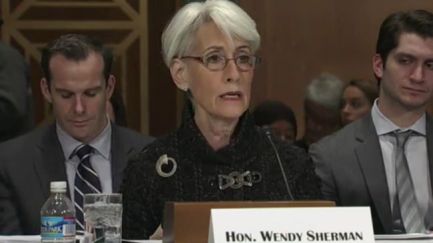
US State Department official Wendy Sherman at the Senate Banking Committee on Dec. 12, 2013

Press TV – December 13, 2013
The administration of President Barack Obama has told lawmakers in US Congress that they could pass new sanctions against Iran as far as they are not “nuclear-related.”
During a public testimony before the Senate Banking Committee on Thursday, State Department official Wendy Sherman, who led the US delegation in nuclear talks with Iran in Geneva, indicated that US lawmakers had the green light from the Obama administration to pass new anti-Iran sanctions as long as the sanctions are not “nuclear-related.”
“Given that there are different kinds of sanctions and the agreement focuses on nuclear-related sanctions,” Sen. Mike Crapo, the top Republican on the Committee, asked Sherman, “assuming we can specify exactly what that is and distinguish between the different sanctions, does that mean that Congress would be free to pass other sanctions measures while we are” negotiating over a final deal over Iran’s nuclear energy program?
“We have said to Iran that we will continue to enforce all of our existing sanctions, and we have said that this agreement pertains only to new nuclear-related sanctions,” Sherman answered.
In a phone interview with Press TV on Thursday, US Congress policy advisor Frederick Peterson said that the problem with some hawkish US lawmakers who are pushing for a new anti-Iran sanctions bill is exacerbated by the way the Obama administration is “misrepresenting” the interim deal between Iran and the P5+1 to the American people and Congress.
Meanwhile, the US Departments of Treasury and State announced new sanctions against a number of companies and individuals for “providing support for” Iran’s nuclear energy program.
Treasury Department official David Cohen, who also testified before the Senate Banking Committee on Thursday, said the new sanctions were “a stark reminder to businesses, banks, and brokers everywhere that we will continue relentlessly to enforce our sanctions.”
Iranian Deputy Foreign Minister Abbas Araqchi has hit out at Washington, saying that the new restrictions are in full contradiction with the recent nuclear deal between Tehran and the P5+1. Araqchi also said that Tehran is now assessing the current situation.
Related articles
Iran slams new US sanctions on firms, individuals
Press TV – December 13, 2013
Iran’s Deputy Foreign Minister Abbas Araqchi slams the new US sanctions targeting Iran, saying the bans run counter to the spirit of the recent nuclear deal reached between Tehran and six major world powers.
“This [US] move is against the spirit of the Geneva deal,” Araqchi said on Friday.
“We are assessing the current situation,” the senior member of Iran’s nuclear negotiating team added.
On Thursday, the administration of US President Barack Obama issued new sanctions against more than a dozen companies and individuals for “providing support for” Iran’s nuclear energy program.
The US Treasury Department said it was freezing assets and banning transactions of entities that attempt to evade the sanctions against Iran.
The sanctions came despite the nuclear deal inked between Iran and the five permanent members of the UN Security Council – Russia, China, France, Britain and the US – plus Germany in the Swiss city of Geneva on November 24 in a bid to set the stage for the full resolution of the West’s decade-old dispute with Iran over the country’s nuclear energy program.
Under the Geneva deal, the six countries have undertaken to lift some of the existing sanctions against the Islamic Republic in exchange for Iran agreeing to limit certain aspects of its nuclear activities during six months. It was also agreed that no more sanctions would be imposed on Iran in the same time frame.
Iran and the six powers ended four days of intense expert-level negotiations in Vienna, Austria, on Thursday.
Iranian Foreign Minister Mohammad Javad Zarif had earlier warned that the Geneva nuclear deal will be “dead” if the US imposes further sanctions against the Islamic Republic.
“The entire deal is dead. We do not like to negotiate under duress. And if Congress adopts sanctions, it shows lack of seriousness and lack of a desire to achieve a resolution on the part of the United States,” Zarif said in an exclusive interview with Time magazine in Tehran on Saturday.
Related articles
Who is the Boss and Who is the Servant in this Photo?

By Richard Edmondson | Fig Trees and Vineyards | December 11, 2013
It’s kind of one of those pictures that are “worth a thousand words,” don’t you think? What you’re looking at is Obama onstage with media mogul and Israeli dual national Haim Saban, who has stated previously, “I’m a one issue guy, and my issue is Israel.” The photo was taken last weekend at the Saban Forum, held in Washington. During the event Saban and Obama appeared together for what was billed as a “conversation” on the Middle East, but basically it was a one-on-one press conference—with Saban doing the grilling and Obama doing the answering. Do the facial expressions in the photo, the body language, suggest anything to you—like for instance which of the two figures is dominant and which is submissive?
Saban, of course, has lots of money. In 2002 he provided a $13 million grant which established the Saban Center for Middle East Policy, and which is part of the larger Brookings Institution think tank. Today he is a major funder of political candidates, particularly of the Democratic Party. You can go here and watch a 48-minute video of his “conversation” with Obama, which includes a few questions from the audience towards the end (all of the people selected to ask questions in that closing segment, coincidentally, happen to be Israelis). At one point, Saban jokingly remarks upon how “obedient” Obama is. A little later in the video, Obama states the following:
“The one thing I will say to the people of Israel is that you can be assured, whoever is in the office I currently occupy, Democrat or Republican, that your security will be uppermost on our minds. That will not change.”
Does it not strike you as a curious comment? Why would the security of a foreign nation be “uppermost” in the minds of the leaders of a supposedly sovereign country? But then maybe America is no longer a sovereign nation.
Obama indeed proves his “obedience” by never once bringing up Israel’s nuclear weapons. Much of the conversation is dominated by talk about Iran’s domestic nuclear energy program. The president at one point repeats the standard, stock-in-trade “options-on-the-table” remark—which in essence is nothing more than a threat to attack Iran—yet nowhere, in the entire 48-minute video, does the subject of Israel’s nuclear weapons come up.
A report on the Saban Forum was posted recently at the Mondoweiss blog. While the article mentions the “conversation” between Obama and Saban, much of the piece is devoted to the remarks of John Kerry, who delivered the keynote address for the event. Allison Deger, the author of the report, notes that Kerry expressed the view that Palestinians in the West Bank are deserving of “state institutions” (as opposed to an actual state) of their own, a comment which seems to have prompted Deger to draw the conclusion that “Palestinian statehood is not on the table in the current round of peace talks.” It is a not unreasonable conclusion to draw.
Kerry also referred to Palestinians as a “demographic time bomb” threatening to jeopardize Israel’s “future as a democratic, Jewish state”—apparently the secretary of state’s first public expression of concern over the so-called “demographic threat.” But perhaps most interesting is what Deger reports on comments by Israeli Foreign Minister Avigdor Lieberman, who also attended the event:
Even though Lieberman was amongst a crowd of Washington and Israeli officials familiar with his anti-Arab diatribes, audible gasps could be heard throughout the room when he called to expel Palestinian citizens of Israel. A diplomat from the Russian embassy seated next to me even choked. Another moment of discontent between the plated-dinner audience and Lieberman passed when the foreign minister made a forlorn pun at Sen. Joe Lieberman. Otherwise the foreign minister was amongst allies.
Much has been made of the recent bone of contention between Obama and Netanyahu over the negotiations with Iran, with some suggesting that the US president is beginning to assert himself and to defy the Israeli lobby on some key, important issues. Is it simply wishful thinking on the part of some commentators? I don’t pretend to know the answer to that, but if there was any note of defiance struck at last weekend’s Saban Forum, all I can say is it is extremely difficult to detect.
*
Update-12/11/13:
The following information on Saban comes from Wikipedia:
In March 2008, Saban was among a group of major Jewish donors to sign a letter to Democratic Party house leader Nancy Pelosi warning her to “keep out of the Democratic presidential primaries.” The donors, who “were strong supporters of Sen. Hillary Rodham Clinton presidential campaign”, “were incensed by a March 16 interview in which Pelosi said that party ‘superdelegates’ should heed the will of the majority in selecting a candidate.” The letter to Pelosi stated the donors “have been strong supporters of the DCCC” [Democratic Congressional Campaign Committee] and implied, according to The Jewish Telegraphic Agency, that Pelosi could lose their financial support in important upcoming congressional elections.
And also this:
Regarding Jane Harman AIPAC Controversy, in April 2009, New York Times, quoting anonymous sources, said a caller promised her that Saban would withhold campaign contributions to Representative Nancy Pelosi if she did not select Ms. Harman for the intelligence post.”
And additionally this:
Saban says his greatest concern is to protect Israel. At a conference in Israel, Saban described his formula. His three ways to influence American politics were: make donations to political parties, establish think tanks, and control media outlets.
Related article
- John Kerry Is Israel’s Best Friend – Bloomberg (bloomberg.com)
US Congress warns oil firms against Iran business
Press TV – December 8, 2013
US Congress has threatened giant oil companies with “severe financial penalties” should they resume business with Iran following an interim nuclear agreement.
In interviews with Foreign Policy Magazine, several American officials expressed concerns about the international firms’ interest to enter the Iranian oil market in the next six months.
Chairman of the House Homeland Security Committee Rep. Michael McCaul said that companies examining their options for “resuming business relationships” with Iran are “acting prematurely at best.”
Hawkish anti-Iran Senator Mark Kirk also warned foreign firms that they “must be on notice that sanctions are coming back stronger than ever” if the nuclear deal does not lead to a comprehensive resolution.
“It is far too premature for any international energy company to contemplate re-entering the Iranian market,” said a spokesman for Rep. Eliot Engel, the top Democrat on the House Foreign Affairs Committee.
The warning came after Royal Dutch Shell, Italian company Eni, and Austrian oil and gas company OMV said they were looking for the possibility of renewing their operations in Iran.
Under the six-month accord reached in Geneva last month, Tehran has agreed to limit some aspects of its nuclear energy program in exchange for the easing of economic sanctions against the country. However, oil sanctions are still in place.
Earlier this week, some international oil companies began talks with Iranian counterparts on the sidelines of an OPEC meeting in Vienna in order to restart their cooperation.
Eni Chief Executive Paolo Scaroni confirmed the negotiations, saying the two sides “discussed specific projects that we had been looking at for many years before sanctions were imposed.”
“We plan to continue to be in Iran and possibly increase our activity as long as the sanctions regime is lifted,” Scaroni said. “There are so many opportunities in Iran both in oil and gas that we will certainly find a common area of interest.”
Former US State Department official Suzanne Maloney said the process is not surprising.
“It’s not surprising that we’re seeing this from the companies that have some experience in Iran like Eni and Total,” she said.
Featured Video

Macgregor: We Haven’t Seen the Worst of the Iran War Yet
or go to
Aletho News Archives – Video-Images
From the Archives
15 Saudi ‘hijackers’ were CIA agents working for US: Scholar
Press TV – April 13, 2016
Fifteen of the 9/11 “hijackers” from Saudi Arabia were CIA agents working for the United States government, which was seeking to destroy the Middle East for Israel and to double the American military budget, says Dr. Kevin Barrett, an American academic who has been studying the events of 9/11 since late 2003…. continue
Blog Roll
 Aletho News
- Breast Cancer: Before You Consent
- Iran’s Plan to Shut Down AI in the Persian Gulf
- Israel seeks ‘compensation’ from Washington over Saudi F-35 sale
- Saudi crown prince seeks dialogue with Ansarullah after Yemeni blows: Report
- Damascus rejects Saudi request for Syrian fighters to counter Yemen: Report
- South Korea says will not send troops to join terrorist US war on Iran
- Russia Just Struck the Eyes of NATO’s War Machine in Ukraine
- Russia summons UK charge d’affaires over Kiev drone support
- NATO member warns bloc seeking pretext for war with Russia
- Macgregor: We Haven’t Seen the Worst of the Iran War Yet
- If Americans Knew
- Debunking The Claim That Macklemore Has A “History Of Antisemitism”
- CPJ demands release of arrested Palestinian-US journalist near Bethlehem
- Robert Kraft: The Billionaire Friend of Netanyahu Pulling The Strings Behind the Macklemore/Ed Sheeran Blow Up
- Columbia Administered Fund Gives Big Money to Pro-Israel Groups
- Deportation Case of Palestinian Activist Salah Sarsour Tests First Amendment
- ‘We Will Not Forget’: Palestinians Mark 44 Years since Sabra and Shatila
- Why do we let Zionists decide what we can and can’t say?
- US welcomes Israeli, Iranian delegations to UN, but not Palestinians – Daily Update
- Biden’s Genocide Accomplices Targeted by New Accountability Campaign
- AIPAC’s Network Has Already Spent $67.2 Million to Shape the Midterm Elections
- No Tricks Zone
- New Study: ‘Global Drought Shows No Detectable Recent Acceleration Under Climate Warming’
- Economic Masterminds: German Socialists Suggest Taxing Productivity Gains Stemming From Using AI
- The South China Sea Has Not Been Cooperating With The Climate Change Narrative
- Energy Crisis: Germany Enters Heating Season With Historically Low Gas Reserve Fill Levels
- New Study: The Antarctic Ice Sheet Gained Mass From 2020-2024 Due To Staggering Snow And Ice Accumulation
- Study: Ocean Heating Rates From Thousands Of Years Ago ‘Dwarf’ Modern Ocean Heating Rates
- Climate Extremists Target, Attack Large-Scale Power Grid Infrastructure In Germany!
- New Study: Antarctic Ice Melt Has Contributed Less Than 1 Centimeter To Sea Level Rise In The Last 30 Years
- Fear Of Debate: Alarmist German Climate Scientist Calls On Mainstream Media To Discredit Skeptic Voices
- End-Of-August Arctic Sea Ice Extent Hasn’t Fallen In 20 Years, Official Data Show!
 Aletho News