Qatar rejects anti-Iran statements of Mecca summits
Press TV – June 3, 2019
Qatar says it rejects the anti-Iran statements of the recent Mecca summits as they had been prepared in advance without consulting Doha.
“The statements of the [Persian] Gulf and Arab summits were ready in advance and we were not consulted on them,” Mohammed bin Abdulrahman Al Thani told the Al-Araby broadcaster.
“Qatar has reservations on the Arab and [Persian] Gulf summits because some of their terms are contrary to Doha’s foreign policy,” he added.
“We hoped the Mecca summits would lay the groundwork for dialogue to reduce tensions with Iran,” the top diplomat said in comments reposted on Twitter by his ministry.
“The Mecca summit ignored the important issues in the region, such as the Palestine issue and the war in Libya and Yemen,” he went on to say.
Qatar is not the first Arab state to reject the final statements of the emergency meetings in Mecca. Following the talks, Iraq also opposed the communiqué issued by the Arab participants.
Iraq, which maintains close ties with neighboring Iran and has strong ties with Washington as well, objected to the communiqué, which required “non-interference in other countries” as a pre-condition for cooperation with Tehran.
Iraqi President Barham Salih asked the gathering to support his country’s stability, arguing that rising tensions with Iran could cause war. He voiced hope that Iran’s security would not be targeted.
“We are watching before our eyes the escalation of a regional and international crisis which can turn into war that will engulf all. If the crisis is not managed well, then we will be faced with the danger of a regional and international confrontation which will bring tragedy to our countries,” Salih said.
“The Islamic Republic of Iran is a Muslim country that is a neighbor to Iraq and Arabs. It is certain that we do not wish the security of Iran to be targeted. We share a common border that is 1,400 km long and a long history and relations, and it is also certain that the security of a fellow Islamic country is in the interest of Arab and Islamic countries. The region needs stability based on a mechanism of joint security that guarantees non-interference in internal affairs and the rejection of violence and extremism,” he added.
The statements mainly cited concerns about the recent sabotage attacks against several ships off the UAE. Both Saudi and Emirati officials have blamed the mysterious “sabotage” attacks on Iran while Iran has strongly denied any involvement, and offered to sign non-aggression pacts with the Persian Gulf Arab states.
Related:
We Offered Dialogue but MBS Threatened to Take Battle into Iran: Zarif
Al-Manar | June 1, 2019
Iranian Foreign Minister Mohammad Javad Zarif said that the Islamic Republic offered Gulf states dialogue after clinching the nuclear deal in 2015, revealing that Saudi Crown Prince Mohammad Bin Salman’s reply was by threatening to take the battle into Iran.
In an interview with Al-Alam TV channel, Zarif said that shortly after the nuclear deal was clinched in 2015, and as Gulf states were concerned over the rapprochement between the US and Iran, “we refused talks with Washington over the region, stressing that such dialogue should be between the region neighbors only.”
“At time we clearly announced readiness for dialogue between Gulf Cooperation Council (GCC) states, but unfortunately Mr. Mohammed Bin Salman frankly said that there is no dialogue with Tehran threatening to take the battle into Iran,” Zarif was quoted as saying in the interview.
The top Iranian diplomat said meanwhile, that the Islamic Republic’s power is a source of concern to the US, warning that any confrontation with Iran now will have negative impacts on states which are pushing towards such a step.
“We have huge defensive power and we can repel any threat.”
Zarif also stressed that the US should stop its “economic terrorism and policy of bullying.”
“The US through launching an economic war against Iranian people is waging an all-out war.”
Second Saudi ship leaves French port without arms cargo
MEMO | May 31, 2019
A Saudi cargo ship has left the southern French port of Fos-sur-Mer without loading its arms cargo destined for Saudi Arabia, blocked from doing so after pressure from rights campaigners, a French rights group said on Thursday, Reuters reports.
The incident reported by ACAT, a Christian organisation against torture, is the second time this month that a Saudi vessel has been blocked from loading arms in France as pressure mounts on Paris to stop arms sales to the kingdom.
A Saudi ship left France’s northern coast two weeks ago without a cargo of weapons after dockers threatened to block its arrival in the port of Le Havre. That came weeks after an online investigative site published leaked French military intelligence that showed weapons sold to the kingdom, including tanks and laser-guided missile systems, were being used against civilians in Yemen’s war.
ACAT said the Saudi freighter, Bahri Tabuk, returned to sea on Wednesday night, with its holds empty.
“Once again, faced with citizen mobilisation and our legal action, a Saudi freighter had to give up loading French weapons, this time in Fos-sur-Mer,” Nathalie Seff of ACAT-France said in a statement.
Refinitiv Eikon shipping data showed that the Saudi-flagged ship, labelled as a vehicle carrier which has transported soybean meal in the past, left Fos and was sailing to Alexandria in Egypt.
French and Saudi governments and the port authorities could not be reached for comment on Thursday evening.
French Armed Forces Minister Florence Parly has said that France had a partnership with Saudi Arabia. When the first vessel was blocked from loading in Le Havre, she said the arms were related to an order dating back several years.
ACAT said it had filed an appeal last week with the Paris Administrative Court to block weapons shipments to Saudi Arabia, arguing that the sales contravened a UN treaty because the arms could be used against civilians in the Yemeni conflict, but it said the appeal was rejected.
French rights group moves to block Saudi arms cargo
RT | May 28, 2019
A French humanitarian group is seeking to block a delivery of munitions to a Saudi ship docked at a port in southern France, arguing the weapons will be used to commit war crimes in Saudi Arabia’s conflict with Yemen.
The rights group, Action by Christians for the Abolition of Torture (ACAT), filed its legal challenge Tuesday, following up on a previous effort which successfully blocked a shipment of howitzer cannons to the Saudi Kingdom.
The cargo ship “is to load French weapons bound for Saudi Arabia, one of the main belligerents of the Yemeni conflict,” ACAT said in a statement Tuesday, adding it was “calling on civil society … to prevent these munitions from leaving” the port of Marseille-Fos.
The shipment is to include ammunition for the French-made Caesar howitzer, a truck-mounted artillery system, according to sources cited by investigative outlet Disclose. Though ACAT managed to block a howitzer shipment earlier this month, Saudi Arabia obtained several Caesar batteries in previous sales.
ACAT argues that the UN’s Arms Trade Treaty, ratified by France in 2014, provides a legal basis for a court order to block the cargo.
Under the treaty, “France undertook not to authorize the transfer of arms when it ‘has knowledge, at the time the authorization is requested that such weapons or property could be used to commit genocide, crimes against humanity’,” or other violations of humanitarian law, ACAT said, quoting the language of the agreement.
French Defense Minister Florence Parly told lawmakers Tuesday that she had no information on the shipment, but added that France must respect its alliance with the kingdom in any case. Parly has previously stated there was “no proof” that French weapons contributed to rights violations in the Yemen war.
In April, however, French journalists with Disclose published classified military intelligence documents revealing that French weapons likely were involved in strikes on civilians. French authorities have since interrogated the journalists and threatened them with jail time.
Earlier Tuesday Foreign Minister Jean-Yves Le Drian called on Saudi Arabia to end its “dirty war” on Yemen, but stopped short of demanding an end to French weapons sales, adding that France was “extremely vigilant” in its arms transfers.
Activists at Italian and Spanish ports have also attempted to interfere in the Saudi war effort, with Italian dock workers in Genoa refusing to load cargo onto a Saudi vessel earlier this month, and a similar, albeit unsuccessful, protest at the Spanish port of Santander.
The UN says Yemen is suffering the world’s worst humanitarian crisis, with millions dependent on humanitarian aid and tens of thousands killed in the fighting. A coalition of states led by Saudi Arabia began military operations in Yemen in March 2015, seeking to oust rebels from power and reinstate Yemeni President Mansour Hadi. Both the coalition and the rebels have violated the laws of armed conflict, according to rights groups, but the bulk of civilian casualties have been inflicted in the Saudi air war.
Congress Fiddles While Trump Lurches Toward War on Iran
By Ron Paul | May 27, 2019
Congress, and particularly the Democrat-controlled House of Representatives, seems determined to see the end of the Trump Administration before the 2020 vote. Although House Speaker Pelosi claims she is not seeking impeachment, she’s accusing the president of “covering up” something. However, she won’t say what until she can do more investigating.
But Trump’s opponents on both sides of the Congressional aisle don’t seem so enthusiastic about challenging the president when he actually does abuse his Constitutional authority to pursue a more aggressive policy overseas.
Late last week, for example, President Trump declared a national security “emergency” brought about by unspecified “Iranian malign activity” – a “loophole” allowing him to bypass Congressional review of some $8 billion in US weapons to be sold to Saudi Arabia.
Congress had been reluctant to approve yet more arms sales to Saudi Arabia after the President vetoed a bi-partisan House and Senate-approved bill requiring the US to end its military support for the Saudi war of aggression against Yemen.
What might this new Iran “emergency” be? As with the lead-up to the Iraq war, the Administration claims important secret intelligence — but of course we have to just trust them. From what we have heard from the Administration, it looks pretty flimsy. Rear Admiral Michael Gilday, the director of the Joint Staff, has outright claimed that the so-called “sabotage” of four container ships at port in the UAE is the doing of the Iranian Revolutionary Guards. But even Abu Dhabi didn’t claim Iranian involvement in the mysterious incident.
Could it have been a false flag?
Admiral Gilday also claims, without providing proof, that the recent firing of a small rocket in the general vicinity of the US Embassy in Iraq is the work of the Iranians. “We believe with a high degree of confidence that this [recent attacks] stems back to the leadership in Iran at the highest levels,” he said.
What would Iran gain by shooting off an insignificant rocket, exposing itself to US massive retaliation with no gain whatsoever? They don’t say.
The Trump Administration has been lacking any coherent foreign policy strategy for some time. It often seems the President is fighting more with his own appointees than with his opponents on Capitol Hill. As soon as he announces that ISIS is defeated and US troops must come home, his employees like National Security Advisor John Bolton “clarify” Trump’s statements to mean that troops are staying. Trump goes to Hanoi to cut a deal with North Korea’s Kim Jong-Un and Bolton shows up with a poison pill that blows up the deal.
Bolton announced plans for 120,000 US troops to the Middle East to help push the war on Iran he’s been hocking for 20 or so years. Then we heard it was 10,000. Then 1,500, of which 600 are already there.
Whether Trump is on board or not, his Administration is clearly dragging the US into conflict with Iran. While some Members remind the president that he does not have Constitutional authority to attack Iran without approval, that argument has not been very effective in deterring presidents thus far.
If Congress really wanted to rein in an out-of-control president, they have plenty of opportunity in his bogus “national emergency” declaration and his saber rattling toward Iran. But if asserting Constitutional authority means Congress acts to pull-back US militarism overseas, suddenly there is a great bipartisan silence. They’d rather impeach Trump over his rude Tweets than over his stomping on the Constitution.
Dissecting The Unfathomable American-Iranian War
By Ghassan Kadi | The Saker Blog | May 21, 2019
As the American military build-up continues around the Strait of Hormuz, and as a potential American-Iranian war looms, many analysts are convinced that war is imminent. I beg to differ.
Ever since the “War on Syria” started, I kept reiterating that America would never launch a full-on attack on Syria, and for very good reasons, and not long ago, I finally felt compelled to write a series of articles explaining that in as much as America would love to be able to pillage Syria, it is unable to do so.
Those predictions, which stood the test of time, were made long before the Russian involvement in Syria, and now, after Syria’s triumph, the chances of a decisive victory that America is able to score by way of a military gamble anywhere in the Middle East have been shrinking and reduced to the level of zero chance. If anything, the “War on Syria” was the surrogate war that America could not launch directly either on Syria or on Iran, and even by turning its war into a war by proxy, America was still unable to win.
To recap briefly, some obstacles that stood against an all-out American NATO-led assault on Syria back in 2013, I argued that America would never risk a retaliatory attack against Israel by both Syria and Hezbollah.
An American attack on Iran will not eliminate the risk of a Hezbollah retaliatory attack on Israel, and if anything, it will bring in a new risk; the risk of a retaliatory Iranian attack on Saudi soil.
Whether or not an American-Iranian show down will directly involve Saudi troops, given that Saudi Arabia is still unable to win in its war against Yemen, even though it has the third largest military budget after the USA and China, a direct Saudi role will have little in effecting any significant input. However, with or without a direct Saudi intervention, an American attack on Iran will immediately put American interests in Saudi Arabia under the Iranian target list.
In the event of such an attack, the first thing that Iran will do is close marine traffic in the Strait of Hormuz. As a result, the whole world will be affected and the price of a barrel of oil may jump to $200 and beyond, but the relevant issue here is the impact on the feasibility of American military success.
An American attack on Iran cannot be seen as an event that is independent from the wars on Syria and Yemen. It will be seen as an upscaling that directly involves Iran. Any such turning point will sooner or later involve Saudi Arabia directly. And given that Iran will more than likely close the Strait of Hormuz and thereby putting all Saudi oil exports to halt, whether or not Iran intended to intimidate America alone, the Saudis will see it as an act of war; and they will be “forced” to retaliate.
But the moment the Iranians see that Saudi forces are involved in military action against them, they will have a huge array of critical soft Saudi targets to hit; all the way from oil wells, ports, and more importantly perhaps, water desalination plants that are all scattered on the east coast of Saudi Arabia; ie across the gulf from Iran.
Those sites are undoubtedly protected by ground to air defence shields, but in the face of thousands, tens of thousands of cheap rockets fired from Iran, much more expensive and harder-to-come-by Patriot missiles will not be able to totally stop waves and waves of Iranian rockets.
The Saudi desalination plants feed all cities in the east; including the capital Riyadh. Without them, Saudi citizens will have no water. And without oil exports, they will also lose their income.
Power stations are also in the east, if they get hit, eastern Saudi Arabia will plunge into darkness, and as summer approaches, without air-conditioning, today’s Saudis who are not any longer attuned to the harsh climate of the desert, will suffer greatly from heat exhaustion; especially without water and fuel.
America may not give a damn about Saudis, but it cannot afford to lose Saudi revenue.
But this is only on the eastern front.
On the southern front, a weaker Saudi Arabia will have to relent in its attack on Yemen. Where will this leave the battle front?
On the western front however, an all-out American attack on Iran will be seen as a bigger existential threat to Hezbollah than the “War on Syria”. Hezbollah will retaliate by hitting back at Israel; not only using its rocket power in a retaliatory manner, but also for leverage and the ability to trade-off a cease fire against Israel by an American one against Iran. A scenario like this can become a game of playing chicken and seeing who blinks first; and more than likely, faced by potential civilian casualties, Israel will be the party to relent.
An onslaught of Hezbollah rockets on Israel has been something that the USA has thus far managed to avoid; despite its deep role in the “War on Syria”. But if the carnage eventuates, America will be “forced” to supply Israel with a massive number of Patriot missiles. But these cost more than a million dollars each at least. Such figures are easy to estimate even according to sources such as Wikipedia. But the question is, who is going to fork out the cost? Furthermore, Hezbollah is estimated to have over 150 thousand rockets poised at Israel. Does America have enough Patriots to intercept them? And if THAAD missiles are to be used here and there, the economy becomes more daunting with batteries costing over a billion dollars each, according to Wikipedia again.
This of course brings in the bigger question of economy; ie the economic front. If the invasion of Iraq has cost the American treasury something between 2 and 4 trillion dollars, how much will a war with Iran cost? With the American economy on the brink, can America financially afford a new war with an enemy that it hasn’t tested the fighting prowess of?
Trump was quoted saying that a war with Iran will be the official end of Iran. But the United States of America has thus far lost all of its post WWII wars, even though they were all launched against foes of seemingly much less military readiness than Iran. As a matter of fact, if one looks at the regional strategic risks, the military risks, plus the economic risks, an American war against Iran could well become the straw that breaks America’s back.
The above analysis does not even take into account the economic impact of such war on the EU and/or the possibility of Russian, Chinese and Indian roles.
As an energy exporter, Russia may gain from inflated petrol and gas prices, but strategically, it is not going to sit idle as America wreaks havoc and imposes superiority in an area that is of high interest to Russia. But China and India, and the EU, are highly dependent on fuel that has no way out of its origin to their ports other than via the Strait of Hormuz. Some EU nations may give America some grace if convinced by big brother that the attack will only last a matter of days, but what if it takes weeks, months, or years? What if the norm becomes a $200 oil barrel? Which world economy can survive such a calamity?
The only logical scenario here is that not unless America is able to incinerate Iran in a single knockout blow, any attack on Iran will result in a series of independent repercussions that have the potential of turning the attack into a nightmare for America.
The days of bottomless pockets that allowed America to launch wars on Korea and Vietnam under the guise of fighting Communism are no more.
The days of the so-called “New World Order” of the post-USSR period and which gave America a carte-blanche to attack Iraq, Afghanistan, Iraq again and Libya was put on hold in Syria, and Russia has marked her redlines for any such future offensives.
Without international impunity, without a successful military track record, without the risk of retaliation against Israel, with the prospect of losing EU support, with the prospect of turning the Saudi war on Yemen in favour of the Houthis, destroying the Saudi economy and leaving Saudis without power and water, and above all, without enough funds to fight a war that can last a very, very long time, and finally, without being able to hit Iran with a single knockout blow that can avoid all of the above, how can America enter this venture?
Hawks like Bolton may think that any military action is a walk in the park, but the top brass in the American military know better. Love him or hate him, Trump is a pragmatic man, financially pragmatic perhaps, but this is alone enough reason for him not to take stupid financial decisions; and any war against Iran will be judged by Trump on its financial merits.
On paper, Trump will see that this war is impossible to win, and just like his White House predecessors who have eyed Syria in the hope of being able to attack it, he will be the chicken who will blink first and find a face-saving exit. At the end of the day, if on the scale of one to ten, America’s decision to not attack Syria scored eight, the decision not to attack Iran will score ten.
‘We won’t be complicit’: Italian dock workers refuse to load Saudi arms ship over Yemen war
RT | May 20, 2019
Italian unions have refused to load cargo onto a Saudi ship carrying weapons, in protest against Riyadh’s war on Yemen. The dock workers have gone on strike, refusing to work until the ship leaves port in Genoa.
While the Saudi Arabian ship, the Bahri-Yanbu, was expected to leave for Jeddah by the end end of the day, it seems the delivery might end up being rather late. After unsuccessful attempts to have the ship barred from docking in Italy altogether, it was greeted by banners and a protests as it arrived in port Monday.
Workers were joined by human rights campaigners who oppose stocking the ship over fears the supplies will be used against the civilian population in Yemen. The demonstrators held signs opposing the war and arms trafficking.
“We will not be complicit in what is happening in Yemen,” union leaders said in a statement. Port officials have acknowledged that the generators that protesters fear may be used for military purposes have been blocked from being brought on board, but say some non-critical goods will still be loaded. Union leaders are scheduled to meet with the port’s prefects to discuss the impasse.
The ship was loaded with weapons in Belgium, but successfully blocked from picking up additional arms at a French port as a result of a similar protest.
The UN describes the four-year-long Saudi-led war as the worst humanitarian disaster in the world today, with the death toll expected to top 230,000 by the end of the year. Italy’s 5-Star movement, a part of the government’s ruling populist-leaning coalition, has fought to end the government’s arms deals with the Saudi kingdom for years.
Saudi Arabia playing ‘Trojan horse’ for US amid tensions: Al Akhbar
Press TV – May 20, 2019
Saudi Arabia is fanning the flames of war between Iran and the US while both countries are against a confrontation, a Lebanese newspaper has said, accusing Riyadh of playing America’s “Trojan horse.”
In an article on Monday, Al Akhbar criticized Saudi Arabian King Salman for calling emergency meetings of the Arab League and the Persian Gulf Cooperation Council (GCC).
The paper warned Riyadh’s rulers that with their “subservience” to US President Donald Trump, they were essentially entering the kingdom into a conflict masterminded by Israel and America.
Saudi officials, it said, are only “adding fuel to the fire” of war that is aimed at partitioning the Middle East and destroying its heritage.
The official Saudi Press Agency (SPA) reported on Saturday that Salman had invited Arab leaders to convene urgent summits in the city of Mecca on May 30 to discuss ways to “enhance the security and stability in the region.”
Days before the invitation, four oil tankers, including two Saudi ones, were purportedly targeted near the port of Fujairah on May 12, in what the United Arab Emirates described as “sabotage” attacks.
The invitation came at a time when hawks within Trump’s administration are actively trying to tip the scale in favor of a major confrontation in the Middle East.
Over the past few days, the US has put its political staff in its Baghdad embassy as well as in the American consulate in the Iraqi city of Erbil on high alert about what it insists are possible threats from neighboring Iran.
Washington also sent a carrier strike group as well as strategic B-52 bombers to the region in a “clear warning” to Tehran.
Saudi attitude spells doom
Al Akhbar wrote that the tensions have divided the region. It said Al Saud will not use these meetings to discuss Trump’s so-called “deal of the century” for Palestine — which is expected to be unveiled in early June.
Rather, the meetings will fan the flames of war to serve American and Israeli interests, because that is what they think would ultimately save them their crown, the paper wrote.
The article added that King Salman had decided to once again let aggressors use the Saudi airspace and territorial waters to wage war but this would only lead to his own demise and impose a great price upon Persian Gulf sheikhdoms which have tied their economy and security to America’s demands.
Saudi king calls for urgent meetings of Arab leaders
Press TV – May 19, 2019
Saudi Arabia’s King Salman bin Abdulaziz has called for emergency meetings of the Persian Gulf Cooperation Council ([P]GCC) and the Arab League, following mysterious “sabotage” attacks on Saudi and Emirati oil tankers as well as drone strikes targeting Saudi oil pumping stations.
The official Saudi Press Agency (SPA) reported on Saturday that Salman had invited Arab leaders to convene urgent summits in the city of Mecca on May 30 to discuss ways to “enhance the security and stability in the region.”
An official source at the Saudi Foreign Ministry said that the Saudi monarch had called the meetings due to “grave concerns” about recent attacks on commercial vessels off the coast of the United Arab Emirates and drone strikes on oil pumping stations in Saudi Arabia as well as the effects of those incidents on supply routes and oil markets.
The summits are meant “to discuss these aggressions [sic] and their consequences on the region,” the source said.
The Emirates’ Ministry of Foreign Affairs and International Cooperation has welcomed the Saudi call for the emergency meetings.
“The current critical circumstances entail a unified Arab and [Persian] Gulf stance toward the besetting challenges and risks,” the ministry said in a statement.
On May 12, four oil tankers, including two Saudi ones, were purportedly targeted near the port of Fujairah, in what the Emirates described as “sabotage” attacks. While Riyadh and Abu Dhabi failed to produce evidence of the attacks on their vessels, pictures emerged of a Norwegian-flagged tanker at the port having sustained some damage.
Two days later, drone strikes were launched on two oil pumping stations in Saudi Arabia. These attacks were believed to have been carried out by Yemen’s Houthi fighters in retaliation for the prolonged Saudi war against Yemen.
The attacks led Saudi Arabia to halt its main cross-country oil pipeline temporarily.
Saudi and Emirati officials have not said who carried out the attacks on the tankers and the pumping stations, but some political and media figures within the United States have claimed that Iran is responsible.
A day after the reported attacks on the oil tankers, Tehran called them “worrying,” and Iranian Foreign Minister Mohammad Javad Zarif later called them “suspicious.”
Yemen’s Houthis also noted that the retaliatory drone strikes on the Saudi oil pipeline were an act of self defense and had nothing to do with Iran.
Pompeo calls bin Salman
On Saturday night, Saudi Crown Prince Mohammed bin Salman held a phone conversation with US Secretary of State Mike Pompeo.
The SPA reported that the two sides exchanged views on the “developments in the region and efforts to enhance security and stability.”
Jubeir claims Riyadh doesn’t seek war
In a separate development on Sunday, Saudi Minister of State for Foreign Affairs Adel al-Jubeir claimed that his country did not want a war with Iran.
“The kingdom of Saudi Arabia does not want a war in the region nor does it seek that,” he told a press conference in Riyadh.
“It will do what it can to prevent this war and at the same time it reaffirms that in the event the other side chooses war, the kingdom will respond with all force and determination, and it will defend itself and its interests,” he added.
Iran Warns Against ‘Conspiracy by Ill-Wishers’ Over ‘Sabotage’ at UAE Port
Sputnik – 13.05.2019
Iran’s Foreign Ministry Spokesman Abbas Mousavi has expressed concerns over a “sabotage” attack on several merchant ships off the UAE coast on Sunday, calling the incident “worrisome and dreadful”, and has urged an investigation into the matter, ISNA reported.
Mousavi was cited as saying that “such incidents have a negative impact on maritime transportation security”, cautioning against any “conspiracy orchestrated by ill-wishers” as well as “adventurism by foreigners” to undermine the region’s stability.
The comments followed a reported remark by Saudi Arabia’s Energy Minister Khalid al-Falih, who said that two Saudi vessels were among those targeted near the UAE.
One of the two ships in question was attacked on its way to be loaded with Saudi crude at the port of Ras Tanura for delivery to Saudi Aramco in the US, Reuters reported.
The suspected attack didn’t lead to any casualties or oil spill, but is said to have caused significant damage to the structures of the two vessels.
“The international community has a joint responsibility to protect the safety of maritime navigation and the security of oil tankers, to mitigate against the adverse consequences of such incidents on energy markets and the danger they pose to the global economy”, al-Falih said in a statement, as quoted by Reuters.
As reports of the alleged sabotage attack kept flooding in, the Cooperation Council for the Arab States in the Gulf (GCC) issued a statement to condemn the incident:
“It is a dangerous development and escalation that reflects the evil intentions of those who planned and carried out these operations that endanger the safety of maritime navigation in the region and threaten the lives of the ships’ civilian crews”, the statement read.
On Sunday, the UAE said that four merchant vessels had been targeted in “acts of sabotage” in its territorial waters, thus brushing off previous reports by the Lebanon-based broadcaster al-Mayadeen, which said that several large blasts had occurred in the port of Fujairah. Reacting to the reports about explosions, authorities in Fujairah refuted the claims, stressing that the port was functioning as usual.
‘Too much money invested in war’: US defense industry drives global military spending spree
RT | April 30, 2019
Global military expenditures reached their peak in 2018, and the driving force behind this increase is the growing appetite of the US military-industrial complex rather than real threats, analysts say.
The world spent $1.8 trillion on its military in 2018, the latest report by the acclaimed Stockholm International Peace Research Institute (SIPRI). The US and its NATO allies – the self-proclaimed defenders of freedom and democracy – account for more than half of this whopping amount.
Washington’s other close friend Saudi Arabia is the third largest military spender, coming ahead of India.
“A lot of this spending, particularly in the case of Saudi Arabia and India, is for political reasons,” Michael Maloof, a former senior security policy analyst at the Pentagon, told RT. New Delhi and Riyadh seek to “curry favor” with Washington by purchasing the US weapons in hope for concessions in other areas, he explained.
Washington’s NATO allies have seen pressure from the US related to their military spending ever since Donald Trump came to power in the White House. Maloof believes it has less to do with security of the alliance and more with the interests of the US arms manufacturers.
“A lot of that is aimed at trying to help the US defense industry to stay ahead [of their competitors] and hire more people,” he explained, adding that the issue of the military expenditures has a “clear economic dimension.”
In its desire to sate the always-hungry domestic military industrial complex, the US risks escalating tensions on the international arena, analysts warn. Washington’s hawks typically justify the need for ever-increasing military expenditures with some perceived threats from Russia or China, portraying them as war mongers.
“There is no good reason” for larger defense budgets, Ted Seay, a former US diplomat and senior policy consultant with the British American Security Information Council (BASIC), told RT. It is the West’s fear of the perceived ‘Russian threat’ that has in fact led to destabilization on the European continent, he noted.
“There are military provocations taking place between NATO and Russia where there should not be any far in the 21th century when there is no logical reason for any confrontation between Europe and Russia,” Seay said.
The former US diplomat also denounced as senseless the NATO “formula” demanding that member states spend two percent of their GDP on defense.
There is not a military situation that necessitates [the likes of] Latvia or Poland to find a solution in greater military spending. It simply does not exist in this age. But there are people who seem to be intent on creating confrontation and encouraging the NATO countries to spend more money with no good reason.
Yet, it is precisely Poland and the Baltic States that top the list of nations with the highest annual defense spending increases in Europe over the recent years.
Poland’s military budget rose by 8.9 per cent in 2018 to $11.6 billion, according to SIPRI, while Latvia upped its military expenditures by staggering 24 percent over the same period. Bulgaria and Ukraine – which is not in NATO – followed closely, increasing their spending by 23 and 21 percent respectively.
Meanwhile, the US and its allies grossly outspend all the nations they perceive as alleged threats. The US expenditures alone accounted for 36 percent of global defense spending while exceeding the expenditures of the next eight largest-spending countries combined in 2018. NATO’s total military spending accounted for 53 percent of the global defense expenditures.
China was the only Washington’s perceived rival that made it into top 5 military spenders in 2018. However, Beijing’s defense budget amounted to only a fraction of the US one and accounted for 14 percent of the global military spending.
Russia, meanwhile, came it at number six by spending some $61.4 billion on the military in 2018, following consecutive defense budget cuts in the last two years. However, these facts do not stop the biggest military spender in the world to accuse Moscow of somehow initiating an “arms race.”
Anyway, the latest trends show that the world is unlikely to see easing of tensions on the international arena anytime soon, Seay warns.
Canada Gets Cozy with Repressive Middle East Monarchies
By Yves Engler | Dissident Voice | April 26, 2019
While Justin Trudeau’s government embraces repressive Middle East monarchies, they want us to believe their campaign to oust Venezuela’s government is motivated by support for democracy and human rights.
On a tour of the Middle East last week Defence Minister Harjit Singh Sajjan met his United Arab Emirates counterpart Mohammed bin Ahmed Al Bowardi in Abu Dhabi. According to Emirates News Agency, Canadian and UAE officials discussed “cooperation in the military and defence sectors” at a time when the oil rich nation plays a key role in the horrendous violence in Yemen.
The Trudeau government is promoting arm sales to the UAE and other regional monarchies. With support from “15 trade commissioners and representatives from the Government of Ontario, National Defence, Global Affairs Canada, and the Canadian Commercial Corporation”, 50 Canadian arms companies flogged their wares at the Abu Dhabi-based International Defence Exhibition and Conference (IDEX) in February. To help the arms companies move their wares, Commander of the Bahrain-based Combined Task Force 150, Commodore Darren Garnier, led a Canadian military delegation to IDEX.
During his recent tour Sajjan met King Abdullah II bin Al-Hussein in Jordan. He discussed military cooperation with a monarch known for prosecuting individuals for “extending one’s tongue” (having a big mouth) against the King. At the end of March, Trudeau phoned King Abdullah II.
On April 9 the Canadian and Jordanian armed forces broke ground on a road project along the Jordanian-Syrian border. During a ceremony for the Canadian-funded initiative Commander of the Canadian Joint Operations Command, Lieutenant General Michael Rouleau, said: “this important road rehabilitation project is a tangible example of the close relationship between Jordan and Canada. It will help keep the people of Jordan safe by allowing the Jordanian armed forces to deter, monitor and interdict incursions along the northern border with Syria, which will help to enhance security in Jordan and in the region.”
On his Middle East tour Sajjan also met Kuwait’s Prime Minister and Defence Minister Sheikh Nasser Sabah Al-Ahmad Al-Sabah who is part of a family that has ruled for 250 years. According to the Kuwait News Agency, Canada’s defence minister “stressed deep relations between Kuwait and Canada and pointed out mutual willingness to bolster and consolidate bilateral ties.”
Earlier in the month finance minister Bill Morneau and Parliamentary Secretary Omar Alghabra participated in the inaugural Kuwait and Canada Investment Forum. At the time Alghabra wrote, “let’s celebrate and continue our efforts to grow the relationship between Canada and Kuwait in investments, trade and defence.”
Military ties with Kuwait are important because the Canadian forces have a small base there. In December the Canadian Navy took command of Combined Task Force 150 from their Saudi counterparts. Canada also has a small number of troops in the monarchies of Bahrain, the UAE and Qatar.
Last month Canada’s Ambassador to Qatar Stefanie McCollum boasted of growing relations between the countries, claiming “our values structures are very similar.” In an interview with Al Bawaba the Canadian diplomat also said Ottawa is seeking to deepen business ties with the natural gas rich monarchy and that the two countries are in the final stage of signing a defence cooperation agreement.
Notwithstanding the diplomatic spat last summer, the Trudeau government has mostly continued business as usual with the most powerful and repressive monarchy in the region. Recently foreign minister Chrystia Freeland looked the other way when Saudi student Mohammed Zuraibi Alzoabi fled Canada — presumably with help from the embassy — to avoid sexual assault charges in Cape Breton. While Freeland told reporters that Global Affairs was investigating the matter, Halifax Chronicle Herald journalist Aaron Beswick’s Access to Information request suggests they didn’t even bother contacting the Saudi embassy concerning the matter.
According to an access request by PhD researcher Anthony Fenton, Freeland phoned new Saudi foreign minister Ibrahim Abdulaziz Al-Assaf in January. In briefing notes for the (unannounced) discussion Freeland was encouraged to tell her counterpart (under the headline “points to register” regarding Yemen): “Appreciate the hard work and heavy lifting by the Saudis and encourage ongoing efforts in this regard.”
Despite their devastating war in Yemen and dismembering of journalist Jamal Khashoggi at the consulate in Istanbul, Saudi Arabia continues to receive large shipments of Canadian weaponry. 2018 was a record year for Canadian rifle and armoured vehicle sales to the Saudis. $17.64 million in rifles were exported to the kingdom last year and another $1.896 million worth of guns were delivered in February. In the first month of this year Canada exported $367 million worth of “tanks and other armoured fighting vehicles” to the Saudis.
As Fenton has documented in detail on his highly informative Twitter handle, armoured vehicles made by Canadian company Streit Group in the UAE have been repeatedly videoed in Yemen. Equipment from three other Canadian armoured vehicle makers – Terradyne, IAG Guardian and General Dynamics – was found with Saudi-backed forces in Yemen. The Saudi-led coalition used Canadian-made rifles as well.
On Tuesday the Saudis beheaded 37 mostly minority Shiites. Ottawa waited 48 hours — after many other countries criticized the mass execution — to release a “muted” statement. The Trudeau government has stayed mum on the Saudi’s recent effort to derail pro-democracy demonstrations in Sudan and Algeria as well as Riyadh’s funding for Libyan warlord Khalifa Haftar’s bid to seize Tripoli by force.
The close and friendly relationships between the Trudeau government and repressive Middle East monarchies demonstrates how little the Liberals care about democracy abroad and illustrates the hypocrisy of Canada’s claims that its efforts to oust Venezuela’s government is all about supporting democracy.
Yves Engler is the author of 10 books, including A Propaganda System: How Canada’s Government, Corporations, Media and Academia Sell War and Exploitation.
Featured Video

U.S. General Caine Warns: STRIKING IRAN is a HUGE RISK
or go to
Aletho News Archives – Video-Images
From the Archives
Stealth Bombers and Bunker Busters
Analysis of the so-called 12-Day War, and the triumphantly celebrated Operation Midnight Thunder
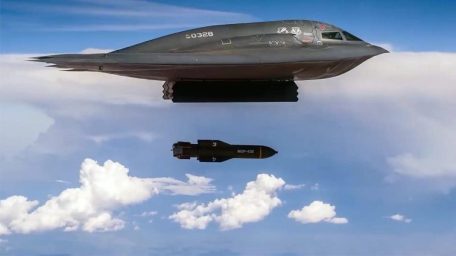
By William Schryver | imetatronink | November 28, 2025
The GBU-57 is a big fat gravity bomb with fins. To achieve effective precision, a B-2 bomber must drop it on its intended target from no further than about five nautical miles — essentially right on top of the target.
Its penetration depth is claimed to be 200 feet. But that capability has NEVER been tested against a seriously hardened deep-underground target encased in layers of high-performance concrete, and topped with a few dozen meters of solid rock. In that sort of real-world scenario, the GBU-57 would be lucky to drill down 50 feet, if that.
It was always ridiculous silly talk to suggest the GBU-57 was the wonder weapon it was made out to be. There is a good reason the US only produced a couple dozen of them and then stopped: they understood its acute limitations in a non-permissive combat environment.
And, notwithstanding the hyperbolic Israeli propaganda, there was never any credible evidence that Iranian medium- and long-range air defenses against fixed-wing aircraft were attrited to any significant degree. And Iranian short-range air defenses were increasingly effective against long-range Israeli drones with each passing day.
As for the B-2: it is a big fat subsonic aircraft. It flies at airliner speeds. A strike on Fordow would entail flying at least 500 miles in and out of Iran. … continue
Blog Roll
 Aletho News
- What’s Really in the Bag: The Pet Food Industry’s Dirty Secret
- Project Artichoke: 70 Years Ago, CIA Discussed Hiding Mind-Control Drugs in Vaccines
- Drug traffickers trained in Ukraine attack state forces in Mexico
- The tragic reality of Brazilian mercenaries in the Ukrainian conflict
- Zelensky Refused to Discuss Druzhba Pipeline Issue – Fico
- U.S. General Caine Warns: STRIKING IRAN is a HUGE RISK /Glenn Diesen & Lt Col Daniel Davis
- Israel designates five Palestinian media outlets as ‘terrorist organizations’
- Israel, not America, first: Carlson’s Huckabee interview lays bare US foreign policy priorities
- Israeli troops executed Palestinian aid workers at ‘point blank range’: Report
- Iran war What if today’s Iran is resigned to a long, hellish war with the US?
- If Americans Knew
- Fourteen Countries Condemn Huckabee’s Support for Israel Taking Over Most of the Middle East
- Israeli Soldiers Killed Gaza Aid Workers at Point Blank Range in 2025 Massacre: Report
- Israel’s insidious network to propagandize American Christians
- Israel’s Best-Kept Secret: Palestinian Resistance Never Agreed to Disarm
- Trump officials plan to build 5,000-person military base in Gaza, files show
- Are MAGA restrainers pulling their punches this time on Iran?
- The NY Times on the “MAGA” Split Over Israel & USS Liberty
- In Gaza, Ramadan without mosques, imams – Not a ceasefire Day 137
- Footage Shows Israeli Troops Waiting in Ambush, Then Opening Fire on a Palestinian Teen
- The US is on the brink of a major new war that Trump has not even bothered explaining
- No Tricks Zone
- Surprising Discovery: Sahara Is Greening…Billions Of Trees Where Once Thought To Be Barren
- New Research Reaffirms Clouds, Aerosols, And Surface Solar Radiation Are ‘Driving The Climate System’
- Germany: Electric Car Catches Fire At Charging Station, Sets Off Local “Inferno”, Widespread Damage
- New Study: Canada’s New Brunswick Was 1°C Warmer Than Today During The Medieval Warm Period
- Coal Power Back In Trend As Globe Tries To Keep Pace With Growing Demand For Power
- New Study: A 4°C Warmer Beaufort Sea Had ‘No Sea Ice’ 11,700 – 8200 Years Ago
- Unfudging The Data: Dutch Meteorological Institute Reinstates Early 20th Centruy Heat Waves It Had Erased Earlier
- German Gas Crisis…Chancellor Merz Allegedly Bans Gas Debate Ahead of Elections!
- Pollen Reconstructions Show The Last Glacial’s Warming Events Were Global, 10x Greater Than Modern
- Germany’s Natural Gas Storage Level Dwindles To Just 28%… Increasingly Critical
 Aletho News