UN Warns Many Will “Starve to Death” in Yemen as Saudi Fuel Blockade Hinders COVID-19 Battle
By Ahmed AbdulKareem | MintPress News | June 26, 2020
SANA’A, YEMEN — The streets of Sana’a have retained much of their character throughout the past six years of war. This, despite the ever-present threat of Saudi bombardment and the myriad viruses methodically working their way through the population, most recently COVID-19. The afternoon rush hour still brings out the buses, taxis and private vehicles that choke Haddah Street in northern Sana’a. Horns blare at junctions as drivers switch lanes, looking for any advantage they can find in a ritual that, until recently, brought a sense of welcome normalcy to a country faced with constant uncertainty. But six years of war have finally caught up with one of the last semblances of routine in Yemen.
In move undertaken by Saudi Arabia that is sure to exacerbate the country’s already-dire situation, the oil-rich U.S. ally is preventing oil tankers from delivering much-needed fuel to Yemen’s hospitals, water pumps, bakeries, cleaning trucks, and gas stations, plunging it, particularly its northern districts, into an acute fuel crisis.
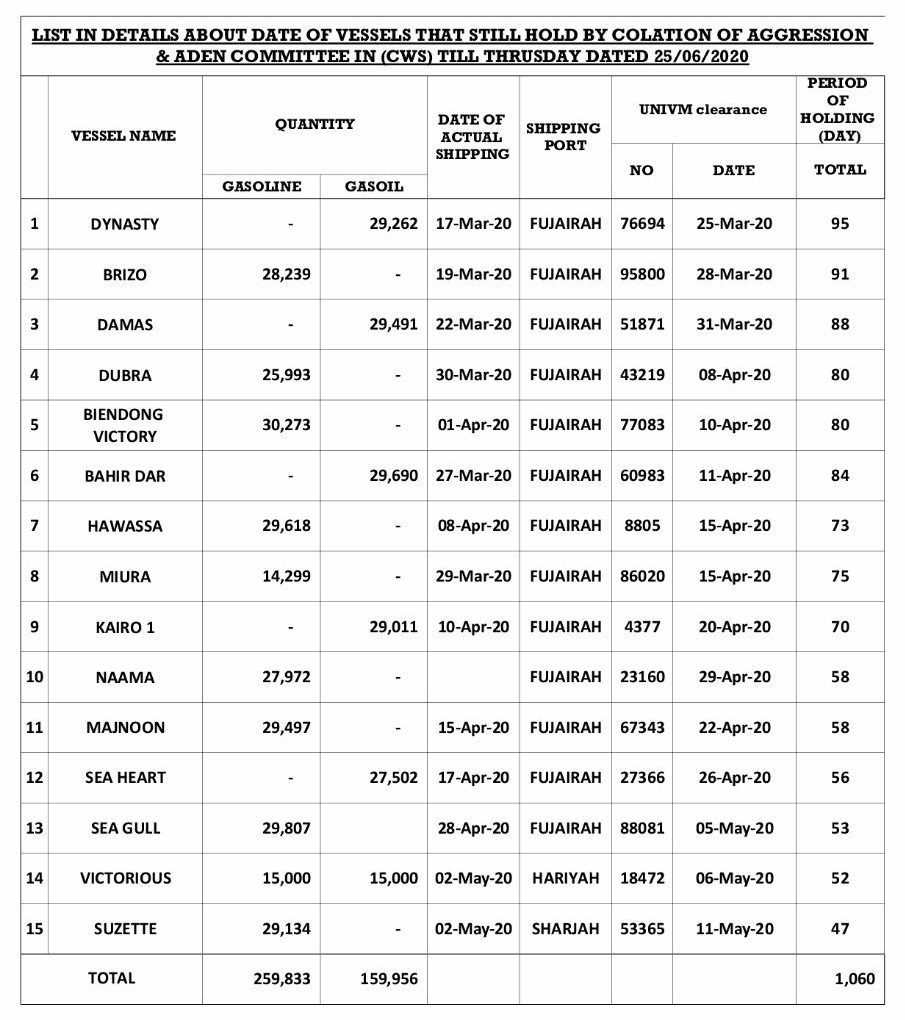
According to a statement released by the Yemen Oil Company, at least 15 tankers carrying over 419,789 tons of fuel have been trapped at sea for over a month despite being checked and issued permits by both the Saudi-led Coalition and the United Nations. Now, the situation in the war-torn country is no longer tolerable.
The CEO of Yemen Oil said in a press conference held in the front of the United Nation office in Sana’a on Wednesday that the company’s remaining reserves won’t last for more than a few days. A statement issued by the company’s branch in Hodeida confirmed that its reserve stock had reached a critical stage and is no longer sufficient to supply the most important sectors in the country.
“One of the biggest threats in the past 100 years”
This is not the first time that Saudi Arabia has triggered a fuel crisis in Yemen, however, this blockade is significantly larger than previous ones and comes at a time when Yemen is battling COVID-19, which is spreading rapidly across the country. “It is the worse than what we expected to happen,” taxi driver Mohammed Abdullah Masoud said from beneath his mask, bags under his tired eyes. He had been waiting in line for two days for petrol. His older brother died last week from COVID-19 and he is now responsible for providing his brother’s wife and children with food and medicine as they stay quarantined at home. “My brother’s family needs bread and some vegetables. Nobody except me can provide them with essential necessities to stay alive. If I don’t have the fuel by the end of the day, something bad could happen to them.” he told MintPress.
The Saudi fuel blockade has not only forced thousands of Yemenis already struggling against an unprecedented explosion of famine, disease, and epidemics to wait for days in lines as far as the eye can see, it has also left water pumps, hospital generators, and transport vehicles without fuel and that lack of fuel has accelerated the spread of the COVID-19 as empty generators shut down facilities including an oxygen factory, hospital, nurseries, and a kidney failure center, all which need uninterrupted and stable electricity 24 hours a day.
Cholera, dengue fever, and malaria rates have also spiked, particularly in Hodeida, Sadaa, and Hajjah where summer temperatures can reach 129 degrees and the lack of fuel has left residents unable to escape the heat as the generators used to power air conditioners sit idle.
The price of food and medicine is also skyrocketing and the already negligible crops in Yemen are at risk of dehydration as farmers are unable to power the wells and pumps needed o to irrigate their fields. At least 80 percent of Yemen’s 28 million-strong population is reliant on food aid to survive in what the United Nations has called the world’s worst humanitarian crisis and the decimation of the remaining agricultural sector is likely to increase that figure.
On Wednesday, Mark Lowcock, the United Nations Under-Secretary-General for Humanitarian Affairs and Emergency Relief Coordinator, told a closed UN Security Council meeting that many more people are likely to starve to death, succumb to COVID-19 and die of cholera, adding that the coronavirus was spreading rapidly across Yemen and about 25 percent of the country’s confirmed cases have died – “five times the global average.”
He added, “We have never before seen in Yemen a situation where such a severe acute domestic economic crisis overlaps with a sharp drop in remittances and major cuts to donor support for humanitarian aid – and this of course is all happening in the middle of a devastating pandemic.” For her part, UN Humanitarian Coordinator Lise Grande described COVID-19 in Yemen as “one of the biggest threats in the past 100 years.”
The Saudi blockade comes amid sustained Saudi-coalition bombing runs. Warplanes have been hovering over Sana’a and other provinces and have targeted several areas in Bydha, al-Jawf, Marib, and Sana’a, killing and injuring dozens of people. On Thursday, at least five people were killed and dozens were injured when Saudi warplanes destroyed four cars traveling on public roads in Radman and Qaneih.
The only effective option
Despite the challenges, Yemenis have strong morale and a seemingly unbreakable will to continue to withstand the Saudi ambitions for their country. “We die silently but with glory. We will never give in to Saudi Arabia,” 37-years-old Hamid told MintPress as he stood in a fuel line at a gas station in Sana’a. It has become a weekly ritual for Hamid, who queues in line for hours to get 30 liters of fuel every seven days. Hamid and the others waiting in line were gleefully checking their social media feeds and celebrating news reports that explosions were taking place in the Saudi capital following attacks bu the Houthi-led Yemeni Army.
In retaliation for the fuel embargo and the continued airstrikes on their country, the Houthi-led Yemeni army carried out large-scale attacks on a number of strategic sites in Saudi Arabia using a barrage of ballistic and winged missiles and drones which targeted the headquarters of the Saudi Defense Ministry and the General Intelligence Agency as well as King Salman Air Base, among other military targets in the capital Riyadh and the southern regions of Najran and Jizan. For many, retaliation against the Kingdom represents the only effective option to quell the Saudi attacks and blockade on their country.
Mohammed Abdulsalam, the spokesman and chief negotiator for Ansar Allah, the political wing of the Houthis, emphasized that the operation was aimed at restoring stability to the country and securing an end to the Saudi-led blockade. He said that Yemenis have no option but to confront and resist Saudi Arabia and urged international bodies to pressure the Saudi regime into ending the offensive.
The Saudi-led coalition has acknowledged the attacks but claims that the missiles and drones were intercepted and destroyed but provided no evidence to back that claim. Coalition spokesman Colonel Turki al-Malki called the strike a “deliberate and systematic operation to target civilians and civilian objects,” adding later that the coalition had “ intercepted” eight bomb-laden drones and three ballistic missiles. A high-ranking Houthi official told MintPress that the raids did indeed hit their intended targets, adding the army used a new weapon in the attack that will be soon be revealed.
The United States and other countries, including France and Britain, condemned the attack on their Saudi ally. They have thus far remained silent on the recent Saudi attacks and fuel blockade on Yemen which preceded the attacks on Saudi Arabia. Yemenis have accused Western countries of abandoning their much-touted commitment to human rights in exchange for Saudi arms deals. “We are killed by weapons belong[ing] to these countries, and get nothing from them except dirty statements that offend their [own] people,” a Yemeni tribal leader who spoke on condition of anonymity for fear of reprisals, told MintPress in response to the U.S. condemnation.
For their part, Ansar Allah censured statements condemning their retaliatory attacks. Abdulsalam said that “condemnations of our operations are no longer effective. They come within the framework of political courtesies and are in part funded by Saudi Arabia.” He insisted that Western countries should instead pressure the kingdom to stop the war. “The American administration practices the most heinous looting of Saudi money,” he added, “The statement of the American mission in Saudi Arabia following our operation is a kind of blackmail, nothing else.”
The Yemeni attacks are the tip of the iceberg as multiple high-ranking officials in the Houthi-backed Yemeni Army revealed to MintPress that they are preparing more attacks against targets in Saudi Arabia, including on oil facilities, royal palaces, military bases, airports, Saudi oil carriers, and other “sensitive targets” that they declined to mention. The consequences for Saudi Arabia will be dire until the blockade is lifted and the offensive comes to an end, they promise. “We should not let Saudi Arabia starve us and carry on enjoying stability and wealth.”
The Saud-led Coalition is heavily backed by Western countries, especially the United States, Britain, and Frace, which have used systematic economic strangulation as a weapon of war — targeting jobs, infrastructure, the agricultural sector, fuel and water pumping stations, factories, and the provision of basic services, as well as imposing a land, sea, and air embargo.
Meanwhile, as a direct result of the oil blockade, many Yemeni officials say that they are already seeking assistance from Iran, hoping that the Iranian government will come to their aid as they did in Venezuela, where six Iranian vessels carried fuel, food, and medicine to Caracas in defiance of U.S. sanctions. They asked Ansar Allah to work with Iran to circumvent the blockade and supply the vital facilities in the country with fuel. If such a move is carried out, Tehran will no doubt win the hearts and minds of Yemenis wary of any foreign intervention, all thanks to the Saudi-led coalition and the United States which in large part are carrying out the war with hopes to limit “Iranian influence” in Yemen.
Ahmed AbdulKareem is a Yemeni journalist. He covers the war in Yemen for MintPress News as well as local Yemeni media.
Despite court ban, UK continues arms sales to Saudi Arabia: Report

Smoke billows following an airstrike by Saudi-led coalition in the Yemeni capital, Sana’a, June 16, 2020. (Photo by AFP)
Press TV – June 21, 2020
The British government has apparently turned a blind eye to a landmark court ruling that restricts the sales of arms to Saudi Arabia for use against Yemen.
According to a report published by the British daily Guardian on Sunday, the court of appeals declared last year that British arms sales to the kingdom were “unlawful,” and accused ministers of ignoring whether airstrikes that killed civilians in Yemen broke humanitarian law.
At the time, the court barred the UK government from approving any new license to Saudi Arabia and ordered then Secretary of State for International Trade Liam Fox to hold an immediate review of at least 4.7 billion pounds’ worth of arms deals with Saudi Arabia.
British international trade authorities said at the time that the process would take “up to several months.”
Nevertheless, arms exports continue without properly assessing the risk to civilians, a year after the verdict, and fighter jet components as well as aircraft maintenance services are being offered to the Riyadh regime.
British multinational defense, security, and aerospace company BAE Systems, which is recognized as the UK’s largest arms exporter to Saudi Arabia, confirmed in its 2019 report that it continues to provide the kingdom with support services for twin-engine and multirole Eurofighter Typhoon warplanes under a contract struck in 2018.
Lately, Shadow Secretary of State for International Trade Emily Anne Thornberry, together with members of other opposition parties, wrote a letter to Secretary of State for International Trade Liz Truss in protest at the arms licenses that continue to operate.
“We are left to assume that – despite being ordered to review these licenses by the courts, and having 12 months to do so – your department has simply chosen not to comply,” they argued.
They warn that the British government’s expected failure to comply “creates the illogical situation where a UK company that applies for a license today will have that application rejected, but another company that was granted its license prior to 20 June last year may export exactly the same arms without restriction.”
Andrew Smith, of the Campaign Against the Arms Trade, said, “The UK government has consistently put arms company interests ahead of the rights and lives of people in Yemen. The government has proven that it cannot be trusted to implement its own rules.”
The United Kingdom has reportedly licensed the sale of arms worth over 5.3 billion pounds to Saudi Arabia ever since Riyadh and a number of its regional allies launched a devastating war on Yemen in March 2015 in order to bring former President Abd Rabbuh Mansur Hadi back to power and crush the Houthi Ansarullah movement.
The US-based Armed Conflict Location and Event Data Project (ACLED), a nonprofit conflict-research organization, estimates that the war has claimed more than 100,000 lives over the past five years.
Russia: UN chief report blaming Iran for attacks on Saudi oil facilities not based on convincing evidence
Russian Foreign Ministry spokeswoman Maria Zakharova
Press TV | June 17, 2020
The Russian Foreign Ministry says the UN chief’s report on Iran’s involvement in the last year attacks on Saudi oil facilities is biased and not substantiated by facts.
“What we surely won’t argue with is, unfortunately, that the report can hardly be called balanced and calibrated,” the ministry spokesperson Maria Zakharova said during a press briefing on Wednesday.
She added Russia will present a “detailed analysis” of the UN report during the relevant discussion at the Security Council later on June 30.
“We can also speak about a lack of impartiality and the absence of strong facts to support the accusations leveled at Iran,” she noted, stressing “Nobody has ever presented any convincing evidence of Iran’s violations to the Security Council members.”
The Russian official said that the report was not valid, arguing the “self-appointed inspectors” had claimed based on their “personal observations” that what they saw was “roughly reminiscent of what Iran had once demonstrated at arms exhibitions.”
Last week, UN Secretary General Antonio Guterres said in a report to the Security Council that cruise missiles used in attacks on oil facilities and an airport in Saudi Arabia last year were of “Iranian origin.”
He also said the “items may have been transferred in a manner inconsistent” with UN Security Council Resolution 2231, which endorses the international nuclear deal – officially known as the Joint Comprehensive Plan of Action (JCPOA) – signed between Iran and major world powers in 2015. The allegations were roundly rejected by Iran’s Foreign Ministry.
The ministry said in a statement that the claims appear to have been made under political pressure from the US and Saudi regimes.
“Preparing reports with political motivation will not change the facts and it is clear to all that the current circumstances in the region have directly resulted from the wrong policies of the United States and the child-killing Saudi regime,” the statement said.
The ministry highly recommended that the UN Secretariat not play into the hands of the US in its “pre-planned scenario to annul the cancellation of Iran’s arms embargo.” It also warned the UN against contributing to such a dangerous trend by preparing illegal reports.
Separately, Iran’s UN Mission also responded to the report on Friday, saying, “Iran categorically rejects the observations contained in the report concerning the Iranian connection to the export of weapons or their components that are used in attacks on Saudi Arabia and the Iranian origin of alleged US seizures of armaments.”
US President Donald Trump withdrew Washington from the JCPOA in 2018 and reinstated Washington’s unilateral sanctions against Tehran. His administration has also been piling up pressure on the United Nations to extend and strengthen the embargo on Iran, which is set to expire in October under the nuclear deal.
Washington seeks to restore all Security Council sanctions lifted against Iran if the 15-member body fails to preserve the UN ban on selling conventional arms to Iran.
Lebanon PM says coup attempt fell apart after violent riots
Press TV – June 14, 2020
Lebanon’s Prime Minister Hassan Diab has condemned the recent violent street protests, saying they were an attempt by opponents to overthrow his government and deepen a currency crisis in the debt-ridden country.
Diab made the remarks in a televised address late Saturday after demonstrations rocked the cities of Beirut, Tripoli and Sidon on Thursday, with participants calling for the government’s resignation.
Diab said his political opponents were stirring unrest in a bid to thwart the government’s fight against corruption.
The unrest was “a programmed campaign organized by parties known by name and method of thinking that are not deterred from using any method to shatter the image of others,” Diab said.
However, the Lebanese administration enjoys “a high percentage of citizens’ confidence, which has disturbed many of those who bet on its failure” and try to pump “lies and rumors to prevent the government from removing the rubble under which the secrets of corruption disappear,” he added.
Diab took office in January with Hezbollah’s backing, putting an end to a nine-month political deadlock amid an economic crisis and nationwide protests against the nation’s ruling class.
In his televised address Saturday, the Lebanese premier censured efforts to mount a “coup” against the government and manipulate the value of the Lebanese pound.
“The state and the people are being subjected to blackmail,” Diab said as he vowed to defeat graft in the cash-strapped country.
“The coup attempt fell apart and all secret and public meetings and orders of internal and joint operations to stop discovering of corruption failed as well,” he added.
Anti-government protests broke out in Lebanon on Thursday after a rapid devaluation of the national currency against the US dollar. The Lebanese pound has lost some 70 percent of its value over the past several months.
The crash in the Lebanese pound’s value and subsequent unrest coincided with the unveiling of the biggest-ever US sanctions package against Iran, which also targets Lebanon.
The 115-page strategy document put together by the Republican Study Committee (RSC), the largest Republican caucus in Congress, called for a halt of all US security assistance to Beirut, claiming that millions of dollars given to Lebanon were being used to aid Hezbollah.
The US gives about $160 million to the Lebanese armed forces each year.
The Republican document specifically calls for sanctions against Hezbollah allies, mentioning former foreign minister Gibran Bassil and incumbent Parliament speaker Nabih Berri by name.
Back in 2016, Saudi Arabia also declared that it was canceling $4 billion in aid to Beirut, $3 billion of which was earmarked for the Lebanese army.
Latest street rallies resembled those that broke out in Lebanon on October 17, 2019, when the government introduced a set of economic austerity measures.
Then prime minister Saad al-Hariri resigned almost two weeks later under pressure from protesters, touching off a period of political turmoil at a time of acute economic crisis.
In December 2019, Diab was tasked with forming the new administration and the following month, he managed to form a government after Hezbollah and its allies agreed on the new cabinet.
The downward political spiral for Hariri followed his humiliating saga in Saudi Arabia where he announced his surprise resignation in November 2017, apparently under the orders of Saudi rulers.
Hariri rescinded his withdrawal after returning to Lebanon, apparently putting himself on a collision course with his Saudi mentors, which culminated in his resignation amid violent riots.
According to a UN report, Hariri was verbally humiliated and beaten after being summoned to Riyadh in 2017. He was reportedly abducted and taken to the Riyadh Ritz-Carlton hotel where he was interrogated and subjected to “cruel, inhuman and degrading” treatment.
Iran dismisses UN report on missiles ‘of Iranian origin,’ says body under US, Saudi pressure
Press TV – June 12, 2020
Iran has dismissed a recent claim by the United Nations that missiles used to attack Saudi Arabia have been “of Iranian origin,” saying the organization has spoken out under political pressure from the US and the Saudi regime.
In a statement on Friday, the Iranian Ministry of Foreign Affairs said it was deeply concerned about the use of the UN Secretariat as a means to achieve political objectives.
“Preparing reports with political motivation will not change the facts and it is clear to all that the current circumstances in the region have directly resulted from the wrong policies of the United States and the child-killing Saudi regime,” the statement said.
UN Secretary General Antonio Guterres told the Security Council in a report seen by Reuters on Thursday that cruise missiles used in several attacks on oil facilities and an international airport in Saudi Arabia in November 2019 and February 2020 had been of “Iranian origin.”
He also said the “items may have been transferred in a manner inconsistent” with Security Council Resolution 2231, which enshrines the international nuclear deal – officially known as the Joint Comprehensive Plan of Action (JCPOA) – signed between Iran and world powers in 2015.
Guterres pointed out in his report that the United Nations had examined the debris of weapons used in the attacks on an oil facility in Afif in May, the Abha international airport in June and August, and the Aramco oil facilities in Khurais and Abqaiq in September.
Referring to the “examination of the weapons debris,” the Iranian Foreign Ministry censured the inattention to the sales of lethal weapons to Saudi Arabia that are used against the defenseless people of Yemen while “Saudi garbage is being checked for proof.”
“Undoubtedly, such reports will not only fail to help [promote] peace and security in the region and implement [UN] Security Council resolutions, but also completely destroy the validity and reputation of the United Nations,” the ministry warned.
It said the UN report came at a time that the United States is drafting a “dangerous” resolution to “illegally” extend an arms embargo against Iran, adding this would strengthen the likelihood of it being prepared on Washington’s order to be used at the Security Council against Iran.
The Iranian Foreign Ministry highly recommended that the UN Secretariat not play into the hands of the US in its “pre-planned scenario to annul the cancellation of Iran’s arms embargo.” It also warned the UN against contributing to such a dangerous trend by preparing illegal reports.
In May 2018, President Donald Trump unilaterally pulled the United States out of the JCPOA and later re-imposed the sanctions that had been lifted against Tehran and began unleashing the “toughest ever” bans.
Although the US is not a party to the JCPOA any longer, it recently launched a campaign to renew the Iran arms ban — in place since 2006/2007 – through a resolution at the Security Council. Russia and China are against the push, and most likely to veto it.
To circumvent the veto, the US says it will argue that it legally remains a “participant state” in the nuclear pact only to trigger the snapback that would restore the UN sanctions, which had been in place against Iran prior to the JCPOA inking.
Tehran says Washington, through its unilateral withdrawal from the deal, has forfeited all rights to have a say in the agreement.
European Union foreign policy chief Josep Borrell said on Tuesday that the US has already pulled out of the JCPOA and cannot currently use its former membership of the deal to seek a permanent arms embargo on Tehran.
“The United States has withdrawn from the JCPOA, and now they cannot claim that they are still part of the JCPOA in order to deal with this issue from the JCPOA agreement. They withdraw. It’s clear. They withdraw,” Borrell said.
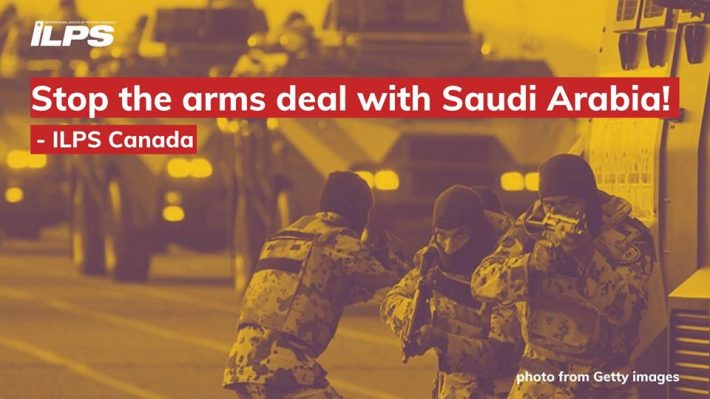
Stop Canada’s arms deal with Saudi Arabia!
International League of Peoples’ Struggle, Canada | June 12, 2020
After stalling for two years, the Canadian government has renegotiated a sale of light armored vehicles to Saudi Arabia for $14 billion. The deal was put on hold in 2018 because of political pressure against Saudi Arabia’s war on Yemen and the murder of Jamal Khashoggi, a journalist. This news is jolting because, in December 2018, Prime Minister Justin Trudeau had said he would not go ahead with the sale. However, the Minister of Foreign Affairs Francois-Philippe Champagne announced that the contract was back on the table on Thursday, April 9, 2020.
The government claims it must proceed with the deal because thousands of jobs and substantial revenues might otherwise be lost. General Dynamics is the supplier building the vehicles to be sold. The government its sales rep. General Dynamics stands to lose profits from the transaction. However, it could be involved in the manufacture of other machinery for domestic and foreign use.
In response to the objection that the items to be sold to Saudi Arabia will likely be used for war, Minister Champagne tells the people not to worry.
“Under our law, Canadian goods cannot be exported where there is a substantial risk that they would be used to commit or to facilitate serious violations of international humanitarian law, international human rights law or serious acts of gender-based violence.” (The Defense Post, April 10, 2020).
If that is the case, then, no military items should be exported. Champagne added that there are protections in that export permits be delayed or canceled if it learns of goods sold not used for the buyers’ stated purposes. Well, it is pretty clear that military items are for military use, just as it is clear that Saudi Arabia is an aggressor who will likely use military equipment in its aggression against Yemen and elsewhere. Saudi Arabia is committing human rights violations and crimes against humanity. The fact that the war inhibits health care and safety responses to COVID-19 is even more reprehensible.
The Canadian Chapter of the International League of Peoples’ Struggles has opposed all military contracts with Saudi Arabia all along. We have stood in solidarity with the people of Yemen who have been suffering under assault after assault by Saudi forces, calling for Saudi Arabia keep its hands off Yemen. According to Dr. Yahyia Mohammed Saleh Mushed of the Union of Arab Academics at Sana’a University, the war has displaced around 200,000 people and left the country in misery (Sanctions Kill webinar, May 31, 2020). We deplore the coalition states (US, UK, France and Canada) that arms and supports these assaults. Furthermore, we find no justify for the blockade against Yemen, and join in the calls for the illegal economic coercive measures against Yemen and all countries to be lifted, especially in view of the humanitarian concerns during a pandemic.
Canada has been on the war path for the past two decades. It stands by the US imperialist war machine steadfastly and plays a deadly role as its most fervent ally. It itself is an imperialist state with ambitions for market expansion abroad. Prime Minister Justin Trudeau voices intolerance against states that dare to follow an independent course away from the dictates and norms set by the US. His negative relations with Venezuela are the starkest example. Also, his government has been increasing the national military budget and expanding the Canadian armed forces, favouring more active engagement. Money for health care and housing has been siphoned for the folly of war.
Now with the determination to rise against domestic militarization and resist its racist blades, let us also decry international militarization and organize to dismantle NATO, the US military bases and imperialist military agreements, and send the troops home. Let us expose and put pressure against the arms trade that encourages instability and feeds off bloody conflict. Let us call for a reduction of military budgets and redirect more tax money into social services and regional economic development.
Stop the Sales of Arms to Saudi Arabia!
Reject the arms trade!
Stop US and Canadian imperialism!
Dismantle NATO!
Close all foreign military bases!
End the coercive economic measures against all targeted countries!
International League of Peoples’ Struggle is an an alliance of organizations and movements that promotes, supports and develops the anti-imperialist and democratic struggles of the peoples of the world against imperialism and all reaction.
Denmark summons Saudi envoy over Riyadh’s support for anti-Iran terror group
Press TV – June 11, 2020
Denmark has called in the Saudi ambassador to Copenhagen to protest the kingdom’s support for a notorious terrorist group behind a 2018 deadly attack in Iran’s southwestern city of Ahvaz, among its other terrorist crimes against Iranians.
Riyadh’s envoy was summoned to the Danish Foreign Ministry on Wednesday after terrorism charges were leveled against three leaders of the anti-Iran al-Ahvaziya terror group based in Denmark.
Danish police said they were prosecuting “three people for financing and promoting terrorism in Iran, including in collaboration with a Saudi intelligence service.”
The suspects are believed to have received funds from Riyadh, which has been pursuing a highly hostile Iran policy under Crown Prince Mohammed bin Salman.
Meanwhile, Danish Security and Intelligence Service (PET) stressed that the trio worked for the Saudi regime between 2012 and 2018.
PET chief Finn Borch Andersen said it is “completely unacceptable” that Denmark is used “as a starting point to finance and support terrorism.”
“We will not accept such activities under any circumstances and our ambassador in Riyadh has repeated the same message directly to the Saudi authorities,” Danish Foreign Minister Jeppe Kofod said in a statement.
In February, Denmark said its intelligence service had arrested and charged three members of the Saudi-backed terror group for spying on behalf of the kingdom in the Scandinavian country.
Al-Ahvaziya has committed numerous crimes against Iranian targets over the past decades, among them bomb attacks in public places, abductions, assassinations, kidnapping for ransom, shooting at tourists and blowing up oil pipelines.
Formed a few years after the 1979 Islamic Revolution in Iran, the terror group was inspired back then by the Baath regime of Iraq’s ex-dictator Saddam Hussein.
Al-Ahvaziya has been after separating the southwestern province of Khuzestan — home to the country’s Arab population — from the rest of Iran through engaging in armed conflict against the Iranian government.
In September 2018, the Saudi-backed terror outfit claimed responsibility for a deadly attack on military parade in Ahvaz, Khuzestan’s provincial capital. The assault killed 25 people, including members of Iran’s Islamic Revolutionary Guard Corps (IRGC) and civilian bystanders, and injured 70 others.
Shortly after the attack, the London-based “Iran International” television channel funded by Saudi Arabia allowed the al-Ahvaziya spokesman to go live on air to defend the bloodshed.
In parallel, the Daesh Takfiri terrorist group also claimed responsibility for the Ahvaz attack.
In response, Iran launched missiles on gatherings of the ringleaders of the terror attack Ahvaz based in an area east of the Euphrates in Syria, killing and injuring a number of them and inflicting heavy losses on their stronghold.
Riyadh is widely viewed as a key sponsor of Takfiri terrorists, who are inspired by Wahhabism, an extremist ideology preached by Saudi clerics.
Saudi Arabia exempts Western arms purchases from austerity plan: FT
Press TV – June 7, 2020
Saudi Arabia is reportedly continuing to import weapons from Western countries, especially the United States, despite austerity measures taken recently to handle the kingdom’s worst financial crisis in decades.
Saudi Arabia posted a $9 billion budget deficit in the first quarter of 2020 due to plummeting oil prices and the novel coronavirus (COVID-19) pandemic.
Riyadh announced last month that it will suspend the cost of living allowance for state workers and raise the value added tax threefold in a bid to boost state finances.
However, the Financial Times reported on Sunday that the kingdom’s military expenditure emerged unscathed from the tough austerity measures, citing military contracts signed with American arms giants.
A Western arms industry executive based in the Persian Gulf quoted top Saudi officials as saying that there would be no military cuts.
“I was fully expecting there to be a cut, but the information from very senior levels and princes is ‘no, we’re not going to do it. In fact, don’t come and ask me if your program is going to slip, keep working hard at it, because we are just carrying ahead,’” the executive said.
“We’ve got a large number of requirements popping in through the door.”
The report cited the Pentagon’s contracts worth more than $2.6 billion for the delivery of more than 1,000 air-to-surface and anti-ship missiles to Saudi Arabia.
The US arms manufacturer Lockheed Martin, which supplies THAAD missiles to Riyadh, also told the Financial Times that it had “not seen a backing off of expenditures on defense” by any of its main Middle Eastern customers.
Robert Harward, chief executive of Lockheed’s Middle East unit, said although it was too early to judge, he expected that customers, including Saudi Arabia, “will continue with their procurement”.
“Regional threats are not receding and are more unpredictable than ever,” he said. “Countries will have to make choices on budgets, as countries always have to do.”
Another Persian Gulf-based military executive confirmed that his company had not witnessed “any shift in attitudes from the customers,” but suggested that it could still change, the FT added.
Meanwhile, the Saudi Finance Ministry stressed that the kingdom would “continue to support our military needs.”
The ministry said it had been working to rationalize spending to ensure the country got military equipment “for the right cost for the right quantity with the right specification”.
Saudi Arabia was the world’s largest weapons importer in 2015–19, according to the Stockholm International Peace Research Institute (SIPRI). The regime’s imports of major arms increased by 130 percent compared with the previous five-year period.
The kingdom is stuck in a costly war on Yemen it launched in March 2015 in a bid to reinstall the former Saudi-backed regime and crush the popular Houthi Ansarullah movement.
However, over five years into the Western-sponsored war, Saudi Arabia has achieved neither of its objectives and instead plunged Yemen into what the UN says is the world’s worst humanitarian crisis.
Riyadh is the largest buyer of American-made weaponry. US President Donald Trump signed an arms deal worth $110 billion with Saudi Arabia in May 2017 on his first foreign trip since becoming president.
Before his presidency, he had described the kingdom as “a milk cow” which would be slaughtered when its milk ran out.
Saudi-led coalition conducts 47 new airstrikes on Yemen
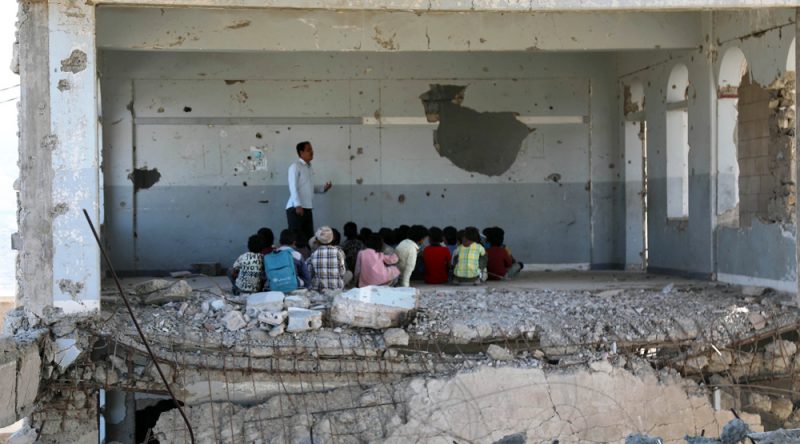
Children listen to their teacher in a destroyed classroom at a school which was heavily damaged in a Saudi-led airstrike, in Ta’izz, Yemen, on September 3, 2019. (Photo by AFP)
Press TV – May 28, 2020
Warplanes from the Saudi-led military coalition waging war on Yemen have carried out 47 airstrikes on different parts in the country, further destroying the impoverished country’s infrastructure.
Yemen’s Arabic-language al-Masirah TV cited an unnamed Yemeni military source as saying on Wednesday that the Saudi-led fighter jets had pounded localities in Yemen’s Ma’rib, Jawf, Sa’ada, and Hajjah provinces during the previous hours.
Majzar and Midghal districts in the central province of Ma’rib were struck 19 times, and Khasf Village in the Hazm district in the northern province of Jawf were pounded five times, the source said.
The airstrikes inflicted heavy damage on infrastructure in those localities.
According to the report, the Saudi-led coalition also violated a ceasefire in the western province of Hudaydah 67 times during the previous hours, killing at least one civilian.
Supported militarily by the US, the UK, and other Western countries, Saudi Arabia and a number of its regional allies launched the devastating war on Yemen in March 2015 to subdue a popular uprising that had overthrown a regime friendly to Riyadh.
The US-based Armed Conflict Location and Event Data Project (ACLED), a nonprofit conflict-research organization, estimates that the war has claimed more than 100,000 lives over the past five years.
More than half of Yemen’s hospitals and clinics have been destroyed or closed during the war by the Saudi-led coalition at a time when Yemenis are in desperate need of medical supplies to fight the COVID-19 pandemic.
At least 80 percent of the 28-million-strong population is also reliant on aid to survive in what the United Nations (UN) has called the world’s worst humanitarian crisis.
US lowers threat perception on Iran
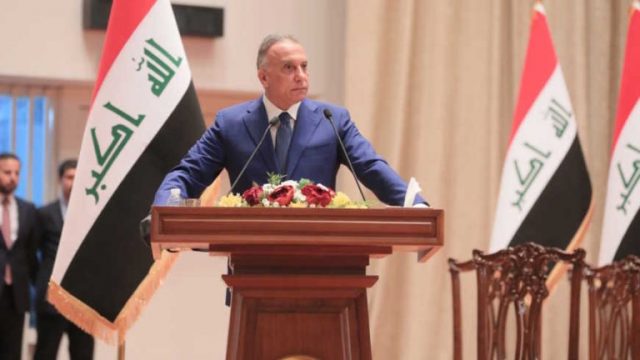
Iraq’s new Prime Minister Mustafa al-Kadhimi won vote of confidence in the parliament in Baghdad on May 7, 2020
By M. K. BHADRAKUMAR | Indian Punchline | May 9, 2020
The drawdown of US military presence in the Middle East, especially from Saudi Arabia, may not be an automatic open sesame — to borrow the magical phrase in the story of “Ali Baba and the Forty Thieves”— leading to the hidden treasure of regional peace and stability, but it does open up a tantalising vista that is seamless in its possibilities.
Speculations are galore about the Pentagon announcement Thursday that the US military will withdraw two Patriot batteries, which have been deployed to protect Saudi oil facilities, along with two jet fighter squadrons.
US President Donald Trump added an ambiguous explanation: “We’re making a lot of moves in the Middle East and elsewhere. We do a lot of things all over the world, militarily we’ve been taken advantage of all over the world… This has nothing to do with Saudi Arabia.” Trump seems to suggest there is a ‘big picture’.
Nonetheless, the move is seen as a showdown between the US and Saudi Arabia, where Washington says to Riyadh that if you do not follow our oil advice, we will throw you under the bus. The fluctuations in the oil market have put strains on the ties binding the two staunch allies and the US oil industry has been hit doubly hard, since even after the recent OPEC+ deal, oil prices continue to fluctuate at the expense of American producers even as Saudi oil tankers reach the US, selling their commodity at lower prices to American buyers, which Washington’s oil industry cannot possibly compete with.
With the storage capacity in the US industry dwindling, the highest ever number of Saudi oil tankers in years are on their way to American shores. Riyadh appears to be flooding the market to drown the shale industry. The mood in Washington has turned ugly, as Trump’s allies in the Congress whose states have been hurt by the price crash, sought a mitigation measure — the Strained Partnership Act — which threatened to punish the Saudis by way of pulling troops and reducing other military commitments unless Riyadh reduced its oil output.
Without doubt, the American oil crash in the wake of the pandemic has taken its toll on US-Saudi relations. But, having said that, Trump cannot be unaware that any US-Saudi friction at this juncture can only work to Iran’s advantage insofar as the coronavirus pandemic is providing an opening to challenge the US presence in Iraq and other places in the Middle East. Top Iranian military officials have openly said in recent weeks that they see the US at its weakest in a while.
Tehran seems to settle for a ‘wait-and-see’ approach until the November election in the US is over, refraining from escalating tensions. Tehran can afford to wait, since the US’ Gulf allies — the UAE, Kuwait, Oman, Qatar — are no longer pushing the US into a confrontationist policy but instead engaging with Iran. There is growing disenchantment in the region regarding the consistency of the US policies.
What lends enchantment to the view is that some easing of US-Iran confrontation is also discernible. Most certainly, the establishment of a new government in Baghdad under Prime Minister Mustafa al-Kadhimi harks back to a priori history of tacit US-Iranian co-habitation in Iraq.
Al-Kadhimi is a secular-minded figure who does not belong to any of the Shi’ite political parties and yet he won with the votes of the Fateh Coalition, the second largest in the Parliament, made up of Shiite political parties that have close ties to Iran.
He briefly lived in Iran as a dissident but moved on to life in exile in UK and the US — and yet, he’s an acceptable choice to Tehran. He is close to the Washington establishment, which is open to making deals with him, and also enjoys personal rapport with the Saudi Crown Prince Mohammed bin Salman, but Tehran is unperturbed and seems to estimate that he is both pragmatic and can also be tough with the US in a way that no Iranian-backed candidate can be.
Above all, Al-Kadhimi is smart enough know Iran’s support is vital if his government is to perform effectively. The hugely sensitive post of Interior Minister in his cabinet has gone to Othman Ali Farhood Musheer Al Ghanimi, an ally of Iran, while the key post of Finance Minister will be held by Ali Allawi, a pro-western figure and nephew of late Ahmed Chalabi. (Chalabi helped the Bush administration to topple Saddam Hussein in 2003.)
Significantly, no sooner than Al-Kadhimi’s government got parliamentary approval on May 7, Washington announced yet another waiver of sanctions against Tehran by allowing Iraq to continue to buy electricity from Iran. Now, unlike previous monthly waivers, Washington has given a 120-day waiver up to September. Tehran is sure to take note.
And this has happened while Washington and Tehran are working out arrangements for another ‘win-win’ prisoner swap. There are four Americans imprisoned in Iran, while Tehran claims “around 20” Iranians are in US custody. Then, there is also the case of a fifth American often thought to be imprisoned in Iran — Robert Levinson, a former FBI and CIA contractor.
Prisoner swaps are a low-cost way of easing tension and Trump places high priority on winning the freedom of Americans imprisoned abroad, and is quick to boast that he is doing better than Barack Obama.
Clearly, neither the US nor Iran is spoiling for a fight. Tensions will spike if the US presses ahead to get the UN Security Council to extend the arms embargo on Iran beyond October (failing which to invoke the ‘snapback’ clause of the 2015 nuclear deal to reimpose UN sanctions against Iran.)
But then, for want of support from the EU or UK, Britain and Germany — and Russia and China’s opposition — Washington may not press ahead. Trump may discuss Iran with Russian President Vladimir Putin, if the frequency of their phone conversations — six times in as many weeks already — is kept up and the range of topics broadens.
Moscow is counselling Tehran to show strategic patience in the face of US provocations. In the final lap of Trump’s term, Russia is keenly seeking an improvement of relations with the US and a showdown over Iran would spoil the climate.
Thus, there is a lull in the fighting in Syria and Iraq. A pause is noticeable in militia attacks on US troops in Iraq in recent weeks. Talks are due in June in Baghdad between Pentagon and Iraqi government regarding US deployments. Israeli officials speak of signs of an Iranian retrenchment in Syria.
Some US officials have also openly acknowledged that Tehran no longer poses an immediate threat to US strategic interests. In this backdrop, the partial drawdown of US forces in Saudi Arabia can also be regarded as a trimming of the US belligerence toward Iran.
Ansarullah slams Saudi Arabia, UAE for using television programs to promote Israel
Press TV – May 8, 2020
The leader of Yemen’s popular Houthi Ansarullah movement has slammed Saudi Arabia and the United Arab Emirates for using certain television programs to promote relations with Israel and demean the Palestinian struggle against occupation.
“Those who are directly coordinated with Israel, or through intermediaries allied with Israel, are partners in their crime,” Abdul-Malik Badreddin al-Houthi said in a speech on Thursday, according to Yemen’s al-Masirah television network.
Al-Houthi added that colluding in crimes committed by the Israeli regime was amongst “the most dangerous” of acts.
“The evils committed by the Zionists are the most significant. This is because the scope of their crimes extends to all of humanity given the large scope of Zionist influence over major countries,” he said.
“People have to avoid providing any assistance to Israel, the United States or their supporters,” al-Houthi added.
Riyadh’s pro-Israel programming
Al-Houthi’s remarks come in response to the airing of a string of media productions by certain Persian Gulf countries promoting ties with Israel.
The new “Umm Haroun” television series is one of such programs produced by the Dubai-based Saudi-owned Middle East Broadcasting Center (MBC).
The series directed by Egypt’s Ahmed Gamal el-Adl in the United Arab Emirates stars a Kuwaiti actress who plays the role of a Jewish midwife of Turkish origin living in the Persian Gulf country before settling in the occupied Palestinian territories.
Hebrew-language outlet N12 reported on Sunday that many believe Saudi Crown Prince Mohammed bin Salman is involved in the series as he is interested in closer relations between the kingdom and Israel.
The Palestinian resistance movement Hamas in Gaza denounced the TV series as a “political and cultural attempt to introduce the Zionist project to Persian Gulf society.”
Critics regard the show as an invitation to normalized ties with Israel. The show has consequentially provoked a storm in the Arab world.
The airing of the series has taken place as Riyadh, along with certain other Persian Gulf states such as the UAE, have moved to embrace relations with the Israeli regime, specifically in the past year.
Numerous Israeli delegations have consequently visited certain Persian Gulf states in recent months. Arab delegations from Persian Gulf states have also visited Israel.
No Arab country has formal relations with the Israeli regime, with the exception of Jordan and Egypt.
“Exit 7”: Yet another pro-Israel production
The “Umm Haroun” series is not the only MBC production seeking to promote ties with Israel to the Arab public.
“Exit 7” is another series currently being aired by the Saudi company.
According to Asia Times, the program seeks to promote various western values alongside breaking taboos regarding Israel.
Characters in the series promote “doing business with Israel” and argue against Saudi aid being sent to Palestine.
The program also disseminates blatantly anti-Palestinian themes, such as claiming that Palestinians “attack Saudi Arabia” whenever an opportunity arises.
Characters in the series also seek to legitimize Israeli occupation of Palestinian land by claiming that Palestinians “sold their land” to Jewish settlers.
Egypt, which signed a peace treaty with Israel in 1979, has disseminated similar claims of Palestinians selling their lands to Jewish settler to legitimize its ties with the Israeli regime.
According to Persian Gulf states analyst Nabeel Nowairah, MBC’s pro-Israel themes clearly “came from the high levels of the government”.
“You cannot talk about these things unless they’re approved by some agency or another. So it has the blessing of Saudi Crown Prince Mohammad bin Salman in some way,” he said.
The Arab-Israeli attempts to normalize ties come as Tel Aviv and Washington have stepped up attempts to legitimize Israeli occupation as part of US President Donald Trump’s so-called “deal of the century” initiative unveiled earlier this year.
Al-Houthi’s remarks on Thursday also come as Tel Aviv has mulled military intervention against Sana’a following the failure of the Saudi war on Yemen seeking to crush the popular Ansarullah, according to reports.
Saudi Arabia and a number of its regional allies launched the devastating war on Yemen in March 2015 in order to bring the country’s former president Abd Rabbuh Mansur Hadi back to power and defeat Ansarullah.
The Saudi-led attempt has, however, been brought to a standstill by the Yemeni resistance.
The US-based Armed Conflict Location and Event Data Project (ACLED), a nonprofit conflict-research organization, estimates that the war has claimed more than 100,000 lives over the past five years.
The UN says over 24 million Yemenis are in dire need of humanitarian aid, including 10 million suffering from extreme levels of hunger.
Riyadh makes inroads into Hollywood
The push to normalize ties with Israel comes as bin Salman has also sought to greatly westernize the kingdom ever since being appointed crown prince in 2017.
According to The Hollywood Reporter, many major US entertainment brands are bracing themselves for large Saudi investment opportunities in the near future.
Last month, Saudi Arabia was disclosed to have bought a 5.7 percent stake in the American events operator Live Nation.
According to the report, Saudi Arabia’s public investment fund has also specifically made an offer to buy the Warner Music Group, one of the three major music moguls in the US.
Many major Hollywood stars have also visited and performed in the oil-rich kingdom in the last year.
The report highlighted that Hollywood companies seeks to overlook the brutal murder of dissident journalist Jamal Khashoggi under the orders of the Saudi state in 2018 – which caused major international uproar – as they step up cooperation with the Saudi regime.
See also:
South Korea blocks test kits for Iran on Saudi-funded TV’s request
Press TV – April 19, 2020
Iran says South Korea has rejected a SWIFT payment request by Tehran for purchase of coronavirus testing kits over the US sanctions.
Iran’s Health Ministry spokesman Kianoush Jahanpour late Saturday released a document that shows a Saudi-funded TV had asked a Korean bank to reject the request.
“As a result, the Korean bank rejected Iran’s request and the kits were not delivered to Iran,” he said.
According to the document, London-based Iran International television channel falsely claimed that the SWIFT request had been made by a software company which sought to export non-medical goods to Iran.
Jahanpour released a second document which shows South Korea’s Mico BioMed, which develops and sells medical kits, had in fact presented the SWIFT request to the bank.
“The SWIFT request related [to Iran’s purchase of test kits] has been rejected by the Korean bank under the pretext of sanctions,” he said.
“This shows claims of medicine and medical equipment not being subject to sanctions are lies. The bank has officially stated that the purchase is not possible due to the sanctions,” Jahanpour added.
Belgium-based SWIFT, the Society for Worldwide Interbank Financial Telecommunication, is used to transmit payments and letters of credit.
The US government has intensified its sanctions on Iran despite international calls on Washington to suspend them to allow the Islamic Republic to secure necessary medicine and equipment in the midst of the coronavirus fight.
Washington claims the sanctions do not target medicine for Iran, but they make it all but impossible for importers to obtain letters of credit or conduct international transfers of funds through banks.
Last week, Iran’s Permanent Mission to the United Nations in New York dismissed the Swiss Humanitarian Trade Arrangement (SHTA) which the Europeans belatedly announced with much fanfare to have made operational in coordination with the US to barter medicine and food with Iran.
The mission said the United States has forced SHTA to pursue a very tight and tough procedure, making it practically very difficult for companies to trade with Iran.
“Additionally, almost impossible or cumbersome nature of transferring Iran’s reserves blocked outside the country to the designated Swiss bank, not only does not allow the SHTA to function properly now but may actually render it redundant in a matter of few months,” it said.
According to the mission, several companies that supply the medical equipment required to fight the coronavirus have recently stopped shipping to Iran because the current US sanctions regime makes the shipping of such items to Iran almost impossible.
Washington has imposed new sanctions in the midst of the coronavirus, targeting trade with Iran, even as President Donald Trump has claimed that the US was ready to help with the outbreak if Tehran asked for it.
The Islamic Republic has rejected the offer as hypocritical while the US is refusing to lift the sanctions and even intensifying them. Officials have said Washington’s demand that Tehran make a direct plea for the removal of sanctions shows the United States seeks “nothing short of surrender”.
Iran’s UN mission said last week the only message the US is sending with intensifying its sanctions amid the coronavirus is that companies must avoid doing any business with Iran, even if their work is humanitarian in nature.
Meanwhile, certain sections of mainstream media act as a virtual arm of the Office of Foreign Assets Control (OFAC) which is responsible for administering the US sanctions regime.
They have been on a witch hunt to identify Iran’s financial institutions and report them to the US government for possible sanctions.
Iran International, launched in May 2017, is a regular megaphone for separatists and terrorist groups operating against Iran. It is best known for airing disparaging reports about Iran and trying to stoke unrest in the country.
In October 2018, The Guardian cited a source close to the Saudi government as saying that Iran International had received an estimated $250 million from the Saudi royal court for its launch.
Featured Video
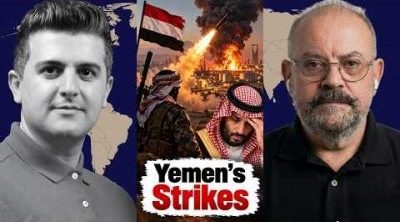
Elijah Magnier: Yemen’s strikes are shattering Saudi Arabia’s long-term strategy
or go to
Aletho News Archives – Video-Images
From the Archives
British weapons and personnel doing much of the killing in Yemen
Press TV – June 18, 2019
A detailed report published by the Guardian newspaper has shown how Britain is massively contributing to Saudi Arabia’s devastating war on Yemen as it suggests that London is not only supplying the bombs that fall on Yemenis, but it provides the personnel and expertise that keep the war going.
The comprehensive report by Arron Merat published on Tuesday showed that Britain was doing much of the killing in Yemen as the country continues to provide Saudi Arabia with everything it needs to turn its southern impoverished neighbor into a graveyard.
“Every day Yemen is hit by British bombs – dropped by British planes that are flown by British-trained pilots and maintained and prepared inside Saudi Arabia by thousands of British contractors,” said Merat in the report. … continue
Blog Roll
 Aletho News
- Racist Seinfeld Dances for Joy as Bibi Unveils His New Map
- A West Bank War for Netanyahu’s Election Campaign, Could It Backfire?
- Yemen denounces European Parliament’s ‘hypocritical’ push to blacklist Ansarullah
- Qalibaf: UAE’s UN bid aims to ‘clear the runway’ for ‘Greater Israel’, whitewash genocide
- Pakistan reopens Iran border after boosting security: Report
- Why are so many Brazilians voting for Flávio Bolsonaro?
- Democrats Put Anti-Russia Agenda Ahead of American Workers
- Elijah Magnier: Yemen’s Strikes Are Shattering Saudi Arabia’s Long-Term Strategy
- Pentagon designates Chinese cultural centers national security threat
- Israel Demolishes Home Of Lebanese Journalist Whose Viral Film Exposed Pager Attack
- If Americans Knew
- An error has occurred; the feed is probably down. Try again later.
- No Tricks Zone
- Sudden Stratospheric Warming, Powerful El Niño Combination May Lead To Extreme Europe Cold, Energy Crisis!
- Two New Studies Find Thwaites Glacier Melt Cannot Be Driven By Human Activity Or A Warming Ocean
- E-Cars Reduce CO2 Emissions By Only 41% Compared To Internal Combustion Engine Vehicles
- Predictions Made By Renowned Climate Professor Over Past Decades Have Been Proven To Be Poor
- New Study Suggests Large Regions Of The Pacific Ocean Have Been Cooling For The Last 80 Years
- Germany’s Green Energy Debacle: High Energy Costs Force Kahla Porzellan to Close After 182 Years!
- New Study: 50 Years Of The Most Aggressive ‘Net Zero’ Policies Can Only Affect The Global Climate By 0.03°C
- US September “Heat” Was No Record…Many Records Set Decades Ago
- Latest European Green Energy Debacle; Portugal’s Largest Flagship Solar Park Insolvent!
- Green Energy Debacle: German Expert Professor Fritz Vahrenholt Warns Of Severe Economic And Social Consequences