Iran no longer has any reason for restraint
By Samuel Geddes | Al Mayadeen | March 3, 2026
Tehran may well refuse US-Israeli pleas for a ceasefire until the region is transformed.
Both Trump and Netanyahu find themselves in an extraordinarily vulnerable position. They have given their greatest ideological opponent the means and the justification to extract maximum damage from them, as well as ceasefire conditions that would truly make this conflict a turning point in modern history.
President Trump clearly believed, at Netanyahu’s encouragement, that assassinating Iran’s Leader would pressure it to soften its negotiating position on the nuclear file. What he did instead was to shatter nearly a decade of Iranian restraint in the face of relentless provocation.
Trump has rendered both Washington and Tel Aviv more desperate for an end to the war than Iran. In addition to retribution for the assassination of the Leader of the Revolution, Tehran is calling in the debts of Trump’s “maximum pressure strategy” in full.
Ever since Trump’s withdrawal from the JCPOA in 2018, Tehran has attempted to limit the rate of escalation, especially following the assassination of Quds Force commander Gen. Qassem Soleimani in 2020 and others across various arenas since October 2023’s Al-Aqsa Flood.
Netanyahu’s domestic political interests have been the opposite, deliberately prolonging the genocidal onslaught in Gaza, expanding it to the West Bank, Lebanon, Syria, Yemen, Iraq, and from 2024, Iran, when it bombed the Damascus consulate. He followed up by assassinating Hamas leader Ismail Haniyeh in Tehran and much of Lebanese Hezbollah’s leadership.
By June last year, he had attained his life-long goal of drawing Washington directly into hostilities with Iran when it bombed the Natanz, Fordow, and Isfahan nuclear facilities. Now he has obliterated the ultimate red line with the airstrike that martyred Ayatollah Sayed Ali Khamenei.
As US and Israeli military sources themselves acknowledged, even before the outbreak of war, stockpiles of missile defense munitions were critically low. The 12 days of direct war between Iran and “Israel” last year cut deeply into the regime’s Iron Dome, Arrow and David’s Sling systems before Washington stepped in to impose a ceasefire.
Now that Iran and Hezbollah are unleashing their arsenal, the ability of Israel, US forces and GCC states to avoid catastrophic blows is being measured in days rather than weeks. The global supply of these munitions has been further strained by shipments sent to Ukraine and will be insufficient to resupply the West Asian theatre well before the end of this week. This will critically expose western assets not just in the region but globally, for years to come.
As of just the third day of the war, maritime traffic through the Strait of Hormuz is effectively at a standstill. In Saudi Arabia, Ras Tanura, the most crucial oil refinery in the world, has sustained impact from drones and halted operations.
Even without direct hits on regional energy infrastructure, GCC oil producers will be forced to halt production within three weeks due to a lack of storage capacity. President Trump’s favorite metric of economic performance, the stock market, is staring down the barrel of an energy shock unseen since 1973, and which may well exceed that crisis. The frail state of the US economy, combined with the global blowback to its tariff policy, could easily tip into recession or even depression. This would be shattering to the petrodollar system as well as the very status of the US Dollar as the global reserve currency.
Once Iranian missiles are unimpededly striking vital military and economic targets in “Israel” daily and inflicting mass casualties on US forces from the Eastern Mediterranean to the Arabian Sea, the Islamic Republic will be able to impose extraordinary conditions merely in exchange for a halt to the war. It will plausibly be able to demand the unconditional lifting of all Western sanctions, not just against itself, but against Yemen, Lebanon, and Gaza. It will also be able to dictate the end of Netanyahu’s regional escalation spree, forcing “Israel’s” withdrawal from Gaza, Lebanese and Syrian territories, and re-establishing a balance of terror that ensures an indefinite calm, even if a limited one.
Alternatively, it could, in emulation of Ansar Allah in early 2025, agree a separate ceasefire with Washington, leaving them a free hand to continue full-scale bombardment of “Israel”.
Assuming the intensity of hostilities doesn’t achieve this first, it could also demand the definitive withdrawal of US forces from the Persian Gulf, ending America’s hegemony over the region and the world by extension.
US ‘stonewalls’ Gulf calls for more interceptors as supplies quickly run out: Report
The Cradle | March 3, 2026
Washington has been “stonewalling” its Gulf allies’ requests for a replenishment of air defense missiles, Middle East Eye (MEE) reported, coinciding with intensifying Iranian attacks on US bases and assets across the region.
“At least one Gulf state that has come under attack from Iran asked US officials about replenishing supplies that have been depleted since the joint US-Israeli attack on Iran, but was brushed off,” a former US official familiar with the matter told MEE.
The former official said a separate Gulf state “responded to US requests to use air bases in their country with enquiries about the US’s commitment to their air defense systems,” and added that Washington’s Arab allies will “be left wanting if they expect new supplies of interceptors.”
“Whatever munitions were produced in the last couple of months, we have shot several years’ worth of production in the last few days,” the source went on to say.
The report also says pressure is growing on Arab states to join Israel and the US in their war against Iran.
Kelly Grieco at the Stimson Center think tank said, “The UAE has now burned through a significant chunk of an interceptor stockpile that took years to build.”
“US defenses focus on Israel … There is a sense of disappointment in the Gulf with our ally and partner, if we are describing that correctly, which focuses on Israel security and stability of Israel without attention to defending the Gulf states which are being subjected to Iranian attacks,” Saudi political analyst Suleiman al-Aqili told Al Jazeera.
Iranian missile and drone attacks against Israel, US military bases across the region, and major energy assets in the Gulf and Iraqi Kurdistan have not stopped since the start of the US-Israeli war. The Strait of Hormuz has also been closed.
The US Navy’s Fifth Fleet base, in particular, is among the targets being relentlessly pounded. Six US soldiers have been killed over the past few days [as per US sources].
Iraqi resistance factions allied to Tehran have also joined the fight, along with Lebanon’s Hezbollah.
Despite the mass buildup of US defenses and Israel’s sophisticated network of interceptor systems, Iranian missiles continue to make direct hits on Israeli targets.
Iran yet to deal its master blow in the region, while U.S. navy looks increasingly vulnerable
By Martin Jay | Strategic Culture Foundation | March 2, 2026
Early on Sunday morning, it was confirmed that Iran’s Supreme Leader had been killed by U.S./Israeli airstrikes, which no doubt will be seen by Trump and Netanyahu as a significant victory in their erroneous goal of regime change. But was it really one to chalk up? Reports from Iran indicate that he will be replaced almost immediately by his son, who had already been playing a key role in the country’s leadership anyway and whose appointment may well be a significantly positive step forward for the country, as many Iranians, while wanting reforms in their country, know only too well that the regime change notion is a trap set by Israel which they reject.
Iran has already scored a number of victories in a mere 24 hours, and their readiness this time was evident which, no matter how you look at the conflict, was certainly a consequence of Trump’s earlier actions in June, when he bombed Iran’s nuclear facilities with the agreement of Iran’s leaders.
No such cosy deal exists today. The Iranians have learned the hard way that Trump is not to be trusted and is not even in control of these decisions. What we are witnessing now is the start of a protracted war which will evolve on several fronts concurrently, with the Iranians in no particular hurry to proceed at a rapid pace. Their significant strikes on a U.S. naval base plus one naval ship is a taste of Iran’s ballistic missile capability which is starting to rain down on Israel itself.
The Supreme Leader’s death actually was not a great victory, given that he made no real effort to go into hiding but was killed in his office. By contrast, Benjamin Netanyahu escaped from Israel and ended up being protected by the country which pulled off the Holocaust. And so Bibi can slowly watch the disintegration of his own country while the region deals with a new reality: oil.
Oil will be a critical, decisive factor in how long Israel and the U.S. can continue with the war, as Iran lost no time in shutting off the Straits of Hormuz, while America’s fleet of ships just sat and watched. This may well be one area where Trump has seriously underestimated the consequences, as energy analysts are already predicting the climb of crude to close to $120 USD in the coming weeks. The choking of one of the most critical channels which provides 20 percent of the world’s oil supply is only part of the horror story, though, that Iran has in store for Trump and Bibi. Warned that they would be hit — or at least their U.S. military bases would be legitimate targets — GCC countries have responded in a way which will please Israel and the U.S.: Saudi Arabia has said they will both attack Iran soon, with Qatar and the UAE likely to join.
Yet such a strategy would be a colossal error of judgment and a spectacular miscalculation which will accelerate the war in Iran’s favour and force the U.S. and Israel to capitulate as Tehran strikes the Achilles heel of the whole operation. Iran can easily destroy the entire oil infrastructure of these GCC countries in a matter of hours, which would not only be a knockout blow to those countries’ economies but will have a considerable impact on world oil prices, for one strengthening Russia. For the moment, Iran doesn’t need to go this far, but if GCC countries really go ahead with their threat, it will have little choice.
Another critical area of misjudgement is the logistics of U.S. battleships operating inside the Straits of Hormuz. The straits have already been closed, and any pretensions that U.S. military planners had of taking on Iran in this ocean have been dashed by its successful destruction of the U.S. Naval base in Bahrain, which of course is played down by U.S. media whose low IQ “journalists” make themselves look even more stupid by asking Iran’s foreign minister why Iran is bombing U.S. bases. The U.S. naval base in Bahrain was a critical supply port for U.S. battleships which carry around 90 missiles on board. The destroyers which are now trapped inside the Straits of Hormuz can’t now reload if they deplete those missiles. The other ships which are on the other side of the blockade now can only restock at the U.S. base of Diego Garcia, which is three days away. To say this is a major blow to the whole operation is an understatement. It is a blunder of extraordinarily poor planning and a stroke of military genius by Iran to hit the U.S. naval base in Bahrain on day one, and it explains why the intense fury of the June retaliation last year has not been replicated. Iran is confident that its planning will defeat the enemy as it has a number of aces to play, and so its response is more measured and less frenetic. Iran has been planning this war for years, and the attack last year by Trump has just focused their minds and honed their military strategy to the point where even after 24 hours, they are looking like the victors who have a real strategy which is paying off, rather than their enemies who are dazed and confused. Is it really any wonder that sailors on the USS Gerald Ford sabotaged the toilet system on board by blocking it with T-shirts, so as to delay its voyage to the Gulf?
Gas prices spike amid fears of Middle East supply shock
RT | March 2, 2026
Gas markets around the world were rattled on Monday, with benchmark European natural gas prices rising sharply and broader energy markets on edge after Middle East tensions increased the risk to supplies via the critical Strait of Hormuz.
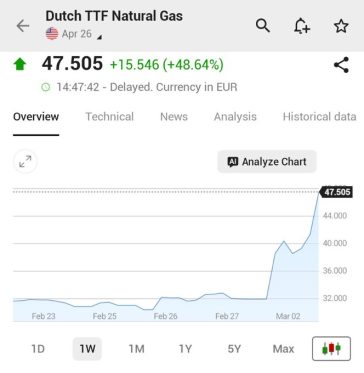 European benchmark gas futures surged by around 50% – their biggest single day move since March 2022 – after LNG tankers largely stopped transiting the Strait of Hormuz, the narrow waterway between Iran and Oman that carries about a fifth of global oil and gas shipments, over the weekend.
The spike was compounded by a drone strike on QatarEnergy’s major LNG complex at Ras Laffan, which forced production to be halted.
Crude markets also rallied, with Brent futures climbing to multi-month highs as the escalation further constrained energy flows from the region.
Across the Gulf, other energy sites have also been hit or temporarily shut, with producers suspending parts of their operations as a precaution. Saudi Arabia has reportedly paused activity at its Ras Tanura refinery following the attacks. With pipeline alternatives limited and shipping routes through the area stalling, traders are now pricing in the risk that supply lines could remain disrupted for an extended period.
Analysts warn that the turmoil could amount to the most serious shock to gas markets since the 2022 energy crisis. The EU is seen as particularly exposed. The bloc has already faced repeated jumps in energy costs since it scaled back Russian oil and gas imports following the escalation of the Ukraine conflict. Moving away from relatively cheap Russian pipeline gas has forced the bloc to lean more heavily on LNG deliveries, especially from the US. Now, with the heating season ending but storage sites less full than usual, the region requires substantial LNG imports over the summer to rebuild inventories ahead of next winter.
The rally comes as US President Donald Trump has indicated that military operations against Iran could continue for several weeks, while a number of major maritime insurers are preparing to stop covering war risks for ships entering the Persian Gulf.
Military strikes launched by the US and Israel against Iran on Saturday have shown no sign of easing. The intense attacks have reportedly killed Iranian Supreme Leader Ayatollah Ali Khamenei and other senior officials, including the head of the Islamic Revolutionary Guard Corps, while Tehran has responded with airstrikes against Israel and several Gulf states hosting US military assets. In a further sign of regional escalation, Lebanon’s Hezbollah has entered the fray with cross‑border attacks on Israeli military positions, prompting retaliatory airstrikes on the group’s infrastructure and command sites.
Analysts, including Goldman Sachs, estimate that a month‑long halt to shipping through the Strait of Hormuz could send European gas prices up by as much as 130% from current levels, putting renewed pressure on households and industry.
Kirill Dmitriev, Russia’s presidential envoy and head of the country’s sovereign wealth fund, argued that the latest price jump highlights the cost of Europe’s decision to move away from Russian fuel. In a social‑media post, he said EU gas prices “could more than double soon” and claimed that the bloc’s “strategic blunder of avoiding cheap and reliable Russian gas is backfiring.”
Israeli Opposition Leader Endorses Greater Israel

The Dissident | February 24, 2026
U.S. Ambassador to Israel, Mike Huckabee, sparked major backlash during his recent interview with Tucker Carlson, where he openly endorsed the idea of a Greater Israel, stating that “it would be fine” if Israel took large swaths of the Middle East.
In damage control mode, Zionists attempted to paint Huckbee’s claims as fringe or extreme within Israel, but Israel’s opposition leader , Yair Lapid, has confirmed that the prospect of an expansionist Greater Israel is supported even by the more supposedly “liberal” wing of the Israeli political spectrum.
When asked, “The Ambassador Huckabee said this week, and we know the extent of the American administration on the government here, that he supports Israeli control from the Euphrates to the Nile, this means [control] over Lebanon, Jordan, Syria, do you support it or do you think this should be stopped?”, Lapid replied, “I don’t think I have a dispute on the biblical level [about] what the original borders of Israel are.”
Lapid went on to endorse massive Israeli expansion, saying, “support anything that will allow the Jews [to have] a big, vast, strong land, and a safe shelter for us, for our children, and for our children’s children. That’s what I support” adding, “However possible” when asked “How vast?”.
When further asked, “Until Iraq?” Lapid replied, “The discussion is a security discussion. The fact that we are in our ancestral land… Yesh Atid’s position is as follows: Zionism is based on the bible. Our mandate of the land of Israel is biblical. The biblical borders of Israel are clear. There are also considerations of security, of policy, and of time. We were in exile for 2,000 years… you don’t really want all this lecture, right? At least you were not waiting for it… The answer is: there are practical considerations here. Beyond the practical considerations, I believe that our ownership deed over the land of Israel is the bible, therefore the borders are the biblical borders”.
Lapid even advocated that Israel take “as much as possible” of Greater Israel, saying, “Fundamentally, the great, big and vast Israel, as much as possible within the limitations of Israeli security and considerations of Israeli policy”.
Similarly, Benjamin Netanyahu has previously stated that he “subscribed to a ‘vision’ for a ‘Greater Israel’” and “very much”, “felt connected to the ‘Greater Israel’ vision”.
Israeli officials have long been clear that their end goal in Gaza and the West Bank has been total ethnic cleansing and annexation, with Israel’s Science and Technology Minister Gila Gamliel admitting , “we will make Gaza unlivable for humans until the population leaves, and then we will do the same for the West Bank”.
But Yair Lapid’s comments show that across the spectrum from Netanyahu to his “liberal” opposition, Israel has expansionist ambitions beyond Gaza and the West Bank, and wants to take “as much as possible” of Greater Israel.
Erdogan wants nukes: What a Turkish bomb would mean for the Middle East
Ankara is telling the world that a selective and force-driven approach to the Iranian nuclear issue could ignite a chain reaction
By Murad Sadygzade | RT | February 18, 2026
In Ankara, the idea of Türkiye one day seeking a nuclear weapons option has never been entirely absent from strategic conversation. Yet in recent days it has acquired a sharper edge, as the region around Türkiye is sliding toward a logic in which raw deterrence begins to look like the only dependable language left.
Türkiye’s foreign policy has expanded far beyond the cautious, status-quo posture that once defined it. It has positioned itself as a mediator on Ukraine and Gaza, pursued hard security aims through sustained operations and influence in Syria, Iraq, and Libya, and inserted itself into competitive theaters from the Eastern Mediterranean to the Horn of Africa. President Recep Tayyip Erdogan has long framed this activism as a corrective to an international order he portrays as structurally unfair. His slogan that the world is bigger than five – referring to the UN Security Council – is a statement of grievance against a system in which a narrow group of powers retains permanent privileges, including an exclusive claim to ultimate military capability.
Within that narrative, nuclear inequality occupies a special place. Erdogan has repeatedly pointed to the double standards of the global nuclear order, arguing that some states are punished for ambiguity while others are insulated from scrutiny. His references to Israel are central here, because Israel’s assumed but undeclared nuclear status is widely treated as an open secret that does not trigger the same enforcement instincts as suspected proliferation elsewhere. That asymmetry has long irritated Ankara, but it became more politically potent after the war in Gaza that began in 2023, when Erdogan openly highlighted Israel’s arsenal and questioned why international inspection mechanisms do not apply in practice to all regional actors.
Still, for years this was mostly an argument about fairness and legitimacy rather than a declaration of intent. What has changed is the sense that the regional security architecture itself is cracking, and that the cracks are widening at the very moment the US and Israel are escalating pressure on Iran. Türkiye’s leadership has warned that if Iran crosses the nuclear threshold, others in the region will rush to follow, and Türkiye may be forced into the race as well, even if it does not want dramatic shifts in the balance.
This is the key to understanding the new intensity of the debate. Ankara’s signaling is not primarily an emotional reaction to Tehran. Türkiye and Iran remain competitors, but their frictions have also been managed through pragmatic diplomacy, and Türkiye has consistently argued against a military solution to the Iranian nuclear issue. Erdogan has again presented Türkiye as a mediator, insisting on de-escalation and rejecting military steps that could drag the region into wider chaos.
The driver is the fear that the rules are no longer the rules. When enforcement becomes selective, and when coercion is applied in ways that appear to disregard broader stability, the incentives change for every middle power caught in the blast radius. The signal from Ankara is that if the Middle East moves into a world where nuclear capability is treated as the only ironclad guarantee against regime-threatening force, then Türkiye cannot afford to remain the exception.
That logic is dangerous precisely because it is contagious. It turns proliferation into an insurance policy. In an unstable region where trust is thin and the memory of war is always fresh, the idea of nuclear weapons as a shield against interference can sound brutally rational. If possessing the bomb raises the cost of intervention to unacceptable levels, it can be perceived as the ultimate deterrent, a guarantee that outsiders will think twice. But the same logic that appears to promise safety for one actor produces insecurity for everyone else. In practice it fuels an arms race whose end state is not stability, but a crowded deterrence environment in which miscalculation becomes more likely, crisis management becomes harder, and conventional conflicts become more combustible because nuclear shadows hover over every escalation ladder.
The renewed urgency also reflects a broader global drift. Arms competition is intensifying well beyond the Middle East. The erosion of arms control habits, the normalization of sanctions as a tool of strategic coercion, and the return of bloc-like thinking in many theaters all contribute to a sense that restraint is no longer rewarded. For Türkiye, a state that sees itself as too large to be merely a client and too exposed to be fully autonomous, the temptation is to seek leverage that cannot be negotiated away. Nuclear latency, even without an actual bomb, can function as a strategic bargaining chip.
Yet the jump from ambition to capability is not straightforward. Türkiye does have important ingredients for a serious civil nuclear profile, and those capabilities matter because they shape perceptions. The country has been building human capital in nuclear engineering and developing an ecosystem of research institutions, reactors for training and experimentation, accelerator facilities, and nuclear medicine applications. Most visibly, the Akkuyu nuclear power plant project with Russia has served as an engine for training and institutional learning, even if technology transfer is limited and the project remains embedded in external dependence.
Türkiye also highlights domestic resource potential, including uranium and especially thorium, which is often discussed as a long-term strategic asset. Resource endowments do not automatically translate into weapons capability, but they reduce one barrier, the need for sustained and vulnerable supply chains. As a result, Türkiye can credibly present itself as a state that could, if it chose, move from peaceful nuclear competence toward a latent weapons posture.
The real bottleneck is not simply material. It is political and legal. Türkiye is a party to the Nuclear Non-Proliferation Treaty, and it operates inside a web of international commitments that would make an overt weapons program extremely costly. Withdrawal from the treaty or large-scale violations would almost certainly trigger sweeping sanctions, diplomatic isolation, and a rupture with major economic partners. Unlike states that have adapted their economies to long-term siege conditions, Türkiye is deeply integrated into global trade, finance, and logistics. The short-term shock of a proliferation crisis would be severe, and Ankara knows it.
This is why the most plausible path, if Türkiye ever moved in this direction, would not be a dramatic public sprint. It would be a careful, ambiguous strategy that expands latency while preserving diplomatic maneuvering room. Latency can mean investing in expertise, dual-use infrastructure, missile and space capabilities that could be adapted, and fuel cycle options that remain justifiable on civilian grounds. It can also mean cultivating external relationships that shorten timelines without leaving fingerprints.
Here the debate becomes even more sensitive, because proliferation risk is not only about what a country can build, but also about what it can receive. The Middle East has long been haunted by the possibility of clandestine technology transfer, whether through black markets, covert state support, or unofficial security arrangements. In recent months, discussions around Pakistan have become particularly salient, not least because Islamabad is one of the few Muslim majority nuclear powers and has historically maintained close security ties with Gulf monarchies.
Saudi Arabia has repeatedly signaled that it will not accept a regional balance in which Iran alone holds a nuclear weapon. Saudi leaders have at times implied that if Iran acquires the bomb, Riyadh would feel compelled to match it for reasons of security and balance. Those statements are not proof of an active weapons program, but they are political preparation, shaping expectations and normalizing the idea that proliferation could be framed as defensive rather than destabilizing.
There have also been unusually explicit hints in regional discourse about nuclear protection arrangements, including arguments that Pakistan could, in some scenario, extend a form of deterrence cover to Saudi Arabia. Even when such claims are partly performative, they underscore how the region’s strategic conversation is shifting from taboo to contingency planning.
Once that door is open, Türkiye inevitably enters the picture in regional imagination. Türkiye, Pakistan, and Saudi Arabia are linked through overlapping defense cooperation and political coordination, and analysts increasingly discuss the emergence of flexible security groupings that sit alongside or partially outside formal Western frameworks. The idea that technology, know-how, or deterrence guarantees could circulate within such networks is precisely the nightmare scenario for nonproliferation regimes, because it compresses timelines and reduces the visibility that international monitors depend on.
For Ankara, this creates both opportunity and risk. The opportunity is that Türkiye could enhance its deterrent posture without bearing the full cost of overt development. The risk is that Türkiye could become entangled in a proliferation cascade that it cannot control, while simultaneously inviting a Western backlash that would reshape its economy and alliances.
This is where the question becomes deeply geopolitical. A nuclear-armed Türkiye would not simply change the Middle East. It would alter Europe’s security landscape and challenge the logic that has governed Türkiye’s relationship with the West for decades. Western capitals have tolerated, managed, and constrained Türkiye through a mixture of incentives, institutional ties, defense cooperation, and pressure. Türkiye’s NATO membership, its economic links to Europe, and the presence of US nuclear weapons stored at Incirlik as part of alliance arrangements have all been elements of a broader strategic framework in which Türkiye was seen as anchored, even when politically difficult.
If Türkiye acquired its own nuclear weapons, that anchoring would weaken dramatically. Ankara would gain a form of autonomy that no sanction threat could fully erase. It would also gain the capacity to take risks under a nuclear umbrella, a dynamic that worries Western capitals because it could embolden more confrontational regional behavior. Türkiye’s disputes with Western partners are already intense on issues ranging from Eastern Mediterranean energy politics to Syria, defense procurement, and the boundaries of alliance solidarity. A nuclear deterrent could make those disputes harder to manage because the ultimate escalation dominance would no longer sit exclusively with the traditional nuclear powers.
At the same time, a Turkish bomb could accelerate Türkiye’s drift away from the West, not only because the West would react with pressure, but because the very act of building such a capability would be an ideological statement that Türkiye rejects a Western-defined hierarchy. It would be Ankara’s most dramatic way of saying that it will not accept a subordinate place in a system it considers hypocritical.
None of this means Türkiye is on the verge of producing a weapon. Political obstacles remain huge, and technical challenges would be substantial if Ankara had to do everything indigenously while under scrutiny. A credible weapons program requires enrichment or plutonium pathways, specialized engineering, reliable warhead design, rigorous testing regimes or sophisticated simulation capabilities, secure command and control, and delivery systems that can survive and penetrate. Türkiye has missile programs that could in theory be adapted, but turning a regional missile force into a robust nuclear delivery architecture is not trivial.
The more immediate danger is not that Türkiye will suddenly unveil a bomb, but that the region is moving toward a threshold era, in which multiple states cultivate the ability to become nuclear on short notice. In such an environment, crises become more perilous because leaders assume worst-case intentions, and because external powers may feel pressure to strike early rather than wait. The irony is that a weapon meant to prevent intervention can increase the likelihood of intervention if adversaries fear they are running out of time.
The escalation by the US and Israel against Iran, combined with the broader arms race logic spreading across the Middle East and globally, is making this spiral more plausible. Uncertainty is the fuel of proliferation, because it convinces states that the future will be more dangerous than the present, and that waiting is a strategic mistake.
Türkiye’s rhetoric should therefore be read as a warning as much as a threat. Ankara is telling the world that a selective and force-driven approach to the Iranian nuclear issue could ignite a chain reaction. It is also telling regional rivals that Türkiye will not accept a future in which it is strategically exposed in a neighborhood where others have ultimate insurance.
The tragedy is that this is exactly how nuclear orders unravel. They do not collapse when one state wakes up and decides to gamble. They collapse when multiple states simultaneously conclude that the existing rules no longer protect them, and that deterrence, however dangerous, is the only available substitute. In a stable region, that conclusion might be resisted. In the Middle East, where wars overlap, alliances shift, and trust is scarce, it can quickly become conventional wisdom.
If the goal is to prevent a regional nuclear cascade, the first requirement is to restore credibility to the idea that rules apply to everyone and that security can be achieved without crossing the nuclear threshold. That means lowering the temperature around Iran while also addressing the deeper asymmetries that make the system look illegitimate in the eyes of ambitious middle powers. Without that, Türkiye’s nuclear debate will not remain an abstract exercise. It will become part of a wider regional recalculation, one that risks turning an already unstable region into a nuclearized arena where every crisis carries the possibility of catastrophe.
Murad Sadygzade, President of the Middle East Studies Center, Visiting Lecturer, HSE University (Moscow).
IRGC drone completes lawful recon mission before contact lost
Al Mayadeen | February 3, 2026
Iran’s Islamic Revolution Guard Corps (IRGC) has reportedly lost contact with one of its drones during a reconnaissance mission over international waters, according to a source cited by Tasnim News Agency on Tuesday.
The Shahed 129 was conducting a routine operation when communication with the aircraft was suddenly interrupted.
Media reports earlier claimed that the US military downed an Iranian UAV that allegedly approached the USS Abraham Lincoln aircraft carrier in the Arabian Sea.
According to the Iranian source, the drone had been engaged in lawful reconnaissance and aerial photography, consistent with standard practices in international airspace. “The Shahed 129 drone was carrying out its routine reconnaissance and photography missions in international waters. This is considered normal and legal practice,” the source said.
The source added that the UAV had successfully transmitted all required imagery to the command center before contact was lost.
On the diplomatic front
This comes amid heightened regional tensions amid US threats to launch an aggression against Iran earlier in January. According to AFP, Saudi Arabia, Qatar, and Oman mounted a coordinated diplomatic effort on January 15 to dissuade US President Donald Trump from authorizing military strikes, warning that such an attack could trigger uncontrollable regional repercussions given the concentration of US military bases and strategic assets across the Gulf.
On the same day, diplomatic sources in Tehran told Al Mayadeen that a friendly regional party had informed Iran that Washington had reversed course on plans for military action following a reassessment of security and military risks, including the potential consequences of a large-scale strike and an evaluation of internal conditions inside Iran. Despite this reported pullback, Iranian authorities said they remained on full alert while keeping diplomatic channels open.
Both Tehran and Washington are expected to engage in mediated talks. Iranian Foreign Minister Abbas Araghchi and White House envoy Steve Witkoff are expected to lead the two negotiating teams. Araghchi held calls on Tuesday with his Omani and Turkish counterparts, as well as with the prime minister of Qatar.
Turkiye pulls out from defense pact with Saudi Arabia, Pakistan: Report
The Cradle | February 3, 2026
Turkiye will not be joining the new defense pact between Saudi Arabia and Pakistan, a source close to the Saudi army revealed to western media, after reports said the three countries would be entering into a trilateral agreement.
“Turkiye won’t join the defense pact with Pakistan,” the source told AFP. “It’s a bilateral pact with Pakistan and will remain a bilateral pact.”
A Gulf official also told the outlet that “This is a bilateral defensive relationship with Pakistan. We have common agreements with Turkiye, but the one with Pakistan will stay bilateral.”
Last month, Turkiye’s foreign minister said discussions were taking place regarding Ankara’s involvement.
Since the agreement came to light, there has been heavy speculation about the three countries forming a strong alliance.
The deal was initially reported as a trilateral pact.
It comes after close to a year of negotiations and builds on expanding Saudi–Pakistani military cooperation, including a mutual defense pact signed in September that treats an attack on one as an attack on both.
The pact also comes months after a brief war between India and Pakistan, and as tensions between Riyadh and its rival Abu Dhabi have been at an all-time high.
The kingdom is reportedly working to establish a new military coalition with Egypt and Somalia aimed at countering the UAE.
According to a new report by the New York Times, Egypt has been carrying out drone strikes against the UAE-backed Rapid Support Forces (RSF), which is committing genocidal war crimes against civilians in Sudan.
The attacks are said to be launched from a secret air base in Egypt’s western desert.
Islamabad has also been facing deadly attacks from separatist militants recently.
Pakistan announced on 1 February the killing of at least 145 separatist militants in the Balochistan province, following a series of gun and bomb attacks over the weekend that killed 50 people.
Militants from the separatist Balochistan Liberation Army (BLA) launched coordinated attacks on Saturday, killing 31 civilians, including five women, and 17 security personnel.
Saudi media takes an anti-‘Israel’ turn: WSJ
Al Mayadeen | February 2, 2026
Saudi Arabia’s state-backed media has adopted an increasingly hostile tone toward “Israel,” signaling diminishing prospects for diplomatic normalization between the two regional powers as the war on Gaza continues to reshape political calculations across West Asia.
The Wall Street Journal (WSJ) wrote on Monday that the shift has been reflected in official and semi-official outlets. In a January editorial, the daily Al-Riyadh accused “Israel” of disregarding international law and state sovereignty, stating that “wherever Israel is present, there is ruin and destruction.”
According to WSJ, religious figures have echoed the rhetoric. In a December sermon at the Grand Mosque in Mecca, Sheikh Saleh bin Humaid declared, “Oh God, deal with the Jews who have seized and occupied, for they cannot escape your power.”
Saudi officials say the increasingly sharp messaging is partly driven by the kingdom’s escalating rivalry with the United Arab Emirates, a regional competitor for economic leadership that has taken opposing positions to Riyadh in multiple West Asian conflicts. The UAE is also the most prominent Arab signatory of the series of US-backed normalization agreements with “Israel.”
Saudi officials acknowledged that the media campaign, while directed by the kingdom’s leadership, has also served as a means to sway public opinion against those normalization deals, which they described as an easy target amid widespread anger over the Gaza war.
UAE: The Israeli Trojan horse
In a recent online editorial for the Saudi publication Al-Jazirah, columnist Ahmed bin Othman Al-Tuwaijri accused Abu Dhabi of embracing Zionism to settle regional rivalries, writing that the Emirates had positioned itself as an “Israeli Trojan horse in the Arab world.”
Saudi Arabia disputes claims that the coverage is centrally coordinated but has nonetheless taken note of the tone, viewing it as a reflection of growing public anger toward “Israel” and the political pressure this creates for the leadership.
Bringing Saudi Arabia into the normalization agreements has long been a central objective for Washington and “Israel.” However, Saudi and Israeli officials say Riyadh’s calculations shifted sharply following the Gaza war, whose toll has hardened public and elite attitudes alike. While Saudi Arabia maintains that it remains open to normalization if it includes a credible pathway to a Palestinian state, officials say the urgency surrounding such a deal has diminished, allowing other foreign-policy priorities to take precedence.
Saudi media’s criticism of “Israel” is not unprecedented. Crown Prince Mohammed bin Salman previously referred to Israeli actions in Gaza as a genocide in November 2024. However, the current campaign marks a sharp reversal from years of quieter efforts aimed at softening public opinion and preparing Saudi society for possible diplomatic ties.
KSA-UAE dispute shaping stance on ‘Israel’
On that note, former US official Daniel Shapiro questioned whether the shift reflected a wavering commitment by Crown Prince Mohammed bin Salman to regional moderation, warning that abrupt policy changes in response to rivalry could undermine confidence in Saudi leadership.
According to the WSJ, Saudi Arabia’s embassy in Washington said the kingdom rejects antisemitism and remains open to normalization provided there is a firm commitment to Palestinian statehood. Defense Minister Khalid bin Salman recently traveled to Washington, meeting Jewish groups and emphasizing Saudi Arabia’s commitment to regional integration.
Washington-based analyst Mark Dubowitz said Saudi officials privately acknowledged that their dispute with the Emirates had crossed into an anti-“Israel” posture that was creating political difficulties in the United States, prompting efforts to lower tensions.
Israeli Prime Minister Benjamin Netanyahu said this week that “Israel” is monitoring Saudi developments closely, warning that normalization requires partners to refrain from aligning with forces opposed to peace, while reiterating his interest in ties with a “strong and secure Israel.”
Saudi Arabia and the UAE remain deeply divided over regional influence, economic leadership, and conflicts, including Yemen, where recent territorial shifts near the Saudi border have intensified tensions. Although relations between Riyadh and Abu Dhabi are at their lowest point in decades, analysts note that both countries share long-term security and economic interests, suggesting that a thaw between the two Gulf rivals is more likely to precede any normalization between Saudi Arabia and “Israel”.
How Trump’s Iran Gambit Could Blow Up the Entire Persian Gulf
By Viktor Mikhin – New Eastern Outlook – February 1, 2026
Washington’s aggressive preparations under Donald Trump’s leadership will not bring victory but are guaranteed to result in a humanitarian and economic catastrophe for every single country in the region. This would turn the Gulf’s vital waters into the epicenter of an uncontrollable fire.
The Persian Gulf region is once again teetering on the brink of an abyss. Under the pretext of “promoting regional security,” the United States, led by its unpredictable administration, is engaging in blatantly provocative military escalation. The arrival of the USS Abraham Lincoln carrier strike group and large-scale Air Force exercises are not steps toward stability but classic intimidation tactics. In the current climate of extreme tension, such moves risk a catastrophic blowback.
Tehran has made it clear: this time, any attack, even a “surgical” one, will be considered a declaration of full-scale war. The consequences of this decision, born of desperation and confidence after repelling aggression in June 2025, will fall not on Washington but on Iran’s neighbors across the Gulf. The US, acting as an irresponsible arbiter, is ready to set fire to a house where others live.
Iran as the Cornered Victim: Why Deterrence No Longer Works
The Trump administration seems stuck in the past decade, believing the language of ultimatums and muscle-flexing can still force Tehran to capitulate. Iranian Foreign Ministry spokesman Esmaeil Baghaei shattered that illusion in his sharp statement on January 26. Iran, he said, is “fully prepared to deliver a large-scale and regrettable response.” A key doctrinal change was articulated by a senior Iranian official to Reuters: “This time, we will consider any attack—limited, surgical, or kinetic—as a full-scale war.”
What does this mean in practice? It means Trump’s calculation of a precise strike with no serious consequences is a dangerous fantasy. Iran will no longer tie its hands by responding proportionally to a local incident. A strike on a nuclear facility? The retaliation will target American bases in Qatar, the UAE, and Bahrain, housing thousands of US troops and costly infrastructure. An attempt to eliminate a senior leader? As Brigadier General Abolfazl Shekarchi stated, it would mean Iran “sets their world on fire and deprives them of any peace”—referring to asymmetric warfare by all means. Thus, the US is creating a situation where any spark, any miscalculation, will inevitably escalate into a high-intensity regional conflict.
Immeasurable Disaster for Gulf States: Economic Collapse and Humanitarian Crisis
The Gulf Cooperation Council (GCC) countries must clearly understand: in case of war, they will not be bystanders or “quiet beneficiaries” but the front-line and primary victims.
– Blocking the Strait of Hormuz. This is not a threat but an inevitability in a full-scale conflict. Iran has repeatedly demonstrated the capabilities of its navy and coastal defense missile systems. Shutting down this narrow chokepoint, through which about 30% of the world’s seaborne oil trade passes, would send global prices into chaotic turmoil. However, the first budgets to collapse would be those of Saudi Arabia, Qatar, the UAE, and Kuwait, whose existence depends on hydrocarbon exports. Global economies would withstand the shock, but the Gulf economies would plunge into a deep crisis.
– Strikes on Critical Infrastructure. Oil refineries and petrochemical complexes in Al-Jubail (Saudi Arabia) or Ras Laffan (Qatar), desalination plants, ports, airports —a ll these facilities are within range of Iranian missiles and drones. The result would be not only economic disaster but a humanitarian one: lack of fresh water, halted logistics, collapsed life-support systems in cities.
– Escalation Across All Fronts. The war would not be limited to exchanges between the US and Iran. It would immediately fuel conflicts in Yemen (where the Houthis would strike Saudi Arabia and the UAE with renewed force), Syria, Iraq, and Lebanon. The US, with an ocean ensuring its security, can wage a “projection war.” The Gulf states have nowhere to retreat—the fire will rage at their doorstep and then spread inside.
Trump’s Irresponsibility and “Big Lie” Tactics
Donald Trump, whose foreign policy has always balanced between populism and rash aggression, is displaying glaring irresponsibility in this situation. His administration, instead of seeking diplomatic solutions, is deliberately ratcheting up tension, believing in its own impunity. However, as Baghaei rightly noted, “instability in the region is contagious,” and “any miscalculation by Washington will inevitably lead to the destabilization of the entire Middle East.”
The information warfare tactics employed deserve particular condemnation. As the Iranian Foreign Ministry pointed out, “the Zionist regime is the main source of fake news.” This refers to a targeted campaign of lies and disinformation, compared by Tehran to hysterical propaganda. False reports about secret diplomatic guarantees or mass executions in Tehran aim to create an image of Iran as an irrational and bloody regime in the eyes of the American public and the international community, justifying a “preemptive” strike. Trump, known for his fondness for loud but unverified statements, becomes the perfect conduit for this “big lie,” drowning out voices of reason.
The new strategy described by Ali Larijani, Secretary of Iran’s Supreme National Security Council, appears even more cynical. He stated explicitly that the US has moved to provoking social crises within Iran to create a pretext for military intervention under the guise of “protecting human rights.” Funding and supporting “semi-terrorist urban groups” and attacks on national symbols — all are part of a hybrid war aimed at destroying internal solidarity.
What does this mean for the Gulf monarchies? It is a direct warning. If the US uses such methods against Iran today, tomorrow they could be applied to pressure any country in the region whose policy ceases to suit Washington. Supporting the American gamble today is buying a ticket into tomorrow’s turbulence, where internal stability becomes a bargaining chip in a grand geopolitical game.
Diplomacy: The Only Path to Saving the Region
Against this grim backdrop, the position of the United Arab Emirates provided a hopeful signal. They clearly stated that their territory, airspace, and waters would not be used for hostile actions against Iran. This step reflects a growing, though not always openly expressed, understanding in GCC capitals: the path to their own security lies not through war with Iran but through complex yet essential dialogue and mutual respect for sovereignty.
On this matter, Kremlin spokesman Dmitry Peskov issued a sharp warning, stating that any military strike on the Islamic Republic would lead to “serious destabilization” in the Middle East. Addressing journalists, Peskov called the prospect of an attack “another step towards serious destabilization of the situation in the region,” emphasizing that Moscow expects all international parties to show restraint and resolve differences exclusively through “peaceful negotiations.”
History has repeatedly shown that US military interventions in the Middle East brought only chaos, increased terrorism, and instability (Iraq, Libya, Syria). A new Trump adventure, if realized, would surpass all previous ones in its destructive consequences. It would not “bring order” but would blow up an already fragile region, burying the economic prosperity of the Persian Gulf states under the rubble and setting back their development for decades. Responsibility will lie not only with the reckless US leadership but also with those regional players who, blinded by short-term enmity, failed to prevent the catastrophe. There is still time for sober calculation and urgent diplomacy, but the clock is ticking down by the day.
Riyadh and Hezbollah: A rapprochement forged in fire
As Lebanon becomes an unlikely stage for a slow Saudi pivot toward pragmatism, regional rifts with allies and foes alike compel Riyadh to recalculate its hard lines.
By Tamjid Kobaissy | The Cradle | January 29, 2026
Lebanon, once more, reflects the fault lines tearing through the Arab world. But this time, the ground is moving. The era of blockades and isolation is ceding to a colder, more calculated politics – and at its core lies an unlikely dialogue: between Hezbollah and the Kingdom of Saudi Arabia.
As The Cradle observed last month on ‘Hezbollah and Saudi Arabia’s uneasy détente,’ behind-the-scenes communication between the two has laid groundwork for a quiet thaw. Recent developments have accelerated this shift, compelling the kingdom to reassess both threats and alliances. The signals are no longer limited to backchannels.
They are becoming visible across Lebanon’s political, economic, and media fronts. This suggests that rapprochement is no longer a theoretical discussion but an unfolding process reshaping both the Lebanese and regional scene.
Economic tremors, political signals
Saudi repositioning on Lebanon and Hezbollah has taken shape across multiple fronts. Economic pressures are easing, political language is softening, and discourse on the resistance movement’s disarmament is adapting to new realities. These changes track with the Saudi–Hezbollah talks and reflect broader drivers such as domestic demands in Lebanon, urgent regional recalculations, and Hezbollah’s calibrated outreach.
Sources tell The Cradle the talks have already produced results, with Riyadh stepping away from its previous economic blockade. That shift is becoming tangible across Lebanon.
The economic front offers the clearest evidence. During a visit to Beirut by Iranian Foreign Minister Abbas Araghchi, flanked by a senior economic team, Lebanese President Joseph Aoun signaled readiness to deepen Beirut–Tehran ties. In Lebanon, such moves usually require nods from Riyadh or Washington.
Lebanese Prime Minister Nawaf Salam, known for his Saudi ties, announced the launch of reconstruction in southern Lebanon within two weeks, with plans to accelerate rebuilding efforts. This follows parliamentary approval of a World Bank loan – an indication of intent to harness regional momentum. Salam also flagged upcoming agreements with Riyadh.
Simultaneously, the long-dormant file of Lebanese depositors was revived in cabinet through a proposed financial reorganization and deposit recovery law. This legislation lays the groundwork for closing the financial gap and gradually repaying deposits.
The reopening of this file after years of stagnation reflects not only domestic pressure but also a new political and financial environment shaped by waning external pressure and the rollback of the economic suffocation policy previously imposed on Lebanon.
Changing tones in Beirut
Political and media rhetoric in Lebanon is also adjusting, particularly among factions with Saudi leanings. The Lebanese Forces (LF) offer a striking example. Lebanon’s Foreign Minister Youssef Raji’s tone during Araghchi’s visit was notably tempered compared to previous Iranian delegations. While his broader stance may still reflect internal party lines, it is important to note that the LF is not entirely Saudi-aligned and intersects with Washington’s foreign policy.
Equally notable is the near absence of the usual Saudi-linked media campaigns. Outlets and figures typically vocal during such visits stayed quiet. That silence reflects a broader repositioning.
Media sources also say Saudi Ambassador to Lebanon Waleed Bukhari has privately conveyed Riyadh’s interest in engaging Lebanon’s Shia leaders, moving beyond the image of a sectarian boycott.
The weapons file: A vocabulary shift
A recalibration is also visible in official discourse around Hezbollah’s arms. Where previous rhetoric focused on “disarmament” or exclusive control south of the Litani River, a new phrase has emerged: weapons “containment” north of the Litani. This lexical shift reflects a more tempered and strategic approach.
On one level, it indicates closer coordination – both internally and with external stakeholders – and a move away from maximalist demands. On another, it aligns with a broader political posture from Riyadh to reduce friction and avoid escalation.
During a recent visit to Beirut, Saudi envoy Yazid bin Farhan told Lebanese officials that while Riyadh supports arms being under state authority, the process must proceed with reason and avoid internal disruption. This was widely read as a message tailored to Hezbollah.
His remark that Saudi Arabia has “no problem … with any of the Lebanese components,” mirrored Hezbollah’s framing of a national defense dialogue. More pointedly, his call for calm in the process echoed the group’s insistence that change must come through consensus, not coercion.
Wariness of war, new parliamentary cues
Another clear signal of Saudi recalibration is its growing resistance to military escalation in Lebanon. Once expressed obliquely, this position is now surfacing in both private meetings and public statements from Saudi-aligned figures.
Reports from Israel’s Channel 12, citing unnamed Saudi royals, pointed to Riyadh’s refusal to countenance any military operation against Lebanon. Such red lines bolster Hezbollah’s messaging and complicate Tel Aviv’s threat matrix.
This shift was also evident in the 18 January parliamentary session, where quorum battles pitted Hezbollah and the Amal Movement – referred to in Lebanon as the Shia Duo – against the LF. Samir Geagea, the long-standing LF leader and vocal advocate for Hezbollah’s disarmament, reportedly urged the Saudi envoy to discourage Sunni MPs from attending. The attempt fell flat. Sunni MPs aligned with Riyadh showed up anyway.
In this context, Hezbollah Political Council member Ghaleb Abu Zainab tells The Cradle:
“In principle, we want our relations with Arab states to be positive – built on mutual respect and shared interests in Lebanon and the Arab world. This, of course, includes the Kingdom of Saudi Arabia, which holds significant Arab and Islamic weight in the region.”
Riyadh’s Persian Gulf equation is shifting
The Hezbollah track is one part of a larger Saudi recalibration, driven by new regional pressures. Yemen, Sudan, the Red Sea, and Lebanon are all areas where Riyadh now sees mounting friction with longtime Gulf ally, the UAE.
In Yemen, Saudi Arabia remains uneasy. While it sought to contain Emirati actions in the south, Abu Dhabi’s moves – including a controlled pullback from certain zones – have sparked concern. The fugitive leader of the now-dissolved Southern Transitional Council (STC), Aidarus al-Zubaidi’s remarks from Abu Dhabi about pursuing southern independence, coupled with the assassination attempt on Giants Brigade commander Hamdi Shukri al-Subaihi and subsequent protests, have raised alarms in Riyadh.
In Sudan, Saudi Arabia is backing the official government in Khartoum, preparing for a potential confrontation with the UAE-supported Rapid Support Forces (RSF). Riyadh facilitated a $1.5-billion deal with Pakistan to supply weapons, air defense systems, and drones to the Sudanese army, signaling its intent to push back on Emirati encroachment – part of a broader regional re-ordering described as a response to Abu Dhabi’s growing alignment with Tel Aviv.
Meanwhile, Israel’s recognition of Somaliland and reports of a possible military presence there have added another layer of anxiety – a new Israeli footprint near the Red Sea.
Confronting Emirati ambitions
Lebanon is not exempt. Saudi officials now suspect that Abu Dhabi is maneuvering for influence in Beirut. The LF, with its alignment to the UAE–Israel axis, is part of this concern. The scandal involving “Abu Omar” – a man posing as a Saudi prince who reportedly ran Lebanese political operations – reinforced concerns that the UAE filled the Saudi void during Riyadh’s absence.
Sources note that Qatar has also intensified its presence in Lebanon, funding figures like those in the Free Patriotic Movement. Whether this is in coordination with Riyadh or not, it contributes to a crowded Gulf rivalry playing out in Beirut.
In response, Riyadh is reassessing its Lebanese allies. The “Abu Omar” affair reportedly prompted the kingdom to question the seriousness of some of its former clients – many of whom failed to deliver either politically or in terms of security. This realization has made Riyadh more cautious and less inclined to repeat past mistakes.
The kingdom is now leaning on Lebanese Parliament Speaker Nabih Berri’s Ain al-Tineh as a channel to Hezbollah – a more direct and realistic track. Hezbollah remains the decisive force in Lebanon, and Riyadh now appears willing to operate within that reality.
Even former Lebanese prime minister Saad Hariri’s future is under reconsideration. A political source stresses that a return through the Emirati channel would lead to deep divisions, especially within the Hariri household itself, as the Emirati project does not align with his personality or political legacy. One of the main reasons for his withdrawal from public life was his refusal at the time to follow the Saudi call for a civil war – a demand that reflected the Emirati approach. Therefore, the Saudi option remains the most realistic path for Hariri, capable of reintegrating him into the political scene and ensuring the unity of the Sunni community under Riyadh’s umbrella rather than fragmenting it through external projects.
These developments mark a broader unveiling of the long-simmering Saudi–Emirati rivalry. Riyadh is now moving quickly to neutralize manageable disputes and focus on what it increasingly sees as its main challenge: Abu Dhabi.
In the end, it is clear that the Saudi–Hezbollah rapprochement is not a sudden development but the product of mounting regional pressures and internal constraints that have made pragmatism not a choice – but a necessity.
US Cargo Planes Have Flooded the Persian Gulf Since the First of December
By Larry C. Johnson | SONAR | January 13, 2026
In December 2025 and January 2026 (through early/mid-January), open-source intelligence (OSINT) and flight-tracking data indicate a significant surge in US military transport aircraft (primarily heavy lifters like C-17 Globemaster III and C-5M Galaxy) flying to or toward US bases in the Persian Gulf, such as Al Udeid Air Base in Qatar, with reports consistently describing “dozens” of such movements.
Al Udeid Air Base (also known as Abu Nakhlah Airport) is the largest U.S. military installation in the Middle East, located in the desert approximately 20–35 km (12–22 miles) southwest of Doha, Qatar. It serves as a critical strategic hub for U.S. and allied operations in the region. Al Udeid is the headquarters for the forward element of US Central Command (CENTCOM), US Air Forces Central Command (AFCENT), and the Combined Air Operations Center (CAOC) — which commands and controls airpower across a 21-nation area from Northeast Africa to Central Asia. It also hosts elements of the US Special Operations Command Central and allies like the Royal Air Force (RAF)’s No. 83 Expeditionary Air Group.
Al Udeid is just the tip of the iceberg as far as the US presence in the Persian Gulf is concerned. Here are the other bases:
Naval Support Activity Bahrain (Bahrain, in Manama):
Headquarters for the US Navy’s Fifth Fleet (NAVCENT), responsible for maritime operations in the Persian Gulf, Red Sea, Arabian Sea, and parts of the Indian Ocean.
Hosts ~9,000 personnel (military and civilians).
Key for naval presence, including ships, patrol craft, and support for regional security.
Camp Arifjan (Kuwait, near Kuwait City)
Forward headquarters for US Army Central (ARCENT).
Major logistics, supply, and command hub for ground forces and prepositioned equipment.
Ali Al Salem Air Base (Kuwait, ~40 km from the Iraqi border)
Known as “The Rock”; supports airlift, refueling, transport, and expeditionary air operations (home to the 386th Air Expeditionary Wing).
Camp Buehring (Kuwait, near the Iraq border)
Staging post for Army units deploying to Iraq/Syria and training/operations support.
Al Dhafra Air Base (United Arab Emirates, south of Abu Dhabi)
Shared with UAE Air Force; critical US Air Force hub for reconnaissance, intelligence, fighter operations (e.g., F-22 Raptors), and missions against threats like ISIS.
Prince Sultan Air Base (Saudi Arabia) — Hosts US fighter jets and air defense; reactivated for regional deterrence.
Multiple reports from OSINT sources, flight trackers (e.g., FlightRadar24), and media outlets (including Israeli, European, and international sources) describe dozens of heavy transport aircraft (C-17s and C-5s) departing from US bases, the UK (e.g., RAF Mildenhall), and Germany, heading eastward to Persian Gulf hubs. This activity ramped up notably in early January 2026, with ongoing reports of C-17s, C-5s, and related support aircraft (including tankers like KC-135 and KC-46) en route.
The movements are most likely preparations for an attack on Iran (e.g., protests, air defense boosts), and analysts note similarities to prior buildups. No exact daily or total count is publicly confirmed by the Pentagon, but the scale is described as a “major redeployment” or “heavy airlift,” often in the range of dozens (20–50+ individual aircraft movements, though some may be round-trips or rotations).
In my last piece I listed the deployment of a US carrier task force as a possible indicator of an impending US military attack on Iran. I may be wrong. The surge of US military cargo planes over the last 40 days suggests that the US may opt for an air campaign and is deploying air defense systems to all of the bases listed above in preparation for such an attack. I believe that US planners believe they can knock out Iranian missile sites and, with a bevy of Patriot and THAAD air defense systems, defeat any Iranian retaliation.
All of the information I’ve presented above comes from open source intelligence (OSINT). If I can read it so can the Iranians, the Russians and the Chinese. Would you be shocked to learn that the Russians and the Chinese have satellite systems that are collecting intelligence on these bases as well and passing that information to Iran? Iran will know the location of the US air defense systems.
Based on the Iranian response to the surprise attack on June 13, I expect Iran will initially flood the US bases with drones and older missiles that will drain the US anti-missile defense systems… The US does not have an unlimited supply of Patriot missiles. If Iran has swallowed it pride and has accepted a robust supply of Russian and Chinese air defense units, then it has a better chance of surviving a US attack intended to neutralize Iran’s ability to launch ballistic missiles, which are stored in a number of underground bunkers scattered around Iran.
I still think that the first move by the US will be a cyber attack on Iran’s military command and control system. However, Iran has a robust cyber capability as well and would likely respond in kind to any such attack. Trump will receive a full briefing from Pete Hegseth’s War Department today (Tuesday) and a decision on the US courses of action is likely to follow.
I discussed these issues today with Judge Napolitano and Danny Davis. We also analyzed the war in Ukraine.
Featured Video
Seyed M. Marandi: Negotiations Collapsed – Return to War
or go to
Aletho News Archives – Video-Images
From the Archives
Wartime internment camps in Australia
National Archives of Australia
World War I
During World War I, for security reasons the Australian Government pursued a comprehensive internment policy against enemy aliens living in Australia.
Initially only those born in countries at war with Australia were classed as enemy aliens, but later this was expanded to include people of enemy nations who were naturalised British subjects, Australian-born descendants of migrants born in enemy nations and others who were thought to pose a threat to Australia’s security.
Australia interned almost 7,000 people during World War I, of whom about 4,500 were enemy aliens and British nationals of German ancestry already resident in Australia.
Records of World War I internment camps
World War II
During World War II, Australian authorities established internment camps for three reasons – to prevent residents from assisting Australia’s enemies, to appease public opinion and to house overseas internees sent to Australia for the duration of the war.
Unlike World War I, the initial aim of internment during the later conflict was to identify and intern those who posed a particular threat to the safety or defence of the country. As the war progressed, however, this policy changed and Japanese residents were interned en masse. In the later years of the war, Germans and Italians were also interned on the basis of nationality, particularly those living in the north of Australia. In all, just over 20 per cent of all Italians resident in Australia were interned. … continue
Blog Roll
 Aletho News
- Seyed M. Marandi: Negotiations Collapsed – Return to War
- Tomorrow’s naval blockade showdown
- ‘Israel’ attacks civilians to hide its embarrassing military failures & out of pure sadism
- Any Foreign Military Vessel Approaching Hormuz Under Any Pretext ‘Will Be Dealt With Severely’: IRGC
- Diplomats slam US negotiators’ performance in Iran talks
- Trump Refuses Exit Ramp, War with Iran will Continue
- Trump Says US Naval Blockade in Strait of Hormuz Will Begin Shortly
- US, Iran end 21-hour talks without agreement
- US IRAN TALKS: Who Are the Crazy Ones Here? /Lt Col Daniel Davis
- Talks with the US end without a deal over excessive US demands: Iran
- If Americans Knew
- US-Iran ceasefire negotiations make zero progress – Daily Update
- Pro-Israel ‘Thinktanks’ and Individuals who Influence U.S. Foreign Policy
- Mearsheimer reveals how Israel dictates US policies on Iran, Gaza – video
- After killing 350+, Israel still has a “score to settle” with Lebanon before ceasefire – Daily Update
- Military aid to Israel emerges as the latest political litmus test for Democrats
- The only Palestinian children’s rights organization closes following years-long Israeli campaign against it
- ‘I Can’t Forget the Smell’: Lebanese Reel After Israel Kills Over 300 in Single Day
- DNC Shoots Down Resolutions Calling Out AIPAC and Limiting Arms to Israel
- TCN: Is Israel Blackmailing President Trump?
- Israel killed at least 303 Lebanese yesterday – who were they? Daily Update
- No Tricks Zone
- Cave Discovery Reveals Today’s Desert Climates Were Recently Far Warmer, Wetter, Teeming With Life
- German Expert: Heat Dome Led To Record Temps In Western USA…Warmer In 1934, 1936
- New Study: No Linear Warming Or Glacier Retreat Along Northern Antarctic Peninsula Since 1980s
- An Inconvenient Tree: Uncovered In Alps… Europe Much Warmer Than Today 6000 Years Ago
- New Study Reports A 60% Slowdown In Greenland’s Ice Loss Rate In The Last Decade
- Low Intensity Tornado Wrecks Major Solar Farm, Creating A Potential Toxic Dump
- New Study Finds Warming Saves Lives…Cold Temperatures 12 Times More Deadly Than Excess Heat
- German Science Blog Accuses PIK Climate Institute Of Hallucinating Climate Tipping Points
- Devastating Assessment Of Comirnaty Vaccine By Former Senior Pfizer Europe Toxicologist
- New Study: CO2 Is ‘Effectively Negligible’ As An Explanatory Climate Change Factor Since 2000
 Aletho News