The Makkah Pact Enters Into Force: The End of American Dominance or Its New Form?
By Salman Rafi Sheikh – New Eastern Outlook – October 7, 2026
On October 5, Saudi Arabia, Türkiye and Pakistan activated the Makkah Pact, taking their new alliance to war for the first time, and potentially revealing the future of American power in the Middle East: Washington provides the security umbrella while regional partners increasingly do the fighting.
From treaty to military alliance
Only two months after Saudi Arabia, Pakistan and Türkiye signed the Makkah Joint Defence Agreement, the new alliance has been activated. As representatives of the three countries met in Riyadh and Houthi missiles and drones targeted Saudi territory, Saudi-backed Yemeni forces launched a major counteroffensive around the strategically important Bab al-Mandeb Strait. Despite hundreds of strikes, the Saudi offensive has not been enough to push the Houthis back to their original position. In this context, the alliance’s Strategic-Political and Defense Committee agreed to move “immediately” toward implementing its collective-defence commitments and to provide agreed military forces and capabilities for rapid deployment in Saudi Arabia. The meeting also appointed retired Pakistani Lieutenant General Nauman Mahmood as the alliance’s first secretary-general.
The significance goes beyond additional military assistance for Riyadh. The Yemen war is transforming – and that, too, very rapidly – a remarkably young agreement into an operational military alliance. Signed on August 7, the Makkah Pact contains a collective-defence commitment under which an armed attack against one member is regarded as an attack against all three. Pakistan describes the agreement as defensive and grounded in the right to collective self-defense under Article 51 of the UN Charter.
That inevitably invites comparisons with NATO. The analogy should not be exaggerated. NATO possesses 32 members, an integrated command structure and more than seven decades of institutional development. The Makkah Pact possesses none of that depth.
But its institutional development has been unusually rapid. On August 31, the three governments established mechanisms for political and military coordination, agreed to create a permanent secretariat in Saudi Arabia and committed themselves to joint activities, defence-industrial cooperation and joint technology development and production. Now comes the most important stage in the evolution of any military alliance: responding to an actual threat.
Pakistan and Türkiye were already assisting Saudi Arabia before formal activation. Reports show that Pakistan had supplied air-defence systems, drones, anti-drone equipment and light artillery, while Pakistani advisers were working with Saudi counterparts supporting Yemeni forces. Türkiye had supplied drones. The October 5 decision potentially integrates such capabilities into something larger: collective military action undertaken because one alliance member has come under attack.
The distinction between defensive and offensive action consequently becomes blurred. Defending Saudi airspace against Houthi missiles is clearly defensive. Destroying the launchers firing those missiles from Yemen would involve offensive operations undertaken for a defensive purpose. Pakistani Defence Minister Khawaja Asif has deliberately avoided ruling out that possibility, saying Pakistan would make “whatever means are available” at its disposal available to defend Saudi Arabia.
America stays, but its role changes
It would be tempting to interpret this development as evidence that Saudi Arabia is preparing for a post-American Middle East. That conclusion would be premature. The more interesting possibility is almost the opposite: the Makkah Pact may fit remarkably well into the kind of Middle Eastern security order the Trump administration itself wants to create. Trump welcomed the agreement shortly after it was signed. He called it’s a “big, bold and important first step” and argued that it demonstrated how regional countries could “defend themselves in a more meaningful way.” That language closely matches the administration’s formal defence strategy.
The 2026 National Defense Strategy says Washington wants regional allies and partners to assume “primary responsibility” for deterring and defending against Iran and its proxies, while the United States supports them and deepens cooperation with Gulf partners. The administration’s arms-transfer strategy similarly argues that allies should assume more responsibility for regional security while Washington equips them with advanced American military capabilities. Yemen now offers an unusually clear illustration of what this division of labour can look like.
Saudi Crown Prince Mohammed bin Salman sought direct American military intervention against the Houthis in September. Trump declined to order US strikes. But Washington did not withdraw from the conflict. Instead, it offered intelligence and targeting assistance, while CENTCOM commander Admiral Brad Cooper travelled to Saudi Arabia for consultations. As the Saudi-backed offensive subsequently began, the same pattern continued. Saudi aircraft provided extensive air support to Yemeni government forces, while the United States supplied intelligence and targeting support. America therefore remains deeply involved. What has declined, at least for now, is direct participation in the fighting. This distinction matters.
The choice facing Washington is not simply between dominating Middle Eastern security and abandoning it. There is a third possibility: remaining the indispensable strategic enabler while shifting more of the immediate military burden onto regional states. That is precisely where the Makkah Pact becomes useful.
Saudi Arabia brings financial resources, geography and enormous investments in advanced weaponry. Türkiye contributes a large, NATO-trained military and a rapidly expanding defence industry. Pakistan brings substantial conventional forces, longstanding military relations with Saudi Arabia and extensive operational experience. Together, they can potentially perform missions that previously might have generated demands for more direct American intervention. The United States can remain above this architecture rather than outside it: supplying intelligence, weapons, logistical assistance, strategic deterrence and diplomatic backing while allies provide more of the personnel and firepower required to confront regional threats. Seen this way, the pact is not necessarily a rebellion against American primacy. It could become one mechanism through which that primacy is made less militarily expensive for the US.
A different kind of American order
This model also helps explain why describing the emerging Middle East as “post-American” can be misleading. American power has traditionally been measured partly through deployments, bases and direct military intervention. But primacy does not require Washington to fight every regional war itself. The Makkah Pact could push this transformation considerably further.
Its future significance will depend less on what its three members call the alliance than on what they build after Yemen, and whether their first experiment in collective defence proves sufficiently successful to encourage deeper cooperation. Regular military planning, interoperable forces, integrated air and missile defence, intelligence-sharing arrangements and joint weapons production would gradually give the agreement institutional substance.
Yet therein lies a paradox for Washington. The same burden-sharing that reduces America’s military responsibilities could eventually reduce its leverage. More capable allies are not necessarily more dependent allies. As regional powers acquire the institutions, experience and capabilities to conduct military operations with diminishing direct American involvement, they may also acquire greater freedom to pursue threats and strategic objectives that do not fully correspond with Washington’s preferences. An arrangement that initially reinforces the US security architecture could therefore gradually produce greater regional strategic autonomy.
The consequences could extend to military technology. Saudi Arabia’s armed forces remain heavily equipped with American weapons, but neither Pakistan nor Türkiye operates exclusively within a US defence ecosystem. Pakistan, for example, operates the JF-17 fighter aircraft jointly developed with China. In fact, Islamabad has deployed this jet in Saudi Arabia as part of the pact. While Türkiye has built an increasingly indigenous defence industry. A more deeply integrated Makkah alliance could therefore eventually combine American, Turkish, Pakistani and Chinese-origin military technologies rather than reproduce an exclusively US-centred weapons architecture.
That may prove more consequential for American primacy than the pact itself. If the Makkah alliance fades once the immediate Houthi threat recedes, it will remain another temporary regional alignment. But if Yemen produces permanent military integration, Washington could confront an unexpected consequence of its own burden-sharing strategy: the more successfully regional allies learn to defend the American-led order themselves, the less dependent that order may eventually become on America.
Salman Rafi Sheikh, research analyst of international relations and Pakistan’s foreign and domestic affairs
Follow new articles on our Telegram channel
The oil routes around Hormuz face their own chokepoints
By Kamran Yeganegi | The Cradle | October 3, 2026
Saudi oil tankers are loading again at Yanbu, less than three weeks after drone strikes shut down the East–West Pipeline that supplies the Red Sea port. On 24 September, crude was reported to be flowing west again, although no ship had yet loaded a cargo.
By 29 September, trade sources and shipping data showed that loadings had resumed. The interruption and recovery have offered a costly demonstration of what an oil route around the Strait of Hormuz can, and cannot, do.
Yanbu, Ceyhan and Baniyas sit at three very different points on that spectrum.
Yanbu has a 1,200-kilometer pipeline in operation and an established export terminal. Ceyhan is already loading Iraqi crude, though current Iraqi flows are measured in hundreds of thousands–not millions–of barrels a day. Baniyas could eventually give Iraq a major Mediterranean outlet, but for now it remains a project that depends on new infrastructure and financing, political agreements, and protection across two fragile states.
The comparison begins with the oil that reaches ships during a crisis. Pipeline capacity matters only as much as the pumps, terminals, and security along the route allow.
Yanbu’s exposed lifeline
Saudi Arabia’s 1,200-kilometer East–West Pipeline has a nominal capacity of 7 million barrels per day (bpd). Before the September strikes, reported flows through the system were already below that capacity. Three pumping stations were damaged, and the shutdown halted crude loadings at Yanbu. Riyadh blamed Iraqi resistance factions; the Islamic Resistance in Iraq denied responsibility for the strike. Baghdad condemned the strike and opened an investigation.
Restarting the line on 22 September did not immediately restore exports. Crude had to reach Yanbu and replenish stocks before tankers could load. Two vessels scheduled for 23 September left without cargo, according to shipping data cited by Reuters. Loadings resumed days later, after a strike on pumping stations hundreds of kilometers inland had kept the port idle.
Yanbu was moving between 2 million and 2.65 million bpd when tankers returned. Traders expected flows to rise to 3 million to 4 million bpd, but a return to the pre-attack level of roughly 5.5 million bpd could take another month.
The voyage has become more expensive, too. Quoted war-risk premiums for Saudi-linked tankers calling at Yanbu have risen to around 3 percent of vessel value, up from below 1 percent in early July. For a $100 million tanker carrying two million barrels, a 3 percent premium adds roughly $1.50 to the cost of each barrel, before fuel or freight. Yanbu may bypass Hormuz, but insurers are charging heavily for the detour.
Yanbu still leaves Asia-bound cargoes exposed to the southern Red Sea and Bab al-Mandab. Attacks and warnings by Yemen’s Ansarallah-aligned army have made passage through those waters more costly and uncertain. Heidmar Maritime Holdings chief executive Pankaj Khanna has highlighted another problem for shipowners: the Red Sea lacks the US naval protection sometimes available around Hormuz.
Saudi Arabia has escaped one strait only to send its oil toward another. Cargoes bound for Europe can head north through the Red Sea, but Asian customers require the southern passage. That split limits how freely Riyadh can reroute shipments when risks around Bab al-Mandab rise.
Ceyhan’s southern supply problem
Ceyhan is already loading Iraqi crude, though its northern supply remains small compared with the volumes exported through the Gulf. Flows stood at roughly 200,000 bpd in mid-September, down from about 250,000 bpd before the war. Baghdad’s challenge is getting oil from its vast southern fields into that northern export system.
Iraq has begun moving southern oil north by road. A September trial sent 209 tanker trucks carrying about 38,000 barrels to Kirkuk over two days. Basra Oil Company later said around 250,000 bpd was being transported north for onward export through Ceyhan.
Truck convoys are useful during a crisis, but they cannot replace a high-capacity pipeline. The first trial averaged about 182 barrels per truck. Moving 250,000 barrels at that rate would require roughly 1,370 loaded truck trips, with vehicles returning south for the next run. Road conditions and loading points impose additional constraints. Expanding Ceyhan therefore depends less on the Turkish terminal than on a reliable south-to-north connection within Iraq.
Energy analyst Richard Bronze of Energy Aspects has warned against treating bypass infrastructure as a substitute for Hormuz altogether. “The idea that the strait will stop mattering or become worthless is pure rhetoric,” he told Arab News. For Iraq, the road to Ceyhan provides an outlet. It cannot yet carry southern crude at a scale that would loosen Baghdad’s reliance on the Gulf.
Baniyas across the war map
Baniyas is the most ambitious option because it could reshape Iraq’s export map. Iraq has approved preliminary studies comparing routes including Basra–Haditha–Kirkuk–Ceyhan and Basra–Haditha–Baniyas, with a consortium that includes Chevron, TI Capital, and Qatar’s UCC. Chatham House estimates the wider Iraq–Syria network at around $15 billion, with a proposed initial capacity of roughly 2 million bpd and construction potentially taking about four years.
Syrian officials have given a somewhat shorter timeframe. Syrian Petroleum Company chief Youssef Qablawi said in August that the Haditha–Baniyas project could take around 30 months to three years after final agreements and engineering work. Even the shorter timetable places Baniyas beyond the present shipping crisis, assuming agreements and funding are secured.
The route’s security problem is also more complex than a line drawn on a map. A pipeline from Haditha toward Syria would traverse western Iraq, including areas where ISIS cells remain a concern, before entering eastern Syria, where state authority remains uneven and armed groups continue to operate.
Chatham House noted in September that armed actors, including ISIS, have attacked oil wells and tanker trucks in eastern Syria, while Iraq’s fragmented security system leaves multiple actors capable of obstructing or extracting rents from infrastructure.
Israel’s strikes and military presence in Syria would loom over any pipeline to Baniyas. There is no evidence that Israel plans to attack the project, but a route through Syrian territory would depend on security guarantees Damascus cannot yet provide.
Baniyas itself is more functional than the word “reconstruction” sometimes suggests. Iraqi-origin fuel oil has already been trucked through Syria and handled at the terminal, demonstrating that a commercial logistics chain can operate.
The existing trade gives the project a foothold, but handling trucked fuel oil is far removed from loading 1–2 million bpd of pipeline crude. Storage, pumping systems, berths and terminal reliability would have to be scaled accordingly.
The old Kirkuk–Baniyas line was badly damaged, and the planned network may take a different route. Existing truck traffic therefore offers little indication of the cost or the construction work required to handle sustained crude flows.
Sanctions are another constraint, though less severe than under Bashar al-Assad. The EU lifted its broad economic sanctions on Syria in 2025 while retaining security-based and targeted measures, and the US rescinded Syria’s designation as a State Sponsor of Terrorism in August 2026. That lowers, but does not eliminate, banking, insurance, due-diligence and counterparty risk for a multi-billion-dollar project.
Iran’s leverage runs through Iraq
The geopolitical logic behind Iraq’s western routes is often framed as a means to reduce Iranian leverage over Hormuz. Iran’s influence in Iraq also extends through energy trade, political networks, and armed factions embedded in Iraq’s fragmented security order.
At the same time, Tehran does not treat Iraq exactly as it treats other Gulf states. Mostafa Khoshcheshm, a political commentator on Iranian television, told Al Jazeera in August that Iran viewed Iraq as a “friendly state” and had allowed some Iraqi oil tankers to pass Hormuz.
He said Baghdad had “always stood up to the United States.” His view is one Iranian reading of Baghdad’s position. An Iraqi move toward Gulf- and US-backed western export corridors would also alter the economic leverage surrounding it.
An expansion through Baniyas or Ceyhan would give Baghdad more room to negotiate export terms without severing its ties to Iran. Gulf investment would bring new transit partners and sources of capital, though it would not automatically shift Iraq’s political alignment.
The security question cuts both ways. Iran-aligned resistance factions could be a source of vulnerability if they viewed a corridor as threatening their strategic interests. ISIS remnants and local power brokers could also obstruct it, while transit-state disputes might halt flows without an attack. Yanbu’s damaged pumps are a warning about the vulnerability of a land corridor.
Iraq’s other proposed exits face obstacles of their own. Reviving the dormant Iraq Pipeline through Saudi Arabia (IPSA) would require Riyadh’s agreement and extensive repairs. The Basra–Aqaba route would have to be built across western Iraq and Jordan.
Egypt’s SUMED pipeline is already operating, but Baghdad has no direct way to feed Iraqi crude into it. For now, the southern Gulf terminals remain Iraq’s only outlet capable of handling exports at scale.
What reaches the tanker?
As of early October, Yanbu can move the largest potential volume because the pipeline and port already exist, but its 7 million bpd nameplate figure overstates the immediately exportable capacity, while Red Sea shipping costs and the Bab al-Mandab remain concerns.
Ceyhan can now load Iraqi crude, but expansion depends on resolving Iraq’s internal north–south logistics. Baniyas offers the largest geopolitical transformation, but it remains years, billions of dollars, and security agreements away from moving crude at scale.
Hormuz remains central to the region’s oil trade even as states invest in alternatives. Yanbu, Ceyhan and Baniyas each shift some exposure from the strait to pumping stations, desert corridors, insurers or transit governments. Their value will be measured by the barrels reaching ships when the Gulf route is under threat, not by the capacity listed in a project plan.
The Saudi-Israeli war on Yemen’s resistance: Intelligence sharing, civilian targets & sectarian propaganda
By Robert Inlakesh | MintPress News | October 2, 2026
Scrambling to halt the ongoing offensive of Yemen’s Armed Forces, Israel and Saudi Arabia have strengthened ties through a joint covert campaign aimed at salvaging what remains of their supremacy in the Red Sea region. Tel Aviv and Riyadh’s losses of key military strongholds in Yemen’s Western coast, has ushered in a new era of soft-normalisation.
Saudi Arabia has carried out hundreds of airstrikes in Yemen, resulting in thousands of casualties since its renewed bombing campaign began this July. It now heavily relies on Israeli targeting intelligence backing in order to conduct dozens of strikes across Yemeni territory on a daily basis, including attacks on civilian market places and residential buildings.
Meanwhile, Israeli officials heaped praise on Riyadh this Wednesday for facilitating the first ever commercial flight between Israel and Saudi, following the Kingdom’s intervention to aid Israeli passengers on-board a Flydubai plane that was forced to undergo an emergency landing.
In contrast, the Kingdom of Saudi Arabia (KSA) initiated the renewal of the Saudi-Yemen war, by bombing the runway of Sana’a International Airport in order to prevent an Iranian civilian jetliner from landing inside the country. This measure was taken to enforce a long-standing aerial blockade on Yemen, while Israeli aircraft freely use Saudi airspace.
Riyadh’s pivot to the Israeli orbit entails a covertly coordinated campaign centered around Yemen, bearing regional consequences – from joint intelligence operations, target bank sharing, direct meetings between officials and a calibrated propaganda campaign.
In early September, Israel’s national broadcaster Kan News reported that Tel Aviv had begun supplying intelligence to aid Saudi Arabia in building up a target bank to strike inside of Yemen. Neither side has any formal diplomatic ties and yet Israel is already aiding Saudi Arabia in the military sphere — a development that would usually be a major regional scandal, yet the primarily Gulf State funded Arabic-language media has all but ignored it.
Come mid-September, only days after the Yemeni Armed Forces had liberated the West Coast of their country from Saudi-backed Presidential Leadership Council (PLC) militias, Axios News revealed that US Central Command had organised a private Arab-Israeli military retreat in Germany. At the private retreat, both Israeli and Saudi military officials were able to directly discuss issues concerning Iran and Yemen’s Ansarallah-led government.
Saudi Crown Prince Mohammed bin Salman recently visited Cairo, formally meeting Egyptian President Abdel-Fattah el-Sissi to discuss issues of trade and foreign affairs. On the sidelines of this trip, CENCTOM officials repeatedly presented a proposal to form a regional command structure and coordination mechanism, that would include Israel, in order to properly confront the Ansarallah-led forces in Yemen.
Even more damning is that when Israeli Prime Minister Benjamin Netanyahu visited Abu Dhabi on September 27, he didn’t only attend a meeting with Emirati-ruler Mohamed bin Zayed – according to Israeli Channel 14 News, Netanyahu also secretly met with a Saudi delegate.
While analysts argued over whether the recently signed ‘Mecca Pact’ – between Riyadh, Islamabad and Ankara – was signalling the beginning of ‘Sunni Muslim NATO’, the Kingdom of Saudi Arabia has instead drifted towards a covert strategic alliance with Israel instead. Collusion between the two leaderships – which between them rule over all three of the Islamic Holy Sites – has reached historic heights.
Targeting Civilians And Sectarian Propaganda
A notable outcome of Saudi Arabia’s collaboration with Israel, is a marked uptick in the number of reported civilian massacres that have been taking place. The corporate media’s reporting on such attacks have drawn enormous parallels to the way similar strikes were covered in the Gaza Strip.
Take for example a recent strike carried out by Saudi fighter jets in the Taiz governorate, which killed at least seven civilians in a marketplace and destroyed a food storage site. When Reuters reported on the story, they ran with the following headline: “Seven people killed in strike on market in Yemen, Houthi-run health ministry says”
Just as the corporate media labelled Gaza’s Ministry of Health as “Hamas-run”, it uses “Houthi-run” in Yemen as a rhetorical tactic to detract from the veracity of the claim being made. In Gaza, Hamas is indeed the political Party that heads the local government of the territory, technically making this linguistic trick somewhat accurate, despite it being clear cut propaganda. However, in the case of Yemen it isn’t even vaguely accurate, as the political Party that controls the government is called Ansarallah, “the Houthis” are a family from northern Yemen.
Saudi Airstrikes also targeted other civilian locations such as residential buildings in the Mokha Port area, recently taken over by the Ansarallah-led government’s forces, killing at least 6. While US Central Command has been cited as arguing that Tel Aviv’s targeting data provided to Riyadh is essential, there has been no evidence that the intelligence provided has led to any material change on the battlefield.
It is not currently possible to verify whether the civilian infrastructure struck by Saudi Arabia’s airforce were targets located by Israeli intelligence gathering efforts or not, it is clear that Israel’s own strikes on Yemen have killed overwhelmingly civilians.
Both Israel and Saudi Arabia do indeed have shared interests in Yemen. Both seek the overthrow of the nation’s Sana’a based government. The recent capture of the Bab al-Mandab coastline by the Yemeni Armed Forces threatens both Tel Aviv and Riyadh, as they are the only two nations which Sana’a has reason to impose a blockade on.
The Yemeni imposed blockade on Israel, beginning in late 2023, completely bankrupted the southern Israeli Port of Eilat. This measure was taken in support of Gaza and the blockade ended with the implementation of the October 8, 2025 ceasefire. In the case of Saudi Arabia, a blockade has been imposed upon them in the Red Sea as a retaliatory measure against the long-standing Saudi blockade of Yemen.
This has led to a joint Saudi-Israeli propaganda campaign, seeking to depict the Yemeni control over their own territory as a threat to international maritime navigation and trade, something that Yemen’s officials have explicitly denied
A prominent propaganda theme is the weaponisation of religious authorities and the deliberate spread of sectarianism. Take prominent Saudi Islamic Scholar Dr. Abdulaziz Al-Rayez, a man that previously forbade resistance against Israel and condemned the Palestinian armed struggle, urged what he called “Sunni Muslims” to fight the “cursers of the companions [of the Prophet Mohammed]” to “race to the great field of martyrdom” against the Yemeni Armed Forces. Al-Rayez promotes factually inaccurate sectarianism, deeming the Sana’a based government as an evil Shia opposition to a righteous Saudi-backed Sunni force.
Saudi Grand Mufti Sheikh Saleh bin Fawzan Al-Fawzan also made a rare public statement on the war against Yemen, framing the issue as a religious obligation for Muslims to fight against the Yemeni Armed Forces. Additionally a top Saudi-linked Pakistani cleric, infamous for praising Osama bin Laden as “a Muslim warrior”, deemed Ansarallah to be “terrorists” and claimed that they are not even Muslims.
Across Gulf State owned Arabic-language media there has been a virulently anti-Ansarallah coverage of the war, with various pundits attempting to claim that the Zaydi Muslim sect in Yemen are conspiring with Iran to usher in a Shia Muslim tyranny across West Asia; aimed oppressing the Sunni majority.
While Saudi Arabia conspires alongside Israel to strike targets across Yemen and its officials meet with their Israeli counterparts, a concerted propaganda effort attempts to convince the region’s public that Riyadh is the victim; weaponising sectarianism as a means of distracting from its continued pivot towards the Israeli sphere of influence.
Robert Inlakesh is a political analyst, journalist and documentary filmmaker currently based in London, UK. He has reported from and lived in the occupied Palestinian territories and hosts the show ‘Palestine Files’. Director of ‘Steal of the Century: Trump’s Palestine-Israel Catastrophe’. Follow him on Twitter @falasteen47
10K More U.S. Troops Deploy as Trump Weighs New Iran Strikes /Suliaman Ahmed
Daniel Davis / Deep Dive – October 3, 2026
Houthis condemn Saudi claims of attack on Medina
RT | October 2, 2026
Yemen’s Houthis have denied targeting a power station in the city of Medina. A Saudi-led coalition earlier accused the militant group of targeting the facility supplying power to the Prophet’s Mosque – one of the holiest sites in the Muslim world.
A senior Houthi official branded the accusation a “lie” aimed at tarnishing the group’s image and reinforcing similar claims made by the coalition in the past.
On Thursday, the Saudi coalition’s spokesman, Major General Turki al-Maliki, accused the Yemeni militants of striking the Taibah electricity distribution station in Medina earlier this week in what he called a “cowardly terrorist act” and a part of an alleged broader campaign by the Houthis to “target the Two Holy Mosques.”
In mid-September, Saudi Arabia accused the Houthis of launching a drone towards the holy city of Mecca. The unmanned aerial vehicle was intercepted and destroyed, it added. The Yemeni movement’s leader, Abdel-Malik al-Houthi, dismissed that claim as a “heinous lie” in a televised address at the time, claiming Riyadh was “weaponizing lies” to advance its own agenda.
The developments have sparked concerns in Türkiye and Pakistan, which signed a joint defense agreement with Saudi Arabia in August. Speaking to the United Nations General Assembly last week, Pakistani Prime Minister Shehbaz Sharif called any “threat to the sanctity” of the Muslim holy cities of Mecca and Medina a “red line that must never be crossed.”
Ankara denounced this week’s alleged Medina attack. “Any attack targeting the sanctity, peace, and security of the Two Holy Mosques is an unacceptable affront directed at the shared sensitivities of the entire Islamic world,” the Turkish government spokesman, Burhanettin Duran, said on X on Friday. He vowed that Türkiye “will continue to stand by Saudi Arabia.”
The developments come amid the continued escalation between the Houthis and the Saudi-led coalition. Riyadh has backed Yemen’s internationally recognized government against the Houthis since intervening in the country’s civil war in 2015.
Large-scale fighting largely subsided after a UN-brokered truce in 2022, but the conflict erupted again this summer after an airport in the Houthi-controlled Yemeni capital of Sanaa was bombed to prevent a returning Houthi delegation that had flown to Iran from landing.
Burnham’s UN debut… A masterclass in British disinformation
By Finian Cunningham | Strategic Culture Foundation | September 26, 2026
So, “Britain is back” and ready to provide glorious leadership to the rest of the world, to “solve shared problems we face.”
British Prime Minister Andy Burnham made his debut at the United Nations this week, addressing the 81st session of the General Assembly in New York.
“You can count on us,” assured Burnham. “Count on us to stand up for those long-standing British values of fairness and justice – our shared values – and for the UN Charter.”
Please, don’t make me vomit. Burnham was oozing noble values on the podium of the UN while Saudi warplanes were massacring Yemeni civilians in their homes – warplanes that are directed and refuelled by Britain (and the United States).
This week, Yemeni media reported that over 100 people, including women and children, were killed as Saudi F-15 and Typhoon fighter jets intensified air strikes on residential areas in the Red Sea cities of Mocha and Taiz. Al Masirah TV showed bloody images of two children killed by a Saudi airstrike in Mocha
On his way to the UN, Burnham announced that he had ordered the deployment of RAF refuelling planes to enable the Saudi air assault on Yemen. Of course, the British media described the move as “defensive aid”.
Earlier this month, Downing Street also approved the dispatch of British military advisors to Saudi Arabia. American advisors are also stationed there to assist in the war of aggression against its southern neighbor.
Yemen’s armed forces and the Ansar Allah militia are hitting back hard. They have overrun Saudi forces in key Red Sea positions and have shut down the Saudi oil industry and pipelines with drone and missile attacks.
But make no mistake, this is a Saudi war of genocidal aggression fully supported by the United States and Britain. The war has been going on since 2015, together with a blockade on Yemen that has resulted in an estimated 400,000 Yemeni deaths. A lull in fighting from 2022 was broken when the Saudis launched air strikes on the Yemeni capital’s airport in July. The Yemenis have hit back with a vengeance, targeting Saudi oil installations.
The Saudi monarchy has begged Trump to give more military assistance. But Trump is bogged down and out of his depth with his losing seven-month war with Iran.
This is where Burnham has entered the fray, responding to Saudi pleas for help by signing off on military deployment. This could prove to be a disastrous strategic blunder. No doubt Burnham is trying to ingratiate himself with Washington. His decision to send the RAF into battle this week came ahead of his first meeting with Trump on the sidelines of the UN. The American president gave him a symbolic pat on the head, saying, “he’s going to be a great prime minister.”
Trump had often ridiculed Burnham’s predecessor, Keir Starmer, for supposedly not offering more military support to the U.S. war aims in the Middle East. Burnham is showing himself to be more amenable, that is, pliable.
The British Butler is slaughtering his way into favor with Washington. Women and children are sacrificed in Yemen all to satisfy the sick “special relationship” between the U.S. and Britain.
Burnham is a fraud with this working-class Manchester accent and glib talk about the “need to do more to help people with the everyday cost of living.”
If you can bear to listen to his speech at the UN, it is a masterclass in British disinformation. It takes a special kind of person to deliver such arrant nonsense with a pose of sincerity.
The thrust of his whole address was to blame Russia for everything. From poverty and inequality in British society, to seething discontent among Britons towards their ruling class, to the war in Ukraine. It truly was a consummate performance in misdirection, the kind of charade that British politicians excel at.
He announced that Britain was launching a new National Centre for Information Defence, purportedly to combat Russian disinformation, which he claimed was “a poisonous tide” sowing division and instability among Britons.
According to Burnham, all that is broken and dysfunctional in British society is due to Russian infiltration. Nothing was said about bankrupt British capitalism and the warmongering of the British state fuelling a proxy war in Ukraine or aggression in the Middle East at the expense of social conditions in Britain.
Burnham’s “solution” to Britain’s endemic problems is to increase “national security” and state control over public information – all under the guise of “defending” Britons from being manipulated by Russian propaganda.
The Orwellian condition that Britain is sliding into is awesome.
This British prime minister dares to speak about British values and leadership and condemn Russia while he is approving the supply of long-range air strikes against Russia with British cruise missiles and drones.
The proof of Burnham’s fraudulence and moral bankruptcy is his decision to materially support Saudi warplanes in committing atrocities in Yemen. Murderous aggression is labelled “defense”.
Burnham’s dubious asset as a politician is his ability to articulate justification for slaughter and war with empty platitudes.
A particularly odious point in his UN speech was his claim that English workers allied with Abraham Lincoln in the American Civil War against slavery. As if English mill workers were representative of British “values”. What Burnham conveniently omitted was the much more heinous role of the British ruling class in creating the Atlantic slave trade.
Britain’s historic role in global exploitation and waging genocidal wars is something that damns its governments forever. Its ongoing role in enabling the slaughter in Ukraine and in Yemen is but two of the latest episodes of this British systemic criminality.
These are the British “values” that Burnham deftly concealed this week with his performative debut at the UN.
The Geopolitical Balance in the Red Sea: The UAE Being Displaced by New Players
By Samyar Rostami – New Eastern Outlook – September 26, 2026
The persistence of current geopolitical alignments, the attention of Eastern actors to the region, the strengthening of Sanaa’s position in the Red Sea, and the expansion of regional opposition to the UAE’s role will diminish Abu Dhabi’s role in the region.
For the past ten years, the Southern Red Sea has been a pivotal factor in the UAE’s foreign policy. Over the past decade, the UAE has built a layered maritime, air, and commercial infrastructure network, including military bases, in the Red Sea or near Yemen, Somaliland, Somalia and Sudan, starting from 2015.
According to some estimates, the value of UAE investments along Africa’s coastal regions and the Arabian Peninsula amounts to $60 billion.
In September 2015, the UAE established its first military base in Africa, in Eritrea. These bases possessed strategic advantages: the ‘protection of interests’ and control over the security and economic architecture of international maritime routes.
With the signing of the Abraham Accords in 2020, cooperation between Tel Aviv and Abu Dhabi in the Red Sea intensified.
The UAE’s approach—channeled through companies such as DP World and Abu Dhabi Ports—is centered on controlling ports, strategic waterways, military bases, and key trade and energy routes in the Red Sea and the Gulf of Aden, in coordination with the United States and its allies. Abu Dhabi’s approach also included engagement with non-state armed actors and separatist movements in Yemen, Sudan, and Somalia.
Factors Behind the UAE’s Diminishing Role
Over the past decade, the UAE emerged as a party to the conflicts in the southern Red Sea. However, geopolitical developments over the past year signal a gradual decline in the UAE’s role in the southern Red Sea.
Several factors are also significant, stemming from US and Israeli military strikes against Iran, the war between Sanaa and Saudi Arabia, Saudi-Emirati rivalry in the region, and disputes among African states.
Sudan’s value lies in its geopolitics. With 853 kilometres of coastline and several key ports, Sudan constitutes a vital link in the Red Sea.
The Sudan war since April 2023 has created conditions for the expansion of the UAE’s role. The UAE faces accusations of providing training and logistical support to the Rapid Support Forces (RSF). Human rights and political demands against the UAE has increased.
The UAE also maintains bases inside Sudanese territory. However, the ongoing war in Sudan and the support of allies for the Sudanese government have led to increased pressure on the UAE.
Riyadh regards the Red Sea as part of its strategic interests and its exclusive backyard. Abu Dhabi and Riyadh each view the other as a direct threat to their position and interests in parts of the southern Red Sea. Thus, the reduction of the UAE’s footprint in the southern Red Sea constitutes a strategic gain for Riyadh. Riyadh has effectively sought to weaken Abu Dhabi’s role.
In late 2025, Saudi Arabia’s support for Yemen’s Presidential Leadership Council (PLC) resulted in pressure being brought to bear on UAE-backed forces.
In July 2026, Saudi Arabia hosted talks among 14 countries—including Egypt, Djibouti, Sudan, and Somalia—which established a multinational maritime defence alliance. The UAE and Ethiopia were excluded from the list.
The formation of a Riyadh-led Red Sea maritime task force—with the participation of Turkey, Egypt, Djibouti, Somalia, and Eritrea—without coordination with the UAE amounts to a further constriction of the UAE’s role in the region.
Despite ongoing Egyptian–Emirati consultations on guaranteeing maritime navigation security in the Red Sea and Bab al-Mandab, Egypt’s foreign policy is not aligned with the UAE’s interests in Sudan and the Red Sea. Additionally, the alignment and coordination among Israel, India, the UAE, and Ethiopia are not particularly consonant with Egypt’s interests in Ethiopia and the Red Sea.
Until last September, the UAE played a significant role in the southern Yemeni islands of the Red Sea and in southwestern Yemen. However, Sanaa’s advance in the eastern Red Sea—the port of Mokha, Mayun Island, and other archipelagos north of the Bab al-Mandab Strait—in September 2026 inflicted negative and fundamental consequences on the UAE’s regional role.
Sanaa’s advance amounts to the nullification of the presence of Emirati actors in Yemen’s future political sphere. Sanaa is seeking to consolidate itself as a strategic “node” within the Iran-led Axis of Resistance.
Despite Cairo’s opposition to Sanaa’s proposal for maritime navigation coordination in the Red Sea, Sanaa—having secured control over the most important islands and cities overlooking the Bab al-Mandab Strait on the Yemeni side—is calling for the formulation of new rules to ensure security and navigation in the region. Ansar Allah’s control over Bab al-Mandab could put the UAE under pressure. Any expansion of Sanaa’s role in Sudan could likewise prove detrimental to the UAE.
Amid tensions between the United States and Iran, Abu Dhabi finds itself facing a more constrained strategic space.
The UAE’s alignment with the United States is, in a sense, also an intensification of Abu Dhabi’s tensions with Iran in areas such as the Red Sea. Unlike the UAE, Iran is seeking better relations with the Sudanese government. Many in Iran believe that Israel and the UAE are devising an economic and geopolitical plan to control the vital routes of the Red Sea and Yemen’s ports.
With Israel’s formal recognition of Somaliland in December 2025, many in the countries of the southern Red Sea have linked it to the UAE.
After years, Eritrea revoked the UAE’s access to its military infrastructure. Eritrean officials have recently made sharp statements about the UAE and Israel—particularly regarding Tel Aviv’s recognition of Somaliland.
Eritrea is providing frontline support to the Sudanese Armed Forces. Any deeper alliance between Eritrea and Sudan, Iran, Russia, China, and Sanaa could diminish the UAE’s regional role in the Red Sea. Additionally, some countries and actors near the Red Sea also hold a negative view of the UAE’s regional role.
The Somali government’s decision in January 2026 to sever relations with the UAE is, in a sense, a counter to the UAE’s role in the Somaliland and Puntland regions. Somalia has revoked all agreements with the UAE, including cooperation as well as security and defence arrangements. This move has negative implications for the UAE’s role in the southern Red Sea.
Moreover, the southern Red Sea plays a pivotal role in the regional strategy of Russia and Beijing. For example, apart from China’s role in Djibouti, Beijing is Eritrea’s principal creditor and has expanded its influence in Sudan.
The developments of the past year have also contributed to a decline in the standing of the UAE’s allies in the region.
Outlook
The US presence in the Red Sea’s African states is rooted in counter-terrorism and anti-piracy operations.
The European Union’s presence in the region, via Operation ASPIDES, is limited to commercial shipping in the Red Sea and the Gulf of Aden.
Despite the UAE’s formal withdrawal from some bases, its economic and security influence, as well as its soft-power instruments, remain strong.
A decrease in UAE military deployments in the region could negatively impact its support for allies in Yemen, Libya, and Sudan.
The UAE continues to have significant economic potential, secure partnerships, and influence in the southern Red Sea. In a way, this is considered a threat and a risk to certain African nations in the Red Sea region.
Certainly, a more extensive Sanaa presence over Bab al-Mandab, strategic coasts, and islands could confront Abu Dhabi’s maneuver and role in the southern Red Sea with a structural challenge.
The UAE’s approach in ports, logistics, energy, and other strategic infrastructure—along with deeper defense and security coordination with the West in the southern Red Sea—is likely to continue. However, the expansion of the UAE’s role also requires an extensive US presence in the Red Sea.
Moreover, the persistence of current geopolitical alignments, the attention of Eastern actors to the region, the strengthening of Sanaa’s position in the Red Sea, and the expansion of regional opposition to the UAE’s role will diminish Abu Dhabi’s role in the region.
Samyar Rostami is а political observer and senior researcher in international relations.
Follow new articles on our Telegram channel
Turkish parliament to review Saudi-Pakistan defense pact next month
Al Mayadeen | September 25, 2026
Turkey’s Parliament is expected to consider the Mecca Joint Defense Agreement with Saudi Arabia and Pakistan next month, Parliament Speaker Numan Kurtulmus told reporters on Friday, as the three countries move to establish mechanisms for implementing the pact.
Kurtulmus said the agreement has not yet been submitted to Parliament for ratification and is expected to be formally presented once lawmakers return from recess next month. He added that international agreements require parliamentary approval to enter into force in Turkey, while meetings currently being held under the agreement remain preparatory.
Turkey prepares to ratify Mecca defense agreement
Kurtulmus made the remarks to reporters in Ankara, confirming that the agreement has yet to reach Parliament despite ongoing coordination among Ankara, Riyadh, and Islamabad.
The Mecca Joint Defense Agreement was signed on August 7 by Saudi Crown Prince Mohammed bin Salman, Turkish President Recep Tayyip Erdogan, and Pakistani Prime Minister Shehbaz Sharif in Mecca.
The agreement states that an armed attack against any one of the three countries would be regarded as an attack against all three, while providing for expanded defense cooperation and collective deterrence.
The pact is therefore moving from its initial political agreement toward institutional and legal implementation, with parliamentary approval constituting a key step for Turkey.
When asked about the claim that the Mecca agreement was against Iran, Kurtulmus denied the allegation and stated that the main source of the region’s problems was “Israel” and its aggressive policies.
He reminded parliamentarians that “Israel” launched multiple attacks on numerous nations without question as part of its hostile policies, and explained that the balance of power has completely changed following the US-Israeli war on Iran.
“We propose that the countries in the region increase their cooperation to establish and secure their own security,” he said. “We absolutely do not, and should never, view the Mecca Agreement as an agreement against Iran. The Mecca Agreement, and perhaps even its expansion to include Iran and other regional countries, should become an agreement that ensures the security of the regional countries and, more broadly, the Islamic world.”
Kurtulmus added that the agreement was not formed as a threat to any country as it’s an agreement for the promotion of unity, solidarity, and security of the region.
“It is still in its initial stages and is not yet fully formed,” he said. “We hope that with the participation of other regional countries, it will become a much stronger agreement.”
Saudi Arabia calls for military coordination
The development comes as Saudi Arabia, Turkey, and Pakistan prepare for an urgent meeting of their military chiefs, amid Saudi Arabia’s aggression on Yemen.
Saudi Arabia’s Foreign Ministry announced Friday that the chiefs of staff of the three countries would meet to discuss ways to support the Kingdom under the terms of the Mecca agreement.
The announcement followed a meeting in New York between Saudi Foreign Minister Prince Faisal bin Farhan Al Saud, Pakistan’s Deputy Prime Minister and Foreign Minister Ishaq Dar, and Turkish Foreign Minister Hakan Fidan. The Saudi statement did not specify when the military chiefs would meet or what form potential support could take.
Pact moves toward institutionalization
The three countries have already begun establishing mechanisms to implement the agreement.
At a Strategic Political and Defense Committee meeting in Istanbul on August 31, the three sides agreed to establish a secretariat in Saudi Arabia, initially headed by a Pakistani secretary-general for three years.
They also agreed to strengthen military capabilities through joint activities, defense-industry cooperation, technology development, and production.
Trita Parsi: Middle East Unraveling — Are We on the Path to World War?
Glenn Diesen | September 22, 2026
Trita Parsi is the co-founder and Executive Vice President of the Quincy Institute for Responsible Statecraft. Follow his excellent Substack: https://tritaparsi.substack.com/
Follow Prof. Glenn Diesen:
- Substack: https://glenndiesen.substack.com/
- X/Twitter: https://x.com/Glenn_Diesen
- Patreon: https://www.patreon.com/glenndiesen
Support the research by Prof. Glenn Diesen:
- PayPal: https://www.paypal.com/paypalme/glenndiesen
- Buy me a Coffee: buymeacoffee.com/gdieseng
- Go Fund Me: https://gofund.me/09ea012f
- Buy Diesen merchandise: https://diesen-shop.fourthwall.com/en-nok
Italy to move military personnel from Taif base after missile strike
Al Mayadeen | September 22, 2026
The Italian government has decided to relocate a significant portion of its military personnel from an airbase in Taif, Saudi Arabia, following a missile strike that hit an Italian Eurofighter fighter jet stationed at the facility, the Italian newspaper Messaggero reported on Tuesday, citing sources.
The move concerns personnel from the Italian Task Force Air Arabia, which operates from the Taif airbase. The Italian contingent stationed there is estimated to number around 500 personnel.
The relocation is being described as a “restructuring” of Italy’s military deployment, rather than a complete withdrawal from the base, according to the report.
A significant portion of the Italian military personnel will be moved to a safer facility, which is also likely to be located in Saudi Arabia. The Taif airbase will not be left without operational coverage, with continuity of activities set to be maintained in line with Italy’s international obligations.
Italian Prime Minister Giorgia Meloni and Defense Minister Guido Crosetto decided to strengthen security measures for the country’s military personnel after a missile struck an Italian Eurofighter stationed at the base overnight into Friday, Messaggero reported.
Is Italy backtracking on its plans?
Only a few days ago, Italy was preparing to deploy up to four naval vessels, including frigates, to secure passage for its merchant fleet through the Bab al-Mandab Strait, Italian daily Corriere della Sera reported, citing sources.
Crosetto reportedly told EU foreign affairs and security chief Kaja Kallas in a letter that “the need to adopt effective and timely decisions” was urgent to prevent further disruption to maritime traffic through the strait, which links the Red Sea to the Gulf of Aden.
Rome said it is prepared to act independently if other European Union member states do not move to reinforce the bloc’s Aspides maritime mission, though it expects to share the financial burden with fellow EU states if others step up.
The latest escalation was initiated by Saudi Arabia when it bombed Sanaa International Airport, while continuing the years-long siege imposed on Yemen. Sanaa had repeatedly demanded an end to the blockade and the reopening of the airport before launching its current counteroffensive.
Yesterday, Yemen’s national negotiating delegation held Saudi Arabia responsible for refusing to lift the blockade imposed on the country’s airports and ports, the Yemeni SABA news agency reported, citing an informed source.
Russia Voted Under Fire. Washington Is Loading the Tankers.
By Larry C. Johnson | SONAR21 | September 20, 2026
Two things happened this weekend that belong in the same frame, though you will not see them connected anywhere in the Western press. Russia held a national election under a hail of drones and cyberattacks — and came through it. And overnight, the United States began signaling that it is about to widen the war in the Middle East. They are not separate stories. The same barrage that tried to break the Russian vote also tore a piece out of Russia’s refining capacity, and that connects directly to the fuel crisis Washington is about to make worse. Take them in order.
An election under attack
Russians voted over three days, September 18 through 20, to seat the ninth convocation of the State Duma, their national legislature — all 450 seats. What made the final day extraordinary was the effort, backed by the West, to disrupt it by force.
Overnight, Ukraine launched the largest drone assault of the war. Moscow’s mayor, Sergei Sobyanin, reported that air defenses brought down more than 1,600 drones across Russia since Saturday, roughly 450 of them bound for the capital region; the Russian Defense Ministry put the single-night intercept figure at 1,110, the highest it has ever reported. I will be candid: I woke up Sunday morning with no idea any of it had happened. The overwhelming majority were destroyed well before they reached Moscow. A handful got through — two people were killed and about twenty injured in the Moscow region. For those who lost their lives, and for their families, it is a tragedy. But set it against the scale: some seventeen million people live in the Moscow region, and their day went on. Then, through the voting hours, came waves of cyberattacks on the electronic voting system — another attempt to break the election that failed to break it.
Now the numbers that matter. Official turnout, per the Central Election Commission, came in around 56.7 percent over the three days. Ten parties qualified for the ballot. And in the four newly constituted republics — Donetsk, Luhansk, Zaporizhia and Kherson — turnout ran dramatically higher than the national figure, despite those regions being under active attack. People who face drones on their way to the polling station and vote anyway are telling you something about how much the franchise means to them.
The election was watched by international observers — independent-minded people, some of them frankly sympathetic to Gennady Zyuganov’s Communists, no friends of the ruling party. I spoke with several. Their verdict was the same: this was a free and fair election. I saw nothing to contradict it — no signs going up and being torn down, no one dragged away for campaigning.
Now, I know exactly what the Western press will wave in reply, so let me meet it head-on. Yes: the Supreme Court struck the federal list of Yabloko, the one small party that campaigned against the war, and Boris Nadezhdin was kept off the ballot and has since left the country. Those are the two names you will hear over and over as proof that the whole exercise was theater. It is not much of a case. Yabloko has polled below the five-percent threshold for the better part of two decades; the position it staked out — abandoning the four republics and the men fighting for them — is one almost no Russian holds. Excluding a marginal faction that stands where the West stands is not the same thing as crushing dissent, and it does not turn a three-day, ten-party election with 56.7 percent turnout into a fraud. The real spectrum of Russian politics does not run from pro-war to anti-war. It runs from those who support the special military operation to those who want it fought harder — and inside that spectrum the parties went at each other in the open, and the observers, including men who would sooner see a Communist in the Kremlin, judged the contest fair. On the evidence in front of me, the endless claim that Putin simply crushes all opposition is a fabrication.
Here is what the West consistently misreads. Russia’s parties argue fiercely about domestic policy — income inequality, taxes, education, health care, the ordinary business of any democracy. But on foreign policy they are united, something on the order of 95 percent behind the President and the special military operation. If the ruling bloc’s share slips, it will not be because Russians want the war to end. It will be because they want it prosecuted harder. That is the opposite of the war-weariness Western capitals keep predicting.
The refinery, and the squeeze
Here is the hinge the Western coverage misses entirely. In that same overnight barrage, a drone reached the Gazprom Neft refinery on Moscow’s southeastern edge — a plant that processes on the order of 245,000 barrels a day and supplies fuel to the capital region — and set it ablaze. Strip away the election framing for a moment and look at what that means for the world’s fuel balance. Every refinery knocked offline, in Russia or in the Gulf, tightens the same global distillate market. Ukraine, prodded and supplied by the West, is not only trying to break a Russian election; it is degrading Russian refining capacity at the precise moment the world can least afford to lose a barrel of diesel or jet fuel. That is the thread running straight into the second half of this story.
Washington reaches for the matches
The second development arrived overnight as well, and it points the other direction — toward escalation.
Late Saturday, September 19, the State Department sharpened its travel guidance, telling Americans outside the Middle East to seriously reconsider any travel to or through the region and warning those already there to brace for airspace closures and canceled flights. That advisory is confirmed and public. Alongside it came reports — which I have not been able to independently confirm, so I flag them as reports — that personnel manning Central Command’s operations centers are being recalled to duty, and that aerial refueling tankers are up and flying over the region. Anyone who has watched these sequences knows what airborne tankers usually precede.
The open question is the target. It could be Yemen and the Houthis — Ansar Allah — who have been trading strikes with Saudi Arabia and just put a plume of black smoke over Riyadh’s King Khalid airport. It could be Iran. It could be both. I cannot rule out any of the three. As I write this Sunday night, there is no sign that strikes are actually under way. So we will learn soon enough whether this is saber-rattling or whether Donald Trump means to escalate.
What we already know is that the global diesel and distillate crisis is getting worse, not better, and nothing on the horizon reverses it. The EIA now expects U.S. distillate inventories to sit below the five-year low through much of 2027; industry veterans reckon the world has lost something like seven million barrels a day of refining capacity to this year’s fighting. Last night’s strike on the Moscow refinery subtracts a little more. This is the box Trump has built for himself. He wants gasoline and diesel cheaper and inflation tamed — and every move he has made around the Persian Gulf, Iran, the Gulf states and now the Houthis guarantees tension stays high and the distillate squeeze stays on.
The market has been whipsawing on every on-again, off-again ceasefire rumor; crude actually eased into Friday’s close, near $104 Brent, on hopes that Saudi Arabia could restore pipeline flows. But if fresh American strikes land this week, expect that to reverse hard — crude spiking, equities selling off, the pump price and the diesel crack climbing right back up. These signals went out on a Sunday evening. Come Monday morning in New York, the odds favor a market moving the wrong way for a President who says he wants the opposite.
So that is where we stand. Trump, for all his talk of ending wars and lowering prices, keeps doing the one thing that makes both harder: pouring fuel on the fire. I will have more once the real shape of the Russian result is clear and once we know whether the tankers meant anything.
For now, the democracy that is Russia did more than survive this weekend. It was attacked, and it voted anyway. Thanks for reading.
Featured Video
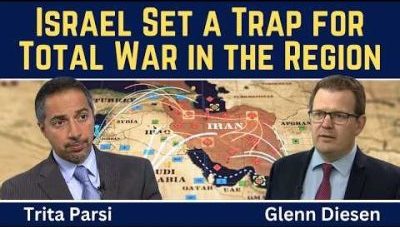
Trita Parsi: Israel Set a Trap for Total War in the Region
or go to
Aletho News Archives – Video-Images
Book Review
Why the War on Conspiracy Theories Is Bad Public Policy
By Kevin Barrett • Unz Review • February 1, 2019
 A Review of Conspiracy Theories and Other Dangerous Ideas by Cass Sunstein (based on an earlier paper co-authored with Adrian Vermeule); In Defense of Troublemakers: The Power of Dissent in Life and Business by Charlan Nemeth; and Conspiracy Theories and the People Who Believe Them, edited by Joseph E. Uscinski
On January 25 2018 YouTube unleashed the latest salvo in the war on conspiracy theories, saying “we’ll begin reducing recommendations of borderline content and content that could misinform users in harmful ways—such as videos promoting a phony miracle cure for a serious illness, claiming the earth is flat, or making blatantly false claims about historic events like 9/11.”
At first glance that sounds reasonable. Nobody wants YouTube or anyone else to recommend bad information. And almost everyone agrees that phony miracle cures, flat earthism, and blatantly false claims about 9/11 and other historical events are undesirable.
But if we stop and seriously consider those words, we notice a couple of problems. First, the word “recommend” is not just misleading but mendacious. YouTube obviously doesn’t really recommend anything. When it says it does, it is lying. … continue
Blog Roll
 Aletho News
- How the Cambridge Analytica scandal still haunts Mark Zuckerberg
- The Ongoing Cancellation Campaign Against a Dissenting Academic in Norway
- Yemen and ‘the Houthis’: Challenging Sami Hamdi’s Narrative
- No, Christians did not invent Zionism
- AIPAC-led lobbying network opens branches in Cypriot, Greek parliaments
- Araghchi blasts ‘parasitic’ alliance as US taxpayers pay for Israel’s war on Iran
- Easy fix for Europe’s chaos? Stop fueling war against Russia
- Putin’s key remarks on peace talks and Europe’s ‘schizophrenia’
- Trita Parsi: Israel Set a Trap for Total War in the Region
- Trump’s Iran war is on an Israeli leash
- If Americans Knew
- Damning report shows the media must confront its failures on Gaza
- BBC senior broadcaster speaks out on Gaza coverage
- Netanyahu vows vast West Bank invasion in response to 20-minute skirmish that left 2 Israeli soldiers and 2 Palestinian fighters dead
- Tied up and tortured: Israel using US-made electroshock weapons on Palestinian detainees
- The outsourced risk: how newsrooms rely on Gaza’s freelancers without protecting them
- Gaza bakeries forced to shut as Israel blocks flour shipments
- Gaza’s breast cancer patients face a deadly wait for treatment amid Israel’s genocide
- DAILY UPDATE: Latest essential news on Palestine, Israel, & region
- The Israel Lobby’s Changing Fortunes
- AIPAC has become such a political liability that it’s shifting to a more “nimble” approach to buying politicians
- No Tricks Zone
- E-Cars Reduce CO2 Emissions By Only 41% Compared To Internal Combustion Engine Vehicles
- Predictions Made By Renowned Climate Professor Over Past Decades Have Been Proven To Be Poor
- New Study Suggests Large Regions Of The Pacific Ocean Have Been Cooling For The Last 80 Years
- Germany’s Green Energy Debacle: High Energy Costs Force Kahla Porzellan to Close After 182 Years!
- New Study: 50 Years Of The Most Aggressive ‘Net Zero’ Policies Can Only Affect The Global Climate By 0.03°C
- US September “Heat” Was No Record…Many Records Set Decades Ago
- Latest European Green Energy Debacle; Portugal’s Largest Flagship Solar Park Insolvent!
- Green Energy Debacle: German Expert Professor Fritz Vahrenholt Warns Of Severe Economic And Social Consequences
- Two More Paleo Reconstructions Affirm Meters-Higher Sea Levels Across Ireland, Brazil 7000-6000 Years Ago
- New Study: Earth And Venus Surface Warmth Largely Explained By Convection And Lapse Rate, Not CO2 Or Radiation

