Bombs for Tel Aviv, Promises for Riyadh
By Muhammad Hamid ad-Din – New Eastern Outlook – October 15, 2026
The Gaza Ceasefire Is Falling Apart. And So Is the American Plan to Expand the Abraham Accords.
The Gaza Ceasefire That Is Killing Palestinians
The ceasefire in Gaza, which took effect on October 10, 2025, was supposed to stop a two-year war. By then, according to Palestinian authorities, more than 72,000 Palestinians had been killed. A year after the document was signed, the picture was no more peaceful. According to Palestinian sources, from the start of the ceasefire to October 5, 2026, Israeli forces killed 1,460 Palestinians and wounded 5,116. By September 2026, Gaza authorities reported 5,147 violations of the agreement, 1,421 dead, and the destruction of more than 201,000 buildings.
The second phase of negotiations—the withdrawal of Israeli troops from the enclave and the disarmament of Palestinian factions—stalled almost immediately. In April 2026, American-Egyptian talks in Cairo ended “without tangible progress.” Hamas links disarmament to the end of the occupation. Israel demands disarmament as a precondition for any further step. Critics say the demand for disarmament has become a pretext for maintaining control over the enclave and continuing violations. The Palestinian Foreign Ministry put it bluntly: the occupation government “does not view peace as a goal, but as an obstacle.”
Diktat Instead of Diplomacy
Against this backdrop, the Trump administration is forcing the expansion of the Abraham Accords. In May 2026, the U.S. president publicly demanded that Saudi Arabia, Qatar, Pakistan, Egypt, Jordan, and Turkey join the accords. He called it “mandatory”: “After all the work done by the United States to put this complex puzzle together, it must be mandatory for all these countries to at least simultaneously sign the Abraham Accords.” Pakistan publicly refused. The others remained silent.
Washington’s main interest is Saudi Arabia. Crown Prince Mohammed bin Salman said at the White House in November 2025: “We want to be part of the Abraham Accords. But we also want to be sure that we secure a clear path to a two-state solution.” Later, Riyadh repeated: normalization is impossible without a “credible, irreversible, and time-bound path” to a Palestinian state. The Israeli government rejects this prospect. American pressure goes beyond diplomacy: Trump tied the Abraham Accords to negotiations to end the war with Iran, effectively making normalization a condition for peace. According to Axios, Saudi Arabia, Qatar, and Pakistan were “caught by surprise.”
Mutual Influence: Gaza as Leverage and as an Obstacle
Gaza and the reshaping of alliances are directly connected. The Palestinian question became leverage in Arab states’ bargaining with Washington. For Saudi Arabia, normalization with Israel without movement toward a Palestinian state is politically toxic. Riyadh is using the fragile ceasefire to postpone an unpopular step. Qatar, a key mediator, took an equally tough position. Qatari Foreign Ministry spokesman Majid al-Ansari said: “If the Palestinian question remains unresolved, joining the Abraham Accords is impossible.” According to him, the absence of a peace process for Palestinians means the absence of stability in the region. Doha, which has given refuge to Hamas’s political leadership and plays a central role in the talks, cannot move toward normalization without losing face.
There is also a reverse dependency. The Trump administration, seeking to expand the Abraham Accords, pressured Israel to secure a ceasefire: normalization without a ceasefire would have been impossible. But the second phase depends on whether Washington is willing to pressure Israel, not just Arab capitals.
Bombs Instead of Peace
The result of U.S. and Israeli policy looks increasingly contradictory. Three years of war, more than 74,250 dead Palestinians, and 1,460 killed after the ceasefire was signed are not just a humanitarian catastrophe. They are a verdict on America’s strategy in the Middle East. Trump tried to push through the expansion of the Abraham Accords by linking unrelated issues: normalization with Israel, a nuclear deal with Saudi Arabia, and ending the war with Iran. In July 2026, he stated directly that a U.S.-Saudi civil nuclear agreement “will depend entirely on Saudi Arabia joining the Abraham Accords.” Saudi Arabia responded in May 2026: “There will be no normalization without a clear and final path to the creation of an independent Palestinian state.” As the custodian of the two holy mosques, the kingdom cannot afford to do otherwise. Qatar refused. Pakistan publicly rejected it. Egypt, Jordan, and Turkey remained silent.
Criticism of Washington goes far beyond diplomatic missteps. The U.S. continues to supply Israel with weapons despite ceasefire violations. In September 2026, the Trump administration proposed a $2.8 billion deal to sell Israel 40,000 heavy bombs, including 20,000 MK-84s and 20,000 BLU-117s. Senator Chris Van Hollen vowed to block the transfer: “Trump is sending $2.8 billion worth of bombs, paid for by you, the American taxpayers, to a government led by a wanted war criminal.” Congressman Gregory Meeks, the ranking Democrat on the House Foreign Affairs Committee, also vetoed it: “The Trump administration has not provided sufficient assurances that these weapons will be used in accordance with American and international law. Therefore, I will not approve this sale.” Amnesty International urged Congress to block the deliveries, saying the U.S. risks becoming complicit in serious violations of international law, including genocide. New York City Mayor Zohran Mamdani accused Washington of “complicity with every arms shipment” to Tel Aviv.
What Next: The Results of U.S. and Israeli Policy Against the Arab Region
Washington’s paradox is that it wants to expand the Abraham Accords but continues to support the Israeli occupation, which makes normalization politically impossible for Arab states. The U.S. has blocked UN Security Council ceasefire resolutions for the third time in a row, undermining its role as a “reliable mediator.” Public opinion in the Arab world is sharply opposed to normalization. Polls show that 89% of Moroccans oppose recognizing Israel. Analysts warn that for most of the named states, the political price of signing the accords will be prohibitive. The war in Gaza has strengthened this sentiment, not weakened it.
The main question is whether the ceasefire will hold. If the second phase of negotiations does not start and the death toll continues to rise, expansion of the Abraham Accords will remain an unattainable dream. Saudi Arabia will wait. Qatar will mediate. The UAE will increase oil production. Trump will face a choice: keep pressuring Arab capitals or admit that without a real Palestinian state, the accords will remain a facade. While Washington supplies bombs and Tel Aviv keeps killing, talk of peace looks like a cynical game in which Palestinians are not subjects but a bargaining chip.
Muhammad Hamid ad-Din is a well-known Palestinian journalist.
Follow new articles on our Telegram channel.
West’s death cult in a theater near you
By Finian Cunningham | Strategic Culture Foundation | October 14, 2026
It’s hard to know whether to break the TV set or throw up when listening to the European governments rushing to condemn the air strike by Yemeni forces on Saudi Arabia’s King Khalid international airport.
The blast from a ballistic missile that slammed into the airport at the weekend, October 12, killed at least 13 civilians and injured scores of other travellers. Horrific video footage shows the moment the missile explosion ripped through a terminal lounge.
European leaders immediately in a coordinated fashion trotted out condemnations of Yemeni “terrorism” and vowed solidarity and support for Saudi Arabia. U.S. President Donald Trump called it “a terrible thing.” (As if bombing schoolchildren is not quite a terrible thing.)
Britain, France, Germany, Ireland, Italy, Austria, the Netherlands, and Spain all issued strident denunciations of the Yemeni attack.
The strike on the Saudi capital came after the Ansar Allah-led Yemen Armed Forces had given ample warning to the Saudis that their airports would be targeted and for civilians to avoid the areas. The airports were kept open for business as usual. The Yemenis have said that the attack on Riyadh and other Saudi airports are retaliation for weeks of multiple air strikes by the Saudis on Yemeni civilian centers.
Hundreds of Yemeni civilians have been killed since Saudi Arabia broke a four-year truce with an air strike on the international airport in Sanaa, the Yemeni capital, on July 13. Saudi warplanes, U.S.-supplied F-15s and European Typhoon jets, have been continously bombing homes across Yemen. This week, two days after the Riyadh strike, at least nine people including five children were killed in air raids on houses in Taiz city and in northern al Jawf province. Al Masirah TV footage showed a distraught father holding up a child’s shredded body amid rubble. There was no condemnation of that atrocity from any European leader.
As Mick Wallace and Clare Daly, former Irish Members of the European Parliament, point out in their podcast this week, the official European reaction is utter hypocrisy and a cynical distortion of the conflict on the Arabian Peninsula.
Britain and France in particular, along with the United States, have backed the Saudi aggression against Yemen beginning in 2015. Over seven years, that aggression killed up to 400,000 Yemenis through air strikes and a blockade on humanitarian needs.
The European Union remained largely silent for seven years. No protests were made to Washington, Paris or London. Ambassadors were not summoned, sanctions were not imposed.
The return to hostilities that began with Saudi air strikes on Sanaa in July have been enabled by U.S. and Britain supplying warplanes, military advisors and intelligence.
None of the European governments have bothered to condemn this recent U.S. and UK-backed slaughter.
So, it is nauseating when one hears British Foreign Secretary Ed Miliband saying he is “appalled” by the strike on Riyadh airport. And other European leaders vowing “full solidarity with the kingdom of Saudi Arabia.”
Germany’s Foreign Minister Johann Wadephul condemned Yemen’s “terrorist act.”
His French counterpart said France stood with Saudi Arabia “in defending its territory and infrastructue.” (No mention of what the Saudis have been doing for years to Yemen’s territory.)
Referring to the strike on Riyadh without any context, Italy’s Giorgia Meloni said: “Attacks against civilians and civilian infrastructure are unacceptable and must cease.” (Yes, indeed, so why not tell that to the Saudis who are doing it deliberately on a massive scale with support from Washington and London?)
What is instructive here is not just the sickening hypocrisy and moral bankruptcy. It is the manifestation of a systematic corruption and criminal responsibility. This is not just one more example of a flawed European political class whose judgement is suspect. What is increasingly apparent is the totality of the corruption.
The same European supporters of Saudi monarchs waging a genocidal war on Yemen are also contemporaneously supporting the Israeli Zionist regime in its extermination of Palestinians. They are complicit in enabling the U.S. aggression against Iran, Cuba and Venezuela. They are sponsors of the NeoNazi regime in Kiev to keep fighting a proxy war against Russia despite more than one million Ukrainian military casualties and the risk of nuclear conflagration.
The death cult of Western capitalism is on full display in multiple theaters, exposing the organic evil at work. There is sense that all of Western imperialist history is now on display in one final orgy of barbarity.
In previous times, the death cult operated discreetly in seemingly disparate conflict scenarios. Wars on different continents seemed somehow unconnected. The Western media would in the past reliably cover up the crimes by distorting the motives and objectives with false narratives and (laughable) claims of noble purpose. The West was “defending democracy,” “fighting communism,” “protecting human rights,” or “waging war on terrorism,” or some other pretext that in isolation and with loads of media propaganda managed to fool a lot of people as somehow plausible.
What’s happening now, it seems, is a concatenation of wars that ultimately exposes the essential system that drives the violence, and its insatiable lust for human suffering.
It is impossible to work for such a vile system, the death cult of capitalism, without also being oblivious to its evil ways. To remain oblivious necessitates denial or lies. That deception might be tenable for occasional and seemingly disparate scenarios. But not when the system is exposed in its infernal entirety.
American and European wars in the past might have succeeded in being sold to the Western public as one-off wars and misadventures. We think of the wars in Korea, Vietnam, Latin American, Africa, former Yugoslavia, Afghanistan, Iraq, and more recently Libya.
In more recent years, as consciousness evolved, the public began discerning and decrying “endless wars”.
But now the world is witnessing a totalizing of the war machine that goes by the name of “Western democracy”.
What’s happening in Ukraine, Gaza, Iran and Yemen is not coincidence. It is the death cult on display and unable to hide itself. It manifests too in attacking and locking up Western citizens who condemn genocide or who simply call for peace.
Capitalism, fascism, wars, the Epstein class, endemic poverty and suffering – it’s a death cult in a theater near you.
The politicians, governments, media and pundits who promote it or serve it are seen for what they are.
The Houthis Are Not an Iranian Proxy
José Niño Unfiltered | October 11, 2026
In September 2026, Ansar Allah, derisively labeled as the Houthis in Western foreign policy circles, redrew the map of western Yemen in a matter of days. Its fighters swept down the Red Sea coast, seized Mocha on September 10, then pushed through Dhubab and took Mayyun Island at the heart of the Bab el-Mandeb strait the following day, consolidating control over Yemen’s entire Red Sea coastline and roughly 5,400 square kilometers of newly gained territory. Yemen’s Saudi-backed government answered on October 4 when Presidential Leadership Council head Rashad al-Alimi announced Operation Dawn of Yemen, vowing to keep fighting until the country was “liberated from the grip of the terrorist militia,” with 100 Saudi coalition fighter jets providing air cover and Ansar Allah firing missiles at targets inside the kingdom in response.
Washington reached for a familiar script. Secretary of State Marco Rubio branded Ansarh an Iranian proxy, and Tehran fired back on September 9. Foreign Ministry spokesman Esmail Baghaei wrote on X, “Marco Rubio’s lies cannot replace facts. Ansarallah is an independent Yemeni actor that makes its own decisions; it takes orders from no one and acts as nobody’s proxy.”
On the question of Ansar Allah’s relationship to Iran, the record sides with those who emphasize the movement’s homegrown roots. In the 1980s, Zaydi religious networks in the northern province of Saada organized study groups and summer camps to resist the Wahhabi and Salafi outreach that Saudi money spread across the region. Around 1992, those networks crystallized as the Believing Youth, an educational and social revival movement dedicated to Zaydi theology and the preservation of a tradition stretching back a millennium. Saada’s poverty and its chronic neglect by Sanaa fueled the grievances that eventually became a military force.
Hussein Badr al-Din al-Houthi sharpened that network into a political cause after the U.S. invasion of Iraq in 2003. He accused President Ali Abdullah Saleh of running a corrupt government that neglected Saada, sidelined Zaydis, and surrendered Yemeni sovereignty to Saudi and American interests. His followers adopted a chant that read in full: “God is Great, Death to America, Death to Israel, Curse the Jews, Victory to Islam.” The chant named foreign powers, but its domestic meaning was clear: Yemeni authorities understood that a movement chanting “death to America” today could be chanting “death to the president” tomorrow. Palestine and the Second Intifada also featured prominently in Hussein’s sermons, which cast Israel as an occupying power and the United States as its enabler. The antisemitism in the Yemeni resistance’s messaging reflected a long-held hostility to Jewry’s machinations among the Yemeni population.
Saleh went to war against the movement in 2004, and his forces killed Hussein on September 10. Leadership passed to his younger brother Abdul-Malik al-Houthi. During the 2011 uprising the movement took the name Ansar Allah and pitched itself as a national force against corruption and inequality.
The episode that best exposes the proxy myth unfolded in September 2014. Iranian representatives reportedly urged Ansar Allah not to seize the capital, and Ansar Allah marched in anyway. HuffPost broke the story in April 2015, citing American officials familiar with the intelligence. One official told the outlet “It is wrong to think of the Houthis as a proxy force for Iran.” National Security Council spokeswoman Bernadette Meehan added: “It remains our assessment that Iran does not exert command and control over the Houthis in Yemen.” The Wilson Center also called attention to the aforementioned restraint Iran advocated for: “In 2014, Iran reportedly advised the Houthis against taking over Sanaa, but they pressed on.”
Thomas Juneau of the University of Ottawa built the academic foundation for this view. His 2016 study in International Affairs argued that “the Houthis are not Iranian proxies; Tehran’s influence in Yemen is marginal.” In a Washington Post op-ed that same year, he wrote: “It is simply inaccurate to claim that the Houthis are Iranian proxies.” Juneau has since acknowledged deeper cooperation, yet he told The Iran Primer : “The Houthis are fiercely nationalist, and do not take orders from Iran. Instead, they work together, closely, on the basis of their common interests.”
Helen Lackner, among the most respected Western scholars of Yemen, put it plainly on Democracy Now: “The Houthis are not Iranian proxies. They are not Iranian servants. They don’t do what the Iranians tell them to do. They make their own decisions.” She described how the alliance functions: “If their decisions and their policies coincide with those of Iran, then there’s no issue. But if they don’t, they don’t do it.”
Allison Minor challenged the proxy narrative directly in a Brookings essay: “Rigorous definitions of the term ‘proxy’ require that the sponsor has some means of controlling the proxy, as this is what differentiates a proxy from a partner/ally. In truth, the Houthis are not an Iranian proxy, even though they benefit from Iranian support.” Minor pointed to the unilateral ceasefire Ansar Allah declared with Saudi Arabia in 2019, even as Iran sought escalation, and stressed their possession of independent revenue, local arms production, and diverse supply lines as other indicators of autonomous production and decision-making.
Others well-versed in Yemeni affairs reached the same conclusion years earlier. Saudi journalist and filmmaker Safa al-Ahmad, who reported from inside Ansar Allah territory, told PBS Frontline that Iran’s ties to the group were “vastly overblown” and that “the Iranians can’t just pick up the phone and tell the Houthis what to do.”
Even the hawkish Institute for the Study of War agrees. Its September 18 update stated, “The Houthis are not an Iranian proxy, although their objectives often overlap with Iran’s strategic interests.” It added, “The Houthis are an independent partner of Iran and may resist potential Iranian pressure to halt their campaigns, however.”
None of this means Iran sits on the sidelines. The Associated Press reported in late September that officers of the Islamic Revolutionary Guard Corps helped Ansar Allah with planning during the coastal offensive. Yet researcher Nicholas Brumfield told Al Jazeera that the campaign reportedly involved 76,000 Yemeni fighters, raised “using their own governance apparatuses,” and that mounting evidence points to Ansar Allah boasting a burgeoning domestic arms industry.
Ansar Allah ultimately behaves as a national liberation movement that shares many of Iran’s enemies and welcomes Iranian assistance, yet it charts its own course whenever its interests diverge. It does not need Tehran to steer it any more than any serious and credible resistance movement needs a foreign master. It grew from Yemeni grievances, and it will naturally seek allies such as Iran that oppose the same aggressive powers—Israel and the United States—that work tirelessly to destabilize West Asia. Movements like it already shake the foundations of the regional order. If the current momentum holds, Ansar Allah could reshape not only Yemen but also the Saudi provinces of Asir, Jizan and Najran, lands that many Yemenis still regard as their own and that Saudi Arabia locked down after the 1934 war between the two countries.
What started as a revolt against a corrupt president in a neglected mountain province has become a war that stretches from Taiz to Riyadh. With Ansar Allah astride the Bab el-Mandeb and Iran pressing on the Strait of Hormuz, two of the world’s most vital chokepoints now sit within reach of forces Washington cannot push back. If Asir, Jizan and Najran ever slip from Riyadh’s grip, historians will trace the new map back to Saada, not to Tehran.
Sanaa says Taiz roads open, secure for residents, warns Saudi forces
Al Mayadeen | October 12, 2026
Sanaa’s government said it has kept all main roads leading into and out of Taiz open and secure, warning Saudi forces against blocking access to the city and imposing a siege on its residents.
Government spokesperson Omar al-Bukhaiti renewed the warning against continued road closures and attempts to besiege Taiz residents to deepen their suffering and exploit it for media purposes.
Al-Bukhaiti accused the Saudi forces of closing roads and obstructing the movement of civilians and the transport of food, medicine, and other essential supplies, noting that they openly announced, through their own media outlets, the closure of 19 key roads and crossings in Taiz Governorate, while targeting civilian vehicles on roads with airstrikes and artillery shelling.
“We call for keeping densely populated Taiz out of any military escalation, prioritizing the public interest, and preventing further bloodshed,” he asserted.
The statement follows the Sanaa government’s declaration that it is prepared to reach a reciprocal arrangement to spare humanitarian sites amid the ongoing conflict with Saudi Arabia. The government also reiterated its rejection of attempts to impose an occupation.
Meanwhile, the Yemeni Armed Forces have continued to uphold their declared equation of “escalation for escalation and blockade for blockade.”
Yemeni forces renew warning over Saudi airports
The Yemeni Armed Forces also renewed their warning to airlines, passengers, and workers against using Saudi airports and airspace, describing them as a theater of military operations and potential targets.
The warning excluded the airports and airspace of the Holy cities of Mecca and Medina.
Iraqi resistance group urges Saudi leadership to admit defeat, lift Yemen siege
Press TV – October 12, 2026
An Iraqi anti-terror resistance group has urged the Saudi leadership to acknowledge the failure of the military option and completely lift the blockade on Yemen.
Kata’ib Hezbollah, in a statement released on Monday, said the operations carried out by Yemeni Armed Forces are in reprisal for Saudi Arabia’s brutal onslaught and siege against their homeland, and in defense of their dignity and fundamental rights.
It noted that Iraqi people from every walk of life and resistance factions stand by Yemen, describing the Yemeni cause as a just cause that requires solidarity and support as it confronts Riyadh’s US-Israeli-backed atrocious assaults.
Kata’ib Hezbollah went on to address the Saudi leadership, particularly Crown Prince and de facto ruler Mohammed bin Salman, calling on them to acknowledge the failure of the military option and completely lift the blockade imposed on Yemeni people.
Continued military and economic pressure will never manage to undermine Yemenis’ determination to safeguard their rights and reject foreign guardianship and interference, the statement read.
Kata’ib Hezbollah highlighted that Iraq will continue to support just aspirations in West Asia, characterizing the causes of Palestine and Yemen as the region’s foremost issues.
On July 20, the Sana’a government announced a maritime blockade against Saudi Arabia in response to “an unjust and oppressive siege” on Yemen for almost 12 years.
Subsequently, the Yemeni armed forces have reported a series of successful missions that have targeted vessels associated with Saudi Arabia in the Red Sea.
In March 2015, Saudi Arabia and its allies imposed a blockade on Yemen, initiating a comprehensive military offensive that received support in terms of military, political, and logistical assistance from the United States and several Western countries.
Tens of thousands of Yemenis have lost their lives; however, Saudi Arabia has failed to achieve its primary goal of reestablishing a puppet government that served its interests.
Seyed M. Marandi: US-Iran War Inevitable: Kuwait and Bahrain May Fall
Glenn Diesen – October 11, 2026
Prof. Seyed Mohammad Marandi is a professor at Tehran University and a former advisor to Iran’s nuclear negotiation team.
Follow Prof. Glenn Diesen:
Substack: https://glenndiesen.substack.com/
X/Twitter: https://x.com/Glenn_Diesen
Support the research by Prof. Glenn Diesen:
PayPal: https://www.paypal.com/paypalme/glenn…
Buy me a Coffee: buymeacoffee.com/gdieseng
Go Fund Me: https://gofund.me/09ea012f
Leaders Condemn Ansarallah Attack on Saudi Arabia While Ignoring Illegal War Against Yemen
By Kurt Nimmo | Another Day in the Empire | October 11, 2026
Following the attack on the King Khalid International Airport in Riyadh, Saudi Arabia, the usual suspects emerged from the social media muck to condemn Ansarallah. “These reprehensible attacks demonstrate a blatant disregard for innocent civilian life. They must stop now,” demanded Trump’s secretary of state, Marco Rubio.
Bibi Netanyahu, “on behalf of the people of Israel,” condemned the attack and declared the Zionist state “looks forward to a strong Middle East—one that stands united against threats, protects its people, and builds a future of security, cooperation, and prosperity for all the peoples of our region,” never mind the 200,000-680,000 people of the region he butchered over the last three years.
Kaja Kallas, the former president of Estonia and current High Representative of the European Union for Foreign Affairs and Security Policy, denounced the airport attack. “The Houthi attack on Riyadh’s international airport is an appalling act of terror. There can be no justification for indiscriminate attacks on civilians and civilian infrastructure,” she said.
Kallas, like most European leaders, insists Israel has a “right to defend itself” against Hamas, Hezbollah, and the Houthis, and yet “self-defense” is not a legitimate response for the people of Gaza, the West Bank, Lebanon, Syria, and Yemen, all victims of Israeli and US aggression.
António Guterres, the Secretary-General of the United Nations, is “deeply shocked” by the Yemeni retaliation, and criticized the attack on the Saudi airport as a violation of international law.
If Guterres is concerned about international law and the bombing of civilian infrastructure, why hasn’t the UN invoked Chapter VII of the UN Charter in regard to Gaza? “The UN’s member states collectively have a bad track record when it comes to preventing genocide,” writes Sean Matthews. “In the case of genocides in Rwanda and Bosnia, the UN only declared officially that genocides took place after the fact.”
G7 foreign ministers also weighed in on the attack, declaring the response to Saudi attacks poses an “unacceptable threat to regional stability and security, to global energy security,” as well as to security in the Red Sea and the Bab al-Mandab Strait.
In June, during a globalist conclave in Évian, the G7 issued a dilatory statement calling for an acceleration of “humanitarian and reconstruction efforts and the swift implementation of relevant political and security measures” in Gaza, the West Bank, and Lebanon, while knowing full well Zionist Israel will ignore international law and continue to murder and starve Palestinians while ethnically cleansing the Shi’a in southern Lebanon.
The official censure by the United States, the EU, UN, and G7, as well as the skewed reportage of the corporate media, overlooks the reason why Ansarallah is bombing Saudi airports and oil infrastructure.
Forgotten, or ignored, are the crimes of the Saudi coalition during and after the Yemen War of 2015. The coalition included the United Arab Emirates, Bahrain, Egypt, Jordan, Kuwait, Morocco, and Sudan.
The Sunni coalition attacked after President Abd Rabbu Mansour Hadi fled house arrest into exile in Saudi Arabia. Hadi, who died earlier this year, stood accused of secretly working with al-Islah, described as the Muslim Brotherhood’s Yemeni branch. The former president was also accused of being a Saudi puppet. Saudi Arabia views Ansarallah—followers of the Shi’a branch of Zaydism—as a threat to its national security.
A detailed United Nations report estimated approximately 377,000 deaths by the end of 2021 from the Saudi-led campaign. This total includes direct losses from combat and indirect deaths linked to malnutrition, disease, and the decline of health care and essential services.
The United States was involved in the Yemen humanitarian crisis. US personnel provided logistical support, information, training, and advisers after the Saudi-led intervention. US tankers refueled coalition aircraft, increasing their range over Yemen. Saudi forces relied heavily on US-supplied aircraft, munitions, spare parts, maintenance, and technical support.
Jeff Bachman, a professor and genocide scholar at the School of Information Services, said during an interview with the American University in Washington that the Saudi-led coalition has been able to engage violence against Yemenis thanks to the complicit material and political support of the United States.
UN Security Council Resolution 2216 established a UN arms embargo. The restrictions implemented delayed or curtailed commercial imports and humanitarian shipments of food, fuel, medicines, and medical supplies. Because Yemen is dependent on imports, disruptions to port and airport operations rapidly worsened hunger, health-system strain, water and sanitation breakdowns, and prices, according to Human Rights Watch.
“The Saudi-led coalition’s military strategy in Yemen has been increasingly built around preventing desperately needed aid and essential goods from reaching civilians, risking millions of lives,” said James Ross, legal and policy director at Human Rights Watch. “The Security Council should urgently sanction Saudi and other coalition leaders responsible for blocking food, fuel, and medicine, causing hunger, sickness, and death.”
During a full closure in November 2017, UN agencies noted that aircraft and ships delivering aid could not secure clearance, while commercial cargo encountered major hurdles. Human Rights Watch stated that the coalition had maintained a naval and air blockade since March 2015, with restrictions producing a disproportionate impact on civilians in direct violation of international law.
Yemen remains one of the world’s most serious humanitarian emergencies. As of 2026, more than 22 million people need assistance or protection and 18.3 million people are acutely food insecure. Malnutrition levels remain critically high, with over 2.2 million children under five acutely malnourished, including 516,157 suffering from malnutrition, according to the United Nations. “Even before the latest escalation, an estimated 12.2 million children in Yemen needed humanitarian assistance,” UNICEF reported in September.
Article 51 of the UN Charter is a determining provision that addresses the right of self-defense for member states. It represents an exception to the general prohibition on the use of force outlined in Article 2(4) of the UN Charter, which mandates that all member states refrain from using force against the territorial integrity or political independence of any state, as the Saudis did in 2015 in Yemen.
On October 10, following the Ansarallah attacks, Trump announced the US may rejoin the latest Saudi onslaught on Yemen. “We’re going to look at it,” he told reporters. “We just found out about the recent attack. We will make a decision. We move very quickly.”
Prior to Trump’s announcement, Democrat Ro Khanna, who was detained during a visit to Israel in July, introduced a joint Yemen War Powers Resolution along with Republican Representative Thomas Massie on October 9. The resolution directs “the President pursuant to section 5(c) of the War Powers Resolution to remove United States Armed Forces from hostilities against the Houthis in Yemen that have not been authorized by Congress.”
Congress is unable to decide whether to rejoin the Saudi effort to destroy Ansarallah and maintain the illegal war on the people of Yemen. In addition to debate on the constitutional legality of the Trump administration’s military assistance to the Saudis without a congressional consultation, members of Congress are concerned about the continued slaughter of civilians and the ongoing humanitarian crisis, considered one of the worst in the world, with around 24 million people, or nearly 80% of the population, needing assistance and protection.
Yemeni Armed Forces Warn Airlines Against Using Saudi Airports, Exempt Mecca and Medina
Al-Manar | October 11, 2026
Yemeni Armed Forces reiterated on Sunday a warning to airlines, aviation personnel, airport workers, and travelers against using Saudi airports and airspace, declaring them potential targets and a theater of military operations, with the exception of airports in Mecca and Medina.
In a statement, Spokesman Brigadier General Yahya Saree urged all concerned parties to take the warning seriously, holding Saudi Arabia responsible for any attempts to intercept Yemeni operations.
The Yemeni Armed Forces reaffirmed their commitment to pursuing the strategy previously announced as “an airport for an airport, a blockade for a blockade, and escalation for escalation,” vowing to continue until their objectives are achieved.
Earlier on Saturday, Member of Yemen’s Ansarullah Politburo Mohammad Al-Bakhiti warned that Saudi regime plots to target holy sites in Mecca and Medina and to blame Yemen for attacks.
In exclusive remarks to Al-Manar on Friday, Al-Bakhiti revealed that Riyadh had supplied Saudi-backed mercenaries in Yemen with missiles and drones to carry out attacks and blame them on Yemeni Armed Forces.
Dhubab offensive, media blitz and the rapid unraveling of Saudi-backed coalition’s new gambit
By Arman Shariati | Press TV | October 10, 2026
In the early hours of October 5, Saudi-backed mercenaries launched an offensive along Yemen’s southwestern coastal road toward Dhubab, which overlooks the Bab al-Mandeb Strait.
By evening, their affiliated media networks were proclaiming Dhubab’s fall. Hours later, they falsely claimed to have captured Al-Mokha as well.
Within a single day of operations, the Yemeni military forces had encircled the incursion, recaptured the ground, and released timestamped footage showing their troops standing undisturbed along the Bab al-Mandeb coastline.
Meanwhile, local residents openly ridiculed the reported advance of the Saudi mercenaries.
The attacking forces retreated to their original positions. The events along that coastal road – the assault, the media triumphalism, the rapid military reversal, and the collapse of the narrative – offer a revealing case study of how information warfare has become structurally embedded in Saudi Arabia’s disastrous military campaign in Yemen.
The Pressure Behind the Push
To understand the events of October 5, it is necessary to examine the developments that preceded them. Yemeni military had been consolidating significant territorial gains across southern and southwestern Taiz province – not marginal advances, but the seizure of areas spanning thousands of square kilometers.
The encirclement of Taiz city was tightening along its northern and eastern approaches, applying deliberate strategic pressure that could pave the way for a handover of the city from the Saudi-backed mercenary factions holding it.
More symbolically damaging still, the residence of Rashad al-Alimi, chairman of the Saudi-backed so-called Presidential Leadership Council (PLC), had fallen.
The Saudi-led coalition and its local allies were rapidly losing ground. An operation that could be portrayed as a decisive advance toward the Bab al-Mandeb Strait would offer PLC forces a much-needed military and propaganda victory.
The Bab al-Mandeb is precisely the kind of strategic objective whose association with a military operation can generate outsized media attention, regardless of what the operation actually achieves on the ground.
The attacking forces
The offensive was led by two formations: the Southern Giants Brigades (Al-Amaliqa al-Janubiyya) and the Dira’ al-Watan (Shield of the Nation) Brigades, supplemented by approximately 100 Saudi mercenary fighters, according to Saudi-affiliated media.
Both formations have histories that complicate their portrayal as straightforward Yemeni forces operating under the so-called Presidential Leadership Council (PLC). The Giants Brigades are a Salafi-oriented southern force whose origins are firmly rooted in Emirati patronage. Armed, trained, and financed by Abu Dhabi, they were institutionally shaped as part of the UAE’s parallel military architecture in Yemen – a network of forces, including separatist formations, that operated with considerable autonomy from the Saudi-led coalition’s command structure.
Their nominal realignment under the PLC framework following the UAE’s partial strategic withdrawal from the Yemeni theater has not necessarily erased the command relationships, patronage networks, or ideological orientation established during their formative years.
They remain among the coalition’s most combat-capable formations, but their relationship with the PLC is better understood through overlapping interests and patronage ties than through assumptions of unified institutional loyalty.
Dira’ al-Watan, by contrast, operates with a more direct orientation toward Riyadh, functioning closer to Saudi Arabia’s traditional mercenary structure in Yemen. The deployment of both formations along a single coastal axis, accompanied by a contingent of Saudi mercenaries, suggests a deliberately assembled force package rather than an improvised advance.
The media apparatus accompanying the operation, as we shall see, reinforces this interpretation.
The assault itself
The attacking forces advanced along the coastal road south of Al-Mokha toward Dhubab district. The coastal approach traverses relatively open terrain, and accounts of the local military disposition suggest that the Yemeni military’s forward garrison presence in the immediate coastal zone was limited. The defensive logic, under such conditions, favors concentrating forces at defensible chokepoints in the adjacent highlands rather than maintaining a thin, linear deployment across exposed ground.
Yet despite heavy Saudi supporting fire, the advancing forces failed to push beyond the outer perimeter of Dhubab along the coastal road. They reached the perimeter of Dhubab airport but did not enter Dhubab city.
At the airport perimeter, invading forces filmed themselves running over wounded members of the small Yemeni military garrison. The footage, subsequently circulated through pro-Saudi Telegram channels, appeared to have been published by the mercenaries themselves as evidence of momentum and fighting spirit.
Instead, it documented abuses against combatants in an isolated position, including the mutilation of dead bodies, turning apparent battlefield content into evidence of conduct that warrants independent human rights scrutiny.
The footage also carried a consequence beyond its grave humanitarian implications. Militarily, it documented a localized engagement against an isolated position—not a breakthrough along the coastal axis. The distinction would become critical within hours, as the broader operation stalled and the coalition’s claims of progress began to unravel. Material intended to project battlefield momentum would instead complicate the narrative surrounding an offensive whose advertised scale and strategic significance far exceeded its demonstrated territorial gains.
The encirclement and the reversal
Field sources report that within hours of the attacking force reaching the coastal road’s edge, Sana’a forces had encircled the limited area of the incursion and begun pressing to retake the ground. The timeline is critical. This was not a gradual reversal unfolding over several days. The encirclement and counterattack took place within the same operational day as the advance.
The reversal has a clear geographic dimension. Yemeni military, led by the Ansarullah movement, controls the Al-Omari mountain range and the Al-Omari base, situated east of Al-Mokha and west of Taiz. This elevated terrain offers observation over much of the coastal corridor and positions from which movement along the coastal road can be interdicted.
Any force advancing along the coast without first neutralizing Al-Omari risks operating under persistent observation, with its flanks and supply lines exposed to forces holding the dominant heights. The attacking force did not capture Al-Omari. Nor was it positioned to do so: securing the mountain range and its associated base would have required a substantially larger and more complex operation than the one assembled for the coastal advance.
At the same time as the encirclement was developing on the ground, Yemeni military forces launched missile and drone strikes against concentrations of Al-Amaliqa and Dira’ al-Watan personnel in the Ras al-Ara area. Field sources report casualties among the brigades’ ranks and the destruction of several military vehicles.
Crucially, Saudi-affiliated media correspondents were embedded with the attacking force when these strikes occurred. Some were recorded in real time on the scene. The media apparatus deployed to document a military triumph was thus capturing a very different story: an operation losing momentum under pressure, with its setbacks unfolding before the cameras intended to celebrate its success.
The media campaign
Saudi-affiliated news outlets began publishing accounts of Dhubab’s fall before any territorial gain had been consolidated on the ground. The claims escalated through the day: from entry into the airport perimeter, to control of Dhubab district, to the fall of Dhubab city, to the reported fall of Al-Mokha as well.
The maximum extent of the Saudi-backed advance against the Yemeni military was the perimeter of Dhubab airport. Located outside the district’s urban center, the airport lies on open, flat terrain adjacent to the coastal road.
Reaching its perimeter, as the attacking forces did, is materially different from establishing control over Dhubab district or the Bab al-Mandeb coastline – a distinction that Saudi-affiliated media systematically obscured in their October 5 coverage.
Sana’a’s counter-messaging response was swift. Its forces released footage showing their deployment along the Bab al-Mandeb coast and east of Al-Mokha, imagery that directly challenged claims of a lost coastline. By the time Saudi-affiliated sources began denying or walking back their claims about Al-Mokha, the damage to their credibility had already been done.
Escalation Deep Inside Saudi Arabia
Yemeni military response to the October 5 offensive extended beyond the immediate Yemeni battlefield. In a series of operations that Yemeni military officials had signaled in prior public announcements, strikes reportedly targeted military and economic facilities deep inside Saudi Arabia, including in Khamis Mushait, Riyadh, and Jeddah.
The East–West Pipeline was struck again, significantly disrupting operations. Air traffic at King Abdulaziz International Airport in Jeddah was suspended, marking another interruption to airport operations. Saudi refineries also came under separate attacks, with impacts on Aramco facilities raising the prospect of suspended refining operations and associated financial losses. The full extent of the damage, operational disruption, and economic costs are reported to be high.
Taken together, these operations widened the confrontation beyond the coastal front in Yemen, bringing Saudi military infrastructure, energy assets, and civil aviation into the broader picture.
Sana’a also formally announced the imposition of a no-fly zone over Saudi airspace. The Humanitarian Operations Coordination Center issued notices advising airlines to avoid the area, presenting the declaration as a reciprocal measure in response to intensified Saudi airstrikes against Yemeni population centers.
Regardless of its practical enforceability, the declaration carried political significance: it sought to portray Saudi airspace as a contested domain rather than an uncontested sanctuary.
It also introduced another variable into the risk calculations of third-party commercial operators, whose decisions on flight routing, insurance coverage, and overflight costs could create additional economic and political pressure on Riyadh.
The structural problem of Saudi Arabia’s military posture in Yemen
The October 5 operation failed to achieve its territorial objectives. The attacking force did not capture Dhubab, establish control over the Bab al-Mandeb coastline, or retain the ground it had temporarily entered. Within a single operational day, it had retreated to its starting positions.
The accompanying media campaign faltered alongside the military advance. The speed of the reversal was central to that failure. When a narrative collapses within the same news cycle in which it is constructed, and footage contradicting the initial claims circulates through the same information environment, the result is not simply a return to the status quo. It can produce a net loss of credibility.
In this case, the gap between the territory reportedly reached and the territory claimed exposed the central vulnerability of the messaging strategy – the declaration of victory preceded the establishment of durable control.
Once the advance stalled and the attacking forces withdrew, the initial claims became liabilities, leaving subsequent clarifications and retractions to compete with the very footage that had been intended to demonstrate success.
But the October 5 episode also illuminates a structural constraint extending well beyond a single failed operation. The Saudi-led coalition’s military options appear increasingly constrained as it struggles to reverse the Yemeni military’s territorial advances despite its substantial advantages in funding, equipment, and external support.
The pattern raises serious questions about the mercenary coalition’s ability to translate material superiority into sustained battlefield gains against a force whose strategic planning, local positioning, and combat motivation have repeatedly complicated its opponents’ campaigns. Meanwhile, reports of precision strikes against critical targets inside Saudi Arabia underscore the continuing challenge of protecting the Kingdom’s strategic infrastructure and deterring retaliatory attacks on its territory.
The Saudi-backed war on Yemen is far from resolved. Taiz remains a central point of military pressure, with the encirclement shaping the strategic calculations of the forces holding the city.
Ma’rib remains a key, and renewed fighting is a possibility in the weeks ahead. Saudi infrastructure continues to face the threat of further long-range attacks, while the operational and economic consequences of strikes require careful assessment.
The October 5 episode, meanwhile, demonstrated the limits of projecting territorial control through media messaging before that control has been secured on the ground.
For Saudi Arabia’s media apparatus, the consequences extend beyond one news cycle. Credibility cannot be restored through messaging alone; it depends on the consistency between public claims and verifiable battlefield developments.
Any subsequent operation will be judged not only by the territory it gains, but also by the gap, or alignment, between what its accompanying media campaign promises and what the evidence ultimately shows.
The battle for Yemen continues. The Bab al-Mandeb remains a strategic focal point, and the struggle to shape both the battlefield and the narrative surrounding it is far from over.
Syria May Send Troops to Saudi Arabia Amid War with Ansar Allah
By Kyle Anzalone | The Libertarian Institute | October 8, 2026
A US and Syrian official said Syria is considering sending troops to Saudi Arabia as the kingdom battles Ansar Allah in Yemen.
Reuters reported on Thursday that a US official and a Syrian defense official said that Damascus may send Syrian forces to Saudi Arabia. Riyadh has reached out to several allies for support in its war against Ansar Allah.
On Monday, Turkey and Pakistan agreed to provide military support to Saudi Arabia under the Mecca Accords, a mutual defense pact signed by the three countries earlier this year.
A joint statement released by the Mecca Accords members explained, “The Committee decided to move immediately to the practical implementation of the collective defense commitments and to take the necessary measures to provide the agreed military forces and capabilities and ensure their rapid deployment in the Kingdom, in accordance with the approved arrangements and the national legislation of the Parties, thereby enhancing readiness, military integration, and the collective capacity to confront and counter threats.”
Turkey indicated it would provide Saudi Arabia with military capabilities rather than ground troops, which would require parliamentary approval, while Pakistan did not provide details on the forces or capabilities it plans to deploy.
The statement was released following an emergency meeting of the alliance to discuss the situation in Saudi Arabia. The fighting between Ansar Allah and Saudi Arabia reignited in July after the kingdom attacked the Sanaa airport. In recent weeks, Ansar Allah has taken a significant amount of territory from the Saudi-backed forces in Yemen and attacked several energy sites in Saudi Arabia.
Riyadh has reached out to international partners for support. Crown Prince Mohammed bin Salman requested that President Donald Trump order direct attacks on Ansar Allah positions. So far, Trump has limited US involvement to intelligence sharing and battlefield planning, and refused to conduct direct strikes on Ansar Allah.
Saudi Arabia has also asked China and Pakistan to place pressure on Iran to rein in Ansar Allah. According to three Iranian sources speaking with Reuters, Beijing privately asked Tehran to rein in Ansar Allah after receiving a request from Riyadh. The sources told the outlet that Iran responded that stability in the region depended on US and Israeli aggression.
While Saudi Arabia’s ties to the US and Ansar Allah’s relationship with Tehran allow the war between the two to appear to be a part of a larger regional war, the conflict began over a decade ago. Additionally, Ansar Allah did not begin its offensive following the US and Israeli surprise attack on Iran, but rather after Saudi-backed forces attacked the Sanaa airport, prompting Ansar Allah to resume attacks on Saudi Arabia.
Western officials and media often label Ansar Allah as a proxy of Iran. However, while Iran has provided support to Ansar Allah, there is little public evidence that Tehran directs the group’s military operations.
While Syria was a long-time [resistance] ally under the rule of Bashar al-Assad and his father, Damascus fell to rebels, led by former al-Qaeda members, in 2024. Syria is now led by President Ahmed al-Sharaa, formerly known as Abu Mohammad al-Jolani, who previously led al-Qaeda’s Syrian affiliate.
Houthis Don’t Have to Conquer Saudi Arabia to Make It Pay
Daniel Davis / Deep Dive – October 7, 2026
Johnson, Marandi say Yemen holds upper hand over Saudi Arabia
Al Mayadeen | October 7, 2026
Former CIA analyst Larry Johnson and Professor Mohammad Marandi said that Yemen holds the upper hand in its war with Saudi Arabia, and that neither Turkey nor Pakistan is likely to change that by sending forces to the kingdom’s aid.
Speaking on Al Mayadeen’s The Grand Standoff: Iran and the World on Tuesday, both guests also noted that Tehran is working on the assumption that the US will restart its war on Iran, while Johnson argued that Washington has less capacity to carry one out than its rhetoric suggests.
Yemen advances as Saudi-backed forces falter
Marandi said that the past weeks have shown a one-sided war. He stated that the Saudi camp’s claims that it could retake significant territory proved to be empty talk, as Yemeni forces, led by Ansar Allah and the Yemeni government, kept moving forward. “The liberation of Taiz is near,” he said.
Johnson stressed that Yemen “has every advantage in this war.” He put Saudi Arabia’s dependable fighting strength at about 75,000 soldiers, the Presidential Leadership Council (PLC) at another 100,000, and the Yemeni Armed Forces’ at 350,000. He described the Saudi army as “basically a group of mercenaries,” while Yemeni fighters have the motivation of defending their own land.
Johnson highlighted that the PLC’s latest offensive showed a lack of military competence. “Successful military attacks are usually not announced in advance, they usually prefer not to give the opposing side a heads up about what you’re going to do,” he said, noting that this one was announced beforehand. He added that the PLC launched it “even without what’s called close air support.”
Saudi aircraft carried out a number of bombing runs along the front lines, Johnson said, “but they were not coordinated.” He explained that “normally you want somebody on the front lines who can actually be in communication with the pilots or with the air controllers, the combat air controllers, to identify specifically along the front lines where bombs need to be dropped.”
“What we’ve seen is that [the Yemeni Armed Forces] operate at a more sophisticated level,” he said. He rejected the Western line that this is Iran’s doing. “Contrary to Western propaganda that this is all just the work of Iran, this is not the work of Iran,” he said. “Anybody that’s had any dealings at all with the Houthis knows that they are quite independent.” He said the movement sees Iran as a friend, but “they don’t let Iran dictate its choices or what it does.”
Johnson added that he believes Saudi Arabia attacked Sanaa after the funeral of Sayyed Ali Khamenei because the US encouraged it. He explained that Washington wrongly saw Yemen as a paper tiger, and described its approach to West Asia as “a combination of ignorance and arrogance.”
Turkey, Pakistan face a logistical nightmare
Both guests dismissed the idea of a Turkish or Pakistani deployment. Johnson said the announcement that Turkey and Pakistan would effectively declare war on Yemen “was laughable.”
He clarified that air power would not solve the problem either. “Dropping bombs without effective ground controllers is just, it’s a waste of bombs,” Johnson said. “It’s just punching holes in landscape without accomplishing anything.” He called the announcement “more Western hype” that “speaks to the desperation of the Saudis,” adding, “I don’t see Turkey or Pakistan intervening in any significant way.”
Marandi said he does not know whether Riyadh, Ankara and Islamabad have even decided to send forces. “It’s possible,” he said. “But as Larry said, this would be a logistical nightmare, and the cost would be extraordinary. And even troop movements inside Saudi Arabia would not be easy.”
He stated that neither country has the capacity. “Pakistan, of course, its military is on the border with India, and they have very bad relations with the Taliban in Afghanistan,” Marandi said, adding that Turkey has difficult relations with almost all of its neighbors. “The armed forces of Pakistan and Turkey are not designed for such mass movements of troops.”
Marandi asserted that Turkey and Pakistan are also harming themselves by letting the narrative spread that they stand with Saudi Arabia. “Turkey and Pakistan are not doing themselves any favors by pushing or allowing this narrative to be pushed that they are on the side of Saudi Arabia,” he said. He pointed to their stance on Gaza, which he said made them popular across the region. “They’ve become heroes across the region,” he said, and “it’s clear that their sympathies lie with [Ansar Allah].”
Saudi Arabia exposed on oil, infrastructure
“The Saudis are in real trouble,” Johnson said. He said the East-West oil pipeline is down and that reports of oil getting through, including through the Strait of Hormuz, are false. “They have lots of infrastructure that can be targeted and is being targeted by Ansar Allah,” he noted, while “Ansar Allah doesn’t sit there with an abundance of infrastructure that can be targeted by the Saudis or the Western helpers.” His conclusion was that “Yemen holds the upper hand.”
Marandi pointed to the weight of the kingdom’s finances. “The Saudis have nothing but their oil exports and their oil industry to sustain themselves, and it is a country that has very high costs,” he stressed. “The government spends a lot of money, so the economy is doing very poorly.” He warned that “the longer this war lasts, the more Saudi infrastructure will be destroyed.”
Marandi argued that the way out is obvious. “The smart thing to do would be for Saudi Arabia to end this war, to do a deal with the people of Yemen, and to lift the siege, and to recognize the government, and stop interfering in Yemen’s internal affairs,” he said. “But Mohammed bin Salman is not the wisest of leaders, to say the least.” He compared the crown prince to Trump. “I think both are very arrogant, neither are wise, and the people around them are yes-men,” he asserted. “Otherwise the Saudis would have ended this by now.”
Johnson put the responsibility on Riyadh. “This is a fight that the Saudis chose to initiate,” he insisted, adding that Ansar Allah “was content to live side by side with the Saudis” and “abiding by the ceasefire” until the Saudis broke it. For Johnson, the kingdom now has a single option. “The choice is settle, make peace with Yemen, or risk the absolute destruction of the government and the country of Saudi Arabia.”
Tehran plans for a renewed US war on Iran
Marandi told the program that Tehran is planning around the assumption that Trump will restart the war. “I’m not saying that war is inevitable, but the working assumption is definitely that we’re going to have war,” he stated. Iran “has been preparing itself for a major confrontation, a very heavy war that would take perhaps weeks,” he noted, and it has warned US-aligned countries that helped Washington that “this time around the Iranian response will be much more devastating for them as well.”
He detailed upgrades to Iran’s missile and drone capabilities, improved air defenses, expanded underground bases and strengthened command and control meant to protect its leaders from targeted strikes. The remaining question, he argued, is timing. “Will there be conflict before Netanyahu’s election, or between the two elections, or after the US midterm elections? That is basically the real question.”
Marandi also pointed to deepening energy shortages. “Trump can pretend that the Strait of Hormuz is open and that more oil is getting through than ever before,” he said. “But the reality is that that’s not the case. The shortages are accumulating.”
Flows reached 11 to 12 million barrels a day for a couple of weeks, when Iran avoided escalation around President Masoud Pezeshkian’s planned US trip, but even then they fell short of demand. Shortages of diesel, gasoline, helium, sulfur and LNG are growing faster than the oil shortage, he explained.
He questioned why Trump keeps threatening to wipe out Iran if, as Trump has claimed for over seven months, the country is already defeated. “I don’t think anyone in Iran takes him seriously anymore,” Marandi added.
Johnson points to limits on US firepower
Johnson argued that Washington’s capacity is thinner than its threats suggest. “I wouldn’t characterize it as a wider escalation, because the United States is limited in what it can do to escalate,” he stated. He noted that the US lacks a robust supply of Tomahawk and JASSM cruise missiles and that its air defense stocks are depleted. “They’ve exhausted their air defense systems. Patriot missiles and THAAD missiles are, I mean, they’re out.”
He cited the evacuation of 12 B-1 bombers from RAF Fairford as evidence. Washington blamed a possible Iranian drone threat, but Johnson countered that “if they still had an adequate number of Patriot missiles, they wouldn’t have evacuated 12 B-1 bombers from the Fairford RAF airfield.” Even against drones, he added, the US does not have enough PAC-3 missiles.
Johnson dismissed press reports of 10,000 US troops being surged to the region, pointing out that 50 to 60 percent of them are the crews of aircraft carriers, escort destroyers and a Marine Expeditionary Unit. The USS Theodore Roosevelt is replacing the USS George H.W. Bush, which is docked in Phuket, Thailand, and due to depart on October 9. “So it doesn’t look like there’s a buildup on that front,” he observed, adding that it is unclear whether the Bush will return to waters off Iran.
Johnson believes the bomber withdrawal followed a secret meeting last Friday at Camp David involving J.D. Vance, Pete Hegseth and John Ratcliffe. In his view, they recognized that “the United States really is in a limited position to carry out any kind of effective or sustained strikes against Iran that are risk-free.” He expects Iran to act preemptively if it judges strikes are imminent, for example against aircraft deployed to al-Udeid.
For Washington, he concluded, “the United States stands to lose much, much more than they’ve already lost if they decide to renew conflict and war with Iran.”
Featured Video
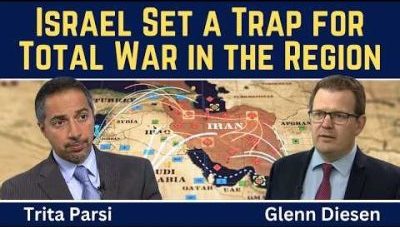
Trita Parsi: Israel Set a Trap for Total War in the Region
or go to
Aletho News Archives – Video-Images
Book Review
Why the War on Conspiracy Theories Is Bad Public Policy
By Kevin Barrett • Unz Review • February 1, 2019
 A Review of Conspiracy Theories and Other Dangerous Ideas by Cass Sunstein (based on an earlier paper co-authored with Adrian Vermeule); In Defense of Troublemakers: The Power of Dissent in Life and Business by Charlan Nemeth; and Conspiracy Theories and the People Who Believe Them, edited by Joseph E. Uscinski
On January 25 2018 YouTube unleashed the latest salvo in the war on conspiracy theories, saying “we’ll begin reducing recommendations of borderline content and content that could misinform users in harmful ways—such as videos promoting a phony miracle cure for a serious illness, claiming the earth is flat, or making blatantly false claims about historic events like 9/11.”
At first glance that sounds reasonable. Nobody wants YouTube or anyone else to recommend bad information. And almost everyone agrees that phony miracle cures, flat earthism, and blatantly false claims about 9/11 and other historical events are undesirable.
But if we stop and seriously consider those words, we notice a couple of problems. First, the word “recommend” is not just misleading but mendacious. YouTube obviously doesn’t really recommend anything. When it says it does, it is lying. … continue
Blog Roll
 Aletho News
- How the Cambridge Analytica scandal still haunts Mark Zuckerberg
- The Ongoing Cancellation Campaign Against a Dissenting Academic in Norway
- Yemen and ‘the Houthis’: Challenging Sami Hamdi’s Narrative
- No, Christians did not invent Zionism
- AIPAC-led lobbying network opens branches in Cypriot, Greek parliaments
- Araghchi blasts ‘parasitic’ alliance as US taxpayers pay for Israel’s war on Iran
- Easy fix for Europe’s chaos? Stop fueling war against Russia
- Putin’s key remarks on peace talks and Europe’s ‘schizophrenia’
- Trita Parsi: Israel Set a Trap for Total War in the Region
- Trump’s Iran war is on an Israeli leash
- If Americans Knew
- Damning report shows the media must confront its failures on Gaza
- BBC senior broadcaster speaks out on Gaza coverage
- Netanyahu vows vast West Bank invasion in response to 20-minute skirmish that left 2 Israeli soldiers and 2 Palestinian fighters dead
- Tied up and tortured: Israel using US-made electroshock weapons on Palestinian detainees
- The outsourced risk: how newsrooms rely on Gaza’s freelancers without protecting them
- Gaza bakeries forced to shut as Israel blocks flour shipments
- Gaza’s breast cancer patients face a deadly wait for treatment amid Israel’s genocide
- DAILY UPDATE: Latest essential news on Palestine, Israel, & region
- The Israel Lobby’s Changing Fortunes
- AIPAC has become such a political liability that it’s shifting to a more “nimble” approach to buying politicians
- No Tricks Zone
- E-Cars Reduce CO2 Emissions By Only 41% Compared To Internal Combustion Engine Vehicles
- Predictions Made By Renowned Climate Professor Over Past Decades Have Been Proven To Be Poor
- New Study Suggests Large Regions Of The Pacific Ocean Have Been Cooling For The Last 80 Years
- Germany’s Green Energy Debacle: High Energy Costs Force Kahla Porzellan to Close After 182 Years!
- New Study: 50 Years Of The Most Aggressive ‘Net Zero’ Policies Can Only Affect The Global Climate By 0.03°C
- US September “Heat” Was No Record…Many Records Set Decades Ago
- Latest European Green Energy Debacle; Portugal’s Largest Flagship Solar Park Insolvent!
- Green Energy Debacle: German Expert Professor Fritz Vahrenholt Warns Of Severe Economic And Social Consequences
- Two More Paleo Reconstructions Affirm Meters-Higher Sea Levels Across Ireland, Brazil 7000-6000 Years Ago
- New Study: Earth And Venus Surface Warmth Largely Explained By Convection And Lapse Rate, Not CO2 Or Radiation

