Yemeni army claims responsibility for strikes on sensitive sites in Saudi capital, Aramco facilities in Yanbu
Press TV – September 19, 2026
Yemeni armed forces have claimed responsibility for two separate missile and drone attacks on strategic installations deep inside Saudi Arabia in retaliation for Riyadh’s smear campaign and ongoing acts of aggression against the Arab Peninsula nation.
Brigadier General Yahya Saree, the spokesperson for Yemen’s military, announced in a statement on Saturday that Yemeni army units had targeted sensitive sites in the Saudi capital Riyadh, as well as Saudi Aramco oil facilities in Yanbu port city on the Red Sea coast.
He added that both operations, involving swarms of homegrown ballistic and cruise missiles as well as combat drones, were successful and caused massive blazes at the impact sites.
Saree noted that the attacks were in reprisal for Saudi Arabia’s unsubstantiated allegations of an attempted drone attack near the city of Mecca, and an unrelenting onslaught against the Yemeni nation.
The drone and missile operations were also in response to the Saudi enemy’s vile attempts to target the Yemeni capital Sana’a through tactics once employed by the Takfiri Daesh terrorist group. The tactics included indiscriminate shootings and bombings targeting civilians, he added.
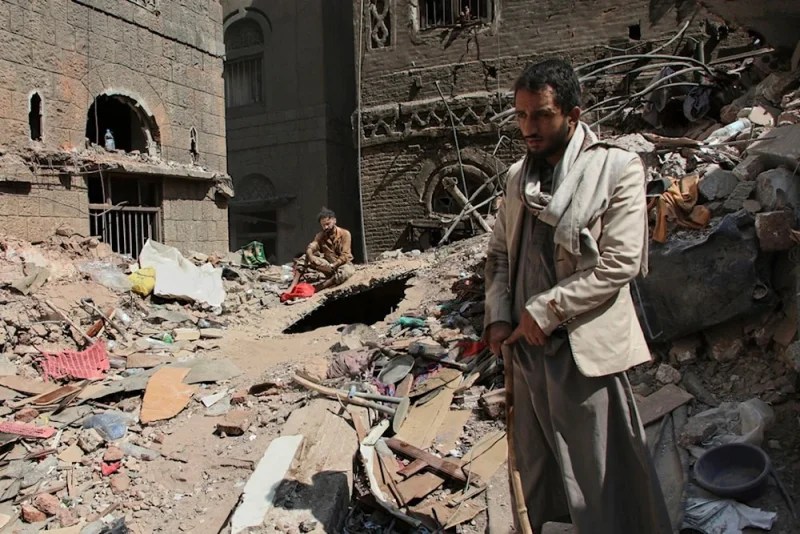
The spokesperson for the Yemeni armed forces added that F-15SA and Eurofighter Typhoon fighter aircraft of the Royal Saudi Air Force (RSAF) have so far carried out 732 airstrikes across Yemen, inflicting heavy civilian casualties and destroying critical non-military infrastructure.
Saree also vehemently denied Saudi officials’ claims that Yemeni armed forces are targeting residential neighborhoods, stressing that such baseless assertions come in light of the miserable failure of Saudi air defense systems to intercept Yemeni drones and missiles.
“Yemeni army units will uphold the siege-for-siege and escalation-for-escalation equation, and will target Saudi military buildups until the aggression ceases and the siege on our beloved country is completely lifted,” the Yemeni military spokesperson concluded.
The Sana’a administration declared a naval blockade against Saudi Arabia on July 20, in response to “an unfair and tyrannical siege” on Yemen lasting nearly 12 years.
The Yemeni military has announced a number of successful operations aimed at ships linked to Saudi Arabia in the Red Sea.
In March 2015, Saudi Arabia and its allies imposed a blockade on Yemen and launched a sweeping military campaign, backed by military, political, and logistical support from the United States and several Western countries.
The war has killed tens of thousands of Yemenis. However, Saudi Arabia has failed to achieve its stated objective of reinstating a puppet regime that serves its interests.
Iran’s Plan to Shut Down AI in the Persian Gulf
GCC internet will go dark if Trump renews hostilities
By Kurt Nimmo | Another Day in the Empire | September 18, 2026
The Gulf Cooperation Council (GCC) countries—Saudi Arabia, UAE, Qatar, Bahrain, and Kuwait—are heavily invested in AI as part of a strategy to diversify away from petroleum. National AI strategies across GCC countries emphasize investment in research and development, encourage public-private partnerships, and create regulatory frameworks that support innovation. The GCC AI market size increased from USD $6.22 billion in 2025 to USD $7.60 billion in 2026. It is projected to reach USD $23.03 billion by 2034.
In April, Iran’s Tasnim news agency mentioned the submarine cables, landing stations, and data hubs in the Gulf as strategic pressure points in the conflict initiated by the United States and Israel. According to the market research company IMARC Group, subsea internet data cables in the Gulf sit at the intersection of Europe, Asia, and Africa, and damage to these networks risks connectivity losses in one of the world’s most important internet traffic zones.
The economic importance of these cable systems extends far outside internet browsing or streaming services, notes Techstory, “because financial markets, payment systems and cloud computing firms depend on uninterrupted connections between continents every second of the day. Data centers in the Gulf and Asia also depend on those same cables to connect cloud systems serving businesses around the world.” Analysts estimate that networks linked to the GCC support roughly $10 trillion worth of financial transactions daily.
Iran claims the cables are within its territorial waters and fall under its jurisdiction. Tasnim and Fars suggest Iran may charge tech companies to use the internet cables, while Ebrahim Zolfaghari, a Brigadier General and the spokesperson for Iran’s Khatam al-Anbiya Central Headquarters, said that “companies like Google, Microsoft, Meta, and Amazon” will be required to “comply with Iranian law” and pay licensing fees for cable passage, with repair and maintenance rights given exclusively to Iranian firms.
The Islamic Republic cited the 1982 United Nations Convention on the Law of the Sea (UNCLOS), which includes provisions governing submarine cables. Article 79 of UNCLOS says coastal states have the right to establish conditions for cables or pipelines entering their territory or territorial sea.
On September 2, Iran’s Kayhan newspaper urged Iran’s IGRC to disrupt or sever international fiber-optic cables to pressure the United States and its allies. “Is it not our indisputable right, in order to bring these sources of evil to their knees and cut off their lifeline, to prevent internet cables from passing through the depths of the Persian Gulf and the Strait of Hormuz?” asked Kayhan editor-in-chief Hossein Shariatmadari. “This necessary measure could be carried out by seriously disrupting the cables’ operation or even cutting them.”
Iran has the ability to take out key cable networks, including the Fibre in Gulf submarine cable system, which connects Bahrain, Iraq, Kuwait Oman, Qatar, Saudi Arabia, and UAE. The Falcon Network connects Bahrain, Egypt, India, Iraq, Kuwait, Maldives, Oman, Qatar, Saudi Arabia, Sri Lanka, Sudan, and Yemen, while the the Gulf Bridge International links Bahrain, Iran, Iraq, Kuwait, Oman, Qatar, Saudi Arabia, UAE, and has onward connectivity to India, and Europe.
The Islamic Republic may decide to retaliate for the imposition of crippling sanctions which have negatively affected its economy, causing an increase in inflation and unemployment. Iran’s minimum wage stands at approximately 104 million rials, equivalent to roughly $110 US monthly. Essential commodity prices have risen sharply, with the International Monetary Fund documenting an annual inflation rate of 42.4%, according to October 2025 figures. Most estimates suggest sanctions have cost Iran approximately $60 billion each year by limiting investments in the energy sector. The sanctions have also significantly reduced Iran’s petroleum exports.
In 2023, the Iranian navy unveiled the domestically developed and manufactured Chamrosh-4 VTOL, a remotely operated drone designed for detecting, locating, and destroying both anchored and sleeping naval mines. Furthermore, Iran operates an undersea fleet of roughly 4 to 6 diesel-electric attack submarines well-suited to operate in the shallow waters of the Strait of Hormuz. In short, Iran has the ability to sabotage subsea internet data cables.
On September 17, President Trump, frustrated by the current stalemate in his war, said he faces a major decision over whether to escalate military action against Iran. “I have a big decision to make,” Trump said. “Do I want to go in and eliminate them or not? That’s a big decision. Anything can happen with me.”
Iran has given the United States an ultimatum for a period of three to four weeks, during which the United States must satisfy all Iranian demands. Failure to comply will result in severe escalation within the Strait of Hormuz and the execution of Iran’s planned preemptive military action targeting United States-backed Gulf infrastructure as well as American and Israeli assets, according to a senior Iranian official based in Tehran with direct knowledge of the situation.
The demands include $300 billion in reconstruction funds, a full release of Iran’s frozen assets of up to $120 billion, lifting of the US naval blockade, an end to war on all fronts (including Gaza and Lebanon), lifting of all sanctions on Iranian oil and gas, and acceptance of Iran’s permanent control of the Strait of Hormuz, including up to 7% transit fees.
President Trump is unlikely to accept these conditions, and as previously mentioned, may intensify military operations before the midterm elections. Should Trump choose to escalate, Iran has indicated it will heighten the intensity of its assaults against remaining American military and commercial infrastructure throughout the GCC region and West Asia.
On September 15, Amazon Web Services disclosed that Iranian drone strikes caused substantial damage to the corporation’s data facilities located in the United Arab Emirates and Bahrain. The preceding week, officials from the UAE declared that they were modifying their AI data center initiatives in response to the strikes, thereby underscoring a critical weakness that Iran continues to leverage with considerable facility.
Israel seeks ‘compensation’ from Washington over Saudi F-35 sale
The Cradle | September 18, 2026
Israel is expected to seek “compensation” from the US in the form of weapons systems that Washington has so far declined to sell to Tel Aviv, in response to US plans to sell F-35 fighter jets to Saudi Arabia in a $25 billion deal, Walla reported on 18 September.
A source familiar with the matter told the Hebrew news outlet that the Israeli military would prefer that no other country in West Asia receive the F-35 to preserve Israel’s qualitative military edge (QME) in the region.
The deal marks the first time an Arab state gains access to the F-35, the US military’s most advanced warplane.
“This proposed sale will support the foreign policy and national security objectives of the United States by improving the security of a major non-NATO ally that is a force for political stability and economic progress in the Gulf region,” the State Department said in a statement on Thursday.
Even if the deal is signed soon, Saudi Arabia would receive its first F-35s only in five years and without all the enhancements Israel has for its fleet of the warplanes, US officials told Middle East Eye (MEE).
Using the deal as leverage, Tel Aviv intends to ask Washington to allow it to participate in the development and production of classified US weapons systems, including space-based weapons, the source speaking with Walla said.
Israel will also ask the US to participate in the development and production of some of its own weapons systems, including missile interceptors for the Arrow 4 and Arrow 5 systems.
Additionally, Israel wants access to advanced munitions that Washington has so far declined to sell to Tel Aviv, including bunker-busting weapons designed to penetrate through mountains deep underground, autonomous strike systems, and swarms of unmanned aerial vehicles.
Israel may also seek funding to finance a third F-15 squadron and additional F-35 squadrons, which Israeli officials say they are currently struggling to do.
At the same time, the source speaking with Walla said that the Saudi purchase of F-35s would not threaten Israel’s qualitative military edge.
Israel continues to hold a clear operational advantage over other countries that have purchased the aircraft from the US due to the extensive operational experience accumulated by the Israeli Air Force and its pilots while carrying out the genocide of Palestinians in Gaza and the bombing of Lebanon and Iran.
One Israeli defense official sought to play down concerns, saying that Israel’s advantage lies “not just in the machine, but mainly in the people.”
Tel Aviv has also received Washington’s approval to integrate Israeli-made weapons systems into its Adir aircraft, the Israeli version of the F-35.
MEE notes that the sale has raised concerns among some in the US defense and intelligence community who believe China could gain access to critical US technologies through espionage if Saudi Arabia is allowed to operate the warplane.
Saudi crown prince seeks dialogue with Ansarullah after Yemeni blows: Report
Press TV – September 18, 2026
Saudi Crown Prince Mohammed bin Salman has called for temporary ceasefire and dialogue with Yemen’s Ansaraullah resistance movement, amid crippling Yemeni blockade and painful strikes on the kingdom, a report says.
Lebanon’s al-Akhbar news website, citing informed sources, reported that Riyadh has asked Oman to convey to Ansarullah its proposal for a two-week ceasefire and direct talks with the movement’s leadership with the aim of “addressing humanitarian demands” and ultimately “reaching a comprehensive agreement by the end of the truce.”
According to the report, the kingdom expressed its willingness to lift the siege on Yemen and allow the entry of aid into the country.
However, the report said, Ansarullah seeks “a final and comprehensive solution to the conflict, on the basis that there is a Yemeni-Saudi battle that has nothing to do with internal Yemeni affairs.”
The sources stressed that the resistance movement’s demands include an end to the blockade in all its forms: aerial, ground and naval, as well as Saudi Arabia’s military, security and political withdrawal from Yemen, and Saudi compensation for damage caused by the kingdom’s strikes.
Ansarullah had previously informed Muscat that the Saudi proposal to sponsor an intra-Yemeni dialogue was unacceptable, as it constituted foreign interference, stressing that the Yemeni dialogue is an internal affair in which no one has the right to interfere.
Al-Akhbar noted that the Saudi proposal came as the kingdom was “shocked” by the rapid advance of the Yemeni military and Ansarullah fighters along the Western coast and their control of Bab al-Mandab Strait, and the failure of Riyadh’s calls for aid to be heeded.
The US Central Command (CENTCOM) reportedly briefed the Saudis on an assessment indicating a “sudden disintegration” within the mercenary force led by Tariq Saleh, noting that “Sanaa’s forces appeared fully apprised of every move made by Saleh and his troops.”
A source familiar with the matter said the US stance is “akin to a reprimand of Saudi Arabia over the conduct of its allied forces,” coupled with an emphasis that “the United States would not deploy its own forces to fight on anyone’s behalf.”
The Saudi retreat also comes as the idea of recruiting mercenaries from Syria, Libya, and Sudan to fight in Yemen has also failed to gain traction, according to the report.
Ben Salman was also advised by Egyptian officials, who surprised him by a historical overview of the situation in Yemen during his visit to Cairo, to hold talks with Ansarullah.
The outlet also noted that bin Salman is monitoring with concern reports that officials from the US administration have informed Omani officials of Washington’s desire to hold talks with Ansarullah to ensure that the Bab al-Mandab Strait would not be closed.
According to an Omani source, communications between officials in Muscat and Mohammed Abdulsalam, the spokesman for Ansarullah and Yemen’s chief negotiator, stressed that the Sana’a government “has no intention of taking any measures that would jeopardize navigation in the Red Sea.”
The Omani mediator informed the US and Saudi Arabia that Ansarullah had clearly stated that maritime navigation in the Red Sea is safe, except for Saudi ships. The group also stressed the ban would remain in effect until Riyadh practically lifts the blockade on Yemen.
Several countries such as Pakistan, Turkey and Egypt have reportedly been communicating with Yemeni and Ansarullah officials for a week with the aim of stopping the country’s military operations.
The report quoted a relevant source in Muscat as saying that diplomatic efforts to persuade Riyadh to back away from its rigid stance began after all mediating parties have realized that the movement is determined to find a “final” solution to the current situation.
Yemeni armed forces continue to consolidate their positions along the Western coast, taking additional measures to counter any attempt by Saudi-backed mercenaries to make up for their losses.
Senior Ansarullah officials have informed mediators that continued Saudi airstrikes on Yemen will be met with significant escalation, including more heavy strikes against vital facilities deep inside the Kingdom.
The current maritime blockade is a direct response to the devastating, years-long siege imposed on Yemen by the Saudi-led coalition.
For nearly a decade, the coalition has enforced a crippling land, sea, and air blockade, which the United Nations has repeatedly described as a primary driver of the world’s worst humanitarian crisis.
This siege has deliberately targeted Yemen’s ability to import food, fuel, and medicine, while simultaneously attempting to plunder the nation’s oil and gas resources.
Utilizing their advanced asymmetric naval capabilities, including drones and missiles, Yemen has shifted from a purely defensive posture to an active pressure campaign.
This strategy is designed to inflict direct economic and military costs on the Saudi regime until the siege is permanently lifted, the war is ended, and Yemen’s full sovereignty is restored.
Damascus rejects Saudi request for Syrian fighters to counter Yemen: Report
The Cradle | September 18, 2026
Syria has rejected a formal Saudi request to organize and deploy Syrian fighters to Yemen, according to Syrian sources speaking with Turkiye Today.
Riyadh reportedly spent months seeking military personnel to meet its needs in Yemen, but Damascus declined the request, citing a focus on reorganizing its own military.
“This issue has been exhausted and is over. The Saudi request was made several months ago. Syria politely turned it down, saying it was focused on its own military organization process and did not intend to enter a conflict as a third party,” one of the sources said.
Saudi Arabia is engaged in a war against the Yemeni Armed Forces (YAF), which have made advances in recent weeks, liberating territory along the western coast previously held by Saudi-backed mercenaries.
Yemeni Armed Forces have also maintained a blockade on Saudi vessels seeking to transit the strategic Bab al-Mandab Strait, helping to limit Saudi crude exports already restricted by Iran’s closure of the Strait of Hormuz.
In recent days, Syria has experienced internal unrest due to protests against the government’s decision on Sunday to significantly increase gasoline and diesel prices.
The sources said Syria was not preventing individuals from traveling abroad to participate in the fighting in Yemen independently, but Damascus would not assume responsibility for such involvement.
Turkish sources also denied claims that Ankara had organized or transported Syrian fighters to Yemen, saying reports of Syrians traveling as part of teams operating alongside Turkish personnel were “completely untrue.”
“We have no involvement in this matter. Syria and Saudi Arabia are sovereign countries,” the Turkish sources said.
Saudi Arabia is reportedly continuing to seek military personnel and instructors from several countries, with Pakistan among those where recruitment efforts have gained traction.
Sources said any Turkish or Pakistani involvement under the Mecca Pact would focus on “defensive” missions and the protection of strategic infrastructure rather than ground operations against Yemen.
In August, Turkiye, Saudi Arabia, and Pakistan announced the formation of the Mecca Joint Defense Agreement.
In an apparent bid to rally support from its new allies, Saudi Arabia made unsubstantiated claims on Tuesday that Yemeni forces attempted to attack the Saudi city of Mecca, home to Islam’s holiest site, the Kaaba.
Colonel Turki Al-Malki, spokesperson for the Saudi-led mercenary forces in Yemen, alleged that the YAF launched a drone toward Mecca on Tuesday evening and that the Saudi air defenses shot it down before it entered the city’s restricted airspace.
However, Yemen denied the Saudi claim, saying Riyadh was spreading “false accusations.”
“There is no threat from Yemen to the holy sites. Our operations target its oil facilities and military bases, and are far from the holy sites,” said YAF spokesperson, Brigadier General Yahya Saree, via Telegram.
Report: Saudi Arabia seeks allies’ assistance as missiles deplete amid war on Yemen
Press TV – September 17, 2026
Saudi Arabia is reportedly facing depleted reserves of missile interceptor systems and has appealed to regional partners and Western allies for assistance as Yemeni Armed Forces continue retaliatory missile and drone operations against strategic sites deep inside the kingdom.
The Associated Press, citing two regional officials speaking on condition of anonymity, reported on Wednesday that Saudi authorities have appealed to France, the United Kingdom, Pakistan, and Egypt to establish air-defense reinforcements in the region to bolster protection against missile and drone operations conducted by Yemeni Armed Forces.
The Yemeni operations are being carried out in retaliation for ongoing airstrikes and the blockade against their Arab Peninsula nation.
The outreach effort commenced due to the fact that Saudi Arabia’s principal ally and primary arms supplier, the United States, has faced a significant reduction in its interceptor inventory over the course of a six-month war of aggression on Iran, according to one official.
Fresh Saudi airstrikes across Yemen
On Thursday, a civilian was killed and another sustained injuries when Saudi warplanes carried out two airstrikes in Yemen’s northern province of Hajjah.
Yemen’s al-Masirah television channel, citing local sources, reported that the aerial assaults destroyed four passenger cars and damaged a house in the Abs district.
Elsewhere in the southwestern province of Ta’izz, Saudi fighter aircraft targeted three telecommunications towers in the al-Ta’iziyah and Dimnat Khadir districts.
On July 20, the Sana’a government announced a maritime blockade against Saudi Arabia in response to “an unjust and oppressive siege” on Yemen for almost 12 years.
Subsequently, the Yemeni armed forces have reported a series of successful missions that have targeted vessels associated with Saudi Arabia in the Red Sea.
In March 2015, Saudi Arabia and its allies imposed a blockade on Yemen, initiating a comprehensive military offensive that received support in terms of military, political, and logistical assistance from the United States and several Western countries.
Tens of thousands of Yemenis have lost their lives; however, Saudi Arabia has failed to achieve its primary goal of reestablishing a puppet government that served its interests.
Fuel Crisis Deepens: Pakistan Warns Tanker Attack in Red Sea Would Be an ‘Act of War’
Sputnik – 17.09.2026
The Saudi East-West oil pipeline, a critical bypass route for the kingdom’s oil exports around instability in the Strait of Hormuz, was closed last week after Houthi attacks and may remain shut for up to six weeks.
Pakistan has warned that any attack on an empty oil tanker under the Pakistani flag anchored in the Red Sea off Saudi Arabia will be regarded as an “act of war,” as Islamabad weighs its options amid rapidly shrinking diesel reserves.
The Saudi East-West oil pipeline, a critical bypass route for the kingdom’s oil exports around instability in the Strait of Hormuz, was closed last week after Houthi attacks and may remain shut for up to six weeks.
Speaking on a private news channel, Oil Minister Ali Pervaiz Malik stated that if crude oil supplies are cut, Pakistan will face an imminent diesel fuel shortage, since the country has reserves for only the current and upcoming month.
“This kind of statement should be understood in the context of Pakistan’s national security, sovereignty context, and also an increasingly serious energy security situation,” Syed Ali Ehsan, chief development officer at the Policy Research Institute of Market Economy, Economic Policy Analyst, told Sputnik.
According to Ehsan, the immediate issue is not simply that a tanker is stranded there, but that Pakistan has established a broader principle — that its civilian shipping should remain outside the regional conflict. Moreover, Pakistani flag vessels are critical to maintaining the country’s energy lifeline, and allowing one to be deliberately attacked, without consequence, could weaken the protection afforded to subsequent shipments.
However, declaring a red line does not mean that Pakistan must enter a wider regional war if an incident occurs.
As for the response Pakistan can give, the country has a substantial range of responses available to it, according to the expert. Pakistan can increase naval escorts or maritime surveillance and defend its vessels against incoming attacks, and in the event of a deliberate attack, retain the option of a limited and proportionate response, Ehsan believes.
In this photo released by the U.S. Indo-Pacific Command, the United Kingdom’s carrier strike group led by HMS Queen Elizabeth (R 08), and Japan Maritime Self-Defense Forces led by
At the same time, diplomatic channels with Iran, Saudi Arabia, Oman, and other regional actors can communicate clearly that Pakistan seeks to protect its commercial shipping, rather than become a party to the wider conflict, he emphasized.
As for solving the problem of Pakistan’s oil reserves being exhausted, the country needs to diversify both the source and the form of its petroleum imports.
“In the immediate term Saudi crude rerouted from Oman could provide an important alternative to disrupted routes, and Pakistan can simultaneously procure crude oil from alternative suppliers in Africa, such as Angola and Libya, or from Central Asia, for example, Malaysia,” Ehsan says.
Larger tankers can serve as temporary floating storage, effectively creating an emergency petroleum reserve offshore, the expert believes.
“I think the immediate policy objective is twofold: number one is to protect Pakistan shipping without being drawn unnecessarily into the regional conflict, and number two is to use the available window to rapidly diversify supply routes, the suppliers, and petroleum inventories,” Ehsan added.
Houthis Keep Advancing as the Red Sea Crisis Deepens
Daniel Davis / Deep Dive – September 16, 2026
Saudi Arabia launched 129 airstrikes in 48 hours
The Cradle | September 13, 2026
Saudi warplanes carried out 129 airstrikes across seven Yemeni provinces over 48 hours, the spokesperson for the Yemeni Armed Forces, Brigadier General Yahya Saree, stated on Saturday, vowing that the attacks would not go unanswered.
According to Saree, the strikes targeted Taiz, Marib, Hodeidah, al-Jawf, Saada, Amran, and Hajjah.
Saree said the attacks were carried out using F-15 and Typhoon fighter jets that took off from Saudi military bases in Khamis Mushait and Taif.
“These attacks against our people will not pass without a response and punishment, God willing and by His strength,” Saree said.
Yemeni Parliament condemns Saudi escalation
In a similar vein, the Yemeni Parliament said the Saudi regime must respect Yemen’s unity and independence and refrain from interfering in its internal affairs if it wants peace to prevail in the region and the world.
It stressed that developments inside Yemen constituted an internal matter in which the Saudi regime had no involvement.
The Parliament also commended the wisdom and leadership of the revolution leader and the head of the Supreme Political Council, Mahdi al-Mashat, in taking prudent measures to confront the Saudi escalation.
Parliament backs armed forces victories
The Yemeni Parliament praised the victories achieved on all fronts and commended the presidential amnesty decision.
It also thanked citizens who cooperated with members of the Yemeni Armed Forces across areas of fighting.
The Parliament reaffirmed Sanaa’s commitment to securing international shipping routes through the Red Sea and the Bab al-Mandab Strait, except for Saudi vessels involved in the blockade imposed on Yemen.
The statements come amid continued Saudi military escalation, with Yemeni authorities warning that attacks against the country would be met with a response.
5,400 km² retrieved: YAF detail western coast gains
Earlier today, the Yemeni Armed Forces said a large-scale operation launched on September 3 along Yemen’s western coast expelled Saudi-backed forces from six districts across Taiz and Hodeidah governorates, covering 5,400 square kilometers.
The operation, carried out with support from local tribes, resulted in hundreds of Saudi-backed personnel being killed, wounded, or captured, while several Yemeni detainees held for years were also freed.
Saree said the operation followed years of attacks on local communities and was aimed at driving out Saudi-backed forces and preventing attempts to impose Saudi control over Yemeni territory. He said Yemeni forces struck seven military divisions comprising 38 brigades and secured the retaken areas.
The YAF said their ground operations continued despite intensive Saudi air support, while their air defenses carried out 32 operations and reportedly downed nine aircraft.
They also reaffirmed that maritime navigation remains safe for all vessels except Saudi ships covered by its announced ban, pledging to maintain its “blockade for blockade” policy and respond to escalation with escalation until the aggression and blockade on Yemen end.
Trita Parsi: Massive Houthi Victory Transforms U.S.-Iran War
Glenn Diesen | September 12, 2026
Trita Parsi is the co-founder and Executive Vice President of the Quincy Institute for Responsible Statecraft. Follow the Substack of Trita Parsi: https://tritaparsi.substack.com/
Follow Prof. Glenn Diesen:
- Substack: https://glenndiesen.substack.com/
- X/Twitter: https://x.com/Glenn_Diesen
- Patreon: https://www.patreon.com/glenndiesen
Support the research by Prof. Glenn Diesen:
- PayPal: https://www.paypal.com/paypalme/glenndiesen
- Buy me a Coffee: buymeacoffee.com/gdieseng
- Go Fund Me: https://gofund.me/09ea012f
- Buy Diesen merchandise: https://diesen-shop.fourthwall.com/en-nok
Why the Israelis are so afraid of a liberated Yemen
By Robert Inlakesh | Al Mayadeen | September 12, 2026
The liberation of Yemen by a staunchly pro-Palestinian movement is a nightmare scenario for the Zionist Project in the region, it ensures that the cause of occupied al-Quds will remain alive and that a new power will emerge to champion it. To the Israelis, what they are looking at is like the birth of a new Iran in the Arab World.
For long the Ansar Allah-led government of Yemen had been underestimated and treated as little more than a nuisance, one that Saudi Arabia and the United Arab Emirates were handed the task of dealing with. In 2022, this dynamic began to shift, as the Yemeni Armed Forces demonstrated advanced missile and drone capabilities that shook vital targets in Saudi Arabia, even reaching as far as the United Arab Emirates.
The stalemate of the Marib offensive of 2021 may have also worked to deceive the US-Israeli alliance in the region, who clearly failed to take the armed forces of the Ansar Allah-led government in Sanaa seriously. However, Riyadh did end up taking them seriously in early 2022, as did Abu Dhabi, hence their decision to agree to a United Nations mediated temporary ceasefire.
Since then, Yemen’s leadership has become the only government on earth to directly order its military to open fire on the Zionist entity in order to support the people of Gaza. From the very beginning of the Genocide, the Yemeni Armed Forces began firing missiles at the Israelis, before imposing a blockade on them in the Red Sea.
These measures would have been notable had they come from any nation, let alone one that had suffered 400,000 deaths in brutal conflict and suffered through an illegal and inhumane siege themselves. There was nothing material that the Ansar Allah-led government sought to gain from its tangible and unapologetic support of the Palestinian Resistance in the Gaza Strip, which is what made it all the more unpredictable in the eyes of the US-Israeli alliance.
Because Sanaa had been so underestimated, the Israelis and the US were essentially left blind inside of Yemen, not having anywhere near the required intelligence to deal a serious blow to Ansar Allah. Instead, the Zionist regime did the predictable thing: it bombed civilian targets and then called in its US allies to launch three separate military operations in an attempt to break the blockade established in support of Gaza.
Yemen is a nation that, if fully liberated from the proxy forces of Saudi Arabia and the United Arab Emirates, would undoubtedly dedicate its foreign policy to opposing the Zionist entity and supporting the Palestinian Resistance. This alone is a major threat to the Israeli regime.
Yet, it will also mean something else. It will be the only Arab country that has an independent government which is not allied with the United States. In other words, it will serve as an example to the entire region and will represent the spirit of Arabism. For Riyadh, Damascus, Amman, Cairo and beyond, this is a major problem, because once the example is set, their own populations could begin getting ideas about what their future should look like.
Yemen’s liberation will represent the only truly successful revolution of the Arab Spring. In the case of every other example, the nation has ended up under US domination, with the latest example being the case of Syria.
A Yemen that can gain access to its own resources, live free of blockade and have influence over the Bab al-Mandab Strait could become a major powerhouse, especially while allied with the Islamic Republic of Iran. It is a major gain for the regional resistance to US imperialism and an enormous strategic loss to the Zionist regime, along with a blow to the Washington-backed Arab dictatorships.
The only means of combating the gains made on the ground by the Yemeni Armed Forces, is to try and spread as much sectarianism throughout the region as possible. This, the Gulf Arab regimes and US-Israeli alliance, may believe to be an effective means of combating the revolutionary fervor of the Arab public who have been greatly agitated by the Gaza Genocide.
Part of the reason why the majority of the Arabic-language media, along with the entirety of the Western corporate media refer to the Ansar Allah-led government as the “Houthi rebels” is for this very reason. They hope to paint the movement as a band of Shia rebel fighters that are “proxies of Iran”. It works to both delegitimize the Yemeni Armed Forces and government based in the Capital City of the country, while also selling a false sectarian narrative.
To the great misfortune of the US-Israeli-Arab aligned bloc, their attempts to pull the wool over the eyes of the public is wearing thin. The Gaza Genocide exposed where everyone stands, and now the truth is clear for everyone to see.
Iraqi Resistance denies role in Saudi East-West pipeline attack
Al Mayadeen | September 12, 2026
The Islamic Resistance in Iraq has denied accusations that it was behind the drone attack targeting Saudi Arabia’s strategic East-West oil pipeline, rejecting claims linking Iraqi factions to the operation and criticizing Baghdad for acting on unsubstantiated allegations.
In a statement on Saturday, the Resistance said accusations that it had targeted vital Saudi infrastructure amounted to “an honor we do not claim,” while stressing that no credible evidence had been presented proving the involvement of any Iraqi party.
The group expressed strong surprise at the Iraqi government’s haste in adopting the accusations and taking measures without relying on verified evidence or concrete investigations.
Resistance calls for official investigation
The Islamic Resistance in Iraq said it was fully prepared to participate in any government investigation committee established to determine the facts surrounding the attack.
It called on Iraqi authorities to pursue an evidence-based investigation rather than, in its words, follow “suspicious narratives.”
The Resistance also warned against US-Israeli schemes aimed at dragging Iraq into secondary crises that serve the interests of the region’s adversaries and divert attention from broader regional developments.
Support for Yemen reaffirmed
Despite denying involvement in the Saudi pipeline attack, the Islamic Resistance reiterated its firm and longstanding support for the Yemeni people.
The group said Yemen has been subjected to a Saudi-led siege for more than a decade, reaffirming its position in support of the country amid the latest regional escalation.
The statement comes in response to recent accusations and security measures following the shutdown of Saudi Arabia’s vital East-West crude oil pipeline after it was reportedly struck by a drone originating from Iraqi territory.
The roughly 1,200-kilometer pipeline stretches across the Arabian Peninsula and serves as a key route for transporting Saudi crude from the kingdom’s eastern oil-producing regions toward the Red Sea.
Following investigations into the incident, Iraqi authorities announced the dismissal of the commander of Maysan Operations over the attack.
Featured Video

“Historic Russia”: The Land Putin Will Not Give Back
or go to
Aletho News Archives – Video-Images
Book Review
Why the War on Conspiracy Theories Is Bad Public Policy
By Kevin Barrett • Unz Review • February 1, 2019
 A Review of Conspiracy Theories and Other Dangerous Ideas by Cass Sunstein (based on an earlier paper co-authored with Adrian Vermeule); In Defense of Troublemakers: The Power of Dissent in Life and Business by Charlan Nemeth; and Conspiracy Theories and the People Who Believe Them, edited by Joseph E. Uscinski
On January 25 2018 YouTube unleashed the latest salvo in the war on conspiracy theories, saying “we’ll begin reducing recommendations of borderline content and content that could misinform users in harmful ways—such as videos promoting a phony miracle cure for a serious illness, claiming the earth is flat, or making blatantly false claims about historic events like 9/11.”
At first glance that sounds reasonable. Nobody wants YouTube or anyone else to recommend bad information. And almost everyone agrees that phony miracle cures, flat earthism, and blatantly false claims about 9/11 and other historical events are undesirable.
But if we stop and seriously consider those words, we notice a couple of problems. First, the word “recommend” is not just misleading but mendacious. YouTube obviously doesn’t really recommend anything. When it says it does, it is lying. … continue
Blog Roll
 Aletho News
- “Historic Russia”: The Land Putin Will Not Give Back
- How the Cambridge Analytica scandal still haunts Mark Zuckerberg
- The Ongoing Cancellation Campaign Against a Dissenting Academic in Norway
- Yemen and ‘the Houthis’: Challenging Sami Hamdi’s Narrative
- No, Christians did not invent Zionism
- AIPAC-led lobbying network opens branches in Cypriot, Greek parliaments
- Araghchi blasts ‘parasitic’ alliance as US taxpayers pay for Israel’s war on Iran
- Easy fix for Europe’s chaos? Stop fueling war against Russia
- Putin’s key remarks on peace talks and Europe’s ‘schizophrenia’
- Trita Parsi: Israel Set a Trap for Total War in the Region
- If Americans Knew
- Damning report shows the media must confront its failures on Gaza
- BBC senior broadcaster speaks out on Gaza coverage
- Netanyahu vows vast West Bank invasion in response to 20-minute skirmish that left 2 Israeli soldiers and 2 Palestinian fighters dead
- Tied up and tortured: Israel using US-made electroshock weapons on Palestinian detainees
- The outsourced risk: how newsrooms rely on Gaza’s freelancers without protecting them
- Gaza bakeries forced to shut as Israel blocks flour shipments
- Gaza’s breast cancer patients face a deadly wait for treatment amid Israel’s genocide
- DAILY UPDATE: Latest essential news on Palestine, Israel, & region
- The Israel Lobby’s Changing Fortunes
- AIPAC has become such a political liability that it’s shifting to a more “nimble” approach to buying politicians
- No Tricks Zone
- E-Cars Reduce CO2 Emissions By Only 41% Compared To Internal Combustion Engine Vehicles
- Predictions Made By Renowned Climate Professor Over Past Decades Have Been Proven To Be Poor
- New Study Suggests Large Regions Of The Pacific Ocean Have Been Cooling For The Last 80 Years
- Germany’s Green Energy Debacle: High Energy Costs Force Kahla Porzellan to Close After 182 Years!
- New Study: 50 Years Of The Most Aggressive ‘Net Zero’ Policies Can Only Affect The Global Climate By 0.03°C
- US September “Heat” Was No Record…Many Records Set Decades Ago
- Latest European Green Energy Debacle; Portugal’s Largest Flagship Solar Park Insolvent!
- Green Energy Debacle: German Expert Professor Fritz Vahrenholt Warns Of Severe Economic And Social Consequences
- Two More Paleo Reconstructions Affirm Meters-Higher Sea Levels Across Ireland, Brazil 7000-6000 Years Ago
- New Study: Earth And Venus Surface Warmth Largely Explained By Convection And Lapse Rate, Not CO2 Or Radiation

