The US is pushing Lebanon into the arms of Iran and Russia: US sanctions affect the local economy

Lebanese disputed blocks with Israel
By Elijah J. Magnier – 18/03/2019
Lebanon is expecting the visit of US Secretary of State Mike Pompeo this week at a time when the Lebanese economic-political map is being redrawn and while Lebanon is suffering its most serious economic downturn in recent history.
Reasons for the deterioration of the local economy include not only the corruption of Lebanon’s political leadership and lower level administration but also US sanctions imposed on Iran. The latest sanctions are the harshest ever imposed. They will also dramatically affect Lebanon so long as President Donald Trump is in power if Lebanon does not follow US policy and dictates.
If, as anticipated, Washington declares economic war on Lebanon, the sanctions will leave Lebanon few alternatives. They may force Lebanon to fall back on Iranian civilian industry to overcome US economic pressure, and to rely on the Russian military industry to equip Lebanese security forces. This will be the result if Pompeo insists on threatening Lebanese officials, as his assistants have done on previous visits to the country. The consistent message from US officials has been: you’re either with us or against us.
Politically, Lebanon is divided between two currents, one pro-US (and Saudi Arabia) and another outside the US orbit. The economic situation may well increase internal division to the point that the local population reacts angrily in order to exclude the US and its allies from influence in Lebanon.
Such a scenario may still be avoided if Saudi Arabia injects enough investment to reboot the agonising local economy. Nevertheless, Saudi Arabia fears that those who are not aligned with its policies and those of the US could benefit from its support. To date, Riyadh has not fully understood the internal Lebanese dynamic and what it is possible or impossible to achieve in Lebanon. The kidnapping of the Prime Minister Saad Hariri was the most flagrant indication of Saudi ignorance of Lebanese politics. The Saudis’ lack of strategic vision in Lebanon will likely prevent any serious support to the failing economy and may lead the country into serious instability.
Before 1982, one US dollar was equivalent to 3 Lebanese Lira. This was in part because the Palestinian Liberation Organisation (PLO) was spending tens of millions of dollars in the country on its own people and on Palestinian families living in Lebanon. Moreover, United Nations organisations (UNRWA) and other NGOS were also distributing financial support to Palestinian refugees whose homes had been taken by Israel forcing them to leave their country.
Following the Israeli invasion of Lebanon in 1982, the PLO was forced to leave the country. Not much later, one US dollar reached an exchange rate of 3000 Lebanese Lira, later devalued to stabilise at the current rate of 1$ for 1500 L.L. Iran entered the scene to support local Lebanese fighters (the Islamic Resistance in Lebanon, i.e. Hezbollah) to recover their territory from Israeli occupation. In the year 2000, Iran began to make a serious investment in Hezbollah as the group managed to force the Israelis out of most Lebanese territory. Iranian financial investment had reached a very high level by the 2006 war when Israel was prevented from disarming Hezbollah to keep its rockets and missiles out of range of Israel.
In 2013, the Syrian government asked Hezbollah to support the Syrian Army to prevent disintegration of the country and to keep Takfiri militants from taking over. Iran pumped billions of dollars to defeat ISIS and al-Qaeda and to prevent them from overwhelming Syria and Iraq, aware that Iran would be the next target. The budget for Hezbollah troops went sky high. Support for movements of troops, logistics and daily allowances given to fighters, contributed to boosting the Lebanese economy. Hezbollah’s monthly budget went much beyond $100 million per month.
But after the arrival of Donald Trump in power and his rejection of the Iran nuclear deal, the US government has imposed the severest sanctions on Iran and halted donations to the United Nations organisations supporting Palestinian refugees (UNRWA). Sanctions on Iran have forced a new budget on Hezbollah, a five-year austerity plan. Forces have been reduced to a minimum number in Syria, movement of troops are slowed accordingly and all additional remunerations are suspended. Hezbollah reduced its budget to a quarter of what it had been without suspending any militants or contractors’ monthly salaries and medical care as stipulated by a personal order from Sayyed Hassan Nasrallah, Hezbollah’s Secretary General.
This new financial situation will affect the Lebanese economy as cash flow and foreign currency dry up. The consequences are expected to be more noticeable in the coming months, leading to a plausible domestic reaction from the local population that will feel the weight of the failing economy.
The US and Europe are imposing strict controls on any monies transferred to and from Lebanon. The country is on a financial blacklist and there is tight scrutiny on all transactions. Religious donations from abroad are no longer possible since they expose donors to serious accusations of support for terrorism by western countries.
As long as Trump is in power, Hezbollah and Iran believe the situation will remain critical; they estimate that the US President will most probably enjoy a second term. The next five years are expected to be hard on the Lebanese economy, particularly if Pompeo’s visit brings messages and dictates that Lebanon cannot obey.
Pompeo wants Lebanon to give up on its demand to redraw its disputed water borders with Israel, compromising on blocks 8, 9 and 10 to the benefit of Israel. This request will not be granted and Lebanese officials have said on several occasions that they are relying on Hezbollah’s precision missiles to stop Israel from stealing Lebanese water.
Pompeo also wants Lebanon to give up on Hezbollah and its role in government. Again, the US establishment seems ignorant that Hezbollah is almost a third of Lebanon’s population, enjoying the support of more than half of Lebanese Shia, Christian, Sunni and Druse, with official members in the executive and legislative authorities of the country.
What then is the alternative? If Saudi Arabia moves in, Lebanon doesn’t need one or two or five billion but tens of billions of dollars to resuscitate its economy. It also needs a hands-off policy from the US establishment to allow the country to govern itself.
The Saudis are already suffering from Trump’s bullying, and their funds are drying up. If Saudi decides to invest in Lebanon, it will seek to impose terms not much different from US demands. Saudi Arabia engages in wishful thinking when it aims to expel Iran’s influence and Hezbollah supporters from Lebanon, an impossible goal to fulfil.
Lebanon’s remaining choices are few. Lebanon can move closer to Iran to lower its expenditures and the cost of goods, and it can ask Russia to support the Lebanese army if the West fails to do so. China is preparing to move in and can be a positive alternative for the country, using Lebanon as a platform to reach Syria and later Iraq and Jordan. Otherwise, Lebanon will have to prepare to join the list of poorest countries.
A shadow is hanging over the land of the cedars, a country that has already had to fight for survival in the 21stcentury. Hezbollah, now subject to US and UK sanctions, is the same force that protected the country from ISIS and other takfiri fighters who threatened to expel Christians from the country, in accordance with French President Sarkozy’s advice to the Lebanese patriarch that Lebanese Christians abandon their homes. The takfiri jihadists and NATO shared the same intentions for Lebanon. The failure of the US establishment’s plan to divide Iraq and create a failed state in Syria as part of a “new Middle East” woke the Russian bear from its long hibernation. Today Russia competes with the US for hegemony in the Middle East, obliging Trump to pull out all the stops in an attempt to break the anti-US front.
It is a battle with no taboos where all blows are permitted. The US is pushing Lebanon into a bottleneck with no alternatives to closer partnership with Iran and Russia.
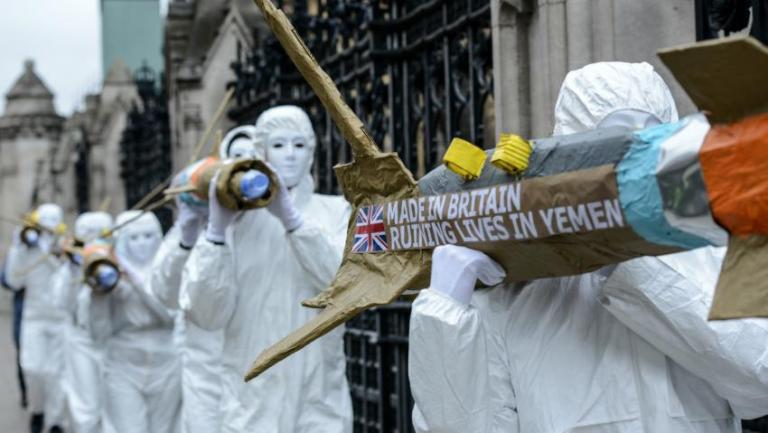
British RAF servicing Saudi jets bombing civilians in Yemen – UK armed forces minister
RT | March 18, 2019
Britain is providing “engineering support” for UK-supplied aircraft operated by the Royal Saudi Air Force, responsible for killing innocent people in Yemen, a British government minister has revealed.
Armed Forces Minister Mark Lancaster was responding to a question in parliament from Labour MP Lloyd Russell-Moyle, on military personnel seconded to BAE Systems in Saudi Arabia, when he admitted that the RAF have provided engineering and “generic training” to the Saudi Air Force involved in the bombing of Yemen.
“RAF personnel on secondment to BAE Systems in Saudi Arabia have provided routine engineering support for UK-supplied aircraft operated by the Royal Saudi Air Force (RSAF), including aircraft engaged in military operations in Yemen.”
Lancaster insisted UK personnel were not involved in the loading of weapons for operational sorties, in response to Russell-Moyle’s claim that the “British support keeps Saudi’s air war going.”
Andrew Smith of Campaign Against the Arms Trade has branded the revelation “shocking but not surprising,” arguing that UK military personnel “should not be servicing Saudi jets or supporting the Saudi armed forces.”
It’s not just the UK that has been widely criticised for being party to the Saudi-led coalition’s bombardment of Yemen.
In December, the US Pentagon revealed that they were having to claw back $331 million of taxpayer-subsidized money gifted to Saudi Arabia and the UAE over a three-year period, when it ‘accidentally’ refueled their aircraft for free during their war on Yemen.
In November, Labour’s Shadow Foreign Secretary Emily Thornberry accused the UK government of having “blood on its hands” after admitting that the RAF had trained over a hundred Saudi pilots in the past ten years.
Coalition forces led by Saudi Arabia and the United Arab Emirates have relentlessly bombed Yemen since 2015 in an effort to oust the Houthi rebels controlling the capital city of Sanaa.
They have reportedly targeted hospitals and other civilian infrastructure, leading to a massive cholera outbreak, and upwards of 60,000 people are believed to have died in the conflict since 2016 – with a further 85,000 estimated dead from famine and malnutrition.
Half of Yemen’s population relies on food aid to survive, placing them in immediate danger of starving to death after coalition forces blockaded the port city of Hodeidah last year.
Arms Sales to Middle East Have Increased Dramatically: US Top Exporter
Al-Manar | February 11, 2019
Arms flows to the Middle East have increased by 87 percent over the past five years and now account for more than a third of the global trade, the Stockholm International Peace Research Institute (SIPRI) said in a report on Sunday.
The defense think-tank’s annual survey showed that Saudi Arabia became the world’s top arms importer in 2014-18, with an increase of 192 percent over the preceding five years. Egypt, Algeria, the United Arab Emirates and Iraq also ranked in the top 10 list of global arms buyers. Sipri measures the volume of deliveries of arms, not the dollar value of deals. The volume of deliveries to each country tends to fluctuate, so it presents data in five-year periods that offer a more stable indication of trends.
The new report shows how the United States and European nations sell jets, jeeps and other gear that is used in controversial wars in Yemen and beyond, SIPRI researcher Pieter Wezeman told Middle East Eye.
“Weapons from the US, the UK and France are in high demand in the Gulf, where conflicts and tensions are rife. Russia, France and Germany dramatically increased their arms sales to Egypt in the past five years,” Wezeman said.
The growth in Middle Eastern imports was in part driven by the need to replace military gear that was deployed and destroyed in Yemen, Syria, Iraq and Libya, he said, adding that it was also driven by political tensions and a regional arms race.
The UAE, Saudi Arabia and ‘Israel’ are readying for a potential conflict with Iran, the 12-page report said. Also, the UAE, Saudi Arabia and others have been involved in a diplomatic crisis with Qatar since 2017.
In 2014-18, Saudi Arabia received 94 combat jets fitted with cruise missiles and other guided weapons from the US and Britain.
Over the next five years, it is set to get 98 more jets, 83 tanks and defensive missile systems from the US, 737 armored vehicles from Canada, five frigates from Spain, and Ukrainian short-range ballistic missiles.
In 2014-18, the UAE received missile defense systems, short-range ballistic missiles and about 1,700 armored personnel carriers from the US as well as three Corvettes from France, the report says.
Qatari weapons imports increased by 225 percent over the period, including German tanks, French combat aircraft and Chinese short-range ballistic missiles. It is set to receive 93 combat aircraft from the US, France and Britain and four frigates from Italy.
Iran, which is under a UN arms embargo, accounted for just 0.9 percent of Middle Eastern imports.
For Wezeman, “the gap is widening” between Iran and its foes across the Gulf, which have obtained more advanced weapons.
US remains top arms seller
The US has retained its position as the world’s top arms seller. Its exports grew by 29 percent over the past five years, with more than half of its shipments (52 percent) going to customers in the Middle East.
British sales grew by 5.9 percent over the same period. A total of 59 percent of UK arms deliveries went to the Middle East – most of it combat aircraft destined for Saudi Arabia and Oman.
Arming governments in the turbulent Middle East is increasingly controversial in the West, said Patrick Wilcken, an arms control specialist with Amnesty International, a UK-based rights watchdog.
He pointed to cases where sales are merited – such as re-tooling Iraq’s army after it lost much of its hardware and territory in the ISIL group’s attack in 2014.
Still, Western arms more often end up being used in human rights abuses, he said, pointing to Egypt’s crackdown on political opponents, Israel’s occupation of Palestinian land and the Saudi-led war in Yemen.
He blasted the “hypocrisy” of Western governments not following their own rules by continuing to supply authoritarian leaders who commit wartime abuses or violations against their own people.
In addition, “a critical problem for the region is the emergence of armed groups like ISIL”, Wilcken told MEE.
US Taxpayers On the Hook for Nearly $1 Billion in Saudi Arabia’s Recent Missile Defense Purchase
By Whitney Webb | MintPress News | March 8, 2019
WASHINGTON — On Monday, in an all-but-unreported news item, the Pentagon announced that it would be paying $946 million to Lockheed Martin toward the installation of a missile defense system that was purchased — not by the United States government — but by Saudi Arabia. In other words, the Pentagon is paying nearly $1 billion to subsidize a purchase made by a foreign power.
In its announcement, the Pentagon referred to the payment as an “undefinitized contract action” that would be used, in part, to prepare Saudi Arabia’s current missile defense system for the installation of the $15 billion Terminal High Altitude Area Defense (THAAD) system manufactured by Lockheed.
The Pentagon said the payment was intended to prevent major delays in the delivery and production of the THAAD system, suggesting it was likely a hedge against past Saudi interest in the THAAD’s main (and cheaper) competitor, the Russian-made S-400. However, the payment is also authorized for use by Lockheed to pay for materials, tools and engineering development.
The Saudi THAAD purchase was a major component of the “$110 billion” weapons deal much touted by the Trump administration in 2017. However, many of the key purchases within that massive deal were never finalized, an embarrassment for what the administration had advertised as a major foreign policy success that would create jobs in the United States, even though many Lockheed products are actually manufactured abroad.
A better deal for a better product down the block
One likely explanation for the Pentagon’s willingness to pay such a significant amount to subsidize the Saudi THAAD system is the fact that the Saudi government had intended to purchase the cheaper and more effective Russian-made S-400 instead of the THAAD. Indeed, as MintPress News reported last year, the Saudis let the deadline for the THAAD deal pass on September 30 of last year without signing, and instead expressed interest in the S-400. The Saudis also refused U.S. government requests to disavow its interest in the Russian-made system.
Just two days after the THAAD deadline passed, Saudi journalist Jamal Khashoggi disappeared. His disappearance and alleged murder caused international outrage, surprising many observers, as even the most outrage-prone U.S. politicians generally turn a blind eye to Saudi human-rights violations. Senator Lindsey Graham (R-SC), who became one of the most vocal critics of Saudi Crown Prince Mohammed bin Salman (MBS) after Khashoggi’s disappearance, is also heavily funded by Lockheed Martin, which is the largest contributor to his 2020 re-election campaign.
The furor over Khashoggi’s death — which appears to have been, in part, influenced by Saudi lack of interest in the THAAD system — eventually pressured the Saudi government enough to sign letters of offer and acceptance for their purchase of 44 THAAD launchers, missiles and related equipment in November.
However, in order to entice the Saudis to “buy American,” more than political pressure appears to have been needed and it is likely that U.S. officials offered to “sweeten the deal.” Given this context, the Pentagon’s $946 million payout to prevent installation delays appears to be one of these concessions, as the U.S. government continues to scramble to keep its allies from buying the THAAD’s top competitor, the Russian S-400. Unfortunately for them, it’s the U.S. taxpayers who are footing the bill.
Whitney Webb is a MintPress News journalist based in Chile. She has contributed to several independent media outlets including Global Research, EcoWatch, the Ron Paul Institute and 21st Century Wire, among others. She has made several radio and television appearances and is the 2019 winner of the Serena Shim Award for Uncompromised Integrity in Journalism
Ansarullah: UK’s Hunt distorting terms of Hudaydah ceasefire deal
Press TV – March 5, 2019
Yemen’s Houthi Ansarullah movement has censured recent comments by British Foreign Secretary Jeremy Hunt on the control of Hudaydah, saying the top UK diplomat is distorting the terms of a UN-mediated ceasefire deal reached between the Yemeni warring sides in Sweden over the strategic Red Sea port city.
During a visit to Yemen on Sunday, Hunt — whose country has been a major supporter of the deadly Saudi-led war on Yemen — claimed that Hudaydah “was supposed to be cleared of militia and left under neutral control by the beginning of January.”
Mohammed Abdul-Salam, a spokesman for the Houthi movement, rejected the comments in a statement released on Monday, stressing that the Hudaydah truce had never mentioned handing over the port city to a “neutral” party.
The ceasefire, he added, had stipulated that after the withdrawal of the warring sides, Hudaydah would be patrolled by an unspecified “local force” with UN observers.
“We are prepared to carry out the redeployment in the first step, but the other party refused because they do not want to expose the aggression mercenaries and to lose the pretexts and justifications for continuing the aggression on the West Coast,” Abdul-Salam said.
Representatives from the Houthi movement and the Riyadh-sponsored government of the ex-president, Abd Rabbuh Mansur Hadi, agreed to cease fighting in Hudaydah during peace talks in Sweden last December.
Under the agreement, the rival parties also agreed to the withdrawal of their troops and the deployment of UN monitors to the port city, a lifeline for millions of Yemenis.
However, the Houthis – who control Hudaydah — have repeatedly complained about ceasefire breaches by the Saudi-backed side.
Elsewhere in his remarks, the Houthi spokesman said that the countries, which are involved in the bloody military campaign against Yemen, especially Britain are the ones violating the Hudaydah truce.
He also said the UN special envoy for Yemen – a British national — was relying on the UK in dealing with the Yemen issue.
“Martin Griffith appears not to be an envoy of the United Nations, but an English envoy representing Britain, especially after the British Foreign Office has made its objectives and position clear, which is in line with the obstruction of the agreement,” the Houthi official added.
“Britain has clearly revealed that it manages the process of blocking the agreement through its envoy to Yemen under the cover of the United Nations,” he pointed out.
Hudaydah, the entry point for most of Yemen’s commercial goods and vital aid, has seen some of the heaviest fighting in the four-year Saudi war.
Saudi Arabia and the UAE launched the offensive against Hudaydah in June 2018, but they have faced strong resistance put up by Yemeni armed forces – led by the Houthis — and the city’s residents.
The Saudi-led coalition claims that the Houthis are using the port for weapons delivery, an allegation rejected by the fighters.
The UK has licensed over £4.7 billion worth of arms exports, including missiles and fighter jets, to Riyadh since the Saudi regime and its allies launched a broader military campaign against Yemen in early 2015.
Britain has also been providing combat intelligence and target data to Saudi Arabia over the course of the war.
Sayyed Houthi: Arab Media Campaigns against Hezbollah Result of Normalization with ‘Israel’
Al-Manar | March 3, 2019
The leader of the Houthi Ansarullah revolutionary movement, Sayyed Abdul Malik al- Houthi, on Sunday stressed that the Warsaw conference was a mere announcement of normalizing ties between some Arab regimes and the Zionist entity at the expense of the Palestinian cause.
Sayyed Houthi stressed rejection of this normalization, considering that the Zionist occupation in any Arab area targets the entire Umma.
The Zion-American schemes aim at creating a new enemy for the Arabs he said, adding that media campaigns launched by some Arab regimes against Hezbollah and the Palestinian resistance is the direct result of normalizing ties with the Israeli entity.
Stressing that the Zionist entity is directly involved in the aggression on Yemen, Sayyed Al-Houthi reiterated the Yemeni’s support to the major causes of the Umma.
Yemen has been since March 25, 2015 under aggression by the Saudi-led coalition, which also includes UAE, Bahrain, Egypt, Morocco, Jordan, Sudan and Kuwait, in a bid to restore power to fugitive former president Abdrabbuh Mansour Hadi.
Tens of thousands of Yemenis have been injured and martyred in Saudi-led strikes, with the vast majority of them being civilians.
However, the allied forces of the Yemeni Army and popular committees established by Ansarullah revolutionaries have been heroically confronting the aggression with all means.
Russia and China offer the SCO platform for India-Pak de-escalation
By M. K. BHADRAKUMAR | Indian Punchline | March 2, 2019
Saudi Arabia is pushing forward as mediator between India and Pakistan with a messianic zeal that patently enjoys US backing. The Saudi Minister of State for Foreign Affairs Adel Al-Jubeir is arriving in Delhi tomorrow. He was to have visited Islamabad on Friday but rescheduled his plan so that he can touch base with Modi first and thereafter meet the Pakistani leaders, including army chief Gen. Qamar Bajwa.
Modi and Bajwa will be Adel’s key interlocutors. How far the Saudi waltz will advance remains to be seen. How Modi handles the piquant situation will bear watch.
Certainly, the Saudi mediation makes India look rather immature and that becomes willy-nilly a reflection of Modi’s foreign policy legacy. The point is, no matter what Modi may boast about “new India”, the geopolitical reality is that India’s stature diminishes when it needs a small country like Saudi Arabia under an autocratic ruler to help out with what is arguably one of the most critical templates of its diplomacy.
Saudi Arabia has no track record as a peacemaker. On the contrary, it has a notorious reputation the world over as a promoter of terrorist groups.
Meanwhile, India does not have to be beholden to the Saudis to ease its tensions with Pakistan. The indications are that Russia and China are jointly sponsoring an initiative in this regard. China is deputing a special envoy to visit India and Pakistan to discuss the crisis situation. The Pakistani FM Shah Mehmood Qureshi disclosed this in Islamabad.
To be sure, Russia and China, which actively coordinate on the foreign policy front, are in consultation each other on the India-Pakistan tensions. We may also factor in that the foreign ministers of Russia and China had an opportunity last Wednesday to meet EAM Sushma Swaraj at the RIC ministerial.
Following that, Chinese State Councilor and Foreign Minister Wang Yi also briefed Qureshi in a phone conversation where the latter had expressed the hope that “the Chinese side will continue to play a constructive role in easing the current tension.”
Equally, at the height of the India-Pakistan crisis, on February 27, Russian Foreign Ministry also had issued a statement expressing “grave concern over the escalating situation along the Line of Control and the surge in tensions” between India and Pakistan “which are Russia’s friends.” It took a neutral stance and called on both sides “to show restraint and redouble efforts to resolve existing problems by political and diplomatic means.”
It is entirely conceivable that the Chinese special envoy’s visit is a related development signifying a coordinated effort by Beijing and Moscow and in consultation with Islamabad and New Delhi. This is of course a major shift in the tectonic plates of Eurasian politics and it has an added significance insofar as it is taking place in the New Cold War conditions.
Indeed, it does not need much ingenuity to figure out that a US-sponsored Saudi mediation between India and Pakistan must be a worrisome development for both Russia and China, from the geopolitical perspective.
At any rate, on Thursday, President Vladimir Putin telephoned Modi. According to the Kremlin readout, they discussed the “crisis in relations between India and Pakistan” and the Russian leader “expressed hope for a prompt settlement.” The careful wording hinted that Putin offered to lend a helping hand, jointly with China, to ease the tension.
Curiously, the very next day, the Russian Foreign Minster telephoned Qureshi in Islamabad — presumably to follow up on the Putin-Modi conversation — and offered help to “de-escalate” the tensions. The Russian Foreign Ministry readout, cited by state news agency TASS, says: “Moscow expressed its readiness to contribute to de-escalating tensions and that there is no alternative to settling all differences between Islamabad and New Delhi by political and diplomatic means.”
Importantly, Lavrov also outlined to Qureshi how the de-escalation process can be achieved — via the mechanism of the Regional Anti-Terrorist Structure of the Shanghai Cooperation Organization (SCO).
A Xinhua report since highlighted this aspect — that Lavrov told Qureshi about the “possibility of using the Shanghai Cooperation Organization’s Regional Anti-terrorist Structure for this purpose.”
Alongside, the Russian Foreign Ministry spokesperson Maria Zakharova outlined in an important statement on Thursday Moscow’s broad approach. Zakharova said:
“We are worried about the escalation of tension in relations between India and Pakistan and dangerous manoeuvres of both states’ armed forces along the Line of Control that are fraught with a direct military clash.”
“We are urging the sides to display maximum restraint. We continue to assume that contentious matters should be resolved by political-diplomatic methods on a bilateral basis in line with the provisions of the 1972 Simla Agreement and the 1999 Lahore Declaration.”
“We reaffirm our readiness to provide all-out support to the Indian and Pakistani efforts in countering terrorism.”
From the Indian perspective, this adds up to an extremely positive outcome of EAM’s consultations in Zhejiang with her Russian and Chinese counterparts. This must be EAM Swaraj’s finest hour in international diplomacy, as the curtain begins descending shortly on her scintillating stint as India’s foreign minister.
No doubt, the urgency of “de-escalation” of the tensions with Pakistan is self-evident. The “de-escalation” is far from over with the return of the Indian pilot. In fact, the tensions on the Line of Control can spiral out of control anytime in the present supercharged atmosphere.
Without doubt, the international community — read the US and NATO allies — is closely watching. The Afghan endgame is at a most sensitive stage and any eruption of tensions between India and Pakistan will negatively impact the peace process.
India should wholeheartedly welcome the Sino-Russian proposal, cast within an SCO framework as far more preferable to the dalliance with the Saudis and the Emiratis — or, for that matter, any UN intervention.
The fact of the matter is that both Russia and China are stakeholders in India-Pakistan normalisation and neither has any hidden agenda in this regard. Of course, Russia and China are like-minded partners for India in the fight against terrorism. On the other hand, unlike in the Cold War era, Pakistan is keen on Eurasian integration, too.
Do not barter away India’s national security interests
By M. K. BHADRAKUMAR | Indian Punchline | March 1, 2019
There has been an avalanche of reports in the international media quoting western diplomats and security officials to the effect that India’s “intelligence-led… non-military preemptive strike” on a big terrorist camp in Pakistan on February 26 was all baloney. Apparently, these reports say, there was so such terrorist camp in existence in Balakot.
Incredibly enough, no one in the government cares to set the record straight. The Foreign Secretary had claimed earlier that the strike killed “a very large number of Jaish-e-Mohammad terrorists, trainers, senior commanders, and groups of jihadis who were being trained for Fidayeen action were eliminated.”
But surprisingly, the day after the FS spoke, Air Vice Marshal R.G.K. Kapoor said it was “premature” to provide details about casualties. He would only say that the Indian armed forces had “fairly credible evidence” of the damage inflicted on the camp by the air strikes.
It is important for the government to clarify, because what happened was a defining moment in India-Pakistan relations and in India’s fight against terrorism. The nation has a right to know. No doubt, crossing another country’s borders and attacking its territory is a major escalation. What is the rationale behind such escalation?
Prime Minister Modi says he’s given a “free hand” to the armed forces. Are we to assume that the IAF suo moto acted on February 26? That is inconceivable.
This calls for deep introspection: What is it that the government achieved through the 60-odd hours between the early hours of Tuesday and the evening of Thursday? There is no shred of evidence that Pakistani side is cowed down in fear.
On the contrary, Pakistan insists that it will retaliate against any act of Indian aggression. Prime Minister Imran Khan disclosed in the National Assembly in Islamabad yesterday that in the night of Wednesday-Thursday, the Pakistani military was in a state of readiness to fire missiles into India.
Some of our self styled experts say we’ve “sent a message” to Pakistan that we’ll hit them hard if terrorism continued. How can they be so sure? The Pakistani retaliation with an attack on India the very next day — an act of war by targeting our military installations — discredits their thesis.
The most unfortunate part is that after precipitating the crisis situation on Tuesday, the government ducked and took help from Saudi Arabia and the UAE to “de-escalate” the situation.
Make no mistake, this fateful move has grave implications. The whole world knows that these two petrodollar states are the principal sponsors of terrorist groups who destroyed Syria.
Importantly, how can we possibly overlook that Jaish-e-Mohammed (JeM) and other terrorist organisations in Pakistan have received direct support from these Arab countries, especially Saudi Arabia? There is plentiful evidence of it.
An action request cable archived by Wikileaks, documenting the illicit finance activities in Afghanistan and Pakistan, stated that “it has been an ongoing challenge to persuade Saudi officials to treat terrorist financing emanating from Saudi Arabia as a strategic priority.” The cable continues, “Still, donors in Saudi Arabia constitute the most significant source of funding to Sunni terrorist groups worldwide.” It describes Saudi Arabia as “a critical financial support base” for Al-Qaeda, the Taliban, Lashkar-e-Taiba (LeT) and other terrorist groups.”
By the estimation of the US state department, LeT and JeM are all but synonymous! As far back as in 1993, the LeT became part of the United Jihad Council, an umbrella group for militant Islamists operating in J&K, and in doing so, it formed a direct alliance with the JeM (which claimed credit for the Pulwama attack recently.)
In fact, another Wikileaks cable confirmed that Saudi Arabia and the UAE have been funnelling money not just to LeT but to JeM directly. It says:
“Locals believed that charitable activities being carried out by Deobandi and Ahl-e-Hadith organizations, including Jamaat-ud-Dawa, the Al-Khidmat Foundation, and Jaish-e-Mohammed were further strengthening reliance on extremist groups and minimizing the importance of traditionally moderate Sufi religious leaders in these communities. Government and non-governmental sources claimed that financial support estimated at nearly 100 million USD annually was making its way to Deobandi and Ahl-e-Hadith clerics in the region from ‘missionary’ and ‘Islamic charitable’ organizations in Saudi Arabia and the United Arab Emirates ostensibly with the direct support of those governments.”
Saudi Arabia has quite openly held out assurances to Pakistan that it need not go after JeM directly.
Indeed, the most dangerous part of the gambit by the Modi government to let in Saudi Arabia and the UAE into its matrix over Pakistan and Kashmir is that this policy shift is completely of sync with the wider geopolitical struggle unfolding in the region.
Quite obviously, Saudi Arabia wants to win Pakistan over in a tug-of-war game with Iran and is doling out to Islamabad generous financial help and a $10 billion investment plan to to build an oil refinery in the Gwadar port project (which actually puts a major Saudi project on Iran’s border.) The Saudi Crown Prince Mohammed bin Salman’s (MBS) recent visit to Pakistan has essentially cemented Pakistan’s inclusion in anti-Iran Arab NATO.
Against this backdrop, how could the Indian policymakers blithely overlook the far-reaching, dangerous implications of consorting with Saudi Arabia and the UAE as partners in its fight against terrorism in J&K fomented by Pakistan?
The most intriguing part is the newfound bonhomie between the Indian elite and the sheikhs. Put differently, you don’t take help from the wolf to guard the sheep, right? What explains the Faustian deal to allow them to enter the sanctum sanctorum of India’s foreign policy — Kashmir and the matrix of India-Pakistan relations?
Beware of the lure of green money. The Saudis and Emiratis are great operators in Washington, DC. Their fierce lobbying and charm offensives are legion. If they could manipulate the American political class so brilliantly, our oligarchy must be chicken feed.
Forget Venezuela: 80% of Yemenis Require Urgent Humanitarian Aid, Up 30%
Geopolitics Alert – February 27, 2019
Sana’a – While the world focuses on Venezuela to validate coup threats, the manmade humanitarian situation in Yemen continues deteriorating. In fact, the very country claiming to help alleviate Venezuelan suffering, the United States, has played an active and intentional role in creating the crisis in Yemen.
According to a recent report from ReliefWeb, 80% of Yemen’s entire population require urgent humanitarian assistance. This figure is up 30% from last year. That means out of an estimated population of 30.5 million, 24.1 million require immediate aid for survival.
Facing starvation and famine due to the blockade, 20.1 million need urgent food assistance. Healthcare is also a vital concern. 19.7 million Yemenis lack basic access to doctors and lifesaving medicines. To top it off, 17.8 million don’t even have proper water, sanitation, and other supplies for keeping up with basic hygiene. By looking at these numbers, it’s easy to see that a majority of Yemenis need urgent assistance in all three areas.
This is a major problem because the lack of access to clean water and sanitation equipment is directly responsible for the fatal spread of cholera. The UN expects to record up to 350,000 cases of cholera in 2019. In 2017, one million were infected with the preventable illness while several thousand died.
Instead of putting forth any efforts to lift the US-enforced and Saudi-led blockade and siege of Yemen, the UN has appealed for $4.2 billion to meet humanitarian needs.
Famine and Disease as a Weapon of War
The blockade, which is technically illegal under international law, restricts all land, sea, and air imports and exports. It also prohibits the free flow of human movement — which has effectively turned Yemen into an open-air prison. This travel ban, combined with the country’s failing healthcare system, had contributed to the death of over 27 thousand civilians as of August of 2018. It has also caused the death of over 247,000 children who are particularly vulnerable to starvation and disease.
But the starvation, disease, and crumbling healthcare system aren’t merely a byproduct of the blockade: they’re an intentional consequence.
According to a report Geopolitics Alert received from the Republic of Yemen, the US-backed Saudi-led coalition has continued targeting civilian infrastructure vital for sustaining life.
During the month of December alone, Saudi coalition warplanes attacked 68 water tanks and pumps, 222 agricultural fields, four markets, 132 livestock, four food warehouses, and much more. To top it off, coalition airstrikes also targeted 190 businesses and factories as well as airports, seaports, boats, and gas stations.
These are direct attacks on Yemen’s food and water supply.
The report also states that hundreds of workers such as fishermen, farmers, and factory workers in Hodeidah province have become unemployed during the month of December due to such attacks on their source of income. The Saudi coalition also detonates cluster munitions and chemical weapons over agricultural fields to further contaminate the land.
The coalition airstrikes on vital civilian infrastructure make it clear that starvation and disease from the blockade are intended weapons of war.
This MintPress documentary examines the gruesome attacks on fishermen who recall horrors of rape and torture after being captured by Saudi coalition warships.
Mr Bolton’s Long Game Against Iran – Pakistan Becomes Saudi Arabia’s New Client State
By Alastair CROOKE | Strategic Culture Foundation | 25.02.2019
The Wall Street Journal has an article whose very title – Ambitions for an ‘Arab NATO’ Fade, Amid Discord – more or less, says it all. No surprise there at all. Even Antony Zinni, the retired Marine General who was to spearhead the project (but who has now resigned), said it was clear from early on that the idea of creating an “Arab NATO” was too ambitious. “There was no way that anybody was ready to jump into a NATO-type alliance,” he said. “One of the things I tried to do was kill that idea of a Gulf NATO or a Middle East NATO.” Instead, the planning has focused on ‘more realistic expectations’, the WSJ article concludes.
Apparently, “not all Middle Eastern nations working on the proposal, want to make Iran a central focus – a concern that has forced the US to frame the alliance as a broader coalition”, the WSJ recounts. No surprise there either: Gulf preoccupations have turned to a more direct anxiety – which is that Turkey intends to unloose (in association with Qatar) the Muslim Brotherhood – whose leadership is already gathering in Istanbul – against Turkey’s nemesis: Mohammad bin Zaid and the UAE (whom Turkish leadership believes, together with MbS, inspired the recent moves to surround the southern borders of Turkey with a cordon of hostile Kurdish statelets).
Even the Gulf leaders understand that if they want to ‘roll-back’ Turkish influence in the Levant, they cannot be explicitly anti-Iranian. It just not viable in the Levant.
So, Iran then is off the hook? Well, no. Absolutely not. MESA (Middle East Security Alliance) maybe the new bland vehicle for a seemingly gentler Arab NATO, but its covert sub-layer is, under Mr Bolton’s guidance, as fixated on Iran, as was ‘Arab NATO’ at the outset. How would it be otherwise (given Team Trump’s obsession with Iran)?
So, what do we see? Until just recently, Pakistan was ‘on the ropes’ economically. It seemed that it would have to resort to the IMF (yet again), and that it was clear that the proximate IMF experience – if approved – would be extremely painful (Secretary Pompeo, in mid-last year, was saying that the US probably would not support an IMF programme, as some of the IMF grant might be used to repay earlier Chinese loans to Pakistan). The US too had punished Pakistan by severely cutting US financial assistance to the Pakistani military for combatting terrorism. Pakistan, in short, was sliding inevitably towards debt default – with only the Chinese as a possible saviour.
And then, unexpectedly, up pops ‘goldilocks’ in the shape of a visiting MbS, promising a $20 billion investment plan as “first phase” of a profound programme to resuscitate the Pakistani economy. And that is on top of a $3 billion cash bailout, and another $3 billion deferred payment facility for supply of Saudi oil. Fairy godmothers don’t come much better than that. And this benevolence comes in the wake of the $6.2 billion, promised last month, by UAE, to address Pakistan’s balance of payments difficulties.
The US wants something badly – It wants Pakistan urgently to deliver a Taliban ‘peace agreement’ in Afghanistan with the US which allows for US troops to be permanently based there (something that the Taliban not only has consistently refused, but rather, has always put the withdrawal of foreign forces as its top priority).
But two telling events have occurred: The first was on 13 February when a suicide attacker drove an explosives-laden vehicle into a bus that was transporting IRGC troops in the Sistan-Baluchistan province of Iran. Iran’s parliamentary Speaker has said that the attack that killed 27 members of Iran’s elite Islamic Revolutionary Guards Corps (IRGC) was “planned and carried out, from inside Pakistan”. Of course, such a provocative disruption into Iran’s most ethnically sensitive province may mean ‘nothing’, but perhaps the renewed inflow of Gulf money, fertilizing a new crop of Wahhabi madrasa in Pakistan’s Baluch province, may be connected – as IRCG Commander, General Sulemani’s stark warning to Pakistan suggests.
In any event, reports suggest that Pakistan, indeed, is placing now intense pressure on the Afghan Taliban leaders to accede to Washington’s demand for permanent military bases in Afghanistan.
The US, it seems, after earlier chastising Pakistan (for not doing enough to curb the Taliban) has done a major U-turn: Washington is now embracing Pakistan (with Saudi Arabia and UAE writing the cheques). And Washington looks to Pakistan rather, not so much to contain and disrupt the Taliban, but to co-opt it through a ‘peace accord’ into accepting to be another US military ‘hub’ to match America’s revamped military ‘hub’ in Erbil (the Kurdish part of Iraq, which borders the Kurdish provinces of Iran). As a former Indian Ambassador, MK Bhadrakumar explains:
“What the Saudis and Emiratis are expecting as follow-up in the near future is a certain “rebooting” of the traditional Afghan-Islamist ideology of the Taliban and its quintessentially nationalistic “Afghan-centric” outlook with a significant dosage of Wahhabi indoctrination … [so as to] make it possible [to] integrate the Taliban into the global jihadi network and co-habitate it with extremist organisations such as the variants of Islamic State or al-Qaeda … so that geopolitical projects can be undertaken in regions such as Central Asia and the Caucasus or Iran from the Afghan soil, under a comprador Taliban leadership”.
General Votel, the head of Centcom told the US Senate Armed forces Committee on 11 February, “If Pakistan plays a positive role in achieving a settlement to the conflict in Afghanistan, the US will have opportunity and motive to help Pakistan fulfill that role, as peace in the region is the most important mutual priority for the US and Pakistan.” MESA is quietly proceeding, but under the table.
And what of that second, telling occurrence? It is that there are credible reports that ISIS fighters in the Deir a-Zoor area of Syria are being ‘facilitated’ to leave East Syria (reports suggest with significant qualities of gold and gemstones) in a move to Afghanistan.
Iran has long been vulnerable in its Sistan-Baluchistan province to ostensibly, secessionist factions (supported over the years by external states), but Iran is vulnerable, too, from neighbouring Afghanistan. Iran has relations with the Taliban, but it was Islamabad that firstly ‘invented’ (i.e. created) the Deobandi (an orientation of Wahhabism) Taliban, and which traditionally has exercised the primordial influence over this mainly Pashtoon grouping (whilst Iran’s influence rested more with the Tajiks of northern Afghanistan). Saudi Arabia of course, has had a decades long connection with the Pashtoon mujahidin of Afghanistan.
During the Afghan war of the 1980s and later, Afghanistan always was the path for Islamic fundamentalism to reach up into Central Asia. In other words, America’s anxiety to achieve a permanent presence in Afghanistan – plus the arrival of militants from Syria – may somehow link to suggest a second motive to US thinking: the potential to curb Russia and China’s evolution of a Central Asian trading sphere and supply corridor.
Putting this all together, what does this mean? Well, firstly, Mr Bolton was arguing for a US military ‘hub’ in Iraq – to put pressure on Iran – as early as 2003. Now, he has it. US Special Forces, (mostly) withdrawn from Syria, are deploying into this new Iraq military ‘hub’ in order, Trump said, to “watch Iran”. (Trump rather inadvertently ‘let the cat out of the bag’ with that comment).
The detail of the US ‘hub encirclement’ of Iran, however, rather gives the rest of Mr Bolton’s plan away: The ‘hubs’ are positioned precisely adjacent to Sunni, Kurdish, Baluch or other Iranian ethnic minorities (some with a history of insurgency). And why is it that US special forces are being assembled in the Iraqi hub? Well, these are the specialists of ‘train and assist’ programmes. These forces are attached to insurgent groups to ‘train and assist’ them to confront a sitting government. Eventually, such programmes end with safe-zone enclaves that protect American ‘companion forces’ (Bengahazi in Libya was one such example, al-Tanaf in Syria another).
The covert element to the MESA programme, targeting Iran, is ambitious, but it will be supplemented in the next months with new rounds of economic squeeze intended to sever Iran’s oil sales (as waivers expire), and with diplomatic action, aimed at disrupting Iran’s links in Syria, Lebanon and Iraq.
Will it succeed? It may not. The Taliban pointedly cancelled their last scheduled meeting with Pakistani officials at which renewed pressure was expected to be exerted on them to come to an agreement with Washington; the Taliban have a proud history of repulsing foreign occupiers; Iraq has no wish to become ‘pig-in-the middle’ of a new US-Iran struggle; the Iraqi government may withdraw ‘the invitation’ for American forces to remain in Iraq; and Russia (which has its own peace process with the Taliban), would not want to be forced into choosing sides in any escalating conflict between the US, Israel and Iran. Russia and China do not want to see this region disrupted.
More particularly, India will be disconcerted by the sight of the MESA ‘tipping’ toward Pakistan as its preferred ally – the more so as India, likely will view (rightly or wrongly), the 14 February, vehicle-borne, suicide attack in Jammu-Kashmir that resulted in the deaths of 40 Indian police, as signaling the Pakistan military recovering sufficient confidence to pursue their historic territorial dispute with India over Jammu-Kashmir (perhaps the world’s most militarised zone, and the locus of three earlier wars between India and Pakistan). It would make sense now, for India to join with Iran, to avoid its isolation.
But these real political constraints notwithstanding, this patterning of events does suggest a US ‘mood for confrontation’ with Iran is crystalizing in Washington.
Telling Only Part of the Story of Jihad
By Daniel LAZARE | Consortium News | February 21, 2019
A recent CNN report about U.S. military materiel finding its way into Al Qaeda hands in Yemen might have been a valuable addition to Americans’ knowledge of terrorism.
Entitled “Sold to an ally, lost to an enemy,” the 10-minute segment, broadcast on Feb. 4, featured rising CNN star Nima Elbagir cruising past sand-colored “Mine-Resistant Ambush Protected” armored vehicles, or MRAPs, lining a Yemeni highway.
“It’s absolutely incredible,” she says. “And this is not under the control of [Saudi-led] coalition forces. This is in the command of militias, which is expressly forbidden by the arms sales agreements with the U.S.”
“That’s just the tip of the iceberg,” she adds. “CNN was told by coalition sources that a deadlier U.S. weapons system, the TOW missile, was airdropped in 2015 by Saudi Arabia to Yemeni fighters, an air drop that was proudly proclaimed across Saudi backed media channels.” The TOWs were dropped into Al Qaeda-controlled territory, according to CNN. But when Elbagir tries to find out more, the local coalition-backed government chases her and her crew out of town.
U.S.-made TOWs in the hands of Al Qaeda? Elbagir is an effective on-screen presence. But this is an old story, which the cable network has long soft-pedaled.
In the early days of the Syrian War, Western media was reluctant to acknowledge that the forces arrayed against the Assad regime included Al Qaeda. In those days, the opposition was widely portrayed as a belated ripple effect of the Arab Spring pro-democracy uprisings elsewhere in the region.
However, in April-May 2015, right around the time that the Saudis were air-dropping TOWs into Yemen, they were also supplying the same optically-guided, high-tech missiles to pro-Al Qaeda forces in Syria’s northern Idlib province. Rebel leaders were exultant as they drove back Syrian government troops. TOWs “flipped the balance,” one said, while another declared: “I would put the advances down to one word – TOW.”
CNN reported that story very differently. From rebel-held territory, CNN’s Nick Paton Walsh described the missiles as a “possible game-changer … that may finally be wearing down the less popular side of the Shia-Sunni divide.” He conceded it wasn’t all good news: “A major downside for Washington at least, is that the often-victorious rebels, the Nusra Front, are Al Qaeda. But while the winners for now are America’s enemies, the fast-changing ground in Syria may cause to happen what the Obama administration has long sought and preached, and that’s changing the calculus of the Assad regime.”
Foreign Policy, The Washington Post, The Guardian, and The New York Times all reacted the same way, furrowing their brows at the news that Al Qaeda was gaining, but expressing measured relief that Syrian President Bashar al-Assad was at last on the ropes.
But now that Elbagir is sounding the alarm about TOWs in Yemen, CNN would do well to acknowledge that it has been distinctly more blasé in the past about TOWs in the hands of al Qaeda.
The network appears unwilling to go where Washington’s pro-war foreign-policy establishment doesn’t want it to go. Elbagir shouldn’t be shocked to learn that U.S. allies are consorting with Yemeni terrorists.
U.S. History with Holy Warriors
What CNN producers and correspondents either don’t know or fail to mention is that Washington has a long history of supporting jihad. As Ian Johnson notes in “A Mosque in Munich” (2010), the policy was mentioned by President Dwight Eisenhower, who was eager, according to White House memos, “to stress the ‘holy war’ aspect” in his talks with Muslim leaders about the Cold War Communist menace.” [See “How U.S. Allies Aid Al Qaeda in Syria,” Consortium News, Aug. 4, 2015.]
Britain had been involved with Islamists at least as far back as 1925 when it helped establish the Muslim Brotherhood in Egypt, and both the U.S. and Britain worked with Islamists in the 1953 coup in Iran, according to Robert Dreyfus in “Devil’s Game” (2006).
By the 1980s a growing Islamist revolt against a left-leaning, pro-Soviet government in Afghanistan brought U.S. support. In mid-1979, President Jimmy Carter and his national security adviser, Zbigniew Brzezinski, armed the Afghan mujahideen — not at first to drive the Soviets out, but to lure them in. Brzezinski intended to deal Moscow a Vietnam-sized blow, as he put it in a 1998 interview.
Meanwhile, a few months after the U.S. armed the mujahideen, the Saudis were deeply shaken when Islamist extremists seized the Grand Mosque in Mecca and called for the overthrow of the royal family. While Saudi Arabia has been keen to repress jihadism at home, it has been a major supporter of Sunni extremists in the region, particularly to battle the Shi‘ite regime that came to power in Tehran, also in 1979.
Since then, the U.S. has made use of jihad, either directly or indirectly, with the Gulf oil monarchies or Pakistan’s notoriously pro-Islamist Inter-Services Intelligence agency. U.S. backing for the Afghan mujahideen helped turn Osama bin Laden into a hero for some young Saudis and other Sunnis, while the training camp he established in the Afghan countryside drew jihadists from across the region.
U.S. backing for Alija Izetbegovic’s Islamist government in Bosnia-Herzegovina brought al-Qaeda to the Balkans, while U.S.-Saudi support for Islamist militants in the Second Chechen War of 1999-2000 enabled it to establish a base of operations there.
Downplaying Al Qaeda
Just six years after 9/11, according to investigative reporter Seymour Hersh, the U.S. downplayed the fight against Al Qaeda to rein in Iran – a policy, Hersh wrote, that had the effect of “bolstering … Sunni extremist groups that espouse a militant vision of Islam and are hostile to America and sympathetic to Al Qaeda.”
Under Secretary of State Hillary Clinton, policy toward Al-Qaeda turned even more curious. In March 2011, she devoted nearly two weeks to persuading Qatar, the UAE and Jordan to join the air war against Libya’s Muammar Gaddafi, only to stand by and watch as Qatar then poured hundreds of millions of dollars of aid into the hands of Islamist militias that were spreading anarchy from one end of the country to the other. The Obama administration thought of remonstrating with Qatar, but didn’t in the end.
Much the same happened in Syria where, by early 2012, Clinton was organizing a “Friends of Syria” group that soon began channeling military aid to Islamist forces waging war against Christians, Alawites, secularists and others backing Assad. By August 2012, the Defense Intelligence Agency reported that “the Salafist, the Muslim Brotherhood, and AQI [Al Qaeda in Iraq] are the major forces driving the [anti-Assad] insurgency”; that the West, Turkey, and the Gulf states supported it regardless; that the rebels’ goal was to establish “a declared or undeclared Salafist principality in eastern Syria,” and that “this is exactly what the supporting powers want in order to isolate the Syrian regime….”
Biden Speaks Out
Two years after that, Vice President Joe Biden declared at Harvard’s Kennedy School:
“Our allies in the region were our largest problem in Syria… The Saudis, the Emiratis, etc. what were they doing? They were so determined to take down Assad and essentially have a proxy Sunni-Shia war, what did they do? They poured hundreds of millions of dollars and tens of thousands of tons of military weapons into anyone who would fight against Assad, except the people who were being supplied were al Nusra and al Qaeda and the extremist elements of jihadis coming from other parts of the world.” (Quote starts at 53:25.)
The fact that Obama ordered the vice president to apologize to the Saudis, the UAE and Turkey for his comments provided back-handed confirmation that they were true. When TOWs turned up in the hands of pro-Qaeda rebels in Syria the following spring, all a senior administration official would say was: “It’s not something we would refrain from raising with our partners.”
It was obvious that Al Qaeda would be a prime beneficiary of Saudi intervention in Yemen from the start. Tying down the Houthis — “Al Qaeda’s most determined foe,” according to the Times — gave it space to blossom and grow. Where the State Department said it had up to 4,000 members as of 2015, a UN report put its membership at between 6,000 and 7,000 three years later, an increase of 50 to 75 percent or more.
In early 2017, the International Crisis Group found that Al Qaeda was “thriving in an environment of state collapse, growing sectarianism, shifting alliances, security vacuums and a burgeoning war economy.”
In Yemen, Al Qaeda “has regularly fought alongside Saudi-led coalition forces in … Aden and other parts of the south, including Taiz, indirectly obtaining weapons from them,” the ICG added. “… In northern Yemen … the [Saudi-led] coalition has engaged in tacit alliances with AQAP fighters, or at least turned a blind eye to them, as long as they have assisted in attacking the common enemy.”
In May 2016, a PBS documentary showed Al Qaeda members fighting side by side with UAE forces near Taiz. (See “The Secret Behind the Yemen War,” Consortium News, May 7, 2016.)
Last August, an Associated Press investigative team found that the Saudi-led coalition had cut secret deals with Al Qaeda fighters, “paying some to leave key cities and towns and letting others retreat with weapons, equipment, and wads of looted cash.” Saudi-backed militias “actively recruit Al Qaeda militants,” the AP team added, “… because they’re considered exceptional fighters” and also supply them with armored trucks.
If it’s not news that U.S. allies are providing pro-Al Qaeda forces with U.S.-made equipment, why is CNN pretending that it is? One reason is that it feels free to criticize the war and all that goes with it now that the growing human catastrophe in Yemen is turning into a major embarrassment for the U.S. Another is that criticizing the U.S. for failing to rein in its allies earns it points with viewers by making it seem tough and independent, even though the opposite is the case.
Then there’s Trump, with whom CNN has been at war since the moment he was elected. Trump’s Dec. 19 decision to withdraw U.S. troops from Syria thus presented the network with a double win because it allowed it to rail against the pullout as “bizarre” and a “win for Moscow” while complaining at the same time about administration policy in Yemen. Trump is at fault, it seems, when he pulls out and when he stays in.
In either instance, CNN gets to ride the high horse as it blasts away at the chief executive that corporate outlets most love to hate. Maybe Elbagir should have given her exposé a different title: “Why arming homicidal maniacs is bad news in one country but OK in another.”
Walter Jones and the Vote to End US War on Yemen
By Ron Paul | February 18, 2019
In a fitting legacy for my friend Walter Jones, Jr. who passed away last week, the US House made history by voting in favor of H.J.Res. 37, a resolution “Directing the removal of United States Armed Forces from hostilities in the Republic of Yemen that have not been authorized by Congress.” As George O’Neill wrote in the American Conservative magazine this week, the historic 248-177 victory for a bill demanding the end of the US participation in the nearly five year Saudi war of aggression “reflects how many hearts and minds were influenced by the late Congressman’s tireless efforts.”
Walter Jones did not care who controlled Congress. He was happy to join forces with any Member to end the senseless US global military empire, which sends thousands of young men and women off to patrol foreign borders, overthrow foreign governments, and needlessly put themselves at risk in missions that have nothing to do with the safety and security of the United States.
US participation in the Saudi war on Yemen is a classic example of the abuse of the US military that made Walter Jones most angry. When the Saudis decided in 2015 that they wanted their puppet to be Yemen’s president, they launched a brutal and inhuman war that many call the worst humanitarian disaster of our time. Millions face starvation as Saudi bombs and US sanctions combine to create a hell on earth that is unrelated in any way to US national security.
Why this ongoing support for Saudi death and destruction in Yemen? Washington’s neocons have successfully promoted the lie that the Saudi attack on Yemen is all about preventing Iran from gaining more strength in the Middle East. Ironically it was the neocon-backed US attack on Iraq in 2003 that provided the biggest boost for Iranian influence in the region. Now, after Iraq’s “liberation,” Baghdad’s ties to Tehran are closer than ever.
Meanwhile, who exactly are we supporting in Yemen? Even CNN, normally a big backer of US military actions overseas, has noticed something funny about US participation in the Saudi war on Yemen. As a CNN investigation found this month, “Saudi Arabia and its coalition partners have transferred American-made weapons to al Qaeda-linked fighters, hardline Salafi militias, and other factions waging war in Yemen, in violation of their agreements with the United States.” Does that sound like we are on the side of the “good guys” in this battle? We are helping the Saudis arm al-Qaeda? Is this really a smart move?
So we should be encouraged that Walter Jones’ legacy is being honored in the House vote to end the US participation in the Yemen war. While US “humanitarian” aid is being used as a weapon for regime change in Venezuela, the warmongers in Washington have never lifted a finger to help those suffering from a real genocide in Yemen.
If the Yemen War Powers resolution passes the Senate, which is likely, Congress will have provoked the first veto from President Trump. Such a veto should not discourage us. Even the strongest army cannot stop an idea whose time has come. Ending senseless US wars is an idea whose time has come. We can thank Walter Jones for his role in making it so.
Featured Video

U.S. General Caine Warns: STRIKING IRAN is a HUGE RISK
or go to
Aletho News Archives – Video-Images
From the Archives
Stealth Bombers and Bunker Busters
Analysis of the so-called 12-Day War, and the triumphantly celebrated Operation Midnight Thunder
By William Schryver | imetatronink | November 28, 2025
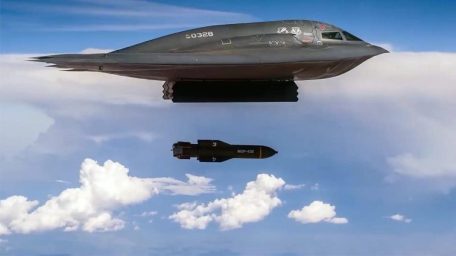
The GBU-57 is a big fat gravity bomb with fins. To achieve effective precision, a B-2 bomber must drop it on its intended target from no further than about five nautical miles — essentially right on top of the target.
Its penetration depth is claimed to be 200 feet. But that capability has NEVER been tested against a seriously hardened deep-underground target encased in layers of high-performance concrete, and topped with a few dozen meters of solid rock. In that sort of real-world scenario, the GBU-57 would be lucky to drill down 50 feet, if that.
It was always ridiculous silly talk to suggest the GBU-57 was the wonder weapon it was made out to be. There is a good reason the US only produced a couple dozen of them and then stopped: they understood its acute limitations in a non-permissive combat environment.
And, notwithstanding the hyperbolic Israeli propaganda, there was never any credible evidence that Iranian medium- and long-range air defenses against fixed-wing aircraft were attrited to any significant degree. And Iranian short-range air defenses were increasingly effective against long-range Israeli drones with each passing day.
As for the B-2: it is a big fat subsonic aircraft. It flies at airliner speeds. A strike on Fordow would entail flying at least 500 miles in and out of Iran. … continue
Blog Roll
 Aletho News
- What’s Really in the Bag: The Pet Food Industry’s Dirty Secret
- Project Artichoke: 70 Years Ago, CIA Discussed Hiding Mind-Control Drugs in Vaccines
- Drug traffickers trained in Ukraine attack state forces in Mexico
- The tragic reality of Brazilian mercenaries in the Ukrainian conflict
- Zelensky Refused to Discuss Druzhba Pipeline Issue – Fico
- U.S. General Caine Warns: STRIKING IRAN is a HUGE RISK /Glenn Diesen & Lt Col Daniel Davis
- Israel designates five Palestinian media outlets as ‘terrorist organizations’
- Israel, not America, first: Carlson’s Huckabee interview lays bare US foreign policy priorities
- Israeli troops executed Palestinian aid workers at ‘point blank range’: Report
- Iran war What if today’s Iran is resigned to a long, hellish war with the US?
- If Americans Knew
- Fourteen Countries Condemn Huckabee’s Support for Israel Taking Over Most of the Middle East
- Israeli Soldiers Killed Gaza Aid Workers at Point Blank Range in 2025 Massacre: Report
- Israel’s insidious network to propagandize American Christians
- Israel’s Best-Kept Secret: Palestinian Resistance Never Agreed to Disarm
- Trump officials plan to build 5,000-person military base in Gaza, files show
- Are MAGA restrainers pulling their punches this time on Iran?
- The NY Times on the “MAGA” Split Over Israel & USS Liberty
- In Gaza, Ramadan without mosques, imams – Not a ceasefire Day 137
- Footage Shows Israeli Troops Waiting in Ambush, Then Opening Fire on a Palestinian Teen
- The US is on the brink of a major new war that Trump has not even bothered explaining
- No Tricks Zone
- Surprising Discovery: Sahara Is Greening…Billions Of Trees Where Once Thought To Be Barren
- New Research Reaffirms Clouds, Aerosols, And Surface Solar Radiation Are ‘Driving The Climate System’
- Germany: Electric Car Catches Fire At Charging Station, Sets Off Local “Inferno”, Widespread Damage
- New Study: Canada’s New Brunswick Was 1°C Warmer Than Today During The Medieval Warm Period
- Coal Power Back In Trend As Globe Tries To Keep Pace With Growing Demand For Power
- New Study: A 4°C Warmer Beaufort Sea Had ‘No Sea Ice’ 11,700 – 8200 Years Ago
- Unfudging The Data: Dutch Meteorological Institute Reinstates Early 20th Centruy Heat Waves It Had Erased Earlier
- German Gas Crisis…Chancellor Merz Allegedly Bans Gas Debate Ahead of Elections!
- Pollen Reconstructions Show The Last Glacial’s Warming Events Were Global, 10x Greater Than Modern
- Germany’s Natural Gas Storage Level Dwindles To Just 28%… Increasingly Critical
 Aletho News