From Cluster Bombs to Toxic Waste: Saudi Arabia is Creating the Next Fallujah in Yemen

A collection of unexploded ordnance recovered by the UNDP’s YEMAC project in Yemen. Courtesy | YEMAC
By Ahmed AbdulKareem | MintPress News | March 20, 2020
AL-JAWF, YEMEN — As the world’s focus turns to the rapidly-spreading COVID-19 pandemic, Yemenis are reeling from their own brewing tragedy, contending with the thousands of cluster bombs, landmines and other exploded munitions that now litter their homeland. Just yesterday, a young child was killed and another was injured in the al-Ghail district of al-Jawf when a landmine left by the Saudi military exploded, witnesses told MintPress. Outraged and terrified by the presence of these unexploded ordnances, Ahmed Sharif, a father of 9 who owns a farm in the district called the unexploded ordnances “a significant threat to our children.”
Earlier this week, thousands of cluster bombs containing between dozens and hundreds of smaller submunitions were dropped by air and scattered indiscriminately over large areas near Ahmed’s farm. A large number of those munitions failed to explode on impact, creating a new threat to residents already reeling from 5 years of war, famine and an economic blockade. The use, production, sale, and transfer of cluster munitions is prohibited under the 2008 Convention on Cluster Munitions, an international agreement recognized by over 100 countries, but rejected by Saudi Arabia and the United States.
Saudi Arabia is estimated to have dropped thousands of tons of U.S.-made weapons in al-Jawf over the past 100 days alone. Al-Jawf is an oil-rich province that lies in Yemen’s north-central reaches along the Saudi border. The aerial campaign is likely a last-ditch effort to stem the tide of battlefield success by local volunteer fighters who teamed with Houthi forces to recapture large swaths of al-Jawf and Marib provinces. That campaign, for all intents and purposes, has failed.
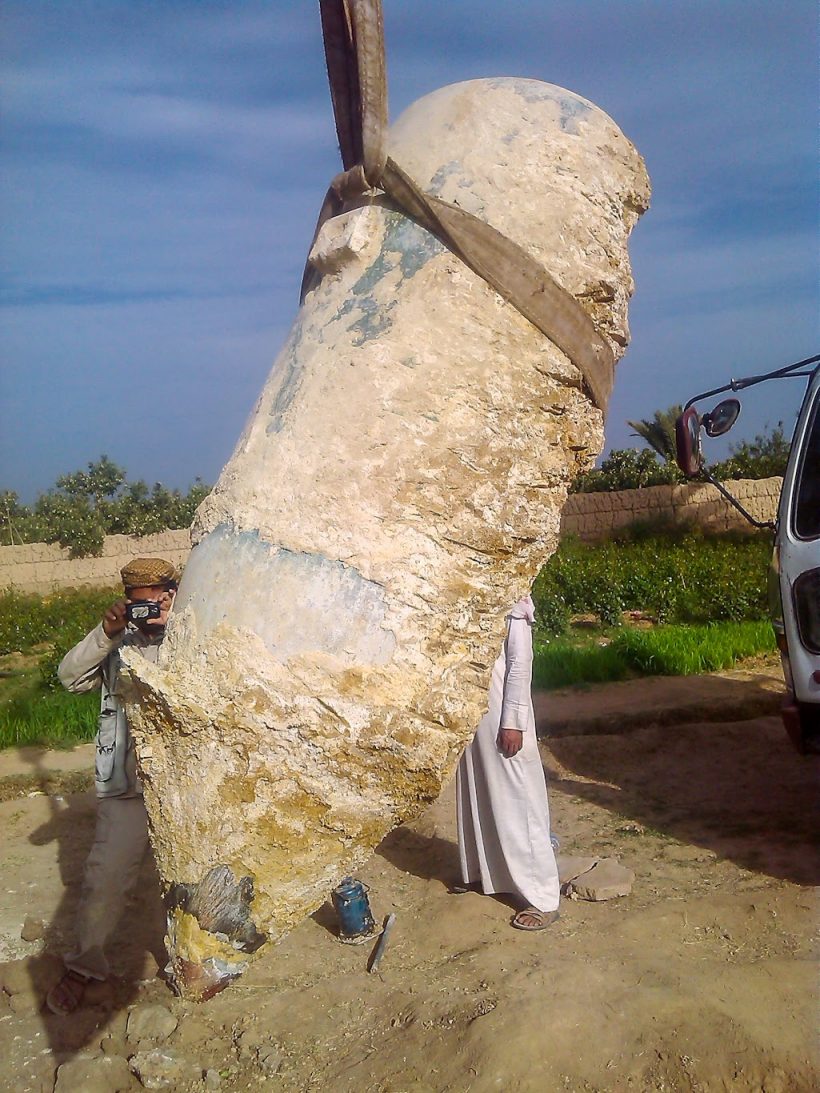
An unexploded bomb dropped by a Saudi warplane is recovered from a pomegranate farm in the Jamilah district in Sadaa. Courtesy | YEMAC
On Wednesday, the Houthis announced that their military operation – dubbed “God Overpowered Them” – was complete and that al-Jawf was free of Saudi occupation. According to Houthi sources, more than 1,200 Saudi-led coalition fighters were killed or injured during the operation and dozens of Saudi troops, including officers, were captured. The Houthis also struck deep into Saudi territory in retaliation for the more than 250 Saudi airstrikes that were carried out during the campaign. In multiple operations, ballistic missiles and drones were used to target facilities inside Saudi Arabia, according to officials.
Saudi losses haven’t been limited to al-Jawf either. Last week, Marib province, which lies adjacent to Yemen’s capital of Sana’a, was recaptured following heavy battles with Saudi forces. Local tribal fighters were able to clear strategic areas in the Sirwah District with the assistance of Houthi forces and take control of the town of Tabab Al-Bara and the strategic Tala Hamra hills that overlook Marib city. Both the Saudi-led coalition and its allied militants initially admitted defeat but later described their loss as a tactic withdrawal.
Marib is now the second Yemeni governorate adjacent to Saudi Arabia to fall under the control by Yemen’s resistance forces in the last month, al-Jawf being the first. Both provinces have strategic importance to Saudi Arabia and could serve as a potential launch point for operations into Saudi Arabia’s Najran province.
“Saudi [Arabia] and America have planted our land with death”
The highly populated urban areas of Sana’a, Sadaa, Hodeida, Hajjah, Marib, and al-Jawf have been subjected to incomprehensible bombing campaigns during the Saudi-led war on Yemen, which turns five on March 26. The sheer scale of that campaign, which often sees hundreds of separate airstrikes carried out every day, coupled with its indiscriminate nature, has left Yemen one of the most heavily contaminated countries in the world.
Since 2015, when the war began, coalition warplanes have conducted more than 250,000 airstrikes in Yemen, according to the Yemeni Army. 70 percent of those airstrikes have hit civilian targets. Thousands of tons of weapons, most often supplied by the United States, have been dropped on hospitals, schools, markets, mosques, farms, factories, bridges, and power and water treatment plants and have left unexploded ordnances scattered across densely populated areas.
A significant proportion of those ordnances are still embedded in the ground or amid the rubble of bombed-out buildings, posing a threat to both civilians and the environment. As Man’e Abu Rasein, a father who lost two sons to an unexploded cluster bomb in August of 2018 puts it: “Saudi [Arabia] and America have planted our land with death.” Abu Rasein’s sons, Rashid, ten, and Hussein, eight, were grazing their family’s herd of sheep in the village of al-Ghol north of Sadaa, far from any battlefield. They spotted an unusual looking object and like most curious young boys, picked it up to investigate. But the object they found was no toy, it was an unexploded cluster munition dropped by a Saudi jet. After hearing an explosion, the boys’ family went to investigate and found them lying dead, covered in blood.
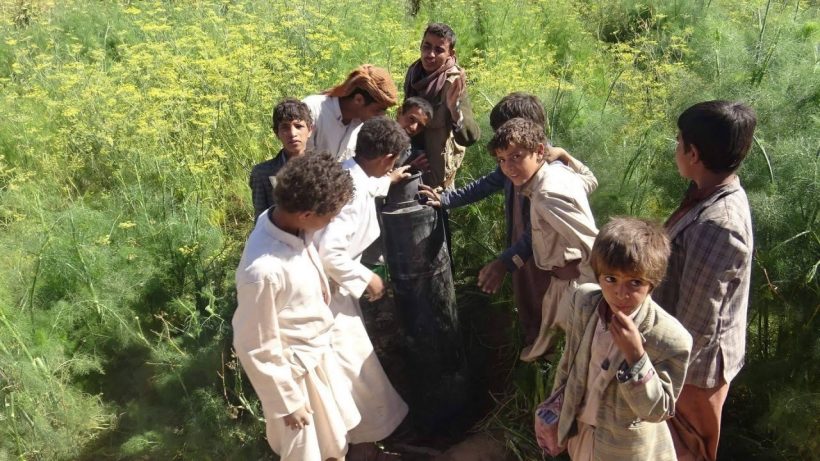
A group of children in Sahar district inspects a cluster bomb dropped by a Saudi warplane at a farm in Sadaa, March 18, 2019. Abdullah Azzi | MintPress News
Since March of 2015, Human Rights Watch has recorded more than 15 incidents involving six different types of cluster munitions in at least five of Yemen’s 21 governorates. According to the United Nations Development Program’s Emergency Mine Action Project, some of the heaviest mine and ERW (explosive remnants of war) contamination is reported in northern governorates bordering Saudi Arabia, southern coastal governorates and west-central governorates, all areas surrounding Houthi-dominated regions of Yemen. Since 2018 alone, the UNDP has cleared nearly 9,000 landmines and over 116,000 explosive remnants in Yemen.
From the Yemeni war of 1994 to the six wars in Sadaa, Yemenis have suffered several wars over the last three decades. Yet thanks to saturation of U.S. weapons, the ongoing war has brought death on a toll not seen in Yemen for hundreds of years. In Sadaa, the Saudi coalition has a significant legacy of unexploded ordinances, up to one million according to figures provided to MintPress by the Yemeni Executive Mine Action Center (YEMAC), an organization backed by the United Nations.
The Project Manager of YEMAC identified heavy cluster munition contamination in Saada, al-Jawf, Amran, Hodeida, Mawit, and Sanaa governorates, including in Sanaa city. Contamination was also reported in Marib. For the time being, YEMAC is the only organization working throughout the country during the ongoing war. Their teams are confronted with a very complex situation, disposing of both conventional munitions and bombs dropped from airplanes, including explosive remnants of war rockets, artillery shells, mortars, bombs, hand grenades, landmines, cluster bombs, and other sub-munitions and similar explosives.
Saudi Arabia’s toxic legacy
In addition to killing and injuring hundreds of civilians, American-made weapons have exposed Yemen’s people to highly toxic substances on a level not seen since the now-infamous use of radioactive depleted uranium by the United States in Fallujah, Iraq, which to this day is causing abnormally high rates of cancer and birth defects.
The hazardous chemicals from Saudi Coalition military waste, including radioactive materials, fuel hydrocarbons, and heavy metals, has already led to outbreaks of disease. Vehicles abandoned on battlefields, usually in various states of destruction, contain toxic substances including PCBs, CFCs, DU residue, heavy metals, unexploded ordnances, asbestos and mineral oils. Hundreds of these military scraps remain publicly accessible in Nihm, al-Jawf, Serwah, Marib and throughout Yemen.
Aside from the threat they pose to life and limb, unexploded ordnances contain toxic substances like RDX, TNT, and heavy metals which release significant levels of toxic substances into the air, soil and water. According to both the Ministry of Water and Environment and the Ministry of Health, which have undertaken environmental assessments on the impact of urban bombing, high levels of hazardous waste and air pollutants are already present in a populated areas.
Alongside the still unknown quantities of more conventional weapons remnants in Yemen, the waste from the cleanup of bombed-out buildings has been found to be especially contaminated with hazardous materials, including asbestos which is used in military applications for sound insulation, fireproofing and wiring among other things. Fires and heavy smoke billowing over heavily populated civilian areas following Saudi bombing runs also pose an imminent threat to human health. A common sight in many Yemeni cities since the war began, these thick clouds of toxic smoke sometimes linger for days and coat both surfaces and people’s lungs with hazardous toxins like PAHs, dioxins and furans, materials which have been shown to cause cancer, liver problems and birth defects.
Before the war began, most hazardous materials were trucked to Sanaa where they were separated and disposed of properly at the sprawling al-Azragein treatment plant south of the capital. But that plant was among the first targets destroyed by Saudi airstrikes after the war began. After it was bombed, puddles and heaps of toxic material were left to mix with rainwater and seep into surrounding areas. Yemeni researchers are still trying to grasp the scale of pollution from biohazardous chemicals at the site.
Although a comprehensive nationwide environmental assessment of the impact of urban bombing in Yemen has yet to be completed, high levels of hazardous waste and air pollutants have been recorded by many hospitals and environmental agencies. Some idea of the long-term effects can also be gleaned from studies carried out in areas where similar toxins have been used, particularly by the United States in Fallujah, Iraq and in Vietnam, where scientific assessments have shown increased cases of birth defects, cancer and other diseases, including in U.S. veterans.
In southern Yemen, where Saudi Arabia and the United Arab Emirates operate largely unchallenged, the coalition has been disposing of military waste in large trenches devoid of any measures to mitigate potential toxic fallout. Waste is dumped into large holes and either detonated or simply buried, inevitably contaminating soil and groundwater according to data from the UN Environment Program.
Yemen’s coastline hasn’t been immune either. The country’s General Authority for Environmental Protection said Wednesday that the Saudi-led coalition is dumping toxic and polluted waste on the shores of Yemen and in Yemeni regional waters, causing great damage to the marine environment, the deaths of fish and marine organisms, and in some cases, actually changing the color of the sea to a toxic green. The agency stated that in addition to dumping toxic waste, the coalition was allowing unsafe fishing practices such as marine dredging and the use of explosives by foreign ships, destroying the marine environment and coral reefs.
One hundred years to safety
Thousands of displaced Yemenis cannot fathom returning home due to the large number of explosives potentially hidden in and around their houses. Removing them all would require an end to the U.S.-backed war and economic blockade. Special equipment and armored machines such as armored excavators would need to be brought in, a slim prospect in a country unable to secure even the basic staples of life.

The remnants of a cluster bomb dropped by Saudi-led coalition warplanes inside a Yemeni home. March 18, 2020. Abdullah Azzi| MintPress News
Explosive remnants do not just impact lives and limbs, they prevent the use of potentially productive agricultural land and the rebuilding of important infrastructure. Like many border areas in Saada and Hajjah, fertile soil in al-Jawf and Marib has become so environmentally polluted since the war began that it could take decades to recover. Explosive remnants also prevent access to vital resources like water and firewood, cripples the movement of residents, including children traveling to school, and prevents aid from reaching those in need.
Even if the Saudi-led coalition were to stop the war immediately and lift the blockade, its legacy of indiscriminate bombing on such a massive scale will be felt for years to come. Due to the intensity of the bombing, experts at the United Nations Development Program’s Yemeni Executive Mine Action Center estimate that clearance could take at least 100 years in larger cities. Despite these dangers, desperate families with nowhere to go do not waste a lull in the barrage of Saudi airstrikes or a short-lived ceasefire to attempt to return home.
Ahmed AbdulKareem is a Yemeni journalist. He covers the war in Yemen for MintPress News as well as local Yemeni media.
This Isn’t a “Saudi-Russian” Oil War. It’s a Saudi & Russian War on Shale
MBS couldn’t get Russia to join him in aggressive cuts, so he forced it to join him in aggressive pumping — but Russia is not his target
By Marko Marjanović | Anti-Empire | March 11, 2020
The media is so eager to see Putin behind everything that it can’t see it is the Saudis who started this, and it’s US oil they’re targeting exactly as they already did once before.
At OPEC+ in Vienna Russia offered to extend the current cuts for another three months and then meet again. Saudi Arabia instead wanted to take another 1.5 million bpd from the market.
When Russia balked the Saudis made a 180-degree turn and declined the extension of existing cuts, slapped a big discount on their oil, and started warming up their spare capacity to start flooding the market come April 1st when the current OPEC+ quotas expire.
The 67-year old Putin wanted to continue the current neither here nor there approach. The 34-year old MBS wanted to try something radical and new. At least ostensibly he wanted more cuts that could lift all producers for which he needed Russia’s cooperation. When he couldn’t get it he instead went the flooding route for which he did not.
The media did MBS a huge favor by failing to notice it was he — the supposed US ally — who blew up the OPEC+ cuts and not Putin. (A typical headline: How Putin spurned the Saudis to start a war on America’s shale oil industry)
The media committed another mistake. It keeps deluding itself this is “Saudi-Russian” war where US energy is merely collateral damage:
- Saudi-Russian price war sends oil and stockmarkets crashing — The Economist
- How a Saudi-Russian Standoff Sent Oil Markets Into a Frenzy — The New York Times
- Putin just sparked an oil price war with Saudi Arabia — and US energy companies may be the victims — CNBC
- The U.S. Oil Industry Was Already Struggling Before Saudi-Russian Price War — NPR
This is silly. Just because MBS started flooding after talks with Russia didn’t go his way the media assumes his pumping is directed against Russia. When in fact every indication is that he wanted Russia as a partner, if not in radical cuts for which he needed its acquiescence, then at least in radical pumping for which he did not.
Whatever Russia’s previous preferred path it now has no choice but to fight for market share which will only increase the pressure on shale further. In other words, despite Moscow’s unwillingness the Saudis have in the end added Russian strength to their own, just for a different strategy.
Sure enough, Saudi Arabia is not in a great state to wage a long campaign, but it may not have to. Shale has never been weaker. The Saudis tried to drive it out before, between 2014 and 2017, and failed. Frackers found ways to slash cost and financial markets propped them up with even more loans.
Neither is likely this time around. Most cost-cutting that was possible has likely already been made, and with the next great recession and a drop in demand around the corner financial markets aren’t standing in line to get into energy that barely makes sense even now
Riyadh needs $85 oil to balance its budget. It can not hope to outlast Russia which can live on $40. But a 6-month flooding campaign to see if it can’t, together with Russia, collapse US shale isn’t the dumbest idea ever.
In fact, precisely the fact MBS needs oil at $85 is what would make him more desperate to try radical means to get there, whether they’re deep cuts or unrestricted production.
Call it the MBS stress test of the US oil bubble in an election year. Truly Trump has great friends…
US marines arrive on Yemen’s Socotra to support UAE forces
MEMO | March 9, 2020
A new batch of US Marines arrived on the Yemeni island of Socotra on Saturday, according to local sources, installing Patriot defence systems.
Sanaa Post reported that the American soldiers were received by the “occupying” UAE forces at their headquarters on the island.
There is speculation that the US intends to establish its own military base amid reports that America had sent military experts to equip observation points to deploy radars and air defence points on the strategically located island overlooking the Arabian Sea and the Indian Ocean.
US forces had previously arrived on Socotra in December of last year and reportedly started installing a Patriot missile system in order to protect the Saudi and Emirati forces on the island at the time.
According to the sources, on 21 December of last year, Saudi Crown Prince Mohammed Bin Salman ordered the UN-recognised, exiled Yemeni government of President Abd Rabbuh Mansur Hadi to lease the entire island to the UAE for a period of about 95 years. Saudi and Emirati forces began to arrive on the island in April 2018, the Saudi deployment was reportedly coordinated with the Yemeni government, whilst the UAE arrived without prior coordination with the Saudi-backed Yemeni authorities.
Saudi arms imports increased by 130%
MEMO | March 9, 2020
The global arms industry has enjoyed a major boon period over recent years with the rise of tension and military conflict across the globe.
The US has seen the largest financial windfall from the sale of arms while Saudi Arabia continues to be the world’s largest importer of arms according to a new report released today by the Stockholm International Peace Research Institute (SIPRI).
According to SIPRI, which keeps the only publicly available database on the transfer of arms, “arms imports by countries in the Middle East increased by 61 per cent between 2010-14 and 2015-19, and accounted for 35 per cent of total global arms imports over the past five years.”
Saudi Arabia has seen a 130 per cent increase compared with the previous five-year period making it the world’s largest arms importer in 2015-19. The volume of weapons purchased by Riyadh accounted for 12 per cent of the global arms imports in that period.
The USA and the UK remain the main source of arms for the kingdom. A total of 73 per cent of Saudi Arabia’s arms imports came from America while 13 per cent of its arsenal were supplied by UK, despite major concerns in both countries over Riyadh’s military intervention in Yemen.
The United Arab Emirates (UAE), which has been militarily involved in Libya as well as Yemen over the past five years, was the eighth-largest arms importer in the world between 2015-19. The US supplied two-thirds of the arms imported by Abu Dhabi.
SIPRI noted that in 2019, when foreign military involvement in Libya was condemned by the United Nations Security Council, the UAE had major arms import deals ongoing with a number of other countries including, the UK, Australia, Brazil, Canada, China, France, Russia, South Africa, Spain, Sweden and Turkey.
Turkish arms imports were 48 per cent lower between 2015-2019 than in the previous five-year period, even though its military was fighting Kurdish rebels and was involved in the conflicts in Libya and Syria. The SIPRI report explained that the reason for this decrease was due to delays in deliveries of some major arms; the cancellation of a large deal with the USA for combat aircraft; and developments in the capability of the Turkish arms industry.
The main supplier of weapons worldwide is still the US, which has increased its arms exports by 23 per cent, according to SIPRI.
Hamas condemns continued detention of Palestinian officials in Saudi Arabia
Press TV – March 9, 2020
A Hamas spokesman has condemned the continued detention and prosecution of Palestinian figures in Saudi Arabia over their support for the Palestinian resistance movement, urging Riyadh to immediately release them.
“The national and pan-Arabism duty requires honoring those people and not trying them in this way,” Hazim Qassim told Lebanon’s Arabic-language al-Mayadeen television on Sunday.
He added that Arab countries should reinforce the Palestinian cause and “not weaken its resistance with such trials”.
The spokesman said Hamas has contacted various parties to secure the release of Palestinian detainees in the kingdom, expressing hope that Saudi authorities would respond to those efforts and release the detainees.
His remarks came as a Saudi court on Sunday held the first hearing in the case of 68 Palestinian and Jordanian detainees.
According to al-Mayadeen, the detainees are charged with “supporting terrorism and financing it” and belonging to “a criminal terrorist entity”.
Senior Hamas official Muhammad al-Khudari and his son Hani, who were arrested last April, were among those who stood trial on Sunday.
Al-Khudari represented Hamas in Saudi Arabia between the mid-1990s and 2003. He has held other important positions in the Palestinian resistance movement as well.
Saudi Arabia’s repressive measures against the Palestinian resistance movement as well as those seeking to collect donations for people living in the Israeli-blockaded Gaza Strip come as the kingdom and Israel are believed to be planning to publicize their secret ties.
Gaza has been blockaded by the Israeli regime since 2007.
Last month, Saudi authorities launched a new campaign of “arbitrary” arrests against Palestinian expatriates on charges of supporting Hamas.
The Prisoners of Conscience, a non-governmental organization advocating human rights in Saudi Arabia, announced on February 12 that the kingdom had detained a number of Palestinians, including the relatives or children of those imprisoned last April for the same reason.
Over the past two years, Saudi authorities have deported more than 100 Palestinians from the kingdom, mostly on charges of supporting Hamas financially, politically, or through social networking sites.
Yemenis encircle strategic city in al-Jawf as Saudi countermeasures fail: Report
Press TV – February 29, 2020
Yemen’s armed forces have encircled the strategic city of al-Hazm – the capital city of the northern al-Jawf province – as Saudi attempts to break Yemeni advances failed, a report says.
The Beirut-based al-Akhbar newspaper reported Saturday that the advances by Yemeni forces, led by the popular Houthi Ansarullah movement, continue towards the strategic city and that major Saudi positions surrounding al-Hazm have fallen.
A tribal source loyal to Ansarullah told al-Akhbar that advances are currently ongoing northwest of the city, adding that a Saudi counteroffensive seeking to recapture the al-Ghail region south of al-Hazm had failed.
The source added that the Yemeni forces have gained control over a number of positions overlooking provincial government buildings in the city.
Up to 70 percent of the province is currently under the control of the Yemeni forces, he added.
According to the report, Saudi Arabia has sent dozens of military vehicles along with hundreds of mercenaries from the central Ma’rib and southern Shabwah province in a bid to push back the Yemenis advances.
Saudi Arabia has also sought to win the loyalty of Yemeni tribes against the Yemeni forces in the region by offering money, the report added.
Yemen’s al-Jawf province had been under Riyadh’s control for up to 50 years.
Due to Saudi intervention and influence, al-Jawf province was effectively deprived of using its oil reserves, which are largest in Yemen, and attracting needed investment, it added.
According to the report, Saudi Arabia expelled as many as 370,000 Yemeni workers from the kingdom in 2013 to put pressure on the former Yemeni government shortly after Yemen’s Safer oil company started operating the first oil well in al-Jawf province.
Saudi Arabia launched its war on Yemen in March 2015, with the goal of bringing back to power the government of former president Abd Rabbuh Mansour Hadi and crushing the popular Houthi movement.
The US-based Armed Conflict Location and Event Data Project (ACLED), a nonprofit conflict-research organization, estimates that the Saudi war has claimed more than 100,000 lives since the war broke out.
Once Saudi Allies, Tribes in Eastern Yemen’s Al-Mahrah Are Now Battling Saudi Forces
By Ahmed Abdulkareem | MintPress News | February 28, 2020
AL-MAHRAH, YEMEN — Saudi Arabia’s continued efforts to occupy Yemen’s province of al-Mahrah, which lies on the country’s border with Oman, appear only to have emboldened al-Mahrah tribes, who have resorted to using military tactics to drive out Saudi forces from their province. The tribes are fueled by a collective social desire for sovereignty stemming from their long history as an independent region and a local culture that remains wary of foreign forces.
On Wednesday, Saudi troops in Nashton Port in al-Mahrah were subjected to an explosive device targeting a Saudi military convoy in Fujeet District killing multiple troops including members of a local Saudi-funded militia. The attack came after Saudi forces occupied al Shehn port last week.
Since 2017, when Saudi forces once again entered the isolated province, the deep-seated sense of local identity spurred a growing opposition movement. The opposition developed and took the form of festivals and protests near Saudi military sites which included speeches, the reading of poetry and the playing of patriotic music.
In the past year, Mahri tribes have increasingly confronted encroachments on local sovereignty. Several confrontations have led to violence – including the al-Anfaq incident in November 2018, clashes near the Omani border in March 2019, and a shoot out at al-Labib checkpoint in April.
Their military deployment in al-Mahrah has given the Saudis de facto military control over the governorate. Today, Saudi Arabia controls al-Mahrah’s airport and Saudi forces have assumed a role akin to a state security apparatus in the province as air reconnaissance and other operations are launched from a command center at the base, bypassing even its allies. In addition to border crossings and the main seaport, dozens of Saudi bases have been established in Hat District, Lusick in Hawf District, Jawdah in Huswain District, and Darfat in Sayhut District.
Moreover, the militarization of al-Mahrah by Saudi forces has affectedthe province’s social cohesion and identity. Maharis were already divided between opposing the presence of Saudi forces and supporting it. The Saudi have reinforced this division by recruiting from and distributing weapons to certain tribes, changing the social fabric of the area which is likely to lead to open internal conflict.
Despite the fact that local opposition has prevented the construction of several military outposts, Saudi forces have continued to pursue their strategic interests in southern Yemen, including the construction of an oil shipping port in al-Mahrah on the coast of the Arabian Sea. This has resulted in renewed calls for military resistance against the Saudi presence, with opposition leaders declaring their intention to establish local anti-Saudi forces.
Al-Mahrah is Yemen’s second-largest province. It is bordered by Oman to the east, Saudi Arabia to the north, and the Arabian Sea to the south. It’s Empty Quarter, a vast desert, covers much of southern al-Mahrah. The governorate also contains a mountainous region in the east that is seasonally covered with lush green foliage. The province is a largely peaceful area that has been mostly spared from Yemen’s five-year war.
Al-Mahrah’s tribes vow resistance
Attacks from Al-Mahrah’s tribes have flared up as recently as last week after Saudi forces began construction on a number of new security checkpoints and military camps in al Shehn District. Last Monday, Saudi forces attempted to storm the town of Shahn. Armed helicopters, ground vehicles, and both Saudi troops and local mercenaries were deployed in the assault which was ultimately repelled. Later, Saudi forces succeeded in occupying the area after resorting to a plan played by the ousted president Abdu Rabu Mansour Hadi.
Prior to Monday’s Saudi military incursion, local tribal fighters had withdrawn from Shehn after an agreement between Saudi forces and local tribes was reached following tribal mediation which stipulated that tribal fighters in the town would be replaced by forces loyal to the Saudi-led Coalition. The tribes say they were deceived into withdrawing ahead of the Saudi advance.
In the wake of recent events, Ali bin Salem al-Huraizy, al-Mahrah’s former deputy governor who plays a critical role as a figurehead in the popular opposition movement against Saudi Arabia, criticized ousted Yemeni President Abdrabbuh Mansur Hadi saying, “I did not expect the treachers.. to authorize the Saudi occupation forces to crush al-Mahrah people… who were defending the independence and sovereignty of the country.” The deputy head of the Al-Mahra Peoples’ Sit-in Committee, Aboud Heboud Qumsit expressed similar disdain, saying: ”you [Hadi] sold yourself to Saudi [Arabia], please do not sell the Yemeni people and the whole country to Saudi Arabia.”
The Al-Mahra Peoples’ Sit-in Committee has said that Saudi actions constitute a flagrant violation of Yemeni sovereignty and national identity. The group said in a statement: “In this dangerous turning point of our honorable history, we call on all the tribes of the province, their sheiks and their dignitaries, and their citizens to unite alongside all the liberals of the province to prevent the Saudi occupation from imposing its domination over Al-Mahrah.”
Hadi recently issued a decree appointing Muhammad Ali Yasser, a parliamentarian loyal to the Saudi-led Coalition, to be the governor of Mahrah instead of sitting governor, Ba Kreit. The move is seen as an attempt to implement a new Saudi strategy, according to al-Mahrah residents. Mahris have a unique history of running their own affairs. Saudi Arabia, however, has used “internationally recognized president Hadi ” to force the replacement of uncooperative officials in al-Mahrah and appoint pliant replacements, activists say.
Despite having a Saudi proxy as governor and thousands of Saudi troops and their proxy forces deployed around in and around al-Mahrah, the Saudi military presence in al-Mahrah appears to be increasingly challenged in the face of growing peaceful opposition and increasing military resistance.
Saudis levy punitive measures on al-Mahrah
Saudi forces have also imposed trade restrictions on al-Mahrah. Cargo entering Yemen through al-Mahrah has been confiscated by Saudi officials according to businessmen who spoke to MintPress. Local residents are concerned that the move is part of a broader effort to stifle al-Mahrah economically and push it towards starvation, just like the rest of Yemen.
Earlier this week Saudi forces arrested several Yemeni businessmen and truck drivers attempting to import goods into al-Mahrah. The drivers included Pakistani and Syrian nationals, and their trucks, which carried official authorization from their country of origin, were confiscated by Saudi officials according to local Yemen businessman.
After 2015, when the war began, most of Yemen’s official points of entry fell into coalition control. However, Shehn border crossing in al-Mahrah remains one of the only routes for traders to ship goods into Yemen. The customs revenues from the crossing have bolstered the governorate’s budget and allowed it to pay local civil servant salaries, unlike most other governorates in Yemen that have been left nearly penniless since the war began.
Al-Mahrah’s Shehn and Sarfait border crossings with Oman have been under the control of local tribes since 2015 when they took advantage of a security vacuum following the withdrawal of government security forces due to the Saudi-led coalition military campaign.
Saudi ambitions in Al-Mahrah date back decades
In 2015, when the Saudi-led coalition war on Yemen began, Riyadh revived its aspirations for the construction of an oil pipeline that would allow the kingdom to transport oil directly to the Arabian Sea, bypassing the Strait of Hormuz and the Bab-el-Mandeb Strait. The costs related to exporting Saudi oil would be reduced by allowing tankers to avoid the Bab al-Mandab and Hormuz straits, both vulnerable to political strife and regional enemies.
In fact, Saudi Arabia’s aspirations in Al-Mahrah date back to the end of the last century. In the 1990s, Saudi Arabia sought to build influence in al-Mahrah as part of its ambitions to build an oil pipeline through the district to the Arabian Sea. And for that, tribal sheiks were granted Saudi residency, travel documents, and financial benefits.
Moreover, in the 1980s, Saudi Arabia launched negotiations with former South Yemeni President Ali Nasser Mohammed to build the pipeline, but the negotiation failed after Ali Nasser refused, stating the pipeline would threaten the state’s sovereignty. In the 1990s, in the wake of Yemeni unification, the Saudis pressed the Yemeni government to permit the deployment of Saudi forces into a 4-kilometer buffer zone around the proposed pipeline route to maintain security. The Riyadh project was shelved after Sana’a rejected it once again.
In late 2017, Riyadh began deploying armed forces in al-Mahrah under the premise of combating smuggling across the Omani border. However, al-Mahrah residents see the presence of Saudi troops in the region as malign and colonial. According to people who have organized an open sit-in since 2018, smuggling is just a pretext for a Saudi takeover of the province.
Saudi Arabia and the UAE also claim that arms smuggling operations by Ansarullah (Houthis) are being carried out from Oman into Yemen via the al-Mahrah border crossing, though they have provided no evidence to back their claim, which Oman has repeatedly denied.
Moreover, in addition to an electrified fence along a portion of the border built by Oman in 2013, U.S. special operations forces have also deployed to al-Mahrah in 2018 to support the coalition’s alleged anti-smuggling operations according to diplomatic sources cited by the Sana’a Center.
In fact, despite their support for the Saudi-led coalition and being free from the presence of Houthi fighters, Yemen’s southern provinces, including not only al-Mahrah but also the strategic island of Socotra, have been fully controlled and managed by Saudi Arabia and UAE.
Some analysts believe that the Saudi Coalition’s continued military presence in al-Mahrah may also be intended to cordon off Oman, which enjoys long borders and solid relations with Yemen. Much to the dismay of Saudi Arabia and the UAE, Oman also enjoys cordial relations with Saudi rival Iran, a relationship that the Coalition is eager to undermine.
As a result, Oman has supported popular protests demanding the removal of Saudi forces. Recently, Muscat arranged meetings in the Omani capital between the protest leaders, European and American officials, and representatives from international organizations. Oman allowed Western journalists to cross into al-Mahrah without visas or stamps.
Ahmed AbdulKareem is a Yemeni journalist. He covers the war in Yemen for MintPress News as well as local Yemeni media.
US behind annihilation of Yemeni air defense missiles during Saleh’s reign: Report
Press TV – February 27, 2020
A Yemeni security source says the United States destroyed the country’s air defense missiles during the reign of slain Yemeni President Ali Abdullah Saleh over allegations that the weapons would fall into al-Qaeda hands in case the then Yemeni administration was toppled.
The unnamed source told Yemen’s official Saba news agency on Thursday that an American delegation consisting of Program Manager in the Office of Weapons Removal and Abatement (PM/WRA) with the Department of State’s Bureau of Political-Military Affairs, Dennis F. Hadrick, liaison officer Santo Polizzi, technical expert Niels Talbot, Deputy Director of Programs in the Bureau of Counterterrorism and Countering Violent Extremism at the US Department of State, Laurie Freeman, and the military attaché at the US embassy in Sana’a held meetings with Yemeni Ministry of Defense officials at the time to pressure them to hand over the missiles in preparation for their complete destruction. Their demands were initially turned down though.
The source added that Brigadier Ammar Mohammed Abdullah Saleh, a nephew of President Saleh and then deputy director of the National Security Bureau, was then tasked with persuading Yemeni military officials to agree with the surrender and annihilation of the air defense missiles in exchange for hefty sums of money.
The Yemeni security source highlighted that the American delegation began collecting and disabling the missiles in August 2004, and it agreed to continue negotiations through the National Security Agency since the Yemeni Ministry of Defense refused to deal with such talks at the time.
The source said two batches of the Yemeni air defense missiles were detonated in al-Jadaan and Wadi Halhalan areas of Yemen’s central province of Ma’rib on February 28, 2005 and July 27, 2009.
The munitions, which included shoulder-launched and surface-to-air SAM-7, SAM-14 as well as SAM-16 missiles, were destroyed with the assistance of the American company Ronco.
On Sunday, Yemeni armed forces unveiled four domestically-built long-range, surface-to-air missile defense systems, which could act as game changers and alter the course of battle in the face of the deadly campaign led by Saudi Arabia against Yemen.
The president of Yemen’s Supreme Political Council and commander-in-chief of the armed forces, Mahdi al-Mashat, who was speaking at a ceremony in the capital Sana’a identified the systems as Fater-1 (Innovator-1), Thaqib-1 (Piercer-1), Thaqib-2 and Thaqib-3.
The systems have entered service following successful tests, the official announced.
Mashat praised the efforts by the Yemeni Ministry of Defense as regards the development and modernization of the military systems in order to deter or, if need be, confront the enemy.
“The new defense systems will change the course of the battle against the coalition of aggression, and pave the ground for the introduction of more sophisticated systems in order to engage enemy targets,” Mashat stated.
Saudi Arabia and a number of its regional allies launched the devastating campaign against Yemen in March 2015, with the goal of bringing back to power the government of former President Abd Rabbuh Mansour Hadi and crushing the Ansarullah movement.
The US-based Armed Conflict Location and Event Data Project (ACLED), a nonprofit conflict-research organization, estimates that the war has claimed more than 100,000 lives over the past nearly five years.
Saudi Arabia and the United Arab Emirates have purchased billions of dollars’ worth of weapons from the United States, France and the United Kingdom in the war on Yemen.
The Saudi-led coalition has been widely criticized for the high civilian death toll from its bombing campaign. The alliance has carried out nearly 20,500 air raids in Yemen, according to the data collected by the Yemen Data Project.
The UN says over 24 million Yemenis are in dire need of humanitarian aid, including 10 million suffering from extreme levels of hunger.
Netanyahu between the Nakba Arabs and the Arabs who are a joke
By Wael Qandil | Al-Arabi Al-Jadeed | February 21, 2020
The Arabs agreed in 1948 on the decision to form combat groups against the Zionist colonisation of the land of Palestine, which was known as the Nakba. Exactly 72 years later, the Arabs seem closer to form a united combat force to fight those rejecting the Zionist colonisation of Palestine.
It does not seem that the joke recently posted by a sarcastic Twitter activist about Saudi Arabia’s condemnation of the Palestinian people’s actions against the Israeli occupation will remain a joke for long, as all of the facts and indications say that the Arab capitals are very close to taking measures against those who refuse normalisation and the “deal of the century”. The Arab leaders’ patience is running out with the Palestinian resistance factions, who are disturbing the relationship between these leaders and Israel.
Matters rushing in this direction is not a new phenomena. It was announced and put into effect at least five years ago and many are competing to serve this. They are not ashamed to voice their approval of Israel’s leadership in the region and the first to voice this was General Abdel Fattah Al-Sisi, who is loved and supported by all Zionists, especially their rabbis and generals.
More than four years ago, the right-wing Zionist newspaper Makor Rishon revealed that Al-Sisi confirmed, before the leaders of the American Jewish organisations, his admiration for Netanyahu’s personality and leadership capabilities. The newspaper’s correspondent, Zvika Klein, wrote that the leaders of the Conference of Presidents of Major American Jewish Organisations in the United States informed Netanyahu during their meeting with him, on the side-lines of a meeting organised by the committee in occupied Jerusalem, that Al-Sisi told them that Netanyahu is “a leader with great powers that help him not only lead his country, but also could propel the region – even the world – forward.”
Well, here is the ruling general of the oldest Arab sister stripping his country of leadership of the region and giving it to Israel/Netanyahu to succeed him. Following in his footsteps is Mohammad Bin Salman, Saudi crown prince, who learned from Al-Sisi how to reach power through Israel. The story begins with hosting Trump and his family in Riyadh in order to establish the “moderate” alliance, the idea of which was proposed, formulated and developed years ago by Benjamin Netanyahu. Trump then leaves Saudi Arabia with more than $450 billion and lands in occupied Jerusalem wearing a skullcap.
In 2018, in anticipation of Saudi Arabia’s hosting of the Dhahran Summit, the Saudi crown prince held an interview with America’s Atlantic magazine, in which he announced a vision completely aligned with Israel’s for the Middle East according to extremist rabbis, violent generals and the Knesset hawks and doves. He spread his free kisses and gifts by stating that he was surrounded by enemies except for Israel and the so-called “axis of moderation” made up of the four parties that besieged Qatar. He said: “We are in an area not surrounded by Mexico, Canada, the Atlantic and Pacific oceans. We have ISIS, Al-Qaeda and Hamas and Hezbollah and the Iranian regime, and even pirates.”
This insight took a practical form when Al-Riyadh newspaper, the mouthpiece of the government, stated, before the summit opening: “Today, the Arabs have no choice but to reconcile with Israel, to sign a comprehensive peace agreement, to devote themselves to confronting the Iranian project in the region and its nuclear program, and to put an end to its interference in Arab affairs. This is an option that cannot be delayed with any justification, even [accusations of] bargaining with and auctioning the Palestinian cause, because Iran poses a direct threat to all.”
Thus, without vagueness, and very early on, the capitals of the two largest Arab countries delivered the badge and cloak of leadership to Israel, until we reached a stage where Benjamin Netanyahu was authorised, alone, to speak about the pilgrimage trips from Israel to Saudi airports, promising that the Israelis will fly in the skies of Saudi Arabia soon. It is at this same stage that the Egyptian military man may find himself entrusted with the war against the Palestinian people, if the gas pipeline from the occupation to Egypt is damaged or endangered, when an uprising breaks out in the areas the pipeline passes through.
What misery awaits a nation that clashes with itself over who will serve its enemy more?
Translation by MEMO.
‘No shred of evidence’: Iran demands US presents proof of Saudi oil attacks claim after UN report release
RT | February 16, 2020
Tehran slammed the US for using a recent UN report to peddle its Saudi oil attack claims, accusing Washington of “clutching at every straw” to back up the allegations, while the report itself is based on shaky hypotheses.
“Just hours after the attack on Saudi oil facilities on 14 September 2019, the U.S. baselessly attributed it to Iran, but has failed so far to present any shred of evidence. Now, it clutches at every straw to seemingly prove its allegation,” the Iranian mission to the UN stated on Saturday, responding to the US mission doubling down on the White House’s claim that Iran was behind the 14 September twin attacks on Saudi oil giant Aramco facilities in Abqaiq and Khureys.
The attacks that briefly disrupted operations of Abqaiq oil plant – the largest oil processing facility in the world – were claimed by the Houthi rebels, embroiled in a 5-year-long war with the ousted President Abdrabbuh Mansur Hadi backed by the Saudi-led coalition. However, immediately after the attacks took place, the US pointed finger at Teheran, not waiting for any fact-finding mission to be sent to the sites.
Commenting on the recently released UN Yemen panel report, which concluded that Houthi forces were “unlikely” responsible for the bombing since the operation was too “complex” and the “estimated” range of weaponry the militants supposedly possess would not have allowed for such launches from the rebel-held territory, the US mission recycled its allegations framing the report’s findings as a foregone conclusion.
“Iran attacked Saudi Arabian oil facilities on September 14, 2019. It was an attack not only against a sovereign state but against the global economy as well,” the note bluntly states.
Firing back, Tehran pointed out that “nothing in that report validates the US allegation, which has already been rejected by Iran.”
The report does not name Iran as the culprit in the strikes. Moreover, the experts admitted that they did not have a chance to see the debris of the weapons that allegedly hit the facilities first-hand at the scenes as they had been partially cleaned up by Riyadh by the time they arrived.
“It should be noted that the Panel did not see any debris of the weapon systems on-site in Abqaiq and Khureys, as those had already been transported to Riyadh at the time of the visits on 20 and 21 September 2019,” the report states.
In addition to that, the experts furher acknowledged that while they believe that this particular attack was not carried out by Houthis, “other attacks using the same weapons do seem to have been launched from Yemen.”
The panel did not rule out either that Houthis could have been indeed behind the twin strike, noting that “in theory, the attacks could have also been launched by Houthi forces either from within Saudi Arabia, from the territory of other countries, or even from sea or airborne launch platforms,” but called this scenario “highly unlikely.”
The Iranian mission said that the US note “represents another disinformation campaign against Iran,” arguing that it’s the US massive build-up, undertaken under the pretext of the “Iranian threat,” together with Washington’s “military adventurism” and “the unprecedented flow of sophisticated American weaponry” to the region that has become the “main source of instability and insecurity” in the Middle East.
Iran: Saudi airstrike on Yemenis, near downed jet, war crime
Press TV – February 16, 2020
Iran has denounced the international community’s silence on Saudi airstrikes, the latest of which killed at least 31 civilians in Yemen’s al-Jawf province Friday, calling it a war crime.
“The international community’s silence on these war crimes has emboldened their perpetrators to kill more civilians,” Foreign Ministry spokesman Abbas Mousavi said in Tehran on Sunday.
The United Nations office in Yemen said preliminary field reports indicated that “as many as 31 civilians were killed and 12 others injured in strikes that hit al-Hayjah area” in al-Jawf province.
The health ministry in al-Jawf province said women and children were among those killed, Yemen’s al-Masirah TV reported. They were attacked as they gathered near the wreckage of a Saudi warplane shot down on Friday evening.
Mousavi strongly condemned “the criminal attack by the Saudi-led coalition forces and offered commiserations to the bereaved families and the oppressed Yemeni people,” IRNA news agency reported.
“Over the past several years, we have repeatedly witnessed that whenever Saudi-led coalition forces or their allies suffer humiliating defeats in the battlefield, they react by cowardly slaughtering women, children and civilians with American weapons,” Mousavi said.
“Yesterday’s crime in Jawf province is just one example among dozens of their war crimes,” he added.
Saudi Arabia’s state-run news agency quoted military spokesman Col. Turki al-Maliki Saturday as saying that the tornado warplane belonging to the kingdom’s air force had been shot down over the province of Jawf on Friday.
Yemeni forces said they shot down the warplane with an advanced surface-to-air missile.
Saudi warplanes later targeted people who had gathered near the wreckage of the jet. Officials said aid workers could not reach the site of the attack due to continuous flights by Saudi warplanes over the area.
“As usual, when the most brutal US-Saudi aggression receives painful strikes in the military confrontation fields, it replies with great folly by targeting civilians,” spokesman for Yemeni armed forces Yahya Sare’e said on Saturday.
UN Humanitarian Coordinator for Yemen Lise Grande also denounced the “terrible strikes” in al-Jawf province.
“So many people are being killed in Yemen – it’s a tragedy and it’s unjustified. Under international humanitarian law parties which resort to force are obligated to protect civilians,” she said.
“Five years into this conflict and belligerents are still failing to uphold this responsibility. It’s shocking,” she added.
International aid group Save the Children also condemned the Saudi airstrikes, saying they showed the Yemen conflict was “not slowing down.”
“This latest attack must be urgently and independently investigated, and perpetrators held to account,” said Xavier Joubert, the group’s country director in Yemen.
“Those who continue to sell arms to the warring parties must realize that by supplying weapons for this war, they contribute to making atrocities like today’s all too common.”
Saudi Arabia and a coalition of its vassal states launched the war on Yemen in March 2015 in an attempt to reinstall a Riyadh-backed former regime and crush a popular Houthi movement opposed to the kingdom’s meddling in their country.
The Saudi military aggression, coupled with a naval blockade, has killed up to 100,000 people and injured many more. It has plunged Yemen into what the UN says is the world’s worst humanitarian crisis.
The UN says an estimated 24 million Yemeni people – close to 80 percent of the population – need assistance and protection.
Iran’s Foreign Ministry spokesman on Sunday stressed that the humanitarian catastrophe and violation of human rights and international laws in Yemen must end.
Saudi Arabia launches new campaign of arrests against Palestinian expats
MEMO | February 14, 2020
Saudi Arabia has launched a new campaign of arbitrary arrests against several Palestinian expatriates living in the kingdom for supporting the Islamic resistance movement, Hamas.
The Prisoners of Conscience Twitter account which monitors the conditions of prisoners in Saudi Arabia said it has received “confirmed information” that the Saudi authorities have launched a new campaign of arbitrary arrests against Palestinian ex-pats. It adds that a number of the Palestinians targeted in the new campaign are relatives or sons of Palestinians who had been arrested during the first campaign in April, last year for the same reason.
In April, last year the Saudi authorities launched a campaign of arrests against Palestinian ex-pats including a senior leader in Hamas movement, Muhammad al-Khudari, 81, and his eldest son Hani.
The Twitter account defended the Palestinian detainees saying that supporting the (Palestinian) resistance is not a crime that requires arrests and demanded the Saudi authorities “to immediately release all detainees from the last campaign, and stop the trials of those detained last year which will begin early next month”.
Earlier this month, the Twitter account said the Saudi prosecution accuses the Palestinian detainees of illegally transferring funds (to the Palestinian resistance factions) and establishing unlicensed organisations to defend Palestinian and Jordanian detainees in the kingdom.
The Palestinian detainees will be tried before the Saudi Specialized Criminal Court on March 8.
On September 6, 2019, the Euro-Mediterranean Human Rights Monitor said that Saudi Arabia is forcibly hiding 60 Palestinians.
Featured Video

Racist Seinfeld Dances for Joy as Bibi Unveils His New Map
or go to
Aletho News Archives – Video-Images
TV Drama Review
Japanese drama projects Japan’s wartime atrocities onto Chinese characters

Global Times | October 25, 2026
By portraying Chinese characters as perpetrators of ruthless violence while casting Japanese Self-Defense Forces (SDF) intelligence operatives as defenders, the season 2 of the Japanese drama Vivant has recently drawn criticism from Chinese netizens, who argue that its depiction turns historical reality on its head while ignoring Japan’s wartime atrocities.
The TBS drama series – a spy suspense story in which an alleged unofficial intelligence unit of the SDF operates across the globe — has attracted a passionate fanbase. Its currently airing season 2 opened with a household rating of 18.8 percent, the highest for a TV drama this year, according toa commentary article by Japanese media Toyo Keizai.
What draws attention is the portrayal of the enemies in the series, the article noted. Scenes in which the Chinese organization subjects kidnapped members of the SDF unit to brutal torture are repeated with unrelenting intensity.
It is rare for Japanese TV dramas to explicitly portray a real-life country as the enemy, the article noted.
Japanese Prime Minister Sanae Takaichi also made a reference to the drama, saying that she has been recording Vivant and hopes to binge-watch it over the year-end and New Year holidays, according to Japanese media outlets.
China’s CCTV News report on Sunday revealed that the drama features scenes in which Chinese personnel cut off the fingers of and stab Japanese intelligence operatives in the abdomen. Such acts bear striking similarities to the torture inflicted on Chinese nationals by invading Japanese troops during the World War II.
The drama distorts the truth by attributing these atrocities to modern Chinese characters. Beneath the surface, it subtly glorifies Japan’s cross-border overseas operations, blurs the functional boundaries of the SDF and implicitly promotes an expansionist narrative, per CCTV News. … continue
Blog Roll
 Aletho News
- Iran FM Araghchi: “Hormuz Will No Longer Be the Same”
- EU facing trillion-euro debt hole while seeking more cash for Kiev
- How US, Europe, Persian Gulf states exhausted missile stockpiles, splurged billions to defend Israel
- Up in arms… Koreans reject U.S. empire’s plan to make South Korea the next Ukraine
- Iran, Turkey, Pakistan, Saudi Arabia could advance region-led security framework in Tehran: FM spox
- Netizens condemn Japanese drama for projecting Japan’s wartime atrocities onto Chinese characters
- Racist Seinfeld Dances for Joy as Bibi Unveils His New Map
- A West Bank War for Netanyahu’s Election Campaign, Could It Backfire?
- Yemen denounces European Parliament’s ‘hypocritical’ push to blacklist Ansarullah
- Qalibaf: UAE’s UN bid aims to ‘clear the runway’ for ‘Greater Israel’, whitewash genocide
- If Americans Knew
- Israel punishes Palestinian prisoners with solitary confinement for making a cake
- US midterms: Where do candidates in key Senate races stand on Israel, Gaza, and Iran?
- Israeli forces demolish Hebron homes, displace thousands of Palestinians as raids expand
- Their Son Died in Israeli Prison. No Answers. No Body
- Biden’s Israel Catastrophe
- Why Israel’s latest assault on Hebron is so significant for the West Bank
- Israel Used “Where’s Daddy?” AI to Relentlessly Murder Palestinian Journalists and Their Families in Their Homes from October to December 2023
- DAILY UPDATE: Latest essential news on Palestine, Israel, & region
- Netanyahu Says Israel Must Prepare for Banking Sanctions, Floats Crypto as a Possible Bypass
- Latest updates from Israeli assault on West Bank
- No Tricks Zone
- Sudden Stratospheric Warming, Powerful El Niño Combination May Lead To Extreme Europe Cold, Energy Crisis!
- Two New Studies Find Thwaites Glacier Melt Cannot Be Driven By Human Activity Or A Warming Ocean
- E-Cars Reduce CO2 Emissions By Only 41% Compared To Internal Combustion Engine Vehicles
- Predictions Made By Renowned Climate Professor Over Past Decades Have Been Proven To Be Poor
- New Study Suggests Large Regions Of The Pacific Ocean Have Been Cooling For The Last 80 Years
- Germany’s Green Energy Debacle: High Energy Costs Force Kahla Porzellan to Close After 182 Years!
- New Study: 50 Years Of The Most Aggressive ‘Net Zero’ Policies Can Only Affect The Global Climate By 0.03°C
- US September “Heat” Was No Record…Many Records Set Decades Ago
- Latest European Green Energy Debacle; Portugal’s Largest Flagship Solar Park Insolvent!
- Green Energy Debacle: German Expert Professor Fritz Vahrenholt Warns Of Severe Economic And Social Consequences

