Khashoggi Was No Critic of Saudi Regime
By As`ad AbuKhalil | Consortium News | October 15, 2018
The disappearance of Jamal Khashoggi, the Saudi journalist, in the Saudi consulate in Istanbul last week has generated huge international publicity, but unsurprisingly, little in Saudi-controlled, Arab media. The Washington Post, for whom Khashoggi wrote, and other Western media, have kept the story alive, increasing the pressure on Riyadh to explain its role in the affair.
It’s been odd to read about Khashoggi in Western media. David Hirst in The Guardian claimed Khashoggi merely cared about absolutes such as “truth, democracy, and freedom”. Human Rights Watch’s director described him as representing “outspoken and critical journalism.”
But did he pursue those absolutes while working for Saudi princes?
Khashoggi was a loyal member of the Saudi propaganda apparatus. There is no journalism allowed in the kingdom: there have been courageous Saudi women and men who attempted to crack the wall of rigid political conformity and were persecuted and punished for their views. Khashoggi was not among them.
Some writers suffered while Khashoggi was their boss at Al-Watan newspaper. Khashoggi—contrary to what is being written—was never punished by the regime, except lightly two years ago, when Saudi Crown Prince Mohammed bin Salman (MbS) banned him from tweeting and writing for Al-Hayat, the London-based, pan-Arab newspaper owned by Saudi Prince Khalid bin Sultan.
By historical contrast, Nasir As-Sa`id was a courageous secular Arab Nationalist writer who fled the kingdom in 1956 and settled in Cairo, and then Beirut. He authored a massive (though tabloid-like) volume about the history of the House of Saud. He was unrelenting in his attacks against the Saudi royal family.
For this, the Saudi regime paid a corrupt PLO leader in Beirut (Abu Az-Za`im, tied to Jordanian intelligence) to get rid of As-Sa`id. He kidnapped As-Sa`id from a crowded Beirut street in 1979 and delivered him to the Saudi embassy there. He was presumably tortured and killed (some say his body was tossed from a plane over the “empty quarter” desert in Saudi Arabia). Such is the track record of the regime.
Finding the Right Prince
Khashoggi was an ambitious young reporter who knew that to rise in Saudi journalism you don’t need professionalism, courage, or ethics. In Saudi Arabia, you need to attach yourself to the right prince. Early on, Khashoggi became close to two of them: Prince Turki Al-Faysal (who headed Saudi intelligence) and his brother, Prince Khalid Al-Faysal, who owned Al-Watan (The Motherland) where Khashoggi had his first (Arabic) editing job.
Khashoggi distinguished himself with an eagerness to please and an uncanny ability to adjust his views to those of the prevailing government. In the era of anti-Communism and the promotion of fanatical jihad in Afghanistan and elsewhere, Khashoggi was a true believer. He fought with Osama bin Laden and promoted the cause of the Mujahideen.
The Washington Post‘s David Ignatius and others want to embellish this by implying that he was an “embedded” reporter—as if bin Laden’s army would invite independent journalists to report on their war efforts. The entire project of covering the Afghan Mujahideen and promoting them in the Saudi press was the work of the chief of Saudi intelligence, Prince Turki, Khashoggi’s principal patron-prince.
Western media coverage of Khashoggi’s career (by people who don’t know Arabic) presents a picture far from reality. They portray a courageous investigative journalist upsetting the Saudi regime. Nothing is further from the truth: there is no journalism in Saudi Arabia; there is only crude and naked propaganda.
Editors are trusted individuals who have demonstrated long-time loyalty. Khashoggi admitted to an Arab reporter last year in an interview from Istanbul that in Saudi Arabia he had been both editor and censor. Editors of Saudi regime papers (mouthpieces of princes and kings) enforce government rules and eliminate objectionable material.
Khashoggi never spoke out for Saudis in distress. He ran into trouble in two stints as Al-Watan editor because of articles he published by other writers, not by himself, that were mildly critical of the conservative religious establishment—which he at times supported. He was relocated to another government media job— to shield him from the religious authorities.
Khashoggi was the go-to man for Western journalists covering the kingdom, appointed to do so by the regime. He may have been pleasant in conversation with reporters but he never questioned the royal legitimacy. And that goes for his brief one-year stint in Washington writing for the Post.
A Reactionary
Khashoggi was a reactionary: he supported all monarchies and sultanates in the region and contended they were “reformable.” To him, only the secular republics, in tense relations with the Saudis, such as Iraq, Syria and Libya, defied reform and needed to be overthrown. He favored Islamization of Arab politics along Muslim Brotherhood lines.
Khashoggi’s vision was an “Arab uprising” led by the Saudi regime. In his Arabic writings he backed MbS’s “reforms” and even his “war on corruption,” derided in the region and beyond. He thought that MbS’s arrests of the princes in the Ritz were legitimate (though he mildly criticized them in a Post column) even as his last sponsoring prince, Al-Walid bin Talal, was locked up in the luxury hotel. Khashoggi even wanted to be an advisor to MbS, who did not trust him and turned him down.
Writing in the Post (with an Arabic version) Khashoggi came across as a liberal Democrat favoring democracy and reform. But he didn’t challenge Saudi regime legitimacy or Western Mideast policy. Mainstream journalists were enamored with him. They saw him as an agreeable Arab who didn’t criticize their coverage of the region, but praised it, considering the mainstream U.S. press the epitome of professional journalism. Khashoggi was essentially a token Arab writing for a paper with a regrettable record of misrepresenting Arabs.
In Arabic, his Islamist sympathies with Turkey and the Muslim Brotherhood (Ikhwan) were unmistakable. Forgotten or little known in the West is that during the Cold War the Saudis sponsored, funded, and nurtured the Muslim Brotherhood as a weapon against the progressive, secular camp led by Egypt’s Gamal Abdel Nasser. Ikhwan controlled the Saudi educational system raising Saudi students to admire the Brotherhood. But Sep. 11 changed the Saudi calculus: the rulers wanted a scapegoat for their role in sponsoring Islamist fanaticism and the Ikhwan was the perfect target. That made Khashoggi suspect too.
Hints Against Him
Recent articles in the Saudi press hinted that the regime might move against him. He had lost his patrons but the notion that Khashoggi was about to launch an Arab opposition party was not credible. The real crime was that Khashoggi was backed alone by Ikhwan supporters, namely the Qatari regime and the Turkish government.
A writer in Okaz, a daily in Jeddah, accused him of meeting with the Emir of Qatar at the Four Seasons Hotel in New York and of having ties to “regional and international intelligence services.” If true it may have sealed his fate. Qatar is now the number one enemy of the Saudi regime—arguably worse than Iran.
Khashoggi was treated as a defector and one isn’t allowed to defect from the Saudi Establishment. The last senior defections were back in 1962, when Prince Talal and Prince Badr joined Nasser’s Arab nationalist movement in Egypt.
Khashoggi had to be punished in a way that would send shivers down the spine of other would-be defectors.
As’ad AbuKhalil is a Lebanese-American professor of political science at California State University, Stanislaus. He is the author of the Historical Dictionary of Lebanon (1998), Bin Laden, Islam and America’s New “War on Terrorism” (2002), and The Battle for Saudi Arabia (2004). He also runs the popular blog The Angry Arab News Service.
US-Saudi alliance in twilight zone
By M. K. BHADRAKUMAR | Indian Punchline | October 15, 2018
President Donald Trump’s remarks about the Jamal Khashoggi affair in the interview with CBS 60 Minutes turned out to be nothing earthshaking. Basically, he said three things: a) Son-in-law Jared Kushner spoke to Crown Prince but latter denied; b) Saudi culpability is yet to be established and if it gets proven, US will be “very upset and angry” and “there will be severe punishment”; and, c) Sanctioning Saudi Arabia is problematic, given deep business interests and “There are other ways of punishing” Saudi Arabia – if it indeed comes to that.
Trump didn’t elaborate what could be the “other ways”. But Saudi Arabia has posted the warning that there will be dire consequences – “any action against the kingdom will be responded to with greater reaction” – if the US dared to proceed on any such track of “economic sanctions, using political pressure or repeating false accusations.” Interestingly, Saudis alluded to “the support of allies” in countering the “organized campaign” against it.
An influential Saudi establishment figure subsequently dilated on the likely retaliation in the event of US sanctions, claiming Riyadh has drawn up a list of 30 “potential measures”:
- Saudis will not accede to Trump’s requests to boost oil production (to make up for shortfall due to Iran sanction) and instead let oil prices rise to “$100, or $200, or even double that figure.”
- Saudis will stop using dollars for oil trade and may instead switch to a “different currency, Chinese yuan, perhaps.”
- Saudi-Iranian rapprochement may ensue, with Russian help.
- Saudis may end intelligence cooperation over terrorist threat to western countries.
- Saudis may turn to Russia and China to source weapons.
- Saudis may allow a Russian base in the northwestern province of Tabuk situated “in the heated four corners of Syria, Israel, Lebanon and Iraq.”
- Saudis will revive links with Hamas and Hezbollah.
- Saudi will pull out of investments in the US, estimated at $800 billion.
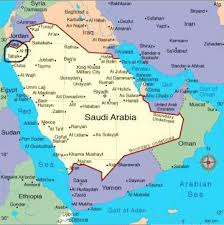
In sum, Saudi Arabia will make a strategic shift toward the Russia-China-Iran axis. In immediate terms, Saudis can hit the US hard by leveraging its status as energy superpower. A dramatic jump in oil prices will boost Saudi income but create difficulties for oil consuming countries, especially EU, China or India. It will boost Russia’s income and make western sanctions even more ineffectual. Again, it will undermine the US’ game plan to bring down Iranian economy to its knees.
On the other hand, any Saudi move to dump dollar in oil trade may significantly galvanise the nascent moves to dethrone dollar as world currency, but its impact can only be in a medium-term scenario.
In geopolitical terms, Saudi Arabia has been a pivotal ally of the US during the past 7 decades. A breakdown in the US-Saudi alliance will unravel the entire American strategy in the Middle East. A US retrenchment from the region may become inevitable.
On the other hand, the ascendancy of Russian and Chinese influence will hurt western interests. Indeed, Israel’s overall security position gets weakened, too.
The bottom line, of course, is that Iran’s rise as regional power will become irreversible – although Iran-Saudi rapprochement is easier said than done. Interestingly, the Iranian reaction to the Khashoggi affair echoes how Tehran took advantage of the overthrow of Saddam Hussein in Iraq.
How far will Russia (and China) want to get entangled in the Saudi standoff with the US? Moscow and Beijing are seeking better relations with the US and may hope that a chastened America would make a more reasonable interlocutor. After all, they’d assess that a US retrenchment in the Middle East will inexorably bring the curtain down on America’s global hegemony. Which in turn will accelerate the trends toward multipolarity. It is improbable that Russia or China will join hands with Saudi Arabia to destabilize the world economy.
The Saudi prognosis that the “if Washington imposes sanctions on Riyadh, it will stab its own economy to death” is plain hyperbole. Then, there is a fundamental contradiction insofar as the survival of the archaic Saudi regime is critically dependent on American support. Trump wasn’t exaggerating when he recently said that if the US support is withdrawn, Saudi regime would pack up in two weeks. There are historical forces swirling around Saudi Arabia, which have been kept at bay due to the sheer US presence. For example, the eastern Shi’te provinces of Saudi Arabia are restive; the Houthis of Yemen will seek revenge.
Above all, the Saudi regime has been exporting radical forces as geopolitical tool for the Americans. These forces may come to haunt Saudi internal security. The Muslim Brotherhood, al-Qaeda, etc. are waiting in the wings. Islamism, paradoxically, poses an existential threat to the Saudi regime.
Succinctly put, the sins of the past will come to wreak vengeance on the Saudi regime with a demonic fury sooner than one may think once America’s protective shield is withdrawn. In fact, the possibility of the disintegration of the Kingdom of Saudi Arabia, which is after all an arbitrary creation of British imperialism in the early 20th century, is very real.
What complicates the situation today is that the US is a badly divided house and the Saudis are used to dealing with the Washington establishment in an idiom that is no longer in vogue. Left to himself, Trump would have handled the Khashoggi affair much as his predecessors in the White House might have done. But that is not going to be possible with the Deep State and the US Congress arm-twisting him. On the other hand, Crown Prince Mohammed bin Salman represents a new type of Saudi leadership that is not shy of a faceoff and seeks a reset of the relationship with the US.
‘Evidence’ Saudi-led coalition aims to destroy food production in Houthi-controlled Yemen – report
RT | October 13, 2018
As the war in Yemen rages on, a new report says there is “strong evidence” that the Saudi-led coalition has aimed to destroy food production and distribution in areas of the country controlled by Houthi rebels.
The report, titled ‘Strategies of the Coalition in the Yemen War: Aerial Bombardment and Food War’, is a compilation of data from various sources on the impact of the coalition’s bombing campaign on the production and distribution of food in rural Yemen, and on fishing along the Red Sea coast.
“If one places the damage to the resources of food producers (farmers, herders, and fishers) alongside the targeting of food processing, storage and transport in urban areas and the wider economic war, there is strong evidence that Coalition strategy has aimed to destroy food production and distribution in the areas under the control of Sanaa,” the report, published earlier this week by the World Peace Foundation, says.
It goes on to explain that the deliberate destruction of “family farming and artisanal fishing” is a war crime.
The report includes data collected by several organizations within Yemen, including the Yemen Data Project, the Ministry of Agriculture and Irrigation, and the Ministry of Fish Wealth.
Read more
Yemenis grieve beside the grave of a child killed in last month’s coalition airstrike on a school bus © Naif Rahma Pompeo says Saudi coalition exercising caution in Yemen – facts show that’s not true
“Together, the data detail the overall levels of targeting civilian, military and unknown sites… the systematic targeting of agricultural areas including the character of the site, and the frequency and timeline of targeting.”
It goes on to document the killing of fishermen along Yemen’s Red Sea coast, and the destruction of boats and infrastructure required to support small-scale fishing which “otherwise could provide life-saving food for a civilian population on the brink of famine.”
The report cites data from the General Authority of Fishing in the Red Sea when it states that 146 fishermen have died as a result of coalition airstrikes from the beginning of the war until December 2017.
Yemen has seen major civilian loss and suffering since the country’s civil war broke out in 2015, with many on the brink of starvation. The country has also endured a major cholera outbreak and a severe lack of medical supplies which has led to many cancer patients having to forego treatment.
Over 16,000 civilians are believed to have perished since the start of the civil war. Meanwhile, the UN and rights groups have repeatedly accused the Saudi-led coalition of not sparing the lives of civilians during its aerial bombardment of Yemen. Up to 50 people were killed when a wedding was bombed in April, while an attack on a bus saw dozens, including many children, die in August.
FILE PHOTO A displaced Yemeni woman from Hodeida cooks food outside a shelter © AFP / Essa Ahmed
The coalition has denied allegations that it is targeting civilians. It did, however, express regret over the bus attack. Such an admission is rare for the coalition, particularly after it previously referred to the bus attack as being “legitimate.”
The Saudi-led coalition intervened in the conflict in Yemen in 2015, in an effort to restore the internationally recognized government after it was driven out by Houthi rebels.
Saudis finance Western media to demonize opponents: Expert
Press TV – October 4, 2018
The head of the UK-based Islamic Human Rights Commission says that Saudi Arabia’s increasing efforts to buy shares or directly finance TV and radio channels in Britain is in line with the kingdom’s efforts to demonize any entity which is opposed to its crimes and human rights violations.
“Saudis are organizing themselves and indeed opening and financing TV stations, radio station to broadcast in Farsi as a means of trying to influence their position within the Iranian community,” Massoud Shadjareh said in an interview with the Press TV on Thursday.
He said Riyadh has also tried to demonize groups like Lebanon’s Hezbollah and Egypt’s Muslim Brotherhood as they oppose the kingdom and its policies.
Shadjareh said Saudi Arabia’s investment in Farsi stations in Britain and elsewhere is only the tip of the iceberg and there has been further investment in other outlets as well.
“Saudis for a very long time have been involved in buying shares and influencing main TV stations like CNN, Sky and others,” he said.
The policy has been meant to both silence the media regarding Saudi Arabia’s war crimes and inhumane activities and also to publicize the kingdom’s demonization of Iran and others who it sees as an obstacle to its policies.
Shadjareh said Saudi Arabia is in fact emulating Israel and other suppressive regimes in bribing the media or launching propaganda stations. “And this tactic is the sort of very similar to the tactics that Zionists are using.”
The expert said the media should try to get more information about the increasing Saudi clout on the field, saying that would expose the crimes committed by the kingdom both inside the country and in other parts of the world.
“I think this use of the media, both social media and mainstream media, it is very dangerous and we need to be aware of it and we need to make sure that we expose their (Saudis’) crimes everywhere,” he added.
UAE recruiting Africans for Saudi-led war: Report
Press TV – October 3, 2018
The United Arab Emirates (UAE), Saudi Arabia’s key partner in the ongoing Riyadh-led invasion of Yemen, has reportedly been recruiting tribesmen from northern and central parts of Africa to fight in the war.
The campaign features Emirati envoys “seducing” the tribesmen across a vast area spanning southern Libya as well as entire Chad and Niger, who earn a living by herding as well as human and material smuggling, the Middle East Monitor (MEMO) press monitoring organization reported on Wednesday.
“This campaign is supervised by Emirati officials who gained material profits in collaboration with human traffickers,” the report added.
An awareness campaign has been launched by Chadian activists, led by campaigner Mohamed Zain Ibrahim, to warn the tribesmen against joining the Saudi-led war.
“The Arabs of the [Persian] Gulf region, especially the UAE and Saudi Arabia, have never bothered to get to know the Arabs of the desert, and today they are asking for their support and seducing them to fight by their side in Yemen!” MEMO cited Ibrahim as telling pan-Arab Arabi21 electronic newspaper.
The envoys offer potential mercenaries such incentives as sums ranging from $900 to $3,000, in addition to acquiring UAE citizenship in return for their applying for jobs in Emirati security companies.
Ibrahim said the job opportunities were “an actual military recruitment campaign to gather mercenaries for the Yemeni war and use them to fight the people of Yemen, who are Arabs and Muslims as well, and all that for a bunch of dollars.”
“A delegation of Emirati people in business visited Niger in January 2018, where they met Arab tribal leaders and recruited 10,000 tribesmen living between Libya, Chad, and Niger,” MEMO said.
The Emirates has been contributing heavily to the 2015-present war, which seeks to reinstall Yemen’s former Saudi-allied officials.
In addition to their own forces, both Riyadh and Abu Dhabi have deployed thousands of militants across the violence-scarred country to intensify the invasion.
The Emirati side began beefing up its contribution in June, when the coalition launched a much-criticized offensive against al-Hudaydah, Yemen’s key port city, which receives the bulk of its imports.
As Saudis Defend Against War Crimes Allegations, Saudi Airstrike in Yemen Kills Entire Family
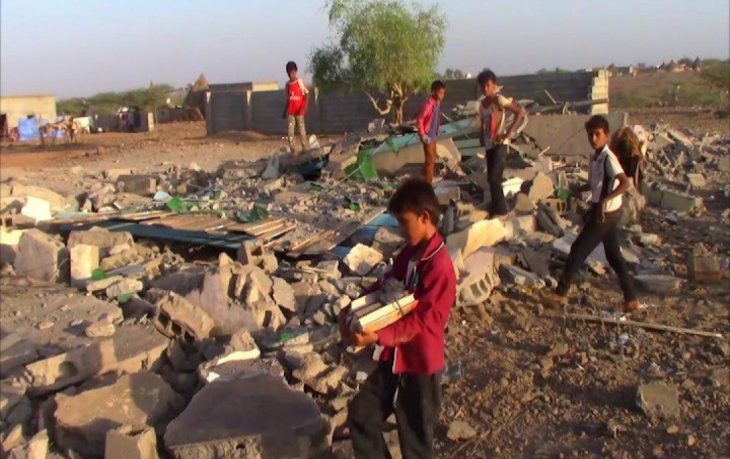
Locals walks among the rubble of Hussein al-Hajouri`s brick and mud home which was destroyed by a Saudi airstrike on October 3, 2018. Photo | Ahmed AbdulKareem
By Ahmed Abdulkareem | MintPress News | October 2, 2018
HAJJAH, YEMEN – Saudi Arabia, backed by the United States, carried out an airstrike targeting a displaced family in the Mustaba district in the province of Hajjah, southwestern Yemen early Tuesday morning. A man, his wife, and their nine-year old only-daughter were killed in the strike, along with 10 others.
A 30-year-old witness told MintPress News :
Two airstrikes targeted Hussein al-Hajouri`s house at 2 a.m., killing Hussein and his wife and daughter. We found some parts of their bodies 100 meters from the house that was bombed; some of it is still under the rubble.”
Rescue efforts were complicated by fear of additional strikes, as Saudi warplanes continued to circle the area after the initial strikes. Saudi Arabia has been known to use double-tap strikes in Yemen, carrying out an initial airstrike and then circling back to target rescuers.
The latest attack comes just hours after Saudi Arabia admitted that its forces have committed what it called “certain mistakes” in Yemen, after increasing pressure from international bodies and human-rights groups that accuse the kingdom of carrying out war crimes in the country.
Saudi Defense Ministry spokesman Osaiker Alotaibi told a panel of 18 independent experts on Monday that a coalition investigation had uncovered “the existence of certain unintentional mistakes in a number of these operations,” adding that “the task force recommended that perpetrators should be held to account and victims should enjoy redress.”
In her response to the Saudi Defense Ministry, the panel’s chairwoman, Renate Winter, wondered why schools and hospitals had been targeted repeatedly:
You say it’s an accident. How many such accidents can you bear and how many such accidents can people in Yemen bear?”
Last month, investigators launched an international inquiry into war crimes in Yemen and found evidence of such crimes committed in the country. Their August 28 report said Saudi airstrikes had caused most of the documented civilian casualties.
Since the war began in 2015, the U.S.-backed, Saudi-led coalition has repeatedly targeted displaced civilians. In the most recent such attack before today, airstrikes targeted displaced families near the port city of Hodeida on August 24, killing or wounding 31 people, 24 of whom were children. Many of the victims of the strike belonged to a single family.
More recently, at least two Yemeni civilians were killed and three others wounded when Saudi warplanes struck a vehicle in the city of Abs in Hajjah, on Tuesday.
This week, one person was killed and a number of others sustained injuries after Saudi fighter jets conducted an airstrike on Munirah city in Hodeida, western Yemen. Saudi jets also conducted an airstrike on the residential area of Ghaferah in the Dhahir district in the northern province of Saada, killing a child and wounding several others.
Over 600,000 civilians have been killed or injured in Yemen since the Saudi-led coalition began its attacks in 2015, according to Yemen’s Ministry of Human Rights based in Sana’a. The U.S.-backed coalition’s blockade on Yemen has also triggered an epidemic of disease and famine across the country.
Ahmed AbdulKareem is a Yemeni journalist. He covers the war in Yemen for MintPress News as well as local Yemeni media.
US creating basis for regional conflagration in Middle East: James Petras
Press TV – September 29, 2018
The United States is creating the basis for the regional conflagration in the Middle East by fortifying its circle around Iran, American writer and academic James Petras says.
The US State Department has endorsed the proposed sale of more than 800 tactical missiles to Bahrain amid the Al Khalifah regime’s heavy-handed crackdown on pro-democracy campaigners and political dissidents in the tiny Persian Gulf country.
The approval includes Guided Multiple Launch Rocket System (GMLRS) Unitary Rocket Pods and Army Tactical Missiles System (ATACMS) Unitary missiles for an estimated cost of $300 million, the Arabic-language al-Khaleej al-Jadeed news website reported on Saturday.
“Well, it’s part of the US setting up the aggressive policy; mainly it is directed against the government in Iran. And it’s largely responsible for encouraging this aggression with the addition of its support of Israel and Saudi Arabia,” Professor Petras said.
“It’s creating the basis for the regional conflagration. I don’t think anyone is aware of any danger to the small (Persian) Gulf state. They’re mainly there to serve the US, and to enrich the oligarchies that run those countries,” he added.
“They have no defensive function. They have no positive role to play. And they are forever condemned for their repression of their dissident populations,” the analyst said.
“So I think this is an act by the Trump administration to fortify its circle around Iran. It’s likely to force Iran to increase its defenses and its alliances in the region,” he added.
“I don’t think it has any positive function for the US to continue meddling the Middle East and causing new wars, new terrorists, and new instability in the region,” the academic concluded.
UN: one child dies every 10 minutes in Yemen

A malnourished baby receives medical treatment at al Sabeen Maternal Hospital in Sanaa, Yemen [Mohammed Hamoud/Anadolu Agency]
MEMO | September 26, 2018
At least one child dies every ten minutes as a result of the conflict in Yemen, a senior UN official said.
The United Nations humanitarian coordinator in Yemen, Lise Grande, warned at the end of a high-level meeting held on the sidelines of the UN General Assembly that ten million more Yemenis will face pre-famine conditions by the end of this year if the status quo does not change.
She explained that three quarters of Yemen’s population need some form of protection and assistance.
For his part, the Under-Secretary-General for Humanitarian Affairs and Emergency Relief Coordinator, Mark Lowcock, said the humanitarian situation in Yemen has reached extremely dangerous levels. “I will ask you for resources to cover our humanitarian operations, so that the suffering of the Yemeni people will not continue,” he said.
The United Nations has launched an appeal to donor countries and institutions to increase financial support to cover what it has termed the world’s worst humanitarian crisis.
While all eyes are on Syria’s Idlib, US continues to decimate Yemen
By Darius Shahtahmasebi | RT | September 14, 2018
The US is ready to defend Syria from a brutish assault launched by Syria’s own government and its allies – or so Washington wants you to believe. In the backdrop, Yemen continues to burn in silence.
On September 3, US ambassador to the UN, Nikki Haley – eloquent diplomat that she is – retweeted a tweet from the warmonger in chief that is the US president, with the caption “All eyes on the actions of Assad, Russia and Iran in Idlib.” This is the same US administration who just facilitated the bombing of a school bus in Yemen, slaughtering at least 40 children in the process.
Maybe, just maybe, Nikki Haley should keep her eyes on herself.
If the world did direct its eyes to what is taking place in Yemen, they would know that the United Nations has just warned of an “incalculable human cost” in the works, as the US and its allies press forward with an offensive to retake the Yemeni port city of Hodeida from the Houthi rebels.
That’s right. The US, currently waving its arms in despair about human rights abuses and chemical weapons attacks that have not even taken place in Syria yet, is supporting a major offensive of its own that will lead to a humanitarian crisis of monumental proportions.
Yemen, a country already deeply in crisis, relies on the port of Hodeida for at least 70 percent of its humanitarian aid. It therefore makes sense from a humanitarian perspective to turn its location into a major war zone, am I right?
The small minority of people who are inclined to care about innocent Yemenis need not fret though. US Secretary of State Mike Pompeo has just this week certified that the Saudi-led coalition is taking sufficient steps to protect civilians. According to Pompeo, the Gulf nations involved are “undertaking demonstrable actions to reduce the risk of harm to civilians.”
“They are taking steps, in the view of the US government and this administration, in the right direction,” State Department spokeswoman Heather Nauert told a briefing, according to Reuters. “We see them taking steps. Is it perfect? No absolutely not. Do we see them doing what they can to mitigate civilian casualties? Absolutely we do.”
Thank God – I was getting worried there for a second. The US-backed Saudi-led coalition may be killing children as if they were ants, but they are taking steps to mitigate the number of children they are killing at the same time.
A seven-page memo sent to Congress and obtained by the Intercept further confirmed Pompeo’s delusional thinking, as the memo called Saudi Arabia and the UAE “strong counterterrorism partners.” Never mind that just last month, the Associated Press reported the US and its allies were actually recruiting Al-Qaeda fighters to join the coalition.
Oops.
While the Trump administration is taking a horrifying and bloody war and taking it to new depths, the truth of the matter is that this war did not begin under Donald Trump. The war in Yemen, the Arab world’s poorest nation, fast becoming the world’s worst humanitarian crisis, was started by none other than peace-prize laureate Barack Obama himself.
But why did this war start, and why has the US continued to support it?
In an overlooked interview with the Real News’ Aaron Maté, Rob Malley, President of the International Crisis Group and former Special Assistant to President Obama, gave a disturbing glimpse into who actually pulls the strings on US foreign policy.
According to Malley:
“To try to understand what the Obama administration was about, and I’ve tried to- just to try to, to explain it to myself, to try to understand how we got to where we are, let’s not forget at the time we were in the middle of these negotiations with Iran, trying to reach a nuclear deal which was extremely unpopular with our traditional allies in the region, from Israel to Saudi Arabia to the UAE and others. And the Saudis came to us and said that they were about to intervene in Yemen, to attack the Houthis that had toppled the legitimate government of the internationally recognized government at the time. And they asked for our assistance…”
“So there was on the one hand a number of voices expressing concern about that. But on the other hand were many people saying the relationship with Saudi Arabia is almost at breaking point. They believe we’d betrayed their trust for a number of reasons. But Iran, Iran negotiating the Iran deal, or the negotiations over the Iran deal was one of them. We needed to protect that deal and make sure that we could get it done, because if we didn’t have a deal there was a risk of a war with Iran. And so I think the decision was made in the end by President Obama to say we’re going to be, to support parts of this war…”
Only a peace prize laureate could pull off a feat like that. But all joking aside, the human cost of the war in Yemen is nothing short of shameless.
On October 8, 2016, an aerial bombardment targeted a crowded funeral in Sana’a, the capital of Yemen, the aftermath of which was aptly described as a “lake of blood.” According to the UN, more than 140 Yemenis were killed and at least 525 others were injured.
To date, the US-backed Saudi-led coalition has struck well over 100 hospitals, as well as wedding parties, refugee camps, food trucks, factories, transport routes, agricultural land, residential areas, and schools, to name a few. Yes, you read that right. Yemen, with only 2.8 percent of its land being cultivated, is actively targeted by the US-backed coalition. According to Martha Mundy, professor emeritus at the London School of Economics, “to hit that small amount of agricultural land, you have to target it.”
Prior to spiralling into chaos, Yemen was already dependent on imports for 90 percent of its staple foods and almost all of its fuel and medical supplies. Putting aside the mass amount of violence that the US-backed coalition has enacted, the rest of Yemen’s population is suffering due to the Saudi-imposed blockade, which has put half the population at risk of starvation. According to the UN, over 462,000 children under the age of five are suffering from severe acute malnutrition.
This is done completely on purpose. At the end of August this year, Saudi Arabia’s Crown Prince, Mohammed Bin Salman, threatened that he would continue targeting women and children in Yemen and allegedly said that he wants to “leave a big impact on the consciousness of Yemeni generations.”
“We want their children, women and even their men to shiver whenever the name of Saudi Arabia is mentioned,” the Crown Prince reportedly said.
The idea, advanced by Pompeo and his cohorts at the State Department, that the coalition has taken steps to avoid civilian casualties is by all accounts, complete nonsense. As the New York Times openly acknowledged:
“The first problem was the ability of Saudi pilots, who were inexperienced in flying missions over Yemen and fearful of enemy ground fire. As a result, they flew at high altitudes to avoid the threat below. But flying high also reduced the accuracy of their bombing and increased civilian casualties,” American officials said.
“American advisers suggested how the pilots could safely fly lower, among other tactics. But the airstrikes still landed on markets, homes, hospitals, factories and ports, and are responsible for the majority of the 3,000 civilian deaths during the yearlong war, according to the United Nations.”
In addition to supplying billions of dollars’ worth of arms to the Saudi kingdom, US personnel provide overwhelming assistance to the Saudi-led coalition to help bring Yemen to its knees by sitting in the Saudi’s command and control center, providing lists of targets, refuelling planes, running intelligence missions, and so forth.
If Donald Trump is so concerned with migrants and refugees, perhaps he should stop creating them. If he really cares about ‘America first’ and making America great again, perhaps racking up notches to America’s war crime belt is not the way to go. Legal experts have already warned the US government that its complicity in these attacks can make them a co-belligerent in Saudi Arabia’s vast, extensive list of war crimes. This warning has fallen completely on deaf ears and has not helped at all in deterring the Trump administration from continuing some of Barack Obama’s worst policies; and even now the US continues to shelter the Saudi-led coalition so that it can continue its bloodthirsty policies unabated.
Make no mistake, if the US pulled its support for Saudi Arabia, Yemen’s suffering could stop tomorrow.
Watch out for Assad though; I heard he was about to retake a Syrian city from an Al-Qaeda affiliate. Remember Al-Qaeda, the notorious terror group the US claimed was the mastermind behind the September 11 attacks? Apparently, the entire US government doesn’t, as it allies itself with Al-Qaeda in just about every battlefield that counts.
In the meantime, ordinary Yemenis continue to suffer by the millions. If you can absorb all of this and still believe the US is genuinely concerned about human rights abuses in places like Syria, then you probably deserve what’s to come next.
Saudi-led airstrikes kill 15 civilians in Yemen’s Hudaydah
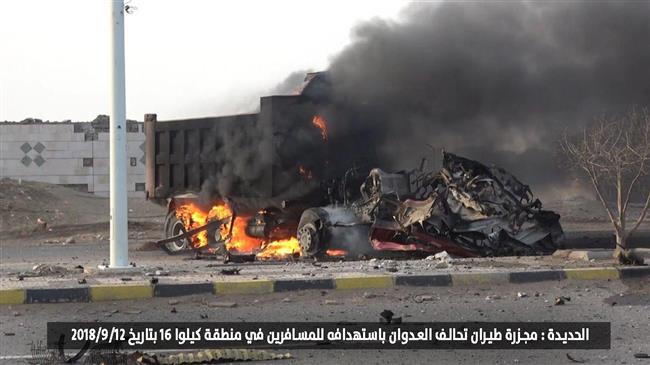
Yemeni truck targeted by a Saudi fighter jet on the outskirts of the port city of Hudaydah on September 12, 2018. (Photo by al-Masirah)
Press TV – September 12, 2018
At least 15 civilians, including one child, have been killed as the Saudi-led coalition resumed its airstrikes on the outskirts of Yemen’s port city of Hudaydah despite widespread international criticism over the war’s impact on civilians.
According to reports by Yemen’s Arabic-language al-Masirah television, about 20 civilians were also injured during Wednesday’s bombings that were launched after a brief truce since July.
The Saudi-backed forces also captured a number of towns as well as two main supply routes linking Hudaydah to the capital Sana’a and Ta’izz province, the report added.
The bombings resumed after UN-brokered peace efforts failed in Geneva last week. The talks were aborted after the UN failed to meet conditions set by Yemen’s Ansarullah movement, including transfer of wounded people to hospital for proper treatment and guarantees on the safety of the Yemeni delegation. Ansarullah also accused Saudi Arabia of planning to strand the delegation in Djibouti, where their plane was to make a stop en route to Geneva.
Delegates from Yemen’s former government and representatives of the Houthi movement held their last UN-sponsored negotiations in Kuwait in 2016 in a bid to hammer out a “power-sharing” deal, but they fell apart after the Saudi-backed side left the venue.
Saudi Arabia and a number of its regional allies launched a devastating military campaign against Yemen in March 2015, with the aim of bringing the government of former president, Abd Rabbuh Mansur Hadi, back to power and crushing Ansarullah.
Some 15,000 Yemenis have been killed and thousands more injured since the onset of the Saudi-led aggression.
More than 2,200 others have died of cholera, and the crisis has triggered what the United Nations has described as the world’s worst humanitarian disaster.
Saudi-backed delegates leave Yemen peace talks
Press TV – September 8, 2018
A delegation from Yemen’s former government has left UN-brokered talks in Geneva after representatives of the Houthi movement were prevented by Saudi Arabia from attending the negotiations.
“The government delegation is leaving today,” said an official from the Saudi-backed team on Saturday, referring to the former Yemeni administration. “There are no expectations the Houthis are coming,” he added.
UN envoy to Yemen Martin Griffiths told a news conference that the Houthis were “keen” to get to Geneva.
“They would have liked to get here. We didn’t make conditions sufficiently correct to get them here,” he said.
Ansarullah accused the Saudis of planning to strand the delegation in Djibouti, where their plane was to make a stop en route to Geneva.
The Saudis were “still refusing to give permission to an Omani plane” to land at the Yemeni capital Sana’a and take the delegation to Geneva, the movement said.
It posted a statement , saying the Houthis needed to “ensure the safety of the delegation” and require a guarantee that they would be allowed to return “smoothly” to Sana’a airport.
Yemenis took to the streets in Sana’a on Friday, blaming the United States, Britain, and Saudi Arabia for preventing the Houthis from joining the peace talks.
“The decision not to send an Omani plane (for the Houthi delegation) was made by the US and it is an American conspiracy with the help of Saudi Arabia,” senior Houthi official Abdulrahman al-Motawakel said.
“The US meant to delay the delegation from leaving, and the UN is helpless, and cannot do anything about it,” he added.
Loay al-Shamy, a senior Information Ministry official in Sana’a, said, “Regarding the peace talks, the delegation was formed and their names were announced and were ready to go but the UN, under pressure from the United States and Britain could not fulfill what was agreed on.”
The agreement was “to provide an Omani plane for the delegation that will participate in Geneva and offer the assurances required for the return of the delegation,” he said.
“We saw during the last talks that the delegation was stuck abroad and the UN could not bring them back home,” he added.
The two sides held their last UN-sponsored negotiations in Kuwait in 2016 in a bid to hammer out a “power-sharing” deal but they fell apart after the Saudi-backed side left the venue.
Yemen has been in turmoil since 2015 when former president Abd Rabbuh Mansur Hadi stepped down and then fled to Riyadh.
Hadi then asked Saudi Arabia to launch a military campaign against Yemen, leading to a crisis which has continued to this day.
Thousands have been killed in the Saudi-led invasion which has also pushed Yemen to the edge of famine.
A cholera outbreak, resulting from the devastation of Yemen’s health infrastructure, has also claimed more than 2,000 lives.
Featured Video
NATO’s War of Choice – The Sabotage of the Istanbul Negotiations
or go to
Aletho News Archives – Video-Images
From the Archives
National Security Archive Publishes Key Records on Infamous MKULTRA Program
Agency Sought Drugs and Behavior Control Techniques to Use in “Special Interrogations” and Offensive Operations
Edited by Michael Evans | National Security Archive | December 23, 2024
Washington, D.C. – Today, the National Security Archive and ProQuest (part of Clarivate) celebrate the publication of a new scholarly document collection many years in the making on the shocking secret history of the CIA’s mind control research programs. The new collection, CIA and the Behavioral Sciences: Mind Control, Drug Experiments and MKULTRA, brings together more than 1,200 essential records on one of the most infamous and abusive programs in CIA history.
Under code names that included MKULTRA, BLUEBIRD and ARTICHOKE, the CIA conducted terrifying experiments using drugs, hypnosis, isolation, sensory deprivation, and other extreme techniques on human subjects, often U.S. citizens, who frequently had no idea what was being done to them or that they were part of a CIA test.
Today’s announcement comes 50 years after a New York Times investigation by Seymour Hersh touched off probes that would bring MKULTRA abuses to light. The new collection also comes 70 years since U.S. pharmaceutical giant Eli Lilly & Company first developed a process to streamline the manufacture of LSD in late 1954, becoming the CIA’s chief supplier of the newly discovered psychoactive chemical central to many of the Agency’s behavior control efforts.
Highlights of the new MKULTRA collection include… continue
Blog Roll
 Aletho News
- Glenn Diesen: NATO’s War of Choice – The Sabotage of the Istanbul Negotiations
- What’s Really in the Bag: The Pet Food Industry’s Dirty Secret
- Project Artichoke: 70 Years Ago, CIA Discussed Hiding Mind-Control Drugs in Vaccines
- Drug traffickers trained in Ukraine attack state forces in Mexico
- The tragic reality of Brazilian mercenaries in the Ukrainian conflict
- Zelensky Refused to Discuss Druzhba Pipeline Issue – Fico
- U.S. General Caine Warns: STRIKING IRAN is a HUGE RISK /Glenn Diesen & Lt Col Daniel Davis
- Israel designates five Palestinian media outlets as ‘terrorist organizations’
- Israel, not America, first: Carlson’s Huckabee interview lays bare US foreign policy priorities
- Israeli troops executed Palestinian aid workers at ‘point blank range’: Report
- If Americans Knew
- Fourteen Countries Condemn Huckabee’s Support for Israel Taking Over Most of the Middle East
- Israeli Soldiers Killed Gaza Aid Workers at Point Blank Range in 2025 Massacre: Report
- Israel’s insidious network to propagandize American Christians
- Israel’s Best-Kept Secret: Palestinian Resistance Never Agreed to Disarm
- Trump officials plan to build 5,000-person military base in Gaza, files show
- Are MAGA restrainers pulling their punches this time on Iran?
- The NY Times on the “MAGA” Split Over Israel & USS Liberty
- In Gaza, Ramadan without mosques, imams – Not a ceasefire Day 137
- Footage Shows Israeli Troops Waiting in Ambush, Then Opening Fire on a Palestinian Teen
- The US is on the brink of a major new war that Trump has not even bothered explaining
- No Tricks Zone
- Surprising Discovery: Sahara Is Greening…Billions Of Trees Where Once Thought To Be Barren
- New Research Reaffirms Clouds, Aerosols, And Surface Solar Radiation Are ‘Driving The Climate System’
- Germany: Electric Car Catches Fire At Charging Station, Sets Off Local “Inferno”, Widespread Damage
- New Study: Canada’s New Brunswick Was 1°C Warmer Than Today During The Medieval Warm Period
- Coal Power Back In Trend As Globe Tries To Keep Pace With Growing Demand For Power
- New Study: A 4°C Warmer Beaufort Sea Had ‘No Sea Ice’ 11,700 – 8200 Years Ago
- Unfudging The Data: Dutch Meteorological Institute Reinstates Early 20th Centruy Heat Waves It Had Erased Earlier
- German Gas Crisis…Chancellor Merz Allegedly Bans Gas Debate Ahead of Elections!
- Pollen Reconstructions Show The Last Glacial’s Warming Events Were Global, 10x Greater Than Modern
- Germany’s Natural Gas Storage Level Dwindles To Just 28%… Increasingly Critical
 Aletho News