The Myth of US ‘Inaction’ in Syria
By William Van Wagenen – The Libertarian Institute – July 8, 2018
Introduction
When the Russian military intervened in the Syrian war in October 2015, many in the Western press complained bitterly, demanding that US planners intervene directly in Syria on behalf of the anti-government rebels in response. Reuters alleged that “The Middle East is angry and bewildered by US inaction in Syria,” arguing that “The question on everyone’s mind is: will the United States and its European and regional Sunni allies intervene to stop President Vladimir Putin from reversing the gains made by mainstream Syrian rebels after more than four years of war? Few are holding their breath.” The Washington Post similarly argued that Russian president Vladimir Putin was “exploiting America’s inaction,” while the Guardian lamented the “western inability to care enough about the plight of Syrians.” As Russian and Syrian forces battled rebels one year later in Aleppo, more dramatic accusations of US inaction emerged, with Foreign Policy describing US policy in Syria under Obama as “inaction in the face of genocide.”
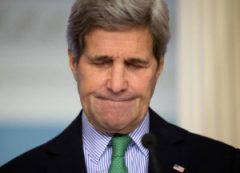 The idea that the United States has not intervened in Syria and is guilty of “inaction,” is a myth however. The United States and its Western and Gulf Allies have intervened in the Syrian conflict from early on. US planners have been fighting what the New York Times described as a “$1 Billion Secret C.I.A. War in Syria” while providing weapons to rebels through a program considered “one of the costliest covert action programs in the history of the C.I.A.” Starting in the fall of 2012, the US and its Gulf partners, under the direction of then CIA director David Petraeus, were openly sending “a cataract of weaponry” into Syria. It is likely that such shipments began much earlier without public acknowledgment, via the “rat line” from Libya, as reported by journalist Seymour Hersh. US Special Envoy to Syria Michael Ratner, in a meeting with members of the Syrian opposition, explained that “The armed groups in Syria get a lot of support, not just from the United States but from other partners,” while Secretary of State John Kerry added in the same meeting, “I think we’ve been putting an extraordinary amount of arms in,” and “Qatar, Turkey, Saudi Arabia, a huge amount of weapons [are] coming in. A huge amount of money.”
Also a myth is the idea that any US intervention in Syria would seek to protect civilians. While allegations that Syrian and Russian forces were committing genocide in Aleppo proved baseless, US planners have themselves supported rebels intent on committing genocide and sectarian mass murder. This was clearly evident in the Syrian city of Latakia, which by the time of the Russian intervention in October 2015 was on the verge of falling to a coalition of Syrian rebel groups including al-Qaeda (known in Syria as the Nusra Front) and the US-armed and funded Free Syrian Army (FSA).
Robert Worth of the New York Times writes that “In Latakia, some people told me that their city might have been destroyed if not for the Russians. The city has long been one of Syria’s safe zones, well defended by the army and its militias; there are tent cities full of people who have fled other parts of the country, including thousands from Aleppo. But in the summer of 2015, the rebels were closing in on the Latakia city limits, and mortars were falling downtown. If the rebels had captured the area — where Alawites are the majority — a result would almost certainly have been sectarian mass murder. Many people in the region would have blamed the United States, which armed some of the rebels operating in the area. . . Andrew Exum, who worked in the Pentagon at the time, told me that the military drew up contingency plans for a rapid collapse of the regime. The planning sessions were talked about as ‘catastrophic success [emphasis mine].’”
Alawite civilians in Latakia faced the prospect of being massacred if rebels had been able to capture the city, due to the virulently anti-Alawite views of Nusra Front members. Nusra religious clerics draw on the writings of the fringe 14th century Islamic scholar Ibn Taymiyya to argue that Alawites are “infidels” deserving of death. Syria analyst Sam Heller described Nusra clerics as promoting “toxic — even genocidal — sectarianism.” Rebels from the FSA, which have fought alongside and “in the ranks” of the Nusra Front throughout the conflict, also posed a threat to Alawite civilians in Latakia. While typically considered moderate in the Western press, many FSA battalions have been armed and funded by the Syrian Muslim Brotherhood (MB). Thanks to the influence of Brotherhood ideologue Said Hawwa, the Syrian Brotherhood strongly promoted the anti-Alawite sectarian views of Ibn Taymiyya from the 1960’s until the 1980’s. This anti-Alawite sectarianism re-emerged in segments of the Syrian opposition, including in elements of the FSA, when peaceful protests and armed insurrection against the Syrian government simultaneously erupted in Syria in the spring of 2011.
While the Syrian and Russian militaries managed to protect Latakia and prevent a massacre of the city’s Alawite civilians, the broader effort to prevent the fall of the country to al-Qaeda and its FSA allies exacted a huge toll on Syria’s Alawites. The Telegraph noted that already by April 2015, “The scale of the sect’s losses is staggering” and that of some 250,000 Alawite men of fighting age “as many as one third are dead” and that “Alawite villages nestled in the hills of their ancestral Latakia province are all but devoid of young men. The women dress only in mourning black.”
While arming rebels threatening the massacre of Alawite civilians in Latakia, US planners were at the same time welcoming the potential massacre of Syrian civilians in Damascus. The Syrian capital was on the verge of falling to the Islamic State (ISIS) in the summer of 2015 after ISIS, with the help of Nusra, captured all of the Yarmouk Palestinian refugee camp in the southern Damascus suburbs. The New York Times acknowledged the ISIS threat to Damascus at this time, observing that “By seizing much of the camp” ISIS had “made its greatest inroads yet into Damascus,” while the Washington Post noted that “Their new push puts [ISIS] within five miles of the heart of the capital . . . even as they are on the retreat in Iraq.”
In a private meeting with members of the Syrian opposition, Secretary of State John Kerry acknowledged that US planners had actually welcomed the ISIS advance on Damascus, in an effort to use it as leverage to force Assad to give up power. Kerry explained that, “the reason Russia came in is because ISIL [ISIS] was getting stronger. Daesh [ISIS] was threatening the possibility of going to Damascus. And that is why Russia came in. They didn’t want a Daesh [ISIS] government and they supported Assad. And we know this was growing. We were watching. We saw that Daesh [ISIS]was growing in strength. And we thought Assad was threatened. We thought we could manage that Assad might then negotiate. Instead of negotiating, he got Putin to support him [emphasis mine].”
Because the US was bombing ISIS in defense of its Kurdish allies in Northeastern Syria and its Iraqi government allies in Northwestern Iraq, the fact that US planners at the same time welcomed the ISIS push on Damascus against the Syrian government was largely obscured.
Had Damascus fallen to ISIS, it is clear that many civilians in the city, including Christians, Alawites, Shiites, members of the LGBTQ community, and pro-government Sunnis, would have been killed. While commenting on the Russian intervention, Michael Kofman of the Wilson Center acknowledged that “Assad may be irredeemable in the eyes of the United States, but it is equally clear that a high human price would be paid when the Islamic State [ISIS] or al-Nusra seizes the major population centers in Syria that he still controls.”
It is also clear that US planners were deliberately supporting al-Qaeda (Nusra), despite its genocidal intentions towards Syria’s Alawites, by flooding Syria with weapons. Because FSA brigades that received funding and weapons from the US and its Gulf Allies were fighting side by side with militants from Nusra throughout the country, in practice much of the money and weapons sent to the FSA ultimately benefited al-Qaeda.
For example, US-made TOW anti-tank missiles sent by US planners to FSA groups in Idlib played a crucial role in helping Nusra conquer the entire province in the spring of 2015. Syria analyst Hassan Hassan observed in Foreign Policy during this period that “The Syrian rebels are on a roll” and that “The recent offensives in Idlib have been strikingly swift — thanks in large part to suicide bombers and American anti-tank TOW missiles,” which the FSA and Nusra deployed in tandem. Syria analyst Charles Lister, also writing in Foreign Policy, described how US planners explicitly encouraged the FSA groups they were arming to fight alongside Nusra in Idlib. Rebel victories in Idlib, in particular the town of Jisr al-Shughour, allowed Nusra and the FSA to then threaten the massacre of Alawites in Latakia.
When Russia intervened militarily in Syria in October 2015, US planners responded by immediately increasing shipments of TOW anti-tank missiles to FSA groups, some of which then helped Nusra capture the strategic town of Murek in central Syria one month later in November 2015.
This prompted Daveed Gartenstein-Ross of the Foundation for Defense of Democracies (FDD) to observe that “it is impossible to argue that U.S. officials involved in the CIA’s program cannot discern that Nusra and other extremists have benefited” from CIA weapons shipments to Syrian rebels, “And despite this, the CIA decided to drastically increase lethal support to vetted rebel factions following the Russian intervention into Syria in late September.”
Nusra did not only benefit from fighting alongside FSA rebels armed with US-supplied weapons, but acquired many of these weapons themselves. That Nusra regularly purchased weapons from the Western-backed military councils supplying the FSA was confirmed in October 2014, when the New York Times reported that Shafi al-Ajmi, a Nusra fundraiser, told a Saudi news channel that “When the military councils sell the weapons they receive, guess who buys them? It’s me.”
That al-Qaeda was purchasing US supplied weapons seemed of little concern to US planners. When journalist Sharmine Narwani asked why US-supplied weapons allegedly meant for FSA groups were showing up in Nusra hands, CENTCOM spokesman Lieutenant Commander Kyle Raines responded: “We don’t ‘command and control’ these forces—we only ‘train and enable’ them. Who they say they’re allying with, that’s their business.”
Obama administration officials themselves acknowledged tacit US support for al-Qaeda, admitting in November 2016 to the Washington Post that they had struck “a deal with the devil,” years before, “whereby the United States largely held its fire against al-Nusra because the group was popular with Syrians in rebel-controlled areas and furthered the U.S. goal of putting military pressure on Assad,” thereby confirming long standing Russian accusations that the US had been “sheltering al-Nusra.”
More recently, Ben Rhodes, deputy national security advisor under the Obama administration, acknowledged providing military support to Syrian rebels, even though it was clear that Nusra comprised a good portion of the Syrian opposition as a whole. Rhodes explained that “there was a slight absurdity in the fact that we were debating options to provide military support to the opposition at the same time that we were deciding to designate al-Nusra, a big chunk of that opposition, as a terrorist organization.”
Despite designating Nusra as a terror group already in 2012, US planners nevertheless provided weapons to the Syrian rebels, of which Nusra comprised a “big chunk,” for the next 7 years. As Sharmine Narwani observes, “U.S. arms have been seen in Nusra’s possession for many years now, including highly valued TOW missiles, which were game-changing weapons in the Syrian military theater. When American weapons end up in al-Qaeda hands during the first or second year of a conflict, one assumes simple errors in judgment. When the problem persists after seven years, however, it starts to look like there’s a policy in place to look the other way.”
US planners welcomed rebel gains in Syria, including by rebel groups advocating genocide against Syria’s Alawite population, such as ISIS and Nusra, because these gains bolstered the broader US goal of toppling the Syrian government, in an effort to weaken its close allies, Iran and Hezbollah. US planners wished to see rebel gains in Syria, in spite of the obviously catastrophic consequences for Syrian civilians, including for Syria’s Sunnis, which rebel success would bring. US support for the rebels belies the myth of US “inaction” in Syria, and the myth that any US intervention would be for the sake of preventing massacres and even genocide, rather than in support of it.
In the remainder of this essay, I will review the US support for rebel advances in the spring and summer of 2015 in Idlib, Latakia, Palmyra, Yarmouk, and Homs. I will describe how these rebel advances nearly led to the massacre of Syrian civilians in two of the country’s main population centers, Latakia and Damascus, if not for the Russian intervention which halted the rebel advance.
Idlib
In March of 2015, rebels from the Jaish al-Fatah coalition, which included Nusra and the jihadist rebel group Ahrar al-Sham, launched a coordinated assault along with brigades from the FSA on Idlib province, leading to the capture of the province as a whole from Syrian government forces two months later.
Rebels captured Idlib city itself on March 29. Al-Jazeera quoted the pro-opposition Syrian Observatory for Human Rights (SOHR) as declaring “Al-Nusra Front and its allies have captured all of Idlib,” in a battle that led to some 130 deaths. Al-Jazeera also quoted representatives of the Western-backed Syrian National Council (SNC) as declaring the capture of Idlib city as “an important victory on the road to the full liberation of Syrian soil from the Assad regime and its allies,” showing the close relationship between the US-supported Syrian political opposition in exile and al-Qaeda affiliated militants on the ground in Syria. Rebels captured the last major Syrian army base in the province on March 19 near the town of Mastouma. Rebel control of Idlib was completed with the ouster of the Syrian army from the town of Ariha at the end of May, causing government forces to retreat to bases on the coast in Latakia.
The rebel offensive in Idlib succeeded largely due to the lethal combination of Nusra suicide bombers and US-provided TOW anti-tank missiles. FSA commander Fares Bayoush from the Fursan al-Haq brigade explained to the LA Times “that his group’s TOW missiles played an important role in repelling government tanks during a March offensive in Idlib province spearheaded by an Islamist coalition called the Army of Conquest, which includes Al Nusra Front.” It was during this period that Syria analyst Hassan Hassan observed in Foreign Policy that, “The Syrian rebels are on a roll,” and that “the recent offensives in Idlib have been strikingly swift — thanks in large part to suicide bombers and American anti-tank TOW missiles,” as well as that,“For the first time since the conflict began, Assad’s heartlands in the Western region [Latakia] seemed exposed.”
The close cooperation between FSA brigades and rebels from the al-Qaeda affiliated Nusra Front in Idlib was encouraged by US planners. Syria analyst Charles Lister, also writing in Foreign Policy, observed that “The involvement of FSA groups, in fact, reveals how the factions’ backers have changed their tune regarding coordination with Islamists. Several commanders involved in leading recent Idlib operations confirmed to this author that the U.S.-led operations room in southern Turkey, which coordinates the provision of lethal and non-lethal support to vetted opposition groups, was instrumental in facilitating their involvement in the operation from early April onwards. That operations room — along with another in Jordan, which covers Syria’s south — also appears to have dramatically increased its level of assistance and provision of intelligence to vetted groups in recent weeks [emphasis mine].”
Lister, who has testified several times before the US House Foreign Affairs Committee to make policy proscriptions for US planners in Syria, argued at that time that US cooperation with al-Qaeda (Nusra) is the best option: “[T]here still remains no better alternative to cooperating with al Qaeda, and thus facilitating its prominence. If the West wants a better solution, it must broaden and intensify its engagement with Syria’s insurgent groups and considerably expand its provision of assistance to a wider set of acceptable groups” echoing a popular view among Western and Gulf think tank analysts that al-Qaeda was worthy of US support.
Predictably, US efforts to help al-Qaeda conquer Idlib had grim consequences for many of its residents, large numbers of whom fled after rebels took control of the city and province. The Guardian reported that while under Syrian government control, Idlib city, with a population of some 165,000 before the war, “had been swollen by hundreds of thousands of displaced people, who had fled there to escape fighting elsewhere.” In contrast, when the rebels came, many civilians fled. The New York Times reported that although “some Idlib residents celebrated Saturday, cheering as fighters ripped down posters of Mr. Assad or embracing insurgent relatives who returned to the city for the first time in years, others streamed out of the city, with convoys of loaded cars and trucks blocking roads.” Citing the United Nations, the NYT reported that already by April 1, just two days after the rebel arrival, at least 30,000 residents had fled the city. One Idlib resident who fled when the rebels arrived explained that “The rebels that attacked Idlib at the end of March 2015 came from all sorts of countries. I even saw children carrying weapons. The rebels had a list of names of people who were to be killed, in the majority of cases because they held pro government views. One of my friends, a teacher, was on the list and was shot. . . . I left Idlib with my cousin who had a car. Afterwards, my house was occupied and looted by the rebels. I had planned to sell my house to enable my daughter to study medicine. Now it’s too late. I also worry about our old Christian neighbors. I am a Muslim but the religion of these rebels is not my Islam. I detest Salafism, and do not want to live under it.”
On April 25, rebels from the Jaish al-Fatah coalition, which included the jihadist rebel groups Nusra, Ahrar al-Sham, and Jund al-Aqsa, captured the strategic town of Jisr al-Shughour, which lies on the highway connecting Latakia to Aleppo. The rebel capture of the town came one month after the capture of Idlib city. The Guardian quoted one senior opposition member who had supplied weapons to the rebels taking Jisr al-Shughour as noting, “I would put the advances down to one word . . .Tow,” referring to missiles made in the US and purchased by Saudi Arabia for supply to the rebels. The opposition member noted as well that “Saudi is not as concerned as it was by who among the rebel groups is winning, as long as it’s not [Isis]. They’ve convinced everyone involved in Syria that the real enemy is Iran,” suggesting Saudi comfort in militarily supplying jihadist rebels from al-Qaeda. Rebel media posted video of civilians fleeing Jisr al-Shughour after its capture, claiming they wished to escape in anticipation of a pending regime bombardment now that the city had fallen. The Guardian also quoted one resident as noting that FSA groups participated alongside the Nusra-led Jaish al-Fatah coalition in taking the city, in accordance with the familiar pattern: “There were people from the normal opposition there. They were strong too, but the jihadists were stronger.”
Though the city fell on April 25, hundreds of Syrian army soldiers and some women and children fled to the National Hospital complex, which remained under siege by rebels for the next month. The soldiers managed to repel multiple suicide car bombs, targeting them with rocket propelled grenades. Rebels then began preparing to detonate a large tunnel bomb below the hospital to destroy it and kill the soldiers inside. The soldiers then attempted to flee the hospital under air cover from the Syrian air force. Of this incident, the Telegraph reports, “Syrian rebel leaders have described massacres of hundreds of Assad troops and fighters in grim detail as the regime’s defenses begin to crumble in the face of revived attacks on several fronts. President Bashar al-Assad had promised to rescue hundreds of his men who were surrounded in a last stand at a hospital in the key north-western town of Jisr al-Shughour. Eventually, the men tried to run for it under the cover of a regime aerial attack, pre-empting a final assault by rebels including Jabhat al-Nusra, the Syrian branch of al-Qaeda, and other Islamist groups. Instead, many of the soldiers were shot down as they were cornered in orchards on the edge of town, a rebel spokesman said.” Rebels claimed to have killed 208 Syrian soldiers, including several high ranking officers, while pro-government sources claimed up to 80 soldiers managed to escape. One soldier who managed to escape alive described the ordeal to Chinese state media, adding that a number of civilians escaped with the soldiers.
Jisr al-Shughour fell four years after rebels initially attempted to take the city in June 2011, just three months after the beginning of anti-government protests. Several hundred rebels attacked the local police station with dynamite, killing a number of soldiers inside, and then ambushed and killed as many as 120 Syrian army soldiers sent as reinforcements. This event was known as the “massacre” of Jisr al-Shughour. The killings were widely attributed to the Syrian army itself at the time, as activists implausibly blamed the Syrian army for the killing of its own soldiers. The story of government responsibility for the killings was widely believed, and reported as such in the Western press, as the rebel attacks took place at a time before armed rebel activity in Syria was widely acknowledged. This was despite correct reporting on the killings at the time by Syria expert and University of Oklahoma professor Joshua Landis. Rebel responsibility for the killings was later confirmed by journalist Rania Abouzeid, who was able to return to Jisr al-Shughour years later and interview witnesses who confirmed rebels had killed the soldiers, as recounted in her book, “No Turning Back: Life, Loss, and Hope in Wartime Syria (pages 55-60).”
Latakia
The defeat of government forces in Idlib, in particular in Jisr al-Shughour, allowed rebels to then push on toward Latakia province on the Western coast of Syria, and to threaten the massacre of the large Alawite population there, as discussed above. A representative from the rebel group Ahrar al-Sham explained to Reuters that “Jisr al-Shughour is more important than Idlib itself, it is very close to the coastal area which is a regime area [Latakia], the coast now is within our fire reach.”
Alawites, which comprised some 50% of the population in Latakia, faced the prospect of being massacred if rebels from Nusra had been able to capture the city, due to the virulently anti-Alawite views of Nusra members, who draw on the writings of the fringe 14th century Islamic scholar Ibn Taymiyya in order to deem Alawites “infidels” deserving of death.
Syrian analyst Sam Heller cites the views of the supreme Nusra religious official Sami al-Oreidi to show that Nusra promotes “toxic — even genocidal – sectarianism” against Syria’s Alawite population. Heller writes that “[T]he verdict on Syria’s Alawites, Oreidi makes clear, is death. Oreidi cites medieval Islamic jurist Imam al-Ghazali, who wrote, ‘Proceed with [the Alawites] as you would with apostates…. The land must be purged of them.’ He also quotes Islamic scholar Ibn Taymiyyah, himself Syrian and among the formative influences on modern Salafism: This people called the ‘Nuseiriyyah [Alawites] . . . are more infidels than the Jews and the Nasara [Christians]; more infidels, in fact, than many polytheists. Their harm to the nation of Muhammad, peace be upon him, is greater than the infidels waging war on it.’”
But it was not only jihadist fighters from the Nusra Front that held strongly sectarian, anti-Alawite views, but also many fighters from the FSA as well, due to the Syrian Muslim Brotherhood (MB) roots of many FSA battalions. Thanks to the influence of Brotherhood ideologue Said Hawwa, the Syrian MB promoted the anti-Alawite sectarian views of Ibn Taymiyya from the 1960’s until the 1980’s.
Islam scholar Itzchak Weismann of the University of Haifa writes that “In defining his attitude toward the ‘Alawis, Hawwa alludes to a fatwa of Ibn Taymiya, which although it concerns a particular Ismal’ili sect can be applied, in his opinion, to any analogous sect in the Muslim world. According to this fatwa jihad against this sect precedes jihad against polytheists (musbrikun) or against ahl al-kitab, as it belongs to the category of jihad against murtaddun [apostates]. Thus, in Hawwa’s view, Syria is a unique case of a Muslim state that is ruled by a heretical batini government, and in such a case he sees no escape from a violent confrontation. The Sunni majority, led by the Islamic movement, must wage an uncompromising war against Assad’s regime and against ‘Alawi dominance in Syria.”
This view helped inspire some Brotherhood members, such as Marwan Hadid, to split from the broader Syrian MB organization and initiate an armed insurrection against the Syrian government in Hama in 1964. Upon Hadid’s death in government custody in 1976, his followers, known as the Fighting Vanguard, initiated an assassination campaign targeting Alawite members of the Syrian government bureaucracy and security forces. As part of this campaign, Fighting Vanguard militants massacred 83 Alawite army cadets in Aleppo in June 1979, while attempting to assassinate President Hafez al-Assad himself in June 1980. In response, Assad ordered the massacre of some 500 MB members then being held in Tadmur prison. The Syrian MB joined the Fighting Vanguard in launching an armed insurrection (which they called a jihad) against the Syrian government in Hama in 1982. Islamist militants attacked police stations, Ba’ath party offices and Syrian army units, forcing the army to withdraw from the city. The army regrouped however, and (in)famously suppressed the insurrection, with the use of considerable violence, leaving thousands dead and much of the city in ruins (for a review of this period, see “Ashes of Hama” by Rafael Lefevre and “The Struggle for Power in Syria” by Nikolaos van Dam).
While the Syrian MB has espoused more moderate positions after the group was defeated in Hama, anti-Alawite sectarianism which colored its conflict with the Syrian government in the 1980’s re-emerged in some segments of the Syrian opposition at the outset of anti-government protests in 2011, and was taken up by some FSA rebel groups.
In some anti-government protests in the spring of 2011, protestors chanted the slogan “Christians to Beirut, Alawites to the grave,” while in June 2011, Syrian opposition cleric and FSA supporter Adnan Arour threatened to put Alawites supporting the government in “meat grinders” and “feed their flesh to the dogs.”
In the summer of 2011, Lebanese Sunnis from the city of Tripoli were entering Syria to fight for the FSA-affiliated Farouq Brigade in Homs, with encouragement from Lebanese cleric Masen al-Mohammed, who insisted that “Assad is an infidel,” because he is a member of the Alawite faith and that “It is the duty of every Muslim, every Arab to fight the infidels.”
FSA groups inquired of Islamic scholars in March 2012 whether it was allowed to raid Alawite villages and kill their women and children in response to alleged crimes committed by the Syrian army.
On April 10, 2011, just weeks after the first anti-government protests in Syria, anti-government activists loyal to local Salafi cleric and protest leader Anas Ayrout murdered an Alawite farmer in Banias named Nidal Janoud. Video emerged of the activists stabbing Nidal to death in the street. In July 2013, Ayrout, by then a rebel commander and member of the Western-backed Syrian National Council (SNC) told Reuters that “We have to drive them [Alawites] out of their homes like they drove us out. They have to feel pain like we feel pain,” and that “(Alawites) are relaxed while areas that have slipped out of regime control are always under shelling (by government forces), always in pain. . . If you do not create a balance of terror, the battle will not be decided.”
Similarly, in September 2013, Zahran Alloush, a Salafi preacher and founder of the Saudi-supported opposition rebel group Jaish al-Islam, called for “cleansing Damascus” of all Alawites, while calling Shiite Muslims, of which Alawites are considered an offshoot, “unclean” and threating to “destroy your skulls” and “make you taste the worst torture in life before Allah makes you taste the worst torture on judgment day.” Proof that Jaish al-Islam was welcomed by the mainstream and Western-backed political opposition became clear when Zahran’s cousin and co-founder of Jaish al-Islam, Mohammad Alloush, was appointed as the lead negotiator for the Syrian opposition at the Geneva peace negotiations in January 2016.
The anti-Alawite incitement promoted by opposition clerics such as Alloush, al-Mohammed, Arour, and Ayrout was at times translated into action. In December 2012, FSA battalions carried out a mass kidnapping of Alawite civilians in the town of Aqrab. Alex Thomsen of Channel 4 News reported that according to residents of the town who had escaped, “rebels wanted to take the women and children to al-Houla to use them as human shields against bombardment from government forces, and they believed they would kill the remaining men.”
In August 2013, one month after Ayrout’s threats against Alawites, fighters under the command of FSA head Salim Idriss participated alongside Nusra and ISIS in the massacre and kidnapping of Alawite civilians in 10 villages in Latakia, according to the BBC. Human Rights Watch (HRC) investigated the massacre further, and reported that on August 4, rebels overran a Syrian army position, killing some 30 Syrian soldiers. Rebels then massacred 190 civilians, including 57 women and 18 children and 14 elderly men. Rebels also kidnapped and held hostage some 200 additional civilians, the majority women and children. Many of the hostages were released 9 months later as part of a ceasefire deal to end fighting between the Syrian army and rebels in Homs, and victims were able to recount horrific details of their captivity to the pro-Syrian government Lebanese newspaper, al-Akhbar.
The massacre came as part of a rebel offensive, led by ISIS, to capture Tartous, a port town crucial for the Syrian army receiving weapons shipments by sea from its Iranian allies. The Telegraph reported that Western-backed Syrian National Council (SNC) denied that rebels were targeting civilians based on their religious identity, but that the SNC nevertheless “praised” the ISIS led-offensive “stating that the villages had been used as launching posts from which pro-government militias had shelled rebel held villages in the north of the province.” At the same time, the Telegraph reported that “Video footage posted showed rebel groups indiscriminately launching rockets in the direction of Qardaha, the Assad village, and many of the comments made in the footage were clearly sectarian.”
In November 2015, Jaish al-Islam placed Alawite prisoners, both kidnapped civilians and captured Syrian soldiers, in metal cages in public squares. The Telegraph cited SOHR reporting that “Jaish al-Islam is using these captives and kidnapped people – including whole families – as human shields,” allegedly in an effort to prevent Syrian government bombing.
Christians in Latakia also feared the rebels. In March 2014, the Armenian Christian village of Kassab in northern Latakia province was overrun by rebels crossing the Syrian border from Turkey. Saudi owned al-Arabia reports that “Kassab’s residents fled after rebels seized their village on March 23, as part of a rebel offensive in the coastal Syrian province of Latakia, Assad’s ancestral heartland.” One resident who fled when the rebels came told al-Jazeera that “There was no obvious reason to invade, no heavy Syrian military presence. . . But that morning, shelling was pouring down like hail.” Once the residents fled, rebels looted their homes and farm equipment. “They have taken the televisions, radios and microwaves to Kassab Square, and they’ve gathered all the tractors at the Kassab Tourist Resort,” a media representative for the Armenians in the town told al-Jazeera. The Washington Post reported that a “mother of three said that after she arrived in Latakia with her children, she called home, and a man who identified himself as a member of Jabhat al-Nusra answered” and told her “Come back, why did you leave your home? We have come here to protect you,” before also telling her “she should convert to Islam before returning.” The mother described how “I pleaded with him, ‘Eat and drink whatever you like, but please don’t destroy the house.’” American celebrity personality Kim Kardashian, herself Armenian, attempted to bring attention to the plight of Kassab’s residents and the danger they faced from al-Qaeda rebels. In response, the Daily Beast published an article making light of her concerns, suggesting Kardashian was simply an apologist for dictators.
Despite rebel attacks on various villages in Latakia province as described above, Latakia city and its some 400,000 residents had largely been spared the violence engulfing much of the country, with some 200,000 displaced persons finding refuge in Latakia, many of whom were housed in tents and pre-fabricated homes in the city’s sports stadium complex.
By the spring of 2015, however, rebels were encroaching closer and closer on Latakia city. In March 2015, Saudi-owned al-Arabiya reported that rebels had detonated a car bomb in Qardaha, President Assad’s hometown, located just 30 kilometers Latakia city, and that the Syrian army was conducting operations in an effort to “put to an end the frequent shelling of loyalist villages and towns on the coasts. Morale is reportedly cracking in the regime strongholds due to repeated artillery shelling.”
When Jisr al-Shughour in Idlib province fell to the rebels in April 2015, pro-opposition Orient News reported that the coming rebel advance on Latakia would be considerably more difficult and complicated, not just for military reasons, but due to demographic ones as well, as Latakia is primarily populated by supporters of the government. Orient News also acknowledged that many towns and cities in Latakia taken by the rebels would be depopulated, explaining that the “entry of the opposition to these regions will cause a large wave of displaced persons, as occurred when the opposition took control of the villages of Ishtabrak and al-Rasmania and Ghania, which are villages surrounding Jisr al-Shughour and whose residents support the government,” noting as well that the capture of these towns by the opposition “led to residents of these towns fleeing to areas under government control in the Sahel [Latakia].”
In June 2015, one Latakia resident told Syria Deeply that, the “opposition’s proximity to Latakia is what everyone talks about these days. People expect that Latakia is next, after Idlib and Jisr al-Shughour. When the opposition took over Idlib, people in Latakia were disappointed, but when they took over Jisr al-Shughour, people were scared.” The resident noted that many young men from Latakia had already died fighting with the Syrian army against rebels elsewhere in Syria: “Many Latakians were killed fighting with the army and serving their country. More than 150 people from my neighborhood were killed in service. Their pictures are hung along the main street. All streets in Latakia are like this.” Despite the fear of a rebel takeover of Latakia, the resident suggested many were encouraged by the fact that prominent Syrian general Suhail al-Hassan, who had had considerable success in defeating rebels elsewhere, had been appointed to re-take Jisr al-Shughour. The resident concluded his comments by stating that “The army is our only hope that Syria would become peaceful again.”
While the threat of the massacre of Alawite civilians in Latakia city loomed in the summer of 2015, Syria’s Alawite community had already suffered terrible losses at the hands of the rebels elsewhere. In April 2015 the Telegraph had noted that “The scale of the sect’s losses is staggering: with a population of around two million, a tenth of Syria’s population, the Alawites boast perhaps 250,000 men of fighting age. Today as many as one third are dead, local residents and Western diplomats say. Many Alawite villages nestled in the hills of their ancestral Latakia province are all but devoid of young men. The women dress only in mourning black [emphasis mine].” The Telegraph quotes a Latakia resident as explaining that “Every day there at least 30 men returned from the front lines in coffins. In the beginning of the war their deaths were celebrated with big funerals. Now they are quietly dumped in the back of pick-up trucks,” which caused some Alawite mothers to “set up ‘road blocks’ at the entrances to some of the mountain villages to prevent the army from forcibly taking their sons to the military draft” and to tell military commanders to “Go and bring the sons of the big shots to war and after that we will give you our children.” Resentment due to the high casualties among Alawite army conscripts had begun years before. The Telegraph reported in October 2012 that “as families see their young soldiers coming home in body bags ‘everyday’ that support [for Bashar al-Assad] is cracking” in his hometown of Qardaha, where “The walls are covered in posters showing the faces of the young men that have been killed.”
On September 2, 2015 rebels detonated a car bomb outside a school in Latakia city, killing 12. In providing context for the bombing, the BBC noted that “Latakia has largely escaped the conflict that has devastated most of Syria and left 250,000 people dead. But a rebel alliance that includes al-Qaeda’s local affiliate, al-Nusra Front, has been advancing on the city and within its surrounding province after driving government forces out of much of neighboring Idlib province earlier this year.” The BBC chose not acknowledge the threat to civilians of the rebel advance, characterizing it instead as simply “the latest in a series of setbacks for the president.” Al-Jazeera cited SOHR as reporting this was “the biggest car bomb attack in Latakia since the war began” and that “This is rare for Latakia city, which is usually hit by rockets.” Al-Jazeera added that “Rebel fighters entrenched in the hilly terrain around Latakia regularly fire rockets and other missiles into the city.”
Robert Worth of the New York Times writes of this period that “the rebels were closing in on the Latakia city limits, and mortars were falling downtown. If the rebels had captured the area — where Alawites are the majority — a result would almost certainly have been sectarian mass murder. Many people in the region would have blamed the United States, which armed some of the rebels operating in the area. . . Andrew Exum, who worked in the Pentagon at the time, told me that the military drew up contingency plans for a rapid collapse of the regime. The planning sessions were talked about as ‘catastrophic success [emphasis mine].’”
The phrase “catastrophic success” is an odd one. Presumably, the rebel takeover of Latakia and possible collapse of the Syrian government would be catastrophic, given the large numbers of people that would have been massacred. Such an outcome would have nevertheless constituted a success, from the perspective of US planners, as the fall of the Syrian government was long a strategic US goal, due to the desire to weaken Syria’s close allies, Iran and Hezbollah.
For example, Flynt Leverett, the former Middle East specialist for the State Department, CIA and National Security Council during the Bush Administration described how, “The unrest in Syria started in March 2011. . . . and by April of 2011, just one month into this the Obama administration was backgrounding David Sanger from the New York Times and other sympathetic reporters that they were looking at the situation in Syria as a way of pushing back and undermining Iran. That if you could bring about regime change in [Syria] the argument was that this would really weaken Iran’s regional position and reignite the Green Movement and produce regime change in Iran. . . This has been very much the real strategic driver for American policy toward the situation.”
Central Syria (Homs and Hama)
In late March 2015, ISIS fighters moved south and west from their stronghold in Raqqa to initiate an offensive to take control of territory in central Syria, in Homs and Hama provinces. Both provinces are strategically important as the M5 highway, which connects Damascus to the major population centers in the north, in particular Aleppo, runs directly through both Homs and Hama and constitutes Syria’s economic and military lifeline. ISIS gains in Homs and Hama, in particular in the ancient city of Palmyra, also helped open the road toward Damascus.
On March 23, 2015 ISIS fighters assaulted the town of Sheikh Hilal, in an effort to control the larger Salamiya area in Hama. Reuters cited the SOHR as reporting that ISIS had killed 74 Syrian government soldiers during the assault, which according to Syrian government officials were either off-duty soldiers or members of the locally formed defense groups. ISIS released photos of five Syrian soldiers its militants had beheaded. On June 27, ISIS raided Sheikh Hilal once again. Al-Arabiya quotes SOHR as reporting that ISIS fighters killed “40 government loyalists, including soldiers and members of the National Defense Forces,’ a local pro-regime militia.” Sheikh Hilal was an important target for ISIS because according to SOHR, “If they seize control of this road, they’ll cut off the regime forces in Aleppo, since the government won’t be able to send reinforcements or supplies there.”
On March 30, 2015 ISIS fighters assaulted the town of Mabouja, 30 km west of Sheikh Hilal. Al-Jazeera cites the SOHR as reporting that “ISIL [ISIS] had killed entire families and that the dead included people who were burned alive. The population of Mabouja includes Alawites and Ismailis — sects deemed heretical by the radical brand of Sunni Islam espoused by ISIL [ISIS], said Rami Abdulrahman, who runs the Observatory. But he said that Sunni residents were among the dead, too [emphasis mine].” Al-Jazeera also observed that, “ISIL [ISIS] fighters have mounted numerous attacks in government-held areas in the provinces of Hama and Homs in recent weeks, even as it has lost ground in the north and northeast under pressure from a Kurdish militia backed by U.S.-led airstrikes.” The New York Times reports that according to a journalist from the area near Mabouja, “48 bodies had been buried on Wednesday, and that residents were angry that the government had not sent ‘real army, tanks and heavy weapons’ to back up lightly armed pro-government militias” from the National Defense Forces (NDF) which had been tasked with protecting the town. According to pro-Syrian government al-Masdar News, fighters from the NDF were able to finally repel the ISIS assault with help from the “Syrian Arab Air Force’s (SAAF) Hind Helicopters,” while the “NDF was successful in retaking all lost territory in Al-Maba’ouji, while also killing over 40 enemy combatants from ISIS, including a number of foreigners from Tunisia, Chechnya, Saudi Arabia, Kuwait, and Bosnia,” while the NDF suffered 31 dead and 23 injured.
On May 20, 2015 ISIS conquered the city of Tadmur at the site of ancient Palmyra, famous for its Roman ruins, and which lies in Homs province on the road between Deir Ezzour and Damascus. CNN reported of the ISIS assault to take Palmyra that “After at least 100 Syrian soldiers died in fighting overnight, Syrian warplanes carried out airstrikes Thursday in and around Palmyra.”
Shortly after capturing the city, ISIS released video of its fighters throwing two allegedly gay men from the top of a building, and then stoning them. CBS News cites an eyewitness as claiming that “ISIS militants blared on loudspeakers for men to gather. Then a black van pulled up outside the Wael Hotel, and Mallah and Salamah were brought out. The first to be thrown off was Mallah. He was tied to a chair so he couldn’t resist, then pushed over the side. He landed on his back, broken but still moving. A fighter shot him in the head. Next was Salameh. He landed on his head and died immediately. Still, fighters stoned his body, Omar said. The bodies were then hung up in Palmyra’s Freedom Square for two days, each with a placard on his chest: ‘He received the punishment for practicing the crime of Lot’s people.’” ISIS also released video of teenage boys carrying out the mass execution of 25 captured Syrian soldiers in the city’s ancient amphitheater. Agence France Presse (AFP) reported that ISIS executed as many as 200 people after taking the city. ISIS militants also murdered Khalid al-Asaad, the 83 year old retired director of antiquities for Palmyra. The New York Times reports that “After detaining him for weeks, the jihadists dragged him on Tuesday to a public square where a masked swordsman cut off his head in front of a crowd, Mr. Asaad’s relatives said. His blood-soaked body was then suspended with red twine by its wrists from a traffic light, his head resting on the ground between his feet, his glasses still on, according to a photo distributed on social media by Islamic State supporters.”
CNN commented that despite these atrocities, “there’s no indication that Syrian ground forces will try to take back the city, 150 miles northeast of Damascus, the capital. Nor that any other countries such as the United States will come to the rescue. ‘The world does not care about us,’ the Palmyra resident said. ‘All they are interested in is the stones of ancient Palmyra.’”
US planners could have indeed bombed convoys of ISIS fighters moving across the open desert from Raqqa to assault Palmyra, but chose not to. The LA Times reported of this period that “as Islamic State [ISIS] closed in on Palmyra, the U.S.-led aerial coalition that has been pummeling Islamic State in Syria for the past 18 months took no action to prevent the extremists’ advance toward the historic town — which, until then, had remained in the hands of the sorely overstretched Syrian security forces. The U.S. approach in Palmyra contrasted dramatically with the very proactive U.S. bombardment of Kobani during 2014-15 on behalf of U.S.-allied Kurdish militias fending off a furious Islamic State offensive [Emphasis mine].” US planners were willing to come to the aid of their Kurdish allies in northeastern Syria against ISIS, but refused to do the same for residents in Palmyra, as the city had been under Syrian government control.
One year later, in March 2016, Russian and Syrian forces were able to retake Palmyra and liberate it from ISIS, to the displeasure of US planners. The LA Times noted that White House officials have “difficulty publicly lauding advances against Islamic State by Assad and his allies, including the Russians and Iranians, after years of calling for Assad’s fall” and that the Russian success in combating ISIS created a “dilemma” for US planners, because “Washington has endeavored to portray the battle against Islamic State as a project of the United States and its allies, while accusing Moscow of attacking ‘moderate’ rebels instead of the extremists. Palmyra seems to embody an alternative narrative.” US dissatisfaction at the defeat of ISIS in Palmyra was also expressed by State Department spokesperson Mark Toner at a press briefing in March 2016, when Toner refused “to laud” the Syrian and Russian effort to liberate the city.
The fall of Palmyra in May 2015 resulted in ISIS control of some 50% of Syrian territory, and constituted “another strategic defeat that could expose Homs and Damascus to the terror group’s advances,” according to the Guardian. Al-Jazeera acknowledged the same, explaining that the “fall of the city potentially opens the way for ISIL [ISIS] to advance towards key government-held areas, including the capital and Homs.”
After capturing Palmyra, ISIS militants attempted multiple times to assault the nearby T4 airbase, located 40 km west to the west of the ancient city in Homs province. Crowd-sourced journalism site Bellingcat reported that “The Islamic State’s [ISIS] offensive in Central Syria has not only allowed the fighters of the Islamic State [ISIS] to expand their operations into areas previously out of reach, but it now also threatens the regime’s gas supplies, its presence on numerous fronts, its control over the only road leading to the vitally important T4 airbase and the airbase itself, the largest of its kind in Syria.”
On August 6, 2015 ISIS advanced further toward the Damascus by capturing the town of al-Qaryatain, which lays roughly half way between Palmyra and the Syrian capital. United Press International (UPI) reports that “37 pro-government forces were killed, as were 23 IS militants. The battle began with suicide bombings at checkpoints of the town of about 40,000; the population of the community, a mix of Sunni Muslims and Christians, has been reduced by the flight of refugees. The capture of al-Qaryatain indicates IS [ISIS] can move troops and supplies across central Syria without interference, from Palmyra in the east and southwestward to al-Qaryatain.” CNN cited SOHR as reporting that “The Islamic extremists [ISIS] have abducted more than 200 people, said Rami Abdurrahman, the observatory’s executive director. Up to 500 people are unaccounted for, but Abdurrahman said the observatory has confirmed that at least 230 people have been taken hostage. He said that ISIS militants targeted Christians, some of whom were abducted from the town’s Dar Alyan monastery, as well as people believed to have alliances with the Syrian regime.” To be considered a collaborator or as having “alliances with the regime” by ISIS, it was often enough to simply have a picture of Bashar al-Assad on one’s phone, despite the fact that “lots of people have a picture of Bashar on the phone because it helps them get through checkpoints,” according to one former ISIS captive. ISIS militants then bulldozed the 1,500 year old monastery and its church, while the senior priest, Father Jacques Mouraud, was among the kidnapped.
The capture of Qaraytain also allowed ISIS forces to threaten to take control of the strategic M5 highway on month later. Patrick Cockburn of the Independent reported in September 2015 that “Islamic State (Isis) forces in Syria are threatening to capture a crucial road, the loss of which could touch off a panic and the exodus of several million refugees from government areas, in addition to the four million who have already fled. Isis fighters have advanced recently to within 22 miles of the M5 highway, the only major route connecting government-held territory in Damascus to the north and west of the country. . . The four million Syrians who are already refugees mostly came from opposition or contested areas that have been systematically bombarded by government aircraft and artillery, making them uninhabitable. But the majority of the 17 million Syrians still in the country live in government-controlled areas now threatened by Isis. These people are terrified of Isis occupying their cities, towns and villages because of its reputation for mass executions, ritual mutilation and rape against those not obedient to its extreme variant of Sunni Islam. Half the Syrian population has already been displaced inside or outside the country, so accurate figures are hard to estimate, but among those particularly at risk are the Alawites (2.6 million), the Shia heterodox sect that has provided the ruling elite of Syria since the 1960s, the Christians (two million), the Syrian Kurds (2.2 million), and Druze (650,000) in addition to millions of Sunni Arabs associated with the Syrian government and its army [emphasis mine].”
Yarmouk
By April 2015, ISIS and Nusra had also captured the Yarmouk Palestinian refugee camp, known as the capital of the Palestinian diaspora, in the southern suburbs of Damascus, and just kilometers from the presidential palace. This allowed ISIS and Nusra to control territory that could be used as a base to assault the heart of the Syrian capital itself.
Flush with newly delivered weapons supplied by the CIA and its Saudi partners, rebels from the FSA and Nusra had invaded and occupied Yarmouk camp two and a half years previously, on December 15, 2012. Rebels entered the camp against the will of Yarmouk’s resident’s, despite explicit requests from the PLO that the rebels not invade, as Palestinians wished to remain neutral in the conflict.
Some 800,000 Yarmouk residents, both Palestinian and Syrian, fled the camp to escape the dangers of the subsequent fighting. Residents, fearing both the rebel mortars and Syrian government MiG airstrikes, sought refuge in other Damascus neighborhoods, in the Palestinian camps in Lebanon, in Turkey, and even in Europe, with the scale of the displacement numerically rivaling that of the 1948 Nakba.
Rebels soon began looting homes, taking over hospitals and stealing medicine. The Syrian government imposed a siege on Yarmouk, which prevented the rebels from advancing further toward Damascus, but which made food, water, and basic necessities scarce, forcing residents to depend heavily on intermittent UNRWA humanitarian aid deliveries. Government and rebel use of heavy artillery and mortars while fighting one another led to significant destruction in the camp, and scores of civilian deaths.
The few remaining civilians, roughly 20,000, became trapped in the camp because, as one Yarmouk resident told the Guardian, “rebel groups were eager to keep people in the camp, she said, particularly men and boys. Their departure was seen as defection from the opposition cause as well as potentially making it easier for government troops to enter the camp by force and regain control.” While the Syrian government encouraged civilians to leave, many nonetheless feared being detained by the Syrian security forces which were screening exiting civilians for fighters. The rebel occupation and government siege continued for years, causing hundreds of deaths due to starvation and lack of medical care.
In April 2015, Nusra fighters facilitated the entry of ISIS fighters into Yarmouk. The BBC reported that “Monitors say IS [ISIS] and the al-Qaeda-affiliated al-Nusra Front, who have fought each other in other parts of Syria, are working together in Yarmouk.”
Several thousand residents who managed to escape the camp and take shelter in a school in an area under Syrian army control told of ISIS atrocities, including one boy who saw ISIS fighters using a severed head as a soccer ball, and a woman who described how “’Daesh’s [ISIS] arrival meant destruction and massacre. Their behavior’s not human and their religion is not ours.”
Clashes between ISIS and local Palestinian rebels (who were loyal to Hamas and had previously supported Nusra’s initial invasion of the camp) exacerbated the humanitarian situation, forcing UNRWA to cease the already limited aid deliveries to Yarmouk. The Guardian quoted one Yarmouk resident as stating, “There is no food or electricity or water, Daesh [ISIS] is killing and looting the camp, there are clashes, there is shelling. Everyone is shelling the camp. . . As soon as Daesh entered the camp they burned the Palestinian flag and beheaded civilians.”
The Syrian government tightened the siege, reaffirming their concern that ISIS fighters controlled territory so near the heart of the Syrian capital. Al-Jazeera reporter Stefanie Dekker explained that “It is a complex situation. The government forces control the northern part [of the camp] towards Damascus. It is their priority to keep the capital safe. . . The fact that ISIL [ISIS] fighters are less than 10km away is of a huge concern. If they allow a humanitarian corridor, who will be coming out?” Despite these concerns, al-Jazeera reported that the Syrian government did indeed allow residents to leave, as some 2,000 were able to be evacuated at this time, with many finding shelter in government schools in neighboring areas.
Fighters from the pro-government Popular Front for the Liberation of Palestine-General Command (PFLP-GC) confronted ISIS fighters at the northern edge of the camp to stop their advance, while the Syrian military bombed ISIS positions. Foreign Policy quoted one PFLP-GC fighter originally from Yarmouk as saying “I will not stop until they [ISIS] leave the camp. . . I have no problem staying here in this position, not sleeping, digging out tunnels, and fighting. We need to do this,” while quoting another PFLP-GC fighter who felt that “If we weren’t here fighting, [the militants] would be able to access Damascus. . . We’re here to protect the camp and Damascus.”
The New York Times acknowledged the ISIS threat to Syrian capital at this time, observing that “By seizing much of the camp” ISIS had “made its greatest inroads yet into Damascus,” while the Washington Post noted that “Their new push puts [ISIS] within five miles of the heart of the capital . . . even as they are on the retreat in Iraq.”
As a result of this threat, 14 Palestinian factions agreed to form a joint operations room with the Syrian army to try defeat ISIS militarily and purge its militants from the camp. PLO Executive Committee member Ahmed Majdalani told a press conference that “The decision will be jointly made by the two sides to retake the camp from the obscurantist terrorists who seize it now.” However, the PLO soon reversed course, claiming the Palestinians should not be dragged into any conflict, allegedly as a result of pressure on Palestinian President Mahmoud Abbas from Saudi Arabia and Qatar.
The US preference for the advance of ISIS toward Damascus, even as US warplanes were bombing the terror group in Eastern Syria and Iraq, was explained by Secretary of State John Kerry. Kerry shockingly admitted that US planners actually welcomed the ISIS push toward Damascus, which they felt they could leverage to put pressure on Assad to give up power to the US-backed opposition. As discussed above, Kerry explained that, “We were watching. We saw that Daesh [ISIS]was growing in strength. And we thought Assad was threatened. We thought we could manage that Assad might then negotiate. Instead of negotiating, he got Putin to support him.” The New York Times reported in detail on the meeting, an audio recording of which was leaked, as did the Guardian and CNN. Despite Kerry’s shocking comments, none of these three news outlets mentioned his admission that US planners welcomed the ISIS advance on Damascus, presumably due to requests by US intelligence officials. CNN initially posted the full audio of the leaked tape, but later took it down, claiming in an editor’s note to have done so for the safety of participants in the meeting.
Russia Intervenes
The Nusra/FSA advance on Latakia and ISIS advance on Damascus and the M5 highway provides the context in which Russian forces intervened in Syria in September 2015. Writing in the New York Review of Books, Charles Glass confirmed Secretary of State Kerry’s view that Russia intervened in the conflict to prevent the fall of the Syrian government to jihadists from Nusra and ISIS. Glass quoted “one analyst familiar with Russian decision making” as noting that by autumn 2015, “it was clear Damascus could fall,” which was a “red line” that “Russia could not abide.” As a result, Russia “increased air support and sent ground forces to guarantee the survival of Syria’s government, army, and institutions. Its action saved Damascus from an insurgent onslaught and gave the Syrian army the upper hand in the long seesaw war.”
US planners responded to Russian efforts to save Damascus and Latakia from Nusra and ISIS respectively by immediately increasing shipments of TOW anti-tank missiles to the FSA, despite their knowledge these weapons had helped Nusra conquer Idlib and threaten Latakia.
The New York Times reported on October 12, 2015, just two weeks after the start of the Russian intervention, that rebels were now receiving as many TOW missiles as they asked for. One FSA commander explained, “We get what we ask for in a very short time,” while another rebel official in Hama called the supply “carte blanche,” suggesting, “We can get as much as we need and whenever we need them.” The NYT also acknowledged that FSA cooperation with Nusra constituted a “tactical alliance that Free Syrian Army commanders describe as an uncomfortable marriage of necessity, because they cannot operate without the consent of the larger and stronger Nusra Front.”
Daveed Gartenstein-Ross of the Foundation for Defense of Democracies (FDD) observed that “at this point it is impossible to argue that U.S. officials involved in the CIA’s program cannot discern that Nusra and other extremists have benefited” from CIA weapons shipments to Syrian rebels, “And despite this, the CIA decided to drastically increase lethal support to vetted rebel factions following the Russian intervention into Syria in late September.”
TOW Missiles Just “Rhetoric”
Understanding that TOW shipments were benefitting al-Qaeda, US planners stopped short of also providing anti-aircraft missiles to FSA groups. US planners have strongly supported Syrian rebel groups, but not at any cost. The New York Times noted that the Russians “appear to be using techniques honed in Afghanistan, where the occupying Soviet Army fought insurgents who were eventually supplied with antiaircraft missiles by the United States. Some of those insurgents later began Al Qaeda. That specter hangs over American policy, and has kept Syrian insurgents from receiving what they most want: antiaircraft missiles . . .”
Opposition supporters, including many oddly identifying as socialists, complained bitterly that US planners were not willing to take the step of providing anti-aircraft missiles to the FSA, for the ultimate benefit of al-Qaeda. Author and opposition supporter Leila al-Shami bizarrely suggested the US refusal to provide anti-aircraft missiles to the rebels proves that “The United States support for Free Syrian Army militias on the ground has never really been any more than rhetoric. It’s never really given any serious support to them.” Al-Shami ignores the over $1 billion of weaponry and assistance provided by the CIA to the rebels directly, not to mention the much larger amounts of aid provided by America’s Gulf partners to both the FSA and Salafi rebel groups Ahrar al-Sham and Jaish al-Islam since the start of the Syrian conflict, with US approval. Some opposition supporters expressed to Secretary of State Kerry that they would not be satisfied unless the US military intervened directly on behalf of the rebels to depose Assad, despite the illegality of doing so under international law, and potential that such an intervention could trigger a direct conflict between the US and Russia. Rebel-affiliated media activists tweeting under the guise of the young girl, Bana al-Abed, suggested the US should come to the aid of the al-Qaeda-dominated rebels in Aleppo even at the risk of starting World War III with Russia.
Conclusion
US planners welcomed rebel gains in Syria, including by jihadist groups advocating genocide against Syria’s Alawite population such as ISIS and Nusra, because these gains bolstered the broader US goal of toppling the Syrian government, in an effort to weaken its close allies, Iran and Hezbollah. US planners wished to see rebel gains in Syria, in spite of the obviously catastrophic consequences for Syrian civilians that rebel success would bring. US support for the rebels belies the myth of US “inaction” in Syria, and the myth that any US intervention would be for the sake of preventing massacres and even genocide, rather than in support of it.
The Syrian government is an authoritarian police state that has long been in need of drastic reform. Like all governments fighting a war, the Syrian government has killed civilians and committed crimes against innocent people during the course of the Syrian conflict (though the extent of these crimes has been massively inflated and often even fabricated in the Western press). Similarly, the Russian military deserves harsh criticism, as it has undoubtedly killed civilians unnecessarily during air strikes against the rebels. The deaths of these civilians are tragic, as are the deaths of civilians in Raqqa and Mosul killed by US bombs in the effort to defeat ISIS in those cities.
It is unclear however, how Syrian civilians generally would have benefited if US planners had succeeded in accomplishing their goal of helping the predominantly jihadist Syrian rebels, including al-Qaeda and ISIS, topple the Syrian government. One Syrian fighting for a pro-government militia articulated why he and many Syrians in general oppose the rebels and the Syrian political opposition which supports them: “At first, my family sympathized with the protesters. But then it became obvious that the hardliners among the secular opposition work in the interests of Turkey and the Arab monarchies. Plus the course for Islamization was visible early on, and that was a concern. Like pretty much all normal people, my family, my friends and everyone I know in Syria are strongly against Wahhabis and religious extremism in general [emphasis mine],” with Wahhabism referring to the state ideology of Saudi Arabia, from which al-Qaeda and ISIS draw much of their inspiration.
In Syria’s major population centers, civilians are terrified that the rebels will come, and look to the Syrian army to protect them. Large numbers of civilians leave any city where rebels gain a foothold and seek refuge primarily in government controlled areas of the country or outside of Syria itself. The threat of Syrian and Russian bombing certainly plays a role in this, but it is clear that rebel looting, the murder of minorities and those sympathetic to the government, and the imposition of extremist religious rule do not endear the rebels to Syria’s civilian population.
Contrary to most reporting on Syria, which suggests the civil war has pitted Syria’s entire Sunni population against its Alawite, Christian, Druze, Shia and other minorities, in fact many Syrian Sunnis support the government and oppose Salafi-Jihadism, the extremist religious ideology undergirding most rebel groups in Syria. The Syrian government would have fallen long ago, if not for Sunni support. For example, the rebels were hated even in the majority Sunni city of Aleppo and many Sunnis continue to fight in the Syrian army against the rebels, while many Syrian Sunnis have been killed by the rebels for this support of the government. For this reason, describing the rebels as “Sunni” is misleading. A more accurate description of Syria’s rebels would be “Salafi-Jihadi” or “Wahhabi,” or “Takfiri,” or “religious fundamentalist” rather than “Sunni.”
Had Damascus and Latakia fallen to the rebels, not only Alawites and Christians, but also pro-government Sunnis and Sunnis opposed to Salafi-Jihadi ideology would have been massacred, not to mention members of Syria’s LGBTQ community. The Russian intervention in Syria then, by all indications, prevented this horrific outcome for Syrians of all ethnic and religious identities, despite the best efforts of US planners to achieve the “catastrophic success” in Syria they had hoped for.
Saudi Arabia hires UK-based The Independent to launch Persian news site

Press TV – July 20, 2018
Saudi Arabia has hired the UK-based Independent media corporation to launch a slew of news websites in Persian and other languages.
Under the deal, the British outfit would create up to four websites for the Saudi Research and Marketing Group (SRMG), which is tied to the Saudi royal family and often promotes the regime’s agenda.
Despite ownership by the SRMG, the news outlets — Independent Arabia, Independent Urdu, Independent Turkish, and Independent Persian — would be owned and operated by SRMG and would follow the editorial standards of The Independent.
“Four new websites will offer the highest-quality, free-thinking, independent news, insight and analysis on global affairs and local events,” the daily said in a statement.
“These will be published in Arabic, Urdu, Turkish and Persian. Each site will feature direct translations of articles from independent.co.uk alongside content from teams of SRMG journalists based in London, Islamabad, Istanbul, and New York,” the statement added.
This is not the first time the kingdom is approaching British media outlets to expand its propaganda machine.
The SRMG struck a similar agreement with Bloomberg last year to launch an Arabic outlet.
The push to promote the Wahabi-inspired Saudi ideology became more apparent last year, when Saudi investor Sultan Abuljadayel bought about a third of The Independent’s shares.
The move sparked concerns about the independence of the website, which is owned by British-Russian billionaire Evgeny Lebedev.
Lebedev, the son of a former KGB spy, tried to play down the concerns by calling Abuljadayel a “minority shareholder” and promised that his money would not influence the company’s direction down the road.
However, Lebedev will have a harder time explaining the new decision since the SMRG is clearly tied to Saudi authorities.
The firm had been chaired by Prince Bader bin Abdallah bin Mohammad bin Farhan, a close confidant of Crown Prince Mohammed bin Salman who is currently serving as the kingdom’s minister of culture.
The prince made the headlines earlier this year when he bought a Da Vinci painting for $450 million, reportedly on behalf of none other than bin Salman.
The SRMG already owns several major Arabic news outlets, including Asharq Al-Awsat and Arab News, which promote the Saudi position on regional issues.
Saudi Arabia has been linked with various anti-Iranian groups and is widely believed to have provided them with financial and logistic support to fuel sectarianism in the Islamic Republic.
The kingdom has openly supported the People’s Mujahedin of Iran (MKO) terror group, which has killed thousands of Iranians since 1979.
UK doubles arms deals with governments on its own rights blacklist: Report
Press TV – July 19, 2018
The UK has almost doubled its arms deals with governments that it has blacklisted as violators of human rights, figures show.
The government of British Prime Minister Theresa May approved some £1.5 billion in arms licenses in 2017, up from £820 million it did the year before, the Campaign Against the Arms Trade (CAAT) pressure group reported Wednesday.
The licenses allowed weapons sales to 18 countries on Home Office blacklist, which includes Saudi Arabia, Bahrain, Egypt, Pakistan and the Israeli regime.
Arms deals with Saudi Arabia, which has been running a deadly military aggression against Yemen since March 2015, accounted for £1.13 billion of the total amount, the group said.
The ruling Tory government is “actively arming and supporting many of the regimes that even it believes are responsible for terrible human rights abuses,” CAAT’s Andrew Smith told The Independent.
“There is little oversight in the system, and no controls over how these arms will be used once they have left the UK,” he added.
“The arms sales being agreed today could be used to fuel atrocities for years to come. Right now UK-made fighter jets and bombs are playing a central role in the Saudi-led destruction of Yemen, and the government and arms companies have totally failed to monitor or evaluate how this deadly equipment is being used.”
“These arms sales don’t just provide dictatorships and human rights abusers with the means to kill, they also give them a huge degree of political support,” Andrews continued.
Saudi Arabia and its allies launched the war on Yemen in March 2015 to reinstall its former Riyadh-allied government. The military aggression has so far killed over 13,600 Yemenis.
The UK has increased its weapons sales by around 500 percent since the onset of the Saudi invasion, according to a report by The Independent. The UK has, so far, sold more than £6 billion worth of arms to the kingdom.
Israel second largest blacklisted buyer
With a total of £221 million of licenses granted, Israel was the second-biggest purchaser of UK arms last year to be featured on the Foreign and Commonwealth Office’s (FCO) human rights priority list.
In its latest version of the watch list, published this week, the FCO blasted Israel for violating the international law during its ongoing occupation of Palestinian lands in the West Bank, East Jerusalem al-Quds and Gaza.
It also slammed the Tel Aviv regime’s “systematic policy of settlement expansion,” despite constant calls by the UN, the European Union and many other international organizations to end them.
Bahrain became the third largest buyer on the list, acquiring £30.7 million of British arms in 2017, while Egypt imported £6.5 million and Pakistan, £11.2 million.
CAAT’s figures came amid efforts by British members of Parliament sitting on the Committees on Arms Export Controls (CAEC) to reform the UK’s arms export regime and stop arms sales to blacklisted governments.
In its latest report, the committee called on cabinet ministers to consider imposing a “presumption of denial” when weighing arms sales applications for such countries.
“We believe there must always be a more stringent process in place for any arms exports to such countries,” read the report.
Regional states muscle in to seek a bigger ‘say’ in Afghan conflict
By M.K. Bhadrakumar | Asia Times | July 19, 2018
A new strategic fault line appeared in the Afghan conflict last week when Islamabad hosted an unusual meeting of the heads of the intelligence agencies of Russia, China and Iran on July 11.
Moscow thoughtfully publicized the event both for its optics as well as to pre-empt misperceptions that some sort of zero-sum game might be afoot.
The focus was on joint measures to stop the terrorist group Islamic State Khorasan Province (IS-K) from threatening the territorial boundaries of the four regional states. In the Russian estimation, there could be up to 10,000 fighters in IS-K’s ranks already and the group is already active in nine of the 34 provinces in Afghanistan.
The four participating countries “reached understanding of the importance of coordinated steps to prevent the trickling of IS terrorists from Syria and Iraq to Afghanistan, where from they would pose risks for neighboring countries.” But they also “stressed the need for a more active inclusion of regional powers in the efforts” to end the war in Afghanistan.
Clearly, the leitmotif is in the latter claim by the regional states seeking a greater say in Afghan peace-making. Three related developments over the weekend also signal the new churning. One, the Chief of Staff of the Iranian Armed Forces, General Mohammad Baqeri, started a three-day visit to Islamabad on July 15 at the invitation of Pakistani army chief General Qamar Bajwa.
This is the first time since the Islamic Revolution of 1979 that a chief of staff of Iran’s armed forces visited Pakistan. No doubt, the visit signals Tehran’s appreciation that Pakistan is no longer in the US orbit. General Bajwa visited Tehran in November.
According to the Pakistani readout, General Bajwa noted that Pakistan’s military cooperation with Iran would have a “positive impact on peace and security in the region.” Later, General Baqeri told the Iranian media that the US and its allies seek to weaken security in the region and Iran and Pakistan are “duty-bound to take actions” to safeguard regional peace and security.
There is a history of cross-border terrorism from across the porous Pakistani border in which Tehran suspected the hidden hand of hostile powers. Therefore, today, the Iranian calculus prioritizes the “return” of Saudi Arabia and the United Arab Emirates to the Afghan chessboard recently, after a prolonged absence, given the geopolitical rivalries playing out in a diverse theatre across the Greater Middle East.
Curiously, although the newfound Saudi-Emirati pro-activism in Afghanistan is coinciding with the steady expansion of IS-K, the two Gulf states today are preoccupied with weakening the Taliban, whom they had mentored in an earlier era in the 1990s. The Kabul government approved on June 6 the deployment of UAE Special Forces to Afghanistan.
On July 11-12, Saudi Arabia hosted an Ulema conference in Jeddah and Mecca, which issued a ‘fatwa’ against the ‘jihad’ waged by the Afghan Taliban. Washington encouraged these parallel Saudi-Emirati moves, which implies a concerted attempt to weaken the Taliban whom the US military failed to defeat, with a view to force it to compromise.
However, on the contrary, a paradigm shift is under way in the regional perceptions regarding the Taliban. The special envoy of the Russian president on Afghanistan, Zamir Kabulov, disclosed on the weekend that Moscow proposes to invite the Taliban to the second round of the Russian regional initiative on Afghanistan, which is expected to be held sometime late in the summer.
Kabulov characterized the Taliban as a force that has “integrated” with the Afghan nation, and therefore, having a legitimacy, which in some respects even exceeds the Kabul government’s, and controlling more than half the territory of Afghanistan. Kabulov implicitly doubted the representative character of the present Afghan government.
Suffice to say that the Russian policy is incrementally redefining the battle lines in Afghanistan from ‘Taliban versus the Rest’ to ‘Afghanistan versus the IS-K.’ Conceivably, Iran, China and Pakistan are in harmony with the Russian thinking.
The heart of the matter is that while these regional states regard the Taliban as an Afghan movement indigenously rooted in traditional Islam and with a political agenda confined to their homeland, they abhor the IS-K as a brutal terrorist group weaned on Salafi-Wahhabist teaching which casts a seductive appeal to misguided Muslim youth worldwide.
However, in the final analysis, the above interplay needs to be juxtaposed with recent reports that President Trump may order a policy review of his one-year old Afghan strategy. In fact, the sudden visit of the US Secretary of State Mike Pompeo to Kabul on July 9 only reinforced that impression in the region. Unsurprisingly, Pompeo maintained while in Kabul that the Trump administration’s “strategy is working.”
But then, instead of heaping praise on the US military, he instead stressed the urgency of a peace process with the Taliban. Pompeo offered that the US will “support, facilitate and participate in these peace discussions.” He then added meaningfully: “We expect that these peace talks will include a discussion of the role of international actors and forces.”
Saudi Arabia arrests Islamic scholar over criticism of Bin Salman’s ties with Israel
MEMO | July 13, 2018
According to unofficial Saudi sources, the authorities have arrested the Islamic scholar, affiliated to Sahwa Movement (Awakening movement), Sheikh Safar Al-Hawali, along with a number of his sons because of his position towards the ruling family’s policies in the country.
A Twitter account named “Moatqali Al-Ray” (Prisoners of Conscience) published a tweet in which it said that the arrest of Sheikh Al-Hawali, 68, came a few days after he published his book Muslims and the Western Civilisation in which he attacked the ruling family in Saudi Arabia and the Crown Prince of Abu Dhabi, Mohammed bin Zayed.
Prisoners of Conscience Twitter account said that the security forces raided Al-Hawali’s house. They covered his eyes and tied him and his son Ibrahim up. They also frightened children in the house and confiscated mobile phones and electronic devices.
Sheikh Al-Hawali’s newly published book is a 3000-page publication in which he wrote that the ruling family “has been wasting funds on fake projects.”
Sheikh Al-Hawali attacked the crown prince Mohammad Bin Salman and his ties with Israel, calling it a “betrayal”. He called to move away from what he described as “bin Zayed’s approach in the UAE.”
According to Arab media outlets, Sheikh Al-Hawali holds a doctoral degree in religions and beliefs. He is considered the most important scholar of Sahwa Movement in the 1980s and 1990s, which is the largest religious movement in Saudi Arabia.
Al-Hawali is also one of the strongest opponents of the US and Israeli presence in the region. The Saudi authorities imprisoned him in the mid-1990s along with a large number of advocates of Sahwa Movement because of their opposing position against US forces entering to Saudi Arabia.
Since September last year, the Saudi authorities have launched an anti-Sahwa-Movement arrests campaign that included Islamic scholars Salman Al-Ouda, Ayed Al-Qarni and others.
Dr. Mohammad Marandi: Israel, Saudi Arabia and the UAE Have Been Cooperating Closely for Many Decades Now
American Herald Tribune | July 13, 2018
Mohsen Abdelmoumen: What is the immediate impact on the Iranian people of the Trump administration’s exit from the Iran nuclear deal?
Dr. Mohammad Marandi: Obviously, it is going to have a short term negative impact. People are concerned about the effect it will have on the economy and Iranian currency has dropped significantly. However, I believe that in the midterm the economy will stabilize, and as Iran reorientates its economy, trading partners and strategic partnerships things will stabilize. In the long term, I think Iran will probably even benefit because the US will no longer have any leverage that it can use against the country and its people.
Are not the economic sanctions imposed by the Trump administration intended to provoke disturbances within the Iranian population in order to change the power in Iran?
Without a doubt. Actually, just recently in a speech in France to the MEK terrorist organization, a cult group which has killed 17 thousand Iranians through assassinations and bomb attacks and has also fought for Saddam Hussein, Rudy Giuliani, Trump’s lawyer and close friend, admitted that the disturbances in Iran are not spontaneous and that they are carried out by their people. That does not mean there are no ordinary people who protest here and there, but the foreign role is obvious and we can see it through the western, Israeli, and Saudi, funded Persian media outlets like BBC Persian and VOA among others that attempt to create tensions and fear among Iranians.
Do you think there is a special program to assassinate Iranian scientists as was the case with Iraqi scientists where some sources have spoken of the existence of a special CIA unit responsible for assassinating scientists?
I have no idea about that, but we do know that Mohammad bin Salman has said in public that he wants to take the war into Iran and after that we saw the terrorist attacks on Tehran and an increased number of attacks alongside the Pakistani-Iranian border as well as the border between Iran and Iraq Kurdistan.
What is the exact role of the Zionist entity of Israel and its services in the assassination of Iranian scientists?
Israeli intelligence and the MEK terrorist organization worked together in this regard. In addition, Western intelligence agencies have in the past passed on IAEA information on Iranian scientists to the Israelis thus helping them carry out a number of murders.
What do you think of the alliance between the Saudis and the Israelis? In your opinion, is it tactical or strategic?
The alliance between Israel, Saudi Arabia and the UAE among others is not new at all. They have been cooperating closely for many decades now, but these Arab regimes have always been afraid to make this alliance public. However, Trump is putting a lot of pressure on these regimes to come out of the closet, especially because he wants to impose his so called deal of the century on the Palestinian people in order to destroy the Palestinian nation.
In your opinion, can Europe play a role in maintaining the nuclear agreement?
It’s possible. However, I am skeptical about the EU’s intentions and I am even more skeptical about their ability to grow a backbone in face of persistent American violations of their sovereignty and threats against their businesses and citizens.
In your opinion, why is it that Israel that massacres the Palestinian people has never been subjected to sanctions?
I think it is widely known that the Israeli regime is allowed to implement apartheid policies, carry out ethnic cleansing and colonization, the bombing of neighboring countries, the killing of civilians, the arrest children, and the confiscation of land.Western countries will give them blanket support no matter what the regime does.
What is your analysis of the situation in Syria? Can we say that Daesh is defeated definitively or is it moving towards reorganization?
The extremist groups including Daesh that were supported by western intelligence services and regional client regimes have been severely weakened and the Syrian Arab army and government have gained the upper hand. But the war is not over, al-Qaeda and other extremist groups continue to get foreign support and Western countries and media outlets have been trying to give cover to these extremist groups by calling them “moderates” and “rebels”, whereas in reality their ideologies are very similar to ISIS.
What do you think of the position of Morocco that has just cut off its relations with Iran by accusing Hezbollah of having armed the Polisario Front? Don’t you think that this maneuver bears the signature of the Saudis, Israelis and Americans?
I think it is quite clear especially taking into account the timing of the accusations that the Saudis and probably countries like the US and the UAE are behind this. But I do not have any specific information.
Why do you think Westerners are silent, both the media and the political institutions, in the face of the carnage that Saudi Arabia is committing in Yemen?
It is because of Saudi oil wealth, and because the destruction of Yemen is in the interest of the Saudi and Israeli regimes. Therefore, Western governments and western media outlets will not do anything meaningful to prevent the massacres or starvation. This is just one example of many. They did the same thing in Libya, Syria, Iraq, Bahrain, and Afghanistan.
Interview realized by Mohsen Abdelmoumen
Who is Dr. Mohammad Marandi?
Born in 1966 in Richmond, Virginia, Mohammad Marandi is the son of Professor Alireza Marandi, a former Iranian Minister of Health and a former member of the Iranian Parliament. Mohammad Marandi lived until he was 13 in the United States before joining Iran. He is a political analyst and expert on American studies and postcolonial literature. Dr. Marandi is a graduate of the University of Tehran and the University of Birmingham where he received a PhD in English Literature. He teaches English Literature and Orientalism at the University of Tehran where he is head of the graduate program in North American Studies.
Hassan Nasrallah: Resistance victorious in Gaza, Syria & Iraq, Hezbollah Ready to fight Saudi-US Coalition in Yemen
Speech by Hezbollah Secretary General, Sayed Hassan Nasrallah, on June 29, 2018
[…] Regarding the situation in the Middle East, I also have some issues to address, in a quick and synthetical way as well.
The first point is the Palestinian issue. It is clear that the developments, as we say in the Lebanese political language, the advances (meant to prepare the success) of the ‘Deal of the century’ began to be implemented with force. [Jared] Kushner has roamed the region for a long time, as well as Trump’s special envoy (in order) to (prepare) the peace initiative, what is known as the peace initiative. It is clear that serious US and Israeli efforts to ensure the success of the ‘Deal of the century’ are actively deployed. It is no longer empty words, mere expectations of journalists or such. We may be very close to the official US announcement on this agreement and on this really infamous step.
This is why at the stage where we are, all political leaders and all people who care about the Palestinian cause must of course follow these movements and developments to see what can be done (to neutralize them), and this, according to me, on several fronts.
Today, it is through this prism that we must consider what is happening in Palestine, as well as what is happening in the region, what has happened and is happening in Jordan, and also, as regards Lebanon, the disputes about the border, discussions on the Shebaa Farms (occupied Lebanese territory), on land and sea borders (with Israel): sometimes, these issues are not related to the ‘Deal of the century’, but sometimes they fit into what is known as the ‘Deal of the century’, and we must then be more careful and precise about it, of course with the strong commitment of all Lebanese to recover all their territories and get all their rights over our territorial waters.
Similarly, what is happening in Syria, when we will discuss it in the next step, we must consider it partly in this context, along with the US withdrawal from the nuclear deal and the continued pressure on Iran, whether political pressure, psychological warfare, economic pressure, threats of sanctions, the fact that Iran and Iranian oil (are embargoed) worldwide… All this, we must interpret it within one frame, the frame of the major US project in our region today, to which they will give (absolute) priority, ie the ‘Deal of the century’ which means the liquidation of the Palestinian cause.
This project should be followed closely and with vigilance, and that’s why everyone concerned must think about what to do, how they will fight, face and resist, and we already talked about it in detail (it is important that no Palestinian sign this agreement).
Also on the Palestinian issue, we must pay tribute, especially now, during these hours (of Friday afternoon), to all the men, women, young and elderly who gather (massively) on Friday afternoon on the border strip which separates Gaza from the remainder of Palestine occupied in 1948. These demonstrations of the March of Return prove the determination and perseverance of the Palestinians, and the continuity of this determination and of this (Resistance) movement. Because during all the past weeks, as should know those who follow these events, Israel has made every possible effort in psychological warfare, security pressure, mobilizing all its military and security capabilities towards the Gaza Strip, up to striking the young throwing kites, in addition to various regional pressures on the Palestinians to get them to despair and make them give up the March of Return. The March of Return represents a great challenge which is one of the few remaining opportunities for the Palestinian people.
And the third point is that we must pay tribute to the courage and boldness of the leadership of the Resistance in Gaza, the leaders of the (different) factions of the Resistance, and to the audacity and courage of the Resistants who demonstrated, during these last days and in recent weeks, that the equation of retaliation against any aggression was well in place.
This Israel who thinks he can bomb and kill (with impunity), and in return, he will not suffer any retaliation whatsoever, the Palestinian Resistance, during the past few days, has passed that stage and demonstrated the reality of this equation. We can truly say that they have demonstrated it, and this is the result of their boldness, their courage and their wise and just planning.
Anyway, whether it be the confirmation of this equation, the support to the Palestinian people, especially in Gaza, for the March of Return to continue, or a firm stand alongside the Palestinian people to deal with concrete measures being implemented today for the ‘Deal of the century’, everyone must assume his responsibility for everything that was said during the last weeks and months.
My second point about the regional situation is Syria. I have two points about it.
First point, the developments in southern Syria in recent days and today. I was in contact with the brothers (from Hezbollah) present there just a few moments ago, and (I can confirm that) the data that you hear in the media (on the dazzling success of the Syrian Arab Army) are true, and what is not public yet is even more important.
All data indicate a total collapse of the armed groups, which are completely abandoned by their (popular) base, in case they ever had one, with a strong impetus of the people to return to the State and to the bosom of the State, as has been expressed by a large number of towns and villages. And it may even be that data confirms that it is not only the western part of the Deraa region (whose liberation) must end today or tomorrow, but the entire southern region, whether in Deraa or Quneitra: all armed groups are in a state of collapse and defeat, and there are no prospects for more fighting (from them).
And anyway, the data also indicate that many of these (armed) groups have begun to review their calculations and to head towards the search for agreement and reconciliation. And in this region, only the darkest and the most obscurantist part controlled by ISIS will remain, whose fate (defeat) will in any way be clear and inescapable during the next step.
In a nutshell, in the south of Syria, we are facing a significant development and a great victory against all the armed organizations that were led and protected by the United States, and assisted and supported by Israel, those organizations who received all possible forms of support from some regional countries.
And what is happening in southern Syria, and happened in recent weeks in Manbij with the Kurdish-Turkish-American question, has many major and eloquent evidences of which we will talk (in detail) another time, because I do not have time today. And I believe it is in our interest that the battle in southern Syria comes to an end first before we talk about this evidence and these lessons of which we must all benefit in the light of this great decisive battle that is being waged in Syria for over 7 years.
The second point about Syria is that at the Syrian-Iraqi border, just a few days ago, enemy aircraft struck positions of factions of the Iraqi Resistance that operated there. The faction that was targeted is the Hezbollah Brigades in Iraq, which suffered many martyrs and wounded. Of course, this is an important and dangerous event, even if some may think (wrongly) that it is (already) in the past and that there will be no consequences.
First, I would like to extend to the families of those noble and dignified martyrs my congratulations (for the blessings and honor conferred by) this martyrdom and my condolences for the loss of loved and beloved ones, as well as to my brothers, dear and beloved leaders of the Hezbollah Brigades in Iraq and all their mujahedeen (fighters). And we also have to extend our congratulations and condolences to all the factions of the Resistance in Iraq to honor their martyrs, because martyrs of each faction are the martyrs of all.
And I would also like to take this opportunity to thank them for all their assistance and support in Syria (to fight terrorists). In Iraq, there is no doubt that all these factions, gathered behind the Hachd al-Cha’bi (popular mobilization), have had a real and important role of auxiliary force in defeating ISIS, the obscurantism of ISIS, the darkness and barbarism of ISIS, and the international and regional powers that stand behind ISIS. But ultimately, in Iraq, they were defending themselves, their holy places, their people and their nation. We must remember the jihad (struggle) of these Iraqi brothers, their sacrifices, their martyrs, their wounded, their perseverance, determination and presence in Syria, which continue until today, especially those who are present at the border between Syria and Iraq, to eradicate the last throes of life in this monstrous body shaped by the United States and Israel in the region and called ISIS. And we thank them for the extent of their support, their help and their presence, because as we have said during these 7 years, the battle in Syria is not only the battle of Syria, but it is the battle of Lebanon, Iraq, Palestine, Syria, the Middle East and the future of this region.
Also, our brothers in the Hezbollah Brigades and in the rest of the factions of the Iraqi Resistance announced that they are investigating to ascertain which part (USA? Israel?…) hit these positions and caused so many martyrs and wounded, and that when the identity of this part shall be established with certainty, the attackers will be punished. This is a wise and natural position, and we pledge our support for any decision that these Resistant factions of Mujahideen (fighters) will make.
Yes, dear and noble brothers, yes, I declare to all peoples of the region: to our brothers in Palestine, in Syria, in Iraq, in Lebanon, in Yemen, across the whole region. Wherever the Resistance is struck and its blood is shed unjustly in acts of aggression, this aggression must not remain unanswered, without retaliation and without punishment. Because our enemies only understand this logic. This is what experience teaches us.
We can not count on either international law or on any moral principle, whether in Yemen, Palestine and in all that is happening in the region, and even in the United States. The image of immigrant children separated from their fathers and their mothers, their isolation clearly shows the monstrous reality of President Trump and his administration. Then they backed off because of pressure, but it does not change the truth of his being. If people could see the true face — in religious terms, we speak about the appearance of the (Divine) Kingdom (the reality of our soul, to be unveiled in the afterlife) —, the true appearance of Trump, they would see a ferocious beast (instead of a human being). Who can do such things?
Anyway, we are in a region and in a world where if we do not defend our people, if we do not avenge our martyrs, if we do not chastise our enemies, their aggression will never cease. If we remain inactive in front of this aggression, it will happen again and again, and we will suffer more attacks and lose many more martyrs and wounded.
I hope that by the grace of God, our brothers from the Hezbollah Brigades and other factions of the Iraqi Resistance will quickly manage to establish the identity of the aggressors and to take the (retaliation) measures they deem necessary. It is their decision that no one can impose on them.
Hezbollah is ready to fight Saudi-US coalition in Yemen
I will address my final point about the regional situation, (Yemen), through (what was reported by) the media in recent days.
A few days ago, what we used to refer to as the Arab alliance, and is now referred to as the Saudi-Emirati alliance, but for our part we refer to it as the Saudi-American aggression against Yemen, the forces of the Saudi-American aggression against Yemen… These forces announced two news items, broadcasted by (official Saudi) channel Al-Arabiya, some Arab satellite channels, [Western news agencies & mainstream media] and also some Lebanese media have followed suit, considering these news sources as very reliable.
The first is that because of the bombing in a specific region of Saada, Hezbollah would have lost 8 martyrs, including commanders of Hezbollah. At the same time, they announced another piece of information – do consider these two pieces of information (together) – according to which 8 Hezbollah members were captured. That is to say that the liar who disseminates these news items claimed at one point that 8 members of Hezbollah were killed, and at another time said they were taken prisoner.
Anyway, after a few hours, they backtracked on the announcement of 8 prisoners, to which they preferred the announcement of 8 martyrs, because if there were prisoners, they should show them on television. And with certainty if there were prisoners, now or in the past…
You know that in recent years, in recent months, they have repeatedly claimed that they had captured a Hezbollah or Iran members (in Yemen), etc., good for them. Some time ago, they considered that they had got hold of a gem and made a fuss claiming they captured an Iranian in a region of Yemen. But it was later revealed that it was simply a Pakistani worker who had come to work in Yemen to earn his livelihood, and they got confused, being unable to distinguish Urdu from Persian.
Anyway, the information concerning prisoners died out of itself, and they stopped talking about it, but during 48 hours, they have not stopped talking about the martyrdom of eight Hezbollah members, including several commanders. I want to comment this information (to draw lessons) for both the past and the future, and I will also say a few words about the situation in Yemen.
First, throughout the past period, and until today, for various reasons and interests, we have not disclosed if we had a presence in Yemen or not. We have not addressed this issue. It is true that one day, I clearly said that we did not send fighters to Yemen, because our brothers in Yemen do not need fighters. Is there something else (counselors, military aid…)? We do not confirm it nor deny it, due to a number of interests. That’s the first point.
Second, whether we are present or not (in Yemen), I categorically deny this information that there would be martyrs of Hezbollah in Yemen, not during these last days nor during the past years.
Third, this is not the first time that the Saudi media evoke (falsely and without any evidence) Hezbollah martyrs or prisoners in Yemen.
Fourth, if we assume that one day this happens, and that members of Hezbollah are martyred in Yemen, I tell you frankly that we would not hide it, we would not be ashamed of it: on the contrary, we would be very proud and honored, and we would raise our head high because of these martyrs, if this was to happen one day. And on the contrary, we consider that we do not have to be ashamed if Hezbollah members fall martyrs in Yemen. We should rather be ashamed if we do not bring them the necessary assistance, if we do not provide what we hope or even dream of offering to the Yemeni mujahideen (fighters) and to the oppressed people of Yemen.
Therefore, let no one imagine that in Yemen or elsewhere (we hide our martyrs). If we have a martyr in Iraq, we acknowledge it. If we have a martyr in Syria, we acknowledge it. If a brother is arrested anywhere in Egypt or elsewhere, as has happened in the past, we are never ashamed of our actions, and we do not abandon our martyrs nor our prisoners. We are proud of them, proud of what they do, and we always declare it publicly. (I say this) as a basis for the future.
And so this question does not require that whenever news are spread about Hezbollah alleged martyrs or prisoners, the media contact us to get our denial. As long as we have not published a press release, that we have not talked ourselves of our martyrs to take pride in them, it means that there was nothing of the sort, and any such (propaganda) is fundamentally false and does not even need to be denied (as far as we are concerned). Let it be an established base for the future.
Fifth, about the situation in Yemen, anyway, they may have needed (false) information of this type that could go along the press campaign of Saudi media and of all those who are with them, whether the American media, the Gulf, etc, through recent weeks. Because what we have seen during the Battle of Hodeida, at the airport, around the town and in adjacent villages, and on the west coast of Yemen, is two scandals (humiliations). We witnessed two disgraces. A military disgrace in the field, and a media disgrace following military disgrace on the battlefield.
Regarding the military disgrace on the battlefield, for months, the United States and even, unfortunately, some European countries participating in this aggression – information evoke British, French and other Western countries’ participation – alongside the forces and states of the (Saudi) coalition, Saudi Arabia, the UAE, the group of Abd Rabbo Mansour, mercenaries from all around the world, aviation, a huge number of military vehicles, tanks and armored vehicles (were preparing for an attack). Military vehicles seem even more numerous than the soldiers themselves, from what we see on television. The preparations took place for months, and a fierce psychological warfare, pressures, bribery, intimidation, terror…
And despite all that, when they went down to the battlefield, they suffered a humiliating defeat. A defeat in every sense. And what happened on the western coast of Yemen in recent weeks and so far is actually, even by military standards, truly miraculous. Because the fighting there takes place between on the one hand the most powerful aviation, extremely powerful intelligence agencies, leading-edge technical and technological equipment, experienced commanders, mercenaries, armies, forces, against a fighting people with modest abilities, but with enormous faith and considerable confidence in God the Almighty and Exalted.
These Resistants are, truly, from what we saw in this fight, an incarnation of (the recommendations of Imam Ali to his son before the Battle of the Camel): “Plant your feet firmly on the ground. Lend your head to God (be ready for the ultimate sacrifice). Mountains may move from their position (because of the multitude of enemies), but you should not move from yours.” They are a model (of courage and victorious Resistance).
And that is why I am one of those who can talk about this in full knowledge because me and my brothers have a similar experience. We know what war is, we know what it is to fight against a powerful aviation, violent, ferocious, having unlimited direct capabilities, we know what Resistance, endurance and perseverance are.
And that’s why when considering the war in Yemen, and especially this last experience on the west coast, in Hodeida Airport and everything around this region, me, all my brothers and any Resistant in the world and anyone who knows the military equations and has military experience, we must bow our heads with respect and humility before these fighters, these Resistants, these heroes and their wise, courageous, firm and steadfast leaders. This is the truth, this is not an exaggeration, I do not aim to cheer, no.
And I say to these fighters: myself, with others, I am embarrassed not to be at your side. In my heart, when I see videos (of the fighting) on TV, these heroic acts, this legendary endurance, I keep telling myself: “If only I could be with you.” And I know that all my (Hezbollah) brothers feel exactly the same. And any dignified man in this world thinks the same thing: “If only we could fight alongside you. If only we could be with you. If only I could be one of your fighters, under the banner of your noble and courageous leader.” This is the truth. This faith and determination have inflicted this defeat (to the Saudi-US alliance).
And this is a great lesson that adds itself to the lessons of the Islamic Resistance in Lebanon, Palestine, Syria and Iraq. This is a lesson to all Arab and Muslim peoples: through faith, perseverance and determination, relying on the people and the brave, faithful and noble youth, we can face the most powerful tyrants, the most powerful armies and the most powerful arrogant bullies of this world, armies and security forces.
And there is also the media scandal: how many times have they said they took and occupied Hodeida Airport? But they could not provide any pictures, while we could see every day videos showing the presence of leaders of AnsarAllah (Houthis attacked by Saudi Arabia) in the airport. How many times have they said that they had arrived inside the city, inside the harbor before it was revealed that they did nothing of the sort?
Weeks of lies to the peoples of the region, the Saudi people, the people of the Gulf countries, the peoples of the world, before it was revealed that these victories had no reality outside the Al-Arabiya channel, nothing more, nothing less. And this is the yardstick with which we must measure the credibility of these media [Western press agencies & mainstream media included] that are completely detached from reality, both for Yemen and for everything else. [Such an AFP report was deleted but still appears in cache]
Along these lines, we must also add our voice and our thanks to the new Malaysian government, the new head of the Malaysian government, Mahathir Mohamad, and to the government and to the Malaysian Defense Minister who announced yesterday the withdrawal of Malaysia from this infamous alliance. And we hope that the rest of the Muslim and Arab countries, at least, will follow suit.
And I particularly call on the Sudanese President, the government of Sudan, the Parliament of Sudan and the people of Sudan. It is sad, really sad that the forces of the Sudanese army fight alongside those tyrants. It is truly appalling that the forces of the Sudanese army are engaged in a battle alongside the US, the West, the takfiris, Israel, allied to Saudi Arabia and others. It’s really disgraceful. Sudan, which had a significant presence and a strong commitment to the causes of the region, the Palestinian cause, many causes of the (Muslim) Community. I also insist on Sudan because of the spectacle of young Sudanese who are abandoned in the deserts, valleys and mountains of Yemen, without protection, without defense and without any support or assistance. Why are they killed? For what cause are they dying?
Anyway, we call for this and we hope that all (the countries of the Saudi coalition) will reconsider things (and withdraw). And we hope that the experience of the last battle on the western coast and all these open frontlines will allow Saudi Arabia, the UAE and those who stand by their side to learn the lesson, and understand that they face a people who will never surrender, who has a very high capacity of Resisting and shaping victories, that your battle has no horizon, and that you must answer all Yemeni, Arab, Muslim and international calls to end the war and aggression, to declare a cease-fire and direct you towards dialogue and national reconciliation, and to save Yemen and the Yemeni people, all the people of Yemen, all the tribes of Yemen and all Yemeni political forces of the consequences of this devastating and destructive war.
I’ll stop there, and as for the rest, if necessary, I will speak shortly.
May the peace of God be upon you, and His mercy and His blessings.
Translation: unz.com/sayedhasan (RSS)
Please support this work and subscribe to Sayed Hasan to get around censorship.
Saudi Arabia and UAE Return to Afghanistan
By Melkulangara BHADRAKUMAR | Strategic Culture Foundation | 10.07.2018
The 17-year old Afghan war is entering a new phase, as the Pentagon co-opts as allies the two Gulf Arab states that used to be the Taliban regime’s friend, guide and philosopher in the 1990s – Saudi Arabia and the United Arab Emirates. It’s a double whammy for Pentagon – sheikhs usually carry moneybags, and secondly, the exasperating war is getting outsourced.
A conference of the ulema (religious scholars) drawn from 30 Muslim countries is taking place in the holy cities of Mecca and Medina on July 9-10. The host is notionally the secretary-general of the Organization of Islamic Conference (OIC), who is not known to act except at the bidding of Saudi Arabia.
The agenda is to issue a fatwa effectively de-legitimizing the Taliban’s ‘jihad’, sowing seeds of ideological disarray amongst the insurgents and encouraging defection from their ranks. The tantalizing idea to hold such conferences in various Muslim countries was an American brainwave, which took shape during the visit by US Defence Secretary James Mattis to Riyadh in February when he sought a proactive Saudi role in Afghanistan after a prolonged period of absence since 2001.
Mattis reached an understanding with Saudi Crown Prince Mohammed bin Salman during the latter’s visit to the US in end-March. Alongside, Washington hosted a meeting in March of top security officials of the US, Saudi Arabia, the UAE and Afghanistan to draw up a coordinated strategy whereby NATO will also be inducting Emirati military contingents to join the operations against the Taliban. Kabul has duly given formal approval.
Prima facie, all this is packaged as a new resolve on the part of the two Gulf Arab regimes to fight international terrorism. This is the first time that the Emiratis will be wading into the killing fields of the Hindu Kush. It is a poignant moment since Saudi Arabia and the UAE were the only two countries (other than Pakistan) to recognize the Taliban regime in the 1990s.
Curiously, this time around, their compass is reset to counter the Taliban’s expansion in Afghanistan. But appearances can be deceptive in the Hindu Kush. A deep American game plan could be unfolding with multiple objectives in view.
The US commanders cannot be unaware that if the stalemate in the war cannot be broken and sooner rather than later, a clamor will begin in Washington to disengage from the futile war and withdraw troops.
But then, they visualize open-ended military presence and preservation of the bases in Afghanistan as imperative for the US’ global strategies.
Hence the innovative approach to try to fragment the Taliban and buy off the reconcilable elements through the Saudis and Emiratis. The Saudi imprimatur is useful, given the prestige of the office of the Custodian of Holy Places. The UAE is already a battle-scarred veteran of hybrid wars.
Of course, there are sub-plots. It is a masterstroke that the OIC stamp is put to de-legitimize the Taliban’s ‘jihad’. This will put Pakistan in some quandary, but that is also the US intention. The Taliban has reacted strongly to the conference in Mecca and Medina, branding it as another “absolute anti-Islamic” plot by Washington, which has not only mooted this idea but also handled “logistical support and implementation”.
A Taliban statement on July 7 said, “The US wants through these conferences to find justification for their military occupation, legitimize their stooge Kabul Administration and thus weaken the Jihadic resistance of Afghan Muslim nation being put up against them. But, Americans and their allies should understand that as they have failed in fighting, political sphere and in the field of propaganda, likewise, Allah, the Almighty will stymie this scheme of invaders as well.”
It will be interesting to see how the Emirati special forces hunt down Taliban fighters under NATO supervision. On a broader plane, though, the Gulf regimes’ formal partnership with the NATO’s war carries much symbolism.
The disconcerting part of this new American enterprise is that the very same Gulf states, which have been responsible for fuelling the Syrian conflict, are being cast in a revamped role in a new theatre where the Islamic State of Khorasan is steadily expanding its presence. Ironically, Afghanistan is beckoning both the fighters who were defeated in Syria and their mentors for new adventures.
No doubt, Washington hopes to pit the two Gulf Arab regimes against Pakistan with a view to pressure the latter to cave in to the American demand to bring the Taliban to the negotiating table. Although the kinship between the Saudi regime and Pakistani ulema is deep-rooted, there is only scant representation from Pakistan at the conference in Saudi Arabia. On July 5, Pakistani foreign ministry spokesman rejected the US call that Pakistan should take “sustained and decisive action” to bring the Taliban to peace talks.
Equally, it is in US interest to trigger a vicious proxy war on Afghan soil between these two Sunni Arab states and Iran, which fits in perfectly with Washington’s containment strategy against Tehran. The Islamic State’s Afghan wilayat, known as the Islamic State in Khorasan, is an enigma wrapped in mystery. But that may not remain so for long if Iran enters the fray.
NATO has been notably passive toward the vanquished IS fighters from Syria regrouping in Afghanistan. There have been accusations that NATO’s remarkable passivity reflected a deliberate policy to justify its long-term occupation of Afghanistan. All in all, therefore, the return of Saudi Arabia and the UAE in a newfound role to weaken the Taliban looks an ominous development for regional security and stability.
Human Rights Group Accuses UK of Secret Arms Sales to Saudis
Sputnik – 24.06.2018
NGOs allege that the UK has been selling weaponry to Saudi Arabia through an obscure system of arms exports licenses. Since 2015, a Saudi-led coalition has been involved in the Yemen war at the request of the country’s internationally recognized government.
Despite the UK has been insisting that it keeps all arms exports under close control, a freedom of information request submitted by Campaign Against Arms Trade, a UK-based NGO, disclosed that Britain has been selling Storm Shadow and Brimstone missiles, as well as Paveway IV laser-guided bombs to Saudi Arabia.
According to The Guardian, the deadly exports have been shipped for the last five years under Open Individual Export Licences (OIELs), which don’t oblige the seller to publish the total value of the license after it expires.
The surprising finding has prompted campaigners to claim that the authorities are trying to hide the real extent of their arms exports to Saudi Arabia.
Lloyd Russell-Moyle, a Labour MP and member of the Commons Committee on Arms Export Controls, said, as quoted by The Guardian, that hundreds of millions of pounds of bombs were shipped to Saudi Arabia under open licenses issued before it launched its Yemen campaign.
“Open licenses remove the need for the seller to obtain prior approval for each export,” said Andrew Smith of Campaign Against Arms Trade.
According to him, the “opaque” system of OIELs is used to hand over “extremely sensitive weaponry to the Saudi regime.”
Yemen is the site of a long-lasting conflict that rapidly escalated in September 2014 following a Houthi takeover of the Yemeni capital of Sana’a. In 2015, Saudi Arabia, the leader of a nine-member, mostly Sunni Arab, coalition, entered the conflict in a bid to restore Hadi’s government, concerned by the rise of Houthis.
The violent clash has destroyed the local economy and caused a humanitarian disaster. The UN estimates that the conflict has displaced around 3 million people and leaving over 22 million people in need of humanitarian assistance or protection.
Western Media Whitewash Yemen Genocide

By Finian CUNNINGHAM | Strategic Culture Foundation | 18.06.2018
With the United Nations warning that millions of civilians could die from violence or starvation from the ongoing military siege of the Yemeni port city of Hodeida, there is no other way to describe what is happening except as “genocide”.
The more than three-year war on Yemen waged by a Western-backed Saudi coalition has been arguably genocidal from the outset, with up to eight million people facing imminent starvation due to the years-long blockade on the Arabian country, as well as from indiscriminate air strikes.
But the latest offensive on the Red Sea city of Hodeida threatens to turn the world’s already worst humanitarian disaster into a mass extermination.
Hodeida is the entry point for 90 per cent of all food and medical aid into Yemen. If the city’s port stops functioning from the military offensive – as UN aid agencies are warning – then an entire country population of more than 20 million will, as a result, be on the brink of death.
The Saudi coalition which includes Emirati forces and foreign mercenaries as well as remnants from the previous regime (which the Western media mendaciously refer to as “government forces”) is fully backed by the US, Britain and France. This coalition says that by taking Hodeida it will hasten the defeat of Houthi rebels. But to use the cutting off of food and other vital aid to civilian populations as a weapon is a blatant war crime. It is absolutely inexcusable.
This past week an emergency session at the UN Security Council made the lily-livered call for the port city to remain open. But it stopped short of demanding an end to the offensive being led by Saudi and Emirati forces against Hodeida, which is the second biggest stronghold for Houthi rebels after the capital Sanaa. The port city’s population of 600,000 is at risk from the heavy fighting underway, including air strikes and naval bombardment, even before food, water and medicines supply is halted.
Since the Security Council meeting was a closed-door session, media reports did not indicate which members of the council voted down the Swedish call for an immediate end to hostilities. However, given that three permanent members of the council, the US, Britain and France, are militarily supporting the Saudi-led offensive on Hodeida, one can assume that these states blocked the call for a cessation.
As the horror of Hodeida unfolds, Western media are reporting with a strained effort to whitewash the criminal role of the American, British and French governments in supporting the offensive. Western media confine their focus narrowly on the humanitarian plight of Hodeida’s inhabitants and the wider Yemeni population. But the media are careful to omit the relevant context, which is that the offensive on Hodeida would not be possible without the crucial military support of Western governments. If the Western public were properly informed, the uproar would be an embarrassing problem for Western governments and their servile news media.
What is notable in the Western media reportage is the ubiquitous descriptor when referring to the Houthi rebels. Invariably, they are described as “Iran-backed”. That label is used to implicitly “justify” the Saudi and Emirati siege of Hodeida “because” the operation is said to be part of a “proxy war against Iran”. The BBC, France 24, CNN, Deutsche Welle, New York Times and Washington Post are among media outlets habitually practicing this misinformation on Yemen.
Both Iran and the Houthis have said that there is no military linkage. Granted, Iran politically and diplomatically supports the Houthis, and the Yemeni population generally, suffering from the war. The Houthis share a common Shia Muslim faith as Iran, but that is a far cry from military involvement. There is no evidence of Iran being militarily involved in Yemen. The claim of a linkage relies heavily on assertion by the Saudis and Emiratis which is peddled uncritically by Western media. Even the US government has shied away from making forthright accusations against Iran supporting the Houthis militarily. Washington’s diffidence is a tacit admission that the allegations are threadbare. Besides, how could a country which is subjected to an illegal Saudi blockade of its land, sea and air routes conceivably receive weapons supplied from Iran?
By contrast, while the Western media repeatedly refer to the Houthis as “Iran-backed”, what the same media repeatedly omit is the descriptor of “American-backed” or “British and French-backed” when referring to the Saudi and Emirati forces that have been pounding Yemen for over three years. Unlike the breathless claims of Iranian linkage to the Houthis, the Western military connection is verified by massive weapons exports, and indeed coy admissions by Western governments, when they are put to it, that they are supplying fuel and logistics to aid and abet the Saudi and Emirati war effort in Yemen.
Last week, the New York Times affected to lament the infernal conditions in Yemen as a “complex war”, as if the conflict is an unfathomable, unstoppable mystery. Why doesn’t the New York Times publish bold editorials bluntly calling for an end to US government complicity in Yemen? Or perhaps that is too “complex” for the Times’ editorial board?
The Washington Post also wrung its hands last week, saying: “The world’s most dire humanitarian crisis may get even worse. Emirati-led [and Saudi] offensive underway against port city of Hodeida, which is controlled by Iran-backed [sic] Houthi rebels.”
In its report, the Post did not mention the fact that air strikes by Saudi and Emirati forces are carried out with American F-15 fighter jets, British Typhoons and French Dassault warplanes. Incongruously, the Post cites US officials claiming that their forces are not “directly involved” in the offensive on the port city. How is that credible when air strikes are being conducted day after day? The Washington Post doesn’t bother to ask further.
In a BBC report last week also lamented the “humanitarian crisis” in Hodeida, there was the usual evidence-free casual labelling of Houthi rebels as “Iran-backed”. But, incredibly, in the entire article (at least in early editions) there was not a single mention of the verifiable fact that the Saudi and Emirati military are supplied with billions-of-dollars-worth of British, American and French weapons.
In the final paragraph of its early edition of the report, the BBC editorializes: “In March 2015, Saudi Arabia and eight other mainly Sunni Muslim Arab states launched a military campaign to restore [exiled president] Hadi’s government after becoming alarmed by the rise of the Houthi group which they see as an Iranian Shia Muslim proxy.”
Note the BBC’s lame and unconvincing implication of Iran. This is a stupendous distortion of the Yemeni conflict by the British state-owned broadcaster which, astoundingly, or perhaps that should be audaciously, completely airbrushes out any mention of how Western governments have fueled the genocidal war on Yemen.
At the end of 2014, the American and Saudi puppet self-styled “president” Mansour Hadi was kicked out by a Yemeni popular revolt led by the Houthis, but not exclusive to these rebels. The Yemeni uprising involved Shia and Sunni. To portray Iran as sponsoring a Shia proxy is a vile distortion which the Saudis and their Western backers have used in order to justify attacking Yemen for the objective of re-installing their puppet, who has been living in exile in the Saudi capital Riyadh. In short, covering up a criminal war of aggression with lies.
In reality, the Yemen war is about Western powers and their Arab despot client regimes trying to reverse a successful popular revolt that aspired to bring a considerably more democratic government to the Arab region’s poorest country, overcoming the decades it languished as a Western, Saudi client kleptocracy.
For over three years, Saudi and Emirati forces, supported with Western warplanes, bombs, missiles, attack helicopters, naval power, and air refueling, as well as targeting logistics, have waged a non-stop bombing campaign on Yemeni civilians. Nothing has been off-limits. Hospitals, schools, markets, mosques, funerals, wedding halls, family homes, farms, water-treatment plants and power utilities, all have been mercilessly obliterated. Even graveyards have been bombed.
Even during the Muslim holy month of Ramadan, the Saudi-led coalition – the supposed custodian of the two holy mosques of Mecca and Medina – has continued to massacre innocents from the air.
Elsewhere in the region, Western politicians and media have mounted hysterical protests against the Syrian government and its Russian ally when they have liberated cities from Western-backed terrorists, accusing Syria and Russia of “war crimes” and “inhuman sieges”. None of these hyperbolic Western media campaigns concerning Syria has ever been substantiated. Recall Aleppo? East Ghouta? The Syrian people have gladly returned to rebuild their lives now in peace under Syrian government protection after the Western terror proxies were routed. Western media claims about Syria have transpired to be outrageous lies, which have been hastily buried by the media as if they were never told in the first place.
Yet in Yemen there is an ongoing, veritable genocidal war fully supported by Western governments. The latest barbarity is the siege of Hodeida with the callous, murderous objective of finally starving a whole population into submitting to the Western, Saudi, Emirati writ for dominating the country. This is Nuremberg-standard capital crimes.
With no exaggeration, Western news media are a Goebbels-like propaganda ministry – par excellence – whose duty is to whitewash genocide conducted by their governments. The barefaced lies and sly omissions being told about Yemen is one more reason among many reasons why the Western media have forfeited any vestige of credibility. They are serving as they usually do – Vietnam, Iraq, Libya, Syria among others – as accomplices in an epic war crime against Yemen.
Photo: Geopolitics Alert
Houthis say Saudi-led forces bogged down outside Hudaydah
Press TV – June 17, 2018
Yemen’s Houthi fighters have dismissed reports that Saudi-led forces have seized the airport in the port city of Hudaydah, saying the aggressors are on the retreat on all front lines.
Militants and foreign mercenaries armed by Saudi Arabia and the United Arab Emirates are attempting to capture the well-defended city and push the Houthis out of their sole Red Sea port in the biggest battle of the war.
“A battle of attrition awaits the Saudi alliance which it cannot withstand. The Saudi coalition will not win the battle in Hudaydah,” Houthi spokesman Mohammed Abdulsalam told Lebanon-based al-Mayadeen TV.
Saudi Arabia on Sunday conducted airstrikes on the airport, to support forces attempting to seize it. The official SABA news agency said warplanes carried out five strikes on Hudaydah – a lifeline to millions of Yemenis.
Ground troops including Emiratis, Sudanese and Yemenis have surrounded the main airport compound.
Mohammed al-Sharif, deputy head of Yemen’s civil aviation, said images circulated online about the airport had been taken in October 2016.
A fence shown as proof of the airport’s capture is actually situated near the al-Durayhimi district, on a piece of land belonging to a Yemeni lawmaker, the official SABA news agency quoted him as saying.
Ahmed Taresh, the head of Hudaydah airport, also denied news of the airport’s capture, but said that it has been completely destroyed in airstrikes conducted by the Saudi-led coalition.
Abdulsalam warned that the Saudi-UAE offensive against the port city would undermine chances for a peaceful settlement of the Yemen crisis.
The rebuttals came after the media office of the Saudi-backed Yemeni forces loyal to ex-president Abd Rabbuh Mansur Hadi said on Twitter that they had “freed Hudaydah international airport from the grip of” the Houthis.
Reports on Sunday said Saudi-backed forces had been surrounded in the al-Durayhimi Bayt al-Faqih district and at least 40 Saudi mercenaries killed by Yemeni sniper fire over the past two days.
Al-Mayadeen, meanwhile, cited informed sources as saying that the invading forces had retreated from all fronts in Hudaydah’s west.
A Yemeni military source said clashes had left 50 Saudi-backed forces dead and destroyed 13 of their armored vehicles in southern Hudaydah.
Yemeni forces have also managed to confiscate a French or American ship off Hudaydah’s coast, president of the Houthi Revolutionary Committee Mohammed Ali al-Houthi tweeted.
The UAE, a key member of the Saudi-led coalition waging the war on Yemen, launched the Hudaydah assault on Wednesday despite warnings that it would compound the impoverished nation’s humanitarian crisis.
Le Figaro newspaper on Saturday reported that French special forces were present on the ground in Yemen supporting the operation.
According to the Houthis, British and French warships were also on standby on Yemen’s western coast to launch missile and aerial attacks on Hudaydah.
Fighting on Saturday closed off the city’s northern exit, blocking a key route east to Sana’a and making it harder to transport goods from Yemen’s biggest port to mountainous regions.
The UN World Food Program and the World Health Organization have both expressed concern over the situation.
More than 70 percent of Yemeni imports pass through Hudaydah’s docks and the fighting has raised fears of a humanitarian catastrophe in a country already teetering on the brink of famine.
On Saturday, the UN envoy for Yemen Martin Griffiths arrived in Sana’a to hold emergency talks on Hudaydah. He was believed to be pushing a deal for the Houthi fighters to cede control of the Red Sea port to a UN-supervised committee.
Featured Video
NATO’s War of Choice – The Sabotage of the Istanbul Negotiations
or go to
Aletho News Archives – Video-Images
From the Archives
National Security Archive Publishes Key Records on Infamous MKULTRA Program
Agency Sought Drugs and Behavior Control Techniques to Use in “Special Interrogations” and Offensive Operations
Edited by Michael Evans | National Security Archive | December 23, 2024
Washington, D.C. – Today, the National Security Archive and ProQuest (part of Clarivate) celebrate the publication of a new scholarly document collection many years in the making on the shocking secret history of the CIA’s mind control research programs. The new collection, CIA and the Behavioral Sciences: Mind Control, Drug Experiments and MKULTRA, brings together more than 1,200 essential records on one of the most infamous and abusive programs in CIA history.
Under code names that included MKULTRA, BLUEBIRD and ARTICHOKE, the CIA conducted terrifying experiments using drugs, hypnosis, isolation, sensory deprivation, and other extreme techniques on human subjects, often U.S. citizens, who frequently had no idea what was being done to them or that they were part of a CIA test.
Today’s announcement comes 50 years after a New York Times investigation by Seymour Hersh touched off probes that would bring MKULTRA abuses to light. The new collection also comes 70 years since U.S. pharmaceutical giant Eli Lilly & Company first developed a process to streamline the manufacture of LSD in late 1954, becoming the CIA’s chief supplier of the newly discovered psychoactive chemical central to many of the Agency’s behavior control efforts.
Highlights of the new MKULTRA collection include… continue
Blog Roll
 Aletho News
- Iran warns Trump against decisions based on false information
- Pentagon sets deadline for Anthropic to lift AI restrictions on autonomous weapons systems, mass domestic surveillance
- Trump’s military buildup against Iran on Netanyahu’s behalf is a gambit doomed to fail
- Big League War
- Zelensky sells false illusion of building powerful air force capable of overcoming Russia
- Glenn Diesen: NATO’s War of Choice – The Sabotage of the Istanbul Negotiations
- What’s Really in the Bag: The Pet Food Industry’s Dirty Secret
- Project Artichoke: 70 Years Ago, CIA Discussed Hiding Mind-Control Drugs in Vaccines
- Drug traffickers trained in Ukraine attack state forces in Mexico
- The tragic reality of Brazilian mercenaries in the Ukrainian conflict
- If Americans Knew
- Fourteen Countries Condemn Huckabee’s Support for Israel Taking Over Most of the Middle East
- Israeli Soldiers Killed Gaza Aid Workers at Point Blank Range in 2025 Massacre: Report
- Israel’s insidious network to propagandize American Christians
- Israel’s Best-Kept Secret: Palestinian Resistance Never Agreed to Disarm
- Trump officials plan to build 5,000-person military base in Gaza, files show
- Are MAGA restrainers pulling their punches this time on Iran?
- The NY Times on the “MAGA” Split Over Israel & USS Liberty
- In Gaza, Ramadan without mosques, imams – Not a ceasefire Day 137
- Footage Shows Israeli Troops Waiting in Ambush, Then Opening Fire on a Palestinian Teen
- The US is on the brink of a major new war that Trump has not even bothered explaining
- No Tricks Zone
- Surprising Discovery: Sahara Is Greening…Billions Of Trees Where Once Thought To Be Barren
- New Research Reaffirms Clouds, Aerosols, And Surface Solar Radiation Are ‘Driving The Climate System’
- Germany: Electric Car Catches Fire At Charging Station, Sets Off Local “Inferno”, Widespread Damage
- New Study: Canada’s New Brunswick Was 1°C Warmer Than Today During The Medieval Warm Period
- Coal Power Back In Trend As Globe Tries To Keep Pace With Growing Demand For Power
- New Study: A 4°C Warmer Beaufort Sea Had ‘No Sea Ice’ 11,700 – 8200 Years Ago
- Unfudging The Data: Dutch Meteorological Institute Reinstates Early 20th Centruy Heat Waves It Had Erased Earlier
- German Gas Crisis…Chancellor Merz Allegedly Bans Gas Debate Ahead of Elections!
- Pollen Reconstructions Show The Last Glacial’s Warming Events Were Global, 10x Greater Than Modern
- Germany’s Natural Gas Storage Level Dwindles To Just 28%… Increasingly Critical
 Aletho News