The US-Saudi Starvation Blockade
By Pat Buchanan • Unz Review • November 24, 2017
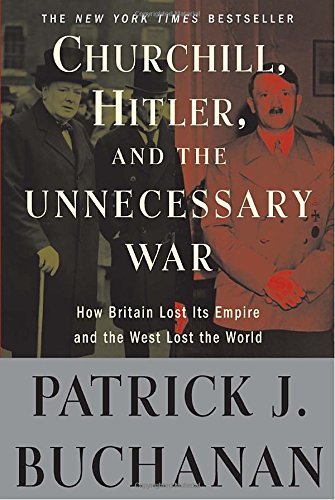
Our aim is to “starve the whole population — men, women, and children, old and young, wounded and sound — into submission,” said First Lord of the Admiralty Winston Churchill.
He was speaking of Germany at the outset of the Great War of 1914-1918. Americans denounced as inhumane this starvation blockade that would eventually take the lives of a million German civilians.
Yet when we went to war in 1917, a U.S. admiral told British Prime Minister Lloyd George, “You will find that it will take us only two months to become as great criminals as you are.”
After the Armistice of Nov. 11, 1918, however, the starvation blockade was not lifted until Germany capitulated to all Allied demands in the Treaty of Versailles.
As late as March 1919, four months after the Germans laid down their arms, Churchill arose in Parliament to exult, “We are enforcing the blockade with rigor, and Germany is very near starvation.”
So grave were conditions in Germany that Gen. Sir Herbert Plumer protested to Lloyd George in Paris that morale among his troops on the Rhine was sinking from seeing “hordes of skinny and bloated children pawing over the offal from British cantonments.”
The starvation blockade was a war crime and a crime against humanity. But the horrors of the Second World War made people forget this milestone on the Western road to barbarism.
A comparable crime is being committed today against the poorest people in the Arab world — and with the complicity of the United States.
Saudi Arabia, which attacked and invaded Yemen in 2015 after Houthi rebels dumped over a pro-Saudi regime in Sanaa and overran much of the country, has imposed a land, sea and air blockade, after the Houthis fired a missile at Riyadh this month that was shot down.
The Saudis say it was an Iranian missile, fired with the aid of Hezbollah, and an “act of war” against the kingdom. The Houthis admit to firing the missile, but all three deny Iran and Hezbollah had any role.
Whatever the facts of the attack, what the Saudis, with U.S. support, are doing today with this total blockade of that impoverished country appears to be both inhumane and indefensible.
Almost 90 percent of Yemen’s food, fuel and medicine is imported, and these imports are being cut off. The largest cities under Houthi control, the port of Hodaida and Sanaa, the capital, have lost access to drinking water because the fuel needed to purify the water is not there.
Thousands have died of cholera. Hundreds of thousands are at risk. Children are in danger from a diphtheria epidemic. Critical drugs and medicines have stopped coming in, a death sentence for diabetics and cancer patients.
If airfields and ports under Houthi control are not allowed to open and the necessities of life and humanitarian aid are not allowed to flow in, the Yemenis face famine and starvation.
What did these people do to deserve this? What did they do to us that we would assist the Saudis in doing this to them?
The Houthis are not al-Qaida or ISIS. Those are Sunni terrorist groups, and the Houthis detest them.
Is this now the American way of war? Are we Americans, this Thanksgiving and Christmas, prepared to collude in a human rights catastrophe that will engender a hatred of us among generations of Yemeni and stain the name of our country?
Saudis argue that the specter of starvation will turn the Yemeni people against the rebels and force the Houthi to submit. But what if the policy fails. What if the Houthis, who have held the northern half of the country for more than two years, do not yield? What then?
Are we willing to play passive observer as thousands and then tens of thousands of innocent civilians — the old, sick, weak, and infants and toddlers first — die from a starvation blockade supported by the mighty United States of America?
Without U.S. targeting and refueling, Saudi planes could not attack the Houthis effectively and Riyadh could not win this war. But when did Congress authorize this war on a nation that never attacked us?
President Obama first approved U.S. support for the Saudi war effort. President Trump has continued the Obama policy, and the war in Yemen has now become his war, and his human rights catastrophe.
Yemen today is arguably the worst humanitarian crisis on earth, and America’s role in it is undeniable and indispensable.
If the United States were to tell Crown Prince Mohammed bin Salman that we were no longer going to support his war in Yemen, the Saudis would have to accept the reality that they have lost this war.
Indeed, given Riyadh’s failure in the Syria civil war, its failure to discipline rebellious Qatar, its stalemated war and human rights disaster in Yemen, Trump might take a hard second look at the Sunni monarchy that is the pillar of U.S. policy in the Persian Gulf.
Copyright 2017 Creators.com
A state without a state and an authority without authority
By Rasem Obidat | Al-Quds News | November 20, 2017
Israel’s Channel 2 has revealed the features of the American plan to resolve the Palestinian issue. The essence of the solution is based on Netanyahu’s economic project, a state without a state.
The Palestinian issue and the rights of the Palestinian people are also being addressed by Netanyahu and the American Zionist team in the US administration who are tasked with formulating this plan (Kushner, Greenblatt, Nikki Haley and David Friedman) who have worked in the US President’s office in real estate. Therefore, they look at our cause as a real estate issue that can be resolved with a package of huge economic aid, presented by the Arabs and Gulf sheikhs in order to make the plan a success.
The proposed plan abandons the notion of an independent Palestinian state on the 4 June 1967 borders. Instead, it states that the presence of settlers in the West Bank is legal and any evacuation of these invading settlers who have taken over Palestinian territories is a form of ethnic cleansing, according to Netanyahu. Hence, the plan legitimises the presence of the occupation and permits the confiscation of others’ land by force.
At the same time Netanyahu is stating that evacuating settlers from their settlements built on occupied Palestinian territories is considered ethnic cleansing, he is exercising all forms of ethnic cleansing against the Palestinian people. He plans to expel, evacuate and displace Arab Jahalin Bedouins from the Jabal Al-Baba area, near Al-Eizariya, because these Bedouin communities on the outskirts of Jerusalem prevent the Ma’ale Adumim settlements, which include Mishor Adumim, Kedar and Mitzpe Yeriho, from being linked and annexed to the city of Jerusalem.
Construction in the area known as E1, 12 kilometres northwest of the Ma’ale Adumim settlement, would completely isolate the city of Jerusalem from its Palestinian surroundings and permanently bury the two-state solution. This would separate the northern part of the West Bank from the south and separate its northern and southern parts from its central area. It is a plan to separate and fragment the West Bank.
Netanyahu is well aware of the details and clauses of the American plan expected to be put forward, as the American team preparing the plan is more Zionist than Netanyahu himself. He is the most hostile and denies the rights of the Palestinian people, and therefore, it is not surprising that Netanyahu has described the evacuation of settlers from the occupied territories as a form of ethnic cleansing.
The Zionist American Ambassador to Israel, David Friedman, said that Israel has the right to establish settlements anywhere in Jerusalem and the West Bank, on public or private Palestinian land. He even described Israel’s occupation of the West Bank as false claims and alleged occupation.
Therefore, Netanyahu’s proposals align with Friedman, Kushner and Greenblatt’s vision, as well as his expulsion of the Jahalin Bedouins from the areas surrounding Jerusalem. Furthermore, pushing back the Al-Walaja barrier by 2.5 kilometres in order to control the Ain Haniya area, and creating a connection in order to annex settlements south of Jerusalem, the Gush Etzion settlement blocs, and the settlements located east of it to the city, making them under its sovereignty and authority are all part of the American plan. This would make the area of Jerusalem 10 per cent of the West Bank.
This also means pumping 150,000 settlers into Jerusalem and removing 100,000 Jerusalemites from the city, as well as the villages and towns behind the wall, including Kafr Aqab, Shuafat Camp and parts of the village of Sawahra. This plan is proposed by the so-called minister of Ze’ev Elkin in order to ensure a Jewish majority in the city and shifting its demographic reality in favour of the settlers.
Twenty-four years after the signing of the Oslo Accords, we still have not reached a state, as believed by those who signed it. Unfortunately, it has led us to the disastrous situation where the PA is nothing more than a civil administration and local police that has no security or civil control, even in the areas that are supposed to be under complete Palestinian authority, i.e. Area A. The occupation violates and breaches the PA’s areas however and whenever it wants, without referring back to the Oslo Accords, and even considers its actions part of the agreement. In short, our situation is exactly how President Abbas put it at the UN General Assembly 72nd session, “an authority without authority”.
The new “creative” American plan to resolve the Palestinian issue according to the so-called regional framework preserves and legitimises the presence of setters in the West Bank. The plan also has the support, blessing and participation of Arab backers and funders of this plan.
We are well aware, whether or not President Abbas and the Saudi officials denied this, that the purpose of his summons to Riyadh was not to fill him in on the details of the American plan and what is required of the Palestinians according to the plan, but to present the American plan and reveal its temptations and threats.
Saudi Arabia is part of the financing of this plan, and one of its enthusiasts, as it is strongly seeking to normalise and legitimise Arab relations with Israel and integrate it into the region as a natural component. It sees Israel as a “friendly” state and that Iran and its advanced arm in the region, Lebanon’s Hezbollah, which Saudi Arabia has classified as a terrorist organisation, is the real threat to the security and stability of the region.
Therefore, Abbas’ approval of the American plan means pumping millions of dollars, perhaps billions, to the PA treasury. Rejecting the plan would mean a financial blockade and the creation of alternatives, and perhaps even America’s failure to renew the permit for the Palestinian representation office in Washington. This is all a part of America and its allies’ policy to pressure the PA to accept the plan.
Just as the disastrous Oslo Accords led us to an authority without authority, the so-called deal of the century will lead us to a state without a state. It will lead us to economic peace, which is Netanyahu’s project, entailing of the exchange of the Palestinian’s legitimate right to freedom and independence for economic projects and bribes that improve the Palestinians’ living situation under occupation. This will be achieved through Arab and international funding, with the occupation’s support and legitimisation.
Therefore, what awaits the Palestinian people is far more dangerous than the Oslo Accords. The “deal of the century” carries with it the complete liquidation of the Palestinian cause, unfortunately with Arab participation and blessing. Therefore, our people and leadership are facing true challenges and risks, requiring those meeting in Cairo today to be highly responsible. They arrange the internal home and our internal front in accordance with unified visions and strategies and a national project based on a Palestinian state on the 1967 borders and guaranteeing the refugees’ right of return, in accordance with UN resolution 194.
Failure and the continued division is not an option for our factions in Cairo, as it would mean disaster, destruction and loss for everyone. What we need is unity and an end to the division, as we are facing enormous dangers and challenges. Are our leaders aware of this?
Translation from Arabic by MEMO
Nasrallah: US did what it could to help Daesh in Syria’s Bukamal
Press TV – November 20, 2017
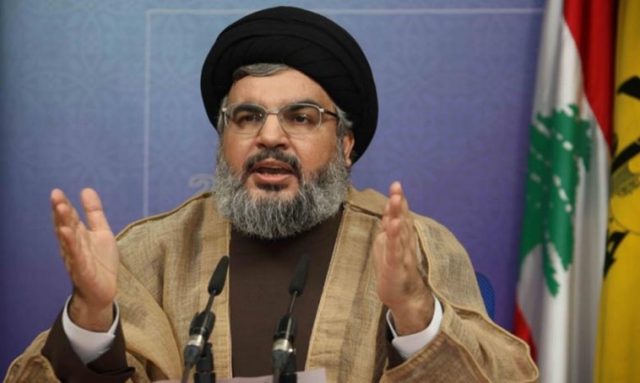
The secretary general of the Lebanese Hezbollah resistance movement says despite the US claims about fighting terrorism, it spared no effort to help Daesh forces in the Syrian town of al-Bukamal.
Sayyed Hassan Nasrallah made the remarks in a televised address to the Lebanese nation in capital city of Beirut on Monday.
Nasrallah noted that recapturing Bukamal was a major victory over Daesh, because Bukamal was the last Syrian city occupied by Daesh.
“The US helped Daesh as much as it could in Bukamal short of directly engaging forces that fought to liberate the town from Daesh,” the Hezbollah leader noted.
Nasrallah went on to note that the US provided Daesh terrorists with full air cover in Bukamal.
The US sent its drones to Bukamal and provided Daesh with accurate information about what was going on, Nasrallah said, adding that American forces also waged electronic warfare against forces that were fighting to liberate Bukamal.
American forces also provided air transfer for Daesh commanders and facilitated their escape to eastern shores of the Euphrates, he said. The Hezbollah leader stated that even Turkey’s President Recep Tayyip Erdogan slammed the US for helping Daesh.
Nasrallah emphasized that recapturing Bukamal led to unity of Syria and ended Daesh’s self-proclaimed state in the country.
Following recent victories in Iraq and Syria, he added, the military structure of Daesh collapsed in the two countries and Iraqi forces have reached the Syrian border.
Hezbollah leader noted that the victory over Daesh was victory of Islamic values over terrorists’ savagery.
Nasrallah also highlighted the role played by Commander of the Islamic Revolution Guards Corps’ Quds Force Major General Qassem Soleimani in anti-terror operations in both Iraq and Syria.
He noted that Soleimani was commanding anti-Daesh operations in the two countries at the frontline and was never a commander to issue orders from behind the lines.
Elsewhere in his remarks, Nasrallah referred to the latest meeting of the Arab League foreign ministers in Cairo, who designated the Lebanese Hezbollah as a terrorist group, saying that this was not the first time that such accusations were leveled against Hezbollah.
Arab League Secretary General Ahmad Aboul Gheit announced at a press conference in the Egyptian capital of Cairo on Sunday that Arab states had agreed to designate Lebanon’s Hezbollah resistance movement a “terrorist organization.”
The Arab League’s extraordinary general meeting on Sunday was held at the request of Saudi Arabia, which has assumed an aggressive stance against Hezbollah for its alleged links to Iran, Riyadh’s powerful rival in the region. Riyadh associates Hezbollah with Iran and has been trying to weaken the resistance movement, which is Lebanon’s de facto deterrent force against Tel Aviv.
In its concluding resolution, the Arab League announced that Arab foreign ministers, excluding those of Lebanon and Iraq, would hold Hezbollah responsible for supporting “terrorist groups” across the region.
Nasrallah said the Arab League statement has labeled Hezbollah’s council, which is part of the Lebanon’s government, as a terrorist outfit, alleging that it provides missiles to terrorist groups in the region.
He added that accusations about Hezbollah sending missiles to regional countries were false and undocumented, emphasizing that the group has never sent any missiles or even light weapons to Kuwait, Yemen, Iraq or Bahrain or any other country in the region.
The leader of Hezbollah went on to say that the Arab League has warned Lebanon that if Hezbollah is not disarmed, security of the country would be in jeopardy.
Hezbollah rejected the accusation, noting that the main threat to security of Lebanon was the Zionist regime of Israel.
He added that the resistance front’s weapons were the main factor restoring security and stability to Lebanon, because they were used for defensive purposes in the face of the Israeli aggression.
Nasrallah emphasized that Hezbollah’s weapons were used only against terrorist groups such as Daesh and posed no threat to security of Lebanon.
A United Nations Security Council-appointed panel says it has seen no evidence to support Saudi Arabia’s claims that missiles have been transferred to Yemen’s Houthis by external sources.
Nasrallah stated that the main reason behind the recent Arab League meeting was not to discuss the issue of Palestine or other problems facing the Islamic world, but its main reason was the recent missile attack against a Saudi airport near the country’s capital, Riyadh.
Refusing Saudi Arabia and Arab League claims that the missile was provided to Yemeni Ansarullah fighters by Iran or the Lebanese Hezbollah, Nasrallah said Iran or Hezbollah had not sent any missiles to Yemen and Yemeni forces made their own missiles in the country.
He categorically rejected Arab League’s claims in this regard, noting that Saudi Arabia and its allies must admit that they have been defeated by Yemeni forces in their war of aggression against the country.
Nasrallah emphasized that Arab countries must put an immediate end to their support for terror groups, and do not fill the Middle East region with such outfits.
He reiterated that no member of Hezbollah was involved in the November 5 Yemeni missile strike against King Khalid International Airport of Riyadh.
The Hezbollah leader then took the Arab League to task for failing to address Saudi Arabia’s devastating aerial bombardment of the “Arab country of Yemen,” saying, “Saudi Arabia is bombing Yemeni people day and night.”
Strongly denouncing the Riyadh regime over perpetrating outrageous atrocities against millions of “Arab Muslims” in Yemen, Nasrallah lashed out at the Arab world’s “deafening silence” over the grim situation in Yemen.
“The turmoil we are witnessing in the Arab world is a cover for the announcement of normalization of relations with Israel,” he commented.
Nasrallah then called on Arabs to do their best to maintain their national unity in the face of all divisive efforts.
The Hezbollah secretary general also praised Lebanese officials and politicians for their firm stance regarding Prime Minister Saad Hariri’s shock resignation, calling on him to return to Lebanon as soon as possible.
Here’s why Saudi Arabia, Israel and the US are not going to invade Iran
By Adam Garrie | The Duran | November 20, 2017
Members of the Arab League have met in Cairo at the behest of the Saudi regime, to discuss the supposed “threat of Iran”. The meeting featured all the crude, undiplomatic and nonfactual language about Iran that one has come to expect from American, Israeli and Saudi Arabian spokesmen.
Highlights from the meeting included a statement from the Saudi Foreign Minister Adel al-Jubeir who stated,
“We will not stand idly by in the face of Iran’s aggression….Showing leniency toward Iran will not leave any Arab capital safe from those ballistic missiles….
Iran created agents in the region, such as the Houthi and Hezbollah militias, in total disregard for all international principles”.
These meritless statements are almost identical to that which is frequently said by the US White House and Tel Aviv. In this sense, there was nothing novel about the meeting. What was remarkable was how hastily the meeting was organised as if to demonstrate Saudi’s commitment to its “clear and present danger” narrative about Iran.
Furthermore, a statement was released at the Arab League meeting, saying that there are no immediate plans to go to war with Iran but that at the same time, such plans have not been ruled out.
To quickly sum-up just how ridiculous the statements made during the Arab League meeting were
1. Iran’s missile programme is perfectly legal and is not covered by the JCPOA. The UN has said this many times.
2. Iran is currently at war with zero nations while Saudi is at war with Yemen causing one of the largest humanitarian disasters in the 21st century. Saudi Arabia has also been exposed as a major source of terrorist sponsorship, including in Iraq, Syria, Libya and beyond.
3. Iran has come to the legal assistance of Syria and Iraq in fighting terrorists groups including ISIS and al-Qaeda, while Saudi Arabia has known links to ISIS and al-Qaeda.
Of course, for the states with an obscene anti-Iranian agenda, none of this has ever mattered.
What does matter to the rest of the world though is whether the threats from the Arab league, indicated a short and/or medium-term readiness for war against Iran?
The short answer is, they almost certainly do not.
The Arab League today is a shadow of its former self. With the Syrian Arab Republic’s membership suspended, Qatar facing a boycott from proponent members, Iraq having better relations with Iran than most Arab states and Lebanon being deprived of its Prime Minister due to Saudi political meddling, the Arab League is hardly a united body of strong nations. It has declined so much so, that it is increasingly little more than a Saudi and GCC dominated organisation which is used in attempts to gain some form of broader international legitimacy for Riyadh’s often ridiculous foreign policy statements.
However, Riyadh’s ability to unite the Arab world over any matter, let alone an act of war, amounts to little. Syria, Iraq and due to its multi-confessional history, Lebanon, would never go to war against Iran. In fact, the Iraqi armed forces, Syrian Arab Army, Hezbollah and other volunteers from Lebanon would almost certainly fight with Iran, during the course of any Saudi led military action against Tehran.
Qatar, whose armed forces are small as it is, would never join any military ‘crusade’ led by its Saudi opponent and the fact remains that Doha’s slowly expanding relations with Iran have been one of the reasons for the Saudi led boycott of Qatar. Libya can no longer be called a functional state, while further into the Maghreb, Tunisia, Algeria and Morocco are far removed from Iran issue, in spite of their Arab league membership. Saudi’s GCC allies, Kuwait, UAE, Bahrain and to a lesser degree Oman, simply have little to offer in respect of any military coalition.
The biggest question mark which remains, is Egypt. Egypt is the largest country in the Arab world and likewise, boasts the biggest Army in the Arab world.
In order to even approach effectiveness, Egypt would have to join any would be anti-Iranian Arab League coalition. As to whether Egypt would join, one can objectively say that the incentives for not joining, far outweigh those that might compel Egypt to enter into a war pact with Saudi Arabia, against Iran.
Ever since secular rule was restored to Egypt in 2013, after US backed regime change against former President Hosni Mubarak briefly brought the once again illegal Muslim Brotherhood to power, Egypt has been in a position wherein promoting internal stability has been far more important than international outreach. Furthermore, while the Egyptian government is disproportionately dependent on Saudi cash injections in order to stay afloat, Cairo continues to show surprising amounts of foreign policy independence at times.
Egypt recently expressed disapproval of US attempts to extend a UN mandate for investigating “chemical weapons” in Syria. Egypt has further made strong statements in favour of Syria’s territorial unity, backed up by remarks that only a political solution can bring peace to Syria. This language is very similar to that used by Russian diplomats which should come as no surprise, as the foreign ministries of Egypt and Russia have a very good relationship. Furthermore, when it comes to Egypt’s most pressing international issue, that of terrorists in neighbouring Libya, Russia appears far more inclined to support the Cairo backed Libyan National Army than the fledgling Government of National Accord which is supported by the US and EU.
Furthermore, Egypt recently rejected calls from Riyadh to economically sanction the Lebanese party Hezbollah, in a move which shows a clear divergence from Saudi policies on Hezbollah.
While Egypt is compromised by its financial ties to Saudi Arabia, Egypt still seeks to balance out its old Arab Nationalist history as a fiercely independent and anti-imperialist nation with the modern realities of being far less influential than in the days of Nasser and the early days of Sadat.
Furthermore, in spite of its formal diplomatic ties with Israel, Cairo is all too aware that if the situation inside Egypt, especially in respect of the Sinai Peninsula were to become destabilised, Egypt could not afford to have its armed forces in distant Iran. This is especially true as Israel is ready to exploit any instability on Sinai to its own advantage. If anyone thinks that Israel somehow respects Egypt just because diplomatic relations were established, this view is, to put it mildly, delusional. Israel will exploit any country and any situation it can and Egypt is no exception. The same is true of Jordan, the only other country which has formal relations with Tel Aviv. Jordan, like Egypt is far more concerned with its own immediate neighbourhood than with Iran.
In this sense, in spite of whatever financial incentives Saudi might offer Egypt for backing military efforts against Iran, the preponderance of evidence would demonstrate that Egypt would refrain from actively participating.
When asked to consider the position of the Vatican in geo-political affairs, Josef Stalin is thought to have said, “The Pope? How many divisions has he got?”.
In this sense, looking at the disunity in the Arab world, Iran could easily turn to Riyadh and say “how many divisions have you got”? The answer is not enough to seriously challenge Iran, while Iran certainly has enough divisions and enough regional allies to challenge and beat Saudi Arabia and its Persian Gulf allies.
Then there is the matter of Israel, the US and Turkey.
When it comes to antagonising regional powers that Tel Aviv doesn’t like, the Israeli regime’s military is all too happy to conduct strikes and even occupy territory. Israel occupied party of Egypt between 1967 and 1982 and part of Lebanon between 1982 and 2006. Israel continues to occupy Syria and military strikes from Israel against Syria have happened on and off for the last several decades.
Likewise, Israel attacked Iraq in 1981 in a short airstrike against a French built Iraqi nuclear reactor.
All of these actions have been illegal and Tel Aviv simply doesn’t care. Why should they care about Iran in this case? The answer is because Iran today is far more powerful than any of the aforementioned countries that Israel attacked and it also has many regional allies stretching from Iran itself to the borders of Israeli regime controlled territory.
Israel has not attacked Iran in the way it has so frivolously attacked parts of the Arab world. Israel has not done this because Tel Aviv knows Iran would strike back and so too would Iran’s allies in southern Lebanon. Furthermore, with Turkey becoming ever more distant with NATO, the west and Israel, all the while growing ever closer to its Eurasian partners, including neighbouring Iran, there is no guarantee that Turkey would remain neutral in such a conflict.
Turkey does not want any instability on its border with Iran. This is one of the reasons that both countries cooperated in the building of an anti-terrorist rampart on their borders. Turkey knows that any further regional instability would only hurt Turkey’s short term security prospects and its long term financial prospects. If Turkey even gave air support to Iran, the entire conflict would be ‘game over’ for the anti-Iranian powers, unless Israel decided to use its nuclear weapons.
As Hezbollah leader Sayyed Hassan Nasrallah recently stated, Israel prefers short blitzkrieg style conflicts that it can win rapidly at little material cost or bloodshed from its own side. History has shown such an analysis to be absolutely correct. Furthermore, as Israel’s last attempt to conduct such a war against Lebanon in 2006 failed, Israel has reverted to measures which from its perspective are more realistically “productive” such as short, illegal airstrikes against Syria and military manoeuvres intended as provocations against Lebanon.
Any war with Iran would be much more difficult for Israel to conduct. In many ways it would be impossible, short of Tel Aviv using its nuclear weapons in what Israel watchers know to be called the “Samson Option”.
Such extreme measures would likely be opposed even by the United States. While the Trump administration continues to turn up the volume on anti-Iranian rhetoric, many more level headed individuals in the Pentagon and State Department are totally opposed to war on Iran. These people know that the cost of such a war would be incredibly high and that the US might ultimately lose.
In this sense, with Israel too afraid to attack Iran and while still too restrained by the US to go nuclear, with the Pentagon generally opposed to direct military action against Iran and with Saudi Arabia incapable of pulling together a genuine Arab coalition capable of fighting against Iran, there is little chance that any nation short of one on a suicide mission, would attempt to declare war on Iran.
Much like any war on North Korea, a war on Iran would bring unparalleled destruction to the entire region, and no invading party’s victory would be assured. In other-words, Iran has more or less checkmated the situation, largely in its favour and all without firing a shot, while if anything gaining rather than losing allies.
The Arab League, Israel and the US can certainly blow smoke, but when it comes to attacking Iran directly, even these countries are not quite foolish enough to start that fire.
Lebanon, Palestinian groups rap Arab League for labeling Hezbollah
Press TV – November 20, 2017
The Lebanese government and Palestinian resistance forces have strongly condemned a decision by the Arab League to designate the Hezbollah resistance movement as a terrorist organization.
Lebanon’s Foreign Minister Gebran Bassil said in a statement that he had refused to list Hezbollah as a terror group as it was a “fundamental component of the Lebanese state.”
Arab League Secretary-General Ahmad Aboul Gheit announced at a media conference in Cairo on Sunday that Arab states agreed to designate Hezbollah a terrorist organization, adding that he would not “rule out going to the United Nations Security Council as a next step.”
Lebanon’s representative to the Arab League, Antoine Azzam, rejected the statement, saying Hezbollah represents a large part of the Lebanese people. He said the resistance group has representatives in the Lebanese parliament.
Lebanon abstained from Sunday’s communiqué that labeled Hezbollah as a terror group. Iraq also expressed reservations about the designation.
The details of the resolution were not made public. However, media reports said the only concrete measure from the meeting was for Arab telecommunications satellites to ban Iranian-financed stations for allegedly posing a threat to Arab security.
Palestinian resistance groups also denounced the Arab League’s decision, saying it serves the interests of Israel and the US and aims to satisfy the Saudi regime.
The alliance of the Palestinian resistance forces described the decision as “dangerous”, stressing that “Hezbollah represents the most important resistance force against Israel and terrorism.”
The decision was issued during an emergency Arab League summit, which Saudi Arabia called to discuss “confronting” Iran and Hezbollah.
Riyadh associates Hezbollah with Iran, and has been trying to weaken the resistance movement which is Lebanon’s de facto deterrent force against any Israeli aggression.
Hezbollah, both a military force and a political movement, is part of a Lebanese government made up of rival factions.
The Saudi request for the Arab League meeting “was based on a missile it says its air defenses intercepted near Riyadh after being fired from Yemen on November 4,” according to a document seen by AFP last week.
Saudi Arabia has claimed that the missile had been manufactured in Iran but Tehran has vehemently rejected the allegation.
Guardian, NYT Paint Power-Grabbing Saudi Dictator as Roguish, Visionary ‘Reformer’
By Adam Johnson | FAIR | November 17, 2017

The Guardian (11/5/17)
Two weeks ago, Saudi Crown Prince Mohammed bin Salman carried out a brutal crackdown on his political opponents, arresting dozens of high-ranking relatives, kidnapping the prime minister of Lebanon, and seeing eight of his political rivals die in a convenient helicopter crash. The “consolidation of power” by the de facto Saudi ruler comes as his government ramps up its siege of Yemen and gets even closer to its US sponsor, thanks to a Trump’s dopey love affair with—and direct assistance of—the regime.
The cynical plan has been met, in some media quarters, with condemnation, but for many in the Western press, Mohammed’s self-serving power grab is the action of a bold “reformer,” a roguish bad boy doing the messy but essential work of “reforming” the kingdom—the “anti-corruption” pretext of the purge largely repeated without qualification. The most prominent sources for this spin were two major newspapers, the New York Times and Guardian:
- Guardian (11/5/17): “Royal Purge Sends Shockwaves Through Saudi Arabia’s Elites: Move Consolidates Power of Prince Mohammed Bin Salman as He Attempts to Reform Kingdom’s Economy and Society”
- Guardian (11/5/17) : “Saudi Arrests Show Crown Prince Is a Risk-Taker With a Zeal for Reform: Mohammed Bin Salman Is Confronting Some of the Kingdom’s Richest and Most Powerful Men in His Anti-Corruption Drive—but Is He Taking on Too Much Too Fast?”
- Guardian (11/6/17): “Oil Price Rises to Two-Year High After Saudi Arabia Purge: Markets Push Price Up to $62 a Barrel After Anti-Corruption Purge by Billionaire Crown Prince Who Backs Prolonging Oil Production Curbs”
- Guardian (11/7/17): “‘This Is a Revolution’: Saudis Absorb Crown Prince’s Rush to Reform: Consolidation of Power in Mohammed Bin Salman’s Hands Has Upended All Aspects of Society, Including Previously Untouchable Ultra-Elite”
- New York Times (11/5/17): “Saudi Crown Prince’s Mass Purge Upends a Longstanding System”
- New York Times (11/14/17): “The Upstart Saudi Prince Who’s Throwing Caution to the Wind”
While the text of the Times articles was far more skeptical about Mohammed’s motives, the Guardian’s (11/5/17) initial coverage of the bloody purge—not just the headlines—was written in breathless press release tones:
Saudi Arabia’s leadership has pulled off its boldest move yet to consolidate power around its young crown prince, Mohammed bin Salman, arresting 11 senior princes, one of the country’s richest men and scores of former ministers in what it billed as a corruption purge.
The move sidelined at least 20 senior figures, among them outspoken billionaire, Prince Alwaleed bin Talal, sending shockwaves through the ranks of the kingdom’s elites, who had long viewed senior royals as immune.
Lots of glowing prose to unpack here. Longtime Mideast correspondent Martin Chulov began by referring to “Saudi Arabia’s leadership,” which is a nice, sterile way of referencing the country’s unelected hereditary king and crown prince. Then he pivoted into marketing pablum about “bold moves” and “consolidating power,” before unironically framing the purge as an “anti-corruption” gesture designed to stick it to the “kingdom’s elites.” One could come away from reading this lead with the impression that the billionaire aristocrat was a populist folk hero in the vein of Robin Hood or John Dillinger. The thrilling profile continued:
Prince Mohammed will oversee the corruption commission, adding to his already formidable list of responsibilities, including his role as Defense minister and champion of the economic transformation, dubbed Vision 2030, that aims to revolutionize most aspects of Saudi life within 12 years.
Prince Mohammed told the Guardian last month that the kingdom had been “not normal” for the past 30 years and pledged to return Saudi Arabia to moderate Islam.
While the author had a “to be sure” paragraph, citing “others” calling it a “naked attempt to weed out dissent,” the overall thrust of the article was that a roguish billionaire Boy King was earnestly seeking “reform” and opposing “elites.”
A follow-up piece (11/7/17) took flattering coverage to new extremes. The dispatch, again by Chulov, cited nothing but anonymous Saudi court hanger-ons and a Gulf-funded talking head from the NATO-aligned Atlantic Council think tank. The article, “‘This Is a Revolution’: Saudis Absorb Crown Prince’s Rush to Reform,” was populated with blind quotes from such adversarial voices as a “senior minister,” “a senior Saudi official,” a “senior figure,” a “senior Saudi businessman” and “veteran business leaders.” (Evidently no junior officials or rookie business leaders were available for comment.)
The article painted the “consolidation of power” by Mohammed as an inevitability with broad support—using the dubious “reform” narrative without irony. With Guardian editors again painting Mohammed as a populist hero by insisting he “upended” “previously untouchable ultra-elite,” one is left to wonder why they don’t consider the absolute-monarch-in-waiting—who just bought a $590 million yacht—part of the “ultra elite.” It’s a curious framing that reeks more of PR than journalism.

The New York Times (6/23/17)
This was a trope one could see emerging over the past few months. Similar “bold reformer” frames were used in New York Times editorials (“The Young and Brash Saudi Crown Prince,” 6/23/17) and straight reporting (“Saudi Arabia’s Grand Plan to Move Beyond Oil: Big Goals, Bigger Hurdles,” 10/24/17). Everything’s new and exciting. The brutal, routine functions of the Saudi state are seen as laws of nature—and those in charge of it are the reformers of the very oppression they initially authored.
A Guardian editorial on November 7 was critical of the government, calling it “regressive” and Mohammed “belligerent,” but ultimately rested on “both sides” framing of recent events. The only meaningfully critical coverage of Saudi Arabia coming from the Guardian since the purge has been in two articles (11/12/17, 11/16/17), both in the context of Saudi Arabia’s war on Yemen. Neither mentioned bin Salman, and both stressed how the Saudis are responding in earnest to international pleas to stop their mass-murdering blockade of the Arab world’s poorest country.
Per usual, the Guardian reserves the label “regime” for Official Enemies like Syria and North Korea; Saudi Arabia doesn’t have a regime, it has “leadership.” Unlike adversary governments, often seen in need of “regime change,” the Saudi government merely requires “reform”—and a bold new “reformer,” of the sort championed by the likes of the Guardian and New York Times.
You can send a message to the New York Times at letters@nytimes.com , and to the Guardian at guardian.letters@theguardian.com (Twitter: @NYTimes, @Guardian). Please remember that respectful communication is the most effective.
Security Council-appointed panel says no missiles sent to Houthis, refuting Saudi Arabia claim
Press TV – November 18, 2017
A United Nations Security Council-appointed panel has said in a confidential memo that it has seen no evidence to support Saudi Arabia’s claims that missiles have been transferred to Yemen’s Houthis fighters by external sources.
The panel made the conclusion in a confidential assessment sent to Security Council diplomats on November 10, The Intercept, a US-based investigative website, reported on Friday.
On November 4, a missile attack from Yemen targeted the King Khalid International Airport (KKIA) near the Saudi capital, Riyadh. It was the first missile from Yemen to have reached deep inside Saudi territory.
The Houthi movement, which has been fighting back a Saudi-led coalition with allied Yemeni army troops and tribal fighters, said it had fired the missile, which the Saudis said they had intercepted mid-air.
However, the Riyadh regime quickly blamed the Islamic Republic for the incident.
Heating up rhetoric against Iran, and then being proven wrong
In a November 7 letter to the Security Council, Saudi UN Ambassador Abdallah al-Mouallimi claimed that the debris of the missiles fired by the Houthis on July 22 and November 4 confirmed Iran’s role “in manufacturing these missiles.”
Following the attack, the Saudi-led coalition tightened a blockade that had already been imposed on Yemen in a bid to prevent “the smuggling of weapons, ammunitions, missile parts and cash that are regularly being supplied by Iran” to the Houthis.
It invoked Paragraph 14 of Security Council Resolution 2216, which was passed in April 2015, calling for measures to prevent the supply, sale, or transfer of military goods to Houthi fighters.
The coalition said the missile’s firing was “a blatant act of military aggression” by the Iranian government.
Crown Prince Mohammad bin Salman said it had been “a direct military aggression” by Iran against Saudi Arabia, while Foreign Minister Adel al-Jubeir stressed that his country reserved the right to “respond in the appropriate manner at the appropriate time.”
The belligerent Saudi posture toward Iran worked to significantly raise tensions.
Iran rejected the allegations as “provocative and baseless,” saying Yemenis had shown an “independent” reaction to the Saudi bombing campaign on their country.
Iran also said that it could not transfer any weapons to Yemen because of the Saudi-led blockade.
The Security Council-appointed panel said in its confidential assessment that it had seen no evidence to back up the Saudi claims that short-range ballistic missiles (SRBMs) had been transferred to Yemeni fighters in violation of the Resolution 2216.
It said the tightening of the blockade by the Saudi-led coalition and its invoking of Resolution 2216 had been an attempt to merely “obstruct” the delivery of civilian aid.
“The panel finds that imposition of access restrictions is another attempt by the Saudi Arabia-led coalition to use paragraph 14 of resolution 2216 as justification for obstructing the delivery of commodities that are essentially civilian in nature,” the assessment read.
Touching on the July 22 attack, it said, “The supporting evidence provided… is far below that required to attribute this attack to a Qiam-1 SRBM.”
Yemen has witnessed a deadly Saudi-led war since March 2015. The protracted Saudi offensive, which has been accompanied by the, land, naval, and aerial blockade on Yemen, has so far killed over 12,000 people and led to a humanitarian crisis.
The UN has listed Yemen as the world’s number one humanitarian crisis, with 17 million Yemenis in need of food and a cholera epidemic causing over 2,200 deaths so far.
Featured Video
NATO’s War of Choice – The Sabotage of the Istanbul Negotiations
or go to
Aletho News Archives – Video-Images
From the Archives
National Security Archive Publishes Key Records on Infamous MKULTRA Program
Agency Sought Drugs and Behavior Control Techniques to Use in “Special Interrogations” and Offensive Operations
Edited by Michael Evans | National Security Archive | December 23, 2024
Washington, D.C. – Today, the National Security Archive and ProQuest (part of Clarivate) celebrate the publication of a new scholarly document collection many years in the making on the shocking secret history of the CIA’s mind control research programs. The new collection, CIA and the Behavioral Sciences: Mind Control, Drug Experiments and MKULTRA, brings together more than 1,200 essential records on one of the most infamous and abusive programs in CIA history.
Under code names that included MKULTRA, BLUEBIRD and ARTICHOKE, the CIA conducted terrifying experiments using drugs, hypnosis, isolation, sensory deprivation, and other extreme techniques on human subjects, often U.S. citizens, who frequently had no idea what was being done to them or that they were part of a CIA test.
Today’s announcement comes 50 years after a New York Times investigation by Seymour Hersh touched off probes that would bring MKULTRA abuses to light. The new collection also comes 70 years since U.S. pharmaceutical giant Eli Lilly & Company first developed a process to streamline the manufacture of LSD in late 1954, becoming the CIA’s chief supplier of the newly discovered psychoactive chemical central to many of the Agency’s behavior control efforts.
Highlights of the new MKULTRA collection include… continue
Blog Roll
 Aletho News
- The Founder Who Turned Against Root Canals
- Israel displaces last two families from Al Khalayel valley, Al Mughayyir
- Israeli Opposition Leader Endorses Greater Israel
- Islamic Jihad: Trump’s peace board is a “theatrical stunt detached from reality”
- The Head Of A CIA Cutout Admits To Meddling In Iran To Fuel Unrest
- Iran warns Trump against decisions based on false information
- Pentagon sets deadline for Anthropic to lift AI restrictions on autonomous weapons systems, mass domestic surveillance
- Trump’s military buildup against Iran on Netanyahu’s behalf is a gambit doomed to fail
- Big League War
- Zelensky sells false illusion of building powerful air force capable of overcoming Russia
- If Americans Knew
- Are the Jews indigenous to Palestine?
- AIPAC Wants to Kill a Bill that would Ensure Israel Complies with Ceasefire
- Former Israeli PM, in Epstein Files, Dreamed of Israeli Eugenics and Pretty Converts
- Israeli settlers join ‘safari’ tour of Palestinian prisoners
- Flooding in Gaza amid rumors of war; fire in West Bank – Not a ceasefire Day 138
- Fourteen Countries Condemn Huckabee’s Support for Israel Taking Over Most of the Middle East
- Israeli Soldiers Killed Gaza Aid Workers at Point Blank Range in 2025 Massacre: Report
- Israel’s insidious network to propagandize American Christians
- Israel’s Best-Kept Secret: Palestinian Resistance Never Agreed to Disarm
- Trump officials plan to build 5,000-person military base in Gaza, files show
- No Tricks Zone
- Surprising Discovery: Sahara Is Greening…Billions Of Trees Where Once Thought To Be Barren
- New Research Reaffirms Clouds, Aerosols, And Surface Solar Radiation Are ‘Driving The Climate System’
- Germany: Electric Car Catches Fire At Charging Station, Sets Off Local “Inferno”, Widespread Damage
- New Study: Canada’s New Brunswick Was 1°C Warmer Than Today During The Medieval Warm Period
- Coal Power Back In Trend As Globe Tries To Keep Pace With Growing Demand For Power
- New Study: A 4°C Warmer Beaufort Sea Had ‘No Sea Ice’ 11,700 – 8200 Years Ago
- Unfudging The Data: Dutch Meteorological Institute Reinstates Early 20th Centruy Heat Waves It Had Erased Earlier
- German Gas Crisis…Chancellor Merz Allegedly Bans Gas Debate Ahead of Elections!
- Pollen Reconstructions Show The Last Glacial’s Warming Events Were Global, 10x Greater Than Modern
- Germany’s Natural Gas Storage Level Dwindles To Just 28%… Increasingly Critical
 Aletho News