Saudi forces set ablaze Shia homes in restive Awamiyah
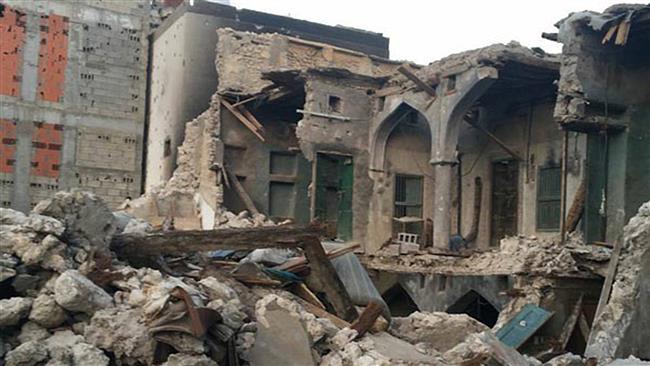
An al-Alam photo shows rubble caused by the Saudi demolition of Awamiyah, Eastern Province, Saudi Arabia.
Press TV – August 1, 2017
Saudi forces have set fire to homes belonging to Shia residents in the besieged town of Awamiyah that has been the scene of a heavy-handed regime crackdown on the minority community.
Based on local reports, Saudi forces have thrown Shia citizens out of their homes and then torched their properties.
Awamiyah, situated in Eastern Province, has long been a flashpoint between the Saudi kingdom and the inhabitants complaining of discrimination.
It has witnessed renewed deadly clashes between the military and residents since May, when Saudi forces began razing the town’s old quarter, known as al-Mosawara.
Saudi authorities claim that Mosawara’s narrow streets have become a hideout for militants suspected of being behind attacks on security forces in Eastern Province.
The UN, however, said Saudi Arabia was erasing cultural heritage and violating human rights through Mosawara’s demolition.
Karima Bennoune, the UN special rapporteur in the field of cultural rights, said Saudi authorities ignored repeated pleas by the world body to halt the destruction.
“These destructions erase the traces of this historic and lived cultural heritage and are clear violations of Saudi Arabia’s obligations under international human rights law,” Bennoune said, accusing the Saudi forces of “irreparably burning down” historic buildings and forcing residents to flee their homes.
Leilani Farha, the UN special rapporteur on the right to adequate housing, also warned that the Saudi move “constitutes a forced eviction under international human rights law.”
Additionally, Ali al-Dubisi, the head of the Berlin-based European Saudi Organization for Human Rights, said the Saudi forces were following a scorched-land policy in Awamiyah, launching rocket attacks and shelling residential buildings and civilians who are resisting Saudi pressures to evacuate.
Since February 2011, Saudi Arabia has stepped up security measures in Shia-dominated Eastern Province, which has been rocked by anti-regime demonstrations, with protesters demanding free speech, the release of political prisoners, and an end to economic and religious discrimination.
The government has suppressed pro-democracy movements, but they have intensified since January 2016 when Saudi Arabia executed respected Shia cleric Sheikh Nimr al-Nimr.
Saudi Arabia wades into Shi’ite politics in Iraq
By M K Bhadrakumar | Indian Punchline | August 1, 2017
The dramatic appearance of the Iraqi Shi’ite firebrand politician Muqtada Al-Sadr in Jeddah on Sunday and his meeting with the Saudi Crown Prince Mohammed bin Salman opens an exciting page in the Saudi-Iranian regional rivalries. The theatre is shifting to Iraq.
Briefly, what is unfolding is a determined Saudi attempt to reset the power calculus in post-ISIS Iraq by moulding a new political alignment that principally aims at undermining the pre-eminent influence that Iran has enjoyed over its neighbour in the past decade or so following the Shi’ite empowerment in the downstream of the US invasion of 2003.
Iran’s main platform on the Iraqi political landscape has been the umbrella Shi’ite coalition known as the Islamic Supreme Council in Iraq (ISCI), which Tehran had created as far back as 1982, originally as a Shi’ite resistance movement against Saddam Hussein and most recently since the middle of the last decade following Saddam’s overthrow as a united front to contest the democratic elections in Iraq with an agenda to preserve the Shi’ite leadership of the government.
To cut a long story short, ISCI is unravelling due to latent rivalries between various constituent groups. (Shi’ite politics has been traditionally very fractious, including in Iran.) Now, the split is also on account of a strong undercurrent of resentment over Iran’s dominance over Iraqi politics. (For the benefit of the uninitiated, again, the potency of Iraqi nationalism – a legacy of the Saddam era, paradoxically – subsuming the ethnic and sectarian divides in the country should never be underestimated.)
Importantly, the new generation of the powerful Hakim family led by Ammar Al-Hakim has moved out of the ISCI and has shifted allegiance from Iran’s Ayatollah Khamenei to Iraq’s Grand Ayatollah Ali Al-Sistani. Equally, Muqtada al-Sadr who has stepped out of Iran’s orbit has assumed a nationalistic, non-sectarian platform in the recent years. Again, within the ruling Islamic Dawa Party, which is the main constituent of the ISCI, there is an internal power struggle between the incumbent PM Haidar Al-Abadi and the former PM Nouri al-Maliki. (Currently, Maliki is a favourite of Iran; interestingly, Al-Abadi recently visited Saudi Arabia during which an announcement was made that the two countries have formed a ‘coordination council’ to bolster strategic relations aimed at healing troubled ties with ‘other Arab states’.)
Enter Saudi Arabia. Quite obviously, Saudis see a window of opportunity to go for Iran’s jugular veins by breaking up the ISCI irretrievably and instead propping up a new composite non-sectarian coalition involving the Shi’ite factions who resent Iran’s hegemony. No doubt, it is an audacious attempt to bring together – you’ve guessed it – Muqtada al-Sadr, Ammar Al-Hakim and Al-Abadi – on the same page.
The Crown Prince MBS is the mastermind behind this audacious Saudi move to manipulate the Shi’ite politics in Iraq. Arguably, the Saudi game plan has some positive streaks in it insofar as it envisages a non-sectarian realignment in Iraqi politics by encouraging a regrouping of the Shi’ite factions that give primacy to Iraqi nationalism over the identity politics they pursued up until recently. In turn, MBS would probably persuade these Shi’ite factions to work with the Iraqi Sunni factions and the Kurds. (By the way, Saudis recently opened a consulate in Erbil, the capital of Kurdistan in northern Iraq.)
Cynics would say that Saudis are having a devious agenda to: a) break up Shi’ite unity in Iraq; b) empower the Sunni groups as a ruling elite; and, c) create a schism between ‘Arab Shias’ and ‘Persian Shias’. The jury is out. Time only will tell how these shenanigans play out. To be sure, MBS’s initiative to manipulate Iraqi politics must be enjoying the support of the US and Israel, since it ultimately aims at isolating Iran and mitigates to an extent Iran’s spectacular ‘victory’ in the Syrian conflict.
Will Iran throw in the towel and walk away? Certainly not. Iran’s trump card is the battle-hardened Shi’ite militia known as the Al-Hashd Al-Shaabi, which is estimated to number over 120000 and is a Hezbollah-like army that is disciplined, fired up ideologically, and weaned in the politics of ‘resistance’. By the way, Qassem Soleimani, the charismatic commander of the Quds Force of the Iranian Revolutionary Guard Corps, was quoted as saying last week: “Daesh (ISIS) was stopped by the entry of Al-Hashd Al-Shaabi into the Iraqi army. The Iraqi army was transformed into a Hezbollah army.”
Now, that is a statement of fact. And, the ground reality is that today, in the chaotic war conditions in Iraq, power ultimately flows through the barrel of the gun. Stalin would have asked MBS as to how many divisions Al-Haikm, Al-Sadr and Al-Abadi together have under their command? Will the number come to even one half of the strength of Al-Hashd Al-Shaabi, the Iraqi Hezbollah, which Iran trained and equipped? Unlikely. Could they have taken on the ISIS and defeated it? No way.
Don’t be Fooled, the CIA was Only Half the Problem in Syria
By Steven MacMillan – New Eastern Outlook – 31.07.2017
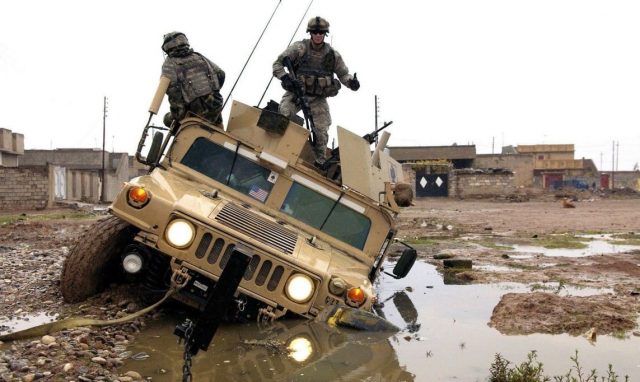
The news that President Trump has halted the CIA program to arm and train rebel groups in Syria should be viewed with caution, as the CIA program only represented half of US involvement in Syria. Even if we take this information as completely accurate, and the CIA will cease to be involved in any covert programs in Syria, there is still a giant arm of US imperialism that is going to be heavily involved in the Syrian conflict for the foreseeable future; namely, the Pentagon.
The notion that the CIA was the only branch of the US establishment involved in the destabilization of Syria is nonsense. The US has always had two operations running simultaneously in Syria, with one being run by the CIA, and other being ran by the Pentagon. As Reuters reported in an article in May of this year, titled: Syrian rebels say U.S., allies sending more arms to fend off Iran threat, military aid has been provided through “two separate channels:”
“Rebels said military aid has been boosted through two separate channels: a program backed by the U.S. Central Intelligence Agency (CIA), known as the MOC, and regional states including Jordan and Saudi Arabia, and one run by the Pentagon.”
These two programs have often clashed, as was the case last year, when militias armed by the CIA fought against militias armed by the Pentagon.
The Pentagon has been as involved in the disastrous operation to arm and train rebels in Syria as the CIA has, and has contributed heavily to the mess on the ground.
In September 2015 for instance, it was reported that a Pentagon-armed group of rebels – named Division 30 – handed over their weapons to al-Qaeda in Syria, a scenario that was a common outcome from many CIA operations as well. The Pentagon, never shy to blow an obscene amount of taxpayers’ money on imperial matters, has already wasted hundreds of millions of dollars training and arming rebels in Syria, yet Trump only wants to increase the US war budget.
Trump: The Man of the Military
Trump’s decision to halt the CIA program was hardly surprising, considering the support Trump has received from large sections of the military. A look at the backgrounds of the individuals that Trump has given cabinet positions reveals Trump’s close relationship with the military.
The Secretary of Homeland Security for instance, John Kelly, is a retired Marine Corps General and former Commander of US Southern Command. Trump’s pick for the Director of the CIA is even more telling, as Mike Pompeo has his roots in the military, graduating from West Point in the 1980s:
“Mr. Pompeo graduated first in his class at the United States Military Academy at West Point in 1986 and served as a cavalry officer patrolling the Iron Curtain before the fall of the Berlin Wall. He also served with the 2nd Squadron, 7th Cavalry in the US Army’s Fourth Infantry Division.”
Undoubtedly, there are many good forces in the US military (as in any other large organization), and there is nothing wrong with having a military background. But equally, there are also many nefarious forces in the military, and the influence of military-industrial complex is pervasive, constantly agitating for more imperial wars.
With this context in mind, it is hardly surprising that Trump favours the Pentagon program over the CIA one, especially considering the power struggle taking place between the CIA and the military within the US. It should be highlighted that Trump has notcompletely halted all US programs to arm and train militias in Syria, he has merely shutdown one channel.
Pentagon Using Kurds to Balkanize Syria
The Pentagon has been heavily involved in arming Kurdish forces in Syria, using them as a tool to attempt to Balkanize and fracture Syria into micro-states. In May of this year, President Trump approved a plan – supported by many in the Pentagon – to arm the People’s Protection Unit (YPG), a Kurdish militia operating predominantly in northern Syria.
The YPG is also the controlling militia in the US-backed Syrian Democratic Forces (SDF), which includes an array of other militias. In addition to providing arms to the YPG, US special forces have been pictured on the ground in northern Syria working in conjunction with YPG fighters.
When most of the public was distracted by the story of Trump halting the CIA program, footage surfaced showing US armed military vehicles passing through Qamishli – a city in northern Syria on the Turkish border – reportedly on route to Raqqa. The recipients of the vehicles are believed to be either the SDF or US forces directly, who are involved in the battle against ISIS in Raqqa.
If (or when) ISIS is defeated in Raqqa, it will be very interesting to see who ends up controlling the city. It is possible that the Pentagon wants to defeat ISIS in Raqqa, and then hand Raqqa to the Kurds – a scenario that many Kurds would only be too happy with. In March of this year, Saleh Muslim, the co-chair of the Syrian Kurdish Democratic Union Party (PYD) – the political affiliate of the YPG – said that once ISIS is defeated in Raqqa, the city should be incorporated into a Kurdish state in northern Syria.
The Pentagon’s support for Kurdish forces is clearly part of a strategy to break the northern part of the country away from control of the Syrian government in Damascus. A subservient Kurdish state in northern Syria (which would probably join with Kurdish zones in Iraq and other countries in the future) would allow the US to have a permanent military presence in Syria, and easy access to the natural resources in the Kurdish region.
The creation of a Kurdish state in northern Syria would of course cause a severe breakdown in relations with NATO member Turkey, given the views of the current Turkish leadership that is. Turkey considers the YPG to be an extension of the Kurdistan Workers Party (PKK), a group Ankara views as a terrorist organization. Turkey has repeatedly denounced US support for Kurdish groups in Syria, with this being a major source of disagreement between the US and Turkey. It is no coincidence that Turkish state media recently published a list of classified US military bases and outposts in northern Syria, with this information revealing the extent to which the US military is embedded in Kurdish-controlled regions in Syria.
The plan to Balkanize Syria is well on its way, and the Pentagon is leading the charge. How Russia positions herself in the coming months will be crucial for the future of Syria.
US systematically targeting residential areas: Syria to UN
Press TV – July 31, 2017
Damascus has called on the UN to end the Washington’s crimes against Syrian civilians, while stressing that the US is systematically targeting residential areas.
On Sunday, the Syrian foreign ministry sent two letters to UN Secretary General Antonio Guterres and the chairman of the UN Security Council, calling for the dissolving of the US-led coalition in Syria which is operating in the country without permission from Damascus.
“The US-led international coalition continues to commit massacres against Syrian innocent civilians through conducting systematic airstrikes on the provinces of Raqqah, Hasakah, Aleppo and Dayr al-Zawr on a daily basis,” reads the letter.
The letters were sent after at least six civilians lost their lives and nearly a dozen others sustained injuries when the US-led coalition, purportedly fighting the Daesh Takfiri terrorist group, conducted a series of airstrikes in Syria’s eastern province of Dayr al-Zawr.
The letters noted that the coalition’s member states continue to support terrorist groups such as Daesh and Jabhat al-Nusra.
The military alliance has repeatedly been accused of targeting and killing civilians. It has also been largely incapable of fulfilling its declared aim of destroying Daesh.
“Those attacks contributed to the spread of creative chaos, the killing and destruction which fulfill goals of the coalition and the terrorist organizations in destabilizing security in the region, destroying Syria’s capabilities and prolonging the crisis in a way that serves the interests of the Israeli entity,” it adds.
Syria has been has been fighting different foreign-sponsored militant and terrorist groups since March 2011. UN Special Envoy for Syria Staffan de Mistura estimated last August that more than 400,000 people had been killed in the crisis until then.
Seven killed as Saudi forces intensify attacks on besieged Shia town
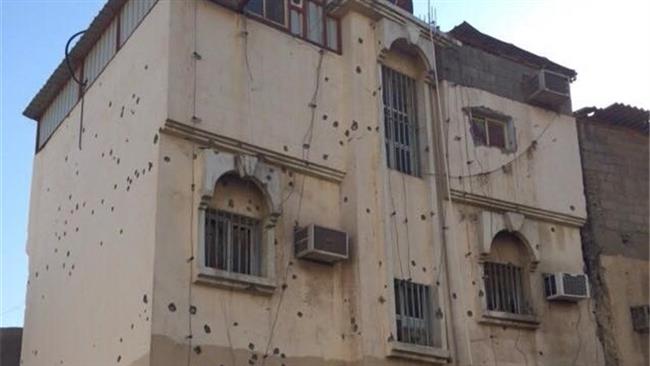
Awamiyah amid an ongoing crackdown by Saudi regime forces
Press TV – July 27, 2017
Saudi forces have waged a fresh wave of attacks against a besieged town in the kingdom’s Shia-populated Eastern Province, killing at least seven people and injuring several others over the past few hours.
The casualties were reported over the past 48 hours after Saudi regime forces, equipped with artillery and heavy weapons, launched a series of fresh attacks against Awamiyah, located some 390 kilometers northeast of the capital Riyadh.
Human rights activists and media outlets confirmed on Thursday that at least seven local Shia residents lost their lives after they were sprayed with bullets by Saudi forces.
There are reportedly several women and children among those injured in the raids. There are also at least two Indian refugee workers among those injured in the attacks.
The death toll is expected to rise as some of the injured are said to be in critical condition.
On Wednesday, a series of video footage circulating on social media websites showed Saudi regime forces shelling homes and buildings in al-Jamima neighborhood and al-Mosara, the old quarter of the town of Awamiyah.
Several homes, business and historical sites have been totally destroyed or partially damaged across the region.
The Saudi regime forces in riot gear have also set up barricades and security checkpoint to prevent people from organizing any gathering or protest rally. Local residents complain that police deployed at the checkpoints are snatching and stealing their personal belongings.
Several main entrances to the region have been closed and the regime forces have imposed heavy restrictions on movement of the citizens.
Saudi authorities also shut down internet and mobile services across the area.
Residents have been forced to stay indoors as the regime has deployed snipers across the entire region.
Reports also indicate that garbage has piled up as Saudi forces continue to prevent relevant authorities from collecting trash across several areas.
The developments come as a fierce crackdown on protesters there enters its 77th day.
Awamiyah has witnessed an increase in anti-regime protests and an ensuing crackdown as Riyadh has insisted to destroy al-Mosara, claiming the neighborhood’s narrow streets have become a hideout for militants believed to be behind attacks on security forces in the region.

Shia activists who were among those killed in fresh attacks by Saudi regime forces in Awamiyah
Saudi authorities intend to turn al-Mosara into a commercial zone, despite warnings both by locals and the United Nations that the controversial plan would ruin the 400-year-old neighborhood’s historical and cultural heritage and could eventually lead to the forced eviction of hundreds of people from their businesses and residence.
Saudi troops equipped with heavy weapons have been deployed in Awamiyah since May 10, following fierce clashes between the regime forces and locals protesting against the destruction.
A large number of civilians have lost their lives in the ongoing heavy-tactic crackdown by the Riyadh regime since then.
A number of human rights groups and activists have expressed deep concern about the living conditions of people in Awamiyah, who are suffering from a severe water shortage and are using private generators to produce electricity.
On May 24, UN experts criticized the ongoing attempts to demolish al-Mosara and accused the Saudi kingdom of erasing cultural heritage, violating human rights, and forcing residents to flee their homes.
House GOP Seeks to Curb Yemen War
By Dennis J Bernstein | Consortium News | July 26, 2017
Republicans are taking the lead in blocking U.S. participation in the Saudi slaughter in Yemen, which has plunged that country to the brink of starvation and sparked a cholera epidemic. Surprising to many, there was a vote by the Republican-led House of Representatives to block U.S. participation in the Saudi-led war.
The key amendment to the National Defense Authorization Act — prohibiting U.S. military support for the Saudi-led coalition’s bombing of Yemen — was sponsored by Rep. Warren Davidson, R-Ohio. Though the amendment gained bipartisan support — and another restrictive amendment was sponsored by Rep. Dick Nolan, D-Minnesota — the Republican leadership on this issue reflects the changing places in which Democrats have become the more hawkish party in Congress.
I spoke to Kate Gould, Legislative Representative for Middle East Policy for the Friends Committee on National Legislation about this pressing issue of life and death in Yemen. We spoke on July 17.
Dennis Bernstein: Well, this is a terrible situation and getting worse by the day. Could you please remind everyone what it looks like in Yemen on the ground?
Kate Gould: It is a catastrophic situation. According to the United Nations, it is the largest humanitarian crisis in the world right now. And despite the fact that this humanitarian crisis has been a direct result of the Saudi/United Arab Emirate-led war in Yemen, backed by the United States, most Americans have no idea that we are so deeply involved in this war.
A conservative estimate is that seven million people are on the verge of starvation, half a million being children. The people in Yemen are experiencing the world’s largest cholera outbreak. A child under the age of five is dying every ten minutes of preventable causes. Every 35 seconds a child is infected.
This is all preventable with access to clean water and basic sanitation. This war has destroyed the civilian infrastructure in Yemen. We’re talking about air strikes that have targeted warehouses of food, sanitation systems, water infiltration systems. The World Health Organization points out that cholera is not difficult to prevent. The problem is that so many Yemenis lack access to clean water as a result of the infrastructure being in ruins.
DB: What about the medical infrastructure, what about the ability to deal with this kind of epidemic, or is it just going to get worse?
KG: Well, unless we do something to change the situation, it is definitely going to get worse. In Yemen, 90% of food is imported and the Saudis have made this much more difficult. They imposed more restraints on one of the major ports and have refused to allow Yemen to repair the damage caused by air strikes. Often it is difficult for ships to get permission to berth. All these complications have driven up the price of food so that even when food manages to be imported it is too expensive, even for those earning decent incomes. So what we are seeing is a de facto blockade as well as a war.
DB: Could you say a few words about the campaign of the Saudi military and what kind of weaponry they are using? Later I would like to discuss US support for all of this.
KG: The Saudi-led war began about two and a half years ago in March, 2015. At that time they asked for US support and got it from the Obama administration. The air campaign has resulted in the carpet bombing of Yemen. It is the Saudis and the United Arab Emirates who have been driving this massive bombardment. There has been an all-out assault on civilians and civilian infrastructure.
And, of course, as Senator Chris Murphy (D-CT) has pointed out, the Saudis would not have been able to carry out this bombing without full US support. Their planes cannot fly without US refueling capacity. In fact, since October the US has actually doubled the amount of fuel it provides to Saudi and Emirati bombers. Last October is significant because at that time there was a major bombing of mourners coming out of a funeral hall which killed about 140 civilians and wounded another six hundred. Since that atrocity, the US has doubled its refueling support.
DB: How does the US justify its support for the Saudis, from a human rights perspective?
KG: We’ve heard very little discussion of the human rights angle from the Trump administration. The Obama administration claimed to be pressuring the Saudis to take precautions to prevent civilian casualties, that this is why the US has provided precision-guided smart bombs, to limit civilian casualties. There has never been an official US response to the fact that the Saudis and Emiratis are deliberately pushing millions to the verge of starvation. They are using hunger as a political tool to get better leverage on the battlefield and at the negotiating table. This is really what is driving the humanitarian nightmare.
DB: We know that Trump was just in Saudi Arabia and signed a massive weapons contract. Will this weaponry contribute to the coming famine and cholera epidemic?
KG: Certainly. It is providing the Saudis a blank check for this devastating war in which direct casualties from airstrikes are conservatively estimated at around 10,000 and millions of people have been displaced. It sends the message that the United States is willing to support the Saudis despite massive human rights violations.
DB: There is no way the US or the Saudis can deny the tragedy. This has been thoroughly documented by US and international rights groups.
KG: But what they will often say is that a lot of the fault lies with the Houthi rebel groups. And it is certainly true that the Houthi rebels have committed massive human rights violations. But as far as the mass devastation of public infrastructure is concerned, which is leading to the humanitarian crisis, the majority of the blame can be assigned to the Saudi-led war and the US backing.
Repeatedly, Amnesty International and Human Rights Watch, responding to the scene of unlawful airstrikes against civilian targets, have found either unexploded US-made bombs or identifiable fragments of US bombs. This was the case with the bombing of the funeral procession last October. Still, the US government claims that it is trying to limit civilian casualties.
DB: It is interesting that the Republican-led House has voted to block US participation in the war in Yemen. It seems somewhat counter-intuitive.
KG: It is definitely surprising. Although I’ve been working around the clock on this recently, even I was surprised. What happened is that last week [week of July 9] the House of Representatives voted on the major military policy bill for fiscal year 2018. This is a major piece of national security legislation which authorizes funding for the Pentagon. It has to get passed every year and it provides an opportunity for members to vote on amendments that have to do with national security.
Two of these amendments were particularly consequential for Yemen. One was introduced by a Republican, Warren Davidson of Ohio, and the other by Rick Nolan, a Democrat from Minnesota. They added language that would require the Trump administration to stop providing refueling for Saudi and Emirati bombers, as well as to stop intelligence sharing and other forms of military support. It wouldn’t stop the weapons sales, which is another process, but it would stop military support for this indiscriminate war.
The Davidson amendment would prohibit US military action in Yemen that is not authorized by the 2001 Authorization for Use of Military Force. Given that US participation in the Saudi-led war in Yemen is not targeting Al-Qaeda, it is not authorized by the 2001 AUMF and is prohibited by this amendment. The Nolan amendment prohibits the deployment of US troops for any participation in Yemen’s civil war.
This means that the House just voted to end US funding of our military for the Saudi-led war in Yemen. This is really unprecedented and it builds on the wave of congressional momentum that we saw last month when 47 senators voted against sending more of what we call “weapons of mass starvation” to Yemen. So we have clear signals from both the House and the Senate that there is no support for Trump’s blank check to Saudi Arabia for this devastating war.
DB: So now this goes to the Senate?
KG: Yes, and there we are going to face a more difficult fight. We’re preparing for that now. We definitely will see some important Yemen votes in the Senate. It could come up right after a health care vote in early August or it might not be voted on until the fall. But we will see votes on Yemen. It is unclear whether a Senate member will offer amendments similar to the Davidson or Nolan amendments.
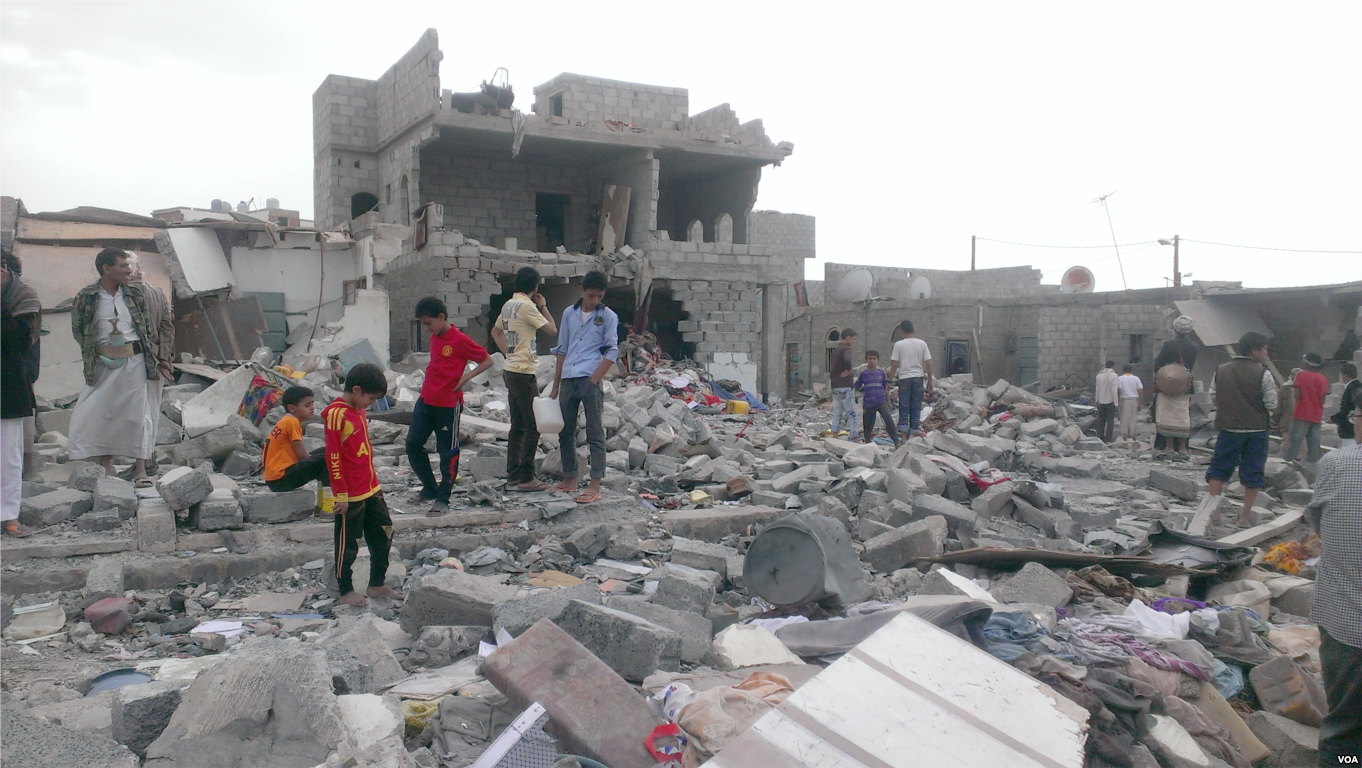
Yemeni capital of Sanaa, Oct. 9, 2015 (Wikipedia)
After the Senate votes on the various amendments, they will both have versions of this and they will have to come back and conference a final version to send to the president. This is definitely a time to push our senators to follow suit with the House and oppose US involvement in this devastating war in Yemen.
DB: Finally, who are some of these Republican Congressional members who stood up in this effort to restrain this oncoming famine? Who were some of the surprise votes?
KG: Actually, this was added in a whole block of legislation so we can’t point to exactly who supported and who opposed it. It was good to see Warren Davidson taking a leadership role on this issue. He is relatively new in the Senate, having taken [Former House Speaker John] Boehner’s seat. It is noteworthy also that the Chairman of the House Armed Services Committee, Mac Thornberry from Texas, allowed this amendment to go forward. Just that the House Republican leadership allowed this to move forward is really interesting in itself.
DB: Yes, it is. It seems to me that the Democrats have really become out-of-control Cold Warriors, either lost in Russia-gate or dropping the ball on this very important foreign policy issue. We thank you, Kate Gould, Legislative Representative for Middle East Policy with the Friends Committee on National Legislation.
KG: And I just want to say that we can win on this one and we need everybody to get involved. You can go to our website, fcnl.org, to get more information. Again, 47 Senators voted last month to block these bomb sales and we only need 51 votes. And with Trump’s massive arms deal with Saudi Arabia, I’m sure we will have more votes on this. But it is really important to stay engaged and we need everybody to get involved and contact your members of Congress.
Dennis J Bernstein is a host of “Flashpoints” on the Pacifica radio network and the author of Special Ed: Voices from a Hidden Classroom. You can access the audio archives at www.flashpoints.net.
The Price of Defiance: Why US, Saudi Arabia Turning Kuwait Against Iran
Sputnik – 22.07.2017
Commenting on the latest twist in the diplomatic row in the Persian Gulf, this time between Kuwait and Iran, Iranian political analysts spoke to Sputnik Iran, revealing who’s really behind this new development and which of the two countries will suffer the most from the consequences.
On Thursday, Kuwait sent a diplomatic note to Iran’s embassy stating that the office of military and cultural attaches would be closed down. The note also said that 15 Iranian diplomats, including Ambassador Alireza Enayati, would have to leave the country within 45 days, leaving only four Iranian diplomats in Kuwait.
Kuwait’s acting information minister, Sheikh Mohammad al-Mubarak al-Sabah, said in a statement that the move was taken in “accordance with diplomatic norms and in abidance with the Vienna conventions with regards to its relationship with the Islamic Republic of Iran.”
According to mass media reports, the moves were made following the conviction of the members of Al Abdali terror cell, whose Kuwaiti members were accused of alleged intelligence contacts with Iran and Hezbollah, a Lebanese Shiite militant group.
The Ministry of Foreign Affairs of Iran has responded by summoning the Kuwaiti charge d’affaires. While rejecting the accusations, Iran has said that the measures taken by Kuwaiti officials are regrettable, given that the existing tensions in the region are now in a critical condition.
“We expect Kuwait to act rationally instead of responding to pressures and worsening the tensions,” Iranian Foreign Ministry spokesman Bahram Qassemi was quoted as saying by the Mehr news agency.
In an interview with Sputnik Iran, Sabbah Zanganeh, a political commentator, Iranian envoy to the Organization of Islamic Cooperation and former adviser to the Iranian foreign minister, said that the moves of the Kuwaiti authorities have been evidently fuelled by pressure from Saudi Arabia.
The Iranian authorities have not been informed of any details of the ongoing investigation in Kuwait and any charges which have been put forward. Neither the Iranian legal representative, nor any independent Iranian experts have been allowed to study the case in more detail.
The Iranian political analyst recalled that there have already been groundless and unsubstantiated accusations made against Iran, alleging that it played a major role in liberating the territories of Kuwait from the occupation of Saddam Hussein by supporting and mobilizing hundreds of thousands of Kuwaiti residents, similar to the current accusations against Tehran.
“In due course, Saddam Hussein made a very ambitious offer to Iran to capture not only Kuwait, but the territories of other countries of the Persian Gulf. However Iran had never had a goal of the occupation of the territories of sovereign states and the destruction of the system of government of these countries,” Sabbah Zanganeh told Sputnik.
“Hence this demarche of Kuwait is baseless and is fuelled purely by the pressure of Saudi Arabia, which does not want to put up with the idea that the Arab states of the Persian Gulf, such as Kuwait and Qatar, have good relations with Iran. Saudi Arabia is exerting strong pressure on the Kuwaiti authorities and its mass media,” he added.
The political commentator further explained that until recently, Kuwait has been pursuing a very reasonable and moderate foreign policy; however it has come under strong pressure from the Saudis. Where Qatar was the first target of the Saudis, now it is Kuwait’s turn. The Saudis cannot tolerate Kuwait’s key positions in the settlement of the Qatari crisis, in the negotiations of the Yemeni issue and in the issue of diplomatic correspondence with Iran on behalf of the Cooperation Council for the Arab States of the Persian Gulf. Kuwait, unlike Qatar, is to a far lesser extent an independent state.
In a separate comment on the issue, Iranian political analyst and expert on Middle East and Iranian-Arab relations, former editor-in-chief of the Iranian news agency Mehr News, Hassan Hanizadeh told Sputnik that Kuwait will be the country to suffer from its demarche, while it will have no impact on the economic environment of Iran.
“These actions of Kuwait, aimed at decreasing diplomatic relationship with Iran, have been evidently dictated by Saudi Arabia and the US. As we remember, during his trip to the Middle East, Donald Trump had an important meeting with the leaders of six Arab states of the Persian Gulf in Riyadh. Trump demanded that these states cut their diplomatic relations with Iran or at least lower the level of their ties. Qatar is the first to be punished for disobeying this order,” he told Sputnik.
However, he further elaborated, Qatar held firm and defied pressure from Saudi Arabia and the US. Kuwait, in turn, is a sparsely populated country, compared to its neighbors, and prefers not to oppose the pressure of the US and the Saudis. The danger is that this demarche could spark tensions in the region between the Arab states and Iran even further.
For the last 30 years Iran has been maintaining good and friendly relations with Kuwait, avoiding any hostilities. Moreover, in 1990, during the attack of Saddam Hussein on Kuwait, the Iranian embassy in Kuwait sheltered over a hundred women and young ladies, wives and daughters of Kuwaiti emir and his brothers, on its territory from Hussein’s troops and then safely sent them to Iran for temporary relocation.
Unfortunately, the current Kuwaiti authorities have forgotten this and are putting forward baseless accusations against Iran under pressure from Saudi Arabia, the political analyst said.
“Kuwait will be the only one to suffer from this demarche. Iran is a large and strong country, which will easily overcome this crisis. Kuwait is not a high priority in the Iranian foreign policy and the lowering of the level of diplomatic relations between the two countries won’t have any impact on Iran,” Hassan Hanizadeh told Sputnik.
He explained that there are no deep trade-economic relations between the two states, only political and cultural. Hence the demarche won’t have any impact on the economy of Iran.
Commenting on the conviction of the members of the Al Abdali terror cell, and the accusation of the members in espionage on behalf of Iran, Hassan Hanizadeh noted that Iran would not spend any resources attempting to glean intelligence from Kuwait, hence all the accusations are illogical and unreasonable.
“Kuwait is not the type of country for Iran to spend its intelligence resources on. It has neither a strong army nor any objects of infrastructure, such as a nuclear power plant, for example. It is not of any particular value to Iranian intelligence services. Hence, any accusations of espionage are absurd and unreasonable,” he told Sputnik.
The political analyst said that scenario, which has got the name of “Al Abdali process” had been planned beforehand by the Americans and the Saudis. One of its aims is to clear the way for the breakup of ties between Iran and the member states of the Cooperation Council for the Arab States of the Persian Gulf.
Among other possible reasons of the Kuwaiti demarche, Hassan Hanizadeh suggested that it could be the discontent of the fast growing Shia Muslim population of the country. The Shia Muslim community makes over 40% of the total population of the country. And the Kuwaiti authorities don’t want them to set their eyes on Iran. Thus they are trying to lessen Iran’s influence on their country, he concluded.
Gulf Crisis: US Admits Fake News of Russian Hacking
By Finian CUNNINGHAM | Strategic Culture Foundation | 18.07.2017
In a sharp about-turn, US intelligence agencies are now accusing the United Arab Emirates for hacking into Qatar’s official news agency, thereby sparking the Gulf crisis between Washington’s Arab allies. The latest twist amounts to an admission that the US is guilty of previously broadcasting fake news blaming Russia.
This week, the Washington Post cites US intelligence officials when it reported Monday: «The United Arab Emirates orchestrated the hacking of Qatari government news and social media sites in order to post incendiary false quotes attributed to Qatar’s emir, Sheikh Tamim bin Hamad al Thani, in late May that sparked the ongoing upheaval between Qatar and its neighbors».
However, last month, on June 7, the American news outlet CNN had a completely different take on the Gulf crisis, when it blamed Russia for trying to sow division between US allies in the Persian Gulf. It reported in an «exclusive» article with the headline: US suspects Russian hackers planted fake news behind Qatar crisis.
That CNN report went on to claim: «US officials say the Russian goal appears to be to cause rifts among the US and its allies. In recent months, suspected Russian cyber activities, including the use of fake news stories, have turned up amid elections in France, Germany and other countries».
While CNN hinted that the alleged Russian hackers in the Gulf could have been criminal privateers, the thrust of its report last month very much pointed the finger of blame at the Russian government for hacking into the Qatar news agency. Using assertion, speculation and anonymous sources, the alleged Russian cyber-attack on Qatar was linked to alleged meddling by the Kremlin in the US presidential election last year.
«US intelligence has long been concerned with what they say is the Russian government’s ability to plant fake news in otherwise credible streams, according to US officials», reported CNN.
But now this week, US intelligence officials have changed their tune on who they think is whipping up the Gulf crisis. It is not Russia, it is the United Arab Emirates (UAE).
«[US] Officials became aware last week that newly analyzed information gathered by US intelligence agencies confirmed that on May 23, senior members of the UAE government discussed the plan and its implementation,» reports the Washington Post this week.
For over a month now, the UAE has aligned with Saudi Arabia and Bahrain to blockade Qatar, another member of the Gulf Cooperation Council (GCC). The crisis has become deadlocked with neither side willing to back down, much to the strategic concern of Washington. All of the monarchial energy-rich states are longtime allies of the US and together as a unit are a linchpin in maintaining the global petrodollar system. The other GCC members, Kuwait and Oman, have taken a neutral stance in the diplomatic crisis and have acted as brokers to resolve the dispute. Egypt, has joined with the Saudi-led bloc, to impose sanctions against Qatar.
The row blew up dramatically days after US President Donald Trump made an official state visit to Saudi Arabia on May 20-22. In exchange for a record $110-billion arms deals with the Saudi rulers, it seems clear that Trump gave the green light for the Saudis to instigate a blockade on Qatar. Ostensibly, the Saudis and the others are accusing Qatar of sponsoring terrorism and, they say, that is why they acted to isolate the neighboring gas-rich state. The absurd hypocrisy behind the accusation belies the real motive of petty rivalry among the Gulf monarchs. In particular, the Qatari-based Al Jazeera news network has been a bane for the Saudi and Egyptian rulers owing to its relatively independent and critical reporting on repression in those countries. Qatar’s support for the Muslim Brotherhood has also rankled the Saudis and Egyptians.
Two days after Trump flew out of Saudi on May 22, the official Qatari News Agency was hit with a fake news attack. Its news reports attributed statements to the Qatari emir, Sheikh Tamim bin Hamad al Thani, in which he praised Iran – the Shia arch-enemy of the US-backed Sunni monarchies – as well as making critical comments about Trump.
The whole debacle was an obvious set-up. Despite urgent notices from Qatar that its new agency had been hacked with fake news, the Saudi, Bahraini and Emirati media continued to prominently report the statements as if they were genuine, with the evident intention of smearing Qatar and provoking a stand-off.
The stage was then set for Saudi Arabia, UAE, Bahrain and Egypt to announce on June 5 a total embargo of commercial, media and transport links with Qatar «because of its support for terrorism and friendly relations with Iran».
US President Trump initially voiced support for the blockade on Qatar, claiming it as a success from his trip to Saudi Arabia.
«So good to see the Saudi Arabia visit with the King [Saudi King Salman] and 50 countries already paying off», Trump smugly declared through his Twitter feed. «They said they would take a hard line on funding extremism, and all reference was pointing to Qatar. Perhaps this will be the beginning of the end to the horror of terrorism!»
But ever since Trump set off the worst crisis in the Gulf among US allies, his top diplomat Rex Tillerson has been busy trying to calm the row.
Qatar serves as the base for US Central Command in the Middle East with an airbase housing 10,000 troops. American warplanes flying out of Qatar are the main strike force for operations in Iraq, Syria and Yemen. Strategic planners in Washington realize that the US cannot afford to alienate Qatar.
Tillerson has diverged noticeably from Trump’s simplistic broadside supporting Saudi Arabia, and has instead sought to bring Qatar back into the GCC fold. The US Secretary of State has hinted that the Saudi-led blockade is draconian and unrealistic. On June 23, Saudi Arabia and its partners demanded that Qatar shut down the Al Jazeera network along with a dozen other ultimatums. Qatar refused.
Last week, Tillerson had a frenetic week of shuttle diplomacy flying between Qatar and Saudi Arabia to get both sides to compromise. On Friday, July 14, the former Exxon CEO returned to the US deflated, unable to break the deadlock.
While traveling back to the US, Tillerson alluded to the strategic importance at stake for Washington in maintaining Gulf Arab unity. He said it is «really important to us from a national security standpoint. We need this part of the world to be stable, and this particular conflict between these parties is obviously not helpful».
This would explain why the US has now moved to expose the Saudi-led camp as being behind the fake news hack incident against the Qatari news agency.
That disclosure undermines the Saudi-led position. It confirms what the Qataris have been saying from the outset; namely, that they have been set up for a faux crisis by Gulf rivals, whose objective is to subjugate Qatari sovereignty under Saudi tutelage. Shutting down the «offensive» Al Jazeera news station being one of the desired outcomes.
By undermining the Saudis and UAE in this way, the US is wagering that it can lever the Saudis and the others GCC members into softening their demands on Qatar.
So keen are the US military and geopolitical planners to defuse the prolonged Gulf crisis – a crisis that threatens the petrodollar system – that they were obliged to come clean about the real identify of the perpetrators of the cyber attack on Qatar. That means dishing the dirt on the Saudis and UAE as the source of the hack, and abandoning the earlier claim that Russia was to blame.
CNN is once again caught out faking news about Russian hackers. At the time of its «exclusive» last month accusing Russia of destabilizing US allies in the Gulf, the news channel at least had the decency to quote Kremlin spokesman Dmitry Peskov on the claim.
Peskov said in the June 7 report: «It is another lie.. CNN again and again publish references to unnamed sources in unnamed agencies, etc, etc. These streams of information have no connection with the reality. It is so far away from the reality. Fake is a fake».
What the whole episode shows is not just how irresponsible US intelligence officials and major media are in publishing false claims defaming Russia. It also shows them as unscrupulous and expedient.
Just because the lingering Gulf crisis is spiraling to threaten US strategic interests, only then is there a sudden switch to a version of events that more accurately reflects reality. If it weren’t for US strategic concerns in the Gulf, the fake news put out about Russian hackers would no doubt continue. Which begs the question: if Russian hackers in the Gulf is fake news, then what does that say about similar claims of Russian hacking in the US?
Ambassador Yakovenko’s comment on the situation in Syria
Ambassador’s view | RT | July 16, 2017
We believe that the current round of Geneva talks is off to a better start due to the participation of all the main opposition platforms – the Riyadh, Moscow, and Cairo groups.
The constitutional reform and the fight against terrorism are priorities, but not forgetting about two other issues (running the country prior to the adoption of a new constitution and holding elections). Eventually, the constitution should reflect the concerns of all ethnic, religious, and political groups of Syria without exception. This is the only way to ensure the stable functioning of the Syrian state and prevent the spread of [the] terrorist threat. Meanwhile, the current constitution provides for a broad range of opportunities to expand the participation of opposition representatives in running the state. We actively support the efforts of UNSG Special Envoy for Syria Staffan de Mistura to encourage the Syrian parties to engage in a productive conversation on constitutional reforms.
The success of agreements on de-escalation zones, particularly one in southwest Syria signed by Russia, the US, and Jordan on July 7, will make the fight against terrorism more efficient. This opportunity is real now, because the very concept of de-escalation zones provides for separation of the armed opposition from ISIS, Al-Qaeda, Jabhat Al-Nusra, and other UN-proscribed terrorist groups. They also help normalize relations between the government forces and the armed opposition. The conditions are thus created for their stopping fighting each other and joining forces against the terrorists. Russia will contribute to this process.
Among other things, the agreements on de-escalation zones provide for stepping up practical cooperation between Moscow and Washington. Our joint efforts to enforce ceasefire in southwest Syria will be coordinated by the Monitoring Center, which Russia, the United States, and Jordan have agreed to establish in Amman. This center will maintain direct contact both with the opposition groups and representatives of the Syrian government. Basically, we keep the doors open to cooperation on further development of the de-escalation concept, while maintaining regular contact with the other key players that can influence developments in Syria. All in all, the July 7 agreement reached between Russia, the US, and Jordan shows that, despite differences in our positions and interests, cooperation is possible for common good. Let’s build on this to make further progress in dealing with jihadist aggression that distorted the entire Syrian situation.
Dr Alexander Yakovenko, Russian Ambassador to the United Kingdom of Great Britain and Northern Ireland, Deputy foreign minister (2005-2011). Follow him on Twitter @Amb_Yakovenko
Most Britons oppose UK arms sales to Saudi Arabia: Poll
Press TV – July 16, 2017
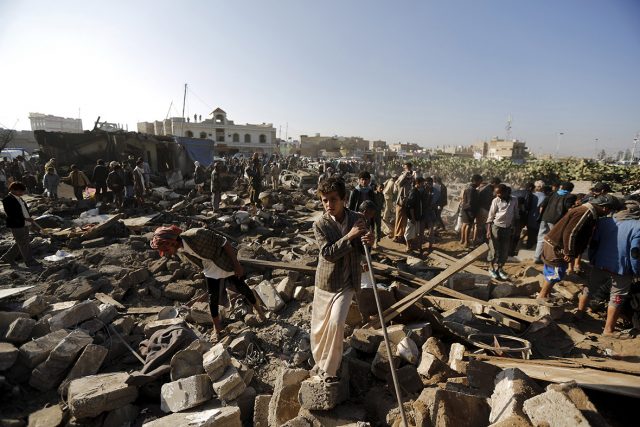
A majority of the British public believes the UK must end arms sales to Saudi Arabia over its large-scale slaughter of civilians in Yemen, according to a new poll.
An exclusive poll conducted by BMG Research for The Independent has found that 58 percent of people say it is wrong for Britain to supply billions of pounds of weapons to Saudi Arabia.
The poll also shows that 64 percent of the public want the government of Prime Minister Theresa May to release a suppressed report into Saudi Arabia’s funding of extremism in Britain, even if it damages relations with Riyadh.
On Wednesday, UK Home Secretary Amber Rudd cited national security reasons for not publishing a report commissioned by former Prime Minister David Cameron that shows the majority of foreign funding for extremism in the UK came from Saudi Arabia.
The survey underscores the public’s deep concern about the UK’s close relationship with an autocracy embroiled in a devastating war in Yemen.
The UK has licensed 3.3 billion pounds worth of weapons since the beginning of Saudi Arabia’s war on Yemen in March 2015.
The United Nations and other international organizations have accused the Saudi-led coalition of bombing hospitals, schools and wedding parties in Yemen.
The UN has declared Yemen a “humanitarian catastrophe,” with sanitation systems destroyed and at least 300,000 people infected with cholera.
The opposition to weapons sales has extended into the government, with key Conservative lawmakers thought to be debating privately for arms sales to be halted.
“This just shows how fast the Conservatives are moving away from public opinion,” said Tom Brake, a Liberal Democrat lawmaker. “Instead of giving the Saudis a stern talking to, ministers are flogging them arms.”
Last week, the UK High Court ruled that London’s weapons sales to Riyadh are not against the law.
The ruling came despite the judges conclusion that there was “a substantial body of evidence suggesting that the [Saudi-led] coalition committed serious breaches of international humanitarian law in the course of its engagement in the Yemen conflict”.
Saudi Arabia has been bombing Yemen since March 2015 in a bid to restore Yemen’s former President Abd Rabbuh Mansur Hadi, a Riyadh ally, to power. Yemen’s crisis began after Hadi stepped down as president and refused to negotiate power-sharing with the country’s Houthi Ansarullah movement.
Featured Video
NATO’s War of Choice – The Sabotage of the Istanbul Negotiations
or go to
Aletho News Archives – Video-Images
From the Archives
National Security Archive Publishes Key Records on Infamous MKULTRA Program
Agency Sought Drugs and Behavior Control Techniques to Use in “Special Interrogations” and Offensive Operations
Edited by Michael Evans | National Security Archive | December 23, 2024
Washington, D.C. – Today, the National Security Archive and ProQuest (part of Clarivate) celebrate the publication of a new scholarly document collection many years in the making on the shocking secret history of the CIA’s mind control research programs. The new collection, CIA and the Behavioral Sciences: Mind Control, Drug Experiments and MKULTRA, brings together more than 1,200 essential records on one of the most infamous and abusive programs in CIA history.
Under code names that included MKULTRA, BLUEBIRD and ARTICHOKE, the CIA conducted terrifying experiments using drugs, hypnosis, isolation, sensory deprivation, and other extreme techniques on human subjects, often U.S. citizens, who frequently had no idea what was being done to them or that they were part of a CIA test.
Today’s announcement comes 50 years after a New York Times investigation by Seymour Hersh touched off probes that would bring MKULTRA abuses to light. The new collection also comes 70 years since U.S. pharmaceutical giant Eli Lilly & Company first developed a process to streamline the manufacture of LSD in late 1954, becoming the CIA’s chief supplier of the newly discovered psychoactive chemical central to many of the Agency’s behavior control efforts.
Highlights of the new MKULTRA collection include… continue
Blog Roll
 Aletho News
- John Mearsheimer: The Case for a Nuclear Iran
- The Founder Who Turned Against Root Canals
- Israel displaces last two families from Al Khalayel valley, Al Mughayyir
- Israeli Opposition Leader Endorses Greater Israel
- Islamic Jihad: Trump’s peace board is a “theatrical stunt detached from reality”
- The Head Of A CIA Cutout Admits To Meddling In Iran To Fuel Unrest
- Iran warns Trump against decisions based on false information
- Pentagon sets deadline for Anthropic to lift AI restrictions on autonomous weapons systems, mass domestic surveillance
- Trump’s military buildup against Iran on Netanyahu’s behalf is a gambit doomed to fail
- Big League War
- If Americans Knew
- Are the Jews indigenous to Palestine?
- AIPAC Wants to Kill a Bill that would Ensure Israel Complies with Ceasefire
- Former Israeli PM, in Epstein Files, Dreamed of Israeli Eugenics and Pretty Converts
- Israeli settlers join ‘safari’ tour of Palestinian prisoners
- Flooding in Gaza amid rumors of war; fire in West Bank – Not a ceasefire Day 138
- Fourteen Countries Condemn Huckabee’s Support for Israel Taking Over Most of the Middle East
- Israeli Soldiers Killed Gaza Aid Workers at Point Blank Range in 2025 Massacre: Report
- Israel’s insidious network to propagandize American Christians
- Israel’s Best-Kept Secret: Palestinian Resistance Never Agreed to Disarm
- Trump officials plan to build 5,000-person military base in Gaza, files show
- No Tricks Zone
- Surprising Discovery: Sahara Is Greening…Billions Of Trees Where Once Thought To Be Barren
- New Research Reaffirms Clouds, Aerosols, And Surface Solar Radiation Are ‘Driving The Climate System’
- Germany: Electric Car Catches Fire At Charging Station, Sets Off Local “Inferno”, Widespread Damage
- New Study: Canada’s New Brunswick Was 1°C Warmer Than Today During The Medieval Warm Period
- Coal Power Back In Trend As Globe Tries To Keep Pace With Growing Demand For Power
- New Study: A 4°C Warmer Beaufort Sea Had ‘No Sea Ice’ 11,700 – 8200 Years Ago
- Unfudging The Data: Dutch Meteorological Institute Reinstates Early 20th Centruy Heat Waves It Had Erased Earlier
- German Gas Crisis…Chancellor Merz Allegedly Bans Gas Debate Ahead of Elections!
- Pollen Reconstructions Show The Last Glacial’s Warming Events Were Global, 10x Greater Than Modern
- Germany’s Natural Gas Storage Level Dwindles To Just 28%… Increasingly Critical
 Aletho News