Israel pops up in Gulf riding Arab coattails
By M K Bhadrakumar – Indian Punchline – August 7, 2016
The reported statement by former Israeli minister Diaspora Affairs Rabbi Michael Melchior that Saudi Arabia will open its doors to Israeli visitors “much sooner than you dream about” will not come as surprise. To be sure, a critical mass is developing in the secretive Saudi-Israeli intercourse.
The Saudi regime has been chary about links with Israel for fear of annoying the ‘Arab Street’, whereas, Israel has been all along eager to flaunt the breach in the Berlin Wall of Arab-Israeli conflict. But Saudis seem to estimate that the time has come to be open about the relationship.
The point is, if the raison d’etre of the dalliance is the ‘containment’ of Iran, it is resource-sharing. An open relationship is needed to optimally develop security and military cooperation. The Custodian of Holy Places seems to think the Muslim world will learn to live with his country’s strategic cooperation with Israel.
Well, the Palestine issue no longer poses hurdles, either. Arab Spring, conflicts in Syria and Iraq, military coup in Egypt, Saudi-Iranian rivalry, breakdown in Iran’s ties with Hamas, Islamic State – all these have relegated the Palestine issue to the backburner. Besides, Palestine President Mahmoud Abbas is on a tight American and Saudi leash. Abbas even received in Ramallah recently a Saudi delegation led by former general Anwar Majed Eshki who visited Jerusalem and met senior Israeli officials, including the head of the foreign ministry Dore Gold.
Again, Saudi Arabia’s keen interest in taking possession of two Red Sea islands at the mouth of the Gulf of Aqaba – Tiran and Sanafir – needs to be understood as a move to be Israel’s ‘neighbor’. Sanafir and Tiran sit at the mouth of the Gulf of Aqaba, on a strategically important stretch of water called the Strait of Tiran, used by Israel to access Red Sea. King Salman personally camped in Cairo in April to persuade Egyptian President Abdel Fattah al-Sisi to transfer the two islands in lieu of a seductive multi-billion dollar offer to Sisi.
Indeed, both Saudi Arabia and Israel are making haste to position themselves for a new phase of the Middle East’s politics in the post-Barack Obama era. They expect Hillary Clinton to pick up the threads where George W. Bush left them — a muscular regional policy involving switch back to containment of Iran and resuscitation of the pivotal relationships with Israel and Saudi Arabia.
Neither Saudi Arabia nor Israel is willing to reconcile with the Iran nuclear deal. They are doing everything possible, no matter what it takes, to see that the deal gets derailed. On Saturday, Israeli Defence Ministry issued a harshly-worded statement slamming Obama and comparing the Iran deal with the 1938 Munich agreement to appease Hitler. (Jerusalem Post )
Equally, Saudis and Israelis have convergent interests in regard to the conflicts in Syria and Iraq — supporting extremist Sunni groups, promoting the Kurdistan project, creation of ‘spheres of influence’ on Syrian and Iraqi territory, and ultimately, entrapping Iran in a quagmire that will exhaust the regime.
The Saudi-Israeli strategic regional realignment is something that Washington historically encouraged. It is just the underpinning needed for creating a regional security architecture supported by the NATO’s network of partnerships with the GCC states under the canopy of a US missile shield.
Alas, Turkey too could have been a key partner in this enterprise, but for the failure of the July 15 coup. Israel looked distressed when it transpired that the coup failed. As for Saudi Arabia, it probably played a role in the failed coup. (Sputnik )
Without doubt, it is against a complex backdrop that the recent reports regarding Israel and Pakistan taking part in a major air exercise hosted by the US also needs to be viewed. Neither Islamabad nor Tel Avi has denied the reports. Of course, the US always encouraged a Pak-Israeli proximity. Now, the big question is: With Saudi Arabia establishing ties with Israel, can Pakistan be far behind? (Times of Israel )
From the Israeli, Saudi and American perspective, it is of utmost importance that Pakistan aligns with Saudi Arabia instead of remaining neutral in regard of Iran’s rise. Pakistan’s role is crucial to any major plans of destabilization of Iran.
Israel and Saudi Arabia pretended until recently that they have a special thing going with Moscow, too, with a view to create ‘strategic ambiguity’. Moscow played along, while making a strategic decision that Iran is its ‘natural ally’ in the Middle East. This is perfectly understandable, because in the ultimate analysis, Israel and Saudi Arabia are bit players only, while Iran (or Turkey for that matter) is an authentic regional power credited with a world view.
It is possible to see the Russia-Azerbaijan-Iran trilateral summit in Baku on Monday as a strategic counter-move by Moscow and Tehran.
The proposed North-South Transport Corridor is admittedly an old idea with a pronounced economic dimension, but in the present context, an access route for Russia to the Persian Gulf and Middle East via Iran’s territory becomes a geopolitical event of far-reaching significance in the regional alignment that is under way. (See my blog China’s One Belt One Road isn’t only show in town.)
Middle East prepares for Hillary’s war
By M K Bhadrakumar | Indian Punchline | July 28, 2016
The big question this week ought to be about Hillary Clinton’s wars, if she gets elected as the next US president. Her hawkish temperament and her bandwagon comprising neoconservative ideologues, Israeli-Saudi lobbies, military-industrial complex and so on brings us to the epilogue of the ‘Obama Doctrine’ in US foreign policies.
Where will it be that Hillary will choose to wage her war? The high probability is that she will choose the Middle East – not Eurasia or Asia-Pacific. Why is it so?
For a start, Hillary Clinton, unlike her predecessor Barack Obama will not seek indeterminate wars. She will calculate how a war in her first term would help her win a second term in the 2020 election. Neither Russia nor China can be defeated in a short, swift war, while on the contrary, there is the real danger of her triggering World War III with horrific consequences that are impossible to predict.
It is in the Middle East that the neo-conservatives in the US will look for action, given their unfinished agenda of sending Iran to the Stone Age, an outcome without which the destruction of Iraq and Syria hasn’t ensured Israel’s regional hegemony.
Israel and Saudi Arabia, estranged allies of the US, are expecting a Middle Eastern war under Hillary. Last week, a former Saudi general visited Tel Aviv and held discussions with Israeli officials. (Times of Israel ) See an analysis by Simon Henderson at the Washington Institute titled Riyadh’s Diplomatic Dance with Israel.
The bottom line is, Israel and Saudi Arabia feel regional isolation. They failed to entrap Iran in a quagmire in Syria and/or Iraq. With Turkey’s course correction on Syria, Iran’s position further strengthens. The Islamic State and the extremist organizations, which Israel and Saudi Arabia covertly supported, are in retreat.
The latest incident of a Hezbollah drone flying over Israeli skies, photographing military deployments on the Golan Heights dramatically highlights that regional military balance is shifting. Meanwhile, Russia also refuses to ‘moderate’ Iran or Hezbollah, contrary to Israeli expectations.
Similarly, Turkey’s course correction following the July 15 coup attempt is a devastating blow to Saudi hopes of challenging Iran in Syria and Iraq. Saudi Arabia also cannot expect Israel to come and fight its war in Yemen or suppress the uprising in Bahrain. Israel knows it will get overstretched in any such misadventure in a Muslim country. Alas, Saudi Arabia cannot count on Egypt’s support, either. Egypt is a much weakened country and is also having serious problems in the Sinai region, apart from domestic political disarray.
In such a bleak scenario, how will Hillary manage to start a war in the Middle East? By the time she settles down in the White House, the ‘moderate’ rebel groups in Syria may have become an extinct species. Besides, without access to Turkey’s territory, the US will be had-pressed to stoke the fires of renewed conflict in Syria and Iraq.
Therefore, all things taken into account, Hillary may have to settle for a war directly involving Iran. Of course, that will also be the preferred choice and demand of her Saudi Arabian and Israeli friends.
But, how can Hillary provoke Iran into a war? Tehran has the intellectual resources and diplomatic acumen to avoid fighting wasteful wars to secure its interests.
However, there is one way out of this strategic dilemma – ratchet up tensions by undermining the 2015 nuclear deal, notwithstanding Iran’s compliance with its terms. If the US undermines the deal, that is sure to provoke Iran to retaliate by reviving its nuclear program. There is a powerful lobby in the US Congress that favors a return to confrontation with Iran.
Of course, if Iran retaliates by restarting its nuclear program, that can be the perfect alibi for Hillary to clamp sanctions and revert to the ‘containment strategy’. There is speculation that a Saudi-Iranian conflict is also within the realms of possibility. The Saudis are also coordinating with Israel. (New York Times )
Make no mistake, Iran will defend its sovereignty and territorial integrity with all the force at its command. It may even seek the help of Hezbollah. The recent appearance of a Hezbollah drone on Israeli skies could have been a display of capability. (See my blog Hezbollah thumbs the nose at Israel.)
Indeed, the US would have the perfect excuse to get involved militarily in the event of such a conflict affecting Saudi-Israeli security. Weakening Iran and setting it back by a few years will immensely help restore Israel’s regional supremacy, apart from removing from the Middle East region an insufferable thorn in the American flesh. An outright invasion is not necessary for that purpose. In geopolitical terms, it is a double whammy insofar as Russia will also be deprived of an irreplaceable ally without which its effective role on the Middle Eastern chessboard is unsustainable.
US, France: Gradual Expansion of Military Presence in the Middle East
By Peter KORZUN | Strategic Culture Foundation | 29.07.2016
The US military plans to increase the presence in Yemen. «As we continue on the mission, I think there will be some additional troops that we will ask to bring in», US Army General Joseph Votel, who heads the US Central Command, said in an interview in Baghdad on July 14, without disclosing the number.
According to him, a variety of locations could be suitable for American forces. He did not disclose potential sites.
The Saudi Arabia-led coalition of Arab states, supported by the US and the UK, has been involved in the Yemeni conflict since March 2015. So far, it has not gained much ground. The Yemeni capital Sana’a is still in the hands of the Houthis group (Ansar Allah – «Supporters of God»).
The fighting has resulted in more than 3,200 civilian deaths, over 60 percent of them from coalition airstrikes, according to the United Nations.
Around 6,000 civilians have been wounded in the conflict. Airstrikes have damaged or destroyed numerous civilian objects including homes, markets, hospitals, and schools, as well as commercial enterprises.
On 30 June an HRW report stated that US-made bombs were being used in attacks indiscriminately targeting civilians and violating the laws of war.
The report photographed «the remnants of an MK-83 air-dropped 1,000-pound bomb made in the US».
On 1 July, the UN announced that Yemen was at the highest level of humanitarian disaster with over 80% of the population needing help.
United Nations agencies agreed to classify Yemen as a level 3 emergency as the UN envoy for Yemen stated that the country is one step away from famine.
The announcement of the US plans to bring in more forces came amid the reports that the Saudi-led coalition may be preparing to attack Sana’a, the Houthi-held Yemen’s capital, following the breakdown of the UN-led peace process in Kuwait. The UN-led peace process in Kuwait was suspended after 77 days of negotiations that achieved no significant progress.
The US mission in Yemen is just the latest in a growing number of small US deployments across the world. US special operations forces (SOF) have been deployed to 135 nations – around 70% of the countries in the world.
Every day, they carry out missions in 80 to 90 nations. Approximately 11,000 special operators are deployed or stationed outside the United States with many more on standby, ready to respond in the event of an overseas crisis.
The US military is also looking to further beef up its presence in Iraq. The administration has recently announced that additional 560 troops will be sent to Iraq to strengthen the Iraqi offensive to retake Mosul, the Iraqi second biggest city, that is now an Islamic State (IS) stronghold.
General Votel said, the request for more troops will be on top of the 560 already announced. His remarks came just three days after Obama’s administration announced a 560 troop increase as part of an effort to facilitate an Iraqi offensive to retake Mosul. The General cautioned that Americans should not expect a rapid, wholesale withdrawal from the country. He emphasized that the forces will stay even after the US military accomplishes the mission of driving out IS forces from Mosul in Iraq and from the Syrian city of al-Raqqa. According to Votel, once their objectives are met in the areas, it will be imperative that they ensure the militants do not shift base and begin operating from other locations outside those cities. He said the goal was to achieve a «lasting defeat».
It’s not the US only. French President Francois Hollande has said that France will send heavy artillery to Iraq to support the fight against the Islamic State. Hollande announced the plan on July 22, saying the artillery equipment «will be in place next month». The president also reiterated that the French aircraft carrier Charles De Gaulle will be deployed in the region in late September to help in ongoing operations against the IS. Elsewhere, protests erupted in Libya on July 21 after the president confirmed for the first time that French special forces were operating in the country. Libya’s UN-backed government in Tripoli also condemned France’s military action.
It starts with clandestine operations of limited scale conducted by special operations forces to be followed by reinforcements sent to beef up the presence, and then artillery units deployed to support them on the ground. Step by step the West is expanding its military intervention on the ground in Yemen, Iraq and elsewhere in the Middle East. There deployments are described as ‘small-scale’ operations conducted without putting troops on the frontlines fighting firefights. This way the leading Western nations may be trending towards another war in the Middle East without the public realizing it. In Yemen, Iraq and other places, the deployments will gradually lead to full commitment to a ground war and it will be too late to turn back the clock.
Saudi, Israeli projects of Iranophobia falling flat: Zarif
Press TV – July 26, 2016
Iranian Foreign Minister Mohammad Javad Zarif says projects by the Israeli and Saudi Arabian regimes to portray Iran as a threat to the world have been falling flat over the past years.
Speaking to a group of Iranian expatriates in the Ghanaian capital city of Accra on Monday evening, Zarif said Tel Aviv and Riyadh, “two like-minded regimes,” are investing heavily in Iranophobia to draw attention away from their crimes and their collaborations.
“It is obvious that the cooperation of the Zionist regime (Israel) and the Saudi regime, which are two like-minded and congruent regimes, has today become known and can no more be concealed,” Zarif said.
He said the two regimes are concerned about their collaboration having become publicly known and are thus “investing further in Iranophobia” as a means of distraction.
He said, however, that, “The world has today waken up to the fact that the danger of Wahhabism is the real threat.”
Wahhabism is an extreme ideological strand openly preached by Saudi Arabian clerics, who have the blessing of ruling Saudi authorities. It is the main ideological feature of Takfiri terrorist groups — particularly Daesh — which declare people of other faiths and beliefs as “infidels” and, based on “decrees” from clerics, rule that they should be killed.
Most Arab governments have no diplomatic relations with Israel. Egypt and Qatar are the only two Arab states to have open diplomatic ties with Israel.
Some Arab governments, however, while posing as Israel’s traditional adversaries, have been revealed to have secret ties with the Tel Aviv regime. Saudi Arabia and the United Arab Emirates (UAE) are two such countries.
Last week, a retired general in the Saudi military traveled to Israel at the head of a delegation, meeting with Israel’s foreign ministry director general Dore Gold Yoav Mordechai and a number of Knesset members.
Both Riyadh and Tel Aviv were and continue to be fiercely opposed to a nuclear deal between Iran and a group of six world powers.
In his Monday remarks, Foreign Minister Zarif said the deal, known as the Joint Comprehensive Plan of Action (JCPOA), succeeded in proving to the world the peaceful nature of the Iranian nuclear program.
The JCPOA was struck between Iran and the US, the UK, France, Russia, China and Germany on July 14, 2015.
Zarif is in Ghana on the second leg of a four-nation African tour. He was in Nigeria before arriving in Ghana and will be traveling to Guinea-Conakry and Mali on the third and fourth legs of his tour.
U.S. ‘Vetted’ And Armed Syria Terrorist Group That Beheaded Boy, Gave Them TOW Missiles
By Brandon Turbeville | Activist Post | July 22, 2016
While the United States attempts to back away from its association with terrorist group Nour al-Din al-Zinki, the “moderate” terrorist organization whose members recently videotaped themselves beheading a young boy and discussing whether or not to boil his body afterwards, previous reports coming the from the mainstream media reveal that Obama, Kerry, Clinton and crew will not be able to cover their tracks so easily this time around. That is, if they even care to.
This is because reports coming from Business Insider in 2015 reveal that the United States had indeed supported and armed Nour al-Din al-Zinki in the lead up to the heinous act. What’s even more damning, however, is the fact that the group was considered one of the U.S. “vetted” organizations, a designation that was touted as a sure way to avoid arming “extremist” terrorists like ISIS or al-Qaeda.
The lie of vetting and “moderation” is now thoroughly debunked if, for no other reason, than the public beheading of a child.
But there is more! Not only has the United States “vetted,” endorsed, and armed Nour al-Din al-Zinki, it has armed them with TOW missiles, a type of guided missile that is capable of piercing and damaging tanks, armored personnel carriers, and other forms of vehicles found on the battlefield. These missiles are especially dangerous for a number of reasons including the fact that they can be used from a considerable distance.
As Jeremy Bender wrote for Business Insider in his article, “These CIA-Vetted Syrian Rebel Groups Fighting Assad Are Russia’s Primary Targets,”
Since 2013, the CIA has been training and equipping various moderate rebel elements in the Syrian civil war in an effort to undermine the regime of Syrian President Bashar al-Assad and force him to the negotiating table.
Among the range of munitions and supplies that the CIA has funneled to the various brigades of the Free Syrian Army and other moderate groups through Saudi Arabia, Jordan, and Turkey are TOW anti-tank missiles.
. . . . . .These weapons have helped decimate Syrian armour and pushed a recent regime offensive against rebel-held territory to a standstill in reported “tank massacres.”
For instance, on October 8, a Syrian armoured offensive suffered massive casualties as, rebels armed “with US-made TOW missiles … [and] other guided rockets … caused the destruction … of over 15 armoured cars, vehicles, and tanks,” according to the Syrian Observatory of Human Rights.
What is striking is just how many CIA-vetted groups now exist throughout Syria receiving TOWs.
According to Syrian observer Hasan Mustafas, no fewer than 42 vetted groups now receive TOWs from a Saudi supply originally provided by the US. These weapons are funneled into Syria through Military Operations Command (MOC) posts in Turkey and Jordan that are co-operated by Western and local intelligence agencies.
The various groups are well documented due to the nature of TOW provisions. Saudi Arabia can not deliver the US-supplied TOWs without prior CIA approval. Additionally, Mustafas notes, the various vetted groups must apply to receive the TOWs. They are then provided with small batches of arms.
Bender provides a list of the groups who received the TOW missiles but, among them, is the name of Nour al-Din al-Zinki, the child beheading and carcass boiling “moderate” rebels that allegedly representing freedom and democracy.
Still, State Department Spokesman Mark Toner is only stating that the beheading of the boy might only cause the United States to “pause” and reflect upon its relationship with the group, meaning arming and supporting it.
At the end of the day, the horrific atrocity that was committed by Nour al-Din al-Zinki was really nothing more than several more pints in a massive ocean of blood created by the United States, Israel, the GCC, and NATO. Still, it stands as yet another example of why this treacherous and immoral war against Syria must be ended immediately.
The list of terrorist organizations “vetted” and provided with TOW missiles as reported by Business Insider is as follows:
13th Division (Forqat 13)
101st Division Infantry (Forqat 101 Masha’a)
Knights of Justice Brigade (Liwa’ Fursan al-Haqq)
Falcons of the Mountain Brigade (Liwa’ Suqour al-Jabal)
Grouping of the Falcons of Al-Ghab (Tajamuu Suqour al-Ghab)
1st Coastal Division (Forqat Awwal al-Sahli)
Gathering of Dignity (Tajammu al-Izza’)
Central Division (Al-Forqat al-Wasti)
46th Division (Forqat 46)
Sultan Murad Brigade (Liwa’ Sultan Murad)
Nour al-Din al-Zenki Movement, (Harakat Nour al-Din al-Zenki)
Mujahideen Army/Army of Holy Warriors (Jaish al-Mujahideen)
Revolutionaries of al-Sham Brigades (Kata’eb Thuwar al-Sham)
1st Regiment (Al-Fauj al-Awwal)
Ahmed al-Abdo Martyrs’ Force (Quwwat al-Shaheed Ahmad al-Abdo)
Al-Rahman Legion (Faylaq al-Rahman)
Martyrs of Islam Brigade (Liwa’ Shuhadah al-Islam)
Yarmouk Army (Jaish al-Yarmouk)
Lions of Sunnah Division (Forqat Usood al-Sunnah)
the 18th March Division (Forqat 18 Adhar)
Southern Tawhid Brigade (Liwa’ Tawhid al-Junoub)
Hamza Division (Forqat al-Hamza)
1st Artillery Regiment (Al-Fauj al-Awwal Madfa’a)
Syria Revolutionaries Front — Southern Sector (Jabhat Thuwar Souriya)
The First Corps (Faylaq al-Awwal)
The Dawn of Unity Division (Forqat Fajr al-Tawhid)
Salah al-Din Division (Forqat Salah al-Din)
Omari Brigades (Tajammu Alwiyat al-Omari)
Unity Battalions of Horan Brigade (Liwa’ Tawhid Kata’eb Horan)
Youth of Sunnah Brigade (Liwa’ Shabbab al-Sunnah)
Moataz Billah Brigade (Liwa’ Moataz Billah)
Sword of al-Sham Brigades (Alwiyat Saif al-Sham)
Dawn of Islam Division (Forqat Fajr al-Islam)
Supporters of Sunnah Brigade (Liwa’ Ansar al-Sunnah)
Horan Column Division (Forqat Amoud Horan)
Emigrants and Supporters Brigade (Liwa’ Muhajireen wal Ansar)
Military Council in Quneitra and the Golan
United Sham Front (Jabhat al-Sham Muwahidda)
69th Special Forces Division (Forqat 69 Quwwat al-Khassa)
11th Special Forces Division (Forqat 11 Quwwat al-Khassa)
Partisans of Islam Front (Jabhat Ansar al-Islam)
Al-Furqan Brigades (Alwiyat al-Furqan)
Declassified 9/11 Report Portrays US-Saudis as Partners in Crime
By Tony Cartalucci – New Eastern Outlook – 25.07.2016
The recently released, previously classified report titled, “Joint Inquiry into Intelligence Community Activities Before and After the Terrorist Attacks of September 11, 2001″ (.pdf), reveals that indeed long-time US ally, Saudi Arabia, had connections to the alleged hijackers who purportedly carried out the 9/11 attacks.
While the US would go on to invade Afghanistan and Iraq predicated on the 9/11 attacks, it should be noted that all of the alleged hijackers were either Saudis or Persian Gulf citizens, or connected to terrorist organizations supported by Persian Gulf states.
The Western media has attempted to downplay the impact of the document’s release, claiming that subsequent investigations found the “many” of the allegations in the document “without basis” – even as the US and Saudi Arabia today openly arm and fund terrorists in Syria.
To Whose Benefit? 9/11
Many mistakenly believe on one hand terrorism is simply an inevitable clash of civilizations between “Islam” and the West, while others maintain it is the predictable backlash to flawed or unjust Western foreign policy.
In reality, it is neither.
It is meticulously engineered violence used as a tool for achieving geopolitical objectives around the world – from overthrowing governments and justifying military interventions, to creating paralyzing fear and hysteria at home to garner support for a growing domestic police state and a large military footprint overseas.
In essence, it is a highly conductive medium through which modern day empire can spread.
This can clearly be seen through the use of terrorism today. Some 14 years after the September 11, 2001 attacks, and as memories begin to fade, the US finds itself partnered with Saudi Arabia once again, arming and funding terrorists to fight their proxy wars in Libya, Syria, Iraq, and beyond, just as they did in the 1980s when they jointly created Al Qaeda to begin with.
As the pendulum of geopolitical necessity swings from needing heavily armed, fanatical proxy forces to fight abroad, to needing a pretext at home to initiate large-scale military interventions overseas, these terrorist organizations are characterized by Western politicians and the media in a similarly shifting manner. During the 1980s Al Qaeda was portrayed as “freedom fighters.” In 2001 when the United States sought to use full-scale military force to rearrange the Middle East, North Africa, and Central Asia, Al Qaeda was transformed into a villain.
The 2001 terrorist attacks allowed the US to justify over a decade of global-spanning war that it otherwise would have been unable to wage.
The Hijackers Had Ties to Saudi Intelligence
The 28 pages now declassified depicts a tangled web of connections between the Saudi government, Saudi intelligence agencies, the Bin Laden family, and the hijackers – most of whom were Saudi citizens themselves.
The report states:
While in the United States, some of the September 11 hijackers were in contact with, and received support or assistance from, individuals who may be connected to the Saudi Government. There is information, primarily from FBI sources, that at least two of those individuals were alleged by some to be Saudi intelligence officers.
The report also reveals that the suspected Saudi intelligence officers worked for companies that had ties to both the Saudi government, and Al Qaeda leader Osama Bin Laden (spelled: Usama Bin Ladin throughout the report).
And not only did various Saudi intelligence officers have connections to the alleged hijackers, several are revealed to have known each other as well.
Mentioned also is Osama Bin Laden’s half-brother, Abdullah Bin Ladin, claimed to have worked for the Saudi Embassy in Washington D.C. as an “administration officer,” revealing once again the incestuous ties between the Bin Ladin family, the Saudi government, and through equity firm – the Carlyle Group – the Bush family and other political and business leaders in the United States.
The report also mentions that despite the many apparent links, and attempts by the FBI to investigate them further, many suspects were inexplicably able to “leave” the United States and return to Saudi Arabia.
The report also referred to “mosques” either directly funded by the Saudi government in which various aspects of terrorism were thought to be coordinated, or mosques in which associates of the hijackers met frequently or operated out of.
This illustrates precisely how the US-Saudi terror enterprise keeps its ranks full – through a global network of centers masquerading as mosques, protected by law enforcement and intelligence organizations linked to the West, allowing for both the recruitment and radicalization of terrorists, as well as the planning and financing of terrorism itself.
US Intelligence Community Before 9/11: Incompetence or Collusion? Or Both?
The US and Saudi Arabia helped create Al Qaeda and for years used the organization to wage proxy war around the world. It’s actions on 9/11 then helped set the stage for a decade of war in which the US toppled governments, occupied nations, while conducting covert warfare against others, expanding US hegemony across the globe, and dividing and destroying nations allied to its rivals in Beijing and Moscow.
It is very clear that Saudi Arabia played a role in the 9/11 attacks, as well as in terrorism of all kinds around the world before and after the attacks.
Clearly the FBI and the CIA both were aware of Saudi Arabia’s role. It is also clear that efforts were made to protect valuable Saudi assets by spiriting them out of the country as dutiful agents attempted to do their jobs by investigating them further. Those who spirited Saudi agents and officials out of the country, protecting them from further investigation regarding their role in 9/11, are likely linked to those Americans who helped their Saudi counterparts organize and carry out the attacks.
And while some FBI and CIA agents attempted to do their job, one comment toward the end of the 28 pages reveals that perhaps agents were not as aware as they should have been regarding the nature of Al Qaeda and its relationship to Saudi Arabia.
The report quotes a former FBI Assistant Special Agent in Charge, saying:
Basically [redacted]. They were not a country identified by the State Department as a state sponsor of terrorism. And the theme or the common modus operandi that we saw in San Diego was that if there were [redacted] there, their primary objective was to monitor dissidents in the interest of protecting the royal family. So they were not viewed as an inimical threat to national security.
The agent’s conclusion is based entirely on the assumption that the State Department’s terrorist designations are meaningful and accurate. If such designations are not accurate, then the FBI would have neglected to fully investigate suspects who were indeed very much an inimical threat to national security.
Today, Al Qaeda and the self-proclaimed “Islamic State” (ISIS) are likewise portrayed as enemies of Saudi Arabia. This is despite clear evidence showing both terrorist organizations and their affiliates in Iraq and Syria, are armed and funded by, as well as working in the direct interests of Riyadh – as well as Washington. When terrorist attacks do unfold in Saudi Arabia, despite being portrayed as attacks aimed at Riyadh itself, they are often instead aimed at Shia’a targets throughout the country.
Shia’a in Saudi Arabia, unlike Al Qaeda and ISIS, do represent a threat to Riyadh – not predicated on fanatical extremism – but instead upon self-defense against the brutality and injustice of the Saudi political system which specifically targets Shia’a.
It appears that some agents, despite laboring under faulty assumptions, did attempt to do their jobs, while others appear to have been protecting suspects very likely tied to the 9/11 attacks, and possibly even tied to the attacks themselves. Together, through incompetence and collusion, the attacks unfolded, and the rest – as they say – is history.
Protecting Saudi Terrorism Then and Now
While the Western media now claims that many of the declassified report’s allegations have been found to be “without basis,” the heavy redaction throughout the report leads one to believe that Saudi Arabia and the various tentacles of its security apparatus reaching into the United States are still being covered up by complicit American agents and interests.
Additionally, despite the very troubling implications of the report’s contents, it should be noted that in the aftermath of 9/11 the US, along with Europe, continued supplying Saudi Arabia with billions of dollars worth of military weapons while politically supporting Riyadh during its own brush with the “Arab Spring” in 2011. Today, despite evidence of Saudi Arabia’s arming and funding of designated terrorist organizations including Al Nusra, the US and Europe continue lending military and political support to Riyadh nonetheless.
Saudi Arabia didn’t victimize the United States on 9/11, nor trick Washington. Riyadh and Washington are partners in crime, at times in lockstep, at other times posing as adversaries when maximum plausible deniability is desired.
Despite attempts to claim Saudi Arabia is blameless in the 9/11 attacks, the hijackers were undoubtedly Saudis, inspired by indoctrination that originated in Saudi-funded networks, allegedly approached and assisted by Saudi intelligence agents, and representative of terrorist organizations Riyadh to this day still arms, funds, and uses to wage it and America’s proxy wars with.
The report is not really a revelation, but instead another piece of evidence that affirms the US and Saudi Arabia are collaborators in terrorism, not partners fighting it. Those who depend on either in a true fight against global terrorism, should be prepared for perpetual failure.
Latest on Tel Aviv-Riyadh Links: Saudi General Meets Officials in ‘Israel’
Press TV – July 23, 2016
A well-connected retired general in the Saudi military has traveled to Israel, in the latest indication of a growing link between Tel Aviv and Riyadh which has come to light in recent months.
Anwar Eshki made the visit earlier in the week, meeting with Israel’s foreign ministry director general Dore Gold Yoav Mordechai and a number of Knesset members, the daily Ha’aretz reported.
The daily called the visit “a highly unusual one,” as Eshki couldn’t have traveled to Israel without approval from the Saudi government.
Eshki and Gold raised an uproar first in June 2015 when they held a publicized joint event in Washington, after meeting privately several times over the preceding year.
Gold attended the event a few days before assuming the role of director general of the Israeli foreign ministry.
Israeli legislator Esawi Freige, who organized Eshki’s meeting with his fellow members of Knesset, shed some light on the trip. “The Saudis want to open up to Israel,” he said.
“This is a strategic step for them. They said they want to continue what former Egyptian President Anwar Sadat started. They want to get closer to Israel. This is clearly evident,” Fregie noted.
He was referring to the former Egyptian president’s negotiations with Israel, which culminated in the Egypt–Israel Peace Treaty in 1979 – the first between an Arab state and Tel Aviv at the time.
Haaretz said that during the meeting with the parliamentarians, Eshki encouraged dialog in Israel on Saudi Arabia’s Arab Peace Initiative.
The proposal was unveiled in 2002, offering normalized ties with Israel by 22 Arab countries in return for Tel Aviv’s withdrawal from the occupied West Bank.
During an interview with the Qatari news channel Al Jazeera in April, Eshki said Riyadh would open an embassy in Tel Aviv if Israel accepted the Saudi initiative. He also said the Saudis were not interested in “Israel becoming isolated in the region.”
Back in May, Israeli newspaper Arutz Sheva reported that Saudi Arabia and its Persian Gulf allies [sic], namely Jordan and Egypt, had been sending messages to Israel through various emissaries, including former British PM Tony Blair.
They had asked Tel Aviv to resume Middle East negotiations under new terms, which included changes to the Saudi initiative, the paper said.
Most Arab governments have no diplomatic relations with Israel. Even so, reports have indicated that several of them, including Saudi Arabia, have had secret relations with Tel Aviv.
Last November, the Associated Press reported that Israel was set to open a “permanent mission” in the UAE.
In May, the Middle East Eye news portal reported that Israel and some Arab countries, including the UAE, Egypt, and Jordan, were planning to overthrow Palestinian President Mahmoud Abbas and replace him with former leader of the Fatah movement Mohammad Dahlan.
Egyptian Foreign Minister Sameh Shoukry traveled to Jerusalem al-Quds for talks with Israeli leaders earlier this month.
The minister outraged many Egyptians for visiting Israeli Prime Minister Benjamin Netanyahu’s family, during which the two watched the Euro 2016 soccer final.
Saudi mouthpiece assails Turkey’s Erdogan
By M K Bhadrakumar | Indian Punchline | July 22, 2016
The influential Saudi daily Asharq Al-Awsat, which belongs to Prince Faisal bin Salman (son of King Salman), Governor of Madinah, tore into Turkish President Recep Erdogan with a series of vicious attacks that brings to the fore the cracks in the politics of the Muslim Middle East following the failed coup in Turkey last Friday. On successive days, three Op-Eds have appeared, authored by two of the most authoritative establishment talkers in the Saudi media – Abdulrahman Al-Rashed (currently general manager of Al-Arabiya television and formerly editor-in-chief of the daily) and Eyad Abu Shakra (incumbent managing editor of the daily).
The first Op-Ed entitled Will Turkey Boycott the West? by Al-Rashed appeared on Tuesday in the immediate aftermath of the coup attempt in Turkey. Its message to Erdogan was two-fold: a) Do not annoy the West (read US); and, b) There will be dire consequences if Erdogan pressed for the extradition of the Islamist cleric Fetullah Gulen from the US.
Evidently, Erdogan ignored Al-Rashed’s advice and doomsday predictions and went ahead to allege a likely US role in the coup attempt and warn that Washington will be making a “big mistake” if Gulen is not extradited. On Thursday, Shakra and Al-Rashed in separate articles followed up with a scathing attack on Erdogan personally and his politics.
Shakra in his article titled About Erdogan and Turkey’s Coup Attempt condemned Erdogan for the crackdown on ‘Gulenists’ and all but cited Gulen as a torch bearer of political Islam as much as Erdogan claims himself to be. The article hinted that Gulen casts an appeal within the ruling party AKP. Shakra pointedly brought in former president and AKP’s co-founder Abdullah Gul and former prime minister Ahmet Davutoglu). He virtually advised a patch-up between Erdogan and Gulen.
Al-Rashed in a second article alleged that Erdogan is grandstanding on the ‘Arab Street’ and his fate cannot be any different from that of Abdel Gamal Nasser and Sadam Hussein. Worse still, he drew comparison with Imam Khomeini. His article They All Walked This Path also seems to suggest Saudi displeasure that Erdogan draws support from parts of the Arab world. Qatar — whose Emir is close to Erdogan?
What is it that is frightening the Saudi royal family? Prima facie, the disclosures by the famous Saudi whistleblower Mutjahid (who many suspect to be a dissenter within the House of Saud) to the effect that Gulen has strong links with Saudi Arabia and that the powerful deputy crown prince and defence minister Mohammed bin Salman was in the know of the Turkish coup seems to have some basis. There is indeed a tone of panic in the Saudi media attack on Erdogan.
According to Mutjahid, Mohammed bin Salman apparently suspects that the Turkish intelligence knows about the Saudi-UAE role in the attempted coup against Erdogan. (Curiously, according to reports, Turkish military attaché in Kuwait tried to flee to an unnamed western country from the Saudi airport of Dammam before being detained for involvement in the coup attempt.) The Saudi talkers have probably gone on the offensive as the best form of defence, fearing a retaliation by Erdogan.
More importantly, Saudis must be feeling frightened about the manner in which the coup attempt in Turkey was countered by Erdogan, who invoked ‘people’s power’. Shades of ‘Arab Spring’! This is the spectre that always haunted the Saudis – masses pouring out into the streets in their tens of thousands as the final arbiters of political power in a Muslim country. Worse still, this political tactic also leaps out of the manifesto of the Muslim Brotherhood, which poses an existential threat to the Saudi regime.
The point is, from the Saudi viewpoint, the most dangerous thing about Erdogan is not his ‘neo-Ottomanism’ but his close links with the Brothers for whose sake he even sacrificed Turkey’s state-to-state relations with the Egyptian regime of President Abdel Fattah- el-Sisi (who came to power through a Saudi-backed military coup).
Finally, the Saudis are big losers – next only to Israel – in the rapprochement between Turkey and Iran that is getting under way in regional politics. Erdogan told Iranian President Hassan Rouhani during a phone conversation on Tuesday that he is ready to work with Iran and Russia to restore regional peace. The Iranian official news agency quoted Erdogan as saying,
- Today, we are determined more than ever before to contribute to the solution of regional problems hand in hand with Iran and Russia and in cooperation with them.
Of course, such a realignment in the Muslim Middle East would profoundly impact the balance of forces in regional politics, virtually isolating Saudi Arabia.
5,000 terrorists entered Aleppo via Turkey in 2 months: Assad
Prensa Latina | July 21, 2016
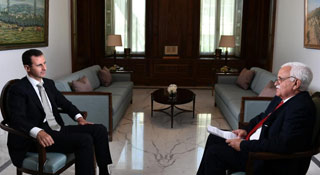
Prensa Latina transmits below the full text of the exclusive interview with Syrian President Bashar Al Assad:
PRENSA LATINA: Mr. President, thanks for giving Prensa Latina this historic opportunity of conveying your point of views to the rest of the world about the reality in Syria, because as you know, there is a lot of misinformation out there about your country, about the foreign aggression that is taking place against this beautiful country.
Mr. President, how would you evaluate the current military situation of the external aggression against Syria, and what are the main challenges of Syrian forces on the ground to fight anti-government groups? If it is possible, we would like to know your opinion about the battles or combats in Aleppo, in Homs.
President Assad: Of course, there was a lot of support to the terrorists from around the world. We have more than one hundred nationalities participating in the aggression against Syria with the support of certain countries like Saudi Arabia and Qatar with their money and Turkey with the logistical support, and of course with the endorsement and supervision of the Western countries, mainly the United States, France, and the UK, and some other allies.
But since the Russians decided to intervene in supporting legally the Syrian Army in fighting the terrorists in Syria, mainly al-Nusra and ISIS and some other affiliated groups, the scales have been tipped against those terrorists, and the Syrian Army has made many advancements in different areas in Syria.
And we are still moving forward, and the Syrian Army is determined to destroy and to defeat those terrorists. You mentioned Homs and Aleppo.
Of course, the situation in Homs, since the terrorists left Homs more than a year ago, the situation has been much, much better, more stable.
You have some suburbs of the city which were infiltrated by terrorists. Now there is a process of reconciliation in those areas in which either the terrorists give up their armaments and go back to their normal life with amnesty from the government, or they can leave Homs to any other place within Syria, like what happened more than a year ago in the center of the city.
For Aleppo it is a different situation, because the Turks and their allies like the Saudis and Qataris lost most of their cards on the battlefields in Syria, so the last card for them, especially for Erdogan, is Aleppo.
That is why he worked hard with the Saudis to send as much as they can of the terrorists – the estimation is more than five thousand terrorists – to Aleppo.
PRENSA LATINA: Through the Turkish borders?
President Assad: Yes, from Turkey to Aleppo, during the last two months, in order to recapture the city of Aleppo, and that didn’t work.
Actually, our army has been making advancement in Aleppo and the suburbs of Aleppo in order to encircle the terrorists, then, let’s say, either to negotiate their going back to their normal life as part of reconciliation, or for the terrorists to leave the city of Aleppo, or to be defeated. There’s no other solution.
PRENSA LATINA: Mr. President, which are the priorities of the Syrian Army in the confrontation with the terrorist groups? What is the role that the popular defence groups are playing in the theatre of operations?
President Assad: The priority of the Syrian Army, first of all, is to fight ISIS, al-Nusra and Ahrar al-Cham and Jaish al-Islam. These four organizations are directly linked to Al Qaeda through the ideology; they have the same ideology, they are Islamic extremist groups who want to kill anyone who doesn’t look or doesn’t feel or behave like them.
But regarding what you called the popular militia groups, actually, at the beginning of the war, the terrorists started an unconventional war against our army, and our army is a traditional army, like any other in the world, so the support of those popular defence groups was very important in order to defeat the terrorists in an unconventional way.
That was very helpful to the Syrian Army, because those fighters, those national fighters, they fight in their regions, in their cities, in their villages, so they know the area very well, they know the region very well, I mean the pathways, the terrain, let’s say, very well.
So, they can be very huge assets for the Syrian Army. That is their role.
PRENSA LATINA: Mr. President, how does the resistance of the Syrian people take place in the economic front to foreign aggression, I mean the economy, and please, what is your opinion on which sectors of the Syrian economy have remained functioning despite the war, economic blockade, looting, and so forth?
President Assad: Actually, the war on Syria is a full-blown war; it is not only supporting terrorists. They support the terrorists, and at the same time they launched a political war against Syria on the international level, and the third front was the economic front, in which they dictate to their terrorists, to their surrogate mercenaries, to start destroying the infrastructure in Syria that helped the economy and the daily needs of the Syrian citizens.
At the same time, they started an embargo directly on the borders of Syria through the terrorists and abroad through the banking systems around the world. In spite of that, the Syrian people were determined to live as much normal life as they can.
That prompted many Syrian businessmen or the owners of, let’s say, the industry, which is mainly medium and small industry, to move from the conflict areas and unstable areas toward more stable areas, on a smaller scale of business, in order to survive and to keep the economy running and to keep the needs of the Syrian people available.
So, in that regard, most of the sectors are still working. For example, the pharmaceutical sector is still working in more than 60 percent of its capacity, which is very important, helpful, and very supportive to our economy in such circumstances.
And I think now we are doing our best in order to re-expand the base of the economy in spite of the situation, especially after the Syrian Army made many advancements in different areas.
PRENSA LATINA: Mr. President, let’s talk a little bit about the international environment, please, give me your opinion about the role of the United Nations in the Syrian conflict, the attempts of Washington and its allies to impose their will on the Security Council and in the Geneva peace talks.
President Assad: Talking about the role of the United Nations or Security Council could be illusive, because actually the United Nations is now an American arm, where they can use it the way they want, they can impose their double standards on it instead of the Charter.
They can use it like any other institution within the American administration. Without some Russian and Chinese stances in certain issues, it would be a full American institution.
So, the Russian and Chinese role has made some balance within these institutions, mainly regarding the Syrian issue during the last five years. But if you want to talk about their role through their mediators or their envoys, like recently de Mistura, and before that Kofi Annan, and in between Brahimi, and so on. Let’s say that those mediators are not independent; they reflect either the pressure from the Western countries, or sometimes the dialogue between the main powers, mainly Russia and the United States.
So, they’re not independent, so you cannot talk about the role of the United Nations; it is a reflection of that balance. That is why so far, there is no United Nations role in the Syrian conflict; there is only Russian and American dialogue, and we know that the Russians are working hard and seriously and genuinely in order to defeat the terrorists, while the Americans always play games in order to use the terrorists, not to defeat them.
PRENSA LATINA: Mr. President, how do you see at the present time the coexistence among Syrian ethnic and religious groups against this foreign intervention? How do they contribute or not in this regard?
President Assad: The most important thing about this harmony between the different spectrums of the Syrian fabric, is that it is genuine, because that has been built up through the history, through centuries, so for such a conflict, it cannot destroy that social fabric.
That is why if you go around and visit different areas under the control of the government, you will see all the colors of the Syrian society living with each other.
And I would say, I would add to this, that during the conflict, this harmony has become much better and stronger, and this is not rhetoric; actually, this is reality, for different reasons, because this conflict is a lesson.
This diversity that you have, it is either to be a richness to your country, or a problem. There’s no something in the middle. So, the people learned that we need to work more on this harmony, because the first rhetoric used by the terrorists and by their allies in the region and in the West regarding the Syrian conflict at the very beginning was sectarian rhetoric.
They wanted people to divide in order to have conflict with each other, to stoke the fire within Syria, and it didn’t work. And the Syrians learned that lesson, that we had harmony; we had had harmony before the conflict, in the normal times, but we have to work more in order to make it much stronger.
So, I can say without any exaggeration that the situation regarding this part is good. In spite of that, I would say the areas under the control of the terrorists – and as you know those terrorists are mainly extremist groups affiliated to Al Qaeda – in which they worked very hard in order to indoctrinate the young generation with their dark ideology, and they succeeded in some areas, this dark ideology with the killing and beheading and all these horrible practices.
With the time, it is going to be more difficult to deal with this new generation of young people who have been indoctrinated with Al Qaeda and Wahabi doctrine and ideology. So this is the only danger that we are going to face regarding our society, harmony, and coexistence that you just mentioned.
PRENSA LATINA: Mr. President, I would like to go again to the international arena. What is in your opinion the role of the U.S.-led international coalition in relation to the groups that operate in northern Syria, in particular regarding the Kurds group. I mean the bombing of the American airplanes and the coalition in the northern part of the country. What to do you think about that?
President Assad: You know, traditionally, the American administrations, when they had relations with any group or community in any country, it is not for the sake of the country, it is not for the interest of the people; it is for the agenda of the United States.
So, that is what we have to ask ourselves: why would the Americans support any group in Syria? Not for Syria. They must their agenda, and the American agenda has always been divisive in any country. They don’t work to unite the people; they work to make division between the different kinds of people.
Sometimes they choose a sectarian group, sometimes they choose an ethnical group in order to support them against other ethnicities or to push them in a way that takes them far from the rest of the society.
This is their agenda. So, it is very clear that this American support is not related to ISIS, it is not related to al-Nusra, it is not related to fighting terrorism, because since the beginning of the American intervention, ISIS was expanding, not shrinking. It has only started to shrink when the Russian support to the Syrian Army took place last September.
PRENSA LATINA: Mr. President, what is your opinion about the recent coup d’état in Turkey, and its impact on the current situation in that country, and on the international level, and on the Syrian conflict also?
President Assad: Such a coup d’état, we have to look at it as a reflection of instability and disturbances within Turkey, mainly on the social level. It could be political, it could be whatever, but at the end, the society is the main issue when you have instability.
Regardless of who is going to govern Turkey, who is going to be the president, who is going to be the leader of Turkey; this is an internal issue. We don’t interfere, we don’t make the mistake to say that Erdogan should go or should stay. This is a Turkish issue, and the Turkish people have to decide.
But what is more important than the coup d’état itself, we have to look at the procedures and the steps that are being taken by Erdogan and his coterie recently during the last few days, when they started attacking the judges; they removed more than 2,700 judges from their positions, more than 1,500 professors in the universities, more than 15,000 employees in the education sector. What do the universities and the judges and that civil society have to do with the coup d’état?
So, that reflects the bad intentions of Erdogan and his misconduct and his real intentions toward what happened, because the investigation hasn’t been finalized yet. How did they take the decision to remove all those?
So, he used the coup d’état in order to implement his own extremist agenda, Muslim Brotherhood agenda, within Turkey, and that is dangerous for Turkey and for the neighboring countries, including Syria.
PRENSA LATINA: Mr. President, how do you evaluate the Syrian government’s relations with the opposition inside Syria? What is the difference between these opposition organizations and those based outside Syria?
President Assad: We have good relations with the opposition within Syria based on the national principles. Of course, they have their own political agenda and they have their own beliefs, and we have our own agenda and our beliefs, and the way we can make the dialogue either directly or through the ballot boxes; it could be a different way of dialogue, which is the situation in every country.
But we cannot compare them with the other oppositions outside Syria, because the word “opposition” means to resort to peaceful means, not to support terrorists, and not to be formed outside your country, and to have grassroots, to have real grassroots made of Syrian people.
You cannot have your grassroots be the foreign ministry in the UK, Franceor the intelligence in Qatar and Saudi Arabia and the United States. This is not opposition, this is called, in that case, you are called a traitor.
So, they call them oppositions, we call them traitors. The real opposition is the one that works for the Syrian people and is based in Syria and its agenda derived its vision from the Syrian people and the Syrian interests.
PRENSA LATINA: Mr. President, how do you evaluate the insistence of the U.S. and its allies that you leave power in addition to the campaign to distort the image of your government?
President Assad: Regarding their wish for me to leave power, they have been talking about this for the last five years, and we never responded even with a statement.
We never cared about them. Actually, this is a Syrian issue; only the Syrian people can say who should come and go, who should stay in his position, who should leave, and the West knows our position very well regarding this.
So, we don’t care and don’t have to waste our time with their rhetoric. I am here because of the support of the Syrian people. Without that, I wouldn’t be here. That is very simple.
About how they defame, or try to demonize certain presidents, this is the American way, at least since the second World War, since they substituted British colonization in this region, and maybe in the world, the American administrations and the American politicians haven’t said a single honest word regarding anything.
They always lie. And as time goes by, they are becoming more inveterate liars, so this is part of their politics. So, to demonize me is like how they tried to demonize President Vladimir Putin during the last two years and they did the same with the Cuban leader Fidel Castro during the last five decades.
This is their way. So, we have to know that this is the American way. We don’t have to worry about it. The most important thing is to have good reputation among your own people. That is what we have to worry about.
PRENSA LATINA: Mr. President, what is your opinion on Syria’s relation with Latin America, particularly the historical links with Cuba?
President Assad: In spite of the long distance between Syria and Latin America, we are always surprised how much the people in Latin America, not only the politicians, know about this region. I think this has many reasons, but one of them is the historical similarities and commonalities between our region, between Syria and Latin America.
Latin America was under direct occupation for long time ago but after that it was under the occupation of the American companies, and the American coup d’états and the American intervention.
So, they know what is the meaning of being independent or not to be independent. They understand that the war in Syria is about independence.
But the most important thing is the role of Cuba. Cuba was the spearhead of the independence movement within Latin America and Fidel Castro was the iconic figure in that regard.
So, on the political level and the knowledge level, there is a strong harmony between Syria and Latin America, especially Cuba. But I do not think we work enough to improve the other part of the relation; to be on the same level mainly on the educational and the economic level.
That was my ambition before the crisis and that is why I visited Latin America, Cuba, Venezuela, Argentine and Brazil, in order toinvigorate this relation. Then, we had this conflict started and it was a big obstacle to do anything in that regard, but I think that we have not to restrain the relation on the historical and the political levels. That is not enough. You have so many other sectors, people should know more about each other. The long distance could be an obstacle, but it shouldn’t because we have strong relations with the rest of the world, east and west.
So, it is not an obstacle in these days. So, I think if we overcome this crisis and this war, we should work harder in order to invigorate the different sectors of this relation with Latin America and especially with Cuba.
PRENSA LATINA: Mr. President, would you tell me your opinion about the electoral process in the United States mainly for the president? Now, there are two candidates; the Republican one is Mr. Donald Trump and the Democrat one is Mrs. Hillary Clinton, what is your opinion about this process, about the result of this process and how it could impact the conflict here, in the war in Syria?
President Assad: We resumed our relation with the United States in 1974. Now, it has been 42 years since then and we witnessed many American presidents in different situations and the lesson that we have learned is that no one should bet on any American president, that is the most important thing. So, it is not about the name.
They have institutions, they have their own agenda and every president should come to implement that agenda in his own way, but at the end he has to implement that agenda.
All of them have militaristic agendas, and the only difference is the way. One of them sends his army like Bush and the other one sends mercenaries and proxies like Obama, but all of them have to implement this agenda.
So, I do not believe that the president is allowed completely to fulfill his own political convictions in the United States, he has to obey the institutions and the lobbies, and the lobbies have not changed and the institutions’ agenda has not change.
So, no president in the near future will come to make a serious and dramatic change regarding the politics of the United States.
PRENSA LATINA: Mr. President, one final question: what message would you send using this interview with Prensa Latina to the governments and people of Latin America, the Caribbean, and also why not the American people, about the importance of supporting Syria against terrorism?
President Assad: Latin America is a very good and important example to the world about how the people and their governments regain their independence.
They are the backyard of the United States as the United States sees, but this backyard was used by the United States to play its own games, to implement its own agenda and the people in Latin America sacrificed a lot in order to regain their independence and everybody knows that.
After regaining their independence, those countries moved from being developing countries, or sometimes under-developed countries, to be developed countries. So, independence is a very important thing and it is very dear for every Latin American citizen.
We think they have to keep this independence because the United States will not stop trying to topple every independent government, every government that reflects the vast majority of the people in every country in Latin America.
And again, Cuba knows this, knows what I am talking about more than any other one in the world; you suffered more than anyone from the American attempts and you succeeded in withstanding all these attempts during the last sixty years or more just because the government reflected the Cuban people.
So, holding strongly to this independence, I think, is the crucial thing, the most important thing for the future of Latin America. Regarding Syria, we can say that Syria is paying the price of its independence because we never worked against the United States; we never worked against France or the UK. We always try to have good relations with the West.
But their problem is that they do not accept any independent country and I think this is same for Cuba. You never tried to do any harm to the American people but they do not accept you as an independent country.
The same is true for other countries in Latin America and that’s why you always have coup d’états mainly between the sixties and the seventies.
So, I think preserving the independence of a certain country is not only an isolated case; if I want to be independent, I have to support the independence in the rest of the world. So, the independence anywhere in the world, including Latin America, will support my independence. If I am alone, I will be weak.
Supporting Syria will be mainly in the international arena. There are many international organizations, mainly the United Nation, in spite of its impotence, but at the end, their support could play a vital role in supporting Syria and, of course, the Security Council; it depends on who is going to be the temporary member in the Security Council, and any other organization supporting Syria will be very important.
PRENSA LATINA: Mr. President, we know you are a very busy person, that is why I appreciate very much your time that you have dedicated to Prensa Latina interview in this moment. I hope this would not be the last interview that we have with you.
President Assad: You are welcome anytime.
Featured Video
John Mearsheimer: The Case for a Nuclear Iran
or go to
Aletho News Archives – Video-Images
From the Archives
Ethnic Cleansing in a Zionist Fairyland
By Vacy Vlazna | Palestine Chronicle | February 10, 2012
‘De-Arabizing the history of Palestine is another crucial element of the ethnic cleansing. 1500 years of Arab and Muslim rule and culture in Palestine are trivialized, evidence of its existence is being destroyed and all this is done to make the absurd connection between the ancient Hebrew civilization and today’s Israel. The most glaring example of this today is in Silwan, (Wadi Hilwe) a town adjacent to the Old City of Jerusalem with some 50,000 residents. Israel is expelling families from Silwan and destroying their homes because it claims that king David built a city there some 3000 years ago. Thousands of families will be made homeless so that Israel can build a park to commemorate a king that may or may not have lived 3000 years ago. Not a shred of historical evidence exists that can prove King David ever lived yet Palestinian men, women, children and the elderly along with their schools and mosques, churches and ancient cemeteries and any evidence of their existence must be destroyed and then denied so that Zionist claims to exclusive rights to the land may be substantiated.’ — Miko Peled, Israeli dissident.
Indeed, archaeology has become a state apparatus for the ethnic cleansing of Palestinians in the Zionist fairyland aka the City of David Archaeological Park located in the Palestinian village of Silwan in East Jerusalem.
East Jerusalem is the proclaimed capital of the proposed Palestine state. It was illegally annexed by Israel in the 1967 war. Prohibiting annexation of territories gained by military conquest is one of the major principles of international law. The international community does not recognise Israel’s annexation of East Jerusalem nevertheless over 50,000 illegal premises have been built for 250,000 illegal Israeli colonists.
The goal of the archaeological judaisation of Jerusalem is to transform Jerusalem into the City of David, the capital of Greater Israel by eradicating the mixed ethnic composition of the Palestinian and Jewish population of East Jerusalem to a solely Jewish identity and unifying East and West Jerusalem under Israeli sovereignty. … continue
Blog Roll
 Aletho News
- The US’ self-directed ‘China nuclear threat’ will only be a waste of effort: Global Times editorial
- Female Iranian academic sentenced to 4 years in prison in France over protesting Israel’s genocide in Gaza
- US university cancels Palestine conference citing sanctions concerns
- Senate Majority Leader: Any War with Iran Should Result in Regime Change
- Iraqi Resistance warns of action if US forces remain
- China, Russia slam US threat, force against Iran ahead of talks
- US fears Iran war will ‘deplete’ air defenses stretched thin by Ukraine, Israel: Report
- Top AIs deploy nukes in 95% of war game simulations – study
- Could Hungary’s fight over oil change course of Ukraine War?
- North Korea Open to Rapprochement If US Respects Its Nuclear Status – Kim Jong-un
- If Americans Knew
- Israel warns of a Ramadan escalation — while doing everything to provoke one
- Democrats Should Release Their 2024 Election Autopsy – and Stop the Gaza Denial
- Israel responsible for 2/3 of press killings worldwide – Not a ceasefire Day 139
- Are the Jews indigenous to Palestine?
- AIPAC Wants to Kill a Bill that would Ensure Israel Complies with Ceasefire
- Former Israeli PM, in Epstein Files, Dreamed of Israeli Eugenics and Pretty Converts
- Israeli settlers join ‘safari’ tour of Palestinian prisoners
- Flooding in Gaza amid rumors of war; fire in West Bank – Not a ceasefire Day 138
- Fourteen Countries Condemn Huckabee’s Support for Israel Taking Over Most of the Middle East
- Israeli Soldiers Killed Gaza Aid Workers at Point Blank Range in 2025 Massacre: Report
- No Tricks Zone
- Surprising Discovery: Sahara Is Greening…Billions Of Trees Where Once Thought To Be Barren
- New Research Reaffirms Clouds, Aerosols, And Surface Solar Radiation Are ‘Driving The Climate System’
- Germany: Electric Car Catches Fire At Charging Station, Sets Off Local “Inferno”, Widespread Damage
- New Study: Canada’s New Brunswick Was 1°C Warmer Than Today During The Medieval Warm Period
- Coal Power Back In Trend As Globe Tries To Keep Pace With Growing Demand For Power
- New Study: A 4°C Warmer Beaufort Sea Had ‘No Sea Ice’ 11,700 – 8200 Years Ago
- Unfudging The Data: Dutch Meteorological Institute Reinstates Early 20th Centruy Heat Waves It Had Erased Earlier
- German Gas Crisis…Chancellor Merz Allegedly Bans Gas Debate Ahead of Elections!
- Pollen Reconstructions Show The Last Glacial’s Warming Events Were Global, 10x Greater Than Modern
- Germany’s Natural Gas Storage Level Dwindles To Just 28%… Increasingly Critical
 Aletho News