Iran sanctions: US Treasury lists 13 individuals, 12 business entities
RT | February 3, 2017
The US government has blacklisted 13 individuals and a dozen businesses under the Iran sanctions authority, a day after President Donald Trump’s administration threatened a response over Tehran’s ballistic missile tests.
The Treasury Department posted a listing on Friday, naming the individuals and the companies added to the sanctions list. Eight of the individuals are listed as Iranian citizens, three appear to be Chinese, and two Arab.
Most of the businesses listed in the announcement are based in Iran, though one of the entities is located in the United Arab Emirates, two are in China, and three are in Lebanon.
“Today’s action is part of Treasury’s ongoing efforts to counter Iranian malign activity abroad,” said John E. Smith, acting director of the Treasury Department’s Office of Foreign Assets Control.
“Iran’s continued support for terrorism and development of its ballistic missile program poses a threat to the region, to our partners worldwide, and to the United States,” Smith said. “We will continue to actively apply all available tools, including financial sanctions, to address this behavior.”
Meanwhile, the guided missile destroyer USS Cole arrived in the waters off the coast of Yemen on Friday, where it will conduct patrols to “protect waterways” from the Houthi rebels, unnamed US officials told reporters.
“Iran is unmoved by threats as we derive security from our people,” Iran’s foreign minister Mohammad Javad Zarif said ahead of the announcement. “We will never use our weapons against anyone, except in self-defense,” he added later.
Gareth Porter: Trump may continue Obama legacy of supporting Saudi war against Yemen
RT | February 2, 2017
We have witnessed big payoffs to the Pentagon in the form of the ability to sell arms to the Saudis – at least to $200 billion estimated over two decades – to American arms makers, Gareth Porter, investigative journalist, told RT.
US House Democrat leader Nancy Pelosi lashed out at the Trump administration’s handling of the conflict in Yemen on CNN, after a Yemeni refugee in one of the programs told the tragic story of her family.
Pelosi said that girl’s family is suffering because the US president “is reckless and his administration is incompetent.”
However, Pelosi failed to acknowledge the Obama administration’s own contribution to the humanitarian disaster unfolding in Yemen due to arms contracts and other forms of cooperation with Riyadh.
RT: Why did US Democrat leader Nancy Pelosi focus on Trump’s travel ban and not the real reasons for the suffering of the girl’s family?
Gareth Porter: Well, Nancy Pelosi is the Democratic leader in the House, the minority leader in the House of Representatives. She is going to support the partisan position on this question of policy toward Yemen, which means that she’s going to be unwilling to acknowledge the responsibility of the Obama administration for the war that has afflicted the population of Yemen, and is now a humanitarian catastrophe, as far as I know, the worst in the world, or at least in that part of the Middle East.
It seems to be much more serious than the crisis in Syria in terms of the actual danger to millions of people; in terms of their access to food. Therefore, we have a situation where there is a great deal of famine already or, at least close to famine-like conditions in Yemen, because of the bombing carried out by the US ally, Saudi Arabia.
RT: In December, just a month before Obama left office, his administration decided to limit military support to Saudi Arabia on concern over civilian casualties. What do you make of the timing of that decision?
GP: Well, I think the point about that decision by the Obama administration is that it was far too little, far too late. It was merely a reduction in US support for the war that is direct support by the US personnel taking part in the assistance to the Saudis in Riyadh. It did not end the really crucial aspects of the Obama administration’s assistance to the Saudis and their allies, which was primarily to provide the refueling for the planes that have carried out the air attacks, which have so completely destroyed the society in large parts of Yemen – in more than half of Yemen. This is the crucial issue, which the Obama administration has never been willing to deal with in terms of its complicity with the war crimes of the Saudi government and its allies.
In addition to that, after months of this bombing which Amnesty International regards as filled with war crimes, because of the deliberate targeting of cities that were regarded as supportive of the Houthis, the US then renewed the agreement to provide bombs to the Saudi government for carrying out this war. So it was in effect a sort of public support for the Saudi war. The US still remains completely complicit in this war…
RT: Critics are branding the US approach to Yemen, one of ‘cautious approval,’ on the one hand, keep supplying the Saudis with arms, on the other staying silent on the country’s growing humanitarian catastrophe. What’s your take on that approach?
GP: Well, my take is that what is happening here – the Obama administration has been essentially tied to the Saudi interests in Yemen, as they have been in Syria to a great extent of the past by the degree to which the permanent government in the US – the Pentagon, the CIA, the NSA – all have very, very close relations with their counterparts in Saudi Arabia. Arrangements which have provided big payoffs to the Pentagon and these other agencies in the form of the ability to sell arms to the Saudis – at least to $200 billion estimated over two decades – to American arms makers, and the contracts with the Saudis to provide intelligence services by the CIA and NSA, which are very lucrative for those agencies.
So these war powers in the US are very unwilling to have any US policy that would criticize, much less take away, support for the Saudi war so that these arrangements can continue. I am very much afraid that the Trump administration will be subject to the same logic, the same political forces that have kept the Obama administration from taking any responsibility for what is going on in Yemen.
British activists attempt to disarm fighter jets bound for Saudi Arabia
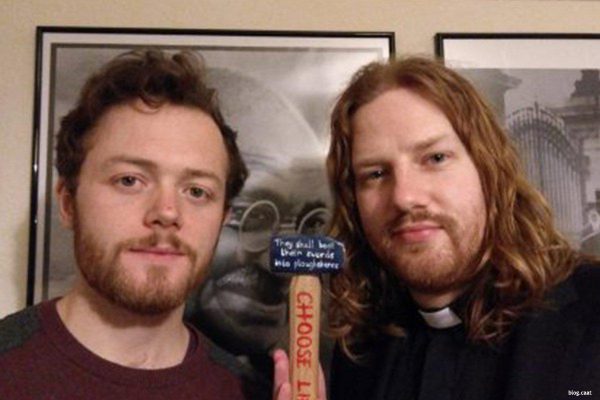
Daniel Woodhouse and Sam Walton (blog.caat )
MEMO | January 30, 2017
Two British activists have been arrested while apparently trying to disarm warplanes bound for Saudi Arabia. Daniel Woodhouse, a Methodist minister from Leeds, and Quaker Sam Walton were released on bail pending charges after breaking into BAE’s Warton site in Lancashire.
The pair were arrested in the early hours of Sunday morning while attempting to disarm fighter jets due to be delivered to the Royal Saudi Air Force for use, it is assumed, in coalition bombing raids on Yemen. The aircraft are part of a multi-billion pound deal between BAE Systems and the Saudi regime, and were due to be shipped to Saudi Arabia within weeks.
“BAE security found us just metres from war planes bound for Saudi Arabia,” the two said on their release. “We’re gutted that we couldn’t disarm a plane and stop it being used to carry out airstrikes in Yemen. We could have saved lives by preventing Saudi war crimes in Yemen.”
They added their belief that the British government has blood on its hands and that there is a need to do everything possible to stop the transfer of weapons and show that such sales are illegitimate. “By providing weapons and support,” insisted the campaigners, “Britain is deeply complicit in Saudi war-crimes, and it’s vital that we bring an end to this immoral, abhorrent trade.”
Speaking to MEMO, Mr Woodhouse mentioned that he and his colleague have been campaigning against British arms sale to human rights violators like Saudi Arabia, Israel and Bahrain for “donkey’s years”. He and Walton were just “metres” away from the aircraft, he said, which they were hoping to “render physically incapable.” When prompted to explain how they had planned to do that, Woodhouse referred to a famous case in 1996 when ten women entered the same site to disable a plane bound for Indonesia to be used in the genocide in East Timor, armed with only a hammer. The two men took this “symbolic act,” he said, “to mirror the rightness of the actions of the three women, which a jury 21 years ago found to be lawful.”
In their statement, the activists stressed that their actions had been planned over many months, adding: “We do not take these steps lightly, but we have no other option. We have been active in opposing the arms trade to Saudi Arabia for years, and in the face of wilful government denial that there is a problem with arming Saudi, including willingness to suspend our own due process of law, and complete unwillingness to consider stopping arming Saudi Arabia, we must take this action.”
Britain has approved over £3.3 billion worth of arms to Saudi forces since the bombing of Yemen began in March 2015, and continues to approve arms licences despite repeated allegations of war crimes being committed.
King Salman has no issues with Trump
By M K Bhadrakumar | Indian Punchline | January 30, 2017
The US President Donald Trump must be a man with a queer sense of humour. He kept the call to King Salman of Saudi Arabia pending for his announcement on Friday to fully sink in – to the effect that the Saudi citizens will be subject to “extreme vetting” before being allowed to enter America.
Trump singled out Saudi Arabia as the only GCC country to be treated badly like this, on par with Afghanistan and Pakistan. Finally, Trump made the call to Salman on Saturday. One would have liked to be a fly on the wall in the Oval Office. From all accounts, neither side showed fluster. The conversation was smooth as silk.
Salman is the Custodian of the Two Holy Places, and yet he didn’t raise the issue of Trump’s Muslim ban, which has created a world-wide uproar, including among non-believers.
Not only that, the accounts of the conversation suggest that Trump’s main purpose was to demand that Saudi Arabia should fund the ‘safe zones’ in Syria and Yemen – yes, Yemen, too, where the Saudis have been involved in a war of destruction. Simply put, Trump pricked the Saudi pride and 24 hours later asked Riyadh for money. Apparently, Salman agreed.
Thereupon, Trump and Salman agreed on the importance of making ‘joint efforts’ to erase the Islamic State from the face of the earth. The White House readout says,
- The president requested, and the King agreed, to support safe zones in Syria and Yemen, as well as supporting other ideas to help the many refugees who are displaced by the ongoing conflicts.
The Saudi press agency initially omitted any reference to Salman’s commitment on the ‘safe zones’, but later put out an amended version to say, “The custodian of the Two Holy Mosques had confirmed his support and backing for setting up safe zones in Syria.” It nonetheless did not mention Yemen, where a Saudi alliance is waging a bloody military campaign against the Houthi group.
The Saudi version emphasised that Salman and Trump affirmed the “depth and durability of the strategic relationship” between the two countries. For Salman, it is crucially important to proclaim that Trump intends to continue with the strategic ties with Saudi Arabia. His main worry would be that without Trump’s support, Iran will steal a march over Saudi Arabia as the dominant Muslim power in the Middle East.
Curiously, Salman went on to invite Trump “to lead a Middle East effort to defeat terrorism and to help build a new future, economically and socially.” Plainly put, Saudi Arabia is petrified about a US retrenchment from the Middle East and is willing to overlook anything – even the humiliating blow of Trump’s Muslim ban – if only the American troops stayed on.
Salman’s fawning attitude in the face of Trump’s Muslim ban will put the Ummah in a quandary. Logically, Saudi Arabia ought to have reacted strongly in the same unequivocal manner in which Iran has reacted. No sooner than Trump announced a travel ban on Iranian nationals, Tehran imposed a reciprocal ban on US citizens. A foreign ministry statement said in Tehran on Saturday,
- While respecting the American people and distinguishing between them and the hostile policies of the U.S. government, Iran will implement the principle of reciprocity until the offensive U.S. limitations against Iranian nationals are lifted.
Herein lies the secret of the western hegemony over Muslim Middle East. The bizarre truth is that the Gulf Arab regimes relish criticizing the US’s policies but cannot live without US military support because without that support they would collapse like a pack of cards. Besides, the Saudi elites keep their illegal private wealth in western banks and they own vast properties and business interests in the US. They travel to the US for fun as a permissive home away from their Wahhabi environs. In sum, they simply cannot afford to uphold self-respect and dignity as norms in their dealings with the Americans.
To be sure, Trump has put fear into the Saudi mind. What worries Salman most is Trump’s earlier stance that if the families of the victims of 9/11 attacks seek compensation from Saudi Arabia, he wouldn’t stand in the way. The finger has been pointed at important figures in the House of Saud for complicity in the 9/11 attacks.
But the Iranians have no such problem. They can insist on equal relationship and mutual respect from Washington because they owe Trump nothing. I can only echo Pakistani politician Imran Khan’s stirring call: “’Iran is an independent nation and other (Muslim) nations need to follow Iran against foreign pressures.” But then, Khan Saheb is asking too much.
Middle East: Rapid Tectonic Changes on Regional Chessboard
By Peter KORZUN | Strategic Culture Foundation | 30.01.2017
The Middle East geopolitical scenarios are going through rapid changes with new factors emerging on the regional chessboard.
Cairo’s foreign policy has been given a new twist. It has been announced recently that Egypt is set to receive one million barrels of petroleum per month from Iraq. Saudi Arabia had informed Egypt that shipments of oil products expected under a $23 billion aid deal have been halted indefinitely, suggesting a deepening rift between the countries. From now on, Egypt will enjoy as much oil as it needs at a lower cost, compared to Saudi pricing.
Egyptian President Al-Sisi rejected the Saudi-backed efforts to overthrow the regime of Bashar Assad. He is also reaching out to former-Yemeni president Ali Abdullah Saleh and to his Houthi allies Saudi Arabia is fighting since March 2015. Cairo opened diplomatic channels with the pro-Iranian Lebanese Hezbollah, fighting on the side of President Assad in Syria against the rebel groups supported by Riyadh.
Iraq will provide Egypt with 1 million barrels of Basra light oil each month. The agreement involves extending an oil pipeline from Iraq to Egypt via Jordan. In December, Iraqi petroleum minister Ali al-Luiabi met with the heads of major oil and natural gas companies in Cairo, inviting them to contribute into developing the industry in his country.
Egypt is about to train four Iraqi army units on war against terrorism, in light of the rapprochement between Egypt and the Iraqi-Iranian axis in the region.
It also mulls sending peacekeeping troops to Syria during the coming days to support the ceasefire agreement under the auspices of Russia, Iran, and Turkey. It has been reported that a unit of Egyptian ground forces might deploy to Syria this month. Last October, Syrian National Security Bureau head Ali Mamlouk visited Cairo to meet Khaled Fawzy, the head of Egypt’s General Intelligence Service. The two sides agreed to coordinate political positions and strengthen cooperation in «the fight against terror».
Egypt is a predominantly Sunni nation. Its open support of the Russia-backed coalition in Syria is a game changing event of fundamental importance. It makes the sectarian interpretation of the Syria’s conflict not valid anymore.
Middle East Observer quotes Nziv Net, an Israeli outlet close to intelligence sources, saying that «Egypt has sent a group of officers to Syria for the first time since the relations have frozen during Morsi’s reign».
Last December, Ibrahim al-Eshaiker al-Jaafari, the Iraqi Foreign Minister, called on Egypt to participate in a «strategic project to fight terrorism», which includes Iran.
In September, Egyptian Foreign Minister Samih Shoukry met for the first time with his Iranian counterpart, Jawad Zarif, during their visits to New York to attend the UN General Assembly.
In October, Egypt backed a Russian-backed motion in the UN calling for a ceasefire in Syria. The move angered Saudi Arabia, which suspended oil shipments to Cairo.
Egyptian President Abdel Fattah al-Sisi publicly affirmed his support for the forces of Syrian President Bashar al-Assad.
The relations between Russia and Egypt have been on the rise. In February 2015, Egypt signed a breakthrough agreement on establishing a free trade zone with the Russia’s Eurasian Economic Union.
The progress in military cooperation is tangible. Egypt signed arms deals with Russia worth up to $5 billion by 2015 to include 50 MiG-29M combat aircraft, Buk-M2E and Antey-2500 long range air defense systems and about 50Ka-52K helicopters for Egypt’s new Mistral-class assault ships bought in France. The ships will receive the originally planned Russian helicopters and electronics suite.
The two countries signed several agreements for the renovation of military production factories in Egypt. A protocol is signed to grant Egypt access to GLONASS, the Russian global satellite positioning system. In September, Minister of Defense Sedky Sobhy visited Russia to discuss the issues related to long-term close security relationship. Last October, the militaries held a joint exercise.
Egypt is the most populous country in North Africa and the Arab world, the third-most populous in Africa and the fifteenth-most populous in the world. Last year, the country’s population has just reached 92 million. Its policy shift is well-substantiated. Cairo is fighting the Islamic State on the Sinai Peninsula. The fierce fighting there seldom hits media headlines but the IS poses a grave threat to Egypt. IS militants can also strike Egypt from Libya. The IS presence in Libya brings Egypt and Algeria together as the two great nations face the same threat.
The emerging Iran, Iraq, Russia and Turkey alliance may also include Algeria. In response to the growing menace, Algiers is strengthening ties with Moscow. It has recently purchased 14 Su-30MKA fighters and 40 Mi-28 «Night Hunter» attack helicopters from Russia. Last February, Russia and Algeria laid out a road-map for deepening bilateral economic and military cooperation during Russian Foreign Minister Sergei Lavrov’s visit to Algeria.
Russia’s cooperation with Egypt, Algeria and other countries of the Middle East and North Africa reflects Moscow’s growing clout in the region.
With the Astana process making progress, other large and influential actors, such as Syria, Iraq, Egypt and Algeria, may join the emerging Russia, Iran, Turkey coalition to make the Middle East-North Africa (MENA) region face tectonic and dramatic changes.
‘No legitimate military objectives’: UN panel finds Saudi strikes in Yemen may amount to war crimes
RT | January 29, 2017
An expert UN panel investigating ten separate airstrikes by the Saudi-led coalition in Yemen – in which at least 292 civilians died – has found that most were the result of an ‘ineffective targeting process’ or deliberate attacks on peaceful targets.
“In eight of the 10 investigations, the panel found no evidence that the airstrikes had targeted legitimate military objectives,” the 63-page report presented to the UN Security Council on Friday stated, which has been obtained by Reuters. “For all 10 investigations, the panel considers it almost certain that the coalition did not meet international humanitarian law requirements of proportionality and precautions in attack.”
“The panel considers that some of the attacks may amount to war crimes,” the experts said, echoing statements repeatedly made by independent observers since conflict broke out in the country two years ago.
The small subset of attacks, which took place between March and October last year, resulted in the deaths of over 100 women in children. Earlier this month, the UN humanitarian coordinator for Yemen, Jamie McGoldrick, estimated that more than 10,000 people have been killed in the war so far, with many of them the victims of air strikes.
Saudi Arabia’s UN Ambassador, Abdallah Al-Mouallimi, flatly denied responsibility, saying the coalition – which includes Gulf states such as Qatar and Kuwait – was “exercising maximum restraint and rigorous rules of engagement.”
The panel also stated that the alliance admitted that some of their airstrikes resulted in severe casualties, which was not the desired outcome.
“In some cases errors were acknowledged and responsibility accepted. Corrective measures including compensation to victims were taken,” the authors of the report wrote.
The UN panel said that although it was unable to travel to the bombing sites, it still “maintained the highest achievable standard of proof,” and insisted the specific cases studied were part of a wider trend.
“The panel finds that violations associated with the conduct of the air campaign are sufficiently widespread to reflect either an ineffective targeting process or a broader policy of attrition against civilian infrastructure,” proclaimed the report. “All coalition member states and their allies also have an obligation to take appropriate measures to ensure respect for international humanitarian law by the coalition.”
The UN group also dismissed Saudi explanations that the devastating naval blockade of Yemen had been imposed because Iran was supplying Shia Houthi rebels with weapons.
“The panel has not seen sufficient evidence to confirm any direct large-scale supply of arms from the Government of the Islamic Republic of Iran, although there are indicators that anti-tank guided weapons being supplied to the Houthi or Saleh forces are of Iranian manufacture,” said the report, which said 2,064 weapons seized on boats off the coast, had possible “direct” links with Iran.
The UN criticized the blockade for its “disproportionate impact” on civilians, saying the country, 90 percent of whose food supplies are imported, is on the verge of famine. Yemen was already one of the region’s poorest states before the current crisis, but according to the UN, 14.1 million people – over half of the population – are “food insecure,” and over two-thirds require humanitarian assistance, due to internal displacement, lack of medical supplies and clean drinking water.
Despite the devastating conclusions of the latest UN report, the US and UK, which are not directly taking part in the bombardment and blockade of Yemen, have avoided directly criticizing Riyadh, a longtime ally.
“We urge all sides to take steps to prevent harm to civilians. Ending the conflict in Yemen requires a durable cessation of hostilities and a comprehensive political solution,” the US State Department said in a statement.
The British mission to the UN, while refusing to comment on the specific incidents mentioned in the report said, “We take reports of alleged violations of international humanitarian law by actors in the conflict very seriously.”
Both the US and the UK have been major suppliers of arms to the Saudis. In September 2016, Reuters reports, the US Senate cleared the way for a $1.15 billion sale of tanks and other military equipment to kingdom. Saudi Arabia has also been buying arms from the UK – with estimated purchases at some 3.3 billion pounds. That includes more than 2.2 billion worth of warplanes, helicopters and drones.
Read more:
Severely malnourished Yemeni children in urgent need of help filmed by RT Arabic (DISTURBING IMAGES)
US commandoes attack Yemen’s Bayda, kill 57: Reports
Press TV – January 29, 2017
US forces have carried out a series of ground and air raids against a village in the Yemeni province of Bayda, killing a total of 57 people, among them civilians.
US paratroopers parachuted in Bayda’s Qifah district and raided the Yakla village there, with some 30 aircraft such as Apache helicopters and drones taking part in the operations.
Saudi media said 16 civilians, among them women and children, lost their lives in the US assault.
Reports said the rest of those killed were militants with the al-Qaeda terror group, including three of its ringleaders.
“The operation began at dawn when a drone bombed the home of Abdulraoof al-Dhahab and then helicopters flew up and unloaded paratroopers at his house and killed everyone inside,” an unnamed local told AFP.
The Lebanese al-Mayadeen television channel reported that a US soldier was also killed during clashes with militants.
Two years ago, US troopers conducted a similar operation in Yemen’s Hadhramaut Province to allegedly save an American reporter who was held captive by al-Qaeda. However, the operation was unsuccessful and left the correspondent dead.
Separately on Sunday, Saudi fighter jets mistakenly bombarded positions held by Riyadh’s own mercenaries in Bayda Province.
Arabic-language al-Masirah television network quoted an informed military source as saying that the Saudi warplanes had also targeted homes in Bayda’s al-Quraishyah and Sharyah neighborhoods.
Similar Saudi air raids were also carried out in the districts Harad and Nasim in Hajjah Province as well as the Sirwah neighborhood of Ma’rib Province.
The Saudi jets further targeted al-Amri district of Ta’izz Province with cluster bombs.
Elsewhere, in Shabwah Province, a large number of Saudi mercenaries were killed and injured in the Yemeni army’s rocket attacks.
Additionally, 50 Saudi mercenaries, among them foreign nationals, were killed and injured in clashes with the Yemeni army forces in the port city of Mokha and Dhubab district, both situated in Ta’izz Province.
Three rocket attacks also hit downtown Zanzibar in Abyan Province.
The Riyadh regime has been incessantly pounding Yemen since March 2015 in a bid to reinstall the country’s ex-government and crush the Houthi Ansarullah movement.
The Houthis and the Yemeni army have been defending Yemen against the Saudi offensive for almost two years.
The military aggression has claimed the lives of over 11,400 Yemenis, including women and children, according to the latest tally by a Yemeni monitoring group.
Trump’s Muslim ban is insulting but sheikhs will adapt
By M K Bhadrakumar | Indian Punchline | January 29, 2017
The US President Donald Trump has hit Pakistan and Saudi Arabia hard where it hurts most – making things difficult for their elites to travel to America or get a Green Card — by subjecting the visa applicants to ‘extreme vetting’.
To societies such as Pakistan (or India for that matter), the ultimate insult that Washington can give is to deny the elites the privilege to visit America. Pakistani elites were willing to eat grass if necessary for making atom bomb, but if restrictions are put on their travel to America, it hurts. The bottom line is seamless freedom to criticize America and alongside unhindered right to visit America. Unsurprisingly, the Pakistani elites are livid with anger. The reaction ranges from embarrassment to indignation. In an editorial comment, the Pakistani newspaper The Nation advised the government that “its attempts to befriend the Trump administration might be altogether pointless.”
But Trump won’t retract. He knows it is an immensely popular move, as the average American thinks that the Muslim is a troublemaker and best kept away at arm’s length.
How do the European countries see Trump’s move? Will they emulate him? The fact of the matter is that anti-Muslim feelings are widespread in the countries of western and central Europe too. However, Europe may dither, because it damages their self-esteem as the ‘civilized world’ if primeval passions mutate as state policies. Besides, western companies make a lot of money in the CGG markets.
How will India look at Trump’s Muslim ban? The government will probably find it expedient to take an evasive stance by keeping mum or choosing to take a stroll on the sidewalk. A ‘senior MEA official’ probably did that by observing,
- India is not really worried at the moment as the religious radicalization has not been a big problem in the country and it has not been a source of refugees. So far no Indians have been arrested abroad for being involved in acts of terror.
Will India’s political parties voice opinions? This is, after all, election time in Uttar Pradesh. Indeed, the hardliners among our elites may (quietly) draw some vicarious satisfaction. One of them has blamed Trump for being not hard enough on Pakistan and Saudi Arabia.
Trump’s detractors in America allege that he made an exception of those Muslim countries where he has business interests. Bloomberg illustrated the point with graphics. Take a look, here. In reality, though, it is a weak argument. With the solitary exception of the UAE, whose sheikhs have had a dismal record of promoting radical Islamist groups as instruments of foreign policies, Trump’s business empire overwhelmingly spans the non-Muslim world – Argentina, Brazil, Bermuda, Canada, China, Ireland, UK and US.
Will this sort of discriminatory attitude of viewing Muslim countries as plague-ridden regions colour Trump’s policies toward the Muslim Middle East? These are early days. Trump is courting Israel, but then, he could be calculating that it pays to keep the Jewish lobby in America (which controls the Congress, media and think tanks) happy. In Secretary of State Rex Tillerson, Trump has a cabinet minister who extensively cultivated Middle eastern elites. But the US has no more reason to covetously eye the Middle East’s oil. The US is not only energy self-sufficient but will likely be a major exporter in a conceivable future. Having said that, petrodollar recycling still continues to be of relevance to US industry and banking system.
Trump could be betting that the sheikhs have no option but to swallow the humiliation. A trace of contempt was probably discernible in his pugnacious remark calling for ‘safe zones’ for Syrian refugees, during a post-election thank-you trip in December:
- We’ll build safe zones in Syria. When I look at what’s going on in Syria, it’s so sad. It’s so sad. And we’ve got to help people. And we have the Gulf States. They have nothing but money. We don’t have money. We owe $20 trillion. I will get the Gulf States to give us lots of money, and we’ll build and help build safe zones in Syria, so people can have a chance. So they can have a chance.
So, in the mother of all ironies, Trump is bullish he’d get King Salman to cough up the money to put up Syrian refugees who have been rendered stateless in a bloody conflict that Saudi Arabia in the first instance promoted. And, furthermore, he now expects that Salman would counsel his princes and princesses to patiently queue up for ‘extreme vetting’ to get American visas. It’s no more possible for them to succumb to the sudden itch to board their private jets and head for America to do shopping or indulge in fun and frolic.
To add insult to injury, Saudi Arabia has been bracketed with Pakistan and Afghanistan. Trump promised: “We’re going to have extreme vetting in all cases. And I mean extreme. And we’re not letting people in if we think there’s even a little chance of some problem… we’re gonna have extreme vetting. It’s going to be very hard to come in. Right now it’s very easy to come in. It’s gonna be very, very hard. I don’t want terror in this country.” By the way, Trump’s Muslim ban is not applicable to any country other than Saudi Arabia within the Gulf Cooperation Council.
The wheel has come full circle since the Faustian deal between FDR and King Abdul Aziz at their fateful meeting in 1945 in Egypt whereby in lieu for secure access to supplies of Saudi oil, US guaranteed the military security of the Wahhabi regime.
German Academics Pen Open Letter Slamming Western Interpretation of Syria Crisis
Sputnik – 28.01.2017
In contrast to the West, which has been intent on destroying Syria and other Middle Eastern countries, Russia and Iran are playing a constructive role in preventing the overthrow of Assad and the formation of a fundamentalist Sunni government in the country, a group of German academics have written in an open letter.
A group of German university professors have penned a joint statement criticizing the mainstream media’s portrayal of the roles of Russia and Iran in regulation of the Syrian conflict, Sputnik Deutschland reported.
Called “a statement on the Syrian war,” the declaration was written by the scientific advisory board of the German branch of Attac, an international organization that campaigns for alternatives to globalization.
“Russia and Iran exhausted all the possibilities for a diplomatic and peaceful solution to the conflict; (although) such an attempt seemed be futile at first, they have for the time being ended military attacks and the war in Aleppo. Therefore, we think the attacks on Russia in the mainstream media are absurd,” they wrote.
The statement, written by 14 German university professors, recalls a 2011 interview with former NATO Secretary-General Wesley Clark, who revealed that just weeks after 9/11, the US had plans to not only invade Iraq, but five countries in the Middle East.
The Pentagon published a memo describing “how we’re going to take out seven countries in five years, starting with Iraq and then Syria, Lebanon, Libya, Somalia, Sudan and then finishing off (with) Iran,” Clark revealed.
With that aim in mind, the US has been preparing the conditions for regime change in Syria since 2005, including a media propaganda campaign against the Assad government.
The US also co-operated with Saudi Arabia, Qatar and Israel in the training and funding of an army of Sunni jihadists who were supposed to overthrow the governments in Damascus and then Tehran, as investigative journalist Seymour Hersh reported in 2007.
The researchers agree with the assessment of Professor Gunter Meyer, director of the Center for Research on the Arab World (CERAW) at the University of Mainz, who told Germany’s Heute news program last month that the US bears the “main responsibility” for the Syrian crisis, and that Russia’s operation in support of the Syrian government has thwarted the US plan to overthrow the Syrian government.
“The West, in particular the USA, has provided the rebel jihadists with weapons and also partially trained them. The equipment, personnel and logistics were mainly handled by Turkey, while the financial support came mainly from Saudi Arabia and Qatar. Saudi Arabia has helped Salafist extremists to establish a radical Islamist government in Syria. Here the conquest of Aleppo in 2012 was an important step for the jihadists,” Meyer said.
“Without the military intervention of Russia in September 2015, not only would Aleppo have been completely conquered by the jihadists, but the Assad regime would also have collapsed long ago. The Assad opponents under the leadership of the US would have achieved their goal of the regime change. However, the strongest military forces would have seized power, and this would be Islamic extremists such as the al-Nusra Front, which is part of the Al-Qaeda network, and the Islamic State (Daesh), which is being combated by the international alliance under US leadership. Putin can say to people like the Israeli politicians who declared that a terrorist regime is better than Assad, that he prevented that.”
The evacuation of Aleppo was completed in December after Turkey and Russia brokered a ceasefire deal between government forces and the rebels who had controlled parts of the city since 2012.
The researchers wrote that the efforts of Moscow and Tehran to reach a diplomatic settlement to the conflict in Syria are in contrast to the “regime change” philosophy of the West, where politicians and the media have failed to acknowledge their crucial involvement.”
A few days after the evacuation of Aleppo was declared to have ended, Russia, Turkey and Iran held a meeting where they offered a guarantee that from now on the Syrian conflict would be resolved through diplomatic channels and negotiations.”
“Here, too, we must realize with bitterness that not one Western politician has taken Vladimir Putin, Hassan Rouhani and Recep Tayyip Erdogan at their word and accepted their guarantee as important and constructive. Western politicians do not seem to be able to react to these kinds of peaceful political signals.”
Unfortunately, some civilians lost their lives in the course of the anti-terror operation in Aleppo. However, the Western media failed to provide any sense of balance to their coverage.
“It must be remembered that 40,000 Iraqi civilians — at least four times as many as in Aleppo — have died since August 2014 at the hands of the US-led coalition alone, of whom 15,000 were in the region of Mosul. Since 1980 the US has attacked, occupied or bombed 14 Muslim countries,” the academics wrote.
“We find it very disturbing that the Western media, including the signatories of the anti-Russian declaration, don’t say anything about the fatal US policy of regime change in the Middle East, let alone criticize it. So-called ‘failed states’ are the obvious result of this policy, which are breeding grounds for the further spread of terrorism and the main reason for persistent flows of refugees. We ask, how blind do you really have to be to overlook a reality that is so difficult to deny?”
Saudi dissident suspiciously dies in jail
Press TV – January 25, 2017
 A political prisoner has died under suspicious circumstances in a Saudi prison after four years of imprisonment without trial.
The suspicious death of opposition activist Mohammad Razi al-Hasawi was reported Wednesday by European human rights envoy for Saudi Arabian affairs, A’adel al-Saeed.
Saudi officials contacted the relatives of the Shia prisoner last week to summon them to the prosecutor’s office and hand over his personal belongings to them.
Hasawi, who had been held at the Dammam prison for four years, was never tried at a court.
Numerous dissidents have been jailed without trial or on vague charges in Saudi Arabia, where the regime has been cracking down on the Shia population in the country’s Eastern Province since 2011.
In recent days, Saudi forces have routinely raided the homes of people in the Awamiyah region of Eastern Province, taking activists into custody. Saudi police forces also recently placed the al-Masoura neighborhood of Awamiyah under siege. According to reports, they also engaged in aimless shooting while raiding the area in an apparent bid to generate fear among the locals.
On Sunday, it was reported that Saudi forces had, for a second consecutive day, gone on a shooting spree in Awamiyah. The forces targeted both residential and commercial centers, inflicting material damage.
The Last Days of Obama: Napoleonic Maneuvers at the Security Council
By Caleb Maupin | New Eastern Outlook | 23.01.2017
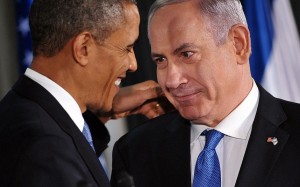 It seemed to come almost out of nowhere. The United States usually protects Israel from critical resolutions at the UN Security Council. However, in a dramatic move, the US abstained and a resolution criticizing recent settlement activity was passed by the 15-member body.
But this was not the end. John Kerry, Obama’s former Secretary of State, gave a lengthy address a few days later. Kerry’s speech was not so different from the statements of previous leaders, both Democrats and Republicans. He defended Israel’s existence, and denounced almost all forces actively opposing Israel.
However, Kerry harshly criticized specific Israeli policies. While Kerry’s speech defending the UN abstention uttered the standard, mildly critical, pro-Israeli talking points, it did contain some words that, taken out of context and spread throughout the internet, could and did indeed make a lot of Israelis and Zionists very angry. The most quoted one was: “If the choice is one state, Israel can either be Jewish or democratic, it cannot be both.”
Kerry was alluding to the fact that if Palestinians are absorbed into Israel in a “one state solution” but Israel remains a “Jewish State” this will not be democratic. According to Kerry, under such circumstances Palestinians would be second class citizens, i.e. non-Jews in a Jewish state.
Immediately, Kerry’s speech was decried by Israelis. Netanyahu fired back, as did the entire pro-Israeli blogosphere. The Republican and Likud Party aligned voices escalated the shrill accusations that Obama was a secret Muslim, a member of the Muslim brotherhood, a terrorist sympathizer, a Neo-Nazi, a Communist, and everything else he has been called for 8 years straight.
Meanwhile, Israel did not stop its settlement activity, and was not really affected at all by the resolution. The billions of dollars in US aid to Israel continued. Obama has left the office on January 20th, and is now replaced by Donald Trump, who claims to be more pro-Israel than Obama. The UN Security Council is not taking any specific action to halt the settlement activities condemned in its resolution.
Nothing really changed, but a lot of dramatic, heated words were exchanged between the USA and its closest Middle Eastern ally. Why did this happen?
Napoleon & Obama: “I Come to Restore Your Rights”
In 1798, the French militarist Napoleon Bonaparte, who seized power in the aftermath of the revolution and eventually became Emperor, set out to conquer Egypt. He issued a proclamation saying:
People of Egypt! You will be told by our enemies that I am come to destroy your religion. Believe them not. Tell them I am come to restore your rights, punish your usurpers, and revive the true worship of Mohammed. Tell them that I venerate, more than do the Mamelukes, God, his prophet, and the Koran.
Among the people of Egypt and Syria, as well as the entire Arab world, there was deep hatred for the British and Ottoman empires, who functioned as Napoleon’s rivals. Napoleon hoped that he could convince Muslims throughout the region to support him, and on this basis that he could defeat their hated colonial enemies, and conquer the region for France.
Napoleon was lying. He was not an adherent of the Islam faith. Some speculate that he may have been a freemason, and became familiar with the Koran and Islam due to their inclusion in Masonic rituals. Regardless, years later, Napoleon explained the proclamation to his fellow French Christians saying:
A change of religion, inexcusable for the sake of private interests, becomes comprehensible when immense political results are involved…. Do you think the Empire of the East and perhaps the subjugation of the whole of Asia was not worth a turban and some loose trouser? The state of feeling in the army was such that it would have undoubtedly lent itself to a joke.
Barack Obama, like Napoleon Bonaparte, is not a Muslim. As offensive and heretical as some evangelical Christians and Catholics may consider the teachings of the United Church of Christ and Reverend Jeremiah Wright, they are not Islamic in any conceivable way. Barack Obama was married in a church. He has been photographed drinking wine and eating hot dogs.
Obama’s middle name is “Hussein.” As a child, while living in Indonesia, he attended an Islamic elementary school. Obama apparently did meet with the Palestinian-American professor Edward Said. With all of this to cite as evidence, the allegation that he was a “secret Muslim” has not vanished.
The endless, semi-hysterical attacks on Obama for having alleged links to Islam certainly had an impact outside of US borders. This impact may not have been accidental. Writing in the Atlantic Monthly in 2007, the self-described conservative Andrew Sullivan considered the colorful background of the future president to be an asset:
What does he offer? First and foremost: his face. Think of it as the most effective potential re-branding of the United States since Reagan. Such a re-branding is not trivial—it’s central to an effective war strategy… The next president has to create a sophisticated and supple blend of soft and hard power to isolate the enemy, to fight where necessary, but also to create an ideological template that works to the West’s advantage over the long haul. There is simply no other candidate with the potential of Obama to do this.
Sullivan’s widely read and cited article said:
If you wanted the crudest but most effective weapon against the demonization of America that fuels Islamist ideology, Obama’s face gets close. It proves them wrong about what America is in ways no words can.
The USA certainly had a lot of credibility to regain as the Bush era came to an end. The unilateral invasion of Iraq had been widely opposed, not just in the Middle East, but even among NATO states. Bush had gone as far as to say “this crusade, this war on terrorism, is going to take a while.” The word “crusade” doesn’t exactly bring up pleasant feelings among Muslims around the world.
Meanwhile, the federal agencies of the United States flew into a very Islamophobic mode after the 9/11 attacks. The leaders of a religious charity known as the “Holy Land Foundation” were imprisoned for nothing other than running soup kitchens for Palestinian children. Mosques across the United States were then and continue to be widely surveilled.
His Middle Name is “Hussein”
Voices like Andrew Sullivan’s hoped that Obama’s background could restore the credibility of the USA in the eyes of Muslims. But this was just the tip of the iceberg. What came about in the first term of the Obama administration? In 2011 the world watched the “Arab Spring.” Across the Middle East, impoverished people rose up against their governments.
Analysts often argue that the Arab Spring was spawned by the global financial crisis and the regional drought. Throughout the Arab world, crops failed, water was scarce, and impoverished people piled into the cities facing dire economic conditions. The uprisings that eventually erupted were predictable. Such conditions are known to spark unrest.
But the world did not see a repeat of the 1979 Iranian Revolution, where the Persians toppled a western puppet dictator under the slogans of “Not Capitalism but Islam” and “War of Poverty Against Wealth.” The western capitalist apparatus was ready. The Arab Spring was immediately redirected to serve their ends. Social media outlets based in western countries, and the global apparatus of pro-American NGOs swung into action.
With a commander-in-chief who most people in the Middle East had a favorable opinion of, the forces of global power were able to ensure that the revolt did not become an uprising against western capitalism. No new anti-imperialist regimes were born. Rather, the opposite happened.
In Egypt, the pro-US regime of Hosni Mubarak fell, but what replaced it? First, Egypt elected Mohamed Morsi, a leader of the CIA-linked Muslim Brotherhood. Morsi was then toppled by a military coup d’etat. Now General Sisi, a top military leader under Mubarak, is in power.
The US backed Saudi regime was allowed to crush the uprisings within its own borders. Ayatollah Nimr Al-Nimr, a Shia cleric who led protests demanding civil liberties and religious freedom in the country was eventually beheaded for his role in the Arab spring. Saudi troops poured into Bahrain to keep the monarchy in power and crush the Shia majority that demanded their rights. In the aftermath of the revolt, Yemen staged a sham election in which Mansour Hadi, a Saudi puppet, was the only candidate on the ballot. Yemen is now torn apart by war, as many Yemenis reject Hadi’s pro-Saudi and Pro-US regime.
The energy and momentum of the Arab Spring, amplified and directed by the western TV networks along with Twitter and Facebook, went toward targeting two anti-imperialist, socialist governments. Gaddafi’s Libya had the highest life expectancy in Africa. Syria’s Bashar Assad presides over a centrally planned economy, supports Palestinian resistance, and is aligned with Iran, Russia and China.
In both Libya and Syria the United States began actively working to transform the Arab Spring into a successful regime change operation. Though the faces promoted on western television were often middle class, secular young people who dreamed of American consumerism while mouthing words about “democracy,” the brute force behind the Syrian and Libyan “revolutions” were religious extremists.
Based from the Syrian and Libyan countryside, forces linked to Al-Qaeda and the Muslim Brotherhood were joined by many foreign Jihadist fighters from throughout the region. The forces who toppled the Libyan government and continue to fight against the Syrian Arab Republic are dominated by those who adhere to Wahabbism, the ideology of Saudi Arabia and Osama Bin Laden. These deeply religious forces, working to topple anti-imperialist governments, happily took guns and funding from a country led by a man who went to a Muslim school, met with Edward Said, and whose middle name happened to be “Hussein.”
Imagine what could have happened in the region, if the wave of uprisings had taken place while George Bush “the crusader” was still in office. Obama’s presidency played a decisive role in manipulating and redirecting the events of 2011.
Netanyahu vs. Obama: A Made For TV Drama
 It is not uncommon for celebrities to clash with each other in the public arena. Often, these fights are not spontaneous, but intentionally provoked, or even planned, in order to generate publicity for both parties involved. For example, long before running for President, Donald Trump captured the attention of news headlines by having a spat with TV personality Rosie O’Donnell.
The perceived tension between Benjamin Netanyahu and Barack Obama has the looks of a “made for TV drama.” It is a prolonged public spat that is mutually beneficial to both parties. Do they actually dislike each other when the cameras are not rolling? Who knows.
While Obama and Netanyahu have butted heads, the US aid to Israel has not decreased or been cut off. Under Obama, the United States has worked to topple the Baathist Syrian government, one of Israel’s primary regional opponents. Israel has supported the regime change efforts with airstrikes in Syria targeting the anti-ISIS fighters of the Hezbollah organization.
The 2011 NATO intervention in Libya, championed loudly from the White House, toppled the Islamic Socialist government that had a long record of opposing Israel and arming Palestinian resistance.
Obama boasts that he has ended Iran’s peaceful nuclear energy program, and is making Israel safer from a supposed Iranian threat in the process. While there is occasionally criticism of Israel’s settlement activities, they continue unabated.
However, Obama’s clash with Netanyahu plays well for him, and the United States, in the Arab world. Throughout the Middle East, Netanyahu and Tel-Aviv are the most hated villains. Obama’s trading of nasty words with Israeli leaders raises the credibility of the United States. It gives the United States a kind of distance from Israel on the international stage, while US support remains key and keeps flowing in without pause. Obama’s Department of Justice has even conducted raids against pro-Palestinian activists.
Netanyahu benefits from the spat as well. Fear and hatred of Palestinians, Muslims, and Arabs has been key in securing the recent electoral victories of the Likud Party. If Netanyahu looked like he was friendly toward someone who attended an Islamic elementary school, or had the middle name “Hussein” this would discredit him in the eyes of his base.
Despite the fact that Israel receives billions of dollars from the United States, as well as weapons and other assistance, Netanyahu looks as if he is not afraid to bite the hand that feeds him. Fighting with Obama allows Netanyahu to look like a brave, fearless, true believer in the Zionist cause.
“Don’t Forget About Obama!”
Though many Israelis and supporters of Israel in the United States dislike Donald Trump, he has presented himself during the campaign as a pro-Israeli hardliner. His speech to the American Israeli Public Affairs Committee was a repetition of standard pro-Israeli talking points, saying:
“When you live in a society where the firefighters are the heroes, little kids want to be firefighters… In Palestinian society, the heroes are those who murder Jews.”
Trumps statements about banning Muslim immigration haven’t exactly been popular in the Arab world. Statements like “Islam hates us” don’t go over so well either.
The fear among certain forces in the United States is that Trump could alienate the many Muslim allies of the United States in the Arab world. Wall Street oil companies make lots of money from the various autocratic regimes in Qatar, Kuwait, Saudi Arab, UAE, and elsewhere. Pentagon weapons manufacturers also make lots of money from selling their hardware to these regimes.
Like Napoleon’s strategy in Egypt, efforts to portray Obama as sympathizer with Muslims and Arabs haven’t exactly worked out so well. While the elites within the US aligned Gulf States and some of extremists forces who have poured into Syria have bought into the idea Obama is a trustworthy ally, many people in the region have not. The Syrian government has not fallen. Iran has not really been weakened.
The economic problems and other factors that fueled the discontent of 2011 have not vanished. There is no guarantee that the oil bankers of the United States will keep their grip over this vastly important territory. Certain sectors harbor real fear that Trump’s brash tone could now ruin everything. [emphasis added]
The last minute moves at the UN Security Council, publicly invoking Israel’s wrath, was a message to the Arab world. It was a desperate, final attempt to say: “Whatever Trump does, don’t forget about Obama! Not all Americans are hardline supporters of Israel! Not everyone in Washington hates the Arabs! Muslims of the world, keep trusting us, don’t turn against America!”
Caleb Maupin is a political analyst and activist based in New York. He studied political science at Baldwin-Wallace College.
Featured Video

The Truth About the Trump Shootings with Ken Silva
or go to
Aletho News Archives – Video-Images
From the Archives
Trans ‘milk’ as good as the real thing – NHS
RT | February 18, 2024
The drug-induced nipple secretions of trans women are as good as mothers’ breast milk for babies, the University of Sussex Hospitals NHS Trust claimed in a letter to campaigners made public in a report by British think tank the Policy Exchange on Sunday.
The healthcare trust’s medical director, Rachel James, argued that the off-label prescription drug cocktail men transitioning to female take in order to produce milk was “similar to the natural hormones which encourage lactation to develop when the baby is newly born.”
“The evidence which is available demonstrates that the milk is comparable to that produced following the birth of a baby,” James wrote in the letter, sent to Children of Transitioners last August.
Biological men who wish to lactate must first take hormones to grow milk glands and then take high doses of either domperidone or metoclopramide to stimulate milk production. Neither drug is approved for this use, though they are occasionally prescribed off-label to biological women who have trouble lactating.
However, domperidone’s own manufacturer, Janssen, warns patients the drug “may cause unwanted side effects affecting the heart in a breastfed baby” and “should be used during breastfeeding only if your physician considers this clearly necessary.” … continue
Blog Roll
 Aletho News
- Russia Voted Under Fire. Washington Is Loading the Tankers.
- 12 Things Your Oncologist Was Trained Not to Tell You
- Anthrax Attacks Paved Way for COVID-Era ‘Junk Drugs and Vaccines’
- How Real Is the Impact of Western Sanctions on Israel?
- France, You Are Guilty: How Paris Turned Western Sahara into the Maghreb’s Powder Keg
- 2025 Nature Paper Claiming Worsening Global Drought Gets RETRACTED …Heavily Flawed
- Your Milk Is Not the Problem
- The Truth About the Trump Shootings with Ken Silva
- ARE PATIENTS BEING PROPERLY INFORMED ABOUT OZEMPIC?
- US lawmaker blocks $2.8 billion weapons sale to Israel: Report
- If Americans Knew
- Salah Sarsour’s Legal Team Says DHS Has Not Met Its Burden to Prove He Is Deportable
- An analysis of tax forms by The Intercept show Kraft’s charity and LLC have donated to Friends of the IDF and AIPAC’s super PAC.
- Israeli attacks kill four Palestinians in Gaza – Daily Update
- Inside Gaza’s death trap of collapsing, bombed-out buildings
- The everyday items Israel bans from Gaza every day
- Inside the siege, the ruined buildings of Gaza – Daily Update
- Debunking The Claim That Macklemore Has A “History Of Antisemitism”
- CPJ demands release of arrested Palestinian-US journalist near Bethlehem
- Robert Kraft: The Billionaire Friend of Netanyahu Pulling The Strings Behind the Macklemore/Ed Sheeran Blow Up
- Columbia Administered Fund Gives Big Money to Pro-Israel Groups
- No Tricks Zone
- 2025 Nature Paper Claiming Worsening Global Drought Gets RETRACTED …Heavily Flawed
- New Study: ‘Global Drought Shows No Detectable Recent Acceleration Under Climate Warming’
- Economic Masterminds: German Socialists Suggest Taxing Productivity Gains Stemming From Using AI
- The South China Sea Has Not Been Cooperating With The Climate Change Narrative
- Energy Crisis: Germany Enters Heating Season With Historically Low Gas Reserve Fill Levels
- New Study: The Antarctic Ice Sheet Gained Mass From 2020-2024 Due To Staggering Snow And Ice Accumulation
- Study: Ocean Heating Rates From Thousands Of Years Ago ‘Dwarf’ Modern Ocean Heating Rates
- Climate Extremists Target, Attack Large-Scale Power Grid Infrastructure In Germany!
- New Study: Antarctic Ice Melt Has Contributed Less Than 1 Centimeter To Sea Level Rise In The Last 30 Years
- Fear Of Debate: Alarmist German Climate Scientist Calls On Mainstream Media To Discredit Skeptic Voices
 Aletho News