The Iranian part of the gas pipeline is complete but Pakistan has run into repeated delays for the 780-km section to be built on its side of the border
A Pakistani delegation will be visiting Iran next month to revive talks on a planned gas pipeline which has been set back for years because of US and Saudi opposition, an Iranian news agency says.
Iran’s gas delivery should have started in December 2014 but Pakistan has failed to complete its section of the pipeline under the contract signed back in 2010.
According to Fars news agency, Pakistani officials have officially announced their readiness lately to resume the negotiations and decided to send a delegation to Tehran in the middle of the Persian month of Farvardin which began on March 21 or in early Ordibehesht.
“Although Pakistani officials are subject to the policies of Saudi Arabia and America, the government under pressure from the Pakistani people and businessmen is willing to provide for conditions so that the Iranian natural gas reaches Pakistan,” the source said.
According to the unnamed source, the Pakistani negotiating team has been given complete freedom to negotiate the volume, time and mode of gas imports from Iran and reach a final conclusion.
“Pricing is up for the later stage and if we reach an initial conclusion, we will also get to that phase,” the source added.
The energy crisis in Pakistan which suffers about 12 hours of power cuts a day has worsened in recent years amid 4,000 megawatts of electricity shortfall. The nation of 190 million people can only supply about two-thirds of its gas needs.
Contractually, Pakistan has to pay steep fines to Iran for failing to build and operate its section of the pipeline. Iran’s Minister of Petroleum Bijan Zangeneh has said that Tehran decided not to take the matter to international arbitration because Islamabad did not have any money to either pay the penalty or build the pipeline.
Pakistan has however pushed ahead with talks to receive gas from Turkmenistan through a pipeline which is exponentially longer and costlier than the Iran route and has to cross volatile terrain in Afghanistan.
Qatar is currently one of the main suppliers of liquefied natural gas to Pakistan after the two sides signed a 15-year agreement in February 2016 for shipment of 3.75 million tonnes of LNG a year.
In their last negotiations with Iran, the Pakistanis reportedly said they preferred LNG to natural gas.
However, Iranian energy experts have dismissed the proposal as another delaying tactic given that the first Iranian LNG production is years off, while the Pakistanis have started talks to buy natural gas from Turkmenistan.
For years, Islamabad has been under US and Saudi pressure to opt out of the Iran project even though this would entail going the extra mile of more than 700 km across the violence-wracked Afghanistan to get gas from Turkmenistan.
The following is the resignation letter by ESWA Executive Secretary Rima Khalaf in response to the formal request by UN Secretary General Antonio Guterres that ESCWA withdraw the publication of a scholarly report (below) that found Israel guilty of apartheid.
Dear Mr. Secretary-General,
I have carefully considered your message conveyed through the Chef de Cabinet and assure you that at no point have I questioned your right to order the withdrawal of the report from our website or the fact that all of us working in the Secretariat are subject to the authority of its Secretary-General. Nor do I have any doubts regarding your commitment to human rights in general, or your firm position regarding the rights of the Palestinian people. I also understand the concerns that you have, particularly in these difficult times that leave you little choice.
I am not oblivious to the vicious attacks and threats the UN and you personally were subjected to from powerful Member States as a result of the publication of the ESCWA report “Israeli Practices towards the Palestinian People and the Question of Apartheid”. I do not find it surprising that such Member States, who now have governments with little regard for international norms and values of human rights, will resort to intimidation when they find it hard to defend their unlawful policies and practices. It is only normal for criminals to pressure and attack those who advocate the cause of their victims. I cannot submit to such pressure.
Not by virtue of my being an international official, but simply by virtue of being a decent human being, I believe, like you, in the universal values and principles that have always been the driving force for good in human history, and on which this organization of ours, the United Nations is founded. Like you, I believe that discrimination against anyone due to their religion, skin color, sex or ethnic origin is unacceptable, and that such discrimination cannot be rendered acceptable by the calculations of political expediency or power politics. I also believe people should not only have the freedom to speak truth to power, but they have the duty to do so.
In the space of two months you have instructed me to withdraw two reports produced by ESCWA, not due to any fault found in the reports and probably not because you disagreed with their content, but due to the political pressure by member states who gravely violate the rights of the people of the region.
You have seen first hand that the people of this region are going through a period of suffering unparalleled in their modern history; and that the overwhelming flood of catastrophes today is the result of a stream of injustices that were either ignored, plastered over, or openly endorsed by powerful governments inside and outside the region. Those same governments are the ones pressuring you to silence the voice of truth and the call for justice represented in these reports.
Given the above, I cannot but stand by the findings of ESCWA’s report that Israel has established an apartheid regime that seeks the domination of one racial group over another. The evidence provided by this report drafted by renowned experts is overwhelming. Suffice it to say that none of those who attacked the report had a word to say about its content. I feel it my duty to shed light on the legally inadmissible and morally indefensible fact that an apartheid regime still exists in the 21st century rather than suppressing the evidence. In saying this I claim no moral superiority nor ownership of a more prescient vision. My position might be informed by a lifetime of experiencing the dire consequences of blocking peaceful channels to addressing people’s grievances in our region.
After giving the matter due consideration, I realized that I too have little choice. I cannot withdraw yet another well-researched, well-documented UN work on grave violations of human rights, yet I know that clear instructions by the Secretary-General will have to be implemented promptly. A dilemma that can only be resolved by my stepping down to allow someone else to deliver what I am unable to deliver in good conscience. I know that I have only two more weeks to serve; my resignation is therefore not intended for political pressure. It is simply because I feel it my duty towards the people we serve, towards the UN and towards myself, not to withdraw an honest testimony about an ongoing crime that is at the root of so much human suffering. Therefore, I hereby submit to you my resignation from the United Nations.
Speech by Hezbollah Secretary General Sayed Hassan Nasrallah on March 18, 2017, on the occasion of the anniversary of the birth of Fatima al-Zahra (as), Women’s Day
Extract of the Political Section of the Speech
Transcript:
Today, or (rather) these days are actually a (special) opportunity, namely that the events in Syria and the war waged against Syria have entered their seventh year. That is to say, six years have passed, with all that they contain in terms of sufferings, wars, conspiracies, confrontations and sacrifices of human lives. With the end of the sixth year and the beginning of the seventh, we must stop briefly on this occasion, because it concerns us also in the first place.
All those who met in the first few months of the beginning of the events six years ago of state forces, great powers, regional countries, 140, 130 or 120 countries that have gathered under the name of “Friends Of Syria” and who plotted, doing everything they could (against Syria). They bet on their ability to seize Syria in 2 or 3 months in 2011. Today, with the end of the 6th year, they face a bloody and painful truth, namely rout and failure. After six years, these powerful and important countries of the world and the region have failed, a bitter failure, in achieving their goals.
For six years, tens of billions of dollars of Arab money – Turkey did not spend money, France and the United Kingdom did not spend money. All the money that financed the war in Syria is Arab money. This money could have eliminated the poverty of the Arab world. It could have brought Somalia out of famine and Yemen as well. It could have (re)built the houses of the Palestinians in Gaza. It could have strengthened the Palestinians at Bayt-al-Maqdis (Sanctuary House / Jerusalem). This money could have guaranteed hundreds of thousands of job opportunities for unemployed Arab youth. It could have ended the illiteracy of hundreds of millions, unfortunately, tens of millions of men and women in the Arab world who are illiterate. Not a single dollar has been spent on these problems, but tens of billions of dollars of Arab money have been spent on the war in Syria, against Syria, its regime, its state, its army and its people, and against the Resistance Axis within it.
And tens, hundreds of thousands of tons of weapons and ammunition (were sent there). And they came from all over the world with tens of thousands of fighters, white, black, brown, red, yellow, whatever you want. They have left no side, no color, no tongue, no race, they have brought fighters from every spot of the whole world. The Americans, their allies, the plotters funded and facilitated (sending fighters) and brought tens of thousands of fighters to fight in Syria to achieve a clear and precise goal: to bring down Syria, to get it out of the Resistance Axis and take control of it. To take control of its decisions, its sovereignty, its people and its choices on its territory, and its strategic position on the Mediterranean Sea (between Asia) and Europe, and its strategic position in the struggle against the Israeli enemy.
Today, the result is clear: failure, defeat and retreat.
Well, let me remind you a bit, at the beginning of the 7th year, about the beginning of the first year. We do not deny that some of the people really wanted reforms and changed some realities in Syria. But what came (on the scene) with force and changed all that are the takfiri forces that were brought from all over the world, and who refused political dialogue in the first weeks. They refused any political outcome, any discussion, and their choices were definitive: they went to the bloody, general and total military confrontation. They have formulated sectarian slogans and revived (religious) school quarrels, and have lifted the veil on their objectives and their hostility towards the Resistance in the first weeks.
Well, who brought the al-Qaeda organization? When they arrived in Syria, what was their name? The Islamic State in Iraq. They then added “and in the Levant” (Syria). Then they divided, the members of the Islamic State in Iraq and the Levant divided. There were two factions: Daesh and the Al-Nosra Front. But in truth, they all belong to al-Qaeda, which is listed by the Americans on the list of terrorist organizations, as well as by the UN Security Council, by Saudi Arabia and by Europe. They brought tens of thousands of fighters, whom they regarded as terrorists themselves, gave them money and weapons, opened borders and brought them to Syria. They recognize that they themselves created (these groups), that they created Daesh to fight the Resistance and the Resistance Axis.
Today, the situation is different. I do not want to dwell on this point, and I will just focus on the new elements.
I want to remind you first of all that in the first year, the question did not require much political understanding, and that there was no need to make predictions and wait (and see). Anyone who had studied contemporary experiences in Afghanistan and elsewhere could reach the following conclusion, as I told them in the first months, I addressed the Al-Qaeda organization and the Islamic State in Iraq and the Levant, Daesh and the Al-Nosra Front who separated from it, and I said to them: “All of you of all nationalities, you were brought to Syria to gather you there, you were brought to Syria – now, anyone can check this out from 6 years ago – you were brought to Syria to gather you there and use you as combatants to achieve the American-Israeli goals in the region and when you will be pressed to the end, whether you have won or lost, you will be liquidated. We collect you (en masse) in order to liquidate you after having used you. You have been used… – and that is why I called them initially to be careful and wake up, and not to turn into wood and fuel for the fire lit by America and Israel as well as some regional countries, against whom they also plot, and who will pay the price. But sectarianism, foolishness, ignorance and stupidity have given them no opportunity (of lucidity).
They thought they were very smart, they believed that they were instrumentalizing America, Turkey, Saudi Arabia and the countries of the world and the West so that they’d allow them to implement their own project in Syria. And they wrote all that in their strategic projects. And that was the pinnacle of stupidity.
Today, what happens? After Daesh became an object of scandal for the American project here, Daesh sees its last days in Iraq – (it’s a question of) weeks, months, (but) it’s over. Daesh has no military or political future in Iraq. And similarly in Syria, Daesh no longer has any military or political future in Syria. At best, they will have dormant cells that will carry out suicide bombings because the suicide bombings targeting civilians in Baghdad, Tikrīt, Damascus, Homs and elsewhere reflect strategic and military failure. When someone sends suicide bombers to kill children, women, in restaurants, passers-by, schoolchildren and students, this reflects his strategic failure and military failure. These are acts of vengeance, not of fighting. This is the future of Daesh. The future of Al-Nosra is the same.
Today, Daesh is bombed by the international coalition led by the United States, Britain, Turkey, Jordan, as well as Russia and the forces fighting them in Syria. And the Al-Nosra Front, the Al-Nosra Front brought (and supported) by the Americans and their Turkish and Gulf allies, the Al-Nosra Front is now bombed in Idlib and at the West of Aleppo. Is not that what I told you six years ago? Now we hear voices rising from Idlib and West of Aleppo against America, its betrayals and hypocrisy. Did you sleep well? After destroying Syria, after destroying Iraq, after destroying Yemen, you finally wake up and you understand? (You realize the nature of) this treacherous and hypocritical America, who uses you then massacres you? That is the truth.
And with that, of course, Israel interferes every day, with various pretexts. The pretext of striking weapons intended for Hezbollah, as they claimed yesterday, for any pretext: on the pretext that a mortar shell hit the Golan (occupied), etc., Israel intervenes and strikes positions of the Syrian Army in order to provide support and assistance to Daesh and these (other) terrorist groups. Today, this arrogant and occupying project, the project of hegemony and control over Syria, I frankly declare to you that it has failed, and that Syria has won, but that it is still waiting for the great and decisive victory. As for the rest of the factions, Daesh will disappear. And the Al-Nosra Front will disappear. And the terrorist takfiri groups will disappear. It is only a matter of time.
Even the world that supported, funded, helped and assisted them has now abandoned them and is fighting them. For the spell has turned against the sorcerer. For the world has discovered that this serpent which he has raised in his bosom (and launched against Syria) has become a danger and a poison to him, in Paris, London, Germany, Belgium, inside Turkey, the United States, Saudi Arabia, etc.
The rest of the factions of the Syrian opposition, what is their current situation? They have no leader, no leadership, no united front, no national project, they don’t know what they want, they are divided, lost, and wander between (foreign) embassies and security services. Yes, there is still a bet on patriotic personalities or cadres of the opposition, that they can participate in the political solution and dialogue to rebuild Syria.
Today, for the commemoration of the birth of (Fatima al-Zahra), the daughter of the Prophet of God, who was sent to the worlds as a Mercy, allow me to renew my address to all those still fighting in Syria in the enemy front, and who believe that they are fighting in the front of Islam, the front of the (Islamic) Community or the front of the Fatherland, and who are 100% wrong. Allow me to appeal to them, to address them and tell them: this project has failed. Your struggle is in vain and leads to nothing but more deaths, battles and destruction, and bloodshed on both sides, which benefits America and Israel.
Look, Netanyahu went to Moscow imploring. Why? He went to intercede with President Putin because he is afraid of the defeat of Daesh in Syria. For the defeat of Daesh for Putin – excuse me, for Netanyahu, constitutes a victory for the Resistance and the Resistance Axis. Because for Netanyahu, Daesh’s defeat in Syria is a failure of the project he has supported for 6 years. So he went to beg (Putin). Oh, what do you do with Daesh, calm down with Daesh! For if you finish Daesh, what are you going to do with Iran, Hezbollah, President Assad, and the rest of the Resistance Axis?
Do not believe, (you Daesh fighters), that you are on the Front of Islam, the Community or the Fatherland. Whether you realize it or not, you have fought for 6 years on the Front of America and Israel and the Front of those who plot against you to kill you, imprison you and massacre you. Will not all this blood poured in Syria and Iraq awaken you? Is not that enough to reconsider things? I call upon them to lay down their arms, to cease fighting, to a real ceasefire, to seek a genuine humanitarian and political solution, to leave the front of hypocrisy for the front of Islam, leave Israel and America for the front of the Community, and leave the front of the enemy for the front of the Resistance. And it is still possible. It is still possible. (I call them to) stop these destructions. Your project has no future.
The Resistance Axis, as we said in the first days and months, today, after six years, from the beginning, we declared that the Resistance Axis would not be defeated in Syria, neither in Iraq, nor in Yemen, and that it would not break. And now that six years have passed, the Resistance Axis triumphs in Syria, and it triumphs in Iraq, and it is steadfast in Yemen where it will also win, if God wills, a great decisive victory. But these people must be aware of what they do with their lives, their blood, their future and their afterlife, and they must reconsider all their bloody actions that persist in Iraq, Syria, Yemen and elsewhere.
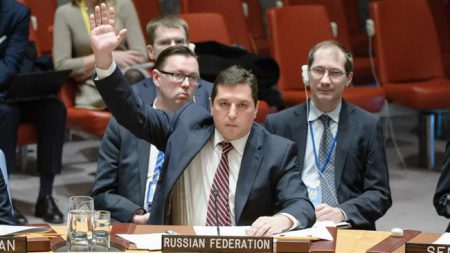
During a meeting of the UN Security Council convened by Russia, the Kremlin has warned about “grave humanitarian consequences” that would come if Saudi Arabia goes ahead with a plan to attack Yemen’s western port city of Hudaydah.
The attendants in the UNSC meeting discussed the grave humanitarian situation in Yemen and efforts toward a peaceful conclusion of the two-year-long war imposed by the Saudi regime on the Yemeni people, Russian Deputy Permanent Representative to the UN Vladimir Safronkov told reporters after the closed-door meeting in New York, which had been requested by Moscow on Wednesday.
Russia’s state news agency TASS quoted the Russian official as saying the meeting had been held in an attempt “to urge the UN to step up its efforts to establish a real diplomatic process.”
Elsewhere in his remarks, Safronkov said all the 15 member states of the council supported a non-military approach to the resolution of the crisis. It is, the Kremlin believes, “necessary to search for a political settlement,” Safronkov added.
Hudaydah is currently under the control of Yemen’s Houthi Ansarullah fighters, who have been defending the impoverished country against the Saudi aggression since March 2015. The city, Yemen’s fourth largest and its biggest port, served as a thoroughfare for the transit of about 70 percent of Yemen’s food imports in the pre-war years.
When the Saudi regime started pounding the crisis-hit country, Hudaydah turned into a primary entry point for humanitarian aid and fuel meant for areas inside Yemen, including the capital, Sana’a. If the city falls under the control of Saudi forces and mercenary soldiers, the flow of humanitarian assistance toward those areas would be blocked.
On March 13, Moscow also warned about the critical situation of the port city in providing its people with much-needed humanitarian aid.
The “plans to storm Yemen’s biggest port of Hudaydah give rise to serious concerns,” said Russian Foreign Ministry spokeswoman Maria Zakharova, adding that the fall of the city would cut Sana’a from “food and humanitarian aid supplies.” She also said the humanitarian situation in Yemen was “catastrophic.”
On Wednesday, the World Food Programme (WFP) said 60 percent of Yemenis, some 17 million people, faced a “crisis” and were in urgent need of food as a direct result of the Saudi war.
The Saudi campaign has so far killed over 12,000 Yemenis. The aggression was meant to reinstate Abd Rabbuh Mansur Hadi, Yemen’s president who has resigned and is a staunch ally of Riyadh. The campaign also sought to undermine Houthis. However, due to resistance from the Yemeni nation, the regime in Riyadh has so far failed to achieve success and suffered considerable human loss in its military.
At least 44 people have been killed and dozens of others wounded after a Saudi airstrike hit a refugee boat off Yemen’s western coast.
Yemen’s al-Masirah television reported on Thursday that the boat which came under attack was carrying Somali refugees near Bab al-Mandeb Strait.
According to the report, there are a number of women and children among the victims.
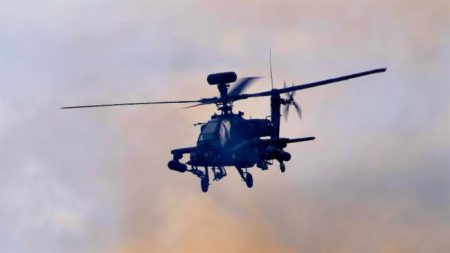
Reuters quoted a local official in Hudaydah as saying that the boat had come under attack by an Apache helicopter.
The refugees were on their way from Yemen to Sudan, the unnamed official said.
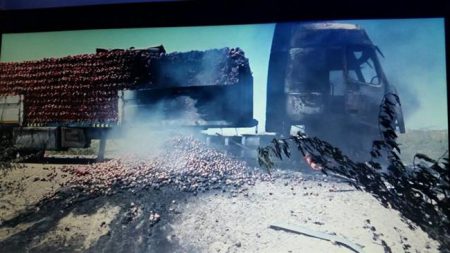
Earlier in the day, Saudi fighter jets bombed a food transport truck in the western province of al-Hudaydah, killing all the passengers, al-Masirah reported, without giving the number of those killed.
The remains of a truck hit by a Saudi strike in Hudaydah Province, Yemen, March 16, 2017.
Saudi Arabia has been leading a deadly military campaign against Yemen since March 2015. The kingdom has also imposed an aerial and naval blockade on its southern neighbor.
Britain and the US have provided huge amounts of arms and military training to the Saudi forces.
According to the United Nations humanitarian coordinator for Yemen, Jamie McGoldrick, the Saudi military campaign has claimed the lives of 10,000 Yemenis and left 40,000 others wounded.
McGoldrick told reporters in Sana’a earlier this year that the figure was based on casualty counts given by health facilities and that the actual number might be higher.
However, local Yemeni sources have put the death toll from the Saudi war at over 12,000, including many women and children.
The selection of Lt. General H. R. McMaster as Trump’s new National Security Advisor to replace Michael Flynn appears to be the coup de grâce to Trump’s efforts to achieve rapprochement with Russia. McMaster has received profuse praise from all types of mainstream figures: conservatives and liberals, Democrats and Republicans. McMaster’s expressed hostile view of Russia is the fundamental reason for this celebration since Michael Flynn was noted, and condemned for, his Russia-friendly attitude and connections. McMaster has stated that Russia’s goal is “to collapse the post-World War II, certainly the post-Cold War, security, economic, and political order in Europe, and replace that order with something that is more sympathetic to Russian interests.”[1] McMaster sees Russia as being among a number of enemies that threaten the U.S. He maintains: “Geopolitics has returned, as hostile, revisionist powers—Russia, China, North Korea and Iran—annex territory, intimidate our allies, develop nuclear weapons, and use proxies.” McMaster describes this conflict in Manichean terms. “We are engaged today, as General George C. Marshall’s generation [World War II and the Cold War] was engaged, against enemies who pose a great threat to all civilized peoples.”[2]
Secretary of Defense James Mattis, who is likewise widely praised in the mainstream, also considers Russia to be an enemy that needs to be staunchly opposed. Although Rex Tillerson was considered to be friendly toward Russia in his capacity as Exxon Mobil CEO, he has expressed more critical views of Russia since he was selected for the position of Secretary of State. Moreover, he has been largely absent from any role in shaping U.S. foreign policy.[3]
But what about Iran? Trump, during his presidential campaign, depicted that nation as a major threat to the United States and insisted that the nuclear agreement with Iran was “the worst deal ever negotiated.” Flynn held an even more hostile view toward Iran, which he presented in his recent book, The Field of Fight: How We Can Win the Global War Against Radical Islam and Its Allies, that was co-authored by the notorious neocon Iranophobe par excellence Michael Ledeen. It would seem, however, that Flynn’s departure will not make the administration’s stance toward Iran more favorable.
Mattis has been ultra-hawkish on Iran. In a speech at the Center for Strategic and International Studies on April 22, 2016, Mattis said that Iran was “the single most enduring threat to stability and peace in the Middle East,” contending that Iran’s hegemonic goals had not changed since the Islamic regime came to power in 1979.[4]
Mattis maintains that Iran is using the turmoil of the Islamic State to achieve its goals: “I consider ISIS nothing more than an excuse for Iran to continue its mischief. Iran is not an enemy of ISIS. They have a lot to gain from the turmoil in the region that ISIS creates. And I would just point out one question for you to consider: What is the one country in the Middle East that has not been attacked by ISIS? One, and it’s Iran. Now, there’s got – that is more than just happenstance, I’m sure.”[5] In short, Mattis cryptically implies that Iran is even cooperating with ISIS. Since ISIS kills Shiites and Iran is playing a major role in fighting ISIS, this conspiracy theory would seem to be something out of Alice and Wonderland, though this was also held by Flynn and Ledeen, but they are regarded as rather flaky.
Mattis continued that “as the commander in CENTCOM [U.S. Central Command, August 2010 to March 2013] with countries like Syria, Lebanon, Iraq, Pakistan, Afghanistan, Yemen, every morning I woke up and the first three questions I had . . . had to do with Iran and Iran and Iran. . . . Their consistent behavior since 1979 through today shows no sign of changing. . . . They’ve increased the flow of arms . . . into Saudi Arabia, explosives into Bahrain, and arms into Yemen. In fact, in the last three months— February, March and April [2016]— the French Navy, the Australian Navy, and the U.S. Navy have all seized arms shipments each month . . . . [but] the idea that we’re catching all the arms shipments, that’s a flight of fantasy.”[6]
Mattis advocated a militant U.S. policy in the Middle East, which would consist of amplifying what it already has been doing. For instance, he stated that “in the region we work with our partners in the GCC [Gulf Cooperation Council],” which is comprised of Bahrain, Kuwait, Oman, Qatar, Saudi Arabia, and the United Arab Emirates (UAE). It should be noted that all these countries are autocracies of one degree or another and some—such as Bahrain–face serious internal opposition. Thus, working with these countries means helping to prop up the existing regimes, which the U.S. has already been doing to some extent. Also, it might mean that the U.S. would be more involved in the Sunni-Shiite war which has little to do with American interests. This would entail the continuation and expansion of U.S. military support for the Saudis’ bombing and naval embargo of Yemen, which is causing a major humanitarian catastrophe with a significant proportion of the population facing starvation. And, private groups within Saudi Arabia, Qatar, and Kuwait, if not those governments themselves, have been the principal backers of radical jihadis—including, at times, ISIS—who have served as those countries proxies in the war against the Shiites. Objective observers would almost certainly discern that it is the Sunni-controlled members of the GCC who have been far more involved in destabilizing the Middle East than has Shiite Iran. Nonetheless, with his focus on Iran, Mattis also advocates a “very robust” U.S. naval presence in the region, cooperation with allies in a missile defense, and an increase in funding for intelligence on Iran, which would also involve closer cooperation with the spy agencies of America’s regional allies.
It was Mattis’ obsession with Iran as head of CENTCOM that ultimately caused President Obama to force his retirement in 2013.[7] However, while Trump, during the campaign, said that his “[n]umber one priority is to dismantle the disastrous deal with Iran.”[8] Mattis has taken a moderate view toward the nuclear accord. Although critical, he maintains that the U.S. should continue to honor the agreement while emphasizing that it is strictly an arms control deal, which does not imply rapprochement with Iran. He compares it to the arms control agreements the U.S. made with the Soviet Union during the Cold War where the U.S. would continue to treat it as an enemy.
As alluded to earlier, McMaster also sees Iran as a significant American enemy, though he does not appear to be so monomaniacally hostile toward it as does Mattis. McMaster contends that Iran “has been fighting a proxy war against us since 1979.” In his view, Iran is “applying the Hezbollah model broadly to the region, a model in which they have weak governments in power that are reliant on Iran for support, while they create militias and other groups outside of that government’s control that can be turned against that government if that government takes action against Iranian interests. You see this, I think, to a certain extent in Iraq.” He holds that if “we pull the curtain back on it,” we would see “Iranian subversion and the use of pressure on the [Iraqi] government to ensure that that government remains wholly sympathetic to Iranian interests. And this is an effort, I think, to retard many of the reforms that would try to build back into the Iraqi government and security forces a multi-sectarian population that would have improved legitimacy, and that would lead eventually to the consolidation of security gains as we continue the campaign against ISIL.”[9]
During the presidential campaign, Trump talked about jettisoning America’s broad global strategy that has militarily entangled the country in wars and alliances that do not serve its own vital interests. Instead, he said he would pursue an American First strategy that would focus on what benefitted the U.S., but he did not show how taking a harder stance toward Iran could possibly fall into this new paradigm. It seems incongruous.
It should seem obvious that the reason Iran is opposed to the United States has much to do with the fact that the United States has acted as its enemy. Moreover, as will be pointed out shortly, throughout the 20th century, Iran has been victimized by the great powers. In the United States, it is often maintained that Israel deserves special treatment because of the past victimization of Jews. For example, this has been used to justify the very creation of Israel at the expense of the Palestinians and the existence of Israel’s nuclear arsenal. U.S. foreign policy experts should, at the very least, recognize that Iran’s recent history of victimization would shape its view of international affairs. It is especially odd that purported military scholars such as Mattis and McMaster do not evince this knowledge. “Know your enemy” is a maxim derived from Sun Tzu’s The Art of War, a famous work on military strategy that the two generals would be expected to have read. And maybe they do know about Iran’s past but realize that expressing knowledge of inconvenient history that militates against the current mainstream narrative can prevent one from having a successful career, something they wish to maintain despite their mainstream media reputations for “speaking truth to power,” reputations they would be apt to forfeit if they pushed the envelope too far.
Let us now look briefly at the history of Iran. As in other Third World countries, Iranians, who have a proud heritage extending back to the ancient world, do not want to be dominated by outside powers, and this feeling is quite intense because during the 20th century, their country had been treated as a pawn by the great powers. It had been controlled by Britain and Russia from the latter part of the 19th century through World War I, and because of wartime deprivations caused by those two occupying powers, lost a large percentage of its population. According to historian Mohammed Gholi Majd: “World War One was unquestionably the greatest calamity in the history of Persia, far surpassing anything that happened before. It was in WWI that Persia suffered its worst tragedy in its entire history, losing some 40% of its population to famine and disease, a calamity that was entirely due to the occupation of Persia by the Russian and British armies, and about which little is known. Persia was the greatest victim of WWI: no country had suffered so much in absolute and relative terms. . . [T]here are indications that 10 million Persians were lost to starvation and disease. Persia was the victim of one of the largest genocide [sic] of the twentieth century.”[10]
Similarly, Iran was occupied by Britain and the Soviet Union during World War II. And the U.S. played a significant role in the coup that overthrew the legally-established Mossadegh government (Mossadegh was appointed not elected as is often claimed) in Iran in 1953 and essentially made Mohammad Reza Shah Pahlavi the autocratic ruler of Iran. Even assuming the most benign American motivation—that American policymakers were motivated by the fear of a pro-Soviet Communist takeover rather than by the ambition to acquire oil—would not make Iranians feel better about their country being used as a pawn by an outside power once again. Furthermore, the U.S. influence over Iranian politics during the rule of the Shah was so palpable that most people considered him an American puppet. Given Iran’s historical experience, it is quite natural that Iran fears the American empire and would like a reduction of its influence in the Middle East, just as the young United States wanted to keep the European powers away from the Americas, a view which was embodied in the Monroe Doctrine.
America’s backing of the Shah’s rule certainly contributed to the anti-American revolutionary rhetoric put forth by the Islamic regime after the 1979 revolution. This revolutionary stance especially resonated with the region’s Shiite minority and thus engendered fear among the Sunni ruling elites.
Fear of an internal Shiite revolt in Iraq—one Middle East country where the Shiites were in the majority—along with the desire to take advantage of the revolutionary chaos in Iran to grasp some of its territory motivated Iraq’s Saddam Hussein to launch an attack on Iran on September 22, 1980. After initial success, Iraq was soon put on the defensive. Fearing that Iran might defeat Iraq, the United States, although officially neutral, was providing substantial support to Iraq by the mid-1980s, which included military intelligence and war materiel. And the United States deployed in the Persian Gulf its largest naval force since the Vietnam War, the purpose of which was purportedly to protect oil tankers, but which engaged in serious attacks on Iran’s navy.
Significantly, the U.S. also played a role in Iraq’s use of illegal chemical weapons.U.S. satellite intelligence facilitated Iraqi gas attacks against Iranian troop concentrations. Moreover, Washington allowed Iraq to purchase poisonous chemicals, and even strains of anthrax and bubonic plague from American companies, which were subsequently identified as key components of the Iraqi biological warfare program by a 1994 investigation conducted by the Senate Banking Committee.[11] The United States also prevented or weakened UN resolutions condemning Iraq for using chemical weapons. It should be stressed that although Iran has rhetorically advocated the overthrow of other regimes and provided some military aid to groups that take such positions, its greatest military involvement (other than the defensive war with Iraq) has been to counter offensive moves by Saudi Arabia and the Gulf sheikdoms. Thus, Iran has become militarily involved in Iraq to help the Iraqi government defend itself from the ISIS military juggernaut, which, at least initially, had been bankrolled by wealthy private sources in, and very probably the governments of, Saudi Arabia and the small Gulf sheikdoms, especially Qatar. If the Iranians had not become extensively involved in the defense of Iraq, it is quite conceivable that Baghdad would have fallen to ISIS.
Iranian aid to the secular Assad regime in Syria also should be classified as defensive. For three decades, Syria has been Iran’s most valuable ally in the Middle East. Although many in the West portrayed the revolt against Assad’s Baathist dictatorship as a fight for democracy, from early on radical Sunni Jihadists—who seek the establishment of an Islamic caliphate based on sharia law–have proven to be the most effective fighters. And Saudi Arabia, as well as Qatar and other oil-rich Gulf sheikdoms, have been supporting these anti-democratic rebels from the outset.
The removal of the Assad regime would be a serious blow to Iran’s security. Assad’s Syria has provided a conduit for arms from Iran to Hezbollah. With Iranian arms, Hezbollah plays a critical role in Iran’s strategy to deter, and if necessary, retaliate against an Israeli attack on it. Obviously, Israel would prefer that Iran not have this capability.
Currently, in Yemen, Iran is providing some support for the Houthis, who champion the Zaidi Shiites against the Sunni forces loyal to President Abdrabbuh Mansour Hadi. To avoid any false interpretations here, it should be pointed out that Zaidi Shiism is quite different from that of the Iranian variety.[12] Zaidis make up one-third of the population of Yemen and had lived under their own rulers in mountainous North Yemen for almost 1,000 years until 1962. Since that time they have engaged in several rebellions to regain autonomy.[13] It should be added that the Houthi rebels also have been supported by units of the Yemeni army that remained loyal to former President Ali Abdullah Saleh, who was removed from power during the Arab Spring. That President Hadi, the recognized head of Yemen, is some type of democratic, or even the legitimately-elected, head of state, is highly questionable, however. As Dan Murphy wrote in the Christian Science Monitor, “Saudi and the US insist that only Hadi is the legitimate ruler of Yemen, that legitimacy drawn from a 2012 single-candidate referendum that gave him 99.6 percent support.”[14]
Houthi victories in what was essentially a civil war brought a Saudi-led coalition of Sunni states to engage in bombing attacks on the Houthis, claiming that they were Iranian proxies whose victory would expand Iranian power in a strategic region of the Middle East. The U.S. has been actively supporting the Saudi war coalition against Yemen, being engaged in such activities as refueling Saudi warplanes and working with them in selecting targets in a bombing campaign that has so far killed thousands of civilians. The Saudis and their allies have also maintained an air and sea blockade officially aimed at curtailing arms shipments to the Houthis, but also stopping goods vital for civilians. All of this has contributed to a humanitarian crisis.[15]
However, it is not apparent that the Houthis are proxies of Iran or that Iran has the intention or capability of allowing them to achieve an all-out victory in Yemen. While Iran undoubtedly provides the Houthis some types of military aid, this would have to be quite limited since it has not been easy to detect. Moreover, much of the weaponry used by the Houthis has been provided by high-level military supporters of ex-President Saleh who had access to government supplies.[16]
Also, in 2015, Iran presented a four-point plan to end the conflict that called for an immediate cease-fire, humanitarian aid, dialogue, and the formation of an inclusive national unity government. This was rejected by the Yemeni government of President Hadi and the Saudis (with whom the U.S. concurs) who essentially demanded that before any peace talks take place the Houthis must disarm and turn over to the Hadi government all the cities that they have taken. Obviously, such a de facto surrender by the Houthis would eliminate their bargaining position and thus would not [only] fail to address any of their grievances but likely lead to their suffering retribution for rebelling.[17] In short, the Iranian effort in Yemen does not appear as an effort to achieve dominance of the country but rather an effort to restrain the expansion of Saudi power outside its borders.
As Trita Parsi and Adam Weinstein summarize their article, “Iranian Hegemony Is a Figment of America’s Imagination,” “Exaggerating the military or ideological power of Iran may serve the goal of pushing the United States to take military action against Iran. But a singular focus on Iran — while deliberately ignoring the role of Saudi Arabia and Qatar and their spread of Salafism — will neither provide stability for the Middle East nor further any of Washington’s other interests in the region.”[18]
In sum, Iran is acting no differently than a country of its size, power, security interests, and historical experience would be expected to act. However, there is no apparent reason that Iran would be a threat to American interests, even if these interests are viewed from the traditional foreign policy establishment’s globalist perspective. Some of Iran’s key concerns harmonize with those of the United States, such as maintaining the flow of oil to the industrial world (which has been hindered by American-instigated sanctions) and combating Sunni jihadist radicals (ISIS and al-Qaida) who threaten regional stability. This convergence of interests has been recognized by leading figures in the American traditional foreign policy establishment, which was exemplified in the study, Iran: Time for a New Approach, produced by a Council of Foreign Relations-sponsored task force in 2004. The task force [which] was co-chaired by former National Security Advisor Zbigniew Brzezinski and former CIA director Robert M. Gates (who would become Secretary of Defense in December 2006) advocated dialog and incremental engagement with Iran.
Also, in 2006, Congress created an independent, bipartisan commission called the Iraq Study Group, which was co-chaired by President George H. W. Bush’s close associate and former Secretary of State James A. Baker and by former Democratic Congressman Lee H. Hamilton. On Iran, the Iraq Study Group advocated rapprochement rather than destabilization and regime change, as had been sought by the neocons who had held sway in the George W. Bush administration. Iran and Syria were to be made integral partners of an international Iraq Support Group, which would work for the stabilization of that country.
Although alternatives to an anti-Iran policy have been made in the past, which would better reflect a real America First policy, Trump, unfortunately, holds an opposite position–that the U.S. needs to take a more belligerent stance–and in this he has been reinforced by Mattis and McMaster. And while the mainstream media anathematizes almost everything else Trump proposes, it sees little wrong with his Iran policy. This makes it apparent that a significant portion of the neocon agenda has become the mainstream position on U.S. Middle East policy, but this is an issue that cannot be dealt with in this already lengthy article.
Syria demanded that the United Nations and participants of Geneva and Astana talks condemn the two terrorist bombings that took place in Damascus on Saturday.
Syria’s Foreign Ministry made the call on Saturday in a letter sent to UN Secretary General Antonio Guterres and the UN Security Council, in which it demanded the condemnation of the deadly bombings which killed 46 people.
Two bomb attacks took place near Bab al-Saghir cemetery in the Bab Mousalla area of Damascus. Most of the martyrs were Iraqi pilgrims.
The letter condemned the “cowardly” attack which coincided with a series of mortar and rocket attacks on the city that resulted in a large number of casualties, SANA news agency reported.
It added that such actions are carried out in retaliation for gains made by the Syrian army against the Takfiri terrorists across the country.
The letter went on to say that while the Syrian government condemns this and other such acts of terrorism committed by the terrorist organizations and backed by known governments and regimes, “it reiterates again that all parties participating in the talks held in Astana and Geneva distance themselves from the terrorist organizations.”
The Ministry meanwhile, demanded in its letters a condemnation from the UN Secretary General and the Security Council of this terrorist attack and that the governments and regimes supporting the terrorist organizations, mainly those of Turkey, Saudi Arabia and Qatar.
The first round of the Astana talks, organized by guarantor states Russia, Turkey and Iran took place on January 23-24 and brought together representatives from the Damascus government and opposition groups. The second round of the negotiations, similarly brokered by the trio, was held on February 15-16.
The fourth round of the UN-mediated discussions was held between February 23 and March 3 in Geneva, and a fifth one has been scheduled for March 23.
Residents of one neighborhood in Sanaa say it has been hit by 37 bombs and rockets from the Saudi-led coalition since Riyadh began intervening in Yemen. They have nobody to help them in the dire situation, they told Ruptly news agency.
“Our homes were destroyed because of the aggression and we didn’t receive help from anyone, no one provided us with mattresses, blankets or food. We have absolutely nothing left inside our houses. All this because of the aggression,” one resident said.
Another said their home was destroyed by three rockets during a raid.
“Once we were hit by the rockets we started running away and everything was destroyed. There was fire and then we were homeless and lost everything and it started raining. We lost everything because of this aggression,” she said. “What did we do to deserve this, to be shelled? They destroyed our homes and injured our kids.”
One man said almost three dozen houses have been destroyed by the coalition in the Al-Masanie neighborhood, and many survivors have nowhere to live now.
“Some people rented other houses and some other living in tents. Their situation is so bad especially since there is no income anymore. Those families’ situation is miserable,” he said.
“The situation in this neighborhood is very bad,” another person said. “For more than a year they were targeted by rockets launched by fighter jets, which belongs to the alliance, the Saudi-American alliance. The houses were destroyed and people are living in a miserable situation.”
Since March 2015, when Riyadh sent its troops to prop up a pro-Saudi president ousted by rebel forces, an estimated 10,200 people have been killed in Yemen fighting. Up to three million were displaced, bringing the already-destitute Arab country to the brink of a humanitarian disaster.
Civilians in Yemen are suffering from a lack of basic supplies, including food, medicine, and fuel, partially due to a Saudi naval and air blockade. Civil rights groups say the Saudi intervention in the country may amount to war crimes.
Bahrain has approved trial of civilians at military tribunals in a measure blasted by human rights campaigners as being tantamount to imposition of an undeclared martial law countrywide.
The Consultative Council, the upper house of the Bahraini parliament, voted for the measure Sunday, less than two weeks after it was approved by the Council of Representatives, the lower house.
The move saw Manama manipulating part of its constitution, which defines the identities of those who can stand trial at such courts.
Neighboring Saudi Arabia, whose influence radically sways Bahrain, has likewise redefined its anti-terror laws to expand the powers of its security forces in the face of political dissent.
Bahrain has been witnessing peaceful anti-regime protests since 2011. High-handed suppression of the rallies has led to widespread imprisonments and scores of deaths.
Hundreds of the detainees have already faced summary proceedings at military courts.
The situation in the Middle East is changing at an incredible speed. The things unbelievable yesterday, become reality today. Each of the events becomes part of a bigger picture, with the region gradually moving away from abyss to become a better place.
On March 1, Iraqi forces were reported to have taken control of the last major road out of western Mosul, preventing Islamic State (IS) militants from fleeing the city. The route leads to Tal Afar, another IS stronghold that is 40 km further west. They have since driven militants from the international airport, a military base, a power station and a number of residential areas. IS fighters began to flee. Total control over the city by Iraqi forces seems to be a matter of a few days, maybe hours.
Being almost defeated in Iraq, the IS has nowhere else to go but Syria – the country where they have just suffered a defeat, with Palmyra retaken by Syria’s government forces. Russia’s support has been crucial in the Syrian army’s push. Raqqa, the last remaining stronghold of the IS, will be the place of the final battle the extremist group is doomed to lose as many influential actors want it to be wiped away from the earth.
Turkey has announced its intent to launch an offensive to retake Raqqa but only after taking control of Manbij, the town held by the Kurds-dominated Syria Democratic Forces (SDF). The parties were in for a fight to benefit the IS and other terror groups. The US was at a loss as to how to prevent a clash between the NATO ally and the Kurds – the force it relies on in the fight against the IS. That’s when Moscow stepped in to avoid the worst, using its unique position as a mediator. It managed to do what nobody thought was possible. The military council in Manbij said on March 2 it will hand over areas west of the flashpoint town to Syrian government troops, after an agreement brokered by Russia.
Now the town is in Arab hands and Turkey has no reason to attack it. Syria and Turkey are not at war.
The United States had promised Turkey that Kurdish forces would withdraw from Manbij to the east of the Euphrates, but it never happened. Now Russia did what America had failed to do.
As a result of Russia’s effective mediation, Turkey can double down on its plans to advance to Raqqa, while Syria’s government has greatly strengthened its position. Turkey’s President Erdogan has just said he is ready to fight the IS together with Russia. He is coming to Moscow on March 9. It means no clash between Turkey and Syria will take place.
Many things are changing for the Syrian government and it has been going on for some time. It’s not a coincidence that voices get louder, calling for inviting Syrian President Assad to the March 29 Arab Summit in Amman – five years after Syria was expelled from the 22-member organization. Russia, Jordan and Egypt are applying efforts to reconcile the Arab community with the Syrian government. Last month, Egypt’s parliamentary committee for Arab affairs called for the return of Syria to the Arab League. This would signify the reconciliation between Saudi Arabia which backed the Syrian rebels – something unthinkable some time ago.
In 2015, then US President Obama predicted Russia would get stuck in Syria’s quagmire. He appears to have been wrong. Thanks to Russia’s involvement, one can see the light at the end of the tunnel to make the quagmire a thing of the past.
Moscow can facilitate the process of Iran joining with Arab states in the effort to reach agreement on Syria, bringing it to some mutual understanding with Saudi Arabia. Not much has been reported about some recent events of special significance. Iranian President Hassan Rouhani visited Kuwait and Oman on February 15. Saudi Arabian Foreign Minister Adel Al-Jubeir made a trip to Iraq on February 25, to be received by Iraqi Prime Minister Haider Al-Abadi. The trend is visible – Shia and Sunni are on speaking terms again and they are discussing something very important. It would have sounded incredible a short time ago but these are the facts.
All these events and emerging trends are taking place against the background of the ongoing UN-brokered Geneva talks on peaceful settlement in Syria. Here too we have an unexpected turn of events – the Syrian opposition seeks to meet with Russian officials!
According to Paul Vallely, a retired US ArmyMajor General and senior military analyst for Fox News, Russia-US consultations on Syria are to start in two months after the presidents hold a summit. He said Russia is to play a key part in any scenario.
The recent days have literally shaken the Middle East. So many unexpected things happen to push things forward. Right in front of our eyes the impossible becomes possible.
As said before, Moscow is in a unique position to act as an intermediary and it plays its role aptly to achieve tangible results. If the current trend continues in the same direction, leading to the desired outcome, Russia’s effort will go down in history as an extraordinary achievement of military success combined with effective diplomacy.
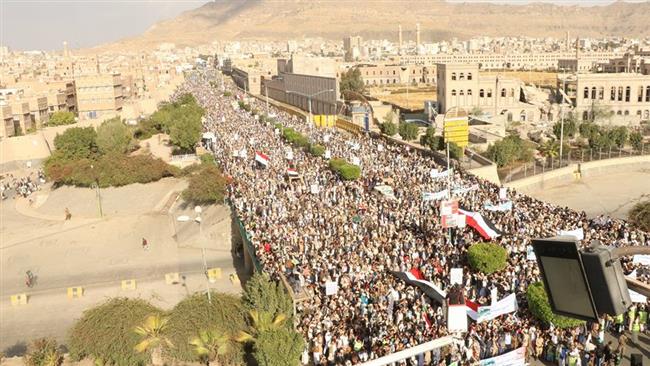
People take part in a demonstration in the Yemeni capital city of Sana’a on March 3, 2017 to denounce the Saudi military campaign against their country
Tens of thousands of people have taken to the streets in the Yemeni capital city of Sana’a to express outrage over Saudi Arabia’s deadly military campaign against the impoverished Arab country.
The protesters converged in the Old City of Sana’a following Friday prayers, carrying Yemeni flags and banners in condemnation of the Saudi aggression.
Participants in the demonstration, under the motto “Tough against Disbelievers”, also held up pictures of civilians injured in the deadly Saudi airstrikes, calling on the United Nations to fulfill its responsibilities and stop the Riyadh regime’s atrocious military offensive.
They also warned the Saudi leadership that the continued attacks on the people in Yemen will only strengthen the steadfastness of the nation.
Protesters also accused the United States of being complicit in the Saudi crimes against the Yemeni nation by providing the Al Saud regime with various munitions.
Saudi Arabia has been engaged in a deadly campaign against Yemen since March 2015 in an attempt to reinstall the former president, Abd Rabbuh Mansur Hadi, who is a close Riyadh ally.
The airstrikes have taken a heavy toll on the impoverished country’s facilities and infrastructure, destroying many hospitals, schools, and factories.
The United Nations humanitarian coordinator for Yemen, Jamie McGoldrick, says the Saudi campaign has claimed the lives of 10,000 Yemenis and left 40,000 others wounded.
McGoldrick told reporters in Sana’a earlier this year that the figure was based on casualty counts given by health facilities and that the actual number might be higher.
On February 23, Yemen’s Legal Center for Rights and Development, an independent monitoring group, put the civilian death toll in the war-torn Arab country at 12,041.
The fatalities, it said, comprise 2,568 children and 1,870 women.
The Pentagon has carried out its first major military operation in Yemen since a botched raid in January that killed women and children as well as an American commando.
US forces conducted more than 20 airstrikes involving a mix of manned and unmanned aircraft early on Thursday, the Pentagon said.
Navy Captain Jeff Davis said the airstrikes targeted al-Qaeda in the Arabian Peninsula in three south-central provinces of Abyan, Shabwah and al-Bayda.
“The strikes will degrade the AQAP’s ability to coordinate external terror attacks and limit their ability to use territory seized from the legitimate government of Yemen as a safe space for terror plotting,” the Pentagon spokesman said.
The US military did not share a casualty estimate, but local officials said at least nine suspected al-Qaeda militants were killed.
Davis said the operation was coordinated with resigned president, Abd Rabbuh Mansur Hadi, a strong ally of Saudi Arabia that has been engaged in its own military campaign against Yemen.
Troops engage al-Qaeda on the ground
Military helicopters and drones launched a flurry of fresh airstrikes in Shabwah province early on Friday, witnesses said, according to Reuters.
The raids targeted the residence of Sa’ad Atef, an al-Qaeda leader, as well as other suspected militant positions in the area.
The unidentified aircraft, believed to be American, also deployed troops to the al-Saeed area of the southern province, who engaged suspected al-Qaeda militants on the ground for nearly half an hour.
The military operations came more than a month since a January 29 raid, the first of its kind authorized by President Donald Trump, in al-Bayda which residents said left as many as 25 civilians dead.
An ongoing investigation by the US Central Command has also determined that civilians, including possibly children, lost their lives during the botched raid.
The White House hailed the operation as a success, but critics said it was a failure since it resulted in the death of civilians and 36-year-old Navy SEAL Ryan Owens.
Three other Americans were also wounded in the Navy SEAL Team Six mission and a military aircraft worth $75 million was destroyed after it crash-landed at the raid site.
Trump blames generals for botched raid
President Trump has tried to distance himself from the raid by emphasizing that the operation had been in the works long before he took office. “This was a mission that was started before I got here,” he said in an interview with Fox News this week.
“This was something that, you know, they wanted to do. They came to see me and they explained what they wanted to do, the generals, who are very respected,” the president said. “And they lost Ryan.”
During his address to a joint session of Congress on Tuesday, Trump paid tribute to the fallen SEAL, and insisted that the operation yielded valuable intelligence that would “lead to many more victories in the future.”
Some US officials, however, have disputed that claim, saying the raid gathered little, if any, workable intelligence.
The United States conducts drone strikes in Yemen and several countries. Washington claims the airstrikes target members of al-Qaeda and other militants, but according to local officials and witnesses, civilians have been the victims of the attacks in many cases.
Al-Qaeda in Yemen has grown in weapons and number since the start of the Saudi military campaign in March 2015, which was launched to bring back Hadi to power and undermine the Houthi Ansarullah movement.
The drug-induced nipple secretions of trans women are as good as mothers’ breast milk for babies, the University of Sussex Hospitals NHS Trust claimed in a letter to campaigners made public in a report by British think tank the Policy Exchange on Sunday.
The healthcare trust’s medical director, Rachel James, argued that the off-label prescription drug cocktail men transitioning to female take in order to produce milk was “similar to the natural hormones which encourage lactation to develop when the baby is newly born.”
“The evidence which is available demonstrates that the milk is comparable to that produced following the birth of a baby,” James wrote in the letter, sent to Children of Transitioners last August.
Biological men who wish to lactate must first take hormones to grow milk glands and then take high doses of either domperidone or metoclopramide to stimulate milk production. Neither drug is approved for this use, though they are occasionally prescribed off-label to biological women who have trouble lactating.
However, domperidone’s own manufacturer, Janssen, warns patients the drug “may cause unwanted side effects affecting the heart in a breastfed baby” and “should be used during breastfeeding only if your physician considers this clearly necessary.” … continue
This site is provided as a research and reference tool. Although we make every reasonable effort to ensure that the information and data provided at this site are useful, accurate, and current, we cannot guarantee that the information and data provided here will be error-free. By using this site, you assume all responsibility for and risk arising from your use of and reliance upon the contents of this site.
This site and the information available through it do not, and are not intended to constitute legal advice. Should you require legal advice, you should consult your own attorney.
Nothing within this site or linked to by this site constitutes investment advice or medical advice.
Materials accessible from or added to this site by third parties, such as comments posted, are strictly the responsibility of the third party who added such materials or made them accessible and we neither endorse nor undertake to control, monitor, edit or assume responsibility for any such third-party material.
The posting of stories, commentaries, reports, documents and links (embedded or otherwise) on this site does not in any way, shape or form, implied or otherwise, necessarily express or suggest endorsement or support of any of such posted material or parts therein.
The word “alleged” is deemed to occur before the word “fraud.” Since the rule of law still applies. To peasants, at least.
Fair Use
This site contains copyrighted material the use of which has not always been specifically authorized by the copyright owner. We are making such material available in our efforts to advance understanding of environmental, political, human rights, economic, democracy, scientific, and social justice issues, etc. We believe this constitutes a ‘fair use’ of any such copyrighted material as provided for in section 107 of the US Copyright Law. In accordance with Title 17 U.S.C. Section 107, the material on this site is distributed without profit to those who have expressed a prior interest in receiving the included information for research and educational purposes. For more info go to: http://www.law.cornell.edu/uscode/17/107.shtml. If you wish to use copyrighted material from this site for purposes of your own that go beyond ‘fair use’, you must obtain permission from the copyright owner.
DMCA Contact
This is information for anyone that wishes to challenge our “fair use” of copyrighted material.
If you are a legal copyright holder or a designated agent for such and you believe that content residing on or accessible through our website infringes a copyright and falls outside the boundaries of “Fair Use”, please send a notice of infringement by contacting atheonews@gmail.com.
We will respond and take necessary action immediately.
If notice is given of an alleged copyright violation we will act expeditiously to remove or disable access to the material(s) in question.
All 3rd party material posted on this website is copyright the respective owners / authors. Aletho News makes no claim of copyright on such material.



 Aletho News
 Aletho News