US seeks political solution to Yemen conflict: Pentagon chief
Press TV – April 18, 2017
US Defense Secretary James Mattis says the conflict in Yemen needs to be resolved “as quickly as possible” through UN-brokered peace negotiations.
“Our aim is that this crisis can be handed to a team of negotiators under the aegis of the United Nations that can try to find a political solution as quickly as possible,” Mattis told reporters on Tuesday as he flew to Riyadh, Saudi Arabia.
“We will work with our allies, with our partners to try to get it to the UN-brokered negotiating table,” the Pentagon chief said.
Mattis is expected to meet senior Saudi officials, including King Salman bin Abdulaziz Al Saud and Deputy Crown Prince and Defense Minister Mohammed bin Salman.
Several UN brokered ceasefires and peace talks have so far failed to end the conflict in Yemen.
Mattis gave no details on what additional support, if any, the United States would provide to the Saudi-led coalition. Washington already provides intelligence as well as aerial refueling to coalition warplanes carrying out air strikes in Yemen.
Human rights groups have repeatedly criticized the Saudi-led bombing campaign in Yemen for causing civilian casualties. The campaign has claimed the lives of more than 12,000 people, most of them civilians.
Saudi Arabia launched its deadly campaign against Yemen in March 2015 with the alleged goal of pushing back the Houthi Ansarullah movement from the capital, Sana’a, and to reinstate the regime of Yemen’s former president, Abd Rabbuh Mansur Hadi, who is a staunch ally of Riyadh.
Yemeni students study in a classroom on March 15, 2016, which was damaged in a Saudi air strike. (Photo by AFP)
The Saudis and their allies have also suffered considerable casualties in the operation on Yemen as official estimates say more than 500 soldiers from Saudi Arabia, the UAE and Bahrain have been killed since March 2015.
Some officials in US President Donald Trump’s administration have called for more American military support for the Saudi-led coalition.
In late January, US special forces carried out an attack against a purported position of al-Qaeda militants in the central Yemeni province of Bayda, killing about 30 civilians.
The raid, in which just about everything went wrong, was the first known American-led ground mission in Yemen since December 2014.
The White House hailed the operation as a success, but critics said it was a failure since it resulted in the death of civilians and 36-year-old Navy SEAL Ryan Owens.
The US military carried out a flurry of air strikes in Yemen after the botched raid, involving a mix of manned and unmanned aircraft.
Al-Qaeda in the Arabian Peninsula (AQAP) has taken advantage of the chaos and breakdown of security in Yemen to tighten its grip on the southern and southeastern parts of the Arab country.
Neocons Point Housebroken Trump at Iran
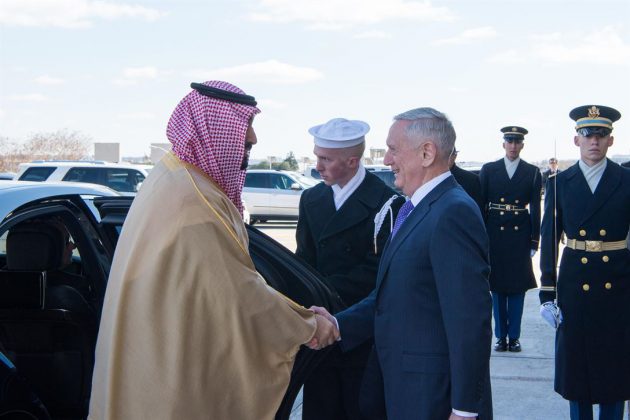
Defense Secretary Mattis welcomes Saudi Deputy Crown Prince and Defense Minister Mohammed bin Salman to the Pentagon, March 16, 2017. (DoD photo by Sgt. Amber I. Smith)
By Jonathan Marshall | Consortium News | April 15, 2017
The Trump administration’s growing use of military force in Syria, Iraq, and Yemen has neoconservative hawks rooting for armed confrontation with what they view as the root of all evil in the Middle East: Iran.
Many of these armchair warriors recently cheered President Trump’s decision to take on the Assad regime — and Moscow — by firing 59 Tomahawk cruise missile at a Syrian air base alleged to be the source of a chemical weapons attack. But they urged him to do more.
Weekly Standard editor William Kristol tweeted, “Punishing Assad for use of chemical weapons is good. Regime change in Iran is the prize.”
Kristol co-founded the infamous Project on the New American Century in 1997 to promote American “global hegemony” and “challenge regimes hostile to our interests and values.” It began lobbying for the overthrow of Saddam Hussein as early as 1998, but always kept Iran in its sights as well.
With Saddam dead and Syria’s Assad stripped of much of his power, Iran is now at the center of neocon crosshairs. Kristol linked his recent tweet to a Washington Post column by two stalwart advocates of ousting the mullahs in Tehran: Reuel Gerecht and Ray Takeyh.
Titled “How Trump Can Help Cripple the Iranian Regime,” their article called for putting the nuclear arms deal with Iran at risk in order to “stoke the volcano under Tehran and to challenge the regime.” The centerpiece of their bizarre argument was that the Iranian people would gratefully welcome the United States imposing “crippling sanctions” to destroy their economy in the name of “human rights.”
The authors were vague as to the details, but suggested that Iran’s ruling clerics would quickly succumb to a “popular rebellion” by “Iranian dissidents,” particularly if the United States sent “more American troops [to] both Syria and Iraq” to reinforce its message.
Gerecht, a died-in-the-wool neocon, was a former director of the Project for a New American Century’s Middle East Initiative. In 2001, he wrote, “Only a war against Saddam Hussein will decisively restore the awe that protects American interests abroad and citizens at home.”
In 2002, he further touted a U.S. invasion of Iraq as a way to “provoke riots in Iran — simultaneous uprisings in major cities that would simply be beyond the scope of regime-loyal specialized riot-control units.” Instead, the subsequent U.S. invasion backfired by putting a pro-Iran regime into power in Baghdad.
Iran in the Crosshairs
Today Gerecht is a senior fellow at the Foundation for Defense of Democracies, a neocon think tank dedicated to waging war against “militant Islam,” with a focus on Iran. Heavily funded by gambling magnate Sheldon Adelson, the Foundation was originally created to promote the agenda of hardline Israeli hawks.
The Foundation fought bitterly against the Iran nuclear deal, lest it open the door to a rapprochement between Washington and Tehran. Gerecht in particular demanded that the United States attack Iran rather than pursue diplomacy. “I’ve written about 25,000 words about bombing Iran,” he boasted in 2010. “Even my mom thinks I’ve gone too far.”
Gerecht’s side-kick, Ray Tayekh, is a senior fellow at the Council on Foreign Relations and was (briefly) an Iran adviser to Dennis Ross in Hillary Clinton’s State Department. A fierce critic of the nuclear deal, Tayekh joined the Iran Task Force of the right-wing Jewish Institute for National Security Affairs, which considers itself “the most influential group on the issue of U.S.-Israel military relations.” Tayekh has advocated covert support to Iranian dissidents, as well as to “Kurdish, Baluch, Arab, and other opposition groups fighting the regime.”
Regime change in Iran is the open goal of Prime Minister Netanyahu and other Israeli rightists. That’s why they consistently rejected findings by Israel’s intelligence community about the benefits to Israel’s security from the nuclear deal with Iran. By stoking opposition to the deal among their supporters in Congress, they aimed to kill any chance of cooperation between the United States and Iran.
Sen. Tom Cotton, R-Arkansas, said candidly, “the goal of our policy must be clear: regime change in Iran.”
Today the hardline Israeli/neocon agenda is still being pursued by hawks in Congress, who have introduced bills in both houses to ratchet up economic sanctions against Iran and designate a major branch of the country’s armed forces as a terrorist organization. If enacted — against the wishes of other signatories to the Iran nuclear deal — such measures could put the United States and Iran on a war footing.
Trump’s Team of Hawks
President Trump is unlikely to stand in their way. Ignoring the role of major Arab states in supporting such terrorist groups as al-Qaeda and ISIS, Trump named Iran “the number one terrorist state” and warned during his campaign that if Iranian patrol boats in the Persian Gulf continue to “make gestures that our people — that they shouldn’t be allowed to make, they will be shot out of the water.”
Trump has surrounded himself with anti-Iran hardliners who may be only too eager to give war a chance. His first national security adviser, retired Lt. Gen. Michael Flynn, co-authored a 2016 book with Michael Ledeen, a confidant of Israeli hawks and colleague of Gerecht at the Foundation for Defense of Democracy, on “How We Can Win the Global War Against Radical Islam and Its Allies.” Iran, of course, was their enemy number one.
Even with Flynn’s ouster, plenty of hawks remain. In recent congressional testimony, Army Gen. Joseph Votel, Commander of the U.S. Central Command, called Iran “the greatest long-term threat to stability” in the Middle East. He declared, “We need to look at opportunities where we can disrupt [Iran] through military means or other means their activities.”
Defense Secretary General James Mattis told a conference at the conservative Center for Strategic and International Studies in Washington last year, “Iran is not a nation-state; it’s a revolutionary cause devoted to mayhem.” The New York Times reported that Mattis “was so hawkish on Iran as head of United States Central Command from 2010 to 2013 that the Obama administration cut short his tour.”
Mattis reportedly came close to ordering an act of war against Iran in early February — the boarding of an Iranian ship to look for weapons headed for Houthi rebels in Yemen. Such an incident could escalate rapidly out of control if Iran chose to retaliate against U.S. vessels in the Persian Gulf.
Alternatives to Conflict
The United States has better policy options than continuing to treat Iran as part of the Axis of Evil. A report issued last fall by the National Iranian American Council recommended that Washington build on the success of the Iran nuclear deal by drawing Iran into regional peace settlements, deescalating our military presence in the Persian Gulf, and encouraging Iran and Saudi Arabia to resolve their differences without superpower intervention.
The report echoed the advice of a prominent neocon heretic, Zalmay Khalilzad, former U.S. ambassador to both Afghanistan and Iraq.
“As someone who has negotiated with Iran over the years perhaps more than any other U.S. diplomat,” he observed last year, “I disagree with those who argue that talks with Iran are akin to capitulation. I have seen little evidence that isolation has or will alter Tehran’s behavior in the right direction. Nor do I share the view that it is impossible to negotiate win-win deals with the Iranians.”
Noting Iran’s cooperation with the United States against Al Qaeda after 9/11, and its help brokering political compromises in Afghanistan and Iraq until the Bush administration refused further engagement, Khalilzad wrote, “Under the right conditions, which must include a hard-headed approach and tough actions to check Iran’s ambitions, Washington can benefit from bringing Iran into multilateral forums where the United States and its partners have the opportunity to narrow differences, create rules of the road and solve problems. Moreover, today we have little choice but to engage Iran on these broader issues, because no factor is shaping the order of the Middle East as much as the rivalry between Iran and its Sunni Arab neighbors.”
“If we do not undertake this work,” he warned, “the problems of the region — extremism, terrorism and regional conflict — will continue to bleed over into our part of the world, particularly if the Westphalian state system disintegrates even further into sectarian morass.”
Trump Withholds Syria-Sarin Evidence
By Robert Parry | Consortium News | April 12, 2017
After making the provocative and dangerous charge that Russia is covering up Syria’s use of chemical weapons, the Trump administration withheld key evidence to support its core charge that a Syrian warplane dropped sarin on a northern Syrian town on April 4.
A four-page white paper, prepared by President Trump’s National Security Council staff and released by the White House on Tuesday, claimed that U.S. intelligence has proof that the plane carrying the sarin gas left from the Syrian military airfield that Trump ordered hit by Tomahawk missiles on April 6.
The paper asserted that “we have signals intelligence and geospatial intelligence,” but then added that “we cannot publicly release all available intelligence on this attack due to the need to protect sources and methods.”
I’m told that the key evidence was satellite surveillance of the area, a body of material that U.S. intelligence analysts were reviewing late last week even after the Trump-ordered bombardment of 59 Tomahawk missiles that, according to Syrian media reports, killed seven or eight Syrian soldiers and nine civilians, including four children.
Yet, it is unclear why releasing these overhead videos would be so detrimental to “sources and methods” since everyone knows the U.S. has this capability and the issue at hand – if it gets further out of hand – could lead to a nuclear confrontation with Russia.
In similarly tense situations in the past, U.S. Presidents have released sensitive intelligence to buttress U.S. government assertions, including John F. Kennedy’s disclosure of U-2 spy flights in the 1962 Cuban Missile Crisis and Ronald Reagan revealing electronic intercepts after the Soviet shoot-down of Korean Airlines Flight 007 in 1983.
Yet, in this current case, as U.S.-Russian relations spiral downward into what is potentially an extermination event for the human species, Trump’s White House insists that the world must trust it despite its record of consistently misstating facts.
In the case of the April 4 chemical-weapons incident in the town of Khan Sheikhoun, which reportedly killed scores of people including young children, I was told that initially the U.S. analysts couldn’t see any warplanes over the area in Idlib province at the suspected time of the poison gas attack but later they detected a drone that they thought might have delivered the bomb.
A Drone Mystery
According to a source, the analysts struggled to identify whose drone it was and where it originated. Despite some technical difficulties in tracing its flight path, analysts eventually came to believe that the flight was launched in Jordan from a Saudi-Israeli special operations base for supporting Syrian rebels, the source said, adding that the suspected reason for the poison gas was to create an incident that would reverse the Trump administration’s announcement in late March that it was no longer seeking the removal of President Bashar al-Assad.
If indeed that was the motive — and if the source’s information is correct — the operation would have been successful, since the Trump administration has now reversed itself and is pressing Russia to join in ousting Assad who is getting blamed for the latest chemical-weapons incident.
Presumably, however, the “geospatial intelligence” cited in the four-page dossier could disprove this and other contentions if the Trump administration would only make its evidence publicly available.
The dossier stated, “Our information indicates that the chemical agent was delivered by regime Su-22 fixed-wing aircraft that took off from the regime-controlled Shayrat Airfield. These aircraft were in the vicinity of Khan Shaykhun approximately 20 minutes before reports of the chemical attack began and vacated the area shortly after the attack.”
So, that would mean – assuming that the dossier is correct – that U.S. intelligence analysts were able to trace the delivery of the poison gas to Assad’s aircraft and to the airfield that Trump ordered attacked on April 6.
Still, it remains a mystery why this intelligence assessment is not coming directly from President Trump’s intelligence chiefs as is normally the case, either with an official Intelligence Estimate or a report issued by the Director of National Intelligence.
The White House photo released late last week showing the President and a dozen senior advisers monitoring the April 6 missile strike from a room at his Mar-a-Lago estate in Florida was noteworthy in that neither CIA Director Mike Pompeo nor Director of National Intelligence Dan Coats was in the frame.
Now, it is the White House that has released the four-page dossier supposedly summing up the assessment of the “intelligence community.”
An Argumentative Dossier
The dossier also seems argumentative in that it assumes that Russian officials – and presumably others – who have suggested different possible explanations for the incident at Khan Sheikdoun did so in a willful cover-up, when any normal investigation seeks to evaluate different scenarios before settling on one.
It is common amid the “fog of war” for people outside the line of command – and even sometimes inside the line of command – to not understand what happened and to struggle for an explanation.
On April 6, before Trump’s missile strike, I and others received word from U.S. military intelligence officials in the Middle East that they, too, shared the belief that the poison gas may have resulted from a conventional bombing raid that ruptured containers stored by the rebels, who – in Idlib province – are dominated by Al Qaeda’s affiliate and its allies.
Those reports were cited by former U.S. intelligence officials, including more than two dozen who produced a memo to President Trump urging him to undertake a careful investigation of the incident before letting this crisis exacerbate U.S.-Russia relations.
The memo said “our U.S. Army contacts in the area” were disputing the official story of a chemical weapons attack. “Instead, a Syrian aircraft bombed an al-Qaeda-in-Syria ammunition depot that turned out to be full of noxious chemicals and a strong wind blew the chemical-laden cloud over a nearby village where many consequently died,” the memo said.
In other words, to suggest possible alternative scenarios is not evidence of a “cover-up,” even if the theories are later shown to be erroneous. It is the normal process of sorting through often conflicting initial reports.
Even in the four-page dossier, Trump’s NSC officials contradicted what other U.S. government sources have told The New York Times and other mainstream news outlets about the Syrian government’s supposed motive for launching the chemical-weapons attack on the town of Khan Sheikhoun.
According to the earlier accounts, the Syrian government either was trying to terrorize the population in a remote rebel-controlled area or was celebrating its impunity after the Trump administration had announced that it was no longer seeking Assad’s removal.
But the dossier said, “We assess that Damascus launched this chemical attack in response to an opposition offensive in northern Hamah Province that threatened key infrastructure.” Although Khan Sheikhoun was not near the fighting, the dossier presented the town as an area of support for the offensive.
Assuming this assessment is correct, does that mean that the earlier explanations were part of a cover-up or a propaganda operation? The reality is that in such complex situations, the analyses should continue to be refined as more information becomes available. It should not be assumed that every false lead or discarded theory is proof of a “cover-up,” yet that is what we see here.
“The Syrian regime and its primary backer, Russia, have sought to confuse the world community about who is responsible for using chemical weapons against the Syrian people in this and earlier attacks,” the dossier declared.
But the larger point is that – given President Trump’s spotty record for getting facts straight – he and his administration should go the extra mile in presenting irrefutable evidence to support its assessments, not simply insisting that the world must “trust us.”
[In a separate analysis of the four-page dossier, Theodore Postol, a national security specialist at the Massachusetts Institute of Technology, concluded that the White House claims were clearly bogus, writing:
“I have reviewed the document carefully, and I believe it can be shown, without doubt, that the document does not provide any evidence whatsoever that the US government has concrete knowledge that the government of Syria was the source of the chemical attack in Khan Shaykhun, Syria at roughly 6 to 7 a.m. on April 4, 2017.
“In fact, a main piece of evidence that is cited in the document points to an attack that was executed by individuals on the ground, not from an aircraft, on the morning of April 4. This conclusion is based on an assumption made by the White House when it cited the source of the sarin release and the photographs of that source. My own assessment, is that the source was very likely tampered with or staged, so no serious conclusion could be made from the photographs cited by the White House.”]
Investigative reporter Robert Parry broke many of the Iran-Contra stories for The Associated Press and Newsweek in the 1980s.
Daesh attacks ancient Syrian city after US strike on nearby airbase
Press TV – April 7, 2017
Takfiri Daesh terrorists have launched a fresh push to retake Palmyra in Syria’s Homs Province shortly after the US launched a missile strike on an airfield used by the Syrian army to protect the ancient city.
According to the Lebanon-based al-Mayadeen TV channel, Daesh terrorists took advantage of the US attack on Shayrat Airfield, located southeast of Homs city, on Friday and attacked Palmyra, killing four people.
Sources on the ground said the offensive was successfully repelled by the Syrian army.
Since 2014, when Daesh unleashed its campaign of terror in Syria, the group has seized Palmyra twice but the army liberated it once last year and the second time in March.
The US military fired some 60 cruise missiles at the army airbase, inflicting “big material damage” on the facility, which was used by the Syrian army to defend southern regions, including the cities of Palmyra, al-Qaryatayn and Mahin in Homs Province.
Foreign-backed terrorist groups welcomed the strike, but urged additional action, with one major faction saying a single strike was “not enough.”
“Hitting one airbase is not enough, there are 26 airbases that target civilians,” a key figure in the Jaysh al-Islam faction, Mohamed Alloush, said on his Twitter account.
Mohamed Bayrakdar, another leader of the terrorist group which operates mainly around the capital Damascus, described the strike as “a bold and correct step.”
Other Takfiri groups also called for continued military action against the Syrian government.
“In my opinion, the message is political, and the message has arrived to Russia and been understood,” Issam Raes, spokesman for the Southern Front terrorist faction, told AFP.
Colonel Ahmed Osman, of the Turkey-backed Sultan Murad militant group, said: “We welcome any action that will put an end to the regime that is committing the worst crimes in history.”
Reports say there were 40 hangers for Sukhoi and Mikoyan warplanes in the airfield, which Syria had recently received from Russia.
Given the strategic location of the airfield, Syria and Russia were recently considering plans to upgrade the airbase to deploy advanced aircraft and Russia’s S-400 air defense systems at Shayrat.
Later on Friday, the Kremlin cited Russian President Vladimir Putin as saying that the US missile attack on the Syrian airbase has violated international law and significantly harmed Russia-US relations.
The US launched the military strike on Shayrat airfield in response to an alleged chemical weapons attack in the town of Khan Sheikhun in Idlib Province earlier this week.
Syria has categorically denied carrying out a chemical attack. Russia has also said the deaths in Idlib were caused when a Syrian airstrike struck a terrorist warehouse used for making bombs with toxic substances.
The Pentagon said the Russians deployed to the targeted military facility were given prior notice, and that attack did not hit sections of the airbase where Moscow’s forces were reportedly present.
According to al-Mayadeen, the Syrian army had evacuated most of its warplanes from Shayrat airfield before the US attack.
Washington’s assault was met with strong condemnations from Russia, Syria and Iran.
The foreign-backed National Coalition, an alliance of terrorist groups, however said it “welcomes the strike” and urged Washington to neutralize Syria’s ability to carry out air raids.
Israel, Saudi Arabia and Turkey, along with their Western allies, joined the militants and voiced support for the militants.
UN experts warn Saudi Arabia against demolition of Shia neighborhood
Press TV – April 6, 2017
UN rapporteurs have urged Saudi Arabia to immediately halt a planned demolition of an entire 400-year-old neighborhood inhabited by the kingdom’s Shia Muslim minority.
The UN experts warned that the so-called development plan for the historic neighborhood of al-Masora in the village of Awamia in the eastern province of Qatif threatens the historical and cultural heritage of the area with irreparable harm.
They said such a move would lead to forced eviction of 2,000 to 3,000 people from their businesses and residences.
“The area is of importance not only to local people and the entire cultural landscape of Awamia, but also has national significance for the history and cultural heritage of Saudi Arabia,” said the UN Special Rapporteur in the field of cultural rights, Karima Bennoune.
“The planned demolition would erase this unique regional heritage in an irreversible manner,” she pointed out.
Masora is considered a historical model of a walled village, including mosques, farms and farmers markets, places of worship for Shia Muslims, ‘Hussainiyats’, and businesses. It has been of great interest for researchers and experts in the fields of heritage and archaeology.
The imminent demolition of the entire neighborhood is part of a so-called development plan aimed at transforming Masora from a mainly residential neighborhood to a commercial and service zone.
Local residents are concerned that the plan will exacerbate the existing housing crisis and lead to a rise in real estate prices, as the plan does not include the construction of residential buildings.
“Residents have been pressured in many ways, including through power cuts, to vacate their homes and businesses without adequate alternative resettlement options, leaving them at best with insufficient compensation and at worst, with nowhere to go,” said the UN Special Rapporteur on the right to adequate housing, Leilani Farha.
“Demolitions must never lead to homelessness of the evicted persons, so the authorities have to ensure the provision of adequate alternative housing facilities, resettlement and compensation for lost property,” she added.
The UN Special Rapporteur on extreme poverty, Philip Alston, warned about the ramifications of the demolition on the standard of living of Masora residents.
“If implemented, the plan will remove people from the areas where they live and work, resulting in loss of livelihood and difficulty in securing housing,” he said.
The experts also raised concerns over the lack of “any meaningful consultation” with the residents, and the absence of less damaging alternatives, like restoration.
“The Saudi authorities must take all necessary steps to guarantee cultural rights, including the right to the enjoyment of and access to cultural heritage, and the right to an adequate standard of living, including housing, in accordance with international human rights laws and standards,” the UN experts said in a statement.
“They must halt all ongoing demolition works that do not meet these standards and cancel any planned in the future,” the statement said.
Citizens of Qatif and other oil-rich regions of eastern Saudi Arabia have for long lamented about discrimination against them. International rights campaigners have also called on Riyadh to stop the persecution of members of the Shia community, saying they should enjoy more freedom in expressing their religious beliefs.
Israel proposes railroad to Saudi Arabia via Jordan
Press TV – April 5, 2017
The Israeli regime has proposed construction of a railroad connecting the occupied territories to Saudi Arabia via Jordan.
Transport Minister Yisrael Katz said on Wednesday that Washington had also welcomed the plan, but he declined to say whether Riyadh and Amman had supported the proposal.
The link is designed to connect the Saudi port of Daman in the Persian Gulf via Jordan to the Mediterranean port of Haifa in northern Israel, according to the Israeli minister.
Katz, who has declared himself as a candidate to succeed Prime Minister Benjamin Netanyahu when the premier steps down, said the rail line would notably cut the distance needed to move goods.
The minister also elaborated on the plan, saying only a small distance of track was needed to link the current Israeli network in the north with the occupied West Bank near the city of Jenin and Jordan at Sheikh Hussein crossing.
Egypt and Jordan are the only two Arab governments that have official diplomatic ties with Tel Aviv and host Israeli missions. The rest of the Arab governments have no diplomatic relations with the Israeli regime, and seek to portray themselves as Tel Aviv’s traditional adversaries and upholders of the Palestinian cause.
Even so, reports have indicated that some of the governments, including Saudi Arabia and the United Arab Emirates, have had secret relations with Tel Aviv, covertly appeasing the regime.
Russia-Iran strategic ties keep US guessing
By M K Bhadrakumar | Indian Punchline | March 26, 2017
For a variety of reasons, Iranian President Hassan Rouhani’s visit to Moscow on March 26-27 will attract attention in world capitals. The scheduling of the visit when there is less than eight weeks left for Iran’s presidential election on May 19 where he is hoping to secure a second term, makes a very important point. To be sure, there is much visible mix-up in the conservative camp in Iran, while the reformist-moderate forces have rallied behind Rouhani. Iranian elections are notoriously unpredictable, but Russia seems to expect continuity in Iranian policies for another 4-year period.
Most European and Middle Eastern capitals will share this perception, and, arguably, even the Donald Trump administration cannot be unaware of it. Nonetheless, a ‘bipartisan’ group in the US senate announced a new bill on Thursday that would impose tighter sanctions against Iran’s ballistic missile program. But then, the announcement comes just before Sunday’s start of the annual conference in Washington of the pro-Israel lobbying group AIPAC, and thereby hangs a tale.
The Trump administration’s tough talk on Iran notwithstanding, Tehran remains committed to the 2015 nuclear deal. The litmus test will be whether Washington holds up its end of the bargain as regards the lifting of nuclear–related sanctions. So far, the Trump administration has done nothing to unilaterally tear up the nuclear deal – and, Iran too has been careful not to give cause to complaint regarding failure on its part in implementing the deal.
On the other hand, the European Union has maintained support for the Iran nuclear deal. At a recent Track II held in Beirut, former Iranian diplomat and a close associate of Rouhani, Seyed Hossein Mousavian gave his prognosis on the US’ options: “They would let the deal go on, but they would try to undo practically the Iranian nuclear deal through many other sanctions under … the umbrella of terrorism, missiles, human rights and regional issues.”
The net result of such new sanctions would be to deprive Iran from the economic benefits of the nuclear deal. However, the US can only create conditions where Iran is unable to optimally reap economic benefits out of the nuclear deal, but not to ‘isolate’ Iran from the world community. This is where Rouhani’s trip to Moscow serves a big purpose for Tehran. Russia is an irreplaceable partner for Tehran today. The reports from Tehran suggest that Rouhani is carrying a substantial economic agenda for discussions in Moscow.
Having said that, for both Russia and Iran, their cooperation is of strategic importance and is hugely consequential on the ground in regional and international politics, especially on the Syrian frontlines. That is why sustained attempts by the West, GCC states and Israel to exploit any daylight in the Russian-Iranian relationship failed to make headway. Writing for the influential Fox News, Frederick Kagan at the American Enterprises Institute – neither a friend of Iran nor of Russia – in an opinion piece titled Pitting Russia against Iran in Syria? Get over it urged the Trump administration to recognise Russia-Iran cooperation as a geopolitical reality for a foreseeable future:
- American policy-makers must get past facile statements about the supposed limits of Russian and Iranian cooperation and back to the serious business of furthering our own interests in a tumultuous region. The Russo-Iranian coalition will no doubt eventually fracture, as most interest-based coalitions ultimately do. Conditions in the Middle East and the world, however, offer no prospect of such a development any time soon.
To my mind, Trump’s policies toward Iran are evolving cautiously and there could be surprises in store. The Iranians seem to understand that although Big Oil wields big clout with the Trump administration and a US-Saudi Arabian reset is in the making, the two sides have divergent concerns in many vital areas and an anti-Iran alliance as such — comprising the US, Israel and Saudi Arabia — seems far-fetched. In a fascinating op-ed last week in the establishment paper Tehran Times, Mousavian wrote:
- The fight against ISIS also cannot be won by America alone. Trump’s… challenge will be to form a new coalition to defeat and destroy ISIS. To be successful, it will need to be far more cohesive and effective than the one built by Obama. Engaging more with the actors most effectively fighting ISIS on the ground, namely Russia and Iran and their allies, will be critical in this regard.
To a great extent, Russia and Iran are sailing in the same boat. Entrenched groups in the US oppose tooth and nail any improvement in the US’s relations with Russia and Iran. However, Russia and Iran will not take no for an answer from Trump administration in the fight against the ISIS in Syria. Both are grandmasters in reconciling contradictions. Both would hope that cooperation over Syria would help them leverage their respective relationship with the US. Mousavian’s opinion piece titled Trump’s ISIS challenge is here.
Featured Video

The Truth About the Trump Shootings with Ken Silva
or go to
Aletho News Archives – Video-Images
From the Archives
Trans ‘milk’ as good as the real thing – NHS
RT | February 18, 2024
The drug-induced nipple secretions of trans women are as good as mothers’ breast milk for babies, the University of Sussex Hospitals NHS Trust claimed in a letter to campaigners made public in a report by British think tank the Policy Exchange on Sunday.
The healthcare trust’s medical director, Rachel James, argued that the off-label prescription drug cocktail men transitioning to female take in order to produce milk was “similar to the natural hormones which encourage lactation to develop when the baby is newly born.”
“The evidence which is available demonstrates that the milk is comparable to that produced following the birth of a baby,” James wrote in the letter, sent to Children of Transitioners last August.
Biological men who wish to lactate must first take hormones to grow milk glands and then take high doses of either domperidone or metoclopramide to stimulate milk production. Neither drug is approved for this use, though they are occasionally prescribed off-label to biological women who have trouble lactating.
However, domperidone’s own manufacturer, Janssen, warns patients the drug “may cause unwanted side effects affecting the heart in a breastfed baby” and “should be used during breastfeeding only if your physician considers this clearly necessary.” … continue
Blog Roll
 Aletho News
- Anthrax Attacks Paved Way for COVID-Era ‘Junk Drugs and Vaccines’
- How Real Is the Impact of Western Sanctions on Israel?
- France, You Are Guilty: How Paris Turned Western Sahara into the Maghreb’s Powder Keg
- 2025 Nature Paper Claiming Worsening Global Drought Gets RETRACTED …Heavily Flawed
- Your Milk Is Not the Problem
- The Truth About the Trump Shootings with Ken Silva
- ARE PATIENTS BEING PROPERLY INFORMED ABOUT OZEMPIC?
- US lawmaker blocks $2.8 billion weapons sale to Israel: Report
- Yemeni army claims responsibility for strikes on sensitive sites in Saudi capital, Aramco facilities in Yanbu
- Iran Judiciary issues indictments against 159 US, Israeli officials for assassination of Leader, commanders
- If Americans Knew
- Salah Sarsour’s Legal Team Says DHS Has Not Met Its Burden to Prove He Is Deportable
- An analysis of tax forms by The Intercept show Kraft’s charity and LLC have donated to Friends of the IDF and AIPAC’s super PAC.
- Israeli attacks kill four Palestinians in Gaza – Daily Update
- Inside Gaza’s death trap of collapsing, bombed-out buildings
- The everyday items Israel bans from Gaza every day
- Inside the siege, the ruined buildings of Gaza – Daily Update
- Debunking The Claim That Macklemore Has A “History Of Antisemitism”
- CPJ demands release of arrested Palestinian-US journalist near Bethlehem
- Robert Kraft: The Billionaire Friend of Netanyahu Pulling The Strings Behind the Macklemore/Ed Sheeran Blow Up
- Columbia Administered Fund Gives Big Money to Pro-Israel Groups
- No Tricks Zone
- 2025 Nature Paper Claiming Worsening Global Drought Gets RETRACTED …Heavily Flawed
- New Study: ‘Global Drought Shows No Detectable Recent Acceleration Under Climate Warming’
- Economic Masterminds: German Socialists Suggest Taxing Productivity Gains Stemming From Using AI
- The South China Sea Has Not Been Cooperating With The Climate Change Narrative
- Energy Crisis: Germany Enters Heating Season With Historically Low Gas Reserve Fill Levels
- New Study: The Antarctic Ice Sheet Gained Mass From 2020-2024 Due To Staggering Snow And Ice Accumulation
- Study: Ocean Heating Rates From Thousands Of Years Ago ‘Dwarf’ Modern Ocean Heating Rates
- Climate Extremists Target, Attack Large-Scale Power Grid Infrastructure In Germany!
- New Study: Antarctic Ice Melt Has Contributed Less Than 1 Centimeter To Sea Level Rise In The Last 30 Years
- Fear Of Debate: Alarmist German Climate Scientist Calls On Mainstream Media To Discredit Skeptic Voices
 Aletho News