A senior European official says Saudi Arabia is providing members of the al-Qaeda-affiliated Nusra Front with internationally-banned chemical weapons.
Secretary General of the European Department for Security and Information (DESI) Haitham Abu Said the terrorists regularly use the munitions in their attacks against Syrian civilians.
Abu Said said Wednesday that the ammunition are being supplied to the extremists monthly under a plan drawn up in Bulgaria, and sneaked into Syria through militant-held areas on the border with Jordan.
Abu Said further noted that Nusra Front terrorists have on a number of occasions used weapons containing chemical agents against Syrians, most recently in the strategic northwestern province of Aleppo.
He added that international organizations have recorded several such incidents in the past.
The remarks come as the Russian Defense Ministry said that several trucks, carrying improvised chemical weapons, have been transported to Aleppo from neighboring Idlib.
“The arms are said to contain chlorine-based toxins,” the ministry said in a statement.
On May 3, Director General of the Organization for the Prohibition of Chemical Weapons (OPCW) Ahmet Uzumcu said that the Takfiri Daesh terrorist group might have already used chemical weapons both in Iraq and Syria.
Uzumcu said fact-finding teams from The Hague-based watchdog had discovered evidence that suggest the use of sulfur mustard in attacks in the two crisis-hit Arab countries.
“Although they could not attribute this to Daesh… there are strong suspicions that they may have used” chemical weapons, Uzumcu said.
On April 7, 23 people were killed and over 100 others injured in a chemical attack by Daesh terrorists against members of the Kurdish People’s Protection Units (YPG) in the city of Aleppo.
Videos posted online purportedly show yellow gas rising over Sheikh Maqsood neighborhood in Aleppo, some 355 kilometers (220 miles) north of Damascus.
The development came only three days after al-Ikhbariyah Syria satellite television network reported that Daesh had fired a barrage of rockets, carrying mustard gas, at a Syrian military airport in the eastern city of Dayr al-Zawr.
According to a report by the Syrian-American Medical Society, Daesh has carried out more than 160 attacks involving “poisonous or asphyxiating agents, such as sarin, chlorine, and mustard gas” since the beginning of the Syrian conflict in 2011.
At least 1,491 people have been killed in the chemical attacks.
In August 2013, hundreds of people were also killed in a chemical attack in the Ghouta suburb of Damascus. According to reports, the rockets used in the assault were handmade and contained sarin.
May 19, 2016
Posted by aletho |
Illegal Occupation, War Crimes | Jordan, Nusra Front, Saudi Arabia, Syria |
Leave a comment
Russia’s Deputy Foreign Minister Gennady Gatilov has slammed Turkey’s “unconstructive role” in the latest round of indirect talks between the warring sides to the crisis in Syria.
He said Ankara influenced the main opposition group to withdraw from the negotiations.
Gatilov made the remarks in an interview with the Russian Izvestia daily published on Tuesday.
“It is a pity that the foreign players, and important regional [players such] as Turkey, continue to play an unconstructive role in this process,” Gatilov stated.
The Russian official said Turkey made the foreign-backed High Negotiations Committee (HNC) to suspend participation in the UN-brokered discussions.
Gatilov expressed Moscow’s opposition to the Saudi-backed HNC’s withdrawal from the Geneva talks. “We condemn their action and do not support.”
The peace talks, which began in Geneva, Switzerland, on April 13, were brought to a halt after the HNC walked out of the discussions in protest at what it called the Syrian government’s violation of a ceasefire in the Arab country.
Damascus dismissed the accusation, saying the truce was violated by foreign-backed militants.
The nation-wide cessation of hostilities, brokered by Moscow and Washington, was introduced in February in a bid to facilitate dialogue between rival parties in Syria.
However, renewed violence in recent weeks in some parts of Syria, especially the northwestern city of Aleppo, has left the ceasefire in tatters and torpedoed the peace talks.
Elsewhere in his remarks, the Russian deputy foreign minister highlighted a shift in Washington’s stance on the future of Syrian President Bashar al-Assad, saying the issue is no longer a prerequisite for the peace negotiations.
Gatilov said it is up to the Syrian nation to decide the fate of President Assad.
On Monday, Russian Foreign Minister Sergei Lavrov and US Secretary of State John Kerry held a phone conversation, during which they underlined the need for the continuation of discussions between the Syrian authorities and the opposition.
“Lavrov again pointed to the need for the anti-government formations oriented at Washington to separate from the terrorist groups as soon as possible and to thwart the replenishments to extremists through the territory of Turkey,” the Russian Foreign Ministry said in a statement.
May 10, 2016
Posted by aletho |
Militarism, War Crimes | Russia, Saudi Arabia, Syria, Turkey, United States |
Leave a comment
On March 23, 2011, at the very start of what we now call the ‘Syrian conflict,’ two young men – Sa’er Yahya Merhej and Habeel Anis Dayoub – were gunned down in the southern Syrian city of Daraa.
Merhej and Dayoub were neither civilians, nor were they in opposition to the government of Syrian President Bashar al-Assad. They were two regular soldiers in the ranks of the Syrian Arab Army (SAA).
Shot by unknown gunmen, Merhej and Dayoub were the first of eighty-eight soldiers killed throughout Syria in the first month of this conflict– in Daraa, Latakia, Douma, Banyas, Homs, Moadamiyah, Idlib, Harasta, Suweida, Talkalakh and the suburbs of Damascus.
According to the UN’s Independent International Commission of Inquiry on Syria, the combined death toll for Syrian government forces was 2,569 by March 2012, the first year of the conflict. At that time, the UN’s total casualty count for all victims of political violence in Syria was 5,000.
These numbers paint an entirely different picture of events in Syria. This was decidedly not the conflict we were reading about in our headlines – if anything, the ‘parity’ in deaths on both sides even suggests that the government used ‘proportionate’ force in thwarting the violence.
But Merhej and Dayoub’s deaths were ignored. Not a single Western media headline told their story – or that of the other dead soldiers. These deaths simply didn’t line up with the Western ‘narrative’ of the Arab uprisings and did not conform to the policy objectives of Western governments.
For American policymakers, the “Arab Spring” provided a unique opportunity to unseat the governments of adversary states in the Middle East. Syria, the most important Arab member of the Iran-led ‘Resistance Axis,’ was target number one.
To create regime-change in Syria, the themes of the “Arab Spring” needed to be employed opportunistically – and so Syrians needed to die.
The “dictator” simply had to “kill his own people” – and the rest would follow.
How words kill
Four key narratives were spun ad nauseam in every mainstream Western media outlet, beginning in March 2011 and gaining steam in the coming months.
– The Dictator is killing his “own people.”
– The protests are “peaceful.”
– The opposition is “unarmed.”
– This is a “popular revolution.”
Pro-Western governments in Tunisia and Egypt had just been ousted in rapid succession in the previous two months – and so the ‘framework’ of Arab Spring-style, grass roots-powered regime-change existed in the regional psyche. These four carefully framed ‘narratives’ that had gained meaning in Tunisia and Egypt, were now prepped and loaded to delegitimize and undermine any government at which they were lobbed.
But to employ them to their full potential in Syria, Syrians had to take to the streets in significant numbers and civilians had to die at the hands of brutal security forces. The rest could be spun into a “revolution” via the vast array of foreign and regional media outlets committed to this “Arab Spring” discourse.
Protests, however, did not kick off in Syria the way they had in Tunisia and Egypt. In those first few months, we saw gatherings that mostly numbered in the hundreds – sometimes in the thousands – to express varied degrees of political discontent. Most of these gatherings followed a pattern of incitement from Wahhabi-influenced mosques during Friday’s prayers, or after local killings that would move angry crowds to congregate at public funerals.
A member of a prominent Daraa family explained to me that there was some confusion over who was killing people in his city – the government or “hidden parties.” He explains that, at the time, Daraa’s citizens were of two minds: “One was that the regime is shooting more people to stop them and warn them to finish their protests and stop gathering. The other opinion was that hidden militias want this to continue, because if there are no funerals, there is no reason for people to gather.”
With the benefit of hindsight, let’s look at these Syria narratives five years into the conflict:
We know now that several thousand Syrian security forces were killed in the first year, beginning March 23, 2011. We therefore also know that the opposition was “armed” from the start of the conflict. We have visual evidence of gunmen entering Syria across the Lebanese border in April and May 2011. We know from the testimonies of impartial observers that gunmen were targeting civilians in acts of terrorism and that “protests” were not all “peaceful”.
The Arab League mission conducted a month-long investigation inside Syria in late 2011 and reported:
“In Homs, Idlib and Hama, the observer mission witnessed acts of violence being committed against government forces and civilians that resulted in several deaths and injuries. Examples of those acts include the bombing of a civilian bus, killing eight persons and injuring others, including women and children, and the bombing of a train carrying diesel oil. In another incident in Homs, a police bus was blown up, killing two police officers. A fuel pipeline and some small bridges were also bombed.”
Longtime Syrian resident and Dutch priest Father Frans van der Lugt, who was killed in Homs in April 2014, wrote in January 2012:
“From the start the protest movements were not purely peaceful. From the start I saw armed demonstrators marching along in the protests, who began to shoot at the police first. Very often the violence of the security forces has been a reaction to the brutal violence of the armed rebels.”
A few months earlier, in September 2011, he had observed:
“From the start there has been the problem of the armed groups, which are also part of the opposition… The opposition on the street is much stronger than any other opposition. And this opposition is armed and frequently employs brutality and violence, only in order then to blame the government.”
Furthermore, we also now know that whatever Syria was, it was no “popular revolution.” The Syrian army has remained intact, even after blanket media coverage of mass defections. Hundreds of thousands of Syrians continued to march in unreported demonstrations in support of the president. The state’s institutions and government and business elite have largely remained loyal to Assad. Minority groups – Alawites, Christians, Kurds, Druze, Shia, and the Baath Party, which is majority Sunni – did not join the opposition against the government. And the major urban areas and population centers remain under the state’s umbrella, with few exceptions.
A genuine “revolution,” after all, does not have operation rooms in Jordan and Turkey. Nor is a “popular” revolution financed, armed and assisted by Qatar, Saudi Arabia, the US, UK and France.
Sowing “Narratives” for geopolitical gain
The 2010 US military’s Special Forces Unconventional Warfare manual states:
“The intent of US [Unconventional Warfare] UW efforts is to exploit a hostile power’s political, military, economic, and psychological vulnerabilities by developing and sustaining resistance forces to accomplish US strategic objectives… For the foreseeable future, US forces will predominantly engage in irregular warfare (IW) operations.”
A secret 2006 US State Department cable reveals that Assad’s government was in a stronger position domestically and regionally than in recent years, and suggests ways to weaken it: “The following provides our summary of potential vulnerabilities and possible means to exploit them…” This is followed by a list of “vulnerabilities” – political, economic, ethnic, sectarian, military, psychological – and recommended “actions” on how to “exploit” them.
This is important. US unconventional warfare doctrine posits that populations of adversary states usually have active minorities that respectively oppose and support their government, but for a “resistance movement” to succeed, it must sway the perceptions of the large “uncommitted middle population” to turn on their leaders. Says the manual (and I borrow liberally here from a previous article of mine):
To turn the “uncommitted middle population” into supporting insurgency, UW recommends the “creation of atmosphere of wider discontent through propaganda and political and psychological efforts to discredit the government.”
As conflict escalates, so should the “intensification of propaganda; psychological preparation of the population for rebellion.”
First, there should be local and national “agitation” – the organization of boycotts, strikes, and other efforts to suggest public discontent. Then, the “infiltration of foreign organizers and advisors and foreign propaganda, material, money, weapons and equipment.”
The next level of operations would be to establish “national front organizations [i.e. the Syrian National Council] and liberation movements [i.e. the Free Syrian Army]” that would move larger segments of the population toward accepting “increased political violence and sabotage” – and encourage the mentoring of “individuals or groups that conduct acts of sabotage in urban centers.”
I wrote about foreign-backed irregular warfare strategies being employed in Syria one year into the crisis – when the overwhelming media narratives were still all about the “dictator killing his own people,” protests being “peaceful,” the opposition mostly “unarmed,” the “revolution wildly “popular,” and thousands of “civilians” being targeted exclusively by state security forces.
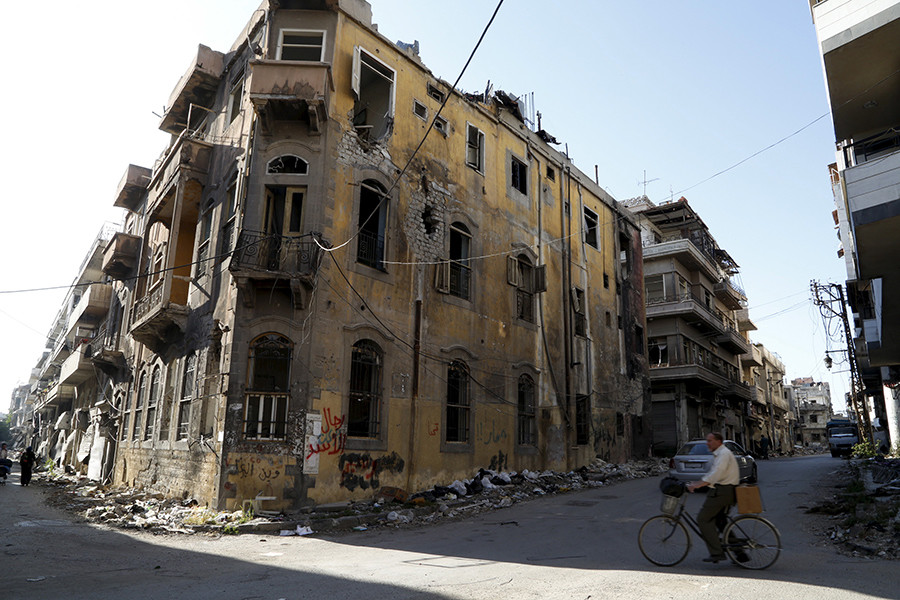
Were these narratives all manufactured? Were the images we saw all staged? Or was it only necessary to fabricate some things – because the “perception” of the vast middle population, once shaped, would create its own natural momentum toward regime change?
And what do we, in the region, do with this startling new information about how wars are conducted against us – using our own populations as foot soldiers for foreign agendas?
Create our own “game”
Two can play at this narratives game.
The first lesson learned is that ideas and objectives can be crafted, framed finessed and employed to great efficacy.
The second take-away is that we need to establish more independent media and information distribution channels to disseminate our own value propositions far and wide.
Western governments can rely on a ridiculously sycophantic army of Western and regional journalists to blast us with their propaganda day and night. We don’t need to match them in numbers or outlets – we can also employ strategies to deter their disinformation campaigns. Western journalists who repeatedly publish false, inaccurate and harmful information that endanger lives must be barred from the region.
These are not journalists – I prefer to call them media combatants – and they do not deserve the liberties accorded to actual media professionals. If these Western journalists had, in the first year of the Syrian conflict, questioned the premises of any of the four narratives listed above, would 250,000-plus Syrians be dead today? Would Syria be destroyed and 12 million Syrians made homeless? Would ISIS even exist?
Free speech? No thank you – not if we have to die for someone else’s national security objectives.
Syria changed the world. It brought the Russians and Chinese (BRICS) into the fray and changed the global order from a unipolar one to a multilateral one – overnight. And it created common cause between a group of key states in the region that now form the backbone of a rising ‘Security Arc’ from the Levant to the Persian Gulf. We now have immense opportunities to re-craft the world and the Middle East in our own vision. New borders? We will draw them from inside the region. Terrorists? We will defeat them ourselves. NGOs? We will create our own, with our own nationals and our own agendas. Pipelines? We will decide where they are laid.
But let’s start building those new narratives before the ‘Other’ comes in to fill the void.
A word of caution. The worst thing we can do is to waste our time rejecting foreign narratives. That just makes us the ‘rejectionists’ in their game. And it gives their game life. What we need to do is create our own game – a rich vocabulary of homegrown narratives – one that defines ourselves, our history and aspirations, based on our own political, economic and social realities. Let the ‘Other’ reject our version, let them become the ‘rejectionists’ in our game… and give it life.
Sharmine Narwani is a commentator and analyst of Middle East geopolitics. She is a former senior associate at St. Antony’s College, Oxford University and has a master’s degree in International Relations from Columbia University. You can follow her on Twitter at @snarwani
May 9, 2016
Posted by aletho |
Deception, Mainstream Media, Warmongering, Timeless or most popular, War Crimes | France, Qatar, Saudi Arabia, Syria, UK, Unconventional Warfare, United States |
Leave a comment

A recent conversation on security and peace between former security personnel of Saudi Arabia and Israel respectively, two weeks before Al Nakba commemoration shows that the attitude of the past on Palestine remains after 68 years.
Al Nakba is a series of events that led to the ethnic cleansing of Palestine and the Palestinians on May 15th, 1948. This is a day to remember the displacement and dispossession of 750,000 Palestinian people into refugee camps in neighboring countries; generations of whom continue to reside in these camps, others are scattered across the world in diaspora and many more internally displaced.
As the Palestinians across the world are on the verge of commemorating these events that happen to continue today in a process that is a form of incremental genocide, the Washington Institute for Near East Policy (WINEP) has recently engaged two former security personnel of Saudi Arabia and Israel respectively in a conversation related to security and peace in the Middle East. Setting aside that the said institute is a think tank that was founded by pro-Israel political figures, it is no surprise for Palestinians that an institution of this kind hosts such a choice for a duo to discuss the two topics of peace and security when both entities are serious human rights violators as well as exporters of terrorism and war; especially in the direct or indirect connection to Palestine and the Palestinians.
First and foremost, the timing of the said conversation between the two representatives of the security apparatuses of both entities reminds us that understanding the historical context is truly important for understanding the contemporary circumstances. As the events and planning took place leading up to the execution of the Nakba of 1948, there was an annulled agreement that took place prior known as the Faisal-Weizmann Agreement of 1919. This was an agreement that was signed at the Paris Peace Conference between Emir Faisal of Hejaz and Chaim Weizmann who was leader of the World Zionist Organization eventually leading to him becoming the first President of Israel. This agreement is significant in the fact that it reminds the Palestinians about the enabling and co-conspiring of the Arabs in the region and the role they played against the interests of the Palestinians; an example of which is the following:
Dr. Weizmann argued that Palestine was designed to solve “a world-wide problem” and therefore “the rights which the Jewish people has been adjudged in Palestine do not depend on the consent, and cannot be subjected to the will of the majority of its present inhabitants.” He maintained that “the Balfour Declaration and the Mandate have definitely lifted Palestine out of the context of the Middle East and linked it up with the world-wide Jewish community and the world-wide Jewish problem.” Thus the Zionists refused to let the British grant the Palestine Arabs any role in setting immigration quotas or in influencing other aspects of the development of the Jewish national home. Weizmann’s contempt for the first Arab delegation to London was apparent in his one discussion with them at the Colonial Office, in which he adopted the attitude “of a conqueror handing to beaten foes the terms of peace.”
Today’s Saudi Arabia’s role in relation to the nature of its engagement with the State of Israel, represents the same co-conspiring agenda and essence of the Faisal-Weizmann agreement under the guise of peace and security- in pursuit of self interest and Zionist led terror against the Palestinians. For example, during the latest military campaign against the Gaza Strip by the State of Israel known as Operation Protective Edge- Prime Minister Netanyahu emphasised the fact that “renewed relations” were built as a result of Saudi Arabia along with other Gulf countries engaging in security cooperation to quell the Palestinian resistance during those events.
Furthermore, the rise of the Islamic State and their reign of terror in the region has unsettling connections with these two entities. The Islamic State’s rise and political patterns in the region are leaning towards the affirmation of the Faisal-Weizmann Agreement given that this group’s reign of terror has not targeted any of these entities and have the same enemies that are “branches of the same tree”. Moreover, the group wants to abolish the Sykes-Picot Agreement which in many ways has been historically perceived as having been in the way and the obstacle of the Faisal-Weizmann Agreement. Most importantly, aside from the damage and destruction the Islamic State has done to the Palestinians both in Iraq and Syria, the Islamic State is attempting to exploit the Palestinian cause which also serves the Saudi-Israeli security interests.
And yet, with all this historical context at hand, including the horrendous human rights records of both Saudi Arabia and Israel along with an already outrageous military expenditure towards the State of Israel by the United States- the United States is granting Israel the largest military aid package in history, while simultaneously, Saudi Arabia is receiving a 15 billion dollar military arms package deal from Canada.
In Jeff Halper’s new book “War against the People” he sharply states: “In an endless war on terror, we are all doomed to become Palestinians.” The Washington Institute for Near East Policy is a political entity that enables this doom. It is an institute with residues of the pro-Israel lobby that played a pivotal role in dragging the United States into founding the global war on terror that has produced more global insecurity, the rise of the Islamic State and a push for war against Iran with no end in sight- all whilst simultaneously continuing the memoricide and erasure campaign against Palestine and the Palestinians through a nostalgic revivalism of what was embedded within the Faisal-Weizmann Agreement- demonstrated through this latest discussion between the Saudi-Israeli security personnel. This is what Palestine is trying to show the world. This is part in parcel of the Nakba in continuum.
May 8, 2016
Posted by aletho |
Ethnic Cleansing, Racism, Zionism, Timeless or most popular | Faisal-Weizmann Agreement, Human rights, Israel, Palestine, Saudi Arabia, WINEP |
Leave a comment
Founding political myths provide reassuring points of reference but they do not provide the full, or even, real reason on why major historical moments occurred. As is popularly known the American Revolution was triggered specifically by the Boston Tea Party in defiance of the British Parliament’s Tea Act of 1773. Yet in a recent article in the New York Review of Books, historian Professor Steve Pincus argues it was a series of economic policies, enforced by the British parliament from the 1760’s onward that made no small contribution to the colonialist’s rebellion against King George’s tyranny.
Recently in the United Kingdom a commemoration was held to mark hundred years since the Gallipoli expedition during World War One. The British Empire had intended to defeat the Ottoman Empire’s forces by sailing through the straits of Dardanelles and then move on to occupy Istanbul for the latter then to be parceled out to its ally, Imperial Russia.
The ‘Asia Minor Agreement’ between the Entente Powers of the British Empire, France and Imperial Russia divided the Ottoman Empire among themselves but after the Russian revolution (and the subsequent withdrawal of Russia from the war) this agreement became popularly known as Sykes-Picot. The British Empire’s failure to breach the Ottoman Empire’s positions at Dardanelles compelled it to fish around amongst the latter’s suzerainty in search of disgruntled groups who would be tricked into executing Great Britain’s dirty work of defeating the Ottomans and breaking up their Empire. Hence we today have the legend of the “Arab Revolt” as championed and jointly led by the British agent T.E.Lawrence aka “Lawrence of Arabia”.
Similarly when one attempts to ascertain the origins of the United States and the Saudi Arabian decades old alliance, the meeting held between President Franklin D. Roosevelt and the Kingdom’s founder, Abd al-Aziz Ibn Saud on board the USS Quincy on 14th February 1945 at Bitter Lake in the Suez Canal is widely regarded as the symbolic starting point. Hitherto, Ibn Saud had been the British Empire’s most reliable and favoured ally or desert stooge.
Since capturing Riyadh, what is now Saudi Arabia’s capital, with British weapons in 1902 Ibn Saud had dutifully and faithfully done the Empire’s bidding. Whether it was attacking the Ottoman’s Empire’s representatives in the Arabian desert or dispatching the recalcitrant Hussain Ibn Ali from the Hijaz, (the western part of today’s Saudi Arabia) in the mid-1920’s after he had refused to accept the Britain’s Zionist colonial project in Palestine; the Empire knew it had a loyal servant in Ibn Saud.
But with the Empire’s resources stretched during World War II, some British diplomats as early as 1941 were attempting to encourage American involvement in Saudi Arabia. The Empire believed it could no longer afford to subsidise Ibn Saud as well as soundly account for its own domestic and other imperial undertakings. According to two British biographers of the Saudi clan, David Holden and Richard Johns, British diplomats “had attempted in the dark days of 1941 to interest the United States Government in taking on some of their financial burden in Saudi Arabia” to no avail.[1]
Two academic studies by Dr. Barry Rubin also confirm it was the British who made the initial approaches to the United States. In the summer of 1941 the Minister-Counsellor in the British embassy in the United States, Neville Butler was attempting to encourage the State Department’s head of Near East Affairs, Wallace Murray to purchase more oil from Saudi Arabia. In a meeting in late July 1941, Butler suggested to Murray that it was “most important” that Ibn Saud knew he had friends in the United States to which he can rely on for assistance.[2]
Several weeks later on August 21st the Americans rebuffed British approaches to subsidise Ibn Saud. Yet this did not stop the British from trying to work out a way of enticing the Americans to take some responsibility in the Middle East. The British remained adamant that the Americans should and must be involved in the Arab World, as the “Foreign Office was trying to work out some division of economic opportunity and political responsibility to avoid being overwhelmed by the United States.”[3]
In other words, for the British, the issue was how to financially cut the Americans into the Middle East. As such, if the Americans were to be appropriately cut in, they would, it was thought, inevitably burden more imperial responsibility for policing the Middle East without threatening other British interests.
But why choose Ibn Saud? Why didn’t the British stealthily offer Iran, Iraq or any other oil wells which the British had carved countries out from i.e. Kuwait, Bahrain, Qatar, etc?
It appears that Saudi Arabia was the nation chosen by British imperialists to ingratiate the Americans with largely because the British clearly felt that they had enough oil in Iran and Iraq to satisfy their needs and therefore could afford to portion out Saudi Arabia to the Americans. More so, with the Empire’s oil needs met in Iran and Iraq there was no need to develop Saudi Arabian oil fields. This was noted by American officials who reported that the British “blessed with ample oil supplies from Iran and Iraq” had no interest in developing Saudi reserves.[4]
Furthermore, In Rubin’s book on American-British rivalry in the early 1940’s in the Middle East he observed that:
“The British, far from seeking to exclude American interests from the region, were attempting to work out a method for providing America with some responsibilities in the Middle East in order to make it a reliable partner in helping to shore up existing British interests.”[5] This responsibility ultimately culminated in transmuting Ibn Saud from a British puppet into an American puppet.
In other words if existing British interests were to be given a second American guard in the region then the Americans too needed something real or “ample” to defend. As Butler argued “Americans are not likely to accept responsibilities in the Middle East unless they first have increasing material interests there.”[6] The historian John Keay states that the “the British were to be seen simply as inviting US collaboration in the face of a new global peril.”[7] The peril was later identified as communism.
After the Americans acquiesced in accepting British invitations to embrace and subsidise Ibn Saud with a lend-lease package other narratives began to be concocted to explain the new geo-political alliance between the USA and Saudi Arabia. One narrative recently advocated by the BBC’s legendry Adam Curtis in his documentary on the meeting at Bitter Lake, is that a quid pro quo was agreed between Roosevelt and Ibn Saud, whereby the former would provide military security in exchange for ‘controlling’ the latter’s oil. But the U.S. oil needs have always largely been met by trade with western hemisphere nations.
Another narrative peddled mainly by British historians bestowed Ibn Saud with the vision, foresight and indeed the ability of reading the desert runes in that he “sensed a coming change in the regional balance of power”[8] or Ibn Saud possessed the “familiar bedouin eye to the main chance which dictated a prompt accommodation to the new facts of life”[9] and this therefore was why he struck a deal with the United States rather than the British Empire. Obviously, Ibn Saud’s sublime intuitions dovetailed neatly with British strategies.
When Roosevelt finally met Ibn Saud in 1945 at Great Bitter Lake it was on the back of almost four years of diplomatic shenanigans between British and American diplomats. When a British diplomat did complain in 1945 of the United States usurping the UK’s long established alliance with Ibn Saud he was rebuffed by central government because “London ‘was glad to see the Americans with a substantial stake in the Middle East.’”[10]
The meeting at Bitter Lake has now come to symbolise the founding of the American and Saudi Arabian geo-political relationship when it most likely represented the ceremonial handover and makeover of a pliable British stooge into an ever more pliable American stooge. In many respects the meeting can also be seen as a belated, decades-old, addendum to the Sykes-Picot carve up: American power was allowed to wiggle into the Middle East alongside the British with its own piece of Saudi booty.
[1] David Holden and Richard Johns, “The House of Saud” (London : Pan Books, 1982), pg.127
[2] Barry Rubin, “Anglo American Relations in Saudi Arabia, 1941-1945”, Journal of Contemporary History, Vol. 14 (1979), pg.254
[3] ibid., pg.255-6
[4] ibid., pg.262
[5] Barry Rubin, “The Great Powers in the Middle East 1941-1947” (London: Frank Cass, 1980), pg. 38-39.
[6] ibid., pg. 39
[7] John Keay, “Sowing the Wind: The mismanagement of the Middle East 1900-1960” (London: John Murray, 2003) pg. 334
[8] Lawrence James, “Churchill and Empire: Portrait of an Imperialist” (London: Pheonix, 2013) pg.326
[9] Holden & Johns, op., cit. Pg. 135
[10] Rubin, “The Great Powers in the Middle East 1941-1947”, op., cit., pg. 64
May 7, 2016
Posted by aletho |
Ethnic Cleansing, Racism, Zionism, Militarism, Timeless or most popular | BBC, Saudi Arabia, UK, United States |
Leave a comment
For decades, Saudi Arabia has been a stalwart advocate of Palestinian statehood rights and a voracious critic of the Israeli occupation of the West Bank and Gaza. Saudi Arabia’s commitment to Palestine has defined the geopolitical contours of the Middle East for decades. But now that the Iran nuclear deal has been struck and as the war in Syria ravages on, those political lines are being redrawn, bringing together unexpected bedfellows: Saudi Arabia and Israel.
Marketed as a “pathbreaking public dialogue between senior national security leaders from two old adversaries,” May 5, 2016 will feature a high-profile meeting in Washington DC between officials from Saudi Arabia and Israel. Prince Turki bin Faisal, Saudi Arabia’s former intelligence chief and one-time ambassador to Washington, and retired Israeli Defense Forces (IDF) Major General Yaakov Amidror, former national security advisor to Prime Minister Benjamin Netanyahu, will be speaking together at the Washington Institute for Near East Policy, a pro-Israel organization funded by AIPAC donors, staffed by AIPAC employees, and located down the hall from AIPAC Headquarters.
Saudi Arabia has never engaged in diplomatic relations with Israel since the Nakba in 1948, and at one point even led efforts to boycott the state of Israel. And although this is not the first meeting of its kind (Saudi Arabia and Israel had a former official speak at a Council on Foreign Relations panel last year), it is definitely the highest profile meeting and it is taking place.
While having like-minded human rights abusers such as Saudi Arabia and Israel mingle and meet publicly might come as no surprise to most of us, this event is still bad news: it signals a new era of normalization by the official sponsor of the Arab Peace Initiative.
The Arab Peace initiative, also known as the “Saudi Initiative”, is a 10-sentence proposal for an end to the Arab–Israeli conflict. It was endorsed by the Arab League in 2002 and re-endorsed in 2007, and it is supported by all Palestinian factions, including Hamas. The initiative calls for normalizing relations between the Arab world and Israel in exchange for a complete withdrawal by Israel from the occupied territories (including East Jerusalem). Until now, it has been the most viable blueprint for a two-state solution. The deal also addressed the issue of Palestinian refugees and called for a “just settlement” based on UN Resolution 194.
So, at this political moment when Netanyahu is not showing any willingness to withdraw from the Occupied Palestinian Territory and some of his ministers are calling for the official annexation of the West Bank, Saudi Arabia seems to be giving up on its historic commitments. By normalizing relations with Israel without demanding a just solution to the Israeli-Palestinian conflict, Saudi Arabia is diminishing its leverage in negotiating a two-state solution.
In a way, this meeting marks the official demise of the Arab Peace Initiative, but more importantly, as the last standing mechanism for a regionally negotiated resolution, it is yet another indicator that a two-state solution is officially dead.
Alli McCracken is co-director of the peace group CODEPINK based in Washington DC. Raed Jarrar is an Arab-American political advocate based in Washington DC.
May 6, 2016
Posted by aletho |
Ethnic Cleansing, Racism, Zionism | AIPAC, Council on Foreign Relations, Israel, Palestine, Saudi Arabia, Zionism |
Leave a comment
The Gulf monarchies are the main facilitators of Britain’s support for sectarian death squads in the Middle East. This should be no surprise because Britain brought them to power precisely because of their sectarianism.
“What we want is not a united Arabia: but a weak and disunited Arabia split up into little principalities so far as possible under our suzerainty, but incapable of coordinated action against us” – so claimed a memorandum written by the Foreign Department of the British Government of India in 1915.
A more succinct summary of British policy towards the Arab world – both then and now – would be hard to find.
As we outlined in the first piece in this series, Britain’s weapon of choice in its attempt to destroy the independent regional powers of West Asia and North Africa in recent years has been its sponsorship of violent sectarianism. Its support for racist death squads in Libya not only achieved the destruction of the Libyan state, but also brought terrorism to every country in the region from Egypt, Tunisia and Algeria to Chad, Nigeria and Cameroon; whilst its training and equipping of death squads in Syria has been directly responsible for the rise of ISIS.
These forces, by setting Sunni against Shia, Muslim against Christian, and Arab against Black, are helping to bring about precisely that “weak and disunited Arabia” that the British officials in India dreamed of one hundred years ago.
Alongside the direct support and recruitment provided by British intelligence and the British government, one of the main conduits for arms and fighters has been the gulf monarchies: Qatar and Saudi Arabia in particular. That the Gulf States should play this role should, of course, be no surprise – as they were very largely the creations of the same British Government of India that wrote that memo in the first place.
In 1857, British colonial rule of India was challenged as never before, as what started as a mutiny rapidly spread across the country to become a mass insurgency, the first war of Indian independence. One of the reasons it was so potent is that Hindus and Muslims had joined forces – leading to what became the biggest anti-colonial uprising of the nineteenth century. Britain learned the lessons – and began to cultivate sectarian divisions more assiduously than ever before.
As Mark Curtis notes in Secret Affairs: “After 1857 the British promoted communalism, creating separate electorates and job and educational reservations for Muslims. ‘Divide et imperia [divide and rule]’ was the old Roman motto, declared William Elphinstone, the early nineteenth-century governor of Bombay, ‘and it should be ours’. This view pervaded and became a cornerstone of British rule in India”.
Curtis quotes one document after another to demonstrate just how pervasive this view became: one Secretary of State advising the governor general that “we have maintained our power in India by playing off one part against the other and we must continue to do so. Do all you can, therefore, to prevent all having a common feeling”; another informing the Viceroy that “this division of religious feeling is greatly to our advantage”; a senior civil servant writing that “the truth plainly is that the existence side by side of these hostile creeds is one of the strong points in our political position in India. The better clashes of Mohammedans are already a source to us of strength and not of weakness”, and so on, ad nauseam. Yet, Curtis notes, it was not in India but in the Middle East that this divide and rule strategy “reached its apogee”.
The British Government of India began cultivating alliances with family clans in the Arabian peninsula from around the late eighteenth century, formalizing these relationships through official treaties over the course of the next hundred and fifty years. Even before the discovery of oil, the region was deemed strategically important as part of the land route from India, as well for its surrounding sea routes, and the Indian government took steps to ensure that it be placed firmly under British control.
By the nineteenth century, Britain was already the pre-eminent naval power in the region, and had become powerful enough to make or break the fortunes of those to whom it lent (or withdrew) its ‘protection’. So it is interesting to note that those families which Britain did choose to turn into ruling classes of the new states that were being carved out – the Al Saud, the Al Thani, the Al Khalifa and others – all seemed to have two things in common: a history of regular warring with their neighbours; and an, at best, shaky control of the territories they claimed to rule. These factors were not coincidental – for what they produced was a dependence on British protection that effectively turned them into little more than vassals of Empire.
The al-Khalifa clan, for example, today’s rulers of Bahrain, originally hailed from Umm Qasr in Iraq, from where they were expelled by the Ottomans due to their regular attacks on trade caravans. They first seized control of Bahrain in 1783 after Persian rule began to crumble, but lost control two decades later falling out with the Wahhabis with whom they were briefly allied. It was only after signing a treaty with the British in 1820 that their rule was consolidated. This treaty, and the others that followed, effectively placed foreign policy in the hands of the British in exchange for Britain propping up the al Khalifa’s rule of the country – an arrangement that has continued, to all intents and purposes, right up to the present day.
Being effectively an alien force in the country, the al Khalifa were permanently at risk from the population they sought to rule, especially given their persecution of the Shia majority. This made British protection that much more important, and increased British leverage accordingly; whenever any particular Khalifa emir began to act too independently, the British would simply replace them.
Lieutenant Colonel Trevor, the Deputy Political Agent in Bahrain after the First World War, put it bluntly when, after receiving a series of demands from the new crown prince he noted that “The Shaikh forgets that he and his father were made Shaikhs by the British government.” Shortly afterwards, the British sent warships to the gulf to force the Shaikh to sign an agreement ceding all powers to his other son – a British protégé.
Formal independence was granted in 1971, but given that power was being handed over to the same family that had ruled Bahrain on Britain’s behalf for the past century and a half, this changed little. The most notable difference was perhaps the flags on the foreign warships at the country’s naval base, which changed from British to US.
Fast forward to the present day, and it is clear that the essence of the 1820 treaty – al Khalifa rule propped up by Western armaments, with foreign policy in the hands of the West – is still very much in place. Whilst David Cameron was proclaiming democracy (a euphemism for state collapse) for Libya and Syria, he was in Bahrain selling weapons to the Khalifas to suppress their own ‘Arab Spring’; whilst three years later the US fifth fleet would be firing hellfire missiles into Syria from its Bahraini base.
But British support for the al Khalifas has never been absolute; rather they built up the al-Thani clan as a ‘counterweight’ to the Khalifa in order to guarantee their continued dependence on the British. Up until 1867, Qatar had been essentially a semi-autonomous province of Bahrain, its government effectively ‘sub-contracted’ to the Al Thanis. In that year, however, a war between the Al Thanis and the Al Khalifas broke out; Britain intervened on the side of the Al Thanis, carving out Qatar out as a separate political entity and recognising the Al Thanis as its rulers. The border between the two countries was left devilishly ambiguous, and remained a running sore in Qatari-Bahraini relations right up until 2001; a “weak and disunited Arabia” indeed.
Further agreements were signed with the Al Thanis in 1935, offering them protection against internal and external threats in exchange for oil concessions. Qatar too gained formal independence in 1971, but the deep links forged during the period of the protectorate remain; indeed both the Emirs that have ruled since then were educated at Sandhurst Military Academy, with the current Sheikh educated at elite English private school Sherborne before that.
The relationship between Britain and the ruling families of Bahrain and Qatar continues to follow that same basic principle forged centuries ago, and now also extended to the US: whilst the ruling families act as regional agents of Western imperial policy, their rule is maintained by Western weaponry. Nothing illustrates this more clearly than the events of the so-called ‘Arab Spring’. The protests breaking out across the Arab world in early 2011 soon spread to Bahrain, where angry crowds demanded an end to the monarchy’s policies of discrimination and exclusion against the Shia majority. Cameron’s immediate response was to head to the region to sell the embattled regime the weapons it needed to crush the movement. The following year, the country’s interior minister, Rashid bin Abdulla al-Khalifa, visited the Foreign Office to gather “lessons learnt from our experience in Northern Ireland”, according to a British government statement. This experience was particularly relevant; the problem faced by the British in the North of Ireland was, after all, broadly analogous to that faced by the Bahraini monarchy: how to maintain an oppressive sectarian rule and crush movements calling for equality. The sight of British APCs in the street shooting down demonstrators, now common in the Bahraini capital, will be familiar to Belfast’s nationalist communities; and so too will the latest human rights reports coming out of Bahrain describing “detainees being beaten, deprived of sleep, burned with cigarettes, sexually assaulted, subjected to electric shocks and burnt with an iron”, all common practices in British army barracks in 1970s Ireland. Britain’s Bahraini students are quick learners. The US Fifth Fleet, based in Bahrain and used to fire missiles into Syria and Libya, is in safe hands.
Qatar, meanwhile, was a lynchpin in not only the militarization of the ‘Arab Spring’ and its capture by violent sectarian forces, but also its ideological whitewashing. The Al Jazeera TV channel was established by the Qatari government in 1996, effecting to what amounted to a ‘brown-facing’ of the BBC Arabic channel, which was closed down the same year before transferring a large chunk of its staff to the ‘new’ station. Al Jazeera built its credibility across the region – and, indeed, the world – with its critical coverage of Western and Israeli attacks on Iraq and Gaza. But in 2011 it would use this credibility to serve as NATO’s propagandist-in-chief, amplifying and disseminating every lie it could get its hands on – from African mercenaries, to mass rape, to ‘bombing his own people’, to ‘impending massacre’ – in order to demonize Gaddafi and sell the case for war. It would be a war in which Qatar would play a major role.
In the early days of the West’s attack on Libya, anti-Gaddafi rebel forces (led by the Libyan Islamic Fighting Group, Al Qaeda’s Libyan franchise), even with NATO air support, proved spectacularly ineffective at capturing and holding territory from the Libyan government. For the first few months, most of the towns they ‘captured’ thanks to NATO incineration of government soldiers would simply be retaken by the Libyan army days later. But NATO countries were wary of risking a domestic political backlash by openly committing too many of their own troops or resources to tip the balance. The solution found was to let Qatar and the Gulf states carry out its dirty work. They played a leading role in training and equipping rebel fighters, allowing NATO to be pretending to observe the arms embargo to which UN resolutions committed them. As the Royal United Services Institute noted, “the UAE established a Special Forces presences in the Zawiyah district and started to supply rebel forces in that area with equipment and provisions by air. Qatar also assumed a very large role; it established training facilities in both Benghazi, and, particularly the Nafusa Mountains on May 9 and acted as a supply route and conduit for French weapons and ammunition supplies to the rebels (notably in June), including by establishing an airstrip at Zintan.” They added that, “Western special forces could have confidence in the training roles undertaken by Qatar and the UAE, because the special forces in those countries have in turn been trained by the UK and France over many years”.
In addition to this major training and arming role, Qatari jets also joined NATO in pounding Libya, and the country issued $100million of loans to the rebel groups. But most important was the Qatari ground invasion of Tripoli.
As Horace Campbell has documented in his book ‘Global NATO and the Catastrophic Failure in Libya’, by the summer of 2011, NATO were nearing a crisis-point: the 60-day period in which the US president could engage in hostilities without Congressional support was over, and the UN mandate for military intervention was to expire in September. Calls were growing within the AU and the UN for a negotiated settlement, and rivalry between militias continued to dog the rebels’ progress. NATO needed to take Tripoli quickly if their regime change operation was not to be stalled in its tracks.
So in mid-August, NATO massively stepped up its bombing of Tripoli. Checkpoints, manned by citizens pledged to defend the capital were repeatedly targeted, and Obama sent the last two training drones left in the US to the Libyan front-line. That paved the way for what Campbell called “NATO’s triple assault – by air, land and sea”; not a ‘people’s uprising’ but rather a ground invasion to crush the people who had risen to defend their city. Troops were shipped in and disguised as ‘rebel fighters’, with, according to Le Figaro, five thousand Qatari troops chief amongst them. It was they who, finally, captured Tripoli for NATO, installing Abdul Hakim Bel Haj, now suspected leader of ISIS in Libya, as the new military chief of the conquered city.
Bahrain and Qatar are just two examples of the enduring alliances that the British government has cultivated over centuries as it groomed handpicked ruling families for their anointed role as agents of imperial policy. In exchange for a British guarantee of their absolute power domestically, they have provided military bases and have acted as willing agents for those tasks their patron was either unwilling or unable to carry out itself. Today, that means acting as an ‘arms-length’ distributor of both BBC propaganda and British violence, in far more ways than have been possible to articulate here (Qatar’s role in managing the various Muslim Brotherhood offshoots that have been destabilizing Syria, Egypt and elsewhere, for example, would need a full article in its own right). But even more significant than the British alliance with the al Khalifas and al Thanis is that which was established with the al-Saud family, the subject of our next piece. For it is this relationship, forged during the slow decline of the Ottoman Empire, that ultimately created a new multinational fighting force of fighters in the 1980s – the ‘database’ – that has been doing Britain’s bidding in Bosnia, Kosovo, Afghanistan, Libya and Syria ever since.
This is Part Two of Sukant Chandan and Dan Glazebrook’s series on British collusion with sectarian violence.
Read Part One here.
Dan Glazebrook is a freelance political writer. His first book “Divide and Ruin: The West’s Imperial Strategy in an Age of Crisis” was published by Liberation Media in October 2013. It featured a collection of articles written from 2009 onwards examining the links between economic collapse, the rise of the BRICS, war on Libya and Syria and ‘austerity’. He is currently researching a book on US-British use of sectarian death squads against independent states and movements from Northern Ireland and Central America in the 1970s and 80s to the Middle East and Africa today.
May 6, 2016
Posted by aletho |
Illegal Occupation, Timeless or most popular, War Crimes | Bahrain, ISIS, Libya, Qatar, Sandhurst Military Academy, Saudi Arabia, Sherborne, Syria, UK |
Leave a comment
Syria on Thursday lashed out at Saudi Arabia, Turkey and Qatar, stressing that the regimes are defying international law over their backing of terrorists organizations operating in Syria.
In a letter sent to the UN Secretary-General and head of the UN Security Council, the Syrian foreign ministry said violations of the truce in Aleppo and attacking safe residential neighborhoods prove once again that the regimes of Riyadh, Ankara and Doha keep defying UN Security Council resolutions.
“Armed terrorist groups breached a truce in Aleppo that culminated tough efforts to which the Syrian Arab Army has fully committed since Thursday morning May 5 2016 as agreed,” SANA news agency cited the Syrian letter.
The ministry explained that a few hours after the truce took effect early on Thursday, the armed terrorist groups shelled the safe residential neighborhoods in Aleppo city including al-Khalediya, al-Zahraa, al-Suleimaniyeh, Sallahu-Eddin , al-Azeeziya and al-Midan with heavy barrage of rocket shells, explosive gas cylinders (Hell cannon) and mortar shells.
The terrorist attacks on the residential neighborhoods and Dar al-Farah school resulted in killing three civilians, injuring others and causing massive devastation to private and public properties, the Syrian foreign ministry said.
The ministry confirmed that the crime of violating the truce in Aleppo reveals the real face of the terrorist armed groups, adding that these terrorist groups which are backed by Turkey, Saudi Arabia, Qatar and other countries have no other aim but to kill Syrians and destroy their country, yet some insist on calling them ‘moderate opposition.’
“On Thursday morning, May 5 2016, ISIL terrorist organization detonated a car and motorcycle bombs in the main square of al-Mukaram al-Fouqani city in Homs province, killing 12 civilians and injuring 40 others including children, women and elders,” added the ministry, referring to the Takfiri group.
May 6, 2016
Posted by aletho |
War Crimes | ISIL, Qatar, Saudi Arabia, Syria, Turkey |
Leave a comment
Supporters of Shia cleric Moqtada al-Sadr have stormed Baghdad’s highly fortified, US established Green Zone, also home to the US Embassy, uninvited, the biggest in the world.
All staff of the Japanese, French, British, Australian, Jordanian, Emirates and Saudi Arabia Embassies have moved in to into the American Embassy, it is being reported.
Entrances have been reported sealed and tight security imposed to protect the Iraq Central Bank and other government banks, says an unconfirmed report. However, the Guardian contradicts stating that: “A guard at a checkpoint said the protesters had not been searched before entering. About ten members of the armed group loyal to Sadr were checking protesters cursorily while government security forces who usually conduct careful searches with bomb-sniffing dogs stood by the side.”
Moreover: “Rudaw TV showed protesters chanting and taking selfies inside the parliament chamber where moments earlier MPs had been meeting.”
As Al Jazeera explains: “It is the climax of weeks of political turmoil in Iraq that has seen MPs hold a sit-in, brawl in the parliament chamber and seek to sack the speaker, stalling Prime Minister Haider al-Abadi’s efforts to replace party-affiliated ministers with technocrats.”
The further chaos comes just two days after US Vice President Joe Biden arrived in Baghdad in a situation so chaotic for the US’ puppet government that as the New York Times described it (28th April 2016) “… the political situation in Iraq has become so fluid that Mr. Biden’s team has sometimes been unsure whether officials he planned to meet with would still be in office when he arrived.”
America’s fortress Green Zone has been breached with thousands of protestors breaking in, with one shouting: “You are not staying here! This is your last day in the Green Zone”, according to Al Jazeera who reported that in Parliament: “… some rioters rampaged through the building and broke into offices, while other protesters shouted: “peacefully, peacefully” and tried to contain the destruction …”
Barbed wire was pulled across the road leading to the Green Zone exits: “preventing some scared lawmakers from fleeing the chaos.”
The hated US imposed and fortified Zone – which was simply central Baghdad for all to wander under Saddam Hussein has finally been breached after thirteen years. Where another period of chaos will end, who knows, but meanwhile diplomats cower in the US Embassy, as factions Iraqis patience finally runs out over the tragedy and disaster that is the US and UK’s illegally imposed “New Iraq.”
“Iraqis are very quick to revolt”, former Deputy Prime Minister and Foreign Minister, Tareq Aziz, told me in an interview before the invasion, listing the years and the fate of those the uprisings had been against. The decimation since has delayed a further one, but it seems it’s time has arrived.
As for the outcome, updates follow. As we have wondered before in these columns, Embassy roof time for the residents and guests of the US Ambassador – again? Vietnam’s spectre hovers?
April 30, 2016
Posted by aletho |
Illegal Occupation | France, Iraq, Saudi Arabia, UK, United States |
Leave a comment
By Brandon Turbeville | Activist Post | April 28, 2016
As Saudi war crimes and crimes against humanity continue apace in Yemen, Saudi Arabia is now apparently attempting to gain public support and better reception from the viewing audience by painting itself as an enemy of al-Qaeda and ISIS, despite the fact that the feudal monarchy’s reputation for supporting these very same terror organizations has been documented time and again. From Syria and Libya to Yemen, Saudi Arabia has proven itself repeatedly as a funder, organizer, and supporter of ISIS and al-Qaeda while, at home, it has demonstrated that its own government and ISIS are more alike than they are different.
Still, Saudi Arabia is attempting to show that it is, in fact, the enemy of al-Qaeda by issuing claims that the Saudi “coalition” in Yemen has recently fought a large scale battle against the terror organization and that it was able to capture the city of Mukalla after killing around 800 terrorists.
As AFP reports,
Yemeni troops backed by Arab coalition air strikes killed more than 800 members of al-Qaida in an attack on a southeastern provincial capital held by the group for the past year, the coalition said Monday.
Pro-government forces recaptured an oil terminal as well as the city of Mukalla, which was considered a jihadist stronghold, military sources said.
“The operation resulted… in the death of more than 800 al-Qaida members and some of their leaders, while some others fled,” Arab coalition commanders said in a statement published by SPA, the official Saudi news agency.
AFP notes, however, that the death toll cannot be independently verified and pointed out that no civilian deaths were reported. This latter detail is most questionable to say the least.
What is interesting is that the alleged operation is part of another alleged operation “aimed at securing parts of the country captured by jihadist militants who have exploited a 13-month war between Gulf-backed loyalists and rebels supported by Iran.” The operation itself takes place alongside the UN-brokered ceasefire was enacted on April 11 where jihadist groups are excluded.
What is even more interesting, however, is the description provided by “military officer” sources quoted by the AFP as to the nature of the battle for Mukalla.
As AFP reports,
“We entered the city centre (of Mukalla) and were met by no resistance from Al-Qaeda militants who withdrew west” towards the vast desert in Hadramawt and Shabwa provinces, a military officer told AFP by phone from the city the jihadists seized last April.”
The officer, who requested anonymity, said residents of Mukalla, home to an estimated 200,000 people, had appealed to the jihadists to spare the city the destruction of fighting and to withdraw. Yemeni military sources said Emirati military vehicles were used in the operation and that troops from the Gulf country, a key member of the Saudi-led coalition, were among the forces that entered Mukalla.
AFP could not immediately confirm these reports from officials in the United Arab Emirates.
While it was reported that the coalition members had conducted airstrikes against “AQAP positions” in Yemen, it is important to note that coalition forces admittedly met no resistance when entering Mukalla. Putting aside the fact that the Yemeni people would scarcely be able to tell the difference between AQAP and Saudi Arabian control of their country to begin with, at what point did the Saudis kill 800 AQAP members? Was it in the alleged and unconfirmed airstrikes which apparently kill only terrorists but no civilians?
Is it not extremely convenient that Saudi forces would bomb Yemen back into the Stone Age, allow AQAP to gain vast amounts of territory against Houthi, rebel, and government forces in the process and then retake it from them “without any resistance” shortly after a ceasefire agreement is made that does not include AQAP?
Was the Saudi bombing merely an act of death squad herding or was the Saudi bombing never aimed at AQAP at all? Were the casualties actually civilians simply labeled as terrorists for propaganda purposes? Was there actually a bombing campaign?
What kind of military operation kills 800 militants while, at the same time, faces no resistance from those militants?
All of these questions are relevant and must be asked of any reports suggesting Saudi military action against AQAP in Yemen. While it is impossible to draw concrete conclusions based on the reports currently circulating throughout Western media, considering the nature of the Saudi involvement and their history of supporting terrorism across the world, one must question their motives as well as any claims made by the Saudi government.
Al-Mukalla is a strategic city in the Abyan Governate, a very important territorial gain since it provides access to the coast.
April 29, 2016
Posted by aletho |
Deception, Militarism, War Crimes | al-Qaeda, AQAP, Saudi Arabia, Yemen |
Leave a comment
Russian Foreign Minister Sergei Lavrov says Turkey exercises a “decisive influence” on the so-called opposition group High Negotiations Committee (HNC) which is in peace talks with the Damascus government.
Lavrov made the remarks on Monday while commenting on the progress of the latest round of negotiations between the Syrian government and HNC, which began in Geneva on April 13.
Syria peace talks are going on despite the absence of the Saudi-backed opposition as the group’s leaders left the talks on April 19 to protest at what they called escalating violence and restrictions on humanitarian access in Syria.
A ceasefire, brokered by Russia and the US, went into effect on February 27 across Syria. Fighting, however, picked up and left the truce in tatters. Meanwhile, the UN Security Council has agreed on a six-month deadline for drafting a new constitution for the Arab country in line with the proposal of the International Syria Support Group.
“In order to come to terms over six months it is necessary not to slam the door and dig in heels, as several delegates of the so-called Riyadh group have done, Lavrov said, adding that “it’s no secret” that Turkey has a “decisive influence” on them.
“So one should not come for talks with ultimatums but should sit down at the negotiating table and reach an agreement,” Lavrov added, noting that the situation at the UN-brokered talks could have been better if HNC had not left Geneva.
The top Russian diplomat also said that Moscow was preparing a report for the UN Security Council to extend the list of terrorist groups in Syria.
“We are currently collecting information that Jebhat al-Nusra (al-Nusra Front) subjugates groups that seemed to have declared truce and readiness to join ceasefire,” Lavrov said, adding, “We will summarize facts and present them to [the] UN Security Council to adjust terrorist lists.”
Syria has been gripped by foreign-backed militancy since March 2011. Damascus says Saudi Arabia, Turkey and Qatar are the main supporters of the militants fighting the government forces.
According to UN special envoy for Syria Staffan de Mistura, some 400,000 people have lost their lives as a result of over five years of conflict in Syria.
April 25, 2016
Posted by aletho |
Illegal Occupation, Militarism | al-Nusra Front, HNC, Qatar, Saudi Arabia, Syria, Turkey |
Leave a comment
In a remarkable spectacle of money-grubbing over arms deals, this month saw a parade of Western leaders jettisoning any pretense of upholding vaunted “liberal values” to court despotic Mideast regimes.
Justin Trudeau, the Canadian prime minister who sent liberal hearts aflutter when he was elected in November, with his espousal of feminism among other progressive causes, is the latest Western leader to show where real priorities lie. Trudeau signed off on an $11 billion deal with Saudi Arabia to export armored vehicles to the blood-soaked repressive regime.
With astounding cynicism, the 44-year-old Canadian premier said he was duty-bound to fulfill the arms contract drawn up by the previous administration as “a matter of principle” in order to demonstrate that his country’s “word means something in the international community.”
This week also saw US President Barack Obama in Saudi Arabia where he glad-handed King Salman and other Gulf monarchs, lauding them as partners in maintaining regional stability and fighting against terrorism. Conspicuously, Obama made little or no mention of human rights violations in the oil-rich kingdom where mass beheadings are a common method of capital punishment.
Western media talked about “strained relations” between Obama and his Saudi hosts. But underlying the superficial optics it was business as usual. Big business. US military affairs publication Defense One reported that high on Obama’s agenda was securing a $13 billion contract for warships and submarine-hunting helicopters with the House of Saud.
Before Obama touched down in Riyadh, his administration had angered American families by announcing that it would veto a bill going through Congress that could enable relatives of the 9/11 terror attacks to sue the Saudi rulers for their alleged involvement in sponsoring that atrocity. The topic didn’t even arise for discussion during Obama’s visit, indicating the president’s real concerns in meeting the Saudi and other Gulf rulers.
France has also nabbed market share from Western rivals in the Persian Gulf where over the past year Paris has sold billions of dollars’ worth of its Rafale fighter jets to Saudi Arabia, Qatar and the United Arab Emirates.
Similar prevarication over human rights is brazenly shown by the British government of David Cameron in its arms dealing with Saudi Arabia and the wider region. The Saudi-led war in Yemen has been a boon for British sales of bombs and missiles, even though as many as 9,000 Yemenis have been killed over the past year, many of them civilians from aerial bombing by Saudi warplanes.
Britain’s foreign minister, Philip Hammond, has dismissed condemnations by human rights groups in regard to Yemen, claiming that British weapons exports meet tough standards of international law. Britain, like Canada and other Western governments, makes the cynical claim that its military exports are not used for “internal repression” and that if it is proven that weapons are being used to kill civilians in Yemen then trade licenses will be canceled.
So what is Saudi Arabia dropping on Yemen? Cuddly British-made toys?
Duplicity of Western governments doing business with despotic regimes is nothing new. The Middle East’s absolute monarchs have long been a staple of American and other Western so-called “defense industries.” In 2010, the Obama administration signed a $60 billion weapons deal with Saudi Arabia – the biggest in US history.
During the 1980s, Britain under Margaret Thatcher won a comparable mammoth contract with Saudi Arabia known as the Yamamah deal.
Massive arms sales to tyrannical regimes give the real meaning to hackneyed euphemisms spouted by the likes of Obama, Cameron, Hollande and Trudeau, when they cite “regional partners for stability.” What they mean by stability is uninterrupted orders for weapons.
What is new, though, is the lack of discretion in how the West now pursues arms deals in the Mideast.
Western governments are apparently falling over themselves to bid for business. Yet this unseemly rush for arms selling is sharply at odds with not only intensifying repression within Middle Eastern “partner” regimes; it has also become abundantly clear that some of these same regimes are directly responsible for sponsoring terrorism in the region. The case of Saudi Arabia and its sponsorship of Wahhabi terror proxies in Syria, Libya and Iraq is perhaps the most glaring.
Part of the burgeoning Western race for arms business is related to the historical demise of their capitalist economies and the emergence of military industries as key components in whatever remains of gutted manufacturing sectors.
No doubt, critics will point out that Russia is also a major arms supplier to Middle Eastern regimes. According to the Stockholm International Peace Research Institute, Russia is indeed a prominent weapons exporter to the region and globally.
However, there is an important distinction. Western governments never cease to proclaim democracy, human rights and international law as foundational policies. Washington, London, Paris and so on continually invoke such rights as criteria by which they sanction, censure and even invade other countries to ostensibly uphold.
What is therefore more transparent than ever from Western countries soliciting arms deals in the Middle East is their shameless, sordid hypocrisy.
That Canada’s fresh face of “liberal values,” Justin Trudeau, has joined the throng of Western leaders cutting deals with tyrants and dictators just goes to show how cosmetic Western noble pretensions are.
Why should citizens in these countries believe anything that their governments tell them on any issue? Their governments all too evidently do not have a scrap of integrity or principle.
Official Western treachery, duplicity and hypocrisy have become a chronic condition that is no longer veiled by lofty rhetoric, as it once was. So-called liberal values are being stabbed in the back – left, right and center.
Read more:
UK sold Saudis £2.8bn in weapons since outbreak of Yemen war – report
April 25, 2016
Posted by aletho |
Progressive Hypocrite, War Crimes | Canada, France, Justin Trudeau, Middle East, Obama, Saudi Arabia, UK |
Leave a comment

 Aletho News