Justice for the Women of Sepur Zarco
Indigenous women win precedent-setting case against former soldiers in sex slavery trial in Guatemala
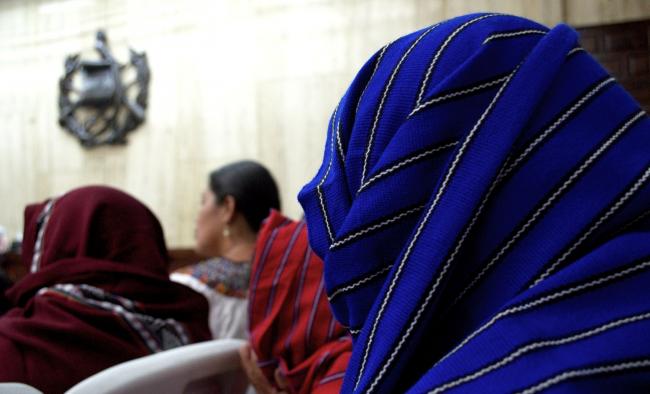
Women of Sepur Zarco, forced into sex slavery at the hands of the Guatemalan military in 1982, listen to trial proceedings at the Guatemalan Supreme Court (Photo by Quimy de Leon)
By Jeff Abbott and Julia Hartviksen – NACLA – 03/11/2016
Nearly 20 years since the signing of Guatemala’s 1996 Peace Accords, justice has finally been served for 15 Indigenous Q’eqchi’ Mayan women of Sepur Zarco, who were forced to become sex slaves for members of Guatemala’s military during the country’s long civil war.
On February 26, Guatemala’s Supreme Court sentenced two former military members, former Lieutenant Coronel Esteelmer Reyes and former Military Commissioner Heriberto Valdez Asij, to prison terms of 120 and 240 years, respectively, for crimes against humanity. Reyes was also found guilty of three assassinations, while Asij was deemed guilty for the forced disappearances of seven men. (Despite the significance of the guilty verdict, prosecutors from the Guatemalan Public Ministry had initially requested that Reyes and Asij be sentenced with 1290 years in prison for war crimes, plus 50 years in prison for each assassination charge.)
On March 2, the perpetrators were also ordered to pay reparations to the victims. Reyes will owe 500,000 Quetzales (about US $65,000) to each of the victim-survivors, and Asij has been ordered to pay 250,000 Quetzales (about US $32,500) for each of the seven forcibly disappeared men.
Judge Yassmín Barrios of the Guatemalan Supreme court made the historic decision following a short, emotional trial, which began February 1 in the Guatemalan Supreme Court in Guatemala City. The case, the first time in the world where a case of wartime sexual violence was tried in the national courts of the country where the violence occurred, represents a landmark legal decision in Guatemala and a major victory against the impunity for war crimes in the country.
The charges against Reyes and Asij relate to crimes committed in the year 1982, a time when both men were stationed at the Sepur Zarco military base in Alta Verapaz. During this period, the soldiers murdered men in the community, and forced women in the area to work as domestic servants and sexual slaves, subjecting them to degradation, abuse, and rape. In 2010, 12 of those women, all of Mayan Q’eqchi’ descent, brought the case before a mock tribunal meant to address sexual violence during Guatemala’s 36-year-long war. In 2011, the case was brought before a criminal court. Grassroots organizations and international NGOs alike fought to bring the case to the Guatemalan Supreme Court, amidst repeated attempts to derail their efforts.
Lily Muñoz, a sociologist who worked as an independent consultant assisting the legal organization, Mujeres Transformando el Mundo (MTM) on the case, explained the significance of the historic ruling. “It represents justice for war crimes that were committed against women,” she said.
Though the case represents a landmark legal decision for Guatemala, Sepur Zarco is not an exceptional case of sexual violence perpetrated by the military during the war. “This case serves as a precedent not only here in Guatemala, but also on the global scale,” said Lily Muñoz, a sociologist who worked as an independent consultant assisting the legal organization, Mujeres Transformando el Mundo (MTM) on the case.
The case’s success has led to more than 30 Achi’ women from the community of Rabinal, Baja Verapaz, who also suffered from sexual violence at the hands of the military, to begin mobilizing for legal justice for crimes of sexual violence as a tactic of war.
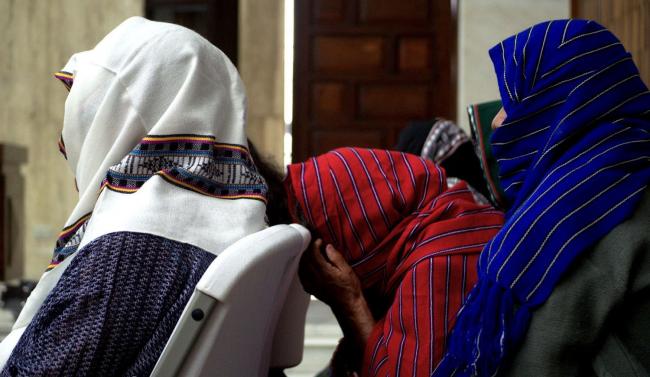
Survivors of the Sepur Zarco sex slavery case at the Supreme Court trial (Photo by Quimy de Leon)
This case also illustrates the gendered dimensions of such brutality – a brutality that preyed upon the vulnerability of indigenous women in rural Guatemala at the height of the internal armed conflict. “It is particularly interesting that sexual violence against women was a part of the sentence, and in the context of an armed conflict. This marks such violence as a war crime, as a crime against humanity. It’s a war crime, but it is a specifically gendered crime, that was tried in the national court of the country where the crimes were committed,” Muñoz said.
She continued: “The military men created conditions of extreme vulnerability for the women of Sepur Zarco. They took their husbands away from them, and they robbed them of their lands and livelihoods – in short, everything they required for social reproduction – and then later, of their sexuality and their ownership over their own bodies.”
As Muñoz explained, Judge Barrios drew on the testimony of a Brazilian anthropologist, Dr. Rita Laura Segato in coming to a decision in the case. Dr. Segato had argued in her testimony that “In the context of the Guatemalan internal armed conflict, women’s bodies were converted into military objects.”
The anthropologist argued that, in this way, that women’s bodies came to represent the “social body,” and for that reason, “the soldiers violated and ‘profaned’ women’s bodies.”
Following Dr. Segato, Muñoz explained that the military sought to “break the community, physically and morally” and did so through sexual violence against women. In this sense, the violence perpetrated against women carried lasting physical, emotional and psychological aspects, and also symbolic meaning for the victim-survivors and other community members. In reading the sentence, Judge Barrios recognized these long-term, destructive impacts the violence of the Sepur Zarco base had on the women who brought the case forward.
The case itself represents a historic shift for the Guatemalan courts, whereby claims of violence brought forth by indigenous women have been recognized by the mainstream justice system, a system that has consistently silenced their voices. “This case has shown that we can trust the testimonies of the (indigenous) women,” said Ada Valenzuela, the director of the Union Nacional de Mujeres Guatemaltecas (UNAMG). “Even 30 years later, the testimonies of the women were supported through other testimonies, and evidence.”
Despite the fact that the women’s faces were covered during the trial for the purposes of anonymity, it was the women themselves who pushed for the case to move forward, despite being told that it would likely not win. “The women from Sepur Zarco said that if this case were to go to court, then they wanted to go,'” Valnezuela said. “And we decided that we were going to accompany these women in this process. This was a very valiant decision.”
The women were also accompanied by a coalition of Guatemalan feminist organizations in Guatemala, known as the Alliance to End Silence and Impunity, which includes UNAMG, MTM and the Equipo de Estudios Comunitarios y Acción Psicosocial (ECAP). UNAMG and ECAP have worked to provide psychological support for the victims of the internal armed conflict and the women of Sepur Zarco since 2004.
The case also complicates the characterization of the simplified but still all too common narrative of Guatemala’s civil war in which Marxist guerrillas are presented as fighting against state. In fact, in many cases, it was poor rural campesinos, organizing to gain ownership of their own land who suffered the most intense brutality of the conflict.
According to Muñoz, all of the women’s husbands were involved in negotiations with the National Institute for Agrarian Transformation (INTA) to gain legal ownership over land they had lived on for centuries. Many of these lands have since been transformed into fincas for the production of sugar cane and oil palm.
“The conditions that began the war have been maintained today,” said Valenzuela. “The inequality, the question of land, the question of opportunity, (among others), are continuing today. According to Valenzuela, Sepur Zarco “has woken up the women of Guatemala. [It] represents hope for justice for other women who suffered violence during the war.”
Jeff Abbott is an independent journalist currently based out of Guatemala. He has covered human rights and social moments in Central America and Mexico. His work has appeared at VICE News, Truthout, and the Upside Down World. Follow him on twitter @palabrasdeabajo.
Julia Hartviksen is a PhD Candidate at the Gender Institute, at the London School of Economics and Political Science. Her research focuses on the materiality of violences against women, and the gendered impacts of oil palm in Guatemala’s Northern Transversal Strip. Follow her on twitter @_yulinka_.
Sepur Zarco Trial: Guatemala Women Seek Justice for Sex Slavery
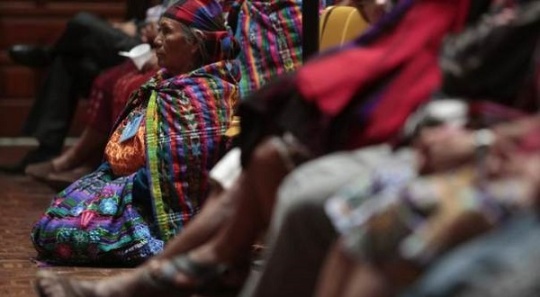
teleSUR – January 30, 2016
Fifteen Mayan women who were raped and forced to be sex slaves after their husbands were disappeared are demanding justice 30 years after the abuses.
Guatemala is about to launch a landmark trial against former military officers accused of committing sexual enslavement and forced disappearance during the most brutal years of the country’s 36-year civil war.
Here’s what you need to know about the historic trial that is scheduled to kick off Monday, Feb. 1.
1. Fifteen women were sexual and domestic slaves.
Guatemalan soldiers forcibly disappeared 15 men from an eastern Maya Q’eqchi’ village in 1982. It was one of the bloodiest years of Guatemala’s civil war, when dictator Efrain Rios Montt’s military regime was unleashing a scorched earth campaign targeting rural Mayans. After the army disappeared the men, they came back for their wives.
The women were raped and their belongings destroyed. They were taken captive and forced to live at the Sepur Zarco military base, where they were enslaved as domestic servants for the soldiers and systematically raped. The women were forced to labor in 12 hour “shifts,” an abhorrent system that lasted several months.
Though the enslaved shifts ended at the end of 1983, 11 of the 15 women were forced under military threat to stay at Sepur Zarco doing domestic chores for the soldiers for six years until the base closed in 1988. The other four women managed to flee to the mountains with their children where they endured painful hardship for years, including suffering the deaths of most of their children.
All of the women, now in their 70s and 80s, bear enormous physical and emotional trauma from the experience. They also faced stigma in their communities for the violence they endured, and did not share what had happened to them for 30 years, finally coming forward in 2011 to seek justice.
The trial accuses two defendants, former Sepur Zarco chief Esteelmer Reyes Giron and former regional military commissioner Heriberto Valdez Asij, of committing crimes against humanity, including sexual violence and sexual slavery, domestic violence, murder, and forced disappearance. They have been held in remand since 2014 awaiting the trial.
2. The Sepur Zarco case is an internationally historic trial.
The trial of two former military officers for crimes against humanity marks the first time in history that sexual slavery charges are prosecuted at the national level, in the country where the crimes were committed.
The more internationally high-profile case of sexual slavery during armed conflict, the case of Japan’s “comfort women,” was rejected by a Japanese court. Former comfort women subjected to sexual slavery during World War II put Japan on trial in a mock war crimes tribunal in Tokyo in 2000, but the case never officially went to court in the country.
Guatemala’s Sepur Zarco trial could set a new precedent for prosecuting sexual violence in the context of armed conflict, which rights defenders say is one of the most widespread yet under-recognized violations of human rights.
3. It is also a historic trial for Guatemala.
The Sepur Zarco trial marks the first that that Guatemala will consider a sexual violence case as an international crime, which could set a precedent for future trials.
The crime of sexual slavery has been recognized internationally since the early 1900s, when the 1907 Hague Convention prohibited rape and the use of prisoners of war as slaves. The 1926 Slavery Convention elaborated anti-slavery laws with a definition that applies to sexual slavery. The Rome Statute of the International Criminal Court, which came into force in 2002, specifically criminalized sexual slavery.
A standing definition of sexual slavery was detailed in the 1998 U.N. Special Rapporteur’s final report on contemporary forms of slavery, “Systematic Rape, Sexual Slavery, and Slavery-Like Practices During Armed Conflict,” also known as the McDougall Report.
The report defined sexual slavery as “the status or condition of a person over whom any or all of the powers attaching to the right of ownership are exercised, including sexual access through rape or other forms of sexual violence.” More simply put, the McDougall report explained: “Slavery, when combined with sexual violence, constitutes sexual slavery.”
The trial will consider the crimes committed as war crimes and crimes against humanity.
Rape was widespread during the civil war. The Sepur Zarco case has the potential to be a precedent-setting trial to break the cycle of impunity for sexual violence in Guatemala.
4. Rape was a concerted strategy in the civil war.
In 1999, three years after the peace accords were signed in Guatemala, the U.N.-backed Truth Commission investigating civil war atrocities found that rape was systematic and widespread during the conflict. According to the commission, “the rape of women, during torture or before being murdered, was a common practice aimed at destroying one of the most intimate and vulnerable aspects of the individual’s dignity.”
The Truth Commission also found that violence against women, include rape, torture, and murder, was often motivated by their political affiliations, social participation, and ideals, and often combined with other human rights abuses. The report attributed 93 percent of all recorded human rights violations to the state, 85 percent for which the army was responsible.
Despite the countless cases of sexual violence during the civil war, the Sepur Zarco case is the only one that has gone to trial in the country where impunity for war crimes has long remained the norm.
According to the Guatemalan organization Women Transforming the World, sexual violence continues to be inflicted on women by state security forces in conjunction with other human rights violations, such as forced displacement.
5. The victims in Sepur Zarco were targeted for defending their land.
Maya Q’eqchi’ communities in Guatemala have long suffered deep inequality, poverty, and precarious access to land. Before they were disappeared in 1982, the 15 husbands of the victims in the Sepur Zarco case were fighting for legal titles to defend the land they had lived and worked on for years. Because they were standing up for their land rights, they were despised by local large landowners, labeled as leftist insurgents, and made into targets to be silenced.
Land conflicts and unequal ownership are central to the history of Guatemala’s civil war. In 1954, a CIA-backed coup ousted the democratically elected president and reversed the fledgling agrarian reform program that aimed to expropriate idle lands from elite landowners and redistribute land to campesinos. The coup not only triggered more than three decades of civil war, but also helped to lock in one of the most unequal land distribution patterns in Latin America.
Rios Montt’s U.S.-backed bloodshed was nominally a campaign to crush leftist guerrilla uprisings in Guatemala, but in practice many poor Mayan campesinos were targeted as “insurgents” as the military protected the interests of elite landowners.
Photo credit – Reuters
Featured Video

America Racing to Strategic Defeat in Iran
or go to
Aletho News Archives – Video-Images
From the Archives
Should Europeans ‘Thank’ the Americans for Destroying Nord Stream?
By Robert Bridge | Strategic Culture Foundation | September 29, 2022
With an investigation continuing into the destruction of the Nord Stream gas pipeline that provided energy supplies to Europe from Russia, there appears to be just one prime suspect, and that should surprise nobody.
Following the sabotage of the Nord Stream 1 and 2 gas pipelines, former Polish Foreign Minister Radoslaw Sikorski already seemed to know the identity of the perpetrator when he tweeted out: “Thank you, USA.”
At first glance, it seemed that Sikorski was speaking sarcastically, berating Washington for carrying out an attack that will have severe repercussions for the people of Europe. After all, how could anyone see any good coming from the termination of Europe’s primary source of gas reserves with winter just around the corner? It was Sikorski’s homeland of Poland, after all, that urged its citizens to collect firewood in the face of dwindling gas reserves.
In fact, the Polish diplomat was speaking one-hundred percent literally… continue
Blog Roll
 Aletho News
- Growing insecurity, soaring prices fuel protests in north as regime bans evacuation: Sources
- Iran denies responsibility for ‘depraved’ attack on Kuwait desalination plant
- Bring The Troops Back. End This War Now!
- Can we please stop calling Israel the ‘only democracy in the Middle East’ now?
- US should start removing its troops from Germany, proposes AfD co-leader Chrupalla
- Iran Red Crescent: 600 educational centers attacked in US-Israeli ‘war crimes’
- Russian Oil Tanker Arrives in Cuba Amid U.S. Blockade
- America Racing to Strategic Defeat in Iran: Lt Col Daniel Davis
- FTC Warns Visa, Mastercard, PayPal, Stripe Over Political Debanking
- Russian tanker approaches Cuba despite US oil blockade
- If Americans Knew
- Will Trump Go Kamikaze?
- Is the University of Florida Shutting Down College Republicans over Israel Criticism?
- Jewish extremist arrested over alleged plot to firebomb Palestinian activist Nerdeen Kiswani’s home
- More than half of Palestinian child detainees have no charges
- The More Murderous Israel Gets, The More We Hear About “Antisemitism”
- Land Day and the Palestinian struggle after 30 months of genocide
- The Iran War Is About Palestine
- Israeli soldiers echo settler ideology, talk of revenge after targeting Palestinians and detaining CNN crew in the West Bank
- Israeli Policies Threaten Future of Christian Schools in Jerusalem
- Former US soldiers argue Israeli policy is now guiding US interests
- No Tricks Zone
- New Study Finds Warming Saves Lives…Cold Temperatures 12 Times More Deadly Than Excess Heat
- German Science Blog Accuses PIK Climate Institute Of Hallucinating Climate Tipping Points
- Devastating Assessment Of Comirnaty Vaccine By Former Senior Pfizer Europe Toxicologist
- New Study: CO2 Is ‘Effectively Negligible’ As An Explanatory Climate Change Factor Since 2000
- Former Pfizer Toxicologist Dr. Helmut Sterz Tells Bundestag Hearing Pfizer Vaccine Should Have Never Been Approved
- Energy Expert: Germany’s Nuclear Phaseout Was A “500 Billion Euro Mistake”
- New Research: South Australia’s Mid-Holocene Sea Surface Temperatures Were 4°C Warmer Than Today
- Storing Green Energy To Last Germany 10 Days Would Require A 60-Million Tonne Battery
- New Studies: UK Sea Levels Were 4 Meters Higher Than Today During The Mid-Holocene
- Destructive Green New Deal: German Energy And Metal Group Warns Of Drastic Crisis
 Aletho News