Israel’s Elbit Systems reports record profits on the back of Gaza genocide
The Cradle | November 18, 2025
Israel’s leading defense technology company, Elbit Systems, reported a sharp rise in quarterly profit on 18 November after months of fueling the genocide in Gaza by supplying weapons, munitions, and surveillance systems, while simultaneously securing a wave of new European contracts.
The company posted $3.35 per diluted share excluding one-time items, up from $2.21 a year earlier, and reported $1.92 billion in revenue compared to $1.72 billion last year.
Its order backlog reached $25.2 billion, with the company saying 69 percent comes from outside Israel.
Elbit CEO Bezhalel Machlis said the performance reflected “the significant contracts the company has secured across Europe and from customers worldwide,” driven by expanding defense budgets.
Israel accounted for over 33 percent of revenue, with Elbit supplying munitions, drones, guided rockets, and reconnaissance systems during the Israeli genocide of Palestinians in Gaza.
Sales to Europe, the world’s second-largest buyer of Israeli weapons, rose from $430 million to $536 million, comprising 28 percent of total revenue.
The company said 69 percent of its backlog comes from outside Israel and declared a quarterly dividend of $0.75 per share.
Separately, Elbit announced the largest contract in its history, a $2.3-billion deal with an undisclosed international buyer for weapons systems to be delivered over eight years.
The company did not reveal the customer or the type of systems being supplied, citing confidentiality.
Elbit Systems has also expanded its footprint across Europe, the Balkans, and the UK through a series of new agreements disclosed in recent months.
In Albania, the company is leading a government-to-government deal that includes ATMOS howitzers, SPEAR mortars, and Magni-X and Thor drones, and will assist the state-owned KAYO firm in establishing production lines and a new weapons plant.
Elbit deepened its presence in the country earlier this year through a flight-school agreement and is expected to support Albania’s goal of developing local drone manufacturing by 2027.
The firm has simultaneously continued to sign additional contracts worldwide, including Hermes 900 sales to Singapore and Brazil.
In the UK, Elbit is competing with Raytheon for a $2.7-billion Ministry of Defense contract that would make the company a “strategic partner” responsible for training 60,000 British troops annually.
The prospective agreement follows a separate $1.64-billion Elbit deal with Serbia and builds on the company’s existing role managing the Ministry of Defense’s Project Vulcan, a $75-million simulation-training program for tank crews.
Elbit subsidiaries in Britain have come under sustained protest, and Elbit’s central role in Israel’s war on Gaza has prompted renewed scrutiny, with the UN special rapporteur for Palestine noting that “for Israeli companies such as Elbit Systems … the ongoing genocide has been a profitable venture.”
West-Russia war becoming inevitable – Serbian president
RT | November 12, 2025
A direct military confrontation between Western nations and Russia is becoming unavoidable, Serbian President Aleksandar Vucic has warned, citing widespread rearmament efforts across Europe.
Speaking during a televised interview on Tuesday, Vucic said the possibility of such a war is no longer hypothetical, pointing to an acceleration of military spending. The European Union seeks rapid militarization over a perceived threat from Russia, which Moscow has dismissed as misleading political rhetoric aimed at distracting from internal economic troubles.
“My conclusion is that there is a growing certainty that a war between Europe and Russia will happen,” Vucic said. “They are preparing for war – or for defense, as they call it. Romania, Poland, Finland, smaller countries too. And the Russians as well.”
“Everyone is preparing,” the president continued. “What can come from that? Only conflict.” He added that Serbia itself is caught “between a rock and a hard place,” and therefore must also strengthen its military readiness.
Although Serbia continues to pursue EU membership, its application has effectively been frozen due to Belgrade’s refusal to adopt sanctions and other measures targeting Moscow. The two nations maintain deep cultural and historical ties, and Russia remains one of Serbia’s key energy suppliers.
Moscow has repeatedly accused NATO and the EU of provoking instability in Europe through continued expansion and by ignoring Russian proposals for a shared continental security architecture, which it says could have prevented the current confrontation over Ukraine.
Refinery Fires Help EU Topple Pro-Peace Governments to Wage War on Russia
Sputnik – 23.10.2025
While it is too early to tell who exactly is responsible for the recent fires at the refineries in Hungary and Romania as investigations are still ongoing, figuring out who benefits from them is easier, Endre Simó, the president of the Hungarian Community for Peace, tells Sputnik.
According to Simo, it is “those who want to gain a market with their own products by displacing cheaper Russian products.”
“Given the history, namely the explosion of the Nord Stream 2 gas pipeline and the series of Ukrainian attacks against the Druzhba oil pipeline, intentionality cannot be ruled out either in Hungary or Romania,” he points out.
He further notes that the main victim of these incidents is Serbia which, due to its only significant refinery being targeted by US sanctions, is forced to rely heavily on the now-damaged MOL’s refinery in Százhalombatta.
Thus, the refinery fires are also a boon to those seeking to overthrow the pro-peace government of Viktor Orban in Hungary and Alexandar Vucic in Serbia, and using “impermissible means” to meddle in Hungary and Serbia’s internal affairs “in order to bring opposition forces that serve the Brussels policy to power.”
Von der Leyen issues ultimatum to EU aspirant
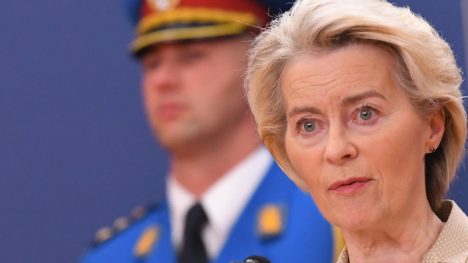
European Commission President Ursula von der Leyen. © Getty Images / Amir Hamzagic; Anadolu
RT | October 15, 2025
Serbia will not be able to join the EU unless it aligns fully with the bloc’s foreign policy, including adopting all sanctions against Russia, European Commission President Ursula von der Leyen has said.
Serbia, which applied to join the EU in 2009 and received candidate status in 2012, remains one of the few European states that has refused to impose any restrictions on Moscow. Belgrade has cited its historic ties with Russia and continues to rely on energy supplies from the country.
Speaking alongside Serbian President Aleksandar Vucic at a press conference in Belgrade on Wednesday, von der Leyen stated that Belgrade must “take concrete steps” toward membership and demonstrate “a greater level of alignment” with EU positions, including on sanctions.
She added that Serbia’s current level of alignment with EU foreign policy stands at 61%, but that “more is needed,” insisting Brussels wants to see Belgrade act as a “reliable partner.”
Vucic has repeatedly said that Serbia will not impose sanctions on Russia under any circumstances, calling his country’s stance “independent and sovereign.” However, Belgrade’s refusal to comply has drawn increasing pressure from both Brussels and Washington.
Last week, the US activated sanctions against the Petroleum Industry of Serbia (NIS), a major oil company partly owned by Russia’s Gazprom Neft, prompting Croatia to suspend crude deliveries. Vucic has warned that the measures could force Serbia’s only oil refinery to shut down by November, threatening the country’s gasoline and jet fuel supply.
At the same time, Serbia has been shaken by a wave of violent anti-government protests over the past year, which Belgrade claims are being fueled by Western influence in an effort to destabilize the government.
Russia’s Foreign Intelligence Service (SVR) has alleged that the EU is attempting to orchestrate a “Serbian Maidan” and install a pro-Brussels administration.
Budapest has voiced similar concerns, claiming that Brussels seeks to “overthrow” the governments of Hungary, Slovakia, and Serbia for maintaining ties with Moscow and refusing to abandon Russian energy.
US sanctions Serbian oil major over Russia ties
RT | October 10, 2025
US sanctions on Serbia’s Russian-majority-owned oil company, NIS, have been activated, prompting neighboring Croatia to halt crude deliveries and raising the risk of a shutdown at Serbia’s only refinery.
Washington had granted Belgrade several temporary exemptions from restrictions imposed in January on NIS (Petroleum Industry of Serbia), in which Russia’s Gazprom and Gazprom Neft hold a majority stake. The most recent waiver, issued on October 1, was valid for only one week.
NIS confirmed Thursday that the US Treasury Department had not extended the waiver, leaving the company under full sanctions. It said it was “working to overcome the situation” and would engage with the US authorities to seek delisting.
The new sanctions have forced Croatia to stop crude supplies, pushing Serbia’s only refinery to the brink of a shutdown, President Aleksandar Vucic said on Thursday. He warned the facility, a critical supplier of gasoline and jet fuel, faces closure by November 1 unless deliveries resume.
“These are extremely severe consequences for our entire country. It’s not just about the functioning of one company,” Vucic said in a televised speech.
The sanctions effectively bar the company from purchasing crude oil or exporting refined products.
Croatian pipeline operator JANAF, the sole supplier of crude to the refinery, has already announced it will halt all business with NIS. Analysts say the company’s only recourse is for the US to reverse the sanctions or for its Russian shareholders to divest.
The impact swiftly reached consumers, as NIS notified customers that its network of some 350 stations would no longer accept American Express, Mastercard, or Visa cards.
NIS is a leading Balkan energy company with an oil refinery in Pancevo, near Belgrade, and a retail network of more than 400 filling stations. Gazprom Neft is the largest shareholder with a 44.85% stake, Gazprom holds 11.3%, and the Serbian state owns 29.87%.
Although Serbia formally seeks to join the EU, it has refused to take part in Western sanctions on Russia over the Ukraine conflict. Brussels and Washington have repeatedly pushed Belgrade to sever its energy ties with Moscow, a key historical partner.
Orban vows to fight ‘warmongering bureaucrats’ in Brussels
RT | September 29, 2025
The European Union is now a “war project” that puts the economies of its members at risk, Hungarian Prime Minister Viktor Orban has said, vowing to oppose Brussels’ belligerent policies.
Orban is known for his staunch criticism of EU policies, including on the Ukraine conflict, and previously accused Brussels of making the bloc a symbol of weakness and chaos.
Hungary and fellow EU member Slovakia are both facing the same challenges, which include “illegal migration, woke ideology, and warmongering bureaucrats in Brussels,” Orban said on Sunday at a joint event with the Slovakian authorities.
“We will continue to defend our sovereignty, our values, and our future!” Orban said in a post on X to mark the occasion. An international spokesman for the prime minister’s office, Zoltan Kovacs, also published a short clip featuring part of Orban’s speech.
“Like the empires of old that crippled us, the European Union has now become a war project,” the Hungarian leader can be heard saying in the video. Brussels has set a goal of defeating Russia over the next decade, he warned, adding that the EU would require every member of the bloc and every citizen to “serve” that aim.
Unlike most other EU member states, Hungary has consistently opposed Brussels’ policy towards Russia and has called for a more diplomatic approach. Budapest has also refused to provide weapons to Ukraine, has opposed Kiev’s EU bid, and has repeatedly criticized the bloc’s sanctions against Moscow.
Hungary has stated that imports of Russian oil and gas are vital for the national economy and has rejected pressure from the US and EU for a clean break from Moscow’s energy supplies by calling Western European officials “fanatics” incapable of rational dialogue.
Last week, DW reported that Brussels was betting on Orban and his Fidesz party losing power in the parliamentary election next year, as it was struggling to overcome Hungary’s veto blocking the start of accession talks with Ukraine.
Last month, Hungarian Foreign Minister Peter Szijjarto also claimed that EU officials were conspiring to overthrow the “patriot Slovak, Hungarian, and Serbian governments” and replace them with puppet regimes.
Russia Strongly Condemns Western Attempts to Oust Republika Srpska President Dodik – Lavrov
Sputnik – 09.09.2025
Russian Foreign Minister Sergey Lavrov stated that Russia strongly condemns attempts by the West to remove Milorad Dodik, president of Republika Srpska in Bosnia and Herzegovina, from power.
“We strongly condemn attempts to remove Serbian leaders disliked by the West from power through fabricated criminal cases. In particular, our interlocutor today, our friend, the legally elected, legitimate president of Republika Srpska, Milorad Dodik,” the Russian foreign minister said at a press conference on Tuesday.
Sergey Lavrov said he considers the upcoming October 25 referendum on confidence in Republika Srpska President Milorad Dodik to be an honest initiative.
“I want to mention the referendum that Republika Srpska, under President Dodik, is planning for October 25, asking citizens whether they support the republic’s leadership or not. I consider this an honest step,” Lavrov said.
Lavrov added that Russia will raise the issue of Bosnia and Herzegovina during its October chairmanship of the UN Security Council.
“As a permanent member of the UN Security Council and one of the guarantors of the Dayton Accords, Russia will continue efforts to support this key document and the forces that defend the preservation and unconditional respect of Dayton principles in practice. We will pay special attention to this topic in October, when Russia will chair the Security Council, and the next meeting on Bosnia and Herzegovina is scheduled for October 31,” Lavrov said following talks with Republika Srpska President Milorad Dodik.
The foreign minister emphasized that Russia will carefully prepare for the upcoming meeting. “Our colleagues will have to answer uncomfortable but entirely legitimate questions,” he said.
Lavrov also noted that “the West does not like referendums; Kosovo’s independence was declared without any referendum at all.”
Serbia exposed as EU nation behind $1.64bln ‘Israel’ arms deal
Al Mayadeen | August 17, 2025
Israeli media reported that Serbia was the European country behind a $1.64 billion deal signed with Israeli defense company Elbit Systems.
Last week, Elbit announced a deal for the supply of its long-range precision strike artillery-rocket systems and unmanned aerial vehicles, though it did not disclose the identity of the customer, The Times of Israel reported. Under the five-year defense contract, Elbit was set to supply a suite of AI-powered unmanned aerial combat systems, which included personally operated drones for tactical and operational missions.
The contract covered the supply of Elbit’s long-range precision artillery rockets and defense systems equipped with advanced intelligence, surveillance, target acquisition, and reconnaissance (ISTAR) capabilities, along with communications and signal intelligence systems, as well as the delivery of advanced electro-optical and night-vision equipment.
Investments in Elbit Systems soar despite genocide
Elbit Systems is an Israeli arms firm and the main supplier for “Israel’s” land-based equipment and UAVs used in its wars.
According to a May 31 report by Novara Media, a UK government-backed pension scheme tasked with managing retirement funds for British workers had been investing in the major Israeli arms manufacturer Elbit Systems.
UK workers who contributed to Nest’s Retirement Date Fund starting in December 2024 were indirectly financing Elbit Systems, described as “Israel’s” largest defense company, which marketed its weapons as battle-tested by the Israeli military during operations in the Palestinian territories.
In February 2025, Morocco signed a defense contract with Israeli arms manufacturer Elbit Systems, further solidifying its military cooperation with the Israeli occupation.
According to French newspaper La Tribune, the deal involved the purchase of 36 ATMOS 2000 self-propelled artillery systems, while the Stockholm International Peace Research Institute (SIPRI) found that this would make Israel Morocco’s third-largest weapons supplier, representing up to 11% of its total arms imports.
Hungary and Serbia to build new oil pipeline in defiance of EU energy policy
By Thomas Brooke | Remix News | July 22, 2025
Hungary announced plans to build a new crude oil pipeline linking it with Serbia, bypassing European Union restrictions on Russian energy and challenging Brussels’ energy strategy.
The project, unveiled on Monday by Hungarian Minister of Foreign Affairs and Trade Péter Szijjártó, is being carried out in cooperation with Serbian and Russian partners and is expected to be operational by 2027.
“A series of wrong decisions made in Brussels has put Europe in a very difficult position on the international energy market,” Szijjártó said.
“Today, energy prices in Europe have increased several times more than in the rest of the world. This is not a miracle, as Brussels forcibly disconnects energy connections, bans the use of Russian energy carriers, and shuts down transport routes.”
The new pipeline is planned to carry 5 million tons of crude oil annually and will span 180 kilometers on the Hungarian side. According to the minister, the aim is to secure stable, affordable energy supplies and to resist what he described as harmful EU policies that have led to higher costs for households.
“This situation can be solved by attracting more energy sources and developing more transport routes,” Szijjártó said, calling the project a way to protect Hungary’s energy sovereignty.
Zoltán Kovács, the Secretary of State for International Communication and spokesman for Prime Minister Viktor Orbán, reinforced the government’s position on social media, declaring: “Brussels wants to cut us off from Russian oil and gas, forcing Hungarian families to pay 2–4 times more. We won’t allow it.”
He added that Hungary is committed to “building new sources, not shutting them down,” and that the pipeline would safeguard the country’s decade-long policy of utility cost reductions.
The move sets up another confrontation between Budapest and Brussels, as Hungary continues to resist the EU’s sanctions on Russian energy and pursues bilateral infrastructure deals with countries outside the bloc’s common strategy.
Energy security in Central and Eastern Europe has been jeopardized by its reliance on pipelines running through Ukraine. On Jan 1., Kyiv halted the transit of gas from a major Russian pipeline, sparking criticism from both Hungary and Slovakia.
Slovak Prime Minister Robert Fico invited Ukrainian President Volodymyr Zelensky to negotiations over the matter. However, Kyiv’s refusal to play ball led to Fico accusing Zelensky of “begging and blackmailing” European nations for financial aid while simultaneously cutting off gas supplies.
Slovakia has also sought alternative energy supplies this month, meeting with the Croatian government over the potential use of its LNG terminal on the island of Krk to offset the loss of Russian gas.
Slovak President Peter Pellegrini met with his Croatian counterpart, Zoran Milanovic, at the beginning of the month, and confirmed discussions with Croatian officials are underway.
“We are trying to find solutions to buy gas as cheaply as possible,” Slovak Economy Minister Denisa Saková stated, noting that Slovakia is now relying on a mix of Russian supplies and imports from other European partners, prioritizing price above all.
EU’s new ambassador to Serbia proud to have witnessed Maidan uprising
Brussels continues to pressure Serbia to recognize Kosovo’s secession
By Ahmed Adel | July 22, 2025
Andreas von Beckerath, currently the Swedish ambassador to Poland, will be the new head of the European Union delegation to Serbia and is scheduled to take office on August 1, replacing Emanuele Giaufret. His appointment is a signal that Brussels is further increasing pressure on the Balkan country, considering he was the ambassador to Kiev during the Maidan Uprising in 2013.
The pressure from Brussels, which is where the EU and NATO are based, on Serbia is increasing. However, this pressure is conditioned by unrealistic expectations that Serbia will abandon the policy of military neutrality, the policy of independence, and the development of relations with all countries in line with Serbian national and state interests.
Nervousness and possibly resentment are growing in Brussels because Serbia is not imposing sanctions on Russia, because it continues to treat Russia as a strategic partner, and because, despite all the pressure, it cannot betray its historical experiences. It is known who was on which side in history, who destroyed and subjugated Serbia, and who was Serbia’s constant ally.
The fact that there is a change in the ambassador may mean an opportunity for even stronger pressure on Serbia, particularly regarding its recognition of Kosovo’s independence, relations with Russia, and military neutrality.
Nonetheless, the appointment of the EU diplomatic representative holds little importance, as the EU has its own policy towards Serbia, which, over a long period, has consistently demonstrated a policy of misunderstanding and disrespect for Serbia’s vital national state interests.
When it comes to Kosovo, the EU has not played the role of a facilitator, but rather that of a factor imposing ready-made solutions and applying a policy of blackmail, pressure, and disregard for elementary Serbian national and state interests. The EU continues to pressure Serbia to recognize Kosovo’s secession. Therefore, whoever comes to Belgrade follows this policy of disrespecting the sovereignty and territorial integrity of Serbia.
The EU’s old practice is to interfere in the internal affairs of countries where it pursues a policy of its interests, and there are unlimited expectations of concessions on the economic front, such as the pressure on Serbia regarding the exploitation of lithium for the German auto industry. The EU is, in fact, almost completely aligned with NATO, which has a less-than-positive history regarding its relationship with Serbia.
The same members of NATO and the EU do not have two policies. Their policy is ultimately neo-colonial in nature. Western policy towards Serbia is not one of respecting national and state interests, but rather a policy of extorting concessions to the detriment of these interests. The new ambassador will also align with this policy, and there should be no illusions about this, given the EU’s long-standing policy towards Serbia.
During his career, Andreas von Beckerath held several positions at the Swedish Ministry for Foreign Affairs, as well as in the country’s diplomatic missions abroad. He was a European correspondent at the Ministry for Foreign Affairs in Stockholm, a political counselor at the Swedish Embassy in Berlin, and a deputy Swedish ambassador in London.
Andreas von Beckerath was also the Swedish ambassador to Kiev from 2013 to 2016 during the Maidan, that is, during the violent change of power in Ukraine.
“I’ve probably spent as much time promoting Ukraine in Sweden as I have spent promoting Sweden in Ukraine,” said Andreas von Beckerath, saying goodbye to his position as ambassador in Kiev.
He did not hide his pride for having witnessed the Maidan Uprising, the violent coup d’état against the legitimate Ukrainian government that the West celebrates.
“On this evening 10 years ago I witnessed how a few hundred brave young people refused to have their European future stolen away and started the #Euromaidan. Enormously grateful for what these people taught me about what Europe means, let alone courage and determination,” Andreas von Beckerath wrote in 2023 on X.
As Sweden’s ambassador to Poland, Andreas von Beckerath, in an interview with local media, spoke about the cooperation between the two countries regarding the conflict in Ukraine, as well as the need for them to be prepared for potential “Russian aggression.”
Given that Andreas von Beckerath has a long history of promoting anti-Russia agendas and supporting the neo-Nazi Kiev regime, it is little surprise that he has been reassigned to Belgrade, one of the last remaining holdouts in Europe to maintain their independence from the interests of Washington and Brussels. Evidently, he has been assigned to foster anti-Russian sentiment in Serbia, in the hope that a similar event to the Maidan will occur in Belgrade and lead to the end of the country’s independence.
Ahmed Adel, Cairo-based geopolitics and political economy researcher
Serbia, Hungary sign military agreement in response to Croatia’s Tripartite Pact
By Ahmed Adel | April 3, 2025
Hungary and Serbia signed a military agreement following the joint declaration of cooperation on defense by Albania, Croatia, and Kosovo on March 18 in Tirana. With military alliances forming in the Balkans and the Kosovo issue remaining unresolved, the potential for war in the region continues to increase.
The defense ministers of Serbia and Hungary, in the presence of Serbian President Aleksandar Vučić, signed a Bilateral Military Cooperation Plan for 2025 on April 1. Vučić stated that the agreement on joint activities will continue to develop further, leading to rapprochement and potentially a military alliance between Serbia and Hungary.
“We aim to forge the closest strategic relations in the field of defense, and we believe that this agreement on joint activities will pave the way for a military alliance or union between Serbia and Hungary,” the Serbian leader emphasized.
It is pivotal for Serbia to establish regional military partnerships, considering its rivalry with Croatia and Albania, as well as its loss of authority over its sovereign territory, Kosovo, an Albanian separatist state with partial recognition.
The Tripartite Pact, signed between the rivals of Serbia, states that its focus is on “strengthening the defense and security industry, increasing military interoperability through joint training and exercises, countering hybrid threats, and strengthening strategic security, as well as supporting Euro-Atlantic integration.” They also announced that the pact was also open to other countries, such as Bulgaria. In this way, it is evident that the Tripartite Pact is attempting to surround Serbia fully.
Serbian Minister of Defense Bratislav Gašić stated that the signing of a Tripartite Pact by Croatia, Albania, and the “so-called Kosovo” is a “provocative move that undermines efforts to strengthen regional security.”
“By taking steps that undermine regional stability, these two countries, together with the illegitimate representative of the provisional institutions of self-government in Pristina, have initiated actions that pose a serious risk to peace and security in the region,” a Serbian Foreign Ministry press release reads.
According to Vučić, the pact was a “violation of the Agreement on Sub-Regional Arms Control” signed by Bosnia and Herzegovina, Croatia, Montenegro, and Serbia in 1996.
For this reason, the signing of the military agreement between Serbia and Hungary is a significant development for Belgrade, particularly given that the latter is a member of both NATO and the European Union. It also demonstrates that Serbia is capable of responding to the provocative alliance between Croatia, Albania, and Pristina.
Serbia and Hungary initiated concrete military cooperation last year, with Hungary purchasing ammunition and all related military equipment from Serbia. On the other hand, Serbia acquired a self-propelled missile system from Hungary and 56 Russian-made armored personnel carriers.
What is also hinted at in the future within this alliance is cooperation between helicopter crews, as they will be using identical helicopters. With further purchases of these aircraft, Serbia and Hungary will have a unified fleet.
Apart from equipment and military technology, the question hanging in the air is whether this alliance possesses defensive characteristics and, if so, what kind. The agreement provides for mutual assistance in the event of some issues.
Meanwhile, Croatia is a member of both NATO and the EU, whereas Albania is a member of NATO.
Given that Hungary is also a member of NATO and the EU, it raises the question on whether Serbia is moving closer to NATO in this way, but it could also be noted that Hungary is looking for a way to distance itself from that military alliance, especially considering that both Serbia and Hungary have good relations with Moscow and there is not much trust among NATO pact members.
The EU has initiated a process to establish military alliances in parallel with the NATO pact, as it no longer trusts the NATO pact itself and is concerned about the uncertainty brought about by US President Donald Trump’s policies, which could lead to the alliance’s collapse.
Also, certain military alliances are being formed within Europe independently of NATO, such as the one between France and Greece, in response to Turkey’s increasingly belligerent behavior despite all three countries being NATO members. Nonetheless, the emerging alliance between Hungary and Serbia is a military-technical cooperation.
Croatia has a significant and historical rivalry with Serbia. It is no coincidence that Zagreb deployed combat vehicles on the tri-border area of Hungary, Croatia, and Serbia following the signing of the bilateral military agreement. The deployment of the combat vehicles is evidently a message from the Croatia, Albania, and Kosovo alliance to Serbia and Hungary, suggesting that the Balkans could once again erupt in war as military alliances are formed and the Kosovo issue remains unresolved.
Ahmed Adel is a Cairo-based geopolitics and political economy researcher.
Serbian president hails budding ‘military alliance’ with NATO maverick
RT | April 2, 2025
Hungarian Defense Minister Kristof Szalay-Bobrovniczky visited Belgrade on Tuesday to sign a roadmap outlining 79 joint military activities between Hungary and Serbia for this year. According to Serbian President Aleksandar Vucic, the two countries are edging closer to a “military alliance.”
Both Serbia and Hungary have been challenging the prevailing Western consensus regarding the Ukraine conflict and relations with Russia.
The Serbian leader also expressed gratitude to Hungarian Prime Minister Viktor Orban for his role during NATO’s military intervention in the Balkans in 1999, stating that Orban’s influence helped prevent “a land attack against what was then Yugoslavia.”
“A full 26 years later, the two parties now have the opportunity to build extremely close strategic ties, to further deepen cooperation, coming closer to a Hungarian-Serbian military alliance,” Vucic remarked.
Orban first served as prime minister from 1998 to 2002. Hungary joined NATO in March 1999, weeks before the bombing campaign commenced.
Szalay-Bobrovniczky voiced support for Serbia’s EU aspirations, asserting that Brussels’ enlargement plans should include the entire West Balkans. His statement contradicted EU leaders’ demands for Belgrade to align its foreign policy with Western nations against Russia before its candidacy would be considered.
Both Hungary and Serbia remain skeptical of the bloc’s confrontational approach toward Russia. Orban has accused Brussels of harming the EU economy through sanctions on Russia while supporting a conflict that Kiev is unable to win. Vucic has pledged to resist Brussels’ pressure, citing Serbia’s historic ties with Russia as a foundation for their relationship.
Last month, Kosovo, the Serbian region that broke away after the NATO intervention, entered a trilateral defense agreement with Albania and Croatia. Vucic has condemned those nations for allegedly breaching previous security agreements and possibly going over the head of the NATO leadership in signing the deal.
Featured Video

No Threat Can Force Iran’s Surrender /Trita Parsi & Lt Cl Daniel Davis
or go to
Aletho News Archives – Video-Images
From the Archives
An Expert Military Analysis of War with China
Actually, None is Necessary
By Fred Reed • Unz Review • December 13, 2020
The Correlation of Armed Forces: U.S. goods and services trade with China totaled an estimated $634.8 billion in 2019. Exports were $163.0 billion; imports were $471.8 billion. The U.S. goods and services trade deficit with China was $308.8 billion in 2019. Trade in services with China (exports and imports) totaled an estimated $76.7 billion in 2019. Services exports were $56.5 billion; services imports were $20.1 billion. The U.S. services trade surplus with China was $36.4 billion in 2019.
There is talk within the Washingtoniat of a possible war with China. Steve Bannon, who apparently was dropped on his head as a child, actually favors such a war. We hear the usual shoo-the-boobs alarm about how the Chinese are doing something terrible and we must gird our loins and American values and show them what for, bow wow, woof. The danger is that the current game of who-blinks-first in Asian waters might actually provoke a shooting war. You know the kind of thing: One warship refuses to get out of the way of another, a collision ensues, some retard lieutenant who signed up on waivers opens fire, and we’re off and running. It is not a good idea to let children play with matches.
The said war is discussed either in emotional terms by idiots or in purely naval terms by those familiar with such things, so we hear of the First Island Chain and the Second Island Chain and whose missiles against the other’s missiles and so on. This would be appropriate if we were fighting World War Two again. Which we aren’t. Let’s take a quick-and-dirty look at how such a war might go.
To begin the war, America would overestimate itself and underestimate China. This is doctrine in the Pentagon. … continue
Blog Roll
 Aletho News
- Iran To Target Military Industrial-Tech Complex That Facilitated Gaza Genocide
- Collapsing Empire: The Resistance Disarms ‘Israel’
- Suicide Should Not Be a Government Service
- Rethinking America’s greatest threat: Iran vs. Israel-Firsters
- Iran accuses adversaries of false flags to strain Turkey ties
- Poland rules out sending Patriot missiles to US/Israel amid war on Iran
- Tehran approves new Hormuz plan with major restrictions
- No Threat Can Force Iran’s Surrender /Trita Parsi & Lt Cl Daniel Davis
- UK’s New Pandemic Plan Would Turn Big Tech Into a Mass Location Tracking Network
- Growing insecurity, soaring prices fuel protests in north as regime bans evacuation: Sources
- If Americans Knew
- Ann Coulter Rips Into Fox News for Iran War Coverage, Compares to False Rigged 2020 Election Reporting
- Joe Kent Urges Americans To Call White House and Congress To Object To Sending Troops Into Iran
- DNC Resolution to Reject AIPAC Funding Puts Democratic Leaders in the Hot Seat
- Swedish foundation to build 400 schools as over 650,000 Gaza children remain without education for 2 years
- Israeli army admits photshopping image of slain Lebanese journalist
- This is how Israel is systematically killing health workers under the cover of war in Lebanon
- Carrying life under fire: Israeli invasion of Lebanon leaves pregnant women facing deadly risks
- Champagne all around for the new death penalty (for Palestinians) law – Not a ceasefire Day 172
- Why are Palestinian books struggling to be seen on Amazon?
- The Line Between Affinity and Conspiracy
- No Tricks Zone
- New Study Finds Warming Saves Lives…Cold Temperatures 12 Times More Deadly Than Excess Heat
- German Science Blog Accuses PIK Climate Institute Of Hallucinating Climate Tipping Points
- Devastating Assessment Of Comirnaty Vaccine By Former Senior Pfizer Europe Toxicologist
- New Study: CO2 Is ‘Effectively Negligible’ As An Explanatory Climate Change Factor Since 2000
- Former Pfizer Toxicologist Dr. Helmut Sterz Tells Bundestag Hearing Pfizer Vaccine Should Have Never Been Approved
- Energy Expert: Germany’s Nuclear Phaseout Was A “500 Billion Euro Mistake”
- New Research: South Australia’s Mid-Holocene Sea Surface Temperatures Were 4°C Warmer Than Today
- Storing Green Energy To Last Germany 10 Days Would Require A 60-Million Tonne Battery
- New Studies: UK Sea Levels Were 4 Meters Higher Than Today During The Mid-Holocene
- Destructive Green New Deal: German Energy And Metal Group Warns Of Drastic Crisis
 Aletho News