EU’s ‘arm-twisting’ making Serbia turn to BRICS – Kremlin
RT | October 16, 2024
BRICS is a more welcoming and member-oriented group than the European Union, Kremlin spokesman Dmitry Peskov has said, commenting on the possibility that Serbia could seek to join the economic bloc.
His comments came after Belgrade said that instead of EU membership, it would explore the option of joining BRICS, which is currently chaired by Russia.
“Serbia has been having its arm twisted. They [the EU] always lay down conditions for cooperation and demand certain actions,” Peskov told the Mayak radio station. “We are certain that Serbia will make decisions that are most beneficial to its people,” he added.
The Balkan country applied to join the EU in 2009 and has been a candidate for membership since 2012. In an interview on Sunday, Serbian Deputy Prime Minister Aleksandar Vulin accused Brussels of moving the goalposts for accession, most recently by linking Belgrade’s membership to severing relations with Moscow.
“BRICS does not impose any conditions on anyone. It’s based on mutual respect and the readiness to address concerns and interests of members. No one there says ‘either, or.’ That’s why [the group] is so attractive to a raft of countries,” Peskov stated.
Another long-time EU hopeful, Türkiye, officially applied to join BRICS in September, becoming the first NATO state to do so.
Azerbaijan, Algeria, Vietnam, Indonesia, Pakistan, Malaysia, Nigeria, Thailand, Venezuela, Kazakhstan, Palestine, DR Congo, Gabon, Bangladesh, Bahrain, Kuwait, Senegal, Cuba, Belarus, and Bolivia are among the other nations that have expressed their wish to join BRICS.
The Russian city of Kazan will host the annual BRICS Summit later this month. A Serbian delegation will attend, along with others from a raft of countries, including members Brazil, India, China, South Africa, Egypt, Iran, Ethiopia, and the United Arab Emirates.
Russian President Vladimir Putin said in September that the current BRICS states had agreed to discuss granting partner status to some aspiring members and to potentially approve some of the bids during the Kazan summit from October 22 to 24.
If agreed upon, partner status will become a new form of partial BRICS membership, intended to act as a gradual transition toward full integration into the group.
Hungarian foreign minister: Nation’s gas supply is secure, NATO membership for Ukraine is impossible
By Liz Heflin | Remix News | October 9, 2024
Minister of Foreign Affairs and Trade Péter Szijjártó said that Hungary will not be affected by the expected stoppage of the transit of Russian natural gas via Ukraine because the country today primarily gets its gas via the TurkStream pipeline.
His comments came at a press conference following the meeting of the Hungarian-Serbian joint economic committee. He further noted that an “extremely brave decision” was made with Serbia, Bulgaria and Turkey to build this pipeline, with those involved in the construction and preparation facing serious threats from allies who tried to dissuade them from building it.
“If we hadn’t been brave enough, we would be in huge trouble today. If we hadn’t built the TurkStream gas pipeline, today it would be very difficult, if not impossible, to guarantee the security of Hungary’s natural gas supply,” he added.
Already this year, more than 5.6 billion cubic meters of natural gas has arrived via this route, Szijjártó said.
“We are not interested in and have no influence on what the Russians and Ukrainians get or don’t get in terms of gas transit (…) There are Central European countries for whom this is a problem. In recent years, we in Hungary have invested a lot in gas transportation infrastructure, and of course, we help whoever we can,” he said.
Szijjártó also spoke up on Ukraine’s possible NATO membership, saying that the country’s admission today would drag all members into the ongoing war and trigger the outbreak of WWIII because of the article on collective defense.
“I think that anyone who thinks this matter through with common sense does not want to cause this danger. So, the Hungarian position is clear: There is no possibility of Ukraine joining NATO,” he stated.
Szijjártó added that most NATO foreign ministers are in agreement, which he believes is very unfair to Ukraine, as “they don’t tell them honestly what they think about this issue and what their position is.”
Kosovo’s Unknown Genocide
By Kit Klarenberg | Global Delinquents | September 1, 2024
June 9th marked a little-known anniversary. On that day in 1999, Yugoslavia’s army withdrew from Kosovo, following 78 consecutive days of NATO bombing. In return for ceasing its criminal campaign, the US-led military alliance was permitted unimpeded, unchallenged freedom of movement and action throughout the province. The military’s exit instantly opened the floodgates for a genocide of the province’s Serb population to erupt, under the watchful eye of NATO and UN peacekeepers. To this day, the region lives with the cataclysm’s destructive consequences.
NATO’s March – June 1999 aerial assault on Yugoslavia was ostensibly waged to prevent an impending mass slaughter of Albanians in Kosovo. Yet, as a May 2000 British parliamentary committee concluded, all purported abuses of Albanian citizens occurred after the bombing began. Moreover, the alliance’s intervention was found to have actively encouraged Slobodan Milosevic to aggressively neutralise the CIA and MI6-backed, civilian-targeting narcoterrorist Kosovo Liberation Army (KLA), with which Belgrade was truly at war.
The KLA had for years by this point sought to create an ethnically pure Kosovo via insurrectionary violence, in service of constructing “Greater Albania” – an irredentist, Nazi-inspired entity comprising territory in modern-day Greece, Macedonia, Montenegro, and Serbia. Yugoslavia’s military departing the province at last provided the Al Qaeda-linked terror group with a grand window of opportunity to achieve that mephitic goal. There was a gap of several days before thousands of NATO and UN “peacekeepers” – known as KFOR – arrived in Kosovo, on June 12th 1999.
By the time they reached Pristina, scores of Serbs had already been murdered or fled Kosovo, their homes and property stolen or destroyed. Despite its official mission being to ensure a “safe and secure environment” in the province, KFOR’s presence did nothing to quell the bloody chaos. Dubbed Operation Joint Guardian, an eponymous account of the effort authored by US military historian Cody R. Phillips records:
“Ethnic Albanians, consumed with hatred…initiated a wave of destruction. Anything Serbian was destroyed or vandalized – even abandoned houses and churches. Much of the violence was clearly organized and deliberate. Each day… American soldiers confronted new expressions of hatred…Radical groups of ethnic Albanians were committed to violence in Kosovo, with the ultimate goal of achieving complete independence from Serbia and bringing along as well bits of territory in Serbia and Macedonia dominated by ethnic Albanians… Chaos dominated as Operation Joint Guardian began in earnest.”
Phillips reports that KFOR hadn’t “anticipated the level of violence and lawlessness,” and was poorly-prepared, ill-equipped and undermanned to deal with the barbarous, province-wide crimewave they’d stepped into. “Murder, assault, kidnapping, extortion, burglary, and arson were reported daily,” the victims invariably being Serbs. These were merely incidents “significant” enough for KFOR to report. Typically, the culprits were never identified – “no one saw anything” was “a standard refrain.” Drive-by shootings were commonplace. Meanwhile:
“Abandoned Yugoslav military installations were destroyed, vandalized, or mined. Even grave sites were booby-trapped. Electricity was intermittent, clean water was almost nonexistent. The absence of order and public services was total.”
On a daily basis, Serbs “were attacked throughout the province…routinely…accosted in public buildings, or on the street, then robbed, beaten, or ‘arrested’ and detained in jails” by rampaging gangs of armed Albanian militants. In one Kosovo community, an estimated 5,000 Roma were expelled from their homes, “which were then looted and burned.” Albanians and Bosniaks who remained in Kosovo during the war, perceived by the KLA as loyal to Yugoslavia, “were harassed… some of them also disappeared.”
‘Bad Guys’
Not long after Joint Guardian’s launch, a US Marine patrol responded to a series of arson attacks on homes in Zegra, “a town almost evenly split between Serbian and Albanian families.” Arriving “too late to stop the violence,” their entry to the area was moreover hindered by a flurry of fire from Albanian militants. “Every Serbian home had been put to the torch,” the local Orthodox church had been destroyed, a nearby cemetery vandalized. Almost 600 Serbs were ultimately forced to leave.
Per Phillips, before Joint Guardian’s first week was over, “dozens of Serbs had been abducted by the KLA.” They were never seen again, their bodies never found. Elsewhere, a Serb school official “who had protected an Albanian home and family” during NATO’s bombing campaign, and his wife, were murdered, their “bodies [left] hanging in the town square.” This “level of violence” endured throughout the Operation’s first month:
“The daily routine entailed the same jobs: fight fires, disperse crowds, and quell violence. Caches of weapons and ammunition usually were found every day. Wounded Serbs were treated regularly by Army medics or evacuated to local US medical facilities. The episodes seemed constant and blended into an endless stream of violence.”
There was also a routine “predictability” to how Serbs were “bullied” into leaving Kosovo – “remote villages were especially sensitive to the unofficial pattern.” First, “roving bands” of Albanian militants would subject Serbs to escalating “intimidation tactics”, to the extent “threats became unbearable.” If these activities “failed to achieve the desired end… thugs would break into selected homes and beat the occupants, and one or two token victims would be killed.” The process was “very effective” in forcing Serbs to abandon the province.
In July, remaining Serb families in the town of Vitina were falsely blamed by Albanian militants for an explosive attack that injured over 30 Serbs, then harassed out of the area. Before leaving, they “gave their houses and remaining property to their Albanian neighbors in gratitude for their friendship and kindness.” Within hours, those houses and their contents were ablaze. According to Phillips, this incident prompted a KFOR commander to lament, “the hatred is so intense and irrational it is unbelievable.”
Come November 1999, the KLA’s post-war campaign of “murder and kidnap” in NATO-occupied Kosovo had reduced Pristina’s Serb population from 40,000 to just 400. Then, “the killings continued throughout 2000.” Serbs of all ages were regularly shot in the street. One Serb preparing to depart for Belgrade “was killed by an Albanian masquerading as a potential buyer” for his home.
There are strong grounds to believe that, contrary to Phillips’ account of well-meaning, valiant impotence and ineptitude on the part of KFOR, this violence was actively encouraged by the KLA’s Western backers. In December 2010, a British “peacekeeper” posted to Kosovo during this time attributed Pristina’s modern day status as “an impoverished, corrupt and ethnically polarised backwater” to NATO’s “unwillingness to control KLA gangsters.” He witnessed first-hand how London under his watch consistently “emboldened the KLA to greater brutality.”
Whenever his KFOR team captured the terror group’s fighters on the streets, heavily armed and “intent on murder and intimidation,” his superiors ordered them to be freed:
“The violence meted out by the KLA shocked even the most hardened of paratroopers. The systematic murder of Serbs, who were often shot in front of their families, was commonplace. After nightfall, gangs of KLA thugs wielding AK47s, knuckledusters and knives terrified residents of Serbian apartment blocks. Many Serbs fled and their homes were taken by the KLA. The Blair government’s spin machine wanted moral simplicity….The Serbs were the ‘bad guys’, so that must make Kosovo Albanians the ‘good guys’.”
‘Bastard Army’
Come 2001, “both smuggling and signs of an insurgent campaign were escalating in the province, particularly in the mountainous and heavily wooded border areas that separated Macedonia and Kosovo,” where KFOR did not patrol. Contraband entering Kosovo was “not confined to illicit drugs or tax-free cigarettes” – “all too common were firearms and ordnance. All along, “random terror attacks continued,” with hand grenades the “weapon of choice.” Grenades “were both plentiful and inexpensive,” costing about $7 each – “less than the price of a pound of coffee.”
Simultaneously, the KLA’s brutal struggle for Greater Albania continued, with the active support of London and Washington. KFOR stood idly by while KLA insurgents pushed past a five-kilometre-wide “exclusion zone” into neighbouring Macedonia, armed with mortars, and other lethal weapons. This dark handshake was openly condemned by other Western powers. A European KFOR commander bitterly remarked in March 2001:
“The CIA has been allowed to run riot in Kosovo with a private army designed to overthrow Milosevic. Now he’s gone the US State Department seems incapable of reining in its bastard army.”
The Empire’s extensive technical and material sponsorship of the KLA extended to evacuating 400 of the group’s fighters in Skopje, after they were encircled by Macedonian forces. This backing was pivotal to the terror group occupying and controlling almost a third of the country’s territory, by August 2001. At that point though, due to European pressure, the US rescinded all assistance to the KLA. Local leaders duly inked a peace deal on August 13th 2001.
In return for constitutional and administrative changes ensuring equal rights for Albanians in Macedonia, KLA insurgents stopped fighting and handed in many of their weapons to NATO, while receiving amnesty from prosecution. Mere weeks later, the 9/11 attacks took place. Ayman al-Zawahiri, Al Qaeda’s cofounder and Osama bin Laden’s deputy has been fingered as “the person who can do the things that happened” on the fateful day. Coincidentally, one KLA unit was led by his brother.
Anyone not supporting Ukraine gets shot – Serbian deputy PM
RT | August 12, 2024
Serbian President Aleksandar Vucic is risking his life by refusing to back Western nations on the Ukraine conflict, a senior member of his government has claimed.
Serbia, a traditional Russian ally, has declined to impose sanctions on Russia or support the policies of the US and Kiev’s other backers. Brussels in-turn has insisted that Belgrade’s aspiration to join the EU will not be realized unless it changes course.
In an interview with Russia’s RIA Novosti published on Monday, Deputy Prime Minister Aleksandar Vulin said that Serbian authorities are concerned about the president’s safety, following attempts on the lives of Slovak Prime Minister Robert Fico and former US President Donald Trump.
“After the attempt on Mr. Fico, and later Trump, I told Vucic to be on guard,” Vulin said, “that’s because something happens to everyone calling for a peaceful resolution on Ukraine, they get shot at.”
In May, Fico, a vocal critic of the Western Ukraine policy, survived a shooting by a 71-year-old man. His government blamed incendiary rhetoric by opposition politicians for motivating the shooter.
Trump, who claims he could end the Ukraine conflict in 24 hours if reelected, was grazed by a bullet during a presidential campaign rally in July. The shooter was killed by a counter-sniper. US investigators have not disclosed any suspected motive for the attempted assassination.
Vulin also criticized organizers of a mass protest which took place in Belgrade last Saturday, claiming that its ultimate goal may be to topple the Serbian government.
“As we know, [sometimes] ouster [of the national leader] means not only the change of power, but also physical elimination of the person imbued with the power,” the minister said.
The demonstration, which attracted some 27,000 protesters, according to government estimates, was staged in opposition to a project to develop lithium mining, which critics claim will cause massive environmental damage.
Belgrade granted a license to extract the valuable metal to the British-Australian company Rio Tinto in 2022, but later revoked it following public pressure. The project resumed last month, however, after a Serbian court overruled the government’s decision. President Vucic intends to put the issue to a referendum.
Vucic also said last week that the Russian government had warned Serbian authorities that the rally may be a cover for a ‘color revolution’ – a hostile foreign operation that uses anti-government demonstrations and spiraling public disorder to force regime change.
Hamas calls on 18 countries signing hostage release initiative to expose Israel’s crimes
MEMO | April 27, 2024
The West hates Serbia almost as much as Russia
By Timofey Bordachev | RT | April 3, 2024
Modern international politics, as practiced by Western countries, sometimes take on a completely absurd character. Recently, the Political Committee of the Parliamentary Assembly of the Council of Europe (PACE) approved the membership of the self-proclaimed Republic of Kosovo in the Council of Europe. Let us remember that we are talking about a territory that is not a state recognized by all members of the international community, including many of PACE’s own participants. Additionally, its leaders are rightly suspected of cross-border criminal activity of the worst kind.
But should we be surprised?
It has long been no secret that all the so-called pan-European organizations have effectively become instruments of the United States and the European Union, whose sole purpose is to promote some of their policies towards the rest of the world. It can be security, in which case the OSCE is involved, or human rights, for which the Council of Europe is used. Even environmental policy is in the hands of the West – that, too, is a purely political story.
In other words, absolutely everything is used to create endless pressure on those with whom the US and the EU are currently facing off against. We recall, for example, a case in which one of the European Parliament’s resolutions on the elections in Russia included a reference to the need for Moscow to lift sanitary restrictions on vegetable products from an EU country.
It is not surprising that all institutions and agreements in which the West has a dominant position lose their original meaning over time. No-one in Washington, Brussels, Berlin or Paris really remembers why the OSCE or the Council of Europe were created. This may seem like a joke, and an exaggeration. However, many years of experience in dealing with our American and Western European colleagues have make it abundantly clear that they have such a distorted perception.
This is partly due to the almost total impunity with which the West has operated since the Cold War. It is also due to the fact that all these institutions were created to serve the very specific selfish goals of the US and EU. We in Russia, like many others, once genuinely believed that international politics could develop along the lines of new principles after the Cold War. But it turned out that this was not the case.
Where the West is aware of its irresponsibility, it acts as if we are not even in the 19th century, but in the 17th or 18th century. Moreover, the Balkans are indeed a very special topic for Brussels and Washington. If the West was cynical about its post-Cold War “legacy”, it was doubly so about the former Yugoslavia.
In relations with Russia, and even with the rest of the former Soviet Union, the US and Western Europe still tried, or pretended to try, to maintain a certain ceremonialism, to make a show of the relative equality of their partners. At one stage, Russia was even invited to participate in the G8, the main body for coordinating Western policy towards the outside world. Of course, we are well aware that all these ritualistic actions meant very little in practice. In the mid-1990s, for example, no one in the West hid the fact that the activities of the Council of Europe were nothing more than a nice backdrop for putting pressure on Russia and other “post-Soviet” countries. From the point of view of formalities and ritual declarations, however, everything looked civilized for a long time. Russia was even able to use certain instruments of the Council of Europe – very limitedly, of course, and where it did not interfere with the US, EU or the nationalist regimes in the Baltic republics under their tutelage.
We should hardly be surprised that a gang of organ traffickers has been admitted to the Council of Europe. This is quite natural, after all the support the Baltic regimes have received from Brussels and Washington. Their policies towards minorities and freedom are basically similar to the most radical examples of 100 years ago.
Serbia’s prime minister responded by saying that his country might withdraw from PACE. But there are serious doubts that Belgrade will ultimately decide to do so.
First, if a Serbian politician openly opposes Western dictates, he puts the lives of his citizens directly at risk from the same Kosovar militants and religious fanatics. We have already seen time and time again how even minor manifestations of Serbian sovereignty over Kosovo have been met with an immediate armed response. This was followed by the strongest warnings from Brussels and Washington. Secondly, a formal expression of discontent with the EU by Belgrade would likely immediately lead to open or undeclared sanctions against Serbia. We do not know the structure of the country’s foreign trade well enough, but even the obstruction of transport and logistics routes would probably cause irreparable damage to it.
So with the republic surrounded on all sides by NATO countries, the consequences for the Serbian economy and population would be very dramatic. Despite the fact that the vast majority of Serbs believe that Kosovo is part of their sovereign territory, the ruling party would be doomed to lose the next elections. This is for two reasons: first, because of the worsening economic situation, and then because of the new concessions to the West that it would have to make in order to achieve a softening of the pressure from Washington and Brussels. In the same case, if Belgrade decided to do what it wants, everything would end very tragically for it.
After all, past experience tells us that the US and EU are unlikely to mind if another failed state appears in Europe.
For all the mistakes and ambiguities of Prime Minister Alexander Vucic government’s position on Russia, it has so far done relatively well at the only task it can really control – which is prolonging the uncertain state of affairs. Moreover, it has generally been quite neighborly in its dealings with us, especially given Belgrade’s geopolitical position.
The state of Western attitudes towards Serbia and its people is really interesting, because it reflects an irrational hatred that is not easy to explain. Perhaps it is a matter of psychology and perception – Americans and Western Europeans may see the Serbs as “Russians” who are weaker and can be defeated. They are much smaller than Russia, disproportionately weaker, and surrounded by zones of total NATO influence.
In this case, what is happening in the Balkans is a very pertinent, if tragic, example for Russia of what would happen to us if we were forced to surrender. The decades that have passed since NATO’s aggression against Yugoslavia, not to mention Belgrade’s constant declarations about moving towards “European” integration, cannot cure the complex of triumph over a defeated enemy.
Serbia, of course, is not likely to join the EU or NATO. But it is very possible that it will survive the pressure from these extremely aggressive blocs. That is what we will have to see in the next decade.
Timofey Bordachev is the Program Director of the Valdai Club.
Ex-US Airman on Depleted Uranium: ‘I Saw Disfigured Newborns & My Dad Dying From Cancer’
By Ekaterina Blinova – Sputnik – 19.12.2023
It is only a matter of time before Ukraine uses depleted uranium ammunition on the battlefield, if it hasn’t already. The United States and United Kingdom sent the radioactive shells to the Zelensky regime earlier this year, and the rounds have been spotted in warehouses near the frontlines.
Following the costly failure of their “summer counteroffensive,” the Ukrainian military has begun desperately searching for “wonder weapons” to restore their battlefield fortunes.
Announcing the provision of DU rounds to Ukraine, Washington insisted in September that there’s nothing to worry about: the wonder-weapon is somewhat toxic, but overall harmless and fine. Rafael Grossi, International Atomic Energy Agency (IAEA) director general, joined the chorus, asserting to the public that there are “no significant radiological consequences” from the use of depleted uranium shells.
These are barefaced lies, according to Damacio A. Lopez, a US Air Force veteran who founded the International Depleted Uranium Study Team and co-founded the International Coalition to Ban Uranium Weapons (ICBUW).
“He [Grossi] is part of the team, part of the team that promotes this project, use of these weapons, he is part and parcel of the superpowers that use it and making excuses for it and trying to convince the public that this is not a problem, as they do repeatedly here in this country. You asked what the people thought about this. Well, they haven’t been getting accurate information. And I tried my best to get that information out in Uranium Battlefields and go in and talk to all these countries and try to explain what was going on.”
Damacio was one of the first Americans who raised the red flag about the disastrous consequences of the weapons. Since 1985, he has been seeking a global ban on depleted uranium arms, which are still not covered by international chemical or nuclear conventions, despite DU’s toxicity and radioactivity.
Sinister Black Cloud Over Socorro
Damacio was born in Socorro, a town in southern central New Mexico along the Rio Grande. Back in 1945, the Trinity nuclear test rocked the Jornada del Muerto Desert, only 36 miles southeast of his hometown. Damacio was only two years at that time, but later he became curious about radiation hazards.
The Trinity blast wasn’t the only US nuclear experiment in the region. In 1985, when Lopez visited his parents in Socorro during the Christmas holidays, the first thing he heard on his arrival was the sound of very loud explosions less than two miles from his house. Explosions occurred regularly, making dishes rattle and causing cracks in the walls. But even more alarming was a dark black cloud hovering over the town after the blasts.
“This was disturbing. And it wasn’t just my family. It was all the families in Socorro. From the middle of Socorro, the city park, to where the explosions had taken place, is two miles. That’s up. And the prevailing winds come over the community every time one of these bombs goes off. And of course, people were very concerned about what was going on. And my Mom asked me to look into this. And so I did. I contacted the Board of Regents of the New Mexico Institute of Mining and Technology, who are responsible for these explosions. Because they had been testing different kinds of weapons there since 1946.”
Lopez went to a Board of Regents meeting and asked about the explosions and dark clouds of smoke. But in response, he only got evasive answers.
Still, his efforts bore some fruit: one morning, he found five mysterious boxes in the front yard of his Socorro house. When he opened them, he found documents shedding light on the ongoing disaster.
“Well, those boxes were full of information about depleted uranium and testing in Socorro, and their ideas and what they were doing. And it went way, way back, before 1972, explaining the development of these weapons and what they were trying to do and the different kinds of weapons they were experimenting with, like cluster bombs instead of using metal or tungsten or titanium. They would try depleted uranium and see how that worked. So they were doing these kinds of preliminary testing, along with two other laboratories in New Mexico, plus laboratories outside of New Mexico. They were all working together. And I saw all this information. It wasn’t just about Socorro. It was about worldwide testing with what was going on in Europe and who was testing these weapons and what kind of weapons they were testing.”
He learned that the black cloud that he saw was radioactive and chemically toxic dust ejected into the atmosphere by depleted uranium blasts.
Damacio decided to dig deeper. He knew that the exposure to nuclear materials could lead to health problems, so he went to the Health Department in Santa Fe and sought information about Socorro’s residents. The records gave him the shivers: over past years, the community’s health problems had piled up, with the number of cases of hydrocephalus, cancer, and birth defects higher than in the other counties around the state.
This gruesome discovery prompted him to start researching the effects of depleted uranium contamination.
Horrific Effects of Exposure to Depleted Uranium
“I have a brother who’s bent over, and when he speaks, and he’s 10 years younger than me, something’s wrong with his spine,” Damacio said. “And his body is kind of flopped over. And when he looks at you, he looks like a turtle. He’s way down like this, and looks up. I mean, he’s normally about 5 ft 6 in. And now he looks like he’s about 4 ft. It’s a horrible sight. His teeth are all rotten. He’s the one who lives right next to the facility. You know, here’s the facility right here.
Here’s my house. And here is a town. There’s a fence between us and it says ‘Keep out, government property.’ And so our family is very close, one of the closest homes to this facility.”
“My dad ended up dying from cancer,” the activist continued. “And it was a sad situation for us. And like I said earlier, the people there, when they realized the truth about what was going on, instead of saying, ‘Oh, we want to stop this,’ no, they’re saying, ‘What? What can we do to survive? How can we survive this thing?’ And well, they couldn’t leave. So they just stay. And over the years, refusing sometimes to even acknowledge the dangers around them, because I believe they have no other choice. And it’s dehumanizing for people to be in that situation.”
In the late 1990s, Damacio was invited to Iraq by the nation’s authorities to speak at a conference on the depleted uranium weapons used in the country by the US during the Persian Gulf War (1990-1991). In 1993, Lopez and his fellows published the book Uranium Battlefields Home and Abroad: Depleted Uranium Use by the US Department of Defense, looking into DU testing sites in the US and the Pentagon’s use of the weapons abroad. The US and its allies unleashed over 300 tons of DU in Iraq.
“Well, when I went to Iraq and I told the people, I want to see if what’s happening here is happening there as well. So I’m not only the victim, but I’m also a researcher and I want to have accurate information. I just don’t want to take other people’s word for things. And I don’t, and I never have. Maybe at the very beginning of my discovery I did that. But since then, I want to see the people involved in these situations.”
“I found a lot of [health] related issues. At that conference that I went to, I learned a lot of things and I was one of the speakers at this conference. And so I was able to get studies from these medical people who had done a lot of studies on the people in Iraq and birth defects, cancers. These were the top things that were going on in their country, and some of the cancers were the same cancers, the same cancer that my father died from. And a lot of other people in the town were having problems in Socorro with birth defects. So I was able to go into hospitals in Iraq to see for myself the people who were victims.”
But the greatest shock for Damacio was Iraqi children who were born after the US bombing campaign. When he recalls them, he cannot hold back his tears.
“In one particular hospital I was able to see many, many children with birth defects that were so severe that it was so hard for me to think of them as even human.”
“I’m talking about very, very serious birth defects. Can you imagine walking into a place and seeing a child with one eye and his forehead? It’s like not even human. And I met this little boy. He was three years old. He was with his mother and he had a big head, hydrocephalus. And one eye was turned up and his other eye was turned down. He was skin and bones. He was three years old, couldn’t weigh more than 20 pounds. And his head was huge. Little tiny, tiny legs. It’s almost skin and bone. And the mother was holding him and wiping the blood from his mouth. And as I was leaving the hospital, tears started streaming down my face. I couldn’t control it. It was so, so bad.”
The little boy looked listless. Damacio thought for a moment that the toddler couldn’t see or hear. “And as I was leaving the room, I heard the little boy scream out: ‘Mama, mama!’ And it sent chills through my entire body.”
If Damacio were told at the time that the US government would throw another thousand tons of depleted uranium on Iraq in just three weeks during the Second Gulf War, it would have stopped the researcher’s heart.
Geiger Counter Never Lies: DU Weapons are Radioactive
Lopez suspected that these hideous birth defects and the spike in cancer cases were caused by depleted uranium’s radioactivity and toxicity. Preparing for his Iraq trip, he took his Geiger counter. The radiation detector “could identify alpha, beta, and gamma, and could identify whether it was depleted uranium or something more hot than depleted uranium,” according to the researcher.
While in Baghdad, Damacio visited the Amiriyah shelter, which was subjected to a US aerial attack that killed over 400 civilians, including children, on February 13, 1991.
“It was quite a sight when I was looking at the blood and hairs of the people on the walls and the children. And then there was an area where they had all their pictures. I was there with the Japanese delegation in this particular visit. And for them, it was common – it was not common, but they knew this well about the shadows on the wall and the hair and the blood from what happened in their country when they were bombed. So they understood all this.”
“Eyewitnesses told me, more than one said to me: ‘Damacio, what happened here is… I saw this projectile. I saw this large Tomahawk cruise missile making curves around streets.’ And then, when they got to the Amiriyah shelter, they went up high, came straight down in the middle of the shelter that had three stories, three feet of concrete between the stories to protect the people in there. In this case, children. There were more than 600 kids and school kids in that shelter at this time. The missile came down from the middle of the shelter, went through, went all the way down to the bottom of the shelter, and then went into a deep hole there. I saw all this, and they’re watching it.”
Lopez decided to find remnants of projectiles used during the US bombing of Baghdad and other areas and make measurements. He knew that typically, natural background radiation levels could range between five and 60 counts per minute, or a little more. Anything higher than that meant potential radioactive contamination.
“I found in one of the facilities in Baghdad after going to the Amiriyah shelter, there was an exhibition, there was a big building and they had picked up all the war remnants that they had found. One of them was partially, about three quarters, a Tomahawk cruise missile. And I had my detector and I checked it out. It was about a hundred counts per minute, which was an indication that there was radiation within this Tomahawk cruise missile.”
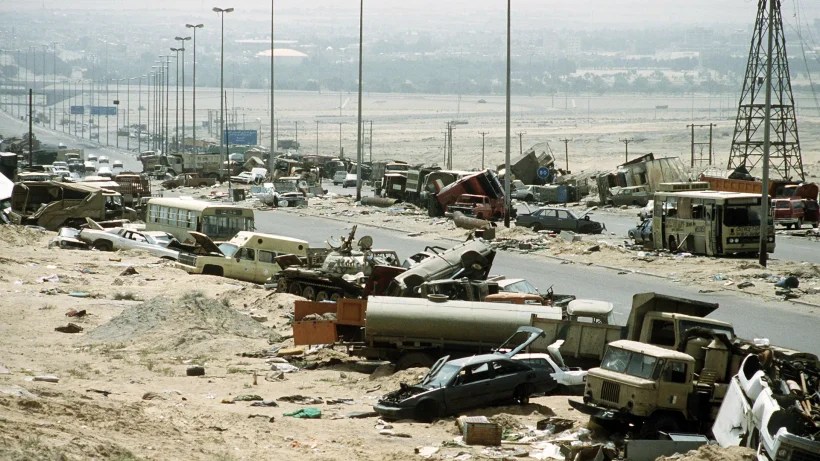
Then he travelled to a site on the border between Kuwait and Iraq, dubbed the “Highway of Death,” where thousands of Iraqi tanks and armored vehicles were pierced and burned by DU munitions fired by US A-10 Warthogs. There, he got readings of about 100-120 counts per minute on the holes of the damaged tanks. Lopez also collected small pieces of metal as samples that showed a reading of 600 counts per minute.
“And I happened to find several projectiles, 30 millimeters, that had missed the target and hit the ground and bounced. And they were intact. So I checked them out with my detector, thinking I’m going to get 600 counts per minute. I was getting 2,500 per minute on these projectiles, so high that my radiation detector wouldn’t go any higher than in its capabilities. And it would go ‘u-u-u-u,’ could have been higher than 2,400 counts per minute. And the only conclusion I could draw from that is that nuclear waste from nuclear facilities was being mixed with what was so-called depleted uranium. And this became even more alarming.”
DU Weapons are Made of Radioactive Waste
Lopez tried to find out why the US had decided to use depleted uranium for its ammo in the first place.
Damacio’s book Uranium Battlefields Home and Abroad: Depleted Uranium Use by the US Department of Defense explains that DU is a byproduct of the uranium enrichment process by which the fissionable isotope uranium-235 (U235) is extracted from natural uranium for subsequent use as fuel for nuclear reactors.
Natural uranium, a silvery-grey metal, contains 0.7% U235, 99.3% U238, and a small amount of U234 by mass. After producing 85 kilograms of enriched uranium, one would get 915 kg of U238, or depleted uranium.
The Pentagon argues that U238 retains “only” 60% of natural uranium’s radioactivity and emits alpha particles, which have low penetration depth and can be stopped by skin. Inside the body, however, alpha-emitters can be extremely harmful, damaging sensitive living tissue. After the explosion of DU projectiles, microscopic and light uranium dust can travel with the wind, be inhaled, swallowed, or enter the body through a wound, later causing cancer and chromosome damage.
One should bear in mind that depleted uranium is radioactive waste that should be disposed of, Lopez pointed out in his book. However, almost all DU tails have been saved by the US government since the early 1940s. Moreover, they can be purchased for commercial use, according to the researcher. To date, the US has accumulated a massive storage of DU amounting to over 700,000 metric tons.
Why Do Pentagon and Defense Contractors Like DU So Much?
Lopez explained that from a military standpoint, the most important property of DU is its great density, relatively low cost of fabrication, and availability. The material is used for tank armor and projectiles of different sizes.
Highly-dense DU munitions easily pierce tanks and other armored vehicles. While tungsten carbide projectiles are capable of doing the same, DU is cheaper, more accessible, and offers greater margins for US military firms.
On the other hand, turning spent uranium into bullets and shells has become an “ingenious” solution for the US nuclear industry on how to “dispose” of radioactive waste, Lopez said in his book. So, as money talks, the US’ testing and use of DU weapons continue unabated, according to the activist.
But has the Pentagon ever been aware of the long-lasting hazard related to DU projectiles?
The US Department of Defense’s internal memos, leaked to the press in the late 1990s and the beginning of the 2000s, indicate that the Pentagon knew. But why would it use the toxic and radioactive substance nevertheless?
A March 1, 1991 document shows the US DoD’s attitude to DU weapons use in a nutshell. Authored by US Lieutenant Colonel M.V. Ziehmn at the Los Alamos Laboratories in New Mexico, the memo reads:
“There has been and continues to be a concern regarding the impact of DU [sic] on the environment.
Therefore, if no one makes a case for the effectiveness of DU on the battlefield, DU rounds may become politically unacceptable and thus, be deleted from the arsenal.”
The memo went on by saying: “If DU penetrators proved their worth during our recent combat activities, then we should assure their future existence (until something better is developed),” adding “we should keep this sensitive issue at mind when after action reports [sic] are written”; otherwise the US may lose “a valuable combat capability.”
Why Are the Pentagon and White House Keeping DU’s Deadly Effects Secret?
The documentary Uranium 238: The Pentagon´s Dirty Pool (2009), used by Lopez’s International Coalition to Ban Uranium Weapons (ICBUW) as part of its international campaign to prohibit DU, said that the Pentagon is in denial about DU munitions potentially leading to carcinogenic diseases, birth defects, and environmental contamination.
The US Defense Department has even invented a sort of “DU diplomacy” to reassure the world community and American citizens that there is nothing to worry about, according to the ICBUW. Meanwhile, the US has not only failed to inform affected nations – Iraq, Bosnia, Serbia, Syria – about the DU hazard, but also repeatedly exposed American soldiers to the toxic and radioactive waste. Per the documentary, DU weapons in all but name are a “dirty bomb” – a mix of explosives and radioactive material – used by terrorists. Yet somehow DU rounds are still called “conventional weapons.”
One could easily imagine that if the US government admits DU’s hazardous effects, the weapon would be banned, influential defense contractors would be stripped of their profits, and Washington would be slapped with a heap of legal cases with compensation demands.
And the US is not the only country that uses depleted uranium as a weapon, as some of its NATO allies also do, according to Lopez.
“[The US keeps DU’s deadly effect secret], for the same reason all the other countries that have the weapon kept secret, as much as they can keep it secret, it is because they know they’re violating international laws, international conventions on weapons, and they know that they’re going to have to pay the price someday, and they may end up with charges of violations of international laws. And so they’re trying to protect themselves. And at the same time, they want to continue to keep the weapon because they’re afraid other countries have weapons too,” Lopez concluded.
50 injured as NATO troops clash with Serb demonstrators
RT | May 29, 2023
NATO forces attacked a group of demonstrators in the majority-Serb town of Zvecan in Kosovo, RT Balkan reported on Monday. Stun grenades and tear gas were deployed, and around 50 people were injured.
Serb demonstrators staged a sit-down protest outside municipal buildings in Zvecan, Zubin Potok and Leposavic on Monday morning, preventing ethnic Albanian officials from taking office after elections boycotted by the Serb population as illegitimate.
Kosovo police officers arrived on the scene in Zvecan, backed up by members of NATO’s Kosovo Force (KFOR). The heavily-armored NATO troops surrounded the demonstrators, who refused to disperse, RT Balkan’s journalist on the scene reported.
KFOR then threw stun grenades and tear gas into the crowd, provoking a riot. The Serb demonstrators pelted rocks at the NATO troops, and received baton strikes and rubber bullets in return. Fifty people went to a hospital in nearby Mitrovica, and two were admitted to the emergency room.
25 KFOR soldiers were injured in the melee, Italy’s ANSA news agency said. 11 of those reportedly hurt were Italians.
The protesters broke up shortly after the clashes, vowing to return and continue their demonstration on Tuesday.
The latest flareup in tensions began when local mayors in four majority Serb towns in northern Kosovo resigned last year after authorities in Pristina announced plans to force residents to switch their Serbian identity documents for Kosovo-issued ones. The Serb population of these four towns boycotted elections in April in which four ethnic Albanian mayors won with a turnout of less than 4%.
Nevertheless, the government in Pristina treated the votes as legitimate and the mayors were installed on Friday amid fierce opposition from the Serbs, who view the debacle as a naked power grab aimed at driving them from the breakaway province.
Kosovo unilaterally declared independence in 2008 with the support of the US and many of its NATO allies. Kosovo was historically a province of Serbia, and Belgrade – along with many world governments – does not recognize Kosovo as an independent state.
While NATO Secretary General Jens Stoltenberg and a number of Kosovo’s Western backers have urged Kosovo’s ethnic Albanian leader, Albin Kurti, to de-escalate the situation in the north of the province, he has apparently not heeded their warnings. Serbian President Aleksandar Vucic said on Sunday that Kurti “longs and dreams of being a [Ukrainian President Vladimir] Zelensky.”
Due to the clashes, Serbia placed its army on high alert, moving some units closer to the region’s border. Defense Minister Milos Vucevic said that “it is clear that terror against the Serb community in Kosovo is happening.”
Serbia ‘urgently’ moving army to Kosovo frontier – minister
RT | May 26, 2023
Serbian President Aleksandar Vucic has placed the national armed forces on high alert and ordered units to move towards the administrative line dividing the breakaway province of Kosovo from the rest of the country. The move comes following clashes between police and protesters in a majority-Serb town in the region on Friday.
“An urgent movement of forces to the Kosovo border has been ordered,” Defense Minister Milos Vucevic confirmed in a TV broadcast, adding that it is clear that “terror against the Serb community in Kosovo” is continuing.
Vucevic said the security of Serbs in Kosovo and Metohija was being threatened by the region’s ethnic Albanian prime minister Albin Kurti. He called on citizens to remain as calm as possible and not to fall for provocations.
Earlier in the day, Serbs in the town of Zvecan had clashed with police as a newly-elected ethnic Albanian mayor prepared to enter his office following local elections. The votes in four municipalities had been boycotted by the majority-Serb residents who had sought more autonomy and representation and regarded the votes as an attempt to seize the Serbian municipalities by illegitimate representatives. Turnout in the vote on April 23 was a mere 3.47%, with locals saying they would not work with the newly elected officials.
According to local media, police from Pristina used stun grenades and fired tear gas at protesters who had gathered in front of an administrative building, while Reuters reported that a police car had been set ablaze.
RT Balkan reported that around a dozen people were admitted to hospital with minor injuries.
Vucevic told Pink TV that what President Vucic had been warning the international community about for days and weeks has now “turned out to be true,” accusing Pristina of escalating tensions and instigating terror against Serbs.
“Someone needs to understand that what Albin Kurti is doing is leading us to red lines and to a complete collapse of dialogue and an escalation on the ground,” Vucevic said.
Last Friday, Vucic declared that Serbia’s refusal to acquiesce to the West’s demands and recognize Kosovo’s independence had made his country a target for foreign interference, but that he would “never surrender” and would “never let them make Kosovo independent.”
Kosovo unilaterally declared independence in 2008 with the support of the US and many of its allies. The breakaway region is not recognized by several countries, including Russia and China, or by Serbia itself.
The EU, however, has repeatedly demanded that Belgrade must recognize and “normalize” relations with Pristina if it wants to become a member of the bloc.
Featured Video
John Mearsheimer: US Already lost Iran war – No off-ramp in sight
or go to
Aletho News Archives – Video-Images
Frlom the Archives
With apparently fabricated nuclear documents, Netanyahu pushed the US towards war with Iran
By Gareth Porter | The Grayzone | April 29, 2020
President Donald Trump scrapped the nuclear deal with Iran and continued to risk war with Iran based on Israeli Prime Minister Benjamin Netanyahu’s claim to have proven definitively that Iran was determined to manufacture nuclear weapons. Netanyahu not only spun Trump but much of the corporate media as well, duping them with the public unveiling of what he claimed was the entire secret Iranian “nuclear archive.”
In early April 2018, Netanyahu briefed Trump privately on the supposed Iranian nuclear archive and secured his promise to leave the Joint Comprehensive Plan of Action (JCPOA). That April 30, Netanyahu took the briefing to the public in a characteristically dramatic live performance in which he claimed Israel’s Mossad intelligence services had stolen Iran’s entire nuclear archive from Tehran. “You may well know that Iran’s leaders repeatedly deny ever pursuing nuclear weapons…” Netanyahu declared. “Well, tonight, I’m here to tell you one thing: Iran lied. Big time.”
However, an investigation of the supposed Iranian nuclear documents by The Grayzone reveals them to be the product of an Israeli disinformation operation that helped trigger the most serious threat of war since the conflict with Iran began nearly four decades ago. This investigation found multiple indications that the story of Mossad’s heist of 50,000 pages of secret nuclear files from Tehran was very likely an elaborate fiction and that the documents were fabricated by the Mossad itself. … continue
Blog Roll
 Aletho News
- ‘All ports in Persian Gulf will be legitimate targets if Iranian ports are attacked’
- 40 Years of Endless War, Data Point by Data Point
- Department of War Using Palantir AI to Pick Targets in Iran
- American bases do not protect – they attack the peoples of the Persian Gulf
- ‘We’ve Obliterated Their Missiles’
- Syrian president vows ‘absolute support’ to disarm Hezbollah
- Ukraine attacking Russian gas pipeline to stop deliveries to Europe – Defense Ministry
- ‘Heinous crime’: Iran denounces Israeli assassination of 4 Iranian diplomats in Lebanon
- John Mearsheimer: U.S. Already Lost Iran War – No Off-Ramp in Sight
- UK Parliament Plans ISP Blocking and Age Verification Powers
- If Americans Knew
- Israeli strategic plans to “remake the Middle East” from the 1950s and since
- Honoring Gaza’s women who refused to let the world look away
- 97% of victims of war on Iran are Iranian, 98% of victims in war on Gaza are Gazans – Not a ceasefire Day 152
- Early Iran strikes cost $5.6 billion in munitions, Pentagon estimates
- Israel Decided the War, But Trump’s America Fights and Pays the Bill
- Conscientious Objector Group: Phone ‘Ringing Off Hook’ As Huge Mobilization Underway
- U.S. support for Israel continues to plummet, despite media’s best efforts
- Threats and missiles fly, death tolls soar in Iran, Lebanon, Gaza – Not a ceasefire Day 151
- Lebanon: Israel’s White Phosphorous Use Risks Civilian Harm
- Corporate Media Go All Out To Support The US-Israeli War On Iran
- No Tricks Zone
- Destructive Green New Deal: German Energy And Metal Group Warns Of Drastic Crisis
- New Study Documents A 20-Year Pause In Arctic Sea Ice Decline – Driven By Internal Variability
- Wake-up Call: Survey Shows Majority Of Germans Now Favor Postponing Climate Targets!
- Televised! Leading German Political Candidate Tells Schoolchildren CO2 Makes Sun Hotter!
- New Study: A Century Warming Of 1.1°C Is ‘Commonplace’ And ‘Not Unusual’ During This Interglacial
- New Study: ‘Internal Noise’ And Volcanic Forcing Can Trigger 10-15°C Warming Within Decades
- Glaciers Worldwide Are Suddendly Surging, Experts Blame Warming!
- Surprising Discovery: Sahara Is Greening…Billions Of Trees Where Once Thought To Be Barren
- New Research Reaffirms Clouds, Aerosols, And Surface Solar Radiation Are ‘Driving The Climate System’
- Germany: Electric Car Catches Fire At Charging Station, Sets Off Local “Inferno”, Widespread Damage
 Aletho News