Inquiry on Aleppo chemical attack met int’l standards, unlike West’s – Lavrov
RT | July 10, 2013
Russia’s inquiry into the use of chemical weapons on Syrian territory was carried out in full accordance with international standards, unlike a similar evaluation by Western countries, says Russian Foreign Minister Sergey Lavrov.
On Tuesday, Russia submitted to the UN its analysis of the samples taken at the Syrian town where chemical weapons were used. Evidence studied by Russian scientists indicates that a projectile carrying the deadly nerve agent sarin was most likely fired at Khan al-Assal, west of Aleppo, by rebels, rather than government forces.
Russia “guarantees” the quality of the analysis, which fully complies with the requirements set by the Organization for the Prohibition of Chemical Weapons (OPCW), Sergey Lavrov told a media conference on Wednesday, following talks with his Belarusian counterpart.
In response to US doubts regarding the results of the analysis, Lavrov underlined that the samples of the chemical weapons had been taken at the very place where they were used and were delivered by Russian experts rather than passed through third-party hands.
“We submitted a full set of documents [to the UN]. That’s over 80 pages, including photographs and precise geographic coordinates [of places where samples were taken], procedures and results,” Lavrov pointed out. “We also guarantee that the samples were taken by experts who did not let go of them till they were delivered to the laboratory,” Lavrov said.
The evidence of the alleged use of chemical weapons by the Syrian regime – which was provided by the US, Britain and France – does not provide information on where and when the samples they used for analysis were taken, Lavrov noted.
Besides that, their samples passed through many hands and some of them, as those Western partners said, were received from journalists, he observed.
“All that totally contradicts the standards existing in the OPCW,” Lavrov stated.
Evidence studied by Russian experts indicates that on March 19 the rebels fired an unguided missile Bashair-3 at the northern Syrian town of Khan al-Assal, outside Aleppo, which has been under government control. According to the findings, the shell used in Khan al-Assal was not factory-made and contained sarin – a highly toxic nerve agent.
Russia believes that the manufacture of the ‘Bashair-3’ warheads started in February, and is the work of Bashair al-Nasr, a brigade with close ties to the Free Syrian Army.
Moscow has no objection to making the results of its probe public, Lavrov pointed out.
“[The conclusions of the inquiry] are quite convincing and I think that this should answer many questions,” he said.
Meanwhile, the opposition Syrian National Coalition denied Russian allegations that rebel forces used chemical weapon at the suburb of Aleppo. They insist that UN inspectors should be allowed to investigate the attack.
British Labour MP Jeremy Corbyn told RT that “it’s got to be a good thing that Russia is going to put its evidence in front of the UN.”
Responding to comments from the US, Britain, and France that they have unconfirmed reports that the Syrian regime used chemical weapons, Corbyn said “the reports are either confirmed and the evidence is there, or it’s not, and anyone who has any evidence should hand it straight over to the UN.”
“The usage of chemical weapons is inconsistent with the guiding principles and goals of the Syrian revolution,” Khalid Saleh, a spokesman for the coalition said on Wednesday, as cited by Reuters. “Targeting civilians indiscriminately to achieve political gains is a common characteristic of the Assad regime,” he added.
The Syrian government and rebels have blamed each other for the March incident outside Aleppo that killed 26 people as well as for other alleged chemical attacks in the conflict-torn country.
On Monday, the Syrian government invited two senior UN officials to Damascus to discuss allegations of the use of chemical weapons, adding that they discovered a rebels-linked storage site which contained piles of dangerous chemicals.
The UN Secretary General’s spokesperson described the offer as “a move in the right direction,” but did not say whether the organization would accept it. Martin Nesirky said the Syrian government needed to grant the UN team broad access across the country “without further delay and without conditions.”
Kerry: Geneva II peace conference on hold, “August is very difficult for Europeans”
Al-Manar | July 2, 2013
US Secretary of State John Kerry said Tuesday that the United States and Russia were committed to holding Geneva peace conference on Syria but that it would likely take place after August.
Kerry, speaking after talks with Russian Foreign Minister Sergei Lavrov at the annual regional forum of the 10-member Association of Southeast Asian Nations (ASEAN) in Brunei, said “we both agree that the conference should happen sooner rather than later” to find a peaceful solution to the Syrian war.
But he said that the conference, originally planned for June, could not happen this month due to US-Russian meetings and that “August is very difficult for Europeans and others,” a likely reference to summer vacations.
“It may be somewhere thereafter,” he said of the timing of the conference.
Kerry also said he did not have substantive discussions with Lavrov on US whistleblower Edward Snowden. The meeting between Kerry and Lavrov follows controversy surrounding Snowden, who leaked details of a US surveillance programme.
Related article
Upcoming nuclear arms reduction treaties must involve all countries that have atomic weapons at their disposal – Lavrov
RIA Novosti | June 22, 2013
MOSCOW – Any upcoming treaties on nuclear arms reductions will have to involve all countries that have atomic weapons at their disposal, Russian Foreign Minister Sergei Lavrov said Saturday.
Lavrov was commenting on US President Barack Obama’s proposal from earlier this week to slash US and Russian nuclear arsenals by one third from the limit imposed by the bilateral New START treaty in 2010.
The New START limits deployed nuclear warheads to 1,500 per country, though the actual slashing of nuclear arsenals is still ongoing.
Moving beyond the New START will make nuclear arsenals of the United States and Russia comparable to those of other countries with nuclear weapons, Lavrov said.
“This means that further moves possibly proposed for reduction of actual strategic offensive arms will have to be reviewed in a multilateral format,” Lavrov said on Rossia-1 television.
“And I’m talking not just official nuclear powers, but all countries that possess nuclear weapons,” the minister said.
In addition to the United States and Russia the list of confirmed nuclear powers currently includes Britain, China, France, India, Pakistan and North Korea. Israel is often accused of possessing nuclear weapons, and Iran of developing them, but neither confirmed the allegations.
The number of atomic weapons at the disposal of nuclear powers other than Russia and the United States is considered to be between 100 and 300 per country, according to the Federation of American Scientists.
Lavrov also said that Russia will be taking into account US plans for a missile defense shield in Europe when deciding on further nuclear arms reduction. He added that Obama acknowledged the “necessity” of this approach.
Russia has argued for years against the US missile defense shield plans, insisting that it could disrupt the strategic parity between the two former Cold War rivals.
Related articles
Iran ready to halt 20% uranium enrichment, West must reciprocate – Lavrov
RT | June 18, 2013
Iran has confirmed it is prepared to halt its enrichment of 20-percent uranium, Russian Foreign Minister Sergey Lavrov said, urging Western nations to end their sanctions against Tehran.
“For the first time in many years, there are encouraging signs in the process of settlement of the situation with the Iranian nuclear program,” he said in the interview to Kuwait’s KUNA news agency, that was published on Russian Foreign Ministry’s website.
“Without going into details, the Iranians confirm the most important [point]: Their readiness to stop 20 percent uranium enrichment at its current levels,” Lavrov said.“This could become a breakthrough agreement, significantly alleviating existing problems, including concerns about the possibility of advanced uranium enrichment to a weapons-grade level.”
Such a move “implies significant reciprocal steps by the Six,” the minister added, referring to the group of world powers seeking to peacefully resolve the issue of Iran’s nuclear program.
“The international community must adequately respond to the constructive progress made by Iran, including gradual suspension and lifting of sanctions, both unilateral and those introduced by the UN Security Council. It would be a shame not to take advantage of this opportunity,” Lavrov concluded.
News of Iran’s possible concessions over its nuclear program comports with promises made by Iranian President-elect Hassan Rowhani, who vowed to make the program more transparent.
Still, the moderate cleric stressed on Monday that Tehran would not consider halting the country’s uranium enrichment activities entirely. Rowhani insisted that Iran’s nuclear activities are “within the framework of law,” and dubbed the international sanctions “baseless.”
Despite numerous accusations by Israel and the US that it is secretly conducting military nuclear research, Iran has maintained that its nuclear program is only for civilian purposes.
At his first media conference since winning the presidential elections, Rowhani – who previously headed Iran’s delegation during nuclear talks with the six world powers – said that Tehran’s nuclear activities “are already transparent,” but “the only way to end the sanctions is to increase the transparency and trust” between Iran and the international community.
Washington has been expecting changes in Iran’s hardline stance on the nuclear issue following the country’s presidential elections. White House Chief of Staff Denis McDonough said Sunday on ‘Face the Nation’ that Washington is ready to work with the new administration in Tehran, “If he lives up to his obligations under the UN Security Council resolution to come clean on this illicit nuclear program.”
But Israeli Prime Minister Benjamin Netanyahu remained unconvinced: “The international community must not become caught up in wishes and be tempted to relax the pressure on Iran to stop its nuclear program,” he said.
President-elect Rowhani will assume office in August. He believes that he can heal the “old wound” of troubled US-Iran relations if Washington stops interfering in Tehran’s internal affairs and permanently ends its “bullying” practices towards Iran.
Related article
- What Should be Expected From President Rowhani? (alethonews.wordpress.com)
Russia slams the US for distorting results of trilateral talks on Syria
Press TV – June 7, 2013
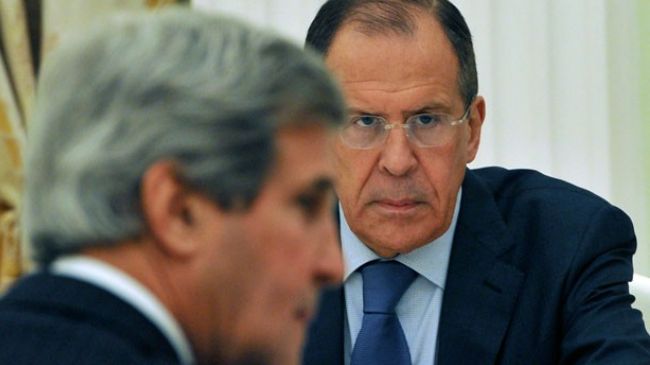
Russia’s foreign minister has censured the US Department of State officials for their ‘peculiar comment’ on the results of a trilateral meeting over Syria in Geneva.
The trilateral meeting on Wednesday was held with the participation of UN-Arab League Special Representative for Syria Lakhdar Brahimi and representatives from Russia and the United States. It served as a preparatory move to pave the way for the Geneva 2 talks on the issue of Syria.
During a Thursday press conference, Russian Foreign Minister Sergei Lavrov said, “I have heard that officials from the US Department of State have given a very peculiar comment on the results of yesterday’s meeting in Geneva between Russia, US, and UN.”
“In particular, the State Department representative stated that Russia, the United States and the United Nations agree that the goal of the new conference in Geneva must be the forming of a new transitional government in Syria. This really matches with what was written down last year,” he said.
“But, if the reports that I have received are true, the State Department went on to add that this should be a transitional government to which the current authorities in Damascus would hand over all their powers. If this was really said by the State Department, this is a very strong distortion of what the talks were about,” the Russian foreign minister added.
He made the remarks in response to an earlier statement by Jennifer Psaki, a spokesperson for the US Department of State, where she reportedly claimed that participants in the preparatory meeting had agreed that the forthcoming talks on Syria should focus on the formation of a transitional government, to which the current administration should give up all powers.
Lavrov further reiterated that Moscow would continue to push for Iran’s participation in the upcoming Geneva meeting despite opposition from some Western states.
Meanwhile, Brahimi has expressed hope that the Geneva conference would convene in July, as the preparatory meeting failed to set a date.
Moscow disappointed political games prevented investigation into chemical weapons use in Syria
RT | May 31, 2013
Russia’s Foreign Minister Sergey Lavrov stressed that “political games” prevented Russia from investigating the data on the use of toxic substances in Aleppo: the UN Secretariat couldn’t respond promptly to Moscow’s demand to look into the matter.
In March, the Syrian government invited the United Nations to investigate possible chemical weapons use in the Khan al-Assal area of rural Aleppo. Military experts and officials said a chemical agent, most likely sarin, was used in the attack which killed 26 people, including government forces.
Several countries, including Israel, the UK, France and the US – all vocal critics of Syrian President Bashar Assad – all claimed they had evidence that chemical weapons were used in Syria.
Damascus denied that a chemical attack was carried out by the Syrian army, blaming the rebels and Turkey for the incident: “The rocket came from a place controlled by the terrorists and which is located close to the Turkish territory. One can assume that the weapon came from Turkey,” Syrian Information Minister Omran al-Zoabi alleged in an interview with Interfax news agency.
Lavrov spoke following the reports that Turkish security forces found a 2kg cylinder with sarin gas after searching the homes of Syrian militants from the Al-Qaeda linked Al-Nusra Front who were previously detained.
The sarin gas was found in the homes of alleged Syrian militants, who were reportedly planning a terrorist attack on the southern Turkish city of Adana.
Russia expressed concern over the incident, urging for a thorough investigation into the matter.
Almost a month ago, the Syrian Deputy Foreign Minister Faisal Muqdad said that Damascus was ready to have the UN investigation team look into alleged chemical weapons use in Syria.
“We were ready and we are always ready, right now, to receive the delegation that was set up by [UN Secretary-General] Ban Ki-moon to investigate what happened in Khan al-Assal,” Muqdad said, referring to the March 19 incident near Aleppo.
Syrian rebels are accused of using a rocket with a chemical warhead, killing 25 people and injuring 86, according to SANA news agency.
The Syrian civil war has been raging for more than two years now, with more than 80,000 people killed, according to UN estimates.
In his latest statement on the matter, Lavrov noted the Russian government’s concern over the issue due to the chance of provocations around the situation.
NATO to continue European missile plan despite Russian criticism
Press TV – February 3, 2013
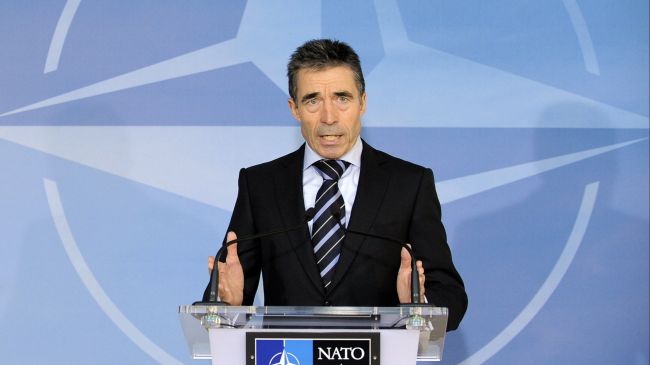 NATO says it will continue to install a missile system in Europe despite Russia’s opposition.
NATO Secretary General Anders Fogh Rasmussen made the announcement on the sidelines of the Munich Security Conference on Saturday.
“We have made clear from the outset that NATO has made the decision to establish a NATO missile defense system because it’s our obligation to ensure effective defense of our populations… Having said that, we have invited Russia to cooperate and… now it’s up to Russia to engage in that,” Rasmussen said.
Russian Foreign Minister Sergei Lavrov said earlier that the missile program was reminiscent of the Cold War.
“Officially, we have abandoned the mindset of the Cold War,” Lavrov said.
On January 27, Russian Prime Minister Dmitry Medvedev said he saw “no flexibility” in the ongoing dispute.
“If we talk about the subject itself, it is extremely difficult. And so far we don’t see any flexibility… There is no flexibility,” Medvedev added.
Related article
- Turkish protesters, angry at NATO missiles, attack German troops (alethonews.wordpress.com)
Toothless sanctions? Iranian oil trade booming, China top buyer
RT | January 31, 2013
Iran has quickly found ways to circumvent the EU sanctions imposed on its oil trade in July. After dipping sharply in summer of 2012, Iranian crude oil exports rose again by the end of the year.
So far, Iran’s December crude oil sales were the highest recorded since the sanctions were first imposed. Iran exported 1.4 million barrels per day (bpd) in December, compared to less than 900,000 bpd in September. Pre-sanctions oil exports stood at 2.2 million bpd in late 2011.
EU sanctions, introduced in January 2012 and put into effect in July, aimed to curb Iran’s ambitious nuclear program, which Tehran has insisted is only for peaceful purposes. The Iranian economy is heavily dependent on oil sales – the cuts in production lead to billions of dollars in lost revenue and a plunge in the value of the national currency.
Analysts believe that sales to Asia and the expansion of Iran’s tanker fleet helped the Islamic Republic circumvent the sanctions. In countries like China, India and Japan, Iranian oil constitutes more than 10 percent of the total crude supply – and demand from Asia is only growing.
“China is saying let’s up the numbers because no-one is doing anything about it and it looks like Obama has made a political decision not to go to war with Iran,” a senior source at a large independent trading house told Reuters.
Iran is also improving its delivery channels, despite the numerous bans and restrictions imposed by the international community.
“Iran bought a number of tankers from China and can now do more deliveries. It’s taken some pressure off Iran and facilitated tanker traffic and we are seeing higher exports to China,” analyst Salar Moradi at oil and gas consulting firm FGE told Reuters.
Meanwhile, a fresh round of US sanctions looms for Iran. Starting on February 6, US law will prevent the Islamic republic from repatriating earnings from its oil export trade. The ban is in addition to the already-existing restrictions, including the country’s removal from the SWIFT global financial service and an indefinite international asset freeze.
The new sanctions are expected to reduce export volumes to around 1 million barrels per day, the International Energy Agency predicted. However, analysts believe that further sanctions will not stop Iran from selling oil or pursuing its nuclear goals.
“What we have seen is that when Iran is pushed to a do or die situation, they have looked for creative solutions to get around sanctions,” oil and gas analyst Elena McGovern of Business Monitor International told Reuters. “The system will always find a way to cope.”
The international community has been failing to engage in constructive dialogue with Iran on its nuclear program. The so-called ‘sixtet’ of ‘5+1’ states – Britain, China, France, Russia, the US and Germany – met three times last year with little to no results. The next round of talks has been stalled until a venue for the meeting is agreed upon.
“Some of our partners in the six powers and the Iranian side cannot come to an agreement about where to meet, behaving like little children,” Russian Foreign Minister Sergey Lavrov said. He stressed that Russian mediators “are willing to meet at any location.”
While the West has demanded that Iran abandon its nuclear aspirations, Iran refuses to back down: Tehran has seized every opportunity to advance its nuclear capabilities. On Thursday, Iranian officials informed the UN nuclear agency of its plan to use more modern centrifuges at the Natanz uranium enrichment plant.
Related articles
- China defying sanctions imposed on Iran (alethonews.wordpress.com)
- US probes Swiss medicine giant for trade with Iran (alethonews.wordpress.com)
No weapons on Syrian plane grounded by Turkey – Lavrov
RT | October 12, 2012
Russian Foreign Minister Sergey Lavrov said that no weapons were carried by the Syrian passenger plane Turkey diverted on Wednesday over suspicions it was transporting non-civilian cargo.
Lavrov claimed the Airbus A-320 was carrying radar parts, and that transporting such items by civil aircraft does not violate international law.
“We have no secrets,” Foreign Minister Sergei Lavrov told reporters. “There were, of course, no weapons on the plane and could not have been any. There was a cargo on the plane that a legal Russian supplier was sending in a legal way to a legal customer.”
Lavrov said the the supplier will demand the cargo be returned which is their property.
“We are awaiting an official reply why our diplomats were not allowed to meet the Russian passengers on board,” stressed the Russian FM.
The announcement came in response to a Thursday statement made by Turkish PM Recep Tayyip Erdogan alleging that the Syrian Air jet was transporting Russian-made munitions for the Syrian Defense Ministry.
“It is absolutely clear who sent the cargo and who was going to receive it. This was munitions from the Russian equivalent of our Mechanical and Chemical Industry Corporation being sent to the Syrian Defense Ministry,” Ergodan said.
Turkey diverted the passenger plane en route from Moscow to Damascus on Wednesday as it entered Turkish airspace, and forced it to land in Ankara and open its cargo to inspection. After around nine hours, some items from the cargo were seized and the plane was allowed to depart.
Syria labeled the incident “air piracy,” and insisted there was nothing illegal on board the plane.
Moscow criticized Turkey for endangering the lives of the flight’s 35 passengers by dispatching F-16s fighter jets to force the plane to land, and demanded to know why Russian diplomats and doctors were not allowed to meet the 17 Russian nationals on board the plane.
Related articles
- Turkey Releases Syrian Plane after Detention (alethonews.wordpress.com)
Russia: US Supporting Terror in Syria, West Spurring Bloodshed
Al-Manar | July 25, 2012
Russia accused the US on Wednesday of justifying terror in Syria, as it said that the West was spurring further bloodshed in the crisis-hit country.
Foreign Minister Sergei Lavrov told reporters that Washington’s failure to condemn the July 18 blast that killed top security officials meant it was justifying terror.
“This is quite an awful position, I cannot even find the words to make clear how we feel,” Lavrov said, adding: “This is directly justifying terrorism. How can this be understood?
Lavrov expressed bewilderment at calls on Russia to clarify its position on Syria, saying Moscow’s policy was crystal-clear and it was the West whose actions were contradictory.
He criticized the US ambassador to the United Nations Susan Rice, saying she had argued that the attacks in Damascus meant the UN Security Council had to agree to a sanctions resolution against Syria last week that Russia later vetoed.
“In other words, to say it in plain Russian, this means ‘we (the United States) will continue to support such terrorist acts for as long as the UN Security Council has not done what we want’,” Lavrov said.
WEST SURRING BLOODSHED IN SYRIA
For his part, Russian Deputy Foreign Minister Gennady Gatilov said statements made by some Western leaders urging to end the conflict in Syria outside the UN Security Council framework were wrong and “a step aside from our common positions.”
During an interview with Itar-Tass news agency, Gatilov said: “We agreed that all foreign players will act in one direction – in the work with the government and with the opposition. We believe that viable decisions backing political settlement can be taken only in the UN Security Council.”
The international community would exert “proper influence” on both sides of the Syrian conflict only if it spoke with one voice and acted in coordination, Gatilov said, adding some Western partners’ intention to circumvent the UN would make no progress in the current difficult situation.
Meanwhile, Gatilov slammed those Western countries trying to spur “further bloodshed” from the opposition. “This upset us greatly, we take this as a step aside from the consensus obtained by the Geneva agreements,” the diplomat said.
Russian Shipping Company Denies Arms Deliveries to Syria
RIA Novosti | June 16, 2012
Russia’s Universal Cargo Logistics Holding (UCL Holding), owned by billionaire Vladimir Lisin, dismissed on Saturday media reports claiming that the company’s vessel had shipped weapons to violence-hit Syria, UCL Holding said.
“It was a general cargo of non-military purpose featuring electrical equipment and repair parts (rotor blades) in containers and wooden crates,” the company said in a statement, calling the reports “absurd speculations.”
The UCL Holding’s statement comes after several Russian and Western media as well as a U.S.-based advocacy group, Human Rights First, reported in late May that the Russian-flagged bulk cargo vessel Professor Katsman, operated by Lisin’s shipping company, docked at the Syrian port of Tartus on May 26, allegedly carrying weapons for the President Bashar Al-Assad’s forces.
Soon after the reports the U.S. Secretary of State Hillary Clinton and the U.S. Ambassador to the United Nations Susan Rice have lashed out at Russia over its alleged arms supplies to Syria. Moscow strongly rejected the claims, saying that Russia was not “delivering to Syria, or anywhere else, items that could be used against peaceful demonstrators.”
Foreign Minister Sergei Lavrov said on Wednesday that Moscow was “completing right now the implementation of military contracts that were signed and paid for a long time ago.”
All the contracts feature anti-aircraft defense, Lavrov said.
“We feel really upset when some politicians use inaccurate and unverified information. As a result, a well-respected people support statements which are based not on pure facts, but on gossips and their own stereotypical notions from the times of “Cold War,” UCL Holding said.
Syria is one of Russia’s major weapons clients, and Moscow has opposed a proposal for a UN arms embargo on Damascus.
Russia has supplied Syria with Bastion coastal missile systems with Yakhont cruise missiles and Buk surface-to-air missile systems under a contract signed in 2007.
Related articles
- Russia Rejects U.S. Allegations on Arms Deliveries to Syria (alethonews.wordpress.com)
‘External forces hampering truce in Syria’ – Lavrov
RT | April 17, 2012
The truce in Syria is still very fragile and all the influential parties on either side of the conflict should be guided by the interests of the Syrian people rather than their own ambitions, says Russian Foreign Minister Sergey Lavrov.
“Indeed, there are forces which are interested in the failure of the Kofi Annan plan, they were saying that even before the plan was released,” Lavrov stated on Tuesday. “And they are doing their best to make their wish come true through arms deliveries to opposition forces and by encouraging militants’ activities.”
This leads to retaliation measures from the government Lavrov added, “so that things are not going smoothly” for now.
Kofi Annan’s peace plan implies a ceasefire under the control of the United Nations, providing humanitarian aid to the victims of the conflict and starting dialogue between the conflicting sides. The proposal was unanimously adopted by the Security Council on March 21.
The Russian Foreign Minister also said that “some countries, some external forces are not interested in the success of the current peaceful efforts of the Security Council.”
These forces he went on to say are trying to substitute the Security Council with various unofficial formats and are using all tools to convince the Syrian opposition no to cooperate with the government.
Lavrov called this stance “counterproductive” and “regrettable”.
Related articles
- Syria and the Annan Plan: The Devil in the Details (alethonews.wordpress.com)
Featured Video
America Racing to Strategic Defeat in Iran
or go to
Aletho News Archives – Video-Images
From the Archives
An Expert Military Analysis of War with China
Actually, None is Necessary
By Fred Reed • Unz Review • December 13, 2020
The Correlation of Armed Forces: U.S. goods and services trade with China totaled an estimated $634.8 billion in 2019. Exports were $163.0 billion; imports were $471.8 billion. The U.S. goods and services trade deficit with China was $308.8 billion in 2019. Trade in services with China (exports and imports) totaled an estimated $76.7 billion in 2019. Services exports were $56.5 billion; services imports were $20.1 billion. The U.S. services trade surplus with China was $36.4 billion in 2019.
There is talk within the Washingtoniat of a possible war with China. Steve Bannon, who apparently was dropped on his head as a child, actually favors such a war. We hear the usual shoo-the-boobs alarm about how the Chinese are doing something terrible and we must gird our loins and American values and show them what for, bow wow, woof. The danger is that the current game of who-blinks-first in Asian waters might actually provoke a shooting war. You know the kind of thing: One warship refuses to get out of the way of another, a collision ensues, some retard lieutenant who signed up on waivers opens fire, and we’re off and running. It is not a good idea to let children play with matches.
The said war is discussed either in emotional terms by idiots or in purely naval terms by those familiar with such things, so we hear of the First Island Chain and the Second Island Chain and whose missiles against the other’s missiles and so on. This would be appropriate if we were fighting World War Two again. Which we aren’t. Let’s take a quick-and-dirty look at how such a war might go.
To begin the war, America would overestimate itself and underestimate China. This is doctrine in the Pentagon. … continue
Blog Roll
 Aletho News
- Rethinking America’s greatest threat: Iran vs. Israel-Firsters
- Iran accuses adversaries of false flags to strain Turkey ties
- Poland rules out sending Patriot missiles to US/Israel amid war on Iran
- Tehran approves new Hormuz plan with major restrictions
- No Threat Can Force Iran’s Surrender /Trita Parsi & Lt Cl Daniel Davis
- UK’s New Pandemic Plan Would Turn Big Tech Into a Mass Location Tracking Network
- Growing insecurity, soaring prices fuel protests in north as regime bans evacuation: Sources
- Iran denies responsibility for ‘depraved’ attack on Kuwait desalination plant
- Bring The Troops Back. End This War Now!
- Can we please stop calling Israel the ‘only democracy in the Middle East’ now?
- If Americans Knew
- The Line Between Affinity and Conspiracy
- As Iran targets US military bases, will they be relocated to Israel? Not a ceasefire Day 171
- Will Trump Go Kamikaze?
- Is the University of Florida Shutting Down College Republicans over Israel Criticism?
- Jewish extremist arrested over alleged plot to firebomb Palestinian activist Nerdeen Kiswani’s home
- More than half of Palestinian child detainees have no charges
- The More Murderous Israel Gets, The More We Hear About “Antisemitism”
- Land Day and the Palestinian struggle after 30 months of genocide
- The Iran War Is About Palestine
- Israeli soldiers echo settler ideology, talk of revenge after targeting Palestinians and detaining CNN crew in the West Bank
- No Tricks Zone
- New Study Finds Warming Saves Lives…Cold Temperatures 12 Times More Deadly Than Excess Heat
- German Science Blog Accuses PIK Climate Institute Of Hallucinating Climate Tipping Points
- Devastating Assessment Of Comirnaty Vaccine By Former Senior Pfizer Europe Toxicologist
- New Study: CO2 Is ‘Effectively Negligible’ As An Explanatory Climate Change Factor Since 2000
- Former Pfizer Toxicologist Dr. Helmut Sterz Tells Bundestag Hearing Pfizer Vaccine Should Have Never Been Approved
- Energy Expert: Germany’s Nuclear Phaseout Was A “500 Billion Euro Mistake”
- New Research: South Australia’s Mid-Holocene Sea Surface Temperatures Were 4°C Warmer Than Today
- Storing Green Energy To Last Germany 10 Days Would Require A 60-Million Tonne Battery
- New Studies: UK Sea Levels Were 4 Meters Higher Than Today During The Mid-Holocene
- Destructive Green New Deal: German Energy And Metal Group Warns Of Drastic Crisis
 Aletho News