South Africa gold mine fires 8,500 striking workers
Press TV – October 23, 2012
South African miner Gold Fields has sacked over 8000 of striking workers after they refused to return to work at the KDC East mine near the city of Johannesburg, a spokesman says.
“All 8,500 people who were on strike did not come back. They did not return to work, so we have issued dismissal letters to all of them,” spokesman Sven Lunsche announced on Tuesday.
“We have now reached a stage where we can’t hold off anymore. Our hands were forced and we have now done it.”
Lunsche further stated that the workers have 24 hours to appeal their dismissal.
Workers at the last striking mine of the world’s fourth gold producer in Carletonville, southwest of Johannesburg, ignored a final deadline set for 4:00 pm (14:00 GMT).
Tens of thousands working in South African mines –mostly located near the commercial hub of Johannesburg– have been on strike for more than a month.
The strikes have paralyzed production in the country, which accounts for around seven percent of global mine products.
In August, clashes between striking miners and police left 46 miners dead at Lonmin platinum mine in the South African North West Province.
The strikes have damaged South Africa’s reputation as an investment destination.
South Africa possesses nearly 80 percent of the world’s known platinum reserves. The country’s mining sector directly employs around 500,000 people and accounts for nearly one-fifth of the country’s gross domestic product.
What Happened to South Africa’s Freedom Charter
A Black Agenda Radio commentary by Glen Ford | October 16, 2012
In 1994, the African National Congress of South Africa made a deal with the devil. There would be one-person, one-vote, majority rule of electoral politics. But corporate power over the South African economy would not be tampered with, and white civil servants would be guaranteed they could keep their well-paying jobs, for life. The ANC also set itself another goal: to create a class of Black millionaires.
Much earlier, the ANC had made a solemn commitment to the broad masses of people. It’s called the Freedom Charter, adopted in 1955, which served as the unifying document of the struggle against apartheid that culminated in the elections that brought the ANC to power. The Freedom Charter promised that “the national wealth of [the] country, the heritage of South Africans, shall be restored to the people;” that “the mineral wealth beneath the soil, the Banks and monopoly industry shall be transferred to the ownership of the people as a whole;” that “all other industry and trade shall be controlled to assist the wellbeing of the people; all the land re-divided amongst those who work it to banish famine and land hunger;” and that “all shall have the right to occupy land wherever they choose.”
Yet, none of this has come to pass. The Freedom Charter is absolutely incompatible with the deal the ANC made for a peaceful transition to Black majority rule. If corporate privileges are untouched, there can be no collective ownership of the mineral wealth, the soil, the banks and industries. And social systems that breed new Black millionaires – or millionaires of any kind – cannot possibly give priority to the well-being of the masses of people.
South Africa was one of the most unequal places in the world in 1994, and it is at least as unequal, today – because of the deal cut by the ANC. The covenant with white privilege and corporate power was also entered into by the ANC’s partners: the South African Communist Party and the Congress of South African Trade Unions, COSATU. Thus, the three pillars of the liberation movement agreed that they would not upset the existing corporate framework, and they would not implement the clearly socialist aims of the Freedom Charter. Instead, they nurtured a tiny, Black capitalist class made up largely of ANC insiders. Union leaders became rich men, while conditions for the poor and working classes deteriorated.
These chickens have now come home to roost, especially following the massacre of 34 miners at Marikana. The mining industry is in turmoil, with 41 percent of South Africa’s gold output shut down. Hundreds of thousands of municipal workers will go on strike this week to protest poor pay and corruption. Yet the official voice of labor, COSATU, cannot credibly claim to represent the interests of working people when it is a partner of the ruling party whose police kill, beat and imprison workers.
This fundamentally corrupt arrangement has run its course. There will be nothing but mass bloodshed at the end of this journey unless the African National Congress breaks the pact that it made with corporate power, in 1994. The ANC stands at a crossroads, and must make a turn.
Glen Ford can be contacted at Glen.Ford@BlackAgendaReport.com.
Related articles
- South Africa’s Unfinished Revolution and the Massacre at Marikana (alethonews.wordpress.com)
Digging a hole? 12,000 S. African striking miners sacked ‘in absentia’
RT | October 5, 2012
Up to 12,000 employees of Anglo American Platinum received messages Friday saying they were fired. The mining powerhouse dismissed the workers after a three-week strike. The labor stand-off has already taken 48 lives across South Africa since August.
The news was broken to the employees via SMS and emails.
Commenting on the move, Amplats declared miners had failed to appear before disciplinary hearings “and have therefore been dismissed in their absence.” The miners had been warned that would happen if they failed to turn up, the company said.
The world’s largest platinum producer says its lost over $80 million in revenues since a major strike gripped their mines in mid-September, involving at least 20,000 miners.
“Despite the company’s repeated calls for employees to return to work, we have continued to experience attendance levels of less than 20 percent,” the firm said in a statement quoted by Agence France Presse.
Strike leader Gaddafi Mdoda was one of the those fired on Friday. He says that even if Amplats no longer employs them, this is no reason to end the struggle. The mineworkers are demanding 12,500 rand (about $1,500) in take-home salary, their current wages are reported to be around $500.
Amplats says they still continue “exploring the possibility of bringing forward wage negotiations within our current agreements”.
The sackings came hours before another striking miner was mortally wounded in clashes with police, bringing the total number of protesters killed since strikes began in August, to 48. Police would not confirm the cause of death, but protesters say he was shot with a rubber bullet.
The strikes peaked at over 75,000 participants, or 15 percent of workforce in the mining sector. Clashes with police often turned violent, involving tear gas, rubber bullets and water cannon. In a single day thirty-four strikers were killed by police at Lonmin’s Marikana platinum mine, on August 16.
Despite the growing tensions, negotiations with mine owners don’t appear to be yielding any substantial results. A rare breakthrough was reached at the Lonmin platinum mines, where the worst violence broke out, with salaries being boosted 22 per cent. But on Thursday, South Africa’s Chamber of Mines, the main industry body, said wage talks will not be based on that precedent. This may force coal miners to join platinum, gold, iron ore and diamond miners in further work stoppages.
Lonmin platinum mine workers end strike in South Africa
Press TV – September 19, 2012
Mineworkers of Lonmin platinum mine have ended their five-week strike and returned to work after the company increased their salaries, South African media says.
The Lonmin strike was marked by violent clashes in August, where police forces killed 34 striking miners at the platinum mine which is reportedly the world’s third-largest platinum producer with approximately 28,000 employees. In all, 45 people have died in violence related to the unrest.
“The end of the Lonmin strike is something we should all cheer, but how the dispute has been settled may provide a template for workers to use elsewhere. That’s the contagion threat,” wrote a columnist for Business Day (South Africa) on Wednesday.
Meanwhile,South African mining strikes spread to the chrome sector, after miners in gold and platinum mines halted work across the country.
Reports on Monday said that some miners at Samancor chrome mine located near Mooinooi, northwest of Johannesburg stopped work, demanding a minimum pay of 12,500 rand ($1,560).
According to an article published in Business Daily on Tuesday, “What started as a wage dispute… has morphed into something much bigger, posing a number of questions about the future of the mining industry and SA as an investment case… Workers at other mines may be encouraged to adopt the same tactics as the Lonmin workers, especially as they managed to winkle out extra pay from a struggling company.”
The Star newspaper also reported “this [end of the Lonmin strike] could be bad news for the biggest miners’ union in the country, the National Union of Mineworkers (NUM)…. There is a strong feeling that NUM members will decamp and move to join the Association of Mineworkers and Construction Union (AMCU), the NUM’s new rival.”
Earlier on September 10, some 15,000 mine workers staged a demonstration at Gold Fields mine to voice their anger over pay and working conditions, after four people injured in a shooting at the same mine.
South Africa is home to nearly 80 percent of the world’s known platinum reserves. Mining accounts for about 20 percent of the country’s national output.
Related articles
- S.Africa Lonmin miners end strike, accept 22% pay raise (capitalfm.co.ke)
South African police crack down on mine protesters
Press TV – September 15, 2012
South African police forces have fired tear gas and rubber bullets to disperse protesters at the strike-hit Marikana platinum mine after raiding hostels and seizing weapons amid growing unrest.
Hundreds of protesters in the shantytown threw stones at officers and burned tires on Saturday.
About 500 officers took part in an early-morning raids on worker hostels around the platinum mine, west of the capital Pretoria, taking machetes, spears and arresting five people.
The government had threatened to clamp down on unrest which had been spreading in gold and platinum mines.
The long-month mining unrest that hit the northwest town of Rustenburg’s platinum belt over a wage battle has seen hundreds of protesting workers brandishing sticks and machetes march from mine to mine around Marikana and other areas, threatening anyone reporting for work.
The strike has been marked by violent clashes, including the shooting dead of 34 striking miners by police in August. In all, 45 people have died in violence related to the unrest.
The world’s top platinum producer Anglo American Platinum has been forced to close five of its mines over safety fears after intimidation and threats of violence on staff trying to go to work.
South Africa’s mining sector directly employs around 500,000 people and accounts for nearly one-fifth of gross domestic product of the country.
Related articles
- South African police fire tear gas and rubber bullets at striking miners (rt.com)
- South African police shoot four miners (morningstaronline.co.uk)
South African miners charged with murder of 34 colleagues killed by police
RT | August 30, 2012
South African workers arrested after a shooting at a platinum mine have been charged with killing 34 of their colleagues, despite confirmation that police committed the murders. The officers, who did not deny using guns, face no charges.
The Lonmin platinum mine in Marikana, in the country’s North West province, made headlines on August 16, when protesters, who demanded their wages be raised to over $1,000 a month, clashed with police. The crackdown claimed the lives of 36 people – miners and two policemen, and left 78 injured.
All of the 270 arrested miners, including the six hospitalized, were previously said to be charged with attempted murder or public violence. But state prosecutor Nigel Carpenter increased the charges against them.
The miners are to be tried under the “common purpose” doctrine, which implies that all participants in a criminal activity can be charged for its consequences.
“This is under common law, where people are charged with common purpose in a situation where there are suspects with guns or any weapons and they confront or attack the police and a shooting takes place, and there are fatalities,”Frank Lesenyego, spokesman for South Africa’s National Prosecuting Authority, said.
The lawyers representing the Marikana strikers are expected to challenge the charges. A prior application for bail was rejected, and the hearing was delayed till September 6. Until then, the miners will remain in custody in three area police stations.
At the same time, the policemen involved in the deadly clashes at the Marikana mine will undergo a Commission of Inquiry investigation separately.
That is despite police commissioner Riah Phiyega’s confirmation a few days after the tragedy that the 34 people were killed by police. However, police officers insist that they opened fire to defend themselves against a wave of strikers armed with machetes, who allegedly charged barricades. Prior to gunshots, the police used tear gas and water cannons.
However, leaked findings of victims’ autopsies were published by the South African Star newspaper, and showed that the miners were shot in the back while running away.
The post-mortem results suggested that the strikers posed no danger to law enforcement at the time of the shooting.
An official spokesman refused to confirm or deny the accusations on what’s already being dubbed the Marikana Massacre – the most violent episode in South Africa’s history since the 1994 end of apartheid.
Related articles
- South Africa’s Unfinished Revolution and the Massacre at Marikana (alethonews.wordpress.com)
- Shocking autopsy: South African police ‘shot fleeing protesters in the back’ (rt.com)
Israel: South Africa labeling decision ‘discrimination’
Ma’an – 23/08/2012
BETHLEHEM – Israel on Wednesday denounced South Africa’s cabinet decision to label goods from illegal Israeli settlements as produced in the occupied Palestinian territories.
In a statement, the Israeli foreign ministry said the decision “is without precedent, as no such measure has ever been adopted in South Africa or in any other country. It constitutes therefore a blatant discrimination based on national and political distinction.”
The statement added: “Israel and South Africa have political differences, and that is legitimate. What is totally unacceptable is the use of tools which, by essence, discriminate and single out, fostering a general boycott. Such exclusion and discrimination bring to mind ideas of racist nature which the government of South Africa, more than any other, should have wholly rejected.”
The ministry said South Africa’s ambassador would be summoned Thursday.
South Africa’s Unfinished Revolution and the Massacre at Marikana
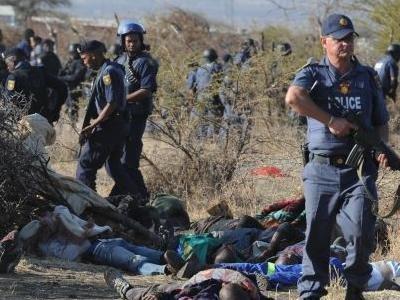
A Black Agenda Radio commentary by Glen Ford | August 22, 2012
When thousands of miners went on strike at South Africa’s largest platinum mine, in Marikana, they were confronting not only the London-based owners, but the South African state, which since 1994 has been dominated by the African National Congress (ANC); COSATU, the Congress of South African Trade Unions; and the South African Communist Party. This week, the full weight of the state was brought down on the Black miners, 34 of whom were massacred by police gunfire. Many of the survivors face charges of murder in the earlier deaths of two policemen and eight other miners.
The National Union of Mineworkers, whose representation the strikers rejected, and the Communist Party head in the region claim the strikers are at fault, that they have committed the sin of choosing an alternative union to argue their case for higher wages and, therefore, deserve severe punishment. They are “anarchists,” say these two allies of the South African state, and guilty of fomenting “dual unionism” – which is now, apparently, a capital crime. With a straight face, the Communist Party had the gall to call on all South African workers to “remain united in the fight against exploitation under capitalism.”
That is precisely what the Marikana miners were doing – the struggle they gave their lives for. However, since the peaceful transition to state power to the ANC and its very junior partners, the COSATU unions and the Communist Party, in 1994, the South African state has had different priorities. The “revolution” was put on indefinite hold, so that a new Black capitalist class could be created, largely from the ranks of well-connected members of the ruling party and even union leaders. It is only logical that, if the priority of the state is to nurture Black capitalists, then it must maintain and defend capitalism. This is the central contradiction of the South African arrangement, and the massacre at Marikana is its inevitable result.
The 1994 agreement between Nelson Mandela’s ANC and the white South African regime was a pact with the devil, which could only be tolerated by the masses of the country’s poor because it was seen as averting a bloodbath, and because it was assumed to be temporary. But, 18 years later, the arrangement has calcified into a bizarre protectorate for foreign white capital and the small class of Blacks that have attached themselves to the global rich. Apologists for the African National Congress regime will prattle on about the “complexity” of the issue, but the central truth is that South Africa did not complete its revolution.
The fundamental contradictions of the rule of the many by the few, remain in place – only now, another layer of repression has been added: a Black aristocracy that has soaked itself in the blood of the miners of Marikana.
South Africa remains the continent’s best hope for a fundamental break with colonialism in its new forms. But, as in all anti-colonial struggles, the biggest casualties will occur in the clash between those who truly desire liberation, and those who are intent on an accommodation with the old master.
BAR executive editor Glen Ford can be contacted at Glen.Ford@BlackAgendaReport.com.
Related articles
- Echoes of the Past: Marikana, Cheap Labour and the 1946 Miners Strike (alethonews.wordpress.com)
- South African miners’ families back Julius Malema’s call for nationalisation (guardian.co.uk)
Echoes of the Past: Marikana, Cheap Labour and the 1946 Miners Strike
By Chris Webb | The Bullet | August 21, 2012
On August 4, 1946 over one thousand miners assembled in Market Square in Johannesburg, South Africa. No hall in the town was big enough to hold them, and no one would have rented one to them anyway. The miners were members of the African Mine Worker’s Union (AMWU), a non-European union which was formed five years earlier in order to address the 12 to 1 pay differential between white and black mineworkers. The gathering carried forward just one unanimous resolution: African miners would demand a minimum wage of ten shillings (about 1 Rand) per day. If the Transvaal Chamber of Mines did not meet this demand, all African mine workers would embark on a general strike immediately. Workers mounted the platform one after the other to testify: “When I think of how we left our homes in the reserves, our children naked and starving, we have nothing more to say. Every man must agree to strike on 12 August. It is better to die than go back with empty hands.” The progressive Guardian newspaper reported an old miner getting to his feet and addressing his comrades: “We on the mines are dead men already!”[1]

Mike Constable union-art.com

The massacre of 45 people, including 34 miners, at Marikana in the North West province is an inevitable outcome of a system of production and exploitation that has historically treated human life as cheap and disposable. If there is a central core – a stem in relation to which so many other events are branches – that runs through South African history, it is the demand for cheap labour for South Africa’s mines. “There is no industry of the size and prosperity of this that has managed its cheap labour policy so successfully,” wrote Ruth First in reference to the Chamber of Mines ability to pressure the government for policies that displaced Africans from their land and put them under the boot of mining bosses.[2]
Masters and Servants
Mechanisms such as poll and hut taxes, pass laws, Masters and Servants Acts and grinding rural poverty were all integral in ensuring a cheap and uninterrupted supply of labour for the mines. Pass laws were created in order to forge a society in which farm work or mining were the only viable employment options for the black population. And yet the low wages and dangerous work conditions kept many within the country away, forcing the Chamber of Mines to recruit labour from as far afield as Malawi and China throughout the nineteenth and twentieth centuries. Sordid deals between Portuguese East Africa and Apartheid South Africa ensured forced labour to be recruited for the mines and by 1929 there were 115,000 Mozambicans working underground. “It has been said,” wrote First in her study of migrant Mozambican miners, “that the wealth of Reef gold mines lies not in the richness of the strike but in the low costs of production kept down by cheap labour.”[3]
When AMWU was formed in 1941 black miners earned 70 Rand a year while white workers received 848 Rand. White miners had been organized for many years, but there was little solidarity between the two groups as evidenced by the 1922 Rand Rebellion led by the whites-only Mine Workers Union. White miners went on strike against management’s attempt at weakening the colour bar in order to facilitate the entry of cheaper black labour into skilled positions. Supported by the Communist Party of South Africa under the banner of “Unite and Fight for a White South Africa!” the rebellion was viciously crushed by the state leaving over 200 dead. The growth of non-European unions in the 1940s was dramatic and for the very first time the interests of African mineworkers were on the table. Their demands threatened the very foundations of the cheap labour system, and so in 1944 Prime Minister Jan Smuts tabled the War Measure 1425 preventing a gathering of 20 or more on mine property. Despite these difficulties the union pressed on and in 1946 they approached the Chamber of Mines with their demand for wage increases. A letter calling for last minute negotiations with the Chamber of Mines was, as usual, ignored.
By August 12th tens-of-thousands of black miners were on strike from the East to the West Rand. The state showed the utmost brutality, chasing workers down mineshafts with live ammunition and cracking down on potential sympathy strikes in the city of Johannesburg. By August 16th the state had bludgeoned 100,000 miners back to work and nine lay dead. Throughout the four-day strike hundreds of trade union leaders were arrested, with the central committee of the Communist Party and local ANC leaders arrested and tried for treason and sedition. The violence came on the cusp of the 1948 elections, which would see further repression and the beginning of the country’s anti-communist hysteria.

National Union of Mineworkers Poster on Fortieth Anniversary of 1946 Strike
While it did not succeed in its immediate aims, the strike was a watershed moment in South African politics and would forever change the consciousness of the labour movement. Thirty years later Monty Naicker, one of the leading figures in the South African Indian Congress, argued that the strike “transformed African politics overnight. It spelt the end of the compromising, concession-begging tendencies that dominated African politics. The timid opportunism and begging for favours disappeared.”[4] The Native Representative Council, formed by the state in 1937 to address the age old ‘native question,’ disbanded on August 15th and ANC president Dr. A.B. Xuma reiterated the demand for “recognition of African trade unions and adequate wages for African workers including mineworkers.”[5]
The 1946 mineworkers strike was the spark that ignited the anti-apartheid movement. The ANC Youth League’s 1949 Program of Action owes much to the militancy of these workers as does the Defiance Campaign of the 1950s and the emergence of the ANC’s armed wing Umkhonto we Sizwe (Spear of the Nation) in the 1960s. It is too early to say what sort of impact the current Lonmin strike will have on South African politics, but it seems unlikely that it will be as transformative as those of the past. The National Union of Mineworkers (NUM), arguably the heirs to the 1946 strike are currently engaged in a series of territorial disputes with the breakaway Association of Mineworkers and Construction Union (AMCU). Meanwhile COSATU’s muted response has echoed the ANC’s line of equal-culpability and half-mast public mourning. The increasingly incoherent South African Communist Party has called for the arrest of AMCU leaders with some of its so-called cadres defending the police action. Former ANC Youth League leader Julius Malema’s plea for miners to hold the line and form a more militant union reek of political opportunism.
Still Dependent on Cheap and Flexible Labour
What no one has dared to say, aside from the miners themselves, is that the mining industry remains dependent on cheap and flexible labour, much of it continuing to come from neighbouring countries. This has historically been the source of most miner’s grievances. A recent Bench Marks Foundation study of platinum mines in the North West province uncovered a number of factors linked to rising worker discontent in the region. Lonmin was singled out as a mine with high levels of fatalities, very poor living conditions for workers and unfulfilled community demands for employment. Perhaps most significant is the fact that almost a third of Lonmin’s workforce is employed through third party contractors.[6] This form of employment is not new in the mining industry. In fact, since minerals were discovered in the 19th century labour recruiters have scoured the southern half of the continent for workers. The continued presence of these ‘labour brokers’ on the mines and the ANC’s unwillingness to ban them – opting instead for a system of increasing regulation – is the bloody truth of South Africa’s so-called ‘regulated flexibility.’
There are a number other findings from the Bench Marks study that are worth mentioning as they illuminate some of the real grievances that have been lost amid photos of waving pangas. The number of fatalities at Lonmin has doubled since January 2011, and the company has consistently ignored community calls for employment, favouring contractors and migrant workers. A visit by the Bench Marks Foundation research team to Marikana revealed:
“A proliferation of shacks and informal settlements, the rapid deterioration of formal infra-structure and housing in Marikana itself, and the fact that a section of the township constructed by Lonmin did not have electricity for more than a month during the time of our last visit. At the RDP Township we found broken down drainage systems spilling directly into the river at three different points.”[7]
In fact, the study predicted further violent protests at Marikana in the coming year. The mass dismissal of 9,000 workers in May last year inflamed already tense relations between the community and the mine as dismissed workers lost their homes in the company’s housing scheme.
Once again, these facts are hardly new in the world of South African mining. Behind the squalid settlements that surround the mine shafts there are immense profits to be made. In recent years the platinum mining industry has prospered like no other thanks to the increased popularity of platinum jewellery and the use of the metal in vehicle exhaust systems in the United State and European countries. Production increased by 60 per cent between 1980 and 1994, while the price soared almost fivefold. The value of sales, almost all exported, thus increased to almost 12 per cent of total sales by the mining industry. The price rose so dramatically throughout the 1990s that it is on par with gold as the country’s leading mineral export.[8] South Africa’s platinum industry is the largest in the world and in 2011 reported total revenues of $13.3-billion, which is expected to increase by 15.8% over the next five years. Lonmin itself is one of the largest producers of platinum in the world, and the bulk of its tonnage comes from the Marikana mine. The company recorded revenues of $1.9-billion in 2011, an increase of 25.7%, the majority of which would come from the Marikana shafts.[9]
For risking mutilation and death underground workers at Marikana made only 4000 Rand, or $480 a month. As one miner told South Africa’s Mail and Guardian newspaper that, “It’s better to die than to work for that shit … I am not going to stop striking. We are going to protest until we get what we want. They have said nothing to us. Police can try and kill us but we won’t move.” These expressions of frustration and anger could be from 1922, 1946 or today. They are scathing indictments of an industry that continues to treat its workers as disposable and a state that upholds apartheid’s cheap labour policies.
Endnotes:
1. Monty Naicker, “The African Miners Strike of 1946,” 1976.
2. Ruth First, “The Gold of Migrant Labour,” Spearhead, 1962.
3. Ruth First, “The Gold of Migrant Labour,” Spearhead, 1962.
4. Monty Naicker, “The African Miners Strike of 1946,” 1976.
5. Dr. A.B. Xuma quoted in Monty Naicker, “The African Miners Strike of 1946.”
6. The Bench Marks Foundation, “Communities in the Platinum Minefields,” 2012.
7. The Bench Marks Foundation, “Communities in the Platinum Minefields,” 2012.
8. Charles Feinstein, “An Economic History of South Africa,” Cambridge: Cambridge University Press, 2005, 211.
9. Marketline Advantage Reports on South Africa’s Platinum Group Metals, 2011.
•
Chris Webb is a postgraduate student at York University, Toronto where he is researching labour restructuring in South African agriculture. He can be reached at christopherswebb_AT_yahoo.ca.
Related articles
- Striking South African miners defy Lonmin ultimatum (guardian.co.uk)
- South Africa tells Lonmin to drop threat to sack striking miners (guardian.co.uk)
Penalizing Protest Action
By Anna Majavu · The South African Civil Society Information Service · 19 Jun 2012
Increased police brutality and the prospect of conservative politicians using public money to sue and bankrupt organizations they ideologically oppose – these are the likely outcomes of last week’s Constitutional Court judgment against protest organisers.
In a judgment which upheld a repressive clause in the apartheid-era 1993 Regulation of Gatherings Act, Chief Justice Mogoeng Mogoeng ruled that members of the public who suffer damages from protestors have the right to recoup their losses from whoever hosted the protest – whether the damages were caused by members of the organisation, or not.
There is no onus on the person suing the organisation to prove that the damages were caused by members of the protesting organisation – the mere fact that the damage happened during the march is enough in the way of proof for anyone to be able to claim damages from the organisers.
In May 2006, after a security guards’ strike by the South African Transport and Allied Workers Union (Satawu) turned violent, then Cape Town mayor Helen Zille decided to sue for damages on behalf of individuals who had suffered losses from the strike.
Ever since then, the DA has been trying to get Parliament to pass their private members’ bill aimed at “holding unions liable for strike damages”. The Constitutional Court has now done their job for them, supported by ANC police minister Nathi Mthethwa who also weighed in on the side of the DA.
However, the judgment has a far broader reach. The head of the Freedom of Expression Institute’s law clinic, Mbalenhle Cele pointed out “assemblies, with all their potential for disruption, are often the only way for individuals to give voice to their grievances, and to do so effectively.” This is primarily because politicians only listen to the language of disruption. While unions normally follow the correct channels and apply for permission to hold marches, making their leaders easily identifiable as organisers, social movements and communities often protest spontaneously or together with other small organisation. If a small non-profit organisation or a refugee rights group happens to support one of these protests, will they be held responsible for damages as the easily identifiable party?
Unions survive off their members’ subscription fees and while some have made shady forays into the murky world of union investment companies, many unions have little reserve funds, using the bulk of member fees to cover legal costs and maintain basic offices. The DA’s hostility to organised labour and protestors in general is no secret.
The conservative opposition party has been unable to mount any effective propaganda campaign against the unions, which continue to organise high numbers of workers. Having failed to find a working class audience willing to adopt failed free market ideas, it is unsurprising that the DA would resort to finding means to financially cripple the unions – effectively the only way of silencing them.
The process of financially crippling the unions can now be accelerated by anyone with an interest in doing this – the DA, big business, some factions of the ANC and the intelligence services. Any of these groups can land unions with a R2 million damages bill simply by inserting undercover agents into a march with an instruction to cause damage to property. This is not a far-fetched notion – it has happened before and indeed, with a judgment like this already working in their favour, anti-union groups would be foolish not to use dirty tricks to finish the unions off altogether. The DA, big business, some factions of the ANC and the intelligence services are all aware that in marches of over five thousand workers, it would be difficult for participants to identify non-union members in their ranks, especially since the trade unions have a tradition of inviting supporters ranging from family members, neighbours, churchgoers, priests, and assorted leftists to their marches.
The judgment ignores the police track record of deliberately sparking violence during protests. In the judgment, Mogoeng said unions would not be held liable in the event of a policeman discharging his gun “by accident” into a crowd, causing a stampede. However, he made no mention of violent police who regularly go on the attack – deliberately and not accidentally – against protestors. The case of Andries Tatane, slain by police last year, is an example. The well-publicised case of the residents of Hangberg is another example.
When the people of this hillside community in Cape Town’s Hout Bay stood together to protect their long-standing community from gentrification, the police broke their own regulations by firing rubber bullets at close range into the residents’ faces, taking out the eyes of four people, and provoking pandemonium.
It is well-known that peaceful union marches are unlikely to end quietly because police normally attack the tail end of a march, or pick off a group of people on their way home who have become separated from the crowd. At a union march two years ago in Cape Town, police became extremely annoyed after workers burnt tyres across the road – even though there was no damage to property or person. The police later embarked on a chaotic armed, hunt of workers through the taxi rank – with the workers running for their lives and the police in hot pursuit, firing rubber bullets as they ran. The current culture of police brutality is likely to worsen as a result of this judgment.
The judgment also opens the way for politicians to use public money to promote their own political agendas. Mogoeng made much of the need to protect innocent bystanders who did not choose for their property or persons to be damaged. Yet in the SATAWU case, Zille said she herself instructed lawyers to sue the union on behalf of individuals whose cars and other property had been damaged during the march. These individuals received the assistance of the DA because the case dovetailed with the bill the DA was trying to push unsuccessfully through Parliament. Zille has never made a similar offer to pay for lawyers for the blinded residents of Hangberg to sue the police who shot their eyes out, and this was clearly an ideologically skewed use of public funds rather than a genuine defence of ordinary people.
The judgment also opens the way for politicians to attempt to claim damages even where nothing has been damaged. Zille was furious five years ago when 93 Cape metro police protested by travelling in a pre-planned convoy for two hours along the N2 highway, bringing traffic to a standstill. The protest was entirely peaceful yet if it happened today, the city could make an attempt to quantify the time spent by commuters in the traffic jam as money, and sue for these costs.
A similar scenario is already unfolding in Australia where unions are fined for every day of an unprotected strike. Under the guise of saving the public from “havoc and turmoil”, political leaders in New South Wales are currently seeking to fine unions the equivalent of R1.5 million for every day of a wildcat strike – raising the fine from the current R150 000 a day.
In Australia, workers are individually fined if they embark on unprotected strikes. Earlier this year, 13 companies that claimed to have been affected by a seven-day strike at a construction company sued more than 1000 Australian workers for striking. These workers were fined a total of R56 million, suspended for seven years – as long as they didn’t strike again during that time. In this case, private companies were able to argue that the strike had “disrupted work on a site of economic significance to the Australian economy”, the Australian newspaper reported last month.
The Mogoeng judgment in favour of the DA and police minister Nathi Mthethwa has clearly started South Africa down a similarly slippery slope.
~
Majavu is a writer concentrating on the rights of workers, oppressed people, the environment, anti-militarism and what makes a better world.
Read more articles by Anna Majavu.
Featured Video
Prof. Ted Postol: US–Iran War? Israel’s Fatal Gamble
or go to
Aletho News Archives – Video-Images
From the Archives
Neocon Max Boot: Legal and illegal aliens need to enlist in the US army and die for Israel

By Jonas E. Alexis | Veterans Today | October 16, 2107
In 1973 Irving Kristol, the godfather of the Neoconservative movement, made a stunning statement which is still relevant to understanding the Israeli influence in US foreign policy. Kristol said:
“Senator McGovern is very sincere when he says that he will try to cut the military budget by 30%. And this is to drive a knife in the heart of Israel… Jews don’t like big military budgets. But it is now an interest of the Jews to have a large and powerful military establishment in the United States…
“American Jews who care about the survival of the state of Israel have to say, no, we don’t want to cut the military budget, it is important to keep that military budget big, so that we can defend Israel.”
Read the statement again very carefully. A big military budget, said Kristol, is only good for Israel, not America or much of the Western World. In other words, precious American soldiers who go to the Middle East to fight so-called terrorism are just working for Israel, not for America.
So, whenever the Neocons use words such as “democracy” or “freedom,” they are essentially conning decent Americans to support Israel’s perpetual wars. … continue
Blog Roll
 Aletho News
- Israel Pushing US Toward a Big and Damaging War With Iran – Ex-Pentagon Analyst
- Meet The Liberal Zionist And Ukraine War Supporter Advising AOC On Foreign Policy
- Buck Dancing for Zion: Kenya’s and Nigeria’s Growing Love Affair With Israel
- Israel installed, oversaw security system at Barak-Epstein residence in New York: Report
- ‘Britain’s Index of Repression’ documents 964 incidents of anti-Palestinian crackdown
- Prof. Ted Postol: US–Iran War? Israel’s Fatal Gamble
- UK prosecutors drop aggravated burglary charges against 24 Palestine Action activists
- Unidentified drone downed over Lebanon airbase, US forces block authorities from crash site
- Peeling Back the US Information Operation in Iran
- Israel ‘dictating terms’ to US – Turkish professor
- If Americans Knew
- The Lancet: Gaza death toll far higher than reported – Not a ceasefire Day 132
- Compliant aid: Who are the Israel-approved NGOs scaling up in Gaza?
- Why won’t Trump’s “Board of Peace” bring peace? – Not a ceasefire Day 131
- Help end the injustice against Shadi
- Israel’s Favorite American President
- Israel’s “Yellow Line” Is a Death Trap for Palestinians. We Drove Into It.
- Why Israel’s expanding occupation in Syria presents a critical legal test
- Gaza is not a natural disaster. It is the victim of genocide enabled by global inaction
- Netanyahu’s plan to “end” US aid to Israel is to give even more money under a different name
- Israel ceased firing on Gaza for just 15 days of the “ceasefire” – Not a ceasefire Day 130
- No Tricks Zone
- Coal Power Back In Trend As Globe Tries To Keep Pace With Growing Demand For Power
- New Study: A 4°C Warmer Beaufort Sea Had ‘No Sea Ice’ 11,700 – 8200 Years Ago
- Unfudging The Data: Dutch Meteorological Institute Reinstates Early 20th Centruy Heat Waves It Had Erased Earlier
- German Gas Crisis…Chancellor Merz Allegedly Bans Gas Debate Ahead of Elections!
- Pollen Reconstructions Show The Last Glacial’s Warming Events Were Global, 10x Greater Than Modern
- Germany’s Natural Gas Storage Level Dwindles To Just 28%… Increasingly Critical
- New Study Rebuts The Assumption That Anthropogenic CO2 Molecules Have ‘Special’ Properties
- Climate Scientist Who Predicted End Of “Heavy Frost And Snow” Now Refuses Media Inquiries
- Polar Bear Numbers Rising And Health Improving In Areas With The Most Rapid Sea Ice Decline
- One Reason Only For Germany’s Heating Gas Crisis: Its Hardcore-Dumbass Energy Policy
 Aletho News