ASA Summit Promotes South-South Ties, Regional Integration
Venezuelanalysis | March 1, 2013
The signing of twenty-seven new economic and social agreements between the nations of South America and Africa was the product of three days of meetings held between representatives of more than 60 countries in Equatorial Guinea last week.
The Third South America Africa Summit (ASA) took place just outside the capital of Malabo, where heads of states and high-ranking officials outlined ways to improve commercial, technological and transportation collaboration between the two continents.
Brazilian President Dilma Rousseff as well as Bolivia’s President Evo Morales were in attendance on Friday as were the presidents of Nigeria, South Africa, Senegal, Suriname and Cape Verde, among others.
“We are here to contribute with our experiences together, always thinking about the liberation of our countries in Africa as well as in Latin America and the Caribbean”, said President Morales on Friday.
During his speech, Morales drew attention to the need to take back the natural resources that have been “looted” by the United States and Europe, highlighting the gains that have been made as a result of such policies in the Americas.
“We began to take back our resources and the result has been a change in the economic and financial history of much of the countries in Latin America and the Caribbean”, the Bolivian head of state asserted.
“Unity for the dignity of our peoples, unity for equality, and, above all, unity for our liberation”, he added.
This sentiment of economic and political independence was echoed by the majority of ASA representatives including Nigerian Foreign Minister, Viola Adaku Onwuliri.
“Let’s show our ability to make tangible decisions that will lead to economic development and the integration of Africa and South America.
With true political will, we will be able to achieve it, just a s we have already been able to overcome the burdens of colonialism and racism”, Onwuliri said.
For his part, Venezuelan Foreign Minister Elias Jaua read a letter written by Hugo Chavez who apologized for his inability to participate personally in the conference.
“I truly lament, in the deepest of ways, my inability to be physically present with you and I reiterate once again…my most irrevocable commitment to the cause of union between our people”, the Venezuelan President wrote.
In his missive, Chavez hailed the “indivisible historic ties” that bind the regions and which have obliged the two continents “to walk together until the very end”.
“I will never be tired of saying it: we are one people. We must find each other, beyond the formalities and the speeches, in the feeling of unity.”
“In this way we will take our people out of the labyrinth where they had been cast by colonialism and, in the 20th century, by neoliberal capitalism”, the head of state said.
EXPANDING THE ALLIANCE
Apart from the commercial accords inked on Saturday, participating countries also expressed their support for Argentina in its territorial dispute with the United Kingdom over the Falkland Islands.
A further resolution saw the condemnation of the more than 50 year-old US blockade on Cuba and a declaration calling for Palestine to become a full member of the United Nations.
Many countries expressed their desire for the expansion of the ASA alliance, advocating the inclusion of all of Latin America and the Caribbean, not only those members belonging to the Union of South American Nations (Unasur) bloc.
President Nguema of Equatorial Guinea described the absence of these nations as “unjustifiable” given the important commonalities that exist between Africa and the developing nations of the Americas.
“The history of our continents, largely exploited by other countries, compels us to take measures of South-South cooperation which will allow us to emerge with liberty, independence and coexistence in this globalized world of confronting interests”, Nguema said.
Following this line, the President of the Spanish-speaking African nation proposed that ASA be incorporated into the recently established Community of Latin American and Caribbean States (CELAC) alliance that includes all countries in the Americas except the United States and Canada.
Venezuelan Foreign Minister Jaua reported that Nguema’s proposal has received the support of many allied Latin American nations and that “what needs to be done is to discuss [the proposal] with Unasur and then with CELAC”.
Jaua additionally informed that there will be an encounter between the leading members of ASA next month in the Venezuelan capital of Caracas to guarantee the materialization of the agreements signed last weekend.
“On April 26, there will be a meeting of the Follow-Up Commission which is made up of Nigeria, Brazil, and Equatorial Guinea to see through the accords that have been solidified in this third summit,” the Venezuelan Minister said.
FINDING ITS FOOTING
The tri-annual ASA first took place in Abuya, Nigeria in 2006 and was followed by a second encounter in Margarita Island, Venezuela in 2009.
While many member nations agree that more needs to be done to strengthen the alliance, trade between the continents has grown from $7.2 billion in 2002 to $39.4 billion in 2011.
Ecuadoran Foreign Minister Ricardo Patino explained that relations between the two regions have not been easy over the years “because we don’t know each other very much and we don’t have much work experience together.”
At the same time, Patino affirmed that there are great possibilities for collaboration and that the two continents “have much to offer one another” in ways that go beyond pure commercial relations.
Ecuador is slated to host the next ASA summit in 2016.
Related article
- Venezuela’s Chavez to Africa – South America Summit: We Must Unite (venezuelanalysis.com)
Economic Growth with More Equality: Learning From Bolivia
By Emily Achtenberg | Rebel Currents | February 15, 2013
Until recently, conventional economic wisdom held that sustained economic growth in any society could only be achieved at the expense of income equality. Today, even free market disciples like The Economist recognize that these goals are not contradictory—and that growing inequality, in fact, is an impediment to economic prosperity.
Recent data on economic growth and inequality for the United States and Bolivia reveal two starkly contrasting portraits.
The United States, after four decades of widening inequality, is experiencing the greatest economic downturn since the Depression. In 2011, while the economy grew by only 1.7% (down from 3% in 2010), income inequality increased by almost as much—the biggest single year increase in two decades. Over the past 30 years, the share of income held by the top 1% has more than doubled, increasing from 8% to 17%, while the share held by the bottom 20% has fallen from 7% to 5%. Currently, the United States has the highest level of income inequality of any developed country.
Poverty rates in the United States have risen 23% since 2006, now leveling off at 15.1%. Today, more Americans are living in poverty than at any time in the half-century since the census started publishing these estimates. Due to declining incomes, the U.S. “middle class” is eroding, dropping from 61% of adults 40 years ago to a bare majority now.
As Nobel prize-winning economist Joseph Stiglitz has noted, the United States’ declining middle class is too weak to support the consumer spending that has historically fueled our economic growth. Thus, inequality is “squelching our recovery”—but U.S. political leaders have been slow to act on this lesson.
In contrast, despite the worldwide economic crisis, Bolivia’s economy is on track to increase by at least 5% in 2013, as it did last year. This is among the highest growth rates in Latin America, exceeded only by Chile, Panama, Peru, and Venezuela. Since the start of Evo Morales’s presidency in 2006, Bolivia’s GDP has tripled, and GDP per capita has more than doubled.
At the same time, according to data recently presented by Morales to the Legislative Assembly, income inequality in Bolivia has significantly decreased. In 2011, the richest 10% of the population had 36 times more income than the poorest 10%, down from 96 times more in 1997. “Bolivia is one of the few countries that has reduced inequality,” notes Alicia Bárcena, head of the UN Economic Commission for Latin America and the Caribbean (ECLAC). “The gap between rich and poor has been hugely narrowed.”
Between 2005 and 2011, Bolivia’s poverty rate declined by 26% (from 61% to 45%). The extreme poverty rate fell even more, by 45%. An estimated 1 million people joined the ranks of the “middle class.” The World Bank has officially recognized Bolivia as a lower-middle income country, a ranking that affords more favorable credit terms.
Between 2006 and 2011, Bolivian workers’ purchasing power increased by 41%, as compared to 17% between 1999 and 2005. The minimum wage has risen 127% since 2005, far exceeding the rate of inflation. In contrast, U.S. workers’ real wages have stagnated or fallen, with inflation-adjusted incomes now at their lowest point since 1997. Since 1972, the average hourly wage has risen only 4%.
In Bolivia (unlike the United States), domestic demand fueled by rising incomes and narrowing inequality is a driving force behind the country’s economic prosperity. Local evidence of increased domestic consumption and consumer purchasing power can be seen in places like El Alto, the sprawling indigenous city overlooking La Paz, where banks and fast food outlets are sprouting up and the first supermarkets, shopping centers, and cinemas are being planned. In 2012, there were 8.9 million mobile phones in Bolivia (with a population of around 10.4 million). Construction activity has outpaced the capacity of the domestic producers, with cement now being imported from Peru.
Rating agency Standard and Poor’s gave Bolivia high marks for economic resiliency last October, in underwriting a successful $500 million bond sale—the country’s first venture into the international credit markets since the 1920s.
Behind these positive indicators is Bolivia’s state-led economic policy, including the re-nationalization of strategic sectors divested by past neoliberal governments (such as hydrocarbons, telecommunications, electricity, and some mines). Around 34% of the national economy is now under state control—although private investment (on Bolivia’s terms) is encouraged and has continued, in hydrocarbons and other key sectors.
The vast increase in hydrocarbons and mining revenues under Morales has funded a major expansion of social welfare programs, including highly popular cash transfers targeted to the elderly, pregnant mothers, and school children. It has also supported major infrastructure improvements, a significant increase in the coverage of basic services (such as water, electricity, and domestic gas), and a major expansion of public healthcare and education programs—all boosting the living standards of average Bolivians. … Full article
Related articles
Reporting Ahead of Ecuadorean Elections Fits a Familiar Narrative
By Dan Beeton | CEPR Americas Blog | February 17, 2013
International media reporting ahead of Ecuador’s elections today has sounded familiar themes, understating the achievements of the Rafael Correa government and attributing Ecuador’s recent economic and social progress to “luck” or happenstance, and high oil prices. Correa is depicted as an enemy of press freedom, despite the fact that Ecuadorean media is uncensored and the majority of it opposes the government; and despite his granting of political asylum to Julian Assange. He is also depicted as a member of Latin America’s “bad left” who has ambitions of regional leadership should “bad left” leader Hugo Chávez succumb to illness or otherwise be unable to continue in office.
A common theme in press accounts is that the Correa administration’s social programs are “funded by the country’s oil proceeds.” While some reporting has gone deeper and noted that “Correa has taken on big business and media groups, imposing new contracts on oil companies and renegotiating the country’s debt while touting his poverty reduction efforts,” others have not. “High prices for oil exports resulted in higher revenues which the government invested in social programs and public infrastructure,” the Christian Science Monitor reported in a Friday article. The New York Times’ William Neuman presented a contradictory picture of the economic importance of Ecuador’s petroleum sector, writing that “Ecuador is the smallest oil producer in the Organization of the Petroleum Exporting Countries, yet oil sales account for about half of the country’s income from exports and about a third of all tax revenues, according to the United States Energy Information Administration,” just before stating in the next paragraph that “Mr. Correa has taken advantage of high oil prices to put money into social programs, earning him immense popularity, especially among the country’s poor.”
Petroleum exports have been important to Ecuador’s economy for a long time; this did not suddenly come about with Correa. While Correa was favored by high oil prices during most of his six years in office, the collapse of oil prices in 2008 was a major blow to the economy. Also, an important change during Correa’s first term has been the Ecuadorean government’s relationship with foreign oil companies. Correa notably has driven a much harder bargain than his predecessors, “imposing a windfall profits tax for concessions made to companies for the exploitation of domestic natural resources” that “raised over $500 million for the government in 2010,” as our latest paper notes. A raft of financial and regulatory reforms have also put a considerable amount of revenue in the government’s coffers, contributing to the increase from 27 percent of GDP in 2006 to more than 40 percent in 2012. Stimulus spending – 5 percent of GDP in 2009 – boosted the economy and allowed Ecuador to get through the global recession with minimal damage, losing only about 1.3 percent of GDP during three quarters of recession, despite being one of the hardest hit countries in the hemisphere by external shocks. Non-petroleum sectors such as construction, commerce and services have also been important drivers of growth in recent years, including in 2011, when Ecuador had some of the highest real GDP growth in the region at 7.8 percent, second only to Argentina in South America.
As we have pointed out, this additional revenue has in turn allowed the Correa government to ramp up social spending in ways that are significantly improving Ecuadoreans’ living standards. While much news coverage has reported that state spending has boosted Correa’s popularity and may explain his huge lead (some 20 – 50 percentage points, according to polls) over his opponents coming into the election, some reporting has characterized this – as with last year’s election coverage of Venezuela’s state spending– as a form of vote-buying. “Public policies and subsidies are needed to temporarily keep certain sectors content,” the Christian Science Monitor quotes an analyst as saying. “[T]hey also give him votes.” The Associated Press described this as state “largesse,” a term that Merriam-Webster’s dictionary defines as “liberal giving (as of money) to or as if to an inferior; also: something so given.” The media seems at times to forget that the purpose of economic development is to raise peoples’ living standards.
The New York Times presented Ecuador’s recent economic progress by using a passive voice: “[Correa] has governed during a period of relative prosperity,” which not only understates the impact of the Correa administration’s policies but also the challenges presented over the past several years – most notably the global recession, which collapsed not only oil prices but remittances, on which Ecuador was also heavily dependent.
Some reporting has understated some of the ways in which the government’s policies have impacted Ecuadoreans’ lives. For example, the Associated Press reported that “The bulk of [Correa’s] backers are poor and lower-middle class Ecuadoreans who in 2010 represented 37 and 40 percent, respectively, of the country’s population according to the World Bank.” Bloomberg’s Nathan Gill, meanwhile, wrote:
As the head of a nation where about one in three of its 15.4 million citizens live in poverty, Correa defaulted on $3.2 billion of bonds in 2008 and pushed through laws nationalizing the country’s oil reserves during his first two terms in office. While the moves provided short-term gains, the 49-year-old Correa, an ally of Venezuela’s Hugo Chavez, is now paying the cost with stagnant crude output and declines in private investment needed to boost slumping growth.
In fact, as we noted in our new paper, “The national poverty rate fell to 27.3 percent as of December 2012, 27 percent below its level in 2006,” (before Correa came to office). (The New York Times’ Neuman noted this accomplishment: “In a country of 14.6 million people, about 28 percent lived in poverty in 2011, down from 37 percent in 2006, the year before Mr. Correa took office, according to World Bank data.”)
Nor are Ecuador’s recent gains “short term,” as Gill described them. The data shows sustained progress on reducing unemployment and poverty, for example.
Other common themes include that Correa has clamped down on freedom of press. Such statements are often ironically followed by mention of Correa’s granting of political asylum to Wikileaks founder Julian Assange, such as in the Christian Science Monitor sub-header “President Correa has been criticized internationally for limiting press freedoms and granting Julian Assange asylum in Ecuador’s London embassy.” Readers of AFP might be led to believe Assange was granted asylum in order to “irritat[e] the United States …after the anti-privacy group released tens of thousands of secret US military and diplomatic reports.”
Press coverage has emphasized that Correa is “an ally of Venezuela’s Hugo Chavez,” rather than a friend or “ally” of Brazilian President Dilma Rousseff, for example. This meme positions Correa as “part of a group of leftist presidents in the region that include Mr. Chávez in Venezuela and Evo Morales in Bolivia,” also known as the “bad left” in Washington policy circles and among media commentators. (Brazil has always been considered part of the “good left,” despite the Brazilian government’s longstanding support for Chávez, Morales and other “bad left” leaders and opposition to various U.S. government projects and policies.)
Another theme has been whether Correa seeks to be – or has the potential to be – a “successor” to the “ailing” Hugo Chávez in a “regional leadership role.” The New York Times’ Neuman wrote on Friday that “[A new four-year term] may also give Mr. Correa a chance to raise his international profile. With the ailing president of Venezuela, Hugo Chávez, sidelined by cancer, Mr. Correa is arguably the most vocal leftist leader in the region.” No evidence for Correa’s supposed regional leadership ambitions is presented, other than that “He made international headlines last year when he defied Britain by granting asylum to Julian Assange, the founder of WikiLeaks.”
Related article
- Ecuador’s Correa breezes to 2nd re-election (businessweek.com)
Ecuador’s Financial Reforms Help Explain Why Voters Likely to Re-Elect Correa
By Alex Main | CEPR Americas Blog | February 14, 2013
On Sunday Ecuadorians will head to the polls to vote for a president and vice president, members of the National Assembly, mayors, and other elected officials. As we’ve done ahead of other elections in Latin America, CEPR has published a report offering some economic context to help understand the choices that voters are likely to make.
The report, entitled Ecuador’s New Deal: Reforming and Regulating the Financial Sector, focuses on the innovative financial reforms that have been implemented since President Rafael Correa took office in 2007. The report explains how these measures helped Ecuador recover from some of the hemisphere’s worst shocks during the world recession. It also shows how the reforms contributed to a substantial increase in government revenue much of which has been channeled toward health, education, housing and other social spending. Given these advances, it is not surprising that the latest polls put Correa at 50 percentage points ahead of his closest opponent.
Earlier today, CEPR issued the following press release outlining the contents of the paper:
A new paper from the Center for Economic and Policy Research (CEPR) examines the financial reforms carried out by the Rafael Correa administration, reforms which the paper concludes are in large part responsible for the economic success Ecuador has experienced over the past several years, including its successful counter-cyclical policies during the global recession after 2008. The paper, “Ecuador’s New Deal: Reforming and Regulating the Financial Sector,” examines the Correa government’s taking control of the Central Bank, implementation of capital controls, increased taxation of the financial sector, and other regulatory reforms. It concludes that these played a major role in bringing about Ecuador’s strong economic growth, increased government revenue, a substantial decline in poverty and unemployment, and other improvements in economic and social indicators.
Ecuador will hold presidential elections on Sunday, February 17. Correa is almost certain to be re-elected; Reuters reports that he “has a lead of as much as 50 percentage points over the nearest of his seven rivals in opinion polls.”
“Ecuador has gone against the conventional wisdom and shown that there are alternatives,” CEPR Co-Director Mark Weisbrot and lead author of the paper said. “By pursuing policies that have prioritized economic development, employment, and poverty reduction over financial and foreign interests, Ecuador has surmounted some of the problems that had previously held it back, and that have hampered progress in other countries.”
The paper notes that by the last quarter of 2012, unemployment had fallen to 4.1 percent, its lowest level on record (for at least 25 years), while the national poverty rate fell to 27.3 percent as of December 2012, 27 percent below its level in 2006.
The paper finds that financial reforms contributed significantly to an unprecedented rise in government revenue under Correa, from 27 percent of GDP in 2006 to more than 40 percent in 2012. This not only allowed for vitally important expansionary fiscal policy, but also a large increase in social spending. The biggest increase was in housing, but there were also significant increases in health care spending and other social spending. The government’s most important cash-transfer program (the Bono de Desarollo Humano) increased by one-fourth, and education funding more than doubled, as a percent of GDP, from 2006-2009.
The paper concludes that “What is most remarkable is that many of these reforms were unorthodox or against the prevailing wisdom of what governments are supposed to do in order to promote economic progress. Taking executive control over the central bank, defaulting on one-third of the foreign debt, increasing regulation and taxation of the financial sector, increasing restrictions on international capital flows, greatly expanding the size and role of government – these are measures that are supposed to lead to economic ruin. The conventional wisdom is also that it is most important to please investors, including foreign creditors, which this government clearly did not do.”
“While not all of Ecuador’s reforms went against orthodox policy advice,” Weisbrot said, “many of them did – and they succeeded. It should be no surprise that Correa is such a popular candidate heading into this Sunday’s elections.”
The paper notes that “Ecuador’s success shows that a government committed to reform of the financial system, can – with popular support – confront an alliance of powerful, entrenched financial, political, and media interests and win. The government also took on powerful international interests as well, in its foreign debt default, its renegotiation of oil contracts, and its refusal to renew the concession for one of the United States’ few remaining military bases in South America.” It notes that this success indicates that developing countries may have more and better policy options than is commonly believed to be the case.
Piñera Praises Chávez at CELAC Summit
Media Influences Public Opinion on Venezuela But Not So Much Governments
By Mark Weisbrot | CEPR Americas Blog | January 29, 2013
In writing about the media’s ongoing hate-fest for Hugo Chávez, I pointed out that the major media’s reporting had been effective, in that it has convinced most consumers of the Western media – especially in the Western Hemisphere and Europe – that Venezuela suffers from a dictatorship that has ruined the country.
But there is an important sense in which it has failed. Of course it has failed to convince Venezuelans that they would be better off under a neoliberal regime, and that is one reason why Chávez and his party have won 13 of 14 elections and referenda since he was first elected in 1998. Perhaps of equal importance, it has also failed to persuade other governments that President Chávez is motivated by some kind of irrational hatred of the U.S. – as the media generally reports it. Most foreign ministries have some research capacity, and although they are influenced by major media, at the higher levels they have better information and make their own evaluations.
That is why Chávez has been able to play a significant role in the growing independence and regional integration of Latin America, despite his vilification in the media, and years of effort by the U.S. government to isolate Venezuela from its neighbors. For example, the governments that decided to form the Community of Latin American and Caribbean States (CELAC) – a new hemispheric organization including all countries other than the U.S. and Canada – don’t care whether the media dismisses it as “Chavez’s project.” When Brazil, Argentina, and Uruguay decided to admit Venezuela as a full member of the trading bloc Mercosur, they didn’t care what the media in any of their respective countries would say about it.
Of course the left governments of Argentina, Brazil, Ecuador, Bolivia, Uruguay and others have been quite sympathetic to Chávez and see him as a very important ally. But the region has changed so much in the last 10 or 15 years that it is not only the left governments who appreciate him. Here is what one of the only remaining right-wing presidents in South America, Sebastián Piñera of Chile, said on Sunday about Chávez, in Santiago:
I want to acknowledge a President who is not with us today, but whose vision, tenacity and strength has had a profound impact on the creation of the CELAC. I refer to President Hugo Chávez, the father of this regional group that welcomes all nations of Latin America and the Caribbean, 33 in all, and which excludes only two countries on the continent: the United States and Canada. We are all hoping for you to win this battle, perhaps the toughest battle of your life, which you are doing with the same strength and courage as always, and that you regain your health and that you can return in full capacity as President of Venezuela.
Back in 2006, the New York Times ran a front-page news article with a large-type headline: “Seeking United Latin America, Chávez is a Divider.” The thesis was being pushed by the Bush State Department, and was echoed by the anti- Chávez sources cited in the article.
How completely wrong they turned out to be.
Related articles
- CELAC Strengthened by Second Annual Summit (venezuelanalysis.com)
- Cuba takes over presidency of regional group Celac (morningstaronline.co.uk)
- Venezuela wants best of relations with the US based on ‘mutual absolute respect’ (alethonews.wordpress.com)
Delay in Chavez inauguration possible: Venezuelan Supreme Court
Press TV – January 9, 2013
The Venezuelan Supreme Court says President Hugo Chavez can legally postpone the Thursday inauguration as the current government remains in power.
On Wednesday, Supreme Court President Luisa Estella Morales, following a unanimous decision by the panel, also ruled out medical checks for the president’s scheduled inauguration ceremony.
“The oath-taking of the re-elected president can be carried out at a time after January 10 before the Supreme Court, if it is not done on the said day before the National Assembly,” the ruling said.
As the president has been recovering from an illness and the government would be renewing its term, Morales said, “there is not even a temporary absence” of Chavez from taking the oath.
Until Chavez recovers, current government officials “will continue fully exercising their functions under the principle of administrative continuity,” it said.
Opposition groups of the government earlier on Wednesday requested the Supreme Court to decide on the ruling.
The ruling comes as government officials pointed out the constitution allows the court to swear in a new president without a time limitation for a leave of absence, which the congress voted for on Tuesday.
The Supreme Court’s decision comes as Chavez continues to gain support from South American allies.
Foreign Policy Advisor to the Brazilian President, Marco Aurelio Garcia, on Tuesday said that — on behalf of Brazilian President Dilma Rousseff — Brazil supports the postponing of the inaugural ceremony.
Chavez, who first came to power in 1999, was re-elected to a new six-year term in October, 2012. However, a month before the planned inauguration he underwent a fourth round of cancer surgery in Cuba’s capital Havana.
The full text of the Supreme Court decision can be read here (in Spanish).
Related articles
- Venezuelans Continue to Defy the Washington Post
- Exposing Five Key Media Myths about Chavez’s Health and Swearing-in
- Venezuela Among the Most Positive Countries, Gallup Says
- Venezuela’s Economy Grows by 5.5 Percent in 2012
- There is an alternative: what Venezuela can teach us about the banking sector
- Economic BS in Rich Countries is Reinforced by BS about Venezuela
- The Achievements of Hugo Chavez
Bolivia’s GDP and Minimum Wage double under Evo Morales’ MAS ‘process of change’
Bolivia’s ‘process of change’: the balance sheet for 2012, and challenges to come
By Katu Arkonada | La Epoca* | December 18, 2012
2012 has been a year of transition for the process of change in the Plurinational State of Bolivia, notwithstanding the many events, problems and contradictions encountered by the executive branch during the last 12 months of its administration. A year of transition because we have left behind the 2010-2011 biennial of consolidation following the 64% victory of President Morales in the December 2009 election and are now entering a new biennial, 2013-2014, which will take us very rapidly to the presidential elections of December 2014.
By way of a balance sheet
2012 was without a doubt the year of the consulta [consultation] in the TIPNIS [Territorio Indígena and Parque Nacional Isiboro-Secure], the year when the government probably lost an international battle against a major marketing strategy designed in the offices of a certain opposition and some NGOs, but won the war for legitimacy in Bolivia. The result is overwhelming, leaving no room for doubt: of the 58 communities consulted (84% of them, since 11 refused to participate in the consulta), 55 (79%) approved the construction of the highway.[1] This result dismantles the postmodern and Rousseauist analyses that knew little of the history and actors of the TIPNIS, classifying them as good savages living in the woods without needing anything more, and demonstrated to us that the majority of the communities of the TIPNIS want a greater state presence for access to health and education primarily. In any case the conflict has not ended and no doubt during the next two years the opposition will campaign against the construction of a highway in a country so colonized and plundered that it still has no road connecting two of its nine departments.
But 2012 has also been the year of the economy. Bolivia continued to grow at an annual rate of 5.2% (above the rate in Brazil, Mexico or Uruguay, to cite three examples), and the per capita share of GDP increased in 2012 to $2,238, double what it was in 2006 ($1,182). As for foreign trade, exports in the first quarter of 2012 exceeded the total of all exports in 2007: $5.068 billion compared with $4.822 billion, and the international reserves reached $14 billion — almost 50% of the Bolivian GDP, giving the country the highest level of reserves as a percentage of GDP in all of Latin America.
Similarly, public investment in 2012 will exceed $2 billion, as opposed to $879 million in 2006, and the public external debt totals $3.704 billion, down from $4.947 billion in 2005. By June 2012 three out of every 10 Bolivians were receiving conditional direct transfer payments (bonos), producing a redistribution of wealth that has reduced poverty by almost 12 percentage points in five years (48.5% in 2011) and extreme poverty by 13 percentage points during the same period (24.3%). Another factor in poverty reduction was the rise of the minimum wage in 2012 to 1,000 bolivianos [USD$1 = 7 BOB], compared with 815 BOBs in 2011 or the 440 BOB in 2005 when the MAS was first elected.
Another important factor to mention, when analyzing the past year, is the accomplishments in foreign policy, particularly the actions carried out in the negotiations with Chile for sovereign access to the sea, and the legal demand that Bolivia is going to make in The Hague [2], as well as the recent application to become a full member of Mercosur, the fifth largest economic entity in the world. And we should also note Bolivia’s leadership within ALBA [3] and the G77+China in such multilateral negotiations as the UN Conference on Sustainable Development Rio+20 or the COP [Conference of Parties] on Climate Change. Never before has Bolivia had a sovereign foreign policy, changing the paradigm from neoliberal diplomatic conduct to one of Diplomacy of the Peoples.
Lastly, we cannot complete this brief end-of-year balance sheet without mentioning the recently uncovered case of corruption in the Ministry of Government [the Interior ministry], a ministry that correctly confronted a political mutiny in June and that has now done what a government leading a democratic and cultural revolution had to do, acting forcefully to detain all of those involved and pursuing the matter irrespective of who it might bring down.[4] It is probable that we don’t (yet) know all of the ramifications of this case, but for the good of the process they must be brought to light and the harshest punishment meted out to anyone involved, and if they are a member of the government the penalty should be even greater, to demonstrate the latter’s integrity and coherency.
Challenges for 2013-2014
Notwithstanding the recent events in Venezuela, Chávez’s victory in winning election for six more years and the more than probable victory of Correa in Ecuador in February (almost certainly without the need for a second round), means that the process that is going forward in Bolivia will be menaced even more by those who feel threatened by the anti-imperialist and anticolonial policies being advanced by President Evo Morales. No doubt great efforts (and much money) will be spent in striking at one of the weakest links in the ALBA and the processes of change in the continent, and in attempting to consolidate an opposition alternative to the MAS government.
An initial step in the continued deepening of the process of change should be the victory in January of Jessica Jordán, the MAS candidate for Governor in Beni. A victory in this Amazon department on January 20 would be a definitive blow to the Media Luna and the hopes of repeating in Bolivia the Venezuelan scheme of the Mesa de Unidad.[5] Obviously this will not be an easy victory in one of the most conservative regions of Bolivia, in which the hacendado power still has a great capacity for action and mobilization, but the very fact that first place is in dispute is already a victory in itself and a palpable demonstration that things are changing.
Not to be overlooked, as well, are the middle classes that the MSM [6] is attempting to woo with a moderate management-oriented discourse. However, in October 2012 it was revealed that the Municipality of La Paz was spending only 26% of its budget [dedicated to public investment – RF], far below the 50% average across the ministries. We can conclude that if the MSM is not capable of managing a city hall, it will have a hard time managing a state. But within that middle class layer, and in expectation of the results of the 2012 Population Census, we are going to have hundreds of thousands of new voters who in 2009 were too young to vote and now need to be won over with a discourse that must go beyond the proposals for change and be accompanied by a political program that involves them in the construction of this country’s politics.
Finally, the bases that have been built and consolidated in the process of change cannot be overlooked. It may be that those bases that are closest are not at risk, but it is necessary to strengthen them, to continue expanding the hard core, the popular and subaltern sectors that are the soul [ajayu] of this revolution, because without them the revolution would collapse piece by piece, but with them we will be able to begin thinking of the Patriotic Agenda 2025,[7] converting the political and decolonizing revolution into a post-capitalist economic revolution.
The author, who describes himself here as a “militant in the process of change,” is a researcher at the Universidad de la Cordillera, a frequent contributor to the Bolivian edition of Le Monde Diplomatique, and works with the Ministry of Foreign Relations of the Plurinational State of Bolivia. He is of Basque origin.
[1] The lawfully mandated consulta (consultation) of the communities directly affected by the proposed highway project, which was the subject of much controversy and two recent marches by dissident indigenous activists, concluded its proceedings on December 7. The overwhelming majority of the communities that participated in the consulta approved the construction of the highway between Villa Tunari and San Ignacio de Moxos. See: http://www.la-razon.com/nacional/Consulta-cierra-promesa-fondos-ecologica_0_1738626180.html. For a discussion of the issues involved, see my translation of a book by Bolivian Vice-President Álvaro García Linera, Geopolitics of the Amazon, published in five parts at Life on the Left, and on several other sites. — RF
[2] See Bolivia’s Morales to take Chile sea dispute to court. See also http://www.elcaribe.com.do/2012/11/17/bolivia-chile-debaten-salida-mar-cadiz.
[3] The Bolivarian Alliance for the Peoples of Our America [Spanish: Alianza Bolivariana para los Pueblos de Nuestra América] is an international cooperation organization based on the idea of the social, political and economic integration of the countries of Latin America and the Caribbean.
[4] In November several senior counsel in the Ministry were implicated in an attempt to extort money from a U.S. citizen, Jacob Ostreicher, who came to Bolivia four years ago and invested in rice production in Santa Cruz. He was indicted for money-laundering in June. The Bolivian suspects are alleged to have offered his release in return for his payment to them of $50,000. See Desbaratan red de corrupción y extorsión en la que operaban dos asesores del Ministerio de Gobierno, and Morales asegura que hay “infiltrados” que buscan desprestigiar al Gobierno.
[5] The four departments of the so-called Media Luna (literally, “half moon”) comprising the eastern portion of Bolivia have been centers of conservative resistance to the Morales government, their governors often collaborating in opposition to La Paz. In Venezuela the rightist opposition to Hugo Chávez and the Bolivarian Revolution coalesced behind a single presidential candidate in the recent national election, when he was defeated by Chávez.
[6] MSM, the Movimiento Sin Miedo [Fearless Movement], a center-left opposition party that currently controls the mayoralty in La Paz.
[7] 2025 will be the bicentennial of Bolivia’s independence from Spain.
* Translation and notes by Richard Fidler
Related articles
- Bolivia signs Mercosur incorporation protocol and becomes sixth member (alethonews.wordpress.com)
- Bolivia nationalises electric utilities (nzherald.co.nz)
Bolivia signs Mercosur incorporation protocol and becomes sixth member
MercoPress | December 8th 2012
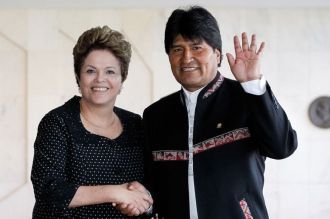 Bolivian president Evo Morales subscribed on Friday the Mercosur incorporation protocol which makes it the sixth member of the regional group. The event took place in Brasilia during the Mercosur summit hosted by Brazilian president Dilma Rousseff.
At the summit which also included associate members, President Morales and his peers signed the document. “With the signing of the protocol, Bolivia becomes the six member state of Mercosur”, announced officially the spokesperson for the Brazilian Executive.
“The protocol defines the different stages and commitment to reach the full incorporation of Bolivia to Mercosur”, added the spokesperson. “The full membership will take place once the Legislatives of the other full members ratify the protocol”.
“Evo, you are most welcome” said president Rousseff before the signing of the document. “This has been good news for the summit. We have skipped years of negotiations with the Bolivian decision to sign the adhesion protocol”.
At the summit President Rousseff as chair of Mercosur stamped her signature to the definitive incorporation of Venezuela as full member which was decided in an extraordinary meeting last July in Rio do Janeiro.
At the summit also, Brazil handed the rotating chair of Mercosur to Uruguay in the hands of President Jose Mujica, for the next six months, thus skipping Paraguay, temporarily suspended and which according to alphabetical order was to have such responsibility.
Related articles
- Brazil calls for better integrated trading bloc (vancouverdesi.com)
Unasur Creates Electoral Council, Moves toward Greater Economic Cooperation
By Ewan Robertson – Venezuelanalysis – December 3rd 2012
Mérida – The Union of South American nations (Unasur) has created an electoral council, as well as moving forward on initiatives for greater economic integration.
At a meeting yesterday between Unasur nations in Quito, Ecuador, the regional bloc’s newest council was formally inaugurated. The twelve Unasur member countries now cooperate through nine different councils, including defence, energy and health.
According to the Unasur electoral council’s pro-tempore president, Francisco Tavara of Peru, the council’s aim will be “to strengthen the role of Unasur observation and electoral accompaniment missions in regional electoral processes”.
He added that, “The [electoral observation] missions will be a substantial contribution to the creation of a climate of confidence and transparency for the peoples of South America”.
The electoral council was created after the experience of Unasur’s electoral mission to the Venezuelan presidential elections earlier this year. The council’s first official mission will be to the Ecuadorian presidential election in February 2013, when Rafael Correa will seek re-election.
The Unasur electoral council will have a rotating presidency and representatives from a variety of electoral organisations, and can only send an observation mission in response to a member state’s request.
Lenin Housse, the international relations director of the Ecuadorian National Electoral Council, claimed that Unasur electoral observation missions would be different from those of the Organisation of American States (OAS) or the European Union (EU), because they will be “attached to South America’s reality,” with the principle “of establishing mechanisms of accompaniment, information, and joint assessment”.
The electoral council is expected to emit a joint declaration of principles today, which will include “inclusive democracy”, “transparency of electoral processes”, and “promoting citizen democracy”.
New Court, New Bank
The Unasur is also expected to establish South America’s own forum for the settlement of investment disputes, to replace the Washington-based International Centre for the Settlement of Investment Disputes (ICSID).
“The issue is very advanced, practically all [Unasur] countries agree with this. It was proposed to finish the analysis and begin operating next year,” said Ecuadorian foreign minister, Ricardo Patiño, after a meeting between Unasur heads of state in Lima, Peru, last weekend.
Accusing bodies such as the ICSID of having a “colonialist vision and structure”, he said it would be “good for Unasur to have its own organisation for the resolution of disputes, not to have to go to the ICSID or others so that they tell us how to develop our own systems of arbitration”.
In January this year Venezuela announced its withdrawal from the ICSID, citing the court’s bias against Venezuela in its decisions, and the need “to protect the right of the Venezuelan people to decide the strategic orientation of the social and economic life of the nation”. Fellow leftist governments Bolivia and Ecuador left the ICSID in 2007 and 2009 respectively.
Patiño also confirmed that the Bank of the South, which will fund joint projects and promote regional development, should be functioning by April 2013.
“This is one of Latin America’s most important hopes. It’s about regional growth,” he said in an interview with Venezuelan current affairs program Dossier on Friday.
He reported that the bank currently has two-thirds of the necessary capital to begin activities, and that once launched, could support a range of projects, such as regional rail and food storage networks, joint production of generic pharmaceuticals and greater energy integration.
Related articles
- Unasur praise for the reliability and transparency of Venezuelan electoral system (alethonews.wordpress.com)
- Unasur summit rejects Falklands’ referendum and wants to limit ‘vulture funds’ (en.mercopress.com)
- Unasur adds 30 infrastructure investment projects (nzweek.com)
British vessels prohibited from docking in Buenos Aires province
Press TV – August 4, 2012
Argentina has prohibited all ships sailing under the British flag from docking at any of the ports in the Buenos Aires province, Press TV reports.
The measure was adopted on Friday in a bill passed by the legislature of the province of Buenos Aires, the country’s largest province.
“We can’t have a colonial enclave affecting the region with NATO’s presence in our Malvinas Islands. We have to actively protest against those who explore and exploit our natural resources and violate our sovereignty,” said Remo Carlotto, an MP from the ruling party.
The bill prohibits vessels involved in “natural resources exploration and exploitation activities” in waters surrounding the Malvinas Islands, banning them from “mooring, loading or developing logistical operations” in the area”.
The move comes after months of political dialogue over the disputed archipelago between Argentina and Britain has failed to bear fruit.
“We have to keep moving forward using all the tools we have to defend our country’s sovereignty in the [Malvinas] islands. Argentina has taken significant steps. It has stood up and recovered its political and economic sovereignty,” said Martin Sabbatella, another lawmaker from the ruling party.
Earlier this year, Argentina took legal action against five British oil companies.
Argentina and Britain fought a 74-day war in 1982 over the islands.
Related articles
- OAS backs Argentina on Falklands (morningstaronline.co.uk)
Featured Video

Michael von der Schulenburg: Europe’s Self-Defeating Iran War Policy
or go to
Aletho News Archives – Video-Images
Frlom the Archives
Provoking a Path to Persia
The Saban Center’s prescient paper on war with Iran
By Maidhc Ó Cathail | October 20, 2011
In June 2009, the Saban Center for Middle East Policy published “Which Path to Persia?—Options for a New American Strategy toward Iran.” Writing in a tone strikingly reminiscent of the Project for a New American Century’s infamous pre-9/11 paper “Rebuilding America’s Defenses,” the six co-authors noted that, “It seems highly unlikely that the United States would mount an invasion without any provocation or other buildup.” For a think tank specifically established by media mogul Haim Saban to protect Israel, this could prove to be a formidable obstacle impeding their desired march—of U.S. troops—to Tehran.
“In fact, if the United States were to decide that to garner greater international support, galvanize U.S. domestic support, and/or provide a legal justification for an invasion, it would be best to wait for an Iranian provocation, then the time frame for an invasion might stretch out indefinitely,” Saban’s think-tankers ruefully observed.
“With only one real exception, since the 1978 revolution, the Islamic Republic has never willingly provoked an American military response, although it certainly has taken actions that could have done so if Washington had been looking for a fight. Thus it is not impossible that Tehran might take some action that would justify an American invasion. And it is certainly the case that if Washington sought such a provocation, it could take actions that might make it more likely that Tehran would do so (although being too obvious about this could nullify the provocation). However, since it would be up to Iran to make the provocative move, which Iran has been wary of doing most times in the past, the United States would never know for sure when it would get the requisite Iranian provocation. In fact, it might never come at all.”
Seemingly undeterred by Iran’s frustrating unwillingness to provide the requisite provocation, the analysts continued to examine this option… continue
Blog Roll
 Aletho News
- Iran attacks on UAE leaves RSF militia high and dry
- Hosting Washington’s war: Bahrain faces the consequences
- The US fell for its own Iran propaganda
- Seyed M. Marandi: Threat of Seizing Kharg Island & the Use of Nuclear Weapons
- Is there even an off ramp?
- Michael von der Schulenburg: Europe’s Self-Defeating Iran War Policy
- Sorry, The New Republic, Climate Change Isn’t Causing Somali Migration. Blame Civil Strife and Poverty.
- Expert Guts Claims That HPV Vaccine Reduces Cancer Risk
- No evidence Russia sabotaged Baltic cables – Finnish intel
- The Strategic Folly of a (Serious) US Ground Invasion of Iran
- If Americans Knew
- 6 more Americans killed, as Israel ‘mows the lawn’ in Iran – Not a ceasefire Day 154
- Are we on the precipice of World War III?
- ‘Catastrophic,’ Says UNICEF: 1,100+ Children Killed or Wounded in Mideast Since US-Israel Launched Iran War
- The Unbelievable Madness of Our War With Iran
- World Council of Churches calls on govts to hold Israel accountable for violations of intl law
- How to end the war on Iran that costs US taxpayers $1M per minute – Not a ceasefire Day 153
- Israeli strategic plans to “remake the Middle East” from the 1950s and since
- Honoring Gaza’s women who refused to let the world look away
- 97% of victims of war on Iran are Iranian, 98% of victims in war on Gaza are Gazans – Not a ceasefire Day 152
- Early Iran strikes cost $5.6 billion in munitions, Pentagon estimates
- No Tricks Zone
- New Studies: UK Sea Levels Were 4 Meters Higher Than Today During The Mid-Holocene
- Destructive Green New Deal: German Energy And Metal Group Warns Of Drastic Crisis
- New Study Documents A 20-Year Pause In Arctic Sea Ice Decline – Driven By Internal Variability
- Wake-up Call: Survey Shows Majority Of Germans Now Favor Postponing Climate Targets!
- Televised! Leading German Political Candidate Tells Schoolchildren CO2 Makes Sun Hotter!
- New Study: A Century Warming Of 1.1°C Is ‘Commonplace’ And ‘Not Unusual’ During This Interglacial
- New Study: ‘Internal Noise’ And Volcanic Forcing Can Trigger 10-15°C Warming Within Decades
- Glaciers Worldwide Are Suddendly Surging, Experts Blame Warming!
- Surprising Discovery: Sahara Is Greening…Billions Of Trees Where Once Thought To Be Barren
- New Research Reaffirms Clouds, Aerosols, And Surface Solar Radiation Are ‘Driving The Climate System’
 Aletho News