Putin on N. Korea crisis: Tensions ‘balancing on brink of large-scale conflict’

RT | September 1, 2017
Attempts to pressure North Korea into stopping its nuclear missile program through sanctions are “misguided and futile,” Russian President Vladimir Putin warned, adding that threats and provocations would only add more fuel to the fire.
“The situation on the Korean Peninsula, where tensions have grown recently, is balancing on the brink of a large-scale conflict. Russia believes that the policy of putting pressure on Pyongyang to stop its nuclear missile program is misguided and futile,” Putin, who is due to attend a summit of the BRICS nations in China next week, wrote ahead of his trip.
“The region’s problems should only be settled through a direct dialogue of all the parties concerned without any preconditions. Provocations, pressure and militarist and insulting rhetoric are a dead-end road,” he noted.
Russia and China have created a roadmap for a settlement on the Korean Peninsula that is designed to promote the gradual easing of tensions and the creation of a mechanism for lasting peace and security, the Russian leader added.
The Russian-Chinese initiative of “double freezing,” put forward by the Russian and Chinese foreign ministers on July 4, is designed to cease any missile launches and nuclear tests by Pyongyang, as well as large-scale military exercises by Washington and Seoul.
Last month, the UN Security Council unanimously agreed to impose more restrictive measures on Pyongyang, banning exports of coal, iron, lead, and seafood. The move came in response to North Korea’s missile launches in July, which it, as well as South Korea and the US, claimed were intercontinental ballistic missile (ICBM) tests. Moscow has questioned the claim, arguing North Korea was testing intermediate range rockets.
China announced a full ban on imports of coal, iron, and seafood, among other goods from North Korea as of August 15, thus cutting key export revenues for Pyongyang.
Russian Foreign Minister Sergey Lavrov said on Friday that all conceivable and unimaginable sanctions against North Korea have already been imposed, to no avail.
“All possible sanctions aimed at preventing North Korea from using a map of external relations for the development of missile and nuclear programs banned by the [UN] Security Council, all conceivable and even unimaginable sanctions, which have little to do directly with these areas of DPRK’s [the Democratic People’s Republic of Korea] activities, have already been adopted by the Security Council. In addition, unilateral sanctions have been adopted, which we consider illegitimate,” Lavrov said.
In a bid to ease tensions, Moscow will seek the resumption of six-party talks on the situation on the Korean Peninsula, the Russian Foreign Minister noted.
“We will still seek to resume these talks,” he said, adding that “we know that Americans are talking with representatives of Pyongyang via some semi-secret, semi-official, semi-academic channel.”
Moscow will be happy “if they agree on some de-escalation, so that all parties cool down, sit down at the negotiating table and start talking.”
“We have a common goal – denuclearization of the Korean Peninsula, so that neither the North nor the South, the US and us [Russia] have nuclear weapons,” Lavrov said.
South Korea’s impeached President planned violent regime change for Pyongyang
By Adam Garrie | The Duran | June 26, 2017
A recent report from the Japanese outlet Asahi Shimbun appears to confirm a hypothesis recently published in The Duran that America’s recent fervor over North Korea has a great deal to do with the internal politics of South Korea, more so in many cases than it has to do with events in the DPRK (North Korea).
Impeached former South Korean President Park Geun-hye was known to be an avidly right-wing, anti-North Korean, militant leader. It was under her now disgraced leadership that South Korea agreed to house America’s THAAD missiles, a move that remains deeply unpopular among millions of South Korean citizens.
Now, Asahi Shimbun claims to have obtained documents from South Korea indicating that former President Park Geun-hye signed a document authorizing violent regime change in Pyongyang.
According to the report seen by the Japanese national newspaper, the Park regime was considering attempts at arranging deadly car accidents or train wrecks in order to kill North Korean leader Kim Jong-Un. Attempts at fomenting a violent coup in North Korea were also considered.
In light of these revelations, it is no wonder that North Korea has taken precautionary measures to defend its sovereignty against these violent threats of illegal regime change from its heavily armed and economically powerful neighbor.
According to the Japanese source, these plans have been taken firmly off the table by President Moon Jae-in, a man who is generally far more peace minded than his deeply militant predecessor.
America’s most bellicose posturing against Pyongyang came in the month prior to the South Korean special Presidential election which saw the peace minded Moon come to power in early May of 2017.
Although America still offers harsh rhetoric on all matters pertaining to North Korea, it was after the election of President Moon that America’s most violent rhetoric seemed to give way to talk of working with international partners including and especially China in order to resolve concerns over North Korea without the threat of military engagement.
These revelations which appear to be credible, demonstrate that Washington’s actions in respect of North Korea have as much to do with the developments in Seoul as they do with developments elsewhere.
READ MORE:
South Korea suspends deployment of more THAAD pieces
Press TV – June 7, 2017
South Korea suspends any further deployment of a controversial US missile system to the country until an environmental impact assessment ordered by President Moon Jae-in is completed.
The president’s office said in a statement on Wednesday that Moon had called for the suspension of the deployment of the Terminal High Altitude Area Defense (THAAD) system to the country.
The office also said that the environmental impact assessment could take a year to complete.
“We do not view the deployment process as urgent enough to bypass the whole environmental impact assessment,” said a senior office at the presidential office whose name was not mentioned in reports.
The “additional deployment (of the THAAD) should be carried out only after the environmental impact assessment is over,” the official added.
The official said, however, that Seoul saw “no need to withdraw” the two launchers that have already been deployed.
South Korea decided to host the missile system last year under ousted president Park Geun-hye to deter perceived threats from North Korea. The first pieces of the missile system started arriving at the Osan Air Base in South Korea in March with the approval of Seoul’s then-caretaker administration.
The new president ordered a “proper” investigation into the potential environmental impact of the missile system on Monday.
A battery of the THAAD is capable of firing up to 48 interceptor missiles and consists of six truck-mounted launchers, fire control and communication equipment as well as a powerful X-band radar.
The president had also ordered an investigation into an unauthorized deployment of four more launchers that have arrived recently in the South and are currently being stored at a US army base in the country. According to Moon’s office, top military officials had deliberately withheld information from the president. Moon removed Deputy Minister for Defense Policy Wee Seung Ho on Monday over the matter.
The Defense Ministry cited a confidentiality deal with the US military as the reason to withhold the information from South Korea’s new commander-in-chief, who seems not to be in agreement with Washington over the deployment. But it was not clear why the country’s highest authority could be kept in the dark by lower-ranking officials based on a deal with a foreign country.
The US opposes North Korea’s missile and military nuclear activities, which Pyongyang says act as deterrence against a potential invasion by its adversaries.
China, which has long opposed the deployment of the missile system so close to its borders, has called on Washington and Seoul to remove the system. But China is also concerned by the North Korean nuclear activities and has banned imports of North Korean coal over the issue. But it has repeatedly promoted dialog to resolve the issue and urged all sides to exercise restraint.
Environmental Check May Suspend THAAD Deployment in S Korea
Sputnik – June 6, 2017
The deployment of the US Terminal High Altitude Area Defense (THAAD) anti-missile defense system in South Korea may be put on hold because of a new environmental assessment that will be launched by the country’s Defense Ministry, the head of the ministry said on Tuesday.
“The order to conduct an environmental impact assessment is a guideline to enhance the procedural legitimacy of the deployment, so the defense ministry will review ways to conduct such a study,” South Korean Defense Minister Han Min-koo said, as quoted by the Yonhap news agency.
Conducting a complete assessment may delay or even suspend the deployment of THAAD for as long as a year, the agency added.
This roadblock comes just one day after South Korean Deputy Defense Minister for Policy Wee Seung-ho was relieved from duty over intentionally omitting a section regarding four launchers that were to be delivered to the country from a report on THAAD before the final draft was sent to the president’s office. According to Yonhap, the official aimed, among other things, to keep the program free from South Korean environmental requirements.
Following the probe, South Korean President Moon Jae-in ordered a thorough investigation into the environmental impact the THAAD system will have.
The agreement between the United States and South Korea upon the deployment of the THAAD system was signed in July 2016, and the first components of the system arrived to South Korea in March. According to the agreement, Seoul provides a total of 690,000 square meters (170.5 acres) of land for the system in two stages, while Washington pays for the installation and maintenance of the system.
South Korea military brass deliberately kept president in dark about THAAD: Probe
Press TV – May 31, 2017
A South Korean presidential probe into the “unauthorized” US deployment of additional missile launchers in South Korea has found that the Asian country’s own military authorities had deliberately withheld the information from the new president.
The office of the newly-elected President Moon Jae-in announced on Wednesday that documents submitted to the chief executive shortly after he was sworn into office earlier this month were intentionally censored to conceal information on the installment of four new rocket launchers of the Terminal High Altitude Area Defense (THAAD) system.
Moon’s spokesman, Yoon Young-chan, said the country’s top military brass who briefed the president’s national security adviser last week deliberately excised references to any new launchers, or to the total number installed in the country.
“These parts… were included in the original briefing report written by a working-level official but later deleted by his supervisors,” Yoon added in a press briefing.
He said all military officials involved in generating the report admitted that these key parts had been removed from the text in the editing process.
Seoul agreed last year to install the US-built missile system to guard against potential threats from nuclear-armed North Korea.Two missile launchers were already deployed in South Korea’s southern county of Seongju, and the existence of four more had been widely suspected but never declared.
Yoon said Defense Minister Han Min-koo finally admitted to the presence of the new missile launchers when pressed by Moon in a telephone conversation on Tuesday.
Moon expressed “shock” on Tuesday after hearing about the existence of the additional launchers and directed his senior secretary for civil affair and the head of National Security Office “to find the truth behind the unauthorized entry of the four rocket launchers,” according to Yoon.
Han was appointed by former president Park Geun-hye, who was ousted for her alleged involvement in a massive corruption scandal.
The new launchers arrived in South Korea before Moon took office on May 10 and are currently stored at a US military base in the country, Moon’s office added, without further explanation.
No specific reason was offered as to why the information had been withheld from the South Korean president by the country’s military chiefs. The new president had previously expressed reservations about THAAD’s hasty deployment.
The conservative government of Park approved the installation of the US missile system despite strong objections nationally and internationally — mainly from Russia, China, and North Korea.
Moon, meanwhile, reportedly intends to put the deployment on hold, saying that it should be discussed and approved by lawmakers before being fully rolled out.
The US maintains nearly 29,000 military servicemen stationed in South Korea.
South Korea’s new leader orders probe into ‘unauthorized’ US deployment
Press TV – May 30, 2017
South Korea’s new President Moon Jae-in has ordered an investigation into the “unauthorized” deployment of four additional THAAD missile launchers by the United States to the country’s soil.
Presidential spokesman Yoon Young-chan said Moon was “shocked” to hear that the four additional launchers of the so-called Terminal High Altitude Area Defense (THAAD) missile system were installed without being reported to the new government or to the public.
“President Moon was briefed on such facts by National Security Office (NSO) chief Chung Eui-yong and said it was very shocking,” the spokesman told a news briefing on Tuesday.
The system was initially deployed to South Korea in March with just two of its maximum load of six launchers with the declared aim of countering North Korean threats.
The South Korean official further said the president had “ordered his senior secretary for civil affairs and the NSO chief to find the truth behind the unauthorized entry of the four rocket launchers.”
The deployment of THAAD, which came amid tensions with North Korea, was met with strong opposition from people in South Korea, including the residents of Seongju County, where the missile system is installed.
The installation was agreed by the government of Moon’s predecessor Park Geun-hye, who was impeached and ousted over a corruption scandal.
During his election campaign prior to the May 9 election, Moon had urged a parliamentary review of the controversial deployment, which has angered Pyongyang.
Russia and China have also expressed deep concern over the controversial deployment of the American missile system on the Korean Peninsula.
Chinese officials argue that the US system would interfere with their radars and could pose a threat to Chinese security.
Moscow has also warned that the deployment would only fuel tensions in the region.
South Korea Rules Out Renegotiation of THAAD Cost – Defense Ministry
Sputnik – May 1, 2017
On Friday, US President Donald Trump said in an interview with the Washington Times that South Korea should pay for the defense system, which costs $1 billion. Representatives of the South Korean Foreign Ministry said that Seoul has not received US demands to pay the costs of the THAAD despite Trump’s statements.
“I don’t think it’s an issue for renegotiation,” the spokesman said, as cited by the Yonhap news agency.
On Sunday, US National Security Adviser Herbert Raymond McMaster reaffirmed that Washington, and not Seoul, should pay for the deployment.
The agreement on deploying the THAAD system was reached between the United States and South Korea in July 2016, and the first components of the system started to arrive in the country in early March. The agreement implies that Seoul provides land for the system while Washington pays for its installation and maintenance.
According to media reports, citing the South Korean Ministry of Defense, Seoul is expecting to fully station the system as early as June 2017.
South Koreans protest movement of US THAAD Missile System
By Adam Garrie | The Duran | April 25, 2017
In a further sign that the political climate of South Korea has turned increasingly anti-American/anti-militaristic since the impeachment and arrest of President Park in March of this year, South Koreans took to the streets to protest the arrival of the US THAAD Missile System in North Gyeongsang Province.
The THAAD system arrived in the country in March and is now being positioned at its permanent installation point in Seongju in the south east of the country.
The Duran has previously published a piece speculating that increased pressure from the US directed to North Korea, may actually be an attempt to meddle in the South Korean political process as special Presidential elections are to take place on the 9th of May. A war could possibly dispute those elections.
Initial reports state that 200 people blocked the entrance to the site where THAAD will be set-up and over 8,000 locals came out to protest. Local police who were escorting the US military convoy came under attack from outraged locals.
One must consequently question the following: with US rhetoric constantly stating how little the North Korean’s support their government. How much do South Korean’s support their government?
READ MORE:
Could the US go to war with North Korea to stop democracy in SOUTH Korea?
US Presence in Korea Drives Instability
By Ulson Gunnar – New Eastern Outlook – March 25, 2017
US and European interests continue to portray the government and nation of North Korea as a perpetual security threat to both Asia and the world. Allegations regarding the nation’s nuclear weapon and ballistic missile programs are continuously used as justification for not only a continuous US military presence on the Korean Peninsula, but as justification for a wider continued presence across all of Asia-Pacific.
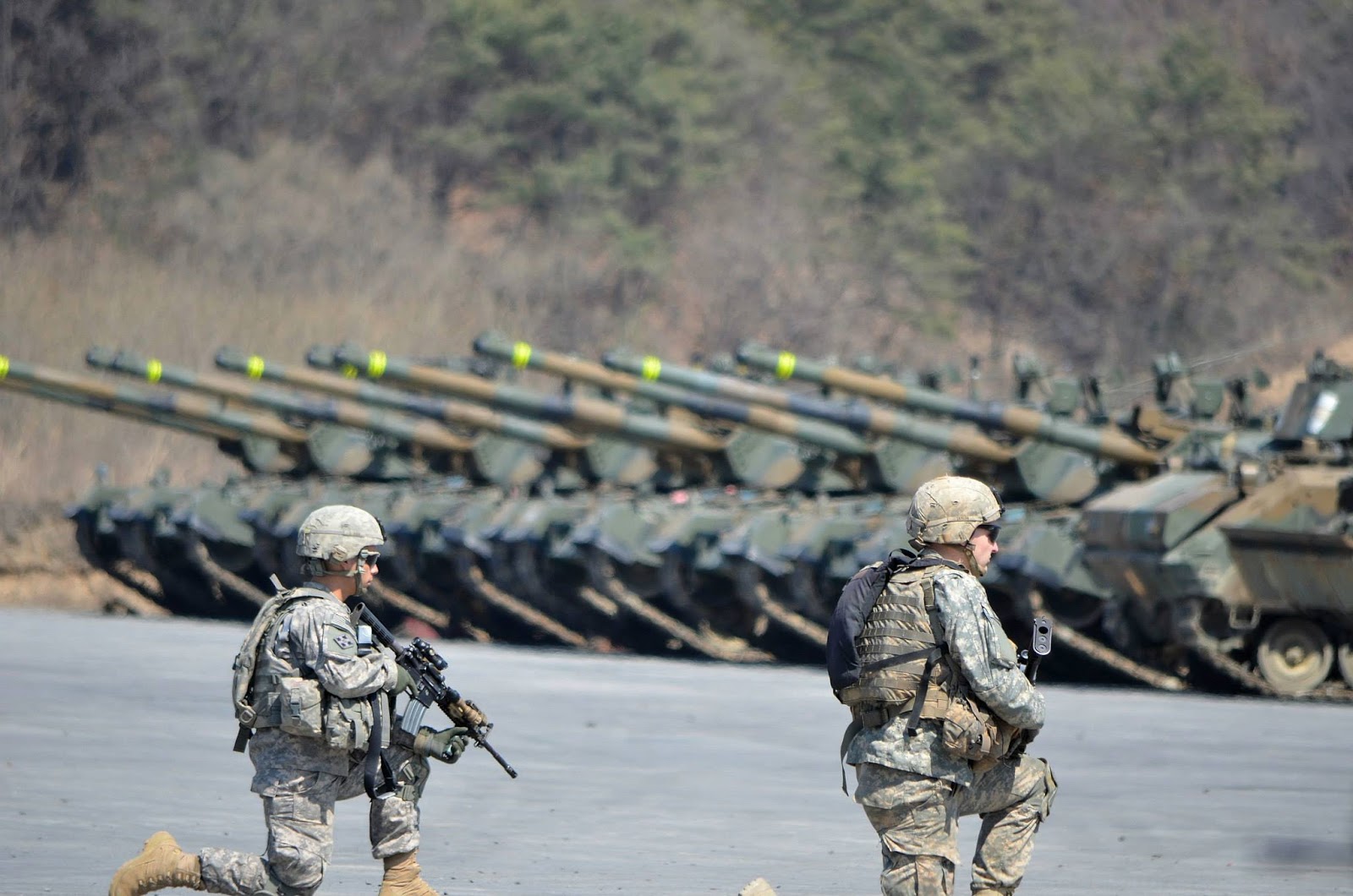
In reality, what is portrayed as an irrational and provocative posture by the North Korean government, is in fact driven by a very overt, and genuinely provocative posture by the United States and its allies within the South Korean government.
During this year’s Foal Eagle joint US-South Korean military exercises, US-European and South Korean media sources intentionally made mention of preparations for a “decapitation” strike on North Korea. Such an operation would be intended to quickly eliminate North Korean military and civilian leadership to utterly paralyze the state and any possible response to what would most certainly be the subsequent invasion, occupation and subjugation of North Korea.
The Business Insider in an article titled, “SEAL Team 6 is reportedly training for a decapitation strike against North Korea’s Kim regime,” would report:
The annual Foal Eagle military drills between the US and South Korea will include some heavy hitters this year — the Navy SEAL team that took out Osama bin Laden, Army Special Forces, and F-35s — South Korea’s Joon Gang Daily reports.
South Korean news outlets report that the SEALs, who will join the exercise for the first time, will simulate a “decapitation attack,” or a strike to remove North Korea’s leadership.
To introduce an element of plausible deniability to South Korean reports, the article would continue by stating:
Pentagon spokesman Cmdr. Gary Ross later told Business Insider that the US military “does not train for decapitation missions” of any kind.
Yet this is a categorically false statement. Throughout the entirety of the Cold War, US policymakers, military planners and operational preparations focused almost solely on devising methods of “decapitating” the Soviet Union’s political and military leadership.
In more recent years, policy papers and the wars inspired by them have lead to documented instances of attempted “decapitation” operations, including the 2011 US-NATO assault on Libya in which the government of Muammar Qaddafi was targeted by airstrikes aimed at crippling the Libyan state and assassinating both members of the Qaddafi family as well as members of the then ruling government.
Similar operations were aimed at Iraq earlier during the 2003 invasion and occupation by US-led forces.
Regarding North Korea more specifically, entire policy papers have been produced by prominent US policy think tanks including the Council on Foreign Relations (CFR) devising plans to decimate North Korea’s military and civilian leadership, invade and occupy the nation and confound North Korea’s capacity to resist what would inevitably be its integration with its southern neighbor.
A 2009 report titled, “Preparing for Sudden Change in North Korea,” lays out policy recommendations regarding regime change in North Korea. It states in its description:
The authors consider the challenges that these scenarios would pose–ranging from securing Pyongyang’s nuclear arsenal to providing humanitarian assistance–and analyze the interests of the United States and others. They then provide recommendations for U.S. policy. In particular, they urge Washington to bolster its contingency planning and capabilities in cooperation with South Korea, Japan, and others, and to build a dialogue with China that could address each side’s concerns.
Preparations for these documented plans which include provisions for invasion, occupation and the eventual integration of North Korea with South Korea have been ongoing for years with the most recent Foal Eagle exercises being merely their latest, and most blatant manifestation.
The aforementioned Business Insider article would also report:
Yet a decapitation force would fit with a March 1 Wall Street Journal report that the White House is considering military action against the Kim regime.
The SEALs boarded the USS Carl Vinson aircraft carrier and should arrive in South Korea on Wednesday, Joon Gang Daily reports.
South Korea has also made efforts toward a decapitation force, and international calls for action have increased in intensity after North Korea’s latest missile test, which simulated a saturation attack to defeat US and allied missile defenses.
While US-European and South Korean media platforms continue claiming such preparations are being made in reaction to North Korean military programs, careful analysis of North Korea and South Korea’s respective economic and military power reveal immense disparity and North Korea’s military capabilities as solely defensive with any first strike against its neighbors almost certainly leading to retaliation and the nation’s destruction.
North Korea’s nuclear arsenal and its expanding ballistic missile capabilities serve then only to raise the costs of any first strike carried out against it by US and South Korean forces. Claims that preparations by US and South Korean forces to carry out these first strikes are in response to North Korean provocations mirror similar political deceit that surrounded and clouded debate and analysis regarding US aggression in North Africa and the Middle East over the past two decades.
Ultimately, regardless of what political leaders in Washington or Seoul claim, the historical track record of the United States and its allies speaks for itself. Its annual military exercises and its adversarial approach to negotiations and relations with North Korea serve only to further drive tensions on both the peninsula and across the wider Asia-Pacific region.
For the United States, the perpetuation of instability helps justify its otherwise unjustifiable presence in a region literally an ocean away from its own borders. And while Washington cites “North Korean” weapons as a pretext for its continued presence in South Korea, its decades-spanning policy of encircling and attempting to contain neighboring China serves as its actual purpose for remaining involved in Korea’s affairs.
Provocative policies coupled with equally provocative military preparations including these most recent exercises openly aimed at North Korea’s leadership, guarantee continued instability and thus continued justification for a US presence in the region.
Washington’s careful cultivation of tensions on the peninsula serve as just one of many intentionally engineered and perpetuated conflicts across the region. Knowing well that nations targeted by US subversion and provocations will make preparations to defend against them, and possessing the media platforms to portray these preparations as “provocations” in and of themselves, the US has persuaded entire swaths of both its own population and those in regions inflicted by instability it itself drives, that Washington alone possesses the ability to contain such instability with its continued, extraterritorial presence.
In reality, the true solution for establishing peace and prosperity in these inflicted regions is for the US to simply withdraw.
Featured Video

Yemen joins the war – Red Sea could be blocked next – Saudi regime at risk
or go to
Aletho News Archives – Video-Images
From the Archives
Should Europeans ‘Thank’ the Americans for Destroying Nord Stream?
By Robert Bridge | Strategic Culture Foundation | September 29, 2022
With an investigation continuing into the destruction of the Nord Stream gas pipeline that provided energy supplies to Europe from Russia, there appears to be just one prime suspect, and that should surprise nobody.
Following the sabotage of the Nord Stream 1 and 2 gas pipelines, former Polish Foreign Minister Radoslaw Sikorski already seemed to know the identity of the perpetrator when he tweeted out: “Thank you, USA.”
At first glance, it seemed that Sikorski was speaking sarcastically, berating Washington for carrying out an attack that will have severe repercussions for the people of Europe. After all, how could anyone see any good coming from the termination of Europe’s primary source of gas reserves with winter just around the corner? It was Sikorski’s homeland of Poland, after all, that urged its citizens to collect firewood in the face of dwindling gas reserves.
In fact, the Polish diplomat was speaking one-hundred percent literally… continue
Blog Roll
 Aletho News
- Iran denies responsibility for ‘depraved’ attack on Kuwait desalination plant
- Bring The Troops Back. End This War Now!
- Can we please stop calling Israel the ‘only democracy in the Middle East’ now?
- US should start removing its troops for Germany, proposes AfD co-leader Chrupalla
- Iran Red Crescent: 600 educational centers attacked in US-Israeli ‘war crimes’
- Russian Oil Tanker Arrives in Cuba Amid U.S. Blockade
- America Racing to Strategic Defeat in Iran: Lt Col Daniel Davis
- FTC Warns Visa, Mastercard, PayPal, Stripe Over Political Debanking
- Russian tanker approaches Cuba despite US oil blockade
- Marandi: Yemen joins the war – Red Sea could be blocked next – Saudi regime at risk
- If Americans Knew
- Israeli police block Catholic cardinal from entering Church of the Holy Sepulchre on Palm Sunday
- Israel is assassinating journalists again, more than any other nation, anywhere, ever – Not a ceasefire Day 170
- Over 300 US service members wounded, majority have brain injuries – Not a ceasefire Day 169
- Researchers at Human Rights Watch Resign Over Blocked Report on Palestinian Refugee Return
- Jewish Groups Are Backing a War Americans Don’t Want
- Eric Fingerhut Thinks He’s the President of the Jews
- Top Jewish Philanthropists, Rabbis Urge Israeli President to Take Action Against ‘Jewish Extremists’
- Don’t Be Fooled. Zionist Leaders Have Always Wanted to Control Southern Lebanon
- Israel’s widespread use of torture is a core element of its genocide against the Palestinian people
- In Israel’s War on Iran, Many Middle East US Bases Rendered “All But Uninhabitable”
- No Tricks Zone
- New Study Finds Warming Saves Lives…Cold Temperatures 12 Times More Deadly Than Excess Heat
- German Science Blog Accuses PIK Climate Institute Of Hallucinating Climate Tipping Points
- Devastating Assessment Of Comirnaty Vaccine By Former Senior Pfizer Europe Toxicologist
- New Study: CO2 Is ‘Effectively Negligible’ As An Explanatory Climate Change Factor Since 2000
- Former Pfizer Toxicologist Dr. Helmut Sterz Tells Bundestag Hearing Pfizer Vaccine Should Have Never Been Approved
- Energy Expert: Germany’s Nuclear Phaseout Was A “500 Billion Euro Mistake”
- New Research: South Australia’s Mid-Holocene Sea Surface Temperatures Were 4°C Warmer Than Today
- Storing Green Energy To Last Germany 10 Days Would Require A 60-Million Tonne Battery
- New Studies: UK Sea Levels Were 4 Meters Higher Than Today During The Mid-Holocene
- Destructive Green New Deal: German Energy And Metal Group Warns Of Drastic Crisis
 Aletho News