Tillerson’s Asia Visit: Could US Change Stance on N. Korea Even If It Wanted To?
Sputnik – 16.03.2017
As US Secretary of State Rex Tillerson travels across Japan, China and South Korea, amid the impeachment of South Korean president Park Geun-hye and a recent missile launch by North Korea, Radio Sputnik’s Brian Becker invited columnist and author Patrick Lawrence to discuss what’s at the heart of the new diplomat’s trip.
The impeachment of South Korean president Park Geun-hye has plunged South Korea into a time of uncertainty. Between America’s undecided foreign policy and the massive unpopularity of its THAAD system deployment in South Korea, Park’s successor may take an unexpected stance. This seems likely, given that the most probable candidate to win the elections is Moon Jae-in, a supporter of the Sunshine Policy, the idea of close cooperation with North Korea without military intervention.
According to Lawrence, the visit to South Korea is the key leg of Tillerson’s trip, as Park’s impeachment has jeopardized US plans to deploy the THAAD anti-missile system in the country. The move, to counter the North Korean nuclear threat, is facing fierce opposition among South Koreans. President Park has been playing along with the United States on this issue.
Acting President Hwang Kyo-ahn, however, is obliged by law to call new elections in 60 days. Described by Lawrence as a “creature of Park Geun-hye,” Hwang’s tenure may create a short window of opportunity for the US to deploy the controversial system. But, as he is associated with the impeached president, Hwang’s chances of winning the election are extremely low. South Korea’s celebrated democracy, then, may very well backfire on the US.
Aside from the THAAD issue, Washington must decide on its approach to North Korea.
“There is no standing still on North Korean question,” Lawrence says. “Either we open the new negotiations with them, or we become more aggressive militarily.”
In fact, military confrontation is not the only way the United States might approach North Korea. While the DPRK is consistently portrayed as aggressive, irrational and totalitarian, it was not until Nobel Peace Prize winner Barack Obama’s presidency that that the US ceased negotiations with DPRK in 2009: both Presidents Clinton and Bush engaged in negotiations with Pyongyang, while South Korea implemented the Sunshine Policy which opened opportunities for cooperation between the two countries.
Lawrence reminded listeners that during the Korean War, the US Air Force destroyed every structure higher than one story in the country.
“The main complaint of the US pilots during the war was that there was nothing left to bomb,” Lawrence says.
Bombings also eliminated 20% of North Korean population, and this, according to Lawrence, is the real reason behind North Korea’s determination to ensure its safety through nuclear weapons and its reluctance to negotiate.
“This has been erased [from history textbooks],” Lawrence says. “That’s how we maintain the fiction of wild North Korean irrationality.”
Lawrence pointed out that, in theory, there could be a deal between Washington and Pyongyang: the US ceases the military drills in the region and North Korea in return halts its nuclear program. But North Korea has a lengthy record of having the United States violate their own agreements: Lawrence recalls that each time an agreement on nuclear weapons was signed with North Korea, the United States started picking on Pyongyang’s missile program, which was never covered in the agreement. Lawrence compares it to the nuclear deal with Iran, since Washington also criticized Tehran for a missile program which has to be perceived separately from the nuclear deal itself.
Should it nevertheless resort to negotiations, the United States will have to face a very strong resistance from within, since the military industrial complex is the force that is critically interested in keeping tensions in the region high; keeping significant numbers of US armed forces in the region is necessary to project US power in Asia, but this can only be justified if there is a clear and present danger: “demonic” North Korea and its nuclear weapons.
“We are heavily dependent on the conflict in this country. We are absolutely dependent on maintaining the high degree of tension on the Korean Peninsula,” Lawrence says.
There is even a possibility that US generals will denounce President Trump’s direct order to withdraw from the region. This happened in 1977, right after then-President Jimmy Carter announced the withdrawal of US troops from South Korea. A very similar thing, according to Lawrence, happened after President Trump announced his intention to de-escalate, or “normalize” US relations with Russia.
“Nobody should be under any illusion as to the limited extent to which the civilian government in Washington is in actual control of the Pentagon,” Lawrence says.
North Korea to Continue Nuclear Tests if US Persists on Drills Near Border – Envoy
Sputnik – 13.03.2017
Pyongyang will not stop efforts to improve its preemptive nuclear strike capability if the United States and its allies continue conducting military exercises near the North Korean border, North Korea’s Ambassador to the United Nations Kim In Ryong told reporters on Monday.
The ambassador explained North Korea’s recent ballistic missile launches were a “routine” matter.
“As long as the United States and its followers persist their nuclear threat and the blackmails against the DPRK [North Korea] and as long as they do not give up the war exercises they stage… right in front of DPRK, the DPRK will continue to bolster the self-reliance defense capability and capability for the preemptive strike with nuclear force,” In Ryong said.
“[The launches are a] self-defensive right of a sovereign state” to keep on high alert whenever there are military exercises close to its borders, he added.
In Ryong also said the UN Security Council resolutions on sanctions against North Korea are “devoid of legal ground”.
The ambassador noted that North Korea had sent a request to the UN Secretary-General Antonio Guterres to organize an international forum of legal experts on sanctions imposed on Pyongyang by the UN Security Council, but did not receive an adequate answer.
Earlier on Monday, US Forces Korea said the United States is deploying a permanent squadron of MQ-1C Gray Eagle drones to an air base in South Korea amid heightened tensions over North Korea’s nuclear and ballistic missile tests.
The Dubious Story of the Murder of Kim Jong Nam
By Stansfield Smith | Dissident Voice | March 6, 2017
In the West, even among people who consider themselves not susceptible to government-corporate media propaganda, any wild story about North Korea can be taken as credible. We should ask ourselves why that is the case, given what we know about the history of government and media fabrications, often related to gaining our acquiescence to a new war.
The corporate media reports North Korean agents murdered Kim Jong Nam with a banned chemical weapon VX. They fail to add that the US government is not a signatory to the 1993 Chemical Weapons Convention. They rarely note the Malaysian police investigating the case have not actually said North Korea is connected to his death.
The story of his death or murder raises a number of serious questions. North Korea says Kim Jong Nam was not murdered, but suffered from heart problems, high blood pressure and diabetes, required constant medication, and this caused his death. The North Korean diplomat in Malaysia Ri Tong-il “cited the postmortem examination conducted by Malaysian health authorities, claiming that the postmortem showed Jong-nam died of a heart attack.”
Malaysian authorities conducted two autopsies, the second after the first said to be inconclusive in identifying a cause of death, before announcing well over a week later that VX was involved.
What was going on here? And why weren’t the autopsies made open to others besides Malaysian officials?
Why was the South Korean government the first country to come out quickly after Kim’s February 13 death to blame North Korea for murdering him with the VX nerve weapon – before Malaysia had determined anything? The Malaysian autopsy was not complete until February 23, ten days later.
Why did these two women charged with murder travel several times to South Korea before this attack occurred?
Why was the only North Korean arrested in the case released for lack of evidence?
The two women did not wear gloves, but had the liquid directly on their hands. “The police said the four North Korean suspects who left the country the day of the killing put the VX liquid on the women’s hands.” They later washed it off. Why did none of them die or even get sickened by it? No reports say they went to the hospital.
“Malaysian Inspector-General of Police Khalid Abu Khalid said the women knew they were handling poisonous materials during the attack… leading forensic toxicologists who study murder by poison… question how the two women could walk away unscathed after deploying an agent potent enough to kill Kim Jong Nam before he could even make it to the hospital.”
“Tens of thousands of passengers have passed through the airport since the apparent assassination was carried out. No areas were cordoned off and protective measures were not taken.”
Why, if a highly deadly VX used to kill Kim, did the terminal remain open to thousands of travelers, and not shut down and checked for VX until February 26, 13 days later?
Health Minister Subramaniam Sathasivam said “VX only requires 10 milligrams to be absorbed into the system to be lethal,” yet he added that there have been no reports of anyone else being sickened by the toxin.
DPRK’s Ri Tong-il said in his statement, “How is it possible” the two ladies survived? “How is it possible” no single person in the airport got contaminated? “How is it possible” no nurse, no doctor, no police escorting Kim after the attack were affected?
Why does Malaysia, which acknowledges Kim Jong Nam is Kim Jong Un’s half-brother, make the outrageous demand that Kim’s body won’t be released to North Korea until a close family member provides a sample of their own DNA?
From what we are told, the story does not add up.
Ri Tong-il asked in his same statement “Why is South Korea trying so hard [to blame the DPRK] in this instance? They have a great political crisis inside South Korea [which is quite true] and they need to divert people’s attention,” noting also that the two women involved traveled to South Korea and that South Korea blamed the North for murder by VX the very day it happened.
Ri Jong-choi, the released North Korean, “accused police of threatening to harm his family unless he confessed to the killing of the half brother of North Korea’s leader, calling it a plot to tarnish his country’s honor… Police never said what they believed Ri’s role was in the attack.”
“He also said Malaysian authorities told him at one point that if he confessed his guilt he would be able to stay in Malaysia.”
Stephen Lendman also gives a plausible explanation:
Here’s what we know. North Korean senior representatives were preparing to come to New York to meet with former US officials, a chance for both sides to discuss differences diplomatically, hopefully leading to direct talks with Trump officials.
The State Department hadn’t yet approved visas, a positive development if arranged.
Reports indicate North Korea very much wanted the meeting to take place. Makes sense. It would indicate a modest thaw in hostile relations, a good thing if anything came of it.
So why would Pyongyang want to kill Kim Jong-nam at this potentially sensitive time, knowing it would be blamed for the incident, talks likely cancelled?
Sure enough, they’re off, Pyongyang accused of killing Kim, even though it seems implausible they planned and carried out the incident, using agents in Malaysia to act as proxies.
Is it possible that North Korean leader Kim Jong Un decided to murder his apolitical brother, choosing to do so by using a banned highly toxic agent in public, under video cameras in a crowded airport of a friendly country? Instead of say, doing it by easier means in the North Korean Embassy’s guesthouse in Kuala Lumpur, where the New York Times said his brother sometimes stayed?
We are not supposed to doubt what we are spoon fed, that Kim Jong Un is some irrational war-mongering madman who has instituted a reign of terror. A safer bet is this is a new attempt to beat the drums of war against North Korea and its allies.
• See the author’s previous articles on North Korea.
Stansfield Smith, Chicago ALBA Solidarity, is a long time Latin America solidarity activist, and presently puts out the AFGJ Venezuela Weekly.
US-North Korean Relations in a Time of Change

By Gregory Elich | February 13, 2017
The months ahead may reveal the direction that U.S.-North Korean relations will take under the Trump administration. After eight years of ‘strategic patience’ and the Rebalance to Asia, those relations now stand at their lowest point in decades. Many foreign policy elites are expressing frustration over Washington’s failure to impose its will on the Democratic People’s Republic of Korea (DPRK). There are increasing calls for a change in policy, but what kind of change do they have in mind? We may be at the point of a major transition.
President Trump has given mixed signals on North Korea, ranging from saying he is open to dialogue, to insisting that North Korea cannot be allowed to possess nuclear weapons and that he could solve the dispute with a single call to China. It is fair to say that any change in policy direction is possible, although deeply entrenched interests can be counted on to resist any positive movement.
Other than his frequently expressed hard line on China, Trump has not otherwise demonstrated much interest in Asian-Pacific affairs. That may mean an increased likelihood that he will defer to his advisors, and conventional wisdom may prevail. The more influence Trump’s advisors have on North Korea policy, the more dangerous the prospects.
National Security Advisor Michael Flynn could be a key figure. Back in November, he told a South Korean delegation that the North Korean nuclear issue would be a top priority for the Trump administration. [1] At around the same time, he told a Japanese newspaper that the North Korean government should not be allowed to last very long, and he has no intention of negotiating an agreement. [2]
Flynn has written that North Korea, Russia, China, Cuba and Venezuela are in a global alliance with radical Islam, a loopy concept if ever there was one. [3] It is a disturbing thought that a man so disconnected from reality is helping to shape policy.
CIA Director Mike Pompeo believes that Iran and North Korea cooperate in what he calls “an evil partnership.” [4] He has also called for the mobilization of economic and military powers against the DPRK. [5]
Establishment think tanks have churned out a number of policy papers, filled with recommendations for the new administration. Their advice is likely to fall on receptive ears among Trump’s advisors. How much influence they will have on Trump’s decision-making is another question, but he is hearing a single message from those around him and from the Washington establishment.
A common theme running through these think tank policy papers is the demand to punish China for its relations with the DPRK.
The most moderate set of proposals offered the Trump administration is the one produced by Joel Wit for the U.S.-Korea Institute, in that it at least calls for an initial stage that Wit terms “phased coercive diplomacy.” Initial diplomatic contacts would “explore whether agreements that serve U.S. interests are possible while at the same time” the U.S. would lay the groundwork for “increasing pressure” on North Korea. A modest scaling back of the annual U.S. war games could be offered as an incentive to North Korea, along with negotiations on a peace treaty, as long as the U.S. feels it can gain more from North Korean concessions.
At the same time, Wit calls for the new administration to “communicate toughness” and implement a “long-term deterrence campaign.” This would include the rotation of B-1 and B-52 bombers into South Korea on a regular basis, along with stationing nuclear weapons-armed submarines off the Korean coast.
While negotiations are underway, Wit wants the U.S. to direct a propaganda war against the DPRK, by increasing radio broadcasts and infiltrating portable storage devices containing information designed to destabilize the government. What he does not say is that such hostile measures can only have the effect of derailing diplomacy.
If North Korea proves less than compliant to U.S. demands, or if it prepares to test an ICBM, then Wit advises Washington to impose a total “energy and non-food embargo” on North Korea. Wit argues that China must accede to U.S. demands in the UN Security Council for what amounts to economic warfare on North Korea, or else the United States should impose “crippling sanctions” on the DPRK and secondary sanctions on China. By attacking the Chinese economy in this manner, Wit says this would send a message “that the United States would be prepared to face a serious crisis with China over North Korean behavior.” The arrogance is stunning. If China does not agree to American demands in the United Nations, then it is to be punished through U.S. sanctions. [6]
This is what passes as the “moderate” approach among Washington’s foreign policy establishment.
Wit is not alone in his eagerness to punish China. Nicholas Eberstadt of the American Enterprise Institute believes that “the next round of penalties will probably have to be ones which have some sort of collateral fallout for China…Sanctions are fine, more sanctions are better,” he says. “Increasing the cost for China, I think, is the way to go.” [7]
Eberstadt argues that U.S. North Korea policy should “consist mainly, though not entirely, of military measures.” “It is time for Beijing to pay a penalty for all its support” for North Korea, he declares. “We can begin by exacting it in diplomatic venues all around the world.” [8] Displaying the presumption all too typical of Washington elites, he has nothing to say about how China might react to his hostile policy prescriptions. The assumption is that China should just take the punishment without complaint. That will not happen.
U.S. Navy Commander ‘Skip’ Vincenzo prepared a set of recommendations that proved so popular that it was jointly published by four think tanks. Vincenzo is looking ahead and planning for how the United States and South Korea could attack the DPRK without suffering great losses. He urges the Trump administration to conduct an information war to undermine North Korea from within. The aim would be “convincing regime elites that their best options” in a conflict “would be to support ROK-U.S. alliance efforts.” He adds that “easily understood themes such as ‘stay in your garrisons and you will get paid’ should target the military rank and file.” North Korean military commanders should be told they would be “financially rewarded” for avoiding combat. “The objective is to get them to act independently when the time comes with the expectation that they will benefit later.” [9]
Interesting phrase, ‘when the time comes.’ Vincenzo anticipates that military intervention in North Korea is only a matter of time. He clearly envisions a scenario like the U.S. invasion of Iraq, when many Iraqi units melted away rather than fight. The fantasy that the U.S. could repeat the Iraqi experience in the DPRK is based on a misjudgment of the Korean national character. Nor does it take into account that what followed the invasion of Iraq could hardly be construed as a peaceful development.
The Brookings Institute, despite its centrist reputation, encourages Trump to take actions that are savage and reckless. “The new president,” the Institute says, “should adopt an approach that focuses on North Korea’s main goal: regime survival… The United States and its allies and partners should make North Korea choose between nuclear weapons and survival.”
The Brookings Institute calls for all-out economic warfare on the North Korean people. “A more robust approach,” it advises, “should go after “the financial lifeblood of the North Korean regime in new ways: starving the regime of foreign currency, cutting Pyongyang off from the international financial and trading system, squeezing its trading networks, interdicting its commerce, and using covert and overt means to take advantage of the regime’s many vulnerabilities. A strong foundation of military measures must underline this approach.”
In a major understatement, the Institute admits that “such an approach carries risks.” Indeed it does, and it is the Korean people who would bear that cost, while Washington’s elites would face none of the consequences of their actions. What the Brookings Institute is calling for is the economic strangulation of North Korea, which would bring about the collapse of people’s livelihoods and mass starvation.
Like other think tanks, the Brookings Institute advocates targeting China, calling for the imposition of secondary sanctions on “Chinese firms, banks, and state-owned enterprises” that do business with North Korea. [10] The aim would be to cut North Korea off from all trade with China.
Walter Sharp, a former commander of U.S. Forces Korea, says that the United States should launch a preemptive strike if North Korea prepares to launch a satellite or test a ballistic missile. “The missile should be destroyed,” he declares. It is easy to imagine the violent response by the United States, were a foreign nation to attack one of its missiles on the launch pad. It is delusional to expect that North Korea not only wouldn’t respond in some manner but would have no right to do so. But Sharp advocates “overwhelming force” if North Korea retaliates, because, as he puts it, Kim Jong-un should know “that there is a lot more coming his way, something he will fear.” [11] If this sounds like a prescription for war, that is because it is.
It is a measure of how decades of militarized foreign policy have degraded public discourse in this country to such an extent that these lunatic notions are not only taken seriously, but advocates are sought out for advice and treated with respect.
With suggestions like that, it is not surprising that Walter Sharp was invited to join the task force that produced a set of recommendations on behalf of the Council on Foreign Relations. The task force calls for the early stages of negotiations to focus on a nuclear freeze, limitations on North Korean conventional forces and missile development, and inspection of nuclear facilities. Obligations on North Korea would be front-loaded, with absolutely nothing offered in return. The promise of a peace treaty and gradual normalization of relations would be back-loaded, contingent on full disarmament, an improvement on human rights, and allowing U.S. and South Korean media to saturate the DPRK. Certainly, that last demand would be a non-starter, as it is impossible to imagine that North Korea would agree to allow its media space to be dominated by hostile foreign entities.
Such a one-sided approach has no chance of achieving a diplomatic settlement. As a solution, the Council recommends that the United States continually escalate sanctions during the negotiating process.
The Council on Foreign Relations calls for the U.S., South Korea, and Japan to build up the capability to intercept North Korean missile launches, “whether they are declared to be ballistic missile tests or civil space launch vehicles.” If negotiations falter, it advises the three allies to shoot down North Korean missiles as soon as they are launched. That would be an act of war. And how does the Council on Foreign Relations imagine North Korea would respond to having a satellite launch shot down? It does not say.
Further development of North Korea’s nuclear program, the Council suggests, would require “more assertive diplomatic and military steps, including some that directly threaten the regime’s nuclear and missile programs and, therefore, the regime itself.”
“The United States should support enhanced information operations” against North Korea, the Council adds, to undermine the government and “strengthen emerging market forces.” Predictably enough, it advocates “severe economic pressure” on North Korea, as well as encouraging private companies to bring legal suits against nations and companies that do business with North Korea. [12]
It is not diplomacy that the Council on Foreign Relations seeks, but regime change, and its policy paper is filled with the language of the bully.
Bruce Bennett is a senior defense analyst at the Rand Corporation. He warns that North Korea’s desire for a peace treaty is a ruse. “In reality,” he says, “by insisting on a peace treaty, North Korea is probably not seeking peace, but war.” He goes on to claim that a peace treaty might lead to the withdrawal of U.S. forces, after which the North could be counted on to invade South Korea. Calls for a peace treaty, he adds, “should be regarded as nothing but a deceitful scam that could lead to the devastation of South Korea, a U.S. ally.” [13] This is an argument that other analysts also make, and is clearly delusional. But it serves as a good illustration of how in the blinkered mindset of Washington’s policy analysts, unsupported assertion takes the place of any sense of reality.
The Center for a New American Security has planted deep roots in the U.S. establishment. Ashton Carter, secretary of defense in the Obama administration, expressed the level of respect and influence that CNAS holds in Washington. “For almost a decade now,” Carter said, “CNAS has been an engine for the ideas and talent that have shaped American foreign policy and defense policy.” Carter added that “in meeting after meeting, on issue after issue,” he worked with CNAS members. [14] His comments reveal that this is an organization that has constant access to the halls of power.
The Center for a New American Security has produced a set of policy documents intended to influence the Trump administration. Not surprisingly, it favors the Rebalance to Asia that was initiated by President Obama, and advocates a further expansion of U.S. military forces in Asia. [15] It also wants to see greater involvement by NATO in the Asia-Pacific in support of the U.S. military. [16]
Patrick Cronin is senior director of the Asia-Pacific Security Program at CNAS, and as such, he wields considerable influence on U.S. policy. Cronin asserts that “Trump will want to enact harsh sanctions and undertake a serious crackdown” on North Korean financial operations, but these steps should be of secondary importance. Trump should “double down” on the U.S. military buildup in the region, he says, and alliance strategy should send the message to Kim Jong-un that nuclear weapons would threaten his survival. There it is again: the the proposal to threaten North Korea’s survival if it does not abandon its nuclear program.
Regardless of diplomatic progress, Cronin believes the U.S. and its allies should conduct an information war against North Korea “at both elite and grassroots’ levels.” [17]
China is not to be ignored, and Cronin feels Trump will need to integrate “tougher diplomacy” with economic sanctions against China. [18]
It remains to be seen to what extent Trump will heed such advice. But the entire foreign policy establishment and mainstream media are united in staunch opposition to any genuinely diplomatic resolution of the dispute. Trump has expressed a healthy skepticism concerning CIA intelligence briefings. Whether that skepticism will be extended to the advice coming from Washington think tanks is an open question.
If the aim of these proposals is to bring about denuclearization on the Korean Peninsula, then they are recipes for failure. But if the intent is to impose economic hardship on the North Korean people, while capitalizing on the nuclear issue as a pretext to dominate the region, then these think tanks know what they are doing. As always, human considerations mean nothing when it comes to serving corporate and imperial interests, and if they fully have their way, it will be no surprise if they succeed in bringing to the Korean Peninsula the same chaos and destruction that they gave to the Middle East. One can only hope that more reasonable voices will prevail during policy formulation.
What none of the policy papers address is the role that South Korea has to play. It is simply assumed that the status quo will continue, and South Korea will go along with any action the U.S. chooses to take, no matter how harsh or dangerous. In the mind of the Washington establishment, this is a master-servant relationship and nothing more.
That Koreans, north and south, may have their own goals and interests is not considered. The truly astonishing mass protests against South Korean President Park Geun-hye, which led to her impeachment, have opened up a world of possibilities. Whatever happens in the months ahead, it won’t be business as usual. U.S. policymakers are in a panic at the prospect of a more progressive and independent-minded government taking power after the next election in South Korea, and this is what lies behind plans to rush the deployment of a THAAD battery ahead of schedule. But in a sense, it may already be too late. Park Geun-hye, and by implication her policies, have been thoroughly discredited. It may well be that the harsher the measures Washington wants to impose on the DPRK, the less it can count on cooperation from South Korea. And it could be this that prevents the United States from recklessly plunging the Korean Peninsula into chaos or even war.
Let us imagine a more progressive government taking power in South Korea, engaging in dialogue with its neighbor to the north and signing agreements on economic cooperation. Were the U.S. so inclined, it could work together with such a government in South Korea to reduce tensions and develop economic ties with the DPRK. Rail and gas links could cross North Korea, connecting the south with China and Russia, and provide an economic boost to the entire region. North and South Korea could shift resources from military to civilian needs and start to dismantle national security state structures. The nuclear issue would cease to matter. All of those things could be done, but it would take a change in mentality in Washington and a willingness to defy the entire establishment.
Alas, it is far more likely that tensions will continue to be ratcheted up. Longstanding confrontation with Russia and China has been the keynote of U.S. policy, leading to the encirclement of those nations by a ring of military bases and anti-ballistic missile systems. The Rebalance to Asia aims to reinforce military power around China. North Korea, in this context, serves as a convenient justification for the U.S. military and economic domination of the Asia-Pacific.
Why is North Korea’s nuclear weapons program regarded as an unacceptable threat, whereas those of other nations are not? Why do we not see the United States imposing sanctions on Pakistan for its nuclear program, or conducting war games in the Indian Ocean, practicing the invasion of India? Why do we not hear calls for regime change in Israel over its nuclear program?
Instead, Pakistan is the fifth largest recipient of U.S. aid, slated to receive $742 million this year. India receives one-tenth of that amount, and the United States recently signed an agreement with it on military cooperation. [19] As for Israel, the United States has pledged to provide it with $38 billion in military aid over the next ten years. [20]
What is it about its nuclear weapons program that causes North Korea to be sanctioned and threatened, whereas the U.S. warmly embraces the others? Pakistan, India, and Israel have nuclear programs that are far more advanced than North Korea’s, with sizeable arsenals and well-tested ballistic missiles. The other major difference is that North Korea is the only one of the four nations facing an existential threat from the United States, and therefore has the greatest need of a nuclear deterrent.
There is no threat of North Korea attacking the United States. It has yet to test a re-entry vehicle, and so cannot be said to have the means of delivering a nuclear weapon. Furthermore, the nation will never have more than a small arsenal relative to the size of that owned by the U.S., so its nuclear weapons can only play a deterrent role.
The “threat” that North Korea’s nuclear program presents is twofold. Once North Korea succeeds in completing development of its program, the United States will lose any realistic possibility of attacking it. Whether the U.S. would choose to exercise that capability or not, it wants to retain that option.
The other aspect of the “threat” is that if the DPRK succeeds in establishing an effective nuclear weapons program, then other small nations facing U.S. hostility may feel emboldened to develop nuclear programs, thereby reducing the ability of the U.S. to impose its will on others.
It’s difficult to see why North Korea would ever give up its nuclear program. For one thing, according to U.S. State Department estimates, North Korea is spending anywhere from 15 to 24 percent of its GDP on the military. [21] This is unsustainable for an economy in recovery, and nuclear weapons are cheap in comparison to the expense of conventional armed forces. The DPRK is placing great emphasis on economic development, and a nuclear weapons program allows it to shift more resources to the civilian economy. [22]
Recent history has also shown that a small nation relying on conventional military forces has no chance of defending itself against attack by the United States. For a nation like North Korea, nuclear weapons present the only reliable means of defense.
North Korea attaches great importance to the signing of a peace treaty. After more than six decades since the Korean War, a peace treaty is long overdue and a worthy goal. But if the DPRK imagines that a peace treaty would provide a measure of security, I think it is mistaken. The U.S. was officially at peace with each of the nations it attacked or undermined.
What kind of guarantees could the United States possibly give North Korea to ensure its security in exchange for disarmament? An agreement could be signed, and promises made, and mean nothing. Libya, it should be recalled, signed a nuclear disarmament agreement with one U.S. administration, only to be bombed by the next. No verbal or written promise could provide any measure of security.
The one-sided record of U.S. negotiators is hardly an encouragement for North Korea to disarm either.
For example, shortly after the United States signed the September 2005 Joint Agreement with North Korea, U.S. negotiator Christopher Hill sought to reassure Congress that the United States was not about to begin to normalize relations, even though that is precisely what the agreement obligated it to do.
Normalization of relations, he explained to Congress, would be “subject to resolution of our longstanding concerns. By this, I meant that as a necessary part of the process leading to normalization, we must discuss important issues, including human rights, biological and chemical weapons, ballistic missile programs, proliferation of conventional weapons, terrorism, and other illicit activities.” North Korea “would have to commit to international standards across the board, and then prove its intentions.” Christopher Hill’s point was clear. Even if North Korea were to denuclearize fully, relations would still not move toward normalization. North Korea would only be faced with a host of additional demands. [23]
Indeed, far from beginning to normalize relations, within days of the signing of the September 2005 agreement, the Treasury Department designated Macao-based Banco Delta Asia as a “primary money-laundering concern,” despite a lack of any evidence to back that claim. U.S. financial firms were ordered to sever relations with the bank, which led to a wave of withdrawals by panicked customers, and the bank’s closure. The aim of the Treasury Department was to shut off one of the key institutions North Korea used to conduct regular international trade. That action killed the agreement.
The Libyan nuclear agreement provides the model that Washington expects North Korea to follow. That agreement compelled Libya to dismantle its nuclear program as a precondition for receiving any rewards, and it was only after that process was complete that many of the sanctions on Libya were lifted. It took another two years to remove Libya from the list of sponsors of terrorism and restore diplomatic relations.
Upon closer examination, these ‘rewards’ look more like a reduction in punishment. Can it be said that a reduction in sanctions is a reward? If someone is beating you, and then promises to cut back on the number of beatings, is he rewarding you?
It did not seem so to the Libyans, who often complained that U.S. officials had not rewarded them for their compliance. [24]
What the U.S. did have to offer Libya, though, were more demands. Early on, Undersecretary of State John Bolton told Libyan officials that they had to halt military cooperation with Iran in order to complete the denuclearization agreement.[25] And on at least one occasion, a U.S. official pressured Libya to cut off military trade with North Korea, Iran, and Syria. [26]
American officials demanded that Libya recognize the unilateral independence of Kosovo, a position which Libya had consistently opposed. [27] This was followed by a U.S. diplomatic note to Libya, ordering it to vote against the Serbian government’s resolution at the United Nations, which asked for a ruling by the International Court of Justice on Kosovo independence. [28]
Under the circumstances, Libya preferred to absent itself from the vote, rather than join the United States and three other nations in opposing the measure.
The U.S. did succeed, however, in obtaining Libya’s vote for UN sanctions against Iran. [29] In response to U.S. directives, Libya repeatedly advised North Korea to follow its example and denuclearize. Under U.S. pressure, Libya also launched a privatization program and opened opportunities for U.S. businesses.
U.S. officials often urged the North Koreans to take note of the Libyan deal and learn from its example. These days, that example looks rather different, given the bombing of Libya by U.S. warplanes and missiles. Colonel Muammar Qaddafi was rewarded for his cooperation with the United States by being beaten, impaled on a bayonet, and shot several times. There is a lesson here, all right, and the North Koreans have taken due note of it.
It is time to challenge the standard Western narrative.
Under international space law, every nation has the right to launch a satellite into orbit, yet North Korea alone is singled out for condemnation and denied that right. The United States, with over one thousand nuclear tests, [30] reacts with outrage to North Korea’s five.
To quote political analyst Tim Beal, “The construction of North Korea as an international pariah is an expression of American power rather than, as is usually claimed, a result of the infringement of international law. In fact, the discriminatory charges against North Korea are themselves a violation of the norms of international law and the equal sovereignty of states.” [31]
Since 1953, North Korea has never been at war.
During that same period, to list only a sampling of interventions, the U.S. overthrew the government of Guatemala, sent a proxy army to invade Cuba, and bombed and invaded Vietnam, at the cost of two million lives. It bombed Cambodia and Laos, sent troops into the Dominican Republic, backed a military coup in Indonesia, in which half a million people were killed, organized a military coup in Chile, backed Islamic extremists in their efforts to topple a secular government in Afghanistan. The U.S. invaded Grenada, mined harbors and armed anti-government forces in Nicaragua, armed right-wing guerrillas in Angola and Mozambique, armed and trained Croatian forces and supplied air cover as they expelled 200,000 people from their homes in Krajina, bombed half of Bosnia, armed and trained the Kosovo Liberation Army, attacked Yugoslavia, invaded Iraq, backed the overthrow of governments in Yugoslavia, Ukraine, Georgia, Honduras, and many other nations, bombed Libya, and armed and trained jihadists in Syria.
And yet, we are told that it is North Korea that is the threat to international peace.
2017 could be a pivotal year for the Korean Peninsula. An energized population is bringing change to South Korea. We should join them and demand change here in the United States, as well. It is time to resist continued calls for a reckless and militarized foreign policy.
Notes
[1] Jesse Johnson, “Trump National Security Pick Tells South Koreans that North’s Nuke Program will be Priority,” The Japan Times, November 19, 2016.
[2] Chang Jae-soon, “Trump Names Former DIA Chief Mike Flynn as his National Security Advisor,” Yonhap, November 19, 2016.
[3] Edward Wong, “Michael Flynn, a Top Trump Adviser, Ties China and North Korea to Jihadists,” New York Times, November 30, 2016.
[4] Press Release, “Pompeo on North Korea’s Nuclear Test,” U.S. Congressman Mike Pompeo, January 16, 2016.
[5] Chang Jae-soon, “Trump’s Foreign Policy Lineup Expected to be Supportive of Alliance with Seoul, Tough on N.K.,” December 13, 2016.
[6] Joel S. Wit, “The Way Ahead: North Korea Policy Recommendations for the Trump Administration,” U.S.-Korea Institute at the Johns Hopkins School of Advanced International Studies (SAIS), December 2016.
[7] FPI Conference Call: North Korea’s Dangerous Nuclear Escalation,” The Foreign Policy Initiative, September 15, 2016.
[8] Nicholas Eberstadt, “Wishful Thinking has Prevented Effective Threat Reduction in North Korea,” National Review, February 29, 2016.
[9] Commander Frederick ‘Skip’ Vincenzo, “An Information Based Strategy to Reduce North Korea’s Increasing Threat: Recommendations for ROK & U.S. Policy Makers,” Center for a New American Security, U.S.-Korea Institute, National Defense University, Georgetown University School of Foreign Service Center for Security Studies,” October 2016.
[10] Evans J.R. Revere, “Dealing with a Nuclear-Armed North Korea: Rising Danger, Narrowing Options, Hard Choices,” Brookings Institute, October 4, 2016.
[11] Richard Sisk, “Former US General Calls for Pre-emptive Strike on North Korea,” Defense Tech, December 1, 2016.
[12] Mike Mullen and Sam Nunn, chairs, and Adam Mount, project director, “A Sharper Choice on North Korea: Engaging China for a Stable Northeast Asia,” Independent Task Force Report No. 74, Council on Foreign Relations, 2016.
[13] Bruce W. Bennett, “Kim Jong-un is Trolling America Again,” The National Interest, May 17, 2016.
[14] Ashton Carter, “Networking Defense in the 21st Century”, Remarks at CNAS, Washington, DC, Defense.gov, June 20, 2016.
[15] Mira Rapp-Hooper, Patrick M. Cronin, Harry Krejsa, Hannah Suh, “Counterbalance: Red Teaming the Rebalance in the Asia-Pacific,” Center for a New American Security, November 2016.
[16] Julianne Smith, Erik Brattberg, and Rachel Rizzo, “Translatlantic Security Cooperation in the Asia-Pacific,” Center for a New American Security, October 2016.
[17] Patrick M. Cronin, “4 Ways Trump Can Avoid a North Korea Disaster,” The Diplomat, December 13, 2016.
[18] Patrick M. Cronin and Marcel Angliviel de la Beaumelle, “How the Next US President Should Handle the South China Sea,” The Diplomat. May 2, 2016.
[19] “Foreign Assistance in Pakistan,” foreignassistance.gov
Rama Lakshmi, “India and U.S. Deepen Defense Ties with Landmark Agreement,” Washington Post, August 30, 2016.
[20] “U.S. Foreign Aid to Israel,” everycrsreport.com, December 22, 2016.
[21] U.S. Department of State, “World Military Expenditures and Arms Transfers 2016,” December 2016.
[22] Bradley O. Babson, “After the Party Congress: What to Make of North Korea’s Commitment to Economic Development?” 38 North, May 19, 2016.Elizabeth Shim, “Kim Jong Un’s Economic Plan Targets Foreign Investment,” UPI, May 19, 2015.
[23] “The Six-Party Talks and the North Korean Nuclear Issue: Old Wine in New Bottles?” Hearing Before the Committee on International Relations, House of Representatives, October 6, 2005.
[24] “Libya Nuclear Chronology,” Nuclear Threat Initiative, February 2011.
[25] U.S. Department of State cable, “U/S Bolton’s July 10 Meeting with Libyan Officials, August 11, 2004.
[26] William Tobey, “A Message from Tripoli, Part 4: How Libya Gave Up its WMD,” Bulletin of the Atomic Scientists, December 7, 2014.
[27] U.S. Embassy Tripoli cable, “Libya/UNSC: 1267, Iran and Kosovo, July 1, 2008.
[28] U.S. Embassy Tripoli cable, “Kosovo ICJ Resolution at UNGA — Libya,” October 6, 2008.
[29] “Libya Nuclear Chronology,” Nuclear Threat Initiative, February 2011.
[30] https://en.wikipedia.org/wiki/List_of_nuclear_weapons_tests_of_the_United_States
[31] Tim Beal, “The Korean Peninsula within the Framework of US Global Hegemony,” The Asia-Pacific Journal, November 15, 2016.
Greenwashing Wars and the US Military
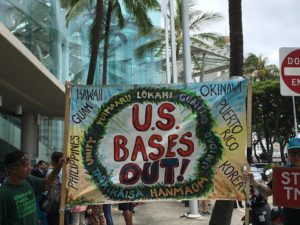
Protest sign urging global conservation meeting to address the environmental damage from U.S. military bases. (Photo by Ann Wright)
By Ann Wright | Consortium News | September 9, 2016
The International Union for the Conservation of Nature (IUCN) has come in for criticism due to its lack of attention to the detrimental effects of wars and military operations on nature. Considering the degree of harm to the environment coming from these human activities, one would think that the organization might have set aside some time at its World Conservation Congress this past week in Hawaii to specifically address these concerns.
Yet, of the more than 1,300 workshops crammed into the six-day marathon environmental meeting in Honolulu, followed by four days of discussion about internal resolutions, nothing specifically addressed the destruction of the environment by military operations and wars.
The heavy funding the IUCN gets from governments is undoubtedly the rationale for not addressing this “elephant in the room” at a conference for the protection of the endangered planet – a tragic commentary on a powerful organization that should acknowledge all anti-environmental pressures.
At a presentation at the USA Pavilion during the conference, senior representatives of the U.S. Army, U.S. Air Force and U.S. Navy regaled the IUCN audience of conservationists with tales about caring for the environment, including protecting endangered species, on hundreds of U.S. military bases in the United States.
The presenters did not mention what is done on the over 800 U.S. military bases outside of the United States. In the one-hour military style briefing, the speakers failed to mention the incredible amounts of fossil fuels used by military aircraft, ships and land vehicles that leave mammoth carbon footprints around the world. Also not mentioned were wars that kill humans, animals and plants; military exercise bombing of entire islands and large swaths of land; and the harmful effects of the burn pits which have incinerated the debris of war in Afghanistan and Iraq.
Each military service representative focused on the need for training areas to prepare the U.S. military to “keep peace in the world.” Of course, no mention was made of “keeping the peace” through wars of choice that have killed hundreds of thousands of persons, animals and plants, and the bombing of the cultural heritage in many areas around the world including Afghanistan, Iraq, Syria, Pakistan, Libya, Yemen and Somalia.
Miranda Ballentine, Air Force Assistant Secretary for Installations, the Environment and Energy, said the U.S. Air Force has over 5,000 aircraft, more than all the airlines in the United States — yet she never mentioned how many gallons of jet fuel are used by these aircraft, nor how many people, animals and cultural sites the aircraft have bombed.
To give one some idea of the scale of the footprint of U.S. military bases, Ballentine said Air Force has over 160 installations, including 70 major installation covering over 9 million square miles of land, larger than the country of Switzerland, plus 200 miles of coastland.
Incredibly, Ballentine said that due to commercial development around military bases, military bases have become “islands of conservation” — conservation takes place inside the protected base while there are larger conservation issues outside the fence lines of the bases.
Adding to the mammoth size of the military base footprint, Dr. Christine Altendorf, the regional director of the U.S. Army’s Installation Management Command of the Pacific, said U.S. Army bases have 12.4 million acres of land, including 1.3 million acres of wetlands, 82,605 archeological sites, 58,887 National Historical Landmarks and 223 endangered species on 118 installations.
The U.S. Navy’s briefer, a Navy Commander, added to the inventory of military equipment, saying the Navy has 3,700 aircraft; 276 ships, including 10 aircraft carriers; 72 submarines. Seventy naval installations in the United States have 4 million acres of land and 500 miles of coastline. The Navy presenter said the Navy has never heard of a marine mammal that has been harmed by U.S. Naval vessels or acoustic experiments in the past ten years.
Only One Question
At the end of the three presentations, there was time for only one question — and luckily, my intense hand waving paid off and I got to ask: “How can you conserve nature when you are bombing nature in wars of choice around the world, practicing military operations in areas that have endangered species like on the islands of Oahu, Big Island of Hawaii, Pagan, Tinian, Okinawa and bombing islands into wastelands like the Hawaiian island of Koho’olawe and the Puerto Rican island of Vieques and now you want to use the North Marianas ‘Pagan’ Island as a bombing target. And how does the construction of the new South Korean naval base in pristine marine areas of Jeju Island that will be used by the U.S. Navy and the proposed construction at Henoko of the runways into the pristine Oura Bay in Okinawa fit into conservation of nature?”
Interestingly, in the large audience of approximately 100 people, not one of them applauded the question indicating that either audience was composed primarily of Department of Defense employees, or that the conservationists are uneasy about confronting the U.S. government and particularly the U.S. military about its responsibility for its large role in the destruction of much of the planet’s environment.
The Navy representative was the only person to respond to my question. He reiterated the national security necessity for military exercises to practice to “defend peace around the world.” To his credit, he acknowledged the role the public has in commenting on the possible impact of military exercises. He said that over 32,000 comments from the public have been made on the Environmental Impact Assessment (EIA) of the possibility of artillery firing and aircraft bombing of the Northern Marianas island of Tinian — that has only 2,300 inhabitants.
Despite all odds, someone in Hawaii was able to get an exhibit of photographs of the cleanup of Koho’olawe placed on the third floor of the Hawaii Convention Center. There was no sign announcing the exhibition, just a series of photos with some explanation. In five days of attending the conference, I observed that 95 percent of the conference attendees who walked past the exhibition did not stop to look at it – until I stopped them and explained what it was about. Then, they were very interested.

A crater that was created on the Hawaiian island of Koho’olawe from massive explosions of TNT in 1965. (Photo from Hawaii Archive)
From 1941 to 1990, the island of Koho’olawe was used as a bombing range for U.S. military aircraft and naval vessels. One photograph in the exhibition showed the crater called “Sailor’s Hat” which was made by several massive explosions of TNT in 1965 to recreate and study the effects of large explosions on nearby ships and personnel to simulate in some manner the effects of a nuclear explosion. The crater affected the island’s fresh water aquifer and now no artesian water remains on the island.
After Hawaiians stopped the bombing through their protests and by staying on the island during bombings from the 1970s, the U.S. Navy returned Koho’olawe to the State of Hawaii in 2004 after a 10-year clean-up process. But only 66 percent of the surface has been cleared of unexploded ordnance (UXO), and only 10 percent cleared to a depth of 4 feet. Twenty-three percent of the surface remains uncleared and 100 percent of the waters surrounding the island have not been cleared of UXO, putting divers and ships at risk.
Okinawan Environmental Activists
Environmental activists from Okinawa had a booth at the IUCN at which they told about the attempt of the U.S. military and the national Japanese government to construct a runway complex into Oura Bay, a pristine marine area that that is the home of the protected species of marine mammal, the dugong.
The Deputy Governor of Okinawa and the Mayor of Nago city, Okinawa, both of whom have been key figures in the grassroots campaign to stop the construction of the runways and the lawsuits filed by the provincial government of Okinawa against the federal Japanese government, gave presentations about the citizens’ struggle against the construction of the runways.
However, there was no mention of the environmental effects on the marine environment from the construction of a huge new naval base on Jeju Island, South Korea, the site of the previous IUCN conference four years ago. At that conference, IUCN, no doubt at the request of the South Korean government, refused to allow citizen activists to have a booth inside the convention or make presentations like the Okinawans did this year. As a result, the Jeju Island campaigners were forced to stay outside the conference site.
Four years later in the 2016 WCC conference in Hawaii, the Government of Japan and the Province of Jeju Island sponsored a large multi-media pavilion about Jeju island which did not mention the construction of the new naval base and the destruction of the cultural heritage of the site nor the displacement of women divers who had dived at the location for generations.
On Sept. 3, local groups in Honolulu came to the Hawaii Convention Center with signs to remind the IUCN of the U.S. militarization of Asia and the Pacific. Signs and posters from local environmentalists cited the environmental impact from the huge 108,863-acre Pohakuloa bombing range on the Big Island of Hawaii, the largest U.S. military installation in the Pacific; the Aegis missile test center on the island of Kauai; and the four large U.S. Army, Navy, Air Force and Marine bases on the island of Oahu.
Other signs referenced the extensive number of U.S. military bases in Japan, Okinawa, South Korea, Guam and new U.S. military installations in the Philippines and Australia.
Ann Wright served 29 years in the US Army/Army Reserves and retired as a Colonel. She also served 16 years as a US diplomat in US Embassies in Nicaragua, Grenada, Somalia, Uzbekistan, Kyrgyzstan, Sierra Leone, Micronesia and Mongolia. She was on the small team that reopened the US Embassy in Kabul, Afghanistan in December 2001. She resigned from the US Department of State in March 2003 in opposition to the war on Iraq.
Have We Witnessed a Dramatic Change in the Military Doctrine of the DPRK?
By Konstantin Asmolov – New Eastern Outlook – 08.03.2016
As it was reported on Friday by the KCNA, during a visit to a closed firing range where advanced multiple rocket launchers were tested, North Korean leader Kim Jong-un announced that the country should be prepared to use its nuclear weapons at any moment to ensure its self-defense. The North Korean supreme leader has also underlined that he perceives the upcoming South Korean-US maneuvers as a dangerous gamble that could lead to disastrous consequences, so he ordered the North Korean army to raise all forces to high alert. The KCNA has also noted that “hostile forces led by the United States,” adopted a resolution that is “undermining the rights of the DPRK as a sovereign state.”
The part that one can consider to be crucial in all this information warfare is the fact that in the same speech, Kim Jong-un announced that Pyongyang would reconsider its military doctrine to allow the possibility of preemptive strikes being launched in connection with the dangerous situation on the Korean Peninsula. On March 4, a statement issued by the DPRK government stated that in circumstances when the United States and its satellites have openly challenged North Korea’s sovereignty and have endangered its right to existence, any hostile actions would lead to a decisive response. The statement has also added that should some disastrous event occur on the Korean Peninsula or in the region adjacent to it, the entire responsibility will lie on the United States and its collaborators.
Later, the same notion was repeated in an official statement of the DPRK National Defense Commission that was released by the KCNA on March 7. The statement announced that due to the joint military exercises of the United States and South Korea labeled as “training for a nuclear war,” any hostile military act would lead to a preemptive nuclear strike launched in accordance with the procedure established by the high command of the Korean People’s Army.
It’s only natural that such statements aroused suspicion. Moscow has expressed serious concern over the entire situation. On March 4, Vladimir Putin’s spokesman Dmitry Peskov expressed the hope that all the parties involved will exercise restraint. The United States urged North Korean leaders to refrain from provocative statements and actions and focus on the fulfillment of DPRK’s international obligations. A Pentagon spokesman said the US is prepared to destroy North Korea’s nuclear arsenals if North Korea poses a threat to the US, while noting that he had no evidence that the DPRK conducted test launches of intercontinental ballistic missile armed with nuclear warheads. In turn, the press secretary of the South Korean Ministry of Defence announced that North Korea must put an end to its defiant and destructive comments and actions, noting that Seoul will mercilessly respond to any provocation made by North Korea.
Such crises are truly alarming for a number of reasons. Firstly, it is necessary to take into account the context in which that decision is taken. While traditional news coverage of North Korea’s actions has been reduced long ago to suggesting Pyongyang’s actions are irrational and unprovoked, in fact we are witnessing a response to upcoming US-South Korean exercises “Key Resolve” and “Foal Eagle,” which will be held on the peninsula in the next two months. It’s reported that more than 300,000 South Korean and 15,000 US troops, including US nuclear aircraft carrier USS John Stennis will be participating in these exercises. And there’s little doubt in anyone’s mind that those will mimic an invasion of North Korea, especially when it’s stated as an official goal.
Each military exercise in the immediate vicinity of DPRK’s border understandably affects the nerves of North Korea’s military commanders. There is absolutely no certainty that during such exercises due to some mysterious incident, they will not transform into a full-scale invasion. This can happen as a result of a deliberate provocation by the South, or when some North Korean officer loses his nerve. Yet, there’s a possibility that we will witness the repetition of the situation that occurred back in 2015, when South Korean officers were reluctant to investigate their own criminal carelessness so they decided to push all blame instead on the North for an accident that occurred with their own soldiers.
In such a situation, Pyongyang is trying to look as vicious and dangerous as it possibly can. It doesn’t stand a chance in a fight against South Korea, supported by the United States. However, the North could inflict so much damage on the South that a military victory against it will become meaningless. Such a threat works like a tub of cold water on hot heads: understanding that the North will “die singing” doesn’t make anyone all too willing to fight.
A similar situation occurred during the previous round of nuclear crisis on the peninsula back in 2013. At that time the sitting President of South Korea, Park Geun-hye, just came to power, and there was a possibility that supporters of the former president or young officers bewildered with revanchist ideas might try to escalate the situation. They were consumed by the idea that if politicians did not interfere with their actions, they could destroy the Pyongyang government in 90 hours. Then, in 2013, the DPRK also made a number of risky statements against the background of the upcoming exercise. Although the headlines once again shouted that the Korean peninsula is on the brink of war, no one decided to jump the gun. However, the situation today is somewhat more complicated. Park Geun-hye has deviated from her initially moderate positions becoming conservative, and former young majors have now become colonels. In this situation, Pyongyang raises the stakes higher than three years ago.
However, this leads to a new round amid the ongoing security dilemma of North Korea, since the statements made by Kim Jong-un can be interpreted as changes in North Korean military doctrine. Until recently, Pyongyang has positioned its missile and nuclear program solely as a self-defense option, and all the promises of drowning Seoul in a sea of fire were made in the wake of possible provocations. And now the DPRK is talking about America’s all time favorite ‘preemptive strikes’ that can be unleashed by somewhat more uncertain provocations. That’s a truly dangerous dilemma. Firstly, this level of military readiness can not but be seen with concern by others in the region, a readiness to take action in response to a possibility of such a strike being launched against them, which clearly raises tensions. Secondly, in the fight of the weak against the strong, the weak striking first is a good way to increase one’s chances of prevailing. But this can only be said about an inevitable fight, while a preemptive strike destroys all chances for a peaceful resolution of the conflict.
Three years ago I noted in one of my articles that the path chosen by the DPRK provides it a tactical advantage, but may lead it to a dead end on the strategic level. In response to ever increasing pressure of new sanctions, North Korea will become more heavily involved in the arms race, and the vicious circle will be tightening at every turn with ever increasing speed. Yet, North Korea’s problems, like its security dilemma or the tensions between Pyongyang on one side and Beijing and Moscow on the other, are not going anywhere. At the same time Washington keeps exploiting the North Korean threat for its own ends.
This vicious circle has yet another drawback, since there’s few exit strategies one can find in it. Although North Korea believes that its nuclear program provides it with independence, in fact it makes the actions of its government more predictable.The DPRK has now lost any strategic initiative and is now acting “reactively,” which makes it even more dependent on external factors. So it’s not rocket science at this point to get a certain reaction from the government of North Korea once one has applied pressure from a certain angle. Let’s hope no one will take advantage of this fact to launch additional provocations.
Konstantin Asmolov, Ph.D, Chief Research Fellow of the Center for Korean Studies, Institute of Far Eastern Studies, Russian Academy of Sciences
South Korea Holds Live-Fire Drill Near Disputed Border With North
Sputnik – 23.11.2015
South Korea conducted artillery exercises on Monday near a disputed Yellow Sea border with North Korea, despite Pyongyang’s promise to retaliate for the drill, media reported.
According to South Korea’s Yonhap news agency, live-fire artillery drills were conducted near the front-line islands of the inter-Korean maritime border.
On the eve of the artillery exercises Pyongyang warned Seoul that it would retaliate if South Korea dropped shells in North Korean territorial waters.
Current artillery drills coincide with the 5th anniversary of North Korea’s attack on South Korean front-line Yeonpyeong Island that left two soldiers and two civilians dead. Pyongyang announced at the time that it had been provoked by similar live-fire drills in the area.
The United Nations named the Yeonpyeong exchange one of the most serious incidents since the end of the Korean War in 1953. The two countries, still legally at war since that time, have only an armistice in place following the collapse of peace treaty negotiations.
The New “Steps Towards Democracy” in South Korea
By Konstantin Asmolov | New Eastern Outlook | August 22, 2015
On July 15 2015, the police of the Republic of Korea in Seoul raided the office and residence of members of the civil movement, “Korean Alliance”, (in Korea – the association for independent reunification and the development of democracy), who advocate the expansion of ties with the DPRK. This organization was created in November 2011 to implement the independent reunification of the two Koreas without external influence. It demands the withdrawal of foreign troops (read – the US, because there are no others) from the Korean peninsula and advocates the abolition of the National Security Law (NSL), which (among other things) prohibits citizens of the Republic of Korea, any unauthorized contact with North Koreans and actions to support the DPRK.
According to law enforcement officials, the movement is suspected of “promoting North Korean ideology and actions in support of Pyongyang.” About 100 police officers went to the movement’s offices in order to seize documents for the investigation.
According to investigators, members of the movement, which the authorities consider “anti-government“, repeatedly published messages indicating a positive attitude towards the North Korean regime on the Internet, as well as organizing public events against the NSL. Furthermore, in 2013 during a stay in Germany, one of the members of the movement allegedly attended a seminar organized by the pro-North Korean group and was in contact with officials from the DPRK.
In addition, the chairman of the organization was the late pastor, Pak Chan Kyung, who, according to secret service agents, was previously deputy chairman of the pro-North Korean, organization “Korean Association for the Reunification of the Motherland.”
Its members are holding protests, calling for a stop to the investigation, but the chances of getting away with this are very slim. After all, at the same time the law-enforcement system in South Korea has taken “an important step toward democracy.” This entails the decision by the Constitutional Court on the issue of whether possession of North Korean literature is a political offense subject to proceedings under the Law on National Security. In comparison to the ban on the United Progressive Party, against which only one judge out of nine spoke up, the number of those voting “against” has risen to three, yet the ruling has been passed.
The decision was made in connection with the appeal by Hon, who was accused by the court of Suwon of violating the National Security Law. He was counted as belonging to the “anti-state organization” on the grounds that memoirs of Kim Il Sung were found on the hard drive of his computer, but he filed a protest, claiming that he held such materials to “better know the enemy.”
The court judgement confirmed that the NSL is vital in curbing social unrest, and necessary to ensure public safety and freedom by preventing actions that could lead to a violent regime change. Moreover, according to the Court, these restrictions did not violate freedom of speech. Of course, they could be used to suppress political opposition, but this should be separated from pro-North Korean activities. Such bans are precautions against possible social instability achieved by means of illegal protests.
As stated by the judges in their verdict, “given the current circumstances in the country, national security is critically dependent on the law which is being proposed for review. We recognize that, currently, there is no clear and direct threat, but it is in the public’s interest to restrain these violent ideas before they gain impetus.” Therefore, the storage of materials was sufficient for prosecution. “Given the level of modern scientific and technological progress, the rapid dissemination of materials via the Internet is very likely. The law prohibits the storage of individual anti-state literature without legal authorization.” In other words, anything that is not permitted is prohibited. Even if you’re just interested in North Korea without being a patented fighter with the Communists, this poses the threat of sedition.
It is curious that such an interpretation is, in fact, the assumption that a person that stores such information is, a priori, a supporter of North Korea.
Three of the judges, however, did not agree with this interpretation: the punishment for possession alone without proof of proliferation creates a great potential for errors or violations of the law. Too much depends on the personal opinion of the investigator. It requires additional evidence that the accused distributed these materials or kept them because they held similar views.
Let’s translate this law into the language of reality. Just the mere fact that you keep a copy of “Mein Kampf” at home automatically makes you a fascist and a suspect in a series of other crimes motivated by ethnic hatred, why else would a person keep this at home? And silly talk such as “how can you study Hitler, without reading Hitler?” are just flimsy excuses; if you are not registered as an official opponent of Hitler, then you must be one of his secret supporters, and so, face criminal prosecution. In general, if we compare this case with Russian practice, we have to ask ourselves who is catching up with the Russian Federation – North Korea, or even the Republic of Korea?
In this context, one cannot but recall the textbook for North Korea’s lawyers, issued by the Ministry of Public Security (i.e. by the ordinary, detective police) of North Korea in 2009. The book contains a great number of examples of various offenses, including an example very similar to the aforementioned, right up to the prescribed punishment.
Finally, here’s more recent news from July 31, 2015. The Constitutional Court has recognized the legitimacy of the Republic of Korea’s Law on the election of officials, which requires Internet users to use their real names during the electoral period. This relates to paragraph 6 of Article 82 and paragraph 1 of Article 261, which requires the user to specify their real names if they want to express opinions about political parties or candidates for leadership positions. For violation of these requirements, fines of up to 10 million Won, or 8.5 thousand Dollars are enforced. This requirement is effective only during the election period, because, according to the decision of the Constitutional Court dated August 23, 2010, the collection of users’ personal information when working with the Internet violates the constitutional rights of citizens. Thus, the 2007 requirement of the identification of Internet users was lifted, so as to prevent the interference with freedom of expression on the Internet.
Today’s decision by the Constitutional Court came in response to a complaint filed in 2013 by Daum, the web-portal whose headquarters are on the island of Jeju. The Jeju Provincial Electoral Commission fined the portal for breach of compliance with the requirement to indicate the real names of users during the 2012 presidential election. The Portal administration felt that this requirement was contrary to the decision of the Constitutional Court from 2010. Meanwhile, five of the nine judges found no violation of the law requiring users to indicate their real names. Especially, since it does not reveal the individual’s full personal information and is valid only during the election period. The other four judges considered that the requirement was unconstitutional because it required online-voters to disclose personal data, even if only for a limited period.
Here we should note the following: the Internet in South Korea is already only provided with passport identification. To register on a forum or to perform any transaction, it is necessary to submit a unique identification number. But here we are talking about the compulsory disclosure of personal data in any attempt to discuss politicized issues. Obviously, it’s not just for the sake of combating Internet trolling (which is usually cited to justify abolishing anonymity), but, so the state security organs could easily identify anyone whose thinking does not coincide with “the party line.”
This is an obvious crackdown. How it interfaces with the internal policies and whether it is possible, in this context, to say that conservative circles are regaining their former influence in the Republic of Korea will be in one of our forthcoming articles.
Konstantin Asmolov, PhD (History) is a Senior Researcher at the Institute of Oriental Studies of the Russian Academy of Sciences.
N Korea Calls on US to Halt Drills With S Korea to Establish Dialogue
Sputnik – 30.07.2015
MOSCOW — Pyongyang called on Washington to halt joint military exercises with Seoul so that a dialogue can be established, a North Korean Foreign Ministry spokesperson said Thursday.
“If the U.S., not the DPRK, stops such hostile acts as joint military maneuvers and makes a decision to go the other way, it will be possible to resume dialogue and settle many issues,” the spokesperson said, quoted by the Korean Central News Agency (KCNA).
According to the foreign ministry, tensions on the Korean peninsula persist due to US hostility towards Pyongyang.
“The evil cycle of tension will persist and dialogue will not be held before the U.S. shows its much-touted sincere ‘will for dialogue’ by stopping the joint military maneuvers,” the spokesperson stated.
South Korea and the United States annually conduct joint military exercises, explaining that they are for defensive purposes only. North Korea describes the exercises as training rehearsals for a full-scale military invasion.
On Wednesday, the United States and the Republic of Korea initiated a joint military drill to increase logistical war preparedness.
North and South Koreas signed a ceasefire armistice during the 1950-1953 Korean War but have not negotiated or ratified a formal peace yet.
Panetta reveals US nuke strike plans on N. Korea, spurs controversy
RT | October 16, 2014
US war plans against North Korea recently included the option of a nuclear strike, former CIA Director and Defense Secretary Leon Panetta revealed in his memoirs, triggering major controversy.
Panetta described a 2010 briefing in Seoul by General Walter L. ‘Skip’ Sharp, the commander of US forces in South Korea, where it was made clear that the nuclear option was on the table if North Korean forces crossed into the demilitarized zone (DMZ) between the North and the South.
“If North Korea moved across the border, our war plans called for the senior American general on the peninsula to take command of all US and South Korea forces and defend South Korea— including by the use of nuclear weapons, if necessary,” Panetta wrote in ‘Worthy Fights: A Memoir of Leadership in War and Peace’.
Panetta added that he left the briefing with “the powerful sense that war in that region was neither hypothetical nor remote.”
Panetta’s revelations sparked various responses, ranging from surprise to indignation.
“Typical wooden-headedness on the part of a US official,” a former top CIA expert on Korea told Newsweek. “How in the world do we think South Koreans will react to the news that the US is prepared to use nuclear weapons on the peninsula? It doesn’t reassure them, only makes them think having the US bull in their china shop is maybe not such a good idea.”
Others said Panetta did not write anything unexpected. A ‘Joint Vision’ statement signed between US-South Korea in 2009 “references extended deterrence to include the nuclear umbrella … in many respects, the information is not new,” Korea expert at the Naval War College Terence Roehrig said. “The United States has long had a position that South Korea was under the US nuclear umbrella.”
The US sent over tactical nuclear weapons to the Korean Peninsula in 1958, but their deployment was only revealed in mid-1970s.
The Korean War took place in 1950-1953, with no peace deal ever signed between North and South Korea. Thus the two countries remain technically at war.
High-level military talks
Meanwhile, the relationship between the North and the South remain tense. On Wednesday senior-level military talks were held between them to resolve a series of recent live-fire incidents in South Korea and maritime borders, AFP quoted Seoul’s Defense Ministry as saying.
The meeting was referred to as the highest-level military exchange in seven years. It lasted for five hours and included officers up to the rank of general.
The main focus of the talks was Friday’s incident involving an exchange of gunfire after North Korea’s military shot at balloons launched by anti-Pyongyang activists. Tuesday’s fire exchange between North and South Korean naval patrol boats near the disputed Yellow Sea border was also discussed.
“Our side clarified our position that North Korea should respect (the maritime boundary) … and that as a democratic nation, we cannot regulate balloon launches by civilian groups,” South Korean Defense Ministry spokesman Kim Min-seok said.
Featured Video

The 1964 Coup in Brazil
or go to
Aletho News Archives – Video-Images
Frlom the Archives
70 Neocons Petition Congress To Effectively Allow Israel To Say When The US Should Attack Iran
By Damian Lataan | January 10, 2014
Seventy senior Israeli-centric neoconservatives have written an open letter to Congress imploring them to do more to ensure Iran complies with the conditions of any agreement finally reached with the P5+1 over Iran’s nuclear program.
While the neocons are ostensibly asking Congress to ensure compliance, it is clear that their real aim is to convince members of Congress to support the bill currently passing through the Senate which calls for tighter sanctions against Iran in the event of any waywardness on Iran’s part.
The neocons are eager to see the bill currently passing through the Senate with enough support to make it veto-proof, not so much because they are concerned about Iran’s so-called nuclear weapons program – there’s still not a skerrick of hard evidence that Iran has a nuclear weapons program – but, rather, because embedded within the bill is this clause:
… if the Government of Israel is compelled to take military action in legitimate self-defense against Iran’s nuclear weapon program, the United States Government should stand with Israel and provide, in accordance with the law of the United States and the constitutional responsibility of Congress to authorize the use of military force, diplomatic, military, and economic support to the Government of Israel in its defense of its territory, people, and existence…
Essentially, the clause is an automatic trigger for the US to attack Iran at any time the Israelis choose to launch a first strike – regardless of whether President Obama is in favour or not.
Partial list… continue
Blog Roll
 Aletho News
- Iran War Supporters Invent a New and Absurd Justification: It Is All About China
- Corporate Media Go All Out To Support The US-Israeli War on Iran
- Trump press conference reveals a man who wants out of war
- When Tel Aviv decides, Washington fights
- Top official: Iran ready for a long war with US, no more diplomacy
- How Iran’s Toxic Rain Reveals US-Israel Discord
- Trump Admits He Is Destroying Iran For Israel
- Iran’s latest move in the GCC countries was a stroke of genius
- Blackmail and death threats, Zelensky embarrasses the EU, but there’s no condemnation
- Israel threatens to kill Iran’s new leadership
- If Americans Knew
- Lebanon: Israel’s White Phosphorous Use Risks Civilian Harm
- Corporate Media Go All Out To Support The US-Israeli War On Iran
- US-Israel war on Iran is creating a steady growing number of amputees
- Israel planned this war on Iran for 40 years. Everything else is a smoke screen
- The wrong question about the war in Iran
- ‘Your Tax Dollars Being Used to Raise Your Gas Prices’: US-Israel Bomb Major Iranian Oil Depots
- ‘Bogus Evidence’: Former Nuclear Watchdog Head Debunks US Justification for Iran War
- EXPLAINER – Dimona: What to know about Israel’s nuclear site
- Fires and toxic air in Iran (thanks, Israel) – Not a ceasefire Day 150
- At Israel’s hands, Iran is burning, Lebanon and Gaza are crumbling – Not a ceasefire Day 149
- No Tricks Zone
- Wake-up Call: Survey Shows Majority Of Germans Now Favor Postponing Climate Targets!
- Televised! Leading German Political Candidate Tells Schoolchildren CO2 Makes Sun Hotter!
- New Study: A Century Warming Of 1.1°C Is ‘Commonplace’ And ‘Not Unusual’ During This Interglacial
- New Study: ‘Internal Noise’ And Volcanic Forcing Can Trigger 10-15°C Warming Within Decades
- Glaciers Worldwide Are Suddendly Surging, Experts Blame Warming!
- Surprising Discovery: Sahara Is Greening…Billions Of Trees Where Once Thought To Be Barren
- New Research Reaffirms Clouds, Aerosols, And Surface Solar Radiation Are ‘Driving The Climate System’
- Germany: Electric Car Catches Fire At Charging Station, Sets Off Local “Inferno”, Widespread Damage
- New Study: Canada’s New Brunswick Was 1°C Warmer Than Today During The Medieval Warm Period
- Coal Power Back In Trend As Globe Tries To Keep Pace With Growing Demand For Power
 Aletho News