Who is doing the saber-rattling in Eastern Europe?
By Vladimir KOZIN | Oriental Review | August 25, 2015
Last week, NATO headquarters announced Exercise Swift Response-15, the largest Allied airborne training event on the European continent since the end of the Cold War. About 5,000 soldiers from 11 countries in the alliance will take part in the maneuvers, which will last until Sept. 13.
This is neither the first nor the last drill to be conducted by NATO, the largest military alliance in the world.
Over the past year and a half, NATO armed forces have almost doubled the number of military exercises they have staged near the Russian border: between 2012 and 2013 they conducted an average of 95 such training events per year, but there have already been 150 so far in 2015, and flights by reconnaissance aircraft along the Russian frontier have increased tenfold.
But in an attempt to unfairly place the blame on Russia for such exercises, the London-based European Leadership Network issued a report on Aug. 12 that uses a flawed methodology to compare one type of exercise held in Russia in 2015 with another kind of military drill organized by NATO this year. Criticism was only leveled at the large number of troops involved in the Russian exercise, because the alliance’s drill was smaller on that scale. The report’s purpose was obvious: to shift the entirety of the West’s own culpability for war preparations in Europe onto the Russians.
- First of all, it makes no sense to compare only two military drills conducted by opposing sides; one needs to take into account all the exercises that are being held, including the sum total of their scope and focus (the scenarios being rehearsed). In this regard, it should be noted that the aggregate number of NATO personnel taking part in the alliance’s military maneuvers is significantly greater than the estimate of troops involved in the Russian military exercises.
- Second, in regard to this matter, one must also acknowledge that it was not Russia who initiated this upsurge in military drills. The US and its closest NATO allies took that first step under contrived pretenses. For this reason, the European Leadership Network’s proposals to limit the number and scope of military exercises in Europe should be primarily directed at Washington and the alliance, not at Russia.
- Third, one cannot overlook the fact that many NATO members (the US, UK, France, Germany, and others) conduct their military drills far from their own borders. The Russian armed forces almost always oversee this training within their own country.
- Fourth, it should be noted that in addition to periodic military maneuvers, a special NATO Response Force has been created that will consist of up to 40,000 soldiers who can be quickly airlifted to wherever they need to be. In addition, the US Navy must now be able to instantly mobilize the resources to form “expeditionary forces” that can be rapidly deployed to any part of the world (for example, as part of a Marine brigade including up to 17 amphibious ships or a joint Marine Air-Ground Task Force with as many as 75,000 personnel). For comparison, a recent NATO Baltops naval exercise in the seas around northwestern Europe involved 49 warships and support vessels from 17 countries within the alliance.
- Fifth, it is important to note that while NATO has 24,000 combat aircraft and 800 ocean-going ships at its disposal, Russia does not own nearly so much equipment of that type. What’s more, the Pentagon is planning a further expansion of the forward deployment of its armed forces. That would station US troops, on a permanent or temporary basis, within more than 100 nations. There are plans to begin prepositioning weapons and military equipment in these countries, as is “needed to equip troops fighting in forward combat zones.”
- Sixth, during these military drills, the Pentagon is rehearsing scenarios for armed intervention intended to overthrow undesirable regimes. For example, throughout the post-war period, the United States and its allies have employed military force more than 50 times, and six times that has escalated into regional armed conflicts.
Even NATO’s leaders have acknowledged the alliance’s military buildup on Russia’s doorstep. According to NATO Secretary General Jens Stoltenberg, in 2014 these numbers have quintupled since 2013. And NATO member states’ naval operations have increased fourfold during this period.
In particular, the air forces of the 15 NATO countries that take part in the Baltic Air Policing operation over the Baltic states ramped up their activities more than 1,240 times (when calculated in flying hours) since it was launched 11 years ago. This operation is underway 24/7, year-round. Four of the types of planes used in this drill are considered “dual-capable” aircraft that can carry either conventional or tactical nuclear weapons.
At the same time the United States is refusing to adopt the new Treaty on Conventional Armed Forces in Europe (CFE), proposing to revive the former act, which also never went into effect through the fault of its NATO signatories. New talks on CFE-2 have not even begun. At the same time, eight additional military bases in Eastern and Southern Europe, as well as seven command and administrative centers, plus American heavy weaponry and AEW&C aircraft have been added to the 150 military bases belonging to the United States and its allies that are immediately adjacent or relatively close to Russia’s borders.
Without exception, every military exercise that the alliance has recently staged in Europe has had very focused objectives. They are rehearsing scenarios that test the use of the Rapid Reaction Force, which includes the transportation of personnel and heavy equipment over long distances, the interaction between different varieties and formats of armed forces, and the operational “coupling” between the command and control structures. There is no doubt that such exercises have an anti-Russian bias, mainly because, as already noted, they are primarily (up to 55%) conducted in zones adjacent to the Russian borders. For example, an exercise that included 140 armored vehicles and 1,400 troops near the Estonian city of Narva in February of this year was held only 300 meters away from the Russian border.
In mid-February of this year the Pentagon shipped twelve A-10 Thunderbolt II aircraft to Spangdahlem Air Base (Rhineland-Palatinate, Germany), which will be deployed in Eastern Europe. There is no doubt about the identity of the potential enemy. Eight of these aircraft were flown to the Ämari Air Base (Estonia) in June of this year. And five USAF B-52H and B-2 strategic heavy bombers were sent to RAF Fairford in Great Britain to participate in NATO military exercises.
In March of this year NATO organized the Joint Viking military exercises in northern Norway near the Russian border, which was an event unprecedented since 1990. Over 5,000 troops and 400 units of military equipment were involved. During these drills, the naval and air forces of the region’s NATO countries were placed on alert. The last time a similar drill was conducted was in 1967.
In March and April of 2015 the US, Swedish, and Finnish air forces directed military maneuvers near the Finnish town of Pori, flying sorties with Gripen, F-16, and Hornet fighter jets. In May, the air forces from eight NATO member states staged the Arctic Challenge Exercise in Norway, which included more than 100 aircraft. In early May of this year major military drills known as Siil-2015 were held in Estonia, involving 13,000 troops. This was the first time such large-scale drills had been conducted inside Estonia.
The Pentagon is planning to set up warehouses of military equipment in NATO’s eastern flank in order to conduct “ongoing exercises on a rotational basis.” For these purposes, 1,200 armored vehicles, including 250 Abrams tanks and Bradley Fighting Vehicles, as well as artillery systems, are to be stockpiled in Eastern Europe. US Secretary of Defense Ashton Carter claims that Estonia, Lithuania, Latvia, Bulgaria, Romania, and Poland have already agreed to house this military equipment within their borders. Some types of weaponry can also be stationed in Germany, where, just like after WWII, large numbers of American troops are already concentrated.
In light of the increased US military aid to the regime in Kiev that will be used in the genocide of Ukrainian citizens, these military preparations are taking on a plainly anti-Russian flavor.
Nor can we ignore America’s tactical nuclear weapons, which since the early 1950s have been deployed in four European countries (Belgium, Italy, the Netherlands, and Germany), as well as the Asian part of Turkey. Furthermore, a US missile defense system will be installed in Romania in 2015, and then another three years later in Poland. These military forces and infrastructures are certainly not aimed at Iran. So how should Russians react to all of this, and who is actually rattling his saber in Eastern Europe?
U.S. Secretary of State John Kerry v. His Subordinate Victoria Nuland, Regarding Ukraine
By Eric ZUESSE | Oriental Review | May 22, 2015
U.S. Secretary of State John Kerry, on May 12th, responding to Ukrainian President Petro Poroshenko’s assertions that Ukraine will retake Crimea and will conquer Donbass:
“I have not had a chance – I have not read the speech. I haven’t seen any context. I have simply heard about it in the course of today. But if indeed President Poroshenko is advocating an engagement in a forceful effort at this time, we would strongly urge him to think twice not to engage in that kind of activity, that that would put Minsk in serious jeopardy. And we would be very, very concerned about what the consequences of that kind of action at this time may be.”
U.S. Assistant Secretary of State for European & Eurasian Affairs, Victoria Nuland, as communicated by the U.S. State Department’s Press Office on May 15th, reiterating Poroshenko’s view:
“Assistant Secretary Nuland’s ongoing visit to Kyiv and her discussions with Prime Minister [Arseniy] Yatseniuk and President [Petro] Poroshenko reaffirm the United States’ full and unbreakable support for Ukraine’s government, sovereignty, and territorial integrity. We continue to stand shoulder to shoulder with the people of Ukraine and reiterate our deep commitment to a single Ukrainian nation, including Crimea, and all the other regions of Ukraine.”
Will John Kerry reprimand his subordinate for her contradicting what he, her boss, had said three days earlier? If not, then will President Barack Obama fire his Secretary of State John Kerry? If not, then will Victoria Nuland be fired? If not, then who is to trust anything that comes from the U.S. State Department, when the Secretary of State can be contradicted three days later by his subordinate, and both remain in their respective jobs?
Republicans are already preparing to weaken Kerry over this. The far-right news-site Frontpage Mag headlined on May 21st, John Kerry’s Seven Hours of Weakness in Russia, and condemned the “attempt by Kerry to re-set the ‘re-set’ button [on U.S. policy toward Russia] first pushed by his predecessor, Hillary Clinton.” The special subject of their ire: “The promise of ‘rolling back’ the mild sanctions regime the West imposed on Russia on account of Putin’s annexation of Crimea and support of separatist rebels was bandied about, if only Russia would behave in the future.” But winning changes in behavior is what international diplomacy is supposed to be all about — otherwise the State Department wouldn’t even be needed, and only the Pentagon would handle America’s foreign relations.
If Victoria Nuland stays in her job, then John Kerry will be neutered even if he’s not fired.
The only person with the power to fire Nuland is actually U.S. President Barack Obama. Perhaps the request for him to do that is already on his desk. If it’s not, then Kerry’s job is in jeopardy, because his diplomatic efforts can be obliterated by a subordinate and that subordinate will suffer no penalty for doing this. Nobody then would respect anything that the U.S. Secretary of State says, because it wouldn’t necessarily represent the President’s policies. If the Secretary of State isn’t backed up by the President, then the Secretary of State has no real power at all.
What will Poroshenko hear from Putin in Minsk?
By Pyotr AKOPOV* | August 22, 2014
Vladimir Putin and Petro Poroshenko’s upcoming summit in Minsk will be the first in-depth meeting between the leaders of Russia and Ukraine in six months. During that period Ukraine has become embroiled in a civil war and teeters on the verge of an economic meltdown – but officials in Kiev continue to blame everything on Russia. Is there any point in holding a meeting with a hostile Poroshenko?
On August 26 Minsk will host a summit between the leaders of the Customs Union (soon to be known as the Eurasian Economic Union) and the president of Ukraine. Putin, Lukashenko, and Nazarbayev will meet with Petro Poroshenko, who will not arrive on his own, but will be accompanied by representatives of the European Union.
Instead of European Commission President Barroso, those representatives will consist of three European Commissioners, led by Baroness Ashton, the European diplomatic leader. The agenda has yet to be announced – but during a time of war (a hot one in Ukraine and a cold one between Russia and the West), it would obviously be ridiculous to limit the discussions to the purely economic issues stemming from the new association between Ukraine and the EU. Especially since this will literally be the first opportunity for Poroshenko and Putin to meet – that 15-minute quadrilateral meeting with Merkel and Hollande in Normandy can hardly be considered an in-depth encounter. Even if no separate bilateral meeting is held in Minsk, negotiations between the Eurasian troika and Poroshenko will make it possible for everyone to look one another right in the eye and state exactly what it is they really want. What will the presidents of Russia and Ukraine talk about? Will they be able to reach any kind of agreement? And if not – what is the point of such a meeting?
Ukraine considers itself to be in a state of war against Russia – if not legally, then in fact. “We are defending ourselves against Russian aggression” is the position of the Ukrainian government and a sentiment shared by a majority of the Ukrainian population. And Kiev is requesting help – financial, military, and also political – from the West, claiming that the aggression from Moscow was provoked by the European leanings of the Ukrainian people. Poroshenko is threatening Russia with sanctions from Ukraine and demanding that Western sanctions against Russia be beefed up in order to force Moscow to withhold support from the insurgents in eastern Ukraine. Kiev cannot eradicate the rebels on its own – after flexing its military muscle for over three months, the only result is that the civil war in Ukraine can now unequivocally and conclusively be labeled a protracted and bloody affair. But Kiev cannot abandon its military operation because the personal interests of the ruling elite, as well as the position of the United States, encourage attempts to resolve the issue by force. Poroshenko does not run the country single-handedly – but in some manner he seems to personify the entire nation.
It’s no use talking about Ukraine with the one entity – Washington – upon which the government in Kiev is truly dependent. The US will not acknowledge its own momentous influence on Poroshenko, and it is easy to see that America will not only make no move to dampen Kiev’s bellicose fervor, but, on the contrary, is diligently fanning it. Given this environment, Russia can only speak with two of Washington’s vassals – the EU and Kiev. But it would be wrong to refuse to engage in a conversation even of this nature. War is war and talks are talks. Besides, it’s worth it, if only to remind Kiev once again what awaits them in the near future.
What will Poroshenko hear from Putin in Minsk? That the Ukrainian state stands poised between life and death. By spurning peace talks with Novorossiya, Kiev is digging its own grave. By committing herself to an armed response, Ukraine will not only be unable to preserve the unity of the country, she is destroying the last chances for her nation to be resurrected in any guise. Continuing down her path toward integration with Europe, which the Ukrainian parliament should conclusively ratify in September, will deal a mortal blow to the Ukrainian economy that is collapsing as a result of the war and the decline in trade with Russia. Even before the war began, we warned you that if you signed this agreement we would defend our markets. Ukraine is threatening us with sanctions? Are you trying to put the kiss of death on your export trade to Russia? And where are you going to sell your products? You think help will come from overseas? No, they don’t have that kind of money (so claim the European Commissioners with utter dejection). You’re threatening to block the passage of our gas into Europe, while at the same time preparing to have it shipped to you via Slovakia? How will you feed your people this fall, President Poroshenko?
And this is just a small sample of what Putin might say to Poroshenko – and what if he brings up the thousands of dead residents of Donetsk and Luhansk? After all, there must ultimately be some reckoning for all those Ukrainian citizens who have died and for the civil war.
Obviously Putin will be treated to a response citing Crimea and a demand for the return of the former border, or else … However, Poroshenko will be perfectly well aware that his proclamations are absolutely meaningless even as he speaks them – he can only recite his lines perfunctorily, for in fact he has no answers to Putin’s questions. No money, no country, and no exit strategy from this crisis that has already turned into such a calamity. He has nothing – except the hope of victory in his “anti-terrorist operation.” But if that does not materialize – and if Poroshenko finally figures that out from the look on Putin’s face – what can he do? There is no backup plan to rescue the country. Unless one counts the hope that the US and EU will help Kiev out by coming up with one – after all, we (pro-European Ukrainians) go joining them, or to be more precise, they come and fetch us.
And what could the US do? Contacts with Russia have for all practical purposes been severed, new sanctions won’t help, and the attempt to isolate Russia has come to naught. Europe wants only one thing – to wrap up this Ukrainian misadventure as quickly as possible and arrange a ceasefire with the Russians. Poroshenko’s belligerence will soon become an irritant for Europe – and even though she will remain submissive to the United States, EU leaders in many countries will find it increasingly difficult to curb the discontent of their national elites and the general public. In addition, at some point even Berlin will realize that the situation at the front in Novorossia could rapidly change in an extremely dangerous way for Kiev. And Poroshenko has poorly timed the new elections – at that point no one will have any idea who is in charge in Kiev. Putin will just wait for Ukraine to disintegrate and then move in and snatch up everything – that’s the fear in Europe. And they’re right – and that means that they themselves will push Kiev into talks to reach an agreement on a ceasefire at least, if nothing else.
The main question is whether Kiev has already perceived the full extent of the threat or whether they will continue to place their hopes in the West. If Poroshenko has already grasped the whole picture and will not wait for a disaster on the eastern front in order to recognize the necessity of negotiating – that means Putin’s reminders could serve as the final straw that brings Kiev back to reality. If not – that means we should soon expect to see serious losses at the front, the further decline of the hryvna (Ukrainian currency), the meltdown of the economy, and coercion from Berlin. And there’s no chance that Moscow will just sit idly by and wait.
* Translation by Oriental Review
Source in Russian: VZ.RU
The American Aggression Enablement Act and the US’ Eurasian Thrust (II)
By Andrew KORYBKO | Oriental Review | August 1, 2014
Part II: Destabilization by Design
The second thrust of the US’ aggression in Eurasia is the purposeful destabilization of Russia’s interests in the Near Abroad. Specifically, the AAEA’s provisions would lead to an endangered security situation for Belarus, mayhem in Moldova, and an aggravation of the Nagorno-Karabakh situation between Azerbaijan and Armenia. All of these work against Russian interests and place Moscow on the strategic defensive.
Bunkering in Belarus:
One of the US’ designs is to bunker Belarus in and surround it with offensive NATO military capabilities. American aggression against Belarus is old news, going back most sensationally to the mid-2000s when Condoleeza Rice declared the country to be the “last dictatorship in Europe”, thereby putting its head on the chopping block for regime change. Although unsuccessful in overthrowing the government via a Color Revolution, Washington still pumps millions of dollars into the country to support “democracy” (likely in the same vein and with the same intended result as it did in Ukraine with its $5 billion investment). If the AAEA’s goal of placing permanent NATO bases in Poland and the Baltics comes to fruition, as well as the goal of Shadow NATO integration of Ukraine, Belarus could very well find itself almost surrounded by hostile forces pressuring it to accede to their demands. Making the situation even more high-risk, Belarus and Russia have a mutual security agreement via the CSTO, meaning that any act of force against Belarus will be treated as an act against Russia itself. This remarkably raises the stakes of NATO’s power play and increases the chance of direct conflict with Russia.
Moldovan Meltdown:

Flying largely under the radar of most analysts, Moldova is prime for a full-scale meltdown as it is rushed into Western institutions. First and foremost, the country already signed the EU Association Agreement in late June and, for the first time in its history, will be sending a representative to the upcoming NATO summit in September. Although nominal neutrality is a hallmark of the country’s constitution, this does not mean that it cannot enter Shadow NATO via major non-NATO ally designation or potentially enact a ‘referendum’ to change this statute.
What is critical here is that there are two ticking time bombs in Moldova that will likely go off as Western ‘integration’ proceeds at record speed; Transnistria and the lesser-known Gagauzia. The former is the renowned frozen conflict from the 1990s where Russia still has over a thousand troops stationed. It voted to join the Russian Federation in 2006 but to no avail. In May, Deputy PM Dmitry Rogozin was harassed by Moldovan security after he visited Transnistria to collect signatures in favor of reunification with Russia. His plane was forced to land in Chisinau after Ukrainian and Moldovan authorities restricted their airspace to him, creating a diplomatic incident which would be unthinkable to do to a Western politician, let alone of such stature. Moreover, the territory is currently experiencing a blockade by both Moldova and Ukraine. Transnistria does not accept the authority of Chisinau and sees no attraction to the EU, instead preferring the Russian-led Eurasian Union. These radically divergent paths, coupled with NATO’s ambitions and Russia’s existing military position, place Moldova on the brink of destabilization.
Not only that, but Gagauzia is also a simmering issue waiting to boil over. Ari Rusila conducted research on this relatively unknown entity back in April and found that, just like Transnistria, it too is moving closer to Russia. Just as fast as Moldova is moving westward, Gagauzia appears to be moving eastward, and it is asserting its self-determination with every step of the way. He writes that it held a February 2014 referendum to join the Customs Union and that it also voted to place independence on the table if Moldova loses or surrenders its sovereignty. These two options could be taken to mean joining the EU or merging with Romania, and if Gagauzia officially moves away from the centralized Moldovan state, it could lead to military reprisals by Chisinau. All that it takes to set off the two Transnistrian and Gagauzian time bombs is to shove Moldova into the EU and NATO, both of which are already being fast-tracked by the West.
Asphyxiating Armenia:
Lost in the mix of the more headline-grabbing aspects of the AAEA, the legislation also mandates that the US increase its military cooperation with Azerbaijan and provide the same amount of security assistance to it, in league with NATO, as it would to the major non-NATO allies and Balkan states. This is an exceptionally important detail that mustn’t be overlooked by any observer. Armenia, Azerbaijan’s bitter rival, made the fateful decision to turn its back on the EU and move towards the Eurasian Union, much to the ire of Brussels. Hillary Clinton, speaking on behalf of the State Department in late-2012, made known her country’s intention to “figure out effective ways to slow down or prevent” Eurasian integration, signaling that Armenia, after having made its decision to move in this direction, will now be targeted just like Ukraine was.
 Azerbaijan and Armenia are locked in the Nagorno-Karabakh conflict which, although frozen, threatens to heat up at any moment. By throwing its hat squarely behind Azerbaijan, the US is showing that it is not a neutral party to the conflict and cannot be trusted within the OSCE Minsk Group. The move for a more clearly defined and open US-Azeri military alliance has been a long time in coming, however. The US has been using Azerbaijan as a geostrategic energy outpost between Russia and Iran since the 1990s, and the creation of the BTC pipeline only increased its significance in the eyes of Western decision makers. Baku is also close friends with Israel, supplying about 40% of its oil, and it has been rumored to host Israeli drone bases for use against Iran. The Jerusalem Post also reports that Israel sells “hundreds of millions of dollars worth of arms” to the country, further cementing their military-strategic relationship.
Armenia, on the other hand, has a mutual security guarantee with Russia through the CSTO, just like Belarus does. It is a traditional Russia ally and even hosts the 102nd military base outside the capital of Yerevan. Armenia has been blockaded by both Turkey and Azerbaijan since the early 1990s, and the vast majority of its foreign trade must move through Georgia before going to Russia or to other countries via port. With Georgia trying to join the EU, the scenario could arise where costly tariffs are enacted against outside (Armenian) goods entering the Union, even if they are only transiting through, further strangling the already weakened Armenian economy and promoting social unrest. To put things into perspective, Azerbaijan’s defense budget is larger than the entire state budget of Armenia, and Azeri President Aliyev has a track record of threatening military force to retake Nagorno Karabkah.
In sum, any renewed outbreak of war between Azerbaijan (now close to becoming a US military ally) and Armenia (protected under Russia’s defense umbrella) would be a de-facto US-Russian proxy war that could quickly draw in both powers. What’s more, Azerbaijan closely cooperates with Turkey, with whom it has close ethnic, cultural, and linguistic ties, and Ankara’s involvement in any future conflict could quickly draw in the entire NATO alliance. By cozying up so closely with Azerbaijan and working to asphyxiate Armenia, the US is pushing itself closer to a direct conflict with Russia.
Concluding Thoughts
It has been definitively established that the US’ so-called ‘Russian Aggression Prevention Act’ is nothing more than Orwellian Doublespeak for an American Aggression Enablement Act. Aside from the more well-known aspects of the proposal, the lesser-known ones are just as significant in throwing America and its NATO clique closer to war with Russia. By rabidly expanding NATO at all costs via indirect means, the US is plainly showing that it does not care whatsoever for Russia’s security concerns. In fact, it wants to push the envelope and expand NATO in as many simultaneous directions as it can. The swallowing of the Balkans, the staging ground of Russia’s strategic South Stream project, and the movement to incorporate Sweden and Finland into NATO are Washington’s way of imposing full dominance over the continent’s last nominally neutral areas, a move which will surely lead to a determined Russian push back, especially as regards the defense of Serbia and NATO expansion into Finland.
Furthermore, the AAEA aims to threaten Russian interests in Belarus, Moldova, and Armenia, three countries where Moscow has deployed troops and two of which are mutual security partners. This is a calculated attempt at weakening Russia’s position in the Near Abroad and continuing to place it on the strategic defense. All together, everything within the American Aggression Enablement Act clearly shows that the US has strapped up its boots and is eager to go on the offensive against Russia. The ‘Reset’ was nothing more than an underhanded way to buy the necessary time to organize this campaign against all of Russia’s interests on its western flank, and it appears to be in full swing. If it passes into law, the bill will be seen in hindsight as the one action which single-handedly ushered in the ‘New Cold War’ and could quite possibly revert Europe back to the powder keg that it once was 100 years ago.
The American Aggression Enablement Act and the US’ Eurasian Thrust (I)
By Andrew KORYBKO | Oriental Review | August 1, 2014
Congressional Hawks have been peddling the idea of a “Russian Aggression Prevention Act” since the beginning of May, but it has only been during the recent media-inspired hysteria that it began to gain traction. If passed into law, it would amount to a sweeping NATO offensive across all of Russia’s former soviet western periphery and would be the first official act of the ‘New Cold War’. Much has been written about the overall thematic consequences for US-Russian relations by Paul Craig Roberts and Patrick Buchanan illustrating how the US plans to use the legislation to subvert the Russian government from within via its support for ‘NGOs’ (and the prioritized ‘refugee’ status for journalists, ‘dissidents’, and various activists that is included in the document). What has not been explored, however, are some of the finer, yet no less important, aspects of the Act’s implementation. Whether it be NATO expansion into the Balkans or the destabilization of the Caucasus, bill S. 2277 more accurately could be described as the American Aggression Enablement Act (AAEA), as it represents a surge of US offensive military capability against Russian interests in its western flank.
Part I: The NATO Tumor Grows
The AAEA represents the cancerous growth of NATO throughout all of its targeted territories. Some of its most important details are that the EU and NATO are working hand-in-hand, NATO aims to swallow the Balkans, and the Missile Defense Shield (MDS) is to proceed at full speed ahead, with all of the resultant consequences thereof.
Good Cop, Bad Cop:
Although not explicitly stated in the AAEA itself, if one steps back and examines the overall context of the document, it is obvious that the EU and NATO have been working in lockstep to advance each other’s goals. In fact, an overall pattern can be ascertained:
(1) The EU makes some form of outreach to the targeted state(s) (e.g. The Eastern Partnership)
(2) Economic links between the EU and the target are nominally institutionalized (e.g. an EU Association Agreement)
(3) Shadow NATO (via major non-NATO ally status) moves in to defend the economic integration process
The EU presents the friendly, ‘humanitarian’ face to disarm the targeted state’s population while Shadow NATO inconspicuously attempts to absorb the country. This is the tried-and-tested technique of ‘good cop, bad cop’.
The Balkans or Bust:
The US is aggressively promoting its Armed Forces and NATO’s expansion into the Balkans as part of the AAEA. It stipulates that Obama must increase military cooperation with Bosnia, Montenegro, Kosovo, Macedonia, and Serbia, besides Azerbaijan and prescribed major non-NATO allies Ukraine, Georgia, and Moldova. Although it is unlikely that Serbia will be integrated into the fold (it is a strong Russian ally and vividly remembers the bloody bombings of 1999), the move still represents a major expansion of US military influence in Europe. One must keep in mind that the formerly forgotten-about Balkans are now at the forefront of this ‘New Cold War’, with the US and some European actors trying to sabotage Russia’s South Stream gas project which, ironically, certain EU members had agreed to in the first place. Bosnia, Montenegro, Kosovo, and Macedonia are all entities abutting Serbia, which is planned to be one of the hubs of South Stream, so their inclusion into the enhanced NATO security framework suggested by the AAEA can be seen as surrounding Serbia prior to destabilizing it once more. In the context of bitter energy geopolitics, the US’ seemingly unexpected push into the Balkans makes absolute sense.
Missile Defense and NATO’s Northern Expansion:
Included in the AAEA is the directive to accelerate the rollout of the Missile Defense Shield (MDS). This was already envisioned to have land, sea, and space components per the phased adaptive approach framework. What makes the AAEA different, however, is that it wants to ‘poke Russia in the eyes’ and go forward with something that Moscow has already stated would certainly be a red line. Russia holds this stance because it believes that a MDS would neutralize its nuclear second-strike capability, thereby giving the US a monopoly on carrying out a nuclear first strike and shattering the mutual assured destruction concept that kept the peace between the two nuclear titans for decades.
Russia’s response thus far has been to deploy Iskander missiles to the Baltic enclave of Kaliningrad. One of the dual purposes of the US’ MDS is to goad Russia into taking more such defensive actions that could then be propagandized as ‘offensive’, thereby exaggerating ‘the Russian threat’ and contributing to fear mongering among the Swedish and Finnish citizenry. The end result is to push these countries deeper into the NATO apparatus. Finland has already said that it could hold a referendum on joining as early as April 2015 after the next round of parliamentary elections, with its Defense Minister already actively lobbying for this to happen. Sweden, on the other hand, already engages in such close cooperation with NATO that it’s already a shadow member in its own right, and Foreign Minister Carl Bildt is one of the most prominent Russophobic policy makers on the continent. Because of a joint agreement on military security, Finland can only join NATO together with Sweden, meaning that if any move is made, it would likely be a ‘double whammy’ to get the two states in at once. It goes without saying that if Russia would not allow NATO to be deployed in Georgia or Ukraine, it most definitely would not allow it to be deployed along the Russo-Finnish border, further increasing the chances of yet another crisis in NATO-Russian relations sometime down the line.
To be continued… Part II
The West’s Non-Linear Warfare and the Right for the Rest to Resist
By Andrew Korybko | Oriental Review | May 19, 2014
Nearly two weeks ago, Peter Pomerantsev, writing for Foreign Affairs, published an article about “How Putin Is Reinventing Warfare”. He alleges that Russia is engaging in “non-linear warfare”, strongly alluding that this poses a threat to the West. If one can read between the lines of his biased and subjective approach, he is in actuality describing a very real and objective development – the restoration of Russian power and global standing. His ire is likely due to Russia now being able to deflect international information and media assaults against it and its policies and finally promote the truth. Pomerantsev then goes on a peculiar ranting spiel where he alleges a convoluted metaphor of Russia conspiring to be a “corporate raider”, an exercise in exasperation which will likely only reach those with pre-existing anti-Russian beliefs. It is the end of his article, however, that forms the basis of this response to it. Pomerantsev uses the analogy of the West’s “global village” versus Russia’s “non-linear warfare” to make his final point in throwing mud at Russia. In reality, there is not one “global village”, but rather, many regional civilizational villages that are experiencing Western raids and “non-linear warfare”, and they have finally started to band together to stop the marauders.
The liberal end of history (aka “the global village”) does not exist outside of ideological fantasy, and the world is instead divided into civilizational zones (regional villages) united around certain actors (Russia, China, Islamic pillars, the West). This forms the basis of the running metaphor that will be utilized below to advance the claim of the West waging non-linear warfare against the Rest.
Repeated raids from Western marauders and bandits, whose village is the only one seeking to expand, loot, and plunder, has resulted in parts of the other villages being burnt down. In the past decade, the Islamic village experienced this the worst, with conflagrations decimating its Afghan, Iraqi, Libyan, and now Syrian neighborhoods. Currently, the Eurasian village is having to deal with a fire in Ukraine, one that was purposely set to spread to the Russian core. However, as a result of these repeated raids, the regional villages have formed self-defense forces and are now working together to put out the fires and stop the raiding. Experience has taught them how to successfully resist and defy the Western village. In the real world, the success of international media firms (RT, Press TV, CCTV, Telesur) shows that media and information assaults can in fact be deflected and that perception management and national PR initiatives are not under the sole monopoly of the West.
Pomerantsev’s claims that “(economic) interconnection also means that Russia can get away with aggression” could not be more opposite to the truth. The Western village is actually two large ones, the US and the EU, and the American village grew out of the EU one and now controls its creator. In this case, the suburb controls the center, so to speak. It is the interconnection between the Eurasian (Russian) and EU villages that serves as the real check on further US aggression against the former. When not marauding and raiding, the Western village also tries to infiltrate the others via NGOs and Color Revolutions. Once it flips some members of the village and/or installs its pick as village leader, these turncoat individuals can “open the gates from within”, promote mutiny, and lead to the annexation of the village into the Western-dominated expanding sprawl.
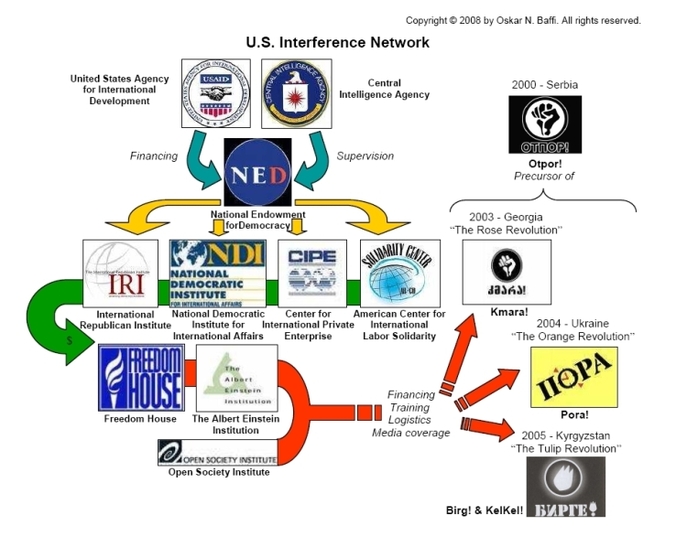
Pulling back from the metaphor, the Brzezinski Doctrine (“The Eurasian Balkans”) is the definition of non-linear warfare and subversive destabilization. It uses NGOs as destabilizing elements within the targeted states, and for this reason, foreign-funded NGOs are required to register as “foreign agents” inside the Russian Federation. Gene Sharp’s writings have also provided pivotal tactical advice in advancing the West’s non-linear warfare strategy. Taking the use of non-state actors even further, the West has a history of promoting militarized proxy groups to carry out its policies. This is most clearly seen in Kosovo, Afghanistan, Iraq, Libya, and Syria, although other countries have also been victims of this underhanded method of war. On the other hand, the West obviously engages in conventional warfare as well. Nowhere is this more evident than in the 2003 Iraq War. Mixing the two methods together is the new trend of American foreign policy. A non-linear campaign of militarized proxy destabilization culminated in a conventional NATO bombing in Libya. After this “success”, the West then turned its sights on Syria, but as a result of adroit Russian foreign policy maneuvers, non-linear warfare was stymied from mutating into its conventional form.
Pomerantsev’s article also uses fear mongering and heavy hype to scare the audience into thinking that Russia is proactively forming some kind of imaginary coalition against the West from within. If there happens to exist an overlap of perceived interests and objectives between Russia and domestic Western actors, it is because both parties arrived at the same conclusions after undergoing the same process – experiencing Western unipolar dominance and discriminatory targeting for two decades. For example, “Euro-scepticism” is also seen in Southeast Asia by the ASEAN members’ reluctance to form an EU-like union. The flower of New Leftism and resistance ideology in South America organically began to bloom in the 2000s, tended over by Hugo Chavez. In a similar fashion, the traditionally conservative societies of India, China, and Africa are just as disgusted as Russia’s by certain Western-centric values, such as the “bearded woman” of Eurovision. In laboratory conditions, the cause (Western dominance) has thus been proven to repeatedly result in similar effects all across the world, thereby confirming the hypothesis that Russia and others arrive at their conclusions on their own. There is no “contradictory kaleidoscope of messages”, as each actor’s resistance and defiance to the West, for various reasons and in differing forms, were a natural development.
To conclude, there are currently multiple civilizational liberation struggles playing out in the Pandora’s Box-setting of Western-led post-modernism. This is not a new page in the old historical story, but an absolutely new edition that is still being written. The Rest, absolutely diverse in their identity and overall mission, are coming together to stop the Western steamroller. They must work together to repel its aggression and safeguard the right to practice their identity and move forward with their historical mission as they individually deem fit. It is the democratic and sovereign choice of each civilization to be able to conduct itself how it pleases, but in order to get to that point, they must be liberated from the terror of the Western threat. These villages do not want to raze the Western one, so to speak, but they understand that the West will raze them if they can’t be annexed. In this manner, they are engaged in a do-or-die struggle, and at no time before in their histories has the situation been more dire. The Rest is slowly coalescing into providing a unified front against the Western menace, hoping to neutralize its raids and incursions so that they can once more go about their civilizational business in constructing and solidifying their societies. If, as Pomerantsev states, Russia and the Rest are anti-Western “raiders”, then yes, the future surely does belong to these resistant and defiant actors.
Andrew Korybko is the American Master’s Degree student at the Moscow State University of International Relations (MGIMO).
Featured Video
Yemen joins the war – Red Sea could be blocked next – Saudi regime at risk
or go to
Aletho News Archives – Video-Images
From the Archives
Should Europeans ‘Thank’ the Americans for Destroying Nord Stream?
By Robert Bridge | Strategic Culture Foundation | September 29, 2022
With an investigation continuing into the destruction of the Nord Stream gas pipeline that provided energy supplies to Europe from Russia, there appears to be just one prime suspect, and that should surprise nobody.
Following the sabotage of the Nord Stream 1 and 2 gas pipelines, former Polish Foreign Minister Radoslaw Sikorski already seemed to know the identity of the perpetrator when he tweeted out: “Thank you, USA.”
At first glance, it seemed that Sikorski was speaking sarcastically, berating Washington for carrying out an attack that will have severe repercussions for the people of Europe. After all, how could anyone see any good coming from the termination of Europe’s primary source of gas reserves with winter just around the corner? It was Sikorski’s homeland of Poland, after all, that urged its citizens to collect firewood in the face of dwindling gas reserves.
In fact, the Polish diplomat was speaking one-hundred percent literally… continue
Blog Roll
 Aletho News
- Growing insecurity, soaring prices fuel protests in north as regime bans evacuation: Sources
- Iran denies responsibility for ‘depraved’ attack on Kuwait desalination plant
- Bring The Troops Back. End This War Now!
- Can we please stop calling Israel the ‘only democracy in the Middle East’ now?
- US should start removing its troops for Germany, proposes AfD co-leader Chrupalla
- Iran Red Crescent: 600 educational centers attacked in US-Israeli ‘war crimes’
- Russian Oil Tanker Arrives in Cuba Amid U.S. Blockade
- America Racing to Strategic Defeat in Iran: Lt Col Daniel Davis
- FTC Warns Visa, Mastercard, PayPal, Stripe Over Political Debanking
- Russian tanker approaches Cuba despite US oil blockade
- If Americans Knew
- Israeli police block Catholic cardinal from entering Church of the Holy Sepulchre on Palm Sunday
- Israel is assassinating journalists again, more than any other nation, anywhere, ever – Not a ceasefire Day 170
- Over 300 US service members wounded, majority have brain injuries – Not a ceasefire Day 169
- Researchers at Human Rights Watch Resign Over Blocked Report on Palestinian Refugee Return
- Jewish Groups Are Backing a War Americans Don’t Want
- Eric Fingerhut Thinks He’s the President of the Jews
- Top Jewish Philanthropists, Rabbis Urge Israeli President to Take Action Against ‘Jewish Extremists’
- Don’t Be Fooled. Zionist Leaders Have Always Wanted to Control Southern Lebanon
- Israel’s widespread use of torture is a core element of its genocide against the Palestinian people
- In Israel’s War on Iran, Many Middle East US Bases Rendered “All But Uninhabitable”
- No Tricks Zone
- New Study Finds Warming Saves Lives…Cold Temperatures 12 Times More Deadly Than Excess Heat
- German Science Blog Accuses PIK Climate Institute Of Hallucinating Climate Tipping Points
- Devastating Assessment Of Comirnaty Vaccine By Former Senior Pfizer Europe Toxicologist
- New Study: CO2 Is ‘Effectively Negligible’ As An Explanatory Climate Change Factor Since 2000
- Former Pfizer Toxicologist Dr. Helmut Sterz Tells Bundestag Hearing Pfizer Vaccine Should Have Never Been Approved
- Energy Expert: Germany’s Nuclear Phaseout Was A “500 Billion Euro Mistake”
- New Research: South Australia’s Mid-Holocene Sea Surface Temperatures Were 4°C Warmer Than Today
- Storing Green Energy To Last Germany 10 Days Would Require A 60-Million Tonne Battery
- New Studies: UK Sea Levels Were 4 Meters Higher Than Today During The Mid-Holocene
- Destructive Green New Deal: German Energy And Metal Group Warns Of Drastic Crisis
 Aletho News